Dan Leo's Blog, page 22
August 26, 2021
“The New Day”

Gerry “the Brain” Goldsmith came suddenly awake and realized he must have left his desk lamp burning. He turned his head to his right and saw the little man sitting at the writing table.
“Excuse me?” said Gerry.
“Oh, the sleeper awakes!” said the man. He was a shabby little fellow, wearing a flat cap and with the stub of an unlighted cigar in his mouth. Despite the warm weather and Gerry’s lack of air-conditioning, the man wore an old grey overcoat and a faded muffler. Gerry fixed the man’s age as somewhere between a rather decrepit fifty and a reasonably spry eighty.
Gerry tried to sit up, but somehow he couldn’t.
“Why are you here?” he asked.
“You mean on this planet?” said the man. Gerry noticed that the man held a sheaf of papers in his hands.
“Well, more particularly,” said Gerry, “I was wondering what you’re doing here in my digs.”
“How are you feeling, by the way?” asked the fellow.
“I believe that I am very drunk,” said Gerry. “And I am finding it difficult to sit up.”
“So don’t sit up.”
“I feel awkward lying here, looking at a strange person sitting at my writing table.”
“Life is awkwardness,” said the man. “I should think that you,” he flicked a fingernail at the sheaf of papers, “a philosopher, would know that by now.”
“Point taken,” said Gerry. “You seem oddly familiar.”
“Oh, you’ve seen me around, my friend.”
“Wait!” said Gerry, and now, with a surge of willpower, in one graceful movement, he tossed aside his covering sheet, drew his legs off the bed and sat up. “You’re the little guy I gave a quarter to a little while ago on the front stoop.”
“Bingo,” said the man. “Hey, I’ve been reading your work-in-progress here. This stuff is hilarious.”
“Thanks,” said Gerry, “I think.”
“Like this line,” said the guy, and he ran his finger along the uppermost page of the sheaf of papers he held in one hand. “Here ya go, this: ‘If you’re listening to someone talk and he’s boring you, rest assured that your interlocutor will be just as bored once you start talking.’ Ha ha. That’s some good shit right there, my friend.”
“Thanks,” said Gerry. “I try.”
“You got a name for this little oeuvre?”
“My current working title is Pensées for a Rainy Day.”
“Pensées for a Rainy Day?”
“I’m not married to the title.”
“Oh, I like it.”
He laid the papers on Gerry’s little writing table.
“I’m also considering Thoughts Like Falling Leaves,” said Gerry.
“I prefer Pensées for a Rainy Day,” said the man. “But what do I know?”
“You still haven’t told me what you’re doing here,” said Gerry.
“You gave me your last quarter.”
“Only because my friend was being so rude to you.”
“Your friend, the one they call Addison the Wit.”
“Yeah.”
“What a hopeless drip that guy is.”
“I know.”
“Then why do you put up with him?”
“I don’t know. I guess I feel sorry for him.”
“You’re a saint, my friend.”
“Hardly.”
“No, you are. Literally. A saint. And I should know, because I myself am an angel.”
“I beg your pardon.”
“My name is Bert by the way. They call me Bowery Bert, on account of I’m the guardian angel for this neighborhood.”
“I didn’t know neighborhoods had guardian angels.”
“You’re a human being. It would take a billion Encyclopedia Brittanicas to cover all the shit that human beings don’t know.”
“Okay.”
“Anyway, it’s official, you’re a saint.”
“Does this mean I’ll go to heaven?”
“Well, no, not necessarily. However.”
The little fellow paused.
“Yes?” said Gerry.
“Okay, I ain’t supposed to interfere in human affairs, but here’s what I’m gonna do, and it ain’t just because you gave me your last quarter.”
“It ain’t, I mean, it isn’t?”
“No, it’s partially that, but it’s mostly because you spent the better part of yesterday afternoon and all last night humoring that ass Addison, listening to him talk about his horrible novel, and buying him five bock beers for every one he bought you.”
“He is a little tight with his nickels and dimes,” said Gerry.
“So here’s what I’m gonna do for ya. And I really shouldn’t do it, but I guess this once won’t hurt. I’m gonna remit your hangover for your present load.”
“Remit my hangover?”
“Yeah. Just this once, mind you, so don’t get used to it. But you’ll go back to sleep, and sleep long and deep, and when you wake up you’ll be as fresh as a daisy.”
“No hangover?”
“Not a trace.”
Gerry woke up.
What day was it?
The sun shone through his window.
He felt strange. He hadn’t felt this way in years, perhaps decades.
What was it?
And then he realized: he wasn’t hungover.
How odd.
He must have slept through the entire day after and ensuing night. And now it was a brand new day.
He tossed aside his sheet, lowered his feet to the floor.
A new day, and he hadn’t felt this good in years, in decades. He got up to go to the bathroom, and on the way he noticed that he had left the lamp burning on his writing table. He switched it off, and in the ashtray, along with all his usual Bull Durham butts, he saw the stub-end of a cigar.
{Please go here to read the “adult comix” version in A Flophouse Is Not a Home, illustrated by the illustrious rhoda penmarq…}


August 19, 2021
“Redemption”
Suddenly, as if he were bursting to the surface of a dark and turbulent ocean, Addison came awake.
God! He was drunk. Had he ever been so drunk? Yes, of course he had been, but all those other times were then, and this was now, and he was deeply, abominably drunk, and, yes, tomorrow he would pay.
He was in his bed, his narrow little bed, and outside his lone window he heard the screeching of the Third Avenue Elevated hurtling down toward the Houston Street stop.
A faint glow of streetlight came through the window into his tiny shadowed flat.
He lay there, the roaring in his head now louder than the fading roaring of the train, and the stained old ceiling seemed to be breathing, pulsing.
Good God, when would he learn?
On a heroic impulse he threw his legs off the bed and sat up, the palms of his hands on the edge of the bed. This was a good position, in case he felt he had to throw up, and then he could launch himself the six feet to the bathroom, and maybe he would even make it.
He looked down at his feet. He was wearing his shoes, his scuffed, worn brogues, and he was also wearing his trousers, and then he also realized he still wore his suit jacket, his shirt and tie. He wasn’t wearing his hat. His hat was by his feet on the floor. His body oozed with sweat, and he could smell himself, and his unlaundered, damp clothing.
How had he got here?
Gerry!
Gerry “the Brain” Goldsmith, his one friend, had dragged him up here and put him to bed. Stout fellow! A true friend. His only real friend. His only friend of any description.
His only friend.
They had been sitting on the stoop downstairs, and he must have passed out.
But there had been something else.
Something else before he had fallen into oblivion.
The little man.
The little man, with the cloth cap and the dead cigar, that shabby little man, trying to bum a nickel.
The little man.
He knew that little man.
He knew him.
But from where?
And then with a chill Addison remembered. Last January, that bitter cold horribly bright day when he stood on the Brooklyn Bridge, looking down at the grey cold river, trying to muster the courage to throw himself off –
And the little man!
That same little man had appeared, and had spoken to him. What had he said? Some nonsense about being an angel. Ha ha! An angel. And what else? Something about how it was true that Addison would never be successful, and that he would die alone and unloved, but nonetheless think of all the little things that made life worthwhile, like a doughnut, a cup of coffee…
A doughnut and a cup of coffee, not much to live for, and yet Addison had not jumped. For a moment there it felt as if he had fallen, and but instead of dropping down into the cold river he had flown above it, he had sailed through the air like an eagle, flying upriver, and the moment had stretched into a moment that lasted five, ten minutes, sailing along through the cold clear air up over the river all the way to what must have been the Long Island Sound, and then he had made a great curving turn and sailed back downriver, back to his place on the bridge, and then he had walked back to Manhattan and walked and walked all day and night in the freezing cold until it started to snow and then he had walked home, to his building, and he sat down on the top step of the landing between his floor and the one below, and then he broke down into tears, with great heaving sobs as he had never sobbed in his life.
And then Gerry had appeared, and sat with him, and rolled him a cigarette.
Gerry had lighted the cigarette for Addison, with one of those wooden kitchen matches he used. It wasn’t much maybe, just a cigarette, a little thing, but it had meant the world to Addison at the time. And then, that time too, Gerry had dragged Addison up to his tiny apartment and put him to bed.
What a pal. What a friend. Addison’s only friend.
But what about the little man? What had he said his name was? Bowery Ben? Bowery Bill?
That little man. Bowery Something-or-other, and when he’d asked for a nickel just now, what had Addison said? He’d told him to fuck off. But what had Gerry done? He gave the guy a quarter, probably his last quarter.
Addison thrust himself to his feet, and he swayed, the whole room swayed, but he managed not to fall.
He stuck his hand in his pocket, took out his old Boy Scout wallet. He had a single one-dollar bill left in it. It had always been an article of faith with Addison not to spend his last dollar until he had gotten his next remittance from home. Better to cadge some coins from the other bums at Bob’s Bowery Bar, or to go without cigarettes or even food for a day or two than to face the stark reality of complete pennilessness.
He lurched to the door, and went out, not bothering to lock it behind him, and then he went down the hall to the landing and started down the stairs.
The little man had headed across Bleecker with Gerry’s quarter toward Ma’s Diner, to order biscuits and gravy, a jelly doughnut and coffee. With any luck the fellow would still be there. Addison could take the stool next to him, apologize for being drunk and rude earlier, offer to buy him something, a piece of Ma’s apple pie maybe, something, maybe even a hamburger, and maybe if he had enough left over Addison would have a cup of coffee, maybe a doughnut as well…
{Please go here to read the “adult comix” version in A Flophouse Is Not a Home, illustrated by the illustrious rhoda penmarq…}

August 12, 2021
“The Little Man”
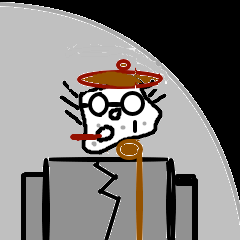
“No, seriously, old chap,” said Addison. “I mean seriously. Old man. Old fellow. Stout fellow.”
As Addison had gotten drunker and drunker his accent had lost nearly all of his native nasal Pennsylvania twang and had become vaguely similar to that of George Sanders or perhaps Ronald Colman.
“Well, maybe we should head up now, Addison,” said Gerry “the Brain” Goldsmith.
They were sitting on the stoop of the Bleecker Street tenement building in which they both resided in tiny one-room flats. It was sometime past four in the morning. Bob had finally ushered them out of his eponymous Bowery bar around the corner, but Addison had insisted on one last cigarette before they called it quits for the night. When Gerry tried to demur, Addison, for the first time ever, had offered Gerry one of his Philip Morris Commanders.
“You just don’t know what it means to me,” said Addison.
Well, you’ve already told me about a hundred times, thought Gerry, but, being the kindly philosopher he was, he said, “That’s quite all right, Addison.”
“You don’t know,” said Addison. “You can’t know. You’ll never know.”
Gerry thought, No, I do know, sadly enough, but he said nothing, because he also knew that only an idiot argued with an idiot. He would finish his cigarette, and, knowing Addison, the man would be too cheap to offer him another one. And then, at long last, Gerry could finally climb those six flights of stairs to his narrow little bed.
Suddenly a shabby little man lurched up to them out of the shadows. Another bum in a neighborhood teeming with bums. He was a very small man, roughly between the ages of fifty and eighty, maybe eighty-five. He had thick round glasses, a cloth cap, and an unlighted stub of a cigar in his mouth. He needed a shave.
“Spare a nickel for a cup of coffee, buddies.”
“Fuck off,” said Addison.
“Maybe a dime so’s I can get a cup of coffee and also one of them nice jelly doughnuts acrost the street at Ma’s.”
“You heard me. Take a hike,” said Addison. “Can’t you see my good friend and I are attempting to have a conversation?”
“Well excuse me for breathing,” said the little man. “Asshole. Maybe someday you’ll be hard up, pal. Maybe someday you will be reduced to cadging nickels and dimes.”
“Scram,” said Addison.
“I’m going,” said the little man. “I wouldn’t take a plug nickel from the mean likes of you, nor would I piss on you even if you was burning in the everlasting fires of hell, which someday you probably will be. See ya later, asswipe, but not if I see you first.”
The little guy spat on the pavement and turned as if to go.
“Wait, buddy,” said Gerry. He reached into his trousers pocket and came out with a quarter, his last quarter. “Here, ya go, pal. It’s all I have.”
“Wow,” said the little man, and he took the offered coin. “A whole quarter. Now I can get a couple of them nice biscuits smothered with gravy at Ma’s.”
“Yes, her biscuits are very good,” said Gerry.
“And I’ll still have enough for a cup o’ joe and a nice jelly doughnut for dessert, and a nickel tip, too, ‘cause I ain’t no piker like some guys I could name.”
“Well, enjoy,” said Gerry.
“You’re all right, pal,” said the little man. “I ain’t so sure about your friend though. See ya round. The both of yez. And if I don’t see you round I’ll see you square.”
And the little guy jaywalked across Bleecker and went into Ma’s Diner.
“This neighborhood,” said Addison.
“I kind of like it,” said Gerry.
“Once my novel gets published I’m out of here,” said Addison. “Sutton Place for me. Maybe a summer cottage in the Hamptons. And you can come and visit whenever you like, Gerald.”
“Yes, that would be nice,” said Gerry, whose actual Christian name was Gerard.
Addison’s still-burning cigarette butt fell from his fingers to the step below the step his worn-out brogues were on, and rolled off that one to the step below it.
“I suddenly feel very sleepy,” he said. “I think maybe I’ll just doze here for a while.”
Gerry tossed away his own butt, got to his feet, and then reached down and grabbed Addison by the arm.
“Lemme sleep,” mumbled Addison.
“Addison,” said Gerry, “you can’t sleep here on this stoop.”
“This is the Bowery. Lots of guys sleep on stoops.”
“Get up,” said Gerry, pulling on Addison’s arm.
Five minutes later he managed to get Addison into his flat on the fourth floor, and into his bed, fully clothed, because even Gerry, as kind as he was, drew the line at undressing Addison.
He closed the door behind him and made his way up to the sixth floor, to his own little apartment. He undressed, tossing his clothes onto his one chair, and got into his bed.
He felt he had learned something on this long boring day and drunken night, but what that was he was not so sure of. And then, as the room rocked gently back and forth, he fell into oblivion.
{Please go here to read the “adult comix” version in A Flophouse Is Not a Home, illustrated by the illustrious rhoda penmarq…}

August 5, 2021
“I Love You, Man”
Once again Gerry “the Brain” Goldsmith was deeply ensconced in what he called “the valley of drunkenness”. Oh, sure, he would pay for it tomorrow, but that consideration had never stopped him before, and it certainly wasn’t going to stop him this time. But tonight he had an excuse, not that he needed an excuse, because for the past five or six hours he had been sitting here at Bob’s Bowery Bar with the crashing bore they all called Addison the Wit, despite the fact that he was not a wit and his name was not Addison.
A lesser man would have told Addison to fuck off right from the beginning.
A lesser man would have refused even to pretend to read Addison’s novel-in-progress.
A lesser man would certainly not spend all afternoon and evening sitting with Addison at Bob’s and listening to Addison talk about his horrible novel and his theories of literature and his thoughts on the parlous state of American letters, and himself.
Or was Gerry a lesser man for not telling Addison to fuck off from the beginning?
But no, Gerry had not told Addison to fuck off. And why? Because he felt pity for the poor jerk.
Father Frank, the bar’s resident “whiskey priest”, had once explained to Gerry the Roman Catholic concept of “offering it up”: instead of weeping and wailing and gnashing your teeth in the face of unpleasantness, you “offered it up” to Christ, and thereby shared in your own way the redemptive suffering of Jesus on the cross, and all his stations approaching that cross. And thus you achieved grace, and possibly even time off from Purgatory. Father Frank had quoted St. Paul: “Now I rejoice in my sufferings for your sake…”
Gerry was not quite able to rejoice in his suffering, but the thought that his suffering contributed to another living soul’s lack of suffering was some small consolation…
“Gerry, my man, a penny for your thoughts?” said Addison.
“Pardon?”
“I’ve been going on and on, and you’ve been listening so politely and attentively, and, yet, I detect a slight furrowing of your brow. Is it that you disagree with my theory?”
Gerry had no idea what theory Addison was talking about, nor did he care.
“No, not at all, Addison, in fact I think you make some very good points.”
“Really?”
“Absolutely.”
“Because, you know, I sent an article adumbrating this very theory to the New Republic and I got it back with the words ‘absolute twaddle’ scribbled on the rejection slip.”
“Well, I would have to disagree with that assessment, Addison.”
“Thank you, Gerry, I appreciate your saying that. There’s only so much rejection a chap can take. And, quite frankly, that’s all my whole life has been: a serious of humiliating rejections.”
“Oh, it can’t have been that bad, Addison.”
“No, it has. And this is why it means so much to me that you really think my novel is good.”
“Well, uh, you know, hey –”
“May I say something I’ve never said to another man in my life?”
“I’m not sure,” said Gerry.
“Yes, how could you be sure? So, dash it all, and as Admiral Peary said at Chesapeake Bay, full speed ahead and damn the torpedoes, you may fire when ready, Smedley, I’ll just out and say it.”
Here Addison paused, and Gerry concentrated, as always, on enjoying one of these rare intermissions in Addison’s never-ending monologue. Gerry noticed that his glass had become empty again, for perhaps the twentieth time this night. Bob was right there, his head cocked, that small ironic smile on his face, the smile of a man who had seen it all, life and death and everything in between, all of it all around the world in his twenty years in the marines, and now saw it all right here in his bar on the Bowery.
“Sure, Bob,” said Gerry, to Bob’s silent question, “and one for Addison too.”
“Thanks, Gerry,” said Addison, after Bob had headed down to the taps, “but I think it was my shout, actually.”
“You can get the next one,” said Gerry.
“I love you, man.”
“What?”
“That’s what I wanted to say, that I have never said to another man before in my life. I love you, Gerry.”
“What?”
“I love you.”
“Gee.”
“Not in a queer way.”
“Oh.”
“I speak platonically. I love you, man. If I may address you as such. Perhaps I should say rather, ‘I love you, buddy.’ I suppose it does sound less queer that way. I hope you don’t mind.”
“Um.”
“And I have decided just this moment that I am going to dedicate my novel to you, Gerry.”
“Oh, that’s not necessary, Addison.”
“I think, dear Gerry, that you’ll grant me the right to be the judge of whom I should dedicate what stands to be my magnum opus to. My only question for you is should I use your full name in my dedication, i.e., “Dedicated to Gerald Goldsmith –”
“Well, it’s Gerard, actually.”
“Gerard, yes, of course, should I use your full name or would you prefer the partial anonymity of just your first name? You see, those who know will know who it is, anyway.”
“Okay, then, thanks, Addison,” said Gerry. “Let’s just go with the first name then.”
“So, just, ‘Dedicated to my best friend, Gerald.’”
“Sure, that’d be great, Addison,” said Gerry, and fortunately Bob was standing there with their two glasses of bock.
{Please go here to read the “adult comix” version in A Flophouse Is Not a Home, illustrated by the illustrious rhoda penmarq…}

July 29, 2021
“The Big One”
In the immortal words of Joseph Conrad’s Mr. Kurtz: “The horror! The horror!”
Gerry “the Brain” Goldsmith looked up at the clock behind the bar. Was it really only 7:32? He had been sitting here since early afternoon, bad enough in its own way perhaps, but he felt as if he had been trapped here listening to Addison drone on for a thousand boring lifetimes, and the man still showed no sign of slowing down.
“…and I think, Gerry, and please correct me if I’m wrong, but I feel it incumbent upon the novelist of today to etch each line as if in stone, because who knows if we will not all be obliterated tomorrow by an atomic bomb?”
How could he escape? Should he just say he had to go to the john, and then slip out quietly? But, no, this was Addison, he would doubtless sit there all twisted around on his bar stool, the better to keep a weather eye on the men’s room door, ready to leap up and catch Gerry in the act and drag him back to the bar by main force…
“Don’t you agree, Gerry?”
“What?”
“I said don’t you agree?”
“Um, with what, specifically?”
“With what I’ve just said. That the novelist of the present day must write with the finality of the knowledge that we could all be obliterated at any moment.”
“Uh, yeah, sure.”
“No time for frivolity, for mere cleverness.”
“No?”
“No! Not when we might all be reduced to cinders without a moment’s notice!”
“You mean, like in a fire?”
“I mean like the Japs in Hiroshima and Nagasaki!”
“Oh, okay, I get it.”
“And that is why we must write, nay, limn, with the utmost, dare I say, sacred gravity each sentence, each word, nay, each comma and em dash, and, yes, even the much-reviled semicolon; because as you have mayhap noticed I am quite fond of the unfashionable semicolon; quite fond indeed.”
“Ha ha, yeah,” said Gerry, although he hadn’t noticed Addison’s fondness for the semicolon because he had only read about a hundred scattered words of Addison’s awful novel-in-progress.
“You laugh,” said Addison. “But the semicolon has its place in the writer’s quiver; an important place.”
“Right; I entirely agree,” said Gerry, because it was slightly less painful just to agree with every jackass opinion Addison spouted; or was it more painful? At any rate Gerry couldn’t be bothered not to agree.
“Choose that semicolon wisely, my friend; wisely I say! Because it may be the last semicolon you ever use, when you suddenly look up and see that blinding flash heralding the extinction of all life on earth.”
“Yeah,” said Gerry. And then the devil made him say, despite himself, and damn his policy of bland acquiescence, “That’s one way of looking at it.”
“It is the only way of looking at it!”
“But –”
“But what?”
“Oh, never mind.”
“No, please, Gerry, speak your mind. I encourage, nay, relish, hearty debate with another intellectual.”
“Okay,” said Gerry, although he knew he’d be much better off just keeping his big mouth shut, “well, if an atom bomb does get dropped, and if you die, and if the whole human race gets wiped out, who cares about a semicolon?”
“Who cares?”
“Yes. I mean, you won’t be around, and maybe no one else will be around. And your novel will never get published, because all the publishing houses will be obliterated, along with everything else.”
“As the young people say: wow,” said Addison.
“I don’t mean to sound depressing,” said Gerry.
“So you’re saying it doesn’t matter?”
“What?”
“The semicolons.”
“Oh, no, I suppose they matter, sure. But on the other hand, if you’re dead, and everyone else is dead, who gives a damn?”
A very strange thing happened right then.
What happened was that Addison stopped talking.
He stopped talking, and stared into his glass of bock. A glass of bock that Gerry had bought. And why was it that Gerry wound up buying four or five rounds for every time that Addison reluctantly dug some nickels from that little change purse of his.
Gerry enjoyed the respite, and lifted his own glass of bock, and drank it down. What was this, his tenth glass? Well, it was too late to stop now.
“You still with us, Brain?” said Bob, standing there just as he always was at the exact moment you emptied your glass. He smiled that small sad ironic Bob smile, the smile of a man who had seen men killed, who had killed men, and who now for his living watched men kill themselves. He took a slow drag on his cigar. He was in no hurry. Let the damned kill themselves in their own good time, Bob granted the damned that much…
And Bob knew. Bob knew what agony it was for Gerry to have to sit here with Addison, not that anyone was holding a gun to Gerry’s head. But, what the hell, Addison couldn’t help it if he was a colossal bore. As horrible as it was to sit with Addison, how much more horrible must it be to be Addison?
“Yeah, thanks, Bob,” said Gerry. “Get Addison another one, too.”
Bob looked at Addison, and gave his head a little shake, one of those “What can you do” head-shakes, and headed down to the taps.
“Thank you, Gerry,” said Addison. “I’ll get the next round.”
“Yeah, sure,” said Gerry.
“And yet,” said Addison, “and yet –”
But he fell silent again. Gerry knew he should leave well enough alone, but despite everything he felt sorry for the man. Not as sorry as he felt for himself, but sorry anyway.
“And yet what?” said Gerry.
“And yet I still feel,” said Addison, “that the semicolon is ever so important; so important, Gerry.”
“You know something, Addison?” said Gerry. “I agree with you; entirely.”
And silence descended again between the two failures as they waited for Bob to return with their fresh basement-brewed bocks. Gerry knew the silence wouldn’t last, but he savored it.
{Please go here to read the “adult comix” version in A Flophouse Is Not a Home, illustrated by the illustrious rhoda penmarq…}

July 15, 2021
“The Only One”

It was midway in the drinking of his third glass of Bob’s excellent basement-brewed house bock that Gerry “the Brain” Goldsmith realized that he was getting terrifically hungry. What was it, past two in the afternoon? Come to think of it, all he had eaten last night when he tied that load on at Henry’s Horseplayers Bar was a small bowl or two of pretzels, and if memory served he hadn’t had a proper meal since yesterday’s lunch at Ma’s Diner, the chicken-fried steak special, with cornpone and stewed greens. Yum…
Addison was talking of course. The man was always talking. Some people lived to drink, some lived to eat, some lived for their art, and then there were people like Addison, who lived to talk.
“Don’t you find that’s true, Gerry?”
What? What was true? Gerry had no idea, but he was a past master in dealing with guys like Addison, and so of course he said, “Yes, of course.”
“You really think so, Gerry?”
“Oh, absolutely.”
“I’m so glad to hear that. Because, really, is there any rule that a western novel cannot deal with questions of the artistic impulse?”
Oh, okay, so Addison was back on the subject of his awful novel-in-progress, or, more likely, he had never got off the subject.
“Yeah, sure, Addison. I mean, why not?”
“Or that a western novel cannot deal with – you should pardon the expression – sexuality?”
“Sexuality?”
“Yes. As in the passage when Buck remembers his introduction to the mysteries of sex in his prep school.”
“Right, right,” said Gerry, although of course he hadn’t read the passage Addison had referred to. No, a dozen or so lines in toto skimmed from the beginning, the middle and the end of that thick sheaf of drivel had been all Gerry had managed, and more than he had wanted to manage.
“You don’t think that part was too, what’s the word, explicit?”
“Not at all.”
“I tried to couch the explicitness in poetic prose.”
“Quite successfully, I think.”
“No one wants to read, say, ‘Otto shoved his pulsing penis into Buck’s anus.’”
“God forbid.”
“Which is why I settled on ‘Otto shoved his pulsing jackhammer into Buck’s cavity of defecation.”
“Right.”
“The thing is, I believe, and I may be wrong, but I believe that one should leave something to the reader’s imagination. Don’t you agree?”
“Oh, entirely. Hey, look, Addison, I’m having a splendid time sitting here talking about your novel, but here’s the thing: I haven’t really eaten in over twenty-four hours and I’m rather starving, so I think I might just toddle over to Ma’s and get a bite of lunch –”
“But there’s nothing to drink at Ma’s. I mean nothing with alcohol in it.”
“That’s true, but –”
“I mean, if you really want to go over to Ma’s Diner, I’ll go with you –”
Damn, thought Gerry, there was just no escaping this twit today.
“But why not just eat here?”
“Yes, I suppose I could –”
“Then you can both eat and drink. While we talk.”
Gerry sighed. If he couldn’t escape Addison, then he would have to drink, that was for sure.
“Okay,” said Gerry. “Good idea, Addison.”
Today was Tuesday, two-for-one hot dogs day, so Gerry and Addison both ordered two dogs, with sauerkraut for Gerry, and melted American cheese for Addison. Gerry wasn’t quite sure how it happened, but he wound up paying for both orders, as well as for another bock each.
Gerry ate his first hot dog in approximately three seconds, and after a good gulp of bock he picked up the second wiener.
“So, Gerry,” said Addison, chewing away, “Speaking of sexuality. Have you, in the words of my old colleagues in the parachute factory, been getting any?”
Gerry had just been about to take his first bite of the dog, but now he halted.
“Pardon me?”
“Getting any,” said Addison. “Are you getting any these days? Or nights, ha ha. Getting any. Sex, I mean.”
Gerry put the hot dog back down on his plate. And he had had such a good appetite a second ago.
“Um,” he said.
“Oh, come on, old man,” said Addison. “No need to be coy with me. I am a fellow bohemian after all!”
Gerry looked at his hot dog. Then he looked at Addison. Should he tell him that he had never gotten any, and, the way his life was going, and had been going, and would doubtless continue to go, it was extremely unlikely he ever would get any?
No.
Gerry was a philosopher, but even he had his limits to self-abasement.
“Well, the thing is, Addison, a gentleman never tells.”
“Ah ha, I knew it!” said Addison.
“Pardon me?”
Addison had just stuck his second hot dog into his mouth, and he pushed it in, chewing and swallowing until it was quite gone before speaking.
“Ah, that was good,” he said, and he scooped up a handful of potato chips. “I said I knew it.”
“You knew it?”
“I knew you were getting some.”
“Oh?” And Gerry knew he should let it go, but the devil made him ask, “How did you know?”
“Because,” said Addison, “– by the way, don’t you want that hot dog?”
“Well, you can have it if you want it, but I thought you didn’t like sauerkraut.”
“It is very true that I prefer my hot dogs with melted American cheese, but in a pinch I’ll take one with sauerkraut.”
“Help yourself.”
Addison grabbed the hot dog from Gerry’s plate and took a good bite.
“Mmm, good,” he said.
“I’m glad,” said Gerry. He picked up a potato chip. Was there nutrition in a potato chip?
“I knew you were getting some,” said Addison, chewing. “And how, you wonder, could I tell?”
“I haven’t the faintest idea.”
“Because, dear chap, of the way that Ma spoke about you today when I told her I was buying you a coffee and a doughnut.”
“Ma? From Ma’s Diner?”
“Don’t play the choirboy, Gerry. As I say, I too am a bohemian. And who am I to judge you if you like a bit of brown sugar?”
“You mean me and Ma?”
“That’s exactly what I mean. Oh, ho.”
He had devoured Gerry’s hot dog with sauerkraut. He looked down at his plate, empty but for a few crumbs.
“Don’t you want your potato chips, Gerry?”
“Help yourself,” said Gerry, again.
Addison pushed away his empty plate, picked up Gerry’s plate and put it in front of himself.
“Salty,” he said. “Like Ma, eh, old man?”
“Um,” said Gerry.
Addison scooped up all the chips on the plate and stuffed them into his mouth. If there was one good thing about Addison eating, it was that it slowed down his talking slightly.
Addison finished swallowing the chips, lifted his glass of bock, and drank.
Gerry lifted his own glass and drank. He was still hungry. He would order two more hot dogs with sauerkraut, and maybe Addison would let him eat at least one of them.
“Someday I’m going to get some,” said Addison.
“Pardon me?” said Gerry.
“Someday,” said Addison. “After my book gets published. Then I’ll get some. Don’t you think?”
“Oh, sure,” said Gerry.
He was thinking about Ma, from over at the Diner. Her kind eyes. The way she called him “Mister Gerry”. Could it be possible? No, even if it were possible, Ma deserved better. A philosopher should know his limitations.
“You’re not going to be the only one who’s getting some, old boy,” said Addison.
“What?”
“You won’t be the only one.”
“Oh, yes,” said Gerry. “That would be nice. I wouldn’t want to be the only one.”
{Please go here to read the “adult comix” version in A Flophouse Is Not a Home, illustrated by the illustrious rhoda penmarq…}

July 8, 2021
“Bon Mot”

Gerry Goldsmith (known as “the Brain” to his fellow habitués at Bob’s Bowery Bar) at last began to feel human again.
Addison had made good on his offer to buy Gerry a bock (just a stubby eight-ounce glass, God forbid not the imperial pint, but this was Addison after all, well-known for paying for his drinks with exact change), which Gerry had downed in three good gulps, and by the time the third gulp had entered his alimentary canal he could palpably feel his hangover fading into the past, along with all the ten thousand hangovers that had preceded it.
“How was that bock?” said Addison, who sat on the stool to Gerry’s left.
“As good as the first one I ever had,” said Gerry. “And now may I buy you one, Addison?”
“You don’t have to,” said Addison.
“I realize that, Addison, but please allow me.”
“But, dear Gerry, if you buy me one, then won’t it negate the moral significance of my having bought you one?”
“I don’t see why,” said Gerry.
“But I wanted to, how shall I put it, to express in a remunerative manner my appreciation for your having read my modest work-in-progress.”
Gerry sighed. Nothing was easy with Addison, but what could Gerry do? Alas, he was stuck with the fellow. It wasn’t as if Gerry could tell Addison outright that Addison was a crashing bore, and please to let him alone. The poor guy couldn’t help being a pathetic drip.
“It was my pleasure to read your novel,” lied Gerry, on at least two levels, as he had not read more than a hundred words of Addison’s novel, nor had he derived the slightest pleasure from reading them.
“You don’t know what that means to me, Gerry,” said Addison. “But, look, I still wanted to show my gratitude in some way beyond mere words –”
“Buy him a shot then, and shut up about it,” said Angie the retired whore, who was sitting on the stool on the other side of Addison.
“A shot?” said Addison.
“Yeah,” said Angie. “Get him a shot. And not that cheap shit either. Get him a Cream of Kentucky.”
“Well,” said Addison, “I suppose I could –”
“That’s okay, Addison,” said Gerry. “You don’t have to buy me a shot.”
“Get the Brain a goddam shot of Cream of Kentucky, Addison,” said Angie. “I been listening to you two, and if he really read your novel –”
“In progress, dear Angie,” said Addison. “Novel in progress. I still have much work to do on it.”
“Oh, I’m sure you do,” said Angie. “I’m sure you do.”
“What do you mean?”
“What do you think I mean?”
“I’m not quite sure.”
“Look, just buy the Brain a shot of Cream of Kentucky. He read your crappy novel, and he deserves a reward.”
“You don’t know that my novel is crappy,” said Addison.
“I know you,” said Angie, “and I know you’re the most boring guy I’ve ever met, and I’ve met some doozies in my time.”
Meanwhile Gerry caught Bob’s eye, and pointed to his empty glass.
“You’re not very nice, Angie,” said Addison, the best he could come up with after a brief pause.
“But you got to admit it’s true, Addison,” said Gilbey the Geek, who was sitting on the stool to Gerry’s right. “I ain’t too smart, but even I know you’re a boring guy.”
Bob came over, picked up Gerry’s empty glass, and headed to the taps.
“I feel as if I am being assailed from all sides,” said Addison.
“It’s okay,” said Gerry. “They’re just kidding.”
“I ain’t kidding,” said Angie.
“Yeah, me neither,” said Gilbey.
“Drink your bock, Addison,” said Gerry.
Addison had only had a few sips of his own bock, but now he lifted the glass and drank it to the dregs.
“Feel better now?” asked Gerry.
“Marginally,” said Addison.
Bob came back with Gerry’s refreshed glass of bock.
“Let me get Addison one too, Bob,” said Gerry.
“But,” said Addison.
“But nothing,” said Gerry. “Oh, and you know what, Bob?” Gerry dragged out his old wallet, a present from his grandmother upon his successful graduation with gentleman’s Cs from Harvard so many years ago, when he was young and full of illusions, some of which he still harbored. “Get Angie and Gilbey what they’re drinking, too.”
“Hey, thanks, Brain,” said Gilbey.
“Yeah, thanks, Brain,” said Angie.
Addison was silent. Maybe he should learn to be silent more often? Maybe then people would not abuse him as a bore, a twit, a drip. But still he felt the urge, that primeval urge to be witty. Perhaps after another bock he would think of an incisive bon mot…
{Please go here to read the “adult comix” version in A Flophouse Is Not a Home, profusely illustrated by the illustrious rhoda penmarq…}

July 1, 2021
“The Right Path”
“I say, Gerry!”
Knock, knock, rap, rap.
“Gerry, are you in there?”
Gerry “the Brain” Goldsmith came awake. It wasn’t a dream, it wasn’t a nightmare, this was real, and someone was at the door of his tiny sixth-floor tenement flat.
“I say, Gerry!”
“What is it?” croaked Gerry.
“Oh, you’re alive,” said the voice. “It’s me – ‘Addison’, as such I am known, ha ha.”
Oh Christ.
Gerry worked his forty-eight-year-old and much-abused corporeal host to a sitting position on the side of his bed, his stockinged feet on the bare floorboards. He saw that he was still wearing his old Scotch-flannel trousers.
“May I come in, cher Gérard?”
Oh, Christ on the cross and all the gambling Roman soldiers and the wailing women.
“I mean,” said Addison’s voice. “If I may? I’ve brought coffee.”
Coffee? Addison? Who had never before brought anything to that door but his own baleful self and his awful work-in-progress?
“I’ve brought you a doughnut as well, old chap. Permission to come aboard, sir?”
“Sure,” said Gerry, and the word sounded like a strangled cough, so he said it again. “I mean, sure, just give me a second, Addison. What time is it anyway?”
“It’s nigh on to one o’clock, old man. In the afternoon!”
Oh, Christ. On his cross, looking down on all those people who were glad it was he on the cross and not they.
Five minutes later Addison sat in one of Gerry’s two chairs, the one that had arms but no cushion, and Gerry sat in the other, his writing chair, no arms but with a cushion, a well worn cushion but better than none.
“So you really got through the whole thing? All two hundred and forty-eight pages?”
“Sure did, Addison. Couldn’t stop turning the pages,” said Gerry. It occurred to him that it was very easy to lie to someone who didn’t want to hear the truth.
“I know it was a lot to ask, that you should read the entire thing in one night.”
“Oh, not at all.”
“How’s that coffee?”
“Good, Addison.”
“I didn’t know how you took it, but I told Ma it was for you, and she said you took milk and sugar.”
“Yes, just the way I like it, thanks, Addison.”
“That’s how I like it too. You know what Ma told me? Quite risible. ‘Mister Gerry likes his coffee sweet and brown, just like his women,’ she told me. Sweet and brown. Just like his women. Ha ha.”
“Ha ha.”
“So.” Addison took a sip of his own coffee. “Ah. You know, you can take those fancy coffees in the French and Italian cafés, expresso and whatnot, just give me a cup of Ma’s humble chicory coffee!”
“Yeah, it’s a lot cheaper than the stuff in those fancy cafés too,” said Gerry.
“Heh heh, yes, how was that jelly doughnut?”
“Good.”
“Ma told me you were partial to the jelly.”
“Yeah, it was great,” said Gerry.
“So you really liked the book?”
How late had he stayed at that Henry’s Horseplayers Bar last night? Until closing. And it had closed at four a.m.…
“Gerry?”
“Yes, Addison.”
“You really liked my book?”
“Oh. Yes, I really liked it, Addison. Very, uh, impressive.”
“So you don’t have any what our theatrical friends call ‘notes’?”
“Notes?”
“Suggestions for improvement shall we say.”
“Oh. No.”
“Nothing at all?”
“Not really.”
“Nothing you would change?”
“No, it all looked pretty, um, you know –”
“What about the flashback?”
“The flashback?”
“The extended flashback to Buck’s childhood, which, come to think of it, extends all the way from page 42 to the end of the pages I gave you.”
“Oh, right, no, I mean yes, I thought that worked very well. Quite effective.”
“So you don’t think it was a mistake to have a two-hundred page flashback?”
“Um, no –”
“That it didn’t, you know, put a stop to the action for perhaps too long?”
“I didn’t think so. No. Not at all –”
How would Gerry know? He’d only read a handful of sentences of the whole horrible thing –
“I’m so glad to hear that,” said Addison, “because, as you saw, the flashback was still in progress on page 248, and I’m thinking it might continue for another hundred or so pages.”
“Why not?”
“Exactly my feeling, Gerry. I mean, what’s so great about ‘action’, per se. Is not all existence a form of action?”
“You’ve got a point there, Addison.”
Addison lighted up his second Philip Morris Commander since he’d been sitting there. Gerry had smoked up all his Bull Durham last night, and he certainly wouldn’t turn up his nose at one of those Philip Morris Commanders himself. But Addison had never in their three-years’ acquaintance even once offered him a cigarette, and it didn’t look as if he were about to start now –
“What about typos or errata?”
“Typos? Errata?”
“Typographical errors, or other mistakes – misspellings, calling characters by the wrong names, having a character wear a black hat in one paragraph and a white hat in the next, that sort of thing.”
“Oh. That sort of thing. Well, this might be hard to believe, but I didn’t find a single, um, erratum, Addison.”
“Not a one?”
“No, not a single one. I mean, it’s possible I might have missed one or two –”
“Do you think it’s possible? But I thought you gave it a careful reading.”
“Oh, I did.”
“Then don’t you think you should have noticed any possible mistakes?”
“Uh,” time to improvise, “here’s the thing, Addison, I was so enthralled, so caught up, that I was reading fairly quickly –”
“So it was a real page-turner you’re saying.”
“Exactly. A page-turner. So it’s possible, I mean, remotely possible that I might have missed a minor typo or two.”
“Wow, you had me worried there for a second. But, you know, I suppose my publisher will have his copy-editors go through it with a fine-tooth comb.”
“Yes, that’s true.”
His publisher. Good God the man was deluded.
“So, to sum up, you think I’m on the right path?”
“The right path?”
“With the direction the book is going?”
“Oh, sure,” said Gerry.
“So I should just keep on the way I’m going?”
“Yes, by all means.”
“God, what a relief,” said Addison. “I was so worried you wouldn’t like it.”
“No,” said Gerry, baldfaced, “I loved it.”
“Would you like to read more pages as I continue?”
Okay, nip this right in the bud.
“Y’know, Addison, thanks, but I really think I’d prefer to wait until you’ve finished the whole thing. So that I can, you know –”
“Just plow through it all at once.”
“Exactly.”
“I quite understand.”
Gerry lifted his paper coffee cup, and saw that it was empty, not a drop left. He sighed.
“Are you finished your coffee?” said Addison.
“Yes.”
“What about a drink?”
A drink!
“A drink?”
“How about we toddle down to Bob’s. I’ll buy you a bock.”
So, a red-letter day. Addison treating Gerry not only to a take-out coffee and a jelly doughnut, but a bock as well!
“Sure,” said Gerry. “Thanks, Addison. Don’t mind if I do.”
“The very least I can do,” said Addison.
And so the two failures (after dropping off Addison’s typescript at his own tiny apartment on the fourth floor) went around the corner to Bob’s Bowery Bar.
Gerry was in the clear now, at least until Addison gave him his completed book to read, not that Gerry would read it, but he would pretend to read it, and the great world would keep spinning obliviously.
{Please go here to read the “adult comix” version in A Flophouse Is Not a Home, profusely illustrated by the illustrious rhoda penmarq…}

June 17, 2021
“À demain, cher Gérard”
There was nothing to be done for it, thought Gerry “the Brain” Goldsmith, nothing but to finish his imperial pint of bock and leave.
Damn Addison! Look at him there, guzzling his own imperial pint. And, since Bob had given them and Gilbey this round on the house, Addison was undoubtedly hoping that Gerry would buy him another imperial, shameless moocher that he was.
All a man wanted was to work on his book of philosophical observations (was Pensées for a Rainy Day really a good title? what about Thoughts Like Falling Leaves?) and then go down to his corner bar and get half a load on, or even a full load, what the hell, it was a free country. But, oh, no, thanks to Addison, this simple desire was not to be satisfied, and all because Gerry had told Addison that he would read his bad work-in-progress novel tonight, all two hundred and forty-eight pages of it, damn him!
Gerry put down the big glass. It was empty.
“Well, I suppose I’d better be going,” he said, with exactly the same tone as a man speaking to a priest before heading down the cell block corridor to the room where they kept the electric chair.
“Yes,” said Addison, who also lowered his big glass, empty. “You’ve still got a lot of reading to do, old chum.”
“Yeah,” said Gerry.
“The Brain don’t want to read it,” said Gilbey, whose own small glass was now also empty.
“I think, Gilbey,” said Addison, “that my good friend Gerry –”
“You mean the Brain?” said Gilbey.
“Yes,” said Addison, “I think that my good friend ‘the Brain’ as you call him, is quite capable of saying for himself whether he wants to read my work-in-progress or not. Right, Gerry?”
“Um,” said Gerry.
“See?” said Gilbey. “You put him on the spot. But he don’t want to read your whaddyacallit –”
“Work-in-progress.”
“Yeah, he don’t want to read that,” said Gilbey. “He wants to sit on that stool there and get his load on, just like he does every night. Look at him.”
Addison looked at Gerry. Gerry produced a weak, perhaps a slightly hopeful smile, the tentative half smile of the condemned man who thinks that word might yet come down from the governor granting a last-minute reprieve, or at least a stay of execution.
“Well?” said Addison.
“Yes?” said Gerry.
“Tell him,” said Addison, “tell Gilbey that you gladly agreed to read my work-in-progress tonight, as a favor, from one literary chap to another.”
Gerry sighed.
“Yes,” he said. “I agreed to read your work-uh-in-progress tonight.’
Of course Gerry had no intention of reading the damn thing tonight, or ever. At best he would skim through a few more passages, just enough to fake having read it. This method had gotten him a degree from Harvard, hadn’t it?
“And, Gerry, may I say something?” said Addison. He struck a match and lighted up a Philip Morris.
“Yes?” said Gerry, wishing he could say no.
Addison exhaled a great cloud of smoke before speaking. One of these days he would offer a Philip Morris to someone else, but it wouldn’t be today.
“I know,” he said, “that two hundred and forty-eight pages might seem a bit much for one night’s reading, but bear in mind these are double-spaced typed pages.”
“That’s true.”
“So it’s not like reading two hundred and forty-eight printed pages.”
“No –”
“And, not to blow my own horn, but I think, old man, that you’ll find that the pages will simply fly by, like, like –”
“Like the wild geese in the west?”
“Precisely, like the wild geese in the west,” said Addison. “In fact, I shouldn’t be surprised if you’ll find that before you know it you’ll have reached page two-hundred and forty-eight, and you’ll say, ‘Hey, is this all? Give me more!’”
“Yeah, maybe so,” said Gerry.
“What do you mean, ‘Maybe?’”
“I mean, yes, I’m sure,” said Gerry.
“I don’t think so,” said Gilbey.
“Gilbey, will you please stay out of it?” said Addison. “What do you know about literature? What’s the last novel you read?”
“Stopover in Singapore, by Horace P. Sternwall.”
“Never heard of it.”
“It’s a good one, Addison. You could learn a lot from Horace P. Sternwall.”
“All right,” said Gerry, “I’m going.”
He got up off his stool, his comfortable bar stool.
“I eagerly await your verdict tomorrow,” said Addison.
“Yeah, sure,” said Gerry.
“Don’t forget to make a list of any errata or typographical errors.”
“Okay,” said Gerry, “I’ll do that.”
“You still have two dollars on the bar there,” said Addison.
“Yeah,” said Gerry. “Ask Bob to give you both another imperial pint, and he can keep the change.”
“Well, that’s most generous of you,” said Addison.
“Thanks, Brain,” said Gilbey. “I’m gonna really enjoy that imperial pint.”
“You’re welcome, Gilbey,” said Gerry. “See you, Addison.”
“I’ll be by first thing tomorrow to pick up my pages.”
“Well, maybe not first thing –”
“So you’re not an early riser?”
“Far from it.”
“Shall we say around noonish then?”
“Can you make it a bit later in the day?”
“How much later?”
“Well, uh –”
“Oh, how self-involved of me. I forgot that quite likely you’ll be up rather late voraciously devouring my book.”
“Uh, yeah –”
“Even though as I said I think you’ll find it is quite the page-turner.”
“Uh-huh.”
“But you’ll probably want to reread certain particularly felicitous sections.”
“Um.”
“Sometimes, as with certain pages of Proust, the author’s true meaning does not begin to emerge until one has read it at least three or four times. Or more.”
“Right,” said Gerry, screaming silently.
“Fine,” said Addison. “Let’s say then shall we that I’ll come over around four-ish. You should be well-rested by then, and perhaps we can adjourn to the bar here, to discuss the work.”
“Yeah, great, sounds good, Addison.”
“It does, doesn’t it?”
So there you had it. The man was insane, and had no idea just how boring he was, and how hopelessly untalented, and how horrible his book was. And yet, who was to say that Gerry’s own book wasn’t just as bad? How deluded was he himself? Didn’t we all need our little delusions and our major delusions just to get us out of bed each day?
The bar was full now, with the regular after-work crowd, and the crowd of regulars who didn’t work and never would work if they had any say in the matter. Over there were the poets at their usual table: Seamas and Lucius, Frank and Howard and Hector – they would never ask a friend to stay home from the bar to read one of their books, they had more consideration and class than that. How Gerry wished he could join those good fellows for a few hours or more of drunken badinage, but no, this was not to be.
“Well, see you Addison,” said Gerry.
“À demain, cher Gérard,” said Addison.
“See ya, Brain,” said Gilbey.
“Yeah, see ya, Gilbey,” said Gerry.
“I feel sorry for ya,” said Gilbey.
“What do you mean?” said Addison.
“’Cause he’s gotta read your work-in-whaddyacallit.”
Gerry didn’t stay to listen to any more of this, but headed for the door and went out into the hot late-afternoon dirty June sunlight. He turned right, and started walking down the Bowery. He needed to get out of the immediate neighborhood, out of Addison’s usual area of operations, and he kept walking until he got to Houston Street and saw the sign for a bar called Henry’s Horseplayers Bar. He had never been in the place before, but it would do. It would have to do.
{Please click here to read the “adult comix” version in A Flophouse Is Not a Home, profusely illustrated by rhoda penmarq…}

June 10, 2021
“Imperial Pint”
Addison came right up to where Gerry “the Brain” Goldsmith sat on his stool.
“Hello, Gerry.”
“Hi, uh, Addison.”
“Hey, Addison,” said Gilbey, still standing there, and he tugged on Addison’s sleeve.
“What?”
“I seen the Devil.”
“What?”
“Here’s your bock, Gilbey,” said Bob, and he laid a glass down in front of Gilbey.
“Thanks, Bob,” said Gilbey, and he picked up the glass and drank half of it down. “What was I sayin’?” he said.
“Does it matter?” said Addison.
“Prolly not, Addison, prolly not. Oh, yeah, now I remember. I seen the Devil.”
“Oh really?” said Addison.
“Yeah. It was something, Addison.”
“Oh, I’m sure it was,” said Addison.
“Um, how about a bock, Addison?” said Gerry.
“You mean you’re offering to buy me one?”
“Sure.”
Addison took pause. Gerry had only ever bought him a drink once, as far as he could recall. But then, to be fair, that was one more drink than Addison had ever bought Gerry.
“Why, thank you, Gerry,” said Addison. “Yes, I don’t mind if I do.”
Bob was still standing there, watching the show, so Gerry said, “Let me get Addison a glass of bock, too, Bob.”
“Is that an imperial pint you’re drinking there?” said Addison.
“Yes, it is,” said Gerry. “Would you like one?”
“Doesn’t the bock get flat when you drink it out of such a large receptacle?”
“Not if you drink it fast enough,” said Gerry, “but if you would prefer just a glass –”
“I think I should like to try one of those imperial pints,” said Addison.
“Make it an imperial pint, please, Bob,” said Gerry.
“Yeah. Sure,” said Bob, and he went down to the taps.
“Thanks, Gerry,” said Addison.
“You’re welcome, Addison.”
“I suppose you’re just taking a brief break from reading my book?”
Gerry had been gulping his bock, but now he lowered the big glass.
“Um, yes,” he said. “Just a brief break, before, you know –”
“You go back and finish it.”
“Yes, precisely – just wanted to wet my whistle a bit, you know –”
“Yes, of course,” said Addison. “Because I really would like it back by tomorrow morning.”
“Yes, you said –”
“You see I really must continue the work while the flow of inspiration yet gushes from the hidden wellsprings of the imagination. Heh heh. And in fact the book is so complex, so multi-layered, that I need continually to check back over the completed pages, just to make absolutely sure there are no errors of continuity.”
“Yeah, that makes sense.”
“For instance, you know Buck?”
“Buck?”
“My protagonist, Buck Baxter.”
“Oh, right,” said Gerry. “Buck Baxter.”
“Imagine my dismay when I suddenly discovered that from page 97 to page 198, I was calling him Chuck Thaxter.”
“Chuck Thaxter?”
“Yes, I was calling Buck Baxter Chuck Thaxter.”
“Why were you doing that?”
“Because I forgot what his name was. And that’s why I always have to have my completed pages at hand when I’m writing new pages. Also, consider my consternation when I established that he had blond hair, and then next thing you know I mentioned his ‘raven black’ hair.”
“Heh heh.”
“It wouldn’t be so funny if I hadn’t caught the error.”
“Well, that’s true,” said Gerry.
“So if you find any of these sorts of errata, please let me know.”
“Okay.”
“I’d appreciate it if you wouldn’t mark up the typescript, but perhaps you might keep a separate notebook where you could write down any of the more blatant errors.”
“Uh, yeah, sure, Addison.”
Bob was standing there again, and now he put down the imperial pint of bock he had been holding.
“Here’s your imperial, Addison,” said Bob.
“Oh. Thank you,” said Addison, and he took the big 20-ounce glass in both his hands and raised it to his lips.
Gerry quickly pulled a dollar bill out of his trousers and laid it on top of the other dollar he had lying on the bar.
“Let me get this straight,” said Bob. “Addison is writing a book, and the Brain here is reading it?”
“Yes,” said Gerry. “I told Addison I would, you know, give it a read –”
“Is this that critical study Addison was supposed to be writing?”
“Um, no,” said Gerry.
“In point of fact, Bob,” said Addison, “I have set aside for the nonce my study of trends in 20th century literary criticism, and I am now writing a novel.”
Addison had drunk about one third of the free imperial pint, and now he put the glass on the bar.
“You’re writing a novel,” said Bob.
“Yes,” said Addison. “It’s an epic novel of the old west.”
“You’re writing a western novel?”
“Yes. But I prefer to think of it not so much as a ‘western novel’ per se, but rather shall we say a sweeping epic in the Homeric tradition – a prose epic, but an epic nonetheless.”
“Uh-huh.”
“And I just wanted Gerry to let me know if he thinks I’m on the right path with the book.”
“Okay,” said Bob, after just a slight pause. “Sure.”
And then he started to turn away.
“Oh, wait, Bob,” said Gerry, and he held up the two dollar bills. “I’ve got this round.”
Bob looked at him over his shoulder.
“That’s okay, Brain. That round’s on the house.”
And he walked away.
“That was odd,” said Addison. “Why did Bob give us a round?”
“I know why,” said Gilbey.
“You do?” said Addison. “Why?”
“On account of he feels sorry for the Brain on account of –”
“Hey,” said Gerry, interrupting, and he raised his imperial pint glass. “Let’s drink up, fellas.”
“It’s on account of –” said Gilbey.
“Drink up, Gilbey,” said Gerry, “and I’ll buy you one of these imperial pints.”
“Oh, boy,” said Gilbey, and he quickly finished off his glass of bock. “I ain’t never had one of them imperial pints before.”
Addison suspected he knew what Gilbey was about to say, but Gilbey was an idiot. What did Gilbey know? The fellow had probably never read a novel in his life. Addison raised his big glass and drank deeply. Maybe, since Bob had given them this round, maybe Gerry would offer to buy him another imperial pint.
{Please go here to read the “adult comix” version in A Flophouse Is Not a Home, profusely illustrated by rhoda penmarq…}