Dan Leo's Blog, page 18
June 9, 2022
“Works in Progress”
Araminta sat tapping away at her work in progress (latest title: In the Shadow of Young Girls in Decay). As usual she had simply picked up the story following the last words she had written, which in this case had been:
“Damn Kenny! Damn him and all he stood for! How dare he criticize her poetry when his own prose was so leaden and boring? And who cared about his wretched Bildungsroman, so obviously based on his own humdrum and unimaginative life? Arabella felt the need to stretch her wings. To fly. To soar! But to where?”
With that promising taking-off point, she had had no problem in filling a dozen or so pages in the space of a couple of hours.
She glanced at her desk clock. Four on the dot. Well, that was quite enough for one day’s work! She had read once in a New Yorker profile of one of her favorite novelists (Margaret St. John Maxwell, author of Sisters of Sappho, Cast Caution to the Wind, and The Girls Who Live Upstairs) that she always quit work when “she still had a little gas in the tank”, and ever since Araminta had followed this method, often ceasing her day’s labor in the middle of a sentence, or even a word.
The Philco played a Beethoven quartet, and outside Araminta’s window the rain fell. She wanted a cigarette, but she was out. Fortunately, she still had some muggles, and so she set to work rolling a reefer, which reminded her of Gerry’s Bull Durhams, which reminded her of Gerry.
Dear Gerry, it had been so kind of him to check in on her yesterday when she had been so monstrously hungover, to bring her doughnuts and hot cocoa. Such a kind man, and too bad he was in his late forties and plump.
Today she felt so much better. Amazing what a day in bed followed by a long good night’s sleep could do.
Someone knocked on her door, and then it was Terry’s voice.
“Hello? Araminta? It’s me, Terry.”
Oh, God. Terry.
“Araminta? Are you there?”
She sighed, but got up and walked to the door and opened it. Terry was standing there in his raincoat and holding his umbrella.
“Hi, there, I hadn’t heard from you so I thought maybe you would like to go down to Bob’s for a drink.”
“I am never touching alcohol again.”
“Really? Why?”
“Because the night before last I went out with Gerry Goldsmith and got horribly plastered and subsequently felt like warmed over death almost the entire next day.”
“Wait, you went out with Gerry Goldsmith? The Brain?”
“Don’t call him that.”
“What should I call him?”
“I call him Gerard.”
“So you went out with him?”
“Yes, I did. Can you blame me?”
“Why should I blame you?”
“Since you think my breasts are mismatched, what would you care?”
“I don’t think your breasts are mismatched.”
“The girl in your novel has mismatched breasts.”
“Oh. You read that part?”
“I did indeed, while you were at your creative-writing workshop.”
“Oh.” He knew he should have left that part out. “But that’s the girl in my novel,” he tried. “She’s not meant to be you.”
“Her name is Annabella and she wears black stockings and a black beret.”
“Oh, well, um –”
“My name is Araminta, and, as you can see, I am fond of wearing black stockings and a black beret.”
“Many girls wear black stockings and black berets.”
“What do you want, Terry?”
“I just wanted to see you.”
“So you can get more material for your stupid novel?”
“Do you really think it’s stupid?”
“No, stupid is perhaps too strong a word. Insipid. Derivative. Boring.”
“You told me you liked it.”
“I lied.”
“You’re very cruel.”
“You were cruel to put me in your boring novel, and you know what? I showed my breasts to Gerard and he said they were completely symmetrical.”
“You showed him your breasts?”
“Why not? You know I am a free spirit.”
“Yes, but still, there are limits, Araminta.”
“Oh, take your Irish Catholic limits and, and –” she remembered a phrase that one of her Vassar friends (Claire who was from Virginia) liked to say, ”stick them where the sun don’t shine!”
“But I love you.”
“You think you do, and for a very simple reason.”
“What is that?”
“I talked to you.”
This hit home. They both knew there was a lot of truth in what she said. Maybe not the complete truth, but a lot of it. Enough for the present moment, anyway.
“Can you forgive me?” said Terry.
“There is nothing to forgive. You cannot help being what you are.”
“And what is that?”
“A drip.”
“A drip?”
“Yes.”
“So does this mean you’re breaking up with me?”
“Define breaking up.”
“Well, does it mean that you no longer want to, uh, how shall I put it, uh –”
“If you mean do I never want to see you in your underwear again, yes, that it precisely what I mean.”
“Hey, wait a minute.”
“What?”
“You’re not actually seeing the Brain, are you?”
“Define seeing.”
“Are you, uh, you know, um –”
“Seeing him in his underwear?”
“Yes.”
“Good day, Terry.”
“So you don’t want to go for a drink?”
“I just told you I am never touching a drop of alcohol again!”
“How about a cup of coffee?”
“Terry, you’re being very tiresome, and I’m trying to write my novel.”
“Oh, I’m sorry. Well, maybe I’ll stop by tomorrow, just to, you know, see how you’re doing.”
“Goodbye, Terry.”
She closed the door.
Terry went down the hall to the staircase, down the two flights to the foyer, and opened the door. The cold rain was clattering down, and the grey mountain ranges of snow seemed hardly to have melted at all since yesterday. He opened his umbrella.
He had never had a girlfriend before, and so a girl had never broken up with him before. It was sad, but on the other hand it occurred to him that he now had a good new plot point for his novel (latest title: Young Chap, Whither Goest Thou?).
He opened his umbrella and stepped out into the lashing cold rain, and as he walked down Bleecker toward the corner of the Bowery, he composed in his brain:
“And so he opened his umbrella and stepped out into the cold lashing rain, out into the cold grey street with the cold rain lashing down on the grey mountain ranges of dirty snow. Alone. Alone again. Or had he ever not been alone?”

{Please go here to read the “adult comix” version in A Flophouse Is Not a Home, profusely illustrated by the illustrious rhoda penmarq…}


June 2, 2022
“This Is Where We Came In”

After Addison had pressed the buzzer five more times, a crackling metallic voice came through the speaker:
“Who the hell is it?”
“It is I, Bubbles – he whom you know as Addison!”
“Madison?”
“No, Addison – you remember, from yesterday?”
“Who?”
“Sometimes you call me Amberson?”
“Oh, Amberson. You again. Scooter.”
“Yes, ha ha. Scooter if you will. May I come up?”
“You just drop by without calling first?”
“I thought I would surprise you!”
“I was taking a nap. Beat it, Scooter, and you can call me later.”
“Oh, please let me come up, Bubbles! It’s raining terribly out here.”
“So go up the corner to the San Remo and have a beer. Call me in an hour, no, two hours.”
“Please, Bubbles. I have five dollars!”
“What?”
“Five dollars. And seventy cents to be exact.”
“Five dollars and seventy cents.”
“Yes, precisely.”
Addison waited. The cold rain clattered down outside the entranceway, on the grey mountain ranges of snow piled up between the sidewalk and the street, on the grey human beings who passed by under their umbrellas. Then the door lock clicked, and quickly Addison grabbed the knob before Bubbles could change her mind.
She lived on the fourth floor, no elevator of course, and although Addison was the least athletic of men, it took him less than a minute before he was knocking on her door, and only two minutes later Bubbles opened it.
“You look like a drowned rat.”
“Yes, my umbrella has a few holes in it I’m afraid. I keep meaning to replace it, but it has a certain sentimental value for me, as my Aunt Enid bought it for me when I matriculated at Swarthmore.”
“Well, come in if you’re coming in.”
She wore her kimono, and even if she had just been awakened from her nap she looked lovely in the pale light of her little studio, with only her bedside lamp turned on.
Addison had only been here twice before, but already it seemed like home, more of a home than his own tiny flat. Bubbles closed the door, and he put his ancient umbrella in the cracked vase by the door. Before he even took his hat and coat off he brought out the five-dollar bill that Milford had given him for supposedly reading his bad poems.
“Look, Bubbles, I have five. Dollars.”
“Yeah, I see.”
“And so I wondered if perhaps, if you weren’t too busy, I might avail myself of a ‘BJ’.”
“Just like that.”
“I beg your pardon?”
“What am I, your dancing monkey?”
“No, of course not, but you see I just wanted to let you know that I, uh –”
“Diamond Jim here, with your lousy five bucks in your mitt. You know why I buzzed you in, Scooter?”
“Um, not because I said I had five dollars?”
“No, I let you in because you said you had five bucks, and so I could do this.”
She hauled off and slapped him, hard, and he staggered back a couple of steps.
“Ow,” he said.
“Count yourself lucky, Scooter.”
“Lucky?”
“Because I slapped you barehanded instead of whacking you with my sap like I should have done. I’ve had it up to here with chumps like you, thinking they can buy me whenever they want.”
“I’m so sorry, Bubbles.”
His face really hurt. He had actually never been slapped before, but there was a first time for everything.
“All right, now take a hike,” she said.
“Oh, but wait,” said Addison.
“Wait for what? You want me to get my sap out of my purse, because don’t think I won’t.”
“Would you like perhaps to go to a movie?”
“What?”
“A movie. I should be delighted to take you to a movie. And then afterwards perhaps we could get a bite somewhere, I mean, you know, someplace reasonable because I only have just the five-seventy, but –”
“You want to go see a movie?”
“There’s a new French film at the Waverly that has gotten some very interesting reviews.”
“You want to see a French movie?”
“Unless there’s something you would prefer?”
A pause fell here, the only sound being the rain rattling on the the glass of the flat’s one window. And then Bubbles spoke.
“There’s a new movie around the corner at the Pantages, called The Night Before the Dawn, with Ruth Roman and Cornel Wilde, on a double bill with some movie with Marie Windsor and Steve Cochran called Gambling Boat Lady.”
“That sounds like a delightful double feature.”
“Did I hurt your face?”
“Not too much.”
“It would have hurt a lot more if I had used my sap.”
“I’m glad you didn’t use the sap,” said Addison.
“All right, let me get dressed.”
“Should we get a newspaper and check for the showtimes?”
“Who cares? We’ll watch the movies until we get to the part where we came in.”
“Splendid idea.”
And as it happened Addison didn’t get his BJ, but during the March of Time newsreel (about big-game hunting in the Amazon rain forest) Bubbles did give him a gentle massage through his trousers (the same trousers that comprised one half of the brown suit his Aunt Edith had bought him at Wanamaker’s for his graduation from Swarthmore), although not to the point of what he believed the French called la petite mort. He was not quite sure if he would have to pay for this massage, or if he should even ask. Just to be on the safe side (he could still feel the delicious burn of that slap!) he decided to wait and see if Bubbles brought the matter up…
{Please go here to read the “adult comix” version in A Flophouse Is Not a Home, profusely illustrated by the illustrious rhoda penmarq…}
May 27, 2022
“Darkness Be My Destiny”

Addison gazed around the automat, not too crowded at this grey time between the rush of lunch and the first stirrings of the dinner trade. Milford hadn’t been here when Addison arrived, and so unfortunately he’d had to buy a cup of coffee with one of his own nickels.
He sat at a small corner table where he could keep an eye on both the Bedford Street entrance and on the side door that opened onto the alley across from the Hotel St Crispian. The rain continued to lash down on the mountains of snow piled along the sidewalks and onto the huddled masses hurrying by, God only knew where they were hurrying to, or from, or why. This would have been a perfect time to smoke a leisurely Philip Morris Commander, but Addison was reluctant to dip into his remaining fund of only seventy cents to buy a pack from the machine, not when Milford might soon be here with quite possibly a full pack of Woodbines, and had not the fellow admitted that he had a trust fund of five hundred a month?
Now that Addison gave the matter a moment’s thought, it occurred to him that Milford was really being rather cheap inviting him to lunch at the automat, and after Addison had supposedly read his collection of bad poetry overnight, not that he’d actually read more than a dozen lines or so of the drivel, but still, it was the principle of the thing. Reading eighty or ninety single-spaced pages of poetry should rate more than just an automat lunch. Which was why he determined anew to try somehow to touch Milford for at least three dollars. With three dollars burning a hole in his pocket he could ring up Bubbles, and, if she was free, purchase another “Baltimore handshake”. For that matter, if he could get five from Milford he could get a “BJ” – he wasn’t entirely sure what a BJ was, but it must be something good if it cost two dollars more than the handshake. And if he flattered Milford sufficiently, perhaps the dullard would even let him have ten, so that Addison could finally get a “throw” from Bubbles, and wouldn’t that be something to write home about? Not that he could ever write home about such a thing.
Still no Milford. Addison had finished his cup, but you couldn’t get free refills here, so he waited.
It occurred to him that his chances of hitting up Milford successfully might be improved if he actually looked at a bit more of the chap’s alleged poetry, and so Addison reached into the inside pocket of his old Jacob Reed’s topcoat (bought for him by Aunt Edna upon his graduation from Episcopal lo those many years ago) and brought out that thick scroll of expensive-looking paper tied up absurdly with its red ribbon. He opened it up and, pushing his empty cup and its saucer aside, laid it on the table. The thing was to give the impression not only that he liked the poems, but that he had actually read them, and to do this successfully he might have to say something specific, so he thumbed about a third of the way through the pages and came onto the following:
Darkness Be My Destiny
(for D.T., again)
Darkness be my destiny,
death be my only goal.
Oblivion be my cup of tea
to soothe my wretched soul.
Why must she always torture me
with questions I cannot answer?
Why must she always pester me
with her words made out of cancer?
I wish she would just let me be,
alone in my lonely room,
but, oh, no, she cannot see
that I prefer my private gloom.
The poem went on, but he had read quite enough of that one. Who was “she” anyway? Who cared? This was pretty unbearable, but Milford still hadn’t shown up, so Addison flipped through a dozen more pages and stopped at:No One Cares a Bit
(Also for D.T.)
No one cares a bit, not a tiny bit,
no one cares even a whit
that I have feelings too, you know,
very deep feelings, even if they don’t show,
but society doesn’t care, not in the least,
it only cares for Mammon, the great Beast
of the almighty sacred Dollar.
It makes me want to holler –
but who will hear? Who will heed?
Who will satisfy this burning need?
Is there no one to be a friend to me,
or, failing that, be not my enemy?
“Oh, I see you’re rereading my poems,” said a voice.
Addison looked up, and sure enough, it was Milford, dressed like some sort of stevedore in his peacoat and newsboy’s cap, and fastening up a black umbrella.
“Why, yes,” said Addison, “just looking over some of my favorites.”
“You actually have favorites?”
“Indeed I do. I especially like this one –” he glanced at the page. “’No One Cares a Bit’. Really, uh, striking.”
“Yes, I do think that’s one of my better ones. Listen, I’m starving, are you hungry?”
“Famished.”
“Then let’s get some nickels and get some food. Then we can discuss my poems at leisure.”
“Yes, splendid idea.”
Addison went for the macaroni and cheese, the baked beans on toast, the stringbean casserole au gratin, a hot cross bun with butter, and the pineapple upside down cake, while Milford chose the French onion soup, the Welsh rarebit, mashed potatoes with mushroom gravy, a side of creamed spinach, and the chocolate Jell-O cake. They both had coffee.
Milford ate steadfastly, without talking, which was fine by Addison, who hadn’t eaten in over twenty-four hours, and in less than five minutes their plates were empty, and Milford (yes!) took out his pack of Woodbines.
“Would you care for one?”
“Don’t mind if I do,” said Addison, and he began to lie and to invent and to create in earnest, Milford eating it all up as if it were chocolate Jell-O cake.
“That’s all I need to know,” said Milford at last. “To know that my words breathe – that they live, that they – how shall I put it – that they resonate.”
“Oh, they certainly resonate,” said Addison.
“You don’t know what this means to me, Addison.”
“Validation,” offered Addison.
“Yes, validation. I wish I could do something in return.”
“Oh, but you’ve bought me lunch, old man.”
“Yes, that’s true,” said Milford.
Now was the time if ever there was a time for Addison to broach the subject of a small loan, to be repaid just as soon as he got his next envelope from home. But something held him back. Pride? Did he still have pride? Yes, he supposed he did, and so alas his next meeting with Bubbles would have to be postponed. But then, after a pause during which the rain spattered against the plate glass of the automat’s windows and people’s voices murmured of whatever they were murmuring and plates clacked and clattered on table tops and trays, Milford spoke.
“I’ll tell you a secret, Addison. I told my mother I was taking a friend to lunch at the automat, and she was appalled, and gave me fifteen dollars so I could take you to the Prince Hal Room at the St Crispian, where we could get the sole meunière or the finnan haddie.”
“I do like finnan haddie,” said Addison.
“She told me to order us a bottle of Sancerre.”
“That would have been nice,” said Addison.
“Except you forget, we’re alcoholics.”
“Oh, right,” said Addison.
“I was going to just keep the money, but now I want you to have some of it, because you read my poems.”
“Oh, I wouldn’t dream of it.”
“You can take this girl of yours out somewhere.”
“Well, that would be nice.”
“I’ll give you five.”
“Gee,” said Addison.
“You don’t have to pay me back.”
“Thanks, Milford.”
“It’s my mother’s money. Thank her.”
“Will you thank her for me?”
“I most certainly will not. Would you like another cup of coffee? Another Woodbine perhaps. You don’t have to go anywhere right away, do you?”
“No, not right away,” said Addison. “I have time for another cup of coffee.”
Another cup of coffee, and then nowhere in the world he wanted to go except to Bubbles’s little flat down the block from the San Remo, and with five dollars in his pocket. And, whatever a BJ was, he would find out soon enough…
{Please go here to read the “adult comix” version in A Flophouse Is Not a Home, lushly illustrated by the illustrious rhoda penmarq…}
May 19, 2022
“Mrs. Milford and Son”
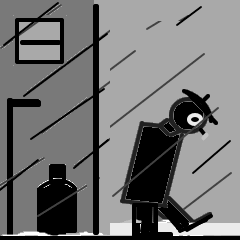
“Who was that on the telephone, dear?
“No one.”
“It was obviously not no one.”
“Can’t I get a telephone call?”
“Of course you can. But.”
“But what, Mother?”
“But for the life of me I can’t remember you ever getting a telephone call before.”
“I’ve gotten telephone calls.”
“Oh, have you, then it must have been when I was out of the house.”
“Yes, it probably was.”
“So who were you speaking with?”
“A friend. Okay?”
“Don’t use that vulgar word. Say all right instead.”
“It was a friend, all right?”
“That’s much better. And this ‘friend’, does he have a name?’
“Of course he does.”
“And may I ask what it is.”
“Addison.”
“Addison what?”
“I don’t know! Why are you grilling me? What is this, a Gestapo interrogation? Where are the rubber hoses? Where are the telephone books?”
“I’m delighted to hear you have a friend. What does he do? If anything.”
“He is – a novelist.”
“A novelist? How charmingly bohemian. Where did you meet him?”
“At a meeting.”
“Oh.”
“Where else would I meet someone?”
“Another drunkard.”
“We don’t say drunkard, Mother, we say alcoholic.”
“Another hopeless sot. Just like your father.”
“Excuse me, Mother. I must dress.”
“Oh dear me, and it’s only quarter to two. Are you sure you don’t need more rest, dear?”
“I am quite well rested, thank you very much.”
“Where are you going?”
“Who said I’m going anywhere?”
“You’re getting dressed, aren’t you? If you were not going somewhere you would stay in your pajamas all the livelong day and night, wouldn’t you?”
“I’m going to lunch if you must know.”
“With this, what, Atcheson?”
“Addison, and, yes, I am having lunch with Addison.”
“Where are you lunching.”
“At the automat on Bedford, over by the St Crispian.”
“Don’t go there. You shouldn’t eat that food. And besides, what will your friend Harrison think?”
“I think he will be perfectly delighted to lunch at the automat, especially since I shall be paying for it.”
“Don’t be such a tightwad, Marion. Take him someplace nice. Even the dining room at the St Crispian would be better than the automat.”
“You’ve eaten at that automat. I know you have because I’ve eaten there with you.”
“I have eaten a restorative slice of orange layer cake at the automat, yes, after a grueling day of taking you shopping, because I simply couldn’t stand the further ordeal of speaking to a waiter or waitress, but that’s different. If you’re giving a friend lunch, you do not take him to the automat.”
“Oh, God!”
“Here, take this ten-dollar bill, and take this fellow Murchison to the Prince Hal Room at the St Crispian. Order the sole meunière, or the finnan haddie. Be a man, for once in your wretched life!”
“Oh, all right!”
“You may keep the change, and don’t forget, a fifteen percent tip, no more, no less.”
“Thank you.”
“Here, better take another five, because you really should order a nice bottle of wine for your friend.”
“Mother, we are both alcoholics!”
“A half-bottle each of a nice Sancerre is not going to kill you, Marion.”
“I’ll take the extra five, but only so we can have a nice dessert.”
“The Baked Alaska is very good there.”
“Fine, I’ll order the Baked Alaska.”
At last Milford escaped his mother and went up to his room. What should he wear? The Hemingwayesque ribbed turtleneck again? Yes, damn it, and the newsboy’s cap as well, along with the sturdy workman’s dungarees, and his Abercrombie Wellingtons on account of the rain and snow. And the peacoat. She would no doubt have words to say about his attire, why didn’t he wear his nice grey suit. Well, too bad for her! He was a poet, damn it, and a poet should dress the part.
He looked at his face in the pier glass. He had not shaved since yesterday morning. Should he? No! Let her say what she would, the harridan. He was the man of the house, even if she did hold the purse strings.
However, just to be on the safe side, and to avoid trouble, when he got downstairs he hurried right through the hall to the foyer, without even saying goodbye to her. He was sorry, but she forced him to be rude!
He had gone halfway down the block before he realized he’d forgotten his umbrella, and so he turned and retraced his steps through the cold slashing rain and the mountains of grey snow. It was all Mother’s fault!
{Kindly go here to read the “adult comix” version in A Flophouse Is Not a Home, profusely illustrated by the illustrious rhoda penmarq…}
May 12, 2022
“Alleyways of Despair”
Addison took that first sip of Ma’s lovely chicory coffee (light, two sugars), and, with a sigh, and wishing he had a cigarette, he unknotted the bow of the red ribbon around Milford’s sheaf of alleged poetry.
The paper looked expensive, thick, and slightly nubbly – a far cry from the cheap typing stock Addison used for his own epic novel.
At the top left of the first sheet was typed a phone number (a SPring-7 exchange) and an address, 175 Bleecker Street. Under that, and centered, was:

Alleyways of Despair
poems by Marion J. Milford
Marion? No wonder Milford went by Milford.
Addison took another sip of coffee and went to the next page, where he read:
Alleyways of Despair
(for D.T.)
Cry, I cry, down tumbling dark streets,
sob, I sob, down avenues of doom,
scream, I scream, into my sweatèd sheets
mourn, I mourn, in my lonely wretched room.
Who will care when I die, I cry,
who will sigh when I dare to bare
the soul I share in church basements
with other bores who silently stare
into the empty Dixie cups of their lives
and await their turn to get up
and vomit their own self-pity
in their turn?
No one, that’s who, no one,
not a one, not a single one…
Addison put the sheet down. That was quite enough of that! However, he had spent all but his last eighty-five cents at Bob’s last night, and there had been no envelope from home in the morning’s post, so he got off his stool, and, taking the cover sheet with the phone number, he went back to the payphone on the rear wall, dropped in a dime, and dialed the number.
“Milford residence.”
“Oh, hello, I wonder if Milford is in?”
“Who?”
Addison glanced at the sheet.
“I mean, uh, Marion?”
“Young Mr. Milford?”
“Yes, I suppose so. Marion J. Milford?”
“Oh. One moment please. I’ll see if he’s available.”
Addison waited, for one minute, then another, staring out the rain-streaked plate-glass window at the rain falling on the piles of snow and on the cars and trucks passing by, and on the sad people shuffling along the sidewalk. Finally a whining voice spoke:
“Yes, this is Marion J. Milford.”
“Hi, Milford, it’s Addison.”
“Who?”
“Addison. From the meeting, at Old St. Pat’s? Smiling Jack’s friend?”
“Oh. You.”
“Of course Addison is not precisely my real name, but it’s the one everyone calls me, ha ha. You see, I got the sobriquet because one of the wags at my local said I was always trying to act like the character Addison DeWitt in the film All About Eve –”
“I never saw that movie.”
“Oh. Well, anyway, Milford – or should I call you Marion?”
“Just Milford will do.”
“Okay, then –”
“I detest the name Marion.”
“Well, all right then, so Milford it is!”
“Thank you.”
“Anyway, Milford, I read your collection of poems –”
“You hated them, didn’t you?”
“Not at all, old man –”
“You didn’t?”
“No, far from it. And anyway, you said yesterday that you might like to have lunch so that I could share my thoughts on your, uh, poetic efforts –”
“You want to have lunch?”
“Well, you know, just so we can, uh, talk –”
“Did you really like the poems?”
“Yes, they were, uh –”
“I was still in bed. I’m still in my pajamas.”
“At one-thirty in the afternoon? And I thought I was a late riser!”
“What’s the point of getting out of bed?”
“Well, that’s a very good question, Milford, and perhaps we could discuss it over a bite to eat.”
“I suppose you want me to buy you lunch.”
“Well, you did mention that you would treat me to lunch, and in point of fact I am a bit short today –”
“Okay, fair is fair. I’ll give you lunch.”
“That’s swell, Milford.”
“What’s it doing outside? Is it snowing again?”
“It’s raining actually.”
“Of course it’s raining. And all I want to do is lie in bed with the curtains drawn.”
“Well, if you would prefer to meet some other time –”
“No, I really want to hear your thoughts on my poems.”
“Yes, well, uh –”
“Look, I’ll meet you at the automat across from the Hotel St Crispian, on Bedford.”
“I shall leave posthaste.”
“Give me a half hour. I still need to get dressed.”
“A half hour it is, and I look forward –”
The phone on the other end clicked and the dial tone came on.
What a rude fellow, but still, a free lunch was a free lunch. And, maybe, just maybe he could touch Milford for a small loan. Three dollars perhaps, which would be good for another Baltimore handshake from Bubbles. Who knew, maybe Milford would even spring for a ten, which would pay for a throw at Bubbles’s going rate. A throw! It would be Addison’s first ever, not only with Bubbles, but in his life. And all he had to do was tell Milford what Milford wanted to hear. Addison could do that. Was he not a novelist, a creator? Was he not a spinner of tales and fabulations, of epics?
He went back to the counter, swallowed the cold coffee in his cup, and politely asked Ma for a refill.
Should he read some more of Milford’s poetry?
God no, life was too short…
{Please go here to read the “adult comix” version in A Flophouse Is Not a Home, lavishly illustrated by the illustrious rhoda penmarq…}
May 5, 2022
“What Price Pie?”

The sweet potato pie with its generous dollop of fresh whipped cream was long gone (and indeed it was all Addison could do to have refrained from licking the plate), and the third cup of chicory coffee had now been finished. It was time to go, because Smiling Jack and this fellow Milford were boring him to distraction, and all Addison wanted was a basement-brewed bock from Bob’s, as soon as possible.
“Well, gentlemen,” he said, “I have enjoyed this collation and its attendant conversation more than I could possibly begin to adumbrate, but, alas, I must go, and thanks again, Jack, for the treat.”
“Oh, please don’t go yet, Addison,” said Smiling Jack, smiling, but with sad eyes.
“Yeah, what’s the big rush,” said Milford. “Are we boring you?”
Milford stared belligerently through his thick glasses under that absurd newsboy’s cap of his.
“Not at all,” said Addison. “I find your tales of drunken degradation absolutely enthralling, dear Milford. By the way, before I go, I wonder if I might have just one more of those Woodbines of yours.”
“You know, there is a cigarette machine right over there in the corner,” said Milford.
“Ah, yes, so there is, but, you see, I’m trying to cut down on the old gaspers –” here he put his fist to his mouth and simulated a cough, “and if I buy a pack, I know I’ll probably just smoke them all up tonight, ha ha.”
“I think you’re just too cheap to buy your own cigarettes.”
“Hey, now, Milford,” said Smiling Jack, “that’s not nice. Addison is an artist, you see – a writer – and he cannot be expected to buy his own cigarettes.”
“I’m a writer, and I buy my own cigarettes.”
“Yes,” said Smiling Jack, “but didn’t you tell me that you get five hundred dollars monthly from your family trust?”
“That’s not the point! Just because I have a modest income, that doesn’t mean I’m obliged to be a free cigarette dispensary for this guy.”
“Do you really get five hundred a month?” said Addison. “Gee.”
“See?” said Milford. “No offense, Smiling Jack, but I wish you hadn’t mentioned my trust fund, in fact I wish I had never told you about it in the first place.”
“But honesty is important, Milford,” said Smiling Jack, barely smiling. “If we are to conquer our disease we must be scrupulously honest.”
“I agree,” said Addison.
“Oh, okay, here,” said Milford, and he tossed the opened pack of Woodbines to Addison’s side of the table. “Take the whole packet, and welcome to it.”
Addison nudged the open end of the pack with his finger.
“There’s only two cigarettes in here.”
“I’m sorry there’s not more of them for you to bum,” said Milford.
“As am I, heh heh,” said Addison, and he took one out of the pack. ”How about a light?”
“Here, take the matches, too,” said Milford, and he flicked the matchbook across the table. White Horse Tavern matches.
“Thanks, pal,” said Addison, and he lighted himself up. “And now, gentlemen, I must hie me hence.”
“Just what’s your big hurry, anyway,” said Milford. “I mean if we’re not boring you.”
“No hurry, but, ah, you see, I must work.”
“Work?”
“Yes, I must do my daily quota.”
“I guess you mean this novel you’re writing.”
“Yes,” said Addison. “Sixguns to El Paso.”
“I’d like to write a novel someday.”
“Well, again, good night, chaps,” said Addison.
“I write poems,” said Milford.
“Good for you, old man.”
“I wonder if you would look at them.”
“I should be glad to.”
“When?”
“Oh, at your earliest convenience.”
“What about now?”
“Now?”
“I have a sheaf of my newer poems on me.”
“Oh,” said Addison.
Milford reached inside his peacoat and brought out a rolled up scroll of what looked like fine vellum, tied up with a red ribbon. He tossed the sheaf onto the table in front of Addison.
“Please be honest,” he said.
Addison touched the thick scroll.
“Yes, of course,” he said.
“Do you want to read them now?” said Milford.
“Well, normally I would say yes, of course,” said Addison, “but, you see, I really must keep to my writing schedule.”
“Oh, okay.”
“I must keep and maintain that daily creative rhythm, you see.”
“Yeah, sure. Maybe you can read them later tonight.”
“I will definitely try to.”
“What’s so hard? Just open them up and read them. It’s only eighty-seven pages. I’m not talking about reading the Odyssey and the Iliad here.”
“Ha ha, yes, well –”
And gathering up the Woodbine pack, the White Horse Tavern matches, and the scroll of Milford’s poetry, Addison slid himself out of the booth.
Smiling Jack had apparently fallen asleep, but now his smiling face popped upward.
“Hey, where you going, buddy?”
“He has to work on his novel,” said Milford.
“Oh, his novel –” said Smiling Jack.
“He has to maintain his daily creative rhythm.”
“Oh, yes, of course,” said Smiling Jack.
“So, thanks again, Jack, for the pie and coffee,” said Addison.
“Don’t forget the Woodbines, too,” said Milford. “You bummed a total of eight of them, by my count.”
“Yes, thank you, Milford,” said Addison.
“Call me tomorrow,” said Milford.
“Tomorrow? Why?”
“So we can get together and you can tell me what you think of my poems.”
“Oh, right,” said Addison.
“My number is on the first page. Call any time.”
“What if you’re out?”
“We have a maid who always answers the phone, and she’ll take a message if I’m out.”
“You have a maid.”
“She’s not my maid. She’s my parents’ maid.”
“You live at home?”
“What is this, an inquisition? Just call me. I’ll take you to lunch.”
“You will?”
“Yes. But only if you read my poems.”
“Splendid,” said Addison, with some measure of honesty, as there were few things in life he loved more than a free lunch, even if it were one given by a crashing and obnoxious bore like Milford. “Till tomorrow then.”
“Old St. Pat’s basement, five-thirty tomorrow,” said Smiling Jack.
“What?” said Addison. “Next meeting,” said Smiling Jack. “I hope to see you there.”
“Oh, yes, well, maybe,” said Addison.
“Lunch tomorrow,” said Milford. “We can meet here if you like. Or maybe the automat across the alley from the Hotel St Crispian. Do you mind automats?”
“I adore automats.”
“Swell. I used to like to lunch at the White Horse Tavern, but I can’t go in there anymore.”
“Why not?”
“Because if I go there I’ll wind up getting drunk.”
“So?”
“Damn it, man, I’m trying to stay sober! Can’t you understand that?”
“Sorry.”
“So maybe we’ll meet at the automat. Because they don’t serve alcohol there.”
“Yes, more’s the pity.”
“I hope you’re joking.”
“Oh, yes, of course, ha ha.”
“I like their pea soup there. And the corned beef special. The pies aren’t bad either.”
“Sounds delightful.”
“It’s all right.”
“Yes, well, that sounds good, Milford.”
“Call me.”
“Sure thing.”
“Leave a message if I’m out.”
“Will do.”
“And think about that meeting tomorrow at Old St. Pat’s,” said Smiling Jack. “Five-thirty!”
Finally Addison got away, and out the door. The snow had stopped, night had fallen, and the streetlights had come on. He crossed Bleecker Street, but instead of turning left past the cobbler shop and towards the entrance to his building, he looked back across the street and through the frosted and fogged window of Ma’s Diner. Neither Smiling Jack or Milford were looking out the window, and so Addison hurried quickly up the Bowery, to Bob’s Bowery Bar, and to that first glorious bock of the evening…
{Kindly go here to read the “adult comix” version in A Flophouse Is Not a Home, illustrated by the illustrious rhoda penmarq…}
April 28, 2022
“The Conscious Woodbine”

All the other drunks were standing in the snow-flurrying gloaming on the sidewalk behind the church, chatting and smoking cigarettes, and before Addison could make his getaway one of the smokers came up to him.
“Why do you make a mockery of us?”
“I beg your pardon?”
“Don’t answer a question with another question. You heard me. Why do you piss on us and the program and all we and it stand for?”
“I haven’t the faintest idea as to what you are averring,” said Addison.
“Averring! Averring! I suppose you think you’re some kind of intellectual, better than the rest of us!”
“If you’re going to abuse me, I wonder if you could spare me a cigarette.”
The fellow was young, or youngish. He wore a floppy newsboy’s cap, and his desperate eyes bulged behind thick glasses which were blurred with the wet snowflakes falling from the flat grey sky above the circumflex of the church’s roof. He looked at the cigarette in his ungloved hand and then back at Addison.
“You piss and shit on us who are only trying to live sober one day at a time, and now you want to bum a cigarette from me.”
“Only if you think you can safely spare one,” said Addison.
“Oh, all right, then,” said the guy, and he dug inside his coat and brought out a pack of Woodbines.
“English cigarettes?” said Addison, taking one. “I see I’m not the only one on this sidewalk who might be accused of pretension.”
“I am not pretentious! I merely smoke Woodbines because they are the cigarette of choice of Dylan Thomas.”
“I amend my previous statement. I see I am not the only person on this sidewalk who might reasonably be called a silly twit and an ass.”
“How dare you.”
“How about a light, chum?”
“Oh, very well, here –”
And the guy gave Addison a light with his own burning Woodbine. Addison noted that the fellow’s coat was a worn peacoat of the sort found in army & navy stores, and that under it he wore a thick bone-colored ribbed turtleneck of the Hemingwayesque type.
“Ah,” said Addison, exhaling, “not bad, although I must say not a patch on Philip Morris Commanders.”
“What do you want, it’s free isn’t it?”
“I fail to see why you are so hostile, my good man.”
“You fail to see? You fail to see? Listen, the name of this fellowship is Alcoholics Anonymous, not Lovers Anonymous. You got up there and droned on about love for half an hour and not one word about your illness.”
“What illness?”
“Your alcoholism, damn it!”
“Oh, that. Well, Smiling Jack gave me to understand that I could talk about whatever I wanted to at these meetings. And so I did.”
“But it had nothing to do with your alcoholism!”
“Ah, but there I think you may be slightly wrong, my friend. Because, you see, I met the young lady with whom I am in love in a bar, while I was, if not quite drunk, then shall we say on my way. As was she, come to think of it.”
“You’re pissing on me again. On all of us.”
“Well, tell you what, next time I get up to speak, why don’t you just leave the room?”
“How dare you.”
Suddenly Smiling Jack was there.
“Oh, Addison, I see you’ve met Milford.”
“Yes, we’ve met,” said the guy.
“Milford?” said Addison.
“Yes, Milford,” said Milford. “And I suppose you’re going to piss on my name now, too.”
“I wouldn’t dream of it,” said Addison.
“Hey, you know what?” said Milford. “Fuck you, Addison. Fuck you and all that you stand for.”
“Well, thanks for the Woodbine, anyway,” said Addison.
“Fuck you.”
“Milford,” said, Smiling Jack, “remember: anger. Misplaced anger. Who are you really angry with, chum?”
“I’m angry with this piece of shit, coming to our meeting and talking about love when we’re only trying to stay sober, that’s who I’m angry with.”
“But is Addison really who you are angry with, Milford?”
“Yes!” said Milford. “It really is him I’m angry with! I despise guys like him. They think they’re so fucking smart. Well, let me tell you something, Mr. Addison, you’re not so smart. And someday you’ll know that when you’re lying soused in some alleyway and some other bum comes in the alleyway and pisses all over you. Then you’ll know you’re not so smart.”
“I’m sure that other fellow didn’t mean to piss on you,” said Addison. “He was probably just too drunk himself to realize he was pissing on another human being and not a pile of thrown-away rags.”
“That’s not the point!” said Milford. “The point is, the point is, oh, God, I don’t know what the point is.”
“I know how you feel, Milford,” said Smiling Jack. “You want a drink now, because you’re angry. But you must fight the urge. Why not join me and Addison for a cup of coffee and some pie, and we’ll talk. Maybe we can catch another meeting tonight if you feel you need it. There’s one in the basement of the Church of the Nativity at seven –”
Milford turned away, staring through the cold wet swirling snow at a red-brick house across Mulberry Street, or in that direction, anyway.
Then he turned back to look at Smiling Jack and at Addison.
“I apologize,” he said.
“Don’t mention it,” said Addison.
“I was rude and insulting.”
“I am used to being insulted,” said Addison, which was certainly true. “But, anyway, it doesn’t matter, because I am in love.”
“Yes,” said Milford. “You’re very lucky.”
“So,” said Smiling Jack, smiling, “what say you fellows join me for some coffee and pie at Ma’s Diner?”
“Well,” said Addison, because, after the exultation of his recent peroration on love in the basement of Old St. Pat’s, what he was really in the mood for was a restorative glass or two of bock at Bob’s Bowery Bar, “thank you so much for the offer, Jack, but –”
“My treat!” said Smiling Jack.
He had said the magic words, and so Addison said sure, why not?
A healthy slice of Ma’s warm and delicious sweet potato pie, topped with whipped cream, and two or three cups of her sui generis chicory coffee (all paid for by someone else) would only make that first bold glass of Bob’s basement-brewed bock all the more welcome, yes, all the more welcome indeed…
{Please click here to read the “adult comix” version in A Flophouse Is Not a Home, fully illustrated by the illustrious rhoda penmarq…}
April 7, 2022
“This Must Be Love”

Yes, this was love. It must be. This magical, supernatural feeling! And like the snowflakes swirling all about him in the cold and whipping ice-colored air, the clichés crowded and swarmed and swirled in Addison’s brain. Walking on clouds, swimming through moonlight, dancing among the stars! My heart overflowing. She is my everything. I want to shout it from the rooftops. I want to tell the world…
He crossed Lafayette, ignoring a red light, ignoring also the foul imprecations of the cabby who had just barely failed to run him down. Addison was approaching his building, down at the far end of this block of Bleecker, but he realized now that he was far too full of joy to return to his lonely tiny fourth-floor walk-up, far too keyed up even to think of working on his epic novel of the old west, Sixguns to El Paso, although he was sure of one thing, and that was when he did get back to work on it, he must needs introduce the element of love – the one essential ingredient he now knew the work had lacked. He must give his hero Buck Baxter a love interest. Why hadn’t he thought of this before? Addison knew why. It was because he, Addison, until last night, had been ignorant of love, of true love. But it was not too late to introduce the love motif into his book, even if he was already several hundred typewritten pages into the story. What about the young girl, Maisie Mae, bent like Buck himself on vengeance against those who had her kinsmen slain? Or maybe that was too obvious a choice for Buck’s inamorata. What about the lady saloon-keeper at the Penultimate Chance Saloon, Maxine Delarue? What about Lola St. James, the chanteuse at the saloon? Or maybe Miss Bertha, the daughter of the town physician, old Doc Bergman?
“Addison!”
“What?”
“Addison, you’re walking along with your head in the clouds, old buddy!”
It was Smiling Jack, standing here amidst the falling snow on the corner of Bleecker and the Bowery, a leather satchel hanging from a strap across his chest, his hat and his coat dusted with white crystals.
“Oh, hi, Jack. Yes, I suppose I am a trifle distrait today. You see –”
“Where you going with your head up in those snow clouds, pal?”
“Where am I going?”
Addison had not really been aware of where he was going, although he had passed the entrance of his building and the adjoining cobbler’s shop, and his feet seemed to be leading him inexorably around the corner to Bob’s Bowery Bar.
“Oh, I don’t know, Jack,” he said, “maybe just over to Bob’s for a bock or two, because you see –”
“Addison, my friend! You can’t go in there! Didn’t you read my book?”
“Your book?”
“My book I gave you last night. Didn’t you read it? Here, take another one.”
Smiling Jack reached under the flap of his leather bag and brought out a pamphlet with a crude drawing of a drunk-looking chap leaning against a lamp post and holding a bottle. Above the drawing were the words
ARE YOU A DRUNKARD?
BY
“SMILING JACK”
“Oh, that book,” said Addison, and he reached into the pocket of his trench coat and brought out an identical copy of the pamphlet. “Yes, you see I do in fact still have it.”
“And have you read it, friend?”
“Well, you see, Jack, I’ve had a very eventful evening and day since you gave me your ‘book’, and I’m afraid to say that I haven’t quite found the time to peruse it. But I will, I promise you, in the very near future. Good seeing you, old man.”
Addison slipped the pamphlet back into his pocket and started to turn up the Bowery.
“Addison!”
“Yes, Jack?”
“Where are you going?”
“Well, as I said, just up to Bob’s for a bock or two. Would you care to join me?”
“No! No, Addison, you must be strong!”
“I don’t understand.”
“You’re an alcoholic, my friend. Just like me. But no judgement! No judgement you understand!”
“Well, thank goodness for that, ha ha.”
“Addison, my good buddy, I have a proposition. There’s a meeting starting up down at Old St. Pat’s basement in just about, oh –” he pulled up the sleeve of his shabby old worsted coat, and glanced at his wristwatch – “just about exactly seventeen minutes. I was planning on going anyway after handing out a few more books, but, tell you what, friend, why don’t you come along, too.”
“To the meeting?”
“Yes. I think it will do you good.”
“Well, I don’t know, Jack –”
“Addison, pal, listen to me. Are you listening?”
“Sure. How can I help but listen? You’re speaking quite loudly, ha ha.”
“You’ve got a story to tell, Addison. I know you do. You got something to say, old chum. And there is a like-minded group of people who will listen to your story.”
“Do you really think so?” said Addison.
“I know so, my friend,” said Smiling Jack. “Believe me, I know it!”
It was about three-quarters of an hour and two other speakers later later that Addison finally stood up at the central table in the basement of Old St. Pat’s.
“Hello, everybody calls me Addison, and, yes, I suppose I am, not least among my qualities, an alcoholic.”
“Hello, Addison,” said a score of voices.
“But I am not here,” continued Addison, “to regale you good people with tales of drunken depravity and degradation. No, my friends, I am here to talk to you about something sweeter than any wine, more intoxicating than any whiskey, and, yes, more refreshing than that first beaded glass of cold basement-brewed bock of the day. Yes, my friends, I have come to speak of love!”
This announcement was met with silence and blank faces, but Addison didn’t care, and he continued to speak about love, until, a half hour later, Smiling Jack came over and touched him gently on the arm.
{Please go here to read the “adult comix” version in A Flophouse Is Not a Home, profusely illustrated by the illustrious rhoda penmarq…}
March 31, 2022
“Scooter and the Kiss”

“All right, Amberson,” said Bubbles, not stifling a yawn, “listen, pal –”
“Um, may I just interrupt you for only the briefest of moments?” said Addison.
“Now what?”
“Well, in point of fact, Bubbles, my name is not exactly Amberson.”
“What? I thought you said it was Amberson, like, you know, the Magnificent Ambersons.”
“Ha ha, yes, well, I can see how one might make that mistake, but actually the joking name that people call me is ‘Addison’, short for ‘Addison the Wit’, heh heh; you see, they call me that because apparently I’m like – or at least it’s said I try to be like – the character of ‘Addison DeWitt’ in the film All about Eve, and –”
“So I’ve been calling you Amberson all this time but really your name is Addison.”
“Well, no, not precisely –”
“Not precisely what?”
“Addison is not precisely my name, but is, rather, a sort of cognomen I am called by my friends at my ‘local’, Bob’s Bowery Bar –”
“You have friends?”
“Well, I suppose one might call them acquaintances at the very least –”
“So Amberson is just your nickname.”
“Addison actually.”
“But that’s not your real name.”
“No, heh heh, and in reality (and, really, what do we mean by reality?), or in what I choose, perhaps foolishly, to call reality, my actual birth-certificated and, indeed, baptismal Christian name is –”
“So what does your family call you? Paterson?”
“Ha ha, no, they actually have another strange sobriquet or ‘family name’ for me –”
“What is it?”
“Oh, no one but my family call me by that name, it’s really quite silly.”
“What is it.”
“My friends just call me Addison, and to be honest I’ve quite gotten used to it. I think it suits me in a way –”
“What do your family call you. What do all those aunts and great aunts and grandmothers who are always sending you envelopes with double sawbucks in them call you.”
“Well, please don’t laugh –”
“I’m not making any promises.”
“Heh heh.”
“Spit it out.”
“They call me Scooter.”
“Scooter.”
“Yes, ha ha, but it’s a name strictly reserved to my most immediate blood relations you see; it was given me by my Great Aunt Enid because of the way I was always scooting around underfoot at family gatherings, heh heh. ‘There goes Scooter,’ Great Aunt Enid would say, ‘scooting around underfoot like a scared little rabbit –’”
“Scooter.”
“Yes, ha ha, but as I say –”
“Okay, Scooter – I like that, that’s what I’m gonna call you.”
“Scooter?”
“Yeah. Scooter.”
“But my real name is –”
“Scooter will do. Now listen, Scooter, what I was starting to say before we got off on this tangent is I want to take a little nap now, so I’m going to ask you to leave.”
“Oh, a nap sounds divine! I wonder if I might take a nap with you?”
“No.”
“Or I could just lie here and watch you napping.”
“Definitely no.”
“No?”
She stubbed out her latest Philip Morris Commander, then she turned and looked at him.
“Listen, Scooter, or Amberson, whatever, it’s been fun, and thanks for the brunch and all, but I like to take my naps alone. So be a good boy and run along.”
“Yes, of course, Bubbles, I quite understand, but may I ring you up again?”
Bubbles paused for a moment, studying Addison’s hopeful and adoring face, or at least looking in its direction.
“Yeah, sure,” she said, “you can call me if you want, just, you know, not before noon.”
“Yes, certainly, not before noon, ha ha, how uncivilized to call someone before noon –”
“So get dressed and hit the pike because I need my nap.”
“Perhaps we could see a movie?”
“What?”
“Perhaps we could take in a film someday?”
“You want to go to the movies with me?”
“Yes, I mean, I see you have quite a few movie magazines on your table, so –”
“You want to take me to the movies.”
“Well, take in the sense of accompany you, and to the film of your choice of course –”
“You mean we would go Dutch treat?”
“Dutch treat?”
“You mean I would have to pay for my own ticket?”
“Oh, well, no, no, of course not, I mean, gee, heh heh, yes, I mean no, I would be glad to buy you a ticket, and in fact I love to go to matinées because the prices are usually so much more reasonable, but, if you would prefer to go in the evening –”
“Look, just give me a call, and if I’m in the mood and there’s something good to see, I’ll let you take me to a movie.”
“Oh, splendid! I wonder if you’ve seen the Audie Murphy film, Ride a Dead Horse, because it’s playing on a double bill right now –”
“I’m not seeing any cowboy movie, so forget it.”
“Oh, yes, absolutely, I mean absolutely not, it doesn’t have to be a western –”
“That's just swell, because it’s not going to be a western. I want to see a good Faith Domergue movie, or maybe something with Marie Windsor or Lizabeth Scott.”
“Certainly.”
“I like those movies where they get mixed up with some crumb ball like Dan Duryea or Zachary Scott but then Dennis O’Keefe or Eddie O’Brien comes along and bails them out.”
“I shall scour the listings for just such a film.”
“Great, now go, I’m falling asleep with boredom here.”
“At once. But first, I wonder if it would be overstepping bounds if I were to ask you for a kiss.”
“A what?”
“A kiss?”
“You want to kiss me?”
“Very much so. I mean if you wouldn’t mind.”
Bubbles sighed, deeply.
“All right,” she said. “One quick peck. But it’s gonna cost you a buck.”
“A buck?”
“One dollar. Just leave it on the table.”
“A dollar?”
“You heard me. I gotta make a living, you know, and there’s lots of rich old perverts who would pay me a lot more than a dollar to let them kiss me.”
“Well, in that case a dollar does sound reasonable.”
“So go ahead. Kiss me, Scooter, and then get dressed and scoot on out of here.”
Outside the snow was still flurrying in the fading afternoon light, but the sidewalks had been shoveled. Addison turned up his collar and headed east on Bleecker.
Bubbles had let him kiss her!
The cold flurries swirled all around him, the air was cold and wet, but he didn’t care. He had kissed her, only on the cheek, but he had kissed her, and all was good in the world, or, at least, all was good in Addison’s little world…
{Please go here to read the “adult comix” version in A Flophouse Is Not a Home, profusely illustrated by the illustrious rhoda penmarq…}
March 24, 2022
“Nobody Cares About Your Theories of the Novel”

“Jesus Christ, Amberson,” said Bubbles, “don’t you ever shut the fuck up?”
“Oh, I’m terribly sorry, Bubbles,” said Addison. “Was I waxing too profusely?”
“Listen, buddy, I’m gonna tell you something.”
She was sitting back against her pillows in her comfortable bed, smoking her cigarette in the dim afternoon light, the covers pulled up but not quite over her breasts, which were the most beautiful things Addison had ever seen.
“I wait with bated breath,” said Addison. He wondered if he could touch one or both of those breasts with impunity, but he didn’t want to overstep, even if she had just given him another Baltimore handshake.
Bubbles took a lazy drag of her Philip Morris Commander. She never seemed to hurry. What an admirable quality! She made you wait, and if you wouldn’t wait, well, that was too bad for you.
“Here’s the thing, Amberson,” she said, gazing out the snow-crusted window and at the snow that was flurrying down again on Bleecker Street. “It’s okay not to say anything sometimes. And it’s okay not to try to be witty and clever all the time. Because nobody cares, Amberson. Okay? Like, nobody cares about your theories of the novel.”
“Gee,” said Addison. “I mean, surely someone on earth must care.”
“No, Amberson,” said Bubbles, and now she turned and looked at him. “No one cares. Maybe they pretend to care, but that’s only so that they can get you to pretend to listen to their baloney, which you also don’t care about, but you pretend to care so that they can pretend to care about your baloney. But nobody really cares. And even more important, Amberson, I don’t care.”
Addison was at a loss for words, but he hated a conversational vacuum, and quickly blurted the first thing he could dredge up from the welter of his crowded and chaotic mind.
“You are magnificent, Bubbles. As I believe I’ve intimated before, I consider you to be no less than an existential goddess, an avatar, of, of –”
“There you go again,” she said. “Talking.”
“But I must talk.”
“No, Amberson,” she said. “You don’t have to talk.”
“You mean, you mean –”
“I mean just what I said, Amberson. It’s okay just to shut the hell up now and then.”
It wasn’t easy for him, but Addison shut up, just for a few seconds anyway, and then he said, “I wonder if I might have another of those Philip Morrises?”
She had been gazing out the window again, but now she turned her gaze on him. Her magnificent gaze.
“You do buy your own cigarettes sometimes, don’t you?”
“Why yes, ha ha, of course, it’s just I forgot to buy a pack from the machine at the San Remo, and –”
She picked up the pack from the night table on her side of the bed and dropped it on Addison’s lap.
“Help yourself, big spender.”
Addison helped himself to a cigarette, and Bubbles handed him her own cigarette for the light. He touched her hand as he gave the cigarette back to her, and the touch sent a thrill through his body and through his soul.
“Thank you so much,” he said.
“Don’t mention it, hot shot,” she said.
She was so lovely. And Addison wondered if, instead of going for the Baltimore handshake for three dollars, he should have cast fiscal caution to the winds and gone for a “throw” for ten dollars, or at least the “BJ” for five. Well, maybe next time. He shouldn’t rush things. This was his chance for love, his first chance, perhaps his last chance, and he must not muff it. He wanted to speak, to tell Bubbles everything that was rioting inside his brain, but he forced himself to hold his tongue, at least for as long as he could…
{Kindly go here to read the “adult comix” version in A Flophouse Is Not a Home, profusely illustrated by the illustrious rhoda penmarq…}