Dan Leo's Blog, page 15
January 7, 2023
“The Day After New Year’s Day”

It was the day after New Year’s Day, and a lawyer in his mid-thirties named Philip finished his breakfast at Ma’s Diner, on the corner of Bleecker and the Bowery. It occurred to him that the recently ended past year was the first year he had completed since he was seventeen years old without having had even a single alcoholic beverage. Well, that was something. He also had a nice girlfriend now, Edna, whom he had met at the sanitarium up in the mountains, where he had still been this time a year ago. Life was not exciting, but he kept busy at his new office right up the block on the corner of Elizabeth Street, and he was not drunk, or hungover.
He paid his check, said good day to Ma and went outside onto Bleecker Street.
Standing on the corner next to a hill of dirty snow was that fellow Smiling Jack, and hanging from a strap across his chest was his worn leather satchel filled with his little alcoholism tracts.
“Good morning, Philip! How are you, today?”
“Pretty good, Jack, how are you?”
“Out here doing the good lord’s work, Philip!”
“Well, keep it up, Jack.”
“Oh, I shall indeed, I shall indeed, and, you know, Philip, we’ve been missing you at the meetings down at Old St. Pat’s!”
“Yeah, well, you know, I’ve been pretty busy –”
“Never too busy to stay sober!”
“That’s very true, Jack.”
“We’ve been missing your lady friend, too. Edith?”
“Edna.”
“Edna, yes. I hope she’s been behaving.”
“Oh, yes. She’s working up at Bloomingdale’s. Ladies’ dresses.”
“Ladies’ dresses?”
“Yes. She, uh, sells ladies their dresses.”
“Good money in that?”
“Well, I think she does okay.”
Actually Edna got a decent alimony from her former husband, but the Bloomingdale’s job kept her busy.
“And your law office, doing pretty well there?”
“Well, as I say, Jack, keeping, uh, busy, but I suppose ‘doing well’ is a relative term.”
“What do you mean?”
“I mean getting my clients to pay me is probably the hardest part of the job.”
“People are poor down here, Philip. Very poor.”
“True.”
“If they weren’t poor they wouldn’t be living down here.”
“Yes, that’s true also.”
“They’d be uptown.”
“Uh –”
“If you want to make money you should have an uptown office.”
“I actually used to work in an uptown office.”
“And did you make good money?”
“I did okay.”
“You know I used to have my own business.”
“Yes, I know.”
“Had three hardware stores, Philip. Was hoping to open a new one. Smiling Jack’s Hardware. But I never opened that fourth store.”
“Yeah, I remember you talking about it at the meetings.”
“Never opened that fourth store and lost the other three, one after the other, one, two, three.”
“Yeah, that was too bad.”
“All on account of the booze, Philip.”
“Yeah.”
“But I’ll get back on my feet someday.”
“I’m sure you will, Jack.”
“I’m saving my money. Gonna get a pushcart and sharpen people’s knives for ‘em.”
“That sounds like a good idea, Jack.”
“Nobody knows how to sharpen a knife like I do, Philip. Nobody. Then after a year or two of sharpening knives I figure I’ll try to take out a loan, try to open another hardware shop. Another Smiling Jack’s Hardware Shop.”
“That’s great, Jack. I promise to buy all my hardware from you.”
“That would be swell, Philip. Ain’t nothing about hardware I don’t know. You come in my shop, tell me what you need, I’ll fix you right up, and at a fair price, too.”
“That’s swell, Jack, but, uh, look, I have to go and open my own office up.”
“Right. Don’t want to keep your clients waiting.”
“God forbid. They’re probably already lining up outside the door.”
“Tell ‘em to keep their shirts on.”
“I will.”
“I’d offer you one of my books except I know I’ve already given them to you.”
“Yes, you have, Jack.”
“You want a couple copies just to keep at your office?”
“Oh, I wouldn’t want to take them, Jack, I mean, they must be expensive to print up, right?”
“They ain’t cheap, but I get ‘em printed up by the hundred, by a fella that’s in the program, and he gives me a very reasonable rate. Here, take a couple three four.”
Jack reached into his satchel and brought out a handful of the little pamphlets.
“Gee, Jack –”
“Please, Philip. You got a waiting area in your office, right? Just keep a few on the table there, so’s your clients might pick one up for something to read.”
“Well, look, how about if I give you a little something for them?”
“I ain’t looking to make money from my books, Philip. I give these books away free, gratis and for nothing. And you know why?”
“Because you want to help people?”
“I want to help people help themselves, Philip. And there’s a difference. The only person can help a person is his own self. And his higher power of course. I learnt that the hard way.”
“Well –”
“Take ‘em, Philip, please. Just leave ‘em on your waiting room table, with the Readers Digests, and the Time Magazines.”
“Okay, Jack, I will.”
Philip took the offered pamphlets, made of the cheapest paper, on each cover the childish drawing of a drunk-looking man leaning against a lamp post and holding a bottle, and in large letters
ARE YOU A DRUNKARD?
BY
“SMILING JACK”
He put the booklets into the pocket of his coat.
“I wish you’d let me give you something, just to cover the printing costs.”
“Well, only if you insist, Philip, but, just to cover the printing, ‘cause like I say, I ain’t in this for the money.”
“Good,” said Philip. He took out his wallet, opened it, took out a five-dollar bill. “Here ya, go, Jack.”
“A five? That’s way too much, Philip. Just give me a dollar.”
“Why not use the extra to pay for more books? Also, why not treat yourself to a nice breakfast here at Ma’s?”
“It’s true I ain’t really eaten this morning. Had a doughnut, and a couple cups of coffee, just to get me going.”
“There’s no nutrition in a doughnut, Jack. Go in there and have a good breakfast. You’ll feel like a new man.”
“What’s your favorite breakfast in there?”
“Well, the pancakes are great, and you can’t go wrong with eggs.”
“Eggs and bacon maybe.”
“Sure, eggs, bacon. Ma’s home fries are great.”
“I like home fries.”
“So take this and get a good breakfast, Jack, and any left over you can put towards your next batch of pamphlets.”
“I’ll do that, Philip.”
Smiling Jack took the five dollar bill, held it up to the grey sky above the grey buildings.
“Don’t often see one of these fivers,” he said.
“Spend it in good health, Jack,” said Philip.
“I will, Philip, I will,” said Smiling Jack.
“Well, I really gotta run,” said Philip.
“Them clients probably lined up outside your door.”
“They just might be.”
Smiling Jack had folded up the five and stuck it inside his old worn gabardine coat.
“Might just get some cigarettes, too,” he said.
“You do that, Jack,” said Philip.
“Put ‘er there, pal.”
Smiling Jack extended his hand, which was very red, and Philip took it. The hand was icy cold.
“Have a good day, Jack.”
“You too, Philip. Oh, and a happy new year!”
“Yes, of course, and a happy new year to you, too, Jack.”
At last Philip turned and headed up the street to his office. His secretary, Miss Blotnick, was waiting outside the entrance, along with a shabby little man, and an old woman, prospective clients no doubt…
{Please go here to read the “adult comix” version in A Flophouse Is Not a Home, profusely illustrated by the illustrious rhoda penmarq…}


December 27, 2022
"Merry Christmas, Mr. Addison"

Addison floated out of the Prince Hal Room and into the lobby of the hotel, past the cushioned arm chairs and sofas and settees on which sat various old people, past a rubber tree and a bird of paradise plant, and on to the entrance, where the enormous doorman was ready, opening the door with a slight bow.
“I trust you had an enjoyable evening, sir.”
“Um, yes, quite, actually.”
“I’m glad you have your umbrella. Because, as you see, it has begun to snow again.”
“Oh,” said Addison, looking out at the street, at the snow falling heavily through the light of a street lamp. “Damn.”
“If you like, sir, I could summon the next passing free cab while you wait in the warmth of the lobby.”
“A cab?”
“Yes, sir.”
Addison rarely if ever took cabs, in fact he wouldn’t even pay for a bus or the subway if he could help it. It wasn’t so much that he was cheap, as that he hardly ever had very much money. It was true, thanks to Farmer Brown’s largesse, he still had the two bucks and change he had walked in here with, but he was loath to spend any of it on such a wild extravagance as a cab – not when it could be spent on more important things like beer and cigarettes. And, also, yes, he was cheap, and so…
“No, thank you, you know, there’s nothing like a good bracing walk through a snowstorm –”
“I hope you have gloves, sir.”
“Gloves?”
“Yes, gloves, to protect your hands from the cold.”
“Oh, well, I used to have gloves, but, you know how it is, I left them somewhere –”
“I know precisely how that is, sir. And, if I may be so bold, I daresay judging by your general demeanor and somewhat carefree mode of dress that you are an intellectual, perhaps even what one may call a bohemian.”
“Oh, well, I suppose one might –”
“Where I come from, sir, such men as yourself are held in high regard, because it is such as you who further and celebrate and create the deepest beauties of mankind.”
“Wow, well, I’m not sure where you come from, but I’m afraid that’s not quite the case here in the good old U.S. of A.”
“No, sir, alas it is not. This country is a great one for liberty, but for the nurturing of artistic and philosophical souls – eh bien, perhaps it is not for me, a humble immigrant to say.”
“Well, gee, I don’t know,” said Addison, “it seems to me your opinion is as worthwhile as the next fellow’s –”
“Do you really think so, sir?”
“Sure, why not? Well, nice chatting with you –”
“Will you wait one moment, please.”
The man let the door close and went to his little doorman’s podium, and apparently opened a drawer in it. He reached around for a bit and then came around holding a nice-looking pair of leather gloves.
“I should think these would be a good fit, sir.”
“Oh, gee,” said Addison. I couldn’t.”
“Nonsense, sir. They’ve lain in that drawer unclaimed since last winter.”
“Well, if you insist.”
“I do, sir. Allow me to hold your umbrella while you try them on.”
Addison handed the man his umbrella and took the gloves, put one on, and then the other. They were lined with soft white fur, and they fit perfectly.
“Wow,” said Addison. “Thanks a lot, pal. What’s your name?”
“Olaf, sir.”
Olaf handed the umbrella back to Addison.
“Thanks, Olaf. You’re what the guys in the parachute factory I worked in during the war would call a regular Joe.”
“I try to be, sir. In my view we are here on this planet to be kind to our fellow human beings.”
“What an admirable philosophy – Olaf.”
“It is the only philosophy I subscribe to. And may I know your name, sir?”
“Well, Olaf, everybody calls me Addison, but, you see, that’s by way of being a sort of nickname, or perhaps a sobriquet, because my friends and acquaintances somehow see a resemblance in my manner to that of the character Addison DeWitt in the film All About Eve –”
“I have not see that film, sir.”
“Well, at any rate, that’s why they call me Addison. And to tell the truth I’ve gotten used to it.”
“And so should I address you as Mr. Addison, sir?”
“Oh, just Addison will do, Olaf. Well, here I go.”
Olaf put his white-gloved hand on the large brass door handle.
“Merry Christmas, Mr. Addison.”
“Pardon me?”
“Merry Christmas, sir. Unless you are perhaps of the Hebrew or Moslem faiths?”
“Oh, no, but it’s just, I’d forgotten that Christmas was approaching.”
“It is indeed, Mr. Addison. That very special time of the year.”
“Yeah. I guess it is,” said Addison.
“That time of, in the words of the Evangelist Luke, ‘peace and good will toward men.’ And, one may presume, to women.”
“Yes,” said Addison. “Right. Oh. The gloves. Should I bring them back?”
“No need, sir. As I say, they’ve lain unclaimed and forlorn in that drawer for at least a year now.”
“So I can keep them?”
“Consider it a present from the Hotel St Crispian, sir.”
“Wow, okay. Thanks again.”
Olaf opened the door.
“I should release your umbrella from its constraint, sir. The snow falls heavily.”
“Oh, right.”
After only a minute, not much more, Addison got the umbrella unbuttoned and unfurled and over his head.
“Merry Christmas, Olaf.”
“And all the compliments of the season to you, sir.”
And down the steps Addison went, without falling, into the heavy falling snow. He turned left. How far was it to Bleecker and the Bowery? Surely no more than half an hour’s walk. He walked past the alleyway at the corner of the hotel and there was the automat, looking warm and inviting through its misted plate glass windows, and as he drew closer through the softly falling snow he saw at a table, sitting alone, no other than the lovely Bubbles. She seemed to be writing something, and on the table was what looked like a box of Christmas cards. She was smoking a cigarette, and on the table was a coffee cup in a saucer and a partially-eaten slice of what might be pumpkin pie.
Did he dare?
Yes, he would, and he walked over to the entrance and opened the door.
{Please go here to read the “adult comix” version in A Flophouse Is Not a Home, profusely illustrated by the illustrious Rhoda Penmarq…}
December 16, 2022
“The Immutable Laws of the Universe”

It was one of the immutable laws of the universe that it was very easy to walk into a bar as long as you had the price of a drink in your pocket, but it was very hard to walk out of a bar when somebody else was buying. It had been twenty minutes (thirty?) since Addison had said he really must leave, but somehow (he knew how) a fresh Cream of Kentucky and ginger ale had appeared before him and had duly been drunk, another one of Farmer Brown’s Old Golds smoked, Shirley De La Salle had finished her set and the Betty Baxter Dancers had come on again, stomping their way now through “A Night in Tunisia”, but finally our hero was actually off his stool, his hat and raincoat on, his umbrella in his hand.
“Well, thanks for everything, Mr. Brown,” he said, not so much speaking the words as willing them out of his mouth.
“’Farmer’, my lad, Farmer!”
“Oh, right, ‘Farmer’ –” said Addison, “thanks, Farmer, uh –”
Uh what? Uh nothing -
“I do wish you would stay for another,” said Farmer Brown, “but I understand!”
“Yeah, great,” said Addison. “So, uh –”
Farmer Brown thrust out his hand, and Addison looked at it. It was pink, almost hairless, pudgy, with a Harvard class ring on its ring finger. To think this man graduated from Harvard –
“Don’t leave me hanging, my boy!” said the Farmer, making short chopping motions with the hand.
“Oh, sorry, Farmer,” said Addison, and he put his hand in the Farmer’s, which was soft and moist, like that of a giant baby’s. He felt his own hand being shook, up and down, up and down, down and up, down and up, would the Farmer never let him leave?
“Hey, Addison,” said a constricted little voice, and standing next to him was that shabby little ventriloquist, Waldo McGee, holding his wooden dummy, Mickey Pumpernickel, who was the one who had spoken. “You leavin’ already?”
“Um, yes,” said Addison, not quite sure whether he should address the little human man or the wooden one, “I, uh, you know –”
“He has to go home so he can get a good night’s sleep so he can work on his epic novel of the American West tomorrow,” said the Farmer, blatantly addressing the dummy and not the man.
“Oh, yeah, that’s right, you’re a writer,” said Mickey.
“Yes, well, you know, trying to be –” said Addison.
“Me and McGee write all our own material,” said Mickey.
“Oh, really?” said Addison, and he managed to extricate his hand from the Farmer’s.
“Yeah, we always done it,” said Mickey. “Every line. To us that’s the mark of a real artiste, y’know? Personal expression.”
“Yes, uh –” said Addison.
“Although we don’t really write it so much as make it up,” said Mickey.
“Really?” said Addison, with a glance at Waldo’s face, whose lips were only moving slightly.
“You write shit down,” said Mickey, “it don’t got that feel, y’know? It’s gotta have that feel, like real people talking.”
“Yes, of course,” said Addison.
“Not like something wrote by some asshole sat in a room with a typewriter. Something real.”
“Um,” said Addison. “Uh –”
“And sometimes when we’re up there, tell the truth, we’re just winging it. Vamping they call it. You go out on a limb and you jump off and sometimes you land on your face, sure, but sometimes you fly, and when you fly there ain’t no other feeling like it.”
“Yes, well -”
“It ain’t like you writer johnnies, sitting in your room at your typewriter.”
“No, um, uh –”
“But it’s what we do. Me and McGee.”
“And you do it well, Mickey!” said the Farmer.
“Thanks, Farmer,” said Mickey. “We appreciate it.”
“Not at all!” said the Farmer.
“Anyways,” said Mickey, addressing Addison again, “we seen you sitting at the bar here, and we just wanted to thank you for stopping in.”
“Oh, my pleasure!”
“None of them other bums from Bob’s ever come in to see us.”
“Oh. Yes, well, you know –”
“I know, we’re a long ways from the Bowery here. Not like geographically speaking. But in every other way. And ya know somethin’, Addison?”
“What’s that, Mickey?”
“If McGee and I didn’t have this gig, we wouldn’t come in here either.”
“Oh, well, uh –”
“Anyway, thanks, pal, and I hope you enjoyed the show.”
“Oh, yes, very much,” said Addison.
“It means a lot, you comin’ in to see us.”
Of course Addison hadn’t actually come in here just to see Waldo and Mickey, no, it was more that after his “date” (could he call it that?) with the lovely Bubbles, he’d been walking aimlessly around on this cold rainy night, in love, and he hadn’t wanted to go home to his lonely room yet, and there across the alleyway from the automat was the Hotel St Crispian with that glass-encased poster by the entrance...
The Prince Hal Room
Entertainment Tonight!
Featuring the “swinging” sounds of
Tony Winston & his Winstonians
with the stunning chanteuse Shirley De LaSalle
(fresh from her nation-wide tour in Fifty Million Frenchmen)
Also, the Betty Baxter Dancers!
(as featured on the Schaefer Beer Variety Hour)
No cover charge. One-drink minimum.
With your compères Waldo McGee and Mickey Pumpernickel!
...and he still had a couple of bucks and change in his pocket, so he had gone in, but there was no reason to mention all that, no reason at all…
“Well, okay, then –” said Addison.
“Put ‘er there, pal,” said Mickey, and the little wooden dummy extended his hand. Addison took the tiny hand and gave it a shake. He had never shaken hands with a wooden dummy before.
“Okay, then,” said Addison.
“See ya later, pal,” said Mickey. “And if we don’t see ya round, we’ll see ya square.”
“Ha ha!” laughed Farmer Brown.
“Okay, good night,” said Addison.
“Write well, Thackerman!” said Farmer Brown.
“I’ll try,” said Addison.
“And don’t forget to put me in your novel!”
“I won’t forget,” said Addison.
“Wait, he’s putting you in his novel?” said Mickey Pumpernickel.
“He most certainly is,” said Farmer Brown.
“What about me and McGee?” said Mickey to Addison. “What are we, day-old chopped liver on melba toast?”
“Uh –”
“Can’t we be in your novel too?’
“Oh,” said Addison, “yes, of course! I mean, why not?”
“Good,” said Mickey. “Look at it this way, it’s two less characters you got to make up.”
“That’s a very good point,” said Addison.
“Just don’t make us out to be too pathetic,” said Mickey.
“Oh, no, of course not,” said Addison.
“Make us, like, you know, heroic.”
“Of course.”
“Admirable like. Noble.”
“Yes, certainly.”
“Addison,” said the tiny wooden man.
“Yes?” said Addison.
“We’re fucking with you.”
“What?”
“You don’t got to put us in your novel.”
“Oh, but I will!”
“Okay, thanks.”
“Right, well, good night again,” said Addison.
“Good night, Hemingway,” said Mickey.
“Heh heh,” said Addison.
“Did I ever tell you fellows my Hemingway story?” said Farmer Brown.
“Tell us,” said Mickey.
“Listen to this, Hatcherman,” said Farmer Brown, “you’ll really like this story.”
“Can I hear it some other time?” said Addison.
“Oh,” said the Farmer. “Okay.”
“Wow,” said Mickey.
“No, sorry,” said Addison “it’s just that, you know, I’m really trying to get out of here –
“Okay,” said Farmer Brown.
“You understand. I’ll take a, uh –”
“A rain check,” said Mickey Pumpernickel.
“A rain check, yes,” said Addison.
“It’s a good story,” said Farmer Brown.
“I’m sure it is, Mr. Brown, but –”
“Farmer.”
“I’m sure it is, Farmer, but it’s just –”
“I know, I know, you have to go home and get a good night’s sleep so you can work on your novel tomorrow.”
“Yes, I mean, otherwise –”
“Otherwise he’d stay and listen to your Hemingway story,” said Mickey.
“Yes, of course,” said the Farmer. “I understand. You’re a writer. You can’t sit at a bar all night and listen to my drivel.”
“Well, um –”
“You’re an artist.”
“Uh –”
“But you know, Hackerman, maybe, just maybe, this is my art form, sitting here, expatiating in a hotel cocktail lounge – maybe, just maybe mind you, maybe in my own way I am an artist.”
“Um –”
“He’s got a point, Addison,” said Mickey. “Not everybody can do what the Farmer does.”
“No, of course not,” said Addison.
“What would the world be without guys like the Farmer shooting the crap in bars every night?”
“I, uh –”
“But go on, get out of here,” said Mickey.
“Okay, good night again,” said Addison.
“I can’t twist your arm, Amperson?” said Farmer Brown.
“No, yes, I mean, no, sorry –” said Addison.
“He’ll take a rain check,” said the dummy.
“Right,” said Addison, “a rain check –”
“I’m going to hold you to that,” said the Farmer.
Suddenly Addison realized that if he didn’t shove off now he might never shove off, and he would be here for the rest of his life talking nonsense with a wooden dummy and an insane midwestern remittance man, and so he said good night one more time to Farmer Brown, one more time to Mickey Pumpernickel, and then, as an afterthought, he said good night to Waldo McGee, who had not said a word for himself or as himself through the entire exchange, and off Addison shoved at long last, away from the bar, at last, through the smoky crowded room and the laughing and shouting of drunken people and the crashing of the band and the stomping of the Betty Baxter Dancers on the dance floor.
{Please go here to read the “adult comix” version in A Flophouse Is Not a Home, profusely illustrated by the illustrious rhoda penmarq…}
December 9, 2022
“A Minor Character”

Farmer Brown was talking, you could tell because his lips were moving, but to Addison it was all just part and parcel of the noise of the bar, the music and chatter, the shouting and drunken laughter.
Yes, this was that happy peak of inebriation, and Addison could smile and nod as if he actually knew what the Farmer was saying, and after all, wasn’t the old boy drunk as a lord himself? Was he any more cognizant of whatever rubbish he was spewing than Addison? Did Farmer Brown himself care any more about whatever it was he was saying than Addison did, which was not at all?
That girl Shirley De LaSalle was onstage singing again with the combo – what was the song? Addison couldn’t recall ever hearing it before…
Somewhere there's a fella –
somewhere there’s a guy,
somewhere there's a hell of
a chap for such as I…
And across the smoky room was that frightening painted hag who had supposedly been the Farmer’s one true love, sitting with that painted old boy, both of them no doubt as plastered as the Farmer and Addison were, surrounded by lots of other drunken people in this lounge.
And was this what it was all about in the end? Drunkenness? The surrendering of oneself to the chaos of existence?
“So what do you think, Henderson?” impinged the Farmer’s words on Addison’s alcoholic musings.
“What?” said Addison. “What do you really think about this Joyce fella? You’re a novelist, and so your opinion means something.”
“Joyce?”
“Yeah,” said the Farmer. “What do ya think? Is he really on the up and up or what?”
“Joyce.”
“Yeah. I mean, what do you really think?”
What did Addison think of Joyce? To be honest he really didn’t have any opinion, but, hey, you couldn’t say that to a guy who was buying you drinks and giving you Old Golds to smoke all night, so…
“Oh, I think Joyce is marvelous,” said Addison.
“Marvelous!” said Farmer Brown. “Now there ya go. ‘Marvelous.’ A real gift for the old literary prose, right?”
“Oh, yes, absolutely,” said Addison, taking a cigarette from the Farmer’s open silver case.
“Marvelous,” said the Farmer, picking up his silver monogrammed lighter, a perfect match for the monogrammed case. He clicked the clicker, and after a few tries a flame appeared, and Addison accepted the light. Cigarettes were good, yes, and free cigarettes were best of all.
“Thanks, Mr. Brown,” said Addison.
“Farmer,” said Farmer Brown. “Please, call me Farmer, Patcheson. Like I said, all my pals call me Farmer, and I really want you to consider me your pal.”
“Okay, ‘Farmer’,” said Addison.
“Someday,” said the Farmer, “I’m gonna finish that book.”
Addison said nothing, he had nothing to say, not that having nothing to say always stopped him from saying anything, but at the moment he couldn’t be bothered to say a word.
“I said someday,” repeated the Farmer.
“Oh,” said Addison, realizing that politeness called for some sort of response.
“Yes, someday I’ll finish it, as the good lord above is my witness!”
“Uh-huh,” said Addison, having no idea what the Farmer was talking about.
“You know how many years I’ve been trying to finish it?”
“Uh, no,” said Addison.
“Guess.”
“Uh, I don’t know, gee, five years?”
“Not even close, my friend. Not even close. Try twenty-five!”
“Twenty-five?”
“Twenty-five years. Maybe twenty. But somewheres in that range. Let’s say twenty-two years.”
“Okay,” said Addison.
“Twenty-odd long years, my friend, that’s how long it’s been taking me.”
“For what again?”
“To read the book.”
“Oh, the book.”
“Yes,” said the Farmer. “Odysseus. By your good man Joyce.”
“Oh!” said Addison. “You mean Ulysses?”
“That’s the one!” said the Farmer. “Ulysses! Greatest novel of the century. And nigh on a quarter of a century is how long I’ve been trying to read that darned book.”
“Yes,” said Addison, “well, uh, Ulysses is a rather, shall we say, a demanding work –”
“I’ll say! And someday, by golly, I’m gonna finish it. If it kills me.”
“Oh, I’m sure you will finish it,” said Addison.
“That Joyce,” said the Farmer. “Say what you will about the man, he could write!”
“Oh, yes,” said Addison.
“Like a motherhumper,” said the Farmer. “Pardon the expression, but that’s just the way we speak back in Indiana. The man could write like a goldarn motherhumper, and I’ll fight any fella that disagrees with me!”
“Oh, you’ll get no disagreement from me, Farmer –”
“And I’m glad to hear it, Mackieson. Because, when they’re tallying up the great names of modern literature, there’s gonna be one fella that’s up if not at the very top of the list, then certainly in the top ten, and that’s our boy Joyce.”
“Yes, he was, uh, certainly, one of the foremost –”
“Yes, good old Joyce Kilmer,” said the Farmer. “That man could write like a motherhumper!”
Suddenly Addison realized that maybe he should make this current drink his last of the night.
The band had been taking an instrumental break, and now Shirley De LaSalle stepped up to the microphone again and sang…
Down, down, down,
to Chinatown I go,
downtown I go,
so low, so low I go
but not too low and
not too slow…
“Yes, sir, Mr. Joyce Kilmer,” said the Farmer again. “There was your man for your glittering literary prose!”
Yes, it was time to go home, thought Addison. The only question was, should he get one more drink from the Farmer, one for the road? Or would he regret it?
“Y’know, our friend Joyce was a fair to middling poet as well,” said the Farmer.
“Oh?” said Addison, that single syllable all he could manage at the moment.
“Fair to middling,” said the Farmer. “You know this one? It goes kinda like this:
“I think that I shall never see
a tree from sea to shining sea.
“A tree whose lusty mouth is pressed
against my lady’s heaving breast.
“A tree which looks way up at the sky
and says, 'Hello, there, big guy!’
“Always wondered what that poem meant,” said Farmer Brown. “Say, I see your glass is empty, MacPherson. Would you like another?”
Ah, what a question! Yes, he would like another, but somewhere deep in Addison’s brain was the awareness of the thick long hangover that already awaited him, and which would only be made thicker and longer by another Cream of Kentucky and ginger ale, and didn’t he have a novel he should be “working on” on the morrow?
“I’m very sorry,” said Addison, “and I thank you, Mr. Brown –”
“Farmer, my lad, Farmer –”
“And I thank you, Farmer, but I really should be going –”
“But why, Ackerman? The night is young!” said the man who was far from young but still young at heart, apparently.
“I must work on my own novel tomorrow, you see,” said Addison, his words feeling like mud he was pushing through his lips into the world.
“Ah, yes,” said the man, the bloodshot eyes behind the thick lenses of his glasses seeming like portals to all the madness of the world and all possible worlds, “your ‘novel’. Very well, my friend, I understand, you are an artist, a writer, whereas I, my fate is to be just ‘a guy in a bar’. But before you go, just do me one favor, Thatcherman.”
“Of course,” said Addison.
“Promise to put me in your novel, your monumental sprawling epic of the American Old West. Slip me in there, buddy. Suitably disguised of course, mutatis mutandis and so forth, poetic license and all that, but just put a version of me in your book – not a major role necessarily, but just a minor character.”
“Okay,” said Addison, “how about a guy in a saloon?”
“Precisely! A guy in a saloon! Will you do that for me, Patterman, just give me some small measure of immortality in your great work?”
Addison said yes, he would certainly do that, and gladly.
{Please go here to read the “adult comix” version in A Flophouse Is Not a Home, profusely illustrated and with additional dialogue by the illustrious rhoda penmarq…}
December 1, 2022
“The Guano and Feed King of Indiana”
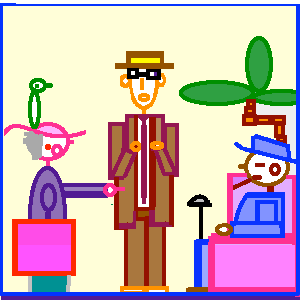
“Is that you, Marion?”
“No, Mother,” said Milford, removing his peacoat, “it is a burglar.”
“Ha ha, very funny. Take your shoes off, I don’t want you tracking wet all over the house.”
Obediently Milford hung up his newsboy’s cap, then sat in the foyer chair, took off his wet work shoes, and pulled on his slippers. Then he stood up.
“Good night, Mother,” he called.
“Come in here first.”
“I want to go to bed.”
“Indulge your mother and come in here.”
Milford sighed, and turned left down the hall to the sitting room where his mother sat in her chair, Daniel Deronda in her lap.
“How was your lunch with your friend?”
“My what?”
“Your lunch with your friend.”
“Oh, that, yes, it was quite nice, thank you.”
“It must have been quite a long lunch as it is now –” she glanced at the grandfather clock – ”nigh on eleven o’clock.”
“I – I – yes, um, I –”
Should he lie? Would a lie be any better than the truth? How could one know?
“If you must know I was at the Prince Hal Room,” he said, the truth just welling up out of him for some strange reason or complex of reasons.
“Oh,” said Mrs. Milford, “so you did take your friend to lunch at the Prince Hal Room. I rather expected you to be a cheapskate and take that twenty I gave you and parsimoniously give your friend lunch at the automat, keeping the difference for yourself.”
This of course was exactly what Milford had done, but why tell the harridan?
“Yes,” he said, “so anyway, we, uh –”
“So you lingered at the Prince Hal.”
“Yes, one might say that.”
“You don’t seem drunk.”
“I am not drunk.”
“Join me in a glass of sherry.”
“Mother! How many times must I tell you, I am an alcoholic and I cannot have even one drink. Are you really trying to drive me by main force back to the sanatorium?”
“It’s only sherry, for goodness’ sake, Marion.”
“Even sherry!”
“So you mean to tell me you spent all afternoon and evening in the Prince Hal Room and had not even one drink.”
Milford sighed.
“You sighed,” said Mrs. Milford. “So you did drink.”
“I had one Cream of Kentucky and ginger ale. There, are you happy?”
“Only one? How does one spend some eight or nine hours in a cocktail lounge and have only one highball?”
“One does it when some oaf buys one a highball, and one drinks it before one realizes that aforementioned oaf has bought it for one.”
“Was the oaf your friend that you treated to lunch?”
“No, it was just some guy at the bar.”
“What was his name?”
“I don’t know.”
“Yes you do.”
“Okay, it was Brown. His name was Brown, but he called himself Farmer Brown.”
“Fiftyish, heavyset, never shuts up?”
“Oh dear God, you know this man?”
“Occasionally after a rigorous day’s shopping I have had a restorative martini at the bar in the Prince Hal Room. A cocktail bar is a public setting, and people do start talking to me, I don’t know why.”
“I can’t believe you know this man.”
“Farmer Brown has been haunting the Prince Hal and the lobby of the St Crispian for over twenty years. He’s not hard to miss, dear boy.”
“My mind is reeling.”
“You’ll get over it.”
“That you actually know the man.”
“I know many men.”
“What does that mean?”
“It means exactly what it seems to mean.”
“Dear God, do you have some sort of secret life, Mother?”
“Nothing secret about it. But how odd.”
“What’s odd? That you consort with barflies?”
“Farmer Brown is no common barfly. I’m told his family owns the largest guano and feed concern in Indiana.”
“Guano? Feed?”
“Next time you see the Farmer tell him hello for me.”
“I most certainly will not.”
“Have a sherry. I want to hear about your evening with the Farmer.”
“I’ll not have a sherry, and there is nothing to tell about my evening with the Farmer, except that he bored me silly.”
“He does go on. But he means well.”
“The man is mentally retarded.”
“What else did you do?”
“Who says I did anything else?”
“You did something else. A mother can tell.”
“I – I –”
“Oh.”
“Oh what?” said Milford.
“Did you meet someone else?”
Again Milford sighed. Why try to hide anything from her?
“Okay, I met someone else,” he said.
“Who?”
“Someone.”
“An attractive someone?”
“If you must know, yes. Extremely attractive.”
“I must ask, so please don’t become exercised with indignation. Was this person a man?”
“What?”
“This attractive person you met, it was a man?”
“What?”
“I’ll find out anyway, you know.”
“No, Mother, it was not a man, it was a – a –”
“A girl?”
“Yes! It was a girl! Okay? I met a girl! And you know what else? We’re having lunch tomorrow!”
“You’re having lunch with a girl?”
“Yes, as fantastic as that possibility may seem to you, I am having lunch with a girl!”
“Sit down. Pour yourself a sherry and tell me all about it.”
“No, I’m tired, and I want to go to bed.”
“How can you be tired after sleeping till one and then spending the rest of your day in the Prince Hal Room? Not exactly a grueling shift at a steel mill, is it?”
“Good night, Mother.”
“What is that in your hand.”
“What, this?” Milford held up the rolled-up sheaf of paper, tied with a red ribbon, which he had been holding all this time.
“I see nothing else in your hand.”
“It is a collection of my poems.”
“May I read them?”
“Most certainly not.”
“Did you show them to your friend? What was his name, Hatcherson?”
“Addison. And, yes, he did read my poems.”
“Did he like them?”
“Yes.”
“He said he liked them?”
“I said yes, didn’t I?”
“Have you shown them to your new girl friend?”
“Mother, I can stand no more of this inquisition! Good night!”
“Don’t show her the poems, Marion. Don’t scare her off first thing.”
“Oh my God!”
And Milford turned and left the drawing room.
Mrs. Milford reached for the sherry decanter and refilled her glass. And all this time she had been sure the boy was homosexual. Will wonders never cease. Was a grandchild out of the question? Was her only child perhaps not the last of the family line after all? Well, one step at a time. She would prize more out of the lad on the morrow…
{Please go here to read the “adult comix” version in A Flophouse Is Not a Home, with art and additional dialogues by the illustrious rhoda penmarq…}
November 24, 2022
“Anti-Aircraft”

At the entrance to the Prince Hal Room Milford said, “Wait, Miss De LaSalle –”
“Shirley.”
“Shirley, I think I had better go home.”
“Yeah? You don’t want to hear me sing again?”
“Oh, I do, very much, but, you see, I’m afraid that if I go in there I will drink, and if I drink I’ll get drunk, and if I get drunk it’s quite possible that I will black out and completely forget about our lunch date tomorrow.”
“Okay. Well, I’ll see ya tomorrow then, Milfie.”
“Yes, at noon?”
“Let’s make it more like one-ish.”
“At the automat.”
“At the automat,” she said.
“I shall be there early,” he said.
“Okay, pal, see ya then –”
She turned to go through the entrance.
“Oh, wait!” said Milford.
She turned.
“Yeah?”
“I’ll go in with you.”
“I thought you were going home.”
“Yes, but I left my umbrella at the bar.”
“Oh, okay, well, come on then.”
They went on into the Prince Hal Room, thick with smoke, the band crashing through “Take the A Train” while the Betty Baxter Dancers danced.
Milford had the strange sensation that he was floating rather than walking as he and Shirley made their way down through the lounge past all these people laughing and drinking and talking while the music crashed on. And how holy was it that he was walking beside her, she whom he had not even touched yet, how sacred was it all?
Suddenly they had reached the end of the bar, and there was his friend Addison (his only friend) sitting at the bar, and standing next to him that oaf called Farmer Brown.
“Ah!” bellowed Farmer Brown, “the young lovers!”
“Hiya, Farmer,” said Shirley.
“And did you have a good time together, Miss Shirley, smoking the wacky weed?”
“I’ve had worse,” said Shirley.
“Did I ever tell you about the time my friend Miss Charlton and her friend Lord Wolverington took me to an opium den in Chinatown?”
“No, Farmer,” said Shirley, “and I really want to hear the whole sordid story, but I gotta go backstage and peel off my wrap and get ready to go on again, so I’ll take a rain check.”
“Of course, my dear! And, in the parlance of you showbiz folk, ‘break a gam!’”
“Thanks, buddy.” She nodded at Addison. “See ya too, Amberson.”
Addison had been in the middle of swallowing a gulp of his Cream of Kentucky highball, but he forced it down, and blurted out, “Yes! I quite look forward to your next selection of chansons –”
Lastly Shirley turned to Milford.
“Later, alligator.”
“Yes, um,” burbled Milford, “later, tomorrow, uh, the automat –”
And then she turned and headed off, through the clamor of the music and the laughing and shouting people and through the smoke of dozens of cigarettes and cigars; and the three idiots, one young, one less young, one older, watched her go until she disappeared through the doorway to the left of the stage.
“Gee,” said Farmer Brown, turning back to face Milford. “What a gal. Sit down, Gifford, and tell me, what’s all this about the automat?”
“We have a date at the automat for lunch tomorrow,” said Milford.
“What?” said Farmer Brown. “What automat?”
“The one right across the alleyway from the hotel.”
“You have a luncheon date with Shirley De LaSalle?”
“Yes.”
“I say, well done, Milford!” said Addison, and he patted the young fellow’s shoulder, realizing as he did so that that he couldn’t remember ever patting anyone on the shoulder in his life before, but then how many new and wonderful things had been happening in his life lately? He also realized that he was finally past the halfway point of having his load on, so that was good, mission accomplished so far…
“Sit down, Milton,” said the Farmer to Milford, “and let’s have another libation and get to the bottom of this –”
“No,” said Milford, “I can’t sit down because I am going home now. I just came back to get my umbrella.”
“Nonsense, my boy,” said the Farmer. “The night is still young, and pregnant with promise. A moderate-to-strong Cream of Kentucky-with-White Rock ginger ale is what you need, and then I want to get the inside ‘gen’ on this supposed luncheon tryst at the automat with the divine Miss De LaSalle –”
“Mr. Brown,” said Milford, “as I have told you a dozen times, perhaps two dozen times, I am an alcoholic, and I cannot have even one drink –”
“You’ve already had one drink.”
“That was a mistake. I didn’t realize there was whiskey in it until it was too late.”
“Might as well have another one then.”
“No! This is precisely why I must go. If I stay here you’ll keep trying to get me to drink, and I don’t want to drink.”
“There’s no need to attack me, lad. I was only trying to be friendly.”
“Well, I’m sorry, but, look, I’m just going to get my umbrella and go. Where did I put it?”
The Farmer lifted a black umbrella from off a hook under the bar.
“I believe this is it?”
“Yes, thank you,” said Milford.
“You’re welcome,” said Farmer Brown. “And, my dear Grimford, I hope there are no hard feelings.”
“No hard feelings, but my name is Milford, not Grimford, or Mumford, or Gifford, or Rutherford – it’s Milford.”
“Milford?” said Farmer Brown.
“Yes. Milford.”
“Are you sure that’s what you told me before?”
“Why would I tell you anything different?”
“I don’t know. Perhaps you wished to remain incognito?”
“Okay, look, whatever, goodnight, and thanks for the, for the –”
“For the conversation and companionship?”
“Yeah, thanks for that, but I’ve got to go now.”
“I really wish you would stay and tell me about this Shirley business.”
“Well, I’m sorry, but I have to go.”
“And I am sorry to see you go,” said the Farmer. “It is not often that I have the opportunity to engage with creative young people. And you know what my motto is, don’t you?”
“Listen to the young people?”
“Yes, how did you know that?”
“Because you told me so, at least twice, and now you’re telling me again.”
“And I will keep telling you, and the world, Melvin, ‘Listen to the young people! Because maybe, just maybe, they’ve got something to say!’”
“Yeah, okay,” said Milford. He turned to Addison. “Good night, Addison. Thank you again for reading my poems.”
“Je vous en prie, mon ami,” said Addison, not that he had read more than a score of lines of said poems.
“Well, it means a lot to me,” said Milford. “Good night. Maybe I’ll see you in the rooms.”
“The rooms?”
“The meetings.”
“The meetings?”
“The AA meetings. If you ever go again.”
“Oh, right, the meetings, well, you know,” said Addison, glancing with a fleeting grin at the highball in his hand, “perhaps I’ll drop in –”
“Or we could have lunch. Or coffee.”
“Lunch would be nice.”
“Not tomorrow though,” said Milford.
“Oh, right, because, uh –”
“Because Gimford has a luncheon date at the automat with the fair Shirley!” said the Farmer.
“Yeah,” said Milford. “Okay. Good night.”
And off the young poet went, in his peacoat and his newsboy’s cap, his furled umbrella in his hand.
“Crazy kid,” said Farmer Brown. “A bit eccentric. Slightly lacking in basic social skills perhaps, and the kind of feller about whom we used to say back in Indiana, ain’t quite sure whether he’s a donkey or an ass, but you can be durned sure he’s one or the other. Anyway, I like the lad, call me an old softy if you like, I won’t dispute it with you, that’s always been my number one fault, a soft heart, and I’ll take it proudly to the grave. But, Hamilton, now that we’re à deux again, tell me more about these ‘meetings’ you and Rudyard go to.”
“Meetings?”
“Yes, the AA meetings.”
“Ah,” said Addison, “the AA meetings –”
“Yes,” said Farmer Brown, “these Anti-Aircraft meetings…”
At this completely asinine and yet hilariously surrealistic utterance Addison felt his glorious mind swirling amidst the music of the band and the kicking and the twirling of the Betty Baxter Dancers, the laughter and shouting of all the other drunkards in here, the heady smoke of cigarettes and cigars, the rising surging tide of his own drunkenness (and, yes, he really must not get too smashed, even if Farmer Brown was buying) and a warm sense of love for all humanity.
“Ah, yes,” he said, to the Farmer’s open glowing face and bleary innocent eyes, “the Anti-Aircraft meetings…”
{Kindly go here to read the unexpurgated “adult comix” version in A Flophouse Is Not a Home, profusely illustrated by rhoda penmarq…}
November 17, 2022
"Life's Feast"

Farmer Brown leaned closer to Addison.
“Love is what it’s all about, my lad.”
“Oh, I quite agree,” said Addison.
“You do?”
“Yes. Absolutely.”
“And, if it is not too personal, may I ask if you yourself have known the glories of love?”
“Believe it or not, Mr. Brown, yes, I have, and do.”
“Ah ha! Spoken like a chap in love! I should have known by the glow emanating from your corporeal host, sir!”
“Well, that glow could be the result of Cream of Kentucky bourbon, Mr. Brown –”
“No, I speak of a spiritual glow, sir. And tell me, dear Thatcherson, what is the name of your objet d’amour?”
“Bubbles.”
“Bubbles! A delightful name. Tell me about her.”
“Well, she’s a – uh – an entertainer,” said Addison, prevaricating if not outright lying.
“Oh, splendid,” said Farmer Brown. “Nothing like a showbiz gal, is there?”
“I suppose not,” said Addison, adding, silently, “not that I would know.”
“And may I ask – and again, if it’s not getting too personal – have you made sweet love with Bubbles?”
“What?”
“Sweet, savage, sweaty love?”
“Mr. Brown!”
“Oh. I have gone too far.”
“Perhaps just a bit,” said Addison.
“I hope you will forgive me.”
“Of course,” said Addison. After all, Farmer Brown was buying, and Addison didn’t really have but half his load on yet.
“Here, let me order you another drink,” said Farmer Brown.
“Only if you insist,” said Addison.
“Raoul!” shouted the Farmer to the barman, who was way down at the other end of the bar. “Two more over here if you please!” He then shoved his silver monogrammed cigarette case toward Addison, and clicked it open. “Another Old Gold?”
“Thank you,” said Addison, although he was already smoking a cigarette, but he took one anyway, and placed it in an indentation of the ashtray he shared with Farmer Brown, a sturdy glass ashtray emblazoned in gold and red with the legend At the St Crispian Hotel our Service is Swell.
“I am aware that sometimes in the throes of quite innocent enthusiasm I overstep the bounds of civilized discourse,” said Farmer Brown. “But, you see, Thatcherson, I think it terribly important that a young man such as yourself should taste in full of the pleasures not just of the soul but of the flesh. Unless of course you are a religious fellow. You’re not by chance a Roman Catholic, are you?”
“No.”
“Thank God – I mean, nothing against any religion, even the Papist, but can any red-blooded man really be expected to refrain from the concupiscent pleasures until marriage?”
“I don’t see why he should,” said Addison.
“A kindred spirit!” said the Farmer. “Because why would the good Lord above give us the beauty of womanhood were it not to be enjoyed in full?”
“My sentiments exactly,” said Addison.
“And so you have,” said the Farmer.
“I have?”
“Enjoyed the physical pleasures of woman, qua woman.”
“Well – yes,” said Addison.
“Here, let me light that Old Gold for you,” said the Farmer, picking up his monogrammed lighter which perfectly matched his cigarette case.
“Thank you, Mr. Brown, but, as you see, I haven’t quite finished this one,” said Addison, showing the Farmer his lighted cigarette.
“Oh, yes, of course, one at a time, heh heh.”
“Yes,” said Addison.
“Ah! Our drinks!” said the Farmer, and the impassive Raoul placed the fresh Creams of Kentucky-and-ginger ales before the middle-aged and the younger man, and took away their depleted glasses.
“To l’amour!” said the Farmer, raising his glass.
“Yes, to l’amour,” said Addison, raising his own glass. Sure, the man was a crashing bore, but he was buying the drinks, and dispensing the cigarettes, and, one never knew, perhaps out of this insanity would come material for one’s novel?
“I have a confession to make, Thatcherman.”
“Pardon?” said Addison.
“A confession.”
“Oh.”
“Stop me if you don’t want to hear it. I do tend to reveal perhaps too much.”
“Oh, no –”
“I myself have never known the pleasures of the female corpus.”
“Pardon me?”
“I have never, as the bawdy Bard put it, made the beast with two backs.”
“You mean –”
“Yes.”
“Oh.”
“Do you think I have missed out?”
“Well, Mr. Brown –”
“Please, Plankington, call me Farmer. As I have said, all my friends call me Farmer, and I would like to think that we have become friends.”
“Okay – ‘Farmer’ –”
“And so?”
“So?”
“Have I?”
“I’m sorry, Farmer, what was the question?”
“Have I missed out in never once in my life having committed what the aforemementioned Bard termed the act of darkness?”
“I, uh, well,” said Addison, who was so rarely at a loss for words, but now nearly was, “um, that is not for me to say, Mr. Br-, I mean Farmer –”
“Yes, but I am asking you to say. Because you, sir, are an artist.”
“I am?”
“Didn’t you say you were a novelist?”
“Oh, right, yes, I suppose I am.”
“So that’s why I’m asking you. Because you are not just some average clod. You are a creative writer, sir, whose remit it is to delve deep into the mysteries of the human soul.”
“Okay, I suppose that’s true.”
“So have I missed out?”
Addison considered. What about himself? He also had never actually made the beast with two backs, done the act of darkness. But he had indisputably gotten a couple of Baltimore handshakes from Bubbles. It was true he had had to pay for them, but nonetheless, he had gotten them, and they must count for something. And, back in his wartime days at the parachute factory, what about that enormous drunken sergeant who had so brutally rubbed his private parts against Addison’s rear in that barroom men’s room? Did that count? But Farmer Brown was not asking about Addison, he was asking about himself.
“Yes, uh, Farmer,” said Addison, “I think that perhaps you have missed out. But –”
“Yes,” said Farmer Brown, “but?”
“But perhaps by missing out you have gained something else.”
“And what would that be, Harrison?”
“Perhaps you have missed out on being disappointed.”
For once Farmer Brown said nothing.
The music of the band had been playing all along, and as if on cue both Addison and Farmer Brown turned and gazed at the Betty Baxter Dancers, kicking their legs so high and twirling and leaping in unison.
After a moment Farmer Brown turned again to Addison.
“All my life I have been, in the words of the noted Irish author James Joyce, outcast from life’s feast. But I have gathered a few crumbs in my time. Yes, Thackerman, I have gathered my precious crumbs.”
The Betty Baxter dancers kicked and swirled, and across the room the love of Farmer Brown’s life, Miss Charlton, sat drinking champagne and smoking with her fattish old male companion, the both of them laughing, probably about the notorious misadventures of their younger days.
{Kindly go here to read the “adult comix” version in A Flophouse Is Not a Home, profusely illustrated by the illustrious rhoda penmarq…}
November 10, 2022
“A Terrible Beauty”
Shirley exhaled, slowly, through her luscious red lips, and the smoke rose up into the harsh light of the naked electric bulb above them.
“Well, that hit the spot,” she said. “You want another hit before we go back in, Milfie?”
Milfie! She called him Milfie. Nobody had ever called him Milfie before.
“Milfie?” she said again.
“Yes, Miss De LaSalle?”
“Shirley, Milfie, for the umpteenth time.”
“Shirley, yes, Shirley!”
“I said you want another hit?”
“A hit?”
“Of the muggles, daddy-o. You want another toke?”
“Toke?”
“Okay, wow, you are really high, my man.” She took another but smaller drag from the ever-diminishing reefer, and exhaled again. “Tell me something, Milfie – oh, do you mind me calling you Milfie?”
“Not at all Miss De-, I mean, Shirley, no, not at all, in fact I am honored by your calling me a, a, what is the word, a sobriquet?”
“Nickname, Milfie, it’s called a nickname.”
“I am honored that you have bestowed a nickname on me!”
“Okay, then, Milfie, so, as I was saying, is this the first time you’ve smoked the crazy weed?”
“You mean marijuana?”
“Yeah.”
“Yes! It is my first time! And to think of all the hours I wasted drinking alcoholic beverages, when instead I could have been smoking crazy weed!”
“Yeah, it’s better,” said Shirley, and she held what was left of the reefer out to him. “Here, finish it off, buddy.”
Obediently Milford took the reefer, and sucked deeply on it.
This, this was ecstasy.
Who would have thought that ecstasy would be found finally here, in the service entrance of this old hotel, with the cold rain spattering down on the cobblestones, and with those ghostly human beings behind the clouded plate glass of the automat across the alleyway, drinking their coffee, eating their apple pie, smoking their cigarettes.
Milford exhaled.
“Now,” he said, “now at last I understand.”
“Oh, yeah?” said Shirley.
“All those years, all those hours and minutes – wasted!”
“No kidding?’
“No kidding! I only drank because I wanted to be like Dylan Thomas. But I was kidding myself. Now I realize.”
“Realize what, Milfie?”
“I realize, I realize – I’m not quite sure what I realize, but now, if I may borrow a phrase from Yeats, I am changed, changed utterly.”
“Just from smoking that reefer?”
“Well, partially I suppose,” said Milford, and he took another drag from what little was left of the reefer. He exhaled, and then said, “But mostly it is because of you, Miss De La-, I mean Shirley.”
“Little old me?” said Shirley.
“Yes,” said Milford. “I have seen a terrible beauty born, and that beauty is you.”
“Wow, that’s quite a compliment.”
“Will you have lunch with me tomorrow?”
“Lunch?”
“Yes, or coffee, or dinner –”
“I gotta sing tomorrow night, and I never eat dinner before I sing.”
“Lunch then!”
“Tell ya what, Milfie. I usually get up around noon, then I head over to the automat here and have a little breakfast, so if you want I’ll meet you there tomorrow.”
“Oh, thank you!”
“Hey, you haven’t seen me when I’ve just woken up, so don’t thank me yet, pal.”
“I will meet you there at noon!”
“Make it more like half-noon, quarter of one.”
“I shall be there at quarter past noon, just to make sure we get a good table!”
“Swell, I like a window table looking out on Bedford Street. I like to watch the passing parade of humanity.”
“Me too!” said Milford, even though it had never occurred to him to watch the passing parade of humanity, but he was sure he could change.
“Just sit there and eat my corn muffin, drink my coffee, smoke a gasper, watch the people go by.”
“Yes, it’s wonderful,” said Milford.
“Maybe have some of that warm huckleberry pie they got there, and the dames behind the windows even give me a scoop of vanilla ice cream on it when I ask them.”
“They do?”
“Yeah, it’s like the brotherhood of dames,” said Shirley. “They know I’m just a working gal like them, and God knows I might be working behind those windows myself someday.”
“Never!” said Milford.
“Oh, yeah? You think I’m that good a singer, Milfie?”
“Yes, you are! And anyway, I would see to it that you would never have to work at the automat!”
“Oh, you would, huh? Would you support me, Daddy Warbucks?”
“Of course I would, Miss De LaS-, I mean, Shirley, but of course I would! I have an income of five hundred a month, and if my mother ever dies I’ll have much more than that!”
“Oh, yeah?”
“Yes!” said Milford.
The stub of reefer had gone out in Milford’s fingers. Shirley opened her sparkly purse, took out a Bayer aspirin tin, clicked it open, and Milford saw that instead of aspirin it contained a half-dozen butts of reefers. Shirley took the reefer stub from Milford’s fingers and dropped it into the tin, clicked it shut, dropped the tin into her purse, and then clicked the purse shut.
“Okay, pal,” said Shirley, “I gotta go on again soon, so let’s head back in.”
“And we really can have lunch tomorrow?”
“Sure,” said Shirley.
What the hell, lunch with this madman wasn’t gonna kill her, and he was kind of amusing in his way. And he had five yards a month income. So at least she probably wouldn’t have to pick up the tab like with all the musicians and actors and out-of-work hoofers and two-bit grifters and chancers and cross-eyed ham-and-eggers she usually went out with…

{Please go here to read the “adult comix” version in A Flophouse Is Not a Home, liberally illustrated by the illustrious rhoda penmarq…}
November 3, 2022
“Who Cares About the Atomic Bomb?”

Farmer Brown turned again to Milford.
“Do me a favor, Crawford, will you promise me one thing?”
“What?” said Milford.
“Don’t blow it. Don’t do as I did with Miss Charlton, and succumb to shyness and cowardice. If Shirley indicates even the slightest interest, and I think she already has, seize your chance, my boy, boldly!”
“Well, maybe –”
“No maybes! Gals like quiet guys, but they also like a take-charge guy!”
“Well, okay,” said Milford.
Seven minutes later Milford and Shirley stood in the shelter of the service entrance of the hotel, in the harsh grainy light of a wire-encased electric light bulb. The rain had started up again, and across the alleyway forlorn people were visible through the fogged plate-glass windows of the automat, drinking coffee and smoking cigarettes, eating pie and split-pea soup.
“This,” said Milford, “this is beauty!”
“What,” said Shirley, “this alleyway?”
“Yes,” said Milford. “Look at the way the light plays on the wet cobblestones! Look at those people in the automat over there! Do they even know that they are in an Edward Hopper painting?”
“Somehow I doubt it, my man,” said Shirley.
“And you, Miss De LaSalle,” said Milford, “if I may say so, the harsh light of this filthy light bulb on the white skin of your face! You are more beautiful even than any of the greatest portraits of the Quattrocento!”
“I’m gonna take that as a compliment, daddy-o.”
“Oh, it is, Miss De LaSalle!”
“Call me Shirley. And by the way, you’re bogarting that joint, my friend.”
“I beg your pardon?”
“The reefer, man. Let me have a toke, pal.”
“Oh, I beg your pardon, Miss De LaSalle!”
“Shirley.”
“Shirley!”
Milford was still hanging onto the reefer, so Shirley picked it out of his fingers. Poor fella, but there was something lovable about his idiocy. And how rich was he, anyway?
“Would you like to hear one of my poems, Shirley?”
“What, right now?”
“Yes!”
“Sure, buddy.”
Milford drew the rolled-up sheaf of poems from inside his peacoat.
“What sort of poem would you like to hear?”
“A love poem,” said Shirley.
“Oh, I’m terribly sorry,” said Milford, “but I don’t have any love poems…”
“Okay, then, your choice, Milford.”
The sheaf of expensive-looking paper was tied up with a red ribbon, which with furrowed brow Milford untied. He stuck the ribbon in the pocket of his peacoat and flipped though the pages.
“Let me see, I have lots of poems about existential despair –”
“Whatever, man,” said Shirley. “I can take it.”
“How about a social protest poem?”
“Let it rip, my dude.”
“Okay, this is a good one, I think. I call it, ‘My Friend, the Bomb’.”
“Sounds good.”
“I hope it’s good,” said Milford. He cleared his throat and began to read:Who cares about the atomic bombMilford looked up from his poem.
as long as you have a nice green lawn?
Who cares about universal destruction
as long as you have your television?
Who cares about the plight of the Negroes
as long as you have your morning Cheerios?
Who gives a damn about the slums
or the Bowery bums
or the unpublished troubadour
whom you revile as a bore?
Who cares?
Not you, Mr. and Mrs. Suburbia –
not you, I’m telling ya!
“What do you think?”
“Pretty good, Milford,” said Shirley. She took a deep drag on the reefer, then exhaled slowly. “But I think I prefer love poems.”
“I will write you a love poem!” said Milford.
“No kidding?”
“Yes! The only reason I’ve never written one is that I’ve never been in love before.”
“Before?”
“Yes, before now!”
“Hold on, Charlie. We just met!”
“I don’t care,” said Milford. “I think you’re magnificent.”
“Take another toke of this reefer.”
“Oh, yes, wait –”
Clumsily Milford rolled up his poems again and shoved them back into his inside peacoat pocket, and then he took the reefer.
“You’re a funny guy,” said Shirley.
Milford drew deeply on the reefer, staring at Shirley’s angelic face in the grimy light of the electric bulb, with the cold rain falling behind her, and the fogged windows of the automat across the cobbled alleyway, the people in the automat smoking their cigarettes and drinking their coffee, eating their slices of pie and their ham-and-cheese sandwiches on rye…
Milford exhaled the smoke.
“I have just realized that all the poems I have written are as nothing,” he said. “When I get home tonight I will write my first good poem, and it will be about you, Miss De LaSalle.”
“Shirley.”
“It will be about you, Shirley.”
“That’s nice,” said Shirley. “Now pass that number one more time.”
Milford passed her the reefer. Already he was composing his new poem in his head. His first love poem. His first real poem…
{Please go here to read the “adult comix” version in A Flophouse Is Not a Home, profusely illustrated by the illustrious rhoda penmarq…}
October 27, 2022
"The Quiet Ones"

“And so you see,” said Milford, suddenly aware that he was sweating profusely, “what I am attempting to do in my poetry is to take the sense of song, of an earthly and yet ethereal rhythm – such as we find in the work of Dylan Thomas, or, perhaps, in an earlier day, Gerard Manley Hopkins – and yet to infuse it with the intelligence and social consciousness of men such as Auden, but – and this is a big but – with a uniquely American perspective –”
“Uh-huh,” said Shirley. “Me, I’m more into writing song lyrics myself, words that go with music, y’know?”
“You write songs?”
“Yeah, what do ya think half the stuff I’ve been singing tonight has been, daddy-o? That wasn’t all Cole Porter and the Gershwin brothers!”
“Well, I did suspect that I hadn’t heard some of the songs before –”
“Yeah, me and Tony, that’s our piano player and combo leader, we like to make up songs together, and we discovered that after about nine o’clock the punters are mostly too drunk to know what they’re listening to, so we stick some of our own material in there. One of these days Tony says he’s gonna take the best numbers uptown to the publishers and see if we can’t get a deal.”
“Gee, that would be swell, Miss De LaSalle.”
“Call me Shirley, Rimford.”
“Well, it’s Milford, actually.”
“Milford, okay, I’ll remember that. So – Milford – do you make any money from your poems?”
“Oh, God no. I’ve never even had any of them published yet.”
“So, like, what do you do to fill your rice bowl?”
“My rice bowl?”
“Yeah, I guess what I’m getting at is do you have a job.”
“Oh, a job. No. Not exactly.”
“So, like, how do you pay your rent and eat?”
“Well, I live at home actually.”
“Oh,” said Shirley. “Around here?”
“Yes, not too far. 175 Bleecker Street. Between Sullivan and MacDougal.”
“Nice. Right near the San Remo, one of my stomping grounds. This an apartment?”
“Well, it’s a house, actually.”
“A whole house?”
“Well, yes. You see my great-grandfather built it, in 1859 I believe.”
“No kidding. And who else lives there?”
“Well, it’s just my mother and I. We have a maid who has a room in the attic. Or at least I assume she does, I’ve never seen it.”
“So – and please don’t be offended, Milford – but, are you, like, loaded?”
“Define loaded.”
“Are you rich.”
“I wouldn’t say I’m rich per se.”
“But you don’t have to work.”
“My poetry is my work.”
“But you don’t have to work to earn your living?”
“Well, no, I suppose not.”
“So, let me ask you a question, Milford, if it’s not too personal.”
“Anything, Miss De LaSalle.”
“Shirley.”
“Anything, Shirley.”
“How come you dress like a dockworker? Or maybe a deckhand on one of those tugboats on the river?”
“You mean my peacoat?”
“Your peacoat. The wooly sweater. The Dead End Kids cap. The dungarees and work shoes.”
“This is my uniform.”
“Your uniform.”
“Yes, my uniform as a poet. But a poet of the people.”
“Okay, I can see that. It’s like you’ve got to dress the part.”
“Yes, I think so.”
“Just like me with the dresses I wear on stage.”
“Precisely.”
“So, if you don’t have to work, what do you do all day when you’re not writing poems?”
“Well, that’s all I do, really. I mean, I read, and I go to meetings –”
“What kind of meetings?”
“Alcoholics Anonymous, I’m afraid.”
“You mean you’re an alcy?”
“Yes. I can’t have even a single drink without getting horribly drunk.”
“Yeah? What’s that you’re drinking there then?”
Suddenly Milford realized with horror that the glass of ginger ale he had just nearly finished had been mixed with whiskey – he could feel the alcohol coursing through his entire being, and not just his physical being but also its emotional, mental and spiritual components.
“Oh, dear God,” he said. “What have I done?”
“Well, you heard Mr. Brown order you a Cream of Kentucky and ginger, right?”
“Yes, I did, Miss De LaSalle –”
“Shirley.”
“Yes, I did, Shirley, but, you see, I was distracted!”
“By what?”
Milford flushed deeply, the sweat now pouring profusely down his face and into the rolled collar of his hearty Breton fisherman’s sweater.
“I was distracted by you, Miss De LaSalle,” he said, and he cast his eyes downward to his glass. He might as well go ahead and finish it now, and he raised the glass and did so. “Okay, I should leave now.”
“What’s the rush?” said Shirley. “Don’t you want to hear my next set?”
“Yes, I do, Miss De LaSalle –”
“Shirley.”
“Yes, I do. Shirley, more than anything I want to hear you sing again, but, you see, I’ve just sent more than six months of sobriety down the drain, or rather, down my wretched gullet, and I’m afraid if I stay here I will only get disgracefully plastered, and wake up in an alleyway, suffused with misery both physical and moral. No, I’d better go.”
“Well, suit yourself, sailor,” said Shirley, “but, hey, why not just, you know, show a little self-control and try not to get plastered?”
“But you don’t understand, Miss De LaSalle, we have a saying in Alcoholics Anonymous, ‘people, places, and things,’ and that means we must avoid people and places and things that will tempt us to drink. So I shouldn’t even be in a bar.”
“This isn’t a bar, it’s a hotel cocktail lounge.”
“Yes, but still –”
“You need to get a grip on yourself, Milford. You think I don’t feel like getting bombed every night? Singing for these clowns who don’t even listen? But I don’t get bombed. At least not every night I don’t. One champagne cocktail in between sets, that’s my limit. Maybe a couple after the show when me and the boys are winding down and Tony and I are working out a new number or two at the piano. The lush ain’t really my bag, on account of I got to watch my looks and my weight, you dig?”
“Yes, of course. You know, if you like, maybe you could come to a meeting with me sometime –”
“I’ve got a better idea. You smoke?”
“Of course, like a chimney,” said Milford, gesturing to his nearly empty pack of Woodbines.
“No, I mean tea, man – gage, muggles.”
“Muggles?”
“Reefer.”
“You mean marijuana?”
“You got it, daddy-o. Wait here while I get my wrap, and we’ll step out into the alleyway and fire one up. So much better than liquor, man!”
“But –”
“No buts. I got two words for you about tea, daddy: no hangover.”
“No hangover?”
“Nope. Wake up fresh as a daisy and ready to run a country mile. Wait here, I’ll be right back in two shakes of a lamb’s tail.”
And Shirley picked up her sparkly purse and descended gracefully from her bar stool.
Milford turned and watched her go, gliding away as if on air back toward the area to the left of the stage, on which that strange little man with the puppet on his lap was still performing to the guffawing people at the tables and the bar.
Milford knew he should leave. He should never have come into this place. He should go home and recite the Serenity Prayer over and over until he fell asleep. But he stayed where he was. What could he do? He was in love.
That idiot Brown had been talking to Addison, but now he turned and noticed that the seat Shirley had been sitting in was empty.
“Say, where did Shirley go, Gifford?”
“She went to get her wrap,” said Milford. “We’re going out to the alley to smoke marijuana.”
A broad smile spread across Farmer Brown’s red face, and he clapped Milford on the shoulder.
“Well done, my boy! Well done!” He turned to Addison. “Did you hear that, Hutcherson? Gilbey is going out to the alley to smoke marijuana with Shirley!”
“Good for you, Milford,” said Addison, leaning forward over the bar to address him.
“It’s the quiet ones,” said the Farmer. “The quiet ones the girls like…”
{Kindly go here to read the “adult comix” version in A Flophouse Is Not a Home, profusely illustrated by the illustrious rhoda penmarq…}