Dan Leo's Blog, page 29
April 16, 2020
"All About Janet"

“I ain’t never even been in a joint like this,” said the lovely Janet, who by occupation was a waitress at Bob’s Bowery Bar, a colorful caravanserai at the northwest corner of Bleecker and the Bowery. “You they might let in, but me they’re gonna throw out on my goddam ear.”
“Don’t worry about it,” said Hector Philips Stone, the doomed romantic poet. “Half the staff in this hotel probably come from worse neighborhoods than you do.”
“There ain’t no neighborhood worse than my neighborhood, and as soon as I open my trap they’re gonna tell me to get my narrow ass back to the slums where I belong.”
“A,” said Hector, “your ass is far from narrow –”
“Hey, what’re you saying –”
“And B, when you open your mouth just talk like one of the actresses in those movies you love so much.”
“What, like Anne Sheridan?”
“More like Bette Davis say.”
“Like Bette Davis?”
“Yes, but in one of her more upper-crusty sort of roles.”
“How about like Bette Davis in All About Eve.”
“Sure, great, just talk the way Bette Davis does in All About Eve.”
“I musta seen that movie thirty times.”
“Must have seen.”
“Right. Must have seen. Okay. What the hell, let’s do this, sonny Jim.”
They went across the lobby to the entrance to the dining room, checked their coats and Hector’s hat, and then walked up to the maître d'hôtel’s little podium.
“May I help you?” said the man, looking Hector and Janet up and down and up again.
“Yes,” said Hector. “We’re here to meet Mr. Julian Smythe.”
Suddenly the man’s face opened up.
“Ah, Mr. Smythe! Yes, of course, follow me please.”
He grabbed two menus and headed into the dining room, and Hector and Janet followed him to a round table that could have seated six, but which was set for only three. The man pulled a chair out for Janet, something that had never happened to her before in her life.
“Would you care for a cocktail while you’re waiting for Mr. Smythe?”
“Yes, two dry sherries, please,” said Hector.
The man bowed and went away.
“What a snob,” said Janet. “He’s lucky I didn’t slam him across the jaw with my purse with that look he gave us. And sherry? Since when do you drink sherry?”
“It’s comme il faut in this sort of place. Try it, you’ll like it.”
“I think I’d rather have a shot of Cream of Kentucky, I’m that nervous.”
“Relax. Look, this guy Smythe is just a human being, no different from you or me.”
“You or me ain’t publishers of a big book company.”
“You and I aren’t.”
“Yeah, right, what you said.”
Suddenly a tall good-looking young man with shiny dark hair loomed up out of nowhere.
“So terribly sorry I’m late! I’m Julian Smythe, and you must be Mr. Stone. Please don’t get up.”
He reached across the table extending a very large hand, and Hector took it in his own thin and medium-sized hand.
“And this must be your lovely literary agent?”
“That’s me,” said Janet, and she extended her hand the way ladies in movies did, palm downward.
“Julian Smythe.” He brushed the knuckles of her hand with his lips. “But please call me Julian.”
“Call me Janet, Julian.”
“Charmed, I’m sure, Janet. My God, Stone, how ever did you find such an attractive young woman to represent you?”
“He’s just lucky,” said Janet, and she realized she was talking like Bette Davis.
“I’ll say he’s lucky,” said Julian, and he sat down. “Have you ordered drinks?”
“Sherry,” said Hector.
“Sherry?” said Julian. “I won’t hear of it.”
He turned his head to his left and like magic a small nervous-looking waiter was there.
“Benjie, do me an enormous favor, old man, and cancel my friends’ orders for sherry, and have Jean-Claude make us three absolutely arctically cold Manhattans.”
“You betcha, Mr. Smythe.”
“I like a nice bourbon in my Manhattan,” said Julian. “That okay with you two?”
“I should love Cream of Kentucky in mine,” said Janet, now in full Bette Davis mode.
“Cream of Kentucky it shall be then,” said Julian.
“Right away,” Mr. Smythe, said Benjie.
And Julian turned and gazed at Janet.
So it was that Smythe & Son, Publishers, who commonly advanced a first-time author no more than a hundred dollars, if that, wound up giving Hector Philips Stone an advance of one thousand dollars for his book of poems, tentatively titled Love Songs of the Damned.
{Kindly click here to read the “adult comix” version in A Flophouse Is Not a Home, illustrated by the illustrious rhoda penmarq…}


April 9, 2020
"Ernest and Bill"
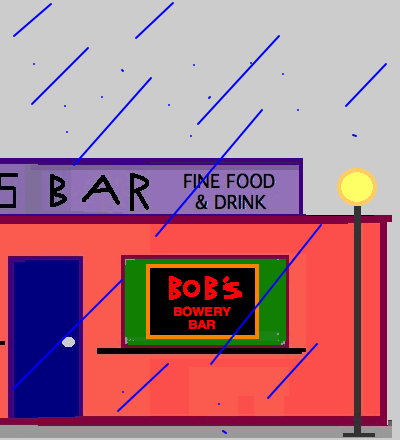
One rainy day in early April a big guy wearing a trench coat and a fedora came into the bar and took a stool. He had a salt-and-pepper beard and he looked to be about fifty.
“Can I help you?” said Bob.
The bearded man pointed at the hand-painted sign above the mirror.
TRY OUR BASEMENT BREWED HOUSE BOCK
“You really brew your own bock beer in the basement?”
“Sure do.”
“Okay, I’ll take a flyer.”
“Eight-ounce glass, twelve-ounce schooner, or imperial pint.”
“Would you be offended if I started off with just a glass?”
“Not at all.”
“Okay, I’ll try a glass.”
Bob got him a glass of bock from the tap.
“That’ll be a dime.”
“Sure.”
The stranger took out his wallet and put a ten on the bar.
When Bob brought him his change the man said, “Hey, this is pretty good bock. It reminds me of the bock I drank back when I was young, skiing in the Harz Mountains of Germany: cold, rich, thick, and strong. With notes of the native spruce trees and peat bogs.”
“Glad you like it.”
The big man pointed to Bob’s ring.
“Marine corps?”
“Twenty years.”
“The fighting leathernecks.”
“Yeah.”
“Got nothing but respect for you guys,” said the big man. “Hemingway’s the name. What’s your name, pal?”
“Bob.”
“Pleased to meet you, Bob. Ernest is my first name.”
“Pleased to meet you, Ernest.”
“Maybe you’ve read my some of my books. Ernest Hemingway?”
“Oh, right, yeah, I’ve heard of you.”
“Ever read any of my stuff?”
“I don’t think so.”
“Well, anyway, your bock is really good.”
“Thanks.”
Just then a little guy in a tan raincoat and carrying a black umbrella came in the joint. He folded up the umbrella and looked around. He was fifty or so, he had a thick moustache, and he wore a Panama hat on his head. He walked over to where Ernest Hemingway sat.
“As I live and breathe,” said the moustached man.
“Jesus Christ,” said Hemingway. “Wild Bill! Sit down, buddy. I don’t believe it.”
The moustached man climbed up on the stool to the left of Hemingway, and hooked his umbrella on the edge of the bar.
“Hey, Bob,” said Hemingway, “want you to meet an old friend of mine – Bill Faulkner.”
“Hi, Bill,” said Bob.
“What’re you drinking, Bill?” said Hemingway.
“What’s that you got there, Ernie?”
“It’s the basement-brewed house bock, really good.”
“Okay, I’ll try one, and a shot of bourbon. You got any Cream of Kentucky, Bob?”
“Sure.”
“Then I’ll take a glass of your house bock and a shot of Cream of Kentucky, on my father here.”
“Ha ha,” said Hemingway, “same old Bill. Hey, Bob, give me another glass of bock too, and I guess I’ll have one of those Cream of Kentuckys myself.”
“Excuse me,” said Philip, who was sitting to Hemingway’s right. “I couldn’t help but overhearing. But – Ernest Hemingway and William Faulkner?”
“How come I get second billing?” said Bill.
“Ha ha,” said Hemingway.
“Heh heh,” said Philip. “This is such an honor to meet you both. My name is Philip.”
“Hi, Philip,” said Hemingway.
“Pleased to meet you,” said Faulkner.
“Such an honor,” said Philip. “I think you two gentlemen are probably our two greatest living American authors.”
“We won’t ask which one is the greater,” said Bill.
“Ha ha,” said Philip.
Bob came over with the two glasses of bock, and he poured out two shots of Cream of Kentucky.
“Hey, Bob,” said Bill. “Give Philip there whatever he’s drinking, on me.”
“Thanks, Mr. Faulkner,” said Philip. “I guess I’ll take another Manhattan, Bob.”
Philip had an almost full Manhattan in his hand, but he lifted it up, drained it, and put it down.
“So you’ve actually read our stuff, Philip?” said Hemingway.
“Oh, of course I have,” said Philip. “My God.”
“What’s your favorite?”
“Of your books, Mr. Hemingway?”
“Yeah.”
“That’s a hard one,” said Philip.
“I agree,” said Bill. “That’s a very hard one. But I’ll give you a tip. It probably didn’t come out any sooner than twenty years ago.”
“Ha ha,” said Hemingway. “Very funny. Go ahead, Philip, what’s your favorite?”
“Wow, gun to my head?”
“Gun to your head.”
“Okay, I’m going to say The Grapes of Wrath.”
“Oh, wow,” said Bill.
“I loved that book,” said Philip. “It was just so moving. And, like, a really trenchant study of the poor working classes of our country.”
“Oh, wow,” said Bill, again.
“Do you agree, Mr. Faulkner?” said Philip.
“Oh, absolutely,” said Bill. “Grapes of Wrath. Magnificent novel.”
Bob came over and poured out a fresh Manhattan for Philip.
“Out of here, Bob,” said Bill, and he shoved a ten forward on the bar.
“Thanks, Mr. Faulkner,” said Philip. He picked up the Manhattan and drank half of it in one go, then sighed. “But you know what’s my favorite of your books, Mr. Faulkner?”
“I’d love to know,” said Bill.
“The Great Gatsby,” said Philip. “Amazing novel.”
“The Great Gatsby?” said Bill.
“Ha ha,” said Hemingway. “Ha ha. Ha ha ha.”
{Kindly go here to read the “adult comix” version in A Flophouse Is Not a Home, illustrated by the illustrious rhoda penmarq.}

April 2, 2020
“A Mob of Loners”
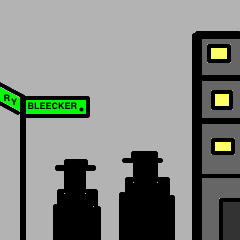
The Bleecker Street Boys weren’t the biggest mob on the Lower East Side, not by a long shot, but they were the most feared, for the simple reason that none of them cared if he lived or died. They were the hardest of the hard cases, and they didn’t like anybody, not even themselves. When they weren’t planning or pulling off a job they never hung out together.
The nominal boss of the gang, Georgie “Gaga” O’Reilly went home to the flat he shared with his mom, and read cowboy novels to pass the time.
Petie “Peepers” Silverstein spent his free time playing poker, and losing as much as he won, not that he cared either way; he just liked playing poker.
Albert “Uncle Albie” Albogino, the oldest of the mob at the age of thirty-three, liked to play handball against a warehouse wall, all by himself, all day.
Stevie “Slick” Slivovitz sat in Washington Square Park all day, playing chess with himself. If it was raining or snowing he sat in the back booth at Ma’s Diner at Bleecker and the Bowery, playing chess with himself.
Howard “Hobie” Hobart pounded the heavy bag for a couple of hours every morning at Gleason’s Gym up in the Bronx, then he would take the Third Avenue El back downtown and drink bock beer at Bob’s Bowery Bar. He always sat at the bar alone, and he talked to no one except to Bob, and precious little to him. Usually everybody left him alone, but one evening Philip the uptown swell had decided to get his load on again and came in and took the stool next to Hobie.
Philip ordered a Manhattan, and when he got it he turned to Hobie.
“I think I’ve seen you in here before, fella. Call me Philip.”
Hobie looked at Philip but didn’t say anything.
“May I know your name, sir?” said Philip.
It was a busy Friday night, otherwise Bob would have already intervened by now. He was good at that sort of thing, twenty years in the United States Marine Corps had not been wasted on him. But he was currently engaged in pouring beers and drinks for other customers way down at the other end of the bar, and so there was no one there to suggest to Philip that he cool it before he wound up with a hard left hook to the jaw or worse.
“Ah,” said Philip, “you prefer to remain incognito! And I’m sure you have very good reasons for doing so. If I were smart I would also keep myself nameless. If not blameless, ha ha! Nameless but not blameless, no, sir, hardly. Unlike many of the fine people in this splendid caravanserai I freely admit I have no one but myself to blame for a life of dissipation –”
“Buddy,” said Hobie, at last.
“At your service, sir.”
“I like drinking here.”
“So also I! A wonderful place! Why –”
“I like drinking here so much that I would hate it if Bob would have to bar me from the joint for knocking you off that barstool and then stomping you with my steel-shanked shoes to a bloody pulp.”
“I would hate that, too, I assure you.”
“Then do us both a favor. Shut the hell up and leave me alone.”
“I only wanted a friendly chat.”
“I don’t.”
“So you really just want to sit there all alone, not talking to anyone?”
“That’s exactly what I want.”
“But doesn’t it get boring?”
“No.”
“So you just sit there, staring at those rows of liquor bottles and at the mirror?”
“Yeah.”
“But what do you think about?”
“You don’t want to know what I think about.”
“But I do. Please tell me.”
“I think about how life is for the birds. I think about what a pain in the ass people are. I think about guys I want to slap around the next time I see ‘em.”
“And that’s it?”
“After a while I think I’m getting hungry, so I think about what I’m gonna eat.”
“Do you eat here?”
“Yeah. This is the only place I eat at.”
“What do you like to order?”
“The burger with hand-cut fries is good. Sometimes I’ll go for one of Bob’s Mom’s specials.”
“Y’know, I’ve been coming here off and on for years, but I’ve never eaten here.”
“The specials are always good, and the burger and fries.”
Suddenly Philip became aware of the blackboard above the mirror, scrawled with the words
TODAY’S SPECIAL
BOB’S MOM’S MULLIGAN STEW - .35¢
“What about that mulligan stew,” said Philip. “Have you ever tried that?”
“Many times,” said Hobey.
“And what do you think?”
“To die for.”
“That good?”
“That good.”
“Wow, I’m not hungry now, but later maybe I’ll give it a try.”
Who was Philip kidding? He never ate when he was on a bender. He probably wouldn’t eat until a day or two after his family’s man that detective Joe Hooley found him again and either dragged him out to his parents’ house in the country or to the rest home, depending on how long the bender lasted. But it was nice at least to think about eating a nice mulligan stew.
He remembered suddenly that the nameless fellow had asked to be left alone, and so Philip shut up now, and stared into his drink.
For his part Hobie took a drink of his bock and wondered why out of nowhere he had just said more to this chump in a few minutes than he had to anyone, including the guys in his gang, for weeks, maybe months.
And the really weird part was that he suddenly realized that he felt like talking to the guy some more, but when he turned and looked at him the guy was staring intently into his drink, as if he were lost in thought, and so Hobie kept his trap shut.
{Kindly click here to read the “adult comix” version in A Flophouse Is Not a Home, profusely illustrated by the illustrious rhoda penmarq.}

March 26, 2020
"The Second Stone"

“You know what the Bible says?” said Gilbey the Geek. “Hey, Purple, I say you know what the Bible says?”
Purple hadn’t turned purple yet, but it was early yet.
“I know a lot of what the Bible says,” said Purple. “And, for your information, I prolly know a hell of a lot more about what the goddam Bible says than you’ll ever know.”
“Yeah,” said Gilbey, “but you know what in particular the Bible says?”
“What, Gilbey? What? Just come out and say it fer Chrissake.”
“Let him what is without sin cast the first stone.”
“What?”
“Let him what is without sin cast –”
“Awright, awright, I heardja the first time. So what?”
“Let him what is without sin cast the first stone.”
“Jesus Christ, Gilbey –”
Sure enough, Purple was starting to turn purple now.
“But,” said Gilbey the Geek, “what about him what casts the second stone?”
“What?”
“The first guy what casts a stone, let him what is without sin cast that first stone, okay, I get it, fair enough, but what I am asking is what about him what casts the second stone? Don’t he gotta be without sin? Or not. What I am saying is maybe, just maybe – maybe it’s only that first guy what casts a stone that’s gotta be without sin. But, if somebody already did cast a stone – and this should preferably be somebody who ain’t got no sins on his soul – then it’s like anybody can cast that second stone.”
“What?”
“I am saying that you’re allowed to throw the second stone even if you do got sins on your soul, but you just ain’t allowed to throw the first stone.”
“That is the stupidest goddam thing I ever heard.”
“It makes sense, Purple. Ya see, this is why so many people get stoned. Because it only takes some guy to throw that first stone, and then everybody just rushes in fallin’ all over each other to cast that second stone.”
Purple didn’t say anything, and oddly enough his color started to fade from deep purple back to its normal bright red. He took a drink of his bock.
“Everybody,” said Gilbey. “Everybody can cast that second stone, and everybody will cast it. Except very few. Very few, Purple.”
Neither of them said anything for a minute. Purple took another drink from his glass, emptying it. Gilbey just stared at his own empty glass. He was out of dough, which was a shame. He sure would like another bock.
Bob came over.
“Another one, Purple?”
“Yeah,” said Purple. “Give Gilbey one too.”
“What?” said Bob.
Purple had never bought a drink for anyone in his life.
“Give Gilbey a bock too.”
“Can I get a imperial pint?” said Gilbey.
“No,” said Purple. “Just a glass, just like me. What do I look like, John D. Rockefeller? Just a glass, and be glad you’re gettin’ that much.”
Bob took the empty glasses and went over to the taps.
“First stone,” said Purple. “Second stone. They both hurt, no matter who throws them.”
“And every stone after that,” said Gilbey.
“Until you croak,” said Purple.
“Until you croak.”
“Then you don’t feel nothin’,” said Purple.
“Unless you go to Hell,” said Gilbey.
“Oh, Christ,” said Purple.
“Unless you go to Hell and burn in the everlasting fires of Hell,” said Gilbey.
“Hey, do me a favor,” said Purple.
“Sure, Purple,” said Gilbey.
Bob brought the fresh bocks over and laid them down. Purple slid two dimes forward, and Bob picked them up and went away.
“Just drink your bock and be quiet, Gilbey,” said Purple. “You think you can do that?”
“Sure, Purple.”
Both men picked up their bocks and took a good drink. They set down their glasses, and another minute passed silently into oblivion.
“You know what else the Bible says?” said Gilbey.
{Kindly click here to read the “adult comix” version in A Flophouse Is Not a Home, profusely illustrated by the illustrious rhoda penmarq.}

March 19, 2020
"Strange"
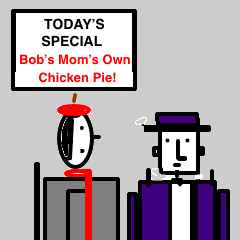
“I got strange desires,” said Gilbey the Geek.
“Why you telling me this?” said the guy they called Purple, on account of when he got mad his face turned from its usual bright red to deep purple.
“I don’t know,” said Gilbey, “just to make conversation. Don’t you wanta know what my strange desires are?”
“No,” said Purple, and you could tell he was on his way to turning purple, “I don’t want to know what your strange desires are.”
“You sure?”
“Absolutely.”
Gilbey turned to his left, where fat Angie the retired whore was sitting.
“Hey, Angie, you know something? I got strange desires.”
“Yeah, you and the rest of the bums in the world.”
“You want to know what my strange desires are?”
“No.”
“Not at all?”
“Not at all.”
“That ain’t very open-minded of you, Angie.”
“I’ll open-mind you, Geek. I’ll crack your skull like an egg with this Rheingold beer bottle. How’d you like that?”
“So you really don’t want to know what my strange desires are.”
“Buzz off.”
“All right,” said Gilbey. “You ain’t got to be rude, Angie.”
“Tell your story walking,” said Angie.
Gilbey picked up his half-drunk glass of bock, now grown warm and flat, and walked over to the poets’ table. The usual crew were all there: Hector Phillips Stone, the doomed (yet somehow still alive) romantic poet; Seamas McSeamas, the professionally hearty Irish poet; Howard Paul Studebaker, the Western poet who had never ventured farther west than the Delaware River; Frank X Fagen, the nature poet who hadn’t departed the island of Manhattan since 1937; Scaramanga the leftist poet, drummed out of the Communist Party for conduct unbecoming of a comrade; and Lucius Pierrepont St. Clair III, the Negro poet who had once been a rising star in the Harlem Renaissance until too much of what he himself termed “excessively militaristic behavior in my cups” had exiled him down to the Bowery.
“I got strange desires,” said Gilbey, to the table as a whole.
“What?” said Frank X.
“Strange desires,” said Gilbey. “You guys mind if I sit with you and tell you about them?”
“Yes,” said Hector. “We mind.”
“You guys are poets, you should be innerested in stuff like strange desires.”
“Beat it, Gilbey,” said Howard.
“I’ll be quick,” said Gilbey.
“How about you be quick about taking a hike,” said Scaramanga.
“I got strange desires,” said Gilbey. “I gotta tell somebody about ‘em.”
“Listen, Gilbey,” said Seamas, “none of us wants to hurt your feelings, but go find a hole to dry up in.”
“Hey, Lucius,” said Gilbey, “you’re a Negro. You know what it’s like to be oppressed and all. You’ll listen to me, won’t ya?”
“No,” said Lucius. “Do I look like a priest? Now scram.”
But Lucius had given Gilbey an idea, so he went over to where Father Frank the defrocked whiskey priest sat at the bar.
“Hey, Father Frank, I got strange desires. You want to hear ‘em?”
“If you want me to hear your confession I charge one shot of Cream of Kentucky bourbon whiskey.”
“I ain’t got no money. Can I owe ya?”
“No.”
“But –”
“Hop it, Gilbey. The good lord’s got no time for pikers.”
In near despair Gilbey looked around and saw Philip the uptown swell, down here on another one of his benders, sitting alone at one of the little tables near the men’s room. Gilbey went over and sat down across from him.
“Hey, Philip, I got strange desires, you want to know what they are?”
“Strange desires?” said Philip, after a long pause.
“Yeah, strange desires. You want to hear about them?”
“Sure,” said Philip. “Fire away.”
“It’s like this,” said Gilbey.
Suddenly Philip pushed his whiskey glass to one side, crossed his forearms on the table top, laid his head on his arms, and began to snore.
Not to be deterred, Gilbey the Geek proceeded to tell the sleeping Philip all about his strange desires.
{Kindly click here to read the “adult comix” version of this tale in A Flophouse Is Not a Home, profusely illustrated by my esteemed colleague rhoda penmarq.}

March 14, 2020
“A Father’s Advice”
One cold grey day in March a young fellow carrying a duffel bag came into Bob’s Bowery Bar, and after looking around in the smoky dimness he came up to the guy everybody called Buffalo Bill, on account of he was so cheap they said he squeezed a nickel so hard he made the Indian ride the buffalo’s back.
It was mid-afternoon, not too crowded, and Buffalo Bill was sitting alone at the bar nursing a glass of bock and waiting for some fool to come in and sit next to him and maybe buy him another bock.
“Dad?”
Bill turned and looked at the kid.
“Jimmy?”
“Yeah, it’s me, Dad.”
“What’d ya do, bust out?”
“No, I turned eighteen, so they had to let me out.”
“You’re eighteen?”
“Yeah, eighteen today.”
“Happy birthday.”
“Thanks, Dad.”
Buffalo Bill was afraid the kid was going to ask him for money, but, what the hell, he couldn’t just tell him to get lost, could he?
“Well, sit down, boyo. You’re eighteen now, old enough to drink like a man.”
“Well, I don’t really want a drink, actually, Dad.”
“You don’t? Why the hell not? You ain’t a pansy, are ya?”
“No, but it’s only two in the afternoon, and I ain’t much of a drinker anyways. I mean, I been in reform school since I was twelve.”
“Don’t they make moonshine there, pruno?”
“Sure they do, but that homemade stuff don’t taste so good.”
“You sure you ain’t a pansy?”
“Pretty sure.”
“Well, sit down, anyway.”
The kid laid down his duffel bag and sat down. Bob came over.
“How old are you, kid?”
“I just turned eighteen today, sir.”
“This is my boy, Bob,” said Bill. “He just got out of Hell Gate reform school today. How about one on the house for him to celebrate his birthday?”
“Because you’re too cheap to buy your own son a birthday drink?”
“Wow, Bob,” said Buffalo Bill. “I mean, you know, wow.”
“You want a drink, kid?” Bob asked the kid.
“Could I just have a ginger ale?” said the kid.
“Sure,” said Bob.
Buffalo Bill looked worried, so Bob said, “Don’t worry, Bill, I’ll let him have a ginger ale on the house for his birthday, and because he just got out of Hell Gate.”
“Hey, that’s real nice of you, Bob,” said Buffalo Bill, suppressing a great sigh of relief.
Father and son were quiet as Bob went and got a ginger ale, laid it in front of the kid, and then went back to reading his Federal-Democrat at the end of the bar.
After a minute the kid said, “So what you been doing, Dad?”
“Ah, you know,” said Buffalo Bill, “this and that. I got a few irons in the fire. What about you? Gonna go back to boosting cars?”
“Nah, I’d like to not be locked up for a while, if you know what I mean.”
“Sure,” said Bill. “I can see that. Nothing wrong with that. So you gonna get a job or something?”
“I was thinking of joining the navy.”
This time Buffalo Bill couldn’t help himself and he did sigh, with relief.
“Hey, that’s great, kid. Join the navy and see the world.”
“Yeah, well, I just thought I’d say hi since I just got out of the place.”
“I’m glad you did, son, glad you did. You see your mother yet?”
“She’s dead, Dad.”
“Oh, right, I forgot.”
Neither of them said anything for another minute, and then the kid said, “Don’t worry, Dad, I ain’t gonna ask you for nothing, and I can get a room myself till I go in the navy.”
“I guess you made some good money making them hubcaps, huh?”
“Not so great, Dad, but after six years I got enough to hold me for a month or so maybe.”
“That’s great, kid. Really great.”
This was turning out to be not so bad for Bill after all.
The kid finished his ginger ale.
“Well, I guess I’ll be shoving off now, Dad.”
“Great seeing ya, kid. Drop me a postcard from one of them foreign ports once in a while.”
“Yeah, sure.”
“You can always address it to Bob’s Bowery Bar and I’ll get it.”
“Okay.”
The kid got off his stool.
“One last word of advice,” said Buffalo Bill.
“What’s that, Dad?”
“Never do nothing you don’t got to do.”
“Never do nothing I don’t got to do.”
“That’s right. I been doing nothing forty-eight years and you know how many regrets I got?”
“None?”
“That’s right, Jimmy boy. None. It’s doing stuff that gets you in trouble, every time. Just don’t do nothing unless you really got to do it.”
“Okay. I’ll remember that.”
“And good luck with the navy, kid. Twenty years, even better thirty years, you can retire with a good pension. You’ll be my age, sitting pretty, all the dough you need. Thirty years.”
The kid said nothing, nodded, then picked up his duffel bag, slung it over his shoulder and walked out.
It was starting to drizzle. The way he looked at it, he had two choices, find a car and boost it and go for a joy ride, or else just take the A train down to the navy recruiting office on Chambers Street. He decided to make up his mind on the way to the subway, depending on if he saw a likely car with the keys in it.
{Kindly go here to read the “adult comix” version in A Flophouse Is Not a Home, brilliantly illustrated by the illustious rhoda penmarq…}

March 5, 2020
“I Ain’t No Good”
“I ain’t no good,” said Bosco. “I been in jail. More than once. I ain’t smart neither. And I got a temper. Also, I admit it, I’m lazy, and I like to drink. But all in all I ain’t the worst guy in the world.”
Maybe he wasn’t the worst guy in the world. That had to mean something, right?
“All right then,” said Janey. “Tell ya what, you can buy me a drink.”
“Okay,” said Bosco. “And I appreciate your saying that. A classy dame like you. I do. Only thing is I just spent my last dime on this here bock I just finished drinking, and, to be honest, I was hoping maybe you would buy me a drink.”
“You’re asking a dame to buy you a drink.”
“I am, Amy.”
“Janey.”
“I am, Janey. Asking you to buy me a drink. And you know why?”
“’Cause you ain’t got no money?”
“Yes, that is the primary reason I guess, but my secondary reason, you wanta know what that is?”
“Dying to, Roscoe.”
“Bosco.”
“Dying to, Bosco.”
“My secondary reason I’m asking you to buy me a drink is I ain’t got no pride. And you know why I ain’t got no pride?”
“Why, Roscoe?”
“Bosco.”
“Why, Bosco?”
“Because it says in the Bible, pride goeth before a fall.”
“That what it says?”
“It’s in the good book, Amy.”
“Janey.”
“It’s what it says in the good book, Janey. Pride goeth before a fall, so if you ain’t got no pride you ain’t got nowhere to fall.”
“’Cause you’re already down in the gutter.”
“That is one way of looking at it. And I’ll admit it, all my life that’s where I been. In the gutter.”
“At least you’re honest, pal.”
“Actually I’m a compulsive liar. I don’t know why, but I am, and you know what? Even if I did know why I’d probably just lie about it.”
“What if you’re lying now?”
“That could well be.”
“So anyway, you want me to buy you a drink.”
“I do, Amy, and that ain’t no lie.”
“Janey.”
“Janey,” he said.
“What’d you say your name was again? Cisco?”
“Bosco.”
“Tell ya what, Bosco, I’ll buy you a drink.”
“I guess it would be too much to ask for a boilermaker.”
“You mean a shot and a beer?”
“Yeah. I mean if you consider a shot and a beer as one like libation – a boilermaker if you will.”
“You got a lot of nerve, I’ll give you that that much.”
“Nerve is one thing I got. I ain’t got pride, but I got a lot of nerve.”
“All right, I’ll buy you a boilermaker, but nothing expensive.”
“How about just another glass of bock and a shot of Cream of Kentucky.”
“All right. I oughta have my head examined, but okay.”
“Thank you, Amy.”
“Janey.”
“Thank you, Janey.”
“Hey, Bob,” called Janey. “When ya get time, another tokay for me, and a glass of bock and a Cream of Kentucky for my father over here.”
Bosco and Janey traded a few quips while Bob got the drinks, and when he laid them down Janey tapped her little pile of crumpled one-dollar bills and small change.
“Outa here, Bob.”
Bob took three quarters and a dime and went away, and Janey raised her glass of tokay.
Bosco raised his shot of Cream of Kentucky.
“You’re a class dame, Amy,” said Bosco.
“And you’re a bum, Roscoe,” said Janey.
They drank, and a month later they went to City Hall, both of them tight as ticks, and tied the knot.
{Please click here to read the “adult comix” version in A Flophouse Is Not a Home, lavishly illustrated by rhoda penmarq.}

February 27, 2020
“The Ballad of Addison the Wit”
He had a real name of course, although no one knew or cared what it was, because shortly after he began haunting Bob’s Bowery Bar a year or so ago some wag (was it Seamas McSeamas the Irish poet?) had dubbed him “Addison the Wit”, after the character “Addison DeWitt” in the movie All About Eve; the joke, the bad joke being that Addison the Wit was always trying to be scathingly witty just like the character in the movie – trying but abysmally failing.
And now poor Gerry “the Brain” Goldsmith was trapped here at the end barstool on this crowded Friday evening at Bob’s, with Addison sitting to his left and not another empty seat in the house.
Gerry liked to drink (of course he did), but he liked to drink at a gentlemanly, leisurely pace, short glasses of Bob’s basement-brewed house bock, and hardly ever a whiskey. But now, here he had been stuck next to Addison a half-hour by the clock on the wall, a half-hour that felt like a year, and he was already on his third imperial pint of bock and his second double Cream of Kentucky. At this rate he would have to be carried home in another half hour. But what could he do, except suffer, and hope against hope that he would notice a stool open up somewhere down the bar.
He hadn’t said more than three words to Addison this whole time, but that hadn’t stopped Addison and his flow of failed witticisms, oh, no, on and on he and it went –
“And so I said to the chap,” he droned, “my dear fellow, if she were to be any more tawdry she would be on sale at Woolworth’s! Ha ha, on sale at Woolworth’s!”
Gerry said nothing.
Addison smiled, he didn’t care, or if he cared he sure didn’t show it, he even turned to his left where the big river boss Tommy McCarthy sat, but Tommy merely glared at him, and Addison quickly turned back to Gerry.
“As if everything at Woolworth’s isn’t normally cheap and tawdry,” he explicated, “but you see, this lady was so cheap that she could have been on sale even at Woolworth’s!”
Gerry merely sighed, and took a good sip of his Cream of Kentucky.
“So,” said Addison, “have you heard about this new Cocteau film at the Thalia?”
Gerry said nothing. He heard words coming from Addison’s mouth, but his brain and the bock and whiskey had filtered the words of any meaning they might possibly hold.
“I find Cocteau to be more,” said Addison, “how shall I put it, more ambitious than artistically successful, but then is not ambition the fatal curse of any artist? By the way, you know what I always say, ‘When I hear the word Art I reach for my peashooter.’ Get it, not my revolver but my peashooter, because, really, isn’t most so-called art –”
“Hey, Addison,” said Janet the waitress. She was transferring some empty glasses and bottles from her tray to the service area at the end of the bar, just to Gerry’s right. “Shut the hell up.”
“I beg your pardon, dear Janet, heh heh,” said Addison.
“I said clam the hell up. Can’t you see you’re boring the Brain to death?”
“But, my dear Janet, Gerard and I are merely having some carefree repartee –”
“Beans,” said Janet. “The whole time he’s been sitting there you haven’t taken a breath from your blathering for one second. Give the poor guy a break and put a lid on it for a while.”
“But, but –” said Addison.
“But nothing,” said Janet. “Why don’t you get it through your thick skull that you ain’t George Sanders, or Clifton Webb, or Monty Wooley, nor Oscar Levant neither. You’re just some boring bum in a bar.”
“Heh heh,” said Addison. “Oh, my, Janet, you are a spitfire, heh heh –”
Janet ignored him.
“Don’t worry, Brain,” she said, “soon as I see a spot open up somewheres I’ll come and get you and you can get free of this idiot.”
She went off with her empty tray.
“Heh heh,” said Addison. “That Janet! Quite the little hellcat she is. The tongue of an adder, and quite a merciless adder at that! Of course she didn’t mean a word of it. Heh heh. Heh heh. Heh.”
And then a strange thing happened.
Gerry felt sorry for Addison.
How strange.
That one could feel sorry for someone so tedious.
And yet there it was, and Gerry couldn’t deny it.
And then Gerry found himself saying something that before this moment he never would have dreamed he could possibly say, not in a thousand years:
“May I buy you a drink, Addison?”
“Pardon me?” said Addison.
“I said may I buy you a drink.”
“You want to buy me a drink?”
“Yes.”
Addison then did something he rarely if ever did: he paused before speaking, and Gerry even thought he could see tears welling in the man’s eyes.
“Why, yes,” said Addison, “thank you, Gerry, don’t mind if I do. You know what I always say about drinking, I always say, heh heh, I always say –”
Gerry mentally turned the volume down on Addison’s voice, and raised a finger to attract Bob’s attention.
{Kindly go here to read the “adult comix” version in A Flophouse Is Not a Home, illustrated by the illustrious rhoda penmarq.}

February 20, 2020
"Trapped"

“Master,” said the apprentice monk, “what is the meaning of life?”
“Come closer, my son,” said the ancient monk, and the apprentice monk leaned closer.
The ancient monk snapped a quick left jab to the apprentice monk’s nose, and the lad fell back onto his posterior.
Stanching the flow of blood with the sleeve of his robe the young apprentice said, “So that is the meaning of life, Master, a punch to the nose?”
“Come closer again, my son,” said the ancient monk.
He had bruised the knuckles of his left hand, so this time he gave the boy a stout right cross to the jaw.
Whew!
It had taken Gerry “The Brain” Goldsmith all afternoon just to come up with those six sentences, but they were good ones, if he did say so himself. He left the sheet of paper in his trusty old Royal portable, so he would be all set to resume work on his “book of philosophical reflections” on Monday. But today was Friday, the beginning of the weekend, and even though Gerry had no “real” job (unless you could call writing his book a job), and indeed had never held a job in all his forty-seven years of life on this planet, he still considered it just and meet to give himself the weekend off from his literary “work”. He believed it was essential to rest his brain and let it lie fallow after five days in the trenches of reflection and creation. Time for a bock!
Gerry threw on his old camel’s hair chesterfield, wrapped his threadbare Andover rowing-team muffler around his neck, put on his twenty-seven-year-old Brooks Brothers fedora, left his little efficiency apartment, and went down the six flights to Bleecker Street.
Snow was falling yet again from the darkening sky. Gerry loved the gentle beauty of the snow, as long as he didn’t have to spend too much time in it, and fortunately his haunt Bob’s Bowery Bar was just right around the corner…
The place was packed, with those who had just got off work, and with those who didn’t work, and those like Gerry who “worked” but didn’t get paid for it. God, how Gerry loved this place. A man – especially a literary man, a philosopher – needed a home away from home, especially when his home was a tiny one-room flat (formerly a storage closet) with a two-burner hot plate. As much as he enjoyed his work, a man needed to get out, to see people, to talk, and, yes, to drink!
But where to sit? Bob’s was usually crowded at this time on a Friday, but today it seemed even more mobbed than usual. All the tables were full, and men and women stood two and three deep at the long bar. Gerry would have loved to join his friends “the poets” (Hector Phillips Stone, the doomed romantic poet; Seamas McSeamas, the hearty Irish poet; Howard Paul Studebaker, the Western poet from Hackensack; Frank X Fagen, the nature poet who never left the Lower East Side; good old Scaramanga, the leftist poet who was always more than ready to let loose with a rousing song of the Spanish Civil War; and genial Lucius Pierrepont St. Clair III, the Negro poet) but the round table at which the poets usually sat was full to capacity. Of course Gerry could join those standing at the bar, but his old Harvard lacrosse knee injury had been acting up lately, and he found it difficult to stand for more than a few minutes. But wait! What did he spy through the fog of tobacco smoke but an actual empty stool down there at the far right of the bar! Quickly he headed for it before someone else could claim the real estate.
Gerry heaved himself up on the stool (he really must work on losing a few pounds, perhaps start doing the odd push-up and sit-up of a morning – he would start tomorrow!) and, breathing a sigh of relief, laid a crumpled dollar bill on the bar.
“And how was today’s assault on the pantheon, dear Gerard?”
Gerry flinched, and realized with horror why this end-seat was empty. Reluctantly he turned to his left and saw none other than the colossal bore everyone called Addison the Wit.
Damn the bad luck!
“Have you nudged Aristotle from his pride of place yet, dear boy?”
Gerry sighed again, this time in despair. It was true, he considered himself a philosopher, but sometimes it was hard, sometimes it was so damned hard to be philosophical.
“Found out yet the meaning of so-called life in this vale of tears?”
Bob came over, took his cigar out of his mouth just long enough to say:
“Usual, Brain?”
Usually Gerry paced himself with short glasses of Bob’s delicious basement-brewed house bock, but if he must sit next to Addison the Wit, there was nothing for it but…
“I think this evening I’ll start with the imperial pint of bock, please,” he said to Bob.
“Ah, the imperial pint,” rhapsodized Addison, “a fitting libation for the emperor of unpublished philosophers!”
Gerry flinched, again, and then quickly said, before Bob could head for the taps:
“Oh, and Bob, a shot of Cream of Kentucky too, please.”
“Ah,” said Addison, “the Cream of Kentucky, to loosen the tongue of the Wittgenstein of the beer stein, the bard of the Bowery –”
“Second thought, make that a double, Bob,” called Gerry to Bob, who was already drawing the imperial pint.
Bob nodded. He understood.
(To be continued, next week, unless I get hit by a truck.)
{Please click here to read the “adult comics” version of this story in A Flophouse Is Not a Home, illustrated by the amazing rhoda penmarq.}

February 13, 2020
"Pick-Up and Delivery"

After six days and (according to his notes) seventy-nine different bars, Joe finally caught up with Philip at a joint called Bob’s Bowery Bar, down at the Bowery off Bleecker.
“Oh, hi, Joe,” said Philip, after staring at Joe’s face for a full minute.
“Finish your drink, Mr. Mortimer, then we’re taking a ride.”
“What if I don’t want to go?” said Philip, after a long pause. At this stage of his week-long bender there were more or less long pauses between every sentence or sentence fragment he uttered.
“We can do it the easy way or we can do it the not so easy way, Mr. Mortimer, but either way we’re doing it.”
Philip took another long pause, or another long pause took him. He turned and looked at old Bob over there behind the bar, smoking a cigar.
“Bob?” he said.
“Time to go, Philip,” said Bob.
Another long pause.
“Yes, I suppose you’re right. Thank you, Bob.”
He shoved his pile of money forward across the bar.
“That’s too much, Philip,” said Bob.
“Well, get the bar a round on me then, and you keep the change, please, Bob.”
Philip raised his glass of bock, and emptied it.
“Okay, Joe,” he said. “Let’s go.”
He almost fell getting off his stool, but Joe got his arm, and the two men headed for the entrance, Joe keeping a tight grip on Philip’s arm.
Outside it was daytime, although Philip would not have been surprised if it had been night. The sky was grey like the color of wet cold sand, the sooty snow was piled up on the curbing.
“The usual place?” said Philip.
“The usual place,” said Joe. “Your room is already reserved. We should beat rush hour, and with luck we’ll be there in less than two hours.”
“Maybe I’ll sleep in the car.”
“It would probably be best if you did,” said Joe.
“Do you have a little something for me, just in case I can’t sleep?”
“I got a fresh pint of Cream of Kentucky in the glove compartment, Mr. Mortimer.”
Philip took a deep breath of the cold air.
“Okay,” he said. “Let’s do this.”
They made it in an hour and forty-five minutes. At the reception desk it took Philip half a minute to sign the form, and then he put down the pen and turned to Joe.
“Well,” he said, “here I go again. Thanks, Joe.”
“Good luck, Mr. Mortimer.”
They shook hands. Philip’s hand was as cold as a dead fish lying on ice.
“Until next time,” said Philip.
“Until next time,” said Joe.
He stopped at this diner he knew nearby off the Hudson River and had a good meal, baked ham with pineapple and red-eye gravy, mashed potatoes, stewed cabbage, fresh warm rolls, a slice of apple pie with cheddar cheese, a pot of coffee. It got dark outside, and then it started to snow. Joe paid his bill, got the receipt for his expense account, went out to the Studebaker and started the long drive back to the city.
{Please click here to read the “adult comics” version of this fable in A Flophouse Is Not a Home, illustrated by the legendary rhoda penmarq.}