Dan Leo's Blog, page 30
February 6, 2020
"Who Cares?"
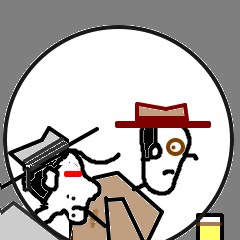
Philip was so drunk that he was living almost entirely in the present moment. Anything less recent than the past minute was a blur, and had been a blur for almost a week now, although he was only vaguely aware of the number of days; if someone had asked him how long he had been on a bender he would have paused and said something like, “At least three days, I should think, or, wait, four? Five? Less than two weeks, certainly, I hope, anyway. What was the question?”
Right now he was talking to a guy here in Bob’s Bowery Bar. He knew he was in Bob’s because there was good old Bob over there behind the bar himself, and he hadn’t even thrown Philip out yet. Good man, Bob!
“He asked me my favorite football team,” said the guy. What was his name? He was a dull guy, whoever he was. “I told him I’m sure I haven’t got one,” said the dull guy. ”Now if they had asked me my favorite playwright I should have said without a moment’s hesitation Philip Barry, followed very hard by Kaufman and Hart.”
“What?” said Philip.
“He asked me my favorite football team,” said the guy. “I told him I’m sure I don’t have a favorite.”
“Favorite?”
“Yes, a favorite football team.”
“Who cares?” said Philip.
“Who cares if I have a favorite football team? Or who cares about football teams at all?”
“What?”
“I don’t follow,” said the guy.
“You don’t follow.”
“No, heh heh, I don’t quite follow your, uh, question –”
“The question,” said Philip.
“Yes,” said the boring guy. “I don’t quite understand what the question is.”
Philip only stared at the boring guy for a moment, maybe two moments, or was it a minute? And then he said:
“What question?”
“What question?” said Mr. Boring Man. “The question of who cares what my favorite football team is, or, perhaps, the question of who cares what anyone’s favorite team is.”
“Favorite football team?”
“Yes. Precisely.”
Philip paused for another moment or a dozen moments, he didn’t know how many and he didn’t care, and then he said:
“You know who my favorite football team is?”
“I assure you I have no idea,” said this boring guy.
Addison, that was what they called him! Addison the Wit, because he was always trying to be like George Sanders in that Bette Davis movie. Addison DeWitt? Addison the Wit. The witty guy who wasn’t witty…
“Please don’t keep me in suspense,” said Addison the Wit. “I can only bate my breath for so long, dear chap.”
“What?” said Philip.
“Your favorite football team.”
“What about it?”
“What is it?” said old Addison.
“Who cares?” said Philip.
Addison took pause. If Philip had not been buying he might have moved to another stool, if not in high dudgeon, then certainly in at least a mild huff, or perhaps simply turned in the other direction, give him a bit of the arctic icy cold shoulder. However, Philip was buying the drinks and had shown no sign of stopping buying them, and so one did what one had to do. All part of the spiritual dues one must pay for membership in the sacred brotherhood of Bacchus!
“Anyway,” said Addison, trying to put a brave face (or a seemingly brave face) on the situation, “anyway, this chap asked me what my favorite football team was, and you know what I told him?”
“Who cares?” said Philip.
{Kindly go here to read the “adult comics” version at A Flophouse Is Not a Home, illustrated by the illustrious rhoda penmarq.}


January 30, 2020
“The Bowery don’t look so bad in the snow”
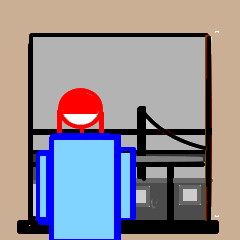
“Nice view you got up here of the el tracks,” said Janet. “And down over them rooftops you can just see the Brooklyn Bridge. Still there in case you ever decide you want to jump off it again.”
Hector Philips Stone, the doomed romantic poet, said nothing, and drank the hot tea with milk and honey she had brought him in a large take-out cup.
Janet lighted up a Philip Morris, shook out the match and laid it on the window sill. She leaned her head to the side, looking up at that sky the color of the sidewalk down below.
“Looks like snow again,” she said. “The Bowery don’t look so bad in the snow.”
She turned to Hector, lying in his narrow bed. He was unwrapping one of the sandwiches she had brought.
“You want me to crack this window, Hector, let a little fresh air in for a minute?”
“It’s stuck,” he said. Ham salad. He loved ham salad. “I haven’t been able to open it since early November. I guess I could have asked Mr. Morgenstern to open it, but I didn’t want to, especially because I had to ask him to close it in the first place.”
He took a bite of the sandwich. Delicious – even better than Grandma Stone’s!
Janet looked at the window, as if taking its measure, and then she hit its upper sash with the heel of her right fist, once, twice, three times.
“It’s really hopelessly stuck Janet,” said Hector, talking with his mouth full.
Janet put her cigarette between her lips, grabbed the two worn metal sash-pulls, gave them a good yank, and the window opened, letting in the cold air of the Bowery, which did not smell so bad six floors up from the street like this. “Just a crack,” she said, lowering the window a bit. “Blow some of the stink out. I’ll close it up when I leave.”
Hector swallowed, wiped his lips with one of the paper napkins she had brought.
“Y’know, Janet,” he said, “I really can’t thank you enough, taking care of me while I’ve been laid up like this.”
“Hey, least I can do since I’m the one laid you up,” she said.
“I deserved it,” he said.
“That’s true,” she said. She flicked the dead match on the sill with her fingernail, sending it flying out the window. “Young guy like you. Educated, and a poet and all. Wanting to jump off the goddam Brooklyn Bridge.”
“You don’t understand,” he said.
“Yeah, I guess I don’t. Me, I was born in this crumby neighborhood, but you don’t hear me talking about jumping off no bridges.”
“You’re stronger than I am, Janet.”
“Yeah,” she said. “But anyways, I got a kid sister and brother to support. Who’s gonna take care of them two if I top myself?”
“Well, I can never repay you.”
“I ain’t looking to get repaid, Hector. Oh, by the way, you got some mail.”
She reached into her old cloth coat and brought out a letter, tossed it over to the bed.
Hector picked it up. From Smythe & Son, Publishers. Another rejection letter, doubtless.
He tore it open, and read:
Dear Mr. Stone,
We have read your collection, Doom Be My Destiny, and are very interested in publishing it, if some deletions and odd changes would not be unamenable to you. Perhaps you are free this coming Friday, and if so I would be delighted to give you lunch, and we can talk the whole matter over. My preferred midday dining spot is the Rose Room at the Algonquin, easy stumbling distance from our offices, and I think you will find the food quite edible and the cocktails refreshing not to mention an excellent cellar. You did not mention if you have representation, but if you do have an agent, feel free to bring him (or her) along as well, as my guest of course. Do please call the number printed above, and I’ll have my secretary make the reservation. Shall we say about one-ish?
Sincerely,
Julian Smythe
Director of Acquisitions
Hector folded up the letter and replaced it in the envelope.
“Janet,” he said, “how would you like to be my literary agent?”
{Please click here to read the “adult comic” version in A Flophouse Is Not a Home with illustrations by the redoubtable rhoda penmarq.}

January 23, 2020
"Basket Lunch"
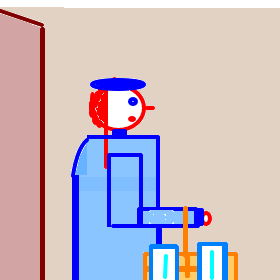
Hector Philips Stone felt terrible. It’s true that normally this doomed romantic poet felt more or less terrible, but today he felt extra terrible. Not only was he subsumed by his usual Weltschmerz, along with just an average hangover, but his jaw, his left shoulder, and his left kneecap all ached terribly from where Janet, the beautiful waitress at Bob’s Bowery Bar, had smacked him with her leather sap the night before. And why? All because she had overheard him announcing his intention to jump off the Brooklyn Bridge after the bar closed down.
Next time he would keep it to himself, God damn it! Just go down to the bridge and do it without first broadcasting it to all the world, or at least to the tiny portion of the world consisting of Bob’s bar and its patrons and staff.
Well, he would never be able to make it to the bridge today, that was for sure. It was all he could do to limp the six feet to his little bathroom and and then back to his bed, forget about making it all the way down six flights of stairs to the street, even if he did have bus fare to the bridge, which he hadn’t.
On top of everything else he was hungry, starving! Once again he had forgotten to eat the previous day, preferring to spend the last of his Christmas money on bock beer and shots of Schenley’s whiskey at Bob’s. So maybe he wouldn’t have to go to the bridge after all, maybe he would starve to death. Not as dramatic as jumping off the bridge, but pretty damned romantic and pathetic, that was for sure.
It occurred to him that he might jump out the window, but his lone window was stuck, and had been stuck ever since Mr. Morgenstern had managed with great difficulty to close it when the cold weather came this past November. Of course he could try to break the window pane, but he hated to put Mr. and Mrs. Morgenstern to the expense of replacing the glass, especially since he was over a month in arrears on his $20-a-month rent.
Misery. Such was his lot. He wondered if he had some aspirin, and he was thinking about dragging himself out of bed and hobbling to the bathroom to check the medicine cabinet, when a knocking sounded on his door.
“Yes, who is it?”
“It’s me, Janet.”
Janet? Had she come to finish him off?
“Let me in, Hector.”
“Come in, it’s not locked.”
He never locked the door, knowing he would only lose the key if he did.
Janet came in, carrying a wicker basket, covered with dishtowels.
“I thought you might be hungry.”
She came over and sat on the side of the bed, and laid the basket down, pulling off the dishtowels.
“You got sandwiches here, roast beef, chicken, liverwurst and ham-and-cheese. A container of split pea soup, eat that before it gets cold. Some hard-boiled eggs, and there’s hot tea with milk and honey in this big container. This here is Bob’s Mom’s boysenberry pie, still warm. Eat up, and I asked Mrs. Morgenstern to check in on you later today to see if you need anything. How’s your knee, anyway? Is it broke?”
“I don’t think so.”
“Let me check.”
She started to pull the bedclothes away, Hector’s old army blanket and the quilt his Grandma Stone had made for him when he went away to college. Hector drew his legs up and grabbed at the covers.
“Janet, please! I’m not dressed!”
“You wearin’ underpants?”
“Yes, but –”
“Oh, please, don’t you know I got a little brother?”
She yanked away the blankets and felt Hector’s swollen knee.
“Okay, it ain’t broke. Another week or two you’ll be dancing the black bottom with the best of them.”
Hector covered up his legs.
“I assure you I have never danced the black bottom and never will.”
“Whatever.”
She had laid out all the provisions on Hector’s little night table, and now she stood up, taking the empty basket and the dish towels.
“I’ll stop by tomorrow around the same time. Rest that leg, and don’t go jumping off any bridges in the meantime.”
Without another word she left Hector’s small room, closing the door behind her.
Hector waited until he heard her steps going down the stairwell, and then he broke into great heaving sobs. Three minutes later he caught his breath, wiped his face on his grandma’s quilt, and then he began to eat and drink.
{Please click here to read the full-fledged “adult comics” version in A Flophouse Is Not a Home, with illustrations by the illustrious rhoda penmarq.)

January 16, 2020
“Something to Whine About”

Janet laid down the fresh pitcher of bock.
“I’ve had it,” said Hector, the doomed romantic poet.
“Ah, we’ve all had it, lad,” said Seamas the Irish poet.
“Up to the ears,” said Scaramanga the leftist poet.
“And out the butt,” said Frank X Fagan the nature poet.
“Had it and been had by, son,” said Lucius Pierrepont St. Clair III, the Negro poet. “The game was fixed before you were born.”
“We have all heard that high sad moaning whine across the prairie,” said Howard Paul Studebaker, the western poet.
“Tonight I do it, damn it,” said young Hector. “Down to the Brooklyn Bridge, and off I go.”
“We’re heard that before, me boyo,” said Seamas.
“That old sad song,” said Scaramanga.
“But somehow it never grows old,” said Frank X.
“The Comanche call it the coyote’s song of death,” said Howard.
“Just make sure you go all the way out to the middle of the bridge,” advised Lucius. “You don’t want to botch the job.”
“I won’t botch the job,” said Hector. “Just you guys wait and see.”
“Hey, Hector,” said Janet, who had been standing there the whole time. “Can I talk to you a minute?”
“What about?” said Hector. This was unheard of, beautiful Janet actually asking one of these bums to talk to her.
“I just want to talk to you a minute. Step outside with me and we’ll have a smoke.”
“But it’s cold out there,” said Hector.
Janet just stared at him, and so he said okay.
Outside it was snowing again, and they stood under the slight shelter provided by the entranceway of Bob’s Bowery Bar.
“What is it, Janet?” said Hector. He was wearing his old army overcoat, he hadn’t taken it off all night, nor his Greek fisherman’s cap, but Janet only wore her old threadbare cardigan.
She offered Hector her pack of Philip Morris Commanders, and of course Hector took one. Janet popped out one for herself, and she gave them both a light.
“So you’re gonna top yourself, hey, Hector?” She flicked the match out into the falling snow. “Jump off the Brooklyn Bridge.”
“Yes,” said Hector, “in point of fact I am, and please don’t try to talk me out of it, Janet, because my mind’s made up.”
“Oh, I won’t try to talk you out of it. But can I ask you exactly why you wanta jump off the bridge?”
“Because I’m tired of it all, Janet! The rejection, the failure, the poverty, the, the, gee, all of it.”
“Tired of it all, huh?”
“Yes, tired to my soul.”
“Okay, I can understand that. But, Hector, before you take that long jump, can I at least give you somethin’?”
“Gee, sure, Janet. What is it?”
Hector for a brief moment thought he might be getting a kiss, a farewell kiss, but instead Janet brought her leather sap out of her apron pocket and whacked him hard across the jaw with it. Hector fell back against the wall and slid down to the pavement, and Janet drew back and gave him another stout whack on the shoulder. Crying, Hector curled up in pain, but Janet leaned over and gave him one more well-placed whack right on the kneecap, and he screamed, but his scream was softly muffled by the thick falling snow.
Janet straightened up, and slid the sap back into her apron.
“Now you got something to whine about,” she said.
She went back in the bar and told the poets to go outside and carry Hector back to his trap around the corner.
Maybe someday Hector would jump off the Brooklyn Bridge, but he sure wasn’t going to do it tonight.
{Kindly go here to read the “adult comic” version in “A Flophouse Is Not a Home”, illustrated by the immortal rhoda penmarq.)

January 9, 2020
“Hector’s New Year’s Resolution”

It was new year’s eve, and Hector Philips Stone, the doomed romantic poet, had but one resolution for the new year: the next day, January the first, he would walk out to the middle of the Brooklyn Bridge and jump off, and good riddance to it all – the failure, the struggle, the tedium, the poverty…
Earlier this day it had occurred to him, for no particular reason, to check his mail box downstairs, something he tended to do no more often than once a week if that, and, lo and behold, what should he find in the midst of the usual pile of rejection letters from literary magazines and publishers, but a Christmas card from his dear old Grandma Stone, and in it, oh happy day, was a twenty dollar bill.
Twenty bucks! Just enough, in fact way more than enough, for one final grand blowout around the corner at Bob’s Bowery Bar. One last glorious drunk, and then after the bar closed at 4 am and Bob kicked everyone out, that ultimate long reeling walk through the slums down to the East River, shimmering grey and cold in the sickly glow from an opaque sky the color of a filthy old circus tent, and then out to the enormous hulking bridge and the end of it all…
Hector pulled on his old army overcoat, wrapped his muffler around his thin long neck, pulled on his Greek fisherman’s cap, and went down the six flights of stairs to Bleecker and a driving snowfall and then around the corner to Bob’s Bowery Bar.
It was only five o’clock but already the joint was packed with boisterous revelers, including all the usual gang of failed poets, all sitting at the usual round top: loud and hearty Seamas McSeamas the Irish poet, who always spoke in a shout if he spoke at all; Howard Paul Studebaker, the “western poet”, born and bred in Hackensack, whose entire experience of the west had been six weeks on a dude ranch in New Mexico when he was twelve years old, before his old man lost his money in the crash; Frank X Fagen the nature poet, who probably hadn’t been closer to nature than Washington Square Park in a dozen years; Scaramanga, the leftist poet, despite the fact that he had been drummed out of the Communist Party for unrepentant dipsomania and general obstreperousness; and Lucius Pierrepont St. Clair III, the Negro poet, whose specialty was poems of the Harlem tenements, although he had lived for years just up the block at the Parker Hotel flophouse, and hadn’t actually been up to Harlem since he had been bounced out of the old Cotton Club one night in 1934 for drunkenly invading the stage in an attempt to declaim his poetry during a Cab Calloway performance. But these were Hector’s friends, his only friends, and so it was fitting that his last night on earth should be spent in their company.
Hector was not well known for buying rounds, and so imagine his buddies’ surprise when he hailed Janet the waitress and ordered two pitchers of Bob’s basement-brewed bock for the table as well as shots of Schenley’s whiskey for all.
This was just about the last thing Hector remembered clearly of this new year’s eve. There were songs, shouted songs of Irish rebels from Seamas, cowboy songs sung in a surprisingly clear tenor by Howard, “On the Banks of the Wabash” from Frank X, “The International” and some supposedly Spanish Civil War songs from Scaramanga, “Ol’ Man River” from Lucius, and even Hector let loose with a favorite Gregorian chant. Beyond that was only oblivion…
Hector awoke the next day with the worst hangover of his life, which was saying something. He was lying in his bed fully-clothed, still wearing his old army coat, his muffler, and his Greek fisherman’s cap. He forced himself out of bed to the bathroom.
When he had finished voiding his bladder he stared at his thin unshaven face in the mirror. Boy, what a blowout that had been! Despite his killing hangover he felt terrifically hungry. Had he not eaten yesterday?
He staggered out of the bathroom and sat down on his bed.
On his night table, right next to the overflowing ashtray (on which was painted the legend THE ST CRISPIAN HOTEL WHERE THE SERVICE IS SWELL was Grandma Stone’s Christmas card. He picked it up and read her palsied handwriting:
Dear Hector,
Please put this twenty to good use.
Love,
Grandma
Well, if getting absolutely bombed was putting the twenty to good use, then he had followed her injunction to the letter.
Hector wondered if he had blown the entire twenty, and he searched his pockets. Mirabile dictu, he found five crumpled one dollar bills. Happy day, he could go across the street to Ma’s Diner and treat himself to an enormous hangover-dulling breakfast, and then come back to his room and have a good long nap!
Hector went down the six flights to Bleecker, and once again it was snowing. It was dusk and the street lights were blinking on in the swirling snow. So he had slept through the whole day – no wonder he was so hungry!
So this was the new year. Had he made any resolutions? He had a vague idea that he had made at least one, but the devil if he could remember what it was. He walked up to the corner of the Bowery and crossed Bleecker Street to Ma’s. Thank God she ran her breakfast menu all day long, because Hector was in the mood for eggs and scrapple, home fries, toast with lots of butter, half a dozen of Ma’s homemade doughnuts, a big slice of apple pie with vanilla ice cream, and lashings of Ma’s strong black coffee. What a great way to start the new year!
{Please click here to read the “adult comic” version in A Flophouse Is Not a Home, with illustrations by the inimitable rhoda penmarq.}

January 2, 2020
“New Year’s Eve Story; or, Back to the Bowery”

It was December 31st, and Reggie Wertham had finally spent all but ten bucks of the three hundred and forty dollars he had rolled from that passed-out swell in the alleyway next door to Bob’s Bowery Bar. That had been Thanksgiving day, so he had had a good five weeks living high off the hog here at the Hotel St Crispian.
The St Crispian was a nice clean old-fashioned Greenwich Village hotel, reasonably priced, with good food and pleasant entertainment downstairs at the Prince Hal Room. Reggie had made friends with Mortimer the elevator operator and Jake the bellhop and Olaf the doorman (through the time-honored method of tipping them each a fin on his first night here), and the three of them had seen to Reggie’s every modest want. Jake had even asked Reggie if he would like some tail, but Reggie hadn’t taken him up on the offer. To be quite honest he was afraid a piece of tail would be a bringdown – you know, thinking about the girl’s impoverished background and sick little brother, that kind of thing. No, Reggie preferred to spend the swell’s gelt on steaks and chops and cocktails in the Prince Hal Room, on Philip Morris Commander cigarettes and a warm and comfortable bed in a room that was not in a flophouse.
But now he was down to his last ten, and it was time to say goodbye to the St Crispian.
He dressed in the new grey flannel suit he had bought at Al’s Tall and Small Men’s Shop down the street on 7th Avenue, his new stout Thom McAn brown brogues, and the passed-out swell’s red-and-grey regimental-stripe silk tie and Camel’s hair topcoat and felt trilby hat with a blue feather in it.
He was clean, bathed, freshly shaved and barbered, and he knew he wouldn’t be any of those again for quite some time, if ever.
Reggie picked up his cheap new Gladstone with a couple of changes of fresh linen in it, and left his room for the last time. He went across the hall with no regrets and pressed the elevator button.
On the way down Mortimer said, “So you’re leavin’ us, Mr. Wertham.”
“Yes, I am,” said Reggie. “Business calls, I’m afraid. But here, Mortimer, I want you to have this.”
He handed Mortimer a one-dollar bill.
“Gee, thanks, Mr. Wertham,” said Mortimer. “Have a good business trip, and I hope you’ll be stoppin’ with us again next time you’re in town.”
“I certainly shall, Mortimer.”
Outside on Bedford the sky was grey and snow was just beginning to fall. Reggie turned up the collar of his topcoat.
“You want cab, Mr. Vertam?” said Olaf, the ancient doorman.
“No, thank you, Olaf,” said Reggie. “I think I’ll walk.”
“Is good to walk in snow,” said Olaf.
“Yes, it is,” said Reggie. “Well, happy new year, Olaf.”
“Happy new year, Mr. Vertam,” said Olaf, “and as we say in my old country, may your akvavit be strong and fiery like your women.”
“Ha ha,” said Reggie, and he started down the steps. But then he stopped and turned, went back up to Olaf and gave him a dollar, which left him with seven, because he had given Jake a buck in the lobby.
Seven bucks, way more than enough for a grand new year’s eve blowout at Bob’s Bowery Bar and a fifty-cent cot at the Parker Hotel flophouse.
He turned left and started walking in the falling snow, back down to the Bowery.
It was New Year’s Eve, and, who knew, maybe it wouldn’t even be his last one…
{Please go here to read the “adult comic book” version with illustrations by the illustrious rhoda penmarq.)

December 22, 2019
“The Bob’s Bowery Bar Christmas Miracle”
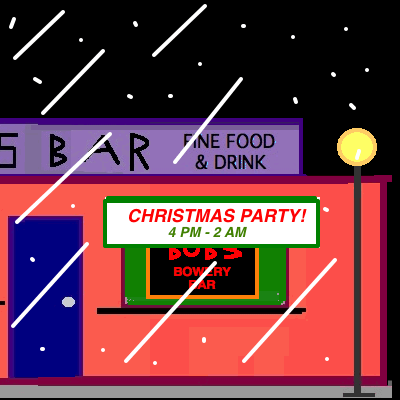
“Gee, them girls was sumpin,” said Little Joe, the littlest of the five or six guys named Joe who frequented Bob’s Bowery Bar. “They was really sumpin. I ain’t never seen girls like them in here before.”
“And you never will again,” said Seamas McSeamas, the Irish poet. “’Twas an aberration, lad. An errant shifting of the stars and planets.”
“They said they was gonna come back in on Christmas Eve for Bob’s annual Christmas party,” said the guy they called Wine, because all he drank was white port wine and lemon juice.
“Them girls was in their cups when they said that,” leaned in fat Angie, the retired whore who now sold artificial flowers on the street. “They won’t come back in this joint. Them girls was class, my friend – high class.”
“High class they was, Angie,” said Seamas. “Terpsichoreans by profession.”
“You watch your mouth, you drunken Mick,” said Angie. “They was ladies and I ain’t gonna sit here listenin’ to you impugn ‘em.”
“I was not impugning them, dear Angie,” said Seamas. “A terpsichorean you see is a dancer.”
“Then whyn’tcha say that instead of showin’ off with your big words, ya pretentious Paddy bastard ya.”
Seamas could see Bob looking at them from down the bar, so he let it go. No one ever won an argument with Angie, retired whore or not.
“Gee they was swell babes,” said Little Joe. “I sure would like to see ‘em again.”
“Me too,” said Wine. “I wouldn’t try to talk to them or nothing. I just would like to look at them.”
“Me too,” said Little Joe. “I wouldn’t know what to talk to them about anyways.”
“Ladies like that don’t talk to bums like youse guys,” said Angie.
“I realize that, Angie,” said Little Joe. “I’m just sayin’ is all.”
“The Brain talked to them,” said Wine. “I seen ‘em. They was just chatterin’ away with the Brain.”
“The Brain is an educated man,” said Seamas. “A philosopher.”
“He’s a bum,” said Angie.
“That may be true,” said Seamas, “but he is an educated bum if you will, and a philosophical one.”
“A bum,” said Angie.
“He went home with ‘em,” said Wine. “I seen ‘em. Went out the door together.”
“That is because they live in the same building round the corner,” said Seamas.
“They live around here?” said Little Joe.
“Right around the corner,” said Seamas.
“Maybe they will come in then,” said Little Joe. “For the party I mean.”
“Don’t bank on it, baby,” said Angie.
“I’ll tell ya one thing,” said Wine. “I ain’t leavin’ here all night, just in case they do come in.”
“You better take it easy on that white port wine and lemon juice then,” said Angie.
It was only five in the afternoon on Christmas Eve and so the annual Bob’s Bowery Bar Christmas Eve party was hardly in full swing yet, but not only Wine, but Little Joe, and Seamas, and even Angie, they were all determined to stay here all night just in case the two beautiful girls did show up. Of course, they all no doubt would have stayed all night anyway, or for as long as their funds lasted, but now they had a real reason not to go anywhere else, a reason even more important than the desire for drunken oblivion and loud meaningless roistering.
The time passed, and more of the usual crowd rolled in out of the snow falling outside, and at seven Bob and his mom and Janet the waitress laid out the annual free Christmas buffet: pretzels and chips, hard-boiled eggs, hot cross buns, pigs-in-blankets, and three big hotel pans filled with hot roast beef in gravy, hot turkey in gravy, and hot ham in red-eye gravy, with a mountain of kaiser rolls to make sandwiches with. Many of the regulars hadn’t eaten all day in anticipation of the free once-a-year feast, and Bob prevented no one from coming back for more, even Seamas, who ate at least seven sandwiches and no one knew how many hardboiled eggs and pigs-in-a-blanket.
The one regular customer notably missing all night was Gerry “the Brain” Goldsmith, but it was known that Gerry came from a wealthy family, so maybe he was scrounging off them this Christmas Eve; it was possible, if only faintly so.
The hours tumbled loudly by, the bar was packed, but still the two beautiful young ladies had not appeared.
Little Joe actually began to cry into his bock beer.
“They ain’t comin’,” he said. “They ain’t comin’. They ain’t comin’ tonight nor never.”
“Brace up, lad,” said Seamas. “At least you saw them that one night. Try to remember that, and hold tight to the memory in your heart.”
“Just one more time I wanted to see ‘em,” said Wine. “Just once. I wouldna tried to talk to them or nothin’. Honest. I wouldna scared ‘em away. I only just woulda looked.”
“I toldjez they wouldn’t come,” said Angie. “Ladies they was. Real ladies. Sumpin you clowns wouldn’t know about.”
More time roared by in drunkenness and shouted carols, and if anything the bar got even more packed, but then, just as the old Ball railroad clock above the bar clicked midnight, the front door opened, letting in a blast of snow and icy air. As if on command everyone in the bar fell quiet and turned to look. The only sound was Bing Crosby on the juke box, singing “I’ll Be Home for Christmas”.
At first the swirling snow obscured the man holding the door open, but then everyone could see it was no other than Gerry Goldsmith, known as the Brain, in his same old ancient chesterfield coat and battered grey fedora. Looking outside, he made a gallant waving motion with one arm, and who should walk in like two goddesses out of the Christmas falling snow but the two beautiful young ladies, the blonde called Pat and the brunette named Carlotta. Pat wore a leopard-spotted pillbox hat and Carlotta a snow-dappled red beret. Laughing they entered, and the smiling Brain pushed the door shut against the snowstorm.
“It’s a miracle,” whispered Little Joe.
“A Christmas miracle,” said Seamas.
“Now I know there is a God,” said Wine.
“Ladies,” said Angie. “Real ladies. Smiling at Christmas on the likes of us, and God bless ‘em.”
Well, I’ll be damned, thought Bob, and he decided right then he wasn’t going to charge those girls for a single drink, and, what the hell, the Brain too. Because it was a miracle.
A goddam Christmas miracle.
{Kindly click here for the “adult comic book” version in A Flophouse Is not a Home , with art by the fantastic rhoda penmarq.}

December 19, 2019
"The Butler"
“Oh, my dear God!” said Carlotta.
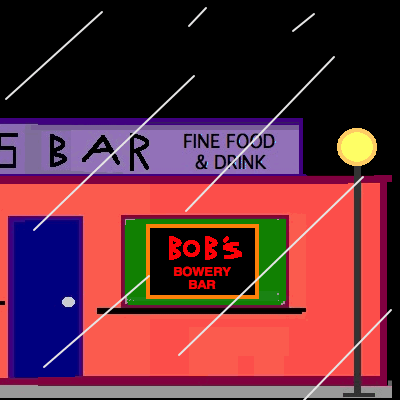
“What,” groaned Pat, from her bed on the other side of the “oriental” folding screen which afforded them at least the fantasy of more than one room in their apartment (“Lg studio w/kitchenette & bath. Heat water electric incl. Bleecker off Bowery”).
“Oh my dear God in Heaven!” said Carlotta.
“What?” said Pat.
“I’m so hungover!” said Carlotta.
“Oh,” said Pat. “Is that all it is. I thought maybe a rat jumped up on your bed and was staring at you.”
“Heh heh,” said Carlotta, as opposed to actually laughed Carlotta.
“What did we do last night?” asked Pat, not in the sense of what awful thing did we do last night, but rather a simple curious question as to what in fact the two girls had done.
“We went to Bob’s Bowery Bar after we left the Prince Hal Room.”
“No!”
“Yes, we did.”
On their opposite sides of the oriental (made by immigrant Chinese women in a little factory down in Mott Street) partition each girl lay on her back smoking a cigarette. Carlotta had an ashtray on her stomach, a glass ashtray with the words THE ST CRISPIAN HOTEL WHERE THE SERVICE IS SWELL emblazoned on it in gold and red paint. Pat was using an open copy of Photoplay for an ashtray, dropping her ashes on an article titled MONTY CLIFT – HOLLYWOOD’S BROODING LONER? OR SECRET LOVER BOY?
“Oh, my dear Lord,” said Pat, after a half-a-minute’s rare silence between the young ladies. “I remember! What were we thinking?”
“That’s just it,” said Carlotta. “We weren’t thinking. Those guys in the Prince Hal Room kept buying us drinks and we got drunk. And then when they got fresh we ran out and jumped in a cab to supposedly go home.”
“I remember, and when the cab passed by Bob’s Bowery Bar we thought it would be a good night to try it out, heh heh. After that I remember nothing.”
“We were so drunk.”
“I hope we didn’t disgrace ourselves,” said Pat, stifling a yawn.
“It’s a dive. How could we disgrace ourselves there?”
“Good point. Well, at least we got home somehow.”
“I want coffee. I’ll give you a dollar if you make a pot of coffee.”
“The hell with you, sister. You make it.”
“I make splendid coffee,” said a man’s voice.
Both girls screamed and pulled their bedclothes up to their necks, being careful not to drop their cigarettes, although Carlotta’s ashtray and Pat’s Photoplay both slid to the floor.
A man laboriously stood up from where he had apparently been lying on the rug at the feet of the two beds. He was a middle-aged, dumpy fellow, wearing a shabby old chesterfield and a beat-up fedora. Each girl could see exactly one half of him on either side of the oriental Mott Street screen.
“I assume the coffee and percolator are in your kitchenette?”
He smiled at each girl in turn on either side of the screen, his hands folded together in an ingratiating sort of way.
“Who,” said Carlotta.
“Are you,” said Pat.
“Oh,” said the man. “I could have sworn we introduced ourselves last night, but I’m Gerry. Gerard Goldsmith. But please call me Gerry. They all call me ‘The Brain’ down at Bob’s, heh heh, God knows why, but please, call me Gerry.”
Simultaneously each girl suddenly recognized the man as someone they had passed occasionally on the stairs of their tenement apartment house, a funny-looking man who always doffed his hat and said good day or good evening with a shy smile.
“What,” said Carlotta.
“Are you doing here,” said Pat.
“’Gerry’,” said Carlotta.
“You don’t remember inviting me in?” said Gerry, turning his glance from one side of the screen to the other, in order to include both girls in the question.
“We,” said Pat.
“Invited you,” said Carlotta.
“In,” said Pat.
“’Gerry’” said Carlotta.
“Yes, and what a swell time we had!” said Gerry. “In fact, I should say it was the most, what’s the word, scintillating time I’ve ever had in my life!”
Oh, no, thought both girls, simultaneously. Please God no.
“Uh,” said Carlotta.
“Um,” said Pat.
“So, I’d better get to that coffee,” said Gerry. “Don’t you two ladies even budge. Just let me know, cream or black, and how many sugars?”
Both girls paused before answering. They heard the el roar by on the other side of the building, and after its roar had faded Carlotta said cream, two sugars, and Pat said cream, one sugar.
{Kindly click here to read the "adult comic book" version with art by the fabulous rhoda penmarq in A Flophouse Is Not a Home.}

December 13, 2019
"The Genie"
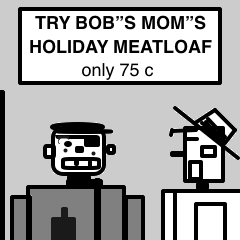
It didn’t happen often, but Harry Beachcroft was stuck. He had been sitting at his battered old Royal portable all afternoon, and he still hadn’t typed a single word. This is what happened when your rent was a month overdue, when you hadn’t had a story or a novel accepted in three months, this is what happened when you really needed to make a sale!
Harry lighted up another Philip Morris Commander and looked out through the thick smoke of his fifth-floor walk-up out at the grey December rooftops of the Bowery, at the elevated tracks, at the sky that promised snow. How he wished he could be downstairs and just around the corner at Bob’s Bowery Bar, hoisting an imperial pint of Bob’s rich basement-brewed bock, carousing with the rest of the gang of pulp writers, bad poets, four-flushers, punks, and assorted reprobates, but he had promised himself he wouldn’t go down to the bar until he had at least knocked out a first draft of a story or the first chapter of a novel or maybe a novella. Something, goddammit!
Why couldn’t a genie suddenly appear out of this cloud of cigarette smoke and tell him a story fully-formed, so that all Harry would need to do was type it up – and Harry was a fast typist, too!
The hell with it, the thing to do was just to start typing, just bash out the first nonsense that came into his head, and let the devil take the hindmost.
And so Harry typed:
Gary Meeker was blocked, blocked goddammit! He had been sitting here in his Bunker Hill hotel room overlooking the Angel’s Flight railway tracks all this hot August afternoon, trying to find a way into this screenplay he needed to write, and write quick, before he got kicked out of his room and had to shift quarters to Skid Row. Mel Melvin over at Colossal Studios had promised him five hundred bucks for an original script in their Range Riders of the Jungle series if he could turn it in by Monday, but here it was Friday and he had idea zero, zilch, nada, nothing! What he wouldn’t give for an angel to drop down from heaven and give him a story idea – an angel, a genie, a devil, Gary didn’t give a damn.
“Well, here I am,” said a voice, kind of like Peter Lorre’s, and Gary turned, and sitting there yogi-style on the unmade bed was a little guy dressed up like an Arabian. He was smoking a roll-your-own, and if Gary was not mistaken it was a reefer. “You say you need a story, Mr. Meeker? I got a million of them. You ready?”
“Sure, pal,” said Gary. “Fire away. But can you make it about the Range Riders of the Jungle?”
“No problem,” said the little guy.
“Okay, then,” said Gary. He cracked his knuckles, then splayed his fingers over his battered old Olivetti portable. “Go.”
And the genie began to tell his tale.
Illustration by the fabulous rhoda penmarq. Click here to read the fully-illustrated "adult comic book" version in A Flophouse is Not a Home.

December 5, 2019
"Hic est enim calix sanguinis mei"

They called him “the whiskey priest”, but strictly speaking this was a misnomer, because Father Frank didn’t care too much what he drank, so long as it had alcohol in it. People also called him a “defrocked priest”, but this was wrong, too; he had never been officially dismissed from the clergy; no, one day he simply walked away from the diocesan “rest home” he had been sent to (for the sixth time), and he never came back, nor did he return to his post at Old St. Pat’s down on Mulberry Street, where he had become infamous for his drunken sermons and for quaffing a whole chaliceful of sacramental wine in one go.
Father Frank now lived in the Parker Hotel, the cheapest flop on the Bowery, and he made his living, such as it was, by begging on street corners, wearing an old army overcoat over his cassock and collecting donations in an ancient tambourine.
“Alms for the poor!” he would call, shaking his tambourine. “Alms for the poor!”
Sometimes, especially if he had been sipping from a bottle, he would get creative and call out: “Alms for the damned! Alms for the wretched and the hopeless and the misbegotten, like myself, yes, like myself!”
It’s true he kept all the donations for himself, but was he not poor after all? Was he not wretched and hopeless and misbegotten?
He had a sideline of sorts, ministering to his fellow bums on the Bowery, dispensing in alleyways the sacred host in the form of Uneeda biscuits, for which he asked in return only a slug or two of Tokay or whatever other libation might be offered. He would also hear confessions, seated on an overturned Andy Boy crate, and always giving a penance of three Hail Marys and three Our Fathers, no matter what the sins, of theft or sloth, of blasphemy or onanism, or even of murder.
When he had the money Father Frank’s favorite stop was Bob’s Bowery Bar, and Bob let no one bother or make fun of him. A single rap on the bar with his Marine Corps ring was the only warning he gave. Bob was not a religious man himself, but in his time in the marines he had seen many mortally wounded men gain some solace in their last gasping breaths thanks to the presence of a chaplain and his murmured prayers.
One night, as he had done innumerable times before, Father Frank slumped forward with his face on his crossed arms on the bar, and as usual, Bob came over and shook his shoulder, saying, “Hey, Father, wake up. This ain’t the Plaza Hotel.”
But this time Father Frank did not wake up. He fell off his stool and down to the sawdust and spittle on the floor, and simultaneously his soul rose up to the gates of God’s great house on a hill.
“Well,” he thought, “I always knew this day of reckoning would come, so let’s get it over with.”
He walked up the winding stone path and finally mounted the steps to the porch, where St. Peter sat at his table with his smoking pipe, his great book open before him. He wore a colorless old canvas jacket, and he looked at Father Frank over his wire-framed glasses.
“No need to go through a great rigamarole, St. Peter,” said Father Frank. “I know I’m guilty, so just point me the way to Hell, and I’ll be on my way.”
“Guilty of what?” said St. Peter.
“Of being a drunk,” said Father Frank. “A hopeless degenerate drunk.”
“Look,” said St. Peter, after a very brief pause, “take this.” He scribbled something on a pad with his quill pen, then tore the sheet off and handed it to Father Frank. “Go in that door there, and hand this over inside.”
Father Frank looked at the piece of paper.
“You mean I’m not going to Hell?”
Again St. Peter took a very brief pause.
“It seems to me,” he said, “as if you’ve already been in Hell for what –” he glanced at the great book before him, “for fifty-three years. Or don’t you agree?”
Father Frank went in the door, handed over the slip of paper to the man there, and a docent led him through many long corridors and cavernous rooms and finally to a bar much like Bob’s Bowery Bar.
“Just sit anywhere you like, Father, table or bar, and a server will be right with you.”
Father Frank found an empty stool at the crowded and smoky bar.
“What can I get you, Father?” said the bartender.
“I’ll take the blood of Christ,” said Father Frank.
“Up or on the rocks, Father?”
{Art by the fabulous Rhoda Penmarq. Kindly click here to read the fullly-illustrated version in A Flophouse Is Not a Home.)