Elizabeth Rusch's Blog, page 27
May 16, 2013
Reminding Myself
I have been traveling much more than usual of late. Travel always sparks new ideas. Perhaps it is because it is spring, or because I’ve been to Italy and Texas and Little Cranberry Isle and back, but my brain is bursting with new ideas. I am always reminded, when I get outside of my own mini-microcosm, how many ways there are to live in this wide world. How many different perspectives, situations, surroundings, events—all shaping the larger cultures, and the smaller ones within. And how many interesting people there are--everywhere!
I remind myself to stop and be grateful. Grateful for all these things, and grateful I had parents and teachers and the rest of the village to remind me to look around and be AWAKE.
It is a marvel, really. A miracle. All of these fascinating things just beyond our own fingertips. Every day brings some new observation, if you’re looking. We talk about research, writing, and revision often, and those topics feel comfortable, like a well-worn pair of work gloves. But it’s the wonder that stops me in my tracks. Those moments when I allow myself to see the world through my own child inside, who is not imposing too much knowledge or point of view on the world. That is when I get my best ideas.
This is a lesson I will remind myself to hold close when I talk with children about writing nonfiction. Or perhaps, I will let them teach me. They are the best at it, after all.

I remind myself to stop and be grateful. Grateful for all these things, and grateful I had parents and teachers and the rest of the village to remind me to look around and be AWAKE.
It is a marvel, really. A miracle. All of these fascinating things just beyond our own fingertips. Every day brings some new observation, if you’re looking. We talk about research, writing, and revision often, and those topics feel comfortable, like a well-worn pair of work gloves. But it’s the wonder that stops me in my tracks. Those moments when I allow myself to see the world through my own child inside, who is not imposing too much knowledge or point of view on the world. That is when I get my best ideas.
This is a lesson I will remind myself to hold close when I talk with children about writing nonfiction. Or perhaps, I will let them teach me. They are the best at it, after all.


May 14, 2013
Good Review / Bad Review
If you write a book, you will most likely get reviewed. Like it or not. Some reviews are perfectly nice; some not so nice. And then there are those reviews which seem to be lazy repeats of the front jacket copy, but that's another story.
I read all the reviews that I get to see (my first book had well over 200 reviews, every one of them carefully clipped out and mailed to me by my publisher; I saw [maybe] ten reviews of my last book, all via e-mail!). Because I always blame myself for falling short, I study every line of the reviews, trying to figure out how to make future books better. I was thinking about my process with reviews a few weeks back and how both the good and bad ones have helped me to re-evaluate and change how I write.
The Good Review: Way back in another time and dimension, I wrote a history of tractors (brilliantly titled -- wait for it -- TRACTORS: From Yesterday's Steam Wagons to Today's Turbocharged Giants, available as we speak at Amazon used books for $0.70). I may have told this story here before, so I'll make it brief. I was telling my Dad about this wonderful, innovative, amazing book about tractors I'd just revised and was ready to mail back to my publisher. After I stopped yammering, my Dad sat back, smiled knowingly, and said: "Jimmy, that'll be a big hit in Russia."
I thought that line was brilliant and laughed out loud. But later I started to wonder who, in their right mind, would actually want to pick up a book about tractors, let alone read it. Panic set in. The package with the manuscript was sitting on a table, very neatly wrapped and ready to go out. But I hesitated. I had to do something before the published book was banished to the far away remainder Gulogs, but what? Which is when I remembered that almost all of the early steam tractors blew up at some point or other, and that the inventors and on-lookers often wrote about these unexpected and exciting developments. I opened the package and spent the following days putting in quotes, many of them offbeat and funny (what's not to laugh about when a giant metal tank of steam explodes?). And guess what; it not only received very positive reviews, but School Library Journal gave it a star (and this was when starred reviews weren't very commonplace).
The thing about the SLJ review is that it mentioned the quotes. Not in any depth; more in passing briefly over what the book was about. I didn't think much of that little phrase until a few years later I began doing research on underage boys from both sides in the Civil War. As I gathered in more and more research, I began to wonder how I would present the information. Happily, I remembered the SLJ review for TRACTORS and decided to let these young soldiers tell their own stories, using pieces from their letters home, diaries, memoirs, and company histories to describe their enlistment, training, battle experience...in short, their stay in the army start to finish. This wealth of firsthand accounts also provided the book's subtitle. THE BOYS' WAR: Confederate and Union Soldiers Talk abop the Civil War received very nice reviews (and it didn't hurt that it was published the very same week that Ken Burns' Civil War documentary was first aired!).
The Bad Review: Okay, this should be 'reviews.' So I was able to have several nonfiction books published and the reviews were encouraging. But one review source, while saying very positive things about these books, also tacked on a brief complaint. They wanted citations for my various sources. Please remember that this was a very different time (the 1980s); most nonfiction books then, even the most serious, usually had a brief bibliography and little else. So when this review source said this, I was troubled and wondered what to do about it.
Here's a bit of publishing history. I'm sure there were people around back then who championed having more sources, but I never came across them. Not in person, that is. When I spoke to editors and other writers, just about everyone thought the idea of extensive notes and sources was a bit, how to say this, excessive. It would take up a decent amount of space in the book (which could be used to add text or illustrations) and would enough kids really use them to justify this? I know, this seems like a silly question now, but back then it was real and we were all trying to puzzle out what to do (or not do).
When the first negative review like this appeared, I had another book at the binder about to appear and another in galley pages (yes, it was a different era). I dithered a bit and both books were published sans notes and sources. And, yes, that review source criticized both titles for this lack of information.
What to do? I wondered. I had another manuscript ready to go off and I was wondering if I should ignore my colleagues and just put in the info. Which was when I happened to have dinner with a friend, Jim Giblin. We spoke about this emerging notes and sources situation (me feeling a bit put upon and undecided about what to do). Jim's response was characteristically practical. Why risk having a negative sentence or phrase soil an otherwise good review. Put the notes in!
Fine, I said. But most backmatter is a bunch of ids and ibids and such that even adults find boring and difficult to interpret. His answer: Have some fun with them.
Which is what I've tried to do ever since. I try to play with and change up the backmatter in every book, shaping it in a way that makes it not just possible for young readers to know where my information came from and how to access it, but easy and non-threatening as well. Every time I do backmatter, I learn new things about how to communicate this to the readers (a quest that will probably never end but keeps me on my toes and having some fun).
Good Review/Bad Review. Each kind is trying to tell me something besides whether the book works or not. Sometimes it takes a while for me to see exactly what it might be, but if I stay open to the reviewer's emotional response and hints, in time it'll register and lead me.
I read all the reviews that I get to see (my first book had well over 200 reviews, every one of them carefully clipped out and mailed to me by my publisher; I saw [maybe] ten reviews of my last book, all via e-mail!). Because I always blame myself for falling short, I study every line of the reviews, trying to figure out how to make future books better. I was thinking about my process with reviews a few weeks back and how both the good and bad ones have helped me to re-evaluate and change how I write.
The Good Review: Way back in another time and dimension, I wrote a history of tractors (brilliantly titled -- wait for it -- TRACTORS: From Yesterday's Steam Wagons to Today's Turbocharged Giants, available as we speak at Amazon used books for $0.70). I may have told this story here before, so I'll make it brief. I was telling my Dad about this wonderful, innovative, amazing book about tractors I'd just revised and was ready to mail back to my publisher. After I stopped yammering, my Dad sat back, smiled knowingly, and said: "Jimmy, that'll be a big hit in Russia."
I thought that line was brilliant and laughed out loud. But later I started to wonder who, in their right mind, would actually want to pick up a book about tractors, let alone read it. Panic set in. The package with the manuscript was sitting on a table, very neatly wrapped and ready to go out. But I hesitated. I had to do something before the published book was banished to the far away remainder Gulogs, but what? Which is when I remembered that almost all of the early steam tractors blew up at some point or other, and that the inventors and on-lookers often wrote about these unexpected and exciting developments. I opened the package and spent the following days putting in quotes, many of them offbeat and funny (what's not to laugh about when a giant metal tank of steam explodes?). And guess what; it not only received very positive reviews, but School Library Journal gave it a star (and this was when starred reviews weren't very commonplace).
The thing about the SLJ review is that it mentioned the quotes. Not in any depth; more in passing briefly over what the book was about. I didn't think much of that little phrase until a few years later I began doing research on underage boys from both sides in the Civil War. As I gathered in more and more research, I began to wonder how I would present the information. Happily, I remembered the SLJ review for TRACTORS and decided to let these young soldiers tell their own stories, using pieces from their letters home, diaries, memoirs, and company histories to describe their enlistment, training, battle experience...in short, their stay in the army start to finish. This wealth of firsthand accounts also provided the book's subtitle. THE BOYS' WAR: Confederate and Union Soldiers Talk abop the Civil War received very nice reviews (and it didn't hurt that it was published the very same week that Ken Burns' Civil War documentary was first aired!).
The Bad Review: Okay, this should be 'reviews.' So I was able to have several nonfiction books published and the reviews were encouraging. But one review source, while saying very positive things about these books, also tacked on a brief complaint. They wanted citations for my various sources. Please remember that this was a very different time (the 1980s); most nonfiction books then, even the most serious, usually had a brief bibliography and little else. So when this review source said this, I was troubled and wondered what to do about it.
Here's a bit of publishing history. I'm sure there were people around back then who championed having more sources, but I never came across them. Not in person, that is. When I spoke to editors and other writers, just about everyone thought the idea of extensive notes and sources was a bit, how to say this, excessive. It would take up a decent amount of space in the book (which could be used to add text or illustrations) and would enough kids really use them to justify this? I know, this seems like a silly question now, but back then it was real and we were all trying to puzzle out what to do (or not do).
When the first negative review like this appeared, I had another book at the binder about to appear and another in galley pages (yes, it was a different era). I dithered a bit and both books were published sans notes and sources. And, yes, that review source criticized both titles for this lack of information.
What to do? I wondered. I had another manuscript ready to go off and I was wondering if I should ignore my colleagues and just put in the info. Which was when I happened to have dinner with a friend, Jim Giblin. We spoke about this emerging notes and sources situation (me feeling a bit put upon and undecided about what to do). Jim's response was characteristically practical. Why risk having a negative sentence or phrase soil an otherwise good review. Put the notes in!
Fine, I said. But most backmatter is a bunch of ids and ibids and such that even adults find boring and difficult to interpret. His answer: Have some fun with them.
Which is what I've tried to do ever since. I try to play with and change up the backmatter in every book, shaping it in a way that makes it not just possible for young readers to know where my information came from and how to access it, but easy and non-threatening as well. Every time I do backmatter, I learn new things about how to communicate this to the readers (a quest that will probably never end but keeps me on my toes and having some fun).
Good Review/Bad Review. Each kind is trying to tell me something besides whether the book works or not. Sometimes it takes a while for me to see exactly what it might be, but if I stay open to the reviewer's emotional response and hints, in time it'll register and lead me.
May 13, 2013
Happy Mother's Day
I was going to write about something entirely different
for this month’s blog but when I typed the first line on Sunday morning, out
came, Thanks, Mom.
Yesterday, of course, was Mother’s Day. At this point in my and my family’s life, I
am the mother who is celebrated with gorgeous flowers, chocolate (two of my
great pleasures) and, if I feel like it, an extracted promise to do some odious
chore.
My mom died in 2006, so she isn’t here to be included in gift
giving. Or phone calls, although we affectionately and impulsively tucked her
favorite, well-used red princess phone into her casket. She was a wonderful mom for many reasons. Given I.N.K.'s focus, I'd like to celebrate how she helped me become a writer just by being who she was.
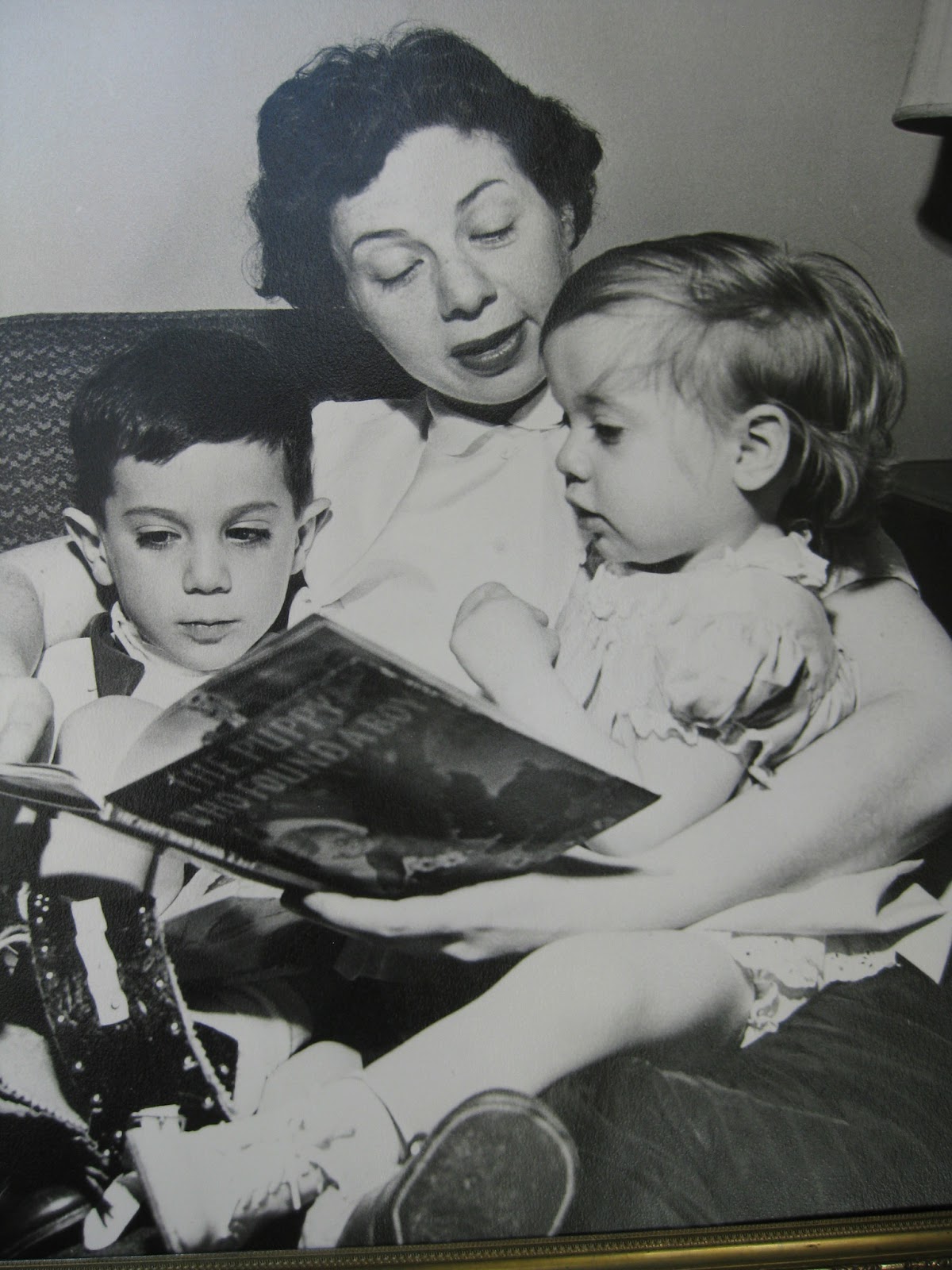
We always had books in the house. We were always read to.
I had a lot of nightmares when I was a kid. So I slept with my door open and the hall
light on, which threw a swatch of light into my bedroom that was perfect for
sneak reading. Let’s just say, I took
advantage of it. I think my mom
knew. She never said a word, doubtlessly
realizing that forbidden fruit is always more delicious.
Once I had a pajama party, maybe in fourth grade, and late
into the night when we went into the kitchen for snacks, we found it had been
invaded by a stream of ants. Our squeals
brought Mom downstairs. I frankly can’t
remember if she dealt with the ants first—or, not at all. All I can see is the picture of my mom
standing in the kitchen in her nightgown, reading The World Book entry about ants to a bunch of girls waiting
for their Swanson’s chicken pot pies to come out of the oven. She always liked to look up things.
When she could afford it, she bought us/her an Encyclopedia Britannica.
A year or two later, I was enthralled by reading Gone
with the Wind. I got in trouble when
 my
myteacher found that I was using my textbook as a shield to camouflage my open
copy. When Mom found out, she
laughed. But her favorite GWTW story was
when I burst into my parents’ bedroom a few nights later, waking her up with the
tearful accusation, “You didn’t tell me it was going to end like that.”
Fast forward--about two years after I got a master’s
degree in psychology that my parents paid for, tried it out and realized the
job wasn’t for me, I decided to become a writer. Somewhat arbitrarily. Then it was what Mom didn’t say that was
important. She didn’t say, you have
never shown much interest in writing before or how will you make money or is
this practical.
And when my first
article came out in the Sunday edition of the Boston Herald American, she called the paper to get a
dozen copies sent to her in Detroit. She wanted originals, not xeroxes. When my first book came out, she just might have put me in the royalty plus column all by herself.
Thanks, Mom.

May 9, 2013
Balance
At critique group this week, four of us sat around a table,
crunching on nuts, sipping iced tea, and talking about balance. All four of us
work at home, which can be great for things like having a flexible schedule.
(Critique group meetings at 2 pm on Tuesdays? No problem.)
But working at home can have its drawbacks, as well—and
that’s where the conversation wound around to after the critiquing was done.
Working at home can be lonely. If I didn’t have a dog, there
might be days when I never left the house.
Working at home can be sedentary. If I didn’t get up for
snacks, I might hardly move at all.
Most of all, working at home can be non-stop, if you let it.
With no time card to punch, no daily commute defining the parameter of the
‘work day,’ you really could work all the time. Writer friends confess to me
all the time that they feel guilty taking time away from their desk to meet a
friend for lunch, take a walk in the park, go out with their husband for
coffee.
But they shouldn’t, and if you work at home, you shouldn’t,
either.
A story a few weeks ago on npr discussed several studies
done on keeping your brain healthy and your memory strong—two things that come
in handy when you’re a writer (or do anything else, for that matter.)
The studies looked at people over 80 and how they fared as
they aged. But the conclusions apply to us all, especially those of us who work
at home:
Physical exercise is key.
Social contact is essential.
And you need to leave your house and get out in the world,
on a regular basis.
So, while I could work all the time, taking the long view of
a productive career (not to mention a happy life) suggests that I shouldn’t—and
I shouldn’t feel guilty about it, either.
I just joined a gym class full of neighbors I’d like to get
to know.
I start today.

May 8, 2013
When Facts Change...Again!
New information can be tough to swallow at times. I wrote previously on I.N.K. about my picture book based on the USDA Food Guide Pyramid that had to be updated due to a change in the graphic (see middle image, below). It happened again in 2011 when the MyPlate program was introduced. Actually, I prefer the plate graphic to the pyramids, which were visually awkward to work with.
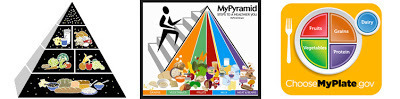
My ever-alert editor at Holiday House, Mary Cash, sent me an email the day the news appeared in the New York Times. It was a surprise, but there's no sense crying over spilled milk, right? Obviously my 1994/2007 book The Edible Pyramid , which was set inside a pyramid-shaped restaurant, was instantly defunct. Or was it? More about that in a second.
A new approach was needed, so I began to noodle on it. For some reason, the idea of having big images of various foods with a small main character popped into mind. Have bugs as characters? Hmmm...obvious downsides to that. How about if the food is accidentally put into a machine that enlarges it...sounds implausible at best, or just plain dumb. Oh! I know who it's gonna be: that classic character Jack, who climbs up the beanstalk! So I wrote the story, yada yada, made a dummy, yada yada, digitally painted the illustrations, and yada yada, here it is:
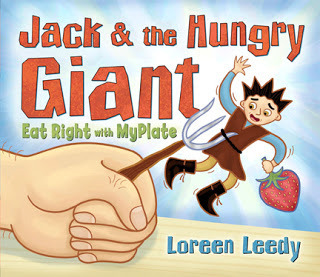
Or will be, soon. It's technically a Fall title, but books have a way of getting around before their official birthday, you know? The story starts out like the traditional fairy tale, but instead of eating Jack, the giant cooks him a healthy meal. The giant, Waldorf, is definitely a good egg.
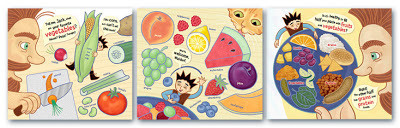
The book is designed to be a fun introduction to MyPlate and hopefully to a lifetime to healthy eating for kids. The goal for the illustrations was to show an abundance of fresh, appetizing foods, the best starting point for good meals. No processed factory foods here, except at the end under the Empty Calories section.
What about the leftovers, the existing copies of The Edible Pyramid? I was surprised to find out that some educators are still using the pyramid system, because the main difference is the presentation rather than the content. It can take awhile for some organizations to make the transition, apparently. So it's still selling, if not like hotcakes.
In any case, I'm looking forward to cooking up some activities to go with the book. Okay, I'll stop with the food and eating sayings now. Stick a fork in me, I'm done!


My ever-alert editor at Holiday House, Mary Cash, sent me an email the day the news appeared in the New York Times. It was a surprise, but there's no sense crying over spilled milk, right? Obviously my 1994/2007 book The Edible Pyramid , which was set inside a pyramid-shaped restaurant, was instantly defunct. Or was it? More about that in a second.
A new approach was needed, so I began to noodle on it. For some reason, the idea of having big images of various foods with a small main character popped into mind. Have bugs as characters? Hmmm...obvious downsides to that. How about if the food is accidentally put into a machine that enlarges it...sounds implausible at best, or just plain dumb. Oh! I know who it's gonna be: that classic character Jack, who climbs up the beanstalk! So I wrote the story, yada yada, made a dummy, yada yada, digitally painted the illustrations, and yada yada, here it is:

Or will be, soon. It's technically a Fall title, but books have a way of getting around before their official birthday, you know? The story starts out like the traditional fairy tale, but instead of eating Jack, the giant cooks him a healthy meal. The giant, Waldorf, is definitely a good egg.
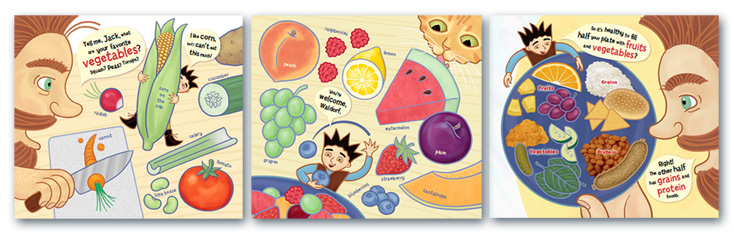
The book is designed to be a fun introduction to MyPlate and hopefully to a lifetime to healthy eating for kids. The goal for the illustrations was to show an abundance of fresh, appetizing foods, the best starting point for good meals. No processed factory foods here, except at the end under the Empty Calories section.
What about the leftovers, the existing copies of The Edible Pyramid? I was surprised to find out that some educators are still using the pyramid system, because the main difference is the presentation rather than the content. It can take awhile for some organizations to make the transition, apparently. So it's still selling, if not like hotcakes.
In any case, I'm looking forward to cooking up some activities to go with the book. Okay, I'll stop with the food and eating sayings now. Stick a fork in me, I'm done!
May 6, 2013
ARE WE HAVING ANY FUN YET? TEACHING TO THE TEST
So today (I’m writing on Monday) I was supposed to do a 9:00
AM test call for an upcoming video conference with some seventh graders. Lo and behold, at 8:30 AM, my screen lights
up and a harried-looking tech person appears amidst stacks of boxes. “Sorry,” she says, “but we have standardized
tests all day long today so I’m in a hurry.” Since our upcoming video conference is based on
a book I wrote about the Revolutionary War, I ask her if the students have
studied that period yet. “Not much,” she
says. “All we do in this state is test,
test, test, so the kids don’t learn a thing.”
Hmmmm….I think she was in such a hurry that she was accidentally
thinking out loud in front of a total stranger.
But she’s definitely not alone. I
hear this same complaint from teachers all the time when I visit schools.
Ever since the No
Child Left Behind Act first reared its head in 2002, kids in have had to take tons
of standardized tests, and if they don’t do well, their schools pay the piper. They stand to lose federal funding and free
tutoring and worse. These tests cover
a very narrow part of the curriculum, but they supposedly show whether kids are
learning or not, whether their teachers are any good, whether students have to
take even more mind-numbing skill-and-drill classes in summer school, and whether
they will stay awake long enough to pass to the next grade. Cheating is common—even
some teachers and principals cheat by upping the test scores because teachers
and principals can get fired or get a fat raise depending upon the results. Kids are bored to death or stress
out over these tests. And nobody is having any fun.
The worst part is
that so much invaluable class time is spent teaching to the tests at the
expense of every single thing that can get kids excited about learning. Who wants to sit in a chair all day long and study
from some dry-as-dust standardized test prep book just to keep their school out
of trouble? And as updated more “interesting”
tests get progressively harder, even more test prep is in the works.
Ahem. Ladies and
gentlemen, there are better ways to teach and there are better ways to learn. Why
would anyone want to give up creative hands-on activities or ignore great music
and art and foreign languages and amazing stories from history just so that
they can mark the right box on a test form?
Who want to cut out class trips, whether they’re to the school library
(to find some great nonfiction books, of course) or to some outstanding museums or to the great outdoors? What
is happening to young peoples’ health when physical education and even recess
give way to studying for the tests? What if a class wants to explore a certain
topic in depth? In many schools, plenty
of such worthwhile and beloved activities are on the chopping block.
Even the best
teachers have trouble raising test scores under certain conditions. In some
places kids can come to school hungry. Some neighborhoods are like revolving
doors where students come and go all the time. Plenty of parents are overworked
or jobless or have other problems that keep them from getting involved with
their kids’ education in any way. If students have recently moved here from
foreign countries and are not fluent in English, they will fare poorly on the
tests no matter how smart they are. But
the tests reflect none of this. They don’t
show a thing about individual student progress or whether kids can think
creatively or whether they have good critical thinking skills or whether they
love to learn.
But at least someone
is thinking creatively out there. I loved this article entitled Eighth
grader designs standardized test that slams standardized tests. Its your homework, so of course you have to read
it.

Happy Birthday
I experienced another birthday recently
(celebrated is no longer appropriate; endured is over-dramatic, at least for
the time being). Without quantifying too much, let’s just say I can remember
Sputnik but not the Korean War.
Why bring it up? My life has,
coincidentally, been concurrent with the last half of the 20th century. Plus a
bit of the 21st. And this period has been a remarkable one for science. I 've
read persuasive arguments that for all the amazing advances in medicine,
communications, and transportation that the past 50 or 100 years have
witnessed, the greater paradigm shift happened during the industrial
revolution. The telegraph, the steam engine, and the transition from farm to
factory had a bigger impact on most peoples lives. This may be true, but our
understanding of the natural world wasn’t changing at the same rate. The
universe described by Newton in the 17th century was the same universe people
inhabited at the beginning of the 20th century. Since then, we’ve come light
years, literally.
One of the most commonly encountered
criticisms of a scientific world view is that science, as a tool for
understanding the world, is no more legitimate than almost any other
mythological or investigative methodology. On the left, this manifests itself
as relativism — the idea that there are no absolute truths, only truth relative
to some cultural or intellectual frame of reference. On the religious right,
science is sometimes positioned as an antagonist to Christianity or Islam, and
is often characterized as a religion itself, especially evolutionary theory. To
quote the Institute of Creation Research (I know, I spend too much time looking
at sites like this): “Evolutionism is thus intrinsically an atheistic
religion.”
I think much of the misunderstanding
about science has to do with a focus on conclusions rather than process. This
is partly a function of the way science and scientific ideas are reported in
popular media. When some finding — margarine is better for one’s heart than
butter — is accepted as dogma only to be discredited later, it appears that the
scientific method has failed. But
the fact that science can accommodate new information and change its
conclusions to provide a more accurate description of something is one of its
strengths. Science thrives on failure. This is in contrast to many of the
belief systems science now finds itself in conflict with, most of which have
not changed the explanations they offer (if any) for hundreds or thousands of
years.
So, back to that birthday. It’s offers a
good excuse to think about a few of the important scientific concepts that have
been accepted as mainstream science only during my lifetime. Many replaced
earlier theories that had to be discarded or completely revised.
An incomplete
list:
• By deciphering the structure and
mechanism of DNA in 1953, Watson and Crick explained the mechanism of heredity and
showed that life is digital, not analog.
• In 1964, Wilson and Penzias discovered
the cosmic background radiation, which allowed other scientists to confirm the
Big Bang as the universe’s origin and relegate the steady-state theory to the
dustbin of cosmology.
• Continental drift. What is obvious to a
second grader — the continents fit together like a jigsaw puzzle and must have
been connected at some point — was proposed by a few geologists but resisted by
most until the 1960s, when symmetrical magnetic anomalies on the seafloor
showed that the continents were separating along the mid-Atlantic Ridge.
Continental drift explained not only the shape and position of the continents
but the existence of many geological features, such as the Himalaya mountains
and the Marianas Trench.
• Until the 1970s, it was widely accepted
that all multi-cellular life on earth is dependent on the sun, either directly
or indirectly. In 1977, hydrothermal vents were discovered in the Pacific
Ocean. These “black smokers” are surrounded by ecosystems that get their energy
not from the sun but from dissolved chemicals in hot water emerging from the
vents.
• In 1980, Walter and Luis Alvarez
discovered a worldwide layer of the element Iridium in strata dating from the
end of the dinosaur era 65 million years ago. They proposed a large asteroid
impact as a key event in the extinction of the dinosaurs (and many other forms
of life), an idea that is widely accepted by earth scientists.
• A few scientists proposed the idea of
human-caused global warming as long ago as the 19th century, but it wasn’t
until the 1980s that an overwhelming majority of climate scientists accepted
the idea of androgenic global warming. As in the case of evolutionary theory,
political and cultural factors have resulted in large segments of the
population in this country dismissing what is an almost unanimous consensus
among scientists.
• In 1998, cosmologists determined that
the expansion of the universe is accelerating, probably due to dark energy,
something we still don’t understand but which apparently constitutes almost 70%
of the mass-energy of the universe.
These are just a few of the new ideas
that science, by its own rules, has had to accept over the past 50 or 60 years.
I say “had to” because each new idea displaced existing theories that, in many
cases, represented the life’s work of other scientists.
But what, one might reasonably ask, does
all this have to do with writing non-fiction books for children? It’s a
reminder that science is a dynamic, messy affair. It rarely deals in absolutes.
Its crowning achievements often turn out to be incorrect or incomplete. Keeping
this in mind as we write can help us give young readers a more accurate picture
of what science is and how it works.

May 2, 2013
The Road Not Taken

Bergen County Court House, Hackensack, NJ
When I was in high school, I
fully expected to grow up to be a lawyer. It seemed to be an honorable and
exciting way to make a living, at least based on the exploits of the legal shows
I watched on TV. I didn’t actually know any lawyers. My family circle included
loads of CPAs, some doctors, and a bunch of store owners. But that handsome,
young Ben Caldwell on Judd for the Defense sure made the law look interesting.
I’m flashing back to my
childhood plans for a few reasons. First, I’m on jury duty as I write this.
Once every three years, the citizens of my county get themselves to the
courthouse to watch a “You the Jury” film and spend one day in the lottery that
plucks jurors from the general population. This time, the film struck a chord
because it was introduced by Stuart Rabner, Chief Justice of the New Jersey
Supreme Court. Back in the early 1970s, when both of us were teenagers, our
dads were undergoing medical procedures at the same time. I remember the future
Chief Justice from the hospital waiting room.
Today there were four
possible trials needing jurors, three civil and one criminal. I got called for
the criminal pool, but was excused after I informed the judge about my
approaching book deadline. (Fortunately, I didn’t even have to make a lame joke
about how my editor might turn up on his docket for murdering me if I was too
late with the manuscript.) It was a gun possession case with two defendants and
three lawyers. From my vast experience watching The Good Wife and the various incarnations of Law and Order, I know that the more lawyers you have, the longer
the trial will be.
That’s not the only reason
lawyers are on my mind. I also recently attended an alumni conference at my
college alma mater, where about 80 percent of those present seemed to be
lawyers. Some were corporate attorneys, to be sure, but the vast majority were
involved with social justice issues like marriage equality and sexual abuse in
the military. I admit I was envious at their abilities to not just talk (or
write) about change, but to do the nitty-gritty work of making it happen. While I don’t regret my ultimate career path, I kind of respect my younger self
for my good intentions.
So what happened to my
aspirations to the law? I took a constitutional law course sophomore year in
college and realized that legal reasoning didn’t seem to have much in common
with actual logic. I just couldn’t wrap my head around the extent to which
semantics dictated the outcome of a case. The “letter of the law” seemed to
depend so much on the actual wording of a statue that common sense was lost in
the process. I preferred to use words to inform, rather than to debate. So I
switched my major from Politics to History and never looked back.

Paperback Writer? -- Guest Post from Karen Blumenthal
In the world of nonfiction for
young people, California librarian Jonathan Hunt is one of my gurus. His
reviews and essays are always incredibly insightful, and his latest article in Horn Book is no exception.
His thoughtful look at readers of
children’s and young adult nonfiction comes on the heels of two recent
experiences, the Texas Library Association annual conference and the upcoming paperback
publication of my book Bootleg: Murder,
Moonshine, and the Lawless Years of Prohibition.
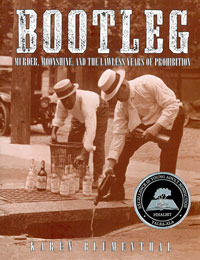
I was at TLA because Bootleg is part of the new Spirit of
Texas Middle School program, which recognizes authors with a Texas connection.
In addition, my book Steve Jobs: The Man
Who Thought Different is on this year’s Lone Star list for
middle-schoolers, and I had a chance to visit with some of the amazing
librarians who devote their precious spare time to reading and picking books
for these lists.
One of them surprised me with her description of her
readers. Her middle school students are “insulted” by heavily illustrated
nonfiction and almost shun them, she told me. Instead, they gravitate to smaller
books like Steve Jobs because it’s
neither too thick nor too thin, and it is sparingly illustrated.
Hunt said almost the same thing in
his essay, noting that “too many photographs can rob author and reader alike of
the opportunity to exercise their imagination.”
 As an avid nonfiction reader who
would appreciate more photos and relevant images in adult books, I always assumed
illustrations brought a greater depth and visual dimension to a true story. But
they have another side effect: To properly display images, nonfiction children’s
books are somewhat larger than fiction books, which gives them the appearance
of either picture books (babyish!) or coffee table books (and who wants to
actually read those?)
In fact, Hunt makes the case for
smaller “novelistic” book sizes for factual stories, saying that they circulate
easily in his library, without any special selling from him.
That’s encouraging news for Bootleg, which is the first of my four
books for young people to go from hardcover to trade paperback. (Steve
Jobs was published simultaneously in hardcover and paperback.)
Lauren Burniac, who oversees the
paperback imprint Square Fish, says the Bootleg
paperback, which will be out in late July, will be smaller in size than the
original, which itself had a smaller trim size than many contemporary
nonfiction books.
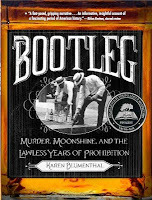
Paperback edition
While many young adult and
children’s novels are published in paperback about a year after their hardcover
publication, few nonfiction books make the leap. But with Common Core Standards
calling for more students to read nonfiction and with school and library budgets
tight, Burniac says that roughly a quarter of her paperback list is now
nonfiction, up from just two or three titles before.
“We’re making a real effort to
bring nonfiction into paperback,” she says, with the hope that a lower price
will bring the books not just into libraries, but also into classrooms. (And, I hope, maybe on to home bookshelves!)
Will a paperback nonfiction book in a smaller size attract
more buyers and more readers?
Or does that old publishing saw
hold, that people choose fiction for the authors and
nonfiction for the subject?
What do you think?
young people, California librarian Jonathan Hunt is one of my gurus. His
reviews and essays are always incredibly insightful, and his latest article in Horn Book is no exception.
His thoughtful look at readers of
children’s and young adult nonfiction comes on the heels of two recent
experiences, the Texas Library Association annual conference and the upcoming paperback
publication of my book Bootleg: Murder,
Moonshine, and the Lawless Years of Prohibition.
.jpg)
I was at TLA because Bootleg is part of the new Spirit of
Texas Middle School program, which recognizes authors with a Texas connection.
In addition, my book Steve Jobs: The Man
Who Thought Different is on this year’s Lone Star list for
middle-schoolers, and I had a chance to visit with some of the amazing
librarians who devote their precious spare time to reading and picking books
for these lists.
One of them surprised me with her description of her
readers. Her middle school students are “insulted” by heavily illustrated
nonfiction and almost shun them, she told me. Instead, they gravitate to smaller
books like Steve Jobs because it’s
neither too thick nor too thin, and it is sparingly illustrated.
Hunt said almost the same thing in
his essay, noting that “too many photographs can rob author and reader alike of
the opportunity to exercise their imagination.”
.jpg) As an avid nonfiction reader who
As an avid nonfiction reader whowould appreciate more photos and relevant images in adult books, I always assumed
illustrations brought a greater depth and visual dimension to a true story. But
they have another side effect: To properly display images, nonfiction children’s
books are somewhat larger than fiction books, which gives them the appearance
of either picture books (babyish!) or coffee table books (and who wants to
actually read those?)
In fact, Hunt makes the case for
smaller “novelistic” book sizes for factual stories, saying that they circulate
easily in his library, without any special selling from him.
That’s encouraging news for Bootleg, which is the first of my four
books for young people to go from hardcover to trade paperback. (Steve
Jobs was published simultaneously in hardcover and paperback.)
Lauren Burniac, who oversees the
paperback imprint Square Fish, says the Bootleg
paperback, which will be out in late July, will be smaller in size than the
original, which itself had a smaller trim size than many contemporary
nonfiction books.

Paperback edition
While many young adult and
children’s novels are published in paperback about a year after their hardcover
publication, few nonfiction books make the leap. But with Common Core Standards
calling for more students to read nonfiction and with school and library budgets
tight, Burniac says that roughly a quarter of her paperback list is now
nonfiction, up from just two or three titles before.
“We’re making a real effort to
bring nonfiction into paperback,” she says, with the hope that a lower price
will bring the books not just into libraries, but also into classrooms. (And, I hope, maybe on to home bookshelves!)
Will a paperback nonfiction book in a smaller size attract
more buyers and more readers?
Or does that old publishing saw
hold, that people choose fiction for the authors and
nonfiction for the subject?
What do you think?
April 30, 2013
Authors on Call

iNK Think Tank has
been pioneering a new kind of interaction with schools through Authors on Call,
a group of nine nonfiction authors who are equipped to do interactive
videoconferencing. (Many authors now
Skype but there are other ivc technologies that some schools prefer.) We call our programs Class ACTS where “ACTS”
is an acronym for Authors Collaborating with Teachers and Students. They are not exactly school visits nor are
they professional development for teachers but a hybrid that takes the books
and expertise of an author and “bakes” it into the classroom experience with
the “buy in” of the teachers and the students. Andrea Warren wrote up her Class
ACTS experience and posted it on this blog here. Let me give you some other examples.
I have been working with, Sarah Svarda, a media specialist
from Discovery School in Murfreesboro, TN.
She is using me as a mentor to help her 120 4th, 5th,
and 6th grade library students learn how to do research. She teaches these students once or twice a
week and since she has so many students and interactive videoconferencing is more
effective with groups of 40 or less (so that kids can ask questions) we decided
that I would meet the students in smaller groups over the period of time that
they were doing their research. Sarah would then model the lesson to the other
students who didn’t interact with me. So
I met with the 4th grade just when they were starting the program,
then with the 5th grade as they were several weeks into their research
to help direct it more specifically, and then with the 6th grade as
they were starting to write. I have one
more session to go, which will be some kind of wrap-up.
The students’ original idea of “research” is
to look something up in an encyclopedia (or Wikipedia) and write up what they find,
which often includes verbatim material, and turn it in the next day as homework. So, in effect, I was teaching them what I do
when I start a project—a long term process that changes over time. As it happens, I’m just beginning a new book
on hurricanes, so I do what all nonfiction authors do. I went to the library and took out every book
on hurricanes I could lay my hands on. I
showed the kids my pile of 25+ books and told them that I start by reading a
lot of sources. This was a real
eye-opener for them. I told them that I don’t read every book but that I look
at all the books and read the ones that grab me first. This was another eye-opener—comparing sources
and expressing preferences for different writers. In addition to the 4 videoconferences, Sarah
and I also chronicle what we do on a wiki—a communal document. You can see the wiki for our work, as can parents and other people in the public, but only Sarah and I can write on
it. Read it from the bottom up to get
the chronology of our progress.
We are also working with a group of teachers in PA. Sue Sheffer is a retired educator working
with the York School District on a Library of Congress grant to help teachers
use primary source material. The group
is scheduling sessions with our history authors: Roz Schanzer, Carla McClafferty, Jim Murphy, Andrea
Warren plus Myra
Zarnowski, our children’s lit consultant,who wrote a terrific book for
teachers: Making Sense of History . The
raves for each author have been off the charts.
Alexandra Siy is working with teachers from Lewis and Clark
Elementary in Missoula, MT. They are
using her book Cars on Mars as a
mentor text for their own research. Here
is the link to their wiki. Again, the enthusiasm for the program is
unequivocally positive.
Here’s what our Class ACTS programs offer that is different
from a school visit or professional development for teachers:
Author school visits are considered
“enrichment.” Class ACTS are programs
that are aligned with the curriculum and the classroom work of the students. They
take place over a period of time from two weeks to several months. They bring the excitement of a school visit to daily work, although the author isn't present on a daily basis. Since a Class ACTS program is no ephemeral one-shot, it can be transformative for students.
An author visit is about the author and the
author’s book. Class ACTS is about students and their work. The shift is to the “demand” side of the
school money—it’s where the rubber meets the road in terms of results, so here
authors can make a profound difference. Students are discovering that doing
work in depth produces a more thoughtful learning experience than simply “covering”
material. And content is now starting to matter again.
All educators know that the key to learning is
motivation. When students are motivated
they will do the hard work of learning.
Having an author involved in the process provides motivation. Studies have shown that another character
trait exhibited by successful people is grit.
I maintain that none of us nonfiction authors would be here without
it. We also exemplify the skills
mandated by the Common Core Standards.
Scheduling is much more flexible than a school
visit because it’s just a short time during the day and you don’t need travel
time, etc. So the videoconferences are
booked with a short lead time and are given at the optimum time for the
students.
Teachers find that all day professional
development sessions are not nearly as
useful as having a personal learning network—a place to go to ask a quick
question on an as needed basis. Through
Class ACTS, an author becomes a part of the teachers’ pln with very positive
outcomes.
Last year, Authors on Call piloted a program with many
authors and one school. This year we have
sold a variety of programs and we’re
learning all the time. Here’s some of
what we’re discovering:
The teachers we’re working with this year are
PHENOMENAL. Make no mistake, there is a
lot of extra work figuring out how to use us and our books and our skills so
that students benefit. The teachers we’re
currently working with are early adopters who see something for themselves in
taking a risk and doing something different.
As a result, they are, perhaps, a self-selected group totally committed
to their students and are doing the lion's share of the work. We authors are
learning from them in this truly collaborative effort. I have no doubt that our
incredibly successful outcomes are due to the quality of the teachers we’re
working with.
Last year, in our pilot program, the best
teachers were the ones that signed on first.
They created a bandwagon effect with other teachers joining in because
they didn't want to be left out. But the
teachers who joined later were not as effective
A successful program depends on planning, collaboration
and commitment. But the rewards are beyond anything anyone imagined in terms of
student output. It is humbling to see
how much talent children have when you give them the opportunity to strive, think,
create and shine.
It takes patience for a new idea to take
hold. The success of Authors on Call
depends on schools that have the videoconferencing technology to understand the
value of books and authors and for schools that appreciate books and authors getting
the technology. We’re moving forward,
however, and Authors on Call is leading the way.
For more information on Class ACTS programs, you can
download a pdf of our brochure here.