Elizabeth Rusch's Blog, page 24
July 4, 2013
What's in a Name?
In case you missed it, I'm rerunning this offering from last October as my "Best of" summer post. When it originally ran, I was excited to hear from a number of people with their own examples of landmarks named after women. To see those, click here. Feel free to add your own in the comments section. And have a great summer!
In downtown Rochester, New York, a triple steel arch bridge carries Interstate 490 over the Genesee River. Originally called the Troup-Howell Bridge, this structure was renamed the Frederick Douglass-Susan B. Anthony Memorial Bridge in 2007, after two historic heavyweights with ties to the city. Locals affectionately call it the “Freddie-Sue Bridge,” as I learned on a visit there last week. It’s just one of several local monuments to Ms. Anthony. (There’s also a local Roller Derby skater with the truly inspired Derby name Susan B. Agony , but that’s a topic for another post.)
As someone who grew up in a world where almost all schools, bridges, and other public memorials were named after men, I rejoiced at the very visible presence of Ms. Anthony in her adopted hometown. Nothing pleases me more than to see women’s names carved in stone or displayed on highway signs. When I wrote Bull’s-Eye, my biography of Annie Oakley, I shared in the pride that members of the Annie Oakley Foundation felt when they successfully lobbied the Ohio legislature to rename a portion of US127 the Annie Oakley Memorial Pike. When I was working on Bylines , my biography of Nellie Bly, I even was thrilled upon driving past the dilapidated Nellie Bly Amusement Park in Brooklyn, New York. Alas, this tribute to Nellie’s round the world voyage was renamed the Adventurers Family Entertainment Center when it was refurbished in 2007.
It’s important for women to stamp their names on things, at least as important as it is for men. It helps us remind people of our achievements and our presence in the world. I know I’m not the only one who thinks so. A few years ago, I attended a weekend celebration of women who graduated from Princeton, and President Shirley Tilghman told the story behind the naming of the university’s newest residential college. The college, home to some 500 undergraduates, was built with donations from 30 donors, but primarily from then eBay CEO Meg Whitman, Class of 1977, and her family and colleagues. President Tilghman implored Whitman to lend her name to the college, but she relented only after the president pointed out that every other residential college, including Rockefeller, Wilson, and Forbes, was named for a man.

In 2003, I had the satisfaction of taking part in the dedication ceremony for another institution named for a woman. Madeline “Maddy” English was a veteran teacher and guidance counselor with the Everett, Massachusetts, Public Schools. She was also a standout third basewoman on the Racine Belles of the All-American Girls Professional Baseball League. After the town voted to name its newest school for her, Maddy asked me to represent the league at the event, since I was then on the board of the Players’ Association and lived only a few hundred miles away. I got to say a few words about her as an athlete and see her pride as the entire community celebrated her achievements. Sadly, Maddy passed away less than a year later, but her school and its “Madeline English Bulldogs” are still going strong.
Some time back, journalists Lynn Sherr and Jurate Kazickas put together a book titled Susan B. Anthony Slept Here: A Guide to American Women’s Landmarks . It’s full of parks, museums, libraries, and other sites that are significant to women’s history. I’d love to see a companion volume of buildings, bridges, and other structures named for women. Are there any in your neck of the woods? Let me know by commenting below.


July 2, 2013
Authors on Call
Since this post first appeared on May 1, iNK has participated in two conferences: The 21st Century Children's Nonfiction Conference and ISTE. One result of our participation is that it was noticed an article in School Library Journal and in Publishers Weekly. An article for NPR's Mindshift, by Holly Korbey, featuring the iNK website and the I.N.K. blog as resources for parents is scheduled for release imminently.
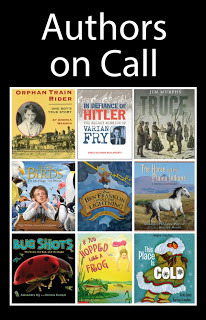
iNK Think Tank has been pioneering a new kind of interaction with schools through Authors on Call, a group of nine nonfiction authors who are equipped to do interactive videoconferencing. (Many authors now Skype but there are other ivc technologies that some schools prefer.) We call our programs Class ACTS where “ACTS” is an acronym for Authors Collaborating with Teachers and Students. They are not exactly school visits nor are they professional development for teachers but a hybrid that takes the books and expertise of an author and “bakes” it into the classroom experience with the “buy in” of the teachers and the students. Andrea Warren wrote up her Class ACTS experience and posted it on this blog here. Let me give you some other examples.
I have been working with, Sarah Svarda, a media specialist from Discovery School in Murfreesboro, TN. She is using me as a mentor to help her 120 4th, 5th, and 6th grade library students learn how to do research. She teaches these students once or twice a week and since she has so many students and interactive videoconferencing is more effective with groups of 40 or less (so that kids can ask questions) we decided that I would meet the students in smaller groups over the period of time that they were doing their research. Sarah would then model the lesson to the other students who didn’t interact with me. So I met with the 4th grade just when they were starting the program, then with the 5th grade as they were several weeks into their research to help direct it more specifically, and then with the 6th grade as they were starting to write. I have one more session to go, which will be some kind of wrap-up.
The students’ original idea of “research” is to look something up in an encyclopedia (or Wikipedia) and write up what they find, which often includes verbatim material, and turn it in the next day as homework. So, in effect, I was teaching them what I do when I start a project—a long term process that changes over time. As it happens, I’m just beginning a new book on hurricanes, so I do what all nonfiction authors do. I went to the library and took out every book on hurricanes I could lay my hands on. I showed the kids my pile of 25+ books and told them that I start by reading a lot of sources. This was a real eye-opener for them. I told them that I don’t read every book but that I look at all the books and read the ones that grab me first. This was another eye-opener—comparing sources and expressing preferences for different writers. In addition to the 4 videoconferences, Sarah and I also chronicle what we do on a wiki—a communal document. You can see the wiki for our work, as can parents and other people in the public, but only Sarah and I can write on it. Read it from the bottom up to get the chronology of our progress.
We are also working with a group of teachers in PA. Sue Sheffer is a retired educator working with the York School District on a Library of Congress grant to help teachers use primary source material. The group is scheduling sessions with our history authors: Roz Schanzer, Carla McClafferty, Jim Murphy, Andrea Warren plus Myra Zarnowski, our children’s lit consultant,who wrote a terrific book for teachers: Making Sense of History . The raves for each author have been off the charts.
Alexandra Siy is working with teachers from Lewis and Clark Elementary in Missoula, MT. They are using her book Cars on Mars as a mentor text for their own research. Here is the link to their wiki. Again, the enthusiasm for the program is unequivocally positive.
Here’s what our Class ACTS programs offer that is different from a school visit or professional development for teachers:
Author school visits are considered “enrichment.” Class ACTS are programs that are aligned with the curriculum and the classroom work of the students. They take place over a period of time from two weeks to several months. They bring the excitement of a school visit to daily work, although the author isn't present on a daily basis. Since a Class ACTS program is no ephemeral one-shot, it can be transformative for students.
An author visit is about the author and the author’s book. Class ACTS is about students and their work. The shift is to the “demand” side of the school money—it’s where the rubber meets the road in terms of results, so here authors can make a profound difference. Students are discovering that doing work in depth produces a more thoughtful learning experience than simply “covering” material. And content is now starting to matter again.
All educators know that the key to learning is motivation. When students are motivated they will do the hard work of learning. Having an author involved in the process provides motivation. Studies have shown that another character trait exhibited by successful people is grit. I maintain that none of us nonfiction authors would be here without it. We also exemplify the skills mandated by the Common Core Standards.
Scheduling is much more flexible than a school visit because it’s just a short time during the day and you don’t need travel time, etc. So the videoconferences are booked with a short lead time and are given at the optimum time for the students.
Teachers find that all day professional development sessions are not nearly as useful as having a personal learning network—a place to go to ask a quick question on an as needed basis. Through Class ACTS, an author becomes a part of the teachers’ pln with very positive outcomes.
Last year, Authors on Call piloted a program with many authors and one school. This year we have sold a variety of programs and we’re learning all the time. Here’s some of what we’re discovering:
The teachers we’re working with this year are PHENOMENAL. Make no mistake, there is a lot of extra work figuring out how to use us and our books and our skills so that students benefit. The teachers we’re currently working with are early adopters who see something for themselves in taking a risk and doing something different. As a result, they are, perhaps, a self-selected group totally committed to their students and are doing the lion's share of the work. We authors are learning from them in this truly collaborative effort. I have no doubt that our incredibly successful outcomes are due to the quality of the teachers we’re working with.
Last year, in our pilot program, the best teachers were the ones that signed on first. They created a bandwagon effect with other teachers joining in because they didn't want to be left out. But the teachers who joined later were not as effective
A successful program depends on planning, collaboration and commitment. But the rewards are beyond anything anyone imagined in terms of student output. It is humbling to see how much talent children have when you give them the opportunity to strive, think, create and shine.
It takes patience for a new idea to take hold. The success of Authors on Call depends on schools that have the videoconferencing technology to understand the value of books and authors and for schools that appreciate books and authors getting the technology. We’re moving forward, however, and Authors on Call is leading the way.
For more information on Class ACTS programs, you can download a pdf of our brochure here.


iNK Think Tank has been pioneering a new kind of interaction with schools through Authors on Call, a group of nine nonfiction authors who are equipped to do interactive videoconferencing. (Many authors now Skype but there are other ivc technologies that some schools prefer.) We call our programs Class ACTS where “ACTS” is an acronym for Authors Collaborating with Teachers and Students. They are not exactly school visits nor are they professional development for teachers but a hybrid that takes the books and expertise of an author and “bakes” it into the classroom experience with the “buy in” of the teachers and the students. Andrea Warren wrote up her Class ACTS experience and posted it on this blog here. Let me give you some other examples.
I have been working with, Sarah Svarda, a media specialist from Discovery School in Murfreesboro, TN. She is using me as a mentor to help her 120 4th, 5th, and 6th grade library students learn how to do research. She teaches these students once or twice a week and since she has so many students and interactive videoconferencing is more effective with groups of 40 or less (so that kids can ask questions) we decided that I would meet the students in smaller groups over the period of time that they were doing their research. Sarah would then model the lesson to the other students who didn’t interact with me. So I met with the 4th grade just when they were starting the program, then with the 5th grade as they were several weeks into their research to help direct it more specifically, and then with the 6th grade as they were starting to write. I have one more session to go, which will be some kind of wrap-up.
The students’ original idea of “research” is to look something up in an encyclopedia (or Wikipedia) and write up what they find, which often includes verbatim material, and turn it in the next day as homework. So, in effect, I was teaching them what I do when I start a project—a long term process that changes over time. As it happens, I’m just beginning a new book on hurricanes, so I do what all nonfiction authors do. I went to the library and took out every book on hurricanes I could lay my hands on. I showed the kids my pile of 25+ books and told them that I start by reading a lot of sources. This was a real eye-opener for them. I told them that I don’t read every book but that I look at all the books and read the ones that grab me first. This was another eye-opener—comparing sources and expressing preferences for different writers. In addition to the 4 videoconferences, Sarah and I also chronicle what we do on a wiki—a communal document. You can see the wiki for our work, as can parents and other people in the public, but only Sarah and I can write on it. Read it from the bottom up to get the chronology of our progress.
We are also working with a group of teachers in PA. Sue Sheffer is a retired educator working with the York School District on a Library of Congress grant to help teachers use primary source material. The group is scheduling sessions with our history authors: Roz Schanzer, Carla McClafferty, Jim Murphy, Andrea Warren plus Myra Zarnowski, our children’s lit consultant,who wrote a terrific book for teachers: Making Sense of History . The raves for each author have been off the charts.
Alexandra Siy is working with teachers from Lewis and Clark Elementary in Missoula, MT. They are using her book Cars on Mars as a mentor text for their own research. Here is the link to their wiki. Again, the enthusiasm for the program is unequivocally positive.
Here’s what our Class ACTS programs offer that is different from a school visit or professional development for teachers:
Author school visits are considered “enrichment.” Class ACTS are programs that are aligned with the curriculum and the classroom work of the students. They take place over a period of time from two weeks to several months. They bring the excitement of a school visit to daily work, although the author isn't present on a daily basis. Since a Class ACTS program is no ephemeral one-shot, it can be transformative for students.
An author visit is about the author and the author’s book. Class ACTS is about students and their work. The shift is to the “demand” side of the school money—it’s where the rubber meets the road in terms of results, so here authors can make a profound difference. Students are discovering that doing work in depth produces a more thoughtful learning experience than simply “covering” material. And content is now starting to matter again.
All educators know that the key to learning is motivation. When students are motivated they will do the hard work of learning. Having an author involved in the process provides motivation. Studies have shown that another character trait exhibited by successful people is grit. I maintain that none of us nonfiction authors would be here without it. We also exemplify the skills mandated by the Common Core Standards.
Scheduling is much more flexible than a school visit because it’s just a short time during the day and you don’t need travel time, etc. So the videoconferences are booked with a short lead time and are given at the optimum time for the students.
Teachers find that all day professional development sessions are not nearly as useful as having a personal learning network—a place to go to ask a quick question on an as needed basis. Through Class ACTS, an author becomes a part of the teachers’ pln with very positive outcomes.
Last year, Authors on Call piloted a program with many authors and one school. This year we have sold a variety of programs and we’re learning all the time. Here’s some of what we’re discovering:
The teachers we’re working with this year are PHENOMENAL. Make no mistake, there is a lot of extra work figuring out how to use us and our books and our skills so that students benefit. The teachers we’re currently working with are early adopters who see something for themselves in taking a risk and doing something different. As a result, they are, perhaps, a self-selected group totally committed to their students and are doing the lion's share of the work. We authors are learning from them in this truly collaborative effort. I have no doubt that our incredibly successful outcomes are due to the quality of the teachers we’re working with.
Last year, in our pilot program, the best teachers were the ones that signed on first. They created a bandwagon effect with other teachers joining in because they didn't want to be left out. But the teachers who joined later were not as effective
A successful program depends on planning, collaboration and commitment. But the rewards are beyond anything anyone imagined in terms of student output. It is humbling to see how much talent children have when you give them the opportunity to strive, think, create and shine.
It takes patience for a new idea to take hold. The success of Authors on Call depends on schools that have the videoconferencing technology to understand the value of books and authors and for schools that appreciate books and authors getting the technology. We’re moving forward, however, and Authors on Call is leading the way.
For more information on Class ACTS programs, you can download a pdf of our brochure here.
July 1, 2013
HOW TO WRITE NONFICTION BOOKS THAT CAN’T BE BEAT
By the time I wrote the following post 13 months ago, nonfiction authors and nonfiction readers were getting a lucky break. Check it out and then go have yourselves an outstanding summer that might even include some great reading and writing....
_________________________________________________
Who woulda thunk it?
Nonfiction is on a roll! And it’s
largely because of a big game-changer called the Common
Core State Standards. What in the world is that? Well, it’s an educational initiative that has already
been adopted by every public school in 45 of these United States and in 3 territories
to boot. In my humble but admittedly prejudiced opinion,
the best part is this: The Common Core requires
that by senior year in high school, 70% of the books students read throughout
their entire curriculum have to be nonfiction.
Hoo-hah!! Ladies and gentlemen, it
is about time.
And there’s more. Instead of writing dreary papers that imitate the facts kids have to learn for testing purposes, they
are now being encouraged to write some truly interesting and thoughtful nonfiction literature of their
own. Here’s just one small example. To tempt the Youth of America to dip their
toes into nonfiction waters, the New York Times is holding its Third
Annual Summer Reading Contest, in which young people aged 13 to 25 are
invited to submit blog posts for possible inclusion on the Times’ educational
site. Check out last year’s winning post
by Elisabeth Rosenthal and tell me this isn’t a great idea. Here ‘tis: “Answer for
Invasive Species: Put It on a Plate and Eat It”
But
what if students like Elisabeth get psyched by
reading some truly outstanding nonfiction (insert brazen hint about INK
books here). And what if they get enough of a kick out of
writing brief nonfiction pieces that they want to write an entire book
of amazing-but-true
tales? Or come to think of it, what if
you want to write a nonfiction book your own self?
I recently helped a couple of fourth grade classes at Bogert
Elementary School in Upper Saddle River, New Jersey, to do just that. The challenge was to take certain bland
basic material from the school’s curriculum and let the kids work together to
write and illustrate an exciting (and accurate) page turner that they would actually love to
read themselves. The kids came through like
champs and had a blast. And in the process, they soaked up the material
in their curriculum like a sponge.
Of course there’s more than one way to skin a cat. But maybe I can entice somebody out there to walk down
the author path by offering a few small tricks of my own for writing nonfiction
books that (I hope) can’t be beat.
1) PAIR YOUR TOPIC WITH A GREAT HOOK
Whether you pick a topic that you’d love to know more about,
or whether a teacher has assigned your kids to write about dry subjects from the
school curriculum, any budding authors out there should try hard to write stories
that fascinate. How? One way is to find a
great hook! I write about history,
and here are just a few of the hooks I’ve used ever since time immemorial for readers in different age groups:
Drawing colorful, complex picture
mazes in which readers have to wend their way through the accurate but amazing scenery of America’s
Wild West, say, or Europe’s Middle Ages in order to reach the next pages in the
story.
Telling true tales from two completely
opposite points of view.
Picking a
genuine hero from the past and telling his story via his 13 great escapes from
danger.
2) BECOME A SPY
Everything in a nonfiction book has to be 100% true, and you
can never ever put your own words
into other peoples’ mouths either. So to
find the facts and to figure out what really happened and what people really said, you have to do tons of
research. That's when you get to become a spy! Snoop around till you can quote from the original letters,
diaries, speeches, and journals of your protagonists! Bravely interview people who were on the scene during a terrifying
event! Or rustle your way through dusty ancient
tomes written by responsible scholars until you uncover hidden clues.
3) USE THE MEAT AND SALT METHOD
“Meat” equals the
facts. Make sure you have them down pat.
“Salt” equals a tasty sprinkling of all the humor, interesting tidbits, unusual
facts, and clever or creative ideas you can lay your hands on in order to bring
your book to life. I love the salt part.
4) WRITE A PAGE TURNER
Every
single sentence you write has to be carefully crafted so that your
readers can’t wait to see what happens next. Read what you wrote out
loud to find out. Does it sound compelling enough? You may be surprised.
5) ADD PICTURES PLEASE
Everyone loves pictures, even grownups. It doesn’t matter if you can't draw your own cartoons
in a graphic novel. Try adding a bunch of your best photos from your cell phone or create
very some clever, colorful graphs with fancy lettering on a computer instead. Or if you have the chops, make Like Michelangelo.
In other words, just add your best pictures to the mix and more people will be likely to read your book.
And speaking of reading, read and READ and READ
the best nonfiction books you can lay hands on.
Then pick your faves and try to figure out what it was about the authors’
writing styles that clicked inside of your brain. That’s it.
6
comments:
Melissa Stewart
said...
These are great tips, Roz. I especially like your term "salt and meat method." I might steal, er, I mean borrow it.
June 5, 2012 at 7:26 AM
Linda Zajac
said...
Wow, I didn't realize the numbers were as high as 70% NF reading
overall. That's supreme! Thanks for spelling it out and making my day.
June 5, 2012 at 8:37 AM
creatingcuriouskids
said...
What a wonderful post. I like the "salt" part too. There are so many
ways to tell a story, and when I hit on the right one, it's a major
rush.
June 5, 2012 at 9:19 AM
Jim Murphy
said...
Great post, Roz. I learned a lot and was inspired. But where are the recipes for these invasive species?
June 5, 2012 at 10:00 AM
Unknown
said...
It's wonderful getting inside a creative mind--even just scratching the surface. Thanks for the tips.
Ellen Butts
June 5, 2012 at 6:58 PM
Rosalyn Schanzer
said...
Thanks, everybody! And Jim, I dunno about the invasive lionfish in
that award-winning blog, but there's a huge ugly invasive fish species
from China called the snakehead that's taking over the waters near DC,
so they recently had a contest to see who could catch the biggest one.
This sharp-toothed fish is a delicacy in China, so chefs around these
parts are coming up with all kinds of creative ways to cook it; you can
even Google the recipes!

June 28, 2013
Summer Reading: Fiction, Nonfiction, and Kinetic Learning Pairings
School’s out for summer! Many summer reading lists combine
nonfiction and fiction reading recommendations. It was exciting to see Steve Sheinkin’s Bomb: The Race to Build, another INK contributor, on the list from my son’s
English teacher.
Since summer’s here and it’s time to play, I thought that it
would be fun to add other senses to the mix and a little play. A few years ago
I taught a class at the Games for Education Conference at the Chicago Toy and
Game fair. The class was titled Play and Creativity in the Classroom. Here’s what I wrote about the class on the
INK blog titled Play in Classroom with several nonfiction book recommendations. Why not add a little
kinetic learning to the summer reading schedule?
A teacher friend is taking her children on an extended
vacation to New England this summer. They are reading fiction and nonfiction
books in preparation. When she mentioned that they were creating KWL charts to
go along with the reading, I was curious. Many teachers reading this will know
about KWL charts, but my friend explained, “It is a 3 column chart- list what
they KNOW, list what the WANT to know, and then after reading list what they
LEARNED. It is a great way to assess prior misconceptions as well as knowledge,
see if they learned anything from their reading, and can be a basis for further
research for unanswered questions.” Here’s a link that explains how to make KWLcharts.
Kind of wish I had made a KWL chart before our recent London
and Paris trip. After we were back home, while recuperating from jetlag, I
tried to remember what my preconceived impressions of Paris were. For example,
my mind had a different vision of what Notre Dame was like. Being there right
in front of Notre Dame was rather surreal.
Everywhere we went on our vacation, I would point out what
we were seeing to my children. I think they became a little tired of me by the
end of our trip. Last Christmas, I bought the family a puzzle of the London Underground and a puzzle of a map of Paris. I do this because of my childhood. Growing up, we would go almost every
other summer to Germany for a month to visit Oma. Most of what I
remember was my little brother and I creating a dividing line in the back seat
of my uncle’s Mercedes and constantly tapping my mom on the arm while she spoke
in German to all my relatives. We went to some cool places, but I have no idea
where I was, why the place was significant, or how it related to European
history.
Here’s a few nonfiction and fiction reading ideas for the
summer with some added senses, kinetic learning, and play.
Bomb: The Race to Build—and Steal—the World’s Most Dangerous
Weapon by Steven Sheinkin
The Green Glass Sea by Ellen Klages
Modern Marvels - The Manhattan Project (History Channel)
We Are the Ship: The Story of Negro League Baseball by Kadir
Nelson
King of the Mound - My Summer with Satchel Paige by Wes
Tooke
Watch a baseball game or go to a game.
Major League Baseball Scrabble
Eat a hot dog, peanuts and Cracker Jacks
Football Hero: A Football Genius Novel by Tim Green
Sports Illustrated Kids 1st and 10: Top 10 Lists of
Everything in Football by Sports Illustrated For Kids
Jukem Football Card Game by Jukem
Play football in the backyard
My Brother Sam Is Dead by James Lincoln Collier or Johnny
Tremain by Esther Hoskins Forbes
The American Revolution for Kids: A History with 21
Activities (For Kids series) by Janis Herbert
City Doodles: Boston by Chris Sabatino
Educational Trivia Card Game - Professor Noggin's American
Revolution by Professor Noggin
Chicago History for Kids: Triumphs and Tragedies of the
Windy City Includes 21 Activities (For Kids series) by Owen Hurd
A Long Way From Chicago by Richard Peck
City Doodles: Chicago by Anna M. Lewis
Chicago-Opoly by Late for the Sky
Build a Skyscaper model
Fact, Fiction, and Folklore in Harry Potter's World: An
Unofficial Guide by George Beahm
Harry Potter and the Sorcerer's Stone by J.K. Rowling
Watch Harry Potter and the Sorcerer's Stone Starring Daniel
Radcliffe, Rupert Grint, and Emma Watson
Eat Harry Potter Bertie Botts Every Flavor Beans by Jelly
Belly
(This list could be endless.)
Sandy's Circus: A Story About Alexander Calder by Tanya Lee
Stone (author), Boris Kulikov (Illustrator)
The Calder Game by Blue Balliett(Author) , Brett Helquist (Illustrator)
Make a Mobile
Go to an art museum
For Younger Readers:
The First Teddy Bear by Helen Kay (Author) , Susan Detwiler
(Illustrator)
Made in the USA - Teddy Bears by Tanya Lee Stone
The Teddy Bears' Picnic by Jimmy
Kennedy (Author) , Michael Hague
(illustrator)
Baby Bear Counters by Learning Resources
Gather all your teddy bears and have a tea party
Play the song Teddy Bear’s Picnic
The Man Who Walked Between the Towers by Mordecai Gerstein
New York City by David F. Marx
New York for Kids: 25 Big Apple Sites to Color (Dover Coloring Books) by Patricia J. Wynne
50-Piece Double 2-Sided Jigsaw Puzzle - New York City by Pigment and Hue
This list is just a jumping off point to get everyone
thinking about all the possibilities. I had to stop somewhere or I’d be still
writing this blog post.
Please add your recommendations to the comments and I’ll add
it to the list. On my website, I will add a hand-out form when I’m done
compiling.
Here’s to a happy summer with lots of reading and playing.
nonfiction and fiction reading recommendations. It was exciting to see Steve Sheinkin’s Bomb: The Race to Build, another INK contributor, on the list from my son’s
English teacher.
Since summer’s here and it’s time to play, I thought that it
would be fun to add other senses to the mix and a little play. A few years ago
I taught a class at the Games for Education Conference at the Chicago Toy and
Game fair. The class was titled Play and Creativity in the Classroom. Here’s what I wrote about the class on the
INK blog titled Play in Classroom with several nonfiction book recommendations. Why not add a little
kinetic learning to the summer reading schedule?
A teacher friend is taking her children on an extended
vacation to New England this summer. They are reading fiction and nonfiction
books in preparation. When she mentioned that they were creating KWL charts to
go along with the reading, I was curious. Many teachers reading this will know
about KWL charts, but my friend explained, “It is a 3 column chart- list what
they KNOW, list what the WANT to know, and then after reading list what they
LEARNED. It is a great way to assess prior misconceptions as well as knowledge,
see if they learned anything from their reading, and can be a basis for further
research for unanswered questions.” Here’s a link that explains how to make KWLcharts.
Kind of wish I had made a KWL chart before our recent London
and Paris trip. After we were back home, while recuperating from jetlag, I
tried to remember what my preconceived impressions of Paris were. For example,
my mind had a different vision of what Notre Dame was like. Being there right
in front of Notre Dame was rather surreal.
Everywhere we went on our vacation, I would point out what
we were seeing to my children. I think they became a little tired of me by the
end of our trip. Last Christmas, I bought the family a puzzle of the London Underground and a puzzle of a map of Paris. I do this because of my childhood. Growing up, we would go almost every
other summer to Germany for a month to visit Oma. Most of what I
remember was my little brother and I creating a dividing line in the back seat
of my uncle’s Mercedes and constantly tapping my mom on the arm while she spoke
in German to all my relatives. We went to some cool places, but I have no idea
where I was, why the place was significant, or how it related to European
history.
Here’s a few nonfiction and fiction reading ideas for the
summer with some added senses, kinetic learning, and play.
Bomb: The Race to Build—and Steal—the World’s Most Dangerous
Weapon by Steven Sheinkin
The Green Glass Sea by Ellen Klages
Modern Marvels - The Manhattan Project (History Channel)
We Are the Ship: The Story of Negro League Baseball by Kadir
Nelson
King of the Mound - My Summer with Satchel Paige by Wes
Tooke
Watch a baseball game or go to a game.
Major League Baseball Scrabble
Eat a hot dog, peanuts and Cracker Jacks
Football Hero: A Football Genius Novel by Tim Green
Sports Illustrated Kids 1st and 10: Top 10 Lists of
Everything in Football by Sports Illustrated For Kids
Jukem Football Card Game by Jukem
Play football in the backyard
My Brother Sam Is Dead by James Lincoln Collier or Johnny
Tremain by Esther Hoskins Forbes
The American Revolution for Kids: A History with 21
Activities (For Kids series) by Janis Herbert
City Doodles: Boston by Chris Sabatino
Educational Trivia Card Game - Professor Noggin's American
Revolution by Professor Noggin
Chicago History for Kids: Triumphs and Tragedies of the
Windy City Includes 21 Activities (For Kids series) by Owen Hurd
A Long Way From Chicago by Richard Peck
City Doodles: Chicago by Anna M. Lewis
Chicago-Opoly by Late for the Sky
Build a Skyscaper model
Fact, Fiction, and Folklore in Harry Potter's World: An
Unofficial Guide by George Beahm
Harry Potter and the Sorcerer's Stone by J.K. Rowling
Watch Harry Potter and the Sorcerer's Stone Starring Daniel
Radcliffe, Rupert Grint, and Emma Watson
Eat Harry Potter Bertie Botts Every Flavor Beans by Jelly
Belly
(This list could be endless.)
Sandy's Circus: A Story About Alexander Calder by Tanya Lee
Stone (author), Boris Kulikov (Illustrator)
The Calder Game by Blue Balliett(Author) , Brett Helquist (Illustrator)
Make a Mobile
Go to an art museum
For Younger Readers:
The First Teddy Bear by Helen Kay (Author) , Susan Detwiler
(Illustrator)
Made in the USA - Teddy Bears by Tanya Lee Stone
The Teddy Bears' Picnic by Jimmy
Kennedy (Author) , Michael Hague
(illustrator)
Baby Bear Counters by Learning Resources
Gather all your teddy bears and have a tea party
Play the song Teddy Bear’s Picnic
The Man Who Walked Between the Towers by Mordecai Gerstein
New York City by David F. Marx
New York for Kids: 25 Big Apple Sites to Color (Dover Coloring Books) by Patricia J. Wynne
50-Piece Double 2-Sided Jigsaw Puzzle - New York City by Pigment and Hue
This list is just a jumping off point to get everyone
thinking about all the possibilities. I had to stop somewhere or I’d be still
writing this blog post.
Please add your recommendations to the comments and I’ll add
it to the list. On my website, I will add a hand-out form when I’m done
compiling.
Here’s to a happy summer with lots of reading and playing.
June 26, 2013
Reading and Thinking
There’s been a lot of talk recently about the Common Core
State Standards and how important they are in creating a market for nonfiction
writers. That’s nice for us, but
I’m excited about this new approach to teaching way beyond its effects on my
pocketbook. I’ve seen too many
examples in my life of how our citizens don’t know how to read for information
content and how to evaluate what they read.
My first exposure to this problem occurred when I worked as
a teaching assistant in a basic zoology class while in graduate school at the
University of California, Berkeley.
More than once after an exam, a student who received an inferior grade
would come to my office very discouraged.
“I came to all the lectures and I read the text but I only got a C on
the exam—what’s my problem?” I’d
ask them about their reading techniques and it would turn out that they had no
idea that there was more than one way to read. Of course they’d learned to read in school, but as has been
the practice for decades, they learned by reading fiction, which requires a
totally different reading style than nonfiction. You can ‘fast read’ fiction by skimming lightly over some
sections and focusing on following the plot and the emotions of the
characters. That kind of reading
will get you nowhere if you are reading to learn.
Reading to learn requires a form of close reading in which
you carefully follow the text with your thinking brain engaged at all
times. Here are some questions to ask yourself as you read nonfiction text. Does this make sense to me? Am I “getting it” as I read, or do I
need to reread this more carefully?
Am I examining all the illustrations, reading the captions, and
checking to see if I understand what the author is trying to convey? Do I stop frequently and review in my
mind what I’ve just read to see if I’m absorbing the information?
This kind of focused, concentrated reading takes time, and
people like me, who have always read a lot of informational nonfiction can have
a hard time reading fiction. We
become so accustomed to reading carefully, paying attention to every word, that
it’s difficult to finish a novel in a reasonable amount of time. I, for one, haven’t learned how to flip
an internal reading style switch, so a novel takes many hours to complete.
The other problem associated with learning to read through
fictional texts is not learning how to evaluate what one reads critically. What kind of reading do adults need to
master in order to be successful in the world? Nonfiction, not fiction! They read the paper, either on ‘paper’ or online; they have
to be able to read all sorts of forms such as for income tax and contracts for
work. They need to be able to spot
propaganda-style writing and to recognize when they are only getting one side
of the story. The internet has
only made this skill more important than ever, since anyone can put up a snazzy
looking website and fill it up with misleading nonsense or misinformation.
If a student plans to be part of society’s middle class, he
or she also needs to be able to write coherently in order to apply to college, to
apply for jobs, and to communicate within the work environment. I’ve spoken to many college teachers
who need to devote vital time to teaching their students how to write when they
are supposed to be teaching them economics, science, psychology, or some other
academic subject. The CCSS are designed to improve students' writing skills, too.
We can hope that the application of the CCSS will help to
alleviate these problems so that Americans will be able better to cope with the
challenges of our complex new world in which communication has become even more
important than in the past.

June 25, 2013
Network, v. intr. Orig. U.S.
My name is Gretchen, and
I’m a researchoholic.
Perhaps my #1 substance of
choice is the Oxford English Dictionary (OED), the online version of which is
available 24/7 via my local library website. And so, though I have mulled over this blog for several days,
when it came to putting fingers to keyboard, I felt compelled to imbibe some
OED first.

network, n.
5b An interconnected group of people; an organization; spec. a group of people having
certain connections (freq. as a result of attending a particular school or
university) which may be exploited to gain preferment, information, etc., esp.
for professional advantage.
And I can’t resist sharing the
first reference:
1884 A. Forbes Chinese Gordon v. 140 British India
is a network of cliquism and favoritism
But it was not the noun I was searching
for, but the verb:
network, v.
intr. orig. U.S. To engage in social or
professional ‘networking’
The first use of the verb
form was given as 1980, and one wonders how we got along without the word. The
phenomenon is surely as old as the earth, or at least humans’ habitation of it
– but that’s not my subject either.
I actually want to give a brief
history of my own evolving children’s literature network, and express
appropriate gratitude forthwith. [Reading the OED makes you talk and write
funny.] BTW ‘evolve’ has an interesting history in the OED going back to 1597,
and Darwin is not mentioned.
My Critique Group
Back in 1992 when I began to
entertain the thought of writing for children, I turned to UCLA Extension. At
the end of a nonfiction class, the instructor, Caroline Arnold,
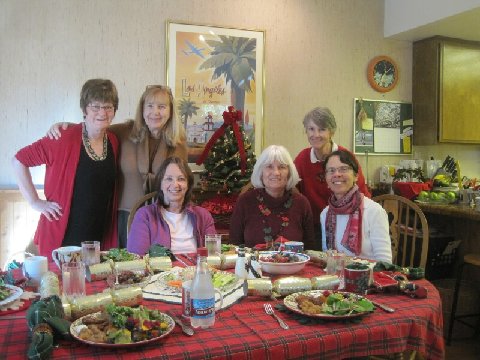
encouraged us to form critique groups, and three of us did. Lo, these 21 years later the group still
includes two charter members, Alexis O’Neill and myself, along with Nina Kidd, Ann Stampler, and our erstwhile teacher,
Caroline Arnold.
Most children’s writers I know have
a critique group and count its many blessings. For me, they include
• Astute reading of woeful first
drafts
• More of the same for rewrites
month after month….after month
• Assurance that it is getting
better and you are getting closer
• Encouragement in the face of
rejection
• A deadline to force one to produce
something for every meeting or feel like a total slacker.
Networking results: personal
introductions to two editors who bought my first book and my first novel. And an annual delectable Christmas/Hanukkah party every year at Alexis's.
The Indomitable Hive
By 1998 I had published one book
and many short stories, but couldn’t crack the picture book market. So I
enrolled in the then-new low-residency MFA in Writing for Children program at
Vermont College (and began to write biographies.) I craved the one-on-one relationship with an advisor and I loved
the bi-annual intensive residences. Too bad, I thought, I wouldn’t get to know
my classmates, since we’d see each other so little.
Wrong! At the end of the first residency we set up a yahoogroup – a
novelty back in 1998 – and for the past fifteen years we’ve been in daily
contact. Of the fifteen original class members, eleven of us are active what Brock Cole dubbed “The Hive.” Since we’re all female, the hive has
become much more than a writer’s group. We’ve shared everything – marriage,
births, deaths, tribulations and triumphs.

We’re in our thirties through
eighties, and though we’re scattered all across the U.S., I’m in closer touch
with the Hive than I am with local friends (We’ve too busy to check in
daily.) The Hive is not a critique group, though some of us do that for
each other some of the time. These writers have published dozens of books in
the 15 years since we met, won top awards, and together we walk the walk of being a writer, making a living, living a life.
Worker bees, all.
The blessings of the Hive:
• a common language, having been
through the MFA program together
• a daily connection to writers
• advice on any professional issue from people who have been there, done that
• occasional in-person reunions
that reinforce our friendship.
Networking results: two more
editor contacts from two Hive members that led to two more book contracts. And
it was hiver April Pulley Sayre who brought me to ….

….that fabulous bevy of writers that
joins me for breakfast every morning at the computer. I love reading
the on- and offstage goings-on of those writing stars, most of whom I’ve never
met. Inksters seem to be north-easterners, though we have had one raucous NYC
dinner that I was party to. And I did meet Sue Macy at ALA here in California, and shared a
dinner with her and her editor….an editor who is now reading one of my
manuscripts…..
I’ve been told that the literary
world of adult writers can be maliciously competitive and ungenerous. My
networks of children’s writers are nothing of the sort.
Happy summer reading and writing!

Recommended Book List and More
This summer on the I.N.K. blog, we’ll be reposting some of
our favorites during the month of July and we’ll take a quiet non-blogging
month of relaxation in August.
During this time, we will consider and begin the steps of
making some improvements to the blog. One of the things I’d like to work on is building
a formidable recommended list of I.N.K. books from preschool through YA. We’d
also like to turn our attention to how we as readers, writers, teachers and
lovers of children’s nonfiction can suggest the best books to implement the
core curriculum.
We welcome your suggestions. What would you like to see on
the blog? How can we talk about non fiction in a way that makes these books
more accessible to the general public?
Please
join the conversation. You can comment here, join our Facebook page and
comment, or even send me a private email if you prefer (see sidebar for email).
Although
our posting will be quieter over the next two months, the conversation will
definitely continue.

June 24, 2013
Author Visits: Virtual vs. Live
Since the debut of INK, I have used my June post to reflect
on one or more of my school visits during the previous school year. I hereby continue the
tradition.
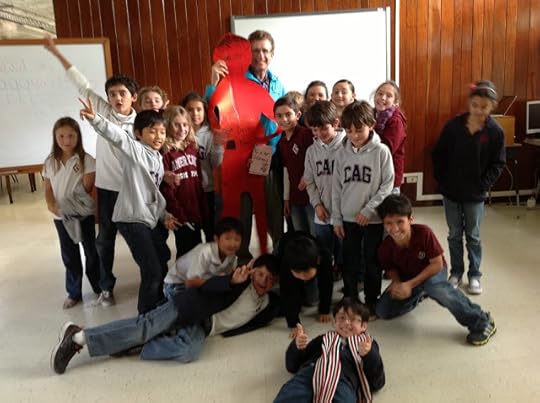
This picture came via email from a class at Colegio Americano de Guatemala, the
American School of Guatemala. I spent a week there in March. A day after seeing
one of my presentations, the 3rd grade class of Ms. Katie Jones-Vis
presented me with “Big David,” a cut-out meant to resemble me in height — 5’ 10”. This prop was a take-off on “Little
Davie” a 4’6” cut-out they saw me use to demonstrate the proportionality
concept in my book If You Hopped Like a
Frog. I had told them the story of how, as a child I noticed that a 3-inch
frog could hop 5 feet, which is 20 times its own height. I wondered how far I
could go if I hopped proportionally, meaning 20 times my height (at the time, 4’
6”). A little arithmetic revealed a trajectory of 90 feet (4.5 feet X 20),
which I quickly equated with the distance between the bases on a major league
baseball “diamond” (square, really, but that matter is in a different book!). Years
later, this childhood revelation became the basis for If You Hopped Like a Frog, which opens, “If you hopped like a
frog…you could jump from home plate to first base in one mighty leap.” Other
examples compare human abilities to those of animals by imagining the comic
results of human performance matching that of certain animals proportionally.
Having seen me walk “Little Davie” through 20 iterations to
show how far I could have hopped if, as a 4’6” boy, I’d been able to hop 20
times my height, Ms. Jones-Vis’s class decided they wanted to see
what would happen if “Big David” could do the same. Good math, good literature
connection, but what pleased me most was what the teacher wrote in her email to
me: “Thank you again for your workshop. The students were so excited to go back
to math class.”
I have been in discussions with some of my iNK Authors on
Call colleagues about live author visits vs. videoconferencing, and
specifically our program “Class Acts,” in which one or more authors work both with teachers, coaching them in the use of our books to meet classroom
objectives, and with students who “meet” us in a videoconference and ask
questions and share their own work inspired by the author’s. There can be two
or more sessions of each. (See, for example, Andrea Warren’s fabulous post on Aprill 22 about her videoconference sessions with 5th graders exploring family history:
http://inkrethink.blogspot.com/2013/04/guest-blogger-andrea-warren-on-using.html.)
We iNKers are of diverse opinion on the pros and cons of virtual vs. live, and some of us have
argued that the intimacy of interactive videoconferencing in multiple sessions
across weeks or months puts the author into a mentoring role giving truly long-term
benefits, while live visits are something of a flash in the pan: “He (or she)
came, he spoke, he left.”
Live author visits are more like performances than
conversations. From my highly unscientific study (sample size one author), here is further unscientifically collected anecdotal evidence, which came in an
email last month, referring to a school visit I made in Ithaca, NY, several
weeks earlier: “Everyone here is still talking about your visit...” Or this from
a parent after seeing my program for the primary grades at a school in Seattle:
“Our family will never look at math in the same way.” Or this from a 5th
grade teacher near Philadelphia: “You put the kids into high-power math mode
for days.” Maybe there can be lasting benefits of live author assemblies,
especially when teachers give the kids opportunities to process what the
author had to say, not just wave good-bye as he drives down the bus lane and
back to the airport.
So, performances on the one hand and conversations on the other. Can’t both be
valuable, inspirational, educational and entertaining? I certainly wouldn’t
want to say that one is has more curricular value or benefits with a longer
half-life than the other. I’m thrilled to be able to participate in both.
Happy summer, everybody!

on one or more of my school visits during the previous school year. I hereby continue the
tradition.
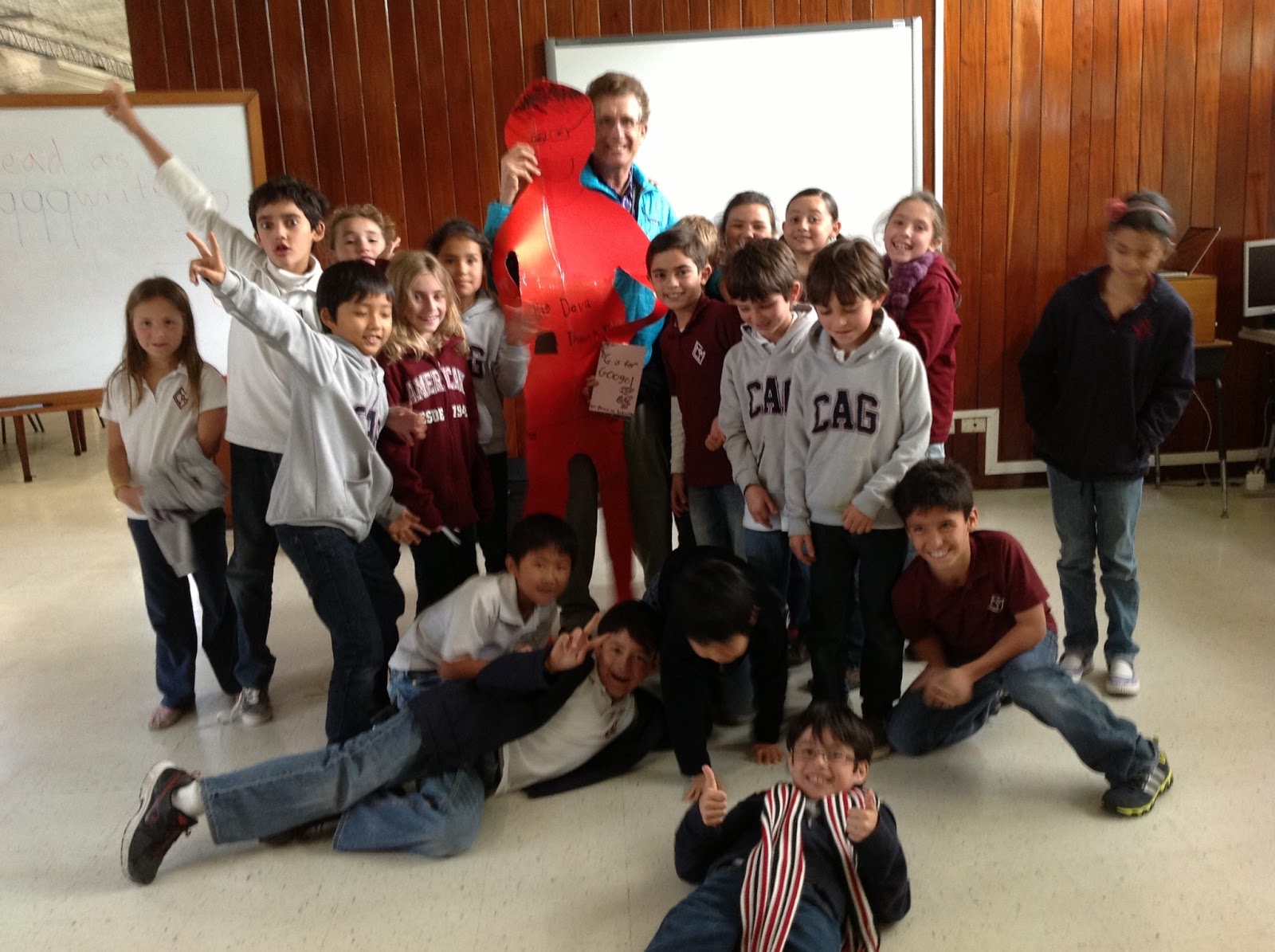
This picture came via email from a class at Colegio Americano de Guatemala, the
American School of Guatemala. I spent a week there in March. A day after seeing
one of my presentations, the 3rd grade class of Ms. Katie Jones-Vis
presented me with “Big David,” a cut-out meant to resemble me in height — 5’ 10”. This prop was a take-off on “Little
Davie” a 4’6” cut-out they saw me use to demonstrate the proportionality
concept in my book If You Hopped Like a
Frog. I had told them the story of how, as a child I noticed that a 3-inch
frog could hop 5 feet, which is 20 times its own height. I wondered how far I
could go if I hopped proportionally, meaning 20 times my height (at the time, 4’
6”). A little arithmetic revealed a trajectory of 90 feet (4.5 feet X 20),
which I quickly equated with the distance between the bases on a major league
baseball “diamond” (square, really, but that matter is in a different book!). Years
later, this childhood revelation became the basis for If You Hopped Like a Frog, which opens, “If you hopped like a
frog…you could jump from home plate to first base in one mighty leap.” Other
examples compare human abilities to those of animals by imagining the comic
results of human performance matching that of certain animals proportionally.
Having seen me walk “Little Davie” through 20 iterations to
show how far I could have hopped if, as a 4’6” boy, I’d been able to hop 20
times my height, Ms. Jones-Vis’s class decided they wanted to see
what would happen if “Big David” could do the same. Good math, good literature
connection, but what pleased me most was what the teacher wrote in her email to
me: “Thank you again for your workshop. The students were so excited to go back
to math class.”
I have been in discussions with some of my iNK Authors on
Call colleagues about live author visits vs. videoconferencing, and
specifically our program “Class Acts,” in which one or more authors work both with teachers, coaching them in the use of our books to meet classroom
objectives, and with students who “meet” us in a videoconference and ask
questions and share their own work inspired by the author’s. There can be two
or more sessions of each. (See, for example, Andrea Warren’s fabulous post on Aprill 22 about her videoconference sessions with 5th graders exploring family history:
http://inkrethink.blogspot.com/2013/04/guest-blogger-andrea-warren-on-using.html.)
We iNKers are of diverse opinion on the pros and cons of virtual vs. live, and some of us have
argued that the intimacy of interactive videoconferencing in multiple sessions
across weeks or months puts the author into a mentoring role giving truly long-term
benefits, while live visits are something of a flash in the pan: “He (or she)
came, he spoke, he left.”
Live author visits are more like performances than
conversations. From my highly unscientific study (sample size one author), here is further unscientifically collected anecdotal evidence, which came in an
email last month, referring to a school visit I made in Ithaca, NY, several
weeks earlier: “Everyone here is still talking about your visit...” Or this from
a parent after seeing my program for the primary grades at a school in Seattle:
“Our family will never look at math in the same way.” Or this from a 5th
grade teacher near Philadelphia: “You put the kids into high-power math mode
for days.” Maybe there can be lasting benefits of live author assemblies,
especially when teachers give the kids opportunities to process what the
author had to say, not just wave good-bye as he drives down the bus lane and
back to the airport.
So, performances on the one hand and conversations on the other. Can’t both be
valuable, inspirational, educational and entertaining? I certainly wouldn’t
want to say that one is has more curricular value or benefits with a longer
half-life than the other. I’m thrilled to be able to participate in both.
Happy summer, everybody!
June 23, 2013

June 21, 2013
The Hit-By-the-Bus Moment
This week I reached my
hit-by-the-bus benchmark for another book. Don’t worry! It’s not what you might
think. No, I haven’t become so frustrated with the project to have considered
throwing myself in front of a bus. (Although as authors we might feel that way
sometimes!)
Quite the opposite.
Instead I’ve reached that golden
moment when the book is nearing completion. I’ve made my last revisions,
written the final photo captions, tweaked the back matter. This baby is almost
done! I say to my friends with great glee, “I could be hit by a bus, and the
book would still come out.” The expression may sound a bit melodramatic, but
for an author who has spent one-two-three-ten—pick a number—of years working on
a project, the relief of knowing the book will “make it” is palpable.
 I came up with the hit-by-the-bus
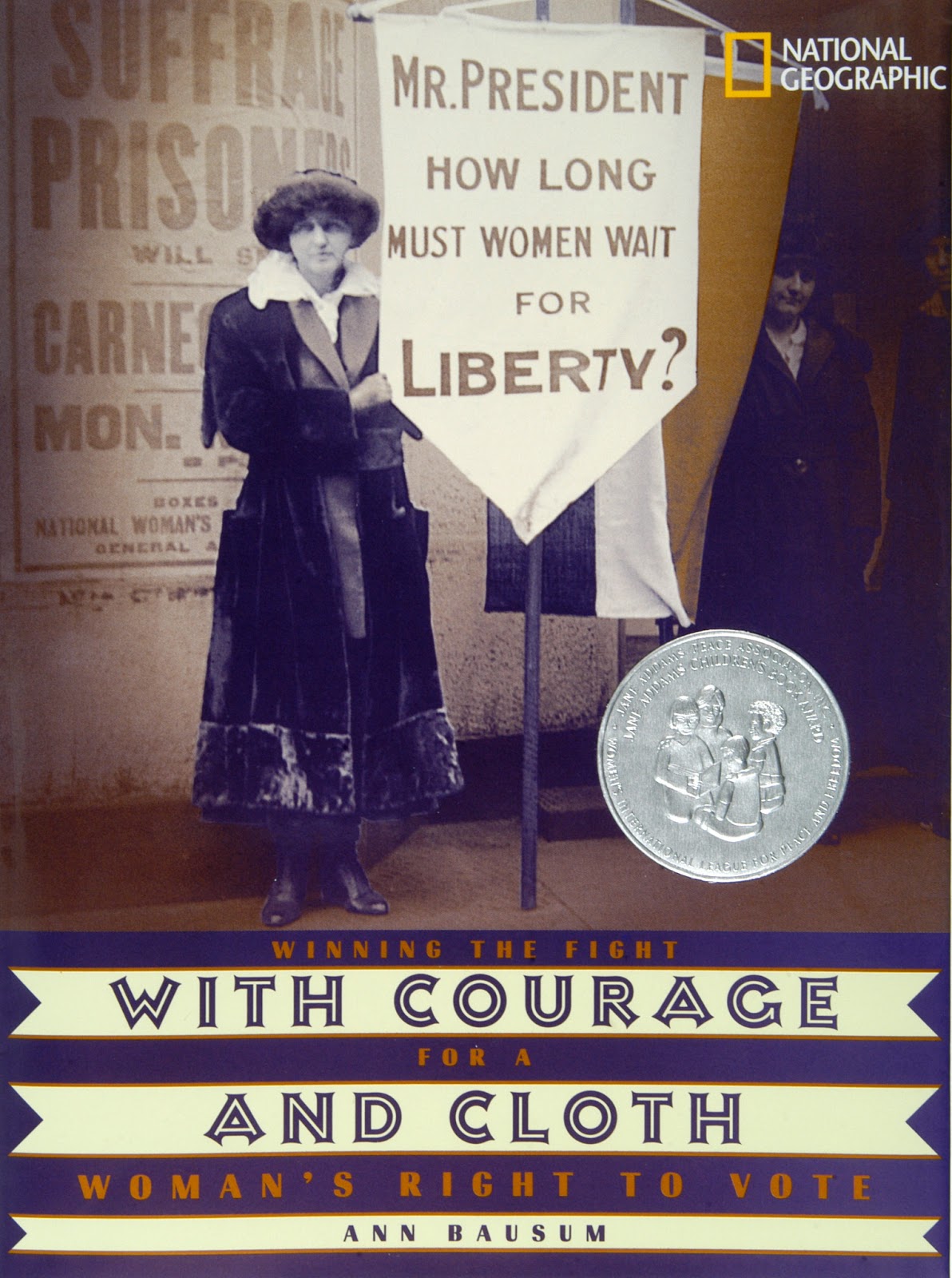
benchmark idea many years ago. I was working on one of my early books, With Courage and Cloth, and the process
had become endless. I began to worry: Will
I ever finish this book?! The more years I worked on it without completing
it, the more my anxiety began to rise. What
if I never quite make it? What if I get that close to done but something
happens to me? The book will never come out, and no one will get to see all the
cool photos I found of suffragists picketing at the White House for voting
rights or learn about the forgotten story of how they went to jail so that
women would earn the right to vote. You get the idea. I became extra
careful in my personal life—looking both ways twice before crossing the street, et cetera.

Alice Paul celebrates, 1920. LC-USZ62-20176
When the book finally reached the
phase of printer’s proofs, my relief was palpable. Yes! The bravery of those
suffragists would become known to young people (and the grownups in their
lives). The ingenuity of Alice Paul—architect of the employment of nonviolent
resistance for her cause four decades ahead of the Civil Rights Movement—could
be celebrated again.
When the book came out months
later, it caught on with readers, and, fortunately, it remains a favorite
almost a decade later. Every year I hear from students who are featuring Alice
Paul and the National Woman’s Party in History Day competitions. Thanks to the
Common Core, the book will remain influential for the foreseeable future, too.
Thank goodness I wasn’t hit by a bus in the middle of the project!
 Seven books later I’ve crossed
another hit-by-the-bus benchmark. Phew! Now the next book will see the light of
day, too, as, I expect, will I.
After all, by now it’s a habit. I always look both
ways twice before I cross the street.