Elizabeth Rusch's Blog, page 36
December 13, 2012
Dessert

I’m working on the Author Note for a new biography, and it’s
got me thinking about the goodies-at-the-back-of-the-book.
I’ve been a big fan of back matter ever since I wrote my
first biography, The Dinosaurs of Waterhouse Hawkins. There was simply so much
interesting information that didn’t fit into the main text, and I couldn’t bear
the idea of not passing it along. So I wrote an author note—a long author note
in itty-bitty font—and Brian Selznick added an illustrator note of his own. The
result is like dessert after a great meal: you were already happy and utterly
satisfied and then yay, you get even more.
Because nonfiction pictures books have such a tight focus,
lots of great stuff gets left out. This makes for a stronger book—it needs one
clean storyline, anchored in person, place and time, and any extra details you
include need to do the work of developing theme. But including back matter does
give you a chance to shine the spotlight, briefly, on something else.
For my biographies, the back matter often shares the story
of what happened after the story told in the main text. In The Dinosaurs of Waterhouse Hawkins,
you get to find out what happened to the villain, Boss Tweed, after he had
Waterhouse’s dinosaurs destroyed. In Walt Whitman: Words for America, you learn
about Walt’s life after his great sacrifice and service during the Civil War.
You get to meet wild-and-crazy Alice as the wife of a
congressman, running around Washington, D.C., in the author note for What To Do About Alice? (and see that becoming a grownup did not temper her behavior one
iota.) And in the author note for The Extraordinary Mark Twain (According to Susy), you come to appreciate just how important Susy’s little biography became
to her father as time went on.
In Those Rebels, John and Tom—the story of a great
partnership and all that it accomplished for American Independence—you see that
friendship strained to the breaking point and then how these two champions of
democracy reconciled and forged an even tighter bond in their final years.
A solid story will stand alone—complete and satisfying in
itself. But if a book has back matter, I always take a peek. Because at the end
of a nice meal, who doesn’t like a little dessert?


December 12, 2012
A Picture Is Worth 1,000 Words

Library of Congress, LC-DIG-ggbain-19173
Well, maybe not 1,000, but even as
a writer I can’t deny the power of a photograph. One click of a shutter release
and BAM, we see a story. Photos capture drama (left, survivors from the 1915 sinking of the Lusitania). They convey emotion. Sometimes
they offer clarity. At other times they fill us with questions. And that’s
where the words come in (thank goodness, say the writers).
I owe at least two of my books to
photos. I became so captivated by the Earnest Withers “I AM A MAN” image from Memphis 1968 that I
wrote a whole book about it, Marching to
the Mountaintop. Ditto for the “Blood Brothers” image of John Lewis and Jim
Zwerg, following their beating as Freedom
Riders on May 20, 1961. (See page 42 of this title.)
I’m not sure which I love more,
writing or photo research. Both are passions for me, so I am lucky to work in a
genre that seamlessly weaves the two media into a powerful forum for conveying
the stories of history. If you read these words on their magical 12-12-12 posting
date, you can imagine me engaged in photo research. I’ll be in Washington,
D.C., that day, wrapping up three days of research for my latest project which,
come to think of it, started with an image, too. (Or at least it started during
an earlier round of photo research when my efforts to track down the background
of one picture led to the discovery of a whole new story from the past.)

Photo courtesy Library of Congress, LC-DIG-highsm-01901
So what is photo research like?
Truthfully it’s about as glamorous as a day of writing, which is to say not
very. By the end of the day my back aches for bending over images. My mind is so
warped by time traveling through thousands of windows into the past that it is
jarring to step out into real time. My sleep is animated by disjointed pictures
as my mind races to process all the scenes it has observed.
But photo research is also as rewarding
as writing. That moment when you revise to the perfect conclusion is matched by
the discovery of a gotta-have-it photograph. I suspect there is some chemical
parallel between gambling and photo research, because that rush of excitement
from finding one great picture becomes the fuel for the next few hours of
fruitless searching.
Sometimes I do photo research using
on-line databases. Sometimes I’m on site, glove-adorned, paging through
carefully catalogued original prints. And sometimes I’m cut loose in an archive
of dog-eared, we-should-organize-these-some-day gems. I become a treasure
hunter, gently sifting through the sheets of chemical-infused paper to find
just the right shades of sepia and cream. Here a dramatic smile. There a scene
filled with action. Now a glimpse of a forgotten figure. Then a fresh look at a
favorite icon. Sorting the wheat from the chaff, the powerful from the mundane.

Courtesy Library of Congress, LC-DIG-highsm-03177
One of my favorite places to
conduct photo research is the Library of Congress, and I will be there at least
twice during my current research trip. Those on-site trips offer access to
materials that are otherwise inaccessible, but these days it’s getting easier
and easier to find treasures using the online databases of the Library’s Prints
and Photographs Collection. I’m a big booster of this site, especially when I
do school visits. Anyone who hasn’t used it should kill an hour or two playing
around with the search engines. More and more material is now accessible
off-site, and any images that can be downloaded from a remote location can be
used with a clear conscience as material in the public domain. These are our
tax dollars at work, people. It’s wonderful! Enjoy!
P.S.: I’ve developed an online
tutorial for using the collections of the Library of Congress Prints & Photographs division. For more information, visit the Muckrakers page of my author website and follow the
tab marked “Behind the scenes—photo research.”


December 11, 2012
A Tiny Bit Worried
I've had the distinct pleasure to be a part of several Children's literary conferences since the beginning of September, including the Rutgers Council on Children's Literature Conference (now 40 years young and still going strong. Yes, I'm on the council and it's a unique and amazing one day event). Anyway, at every conference I've attended this year the changes in the CCSS came up for discussion, but the talk at Rutgers made me pause. And worry.
Part of the confenece is a Five-On-Five discussion, an hour where 5 veterans of the publishing wars (writers, illustrators, agents and editors) talk to 5 hopeful writers about their publishing concerns. In the past such things as "do I need an agent?" "how should I write a proposal?" "what does a personal rejection really mean?" were some of the main concerns and drove the conversations. This year it was the changes to the CCSS.
Almost the entire time was consumed (in a good way) by "the changes," which I said out loud at one point and realized it sounded like some sort of medical condition. We were fortunate to have Marc Aronson (google Marc Aronson and there's more info about him and the CCSS on his website) in the group since he's spent a great deal of time in the past couple of years explaining the changes. But the rest of us added our opinions and ideas as well.
During all of the discussion I noticed that the younger writers were taking notes. Lots of them. This seemed fine for the most part, but then the question was raised (and I'm paraphrasing here): "what sort of topics would fit these changes?"
The discussion about topics went on and so did the note taking. And then I began to worry. At which point I said (blurted out?!?) "but you shouldn't write to the CCSS. You need to write about things you really know and love and..." Yes, that's the old chestnut, the line of advice we've all heard forever and been urged to follow.
Why was I worried? Newer writers like a certain amount of direction -- from established writers, editors, and agents, from survivors! -- on how to take their ideas and early drafts and make them into wonderful books. That's always been so; I know, I was the same way. But I started to worry that we might breed a line of writers who write to the CCSS and not from their inner beliefs and passions.
I wasn't selling short the 5 at our discussion. They were all very thoughtful, very aware, and all seemed to have individual areas in interest, so I think they'll process and use the information wisely. I was worried about myself.
The changes in the CCSS have opened a door for children's nonfiction writers as never before. It has tried to put a new and long-overdue focus on our writing. That's wonderful. But with that comes a certain pressure. Textbooks companies seem to be hunting out and purchasing books that are CCSS compatible; I noticed one major reviewer was going to focus serious attention on books that fulfill the CCSS standards and assume all other reviewers will, too; I know that trade publishers are much more aware of the standards then ever before.
I wondered, for instance, will reviewers begin giving books CCSS scores (you know, 10 being a book that meets a great many of the standards). Silly? Well, twenty years ago most people would have said scoring wine with number ratings was not just silly, but impossible. And then along came Robert Parker. And some wine makers followed (a number of very good French growers made special batches of wine specifically to please -- and get higher rating's numbers -- from Parker and his associates). Why wouldn't some writers -- me -- be influenced by the possible attention and money a perfectly sculpted CCSS book might bring.
Anyone who's read this far is probably thinking: relax, Jim; there are enough smart, honest gatekeepers out there to criticize and marginalize such obviously engineered books. I'm good with that. But in the past all the gatekeepers didn't stop textbooks from being, well, textbooks, and amassing great power nationally. So you never can tell. As I said, this only has me a tiny bit worried, though it's the sort of worry that I think I -- we -- should carefully monitor over the coming years.

Part of the confenece is a Five-On-Five discussion, an hour where 5 veterans of the publishing wars (writers, illustrators, agents and editors) talk to 5 hopeful writers about their publishing concerns. In the past such things as "do I need an agent?" "how should I write a proposal?" "what does a personal rejection really mean?" were some of the main concerns and drove the conversations. This year it was the changes to the CCSS.
Almost the entire time was consumed (in a good way) by "the changes," which I said out loud at one point and realized it sounded like some sort of medical condition. We were fortunate to have Marc Aronson (google Marc Aronson and there's more info about him and the CCSS on his website) in the group since he's spent a great deal of time in the past couple of years explaining the changes. But the rest of us added our opinions and ideas as well.
During all of the discussion I noticed that the younger writers were taking notes. Lots of them. This seemed fine for the most part, but then the question was raised (and I'm paraphrasing here): "what sort of topics would fit these changes?"
The discussion about topics went on and so did the note taking. And then I began to worry. At which point I said (blurted out?!?) "but you shouldn't write to the CCSS. You need to write about things you really know and love and..." Yes, that's the old chestnut, the line of advice we've all heard forever and been urged to follow.
Why was I worried? Newer writers like a certain amount of direction -- from established writers, editors, and agents, from survivors! -- on how to take their ideas and early drafts and make them into wonderful books. That's always been so; I know, I was the same way. But I started to worry that we might breed a line of writers who write to the CCSS and not from their inner beliefs and passions.
I wasn't selling short the 5 at our discussion. They were all very thoughtful, very aware, and all seemed to have individual areas in interest, so I think they'll process and use the information wisely. I was worried about myself.
The changes in the CCSS have opened a door for children's nonfiction writers as never before. It has tried to put a new and long-overdue focus on our writing. That's wonderful. But with that comes a certain pressure. Textbooks companies seem to be hunting out and purchasing books that are CCSS compatible; I noticed one major reviewer was going to focus serious attention on books that fulfill the CCSS standards and assume all other reviewers will, too; I know that trade publishers are much more aware of the standards then ever before.
I wondered, for instance, will reviewers begin giving books CCSS scores (you know, 10 being a book that meets a great many of the standards). Silly? Well, twenty years ago most people would have said scoring wine with number ratings was not just silly, but impossible. And then along came Robert Parker. And some wine makers followed (a number of very good French growers made special batches of wine specifically to please -- and get higher rating's numbers -- from Parker and his associates). Why wouldn't some writers -- me -- be influenced by the possible attention and money a perfectly sculpted CCSS book might bring.
Anyone who's read this far is probably thinking: relax, Jim; there are enough smart, honest gatekeepers out there to criticize and marginalize such obviously engineered books. I'm good with that. But in the past all the gatekeepers didn't stop textbooks from being, well, textbooks, and amassing great power nationally. So you never can tell. As I said, this only has me a tiny bit worried, though it's the sort of worry that I think I -- we -- should carefully monitor over the coming years.
December 10, 2012
Ingredients for a Great School Visit
I had another I.N.K. post just about finished when Kelly Milner Halls' plea for school librarians and a package pushed me in another direction.
The mailer came from Carol Sweny, the Henniker Community School librarian, in Henniker, NH, where I had recently talked to kids, K-8. The disc of photos recording my two days there included all the ingredients of a great school visit and reminded me how often a school librarian is at its core.
In the school visit's section of my web site, I have a version of what most authors say on theirs: I find that when kids are prepared for a school visit, they
get more out of it. So I ask that students have access to some of my
books beforehand, and read (or are read) at least one of them. I also
have downloadable pictures of me and book covers to make a poster for
your hallway. These efforts alone will invoke kids’ interest and
enthusiasm, making the visit more memorable for them.
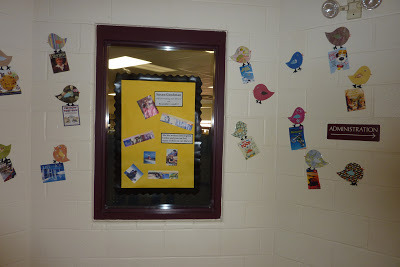
Remember you can click on all these pictures to make them larger.
This statement isn't an ego thing or a plea to buy more of my books beforehand. When kids know I'm coming, when they have read or heard some of my books, they are psyched to see me. They have had time to think and wonder about things, they listen more attentively, they ask more questions. They get more out of the experience. It's not that I can't grab an uniformed class or auditorium's attention; I can. But time after time, I notice that prepared kids have a better experience.
Like Kelly, I know that classroom teachers and principals are overloaded. Some may not even know an author is coming in time to prepare. Besides they are trying to get through their curriculum and whatever enrichments they have planned, let alone teaching to whatever state test is coming up next. PTO parents work hard to raise money for author visits, but their role doesn't usually extend to the classroom or library. The school librarian is the perfect person to rally the troops: to prepare the kids in library class, to suggest and facilitate related classroom exercises, to organize book order forms, to generate excitement.
The Henniker has one author come each year, and Carol Sweny makes the most of it. I'm not suggesting that every school or school librarian wants or needs to put in the time and effort she did. Perhaps showing how she rallied her school, however, will remind people how important it is to have school librarians and how much their efforts, with school visits and everything else, help kids learn and grow.
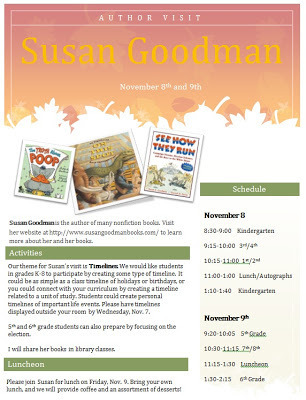
Here is part of the flyer Carol made to pass around to the teachers.
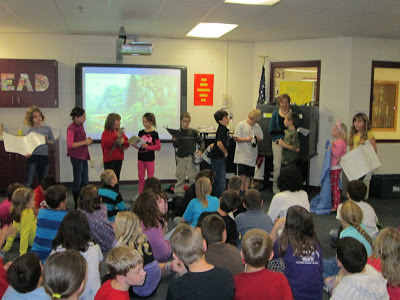
As you saw, grades K through 4 saw a presentation based on my book On This Spot, which takes New York City back in time to when it was home to forests, glaciers, dinosaurs, towering mountains, even a tropical sea. This presentation included, among other things, kids taking many different objects and sorting themselves into a timeline.
Carol asked the teachers to have their classes use timelines to supplement normal learning. They did so in different and wonderful ways. The school's corridors were festooned with examples of this interesting way to think about time and history.
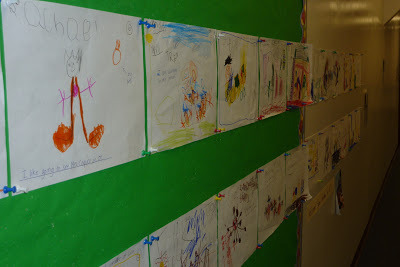
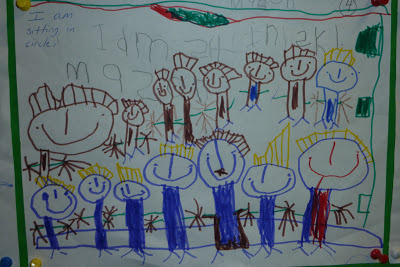
The kindergarteners made timelines of their days.
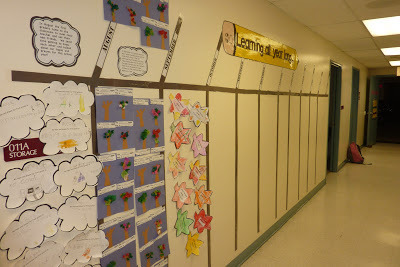
First graders created a timeline that would record a whole year of learning month by month.
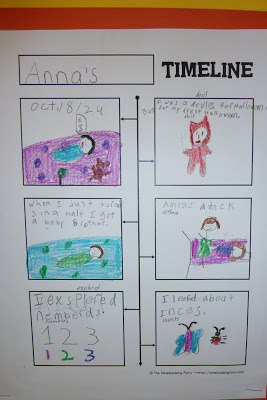
The 2nd graders made illustrated lifelines.
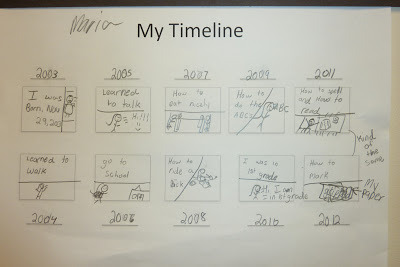
Third graders did their lifelines too.
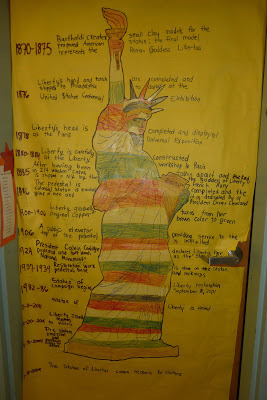
Here's a new way for a 4th grade class to think about the making of the Statue of Library.
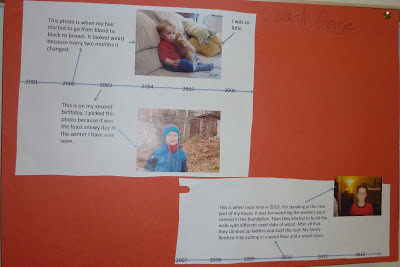
The 5th grade concentrated on learning new computer skills while doing their personal timelines.
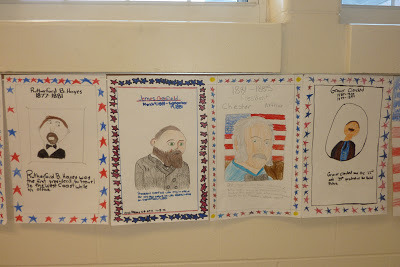
The 6th grades' timeline of our presidents was perfectly timed since my visit occurred shortly after the election in November.
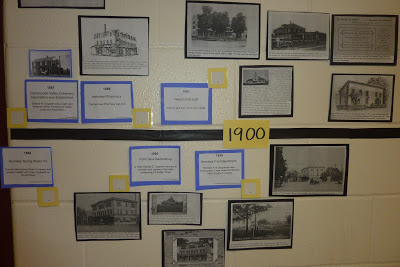
The 7th graders learned research and computer skills creating a timeline of Henniker's history that took up an entire hallway.
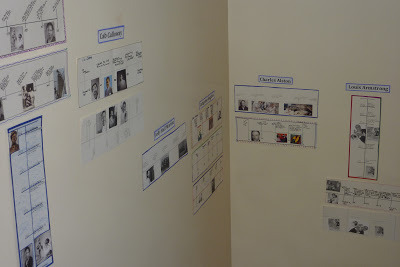
The 8th grade's timeline cascading down the stairway brought their study of the Harlem Renaissance to life.
As Kelly so wisely said, school librarians (any librarians) are teachers. They build relationships, spark imagination. We should fight for them.
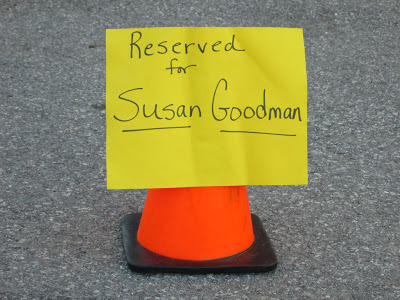
I would fight for Carol Sweny. Besides a great school visit, she gave me a moment of feeling like a rock star. Check out what greeted me when I pulled into the school parking lot.


The mailer came from Carol Sweny, the Henniker Community School librarian, in Henniker, NH, where I had recently talked to kids, K-8. The disc of photos recording my two days there included all the ingredients of a great school visit and reminded me how often a school librarian is at its core.
In the school visit's section of my web site, I have a version of what most authors say on theirs: I find that when kids are prepared for a school visit, they
get more out of it. So I ask that students have access to some of my
books beforehand, and read (or are read) at least one of them. I also
have downloadable pictures of me and book covers to make a poster for
your hallway. These efforts alone will invoke kids’ interest and
enthusiasm, making the visit more memorable for them.

Remember you can click on all these pictures to make them larger.
This statement isn't an ego thing or a plea to buy more of my books beforehand. When kids know I'm coming, when they have read or heard some of my books, they are psyched to see me. They have had time to think and wonder about things, they listen more attentively, they ask more questions. They get more out of the experience. It's not that I can't grab an uniformed class or auditorium's attention; I can. But time after time, I notice that prepared kids have a better experience.
Like Kelly, I know that classroom teachers and principals are overloaded. Some may not even know an author is coming in time to prepare. Besides they are trying to get through their curriculum and whatever enrichments they have planned, let alone teaching to whatever state test is coming up next. PTO parents work hard to raise money for author visits, but their role doesn't usually extend to the classroom or library. The school librarian is the perfect person to rally the troops: to prepare the kids in library class, to suggest and facilitate related classroom exercises, to organize book order forms, to generate excitement.
The Henniker has one author come each year, and Carol Sweny makes the most of it. I'm not suggesting that every school or school librarian wants or needs to put in the time and effort she did. Perhaps showing how she rallied her school, however, will remind people how important it is to have school librarians and how much their efforts, with school visits and everything else, help kids learn and grow.

Here is part of the flyer Carol made to pass around to the teachers.

As you saw, grades K through 4 saw a presentation based on my book On This Spot, which takes New York City back in time to when it was home to forests, glaciers, dinosaurs, towering mountains, even a tropical sea. This presentation included, among other things, kids taking many different objects and sorting themselves into a timeline.
Carol asked the teachers to have their classes use timelines to supplement normal learning. They did so in different and wonderful ways. The school's corridors were festooned with examples of this interesting way to think about time and history.


The kindergarteners made timelines of their days.

First graders created a timeline that would record a whole year of learning month by month.

The 2nd graders made illustrated lifelines.

Third graders did their lifelines too.

Here's a new way for a 4th grade class to think about the making of the Statue of Library.

The 5th grade concentrated on learning new computer skills while doing their personal timelines.

The 6th grades' timeline of our presidents was perfectly timed since my visit occurred shortly after the election in November.
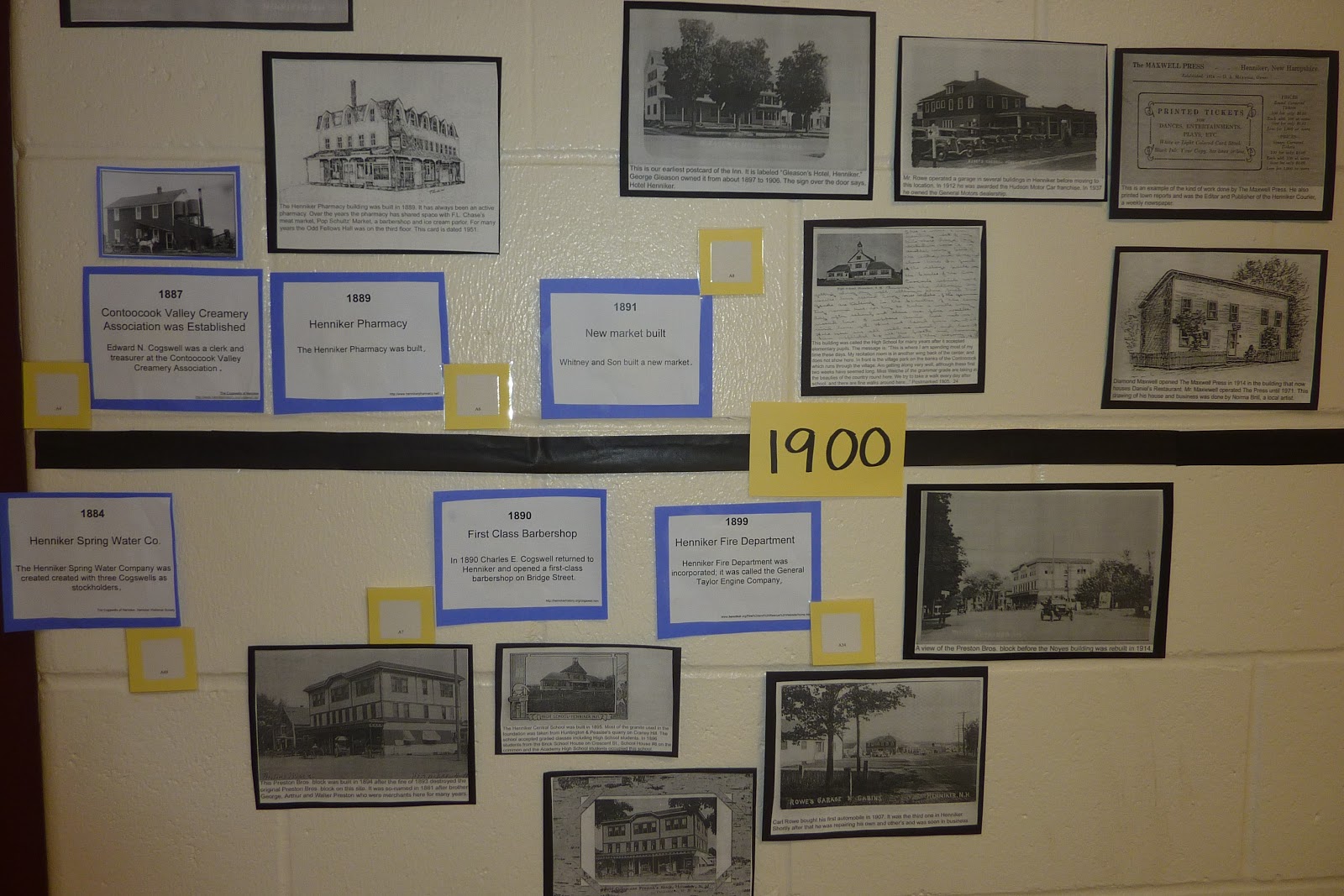
The 7th graders learned research and computer skills creating a timeline of Henniker's history that took up an entire hallway.
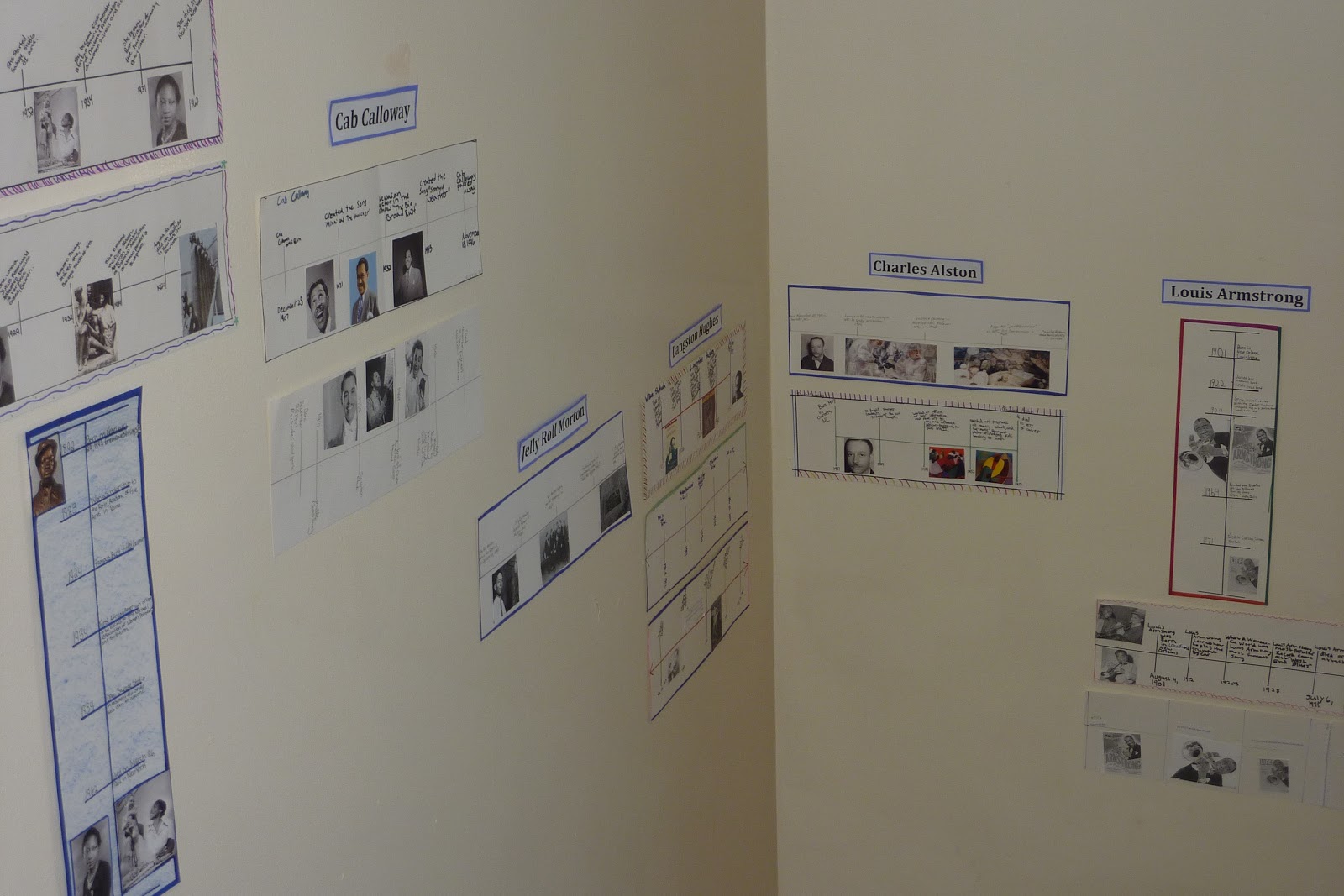
The 8th grade's timeline cascading down the stairway brought their study of the Harlem Renaissance to life.
As Kelly so wisely said, school librarians (any librarians) are teachers. They build relationships, spark imagination. We should fight for them.
I would fight for Carol Sweny. Besides a great school visit, she gave me a moment of feeling like a rock star. Check out what greeted me when I pulled into the school parking lot.

December 6, 2012
Legacy? Never Mind
I don’t know if people are
willing to admit it, but many of us, and I suspect especially those of us who
write books, have given some thought to what our legacy will be. I know I have.
Since I am childfree—a term I recently heard for the first time—I won’t be
leaving any progeny to carry on the family name. But I will be leaving my books
to inform future generations. Even if libraries purge their holdings to make
way for newer volumes, I’m thinking (hoping) that some of my writings will
survive on the dusty shelves, or at the very least, in Cyberspace. I know it
won’t really matter to me after I’m gone, but right now, I find the thought
comforting.
Perhaps that’s why I had
such a visceral reaction to the Gilda’s Club brouhaha that erupted last week.
For those who don’t know, Gilda’s Club is a community organization with more
than 20 affiliates that is dedicated to offering support to people who are
living with cancer, and their loved ones. It was founded in the 1990s in honor
of Gilda Radner, one of the original “Not Ready for Prime Time Players” on Saturday Night Live, who died of ovarian
cancer in 1989. During her illness, Gilda found encouragement and solace at a
California organization called the Wellness Community. Gilda’s Club was modeled
after that group. (The name refers to Gilda’s quote that “having cancer gave me
membership in an elite club I’d rather not belong to.”)
In 2009, Gilda’s Club
Worldwide merged with the Wellness Community to create the Cancer Support
Community. After the merger, the home office decreed that affiliates could
determine which of three names worked best for them: Gilda’s Club, the Wellness
Community, or the Cancer Support Community. A few weeks ago, the affiliate in
Madison, Wisconsin, held a ribbon-cutting ceremony to celebrate its new name,
the Cancer Support Community Southwest Wisconsin. The executive director,
Lannia Syren Stenz, told the Wisconsin
State Journal the name was being changed because the population they serve is getting younger. "One of the realizations we had this year is that our college students were born after Gilda Radner passed," she said. "We want to make sure that what we are is clear to them and that there’s not a
lot of confusion that would cause people not to come in our doors.”
Coverage of this event
jumped from the Wisconsin State Journal
to and pretty much all over the Internet, thanks to Twitter and
Facebook. Fans of Gilda, and common sense, pointed out that it would be more
meaningful to teach people who Gilda was than to obliterate her from the
organization that was founded in her name. Toward that end, actress Martha
Plimpton tweeted that she had ordered five copies of Gilda’s moving memoir, It’s Always Something , to be sent to the
Madison chapter. Others pointed out that few of us know who Mayo was, or Sloan
and Kettering, or Dana and Farber, but we still can find our way to their
hospitals when necessary. Among the hundreds of comments on the Madison
branch’s Facebook page (now taken down) was this one: "The
only educating you're doing is teaching kids that when they die from cancer,
their name will be erased from history in 20 years because the next generation
doesn't know who they are. Way to give them hope!"
While the Wisconsin
affiliate doesn’t seem to have been swayed by the petitions, tweets, and articles
blasting their decision, other branches were quick to reassure the public that
they had no intention of changing their name. “As
the flagship Clubhouse, we value our brand and our association with Gilda
Radner,” the New York club posted on their Facebook page. The Chicago branch tweeted,
“Gilda’s Club Chicago will remain Gilda’s Club Chicago in honor
of the courageous way Gilda, and all of our members, live with cancer.”
Just two months ago, I
about the importance of naming buildings and public memorials after
women, so there’s no mystery about where I stand on this matter. I was also a
big fan of Gilda, who had the guts to bare her soul in the process of reaching
her audience. (Just watch this clip from her movie, Gilda Live, to see what I mean.) She did the same in her book, an admirable,
intimate account of her struggle with cancer which is back in print with a new
Resource Guide and a new chapter on Living with Cancer. And besides all that,
she was really funny. Just check out these clips of her characters Roseanne Roseannadanna and Emily Litella.
I joined the New York
chapter of Gilda’s Club when a close friend was dealing with cancer. The other
day, she reminded me that not too long ago, cancer was something you didn’t discuss.
Friends would shy away from you if they knew you were sick and you pretty much
suffered in silence. Thanks to Gilda and the movement she inspired, people with
cancer have a place to talk about what the “civilians” in their lives might not
want to hear, the gritty details of survival. Helping each other empowers them in their own fight. That's why if people don’t know who Gilda Radner was, they sure as
heck should find out.


December 5, 2012
Librarians as an Endangered Species

Thanks to the new emphasis on nonfiction in the Common Core
standards, my school visit dance card has been filled for months (and for
months, even years to come). Books about
Sasquatch and UFOs may not land me a place on most award lists, but they make
it easy to define critical thinking skills and the value of diligent research.
My job seems secure.
Not so for librarians.
Coast to coast, city to city, I’ve seen a disturbing
trend. Librarians are fighting for their
lives. IMHO, we should be fighting right alongside them. Librarians are the living, breathing bridges
between writers and readers. And they
need our help to survive.
Public education budgets are stretched to their limits and
administrators are search for ways to cut costs. Librarians are an easy target, thanks to the
ready availability of paraprofessionals.
“We can fire our librarians,” the ill-informed conclude, “and hire paraprofessionals
at half the expense. After all, how hard is it to check out books?”
Our educational administrators are stretched so thin with the
demands of academic life, they’ve failed to recognize how much their librarians
do, beyond checking out books. So I hope
we can gently remind them.
Librarians ARE Teachers
They are professionals with years of academic study behind
their credentials. Like classroom
teachers, they have worked hard to achieve their professional degrees and to keep
their credentials current. They are
specially trained to work with books for young readers – and the kids who will
discover them.
Librarians Build Relationships
Consider an elementary school librarian’s awesome
reach. He or she meets a student as a
five-year-old checking out books for the very first time. He knows if the kindergartener had trouble
being away from home. He knows if they
recognize their letters and colors. He
knows if there are signs of abuse or neglect.
He knows if the child is gifted or needs extra help. A year later, he sees the progress the
six-year-old has made. He knows the
second grader got a new step-father, and he knows the marriage crumbled by the
time the boy turned ten. Year after year, the librarian offers her
students a safe place to go – and a witness.
The relationship between a librarian and a child is far deeper than most
people recognize. It is long term and it
is vitally important.
Librarians Spark Imagination
Because of their long term relationships with an entire
school population, librarians acquire books with specific readers in mind. They target their purchases with precision
and sharp consideration. When a
librarian buys IN SEARCH OF SASQUATCH, she knows exactly who will check it out
first – and who will line up to check it out later. She knows which readers are waiting for the
new Lisa Yee novel. She knows who’s
aching for BABY MOUSE and who’s secretly ready for Chris Crutcher. Years of professional observation, years of
trust have created the potential for great reader growth, thanks to the careful
selection that goes into an exceptional library collection. It’s personal. And it matters.
Librarians Are Media Specialists
Common Core standards emphasize the need for students to read
and understand nonfiction in all of its research applications. College students will be required to research
and write in depth papers. Our schools
are charged with making sure they’re ready once they graduate. Who better to teach young people about
research than our media specialists?
Librarians know their collections inside and out. They know what books are available on
loan. They also know their electronic
devices, their computers, their access to online material. Classroom teachers are charged with teaching
math, science, English, history and social studies. Librarians should be celebrated for their ability
to teach research skills.
Librarians Have Heart
Where principals are the heads of every school, librarians
are the hearts. They are the gentle glue
that binds the whole school population.
Like the books they choose, protect and repair, librarians reach out to
needy children and remind them they are never alone. As long as they can find the perfect books,
they can find their kindred, even when traditional friends are scarce. As long as a librarian is on call, kids will
find those perfect books. It’s what
librarians are trained to do, thanks to years of education.
Librarians ARE Appreciated
Well, they SHOULD be.
They are the gatekeepers, poised to unlock every young reader’s passion
for reading. But they are far too often
cast aside. I did a school visit
yesterday where the librarians had been fired, district wide. One librarian had been retained to care for
the collections and populations of twelve different elementary schools. One librarian, twelve schools. She happened to be at the school I visited, though
she was not aware of my visit and the library had almost none of my books.
I asked her how she managed twelve schools as one
individual. She shook her head and laughed.
“I don’t.”
The squeaky wheel gets
the librarian grease – she goes, at any given moment, where she is most
needed. But she doesn’t know any of the kids. How could she? She’s
never building relationships. She’s
always putting out fires. She teaches a
research unit one week, weeds a collection the next. She can’t buy books for readers she doesn’t
know. So she buys, hoping she’ll hit the
mark – never knowing if she's even come close.
I asked what we could do to help. She said, “Oh god, if you could only speak
up.”
When the district fired the librarians, she said loud voices
made it possible -- voices fighting for music; voices fighting for art; voices
fighting for physical education. And I’m
glad those programs were defended. I
would have been lost without P.E. and art.
But the silence disturbs me. No
one fought for the librarians, so they were easy to scrap without the threat of
angry reaction.
As we face the onset of 2013, I hope we’ll look for
opportunities to celebrate our librarian friends the way I did at that same
school visit. I knew when I walked into
the school that the librarians had been fired – even before I spoke to the over
taxed one to twelve remainder. As I
watched one teacher search for the projector while another looked for a table,
and still another searched for a microphone that worked, the principal
apologized.
“It’s hard to pull things
together,” he said with a smile. I
smiled when I answered, too.
“I know exactly what you need,” I said.
He seemed so sincere as he asked his one word question. “What?”
“You need your librarian,” I said. “They are the keepers of the keys.”
“Ah…” he said, almost wistfully. “I’m beginning to think you may be right.”
I smiled again. “I’ve
always loved new beginnings.”
Bless the principal for inviting me. I am grateful. He cares about his students, and the visit
went very well. The kids were enchanted
by my books – only one of which was in their library collection, one published
in 2003. I donated seven more before I
left because the value of a school visit to a student depends on the chance to
explore the books after the author’s gone.
The paraprofessional was delighted. She loved my presentations, even if she had
no idea who I was or what I wrote when I walked through the door. And we had a good day. But I couldn’t help wishing I’d fought harder
to save the librarian along with the paraprofessional. A good author visit could have been great,
in the hands of a devoted librarian.
An academic team works best when it has all its most crucial
players. Librarians should be at the top
of that list.


December 4, 2012
We're Rallying the Troops
What was your reaction to Roz
Schanzer’s excellent post,
yesterday? Frankly, it made steam come
out of my ears. I took it as a shot
across our bow. The Washington
Post article she linked to and the article last week in the NY Times show an enormous lack of
knowledge about our genre. It’s almost
as if we’re invisible to the rest of the world.
We’re fighting all kinds of assumptions.
Here are a few right off the top of my head:
·
All nonfiction is
equal and equally boring.
·
Nonfiction is
reading a manual
·
“there isn’t that human connection that you get with
literature. And the kids are shutting down”
·
Nonfiction is “recipes and train schedules.”
·
“nonfiction requires more rigor than a literary novel”
·
“nonfiction may help you win the corner office but won’t
necessarily nourish the soul.”
And the articles that I excerpted these quotes from mention only long-form
journalism as an example of high quality nonfiction; neither article mentions
the existence of our genre of nonfiction literature for kids.
It’s not like we haven’t been thinking about
this for a looooong time. Here are a few
of the reasons our books are not studied in classrooms as the CCSS say they
should be taught:
·
They don’t come
with ancillary material such as lesson plans, and teacher’s guides and study
questions.
·
Educators don’t understand
how they support and fit into the curriculum.
·
Teachers are
afraid to stray from the prescribed reading material for fear something might
show up on the assessment tests that they should have “covered” but missed.
·
Teachers are
over-worked, over-scheduled and have very little time to invest in doing
something differently unless they know it will work.
·
Many educators
have not taken the time to read even one of our books. Teachers have no time to read them.
Librarians may beg teachers to work with them and pull books but often they don’t
have much influence.
·
There is a LOT of
confusion about the CCSS. Educators need
to understand that the standards are in
the way things are taught, not in the books themselves. Teaching from badly written material is NOT
the way to teach kids to read to learn—one of the basic literacy skills of the
CCSS. So they need to find out that our books are going to liberate them to
teach with much more creativity, critical thinking and, yes, humanity. And
reading is not just for ELA classes but for all subject areas. Our books are not competing with the teaching
of fictional literature.
iNK Think Tank is in the process of
becoming a company that will address these issues. It’s been a learning curve to find out how to
be a business but, after three years, it’s starting to come together. Here are
some of the things we’re planning: (I’m
into lists today.)
·
We are going to
expand our membership to include you, our readers. If you were a member, what would you want
from such a membership? We’re thinking lesson plans, book clubs with online
discussions, a community of sharing and strategizing about using nonfiction in
the classroom.
·
We will have the
money to pay for high-quality lesson plans, and consultants, and passionate advocates and we invite you to
participate.
·
We’re not yet
sure how things will develop but we already have a mailing list of thousands
of registered users for our database and will use it to keep you informed. So
if you’d like to be involved please register in the iNK Think Tank database and
be sure to use an email address that won’t come up against a school
firewall.
·
If you have ideas
and suggestions about how you personally can help, please send them in to: thoughts@inkthinktank.com
It’s
clear that we authors can’t fight this alone; we need your help. Please join
us. Learning is a struggle, but the
community that reads this blog knows that it can be a joyous one. It’s time to help the rest of the world find
out.
PS. Yesterday, I sent Roz's comments to Valerie Strauss at the Washington Post, who responded with interest. Here two posts of hers hot off the keyboard: Common Core Reading, Pros and Cons; and List: What Common Core Authors Suggest High-Schoolers Should Read.


December 3, 2012
WHY AUTHORS DRINK
Uh-oh, people, check it out. Remember the new Common Core State Standards that say nonfiction should make up 50 percent of the reading kids do in elementary schools and 70 percent of what they read by grade 12? Of course you do. Pretty cool for the top-flight authors who write such outstanding nonfiction books for kids these days, yes? Well, take a gander at this front page banner headline from yesterday’s Washington Post:
NEW SCHOOL LIT STANDARDS MAKE TEACHERS SMOLDER
Now there’s a headline that makes authors smolder too. So here’s a link to the very same article in its online incarnation, only with this kinder, gentler headline:
COMMON CORE SPARKS WAR OVER WORDS
Will an alternate headline make this news any easier to swallow? Let’s take a look.
Nope, it only gets worse because in spite of commentary on both sides of the issue, here’s the main thrust of the story:
Now teachers everywhere will have to banish almost all traces of great literature from their classrooms, and especially from their English classrooms. Instead, the CCSS dictates the use of such boring “informational texts” as a bunch of raw data, official papers from a Federal Reserve Bank and the General Services Administration, and some arcane speeches by dead people with no support material whatsoever to help put the material into context.
Want more? Calling the Common Core “misguided,” a Massachusetts’ specialist in pre-K-12 educational standards says that teachers “hate the Common Core, they hate the idea they have to teach nonfiction.” She says its supporters are “trying to elevate fact-based reading and writing at the expense of literature and creative writing.” So what are we—chopped liver?
And then there’s this: “The effect of the new standards is to drive literature out of the English classroom,” says a professor from Teachers College at Columbia University.
What? This article spans three pages in one of the nation’s most prestigious newspapers, and not one single mention is made about the outstanding nonfiction literature written specifically for kids??
WAKE UP, WASHINGTON POST. At this very moment, we are basking in the glow of a Golden Age of nonfiction. The best of these books bring to life some of the most exciting and riveting stories of all time, and better yet, these are books kids love to read. What a great way to make learning about the real world fun and memorable at the same time. And how misleading to omit an entire genre of compelling, beautifully written and illustrated, meticulously vetted, totally accurate, and thoroughly entertaining books from an entire front-page article in one of America’s most prominent newspapers!
What’s more, the best of the best nonfiction books can easily be tied to every aspect of a school’s curriculum, from English to math to social studies and science, making cross-curriculum work a pleasure. In all probability, the reason you are reading this blog is because you already know about these books and might be a fan of the nonfiction authors who write for INK. But judging from the newspaper piece, there are plenty of educators out there who still don’t get it.
So would they like to check out some examples of great nonfiction literature for kids that's a perfect fit for CCSS? Sure, be my guest and make things easy….just send them here. Take a gander at the dust jackets of a bunch of INK’s award winning books. Then go to the top of the page, click on Find the Books, and sign into the free online database, where you can generate entire lists of books geared directly to any subject you have to teach - or for that matter, any subject your heart desires.


November 29, 2012
Top Reasons to Buy a Great Nonfiction Book for a Kid on Your List
(with tips below on how to make a great match)

With gift-giving holidays just around the corner, here’s an idea for
that hard-to-buy-for kid on your list. How about a great nonfiction book? Here’s
why this gift can be a real winner:
* It shows you know the child and his or her interests and passions.
Animal lover? Football fanatic? Astronomy obsessed? You can really tailor the
gift to the child’s passion.
* You’ll probably be buying a book the child doesn’t already have.
Narrative nonfiction and other interesting nonfiction for kids are the best-kept
book secrets around. They can be as
gripping and absorbing as fiction but rarely get the same buzz. So it’s less
likely that the child already has the book.
* You’ll have something to talk about, especially if you read the book,
too. Books are a great way to connect with kids. And the book will give you a
chance to connect over something you know the child cares about. Maybe you
could even read it aloud together. Now that would be a meaningful gift.
* If the book is interesting nonfiction, the child will be entertained
while also learning something. It’s kind of what we want in all our
relationships, isn’t it? We want people to like us, enjoy us, but also learn
and grow from us. Great nonfiction books offer that great mix, too.
So HOW to pick the right book?
* Start with subject. If you don’t already know what
interests the child, ask his or her parent.
* Scan award winners and “best of” lists
for the best books on that subject area. Some good lists are:
Kirkus has released its best of 2012 list:
https://www.kirkusreviews.com/lists/best-childrens-books-2012-nonfiction
As has School Library Journal:
http://www.slj.com/2012/11/featured/best-books-2012/
The ALA’s Sibert Medal (like the Newbery
or Caldecott for nonfiction), http://www.ala.org/alsc/awardsgrants/bookmedia/sibertmedal
Orbis Pictus Award for Outstanding
Nonfiction for Children
http://www.ncte.org/awards/orbispictus
Outstanding Science Trade Books for
Students K-12
http://www.nsta.org/publications/ostb/ostb2013.aspx
Notable Social Studies Trade Books for Children
http://www.socialstudies.org/notable
For you visual-types, here’s a good pinterest
site with some recent outstanding nonfiction titles: http://pinterest.com/lindaslinks/best-nonfiction-books-resources/
* Match the book to the child’s age and reading level.
(One caveat. Many kids I know will read slightly above their age and reading
level if they are really passionate about a topic.)
* Give more than one. Can chose between two? Get them
both. Maybe one is slightly more difficult than the other. Or covers a
different part of the story. If a child loves one, they will probably like them
both. (If you don’t want to give two at once, save one for the next birthday.)
* If a child already reads, loves and enjoys
nonfiction, hand them something on a different subject than what they usually
read. The best nonfiction writing will hook readers in topics that they never
knew they would find interesting
* Pair the book with something fun. A stuffed
lizard. A “build your own robot kit.” A
historical wig.
* If you have the time (everyone sitting
around stuffed after a big holiday dinner) offer to read the
book (if it’s short) or the first chapter
(for a longer book) aloud to the child. Everyone loves to be read to. And it
could get them hooked.
Happy Holidays!
Elizabeth Rusch


With gift-giving holidays just around the corner, here’s an idea for
that hard-to-buy-for kid on your list. How about a great nonfiction book? Here’s
why this gift can be a real winner:
* It shows you know the child and his or her interests and passions.
Animal lover? Football fanatic? Astronomy obsessed? You can really tailor the
gift to the child’s passion.
* You’ll probably be buying a book the child doesn’t already have.
Narrative nonfiction and other interesting nonfiction for kids are the best-kept
book secrets around. They can be as
gripping and absorbing as fiction but rarely get the same buzz. So it’s less
likely that the child already has the book.
* You’ll have something to talk about, especially if you read the book,
too. Books are a great way to connect with kids. And the book will give you a
chance to connect over something you know the child cares about. Maybe you
could even read it aloud together. Now that would be a meaningful gift.
* If the book is interesting nonfiction, the child will be entertained
while also learning something. It’s kind of what we want in all our
relationships, isn’t it? We want people to like us, enjoy us, but also learn
and grow from us. Great nonfiction books offer that great mix, too.
So HOW to pick the right book?
* Start with subject. If you don’t already know what
interests the child, ask his or her parent.
* Scan award winners and “best of” lists
for the best books on that subject area. Some good lists are:
Kirkus has released its best of 2012 list:
https://www.kirkusreviews.com/lists/best-childrens-books-2012-nonfiction
As has School Library Journal:
http://www.slj.com/2012/11/featured/best-books-2012/
The ALA’s Sibert Medal (like the Newbery
or Caldecott for nonfiction), http://www.ala.org/alsc/awardsgrants/bookmedia/sibertmedal
Orbis Pictus Award for Outstanding
Nonfiction for Children
http://www.ncte.org/awards/orbispictus
Outstanding Science Trade Books for
Students K-12
http://www.nsta.org/publications/ostb/ostb2013.aspx
Notable Social Studies Trade Books for Children
http://www.socialstudies.org/notable
For you visual-types, here’s a good pinterest
site with some recent outstanding nonfiction titles: http://pinterest.com/lindaslinks/best-nonfiction-books-resources/
* Match the book to the child’s age and reading level.
(One caveat. Many kids I know will read slightly above their age and reading
level if they are really passionate about a topic.)
* Give more than one. Can chose between two? Get them
both. Maybe one is slightly more difficult than the other. Or covers a
different part of the story. If a child loves one, they will probably like them
both. (If you don’t want to give two at once, save one for the next birthday.)
* If a child already reads, loves and enjoys
nonfiction, hand them something on a different subject than what they usually
read. The best nonfiction writing will hook readers in topics that they never
knew they would find interesting
* Pair the book with something fun. A stuffed
lizard. A “build your own robot kit.” A
historical wig.
* If you have the time (everyone sitting
around stuffed after a big holiday dinner) offer to read the
book (if it’s short) or the first chapter
(for a longer book) aloud to the child. Everyone loves to be read to. And it
could get them hooked.
Happy Holidays!
Elizabeth Rusch
November 27, 2012
When Day Is Done
When I’ve finished
work for the day – writing or reading or driving home from a library or marking page proofs or
answering emails or …… I do other stuff: hike the Santa Monica Mountains, cycle around town, sing, cook,
eat, and go to plays and movies and such.

The last few months
I’ve gone to a load of plays all over Los Angeles. We’ve got a lot of actors hanging out here, and after their
shifts at Le Café du Jour, some of them do live theater. The other night I saw, or
rather didn’t see, Theatre in the Dark -- ninety minutes of listening in a pitch black theatre. with voices coming from all parts of the
theatre.

Then there are the small companies who are helping me complete my
life-goal of seeing all Will S’s work on stage.
However I have a special love for books, plays, or films about an artist’s creative process. How s/he drags that faint idea into a finished book/play/film. Three recent ones come to mind. Seminar made me glad I didn’t do an MFA program in writing literary fiction for adults. It’s a romp for Jeff Goldblum, but has its moments that ring true for all writers. For instance, however resigned we are to rejection and open to critique, a part of us always wants to hear, "It's perfect!" not "It needs a lot of work."

I saw King Vidor’s Show People , a 1928
silent film a few weeks ago. Similar plot to The Artist , but, IMHO, a
better movie. It was contemporary: the old cameras, lights, etc. weren’t
created in the studio’s prop shop and the writing is a lot tighter. Marion Davies is fabulous. What I, as a
writer, took from this – besides a big crush on Billy Haines -- was the conviction to keep doing what I’m best at.
.jpg)
Last weekend I saw Hitchcock , and though it’s gotten mixed reviews, I loved it. One of the friends I went
with wanted a biopic from childhood, but for me the story of the genesis of one
film, Psycho, was just right: the way
a project takes over your life, including your dreams (and nightmares.) The way
your characters talk to you, as you try to bring the story to life, the havoc creative obsession can wreak in one's life. While mine has never reached Hitch's fever pitch, I get it.

As for Theatre in the Dark – it reminded me to
read my stuff out loud. Even if my readers never do that, the sounds of our
words echo inside their heads. Not all my extra-curricular activities feed my
writing, and that's OK. But it’s lovely when they do.