Elizabeth Rusch's Blog, page 32
February 26, 2013
Return to Albion
I can’t seem to stay away from England. After spending three
months here last spring, I returned in mid-January, to stay until late
March. My secret: home exchanging. With laptop, email, and skype, many people
don’t even know I’m away – or they didn’t until now.
I’ve generated a fan base here, bigger than I have at
home! One school visit in
Yorkshire last spring, led to four invitations this time round. The small town/village/rural environment
meant that teachers spread the word quickly. I’ve got return invitations for my
next visit.

At all four schools I was thrilled to see a strong emphasis
on writing. I discussed all my books in all-school assemblies, but since I’ve
only got one book published in England, Katje the Windmill Cat , I focused on that in the younger classes. It’s historical
fiction that focuses on a true incident. I talked about writing true stories
and stories from our imagination, and mixing up the two. The children came up with great ideas for stories – true and fictional -- and one class ended a session by making up a
song and dance about Katje. This was a favorite moment, along with hearing my
story acted out in Yorkshire accents: “Katje, you’re too doosty!”
At Nafferton Primary School I was given the Royal Role of cutting the ribbon the open the new school library!

This was followed by lovely tea and cakes.

And I enjoyed my first English hot school dinner:
vegetarian toad-in-the-hole.

WINDMILLS REDUX

The curiosity that spurs me to write about a subject doesn’t
go away when the book is finally published, e.g. The Wind at Work. So
when I found that my London flat was a quick bus ride away from Wimbledon
Common, off I went to see the Wimbledon Windmill and Museum, tagging along with a school group for a wonderful presentation by Norman
and Ray Plastow.

Norman
spearheaded the restoration of the windmill and the creation of the museum
within. It’s a wonderful place,
chock full of great artifacts and exhibits. And the Windmill Café next door serves delicious hot soup, most
welcome on a cold January day.

Another treat was meeting Paul Sellwood, a windmill-wright
who travels the UK and abroad restoring old windmills. It’s so
much fun to meet people to natter on with, about one’s own arcane interests!
Stay tuned for a report next month on the Biographers Club meetings in London.


R is for Rot (or Happy Anniversary)
I’m not certain how this can be true, but this month marks
the 5th Anniversary of the I.N.K. blog. It’s unclear what we’ve
accomplished, if anything. Maybe we should just keep going until we figure that
out.
I do know that it’s not that easy to commit to writing a
post every month when it steals time from other pressures and deadlines and
actual paying gigs. Thanks to those
hearty few who were brave enough to respond to my awkward email all those years
ago and have continued blogging with us: Anna, Vicki, Sue, David and Steve
(with a hiatus). Special thanks to Loreen for sharing her time and expertise on
the technical side of blogging and helping me with the dirty work of making the
blog look pretty (or at least prettier) and to Steve for designing our spiffy
logo. Thanks to every I.N.K. blogger, past and present, who posted their
thoughts about non fiction, without editorial advice, and contributed to our
community these last five years.
And the Rot? My daughter and I were having a tangential
conversation about rotting apples and I said, “Well, rot can be interesting you
know. David Schwartz wrote a blog post about a favorite manuscript he’s been
trying to sell about a rotting pumpkin.” “Oh, I know,” she replied. He’s
written about rot before. Remember? R is for Rot in his Q is for Quark book.”
Somehow this conversation sums up the value of this blog to me. The import of
quality non fiction kids books can be seen through the college student who
still remembers much that she read and learned in those books and, as far as I'm concerned, I’m just glad to
at least be in the conversation benefiting greatly from having read many good
I.N.K. books myself and every single one of the blog posts.
Happy Anniversary to I.N.K.!

February 24, 2013
Panama Numbers, Panama "Wow!"
I've been wondering: Can raw numerical facts be the raw materials for creativity in the minds of children? If we just set them loose on a set of data as if it were paint or clay, and we encourage them to find ways to use that data, will they come up with something that will make them, and you, say "Wow!"?
Today I went to the Panama Canal. Sounds like a nice Sunday excursion, doesn't it? I am in Panama for school visits next week, and thanks to the generosity of Kathryn Abbott, her husband Tim and their son Alan (an International School of Panama student), a visit to the Gatun Locks was on today's itinerary. Here's proof:
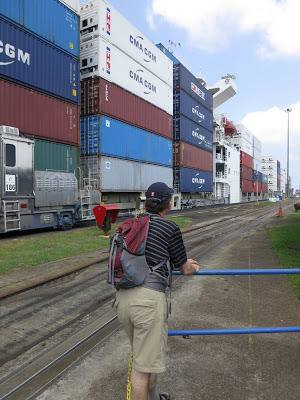
So here are some numerical facts associated with the Panama Canal:
-- Twelve to fifteen thousand ships per year pass through the canal.
-- The 22.5 mile passage takes two hours and saves the ship 7,872 miles and three weeks of sailing around Cape Horn.
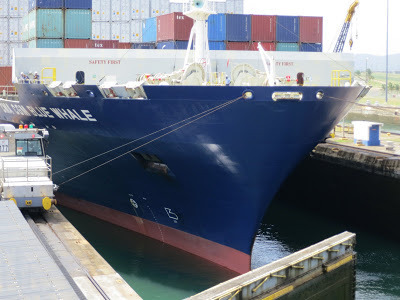
-- The London-based ship called CMA CGM Blue Whale, which I watched pass through Gatun Locks, held 5,080 containers. On the basis of its capacity, it paid a toll of $384,000.
-- the lowest toll ever paid was 6 cents. It covered the passage by Richard Halliburton who secured permission to swim the length of the canal in 1928, but no exemption from the toll, which was assessed on the basis of his "tonnage." (I wrote about Halliburton in the March, 1989, issue of Smithsonian magazine.)
-- 1.8 million cubic meters of concrete were used to construct the Gatun Locks, one of the three lock systems of the canal.
-- About 5,000 workers lost their lives building the canal in the early 20th Century. Eighty percent of them were Black.
-- The locks lift each ship 85 feet to the highest elevation of the canal (Gatun Lake) and then back down again. Many of the ships weigh 60,000 tons or more.
-- Filling each lock chamber drains 26.7 million gallons of water from Gatun Lake. When the chamber is emptied, the water goes to sea. (The ongoing Panama Canal Expansion Project will change the system so that the water will be recycled.)
-- The width of the locks limits the size of ships that can pass through the canal. This distance, 110 feet, is called "Panamax" and it dictates the dimensions of ships worldwide. CMA CGM Blue Whale is 106 feet wide. (Locomotives called mulas, mules, ride on tracks alongside the lock, pulling the ships with taut cables that also center the ships in the passageway. These seagoing behemoths must never, ever touch the sides of the lock!)
There are many, many more but that's enough to run my experiment. The question is: can students take these figures and run with them to discover something interesting, something "Wow!" They can make assumptions. For example, they could assume that the ship I saw is typical of those that pass through the canal. Thus, to use a simple example, they might calculate the annual revenue of the canal by multiplying the toll paid for the Blue Whale by 12,000 or 15,000 (or something in between). Then they could put that into some kind of context. (How many teacher salaries would that pay?)
Here's what I did as an example, using the last bulleted item listed above:
The ship I saw is 106 feet wide and the lock is 110 feet wide, so the clearance is four feet, or two feet on each side. What does that mean in terms we can relate to?
I scaled the Blue Whale to the size of my kayak, which is about two feet wide. The ship is 50 times as wide as the kayak. So I divided the ship's clearance of 2 feet per side by 50 to find out what my kayak's clearance would be: about half an inch! So... a 110-foot wide ship passing through the lock with two feet of clearance on each side is like my kayak passing through a concrete-walled chamber with a half-inch of clearance on each side, not touching either side, not even once, not even for a zillionth of a second! Is that a "Wow!" moment or what?
I find it way cool that math can turn a raw fact into a wowful wonder. Of course I'm already planning a book. Maybe teachers of upper elementary, middle school or high school students can plan a class around this. Make it open ended. Give the kids facts, calculators, internet access to look up information, and the time to play. Show them books that turn facts into "Wows!" (May I recommend my If Dogs Were Dinosaurs and How Much Is a Million? for starters, but don't stop there.) See if your young mathematicians can be creative artists. Wow!

Today I went to the Panama Canal. Sounds like a nice Sunday excursion, doesn't it? I am in Panama for school visits next week, and thanks to the generosity of Kathryn Abbott, her husband Tim and their son Alan (an International School of Panama student), a visit to the Gatun Locks was on today's itinerary. Here's proof:

So here are some numerical facts associated with the Panama Canal:
-- Twelve to fifteen thousand ships per year pass through the canal.
-- The 22.5 mile passage takes two hours and saves the ship 7,872 miles and three weeks of sailing around Cape Horn.
-- The London-based ship called CMA CGM Blue Whale, which I watched pass through Gatun Locks, held 5,080 containers. On the basis of its capacity, it paid a toll of $384,000.
-- the lowest toll ever paid was 6 cents. It covered the passage by Richard Halliburton who secured permission to swim the length of the canal in 1928, but no exemption from the toll, which was assessed on the basis of his "tonnage." (I wrote about Halliburton in the March, 1989, issue of Smithsonian magazine.)
-- 1.8 million cubic meters of concrete were used to construct the Gatun Locks, one of the three lock systems of the canal.
-- About 5,000 workers lost their lives building the canal in the early 20th Century. Eighty percent of them were Black.
-- The locks lift each ship 85 feet to the highest elevation of the canal (Gatun Lake) and then back down again. Many of the ships weigh 60,000 tons or more.
-- Filling each lock chamber drains 26.7 million gallons of water from Gatun Lake. When the chamber is emptied, the water goes to sea. (The ongoing Panama Canal Expansion Project will change the system so that the water will be recycled.)
-- The width of the locks limits the size of ships that can pass through the canal. This distance, 110 feet, is called "Panamax" and it dictates the dimensions of ships worldwide. CMA CGM Blue Whale is 106 feet wide. (Locomotives called mulas, mules, ride on tracks alongside the lock, pulling the ships with taut cables that also center the ships in the passageway. These seagoing behemoths must never, ever touch the sides of the lock!)
There are many, many more but that's enough to run my experiment. The question is: can students take these figures and run with them to discover something interesting, something "Wow!" They can make assumptions. For example, they could assume that the ship I saw is typical of those that pass through the canal. Thus, to use a simple example, they might calculate the annual revenue of the canal by multiplying the toll paid for the Blue Whale by 12,000 or 15,000 (or something in between). Then they could put that into some kind of context. (How many teacher salaries would that pay?)
Here's what I did as an example, using the last bulleted item listed above:
The ship I saw is 106 feet wide and the lock is 110 feet wide, so the clearance is four feet, or two feet on each side. What does that mean in terms we can relate to?
I scaled the Blue Whale to the size of my kayak, which is about two feet wide. The ship is 50 times as wide as the kayak. So I divided the ship's clearance of 2 feet per side by 50 to find out what my kayak's clearance would be: about half an inch! So... a 110-foot wide ship passing through the lock with two feet of clearance on each side is like my kayak passing through a concrete-walled chamber with a half-inch of clearance on each side, not touching either side, not even once, not even for a zillionth of a second! Is that a "Wow!" moment or what?
I find it way cool that math can turn a raw fact into a wowful wonder. Of course I'm already planning a book. Maybe teachers of upper elementary, middle school or high school students can plan a class around this. Make it open ended. Give the kids facts, calculators, internet access to look up information, and the time to play. Show them books that turn facts into "Wows!" (May I recommend my If Dogs Were Dinosaurs and How Much Is a Million? for starters, but don't stop there.) See if your young mathematicians can be creative artists. Wow!

February 22, 2013
Just the Facts, Ma'am
“Just the facts, Ma’am. Just the facts.” Isn’t that what
Sgt. Joe Friday would say on Dragnet?
Actually, no. Sgt. Friday’s actual lines were "All we want are the
facts, ma'am" and "All we know are the facts, ma'am".
The writer's mind is always working - always questioning,
always wondering. Last Saturday night, I sat down for some TV time and the movie Hysteria was on. I love that time frame, the actors in the movie, and
the subject. In my last book, I touch upon the diagnosis of hysteria that was
used to describe the feelings of women in the late 19th century. It’s
a topic that interests me, so I settled down to spend a few hours watching the
movie.
The beginning of the movie starts with “1880” at the bottom
of the screen. I’m enjoying the movie until Maggie Gyllenhaal’s character,
Charlotte, rides down the street on her bike. “Wait, a second”, that voice way
back in my head says. “That’s a safety bike, they weren't invented until
1885.” I know, the director was trying to show that the character of was a
strong, independent woman. The bicycle in the 1890s was a very instrumental in
the woman’s rights movement. In fact, Susan B. Anthony told the New York World’s Nellie
Bly in 1896 that bicycling had “done more to emancipate women than anything
else in the world.” But, the safety bike, though it is very cool, wasn’t invented until 1885.
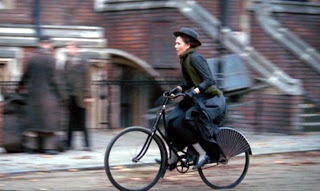
The next day, as I am wont to do, I researched the movie, the
characters, and the story. The movie totally changed the actual facts and
characters for Hollywood’s version of the story. I was okay with that. I was
not okay with the appearance of the safety bike. Actually on IMDB in the goofs
section, it states:
“The character Charlotte Dalrymple is shown
riding a safety bicycle. The film is set in 1880, but safety bicycles weren't
invented until 1885.”
IMDB not a valid source, but a good jumping off point, I
soon plunged into my own quest for the truth. After swimming through the pages
and pages of research, images, and such, I narrowed down the manufacturer of
the bicycle in the movie - who may not manufactured this particular style until many years past 1885. Before I could continue, to
squelch my excitement, that little voice in the back of my head asked, “Don’t
you have a manuscript due in a few days?
The manuscript I just finished contains about 200 "things" about Chicago. Since it is for kids, I thoroughly researched every fact and
yelled at my computer when I found twisted information. For example, several
sources said that rainbow sherbet is a Chicago thing. The truth is "rainbow cone" is a Chicago thing, not rainbow sherbet.
In my description of the 1893 Chicago Columbian Exposition, I
wanted to show the many inventions from the fair. Many sources said that the 1893 Chicago
World’s Fair introduced the world to the Pledge of Allegiance, Cracker Jack,
the Ferris Wheel and Juicy Fruit Gum.
The Random House site for The Devil in the White City says: "The World’s
Fair introduced America to such classic favorites as Cracker Jack, Shredded
Wheat. and Juicy Fruit and was the birth of historically significant symbols
like Columbus Day, the Ferris Wheel, and the Pledge of Allegiance."
In actually, what Erik Larson wrote about Juicy Fruit was: “They sampled a
new, oddly flavored gum called Juicy Fruit and caramel-coated popcorn called
Cracker Jack.”
Evidently, what Erik Larson writes is fact. Many sources now
state, crediting The Devil in the White City as the source, that the 1893 Chicago
World’s Fair introduced the world to Cracker Jack, the Ferris Wheel, and Juicy
Fruit. Cracker Jack was actually sold at the fair, the Ferris Wheel no one can
doubt was a hit at the fair, but Juicy Fruit was not officially at the fair.
Other products that receive second billing as introductions at the fair had
actual booths; Aunt Jemima Pancake Mix, Shredded Wheat, Pabst Blue Ribbon, and others. The Wrigley website reads:
"In 1893, during an economic
depression, he introduced two brands that would become company icons: Wrigley’s
Spearmint® and Juicy Fruit®."
Going straight to the source, I sent an email
to the Senior Vice President of Wrigley Corporate Affairs. We went back and
forth a few times but I didn’t get an official answer to my question:
"In time for the fair and the
millions visited. It would have been sold by salesmen and women to the crowds
attending may of whom visited Chicago for the first time. There will not have
been a Juicy Fruit pavilion I'm pretty sure it was launched in time for the
worlds fair rather than at it.”
"It was as I thought. It was
launched in Chicago in time for the World’s Fair but it wasn’t an official part
of the Fair.”
“The fair bought many people to
chicago so lots of footfall for the brand."
"But in 1893 Wrigley was a small
business and remain so for another 15 years or so.”
In the end, what I finally wrote as part of
the 1893 Chicago Columbian Exposition:
William Wrigley Jr. introduced Juicy Fruit gum. (And, people wonder why writing takes so long.)
I started this piece by quoting Sgt. Joe Friday, I thought
I’d end it by sharing a few fabulous fact quotes by some very wise folks.
“If the facts don't fit the theory, change the
facts.” ~Albert_Einstein
“Facts are stubborn things, but statistics are
pliable." ~Mark Twain
“Facts are stubborn things; and whatever may be
our wishes, our inclinations, or the dictates of our passion, they cannot alter
the state of facts and evidence.” ~John Adams
“The truth is more important than the
facts.” ~Frank Lloyd Wright
“False facts are highly injurious to the
progress of science, for they often endure long; but false views, if supported
by some evidence, do little harm, for everyone takes a salutary pleasure in
proving their falseness; and when this is done, one path towards error is
closed and the road to truth is often at the same time opened.” ~Charles Darwin
And, finally,
"Never trust quotes you find on the internet." ~Abraham Lincoln
Sgt. Joe Friday would say on Dragnet?
Actually, no. Sgt. Friday’s actual lines were "All we want are the
facts, ma'am" and "All we know are the facts, ma'am".
The writer's mind is always working - always questioning,
always wondering. Last Saturday night, I sat down for some TV time and the movie Hysteria was on. I love that time frame, the actors in the movie, and
the subject. In my last book, I touch upon the diagnosis of hysteria that was
used to describe the feelings of women in the late 19th century. It’s
a topic that interests me, so I settled down to spend a few hours watching the
movie.
The beginning of the movie starts with “1880” at the bottom
of the screen. I’m enjoying the movie until Maggie Gyllenhaal’s character,
Charlotte, rides down the street on her bike. “Wait, a second”, that voice way
back in my head says. “That’s a safety bike, they weren't invented until
1885.” I know, the director was trying to show that the character of was a
strong, independent woman. The bicycle in the 1890s was a very instrumental in
the woman’s rights movement. In fact, Susan B. Anthony told the New York World’s Nellie
Bly in 1896 that bicycling had “done more to emancipate women than anything
else in the world.” But, the safety bike, though it is very cool, wasn’t invented until 1885.

The next day, as I am wont to do, I researched the movie, the
characters, and the story. The movie totally changed the actual facts and
characters for Hollywood’s version of the story. I was okay with that. I was
not okay with the appearance of the safety bike. Actually on IMDB in the goofs
section, it states:
“The character Charlotte Dalrymple is shown
riding a safety bicycle. The film is set in 1880, but safety bicycles weren't
invented until 1885.”
IMDB not a valid source, but a good jumping off point, I
soon plunged into my own quest for the truth. After swimming through the pages
and pages of research, images, and such, I narrowed down the manufacturer of
the bicycle in the movie - who may not manufactured this particular style until many years past 1885. Before I could continue, to
squelch my excitement, that little voice in the back of my head asked, “Don’t
you have a manuscript due in a few days?
The manuscript I just finished contains about 200 "things" about Chicago. Since it is for kids, I thoroughly researched every fact and
yelled at my computer when I found twisted information. For example, several
sources said that rainbow sherbet is a Chicago thing. The truth is "rainbow cone" is a Chicago thing, not rainbow sherbet.
In my description of the 1893 Chicago Columbian Exposition, I
wanted to show the many inventions from the fair. Many sources said that the 1893 Chicago
World’s Fair introduced the world to the Pledge of Allegiance, Cracker Jack,
the Ferris Wheel and Juicy Fruit Gum.
The Random House site for The Devil in the White City says: "The World’s
Fair introduced America to such classic favorites as Cracker Jack, Shredded
Wheat. and Juicy Fruit and was the birth of historically significant symbols
like Columbus Day, the Ferris Wheel, and the Pledge of Allegiance."
In actually, what Erik Larson wrote about Juicy Fruit was: “They sampled a
new, oddly flavored gum called Juicy Fruit and caramel-coated popcorn called
Cracker Jack.”
Evidently, what Erik Larson writes is fact. Many sources now
state, crediting The Devil in the White City as the source, that the 1893 Chicago
World’s Fair introduced the world to Cracker Jack, the Ferris Wheel, and Juicy
Fruit. Cracker Jack was actually sold at the fair, the Ferris Wheel no one can
doubt was a hit at the fair, but Juicy Fruit was not officially at the fair.
Other products that receive second billing as introductions at the fair had
actual booths; Aunt Jemima Pancake Mix, Shredded Wheat, Pabst Blue Ribbon, and others. The Wrigley website reads:
"In 1893, during an economic
depression, he introduced two brands that would become company icons: Wrigley’s
Spearmint® and Juicy Fruit®."
Going straight to the source, I sent an email
to the Senior Vice President of Wrigley Corporate Affairs. We went back and
forth a few times but I didn’t get an official answer to my question:
"In time for the fair and the
millions visited. It would have been sold by salesmen and women to the crowds
attending may of whom visited Chicago for the first time. There will not have
been a Juicy Fruit pavilion I'm pretty sure it was launched in time for the
worlds fair rather than at it.”
"It was as I thought. It was
launched in Chicago in time for the World’s Fair but it wasn’t an official part
of the Fair.”
“The fair bought many people to
chicago so lots of footfall for the brand."
"But in 1893 Wrigley was a small
business and remain so for another 15 years or so.”
In the end, what I finally wrote as part of
the 1893 Chicago Columbian Exposition:
William Wrigley Jr. introduced Juicy Fruit gum. (And, people wonder why writing takes so long.)
I started this piece by quoting Sgt. Joe Friday, I thought
I’d end it by sharing a few fabulous fact quotes by some very wise folks.
“If the facts don't fit the theory, change the
facts.” ~Albert_Einstein
“Facts are stubborn things, but statistics are
pliable." ~Mark Twain
“Facts are stubborn things; and whatever may be
our wishes, our inclinations, or the dictates of our passion, they cannot alter
the state of facts and evidence.” ~John Adams
“The truth is more important than the
facts.” ~Frank Lloyd Wright
“False facts are highly injurious to the
progress of science, for they often endure long; but false views, if supported
by some evidence, do little harm, for everyone takes a salutary pleasure in
proving their falseness; and when this is done, one path towards error is
closed and the road to truth is often at the same time opened.” ~Charles Darwin
And, finally,
"Never trust quotes you find on the internet." ~Abraham Lincoln
February 20, 2013
The Next Big Thing: Nonfiction Edition
For my INK blog this month, I am doing something a tiny bit different, although all the content is still nonfiction, and it is in honor of my new picture book about Elizabeth Blackwell, the first woman doctor in America, which came out this Tuesday. But I digress. What is the Next Big Thing? It is an author blog tour. What’s a blog tour? A blog tour gives those on the tour a chance to meet different authors by way of their blogs. The Next Big Thing began in Australia. Each week a different author answers specific questions about his or her upcoming book. The answers are posted on author’s blogs. Then we get to tag another author. On and on it goes.
The tour came to me from Manhattan. I was tagged by my friend Elizabeth Winthrop. She was tagged by her friend Eric Kimmel. I’ll tell you whom I’m tagging at the end.
Now for the questions.
What is the title of your next book?
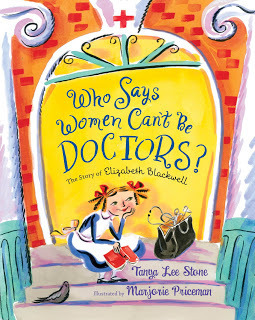 Who Says Women Can’t Be Doctors? It is the story of Elizabeth Blackwell, who was the first woman doctor in America.
Where did the idea come from for the book?
I have done, and do, a lot of research on women’s history—especially in America. Elizabeth Blackwell’s story was one I came upon again and again. It was also one of those stories I tried to sell more than once but met with some resistance because Blackwell’s name is not instantly recognizable. I felt that was exactly why there should be a book about her!
What genre does your book fall under?
Most definitely picture book.
What actors would you choose to play the part of your characters in a movie rendition?
Keira Knightley would make a fabulous Elizabeth Blackwell, who was also British—although she is too tall in real life. But Knightley captures the spark and fire of Elizabeth well. Blackwell was a petite blonde, studious and serious, but a real risk-taker.
Who is publishing your book?
Christy Ottaviano Books/Henry Holt and Company (Macmillan Kids Books)
How long did it take you to write the first draft of the manuscript?
I never know how to answer this question! With picture books, especially, I tend to write a draft and stick it in a drawer for quite a long time, then pull it back out and work on it again, and repeat. A few years inevitably pass in this way.
Who or what inspired you to write this book?
Elizabeth Blackwell inspired me to write this book! There are older books about her, but it was time to get younger kids excited and let them know who this trailblazer was.
What else about the book might pique the reader’s interest?
I love Blackwell’s fire. The details I discovered about her toughness as a kid were a delight to find and kids will, I think, really be able to relate to some of the things she did as a child. Who Says Women Can't Be Doctors? hit bookshelves this past Tuesday, and I couldn't be happier.
For the next Next Big Thing, I am tagging the amazing and talented Deborah Heiligman. Her answers will be up soon.

The tour came to me from Manhattan. I was tagged by my friend Elizabeth Winthrop. She was tagged by her friend Eric Kimmel. I’ll tell you whom I’m tagging at the end.
Now for the questions.
What is the title of your next book?
 Who Says Women Can’t Be Doctors? It is the story of Elizabeth Blackwell, who was the first woman doctor in America.
 Where did the idea come from for the book?
I have done, and do, a lot of research on women’s history—especially in America. Elizabeth Blackwell’s story was one I came upon again and again. It was also one of those stories I tried to sell more than once but met with some resistance because Blackwell’s name is not instantly recognizable. I felt that was exactly why there should be a book about her!
What genre does your book fall under?
Most definitely picture book.
What actors would you choose to play the part of your characters in a movie rendition?
Keira Knightley would make a fabulous Elizabeth Blackwell, who was also British—although she is too tall in real life. But Knightley captures the spark and fire of Elizabeth well. Blackwell was a petite blonde, studious and serious, but a real risk-taker.
Who is publishing your book?
Christy Ottaviano Books/Henry Holt and Company (Macmillan Kids Books)
How long did it take you to write the first draft of the manuscript?
I never know how to answer this question! With picture books, especially, I tend to write a draft and stick it in a drawer for quite a long time, then pull it back out and work on it again, and repeat. A few years inevitably pass in this way.
Who or what inspired you to write this book?
Elizabeth Blackwell inspired me to write this book! There are older books about her, but it was time to get younger kids excited and let them know who this trailblazer was.
What else about the book might pique the reader’s interest?
I love Blackwell’s fire. The details I discovered about her toughness as a kid were a delight to find and kids will, I think, really be able to relate to some of the things she did as a child. Who Says Women Can't Be Doctors? hit bookshelves this past Tuesday, and I couldn't be happier.
For the next Next Big Thing, I am tagging the amazing and talented Deborah Heiligman. Her answers will be up soon.
February 19, 2013
Why Do Books Publish on Tuesdays?
Why do books get published on Tuesdays? I have a book coming out in June, The Boy Who Loved Math, and yes, it's June 25th, a Tuesday. I looked back to when my novel Intentions pubbed--August 14th, a Tuesday. I didn't always know this; in fact I just found it out this past year. I wish I could remember who told me. But the other day I was talking to Ziki, the man who sticks needles in me to make my back and leg pain go away. We made an appointment for the next week (tomorrow) and I told him that afterwards I would be going to a book party for my friend Marguerite's new book:

"But it's not a Tuesday," he said. I told him a book party doesn't have to be on the release date--but wait, how did he know that? He wasn't sure, he just did. He said that albums always had a day to release (he thought Fridays, and maybe it used to be so, but now it seems CDs and DVDs of movies release on Tuesdays, too).
I asked a few people, and no one seemed to know. I posted my question on twitter and got these answers:
Tradition based on coverage in Sunday papers and getting books on shelves is my understanding.
I asked:
Are they reviewed the Sunday before or after.
The answer:
Before. So that booksellers get to spend Monday explaining why people can't buy the books they just heard about.
Hah.
Other people chimed in with links:
http://www.verlakay.com/boards/index.php?topic=64015.msg754277#msg754277
http://www.themillions.com/2009/06/ask-book-question-73-tuesday-new_09.html
http://www.fourhourworkweek.com/blog/2012/08/17/amazon-monthly-100/
And other answers:
I've heard shipment was a factor--UPS boxes come Monday, scan & put out CDs, etc., Tue.
Probably a less busy day for most stores too. But no one seems to know for sure.
I'm 99.9% sure books are Tues b/c of Music release on Tues. So ? would be why music on Tues.
This might answer that question:
http://rulefortytwo.com/secret-rock-knowledge/chapter-4/why-are-cds-released-on-tuesdays/
I read all of those (you don't have to) and it still seems to me that no one knows for sure... I asked some friends who are publishers and editors: nope. They didn't know.
And so I started thinking two things:
1. In the old days, I would have called a reference librarian. My old friend from the Doylestown library (where I used to live) would have found out for me, I know that for sure. So I decided to call the New York Public Library. Oops. I waited too long. It's Presidents' Day. Library closed. But it took me almost a week to remember that I used to talk to reference librarians for this sort of thing. Yes, kids, before the Internet. I used to go to the library, go up to the desk and say, "Jan, how do I find out the answer to this question?" And sometimes Jan would just find out for me, and sometimes she would teach me how to fish. I did this for a long time, even after there was The Internet, until it became more or less part of my right hand.
2.Will this change? Whatever is the cause, will Tuesdays as pub dates change if there are more ebooks and fewer bricks and mortar bookstores? Then will people release books willy nilly? Do people who self-publish books follow the Tuesday rule?
I'm really hoping that someone will post here and tell me... Why do books publish on Tuesday? I've just spent so much time on this... as so often happens when one (me) gets stuck on a research treadmill. I just want to know the answer!
Uh oh. Wait a minute. I just looked up Marguerite's book and it officially published YESTERDAY. Which was Monday. According to Amazon. And B & N. Her publisher just says February. Okay, now I'm really confused.

February 18, 2013
Presidents Day
So, today's the 497th anniversary of the birth of England's
Queen Mary
, Elizabeth Tudor's miserable, "bloody" half-sister and golly, what a sad and dreadful, star-crossed bunch there's was. How sane and lucky many another family is by comparison, no? It was on this day in history that physicist
Alessandro "Mr. Battery" Volta
was born, in 1745, a good 103 years before
Louis Comfort Tiffany
came into the world. February 18 marks the deathdays, too, of lovely painter
Fra Angelico
and revolutionary
Martin Luther
, who exited the world through the celestial door marked 18 Feb, in 1455 and 1546, respectively. Just for you to know. A pair of the best character actors ever to glower down from the silver screen,
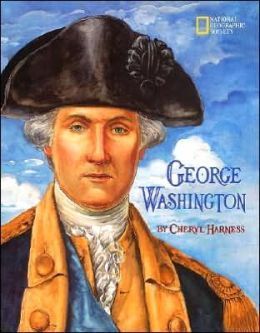
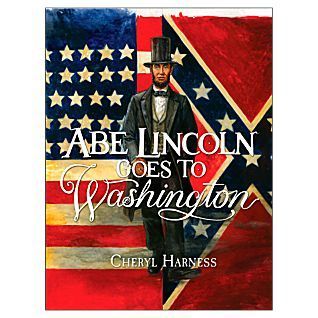
And speaking of Franklin D., it appears to be Presidents' Day, splitting the difference as we do between the commemorations of the great No. 1 and No. 16. In the stores, the tired Valentine candies are discounted. Soon there'll be green shamrocks, pastel eggs and bunnies. Here's a slim window in the culture's cavalcade; today there will be a pause in the beleaguered postal service. There will be silly Abes and Georges in advertisements for furniture, cars, and appliances. Behind and beyond it all were the steadfast pioneer of untrodden ground, of revolution and dare I say it: nation-building. And the grievous, complex stalwart who held it all together for a little while longer. I cannot help but think of all of the other gents who've held the office, each of whom represents a chapter in our ongoing, bumptious experiment in self-governance. And anyway, so the world turns and the calendar continues, And every day of it is a chance to remember those who've gone before. So let there be books, all of our books in which the stories of those vanished lives are shown and told, pictured and explained, again and again for our young readers, for our ever-renewing citizenry. Long live the republic.
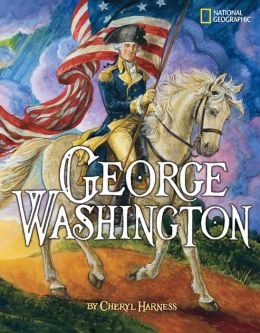
And speaking of Franklin D., it appears to be Presidents' Day, splitting the difference as we do between the commemorations of the great No. 1 and No. 16. In the stores, the tired Valentine candies are discounted. Soon there'll be green shamrocks, pastel eggs and bunnies. Here's a slim window in the culture's cavalcade; today there will be a pause in the beleaguered postal service. There will be silly Abes and Georges in advertisements for furniture, cars, and appliances. Behind and beyond it all were the steadfast pioneer of untrodden ground, of revolution and dare I say it: nation-building. And the grievous, complex stalwart who held it all together for a little while longer. I cannot help but think of all of the other gents who've held the office, each of whom represents a chapter in our ongoing, bumptious experiment in self-governance. And anyway, so the world turns and the calendar continues, And every day of it is a chance to remember those who've gone before. So let there be books, all of our books in which the stories of those vanished lives are shown and told, pictured and explained, again and again for our young readers, for our ever-renewing citizenry. Long live the republic.
February 15, 2013
Sources and Sensibility: Those Pesky Notes
It's my pleasure to share this space with Karen Blumenthal. Her guest post adds to recent discussions about the documentation that accompanies a published work of nonfiction.
Shortly before my first book was published, I attended a
presentation by two very distinguished nonfiction writers.
“Here’s how you must do source notes,” I remember one of
them saying. “You list the beginning of every quote and then the source where
it came from.”
Her words sent my stomach churning and my hands shaking. My pre-publication
copy of Six Days in October was
tucked carefully in my bag--and it was all wrong. I had listed my primary sources
chapter by chapter as they appeared. But I had not specifically detailed the
source of each quotation, or even included specific page numbers. How could I
have made such a horrible mistake?
I recently had a flashback to that painful moment reading
some blogosphere discussions about nonfiction source notes
and Jan Greenberg’s recent post on back matter. A decade later, the “right” way
to do source notes still isn’t clear.
Sourcing nonfiction for a general audience, young or old, is
a difficult and tricky business. While I don’t want to footnote every burp and
grunt and dot pages with microscopic numbers, like the academics do, I do want
readers to know the source, since there can be so many differing views on some
subjects. But compiling them is tedious and unpleasant, and sometimes it’s
tough to pin down exactly where a conclusion came from.
Some publishers leave the decision to the writer and some
dictate a style, like the quotation method cited by the distinguished writer
above. Forced to use that quotation-only
style once, I found it completely misrepresented where the information came
from. In some cases, one sentence may draw on four different sources; other
times, a paragraph reflects dozens of pages of reading. Quotations typically
are a small part of a narrative.
Sometimes, ego gets involved. In my most recent book, Steve Jobs, I wanted to share my research to avoid any perception
that I had merely rewritten the best-selling adult biography. Sometimes the process is messy, with notes
getting jumbled up as sections are rewritten or cut and pages are designed.
Sorting and correcting them can take days.
And sometimes publishers push back. Lots of detail takes lots
of pages, which costs money. More than
once, I’ve been asked to trim the bibliography or notes.
For my second book, LetMe Play, a history of Title IX, I studied the notes of the masters—Russell
Freedman, Jim Murphy, Susan Campbell Bartoletti and Candace Fleming, among
others. From reviewing their work, I came to appreciate a short bibliographic
essay giving an overview of the process for someone who might be new to formal
research. Besides, where else could you
share the little gem that before C-SPAN televised Congress, legislators regularly
rewrote their remarks for the Congressional Record?
That book involved an unusual number of interviews and
primary sources, and the notes are detailed. It felt, at times, that I might be showing
off.
But then came the calls. Every year, I hear from a college
student writing a senior paper or girls from junior high through high school working
on a History Day projects. Over Skype and on the phone, they quiz me. Occasionally, I have to go back to the notes
to jog my memory.
The most ambitious of them surprise me. They have studied
the sources and from them, found new trails for their own explorations. Their
excitement and curiosity is invigorating—and enough to make
those notes feel completely worth the effort.
Karen Blumenthal is
the author of five nonfiction books for young people, most recently Steve Jobs:
The Man Who Thought Different (Feiwel and Friends, 2012), which was a finalist
for the YALSA Excellence in Nonfiction for Young Adults award.

February 14, 2013
Tweet
As I write this on Tuesday afternoon, it’s just a few hours
before President Obama’s State of the Union Address—yet the internet is already
buzzing with discussion.
I’m not a tweeter myself, but on occasion I mosey over to
twitter and take a peek at what others are tweeting about. And #SOTU is
hopping.
Lots of folks are chiming in about how excited they are to
hear the speech. Lots of other folks are passing snarky judgment on what Obama
may say. Many organizations are expressing their hope that he tackles an issue
dear to their hearts. (I have my fingers crossed—as do the folks at the Union
of Concerned Scientists—that “bold action” on climate change is on the
agenda.)
The mood is anticipatory. My favorite tweet so far comes
from Dr. Jill Biden: “Joe is practicing keeping a straight face for the #SOTU.
He is allowed to roll his eyes at John Boehner, though.”
It will be interesting to look back at the end of my career
(hopefully several decades in the future) and see how today’s kids—who have grown
up in the age of social media—view knowledge and scholarship. (There are, of
course, already lively discussions about the effect of the digital revolution
on the writing of history. Take a look at this site to see some of the issues
raised.)
Social media—especially blogs and tweets—are changing the
way we view current events. We all
have opinions, and social media is giving us an easy way to express them.
I hope this leads to a more engaged citizenry. (I’m not sure
it will. Perhaps if you’ve tweeted your displeasure about a situation in the
news, you’ll then feel like you’ve done your bit and won’t have to actually DO
anything to help fix it.)
Will history feel more relevant to tomorrow’s adults, if
they were more actively engaged in current events as kids? I don’t know.
I do know that tweets and blogs will give tomorrow’s
historians a heck of a lot more information to work with—more eyewitness
accounts; more access to how everyday people were feeling ‘back then.’
For now, it’s interesting to be swept up along for the ride.
Whetting my anticipation (along with the opportunity to see if Joe Biden
behaves) is this terrific video, created by the White House, about how the 2012
State of the Union Address was created. While it discusses last year’s speech,
it doesn’t really matter as it’s a video about process and craft—the
speechwriters discussing how they work with President Obama to write and revise
an important speech.
It’s perfect to share with students—and you’ll find it, of
course, on YouTube.

February 13, 2013
On Challenging Words
Spectrometer, assembly,
operations, basalt, meteorite, satellite, communicate,
atmosphere, hematite, mineral, jarosite,
sulfate, surveyor, orbiter, reconnaissance,
thermal, emission, aeronautics, navigation, panoramic, phyllosilicates, abrasion, silica…
Are these words that you think will pull kids into a book
and get them excited about science or space exploration? I think not. But they are words that were
absolutely essential to telling the story of the Mars rovers Spirit and
Opportunity. I think one of the biggest
challenges in writing nonfiction for children, especially science, is how to
introduce very sophisticated, sometimes technical, words to young readers
without intimidating or losing them.
With the Common Core’s emphasis on integration of knowledge
and increasing text complexity, I thought it might be interesting to explore some
techniques that I use to handle challenging words.
Start slowly: I
deliberately try to avoid throwing a lot tough word in the beginning of my books.
Instead I try to grab readers so that they won’t give up when they hit
something challenging. So The Mighty Mars Rovers opens with a
page about life on Mars (Martians…that’s a word kids know and love). Chapter one
introduces scientist Steve Squyres as a boy who gets a telescope for Christmas
and later watches the Apollo landing. I don’t really start hitting readers with
the tough stuff until I describe the making of the Mars rovers in chapter two,
starting on page 16.
Space it out: If
possible, I try to spread out the most difficult words, so kids aren’t reading
a bunch of technical terms all at once.
Follow with short
definitions: When I introduce a tough word, I try to follow it with a quick
definition, something as short as possible. (I describe a Microscopic Imager as
a cross between a camera and a microscope.)
Define and define
again: For a really challenging word, especially one that is central to understanding
the story, I will define the term not just on the first mention but the next
several times as well. Sometimes I use the same definition; sometimes I offer
different ways for kids think about the word.
Use visuals: If I
can show a reader what a word means with a photo or graphic, I do. There is no
better way for kids to absorb the importance of silica on Mars than showing a
photo of silica uncovered by a dragging rover wheel with a caption that explains
its significance.
A spoonful of sugar:
If there is a funny or clever way to define something, I do. Take one of the
tools on the rovers. I wrote: “The RAT was
not a furry gray creature, but a rock abrasion tool, a drill to bore holes into
soil and rock.” When I talk about land deformation in my volcano books, I
describe how magma swelling underground is like a mole pushing up a lawn. (These
examples makes me wonder why furry mammals keep ending up in my hard-science
books.)
I often include a glossary. I know glossaries are important.
But my hunch is that a glossary is not the way most kids learn the difficult
words in a book.
What do I think is really the key to helping kids handle
sophisticated vocabulary? Amazing, gripping, can’t-put-it-down books that don’t
dumb down the language. I really believe that kids who are captivated by a
story will not let a five-syllable word stand in their way. And as they are
swept away by a fascinating true story, they will absorb some rich, challenging
vocabulary as they go.
I hope I’m right because my next Scientist in the Field book,
which comes out later this year ( Eruption: Volcanoes and the Science of
Saving Lives,) includes these doozies: Dormant, tectonic, lahar, pumice, pyroclastic
flow, seismograph, spectrometer (again, can you believe it?)…
How to best handle challenging words will be an issue I face
in other books I’m working on, so I want to toss out a few questions:
For the writers out there: How do you handle challenging vocabulary
in your books? I would love to learn more ideas and techniques….
For teachers and other readers: What do you think writers of
nonfiction can do to help readers master tough words? What works? What doesn’t?
I’d love to hear from you!
Elizabeth Rusch