Elizabeth Rusch's Blog, page 34
January 25, 2013
New STEAM Books for Kids
Earlier this week, I was doing a little personal research on
STEAM books for kids. I hopped over to Google and entered STEAM books for kids.
After looking through the 120+ hits on Mike Mulligan and His Steam Shovel (and a few
Steampunk hits), I finally found a reference to a book discussion about STEAM
books, and then more pages on Mike Mulligan and His Steam Shovel. When I used quotes,
I got one hit… and it wasn’t related to STEAM books.
In November of 2011, in an INK post titled STEM & STEAM – Interesting Nonfiction for Kids, I wrote about the
importance of STEM and STEAM in the schools.
I love STEAM books. One of the reasons why I was asked to be
a member of this group five years ago was of my outspokenness on art
books for kids.
So, in regards to my Google search above and going back to my INK roots, I wanted to
provide a service to any school, library, teacher, or parent who was
interested in STEAM books.
Here are just a few of the latest books that may fall into a Google
search for:
STEAM books for Kids
Art books for Kids
Adding art books to library
Awesome art books for kids
It Jes' Happened: When Bill Traylor Started to Draw
by Don Tate, R. Gregory
Christie
Lee & Low Books, April 2012
What Is
Contemporary Art? A Guide for Kids
by
Jacky Klein and Suzy Klein
The Museum of Modern Art, New York October 2012
Sky High
by Germano Zullo illustrated by
Albertine
Chronicle Books, September 2012
Colorful
Dreamer: The Story of Artist Henri Matisse Marjorie
by Blain Parker (Author), Holly Berry (Illustrator)
Dial, November 2012
Brushes with Greatness: History
Paintings
Brushes with Greatness: Landscapes
By Valerie Boddon
Brushes with Greatness: Portraits
Brushes with Greatness: Still Lifes
By Joy Frisch-Schmoll
Creative Paperbacks, January 2013
A Splash of Red: The Life and Art
of Horace Pippin
by Jen Bryant
Alfred A. Knopf, January 2013
Mister Orange
by Truus Matti
Enchanted Lion Books, January 2013
Diego
Rivera: An Artist for the People
by Susan
Goldman Rubin
Abrams Books for Young Readers, February 2013
And, here's a book to be published soon that my be of interest to teachers, educators, and libraries:
From STEM to STEAM: Using Brain-Compatible Strategies to Integrate the Arts
by David A. Sousa and Thomas J. Pilecki
Corwin, March 2013
In high school when I read The Agony and the Ecstasy by Irving Stone, Michelangelo's artistic passion moved me like no other and drew me to the arts. It is my wish that every child have the opportunity to find his or her passion in life - hopefully, through a wonderful book.
Please, if there are some new STEAM books that I have missed, add them to the comments section.

STEAM books for kids. I hopped over to Google and entered STEAM books for kids.
After looking through the 120+ hits on Mike Mulligan and His Steam Shovel (and a few
Steampunk hits), I finally found a reference to a book discussion about STEAM
books, and then more pages on Mike Mulligan and His Steam Shovel. When I used quotes,
I got one hit… and it wasn’t related to STEAM books.
In November of 2011, in an INK post titled STEM & STEAM – Interesting Nonfiction for Kids, I wrote about the
importance of STEM and STEAM in the schools.
I love STEAM books. One of the reasons why I was asked to be
a member of this group five years ago was of my outspokenness on art
books for kids.
So, in regards to my Google search above and going back to my INK roots, I wanted to
provide a service to any school, library, teacher, or parent who was
interested in STEAM books.
Here are just a few of the latest books that may fall into a Google
search for:
STEAM books for Kids
Art books for Kids
Adding art books to library
Awesome art books for kids
It Jes' Happened: When Bill Traylor Started to Draw
by Don Tate, R. Gregory
Christie
Lee & Low Books, April 2012
What Is
Contemporary Art? A Guide for Kids
by
Jacky Klein and Suzy Klein
The Museum of Modern Art, New York October 2012
Sky High
by Germano Zullo illustrated by
Albertine
Chronicle Books, September 2012
Colorful
Dreamer: The Story of Artist Henri Matisse Marjorie
by Blain Parker (Author), Holly Berry (Illustrator)
Dial, November 2012
Brushes with Greatness: History
Paintings
Brushes with Greatness: Landscapes
By Valerie Boddon
Brushes with Greatness: Portraits
Brushes with Greatness: Still Lifes
By Joy Frisch-Schmoll
Creative Paperbacks, January 2013
A Splash of Red: The Life and Art
of Horace Pippin
by Jen Bryant
Alfred A. Knopf, January 2013
Mister Orange
by Truus Matti
Enchanted Lion Books, January 2013
Diego
Rivera: An Artist for the People
by Susan
Goldman Rubin
Abrams Books for Young Readers, February 2013
And, here's a book to be published soon that my be of interest to teachers, educators, and libraries:
From STEM to STEAM: Using Brain-Compatible Strategies to Integrate the Arts
by David A. Sousa and Thomas J. Pilecki
Corwin, March 2013
In high school when I read The Agony and the Ecstasy by Irving Stone, Michelangelo's artistic passion moved me like no other and drew me to the arts. It is my wish that every child have the opportunity to find his or her passion in life - hopefully, through a wonderful book.
Please, if there are some new STEAM books that I have missed, add them to the comments section.


January 24, 2013
Tell the Biggest Truth

HarperCollins/Greenwillow 2010
Heartbreak. As
adults, we’ve all suffered through the ache of a love suddenly, irrevocably
absent. We remember the tears that would
not, could not quickly subside – the emptiness a friend, pet or sweetheart once
so tenderly filled. For many people,
especially those past 25, it’s universal.
Not so for the kids who read us. And that’s so important to remember.
It sounds like I’m about to praise YA romance, not
nonfiction, but bare with me.
I’m late with my contribution because my youngest daughter,
22, just had her heart shattered, and I’ve spent my writing hours trying in
vain to comfort her. My arms have been
away from the keyboard, wrapped around her shoulders. My fingers have combed through her tear
soaked hair, ignoring the beckoning keys
of my laptop. My heart has been broken, too.
As I have tried to say something worthwhile, beyond, "I love you," the only thing I’ve come up
with is, “You’ll be a better writer for it.”
She already writes circles around me, on her sunnier days.
It’s lame advice, I know…especially in the height of this reign of destruction. But it is also true. And it is vastly important for all writers to remember.
We may be intimately acquainted with pain, but the kids who
pour through our pages might not be. So
when we tell our true stories, it’s important to be thoughtfully honest. The loss we represent, and the survival that
goes along with it may be a child’s first point of reference, when real pain finally strikes.
As I wrote SAVING THE BAGHDAD ZOO for
HarperCollins/Greenwillow a few years ago, I had to consider that kind of
writing. As I reviewed 7,000 photographs
my subject and later writing partner William Sumner had taken while he was
deployed in Iraq, I came across autopsy pictures of a dead Bengal tiger.
I cried as I looked at each bloody image, grieving the loss
of such a magnificent creature. It was even
more crushing to know an American soldier that fired the fatal shots. And I
wondered…how much should I share?
Clearly, the photos of bullets in blood soaked hands weren’t
appropriate for a photo essay for kids 9 and up. Including those images was never a
consideration. But I struggled with
writing about the tiger at all. Then I remembered how I learned compassion and tenderness,
long before I grew up.
I learned through
my mother and father, of course. But I
also learned by reading books. The ache of
Charlotte’s death, as Wilbur wept; the depths of despair in Black Beauty –
these stories taught me how it feels to experience loss. And they gave me comfort when my first
brushes with real life pain finally arrived. Books – fiction and nonfiction -- remind us, we are not alone
in our sorrows. And they give us hope
that we, too, will survive.
Writing about the death of a tiger who had survived
starvation only to be gunned down a year later was painful. Writing about the two tigers the U.S. Army later
gave the Baghdad Zoo in a gesture of apology and friendship, helped ease the
sting. Knowing new tiger cubs soon populated
the war torn zoo gave me a sense of hope.
Will those honest depictions sow the seeds of comfort in
generations to come? I believe they
might. I hope they will and I think it
is important to at least try.
My daughter grew up reading great stories, true and
fictional. She witnessed the joys and
sorrows of others in thoughtfully written text, and now she’s joined their
ranks. I hope, when she felt my arms around
her, she felt their arms, too.
I hope as we write, we offer our readers the most universal
truth of all – none of us is ever truly alone in our pain. All of us have the hope of better things to
come. I hope we tell the biggest truth, as gently as we can.
Kelly

January 22, 2013
Alexandra Wallner's Perspective
Following
Deborah Heiligman's terrific post yesterday on spatial perspective in art and
structural perspective in writing, I'm offering another sort. Alexandra Wallner, writer and illustrator of dozens of children's books presents an
historical perspective on writing, illustrating, collaborating, and publishing over
the last four decades.
You’ve had a long distinguished career as a writer,
illustrator, and collaborator with your husband, John Wallner. How did your creative partnership come
about?
John and I were freelancing
in illustration in the early 1970’s. In the 1980s, John was offered an illustration job for a series of
books by David A. Adler, the children’s book biographer. John was eager to do
the series but the deadlines were very tight. I reasoned to John that if I
helped illustrate the books, we could do it in half the time if I got equal
recognition for my work. The editor agreed. That’s how it began and it has
worked for many projects since, although we still do projects independent of each
other.

How does this partnership work? Do you work together on all parts of
the process or do you have different roles?
I generally do all the
research for the biographies. At first, we relied mostly on picture files at
libraries and on books. In recent years, it has been easier to research on the
internet. Then John sketches out all the spreads in a dummy. When the sketches
are approved, I transfer John’s sketches onto Arches watercolor paper.
Sometimes I paint all the backgrounds and he paints the figures and sometimes
the other way around. We become a “third person.” The main goal is to have a
consistent looking book at the end.

I reviewed your biography of J.R.R. Tolkien on this
blog back in December 2011, written by you, illustrated by John. How did that
collaboration work?
Since the life of Tolkien
was rather dull in the physical sense and all the magic of his world came out
of his imagination, John came up with the brilliant idea that he would
incorporate a game board of imagination throughout the book to reflect what
Tolkien thought and wrote. I think that is what really snapped the book up.
Otherwise, we would have had scene upon scene of Tolkien in his study with
paper and pen. I think John captured the spirit of Tolkien’s world really well.
I am very pleased with the result.
Any dramatic disagreements working so closely with your husband?
When John and I work
together, we are completely professional about it and always, always keep in
mind the most important thing: the end product. I honestly can’t remember any
major fights about the work. Of course, we have our disagreements! We’ve been
married for 41 years and have shared studio space in all that time. Our biggest
disagreements have been about travel. John does not like to travel at all but
occasionally has made concessions to me. John loves to spend time in his studio
among colored pencils, paints, brushes, and collage material.

You illustrated my latest book Write on, Mercy! The Secret Life of Mercy Otis Warren. What
attracted you to the project – and to other subjects you choose to illustrate?
I really enjoyed working on
MERCY! First, it brought to every one’s attention an historic strong woman I
was unfamiliar with. Mercy is a positive reinforcement for female roles in
history, especially for children. I have written and illustrated books about
female historic figures such as authors: Beatrix Potter, Louisa May Alcott, L.
M. Montgomery, Laura Ingalls Wilder; a famous artist: Grandma Moses; political
figures: Susan B. Anthony, Abigail Adams, Betsy Ross. I have also written and/or
illustrated books about famous men, but the women are closer to my heart.
The Colonial American period is my favorite time period to illustrate. My kitchen
has many pieces of crockery and some furniture from that time. I like
the simplicity and classic lines of everyday objects from that time and really enjoy depicting them. I research my material carefully to make sure I
have as much information about how things looked from any particular time
period. It’s important to depict an accurate account of time periods,
especially in children’s books.

Why the interest in American history?
My favorite subjects in
school were history and literature. After World War II I emigrated from Germany,
where I was born, with my parents who were Ukrainian and Bohemian, displaced by
the war. I have always been fascinated by the United States and its history.
After living mostly in
the northeastern U.S., you’ve migrated to Mexico. What drew you there? Do you enjoy a relaxed tropical lifestyle?
I live in Merida, Yucatan.
Although it is EXTREMELY hot and humid in Merida in the summer, five months out
of the year the climate is very comfortable. I love to swim and do so almost
every day. John does not have to shovel snow anymore, which makes him happy.
Our dining table is on the terraza and we eat in warm tropical breezes all the
time.
Both of us are in our
studios most of the day. John and I both go to a hotel health club where John works out in the gym and I swim. Then we come home for
lunch, take a brief siesta, and go to our studios again for the rest of the
afternoon. I meet with a writing friend for a “writer’s group” every couple of
weeks. I stay in touch with close friends via Skype and email. It’s a pretty
quiet lifestyle, although we are always busy on some project or other.
Has Mexico influenced your artwork?
Yes. I love my garden and I
love cactuses. I have incorporated my garden into work, especially for Ladybug magazine. Also, Mexican color
stimulates me and has influenced some bright new paintings.
You’ve been in the business since the 1970s. How would you describe the high and
lows of the children’s publishing industry since then? What is your opinion of
the state of the industry today?
Wow! That’s a loaded topic!
Lots of change! When John and I started illustrating, we had to work with
pre-separation. That meant painting four separate paintings in black and white
for each of the four colors that the printer laid over each other - black, red,
blue and yellow – to make a colored picture to print. Tons of work! I’m glad I was young with better eyes.
The industry used to be
more personal, with more contact with art directors and editors. The art
director invited us to see our books in the process of printing and we had control over the color. By the time John and I
started working on the Adler biographies, four color printing was being used
and all we had to do was one painting. Thank goodness!
Then the publishing companies started to merge with media companies
and everything was less personal. The biggest change came when publishers were
taxed on the books in storage. Before, a book was kept in print for several
years and had a chance to catch on with the public, but after that, if a book
sold poorly, it was scratched from the list after a year or two after
publication. It seems like children’s books changed from personal to big
business in the last couple of decades.
I’m glad John and I had the
chance to start and continue in the industry when we did. Holiday House, with
whom we published many books, is still a personal place where we have a
relationship with John Briggs, the publisher, and the staff. We are very
grateful to them. We feel fortunate to have been a part of this industry for so
long.
What are your present and future projects?
Right now I am writing a
novel for adults. I am on my second or third draft. I’ve lost count, but hope
to tie loose ends together this year and submit it for publication. After that,
more painting, I think.

Perspective
As you may (or may not) know, Vincent Van Gogh was an artist for only ten years. (I know, I know. Take a minute to let that sink in.) He started late for an artist--at about age 27--and died a decade later. Of course he didn't just start right away painting starry nights and work boots to knock your socks off, he first took a lot of time teaching himself to draw and then paint. He read books on drawing, he took classes and he analyzed what other artists were doing and how they were doing it. Even when he was pretty far along in his career, he kept learning, and using tools that helped him learn. One of the things he used that stopped me in my research tracks (stopped me with delight, I mean) was something called a perspective frame. Here is the Van Gogh museum's description of it, and below, a sketch of it by Vincent himself:
"During a significant part of his career Van Gogh worked using a perspective frame, a centuries-old artistic aid. The frame could be secured to one or two supports at eye level. Van Gogh would view his subject through the frame and on his blank sheet of drawing paper or canvas would sketch the lines that corresponded to the wires and edges of the wooden frame. In this way he was able to make an accurate assessment of the depth of field and the proportions of his chosen subject and to render these correctly onto a flat surface."
.jpeg)
So two things about the perspective frame intrigue me. One is that it is a tool to learn while you are doing. What do we who are writers have that does that? More than the writing itself, I mean. (My friend Laurie says each book teaches you how to write that book.) And the second is that it is a tool that frames a scene for you, or helps you frame it, I should say, depending on where you place it. Go, stand up, and look out the closest window. That's a frame into your outside world, isn't it? If you wanted to paint that scene, the window frame (or a single pane if you have a multi-paned window) would help you put things into perspective (even without the wires) and also frame it for you in a way that would help you see it more clearly and, I think, even more beautifully.
Recently on a panel someone asked me why I decide to write something as nonfiction or fiction, as picture book or long-form narrative book. I answered that usually the project told me itself (Ok, that sounds weird, but you know what I mean) what shape it wanted to be. But that's only half the story. Once I decide on a frame, that helps me write the book. So the first frame is format and length--fiction, nonfiction, picture book, YA book, middle grade, narrative, photobiography, etc. I put my own perspective frame around it, such as in my new book, The Boy Who Loved Math. Making it a picture book ensured that I will had to carefully craft a narrative that fit into 32 (or thank you, Roaring Brook, 40) pages. That limit and the limit of the age level and the frame of a book with illustrations all went a long way into helping me shape the book. Looking through that frame every day helped me see it in a very particular way. That creates the second frame, the story I choose to tell. (With Charles and Emma, it was a love story.) Once I decide on that frame, I have to discard (almost) everything that is outside the frame. What I end up writing is from the perspective of me standing looking out my window into the world of my book. What ends up on cutting room floor is outside the frame.
It's all how you look at things. That is something my parents tried to help me see growing up. That how I looked at the world and at certain things that happened to me would guide me throughout my life. It's all in your perspective of it, they'd say. (Seems they usually said it when I was upset about something!). As I write this, Barack Obama is about to take the oath of office in front of the nation (having already done so in private the day before), and this will have a special meaning for me as a person who likes him, and a different meaning for a person who doesn't. It will probably have a very different and more heightened meaning for someone who is African American, seeing how it is taking place on Martin Luther King Day. If someone writes about that, and helps me see it from his or her perspective, that will make me very happy. (OK, I'm adding this after watching the inauguration. Wow. I couldn't stop crying. And I would like to add that writing that from the perspective of so many of the people who participated would be fascinating: a member of the Brooklyn Tabernacle Choir; Richard Blanco, the poet; Chuck Schumer; Lamar Alexandar; our President himself.... )
Where was I?
Back to writing: When I told one great writer friend of mine about the perspective frame, she said that we all need a little help sometimes. Yes, we do. So do children when they are learning to write (and to read). Whether it's a writing prompt or a restriction of some kind (I think restrictions really help in writing) or a genre or a format or a word list even, having a little help is an honorable thing. Hey, if it's good enough for Vincent....
But it's what we do with that help and inside that frame that matters. Here's what Vincent said about his frame in a letter to his brother Theo:
" The perpendicular and horizontal lines of the frame, together with the diagonals and the cross — or otherwise a grid of squares — provide a clear guide to some of the principal features, so that one can make a drawing with a firm hand, setting out the broad outlines and proportions. Assuming, that is, that one has a feeling for perspective and an understanding of why and how perspective appears to change the direction of lines and the size of masses and planes. Without that, the frame is little or no help, and makes your head spin when you look through it."

January 21, 2013
Inauguration No. 57
So: A worship service at St. John's Episcopal Church not so very far from the White House. The old church, once attended by James Madison and buxom Dolley (I wrote a book about her; I could tell you how many times it's been rejected, but I won't), was designed in 1815 by handsome Benjamin Latrobe whose daughter
Lydia
married an inventor Nicholas Roosevelt, whose great-grand-nephew,
Theodore Roosevelt
would have one heck of an uproarious Inauguration Day of his own in 1904, complete with Rough Riders and an enforced appearance by the old Apache warrior, Geronimo. And, just for you to know, 93 years earlier, Nicholas and Lydia went on one heckuva steamboat ride down the Mississippi River just in time for the New Madrid Earthquake. Yes, Dorothy Patent, noodling one's way through the winding pathways one's research takes one is a purely engrossing pastime.) .
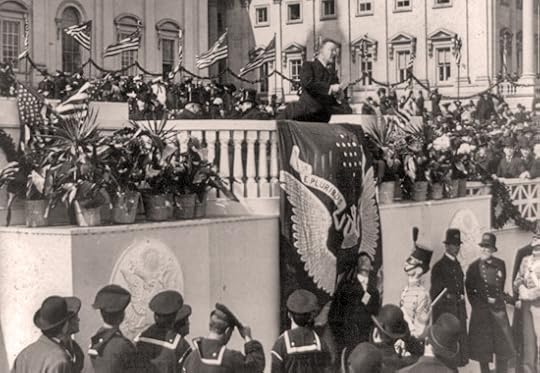
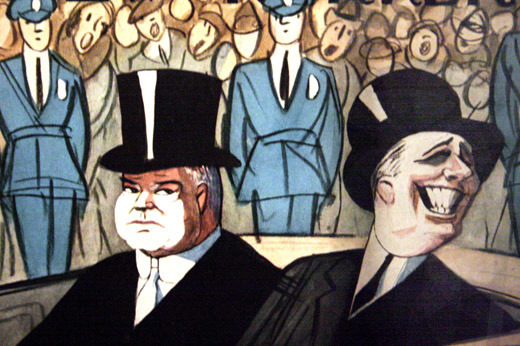 • A procession to the U.S. Capitol, also designed by Mr. Latrobe. At least President O. doesn't have to worry about having a godawful ride like
FDR
had with furious, worn-out
HCH
back in '33.
• A procession to the U.S. Capitol, also designed by Mr. Latrobe. At least President O. doesn't have to worry about having a godawful ride like
FDR
had with furious, worn-out
HCH
back in '33.
• Joe Biden (born 20 Nov 1942, not long after Allied Forces landed in North Africa, just a few days before a hellacious fire broke out at Boston's Cocoanut Grove and killed 487 night-clubbers...Happy Warrior 'Smiley' Joe shares a birthday with Robert F. Kennedy, Alistair Cooke, and the astronomer Edwin Hubble), the 47th U.S. Vice President, once more will be sworn in to office.
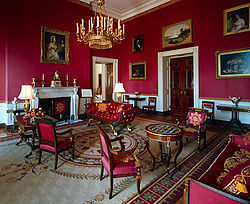
• [the program ] U.S. President No. 44, Barack Obama is scheduled to take his ceremonial Oath of Office at 11:30 A.M., having taken his official O. of O. yesterday, in a private ceremony on January 20, the official I. Day. So it was for Rutherford B. Hayes, in 1877, and Ronald Reagan, too, in 1985, being as their Inaugurals fell on Sundays. As a matter of fact, Mr. Hayes was sworn in in the W.H., a presidential 1st, in the Red Room , where charming Dolley Madison once held her popular Wednesday evening receptions before the whole joint was torched by the Redcoats.
• Then Mr. Obama gives a speech - no, make that an address. Think about it, Citizens: What would you say to your divided, somewhat disheartened nation? (What would I say? Read a book. Heck, read a LOT of books. Learn what we Americans have - and haven't - been about all these years and think about what you read, for crying out loud. And just for a change, listen and THINK about what we have in common. Our history, for one thing. Our scary future, for another.)
• There's a luncheon. Click HERE for the menu! (sounds a good deal fancier than the tortilla/melted cheese & handfuls of 1. cherry tomatoes and 2. MandMs I've got planned. )
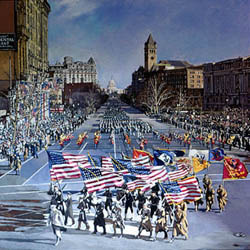
The Inaugural Parade of FDR, 1941, Frank Wright
• PARADE!
• BALLS. (What would I wear? What would I wear? Gownless Evening Strap? Could we have, like, an Author Prom, a BiblioBall or something, PUH-lease??? I totally want to see Jim Murphy in a tuxedo.)
Aren't we thankful for the 20th Amendment? If only for the fact that it isn't the 2nd Amendment, which I am WAY sick of hearing about, at least the part of the argument that comes from these automatically-armed-to-the-teeth blowhards? Because at least we're not having to wait until the 4th of March for all of this hoohah. All of this glorious hoohah, celebrating that for all our bloody-minded, well-intentioned, noble, greedy, bumptious, wonderful/horrible goings-on, we Americans have managed this banged up but unbroken chain of power passing to power.
And in the spirit of that old saw, that trite-but-true wheeze about this being the first day of the rest of OUR lives, how in the heck are we going to inaugurate it? What are we prepared to do? (Despite opposition, fear, inertia, the tough, fast-changing marketplace) Ponder on our intentions. Ask what we can do for our country. And do it.
So help us God.


 • A procession to the U.S. Capitol, also designed by Mr. Latrobe. At least President O. doesn't have to worry about having a godawful ride like
FDR
had with furious, worn-out
HCH
back in '33.
• A procession to the U.S. Capitol, also designed by Mr. Latrobe. At least President O. doesn't have to worry about having a godawful ride like
FDR
had with furious, worn-out
HCH
back in '33. • Joe Biden (born 20 Nov 1942, not long after Allied Forces landed in North Africa, just a few days before a hellacious fire broke out at Boston's Cocoanut Grove and killed 487 night-clubbers...Happy Warrior 'Smiley' Joe shares a birthday with Robert F. Kennedy, Alistair Cooke, and the astronomer Edwin Hubble), the 47th U.S. Vice President, once more will be sworn in to office.
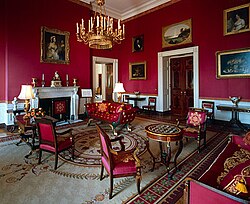
• [the program ] U.S. President No. 44, Barack Obama is scheduled to take his ceremonial Oath of Office at 11:30 A.M., having taken his official O. of O. yesterday, in a private ceremony on January 20, the official I. Day. So it was for Rutherford B. Hayes, in 1877, and Ronald Reagan, too, in 1985, being as their Inaugurals fell on Sundays. As a matter of fact, Mr. Hayes was sworn in in the W.H., a presidential 1st, in the Red Room , where charming Dolley Madison once held her popular Wednesday evening receptions before the whole joint was torched by the Redcoats.
• Then Mr. Obama gives a speech - no, make that an address. Think about it, Citizens: What would you say to your divided, somewhat disheartened nation? (What would I say? Read a book. Heck, read a LOT of books. Learn what we Americans have - and haven't - been about all these years and think about what you read, for crying out loud. And just for a change, listen and THINK about what we have in common. Our history, for one thing. Our scary future, for another.)
• There's a luncheon. Click HERE for the menu! (sounds a good deal fancier than the tortilla/melted cheese & handfuls of 1. cherry tomatoes and 2. MandMs I've got planned. )

The Inaugural Parade of FDR, 1941, Frank Wright
• PARADE!
• BALLS. (What would I wear? What would I wear? Gownless Evening Strap? Could we have, like, an Author Prom, a BiblioBall or something, PUH-lease??? I totally want to see Jim Murphy in a tuxedo.)
Aren't we thankful for the 20th Amendment? If only for the fact that it isn't the 2nd Amendment, which I am WAY sick of hearing about, at least the part of the argument that comes from these automatically-armed-to-the-teeth blowhards? Because at least we're not having to wait until the 4th of March for all of this hoohah. All of this glorious hoohah, celebrating that for all our bloody-minded, well-intentioned, noble, greedy, bumptious, wonderful/horrible goings-on, we Americans have managed this banged up but unbroken chain of power passing to power.
And in the spirit of that old saw, that trite-but-true wheeze about this being the first day of the rest of OUR lives, how in the heck are we going to inaugurate it? What are we prepared to do? (Despite opposition, fear, inertia, the tough, fast-changing marketplace) Ponder on our intentions. Ask what we can do for our country. And do it.
So help us God.
January 16, 2013
Courage Has No Color is out 1/22!
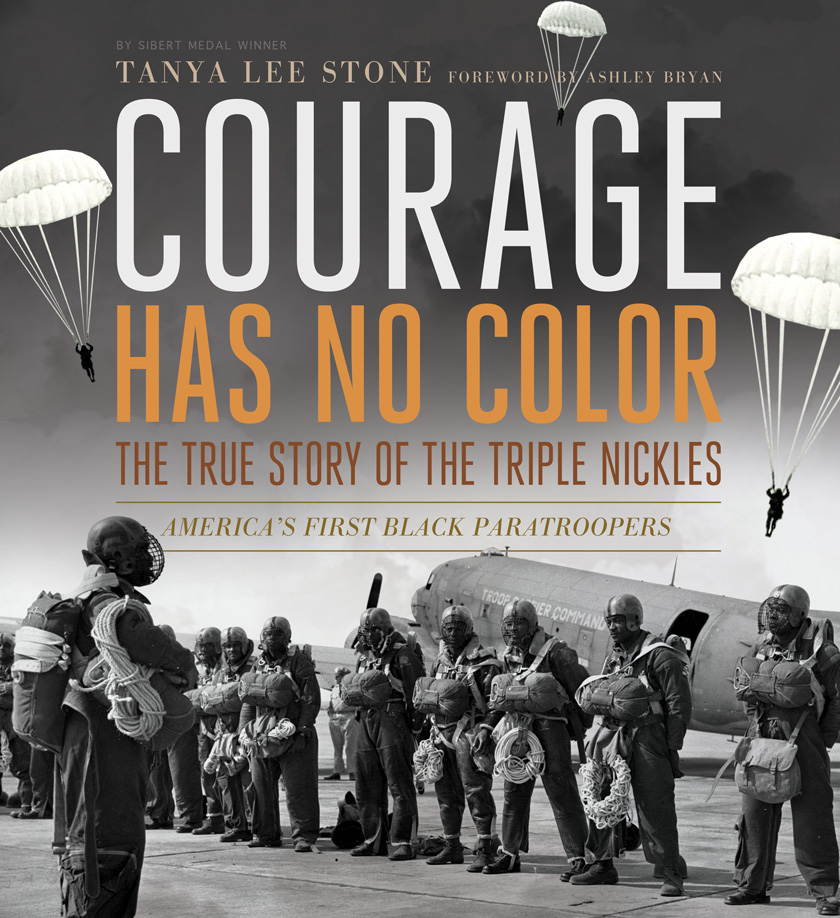
I don’t often post about my books, but I am very excited that Courage Has No Color will launch on Tuesday, January 22nd! This is a story I started way, way back in 2003. It took ten years for me to figure out the best form for the story and accurately put all the pieces together.
This is the true story of a very little-known group of men who should be as familiar to us as any other groundbreaking group of pioneers. Led by Walter Morris, these WWII soldiers who were serving guard duty in the Army became the first black paratroopers in World War II. They also integrated the Army many months before integration was ordered AND helped fight an attack by the Japanese on the American West. Yes, you read that right.
There are a lot of personal reasons why this book has become close to my heart—23 reasons, in fact—all 17 men and 6 officers who became the first to blaze this trail. Walter Morris is at the top of that list, a man I have grown to love and am proud to call my friend. He will be 92 next week, and the minute the box of freshly bound books hit my stoop, I packed one up for him. It is beyond thrilling—after talking with him for ten years—to be able to put his own story into his hands, complete with the more than 100 photographs it took me a few years to gather. Black-and-white-and-sepia-toned needles in a myriad of haystacks. Finding them was a whole other story. Thank goodness for helpful archivists in obscure locations and engines like Zabasearch, without which I could not have found scattered relatives of soldiers who passed on long ago.
This is my second book with Candlewick, and I am so fortunate to have an amazing team to work with there. I am also happy to be able to share the brand new book trailer. The young man you will hear doing the voice-over won 2nd place in the National Poetry Out Loud contest last year, and happens to be local to me. It was wonderful to bring him in for the project.
The wonderful and beloved Ashley Bryan also became an important part of this book. He first read the picture book version in 2003 and we had poignant conversations over the years on the subjects of war and discrimination and art and joy. He read the manuscript of what became this book about a year ago and wrote the Foreword. Incredibly, he also shared his own artwork that he made during the war, when he was a stevedore in the Army. A few of those pieces now grace the pages of Courage Has No Color.
Thank you for indulging me today, as I do some blatant self-promotion, but it’s not all that often you get to shout from the rooftops that a new book baby is born! Oh, and there will be a Reading Guide for this title soon, which will include suggestions for use with Common Core.

January 15, 2013
The Joy of Noodling
<!--
/* Font Definitions */
@font-face
{font-family:Arial;
panose-1:2 11 6 4 2 2 2 2 2 4;
mso-font-charset:0;
mso-generic-font-family:auto;
mso-font-pitch:variable;
mso-font-signature:3 0 0 0 1 0;}
@font-face
{font-family:Cambria;
panose-1:2 4 5 3 5 4 6 3 2 4;
mso-font-charset:0;
mso-generic-font-family:auto;
mso-font-pitch:variable;
mso-font-signature:3 0 0 0 1 0;}
/* Style Definitions */
p.MsoNormal, li.MsoNormal, div.MsoNormal
{mso-style-parent:"";
margin:0in;
margin-bottom:.0001pt;
mso-pagination:widow-orphan;
font-size:12.0pt;
font-family:"Times New Roman";
mso-ascii-font-family:Cambria;
mso-ascii-theme-font:minor-latin;
mso-fareast-font-family:Cambria;
mso-fareast-theme-font:minor-latin;
mso-hansi-font-family:Cambria;
mso-hansi-theme-font:minor-latin;
mso-bidi-font-family:"Times New Roman";
mso-bidi-theme-font:minor-bidi;}
@page Section1
{size:8.5in 11.0in;
margin:1.0in 1.0in 1.0in 1.0in;
mso-header-margin:.5in;
mso-footer-margin:.5in;
mso-paper-source:0;}
div.Section1
{page:Section1;}
</style> <br />
<div class="MsoNormal">
<br /></div>
<div class="MsoNormal">
<span style="font-family: Arial;">Okay, I admit it, I’m a
research junkie.<span style="mso-spacerun: yes;"> </span>My favorite
activity associated with my work is not crafting brilliant sentences or feeling
triumph when I figure out how to organize a huge amount of material so that my
manuscript doesn’t have “too many words” (the mantra of many editor these
days). It happens much earlier, when I’m in the 'finding info' stage.</span></div>
<div class="MsoNormal">
<br /></div>
<div class="MsoNormal">
<span style="font-family: Arial;">That work used to involve
driving to the university, miraculously finding a parking spot, and heading into the stacks after thumbing through
card catalogs or, later, computer listings of holdings.<span style="mso-spacerun: yes;"> </span>Now, I rarely go there.<span style="mso-spacerun: yes;"> </span>The internet has become the ‘go to’
place for most of my research, for a couple of reasons.<span style="mso-spacerun: yes;"> </span>First off, there’s just plain so much
information online, and I know how to ferret out the accurate sites.<span style="mso-spacerun: yes;"> </span>Secondly, my books now are often on
less scientific topics than before.<span style="mso-spacerun: yes;">
</span>But once I get going, it’s hard for me to stop.</span></div>
<div class="MsoNormal">
<br /></div>
<div class="MsoNormal">
<a href="http://3.bp.blogspot.com/-3BET5G9DpOM..." imageanchor="1" style="clear: right; float: right; margin-bottom: 1em; margin-left: 1em;"><img border="0" height="181" src="http://3.bp.blogspot.com/-3BET5G9DpOM..." width="200" /></a><span style="font-family: Arial;">I’ve found that I need to
find a balance between following thread after thread until I’m lost in a tangle
far from where I meant to be and allowing myself to wander hither and yon on
the net and stumbling onto something I didn’t know existed.<span style="mso-spacerun: yes;"> </span>A perfect example of the latter happy
coincidence came while researching my most recent book, “Dogs on Duty:
Soldiers’ Best Friends on the Battlefield and Beyond.”<span style="mso-spacerun: yes;"> </span>Because of my love of canines, I’m on
an email list or two, and one had a link to the American Kennel Club Hero Dog
Awards.<span style="mso-spacerun: yes;"> </span>I clicked through just for
the fun of it and ended up finding a great dog who became one of my favorite
profiles in the book.<span style="mso-spacerun: yes;"> </span>His name was
“Bino,” and he was really a double-header hero.<span style="mso-spacerun: yes;"> </span>First, he had worked in the military keeping bases safe and
sniffing out explosives in Iraq.<span style="mso-spacerun: yes;">
</span>After he retired, Bino was adopted by Debbie Kandoll, an amazing woman
who realized that Bino didn’t’ want to be retired and lounge on the couch.<span style="mso-spacerun: yes;"> </span>He wanted to keep working.<span style="mso-spacerun: yes;"> </span>So she employed him as a helper to
train service dogs for veterans suffering from PTSD.<span style="mso-spacerun: yes;"> </span>Debbie and Bino would take the vets and their dogs into
noisy malls, riding narrow escalators and navigating crowds of shoppers,
showing them that there was nothing to fear.<span style="mso-spacerun: yes;"> </span>Bino died last year at the age of 12, working almost to the
end of his life.<span style="mso-spacerun: yes;"> </span>What a true hero
hound!</span></div>
<div class="MsoNormal">
<div class="separator" style="clear: both; text-align: center;">
<a href="http://1.bp.blogspot.com/-tQB4krdqv04..." imageanchor="1" style="margin-left: 1em; margin-right: 1em;"><img border="0" height="212" src="http://1.bp.blogspot.com/-tQB4krdqv04..." width="320" /></a></div>
<br /></div>
<div class="MsoNormal">
<a href="http://1.bp.blogspot.com/-b2Y_zSiHoCA..." imageanchor="1" style="clear: right; float: right; margin-bottom: 1em; margin-left: 1em;"><img border="0" height="160" src="http://1.bp.blogspot.com/-b2Y_zSiHoCA..." width="200" /></a><span style="font-family: Arial;">Now I’m working on yet
another dog book and have a confession to make.<span style="mso-spacerun: yes;"> </span>Today I was supposed to edit some documents for the Authors
on Call branch of iNK, and I was supposed to get busy writing this blog.<span style="mso-spacerun: yes;"> </span>But instead, I started on a quest for
photos for my next book—another doggy topic.<span style="mso-spacerun: yes;"> </span>I went to Google photos and got lost in the plethora of
appealing photos of working dogs, then clicking on the articles in which the
photos were imbedded.<span style="mso-spacerun: yes;"> </span>I’ve found
that while Wikimedia has photos that are usually available to use for free, Google
photos makes it easy to access the information that accompanies the photos by
ghosting the articles behind the images.<span style="mso-spacerun: yes;">
One click on the background and the article appears. </span>I’ve found it’s an easy way to do targeted research.<span style="mso-spacerun: yes;"> </span>Today, I downloaded some potentially
useful photos, discovered a dog who can sniff out buried 600-year-old bones and added five new bookmarks to my already bloated list--and I’ve
only gotten halfway through the photos!</span></div>
<div class="MsoNormal">
<br /></div>
<div class="MsoNormal">
<span style="font-family: Arial;">One of these days, I may
find the balance between hoping for serendipity and being disciplined about my
research—after all, you can only fit so much information into a 40 or 48 page
book!<span style="mso-spacerun: yes;"> </span>But I’m in no hurry for
discipline; noodling around on the internet is just too much fun.</span></div><img src="http://feeds.feedburner.com/~r/blogsp..." height="1" width="1"/>
The Cagey Mr. Lincoln
Read an interesting piece by Jim Downs in the 1/6/13 SundayReview section of the NY Times. It was titled "Dying for Freedom" and took Abraham Lincoln to task for not providing for the welfare of newly freed slaves after the Emancipation Proclamation was signed on January 1, 1863. This lack of preparation contributed to the death of thousands of people, Downs insists. Downs is an associate professor of history at Connecticut College and part of his agenda (made much more obvious in a Huffington Post blog) is clearly to undercut the patriotic glow that surrounds the movie "Lincoln" by highlighting its numerous historical inaccuracies and exaggerations.
Which is fine. A movie like "Lincoln" can overshowdow years of real scholarship and thought in a matter of minutes (and that's got to annoy anyone seriously interested in history) and trying to alert readers to its problems might actually get some folk to dig a little deeper into our national history. There were a number of things in Downs' article that bothered me and a discussion of them could produce a really extended and lively discussion/debate.
But one phrase kept leaping out to me. When thinking about the liberation of the enslaved, Downs says, "Lincoln can no longer be portrayed as the hero in this story."
Why, I wondered, did he have to say that? Bashing Lincoln is guaranteed to get a certain amount of attention, of course. And maybe even result in publication in one form or another. Nothing wrong with that, I suppose, though was necessary to demote Lincoln's hero status in order to set the record straight? It might be a more emotional and passionate way to reconsider Lincoln, but is it correct or fair?
When I wrote A Savage Thunder: Antietam and the Bloody Road to Freedom I was careful not to portray Lincoln as moved solely by idealism and compassion when he drew up the Imancipation Proclamation. He wanted to abolish slavery in the United States and the western territories, but he knew this wasn't universally popular and could take years, even decades to carry out fully. The Emancipation Proclamation was a way, as Downs points out, to scare southern states into rejoining the union. Yet, what Lincoln did was extremely clever because he couldn't legally free the slaves anyway. He had sworn in his presidential oath to uphold the Constitution; at the time, the Constitution clearly said slavery was legal; for Lincoln to abolish slavery would be a violation of his oath and, at the very least, open him up to scathing criticism, not just from the south, but from northern political rivals as well. Instead, he used an act of war that allowed him to seize enemy property used for war purposes (and the slaves fit this description perfectly). It was a clever, legal manuever and, as they say, a game changer.
At the same time I tried to balance this seemingly cold and distant reality with some of Lincoln's own personal feelings about slavery, the ones where his heart spoke without his political-lawyerly filter on, the ones that make him human, filled with self-doubt and, yes, caring. I also discuss the potential for a mass boycott by many of his senior officers (George McClellan and many of his staff openly opposed the Emancipation Proclamation and weren't shy about telling this to newspaper reporters) and this must have weighed heavily on the President as the new year approached. Lincoln knew he was in an epic battle in many ways and he used every way he could to win his ultimate oibjective. My aim wasn't to simply recreate Lincoln as a classic flawless hero, the kind we meet in textbooks, but to let kids meet a man who faced the complex issues and had to figure them out on the fly, usually by taking a pragmatic and calculating approach. That might not make a compelling movie or an attention getting article, but it does portray Lincoln as human and cagey and, oh yes, heroic.
Which is fine. A movie like "Lincoln" can overshowdow years of real scholarship and thought in a matter of minutes (and that's got to annoy anyone seriously interested in history) and trying to alert readers to its problems might actually get some folk to dig a little deeper into our national history. There were a number of things in Downs' article that bothered me and a discussion of them could produce a really extended and lively discussion/debate.
But one phrase kept leaping out to me. When thinking about the liberation of the enslaved, Downs says, "Lincoln can no longer be portrayed as the hero in this story."
Why, I wondered, did he have to say that? Bashing Lincoln is guaranteed to get a certain amount of attention, of course. And maybe even result in publication in one form or another. Nothing wrong with that, I suppose, though was necessary to demote Lincoln's hero status in order to set the record straight? It might be a more emotional and passionate way to reconsider Lincoln, but is it correct or fair?
When I wrote A Savage Thunder: Antietam and the Bloody Road to Freedom I was careful not to portray Lincoln as moved solely by idealism and compassion when he drew up the Imancipation Proclamation. He wanted to abolish slavery in the United States and the western territories, but he knew this wasn't universally popular and could take years, even decades to carry out fully. The Emancipation Proclamation was a way, as Downs points out, to scare southern states into rejoining the union. Yet, what Lincoln did was extremely clever because he couldn't legally free the slaves anyway. He had sworn in his presidential oath to uphold the Constitution; at the time, the Constitution clearly said slavery was legal; for Lincoln to abolish slavery would be a violation of his oath and, at the very least, open him up to scathing criticism, not just from the south, but from northern political rivals as well. Instead, he used an act of war that allowed him to seize enemy property used for war purposes (and the slaves fit this description perfectly). It was a clever, legal manuever and, as they say, a game changer.
At the same time I tried to balance this seemingly cold and distant reality with some of Lincoln's own personal feelings about slavery, the ones where his heart spoke without his political-lawyerly filter on, the ones that make him human, filled with self-doubt and, yes, caring. I also discuss the potential for a mass boycott by many of his senior officers (George McClellan and many of his staff openly opposed the Emancipation Proclamation and weren't shy about telling this to newspaper reporters) and this must have weighed heavily on the President as the new year approached. Lincoln knew he was in an epic battle in many ways and he used every way he could to win his ultimate oibjective. My aim wasn't to simply recreate Lincoln as a classic flawless hero, the kind we meet in textbooks, but to let kids meet a man who faced the complex issues and had to figure them out on the fly, usually by taking a pragmatic and calculating approach. That might not make a compelling movie or an attention getting article, but it does portray Lincoln as human and cagey and, oh yes, heroic.
January 14, 2013
WHY!!!!!!!!!!!!!!
The exclamation point.
Lately I’m trying to avoid it, or cut down gradually the way you do
when you can’t go cold turkey on chocolate or that late afternoon cup of coffee.
 Like coffee, this bit of punctuation has not always been
part of my repertoire. I simply avoided
them, thinking they belonged in the category of the circles or hearts young
girls used to dot the i in their handwritten signature.
That was then. Slowly
I began ending sentences with undue excitement.
It crept into emails. Into my books. In more informal settings, I might even
explode with a burst of three!!!
Occasionally I’d throw in a question mark to show mixed wonderment--!?!
I know I’m not alone; we are in a time of exclamation
inflation. But that doesn’t make me feel any better. It reminds me of the time I went back home to
visit my folks in a Detroit suburb after years of exposure to Boston’s manic
driving practices. There I was in the
Midwest at a red light with my left-turn signal on. The light turned green and, without thinking,
I turned quickly to beat the line of on-coming traffic. Cruising down the new street, I happened to
glance over at my dad, who was looking at me in surprised disappointment. “Susie,” he said sadly, “what has happened to
you?” (Note to East Coast drivers:
Darwinism does not apply to driving etiquette in other parts of the country.)
So why had the exclamation point parked in my punctuation
stable, I wondered. Is it part of the
emoticon boom that comes with email?
I’ve never slapped a J into a note to friends or close business
associates. I’ve never even considered
the more sedate form of :). Maybe
throwing in a few !!! was my way of joining the crowd.
Or maybe--it occurred to me—it’s not the times, but that I
began to write for children. I really
hope not, though I’m pretty sure I didn’t use them in my articles for Harper’s
Bazaar, National Geographic Traveler or Discovery.
I hate the idea that it could be the writing-for-kids
theory. Did I really think they really
need a mark to show them when to be excited?
Hope not. It feels like talking
down to kids in a way. Or worse, a
crutch for bad writing.
I will continue to monitor my use of exclamation points
carefully, but I am curious about what others think of this matter. Do you find yourselves plastering them into
your sentences more than before? And if
so, why?

January 11, 2013
Ethics in Nonfiction for Kids

There’s something special about speaking at the main branch
of the New York Public Library. Walking up the grand steps between Patience and
Fortitude – I never remember which lion is which – gives one a sense of arrival,
that you are a member of that rarified club called writers. And does that feel good.
Last Saturday, Meghan McCarthy, fellow
INKers, Deborah Heiligman, Sue Macy, and
I, participated in a panel discussion about ethics in nonfiction for kids. It
was part of Betsy Bird’s Children’s Literary Salon that meets there the first
Saturday of each month. The wood paneled room on the second floor quickly
filled as Betsy scurried around for more chairs. Deb, Sue, Meghan, and I took
seats atop a plush Oriental carpet. I wondered what great writers stood on
these warps and wefts.
With my colleagues permission I
taped our panel. Or I should say I taped most of it because my recorder was on
the chair beside me, and as I shifted my butt, the recorder would stop. This is
yet another reason to always bring along additional recorders. A number of
people have asked if there was an audiotape. Rather than playing the entire
tape, I’ve pulled together a few excerpts.
Part of our discussion had to do
with selectivity in nonfiction – what we put in our books/what we leave out.
I hope my selective choices and shaping of the tape fit the ethical standards
of my colleagues.
Betsy started us off with a question about our process. I
turned on the recorder as Sue Macy was describing her collection of bicycle
memorabilia for her book, Wheels of
Change: How Women Rode the Bicycle to Freedom [With a Few Flat Tires Along the
Way.]
Sue: I went to a bicycle auction. I also do typical
research. I go to libraries and read diaries and scrapbooks. I do a lot of
newspaper research because I find reading articles from contemporary newspapers
is a really good way to get back to that time period – to see how people are
speaking about their subject back then. And now, thanks to the Library of
Congress and other sources, a lot of those newspapers are online.
Deborah: Well, I’ll tag on that. I’m a primary source
junkie. When I talk about writing nonfiction, my talk is titled “You Can’t Make
This Stuff Up.” And what I mean by that is two-fold, one is you can’t make this
stuff up. Nonfiction is so amazingly wonderful. I think we all feel that
way. There are great stories out there. And then the other you-can’t-make-this
stuff-up means you’re not allowed to make stuff up. When I wrote Charles and
Emma, I could have read the bazillions and millions of pages that had already
written about Charles Darwin, secondary sources. But I wanted to encounter
Charles Darwin and Emma Wedgwood Darwin on my own. I wanted to meet them not
through anyone else’s filters. I was lucky to be able to read letters,
autobiographies, diaries, and Darwin’s notebooks. And by so doing that I was
able to do original research that nobody else had done. I looked at diary
entries and journal entries at the same time as letters and scientific notebooks.
Then I pieced together the story of Darwin’s work and his family life. I
wouldn’t have been able to do that if I was using secondary sources because
Emma Darwin was only a line or a paragraph in every book.
I firmly
believe that the person you are married to influences who you are and what you
do. I knew in my heart starting out that she was a big influence on Charles
Darwin, but I had to do the research to back that up. Since I write mostly
about dead people, unlike Sue and Susan, I haven’t figured out how to contact
them in any other way, but I do also interview experts. I’m your primary source
gal.
Susan: None of my
people are dead. My books are based on interviews with people who represent a
subject. They are not the entire representations of the subject, but a piece of
it. For example, my last subject was capital punishment, specifically teenagers
on death row. One thing I learned quickly from talking to various lawyers was
that I knew nothing. Before I could begin working I took a course in capital
punishment at NYU Law School. Usually I don’t like to do that. I want to be a
blank page so that I’m completely open to the thoughts of the people I interview.
But I really needed to know what questions to ask.
The second
thing I have to do is find the people who will participate in the books. That
takes most of my time. I go to various organizations that represent people in
whatever subject I am studying. I look for the very, very best organizations,
ones that sorta get me, and understands what I’m trying to do.
Sue: Do you ever get people who want money from you?
Susan: I’ve had two, what I would call shakedowns, and they
are not included in my book. No one is paid.
Deborah: I once had an expert ask for money to read my book.
I said, “You know what, I’m going to find somebody else.” And I easily did.
Meghan: I go to antique stores because you can get lots of
magazines of a period and get a sense of the time period from ads and articles.
Some of the stuff from the 1950s and 60s is very shocking. They were very
sexist and racist.
Betsy: Has anyone ever had a book idea that you had to drop
because you couldn’t get the research?
Sue: Last year I emailed you [Betsy] a story about the Black
List, the Hollywood Black List. It’s still in my head. You have to use the
facts to get your story, and I know what the story should be, but the facts
didn’t support it. So it’s on hold until I can figure out the angle. I mostly
write about women’s history. I want that sort of angle on the Hollywood ten,
especially the TV black list. I keep trying and trying and reading things and
reading things. That’s the problem with nonfiction. If it doesn’t fall into
place, you either do fiction, or you don’t write it.
Susan: That’s where the ethics come in. We have a wide girth,
but it has to be based on truth. So what do you do? Do you take a subject and
try to find the material that fits your point of view, or do you let the
subject lead you?
Meghan: I think it’s going to be slanted by the writer’s
point of view to some extent. That’s a problem I find researching. One
newspaper says this and another newspaper says this.
I had a horrible book accident. I
had this great idea for a book because I had read an autobiography by a guy [Bob
Heft] who said he had invented the fifty-star flag. This was in the 1950s. He
had just died. He had this whole story about how he did it when he was a
teenager in high school. He was on news shows and he posed with celebrities. There
was a ton of stuff to back this up. But doing the research with my editor, I
thought there was something that was just not right. He said that he was
holding up a flag with Eisenhower. My editor asked me to illustrate this but I
couldn’t find any photographs of it. She was determined to make this happen.
She contacted the Eisenhower library, and it all started to fall apart. They
said, “You know, we don’t have any documentation that this actually happened.”
We looked into it further and the whole story was bogus. We canceled the
project. This guy made up this up, and it turned out that lots of people came
up with that same star design.
Deborah: Let me say this one thing. I think a book needs to
be labeled fiction or nonfiction. As a grownup or a child I don’t want to be
confused by that.
Meghan: I have a thing about Thomas Edison. They say that
Thomas Edison invented the light bulb on such and such a date. I’m going to
change that. I’m working on a graphic novel about electricity and stuff. I
think there are a lot of inaccuracies about Thomas Edison. I didn’t think he
was a good guy.
Deborah: Writing is about the choices we make. In my new picture book, The Boy Who Loved Math: The Improbable Life of Paul Erdos [FYI: to
be published in June by Roaring Brook], everything in the book is true, both in
words and illustrations. But you sweat this stuff like nobody’s business. This
is a book that took me so long to write. It’s a biography, essentially, but
guess what, it’s for little kids. And you just can’t get everything in in thirty-two
pages and make it a story that moves. I had to craft a story out of this man’s
life, which turned out to be not so bad because he had such an amazing life.
But in doing so, some things ended up on the cutting room floor. For example,
when he was being born, his two older sisters died of Scarlet Fever. That was
in many, many drafts, but it highjacked the book. You’re in first or second
grade, and can’t get over that his two older sisters died of Scarlet Fever. It
was a decision, a choice I made. [Note: Deborah put the sisters’ deaths in the
author’s notes.]
We have to make the story true but
that doesn’t mean we don’t craft the facts. We have to craft the story, shape
the story.
Betsy: So you’re
killing yourselves to be accurate, and you show it to your editor. Have you
ever been asked to remove anything that was accurate? Let’s say you put a
toilet in outer space, Meghan? [Referring to Megan’s book, Astronaut Handbook]
Meghan: The toilet is in there.
Susan: Years ago I was asked to remove curse words. At the
time some of my books covered some heavy-duty nonfiction subjects. My editor asked
me to leave out the F-bomb. She said, “Don’t give people the excuse to not buy
the book because of the profanities. Let them not buy it because they are
racists, or sexists, or homophobic.” That’s changed. There’s lots of profanity
in my next book.
Deb: There are lots of bathrooms in your new book.
Susan: Yes, lots of bathrooms.
Sue: I was never asked to take out things, but I was asked
to put in things. When I wrote about the women’s baseball league in the 40s and
50s there were no black players. And my editor, Marc Aronson, said, “You have
to say that upfront because it was a fact about this league that people should
know. And then get it over with.”
But I said
it’s kinda like the putting a pall over the story, like what you were talking
about [to Deborah], about the sisters. But I put it in because it was my first
book, and he knew what he was talking about. Every critic said, “While there were
no blacks in this league …,” they accepted it, and moved on to enjoy the story.
So sometimes editors actually know best. [Laughter]

Susan, Meghan, Sue, and Deborah
To read more, Mahnaz Dar covered this event for SLJ.