Elizabeth Rusch's Blog, page 23
July 26, 2013
Summer Interesting Nonfiction and Fiction Pairings
Reposted from June 2013
School’s out for summer! Many summer reading lists combine
nonfiction and fiction reading recommendations. It was exciting to see Steve Sheinkin’s Bomb: The Race to Build, another INK contributor, on the list from my son’s
English teacher.
Since summer’s here and it’s time to play, I thought that it
would be fun to add other senses to the mix and a little play. A few years ago
I taught a class at the Games for Education Conference at the Chicago Toy and
Game fair. The class was titled Play and Creativity in the Classroom. Here’s what I wrote about the class on the
INK blog titled Play in Classroom with several nonfiction book recommendations. Why not add a little
kinetic learning to the summer reading schedule?
A teacher friend is taking her children on an extended
vacation to New England this summer. They are reading fiction and nonfiction
books in preparation. When she mentioned that they were creating KWL charts to
go along with the reading, I was curious. Many teachers reading this will know
about KWL charts, but my friend explained, “It is a 3 column chart- list what
they KNOW, list what the WANT to know, and then after reading list what they
LEARNED. It is a great way to assess prior misconceptions as well as knowledge,
see if they learned anything from their reading, and can be a basis for further
research for unanswered questions.” Here’s a link that explains how to make KWLcharts.
Kind of wish I had made a KWL chart before our recent London
and Paris trip. After we were back home, while recuperating from jetlag, I
tried to remember what my preconceived impressions of Paris were. For example,
my mind had a different vision of what Notre Dame was like. Being there right
in front of Notre Dame was rather surreal.
Everywhere we went on our vacation, I would point out what
we were seeing to my children. I think they became a little tired of me by the
end of our trip. Last Christmas, I bought the family a puzzle of the London Underground and a puzzle of a map of Paris. I do this because of my childhood. Growing up, we would go almost every
other summer to Germany for a month to visit Oma. Most of what I
remember was my little brother and I creating a dividing line in the back seat
of my uncle’s Mercedes and constantly tapping my mom on the arm while she spoke
in German to all my relatives. We went to some cool places, but I have no idea
where I was, why the place was significant, or how it related to European
history.
Here’s a few nonfiction and fiction reading ideas for the
summer with some added senses, kinetic learning, and play.
Bomb: The Race to Build—and Steal—the World’s Most Dangerous
Weapon by Steven Sheinkin
The Green Glass Sea by Ellen Klages
Modern Marvels - The Manhattan Project (History Channel)
We Are the Ship: The Story of Negro League Baseball by Kadir
Nelson
King of the Mound - My Summer with Satchel Paige by Wes
Tooke
Watch a baseball game or go to a game.
Major League Baseball Scrabble
Eat a hot dog, peanuts and Cracker Jacks
Football Hero: A Football Genius Novel by Tim Green
Sports Illustrated Kids 1st and 10: Top 10 Lists of
Everything in Football by Sports Illustrated For Kids
Jukem Football Card Game by Jukem
Play football in the backyard
My Brother Sam Is Dead by James Lincoln Collier or Johnny
Tremain by Esther Hoskins Forbes
The American Revolution for Kids: A History with 21
Activities (For Kids series) by Janis Herbert
City Doodles: Boston by Chris Sabatino
Educational Trivia Card Game - Professor Noggin's American
Revolution by Professor Noggin
Chicago History for Kids: Triumphs and Tragedies of the
Windy City Includes 21 Activities (For Kids series) by Owen Hurd
A Long Way From Chicago by Richard Peck
City Doodles: Chicago by Anna M. Lewis
Chicago-Opoly by Late for the Sky
Build a Skyscaper model
Fact, Fiction, and Folklore in Harry Potter's World: An
Unofficial Guide by George Beahm
Harry Potter and the Sorcerer's Stone by J.K. Rowling
Watch Harry Potter and the Sorcerer's Stone Starring Daniel
Radcliffe, Rupert Grint, and Emma Watson
Eat Harry Potter Bertie Botts Every Flavor Beans by Jelly
Belly
(This list could be endless.)
Sandy's Circus: A Story About Alexander Calder by Tanya Lee
Stone (author), Boris Kulikov (Illustrator)
The Calder Game by Blue Balliett(Author) , Brett Helquist (Illustrator)
Make a Mobile
Go to an art museum
For Younger Readers:
The First Teddy Bear by Helen Kay (Author) , Susan Detwiler
(Illustrator)
Made in the USA - Teddy Bears by Tanya Lee Stone
The Teddy Bears' Picnic by Jimmy
Kennedy (Author) , Michael Hague
(illustrator)
Baby Bear Counters by Learning Resources
Gather all your teddy bears and have a tea party
Play the song Teddy Bear’s Picnic
The Man Who Walked Between the Towers by Mordecai Gerstein
New York City by David F. Marx
New York for Kids: 25 Big Apple Sites to Color (Dover Coloring Books) by Patricia J. Wynne
50-Piece Double 2-Sided Jigsaw Puzzle - New York City by Pigment and Hue
This list is just a jumping off point to get everyone
thinking about all the possibilities. I had to stop somewhere or I’d be still
writing this blog post.
Please add your recommendations to the comments and I’ll add
it to the list. On my website, I will add a hand-out form when I’m done
compiling.
Here’s to a happy summer with lots of reading and playing.
School’s out for summer! Many summer reading lists combine
nonfiction and fiction reading recommendations. It was exciting to see Steve Sheinkin’s Bomb: The Race to Build, another INK contributor, on the list from my son’s
English teacher.
Since summer’s here and it’s time to play, I thought that it
would be fun to add other senses to the mix and a little play. A few years ago
I taught a class at the Games for Education Conference at the Chicago Toy and
Game fair. The class was titled Play and Creativity in the Classroom. Here’s what I wrote about the class on the
INK blog titled Play in Classroom with several nonfiction book recommendations. Why not add a little
kinetic learning to the summer reading schedule?
A teacher friend is taking her children on an extended
vacation to New England this summer. They are reading fiction and nonfiction
books in preparation. When she mentioned that they were creating KWL charts to
go along with the reading, I was curious. Many teachers reading this will know
about KWL charts, but my friend explained, “It is a 3 column chart- list what
they KNOW, list what the WANT to know, and then after reading list what they
LEARNED. It is a great way to assess prior misconceptions as well as knowledge,
see if they learned anything from their reading, and can be a basis for further
research for unanswered questions.” Here’s a link that explains how to make KWLcharts.
Kind of wish I had made a KWL chart before our recent London
and Paris trip. After we were back home, while recuperating from jetlag, I
tried to remember what my preconceived impressions of Paris were. For example,
my mind had a different vision of what Notre Dame was like. Being there right
in front of Notre Dame was rather surreal.
Everywhere we went on our vacation, I would point out what
we were seeing to my children. I think they became a little tired of me by the
end of our trip. Last Christmas, I bought the family a puzzle of the London Underground and a puzzle of a map of Paris. I do this because of my childhood. Growing up, we would go almost every
other summer to Germany for a month to visit Oma. Most of what I
remember was my little brother and I creating a dividing line in the back seat
of my uncle’s Mercedes and constantly tapping my mom on the arm while she spoke
in German to all my relatives. We went to some cool places, but I have no idea
where I was, why the place was significant, or how it related to European
history.
Here’s a few nonfiction and fiction reading ideas for the
summer with some added senses, kinetic learning, and play.
Bomb: The Race to Build—and Steal—the World’s Most Dangerous
Weapon by Steven Sheinkin
The Green Glass Sea by Ellen Klages
Modern Marvels - The Manhattan Project (History Channel)
We Are the Ship: The Story of Negro League Baseball by Kadir
Nelson
King of the Mound - My Summer with Satchel Paige by Wes
Tooke
Watch a baseball game or go to a game.
Major League Baseball Scrabble
Eat a hot dog, peanuts and Cracker Jacks
Football Hero: A Football Genius Novel by Tim Green
Sports Illustrated Kids 1st and 10: Top 10 Lists of
Everything in Football by Sports Illustrated For Kids
Jukem Football Card Game by Jukem
Play football in the backyard
My Brother Sam Is Dead by James Lincoln Collier or Johnny
Tremain by Esther Hoskins Forbes
The American Revolution for Kids: A History with 21
Activities (For Kids series) by Janis Herbert
City Doodles: Boston by Chris Sabatino
Educational Trivia Card Game - Professor Noggin's American
Revolution by Professor Noggin
Chicago History for Kids: Triumphs and Tragedies of the
Windy City Includes 21 Activities (For Kids series) by Owen Hurd
A Long Way From Chicago by Richard Peck
City Doodles: Chicago by Anna M. Lewis
Chicago-Opoly by Late for the Sky
Build a Skyscaper model
Fact, Fiction, and Folklore in Harry Potter's World: An
Unofficial Guide by George Beahm
Harry Potter and the Sorcerer's Stone by J.K. Rowling
Watch Harry Potter and the Sorcerer's Stone Starring Daniel
Radcliffe, Rupert Grint, and Emma Watson
Eat Harry Potter Bertie Botts Every Flavor Beans by Jelly
Belly
(This list could be endless.)
Sandy's Circus: A Story About Alexander Calder by Tanya Lee
Stone (author), Boris Kulikov (Illustrator)
The Calder Game by Blue Balliett(Author) , Brett Helquist (Illustrator)
Make a Mobile
Go to an art museum
For Younger Readers:
The First Teddy Bear by Helen Kay (Author) , Susan Detwiler
(Illustrator)
Made in the USA - Teddy Bears by Tanya Lee Stone
The Teddy Bears' Picnic by Jimmy
Kennedy (Author) , Michael Hague
(illustrator)
Baby Bear Counters by Learning Resources
Gather all your teddy bears and have a tea party
Play the song Teddy Bear’s Picnic
The Man Who Walked Between the Towers by Mordecai Gerstein
New York City by David F. Marx
New York for Kids: 25 Big Apple Sites to Color (Dover Coloring Books) by Patricia J. Wynne
50-Piece Double 2-Sided Jigsaw Puzzle - New York City by Pigment and Hue
This list is just a jumping off point to get everyone
thinking about all the possibilities. I had to stop somewhere or I’d be still
writing this blog post.
Please add your recommendations to the comments and I’ll add
it to the list. On my website, I will add a hand-out form when I’m done
compiling.
Here’s to a happy summer with lots of reading and playing.


July 23, 2013
A Few More Words About PEN
Having just completed a
stint as a judge for the PEN Center’s 2013 Children’s Literature award, I
thought I’d reprise my blog on the history of PEN, from October 2012. The judging was great fun. One thing though: I was dismayed by the small
number of nonfiction books we received. I urge nonfiction authors west of the Mississipi to ask your publishers to submit your books for
consideration. Information is here.
Did you know that PEN – that venerable group that fights for freedom of expression worldwide – is an acronym for Poets, Essayists, and Novelists? I didn’t, until I attended the PEN Center USA Literary Awards Dinner last night in Beverly Hills (swanky hotel, delicious dinner.)

Way back in 1921, the founders of the world’s oldest international literary society acknowledged us nonfiction writers. Today PEN also includes historians, screenwriters, playwrights, graphic writers, journalists, editors, and translators. But somehow PENHSPGJET doesn’t trip lightly off the tongue, so PEN it remains.
Founded in London, PEN’s first president was John Galsworthy, followed by H.G. Wells and J.B. Priestley. In the wake of World War I, its first members hoped that “if the writers of the world could learn to stretch out their hands to each other, the nations of the world could learn in time to do the same.” If only……
PEN American Center was born a year later in 1922 in New York, and PEN Center USA (for writers west of the Mississippi) set up shop in Los Angeles in 1943. Today PEN is active in more than 100 countries.
Though PEN began as a dinner club for literati, it became overtly political in the 1930s, and for decades has lobbied for release of writers imprisoned for speaking their minds. Lives have been saved and prisoners released thanks to PEN’s Writers in Prison Committee.
.jpg)
An empty chair has been a PEN symbol for oppressed writer for decades now, and in 2011, to mark the 90th anniversary of PEN, Witness, a sculpture by Anthony Gormley, was installed at the British Library plaza in London. Its simple lines speak volumes.
In addition to its human rights mission, PEN gives out literary awards every year and that’s what took me to Beverly Hills. I was a finalist for the PEN Literary Award for Children’s Literature (for my novel, All the World’s A Stage: A Novel in Five Acts,) and sat with the winner, Matthew Kirby (for Icefall.) [Correction: Allen Say’s Drawing
from Memory, was one of three finalists.]

Children’s books are sometimes removed from shelves in U.S. schools and libraries, or not purchased at all. Self-censorship – by writers and publishers – of controversial issues has been discussed here and elsewhere. But we haven’t been thrown into prison, tortured, or killed. (I see on the PEN website that just last week, down the road in Tijuana, another journalist was murdered.)
PEN recognizes our work. I’d like to encourage my literary community to join PEN in their worthy work.

A Bird's Eye View of Teaching Persuasive Essay Writing
Last summer, part of my job was helping some 4th and 5th graders hone their skills at writing persuasive essays. This essay form is often seen on standardized tests and is the style kids tend to hate the most. The format must be strictly followed and the rules can be intimidating. There must be five full paragraphs: Introduction, Reason 1, Reason 2, Reason 3, and Conclusion. Yes, each essay must state three reasons and you have to write a full paragraph elaborating on each reason.
Boy, kids really hate this. Can’t you hear the whining now about how they can only think of two reasons? Even though the essays are usually about “kid friendly” topics, they’re not the kind of subjects kinds enjoy pondering, especially when faced with the pressure of writing five paragraphs in 30 or 40 minutes. Honestly their feelings about whether there should be vending machines in school or all students should wear uniforms is usually rather limited and their fear about if they will have enough to write seemingly never ending.
So instead of rote practicing, I used non fiction books to get them thinking. After we talked about the life experiences of a certain bird in New York City, my students had a much better understanding of perspective and point of view. And once we put those things together, their essays really started to flow.
I chose I.N.K. books about a bird named Pale Male, a hawk who chose to build a nest on a swank 5th Avenue Apartment building near Central Park in NYC. This was fascinating to city bird watchers because Hawks were rare in the area but it became a full blown news story when the ritzy apartment building removed the hawk’s nest because of the resulting mess in front of the building and the constant peeking eyes of the bird watchers with large telescopes in Central Park.
There are at least three good non fiction children’s books that I know of about Pale Male. The story and illustrations are a great way to introduce the concept of perspective. The hawks fly high above Central Park and the buildings, giving them a perspective to search for their prey, see the natural beauty of the city, and keep away from the crowds. In the trees or lower on the ground, they can be vulnerable to large groups of crows or people touching their nests. These books also open up a conversation about perspective’s cousin, point of view: what did the hawks want and need, how did the bird watchers want to help them, and how was this the same or different from how the people living in the apartment building thought about birds nesting there?
I ‘ve also found it effective to read two of these books and compare and contrast. What points of the story did each writer focus on? What were some details that were included by one writer but left out by the other? Are there any facts that were absolutely necessary in order to tell the story?
These discussions translated easily and naturally to the persuasive essay form. The kids began to understand that students will often see an issue differently than a teacher or parent or the Principal based on their point of view. They could expand their reasoning when seen from another point of view and based on whom they were trying to convince. Is the letter to a friend or relative? Lets talk about how you could have fun and do things together. If the letter is to the Principal, you can focus on reasons such as safety, health, learning, and community.
From my perspective, using non fiction is tremendously effective in helping kids expand their own way of seeing things and how others see things. This enables them to feel much more confident about their reasoning and, ultimately, helps them express that more naturally in their writing.
Boy, kids really hate this. Can’t you hear the whining now about how they can only think of two reasons? Even though the essays are usually about “kid friendly” topics, they’re not the kind of subjects kinds enjoy pondering, especially when faced with the pressure of writing five paragraphs in 30 or 40 minutes. Honestly their feelings about whether there should be vending machines in school or all students should wear uniforms is usually rather limited and their fear about if they will have enough to write seemingly never ending.
So instead of rote practicing, I used non fiction books to get them thinking. After we talked about the life experiences of a certain bird in New York City, my students had a much better understanding of perspective and point of view. And once we put those things together, their essays really started to flow.
I chose I.N.K. books about a bird named Pale Male, a hawk who chose to build a nest on a swank 5th Avenue Apartment building near Central Park in NYC. This was fascinating to city bird watchers because Hawks were rare in the area but it became a full blown news story when the ritzy apartment building removed the hawk’s nest because of the resulting mess in front of the building and the constant peeking eyes of the bird watchers with large telescopes in Central Park.
There are at least three good non fiction children’s books that I know of about Pale Male. The story and illustrations are a great way to introduce the concept of perspective. The hawks fly high above Central Park and the buildings, giving them a perspective to search for their prey, see the natural beauty of the city, and keep away from the crowds. In the trees or lower on the ground, they can be vulnerable to large groups of crows or people touching their nests. These books also open up a conversation about perspective’s cousin, point of view: what did the hawks want and need, how did the bird watchers want to help them, and how was this the same or different from how the people living in the apartment building thought about birds nesting there?
I ‘ve also found it effective to read two of these books and compare and contrast. What points of the story did each writer focus on? What were some details that were included by one writer but left out by the other? Are there any facts that were absolutely necessary in order to tell the story?
These discussions translated easily and naturally to the persuasive essay form. The kids began to understand that students will often see an issue differently than a teacher or parent or the Principal based on their point of view. They could expand their reasoning when seen from another point of view and based on whom they were trying to convince. Is the letter to a friend or relative? Lets talk about how you could have fun and do things together. If the letter is to the Principal, you can focus on reasons such as safety, health, learning, and community.
From my perspective, using non fiction is tremendously effective in helping kids expand their own way of seeing things and how others see things. This enables them to feel much more confident about their reasoning and, ultimately, helps them express that more naturally in their writing.
July 19, 2013
A Picture Is Worth 1,000 Words
Well, maybe not 1,000, but even as
a writer I can’t deny the power of a photograph. One click of a shutter release
and BAM, we see a story. Photos capture drama (below, survivors from the 1915 sinking of the Lusitania). They convey emotion. Sometimes
they offer clarity. At other times they fill us with questions. And that’s
where the words come in (thank goodness, say the writers).
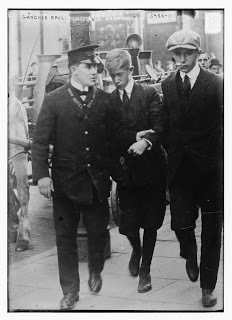
Library of Congress, LC-DIG-ggbain-19173
I owe at least two of my books to
photos. I became so captivated by the Earnest Withers “I AM A MAN” image from Memphis 1968 that I
wrote a whole book about it, Marching to
the Mountaintop. Ditto for the “Blood Brothers” image of John Lewis and Jim
Zwerg, following their beating as Freedom
Riders on May 20, 1961. (See page 42 of this title.)
I’m not sure which I love more,
writing or photo research. Both are passions for me, so I am lucky to work in a
genre that seamlessly weaves the two media into a powerful forum for conveying
the stories of history. If you read these words on their magical 12-12-12 posting
date, you can imagine me engaged in photo research. I’ll be in Washington,
D.C., that day, wrapping up three days of research for my latest project which,
come to think of it, started with an image, too. (Or at least it started during
an earlier round of photo research when my efforts to track down the background
of one picture led to the discovery of a whole new story from the past.)
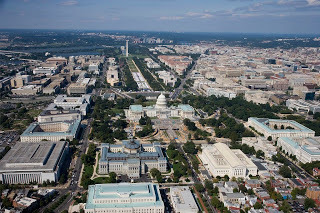
Photo courtesy Library of Congress, LC-DIG-highsm-01901
So what is photo research like?
Truthfully it’s about as glamorous as a day of writing, which is to say not
very. By the end of the day my back aches for bending over images. My mind is so
warped by time traveling through thousands of windows into the past that it is
jarring to step out into real time. My sleep is animated by disjointed pictures
as my mind races to process all the scenes it has observed.
But photo research is also as rewarding
as writing. That moment when you revise to the perfect conclusion is matched by
the discovery of a gotta-have-it photograph. I suspect there is some chemical
parallel between gambling and photo research, because that rush of excitement
from finding one great picture becomes the fuel for the next few hours of
fruitless searching.
Sometimes I do photo research using
on-line databases. Sometimes I’m on site, glove-adorned, paging through
carefully catalogued original prints. And sometimes I’m cut loose in an archive
of dog-eared, we-should-organize-these-some-day gems. I become a treasure
hunter, gently sifting through the sheets of chemical-infused paper to find
just the right shades of sepia and cream. Here a dramatic smile. There a scene
filled with action. Now a glimpse of a forgotten figure. Then a fresh look at a
favorite icon. Sorting the wheat from the chaff, the powerful from the mundane.
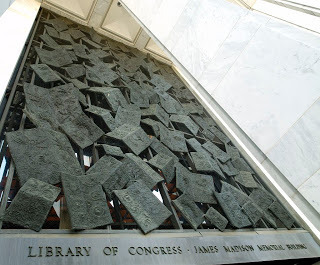
Courtesy Library of Congress, LC-DIG-highsm-03177
One of my favorite places to
conduct photo research is the Library of Congress, and I will be there at least
twice during my current research trip. Those on-site trips offer access to
materials that are otherwise inaccessible, but these days it’s getting easier
and easier to find treasures using the online databases of the Library’s Prints
and Photographs Collection. I’m a big booster of this site, especially when I
do school visits. Anyone who hasn’t used it should kill an hour or two playing
around with the search engines. More and more material is now accessible
off-site, and any images that can be downloaded from a remote location can be
used with a clear conscience as material in the public domain. These are our
tax dollars at work, people. It’s wonderful! Enjoy!
P.S.: I’ve developed an online
tutorial for using the collections of the Library of Congress Prints
& Photographs division. For more information, visit the Muckrakers page of my author website and follow the
tab marked “Behind the scenes—photo research.”
a writer I can’t deny the power of a photograph. One click of a shutter release
and BAM, we see a story. Photos capture drama (below, survivors from the 1915 sinking of the Lusitania). They convey emotion. Sometimes
they offer clarity. At other times they fill us with questions. And that’s
where the words come in (thank goodness, say the writers).

Library of Congress, LC-DIG-ggbain-19173
I owe at least two of my books to
photos. I became so captivated by the Earnest Withers “I AM A MAN” image from Memphis 1968 that I
wrote a whole book about it, Marching to
the Mountaintop. Ditto for the “Blood Brothers” image of John Lewis and Jim
Zwerg, following their beating as Freedom
Riders on May 20, 1961. (See page 42 of this title.)
I’m not sure which I love more,
writing or photo research. Both are passions for me, so I am lucky to work in a
genre that seamlessly weaves the two media into a powerful forum for conveying
the stories of history. If you read these words on their magical 12-12-12 posting
date, you can imagine me engaged in photo research. I’ll be in Washington,
D.C., that day, wrapping up three days of research for my latest project which,
come to think of it, started with an image, too. (Or at least it started during
an earlier round of photo research when my efforts to track down the background
of one picture led to the discovery of a whole new story from the past.)

Photo courtesy Library of Congress, LC-DIG-highsm-01901
So what is photo research like?
Truthfully it’s about as glamorous as a day of writing, which is to say not
very. By the end of the day my back aches for bending over images. My mind is so
warped by time traveling through thousands of windows into the past that it is
jarring to step out into real time. My sleep is animated by disjointed pictures
as my mind races to process all the scenes it has observed.
But photo research is also as rewarding
as writing. That moment when you revise to the perfect conclusion is matched by
the discovery of a gotta-have-it photograph. I suspect there is some chemical
parallel between gambling and photo research, because that rush of excitement
from finding one great picture becomes the fuel for the next few hours of
fruitless searching.
Sometimes I do photo research using
on-line databases. Sometimes I’m on site, glove-adorned, paging through
carefully catalogued original prints. And sometimes I’m cut loose in an archive
of dog-eared, we-should-organize-these-some-day gems. I become a treasure
hunter, gently sifting through the sheets of chemical-infused paper to find
just the right shades of sepia and cream. Here a dramatic smile. There a scene
filled with action. Now a glimpse of a forgotten figure. Then a fresh look at a
favorite icon. Sorting the wheat from the chaff, the powerful from the mundane.

Courtesy Library of Congress, LC-DIG-highsm-03177
One of my favorite places to
conduct photo research is the Library of Congress, and I will be there at least
twice during my current research trip. Those on-site trips offer access to
materials that are otherwise inaccessible, but these days it’s getting easier
and easier to find treasures using the online databases of the Library’s Prints
and Photographs Collection. I’m a big booster of this site, especially when I
do school visits. Anyone who hasn’t used it should kill an hour or two playing
around with the search engines. More and more material is now accessible
off-site, and any images that can be downloaded from a remote location can be
used with a clear conscience as material in the public domain. These are our
tax dollars at work, people. It’s wonderful! Enjoy!
P.S.: I’ve developed an online
tutorial for using the collections of the Library of Congress Prints
& Photographs division. For more information, visit the Muckrakers page of my author website and follow the
tab marked “Behind the scenes—photo research.”
July 17, 2013
It's All About "Me"
Why have so many people
stopped using "me" after prepositions? Instead they say, "This is just
right for you and I," or "Ted went to the game with Tony and I." Friends
do it, family members do it, TV news anchors do it, I've even heard an
NPR reporter do it. OK, she was reporting from a battleground, so I'll
cut her a break for stress, but still...
What's wrong with "me?"
Could it be that some "I" misusers think "me" sounds babyish? "Me want
cookies now!" Or maybe "I" seems more educated, more elegant, more
formal than "me." "Me" certainly feels more sensual in the mouth. You
have to press your lips together to produce the "m" sound, the vibration
that begins a moan or a moo. "I" is unsullied by such an earthy
consonant.
I bet the "I" crowd never had to memorize the 48
prepositions in alphabetical order and be ready for a pop quiz on them
every single week, as I was required to do in 8th grade English. If they
had, they'd think twice before using a subjective pronoun after a
preposition.
But
I'm guessing the main reason so many people say "for you and I" instead
of "for you and me" is because the usage has become so common. You hear
it all the time. My theory--which is probably not original although I
can't recall reading about it before--is that Jim Morrison and The Doors
share the blame for this. In 1968, they released a single called "Touch
Me" that reached #3 on Billboard Hot 100 and has been playing on oldies
stations every since. You must have heard it. Here's the refrain:
I'm gonna love you
Till the heavens stop the rain
I'm gonna love you
Till the stars fall from the sky for you and I.
The
rhythm slows for the first three lines, which are sung gently, sweetly.
Then the tempo starts to pick up and at the crescendo Morrison punches
out "FOR YOU AND I!" Yeah, yeah, I know Morrison did it for the rhyme
and that there are no grammar rules in rock and roll. And I think it's a
great song. I'm just fascinated by the power of music, and by the idea
that maybe the emphatic "FOR YOU AND I," heard over and over again on
oldies stations, became so embedded in our brains that the usage spread
like a virus. Personally, I hope we find a cure for this virus. I think
the cure might have to do with memorizing prepositions and diagramming
sentences.
What does this have to do with nonfiction for kids?
For one thing, it reminds me of something Jim Murphy discussed in one of his INK posts. Faulty "facts"--like faulty grammar--can take hold through
sheer repetition.
As for the poor old pronoun "me," I can't feel
too sorry for it, since it appears to have usurped "I" as a subject. Me
and my kids can tell you all about it.
stopped using "me" after prepositions? Instead they say, "This is just
right for you and I," or "Ted went to the game with Tony and I." Friends
do it, family members do it, TV news anchors do it, I've even heard an
NPR reporter do it. OK, she was reporting from a battleground, so I'll
cut her a break for stress, but still...
What's wrong with "me?"
Could it be that some "I" misusers think "me" sounds babyish? "Me want
cookies now!" Or maybe "I" seems more educated, more elegant, more
formal than "me." "Me" certainly feels more sensual in the mouth. You
have to press your lips together to produce the "m" sound, the vibration
that begins a moan or a moo. "I" is unsullied by such an earthy
consonant.
I bet the "I" crowd never had to memorize the 48
prepositions in alphabetical order and be ready for a pop quiz on them
every single week, as I was required to do in 8th grade English. If they
had, they'd think twice before using a subjective pronoun after a
preposition.
But
I'm guessing the main reason so many people say "for you and I" instead
of "for you and me" is because the usage has become so common. You hear
it all the time. My theory--which is probably not original although I
can't recall reading about it before--is that Jim Morrison and The Doors
share the blame for this. In 1968, they released a single called "Touch
Me" that reached #3 on Billboard Hot 100 and has been playing on oldies
stations every since. You must have heard it. Here's the refrain:
I'm gonna love you
Till the heavens stop the rain
I'm gonna love you
Till the stars fall from the sky for you and I.
The
rhythm slows for the first three lines, which are sung gently, sweetly.
Then the tempo starts to pick up and at the crescendo Morrison punches
out "FOR YOU AND I!" Yeah, yeah, I know Morrison did it for the rhyme
and that there are no grammar rules in rock and roll. And I think it's a
great song. I'm just fascinated by the power of music, and by the idea
that maybe the emphatic "FOR YOU AND I," heard over and over again on
oldies stations, became so embedded in our brains that the usage spread
like a virus. Personally, I hope we find a cure for this virus. I think
the cure might have to do with memorizing prepositions and diagramming
sentences.
What does this have to do with nonfiction for kids?
For one thing, it reminds me of something Jim Murphy discussed in one of his INK posts. Faulty "facts"--like faulty grammar--can take hold through
sheer repetition.
As for the poor old pronoun "me," I can't feel
too sorry for it, since it appears to have usurped "I" as a subject. Me
and my kids can tell you all about it.
July 16, 2013
Helping Kids Nurture Their Inner Ratters
Last July 8, a Cairn terrier came into our lives. We had been without a dog since Tinka, our beloved Golden Retriever, died in 2004. While in Pennsylvania for a party, we heard about a dog who needed a home, and even though we debated for seven years whether or not we could have a dog in the city (we lived in Bucks County, PA, during the Tinka years), we have not looked back. Ketzie is, as I tell her often, a value-adder in our lives.
There is only one time when I feel at all doubtful about Ketzie. And that's the last walk of the night. Not because I'm too tired, but because the last walk of the night has become THE RATTING WALK.
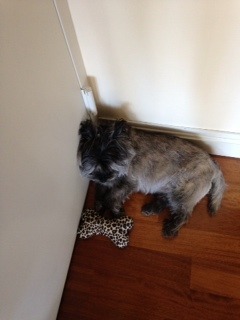
Before you get too grossed out (or maybe too excited), see below for one of the cuter aspects of the dog being a ratter. Here she is hiding under our bed. "Hiding." Why is she hiding? She has a new toy bone, and she doesn't want us to get it. OR rather, she'd like for us to try to get it, but she wants to put up a fight. She knows it is safe under there.

(Why are there books there? Our bed is a little bit broken. Until we can get our friend Keith to make us a new one, we have to prop it up with something. We have more books than we have space for, so.....)
Where we lived in Pennsylvania, there were mice and moles and skunks and deer. Where we live now, there are rats. Mostly they are hidden. But once in a while, at night, one will scamper across the street or sidewalk in front of us. While my instinct is to jump back, Ketzie's instinct is to become very alert. She assumes a posture we don't see any other time: alert in every cell of her body. It's as if her ratting genes coming to ATTENTION. Cairns were bred to get rats out of cairns (or maybe, truly, out of homes made of stones). And at night, just outside our lovely apartment building, Ketzie is ready to be OF SERVICE.
I don't think we're going to train her to be on the rat-hunting squad. Yes. There is a rat-hunting squad in NYC and that link is to an article and a video about it. Please watch the video. It's only a minute and a half, and so worth it. I'll wait until you come back.
Right? Ketzie really should be on that squad. But considering every night we're (husband and I) terrified she will catch a rat, I don't think it is in her future.
When we have to force her to come back inside--Cairns are stubborn!-- I feel like we're thwarting her most basic nature. Which makes me sad.
Tinka, our Golden, did not understand fetching in our Buckingham back yard. But the first time we threw a stick into the ocean, in Nova Scotia, she swam in, retrieved it, and laid it at our feet. Another clear sign of genes being able to express themselves.
As parents and teachers and writers it is our job to help kids find their true selves. To help them express who they are, who they were meant to be. People who live their lives letting their innermost selves guide what they do are the ones we admire the most. Often those people have to fight inner and outer battles to do so. Paul Erdős was one of those people. He was so lucky that his mother (and later his father) nurtured his love of math, and understood his true nature. Mama let Paul be home-schooled until he was ready for school. She challenged him with math from the time he showed the great interest and ability (when he was four). Later on, the love and support he got from his parents, and the great foundation he had in math, allowed him to go out into the world--on his own terms.
(Shameless and excited plug: THE BOY WHO LOVED MATH is coming out next Tuesday. Check out my website for news, etc.)
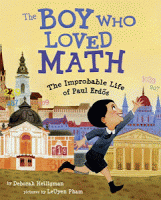
Even if we are not math prodigies or ratters or retrievers, we each have inborn strengths and talents that should be nurtured. We each have problems to overcome; everyone has to learn strategies for how to fit into the world. Some, like Paul Erdős, have more of a challenge than others. But with adults in their lives who understand their needs, they have a greater chance at success and a happy life.
As parents, teachers, and dog-owners, we do the best we can. Even though I don't let Ketzie go after rats, I do buy her a new toy every time she destroys her current favorite. I think--I hope--that along with about an hour and half's worth of walks every day, good food, and lots of attention, that's enough. She seems pretty happy, and at home.

There is only one time when I feel at all doubtful about Ketzie. And that's the last walk of the night. Not because I'm too tired, but because the last walk of the night has become THE RATTING WALK.
Before you get too grossed out (or maybe too excited), see below for one of the cuter aspects of the dog being a ratter. Here she is hiding under our bed. "Hiding." Why is she hiding? She has a new toy bone, and she doesn't want us to get it. OR rather, she'd like for us to try to get it, but she wants to put up a fight. She knows it is safe under there.

(Why are there books there? Our bed is a little bit broken. Until we can get our friend Keith to make us a new one, we have to prop it up with something. We have more books than we have space for, so.....)
Where we lived in Pennsylvania, there were mice and moles and skunks and deer. Where we live now, there are rats. Mostly they are hidden. But once in a while, at night, one will scamper across the street or sidewalk in front of us. While my instinct is to jump back, Ketzie's instinct is to become very alert. She assumes a posture we don't see any other time: alert in every cell of her body. It's as if her ratting genes coming to ATTENTION. Cairns were bred to get rats out of cairns (or maybe, truly, out of homes made of stones). And at night, just outside our lovely apartment building, Ketzie is ready to be OF SERVICE.
I don't think we're going to train her to be on the rat-hunting squad. Yes. There is a rat-hunting squad in NYC and that link is to an article and a video about it. Please watch the video. It's only a minute and a half, and so worth it. I'll wait until you come back.
Right? Ketzie really should be on that squad. But considering every night we're (husband and I) terrified she will catch a rat, I don't think it is in her future.
When we have to force her to come back inside--Cairns are stubborn!-- I feel like we're thwarting her most basic nature. Which makes me sad.
Tinka, our Golden, did not understand fetching in our Buckingham back yard. But the first time we threw a stick into the ocean, in Nova Scotia, she swam in, retrieved it, and laid it at our feet. Another clear sign of genes being able to express themselves.
As parents and teachers and writers it is our job to help kids find their true selves. To help them express who they are, who they were meant to be. People who live their lives letting their innermost selves guide what they do are the ones we admire the most. Often those people have to fight inner and outer battles to do so. Paul Erdős was one of those people. He was so lucky that his mother (and later his father) nurtured his love of math, and understood his true nature. Mama let Paul be home-schooled until he was ready for school. She challenged him with math from the time he showed the great interest and ability (when he was four). Later on, the love and support he got from his parents, and the great foundation he had in math, allowed him to go out into the world--on his own terms.
(Shameless and excited plug: THE BOY WHO LOVED MATH is coming out next Tuesday. Check out my website for news, etc.)
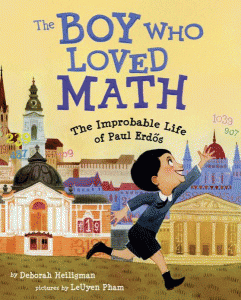
Even if we are not math prodigies or ratters or retrievers, we each have inborn strengths and talents that should be nurtured. We each have problems to overcome; everyone has to learn strategies for how to fit into the world. Some, like Paul Erdős, have more of a challenge than others. But with adults in their lives who understand their needs, they have a greater chance at success and a happy life.
As parents, teachers, and dog-owners, we do the best we can. Even though I don't let Ketzie go after rats, I do buy her a new toy every time she destroys her current favorite. I think--I hope--that along with about an hour and half's worth of walks every day, good food, and lots of attention, that's enough. She seems pretty happy, and at home.
July 11, 2013
FREE Teachers Guides Make Using Nonfiction in the Classroom Less Scary
Reprinted from October
With
Halloween just around the corner, I’m going to offer a solution to something
some teachers find scary: incorporating nonfiction into their teaching. With
the adoption of the Common Core http://www.corestandards.org/ in 46 states, there is a strong
movement to use more nonfiction in the classroom. But how, exactly, should
teachers do this?
The most
common way that I’ve seen nonfiction used in classrooms is as a resource for students
to find information to include in subject-area reports. There is nothing wrong
with this, but many books written by Interesting Nonfiction for Kids (I.N.K.)
authors and others are far more than a list of facts on a subject and can be
used to do so much more. Our books are designed to inspire, engage, enlighten,
challenge, and deepen understanding. We wrote them to open kids’ eyes to the
world around them and to encourage kids’ to ask questions about their world. So
really, what we are trying to do with our books is very much aligned with what
great teachers are already trying to do with their classrooms.
The best news
of all is that many authors have thought deeply about how their books could be
used in the classroom and have created teachers’ guides that offer discussion
questions, writing prompts, hands-on activities, individual and group projects,
theater scripts and more. But there is no organized way, as far as I can see,
to get these powerful resources to teachers.
So here is a start:
What follows is a list of free teachers’ guides available for
some of the best children’s nonfiction books out there. PLEASE share this list
with a teacher you know, forward it, repost it, tweet it, share it on Facebook,
etc. And please let me know about great teachers’ guides for nonfiction that
you wrote or know about. If I get a lot of additions, I’d be happy to post
another, larger, even more inclusive list.
Happy teaching
and Happy Halloween!
Elizabeth
Rusch
The books and teachers’ guides are
organized by subject area and then by grade level (preK-12) within subject
area. So a subject-area teacher can find his or her section and a grade-level
teacher can look for the grade-appropriate books in each subject area. Some
books cross subject areas and so are listed under more than one category.
SOCIAL STUDIES/HISTORY
On This Spot: An Expedition Back
Through Time
By Susan E. Goodman
Subject
areas: Life sciences, animals, adaptation, prehistoric times and creatures,
ecosystems, Earth science, natural history, U.S. history, geography
Grade
levels: K and up
Teachers’
guide: http://www.susangoodmanbooks.com/?page_id=2436
Guide
includes: Cross-curricular activities in art, language arts, math,
science and especially history (historical changes and adaptations); and,
personal, historical, social and societal timelines.
One
World, One Day
By Barbara Kerley
Subject
areas: global awareness, other cultures
Grade
levels: K - 4
Teachers’
guide: http://www.barbarakerley.com/Site/Teachers_Guide__Global_Awareness.html
Guide
includes: diary of a school day; hopscotch around the world with bar
graph follow-up
A
Little Peace
By Barbara Kerley
Subject
areas: global awareness, other cultures, peace
Grade levels: K - 4
Teachers’
Guide: http://www.barbarakerley.com/Site/Teachers_Guide__Global_Awareness.html
Guide
includes: school-related peace projects (peace posters;
Welcome-To-School packet)
You
and Me Together: Moms, Dads, and Kids Around the World
By Barbara Kerley
Subject
areas: global awareness, other cultures, families
Grade
levels: K - 4
Teachers’
guide: http://www.barbarakerley.com/Site/Teachers_Guide__Global_Awareness.html
Guide
includes: creating a Thank You card for a parent; interviewing a
parent
A
Cool Drink of Water
By Barbara Kerley
Subject
areas: global awareness, other cultures, water resources
Grade
levels: K - 4
Teachers’
guide: http://www.barbarakerley.com/Site/Teachers_Guide__Global_Awareness.html
Guide
includes: making a water diary; gallons/minute water use exercise
Sandy's Circus: A Story about Alexander Calder
By Tanya Lee Stone
Subject
Area(s): American Art, Art History, Contemporary Art, Biography
Grade
Levels: K-5
Teacher's
Guide: http://www.tanyastone.com/assets/files/pdfs/Sandys%20Circus%20Reading%20Guide.pdf
Guide
Includes: Synopsis, About the Author and Illustrator, Author
Interview, Pre-Reading and Discussion Question, Cross-Curriculum project
suggestions
Additional Resources:
A
YouTube video showcasing student-made art inspired by Sandy's Circus: http://www.youtube.com/watch?v=Zr9bbuNvezc
Elizabeth Leads the Way: Elizabeth Cady Stanton and the
Right to Vote
By Tanya Lee Stone
Subject
Area(s): American History, Women's History, Suffrage, Biography
Grade
Levels: K-8 (upper level usage because of curriculum connections
to American history)
Teacher's
Guide: http://www.tanyastone.com/assets/files/pdfs/Reading%20Guide.pdf
What
the Guide Includes: Synopsis, Author Interview,
Pre-Reading and Discussion Questions, Cross-curriculum project suggestions
The Truth About Poop
By Susan E. Goodman
Subject
areas: Health, human development, the human body, digestion,
science, animals, world history, regions/cultures
Grade
levels: 1 and up
Teachers’
guide: http://www.susangoodmanbooks.com/?page_id=2446
Guide
includes: Cross-curricular activities in language arts (vocabulary,
grammar, research skills), math and science
Saving the Whooping Crane
By Susan E. Goodman
Subject areas: Language arts, life sciences,
endangered species, birds, national history
Grade levels: 1-4
Teachers’ guide: http://www.susangoodmanbooks.com/?page_id=2485
Guide includes:
Cross-curricular activities in history, endangered species, the
scientific process, and geography by providing links to detailed lesson plans
by National Geographic, and superb downloadable booklets, slideshows, audio and
video clips, handouts, activities and teachers’ tips by Journey North.
Those
Rebels, John and Tom
By Barbara Kerley
Subject
areas: biography, history, American Independence, American
Revolution, Continental Congress, Presidents, John Adams, Thomas Jefferson,
slavery
Grade
levels: Grades 2 and up
Teacher's guide: http://www.barbarakerley.com/Site/Teachers_Guide__Biographies.html
Guide
includes: Venn diagram exercise to compare/contrast; links to historic
homes of Adams and Jefferson
The
Extraordinary Mark Twain (According to Susy)
By Barbara Kerley
Subject
areas: biography, history, women's studies, American
literature, Mark Twain
Grade
levels: Grades 2 and up
Teacher's
guide: http://www.barbarakerley.com/Site/Teachers_Guide__Biographies.html
Guide
includes: tip sheet, "Writing an Extraordinary Biography";
audio clip of author discussing and reading from the book; extension activity
(designing a place to create)
The Right Dog for the
Job: Irah’s Path from Service Dog to Guide Dog
By Dorothy
Hinshaw Patent
Subject area: Social Studies
Grade levels: Grade 2-8
Teachers’ guide: http://www.dorothyhinshawpatent.com/links.html
Guide includes: Activities for young children
The
Dinosaurs of Waterhouse Hawkins
By Barbara Kerley
Subject
areas: biography, history, science, history of science,
paleontology, art, dinosaurs
Grade
levels: Grades 2 and up
Teacher's
guide: http://www.barbarakerley.com/Site/Teachers_Guide__Biographies.html
Guide
includes: make-a-dinsosaur puzzle; creating dinosaurs out of tin
foil; hosting a dinosaur feast; writing a letter in defense of paleontology
What
To Do About Alice?
By Barbara Kerley
Subject
areas: biography, history, women's studies, Presidents,
Theodore Roosevelt
Grade
levels: Grades 2 and up
Teacher's guide: http://www.barbarakerley.com/Site/Teachers_Guide__Biographies.html
Guide
includes: language exploration of metaphor; link to learn more about
being a kid in the White House
For the Love of Music:
The remarkable story of Maria Anna Mozart
By Elizabeth
Rusch
Subject area(s): History, music, biography, women’s
studies, language arts
Grade levels: Grades 2 and up
Teachers’ guide: http://www.elizabethrusch.com/Portals/0/For%20the%20Love%20of%20Music%20Teacher's%20Guide.pdf
Guide includes: Creative art projects, hands-on
musical games, and engaging history lessons for elementary and middle school
students. The guide features lessons on mapping the Mozart's musical tour
of Europe, writing timelines of Maria Anna Mozart's life as if she had been
alive today, linking primary source letters written by the Mozart family and
friends to scenes in For the Love of
Music, and more.
Walt
Whitman: Words for America
By Barbara Kerley
Subject
areas: biography, history, poetry, poets, American Civil War,
Walt Whitman
Grade
levels: Grades 3 and up
Teacher's
guide: http://www.barbarakerley.com/Site/Teachers_Guide__Biographies.html
Guide
includes: creating poetic language; making small notebooks and then
observing/taking notes
Saving Audie: A Pit Bull
Puppy Gets a Second Chance
By Dorothy
Hinshaw Patent
Subject area: Social Studies
Grade levels: Grade 3-8
Teachers’ guide: http://www.dorothyhinshawpatent.com/links.html
Guide includes:
Comprehensive 4th grade lesson plans with questions and space
to write
Jeannette Rankin:
Political Pioneer
By
Gretchen Woelfle
Subject area(s): American History, Geography,
Contemporary Politics, Literary and Dramatic Activities
Grade levels: Grades 4 and up
Teachers’ guide: http://www.gretchenwoelfle.com/jeannette_rankin__political_pioneer_60457.htm
Guide includes: Research on women and other
political figures in 20th century politics, Vietnam War; map
Rankin’s movements; research gender politics in current local, state, and
national office; poll class members on gender politics; creative writing,
creative dramatics, research on 1960s protest songs; stage a women’s suffrage
tea party or ‘60s anti-war rally.
Write on, Mercy! The Secret Life of
Mercy Otis Warren
By Gretchen
Woelfle
Subject areas: Social Studies, American history,
women’s history
Grade levels: 4-8
Teachers’ guide: http://www.gretchenwoelfle.com/write_on__mercy__the_secret_life_of_mercy_otis_warren_113205.htm
Guide includes: Social Studies: research and
discussion of men and women of the Revolution, women in politics today,
political cartoons; Language arts: creative writing and dramatics, parts of a
book; Visual arts and crafts: symbols in portraits, painting a portrait, making
and using quill pen and ink
Generation Fix: Young
Ideas for a Better World
By Elizabeth
Rusch
Grade levels: Grades 4-12
Subject
areas: Social studies, community service, language arts
Teachers’ Guide: http://www.elizabethrusch.com/Books/AllBooks/GenerationFix/GenFixCoolStuff/GenFixDiscussteachers/tabid/101/Default.aspx
Guide Includes: Chapter-by-chapter discussion
questions
Service-learning discussion guide: http://www.elizabethrusch.com/Books/AllBooks/GenerationFix/GenFixCoolStuff/GenFixDiscussAdults/tabid/100/Default.aspx
Guide includes: Tips and questions to kick off a
classroomwide, clubwide, or schoolwide commitment to community service
See How They Run: Campaign Dreams,
Election Schemes, and the Race to the White House
By Susan E. Goodman
Subject areas: Language arts, social studies,
U.S. history, civics, government
Grade levels: 4-12
Teachers’ guide:
http://www.susangoodmanbooks.com/?pag...
Guide includes: Cross-curricular activities in
history, government, civic involvement, and language arts (key ideas and
details, integration of knowledge and ideas, research skills, option/analytic
texts, informative/explanatory texts, etc.)
Marching to the
Mountaintop—How Poverty, Labor Fights, and Civil Rights Set the Stage for
Martin Luther King, Jr.’s Final Hours
By Ann Bausum
Subject area(s): U.S. history, civil rights, labor
rights, poverty
Grade levels: Grades 5-12
Classroom resources: http://www.annbausum.com/mountaintop.html#classroom
Includes: Discussion questions and downloadable
study guide to come by 2013.
Unraveling Freedom—The
Battle for Democracy on the Home Front During World War I
By Ann Bausum
Subject area(s): U.S. history, World War I, wartime
homefront, civil liberties, free speech
Grade levels: Grades 5-12
Classroom resources: http://www.annbausum.com/unraveling.html#classroom
Includes: Discussion topics and questions about
echoes of history, presidential secrecy, and restrictions of civil liberties
during war time.
Denied, Detained,
Deported—Stories from the Dark Side of American Immigration
By Ann Bausum
Subject area(s): U.S. history, immigration policy,
World War I, Red Scare, World War II, Japanese American internment, holocaust
survivors, Mexican-American border relations
Grade levels: Grades 5-12
Classroom resources: http://www.annbausum.com/denied.html#classroom
Includes: Discussion topics on themes explored
in the book, including the Chinese Exclusion Act of 1882, deportations during
the Red Scare, exclusion of Jewish refugees pre-World War II, detention of
Japanese-Americans during World War II, and the exploitation of Mexican and
Mexican-American laborers.
Muckrakers—How Ida
Tarbell, Upton Sinclair, and Lincoln Steffens Helped Expose Scandal, Inspire
Reform, and Invent Investigative Journalism
By Ann Bausum
Subject area(s): U.S. history, journalism, progressive
era, muckraking, investigative reporting
Grade levels: Grades 5-12
Classroom resources on photographs: http://www.annbausum.com/muckrakers.html#behind
Includes: Step-by-step online tutorial on how
to conduct online photo research using the Prints and Photographs Reading Room
at the Library of Congress.
Classroom resources: http://www.annbausum.com/muckrakers.html#classroom
Includes: Further suggestions on how to conduct
research at and download images from the Library of Congress.
Freedom Riders—John
Lewis and Jim Zwerg on the Front Lines of the Civil Rights Movement
By Ann Bausum
Subject area(s): U.S. history, civil rights, the
Freedom Rides
Grade levels: Grades 5-12
Classroom resources: http://www.annbausum.com/freedom_rides.html#classroom
Includes: Activities and discussion topics
related to race and racism, following one’s convictions even in the face of
death, the power of song, and commitments to causes.
With Courage and
Cloth—Winning the Fight for a Woman’s Right to Vote
By Ann Bausum
Subject area(s): U.S. history, women’s rights, voting
rights, World War I, civil liberties
Grade levels: Grades 5-12
Resources: http://www.annbausum.com/courage.html
What you’ll find: Background information about the
research and writing of the book.
Dragon Bones and
Dinosaur Eggs—A Photobiography of Explorer Roy Chapman Andrews
By Ann Bausum
Subject area(s): U.S. history, exploration,
paleontology
Grade levels: Grades 5-12
Resources: http://www.annbausum.com/dragon.html
What you’ll find: Background information about the
research and writing of the book.
Our Country’s Presidents
By Ann Bausum
Subject area(s): U.S. history, U.S. Presidents,
politics
Grade levels: Grades 5-12
Resources: http://www.annbausum.com/presidents.html
What you’ll find: Background information about the
research and writing of the book.
Our Country’s First
Ladies
By Ann Bausum
Subject area(s): U.S. history, First Ladies, U.S.
Presidents
Grade levels: Grades 5-12
Resources: http://www.annbausum.com/firstladies.html
Includes: Background information about the
production of the book.
The Wind at Work: An Activity Guide to
Windmills
By Gretchen
Woelfle
Subject Areas: World history, American history,
history of science, environmental science, climate change
Grade levels: Grades 5-9
Teachers’ guide: http://www.gretchenwoelfle.com/the_wind_at_work__an_activity_guide_to_windmills_2996.htm
Teachers’ guide includes: scientific measurement, arts and
crafts, music, cooking, writing, environmental research, community action
Almost Astronauts: Thirteen Women Who Dared to Dream
By Tanya Lee Stone
Subject
Area(s): Women's History, Space Program History, Biography
Grade
Levels: 5 and up
Teachers’
guide: http://www.tanyastone.com/assets/files/AA%20Reading%20Guide.pdf
Guide
Includes: Synopsis, Author Interview, Pre-Reading and
Discussion Questions, Cross-curriculum project suggestions,and Curriculum
Standards
Additional
Resources: Mountain Lake PBS Interview with the Author: http://www.youtube.com/watch?v=r5o-ocVhb90
CPSAN
Book TV Presentation on Almost Astronauts: http://www.youtube.com/watch?v=OiLvkBHHNX0
Author
Tribute in Poetry to Mercury 13 Women: http://www.tanyastone.com/assets/files/pdfs/Almost%20Astronauts%20Bonus%20Material.pdf
The Lewis and Clark Trail
Then and Now
Plants on the Trail with
Lewis and Clark
Animals on the Trail
with Lewis and Clark
By Dorothy
Hinshaw Patent
Subject areas: American history, social studies,
science
Grade levels: Grade 5-12
Lewis and Clark in the Curriculum:
http://www.dorothyhinshawpatent.com/links.html
Guide includes: Appropriate questions teachers and
students might use to learn more about topics in the book
Using Lewis and Clark in the Science
Curriculum:
http://www.dorothyhinshawpatent.com/links.html
Guide includes: Information, with page numbers, on
how the book fits into the curriculum
Charles and Emma: The Darwins' Leap of
Faith
By Deborah
Heiligman
Subject area(s): History, Science, History of Science,
Biology, Evolution, Religion
Grade levels: Grades 6 and up
Teachers’ guide: http://media.us.macmillan.com/teachersguides/9780805087215TG.pdf
Readers' guide: http://media.us.macmillan.com/readersguides/9780312661045RG.pdf
Readers’ theater: http://deborahheiligman.com/wp-content/uploads/readerstheaterdarwins.pdf
Author's research and further reading: http://deborahheiligman.com/books/charles-and-emma/research/
MATH
How Much Is a Million?
By David Schwartz
Subject
area(s): math
Grade
levels: Grades 2-5
Teachers’
guide: http://davidschwartz.com/blog/resources/mmab gets you to a free download
for The Magic of a Million Activity Book, which is a teacher guide How
Much Is a Million?
Guide
includes: A plethora of activities that build on How Much Is a
Million? and invite children to explore the number 1,000,000 and other big
numbers.
SCIENCE
From Caterpillar to Butterfly
By Deborah
Heiligman
Subject area(s): Science, biology, lifecycles
Grade levels: Pre-K to 3
Teaching activities: http://deborahheiligman.com/books/from-caterpillar-to-butterfly/
On This Spot: An Expedition Back
Through Time
By Susan E. Goodman
Subject
areas: Life sciences, animals, adaptation, prehistoric times and creatures,
ecosystems, Earth science, natural history, U.S. history, geography
Grade
levels: K and up
Teachers’
guide: http://www.susangoodmanbooks.com/?page_id=2436
Guide
includes: Cross-curricular activities in art, language arts, math,
science and especially history (historical changes and adaptations); and,
personal, historical, social and societal timelines.
Under the Snow
By Melissa
Stewart
Subject area(s): science
Grade levels: K-3
Teachers’ guide: http://peachtree-online.com/pdfs/UndertheSnowTG.pdf
Teachers’ guide includes: KWL reading guide; crosscurricular
activities in math, language art, science, social studies, art, and music;
related reading.
Readers Theater Script: http://peachtree-online.com/pdfs/UndertheSnowRT.pdf#zoom=70
Activity Pages: http://www.melissa-stewart.com/sciclubhouse/teachhome/activities.html
Behind the Book Video: http://www.melissa-stewart.com/video/index.html
When Rain Falls
By Melissa
Stewart
Subject area(s): science
Grade levels: K-3
Teachers’ guide: http://peachtree-online.com/pdfs/When_Rain_FallsTG.pdf
Teachers’ guide includes: KWL reading guide; crosscurricular
activities in math, language art, science, social studies, art, and music;
related reading.
Readers Theater Script: http://peachtree-online.com/pdfs/WhenRainFallsRT.pdf
Behind the Book Video: http://www.melissa-stewart.com/video/index.html
Activity Pages: http://www.melissa-stewart.com/sciclubhouse/teachhome/activities.html
A Place for Bats
By Melissa
Stewart
Subject area(s): science
Grade levels: K-5
Teachers guide: http://peachtree-online.com/files/private/books/383/teachers-guides/PlaceForBatsTG.pdf
Teachers’ guide includes: KWL reading guide; crosscurricular
activities in math, language art with direct links to Common core standards,
science, social studies, art, and music; related reading.
Reading Buddies Guide: http://www.melissa-stewart.com/pdf/scirdbuddies.pdf
Bat Song: http://www.melissa-stewart.com/pdf/BatSong.pdf
Activity Pages:
http://www.melissa-stewart.com/sciclubhouse/teachhome/activities.html
A Place for Frogs
By Melissa Stewart
Subject area(s): science
Grade levels: K-5
Teachers’ Guide: http://peachtree-online.com/pdfs/Place_for_Frogs_TG.pdf
Teachers’ guide includes: KWL reading guide; crosscurricular
activities in math, language art, science, social studies, art, and music;
related reading.
Reading Buddies Guide: http://www.melissa-stewart.com/pdf/scirdbuddies.pdf
Link to Nonfiction Text Structure
& Features Materials to introduce and reinforce Common Core ELA RIT #5,
which focuses on text features and structures: http://www.melissa-stewart.com/sciclubhouse/teachhome/nonfiction.html
Activity Pages: http://www.melissa-stewart.com/sciclubhouse/teachhome/activities.html
The Planet Hunter: The
story behind what happened to Pluto
By Elizabeth
Rusch
Grades: K-5
Subject areas: Science, astronomy, biography, solar
system
Teachers’ Guide: http://elizabethrusch.com/Books/AllBooks/PlanetHunter/PlanetHunterCoolStuff/tabid/89/Default.aspx
Guide Includes: Links to great NASA website, hands-on
activities such as make a crater, the real size of the planets, and the real
shape of the solar system.
The Truth About Poop
By Susan E. Goodman
Subject
areas: Health, human development, the human body, digestion,
science, animals, world history, regions/cultures
Grade
levels: 1 and up
Teachers’
guide: http://www.susangoodmanbooks.com/?page_id=2446
Guide
includes: Cross-curricular activities in language arts (vocabulary,
grammar, research skills), math and science
Saving the Whooping Crane
By Susan E. Goodman
Subject areas: Language arts, life sciences,
endangered species, birds, national history
Grade levels: 1-4
Teachers’ guide: http://www.susangoodmanbooks.com/?page_id=2485
Guide includes:
Cross-curricular activities in history, endangered species, the
scientific process, and geography by providing links to detailed lesson plans
by National Geographic, and superb downloadable booklets, slideshows, audio and
video clips, handouts, activities and teachers’ tips by Journey North.
The
Dinosaurs of Waterhouse Hawkins
By Barbara Kerley
Subject
areas: biography, history, science, history of science,
paleontology, art, dinosaurs
Grade
levels: Grades 2 and up
Teacher's
guide: http://www.barbarakerley.com/Site/Teachers_Guide__Biographies.html
Guide
includes: make-a-dinsosaur puzzle; creating dinosaurs out of tin
foil; hosting a dinosaur feast; writing a letter in defense of paleontology
Will It Blow?: Become a
volcano detective at Mount St. Helens
By Elizabeth
Rusch
Grades: 3 and up
Subject areas:
Science, geology, volcanology
Teachers’ Guide: Please note that the book includes
hands-on activities great for use in the classroom. In addition, please see: http://www.elizabethrusch.com/Books/AllBooks/WillItBlow/WillItBlowCoolStuff/tabid/70/Default.aspx
Guide includes: Links to volcanology related
websites; Q&A with author.
Life on the Ice
By Susan E. Goodman
Subject areas: Life sciences, animals, Earth
science, polar science, geography, exploration
Grade levels: 3-6
Teachers’ guide: http://www.susangoodmanbooks.com/?page_id=2478
Guide includes: The National Science Foundation,
which included
Life on the Ice on its reading list, has
assembled a fantastic compendium of information about the polar regions
specifically for elementary school teachers.
It includes lesson plans across the curriculum from polar animals to the
people of the Arctic to water, ice, and snow to polar explorers.
The Mighty Mars Rovers:
The incredible adventures of Spirit and Opportunity
By Elizabeth
Rusch
Subject area(s): Science, astronomy, technology,
engineering
Grade levels:
Grades 4 and up
Teachers’ guide: http://elizabethrusch.com/Portals/0/The%20Mighty%20Mars%20Rovers%20Teacher%20Guide.pdf
Guide includes:
Classroom discussion questions; writing activities; egg-drop, build a
rover, drive a rover blind hands-on activities, and more.
Other teaching resources: http://elizabethrusch.com/MyBooks/AllBooks/TheMightyMarsRovers/TheMightyMarsRoversCoolStuff/THEMIGHTYMARSROVERSFORTEACHERS.aspx
Includes: Links to more astronomy teaching
units, links to NASA and JPL videos on Spirit, Opportunity and the newest rover
Curiosity
The Wind at Work: An Activity Guide to
Windmills
By Gretchen
Woelfle
Subject Areas: World history, American history,
history of science, environmental science, climate change
Grade levels: Grades 5-9
Teachers’s guide: http://www.gretchenwoelfle.com/the_wind_at_work__an_activity_guide_to_windmills_2996.htm
Teachers’ guide includes: scientific measurement, arts and
crafts, music, cooking, writing, environmental research, community action
Almost Astronauts: Thirteen Women Who Dared to Dream
By Tanya Lee Stone
Subject
Area(s): Women's History, Space Program History, Biography
Grade
Levels: 5 and up
Teachers’
guide: http://www.tanyastone.com/assets/files/AA%20Reading%20Guide.pdf
Guide
Includes: Synopsis, Author Interview, Pre-Reading and
Discussion Questions, Cross-curriculum project suggestions,and Curriculum
Standards
Additional
Resources: Mountain Lake PBS Interview with the Author: http://www.youtube.com/watch?v=r5o-ocVhb90
CPSAN
Book TV Presentation on Almost Astronauts: http://www.youtube.com/watch?v=OiLvkBHHNX0
Author
Tribute in Poetry to Mercury 13 Women: http://www.tanyastone.com/assets/files/pdfs/Almost%20Astronauts%20Bonus%20Material.pdf
The Lewis and Clark
Trail Then and Now
Plants on the Trail with
Lewis and Clark
Animals on the Trail
with Lewis and Clark
By Dorothy
Hinshaw Patent
Subject areas: American history, social studies,
science
Grade levels: Grade 5-12
Using Lewis and Clark in the Science
Curriculum:
http://www.dorothyhinshawpatent.com/links.html
Guide includes: Information, with page numbers, on
how the book fits into the curriculum
Lewis and Clark in the Curriculum:
http://www.dorothyhinshawpatent.com/links.html
Guide includes: Appropriate questions teachers and
students might use to learn more about topics in the book
Dragon Bones and
Dinosaur Eggs—A Photobiography of Explorer Roy Chapman Andrews
By Ann Bausum
Subject area(s): U.S. history, exploration,
paleontology
Grade levels: Grades 5-12
Resources: http://www.annbausum.com/dragon.html
What you’ll find: Background information about the
research and writing of the book.
Charles and Emma: The Darwins' Leap of
Faith
By Deborah
Heiligman
Subject area(s): History, Science, History of Science,
Biology, Evolution, Religion
Grade levels: Grades 6 and up
Teachers’ guide: http://media.us.macmillan.com/teachersguides/9780805087215TG.pdf
Readers' guide: http://media.us.macmillan.com/readersguides/9780312661045RG.pdf
Readers’ theater: http://deborahheiligman.com/wp-content/uploads/readerstheaterdarwins.pdf
Author's research and further reading: http://deborahheiligman.com/books/charles-and-emma/research/
LANGUAGE ARTS
Saving the Whooping Crane
By Susan E. Goodman
Subject areas: Language arts, life sciences,
endangered species, birds, national history
Grade levels: 1-4
Teachers’ guide: http://www.susangoodmanbooks.com/?page_id=2485
Guide includes:
Cross-curricular activities in history, endangered species, the
scientific process, and geography by providing links to detailed lesson plans
by National Geographic, and superb downloadable booklets, slideshows, audio and
video clips, handouts, activities and teachers’ tips by Journey North.
The
Extraordinary Mark Twain (According to Susy)
By Barbara Kerley
Subject
areas: biography, history, women's studies, American
literature, Mark Twain
Grade
levels: Grades 2 and up
Teacher's guide: http://www.barbarakerley.com/Site/Teachers_Guide__Biographies.html
Guide
includes: tip sheet, "Writing an Extraordinary Biography";
audio clip of author discussing and reading from the book; extension activity
(designing a place to create)
What
To Do About Alice?
By Barbara Kerley
Subject
areas: biography, history, women's studies, Presidents,
Theodore Roosevelt
Grade
levels: Grades 2 and up
Teacher's guide: http://www.barbarakerley.com/Site/Teachers_Guide__Biographies.html
Guide
includes: language exploration of metaphor; link to learn more about
being a kid in the White House
For the Love of Music:
The remarkable story of Maria Anna Mozart
By Elizabeth
Rusch
Subject area(s): History, music, biography, women’s studies,
language arts
Grade levels: Grades 2 and up
Teachers’ guide: http://www.elizabethrusch.com/Portals/0/For%20the%20Love%20of%20Music%20Teacher's%20Guide.pdf
Guide includes: Creative art projects, hands-on
musical games, and engaging history lessons for elementary and middle school
students. The guide features lessons on mapping the Mozart's musical tour
of Europe, writing timelines of Maria Anna Mozart's life as if she had been
alive today, linking primary source letters written by the Mozart family and
friends to scenes in For the Love of
Music, and more.
Walt
Whitman: Words for America
By Barbara Kerley
Subject
areas: biography, history, poetry, poets, American Civil War,
Walt Whitman
Grade
levels: Grades 3 and up
Teacher's
guide: http://www.barbarakerley.com/Site/Teachers_Guide__Biographies.html
Guide
includes: creating poetic language; making small notebooks and then
observing/taking notes
Jeannette Rankin:
Political Pioneer
By
Gretchen Woelfle
Subject area(s): American History, Geography,
Contemporary Politics, Literary and Dramatic Activities
Grade levels: Grades 4 and up
Teachers’ guide: http://www.gretchenwoelfle.com/jeannette_rankin__political_pioneer_60457.htm
Guide includes: Research on women and other political
figures in 20th century politics, Vietnam War; map Rankin’s
movements; research gender politics in current local, state, and national
office; poll class members on gender politics; creative writing, creative
dramatics, research on 1960s protest songs; stage a women’s suffrage tea party
or ‘60s anti-war rally.
See How They Run: Campaign Dreams,
Election Schemes, and the Race to the White House
By Susan E. Goodman
Subject areas: Language arts, social studies,
U.S. history, civics, government
Grade levels: 4-12
Teachers’ guide:
http://www.susangoodmanbooks.com/?pag...
Guide includes: Cross-curricular activities in
history, government, civic involvement, and language arts (key ideas and
details, integration of knowledge and ideas, research skills, option/analytic
texts, informative/explanatory texts, etc.)
Generation Fix: Young
Ideas for a Better World
By Elizabeth
Rusch
Grade levels: Grades 4-12
Subject
areas: Social studies, community service, language arts
Teachers’ Guide: http://www.elizabethrusch.com/Books/AllBooks/GenerationFix/GenFixCoolStuff/GenFixDiscussteachers/tabid/101/Default.aspx
Guide Includes: Chapter-by-chapter discussion
questions
Service-learning discussion guide: http://www.elizabethrusch.com/Books/AllBooks/GenerationFix/GenFixCoolStuff/GenFixDiscussAdults/tabid/100/Default.aspx
Guide includes: Tips and questions to kick off a
classroomwide, clubwide, or schoolwide commitment to community service
ART/MUSIC
Sandy's Circus: A Story about Alexander Calder
By Tanya Lee Stone
Subject
Area(s): American Art, Art History, Contemporary Art, Biography
Grade
Levels: K-5
Teacher's
Guide: http://www.tanyastone.com/assets/files/pdfs/Sandys%20Circus%20Reading%20Guide.pdf
Guide
Includes: Synopsis, About the Author and Illustrator, Author
Interview, Pre-Reading and Discussion Question, Cross-Curriculum project
suggestions
Additional Resources:
A
YouTube video showcasing student-made art inspired by Sandy's Circus: http://www.youtube.com/watch?v=Zr9bbuNvezc
For the Love of Music:
The remarkable story of Maria Anna Mozart
By Elizabeth
Rusch
Subject area(s): History, music, biography, women’s
studies, language arts
Grade levels: Grades 2 and up
Teachers’ guide: http://www.elizabethrusch.com/Portals/0/For%20the%20Love%20of%20Music%20Teacher's%20Guide.pdf
Guide includes: Creative art projects, hands-on
musical games, and engaging history lessons for elementary and middle school
students. The guide features lessons on mapping the Mozart's musical tour
of Europe, writing timelines of Maria Anna Mozart's life as if she had been
alive today, linking primary source letters written by the Mozart family and
friends to scenes in For the Love of
Music, and more.

With
Halloween just around the corner, I’m going to offer a solution to something
some teachers find scary: incorporating nonfiction into their teaching. With
the adoption of the Common Core http://www.corestandards.org/ in 46 states, there is a strong
movement to use more nonfiction in the classroom. But how, exactly, should
teachers do this?
The most
common way that I’ve seen nonfiction used in classrooms is as a resource for students
to find information to include in subject-area reports. There is nothing wrong
with this, but many books written by Interesting Nonfiction for Kids (I.N.K.)
authors and others are far more than a list of facts on a subject and can be
used to do so much more. Our books are designed to inspire, engage, enlighten,
challenge, and deepen understanding. We wrote them to open kids’ eyes to the
world around them and to encourage kids’ to ask questions about their world. So
really, what we are trying to do with our books is very much aligned with what
great teachers are already trying to do with their classrooms.
The best news
of all is that many authors have thought deeply about how their books could be
used in the classroom and have created teachers’ guides that offer discussion
questions, writing prompts, hands-on activities, individual and group projects,
theater scripts and more. But there is no organized way, as far as I can see,
to get these powerful resources to teachers.
So here is a start:
What follows is a list of free teachers’ guides available for
some of the best children’s nonfiction books out there. PLEASE share this list
with a teacher you know, forward it, repost it, tweet it, share it on Facebook,
etc. And please let me know about great teachers’ guides for nonfiction that
you wrote or know about. If I get a lot of additions, I’d be happy to post
another, larger, even more inclusive list.
Happy teaching
and Happy Halloween!
Elizabeth
Rusch
The books and teachers’ guides are
organized by subject area and then by grade level (preK-12) within subject
area. So a subject-area teacher can find his or her section and a grade-level
teacher can look for the grade-appropriate books in each subject area. Some
books cross subject areas and so are listed under more than one category.
SOCIAL STUDIES/HISTORY
On This Spot: An Expedition Back
Through Time
By Susan E. Goodman
Subject
areas: Life sciences, animals, adaptation, prehistoric times and creatures,
ecosystems, Earth science, natural history, U.S. history, geography
Grade
levels: K and up
Teachers’
guide: http://www.susangoodmanbooks.com/?page_id=2436
Guide
includes: Cross-curricular activities in art, language arts, math,
science and especially history (historical changes and adaptations); and,
personal, historical, social and societal timelines.
One
World, One Day
By Barbara Kerley
Subject
areas: global awareness, other cultures
Grade
levels: K - 4
Teachers’
guide: http://www.barbarakerley.com/Site/Teachers_Guide__Global_Awareness.html
Guide
includes: diary of a school day; hopscotch around the world with bar
graph follow-up
A
Little Peace
By Barbara Kerley
Subject
areas: global awareness, other cultures, peace
Grade levels: K - 4
Teachers’
Guide: http://www.barbarakerley.com/Site/Teachers_Guide__Global_Awareness.html
Guide
includes: school-related peace projects (peace posters;
Welcome-To-School packet)
You
and Me Together: Moms, Dads, and Kids Around the World
By Barbara Kerley
Subject
areas: global awareness, other cultures, families
Grade
levels: K - 4
Teachers’
guide: http://www.barbarakerley.com/Site/Teachers_Guide__Global_Awareness.html
Guide
includes: creating a Thank You card for a parent; interviewing a
parent
A
Cool Drink of Water
By Barbara Kerley
Subject
areas: global awareness, other cultures, water resources
Grade
levels: K - 4
Teachers’
guide: http://www.barbarakerley.com/Site/Teachers_Guide__Global_Awareness.html
Guide
includes: making a water diary; gallons/minute water use exercise
Sandy's Circus: A Story about Alexander Calder
By Tanya Lee Stone
Subject
Area(s): American Art, Art History, Contemporary Art, Biography
Grade
Levels: K-5
Teacher's
Guide: http://www.tanyastone.com/assets/files/pdfs/Sandys%20Circus%20Reading%20Guide.pdf
Guide
Includes: Synopsis, About the Author and Illustrator, Author
Interview, Pre-Reading and Discussion Question, Cross-Curriculum project
suggestions
Additional Resources:
A
YouTube video showcasing student-made art inspired by Sandy's Circus: http://www.youtube.com/watch?v=Zr9bbuNvezc
Elizabeth Leads the Way: Elizabeth Cady Stanton and the
Right to Vote
By Tanya Lee Stone
Subject
Area(s): American History, Women's History, Suffrage, Biography
Grade
Levels: K-8 (upper level usage because of curriculum connections
to American history)
Teacher's
Guide: http://www.tanyastone.com/assets/files/pdfs/Reading%20Guide.pdf
What
the Guide Includes: Synopsis, Author Interview,
Pre-Reading and Discussion Questions, Cross-curriculum project suggestions
The Truth About Poop
By Susan E. Goodman
Subject
areas: Health, human development, the human body, digestion,
science, animals, world history, regions/cultures
Grade
levels: 1 and up
Teachers’
guide: http://www.susangoodmanbooks.com/?page_id=2446
Guide
includes: Cross-curricular activities in language arts (vocabulary,
grammar, research skills), math and science
Saving the Whooping Crane
By Susan E. Goodman
Subject areas: Language arts, life sciences,
endangered species, birds, national history
Grade levels: 1-4
Teachers’ guide: http://www.susangoodmanbooks.com/?page_id=2485
Guide includes:
Cross-curricular activities in history, endangered species, the
scientific process, and geography by providing links to detailed lesson plans
by National Geographic, and superb downloadable booklets, slideshows, audio and
video clips, handouts, activities and teachers’ tips by Journey North.
Those
Rebels, John and Tom
By Barbara Kerley
Subject
areas: biography, history, American Independence, American
Revolution, Continental Congress, Presidents, John Adams, Thomas Jefferson,
slavery
Grade
levels: Grades 2 and up
Teacher's guide: http://www.barbarakerley.com/Site/Teachers_Guide__Biographies.html
Guide
includes: Venn diagram exercise to compare/contrast; links to historic
homes of Adams and Jefferson
The
Extraordinary Mark Twain (According to Susy)
By Barbara Kerley
Subject
areas: biography, history, women's studies, American
literature, Mark Twain
Grade
levels: Grades 2 and up
Teacher's
guide: http://www.barbarakerley.com/Site/Teachers_Guide__Biographies.html
Guide
includes: tip sheet, "Writing an Extraordinary Biography";
audio clip of author discussing and reading from the book; extension activity
(designing a place to create)
The Right Dog for the
Job: Irah’s Path from Service Dog to Guide Dog
By Dorothy
Hinshaw Patent
Subject area: Social Studies
Grade levels: Grade 2-8
Teachers’ guide: http://www.dorothyhinshawpatent.com/links.html
Guide includes: Activities for young children
The
Dinosaurs of Waterhouse Hawkins
By Barbara Kerley
Subject
areas: biography, history, science, history of science,
paleontology, art, dinosaurs
Grade
levels: Grades 2 and up
Teacher's
guide: http://www.barbarakerley.com/Site/Teachers_Guide__Biographies.html
Guide
includes: make-a-dinsosaur puzzle; creating dinosaurs out of tin
foil; hosting a dinosaur feast; writing a letter in defense of paleontology
What
To Do About Alice?
By Barbara Kerley
Subject
areas: biography, history, women's studies, Presidents,
Theodore Roosevelt
Grade
levels: Grades 2 and up
Teacher's guide: http://www.barbarakerley.com/Site/Teachers_Guide__Biographies.html
Guide
includes: language exploration of metaphor; link to learn more about
being a kid in the White House
For the Love of Music:
The remarkable story of Maria Anna Mozart
By Elizabeth
Rusch
Subject area(s): History, music, biography, women’s
studies, language arts
Grade levels: Grades 2 and up
Teachers’ guide: http://www.elizabethrusch.com/Portals/0/For%20the%20Love%20of%20Music%20Teacher's%20Guide.pdf
Guide includes: Creative art projects, hands-on
musical games, and engaging history lessons for elementary and middle school
students. The guide features lessons on mapping the Mozart's musical tour
of Europe, writing timelines of Maria Anna Mozart's life as if she had been
alive today, linking primary source letters written by the Mozart family and
friends to scenes in For the Love of
Music, and more.
Walt
Whitman: Words for America
By Barbara Kerley
Subject
areas: biography, history, poetry, poets, American Civil War,
Walt Whitman
Grade
levels: Grades 3 and up
Teacher's
guide: http://www.barbarakerley.com/Site/Teachers_Guide__Biographies.html
Guide
includes: creating poetic language; making small notebooks and then
observing/taking notes
Saving Audie: A Pit Bull
Puppy Gets a Second Chance
By Dorothy
Hinshaw Patent
Subject area: Social Studies
Grade levels: Grade 3-8
Teachers’ guide: http://www.dorothyhinshawpatent.com/links.html
Guide includes:
Comprehensive 4th grade lesson plans with questions and space
to write
Jeannette Rankin:
Political Pioneer
By
Gretchen Woelfle
Subject area(s): American History, Geography,
Contemporary Politics, Literary and Dramatic Activities
Grade levels: Grades 4 and up
Teachers’ guide: http://www.gretchenwoelfle.com/jeannette_rankin__political_pioneer_60457.htm
Guide includes: Research on women and other
political figures in 20th century politics, Vietnam War; map
Rankin’s movements; research gender politics in current local, state, and
national office; poll class members on gender politics; creative writing,
creative dramatics, research on 1960s protest songs; stage a women’s suffrage
tea party or ‘60s anti-war rally.
Write on, Mercy! The Secret Life of
Mercy Otis Warren
By Gretchen
Woelfle
Subject areas: Social Studies, American history,
women’s history
Grade levels: 4-8
Teachers’ guide: http://www.gretchenwoelfle.com/write_on__mercy__the_secret_life_of_mercy_otis_warren_113205.htm
Guide includes: Social Studies: research and
discussion of men and women of the Revolution, women in politics today,
political cartoons; Language arts: creative writing and dramatics, parts of a
book; Visual arts and crafts: symbols in portraits, painting a portrait, making
and using quill pen and ink
Generation Fix: Young
Ideas for a Better World
By Elizabeth
Rusch
Grade levels: Grades 4-12
Subject
areas: Social studies, community service, language arts
Teachers’ Guide: http://www.elizabethrusch.com/Books/AllBooks/GenerationFix/GenFixCoolStuff/GenFixDiscussteachers/tabid/101/Default.aspx
Guide Includes: Chapter-by-chapter discussion
questions
Service-learning discussion guide: http://www.elizabethrusch.com/Books/AllBooks/GenerationFix/GenFixCoolStuff/GenFixDiscussAdults/tabid/100/Default.aspx
Guide includes: Tips and questions to kick off a
classroomwide, clubwide, or schoolwide commitment to community service
See How They Run: Campaign Dreams,
Election Schemes, and the Race to the White House
By Susan E. Goodman
Subject areas: Language arts, social studies,
U.S. history, civics, government
Grade levels: 4-12
Teachers’ guide:
http://www.susangoodmanbooks.com/?pag...
Guide includes: Cross-curricular activities in
history, government, civic involvement, and language arts (key ideas and
details, integration of knowledge and ideas, research skills, option/analytic
texts, informative/explanatory texts, etc.)
Marching to the
Mountaintop—How Poverty, Labor Fights, and Civil Rights Set the Stage for
Martin Luther King, Jr.’s Final Hours
By Ann Bausum
Subject area(s): U.S. history, civil rights, labor
rights, poverty
Grade levels: Grades 5-12
Classroom resources: http://www.annbausum.com/mountaintop.html#classroom
Includes: Discussion questions and downloadable
study guide to come by 2013.
Unraveling Freedom—The
Battle for Democracy on the Home Front During World War I
By Ann Bausum
Subject area(s): U.S. history, World War I, wartime
homefront, civil liberties, free speech
Grade levels: Grades 5-12
Classroom resources: http://www.annbausum.com/unraveling.html#classroom
Includes: Discussion topics and questions about
echoes of history, presidential secrecy, and restrictions of civil liberties
during war time.
Denied, Detained,
Deported—Stories from the Dark Side of American Immigration
By Ann Bausum
Subject area(s): U.S. history, immigration policy,
World War I, Red Scare, World War II, Japanese American internment, holocaust
survivors, Mexican-American border relations
Grade levels: Grades 5-12
Classroom resources: http://www.annbausum.com/denied.html#classroom
Includes: Discussion topics on themes explored
in the book, including the Chinese Exclusion Act of 1882, deportations during
the Red Scare, exclusion of Jewish refugees pre-World War II, detention of
Japanese-Americans during World War II, and the exploitation of Mexican and
Mexican-American laborers.
Muckrakers—How Ida
Tarbell, Upton Sinclair, and Lincoln Steffens Helped Expose Scandal, Inspire
Reform, and Invent Investigative Journalism
By Ann Bausum
Subject area(s): U.S. history, journalism, progressive
era, muckraking, investigative reporting
Grade levels: Grades 5-12
Classroom resources on photographs: http://www.annbausum.com/muckrakers.html#behind
Includes: Step-by-step online tutorial on how
to conduct online photo research using the Prints and Photographs Reading Room
at the Library of Congress.
Classroom resources: http://www.annbausum.com/muckrakers.html#classroom
Includes: Further suggestions on how to conduct
research at and download images from the Library of Congress.
Freedom Riders—John
Lewis and Jim Zwerg on the Front Lines of the Civil Rights Movement
By Ann Bausum
Subject area(s): U.S. history, civil rights, the
Freedom Rides
Grade levels: Grades 5-12
Classroom resources: http://www.annbausum.com/freedom_rides.html#classroom
Includes: Activities and discussion topics
related to race and racism, following one’s convictions even in the face of
death, the power of song, and commitments to causes.
With Courage and
Cloth—Winning the Fight for a Woman’s Right to Vote
By Ann Bausum
Subject area(s): U.S. history, women’s rights, voting
rights, World War I, civil liberties
Grade levels: Grades 5-12
Resources: http://www.annbausum.com/courage.html
What you’ll find: Background information about the
research and writing of the book.
Dragon Bones and
Dinosaur Eggs—A Photobiography of Explorer Roy Chapman Andrews
By Ann Bausum
Subject area(s): U.S. history, exploration,
paleontology
Grade levels: Grades 5-12
Resources: http://www.annbausum.com/dragon.html
What you’ll find: Background information about the
research and writing of the book.
Our Country’s Presidents
By Ann Bausum
Subject area(s): U.S. history, U.S. Presidents,
politics
Grade levels: Grades 5-12
Resources: http://www.annbausum.com/presidents.html
What you’ll find: Background information about the
research and writing of the book.
Our Country’s First
Ladies
By Ann Bausum
Subject area(s): U.S. history, First Ladies, U.S.
Presidents
Grade levels: Grades 5-12
Resources: http://www.annbausum.com/firstladies.html
Includes: Background information about the
production of the book.
The Wind at Work: An Activity Guide to
Windmills
By Gretchen
Woelfle
Subject Areas: World history, American history,
history of science, environmental science, climate change
Grade levels: Grades 5-9
Teachers’ guide: http://www.gretchenwoelfle.com/the_wind_at_work__an_activity_guide_to_windmills_2996.htm
Teachers’ guide includes: scientific measurement, arts and
crafts, music, cooking, writing, environmental research, community action
Almost Astronauts: Thirteen Women Who Dared to Dream
By Tanya Lee Stone
Subject
Area(s): Women's History, Space Program History, Biography
Grade
Levels: 5 and up
Teachers’
guide: http://www.tanyastone.com/assets/files/AA%20Reading%20Guide.pdf
Guide
Includes: Synopsis, Author Interview, Pre-Reading and
Discussion Questions, Cross-curriculum project suggestions,and Curriculum
Standards
Additional
Resources: Mountain Lake PBS Interview with the Author: http://www.youtube.com/watch?v=r5o-ocVhb90
CPSAN
Book TV Presentation on Almost Astronauts: http://www.youtube.com/watch?v=OiLvkBHHNX0
Author
Tribute in Poetry to Mercury 13 Women: http://www.tanyastone.com/assets/files/pdfs/Almost%20Astronauts%20Bonus%20Material.pdf
The Lewis and Clark Trail
Then and Now
Plants on the Trail with
Lewis and Clark
Animals on the Trail
with Lewis and Clark
By Dorothy
Hinshaw Patent
Subject areas: American history, social studies,
science
Grade levels: Grade 5-12
Lewis and Clark in the Curriculum:
http://www.dorothyhinshawpatent.com/links.html
Guide includes: Appropriate questions teachers and
students might use to learn more about topics in the book
Using Lewis and Clark in the Science
Curriculum:
http://www.dorothyhinshawpatent.com/links.html
Guide includes: Information, with page numbers, on
how the book fits into the curriculum
Charles and Emma: The Darwins' Leap of
Faith
By Deborah
Heiligman
Subject area(s): History, Science, History of Science,
Biology, Evolution, Religion
Grade levels: Grades 6 and up
Teachers’ guide: http://media.us.macmillan.com/teachersguides/9780805087215TG.pdf
Readers' guide: http://media.us.macmillan.com/readersguides/9780312661045RG.pdf
Readers’ theater: http://deborahheiligman.com/wp-content/uploads/readerstheaterdarwins.pdf
Author's research and further reading: http://deborahheiligman.com/books/charles-and-emma/research/
MATH
How Much Is a Million?
By David Schwartz
Subject
area(s): math
Grade
levels: Grades 2-5
Teachers’
guide: http://davidschwartz.com/blog/resources/mmab gets you to a free download
for The Magic of a Million Activity Book, which is a teacher guide How
Much Is a Million?
Guide
includes: A plethora of activities that build on How Much Is a
Million? and invite children to explore the number 1,000,000 and other big
numbers.
SCIENCE
From Caterpillar to Butterfly
By Deborah
Heiligman
Subject area(s): Science, biology, lifecycles
Grade levels: Pre-K to 3
Teaching activities: http://deborahheiligman.com/books/from-caterpillar-to-butterfly/
On This Spot: An Expedition Back
Through Time
By Susan E. Goodman
Subject
areas: Life sciences, animals, adaptation, prehistoric times and creatures,
ecosystems, Earth science, natural history, U.S. history, geography
Grade
levels: K and up
Teachers’
guide: http://www.susangoodmanbooks.com/?page_id=2436
Guide
includes: Cross-curricular activities in art, language arts, math,
science and especially history (historical changes and adaptations); and,
personal, historical, social and societal timelines.
Under the Snow
By Melissa
Stewart
Subject area(s): science
Grade levels: K-3
Teachers’ guide: http://peachtree-online.com/pdfs/UndertheSnowTG.pdf
Teachers’ guide includes: KWL reading guide; crosscurricular
activities in math, language art, science, social studies, art, and music;
related reading.
Readers Theater Script: http://peachtree-online.com/pdfs/UndertheSnowRT.pdf#zoom=70
Activity Pages: http://www.melissa-stewart.com/sciclubhouse/teachhome/activities.html
Behind the Book Video: http://www.melissa-stewart.com/video/index.html
When Rain Falls
By Melissa
Stewart
Subject area(s): science
Grade levels: K-3
Teachers’ guide: http://peachtree-online.com/pdfs/When_Rain_FallsTG.pdf
Teachers’ guide includes: KWL reading guide; crosscurricular
activities in math, language art, science, social studies, art, and music;
related reading.
Readers Theater Script: http://peachtree-online.com/pdfs/WhenRainFallsRT.pdf
Behind the Book Video: http://www.melissa-stewart.com/video/index.html
Activity Pages: http://www.melissa-stewart.com/sciclubhouse/teachhome/activities.html
A Place for Bats
By Melissa
Stewart
Subject area(s): science
Grade levels: K-5
Teachers guide: http://peachtree-online.com/files/private/books/383/teachers-guides/PlaceForBatsTG.pdf
Teachers’ guide includes: KWL reading guide; crosscurricular
activities in math, language art with direct links to Common core standards,
science, social studies, art, and music; related reading.
Reading Buddies Guide: http://www.melissa-stewart.com/pdf/scirdbuddies.pdf
Bat Song: http://www.melissa-stewart.com/pdf/BatSong.pdf
Activity Pages:
http://www.melissa-stewart.com/sciclubhouse/teachhome/activities.html
A Place for Frogs
By Melissa Stewart
Subject area(s): science
Grade levels: K-5
Teachers’ Guide: http://peachtree-online.com/pdfs/Place_for_Frogs_TG.pdf
Teachers’ guide includes: KWL reading guide; crosscurricular
activities in math, language art, science, social studies, art, and music;
related reading.
Reading Buddies Guide: http://www.melissa-stewart.com/pdf/scirdbuddies.pdf
Link to Nonfiction Text Structure
& Features Materials to introduce and reinforce Common Core ELA RIT #5,
which focuses on text features and structures: http://www.melissa-stewart.com/sciclubhouse/teachhome/nonfiction.html
Activity Pages: http://www.melissa-stewart.com/sciclubhouse/teachhome/activities.html
The Planet Hunter: The
story behind what happened to Pluto
By Elizabeth
Rusch
Grades: K-5
Subject areas: Science, astronomy, biography, solar
system
Teachers’ Guide: http://elizabethrusch.com/Books/AllBooks/PlanetHunter/PlanetHunterCoolStuff/tabid/89/Default.aspx
Guide Includes: Links to great NASA website, hands-on
activities such as make a crater, the real size of the planets, and the real
shape of the solar system.
The Truth About Poop
By Susan E. Goodman
Subject
areas: Health, human development, the human body, digestion,
science, animals, world history, regions/cultures
Grade
levels: 1 and up
Teachers’
guide: http://www.susangoodmanbooks.com/?page_id=2446
Guide
includes: Cross-curricular activities in language arts (vocabulary,
grammar, research skills), math and science
Saving the Whooping Crane
By Susan E. Goodman
Subject areas: Language arts, life sciences,
endangered species, birds, national history
Grade levels: 1-4
Teachers’ guide: http://www.susangoodmanbooks.com/?page_id=2485
Guide includes:
Cross-curricular activities in history, endangered species, the
scientific process, and geography by providing links to detailed lesson plans
by National Geographic, and superb downloadable booklets, slideshows, audio and
video clips, handouts, activities and teachers’ tips by Journey North.
The
Dinosaurs of Waterhouse Hawkins
By Barbara Kerley
Subject
areas: biography, history, science, history of science,
paleontology, art, dinosaurs
Grade
levels: Grades 2 and up
Teacher's
guide: http://www.barbarakerley.com/Site/Teachers_Guide__Biographies.html
Guide
includes: make-a-dinsosaur puzzle; creating dinosaurs out of tin
foil; hosting a dinosaur feast; writing a letter in defense of paleontology
Will It Blow?: Become a
volcano detective at Mount St. Helens
By Elizabeth
Rusch
Grades: 3 and up
Subject areas:
Science, geology, volcanology
Teachers’ Guide: Please note that the book includes
hands-on activities great for use in the classroom. In addition, please see: http://www.elizabethrusch.com/Books/AllBooks/WillItBlow/WillItBlowCoolStuff/tabid/70/Default.aspx
Guide includes: Links to volcanology related
websites; Q&A with author.
Life on the Ice
By Susan E. Goodman
Subject areas: Life sciences, animals, Earth
science, polar science, geography, exploration
Grade levels: 3-6
Teachers’ guide: http://www.susangoodmanbooks.com/?page_id=2478
Guide includes: The National Science Foundation,
which included
Life on the Ice on its reading list, has
assembled a fantastic compendium of information about the polar regions
specifically for elementary school teachers.
It includes lesson plans across the curriculum from polar animals to the
people of the Arctic to water, ice, and snow to polar explorers.
The Mighty Mars Rovers:
The incredible adventures of Spirit and Opportunity
By Elizabeth
Rusch
Subject area(s): Science, astronomy, technology,
engineering
Grade levels:
Grades 4 and up
Teachers’ guide: http://elizabethrusch.com/Portals/0/The%20Mighty%20Mars%20Rovers%20Teacher%20Guide.pdf
Guide includes:
Classroom discussion questions; writing activities; egg-drop, build a
rover, drive a rover blind hands-on activities, and more.
Other teaching resources: http://elizabethrusch.com/MyBooks/AllBooks/TheMightyMarsRovers/TheMightyMarsRoversCoolStuff/THEMIGHTYMARSROVERSFORTEACHERS.aspx
Includes: Links to more astronomy teaching
units, links to NASA and JPL videos on Spirit, Opportunity and the newest rover
Curiosity
The Wind at Work: An Activity Guide to
Windmills
By Gretchen
Woelfle
Subject Areas: World history, American history,
history of science, environmental science, climate change
Grade levels: Grades 5-9
Teachers’s guide: http://www.gretchenwoelfle.com/the_wind_at_work__an_activity_guide_to_windmills_2996.htm
Teachers’ guide includes: scientific measurement, arts and
crafts, music, cooking, writing, environmental research, community action
Almost Astronauts: Thirteen Women Who Dared to Dream
By Tanya Lee Stone
Subject
Area(s): Women's History, Space Program History, Biography
Grade
Levels: 5 and up
Teachers’
guide: http://www.tanyastone.com/assets/files/AA%20Reading%20Guide.pdf
Guide
Includes: Synopsis, Author Interview, Pre-Reading and
Discussion Questions, Cross-curriculum project suggestions,and Curriculum
Standards
Additional
Resources: Mountain Lake PBS Interview with the Author: http://www.youtube.com/watch?v=r5o-ocVhb90
CPSAN
Book TV Presentation on Almost Astronauts: http://www.youtube.com/watch?v=OiLvkBHHNX0
Author
Tribute in Poetry to Mercury 13 Women: http://www.tanyastone.com/assets/files/pdfs/Almost%20Astronauts%20Bonus%20Material.pdf
The Lewis and Clark
Trail Then and Now
Plants on the Trail with
Lewis and Clark
Animals on the Trail
with Lewis and Clark
By Dorothy
Hinshaw Patent
Subject areas: American history, social studies,
science
Grade levels: Grade 5-12
Using Lewis and Clark in the Science
Curriculum:
http://www.dorothyhinshawpatent.com/links.html
Guide includes: Information, with page numbers, on
how the book fits into the curriculum
Lewis and Clark in the Curriculum:
http://www.dorothyhinshawpatent.com/links.html
Guide includes: Appropriate questions teachers and
students might use to learn more about topics in the book
Dragon Bones and
Dinosaur Eggs—A Photobiography of Explorer Roy Chapman Andrews
By Ann Bausum
Subject area(s): U.S. history, exploration,
paleontology
Grade levels: Grades 5-12
Resources: http://www.annbausum.com/dragon.html
What you’ll find: Background information about the
research and writing of the book.
Charles and Emma: The Darwins' Leap of
Faith
By Deborah
Heiligman
Subject area(s): History, Science, History of Science,
Biology, Evolution, Religion
Grade levels: Grades 6 and up
Teachers’ guide: http://media.us.macmillan.com/teachersguides/9780805087215TG.pdf
Readers' guide: http://media.us.macmillan.com/readersguides/9780312661045RG.pdf
Readers’ theater: http://deborahheiligman.com/wp-content/uploads/readerstheaterdarwins.pdf
Author's research and further reading: http://deborahheiligman.com/books/charles-and-emma/research/
LANGUAGE ARTS
Saving the Whooping Crane
By Susan E. Goodman
Subject areas: Language arts, life sciences,
endangered species, birds, national history
Grade levels: 1-4
Teachers’ guide: http://www.susangoodmanbooks.com/?page_id=2485
Guide includes:
Cross-curricular activities in history, endangered species, the
scientific process, and geography by providing links to detailed lesson plans
by National Geographic, and superb downloadable booklets, slideshows, audio and
video clips, handouts, activities and teachers’ tips by Journey North.
The
Extraordinary Mark Twain (According to Susy)
By Barbara Kerley
Subject
areas: biography, history, women's studies, American
literature, Mark Twain
Grade
levels: Grades 2 and up
Teacher's guide: http://www.barbarakerley.com/Site/Teachers_Guide__Biographies.html
Guide
includes: tip sheet, "Writing an Extraordinary Biography";
audio clip of author discussing and reading from the book; extension activity
(designing a place to create)
What
To Do About Alice?
By Barbara Kerley
Subject
areas: biography, history, women's studies, Presidents,
Theodore Roosevelt
Grade
levels: Grades 2 and up
Teacher's guide: http://www.barbarakerley.com/Site/Teachers_Guide__Biographies.html
Guide
includes: language exploration of metaphor; link to learn more about
being a kid in the White House
For the Love of Music:
The remarkable story of Maria Anna Mozart
By Elizabeth
Rusch
Subject area(s): History, music, biography, women’s studies,
language arts
Grade levels: Grades 2 and up
Teachers’ guide: http://www.elizabethrusch.com/Portals/0/For%20the%20Love%20of%20Music%20Teacher's%20Guide.pdf
Guide includes: Creative art projects, hands-on
musical games, and engaging history lessons for elementary and middle school
students. The guide features lessons on mapping the Mozart's musical tour
of Europe, writing timelines of Maria Anna Mozart's life as if she had been
alive today, linking primary source letters written by the Mozart family and
friends to scenes in For the Love of
Music, and more.
Walt
Whitman: Words for America
By Barbara Kerley
Subject
areas: biography, history, poetry, poets, American Civil War,
Walt Whitman
Grade
levels: Grades 3 and up
Teacher's
guide: http://www.barbarakerley.com/Site/Teachers_Guide__Biographies.html
Guide
includes: creating poetic language; making small notebooks and then
observing/taking notes
Jeannette Rankin:
Political Pioneer
By
Gretchen Woelfle
Subject area(s): American History, Geography,
Contemporary Politics, Literary and Dramatic Activities
Grade levels: Grades 4 and up
Teachers’ guide: http://www.gretchenwoelfle.com/jeannette_rankin__political_pioneer_60457.htm
Guide includes: Research on women and other political
figures in 20th century politics, Vietnam War; map Rankin’s
movements; research gender politics in current local, state, and national
office; poll class members on gender politics; creative writing, creative
dramatics, research on 1960s protest songs; stage a women’s suffrage tea party
or ‘60s anti-war rally.
See How They Run: Campaign Dreams,
Election Schemes, and the Race to the White House
By Susan E. Goodman
Subject areas: Language arts, social studies,
U.S. history, civics, government
Grade levels: 4-12
Teachers’ guide:
http://www.susangoodmanbooks.com/?pag...
Guide includes: Cross-curricular activities in
history, government, civic involvement, and language arts (key ideas and
details, integration of knowledge and ideas, research skills, option/analytic
texts, informative/explanatory texts, etc.)
Generation Fix: Young
Ideas for a Better World
By Elizabeth
Rusch
Grade levels: Grades 4-12
Subject
areas: Social studies, community service, language arts
Teachers’ Guide: http://www.elizabethrusch.com/Books/AllBooks/GenerationFix/GenFixCoolStuff/GenFixDiscussteachers/tabid/101/Default.aspx
Guide Includes: Chapter-by-chapter discussion
questions
Service-learning discussion guide: http://www.elizabethrusch.com/Books/AllBooks/GenerationFix/GenFixCoolStuff/GenFixDiscussAdults/tabid/100/Default.aspx
Guide includes: Tips and questions to kick off a
classroomwide, clubwide, or schoolwide commitment to community service
ART/MUSIC
Sandy's Circus: A Story about Alexander Calder
By Tanya Lee Stone
Subject
Area(s): American Art, Art History, Contemporary Art, Biography
Grade
Levels: K-5
Teacher's
Guide: http://www.tanyastone.com/assets/files/pdfs/Sandys%20Circus%20Reading%20Guide.pdf
Guide
Includes: Synopsis, About the Author and Illustrator, Author
Interview, Pre-Reading and Discussion Question, Cross-Curriculum project
suggestions
Additional Resources:
A
YouTube video showcasing student-made art inspired by Sandy's Circus: http://www.youtube.com/watch?v=Zr9bbuNvezc
For the Love of Music:
The remarkable story of Maria Anna Mozart
By Elizabeth
Rusch
Subject area(s): History, music, biography, women’s
studies, language arts
Grade levels: Grades 2 and up
Teachers’ guide: http://www.elizabethrusch.com/Portals/0/For%20the%20Love%20of%20Music%20Teacher's%20Guide.pdf
Guide includes: Creative art projects, hands-on
musical games, and engaging history lessons for elementary and middle school
students. The guide features lessons on mapping the Mozart's musical tour
of Europe, writing timelines of Maria Anna Mozart's life as if she had been
alive today, linking primary source letters written by the Mozart family and
friends to scenes in For the Love of
Music, and more.
FREE Teachers Guides Make Using Nonfiction in the Classroom Less Scare
Reprinted from October
With
Halloween just around the corner, I’m going to offer a solution to something
some teachers find scary: incorporating nonfiction into their teaching. With
the adoption of the Common Core http://www.corestandards.org/ in 46 states, there is a strong
movement to use more nonfiction in the classroom. But how, exactly, should
teachers do this?
The most
common way that I’ve seen nonfiction used in classrooms is as a resource for students
to find information to include in subject-area reports. There is nothing wrong
with this, but many books written by Interesting Nonfiction for Kids (I.N.K.)
authors and others are far more than a list of facts on a subject and can be
used to do so much more. Our books are designed to inspire, engage, enlighten,
challenge, and deepen understanding. We wrote them to open kids’ eyes to the
world around them and to encourage kids’ to ask questions about their world. So
really, what we are trying to do with our books is very much aligned with what
great teachers are already trying to do with their classrooms.
The best news
of all is that many authors have thought deeply about how their books could be
used in the classroom and have created teachers’ guides that offer discussion
questions, writing prompts, hands-on activities, individual and group projects,
theater scripts and more. But there is no organized way, as far as I can see,
to get these powerful resources to teachers.
So here is a start:
What follows is a list of free teachers’ guides available for
some of the best children’s nonfiction books out there. PLEASE share this list
with a teacher you know, forward it, repost it, tweet it, share it on Facebook,
etc. And please let me know about great teachers’ guides for nonfiction that
you wrote or know about. If I get a lot of additions, I’d be happy to post
another, larger, even more inclusive list.
Happy teaching
and Happy Halloween!
Elizabeth
Rusch
The books and teachers’ guides are
organized by subject area and then by grade level (preK-12) within subject
area. So a subject-area teacher can find his or her section and a grade-level
teacher can look for the grade-appropriate books in each subject area. Some
books cross subject areas and so are listed under more than one category.
SOCIAL STUDIES/HISTORY
On This Spot: An Expedition Back
Through Time
By Susan E. Goodman
Subject
areas: Life sciences, animals, adaptation, prehistoric times and creatures,
ecosystems, Earth science, natural history, U.S. history, geography
Grade
levels: K and up
Teachers’
guide: http://www.susangoodmanbooks.com/?page_id=2436
Guide
includes: Cross-curricular activities in art, language arts, math,
science and especially history (historical changes and adaptations); and,
personal, historical, social and societal timelines.
One
World, One Day
By Barbara Kerley
Subject
areas: global awareness, other cultures
Grade
levels: K - 4
Teachers’
guide: http://www.barbarakerley.com/Site/Teachers_Guide__Global_Awareness.html
Guide
includes: diary of a school day; hopscotch around the world with bar
graph follow-up
A
Little Peace
By Barbara Kerley
Subject
areas: global awareness, other cultures, peace
Grade levels: K - 4
Teachers’
Guide: http://www.barbarakerley.com/Site/Teachers_Guide__Global_Awareness.html
Guide
includes: school-related peace projects (peace posters;
Welcome-To-School packet)
You
and Me Together: Moms, Dads, and Kids Around the World
By Barbara Kerley
Subject
areas: global awareness, other cultures, families
Grade
levels: K - 4
Teachers’
guide: http://www.barbarakerley.com/Site/Teachers_Guide__Global_Awareness.html
Guide
includes: creating a Thank You card for a parent; interviewing a
parent
A
Cool Drink of Water
By Barbara Kerley
Subject
areas: global awareness, other cultures, water resources
Grade
levels: K - 4
Teachers’
guide: http://www.barbarakerley.com/Site/Teachers_Guide__Global_Awareness.html
Guide
includes: making a water diary; gallons/minute water use exercise
Sandy's Circus: A Story about Alexander Calder
By Tanya Lee Stone
Subject
Area(s): American Art, Art History, Contemporary Art, Biography
Grade
Levels: K-5
Teacher's
Guide: http://www.tanyastone.com/assets/files/pdfs/Sandys%20Circus%20Reading%20Guide.pdf
Guide
Includes: Synopsis, About the Author and Illustrator, Author
Interview, Pre-Reading and Discussion Question, Cross-Curriculum project
suggestions
Additional Resources:
A
YouTube video showcasing student-made art inspired by Sandy's Circus: http://www.youtube.com/watch?v=Zr9bbuNvezc
Elizabeth Leads the Way: Elizabeth Cady Stanton and the
Right to Vote
By Tanya Lee Stone
Subject
Area(s): American History, Women's History, Suffrage, Biography
Grade
Levels: K-8 (upper level usage because of curriculum connections
to American history)
Teacher's
Guide: http://www.tanyastone.com/assets/files/pdfs/Reading%20Guide.pdf
What
the Guide Includes: Synopsis, Author Interview,
Pre-Reading and Discussion Questions, Cross-curriculum project suggestions
The Truth About Poop
By Susan E. Goodman
Subject
areas: Health, human development, the human body, digestion,
science, animals, world history, regions/cultures
Grade
levels: 1 and up
Teachers’
guide: http://www.susangoodmanbooks.com/?page_id=2446
Guide
includes: Cross-curricular activities in language arts (vocabulary,
grammar, research skills), math and science
Saving the Whooping Crane
By Susan E. Goodman
Subject areas: Language arts, life sciences,
endangered species, birds, national history
Grade levels: 1-4
Teachers’ guide: http://www.susangoodmanbooks.com/?page_id=2485
Guide includes:
Cross-curricular activities in history, endangered species, the
scientific process, and geography by providing links to detailed lesson plans
by National Geographic, and superb downloadable booklets, slideshows, audio and
video clips, handouts, activities and teachers’ tips by Journey North.
Those
Rebels, John and Tom
By Barbara Kerley
Subject
areas: biography, history, American Independence, American
Revolution, Continental Congress, Presidents, John Adams, Thomas Jefferson,
slavery
Grade
levels: Grades 2 and up
Teacher's guide: http://www.barbarakerley.com/Site/Teachers_Guide__Biographies.html
Guide
includes: Venn diagram exercise to compare/contrast; links to historic
homes of Adams and Jefferson
The
Extraordinary Mark Twain (According to Susy)
By Barbara Kerley
Subject
areas: biography, history, women's studies, American
literature, Mark Twain
Grade
levels: Grades 2 and up
Teacher's
guide: http://www.barbarakerley.com/Site/Teachers_Guide__Biographies.html
Guide
includes: tip sheet, "Writing an Extraordinary Biography";
audio clip of author discussing and reading from the book; extension activity
(designing a place to create)
The Right Dog for the
Job: Irah’s Path from Service Dog to Guide Dog
By Dorothy
Hinshaw Patent
Subject area: Social Studies
Grade levels: Grade 2-8
Teachers’ guide: http://www.dorothyhinshawpatent.com/links.html
Guide includes: Activities for young children
The
Dinosaurs of Waterhouse Hawkins
By Barbara Kerley
Subject
areas: biography, history, science, history of science,
paleontology, art, dinosaurs
Grade
levels: Grades 2 and up
Teacher's
guide: http://www.barbarakerley.com/Site/Teachers_Guide__Biographies.html
Guide
includes: make-a-dinsosaur puzzle; creating dinosaurs out of tin
foil; hosting a dinosaur feast; writing a letter in defense of paleontology
What
To Do About Alice?
By Barbara Kerley
Subject
areas: biography, history, women's studies, Presidents,
Theodore Roosevelt
Grade
levels: Grades 2 and up
Teacher's guide: http://www.barbarakerley.com/Site/Teachers_Guide__Biographies.html
Guide
includes: language exploration of metaphor; link to learn more about
being a kid in the White House
For the Love of Music:
The remarkable story of Maria Anna Mozart
By Elizabeth
Rusch
Subject area(s): History, music, biography, women’s
studies, language arts
Grade levels: Grades 2 and up
Teachers’ guide: http://www.elizabethrusch.com/Portals/0/For%20the%20Love%20of%20Music%20Teacher's%20Guide.pdf
Guide includes: Creative art projects, hands-on
musical games, and engaging history lessons for elementary and middle school
students. The guide features lessons on mapping the Mozart's musical tour
of Europe, writing timelines of Maria Anna Mozart's life as if she had been
alive today, linking primary source letters written by the Mozart family and
friends to scenes in For the Love of
Music, and more.
Walt
Whitman: Words for America
By Barbara Kerley
Subject
areas: biography, history, poetry, poets, American Civil War,
Walt Whitman
Grade
levels: Grades 3 and up
Teacher's
guide: http://www.barbarakerley.com/Site/Teachers_Guide__Biographies.html
Guide
includes: creating poetic language; making small notebooks and then
observing/taking notes
Saving Audie: A Pit Bull
Puppy Gets a Second Chance
By Dorothy
Hinshaw Patent
Subject area: Social Studies
Grade levels: Grade 3-8
Teachers’ guide: http://www.dorothyhinshawpatent.com/links.html
Guide includes:
Comprehensive 4th grade lesson plans with questions and space
to write
Jeannette Rankin:
Political Pioneer
By
Gretchen Woelfle
Subject area(s): American History, Geography,
Contemporary Politics, Literary and Dramatic Activities
Grade levels: Grades 4 and up
Teachers’ guide: http://www.gretchenwoelfle.com/jeannette_rankin__political_pioneer_60457.htm
Guide includes: Research on women and other
political figures in 20th century politics, Vietnam War; map
Rankin’s movements; research gender politics in current local, state, and
national office; poll class members on gender politics; creative writing,
creative dramatics, research on 1960s protest songs; stage a women’s suffrage
tea party or ‘60s anti-war rally.
Write on, Mercy! The Secret Life of
Mercy Otis Warren
By Gretchen
Woelfle
Subject areas: Social Studies, American history,
women’s history
Grade levels: 4-8
Teachers’ guide: http://www.gretchenwoelfle.com/write_on__mercy__the_secret_life_of_mercy_otis_warren_113205.htm
Guide includes: Social Studies: research and
discussion of men and women of the Revolution, women in politics today,
political cartoons; Language arts: creative writing and dramatics, parts of a
book; Visual arts and crafts: symbols in portraits, painting a portrait, making
and using quill pen and ink
Generation Fix: Young
Ideas for a Better World
By Elizabeth
Rusch
Grade levels: Grades 4-12
Subject
areas: Social studies, community service, language arts
Teachers’ Guide: http://www.elizabethrusch.com/Books/AllBooks/GenerationFix/GenFixCoolStuff/GenFixDiscussteachers/tabid/101/Default.aspx
Guide Includes: Chapter-by-chapter discussion
questions
Service-learning discussion guide: http://www.elizabethrusch.com/Books/AllBooks/GenerationFix/GenFixCoolStuff/GenFixDiscussAdults/tabid/100/Default.aspx
Guide includes: Tips and questions to kick off a
classroomwide, clubwide, or schoolwide commitment to community service
See How They Run: Campaign Dreams,
Election Schemes, and the Race to the White House
By Susan E. Goodman
Subject areas: Language arts, social studies,
U.S. history, civics, government
Grade levels: 4-12
Teachers’ guide:
http://www.susangoodmanbooks.com/?pag...
Guide includes: Cross-curricular activities in
history, government, civic involvement, and language arts (key ideas and
details, integration of knowledge and ideas, research skills, option/analytic
texts, informative/explanatory texts, etc.)
Marching to the
Mountaintop—How Poverty, Labor Fights, and Civil Rights Set the Stage for
Martin Luther King, Jr.’s Final Hours
By Ann Bausum
Subject area(s): U.S. history, civil rights, labor
rights, poverty
Grade levels: Grades 5-12
Classroom resources: http://www.annbausum.com/mountaintop.html#classroom
Includes: Discussion questions and downloadable
study guide to come by 2013.
Unraveling Freedom—The
Battle for Democracy on the Home Front During World War I
By Ann Bausum
Subject area(s): U.S. history, World War I, wartime
homefront, civil liberties, free speech
Grade levels: Grades 5-12
Classroom resources: http://www.annbausum.com/unraveling.html#classroom
Includes: Discussion topics and questions about
echoes of history, presidential secrecy, and restrictions of civil liberties
during war time.
Denied, Detained,
Deported—Stories from the Dark Side of American Immigration
By Ann Bausum
Subject area(s): U.S. history, immigration policy,
World War I, Red Scare, World War II, Japanese American internment, holocaust
survivors, Mexican-American border relations
Grade levels: Grades 5-12
Classroom resources: http://www.annbausum.com/denied.html#classroom
Includes: Discussion topics on themes explored
in the book, including the Chinese Exclusion Act of 1882, deportations during
the Red Scare, exclusion of Jewish refugees pre-World War II, detention of
Japanese-Americans during World War II, and the exploitation of Mexican and
Mexican-American laborers.
Muckrakers—How Ida
Tarbell, Upton Sinclair, and Lincoln Steffens Helped Expose Scandal, Inspire
Reform, and Invent Investigative Journalism
By Ann Bausum
Subject area(s): U.S. history, journalism, progressive
era, muckraking, investigative reporting
Grade levels: Grades 5-12
Classroom resources on photographs: http://www.annbausum.com/muckrakers.html#behind
Includes: Step-by-step online tutorial on how
to conduct online photo research using the Prints and Photographs Reading Room
at the Library of Congress.
Classroom resources: http://www.annbausum.com/muckrakers.html#classroom
Includes: Further suggestions on how to conduct
research at and download images from the Library of Congress.
Freedom Riders—John
Lewis and Jim Zwerg on the Front Lines of the Civil Rights Movement
By Ann Bausum
Subject area(s): U.S. history, civil rights, the
Freedom Rides
Grade levels: Grades 5-12
Classroom resources: http://www.annbausum.com/freedom_rides.html#classroom
Includes: Activities and discussion topics
related to race and racism, following one’s convictions even in the face of
death, the power of song, and commitments to causes.
With Courage and
Cloth—Winning the Fight for a Woman’s Right to Vote
By Ann Bausum
Subject area(s): U.S. history, women’s rights, voting
rights, World War I, civil liberties
Grade levels: Grades 5-12
Resources: http://www.annbausum.com/courage.html
What you’ll find: Background information about the
research and writing of the book.
Dragon Bones and
Dinosaur Eggs—A Photobiography of Explorer Roy Chapman Andrews
By Ann Bausum
Subject area(s): U.S. history, exploration,
paleontology
Grade levels: Grades 5-12
Resources: http://www.annbausum.com/dragon.html
What you’ll find: Background information about the
research and writing of the book.
Our Country’s Presidents
By Ann Bausum
Subject area(s): U.S. history, U.S. Presidents,
politics
Grade levels: Grades 5-12
Resources: http://www.annbausum.com/presidents.html
What you’ll find: Background information about the
research and writing of the book.
Our Country’s First
Ladies
By Ann Bausum
Subject area(s): U.S. history, First Ladies, U.S.
Presidents
Grade levels: Grades 5-12
Resources: http://www.annbausum.com/firstladies.html
Includes: Background information about the
production of the book.
The Wind at Work: An Activity Guide to
Windmills
By Gretchen
Woelfle
Subject Areas: World history, American history,
history of science, environmental science, climate change
Grade levels: Grades 5-9
Teachers’ guide: http://www.gretchenwoelfle.com/the_wind_at_work__an_activity_guide_to_windmills_2996.htm
Teachers’ guide includes: scientific measurement, arts and
crafts, music, cooking, writing, environmental research, community action
Almost Astronauts: Thirteen Women Who Dared to Dream
By Tanya Lee Stone
Subject
Area(s): Women's History, Space Program History, Biography
Grade
Levels: 5 and up
Teachers’
guide: http://www.tanyastone.com/assets/files/AA%20Reading%20Guide.pdf
Guide
Includes: Synopsis, Author Interview, Pre-Reading and
Discussion Questions, Cross-curriculum project suggestions,and Curriculum
Standards
Additional
Resources: Mountain Lake PBS Interview with the Author: http://www.youtube.com/watch?v=r5o-ocVhb90
CPSAN
Book TV Presentation on Almost Astronauts: http://www.youtube.com/watch?v=OiLvkBHHNX0
Author
Tribute in Poetry to Mercury 13 Women: http://www.tanyastone.com/assets/files/pdfs/Almost%20Astronauts%20Bonus%20Material.pdf
The Lewis and Clark Trail
Then and Now
Plants on the Trail with
Lewis and Clark
Animals on the Trail
with Lewis and Clark
By Dorothy
Hinshaw Patent
Subject areas: American history, social studies,
science
Grade levels: Grade 5-12
Lewis and Clark in the Curriculum:
http://www.dorothyhinshawpatent.com/links.html
Guide includes: Appropriate questions teachers and
students might use to learn more about topics in the book
Using Lewis and Clark in the Science
Curriculum:
http://www.dorothyhinshawpatent.com/links.html
Guide includes: Information, with page numbers, on
how the book fits into the curriculum
Charles and Emma: The Darwins' Leap of
Faith
By Deborah
Heiligman
Subject area(s): History, Science, History of Science,
Biology, Evolution, Religion
Grade levels: Grades 6 and up
Teachers’ guide: http://media.us.macmillan.com/teachersguides/9780805087215TG.pdf
Readers' guide: http://media.us.macmillan.com/readersguides/9780312661045RG.pdf
Readers’ theater: http://deborahheiligman.com/wp-content/uploads/readerstheaterdarwins.pdf
Author's research and further reading: http://deborahheiligman.com/books/charles-and-emma/research/
MATH
How Much Is a Million?
By David Schwartz
Subject
area(s): math
Grade
levels: Grades 2-5
Teachers’
guide: http://davidschwartz.com/blog/resources/mmab gets you to a free download
for The Magic of a Million Activity Book, which is a teacher guide How
Much Is a Million?
Guide
includes: A plethora of activities that build on How Much Is a
Million? and invite children to explore the number 1,000,000 and other big
numbers.
SCIENCE
From Caterpillar to Butterfly
By Deborah
Heiligman
Subject area(s): Science, biology, lifecycles
Grade levels: Pre-K to 3
Teaching activities: http://deborahheiligman.com/books/from-caterpillar-to-butterfly/
On This Spot: An Expedition Back
Through Time
By Susan E. Goodman
Subject
areas: Life sciences, animals, adaptation, prehistoric times and creatures,
ecosystems, Earth science, natural history, U.S. history, geography
Grade
levels: K and up
Teachers’
guide: http://www.susangoodmanbooks.com/?page_id=2436
Guide
includes: Cross-curricular activities in art, language arts, math,
science and especially history (historical changes and adaptations); and,
personal, historical, social and societal timelines.
Under the Snow
By Melissa
Stewart
Subject area(s): science
Grade levels: K-3
Teachers’ guide: http://peachtree-online.com/pdfs/UndertheSnowTG.pdf
Teachers’ guide includes: KWL reading guide; crosscurricular
activities in math, language art, science, social studies, art, and music;
related reading.
Readers Theater Script: http://peachtree-online.com/pdfs/UndertheSnowRT.pdf#zoom=70
Activity Pages: http://www.melissa-stewart.com/sciclubhouse/teachhome/activities.html
Behind the Book Video: http://www.melissa-stewart.com/video/index.html
When Rain Falls
By Melissa
Stewart
Subject area(s): science
Grade levels: K-3
Teachers’ guide: http://peachtree-online.com/pdfs/When_Rain_FallsTG.pdf
Teachers’ guide includes: KWL reading guide; crosscurricular
activities in math, language art, science, social studies, art, and music;
related reading.
Readers Theater Script: http://peachtree-online.com/pdfs/WhenRainFallsRT.pdf
Behind the Book Video: http://www.melissa-stewart.com/video/index.html
Activity Pages: http://www.melissa-stewart.com/sciclubhouse/teachhome/activities.html
A Place for Bats
By Melissa
Stewart
Subject area(s): science
Grade levels: K-5
Teachers guide: http://peachtree-online.com/files/private/books/383/teachers-guides/PlaceForBatsTG.pdf
Teachers’ guide includes: KWL reading guide; crosscurricular
activities in math, language art with direct links to Common core standards,
science, social studies, art, and music; related reading.
Reading Buddies Guide: http://www.melissa-stewart.com/pdf/scirdbuddies.pdf
Bat Song: http://www.melissa-stewart.com/pdf/BatSong.pdf
Activity Pages:
http://www.melissa-stewart.com/sciclubhouse/teachhome/activities.html
A Place for Frogs
By Melissa Stewart
Subject area(s): science
Grade levels: K-5
Teachers’ Guide: http://peachtree-online.com/pdfs/Place_for_Frogs_TG.pdf
Teachers’ guide includes: KWL reading guide; crosscurricular
activities in math, language art, science, social studies, art, and music;
related reading.
Reading Buddies Guide: http://www.melissa-stewart.com/pdf/scirdbuddies.pdf
Link to Nonfiction Text Structure
& Features Materials to introduce and reinforce Common Core ELA RIT #5,
which focuses on text features and structures: http://www.melissa-stewart.com/sciclubhouse/teachhome/nonfiction.html
Activity Pages: http://www.melissa-stewart.com/sciclubhouse/teachhome/activities.html
The Planet Hunter: The
story behind what happened to Pluto
By Elizabeth
Rusch
Grades: K-5
Subject areas: Science, astronomy, biography, solar
system
Teachers’ Guide: http://elizabethrusch.com/Books/AllBooks/PlanetHunter/PlanetHunterCoolStuff/tabid/89/Default.aspx
Guide Includes: Links to great NASA website, hands-on
activities such as make a crater, the real size of the planets, and the real
shape of the solar system.
The Truth About Poop
By Susan E. Goodman
Subject
areas: Health, human development, the human body, digestion,
science, animals, world history, regions/cultures
Grade
levels: 1 and up
Teachers’
guide: http://www.susangoodmanbooks.com/?page_id=2446
Guide
includes: Cross-curricular activities in language arts (vocabulary,
grammar, research skills), math and science
Saving the Whooping Crane
By Susan E. Goodman
Subject areas: Language arts, life sciences,
endangered species, birds, national history
Grade levels: 1-4
Teachers’ guide: http://www.susangoodmanbooks.com/?page_id=2485
Guide includes:
Cross-curricular activities in history, endangered species, the
scientific process, and geography by providing links to detailed lesson plans
by National Geographic, and superb downloadable booklets, slideshows, audio and
video clips, handouts, activities and teachers’ tips by Journey North.
The
Dinosaurs of Waterhouse Hawkins
By Barbara Kerley
Subject
areas: biography, history, science, history of science,
paleontology, art, dinosaurs
Grade
levels: Grades 2 and up
Teacher's
guide: http://www.barbarakerley.com/Site/Teachers_Guide__Biographies.html
Guide
includes: make-a-dinsosaur puzzle; creating dinosaurs out of tin
foil; hosting a dinosaur feast; writing a letter in defense of paleontology
Will It Blow?: Become a
volcano detective at Mount St. Helens
By Elizabeth
Rusch
Grades: 3 and up
Subject areas:
Science, geology, volcanology
Teachers’ Guide: Please note that the book includes
hands-on activities great for use in the classroom. In addition, please see: http://www.elizabethrusch.com/Books/AllBooks/WillItBlow/WillItBlowCoolStuff/tabid/70/Default.aspx
Guide includes: Links to volcanology related
websites; Q&A with author.
Life on the Ice
By Susan E. Goodman
Subject areas: Life sciences, animals, Earth
science, polar science, geography, exploration
Grade levels: 3-6
Teachers’ guide: http://www.susangoodmanbooks.com/?page_id=2478
Guide includes: The National Science Foundation,
which included
Life on the Ice on its reading list, has
assembled a fantastic compendium of information about the polar regions
specifically for elementary school teachers.
It includes lesson plans across the curriculum from polar animals to the
people of the Arctic to water, ice, and snow to polar explorers.
The Mighty Mars Rovers:
The incredible adventures of Spirit and Opportunity
By Elizabeth
Rusch
Subject area(s): Science, astronomy, technology,
engineering
Grade levels:
Grades 4 and up
Teachers’ guide: http://elizabethrusch.com/Portals/0/The%20Mighty%20Mars%20Rovers%20Teacher%20Guide.pdf
Guide includes:
Classroom discussion questions; writing activities; egg-drop, build a
rover, drive a rover blind hands-on activities, and more.
Other teaching resources: http://elizabethrusch.com/MyBooks/AllBooks/TheMightyMarsRovers/TheMightyMarsRoversCoolStuff/THEMIGHTYMARSROVERSFORTEACHERS.aspx
Includes: Links to more astronomy teaching
units, links to NASA and JPL videos on Spirit, Opportunity and the newest rover
Curiosity
The Wind at Work: An Activity Guide to
Windmills
By Gretchen
Woelfle
Subject Areas: World history, American history,
history of science, environmental science, climate change
Grade levels: Grades 5-9
Teachers’s guide: http://www.gretchenwoelfle.com/the_wind_at_work__an_activity_guide_to_windmills_2996.htm
Teachers’ guide includes: scientific measurement, arts and
crafts, music, cooking, writing, environmental research, community action
Almost Astronauts: Thirteen Women Who Dared to Dream
By Tanya Lee Stone
Subject
Area(s): Women's History, Space Program History, Biography
Grade
Levels: 5 and up
Teachers’
guide: http://www.tanyastone.com/assets/files/AA%20Reading%20Guide.pdf
Guide
Includes: Synopsis, Author Interview, Pre-Reading and
Discussion Questions, Cross-curriculum project suggestions,and Curriculum
Standards
Additional
Resources: Mountain Lake PBS Interview with the Author: http://www.youtube.com/watch?v=r5o-ocVhb90
CPSAN
Book TV Presentation on Almost Astronauts: http://www.youtube.com/watch?v=OiLvkBHHNX0
Author
Tribute in Poetry to Mercury 13 Women: http://www.tanyastone.com/assets/files/pdfs/Almost%20Astronauts%20Bonus%20Material.pdf
The Lewis and Clark
Trail Then and Now
Plants on the Trail with
Lewis and Clark
Animals on the Trail
with Lewis and Clark
By Dorothy
Hinshaw Patent
Subject areas: American history, social studies,
science
Grade levels: Grade 5-12
Using Lewis and Clark in the Science
Curriculum:
http://www.dorothyhinshawpatent.com/links.html
Guide includes: Information, with page numbers, on
how the book fits into the curriculum
Lewis and Clark in the Curriculum:
http://www.dorothyhinshawpatent.com/links.html
Guide includes: Appropriate questions teachers and
students might use to learn more about topics in the book
Dragon Bones and
Dinosaur Eggs—A Photobiography of Explorer Roy Chapman Andrews
By Ann Bausum
Subject area(s): U.S. history, exploration,
paleontology
Grade levels: Grades 5-12
Resources: http://www.annbausum.com/dragon.html
What you’ll find: Background information about the
research and writing of the book.
Charles and Emma: The Darwins' Leap of
Faith
By Deborah
Heiligman
Subject area(s): History, Science, History of Science,
Biology, Evolution, Religion
Grade levels: Grades 6 and up
Teachers’ guide: http://media.us.macmillan.com/teachersguides/9780805087215TG.pdf
Readers' guide: http://media.us.macmillan.com/readersguides/9780312661045RG.pdf
Readers’ theater: http://deborahheiligman.com/wp-content/uploads/readerstheaterdarwins.pdf
Author's research and further reading: http://deborahheiligman.com/books/charles-and-emma/research/
LANGUAGE ARTS
Saving the Whooping Crane
By Susan E. Goodman
Subject areas: Language arts, life sciences,
endangered species, birds, national history
Grade levels: 1-4
Teachers’ guide: http://www.susangoodmanbooks.com/?page_id=2485
Guide includes:
Cross-curricular activities in history, endangered species, the
scientific process, and geography by providing links to detailed lesson plans
by National Geographic, and superb downloadable booklets, slideshows, audio and
video clips, handouts, activities and teachers’ tips by Journey North.
The
Extraordinary Mark Twain (According to Susy)
By Barbara Kerley
Subject
areas: biography, history, women's studies, American
literature, Mark Twain
Grade
levels: Grades 2 and up
Teacher's guide: http://www.barbarakerley.com/Site/Teachers_Guide__Biographies.html
Guide
includes: tip sheet, "Writing an Extraordinary Biography";
audio clip of author discussing and reading from the book; extension activity
(designing a place to create)
What
To Do About Alice?
By Barbara Kerley
Subject
areas: biography, history, women's studies, Presidents,
Theodore Roosevelt
Grade
levels: Grades 2 and up
Teacher's guide: http://www.barbarakerley.com/Site/Teachers_Guide__Biographies.html
Guide
includes: language exploration of metaphor; link to learn more about
being a kid in the White House
For the Love of Music:
The remarkable story of Maria Anna Mozart
By Elizabeth
Rusch
Subject area(s): History, music, biography, women’s studies,
language arts
Grade levels: Grades 2 and up
Teachers’ guide: http://www.elizabethrusch.com/Portals/0/For%20the%20Love%20of%20Music%20Teacher's%20Guide.pdf
Guide includes: Creative art projects, hands-on
musical games, and engaging history lessons for elementary and middle school
students. The guide features lessons on mapping the Mozart's musical tour
of Europe, writing timelines of Maria Anna Mozart's life as if she had been
alive today, linking primary source letters written by the Mozart family and
friends to scenes in For the Love of
Music, and more.
Walt
Whitman: Words for America
By Barbara Kerley
Subject
areas: biography, history, poetry, poets, American Civil War,
Walt Whitman
Grade
levels: Grades 3 and up
Teacher's
guide: http://www.barbarakerley.com/Site/Teachers_Guide__Biographies.html
Guide
includes: creating poetic language; making small notebooks and then
observing/taking notes
Jeannette Rankin:
Political Pioneer
By
Gretchen Woelfle
Subject area(s): American History, Geography,
Contemporary Politics, Literary and Dramatic Activities
Grade levels: Grades 4 and up
Teachers’ guide: http://www.gretchenwoelfle.com/jeannette_rankin__political_pioneer_60457.htm
Guide includes: Research on women and other political
figures in 20th century politics, Vietnam War; map Rankin’s
movements; research gender politics in current local, state, and national
office; poll class members on gender politics; creative writing, creative
dramatics, research on 1960s protest songs; stage a women’s suffrage tea party
or ‘60s anti-war rally.
See How They Run: Campaign Dreams,
Election Schemes, and the Race to the White House
By Susan E. Goodman
Subject areas: Language arts, social studies,
U.S. history, civics, government
Grade levels: 4-12
Teachers’ guide:
http://www.susangoodmanbooks.com/?pag...
Guide includes: Cross-curricular activities in
history, government, civic involvement, and language arts (key ideas and
details, integration of knowledge and ideas, research skills, option/analytic
texts, informative/explanatory texts, etc.)
Generation Fix: Young
Ideas for a Better World
By Elizabeth
Rusch
Grade levels: Grades 4-12
Subject
areas: Social studies, community service, language arts
Teachers’ Guide: http://www.elizabethrusch.com/Books/AllBooks/GenerationFix/GenFixCoolStuff/GenFixDiscussteachers/tabid/101/Default.aspx
Guide Includes: Chapter-by-chapter discussion
questions
Service-learning discussion guide: http://www.elizabethrusch.com/Books/AllBooks/GenerationFix/GenFixCoolStuff/GenFixDiscussAdults/tabid/100/Default.aspx
Guide includes: Tips and questions to kick off a
classroomwide, clubwide, or schoolwide commitment to community service
ART/MUSIC
Sandy's Circus: A Story about Alexander Calder
By Tanya Lee Stone
Subject
Area(s): American Art, Art History, Contemporary Art, Biography
Grade
Levels: K-5
Teacher's
Guide: http://www.tanyastone.com/assets/files/pdfs/Sandys%20Circus%20Reading%20Guide.pdf
Guide
Includes: Synopsis, About the Author and Illustrator, Author
Interview, Pre-Reading and Discussion Question, Cross-Curriculum project
suggestions
Additional Resources:
A
YouTube video showcasing student-made art inspired by Sandy's Circus: http://www.youtube.com/watch?v=Zr9bbuNvezc
For the Love of Music:
The remarkable story of Maria Anna Mozart
By Elizabeth
Rusch
Subject area(s): History, music, biography, women’s
studies, language arts
Grade levels: Grades 2 and up
Teachers’ guide: http://www.elizabethrusch.com/Portals/0/For%20the%20Love%20of%20Music%20Teacher's%20Guide.pdf
Guide includes: Creative art projects, hands-on
musical games, and engaging history lessons for elementary and middle school
students. The guide features lessons on mapping the Mozart's musical tour
of Europe, writing timelines of Maria Anna Mozart's life as if she had been
alive today, linking primary source letters written by the Mozart family and
friends to scenes in For the Love of
Music, and more.
With
Halloween just around the corner, I’m going to offer a solution to something
some teachers find scary: incorporating nonfiction into their teaching. With
the adoption of the Common Core http://www.corestandards.org/ in 46 states, there is a strong
movement to use more nonfiction in the classroom. But how, exactly, should
teachers do this?
The most
common way that I’ve seen nonfiction used in classrooms is as a resource for students
to find information to include in subject-area reports. There is nothing wrong
with this, but many books written by Interesting Nonfiction for Kids (I.N.K.)
authors and others are far more than a list of facts on a subject and can be
used to do so much more. Our books are designed to inspire, engage, enlighten,
challenge, and deepen understanding. We wrote them to open kids’ eyes to the
world around them and to encourage kids’ to ask questions about their world. So
really, what we are trying to do with our books is very much aligned with what
great teachers are already trying to do with their classrooms.
The best news
of all is that many authors have thought deeply about how their books could be
used in the classroom and have created teachers’ guides that offer discussion
questions, writing prompts, hands-on activities, individual and group projects,
theater scripts and more. But there is no organized way, as far as I can see,
to get these powerful resources to teachers.
So here is a start:
What follows is a list of free teachers’ guides available for
some of the best children’s nonfiction books out there. PLEASE share this list
with a teacher you know, forward it, repost it, tweet it, share it on Facebook,
etc. And please let me know about great teachers’ guides for nonfiction that
you wrote or know about. If I get a lot of additions, I’d be happy to post
another, larger, even more inclusive list.
Happy teaching
and Happy Halloween!
Elizabeth
Rusch
The books and teachers’ guides are
organized by subject area and then by grade level (preK-12) within subject
area. So a subject-area teacher can find his or her section and a grade-level
teacher can look for the grade-appropriate books in each subject area. Some
books cross subject areas and so are listed under more than one category.
SOCIAL STUDIES/HISTORY
On This Spot: An Expedition Back
Through Time
By Susan E. Goodman
Subject
areas: Life sciences, animals, adaptation, prehistoric times and creatures,
ecosystems, Earth science, natural history, U.S. history, geography
Grade
levels: K and up
Teachers’
guide: http://www.susangoodmanbooks.com/?page_id=2436
Guide
includes: Cross-curricular activities in art, language arts, math,
science and especially history (historical changes and adaptations); and,
personal, historical, social and societal timelines.
One
World, One Day
By Barbara Kerley
Subject
areas: global awareness, other cultures
Grade
levels: K - 4
Teachers’
guide: http://www.barbarakerley.com/Site/Teachers_Guide__Global_Awareness.html
Guide
includes: diary of a school day; hopscotch around the world with bar
graph follow-up
A
Little Peace
By Barbara Kerley
Subject
areas: global awareness, other cultures, peace
Grade levels: K - 4
Teachers’
Guide: http://www.barbarakerley.com/Site/Teachers_Guide__Global_Awareness.html
Guide
includes: school-related peace projects (peace posters;
Welcome-To-School packet)
You
and Me Together: Moms, Dads, and Kids Around the World
By Barbara Kerley
Subject
areas: global awareness, other cultures, families
Grade
levels: K - 4
Teachers’
guide: http://www.barbarakerley.com/Site/Teachers_Guide__Global_Awareness.html
Guide
includes: creating a Thank You card for a parent; interviewing a
parent
A
Cool Drink of Water
By Barbara Kerley
Subject
areas: global awareness, other cultures, water resources
Grade
levels: K - 4
Teachers’
guide: http://www.barbarakerley.com/Site/Teachers_Guide__Global_Awareness.html
Guide
includes: making a water diary; gallons/minute water use exercise
Sandy's Circus: A Story about Alexander Calder
By Tanya Lee Stone
Subject
Area(s): American Art, Art History, Contemporary Art, Biography
Grade
Levels: K-5
Teacher's
Guide: http://www.tanyastone.com/assets/files/pdfs/Sandys%20Circus%20Reading%20Guide.pdf
Guide
Includes: Synopsis, About the Author and Illustrator, Author
Interview, Pre-Reading and Discussion Question, Cross-Curriculum project
suggestions
Additional Resources:
A
YouTube video showcasing student-made art inspired by Sandy's Circus: http://www.youtube.com/watch?v=Zr9bbuNvezc
Elizabeth Leads the Way: Elizabeth Cady Stanton and the
Right to Vote
By Tanya Lee Stone
Subject
Area(s): American History, Women's History, Suffrage, Biography
Grade
Levels: K-8 (upper level usage because of curriculum connections
to American history)
Teacher's
Guide: http://www.tanyastone.com/assets/files/pdfs/Reading%20Guide.pdf
What
the Guide Includes: Synopsis, Author Interview,
Pre-Reading and Discussion Questions, Cross-curriculum project suggestions
The Truth About Poop
By Susan E. Goodman
Subject
areas: Health, human development, the human body, digestion,
science, animals, world history, regions/cultures
Grade
levels: 1 and up
Teachers’
guide: http://www.susangoodmanbooks.com/?page_id=2446
Guide
includes: Cross-curricular activities in language arts (vocabulary,
grammar, research skills), math and science
Saving the Whooping Crane
By Susan E. Goodman
Subject areas: Language arts, life sciences,
endangered species, birds, national history
Grade levels: 1-4
Teachers’ guide: http://www.susangoodmanbooks.com/?page_id=2485
Guide includes:
Cross-curricular activities in history, endangered species, the
scientific process, and geography by providing links to detailed lesson plans
by National Geographic, and superb downloadable booklets, slideshows, audio and
video clips, handouts, activities and teachers’ tips by Journey North.
Those
Rebels, John and Tom
By Barbara Kerley
Subject
areas: biography, history, American Independence, American
Revolution, Continental Congress, Presidents, John Adams, Thomas Jefferson,
slavery
Grade
levels: Grades 2 and up
Teacher's guide: http://www.barbarakerley.com/Site/Teachers_Guide__Biographies.html
Guide
includes: Venn diagram exercise to compare/contrast; links to historic
homes of Adams and Jefferson
The
Extraordinary Mark Twain (According to Susy)
By Barbara Kerley
Subject
areas: biography, history, women's studies, American
literature, Mark Twain
Grade
levels: Grades 2 and up
Teacher's
guide: http://www.barbarakerley.com/Site/Teachers_Guide__Biographies.html
Guide
includes: tip sheet, "Writing an Extraordinary Biography";
audio clip of author discussing and reading from the book; extension activity
(designing a place to create)
The Right Dog for the
Job: Irah’s Path from Service Dog to Guide Dog
By Dorothy
Hinshaw Patent
Subject area: Social Studies
Grade levels: Grade 2-8
Teachers’ guide: http://www.dorothyhinshawpatent.com/links.html
Guide includes: Activities for young children
The
Dinosaurs of Waterhouse Hawkins
By Barbara Kerley
Subject
areas: biography, history, science, history of science,
paleontology, art, dinosaurs
Grade
levels: Grades 2 and up
Teacher's
guide: http://www.barbarakerley.com/Site/Teachers_Guide__Biographies.html
Guide
includes: make-a-dinsosaur puzzle; creating dinosaurs out of tin
foil; hosting a dinosaur feast; writing a letter in defense of paleontology
What
To Do About Alice?
By Barbara Kerley
Subject
areas: biography, history, women's studies, Presidents,
Theodore Roosevelt
Grade
levels: Grades 2 and up
Teacher's guide: http://www.barbarakerley.com/Site/Teachers_Guide__Biographies.html
Guide
includes: language exploration of metaphor; link to learn more about
being a kid in the White House
For the Love of Music:
The remarkable story of Maria Anna Mozart
By Elizabeth
Rusch
Subject area(s): History, music, biography, women’s
studies, language arts
Grade levels: Grades 2 and up
Teachers’ guide: http://www.elizabethrusch.com/Portals/0/For%20the%20Love%20of%20Music%20Teacher's%20Guide.pdf
Guide includes: Creative art projects, hands-on
musical games, and engaging history lessons for elementary and middle school
students. The guide features lessons on mapping the Mozart's musical tour
of Europe, writing timelines of Maria Anna Mozart's life as if she had been
alive today, linking primary source letters written by the Mozart family and
friends to scenes in For the Love of
Music, and more.
Walt
Whitman: Words for America
By Barbara Kerley
Subject
areas: biography, history, poetry, poets, American Civil War,
Walt Whitman
Grade
levels: Grades 3 and up
Teacher's
guide: http://www.barbarakerley.com/Site/Teachers_Guide__Biographies.html
Guide
includes: creating poetic language; making small notebooks and then
observing/taking notes
Saving Audie: A Pit Bull
Puppy Gets a Second Chance
By Dorothy
Hinshaw Patent
Subject area: Social Studies
Grade levels: Grade 3-8
Teachers’ guide: http://www.dorothyhinshawpatent.com/links.html
Guide includes:
Comprehensive 4th grade lesson plans with questions and space
to write
Jeannette Rankin:
Political Pioneer
By
Gretchen Woelfle
Subject area(s): American History, Geography,
Contemporary Politics, Literary and Dramatic Activities
Grade levels: Grades 4 and up
Teachers’ guide: http://www.gretchenwoelfle.com/jeannette_rankin__political_pioneer_60457.htm
Guide includes: Research on women and other
political figures in 20th century politics, Vietnam War; map
Rankin’s movements; research gender politics in current local, state, and
national office; poll class members on gender politics; creative writing,
creative dramatics, research on 1960s protest songs; stage a women’s suffrage
tea party or ‘60s anti-war rally.
Write on, Mercy! The Secret Life of
Mercy Otis Warren
By Gretchen
Woelfle
Subject areas: Social Studies, American history,
women’s history
Grade levels: 4-8
Teachers’ guide: http://www.gretchenwoelfle.com/write_on__mercy__the_secret_life_of_mercy_otis_warren_113205.htm
Guide includes: Social Studies: research and
discussion of men and women of the Revolution, women in politics today,
political cartoons; Language arts: creative writing and dramatics, parts of a
book; Visual arts and crafts: symbols in portraits, painting a portrait, making
and using quill pen and ink
Generation Fix: Young
Ideas for a Better World
By Elizabeth
Rusch
Grade levels: Grades 4-12
Subject
areas: Social studies, community service, language arts
Teachers’ Guide: http://www.elizabethrusch.com/Books/AllBooks/GenerationFix/GenFixCoolStuff/GenFixDiscussteachers/tabid/101/Default.aspx
Guide Includes: Chapter-by-chapter discussion
questions
Service-learning discussion guide: http://www.elizabethrusch.com/Books/AllBooks/GenerationFix/GenFixCoolStuff/GenFixDiscussAdults/tabid/100/Default.aspx
Guide includes: Tips and questions to kick off a
classroomwide, clubwide, or schoolwide commitment to community service
See How They Run: Campaign Dreams,
Election Schemes, and the Race to the White House
By Susan E. Goodman
Subject areas: Language arts, social studies,
U.S. history, civics, government
Grade levels: 4-12
Teachers’ guide:
http://www.susangoodmanbooks.com/?pag...
Guide includes: Cross-curricular activities in
history, government, civic involvement, and language arts (key ideas and
details, integration of knowledge and ideas, research skills, option/analytic
texts, informative/explanatory texts, etc.)
Marching to the
Mountaintop—How Poverty, Labor Fights, and Civil Rights Set the Stage for
Martin Luther King, Jr.’s Final Hours
By Ann Bausum
Subject area(s): U.S. history, civil rights, labor
rights, poverty
Grade levels: Grades 5-12
Classroom resources: http://www.annbausum.com/mountaintop.html#classroom
Includes: Discussion questions and downloadable
study guide to come by 2013.
Unraveling Freedom—The
Battle for Democracy on the Home Front During World War I
By Ann Bausum
Subject area(s): U.S. history, World War I, wartime
homefront, civil liberties, free speech
Grade levels: Grades 5-12
Classroom resources: http://www.annbausum.com/unraveling.html#classroom
Includes: Discussion topics and questions about
echoes of history, presidential secrecy, and restrictions of civil liberties
during war time.
Denied, Detained,
Deported—Stories from the Dark Side of American Immigration
By Ann Bausum
Subject area(s): U.S. history, immigration policy,
World War I, Red Scare, World War II, Japanese American internment, holocaust
survivors, Mexican-American border relations
Grade levels: Grades 5-12
Classroom resources: http://www.annbausum.com/denied.html#classroom
Includes: Discussion topics on themes explored
in the book, including the Chinese Exclusion Act of 1882, deportations during
the Red Scare, exclusion of Jewish refugees pre-World War II, detention of
Japanese-Americans during World War II, and the exploitation of Mexican and
Mexican-American laborers.
Muckrakers—How Ida
Tarbell, Upton Sinclair, and Lincoln Steffens Helped Expose Scandal, Inspire
Reform, and Invent Investigative Journalism
By Ann Bausum
Subject area(s): U.S. history, journalism, progressive
era, muckraking, investigative reporting
Grade levels: Grades 5-12
Classroom resources on photographs: http://www.annbausum.com/muckrakers.html#behind
Includes: Step-by-step online tutorial on how
to conduct online photo research using the Prints and Photographs Reading Room
at the Library of Congress.
Classroom resources: http://www.annbausum.com/muckrakers.html#classroom
Includes: Further suggestions on how to conduct
research at and download images from the Library of Congress.
Freedom Riders—John
Lewis and Jim Zwerg on the Front Lines of the Civil Rights Movement
By Ann Bausum
Subject area(s): U.S. history, civil rights, the
Freedom Rides
Grade levels: Grades 5-12
Classroom resources: http://www.annbausum.com/freedom_rides.html#classroom
Includes: Activities and discussion topics
related to race and racism, following one’s convictions even in the face of
death, the power of song, and commitments to causes.
With Courage and
Cloth—Winning the Fight for a Woman’s Right to Vote
By Ann Bausum
Subject area(s): U.S. history, women’s rights, voting
rights, World War I, civil liberties
Grade levels: Grades 5-12
Resources: http://www.annbausum.com/courage.html
What you’ll find: Background information about the
research and writing of the book.
Dragon Bones and
Dinosaur Eggs—A Photobiography of Explorer Roy Chapman Andrews
By Ann Bausum
Subject area(s): U.S. history, exploration,
paleontology
Grade levels: Grades 5-12
Resources: http://www.annbausum.com/dragon.html
What you’ll find: Background information about the
research and writing of the book.
Our Country’s Presidents
By Ann Bausum
Subject area(s): U.S. history, U.S. Presidents,
politics
Grade levels: Grades 5-12
Resources: http://www.annbausum.com/presidents.html
What you’ll find: Background information about the
research and writing of the book.
Our Country’s First
Ladies
By Ann Bausum
Subject area(s): U.S. history, First Ladies, U.S.
Presidents
Grade levels: Grades 5-12
Resources: http://www.annbausum.com/firstladies.html
Includes: Background information about the
production of the book.
The Wind at Work: An Activity Guide to
Windmills
By Gretchen
Woelfle
Subject Areas: World history, American history,
history of science, environmental science, climate change
Grade levels: Grades 5-9
Teachers’ guide: http://www.gretchenwoelfle.com/the_wind_at_work__an_activity_guide_to_windmills_2996.htm
Teachers’ guide includes: scientific measurement, arts and
crafts, music, cooking, writing, environmental research, community action
Almost Astronauts: Thirteen Women Who Dared to Dream
By Tanya Lee Stone
Subject
Area(s): Women's History, Space Program History, Biography
Grade
Levels: 5 and up
Teachers’
guide: http://www.tanyastone.com/assets/files/AA%20Reading%20Guide.pdf
Guide
Includes: Synopsis, Author Interview, Pre-Reading and
Discussion Questions, Cross-curriculum project suggestions,and Curriculum
Standards
Additional
Resources: Mountain Lake PBS Interview with the Author: http://www.youtube.com/watch?v=r5o-ocVhb90
CPSAN
Book TV Presentation on Almost Astronauts: http://www.youtube.com/watch?v=OiLvkBHHNX0
Author
Tribute in Poetry to Mercury 13 Women: http://www.tanyastone.com/assets/files/pdfs/Almost%20Astronauts%20Bonus%20Material.pdf
The Lewis and Clark Trail
Then and Now
Plants on the Trail with
Lewis and Clark
Animals on the Trail
with Lewis and Clark
By Dorothy
Hinshaw Patent
Subject areas: American history, social studies,
science
Grade levels: Grade 5-12
Lewis and Clark in the Curriculum:
http://www.dorothyhinshawpatent.com/links.html
Guide includes: Appropriate questions teachers and
students might use to learn more about topics in the book
Using Lewis and Clark in the Science
Curriculum:
http://www.dorothyhinshawpatent.com/links.html
Guide includes: Information, with page numbers, on
how the book fits into the curriculum
Charles and Emma: The Darwins' Leap of
Faith
By Deborah
Heiligman
Subject area(s): History, Science, History of Science,
Biology, Evolution, Religion
Grade levels: Grades 6 and up
Teachers’ guide: http://media.us.macmillan.com/teachersguides/9780805087215TG.pdf
Readers' guide: http://media.us.macmillan.com/readersguides/9780312661045RG.pdf
Readers’ theater: http://deborahheiligman.com/wp-content/uploads/readerstheaterdarwins.pdf
Author's research and further reading: http://deborahheiligman.com/books/charles-and-emma/research/
MATH
How Much Is a Million?
By David Schwartz
Subject
area(s): math
Grade
levels: Grades 2-5
Teachers’
guide: http://davidschwartz.com/blog/resources/mmab gets you to a free download
for The Magic of a Million Activity Book, which is a teacher guide How
Much Is a Million?
Guide
includes: A plethora of activities that build on How Much Is a
Million? and invite children to explore the number 1,000,000 and other big
numbers.
SCIENCE
From Caterpillar to Butterfly
By Deborah
Heiligman
Subject area(s): Science, biology, lifecycles
Grade levels: Pre-K to 3
Teaching activities: http://deborahheiligman.com/books/from-caterpillar-to-butterfly/
On This Spot: An Expedition Back
Through Time
By Susan E. Goodman
Subject
areas: Life sciences, animals, adaptation, prehistoric times and creatures,
ecosystems, Earth science, natural history, U.S. history, geography
Grade
levels: K and up
Teachers’
guide: http://www.susangoodmanbooks.com/?page_id=2436
Guide
includes: Cross-curricular activities in art, language arts, math,
science and especially history (historical changes and adaptations); and,
personal, historical, social and societal timelines.
Under the Snow
By Melissa
Stewart
Subject area(s): science
Grade levels: K-3
Teachers’ guide: http://peachtree-online.com/pdfs/UndertheSnowTG.pdf
Teachers’ guide includes: KWL reading guide; crosscurricular
activities in math, language art, science, social studies, art, and music;
related reading.
Readers Theater Script: http://peachtree-online.com/pdfs/UndertheSnowRT.pdf#zoom=70
Activity Pages: http://www.melissa-stewart.com/sciclubhouse/teachhome/activities.html
Behind the Book Video: http://www.melissa-stewart.com/video/index.html
When Rain Falls
By Melissa
Stewart
Subject area(s): science
Grade levels: K-3
Teachers’ guide: http://peachtree-online.com/pdfs/When_Rain_FallsTG.pdf
Teachers’ guide includes: KWL reading guide; crosscurricular
activities in math, language art, science, social studies, art, and music;
related reading.
Readers Theater Script: http://peachtree-online.com/pdfs/WhenRainFallsRT.pdf
Behind the Book Video: http://www.melissa-stewart.com/video/index.html
Activity Pages: http://www.melissa-stewart.com/sciclubhouse/teachhome/activities.html
A Place for Bats
By Melissa
Stewart
Subject area(s): science
Grade levels: K-5
Teachers guide: http://peachtree-online.com/files/private/books/383/teachers-guides/PlaceForBatsTG.pdf
Teachers’ guide includes: KWL reading guide; crosscurricular
activities in math, language art with direct links to Common core standards,
science, social studies, art, and music; related reading.
Reading Buddies Guide: http://www.melissa-stewart.com/pdf/scirdbuddies.pdf
Bat Song: http://www.melissa-stewart.com/pdf/BatSong.pdf
Activity Pages:
http://www.melissa-stewart.com/sciclubhouse/teachhome/activities.html
A Place for Frogs
By Melissa Stewart
Subject area(s): science
Grade levels: K-5
Teachers’ Guide: http://peachtree-online.com/pdfs/Place_for_Frogs_TG.pdf
Teachers’ guide includes: KWL reading guide; crosscurricular
activities in math, language art, science, social studies, art, and music;
related reading.
Reading Buddies Guide: http://www.melissa-stewart.com/pdf/scirdbuddies.pdf
Link to Nonfiction Text Structure
& Features Materials to introduce and reinforce Common Core ELA RIT #5,
which focuses on text features and structures: http://www.melissa-stewart.com/sciclubhouse/teachhome/nonfiction.html
Activity Pages: http://www.melissa-stewart.com/sciclubhouse/teachhome/activities.html
The Planet Hunter: The
story behind what happened to Pluto
By Elizabeth
Rusch
Grades: K-5
Subject areas: Science, astronomy, biography, solar
system
Teachers’ Guide: http://elizabethrusch.com/Books/AllBooks/PlanetHunter/PlanetHunterCoolStuff/tabid/89/Default.aspx
Guide Includes: Links to great NASA website, hands-on
activities such as make a crater, the real size of the planets, and the real
shape of the solar system.
The Truth About Poop
By Susan E. Goodman
Subject
areas: Health, human development, the human body, digestion,
science, animals, world history, regions/cultures
Grade
levels: 1 and up
Teachers’
guide: http://www.susangoodmanbooks.com/?page_id=2446
Guide
includes: Cross-curricular activities in language arts (vocabulary,
grammar, research skills), math and science
Saving the Whooping Crane
By Susan E. Goodman
Subject areas: Language arts, life sciences,
endangered species, birds, national history
Grade levels: 1-4
Teachers’ guide: http://www.susangoodmanbooks.com/?page_id=2485
Guide includes:
Cross-curricular activities in history, endangered species, the
scientific process, and geography by providing links to detailed lesson plans
by National Geographic, and superb downloadable booklets, slideshows, audio and
video clips, handouts, activities and teachers’ tips by Journey North.
The
Dinosaurs of Waterhouse Hawkins
By Barbara Kerley
Subject
areas: biography, history, science, history of science,
paleontology, art, dinosaurs
Grade
levels: Grades 2 and up
Teacher's
guide: http://www.barbarakerley.com/Site/Teachers_Guide__Biographies.html
Guide
includes: make-a-dinsosaur puzzle; creating dinosaurs out of tin
foil; hosting a dinosaur feast; writing a letter in defense of paleontology
Will It Blow?: Become a
volcano detective at Mount St. Helens
By Elizabeth
Rusch
Grades: 3 and up
Subject areas:
Science, geology, volcanology
Teachers’ Guide: Please note that the book includes
hands-on activities great for use in the classroom. In addition, please see: http://www.elizabethrusch.com/Books/AllBooks/WillItBlow/WillItBlowCoolStuff/tabid/70/Default.aspx
Guide includes: Links to volcanology related
websites; Q&A with author.
Life on the Ice
By Susan E. Goodman
Subject areas: Life sciences, animals, Earth
science, polar science, geography, exploration
Grade levels: 3-6
Teachers’ guide: http://www.susangoodmanbooks.com/?page_id=2478
Guide includes: The National Science Foundation,
which included
Life on the Ice on its reading list, has
assembled a fantastic compendium of information about the polar regions
specifically for elementary school teachers.
It includes lesson plans across the curriculum from polar animals to the
people of the Arctic to water, ice, and snow to polar explorers.
The Mighty Mars Rovers:
The incredible adventures of Spirit and Opportunity
By Elizabeth
Rusch
Subject area(s): Science, astronomy, technology,
engineering
Grade levels:
Grades 4 and up
Teachers’ guide: http://elizabethrusch.com/Portals/0/The%20Mighty%20Mars%20Rovers%20Teacher%20Guide.pdf
Guide includes:
Classroom discussion questions; writing activities; egg-drop, build a
rover, drive a rover blind hands-on activities, and more.
Other teaching resources: http://elizabethrusch.com/MyBooks/AllBooks/TheMightyMarsRovers/TheMightyMarsRoversCoolStuff/THEMIGHTYMARSROVERSFORTEACHERS.aspx
Includes: Links to more astronomy teaching
units, links to NASA and JPL videos on Spirit, Opportunity and the newest rover
Curiosity
The Wind at Work: An Activity Guide to
Windmills
By Gretchen
Woelfle
Subject Areas: World history, American history,
history of science, environmental science, climate change
Grade levels: Grades 5-9
Teachers’s guide: http://www.gretchenwoelfle.com/the_wind_at_work__an_activity_guide_to_windmills_2996.htm
Teachers’ guide includes: scientific measurement, arts and
crafts, music, cooking, writing, environmental research, community action
Almost Astronauts: Thirteen Women Who Dared to Dream
By Tanya Lee Stone
Subject
Area(s): Women's History, Space Program History, Biography
Grade
Levels: 5 and up
Teachers’
guide: http://www.tanyastone.com/assets/files/AA%20Reading%20Guide.pdf
Guide
Includes: Synopsis, Author Interview, Pre-Reading and
Discussion Questions, Cross-curriculum project suggestions,and Curriculum
Standards
Additional
Resources: Mountain Lake PBS Interview with the Author: http://www.youtube.com/watch?v=r5o-ocVhb90
CPSAN
Book TV Presentation on Almost Astronauts: http://www.youtube.com/watch?v=OiLvkBHHNX0
Author
Tribute in Poetry to Mercury 13 Women: http://www.tanyastone.com/assets/files/pdfs/Almost%20Astronauts%20Bonus%20Material.pdf
The Lewis and Clark
Trail Then and Now
Plants on the Trail with
Lewis and Clark
Animals on the Trail
with Lewis and Clark
By Dorothy
Hinshaw Patent
Subject areas: American history, social studies,
science
Grade levels: Grade 5-12
Using Lewis and Clark in the Science
Curriculum:
http://www.dorothyhinshawpatent.com/links.html
Guide includes: Information, with page numbers, on
how the book fits into the curriculum
Lewis and Clark in the Curriculum:
http://www.dorothyhinshawpatent.com/links.html
Guide includes: Appropriate questions teachers and
students might use to learn more about topics in the book
Dragon Bones and
Dinosaur Eggs—A Photobiography of Explorer Roy Chapman Andrews
By Ann Bausum
Subject area(s): U.S. history, exploration,
paleontology
Grade levels: Grades 5-12
Resources: http://www.annbausum.com/dragon.html
What you’ll find: Background information about the
research and writing of the book.
Charles and Emma: The Darwins' Leap of
Faith
By Deborah
Heiligman
Subject area(s): History, Science, History of Science,
Biology, Evolution, Religion
Grade levels: Grades 6 and up
Teachers’ guide: http://media.us.macmillan.com/teachersguides/9780805087215TG.pdf
Readers' guide: http://media.us.macmillan.com/readersguides/9780312661045RG.pdf
Readers’ theater: http://deborahheiligman.com/wp-content/uploads/readerstheaterdarwins.pdf
Author's research and further reading: http://deborahheiligman.com/books/charles-and-emma/research/
LANGUAGE ARTS
Saving the Whooping Crane
By Susan E. Goodman
Subject areas: Language arts, life sciences,
endangered species, birds, national history
Grade levels: 1-4
Teachers’ guide: http://www.susangoodmanbooks.com/?page_id=2485
Guide includes:
Cross-curricular activities in history, endangered species, the
scientific process, and geography by providing links to detailed lesson plans
by National Geographic, and superb downloadable booklets, slideshows, audio and
video clips, handouts, activities and teachers’ tips by Journey North.
The
Extraordinary Mark Twain (According to Susy)
By Barbara Kerley
Subject
areas: biography, history, women's studies, American
literature, Mark Twain
Grade
levels: Grades 2 and up
Teacher's guide: http://www.barbarakerley.com/Site/Teachers_Guide__Biographies.html
Guide
includes: tip sheet, "Writing an Extraordinary Biography";
audio clip of author discussing and reading from the book; extension activity
(designing a place to create)
What
To Do About Alice?
By Barbara Kerley
Subject
areas: biography, history, women's studies, Presidents,
Theodore Roosevelt
Grade
levels: Grades 2 and up
Teacher's guide: http://www.barbarakerley.com/Site/Teachers_Guide__Biographies.html
Guide
includes: language exploration of metaphor; link to learn more about
being a kid in the White House
For the Love of Music:
The remarkable story of Maria Anna Mozart
By Elizabeth
Rusch
Subject area(s): History, music, biography, women’s studies,
language arts
Grade levels: Grades 2 and up
Teachers’ guide: http://www.elizabethrusch.com/Portals/0/For%20the%20Love%20of%20Music%20Teacher's%20Guide.pdf
Guide includes: Creative art projects, hands-on
musical games, and engaging history lessons for elementary and middle school
students. The guide features lessons on mapping the Mozart's musical tour
of Europe, writing timelines of Maria Anna Mozart's life as if she had been
alive today, linking primary source letters written by the Mozart family and
friends to scenes in For the Love of
Music, and more.
Walt
Whitman: Words for America
By Barbara Kerley
Subject
areas: biography, history, poetry, poets, American Civil War,
Walt Whitman
Grade
levels: Grades 3 and up
Teacher's
guide: http://www.barbarakerley.com/Site/Teachers_Guide__Biographies.html
Guide
includes: creating poetic language; making small notebooks and then
observing/taking notes
Jeannette Rankin:
Political Pioneer
By
Gretchen Woelfle
Subject area(s): American History, Geography,
Contemporary Politics, Literary and Dramatic Activities
Grade levels: Grades 4 and up
Teachers’ guide: http://www.gretchenwoelfle.com/jeannette_rankin__political_pioneer_60457.htm
Guide includes: Research on women and other political
figures in 20th century politics, Vietnam War; map Rankin’s
movements; research gender politics in current local, state, and national
office; poll class members on gender politics; creative writing, creative
dramatics, research on 1960s protest songs; stage a women’s suffrage tea party
or ‘60s anti-war rally.
See How They Run: Campaign Dreams,
Election Schemes, and the Race to the White House
By Susan E. Goodman
Subject areas: Language arts, social studies,
U.S. history, civics, government
Grade levels: 4-12
Teachers’ guide:
http://www.susangoodmanbooks.com/?pag...
Guide includes: Cross-curricular activities in
history, government, civic involvement, and language arts (key ideas and
details, integration of knowledge and ideas, research skills, option/analytic
texts, informative/explanatory texts, etc.)
Generation Fix: Young
Ideas for a Better World
By Elizabeth
Rusch
Grade levels: Grades 4-12
Subject
areas: Social studies, community service, language arts
Teachers’ Guide: http://www.elizabethrusch.com/Books/AllBooks/GenerationFix/GenFixCoolStuff/GenFixDiscussteachers/tabid/101/Default.aspx
Guide Includes: Chapter-by-chapter discussion
questions
Service-learning discussion guide: http://www.elizabethrusch.com/Books/AllBooks/GenerationFix/GenFixCoolStuff/GenFixDiscussAdults/tabid/100/Default.aspx
Guide includes: Tips and questions to kick off a
classroomwide, clubwide, or schoolwide commitment to community service
ART/MUSIC
Sandy's Circus: A Story about Alexander Calder
By Tanya Lee Stone
Subject
Area(s): American Art, Art History, Contemporary Art, Biography
Grade
Levels: K-5
Teacher's
Guide: http://www.tanyastone.com/assets/files/pdfs/Sandys%20Circus%20Reading%20Guide.pdf
Guide
Includes: Synopsis, About the Author and Illustrator, Author
Interview, Pre-Reading and Discussion Question, Cross-Curriculum project
suggestions
Additional Resources:
A
YouTube video showcasing student-made art inspired by Sandy's Circus: http://www.youtube.com/watch?v=Zr9bbuNvezc
For the Love of Music:
The remarkable story of Maria Anna Mozart
By Elizabeth
Rusch
Subject area(s): History, music, biography, women’s
studies, language arts
Grade levels: Grades 2 and up
Teachers’ guide: http://www.elizabethrusch.com/Portals/0/For%20the%20Love%20of%20Music%20Teacher's%20Guide.pdf
Guide includes: Creative art projects, hands-on
musical games, and engaging history lessons for elementary and middle school
students. The guide features lessons on mapping the Mozart's musical tour
of Europe, writing timelines of Maria Anna Mozart's life as if she had been
alive today, linking primary source letters written by the Mozart family and
friends to scenes in For the Love of
Music, and more.
July 10, 2013
Little Red Caboose
July is the month we iNK-ers repost a favorite from the past year. This post (from last January) has me thinking about two of my favorite things: books and chai. Enjoy!
I’ve never been one of those writers who tuck their laptop
into their bag and then head off to a coffee shop to work every day. I’m too
attached to my ergonomically angled keyboard and the utter quiet of my office.
But every once in a while, a very rare once in a while, I
need a change of scenery to get me into the right frame of mind. I need a place
that is not my office, and I need to pick up a pen.
When I’m stuck and I need to be playful—when the tone of
what I’m writing needs an element of play—sometimes it works best to leave
ergonomics and quiet behind.
I have a couple places near me that I like to work, and this
one is the most playful of all: a teahouse inside a little red caboose.

Technically, the entire teahouse is not in the caboose.
There’s a whole addition built out from the back side, with lots of tables and
chairs, a lovely outdoor courtyard, and about 50 kinds of tea. But to enter the
teahouse, you board the little red caboose. Just the idea of it makes me happy.
They also make an excellent masala chai with just the right amount of spice and
the right amount of sweet.
I went to the caboose last week, when I was working on a new
idea for the early concept books I do with National Geographic. The books
introduce simple ideas supported by fabulous photographs (not mine, of
course—the fabulous photographs that have made National Geographic famous.)
I’ve written about a variety of topics: water, families, peace, a day in the
life of school kids, and a new title out this spring encouraging kids to get
out and explore.
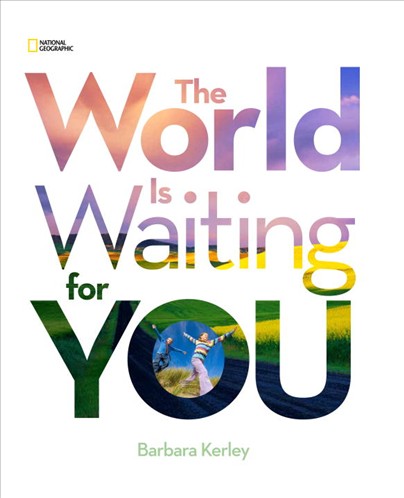
My goal with these titles is to have a clearly defined
concept expressed succinctly in an accessible tone. To express a big idea in a
kid-friendly way, with language that doesn’t take itself too seriously.
In other words, to be playful.
That kind of writing is best not done at a quiet computer.
That’s when it’s a good idea to head to a caboose.

July 8, 2013
Ingredients for a Great School Visit
I know that summer vacation seems like the worst time to think about
school visits, but maybe it's the best. After a bit of rest from early mornings, long days and cafeteria duty, summer gives time to reflect upon the fun parts of teaching and the best ways to use authors in the classroom. That's why on I.N.K. "reprint" month, I'm featuring my post on an inspirational school visit.
Before I do, let me take a moment to welcome my newest book into the world. It will be published tomorrow, on July 9th. How Do You Burp in Space? is a travel guide telling space tourists what to pack and expect on this not-so-distant future vacation. Don't you wish you could go up there this year? I'd do it in a heartbeat.
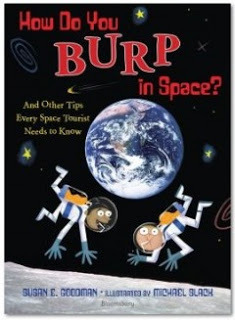
* * * * *
Monday, December 10, 2012
Ingredients for a Great School Visit
Posted by
Susan E. Goodman
I had another I.N.K. post just about finished when Kelly Milner Halls' plea for school librarians and a package pushed me in another direction.
The mailer came
from Carol Sweny, the Henniker Community School librarian, in Henniker,
NH, where I had recently talked to kids, K-8. The disc of photos
recording my two days there included all the ingredients of a great
school visit and reminded me how often a school librarian is at its
core.
In the school visit's section of my web site, I have a version of what most authors say on theirs: I find that when kids are prepared for a school visit, they
get more out of it. So I ask that students have access to some of my
books beforehand, and read (or are read) at least one of them. I also
have downloadable pictures of me and book covers to make a poster for
your hallway. These efforts alone will invoke kids’ interest and
enthusiasm, making the visit more memorable for them.
Remember you can click on all these pictures to make them larger.
This statement
isn't an ego thing or a plea to buy more of my books beforehand. When
kids know I'm coming, when they have read or heard some of my books,
they are psyched to see me. They have had time to think and wonder
about things, they listen more attentively, they ask more questions.
They get more out of the experience. It's not that I can't grab an
uniformed class or auditorium's attention; I can. But time after time, I
notice that prepared kids have a better experience.
Like Kelly, I
know that classroom teachers and principals are overloaded. Some may
not even know an author is coming in time to prepare. Besides they are
trying to get through their curriculum and whatever enrichments they
have planned, let alone teaching to whatever state test is coming up
next. PTO parents work hard to raise money for author visits, but their
role doesn't usually extend to the classroom or library. The school
librarian is the perfect person to rally the troops: to prepare the kids
in library class, to suggest and facilitate related classroom
exercises, to organize book order forms, to generate excitement.
The Henniker
has one author come each year, and Carol Sweny makes the most of it. I'm
not suggesting that every school or school librarian wants or needs to
put in the time and effort she did. Perhaps showing how she rallied her
school, however, will remind people how important it is to have school
librarians and how much their efforts, with school visits and everything
else, help kids learn and grow.
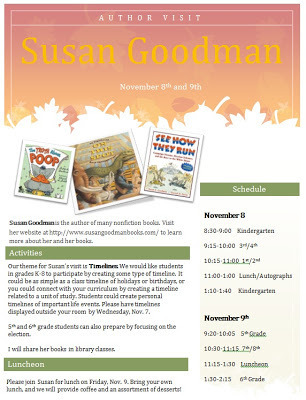
Here is part of the flyer Carol made to pass around to the teachers.
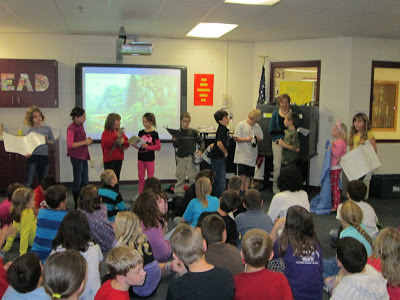
As you saw, grades K through 4 saw a presentation based on my book On This Spot, which takes New York City back
in time to when it was home to forests, glaciers, dinosaurs, towering
mountains, even a tropical sea. This presentation included, among other
things, kids taking many different objects and sorting themselves into a
timeline.
Carol asked the
teachers to have their classes use timelines to supplement normal
learning. They did so in different and wonderful ways. The school's corridors were festooned with examples of this interesting way to think about time and history.
The kindergarteners made timelines of their days.
First graders created a timeline that would record a whole year of learning month by month.
The 2nd graders made illustrated lifelines.
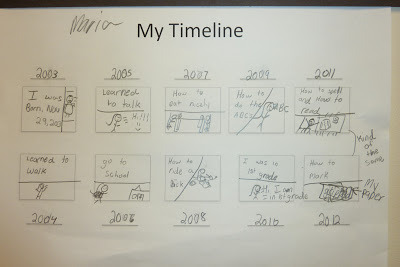
Third graders did their lifelines too.
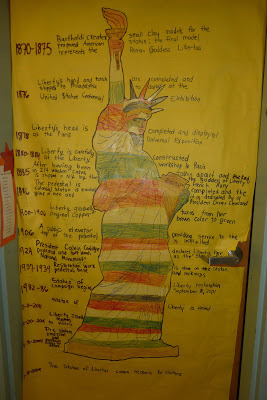
Here's a new way for a 4th grade class to think about the making of the Statue of Library.
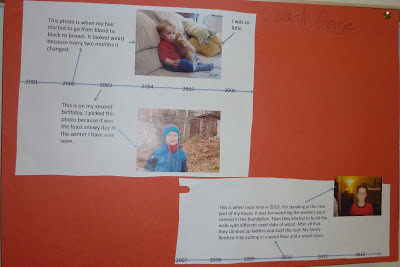
The 5th grade concentrated on learning new computer skills while doing their personal timelines.
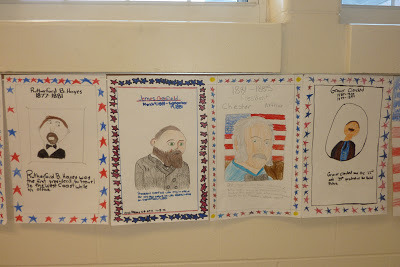
The 6th grades' timeline of our presidents was perfectly timed since my visit occurred shortly after the election in November.
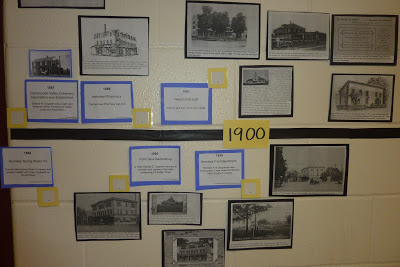
The 7th graders learned research and computer skills creating a timeline of Henniker's history that took up an entire hallway.
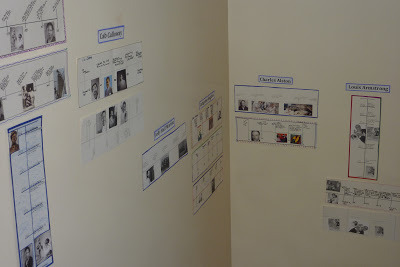
The 8th grade's timeline cascading down the stairway brought their study of the Harlem Renaissance to life.
As Kelly so
wisely said, school librarians (any librarians) are teachers. They build
relationships, spark imagination. We should fight for them.
I would fight
for Carol Sweny. Besides a great school visit, she gave me a moment of
feeling like a rock star. Check out what greeted me when I pulled into
the school parking lot.

school visits, but maybe it's the best. After a bit of rest from early mornings, long days and cafeteria duty, summer gives time to reflect upon the fun parts of teaching and the best ways to use authors in the classroom. That's why on I.N.K. "reprint" month, I'm featuring my post on an inspirational school visit.
Before I do, let me take a moment to welcome my newest book into the world. It will be published tomorrow, on July 9th. How Do You Burp in Space? is a travel guide telling space tourists what to pack and expect on this not-so-distant future vacation. Don't you wish you could go up there this year? I'd do it in a heartbeat.

* * * * *
Monday, December 10, 2012
Ingredients for a Great School Visit
Posted by
Susan E. Goodman
I had another I.N.K. post just about finished when Kelly Milner Halls' plea for school librarians and a package pushed me in another direction.
The mailer came
from Carol Sweny, the Henniker Community School librarian, in Henniker,
NH, where I had recently talked to kids, K-8. The disc of photos
recording my two days there included all the ingredients of a great
school visit and reminded me how often a school librarian is at its
core.
In the school visit's section of my web site, I have a version of what most authors say on theirs: I find that when kids are prepared for a school visit, they
get more out of it. So I ask that students have access to some of my
books beforehand, and read (or are read) at least one of them. I also
have downloadable pictures of me and book covers to make a poster for
your hallway. These efforts alone will invoke kids’ interest and
enthusiasm, making the visit more memorable for them.

Remember you can click on all these pictures to make them larger.
This statement
isn't an ego thing or a plea to buy more of my books beforehand. When
kids know I'm coming, when they have read or heard some of my books,
they are psyched to see me. They have had time to think and wonder
about things, they listen more attentively, they ask more questions.
They get more out of the experience. It's not that I can't grab an
uniformed class or auditorium's attention; I can. But time after time, I
notice that prepared kids have a better experience.
Like Kelly, I
know that classroom teachers and principals are overloaded. Some may
not even know an author is coming in time to prepare. Besides they are
trying to get through their curriculum and whatever enrichments they
have planned, let alone teaching to whatever state test is coming up
next. PTO parents work hard to raise money for author visits, but their
role doesn't usually extend to the classroom or library. The school
librarian is the perfect person to rally the troops: to prepare the kids
in library class, to suggest and facilitate related classroom
exercises, to organize book order forms, to generate excitement.
The Henniker
has one author come each year, and Carol Sweny makes the most of it. I'm
not suggesting that every school or school librarian wants or needs to
put in the time and effort she did. Perhaps showing how she rallied her
school, however, will remind people how important it is to have school
librarians and how much their efforts, with school visits and everything
else, help kids learn and grow.

Here is part of the flyer Carol made to pass around to the teachers.

As you saw, grades K through 4 saw a presentation based on my book On This Spot, which takes New York City back
in time to when it was home to forests, glaciers, dinosaurs, towering
mountains, even a tropical sea. This presentation included, among other
things, kids taking many different objects and sorting themselves into a
timeline.
Carol asked the
teachers to have their classes use timelines to supplement normal
learning. They did so in different and wonderful ways. The school's corridors were festooned with examples of this interesting way to think about time and history.


The kindergarteners made timelines of their days.

First graders created a timeline that would record a whole year of learning month by month.

The 2nd graders made illustrated lifelines.

Third graders did their lifelines too.

Here's a new way for a 4th grade class to think about the making of the Statue of Library.

The 5th grade concentrated on learning new computer skills while doing their personal timelines.

The 6th grades' timeline of our presidents was perfectly timed since my visit occurred shortly after the election in November.
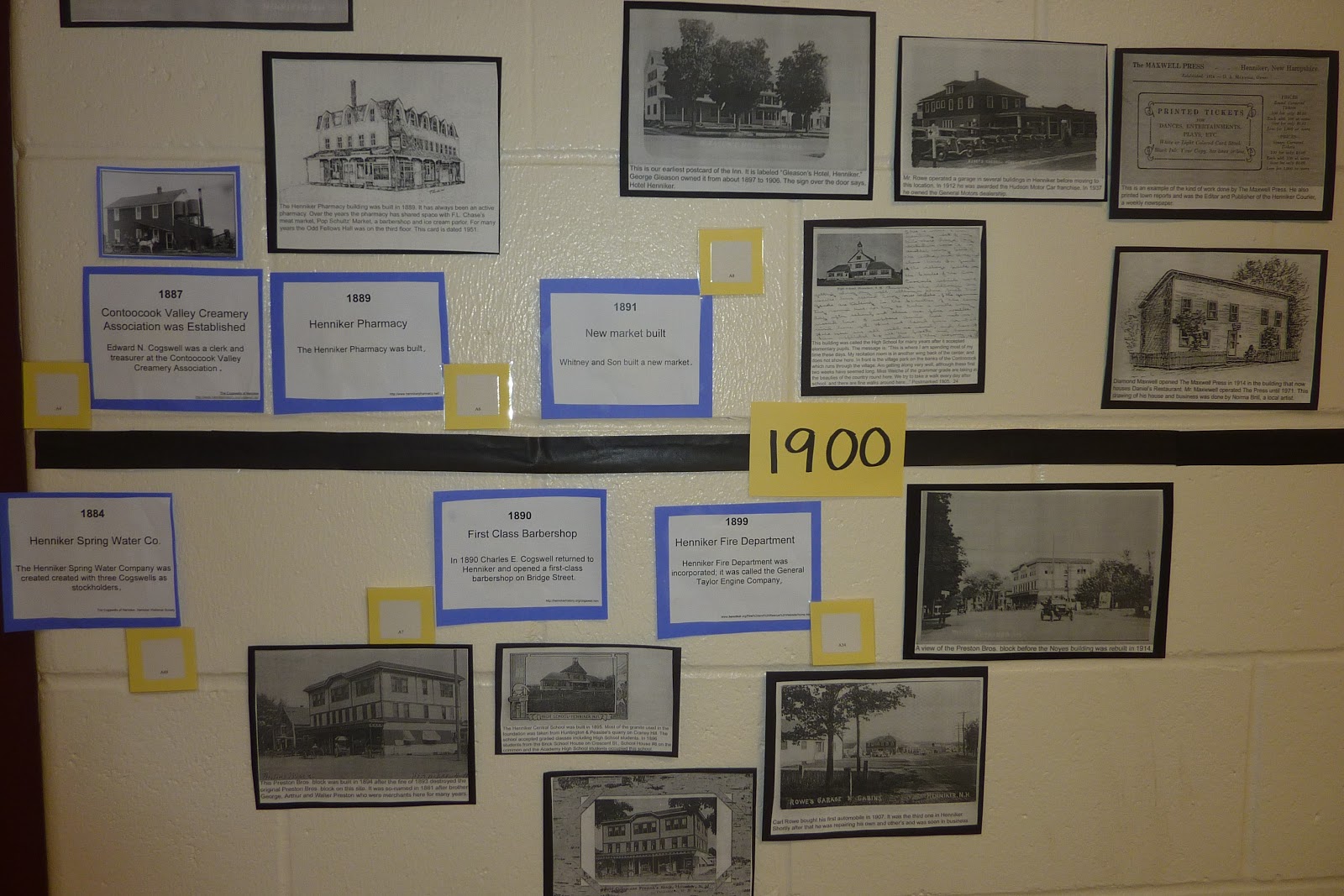
The 7th graders learned research and computer skills creating a timeline of Henniker's history that took up an entire hallway.
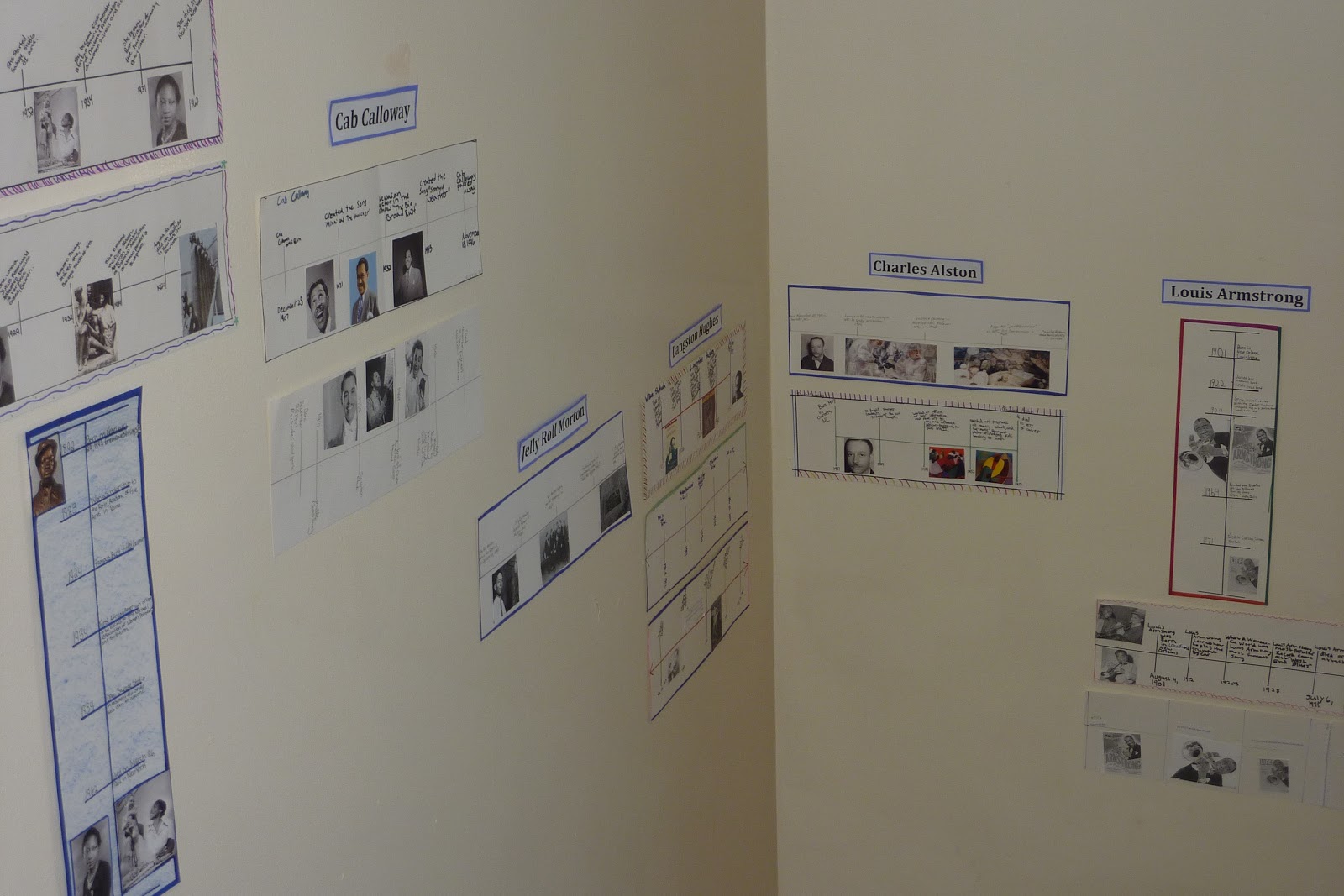
The 8th grade's timeline cascading down the stairway brought their study of the Harlem Renaissance to life.
As Kelly so
wisely said, school librarians (any librarians) are teachers. They build
relationships, spark imagination. We should fight for them.
I would fight
for Carol Sweny. Besides a great school visit, she gave me a moment of
feeling like a rock star. Check out what greeted me when I pulled into
the school parking lot.