
Exponent II's Blog, page 29
April 29, 2025
Guest Post: The Number One Reason LDS Women Are Leaving Religion
Guest Post by Dr. Rebecca Lucero Jones
On March 22nd, Jared Halverson, an associate professor of Ancient Scripture at Brigham Young University, used his social media platform “Unshaken Saints” to persuade LDS women to remain in the pews of The Church of Jesus Christ of Latter-day Saints. Halverson voiced his surprise, citing a 2023 survey report, that more women than men are now leaving religion. He shared, “Women have always outnumbered men, not at the pulpit, but in the pew, and so often it’s these sister Saints organizing benevolent societies…doing incredible things.”
Women flooded the comments to share their opinions, expressing shock and pain that a LDS religious scholar had trouble making sense of why women are leaving the faith. As an academic, and a woman who no longer participates in the LDS church, I was astonished to see a man lay out the evidence of inequity in the church and remain puzzled as to why many women no longer want to take the deal the church offers them. So why is a man with so much religious and secular knowledge caught off guard and surprised at women’s mass exit from the church?
The answer is a patriarchal framework. In her TED talk, Kimberlé Crenshaw poignantly demonstrates that frameworks determine whether we retain information. Without a framework, we will not see a problem, thus we cannot solve it. The church admits that it adheres to a patriarchal structure where men are positioned to receive the priesthood and exercise authority over the church due to their gender. In such a structure, men are valued over women. What this means practically is that within this framework, only men have access to new knowledge that would be relevant to the whole group. While the concept of personal revelation allows a woman to have new knowledge related to herself or her children, women are almost never allowed to have knowledge over anything other than themselves and their children. For example, in the church, a Relief Society president can seek revelation in selecting her counselors but even in her leadership role, she does not have autonomous decision-making power and must submit the recommended names to her bishop who may or may not approve.
The result of this patriarchal framework means that when women gain knowledge about the group, it is quickly dismissed. Under this framework, men gain knowledge for the group first by virtue of their gender. Anything gained in another way will be kicked down the road and considered when presented by a man who is in the correct place in the hierarchy.
While LDS leaders have no structured way of listening to women, women have been talking. They have been meeting with leaders and writing the first presidency. Yet, all avenues of feedback in which women might share new knowledge are filtered by a hierarchical structure that cannot receive them in a meaningful way. Women have been seeking a collaborative relationship with the church asking for women to pray in conference, more women speakers, garments that account for the needs of women’s bodies, and much more. But even female conference speakers more often select topics that support power and decision-making being concentrated in men.
Female wisdom exists and comes from the lived experience of going through life as a woman. The rise of social media has allowed a democratic rise of voices, and women connect with other women as they share the female wisdom they gain as they navigate the difficulties of life with a spiritual perspective.
Female wisdom is often suppressed in the LDS church. Truth and light in the LDS church is only permitted if it comes through a man and upholds the patriarchal structure. So what happens when LDS women begin to see thought leaders or women of other religions sharing their female wisdom? I would argue that LDS women are primed, more than those of other faiths, to leave the church and spend their time and energy listening to female wisdom, or even cultivating their own wisdom, because of how intensely the church teaches us to seek out truth and light. Halverson is right: women have been sitting in the pews. We’ve been listening, intently cultivating our faith, and we recognize wisdom. We have outgrown a framework that cannot hold us. We will continue to find truth because we are not limited by a framework that fails to see our problems and thus cannot offer us solutions.
The exodus of LDS women mirrors the Mormon pioneers’ own journey. We leave the comfort of a highly organized society to go into the wilderness. Like our ancestors, we do not fear the unknown. We know that our people may not understand our path. But in a patriarchal world, in a patriarchal church, we are uniquely prepared to follow the feminine wisdom that comes from within us.
Sources:
Crenshaw, K. October 2016. The urgency of intersectionality. Ted. https://www.ted.com/talks/kimberle_crenshaw_the_urgency_of_intersectionality/transcript
Halverson, J. March 22, 2025. Instagram. Unshaken Saints. https://www.instagram.com/reel/DHg0QNFpwHH/?utm_source=ig_web_copy_link
Definition of Patriarchy. Oxford Reference.https://www.oxfordreference.com/display/10.1093/oi/authority.20110803100310604
Dr. Rebecca Lucero Jones is a professor and Licensed Marriage and Family Therapist and Supervisor. She hosts the podcast “Keeping it up with the Joneses” with her husband where they delve into their published research on sexual communication within committed relationships. She resides in Texas with her husband and three children.


Is There a Right Kind of Patriarchy?
Recently on Instagram, a woman shared a video defending church patriarchy. She said: “We’re not the kind of church patriarchy that the world says we are” before proceeding to defend church patriarchy by describing what she calls ‘kinsmen patriarchy’ that she says existed in the Old Testament. Basically her argument is that in the Old Testament men took care of and protected their relatives, the prophet is the literal mouthpiece of God, God is benevolent like an Old Testament kinsman therefore church patriarchy is acceptable and glorious.
Her argument requires belief in several assumptions such as assuming God is only a singular male being, assuming church administrative structure extends into heaven, and assuming that they way people lived in the Hebrew Bible provides a divinely inspired model for the church’s power structure today. I could write a post about those assumptions. However, that is not where I want to focus because the same day that I saw her post I also saw the ever eloquent Dr. Dan McCllelan post a response to a video about slavery in the bible. While listening to Dan, I realized that exchanging the word patriarchy for slavery explains the mental pretzels this woman, whose name I am not sharing, uses to defend patriarchy.
Note: I want to say that while the topic of slavery helped me understand patriarchy, I am in no way saying that patriarchy is equal to the horrors of enslaving other human beings. Humans mistreating others by enslaving them is evil and harmful on an unspeakable gut wrenching level and the damage caused by race based enslavement still exists today.
Here is the beginning of Dan’s video: Is there a right way to practice slavery? Hey everybody, I’m Dan McClellan. I’m a scholar of the Bible and religion. Let’s take a look at a video. Does the bible endorse slavery?
Video of another person: Yes, of course. Paul, a slave of Christ Jesus James, a slave of God, and of the Lord Jesus Christ, Peter, a slave of Jesus Christ, Jude, a slave of Jesus Christ. Don’t forget John, he is also a slave of Jesus. The fact is, the Bible doesn’t ever condemn slavery outright because God himself is a slave owner. God can’t condemn himself. Obviously, the issue is between evil slave owners mistreating their slaves and good slave owners. If you are a good slave owner there is nothing wrong with that.
Dan: So obviously, there’s no such thing as benevolent slavery. The practice itself of buying, selling, and owning other human beings, absolutely, irrespective of how they are treated is fundamentally evil.
This was a lightbulb moment for me. This woman basically said that because there was patriarchy or father/kinsman rule in the Old Testament, then that means God is our head kinsman so patriarchy is acceptable. She asserts that church patriarchy is not the “world’s” patriarchy which in her argument means the issue isn’t patriarchy; patriarchy in the church is acceptable because the male rulers are kind and the ultimate male ruler is God.
I say that the practice of patriarchy, defined as some men ruling over the rest of men, women, and everyone else, irrespective of how they are treated or how people practiced this Biblical times, is fundamentally wrong. When some men rule over other men a number of practices and beliefs commonly occur. Artistic men are treated as less than men who like sports. Gay men are treated as less than heterosexual men. Women are paid less than men. Trans people are harassed. All of things actions are harmful and therefore wrong. To continue, it is harmful and wrong to:
Say girls can wear dresses but boys can’tUse one person’s preferred name but not another person’s preferred nameSay that real men don’t cry while also saying that women are too emotionalHave people in power pass laws making it harder for other people to get an education and use a public bathroomTell women that motherhood is their main purpose then provide broken chairs and stinky rooms for them to nurse in while male leaders sit in plush chairsEncourage girls to take dance classes yet belittle boys who want to danceSay that women must nurture their children while depriving men of support for nurturing their childrenTrain men to view women as sexual objectsTeach women that they must accept church sanctioned infidelity (aka polygamy)Take away male agency by saying that they must serve missionsPlace the burden of providing for family solely on men while simultaneously restricting economic opportunities for womenReward girls and women for acting tough while boys and men are denigrated for acting sensitivelyTell boys that their specific sexual organs qualify them to pass the sacrament while telling girls that their specific sexual organs disqualify them from passing the sacramentTell boys they can’t read books about princesses and forbid them from meeting female authors while girls can read books with boys as the main characterAnything practice or belief that squeezes the light out of another personAll of the above are examples of patriarchal beliefs and practices. Patriarchy is a power structure. These beliefs and practices stemming from this power structure wound people. Patriarchy hurts those under its rule by limiting the growth of those in power, limiting the growth of those under its power, and by limiting opportunities for human potential for growth and connection for everyone in the system. It is fundamentally evil for humans to harm other humans.
Returning again to Dan’s video: So why do we have an apologist endorsing a fundamentally evil perspective? Well, it comes down to two different things, the more foundational thing is that this functions as costly signaling and as a credibility enhancing display. Apologetics is about advancing one’s own standing within the social identities that are important to them by trying to satisfy or resolve the cognitive dissonance experienced by the members of those social identities. So, as I’ve pointed out many times, apologetics is about performing confidence and conviction to an audience that already agrees with your dogmas, but is struggling with cognitive dissonance and wants to be made to feel validated and authorized in those dogmas. Despite that cognitive dissonance, folks who can perform in a more convincing way, that confidence and that conviction can reach a wider audience, and they can advance their standing within those social identities…..There is going to be an audience…who are willing to waive the identity marker of yes, slavery can be done in the right way if God can do it and be the ideal enslaver, then there must be a right way to practice slavery. Among people, then you just make it a question of how benevolently you treat the folks you own and are buying and selling.
Suddenly I understood that there are going to be people, even women, who are willing to waive the identity marker of yes, patriarchy, like slavery, can be done in the right way if Old Testament people can do it and God can be the ideal patriarch, then there must be a right way to practice patriarchy. Among people, you just make it a question of how benevolently you treat the folks you have power over and rule over. Listening to Dan is when I finally understood why the woman I saw on Instagram defended her subordinate position in patriarchy by justifying it if it is practiced benevolently. She was both advancing her standing within a social identity important to her (I assume that identity is being a good Mormon woman) and was also trying to satisfy or resolve the cognitive dissonance experienced being a member of that social identity.
This woman sells books at Deseret Book, sells scripture study plans on her website, and also offers speaking engagements. Defending patriarchy advances her standing within the church institution and she will be rewarded monetarily. Even for women who do not stand to gain money from the defense of patriarchy, they still defend it because of identity politics; of what they gain. Women can gain church callings, acceptance in a social group at church, and approval from extended family. These things are not insignificant as people who have lost this social standing have shared pain regarding their experiences of loss.
As for cognitive dissonance she has experienced, I can only speculate about that dissonance. Even when people are not fully aware of their cognitive dissonance, I have observed that cognitive dissonance can cause distress and discomfort. I have seen women suffer from anxiety and other mental health issues. I have seen women form tight social cliques at church. I have seen women run themselves into the ground serving others in hopes of gaining approval. It seems that humans really do not want to exist in pain and will find ways to relieve the pain even if they are unaware of its source.
Dan is not the first person to identify and articulate why people defend ideas and practices that harm other people. It is, however, the first time I have truly understood why a grown ass woman in her 40’s would defend her own subordination.
So, is there a right way to practice patriarchy? The pain inflicted by patriarchy says that there is not. We can instead create a church administrative and theological structure around connection, caring, and partnership that nurtures every human being. Letting go of patriarchy does not change the existence of God, does not change what Jesus did, does not change what Joseph Smith saw in the grove. Truth, by its very definition, withstands change and scrutiny. Instead of fear, let us embrace the unknown with curiosity and wonder about what we might discover.
April 28, 2025
Come Follow Me: Doctrine and Covenants 45 “The Promises … Shall Be Fulfilled”
Our Heavenly Parents are pleased with how they created us and with all the efforts we make to grow, love, and reach our potential. They recognize we need their grace and compassion and understand our developmental needs and the value of us learning from our mistakes. Why then should there need to be an intermediary between us and them? Why would they send one child to bear the brunt of what goes wrong on earth and to plead with them to forgive and accept others? Even mortal parents don’t need mediators to beg them to forgive children’s developmentally understandable mistakes.
One way to grapple with these important questions is by learning about atonement theories. While one branch, “objective” atonement theories, assume that Jesus’s role centers on divine needs and requirements, and this is the most commonly used framework, others, including “subjective” theories, and Girardian models, explore other possibilities. They consider how the role Jesus fills might be much more in response to human scruples and spiritual needs rather than any divine ones. In such alternative models, the people who are satisfied and brought to unity and peace by Jesus’s suffering and advocacy are us humans. Some models emphasize that Jesus’ suffering for human sin helps us to forgive others. Some emphasize how Jesus’s actions reveal God’s goodness and love. Others emphasize Jesus’s actions teach us great lessons and transform us by revealing the absurdity and futility of scapegoating and violent retribution, and breaking these cycles.
To this we could add that Jesus’ advocacy can work as an antidote to humans’ self-loathing, hopelessness or shame. Maybe it is not God’s requirements or anger that Jesus staves off, but instead our inner critics and convictions of personal inadequacy. It is with us that Jesus pleads. Unburden yourselves of the mistakes and scars that haunt you–leave them behind. I’ve washed it all away myself, paid for you sense of guilt. Look, you’re already on a path to return to my presence. See how badly I want you in my life?!
Questions for considerationWhat do you think of the possibility that God is already forgiving and satisfied, and it is humans who need Jesus’s acts of shared suffering and advocacy?From your experience, how do Jesus’s redemptive acts and advocacy most help humans emotionally and spiritually? How are they most helping you at this point in your spiritual journey?What do you find most mysterious or complex about Jesus’s role as a redeemer and healer? How has perspective of Him and his unique purpose grown or changed over time?Latter-day Saint religious philosopher Adam Miller is known for writing his own “paraphrases” of scriptures inspired by other scriptural passages and useful sources and the best insights or clarity he can bring to a passage of scripture. How would you paraphrase verses 3-5 to have more clarity and insights based on contemporary life for you?What is the Everlasting Covenant? (Doctrine and Covenants 45:9-10)In our tradition, we have referred to the everlasting covenant as the restored gospel, the fullness of the gospel, temple covenants, or eternal marriage. What is the everlasting covenant exactly? Does it pertain only to our faith tradition? It is in the Bible that this idea originates, and studying Old Testament prophets may provide some perspective. In his 2025 book The Tears of Things, Franciscan Friar Richard Rohr discusses how during Jeremiah’s prophetic period, God extended a “unilateral” covenant of love toward humans (Jeremiah 31). God promises to transform our hearts, extend love and grace, embrace us all as Their people and Their children, and forgive and forget our sins. The strange thing about this covenant is that God makes no demands in return.
This superseded an older covenant communicated by OT prophets in which a relationship with God had a prerequisite of obedience. Starting with Jeremiah, prophets began to reveal that God is actually committed to loving, helping, and forgiving humans regardless of what humans do for their part! It is of this love that Jesus spoke when he referred to the new and everlasting covenant during the Last Supper. The everlasting covenant is not a uniquely Latter-day Saint idea or blessing; it applies to every faith tradition that values the Torah or the Bible and the whole earth, there is no prerequisite or exclusivity in God’s promise of unending commitment to help the human family. Here in D&C 45 as in Isaiah 1:18, the reference to God’s “reasoning” is unexpectedly all about forgiveness, grace, and joyful reconciliation.
We can certainly find God’s commitment to loving humans forever in the restored gospel and in temple ritual experiences, but we might find expanded joy and meaning in the recognition that the everlasting covenant includes all and is celebrated by other people of faith.
Rohr warns that many Christian groups today resist letting God love them without proving themselves. As he explains, “Our refusal to allow ourselves to be loved undeservedly and unconditionally will probably forever be the anguish of every prophet and the burden of every mystic or saint. (The Tears of Things 79-80).
Why do you think people struggle to believe that God loves them or to let God’s love in?How has God’s commitment to you changed your life?What is something you can do to help yourself feel God’s love and commitment to you more in your daily life?How can we let go of tendencies in our tradition to assert that God’s love and approval are exclusive to us?In our Church communities, how can let trust in God’s love prevail instead of hustling for flawless obedience to feel loved and seen in our relationships with God?Troubling Events that will come before the Second Coming are Cause for Sorrow Rather than VindicationMany of the images and ideas in Doctrine and Covenants 45 come from Mathew 24, in which Jesus prophesies about unsettling events that will happen before he returns to the earth. Mathew 24 has a very somber tone; Jesus isn’t happy about what’s to come. Bad things will happen to his disciples and apostles. They will be hated and harmed; they are warned about dangers and deceptions.
From a traditional Latter-day Saint stance, in which we tend to emphasize the exclusive truthfulness of our version of the gospel and church, it is very easy to read passage like Doctrine and Covenants 45 with a sense of satisfaction or vindication as we read of destructive events people of other lifestyles or belief systems may someday face while our own group is promised blessings.
There’s a good chance that the early saints to whom Doctrine and Covenants 45 was given may have received it with such as sense of self-focused gratification. The preface paraphrases a fragment from Joseph Smith’s record, indicating, “at this age of the Church … many false reports … and foolish stories, were published … and circulated, … to prevent people from investigating the work, or embracing the faith. … But to the joy of the Saints, … I received the following.”
The saints were facing discouraging times. Did they feel insecure? Angry? Rejected? Why did this revelation make them feel joyful when it has much of the same content as Matthew 24? It is true it is a fairly different text. It is longer text, a bit harsher on outsiders, and a bit more triumphant about the victories and safety that await Jesus’s followers. The early Saints could easily use this text to feel vindicated that while they were right and righteous, their antagonists would be punished.
Yet the gospel teaches us that how we feel about others should be more intentional, and not driven by fears or insecurities. If we cleave to a vindictive, comfortable mindset of superiority, we’re out of touch with the real spirit of Jesus’s prophecies. These are sorrowful events that call for tears. Most of what he prophecies are things that will come to pass due to tribulation and wickedness on the earth and are not things he is actively doing. Many innocent people will be harmed and suffer due to these events.
Often, we talk about wickedness or wrong living as being centered in spiritual belief systems. Are people atheist? Not Christian? We place them in an inferior category spiritually in broad strokes without looking closely at their spiritual or moral lives or considering that most people simply inherit their worldviews from their predecessors and often don’t actually have much choice or education concerning the matter. Doctrine and Covenants 45 needs a bit of a an inspired update and rephrasing. Like American Protestants during Joseph Smith’s time, it is preoccupied with the battle for who has the correct or true religious beliefs, and assumes that this is at the core of what it means to be righteous and acceptable to God. Today, most of us can recognize that people of all faiths and belief systems are loved and accepted by God, and that what really matters in terms of righteousness is what values and principles we choose to live by, and whether our hearts are hard or soft toward others.
Questions for considerationHow can we do better at church at not touting a sense of moral superiority over people of other belief systems?How can we loosen our grasp on a desire for certainty and being “right” or vindicated in our beliefs in ways that can strengthen our faith and spirituality? How can we cultivate more empathy for people from different cultural and religious backgrounds than us?What might be some things we can do to become less numb to the suffering of those who live with much less privilege than ourselves, or who live in dangerous and uncomfortable situations?Wickedness is Not About Religious Beliefs, Divine Justice is not About VindicationReal wickedness does not have much to do with what we cognitively assent to about God or the afterlife, but instead how we behave and what we desire. As the Book of Mormon teaches, wickedness is a matter of greedy, selfish, and violent behaviors that exploit others and grind on the face of the poor and helpless (2 Ne. 26:20). The book often warns us about being lifted up in pride because of our religious beliefs, identities and statuses! Are peoples’ hearts set upon their own gain, pleasures, pride, rightness, or material wealth at the cost of others? These are the people whose actions on earth need to be set right by the savior.
As Adam Miller suggests in his framework in Original Grace, divine justice is giving people what they need in order to stop harming others out of love. When Jesus will execute justice in our world, as he will during his coming, it will be to help people become righteous and be healed, and to stop harming others, not to vindicate himself, make them suffer for punishments’ sake, or to prove he’s right. Maybe envisioning a vindictive, violent, judgmental Jesus at the Second Coming isn’t actually serving us spiritual, or in harmony with His actual nature. Divine justice is works in harmony rather than opposition to love, mercy and grace. God is fully good, fully kind, fully loving and understanding. They don’t make exceptions, play favorites, or let in certain vices to make us feel better about ourselves or to enjoy seeing God punish others. Seeking to attain vindication and satisfaction through revenge is actually Satan’s promise and logic, and it leads to the endless cycles of scapegoating and violence that Jesus seeks to disrupt, not create!
Questions for considerationWhat are ways that our nations and communities are caught up in wickedness that affect our lives, and that we’d like to see change?How might Adam Miller’s definition of divine justice challenge, enrich, or enlarge our perspectives of the gospel and God’s work?Is Jesus’s coming more of a joyful or a difficult event to think about or imagine for you?What do you want Jesus’s justice to look like when he comes again? How do you long for the world to change?The feature image for this post is a detail showing Jesus Christ in The Last Judgment by Michelangelo (from Wikimedia, public domain).
The blog is free to read, but not free to host! Check out our donation page to make a tax-deductible donation.
Flesh and Blood and Water: Emblems in The Tower
Hours after arriving in London, I gathered with family and others by a side gate at the Tower of London. The site was empty of tourists as evening approached.
At 6:30, the guard opened the gate, and placed chapel passes on the wrists of the 20 of us waiting to enter.
We walked through the empty grounds as the setting sun reflected on the stone buildings. This was the golden hour. We entered the ancient fortress in the center courtyard and ascended the steps to the oldest room near the top of the oldest building of the Tower complex. We passed through the large armory, and a chamber where several clergy greeted us. Then they ushered us into the Old Chapel Royal, built a thousand years ago in the center of the high-walled Norman castle.
There were a few rows of small wooden pews. The stone walls rose in several levels of stone arches which surrounded the small nave. The only adornment was the altar, covered in fine white linen, on which were several large altar crosses and vessels for communion.
We stood as three clergy entered, led by the Bishop of London, the Right Honorable Dame Sarah Mullally. She wore a deep red robe. She stepped to the altar and draped a loose white robe over her shoulders. The other two clergy wore white robes.
One of the priests welcomed us, inviting us to follow the printed program, which would guide us in knowing when and how to respond, or join in singing. He said all were welcome to partake of the emblems of communion. He expressed appreciation for all of us coming to this Maundy Thursday service during this Holy Week, especially those of us visiting from far away Utah. He is friends with my sister, who has brought students and groups to services here for decades. I felt assured that all are invited to partake of the emblems. None are denied.
The small choir stood at the back of the chapel. Their voices were pure and piercing as they sang the Introit, Panis Angelicus to begin the service. The beautiful sound seemed to rise up behind us, then descend down upon us.
As they sang, Bishop Mullally sat in a chair in front of the altar, facing us. Before the first prayer, she removed the symbols of her office and station from her head and shoulders. She led the service in her simple robes of deep red and white.
I listened to the reading of the Lord’s Prayer, and thought of the countless people who, over the centuries, had come here to this chapel, to lead, or listen to services, sometimes out of duty, sometimes reluctantly, or desperately, or arrogantly. How many had come as I did that night – pleading and hungry for something that brought hope for grace, love and mercy in a world where harsh power, fear, violence, and threat of imprisonment was growing. This chapel had existed for a millennium. Just half the time since the extraordinary event in Gethsemane, when Christ revealed At-One-Ment. The experience of love so deep and complete, He became each of us, feeling what we feel, existing as we each exist, knowing us, aware of us with no barriers, no fear, so completely, with no expectation of reward or compensation. This is where His love led Him, to be one with us. All of us. Me.
My fear of what is happening in the world gripped me. Then, I listened again for what is there when I am present to it.
“I am with you. No matter where your journey leads. I am with you.”
Again, it breaks my heart…open. Overwhelmed, I had to remind myself to breathe.
I listened to the priest read the Summary of the Law.
“Our Lord Jesus Christ said: Hear, O Israel, the Lord our God is one Lord, and thou shalt love the Lord the God with all thy heart and with all thy soul and with all thy mind, and with all thy strength. This is the first commandment. And the second is like, namely this: Thou shalt love thy neighbor as thyself. There is none other commandment greater than these. On these two commandments hang all the Law and the Prophets.”
I read the response. . .
Lord, have mercy upon us, and incline our hearts to keep this law.
The choir sang Kyrie Eleison. Lord have mercy.
The service included a moving sermon from the Bishop. Then she placed a chair facing the altar, and set towels and a bowl of water on the floor in front of it. My sister, Jane was one of three women chosen to participate in this part of the service. She removed her shoes, and stepped forward to sit in the chair. The Bishop knelt before her, gently lifting first one, then the other foot into the bowl, washing her feet with water, tenderly tracing a cross where Christ’s wounds would have been, cradling her feet in a towel to wipe away the drops. Then she invited Jane to rise, and return to us.
During this ceremony, I looked at my sister, leaning forward in the chair, and the Bishop, in deep red and flowing white, kneeling and bending over the bowl of water, washing feet that might be tired and hurting. I closed my eyes and thought of the images I had recently seen of hundreds of men, stripped, heads shaven, sitting in rows on the cold stone floor of a prison in El Salvador, packed together so tightly it was hard to distinguish one from another. They leaned on each other, some so worn their heads fell to the side, unable to stay upright. I could not tell if the marks on them were bruises, or tattoos, or wounds, or blood. I opened my eyes and, for a moment, thought one of these men was sitting in the chair before the altar, leaning over the bowl as his tired, wounded feet were washed by gentle hands. The hands washing his feet were also wounded, pierced through the palm and wrist.
I pray for understanding.
Is this what You meant when You said, “I have graven you upon the palms of my hands.” And “Inasmuch as ye have done it unto the least of these…ye have done it unto me.”
Is everything I do vicarious? Everything I do impacts, in some way, everything and everyone.
Lord, have mercy on me a sinner.
When have I turned away from those who are suffering?
When have I added to someone’s wounds, or inflicted more?
Would I step in to shield someone, or to lift them and release them from prison?
What if I think I am helping, but it only makes it worse? How can I know?
The priest continued with reading to prepare for communion.
“Hear what comfortable words our Savior Christ saith unto all that truly turn to him.
Come unto me all that travail and are heavy laden, and I will refresh you.”
All were invited to the altar to kneel, one by one. We could extend our hands to receive the emblems of the body and blood of Christ. Or, if we preferred, we could hold our hands over our heart when kneeling, signaling a desire to receive a blessing from the Bishop. All individual needs were welcomed and fulfilled.
This service commemorated the institution begun at the Last Supper, as Christ offered physical nourishment to symbolize the transformative nourishment of his word to our very being. And as Christ showed us the Way, by kneeling and washing feet, and serving with great love.
“Almighty and everliving God, we most heartily thank thee, for that thou dost vouchsafe to feed us, who have duly received these holy mysteries, with the spiritual food of the most precious Body and Blood of thy Son our Savior Jesus Christ…that we are very members incorporate of the mystical body of thy Son.
The Peace of God, which passeth all understanding, keep your hearts and minds in the knowledge and love of God.”
Receive these mysteries.
Members of the mystical body.
Peace which passeth all understanding.
I struggle with what I cannot explain. I want to know how it is done.
God invites me to experience that which is beyond language.
The final part of the service occurs after the last song, after the final prayer, after everything is spoken.
The clergy carefully strip the altar. All items, all linens are removed and put away.
The altar is bare.
We sit in silence for a moment. Then we gradually make our way out.
What is there on the empty altar for me?
What can I lay on the altar?
What do I grasp that keeps me from experiencing God?
What greater sin is there than my barriers to God’s love? To loving others? To hesitate because I need to know the right way to do this? How can I practice mercy when I can’t begin to describe how Your mercy overwhelms me?
April 27, 2025
Guest Post: Treating My Garment Dysmorphia
by Mags Edvalson
I’m fat. Let’s just get it out of the way, because it’s a fact of life I have to accept every day. I just am. I always have been, and I probably always will be. My whole family is fat, or extraordinarily tall or extraordinarily tall and fat. That includes all my four dozen cousins. We are great Scandinavian giants whose ancestors may as well have been the inspiration behind the Jötnar in Norse mythology. I am, at 5’9” and between 250 and 300 lbs, the small one in my family. My brothers are both close to 6’7” and well over 300 lbs. Fatness, you could say, is my jam.
Of course I hate it. As a teenager I took it on as my solemn responsibility to cover up my body to keep it from offending others. This only ever seemed to accentuate the issue when it came to things like combined youth activities at a pool or large body of water where I grew up in California. Of course all the girls were expected to wear modest bathing suits, but I was the only one who wore an oversized T-shirt and my brother’s extra long swim trunks. I didn’t need to do that, but it seemed that whether I did or not, I still caught glimpses of the boys glancing over and giggling at me. The other girls ignored me. One of my Young Women’s presidents suggested I would be so pretty if I just lost some weight.
I thought garments would be the great equalizer. I remember trying to justify my extra effort to be modest as simply being better prepared to wear them. I wore long skirts to cover my unsightly calves. I camouflaged my “Relief Society arms” with long sleeves year round, even in triple digit temperatures. How bad could garments possibly be after years of enduring extra layers because I believed my very being was offensive?
I was endowed three months before my mission to Louisiana. At my mother’s advice, I bought tops and bottoms in several fabrics and styles to decide which ones I liked best, but it was useless. I hated them all. I took extra long showers in those months leading up to my first day in the MTC. Being alone and nude was the only time I felt comfortable and okay. Upon leaving the shower, I’d stand wrapped in my towel staring at my neatly folded top and bottom and sob quietly at the prospect of putting them on again.
Garments, as it turns out, are just as awful as most any other type of clothing when you’re fat. No matter how long I’d get the bottoms, they would always ride up my leg. You could always tell where they hit my thigh under my jeans, leaving a dent that only hinted at the itchy red line they left behind. The tops were never so bad for me, but I can imagine they’d be awful for other body types. The tops with cups are an absolute must have for me, but the poor design of the hem on the tops lends them to rolling up and over bigger guts. It’s near impossible to keep anything tucked in.
Historically, plus-sized clothing has been designed by and for straight-sized people who figure that simply adding a few inches in either direction at the waist will be enough to fit. Lane Bryant has been the brand associated with bigger women for over a century, and even then it only started out as a maternity line on the assumption that extra weight on women is only ever temporary. I remember being twelve years old and having to “graduate” to Lane Bryant, whose clothing always trended towards mature and business casual. My mom was upset that she had to pay extra money for jeans that would only tear at the knees in six months. I was mortified because I was dressing like my grandmother.
It’s only been within the last decade or so that plus-sized women could find trendy clothing made for them by other plus-sized women. As a young adult I was confined to Lane Bryant and Torrid, and it’s only been since 2022 when Old Navy expanded their jean selection to include sizes that fit my body that I’ve been able to buy jeans from a straight-sized store. Online shops like Bloomchic have finally made fashions I like accessible to me, and shopping is no longer a chore. Garments, on the other hand, are still made by one company and designs are signed off on by straight-sized old men who are all mostly married to straight-sized women and have probably never considered what wearing clothes as a fat woman is like.
I served a mission at a time when options for my body were still limited to a few stores. I put in an extra effort to make sure my skirts were at least mid calf or longer, and my sleeves were at least a quarter length. The church had just started to encourage sister missionaries to wear more fashionable clothing by relaxing the dress code. It was said that this was done to attract more investigators after polls had shown that the dress code was a turn off. No matter, I was going to follow those old rules because modesty had become a coping mechanism.
Despite this, I became a target for ridicule by one of the senior sister missionaries in my MTC zone. Sunday lunches made the cafeteria particularly crowded as zones were joined by their branch presidencies and wives. We had to squeeze in at our table to make room, and I was joined by one of the councilor’s wives to my left. She was a rail thin woman with that stereotypical sternness that one associates with school marms in old movies. As I held my elbows close to my body, I struggled to maneuver my utensils from plate to mouth.
Suddenly, I felt her lean in and heard her whisper, “You really ought to be careful about your modesty, Sister Olsen, or the elders might start thinking impure thoughts.” I almost dropped my fork. I looked down at my blouse, which was a button-up with a tank top underneath. Only the top button was undone, and yet with how tightly packed we were at the table, my cleavage was reaching my clavicle. I didn’t feel so much embarrassed as I felt furious. I glared back at the woman, but I was speechless. I looked around at the other sisters. They all had blouses with lower necklines, but no visible cleavage because they were all A or B cupped, including the sister who chastised me.
After so many years of trying to hide my body and go above and beyond in my modesty to make up for being fat, that was the first moment that I realized that there is no room in the church for fat people. Garments emphasize this fact by their poor fit on diverse bodies, as well as the false sense of security that modesty provides. They were designed to remind us of our covenants to remain chaste, and yet at one slip of the cleavage, my internalized devotion was questionable. Though I was accustomed to feeling unwanted, I hadn’t realized until then that part of that status included the assumption that my body was undesirable because it was too sexual. It was a devastating and very confusing moment, and I hated myself as much as I hated that senior sister. Being fat is not ideal, but hating yourself for something you can’t necessarily change let alone quickly is far worse.
So many opinions have been shared about the new garment changes. I am happy that there are women celebrating. I love the criticisms being voiced about the lack of consideration for vaginal health. Most of all I feel deeply betrayed along with those who feel that this change does not address the culture of shame that the church has facilitated against women’s bodies. Particularly, I want to point out how much this change in the garment top exacerbates the layers of shame that fat women have for not only being female, but also embodying the paradox of undesirability and hypersexualization. As straight-sized women revel in showing off their now temple worthy shoulders, many fat women will still hesitate. Dare they own their arms and risk offending the brethren with some extra skin and jiggle? Or do they persist in wearing longer sleeves and face the ridicule anyway? Nobody, no matter their size, should have to think twice about their own comfort.
Finally, I have a confession to make. I don’t wear garments anymore. That’s actually not the confession. It’s just a fact that I don’t feel shame for. If my story of crying in the bathroom at having to put garments on was any indication, I definitely hated wearing garments. The confession is that I wore garments for years after leaving the church. I endured several extra years of yeast infections, itchy red welts on my thighs, uncomfortable bunching, and worst of all shame of my body, because I could not bear the idea that I could be fat and beautiful. While women who leave the church often share pictures of their “porn shoulders” with pride, I could not allow my gross body to be seen.
It wasn’t until I partnered up with my now spouse that I stopped wearing them. It wasn’t that I was embarrassed to have to explain my weird underwear to my partner. He was a non-member raised by former members with plenty of active family. We’d been friends in college and he’d written to me on my mission. If anything, he would be the most understanding of my journey. I stopped wearing garments for myself because I realized that for all that pressure I placed on myself for protecting other people, I was depriving myself of my own love. If this other person that I adored could love my fat body, then why couldn’t I?
It was still several years before I threw my garments out. It was moving day, and we were down to the wire to get the house locked up and the last of the odds and ends out. The old trash bag of garments was one of the last things to go. In my exhaustion and frustration at the day, I stared down that bag and felt the weight of all those bathroom moments over again. This time I did not cry. Instead, I picked up the bag, carried it to the dumpster, and with a scream of rage and release, I slammed the bag down inside and dropped the lid.
I’m fat. I hate it, but I won’t be ashamed of it anymore.
 From
the time Mags Edvalson learned to read, they’ve had an obsession with church history and the paranormal. This fixation is what drives them as a folklorist and a church historian for the Community of Christ, which has
been their church home since 2017. Mags lives in picturesque S
ilverton, Oregon with their spouse and an menagerie of furry children.
From
the time Mags Edvalson learned to read, they’ve had an obsession with church history and the paranormal. This fixation is what drives them as a folklorist and a church historian for the Community of Christ, which has
been their church home since 2017. Mags lives in picturesque S
ilverton, Oregon with their spouse and an menagerie of furry children.
Sacred Music Sunday: Cast Thy Burden upon the Lord
I was thinking about the right hymn for this month, and I was struggling to come up with something that fits the times. The world is in chaos. My personal life is in its own unrelated chaos. I’m working two jobs while barely making ends meet. When I do have a free moment, all I want to do is take a nap. When it comes right down to it, I’m tired. Not just the “I stayed up too late last night” or even the “I could use a vacation” kind of tired – the bone-deep weariness where just getting through the day is like running a marathon while wearing a suit made of weights.
 Sacred Heart of Jesus statue, Mission Santa Clara de Asis – Photo Credit Santa Clara University
When I was in college and law school, one of my favorite places to go was behind the chapel. Mission Santa Clara sat as the focal point of campus, and right behind, in a garden, was a statue of Jesus. On either side, in Latin, the words “Come to me” and “Learn of me” were inscribed, from Matthew 11:28-29. Whenever I was having a rough day, I would just go and sit there by the statue.
It’s been over two decades since undergrad, and nearly 15 years since law school, and I’m 700 miles away now. Instead of a lush garden, I’m in the barren desert – both literally and figuratively. Even so, Jesus still stands beckoning us to come to Him and drop our burdens.
A related scripture is Psalm 55:22, and one of the most famous settings of this verse is by Felix Mendelsshon in his oratorio Elijah. “Cast thy burden upon the Lord, and He shall sustain thee.”
I’m not sure where the line is between casting my burden upon the Lord and just abdicating responsibility for the world altogether, but I wouldn’t mind being sustained for a while so I can rest.
April 26, 2025
Do I want to find community at church?
Moroni 6:5 And the church did meet together oft, to fast and to pray, and to speak one with another concerning the welfare of their souls.
I love the idea of this scripture. I love the idea of a community that comes together and talks about the welfare of their souls together. I imagine people chatting about their challenges and successes big and small that contribute to how they are doing in their hearts. I imagine honesty. I imagine openness. I imagine tears of sorrow and joy. I imagine mourning with those who mourn. I imagine celebrating with those who are celebrating. I imagine being one in purpose. Mostly, I imagine loving friendship.
When I was younger, my church community was my main community. It was where I felt the most love. It was where I felt friendship. Indeed, some of my very best friends are from the church.
But then things started to change. A primary parent made an anonymous complaint about a class I taught to the 11 year olds where we talked about bullying and racism and how to be more loving and accepting. Then a few months later, an old man chewed me out for being too critical because I brought up the Gospel Essay on race when I was teaching Gospel Doctrine. I started wondering if maybe this church building and the people inside it weren’t really who I wanted as my community. Maybe they weren’t the people that shared my values. Maybe they weren’t the people that I wanted to spend time with. Perhaps these people really weren’t my community. I started to step back from the social aspects of church.
There are doctrines of the gospel that I find beautiful, so I stayed in the church. But I intentionally started making my community – the people that I discuss the welfare of my soul with – people outside of the church building.
COVID then hit and I no longer had any reason to socialize with my ward. Truthfully, it was a welcomed reprieve to focus my worship on the Savior and not the institutional racism.
After COVID, going back to church was hard for me (I resonate with the experience described here), but I went back because of the doctrines I love (not the community there).
Due to work related moves, we ended up in a few different wards over the coming years. I found each of these wards to be a place to make some friends, but I purposely felt myself pulling back socially. I worried about getting too close only to feel heartbreak if I realized we didn’t share values. I didn’t want to assume that each new ward was a place where I would feel safe to discuss the welfare of my soul. I didn’t want to assume that each new ward was a place where I would feel safe to discuss the things in my heart. I didn’t want to assume that each new ward was a place where I would find loving friendship.
Last summer we made our final move to a new ward, knowing that we’d be in this house for (hopefully) the next few decades. After several years of pulling back a bit from social aspects of church, I decided I was ready to try again. I wanted to try to make this new ward my community. I figured I’ll be with these people for decades to come. I would like to be able to go to church and worship with people that I feel care about the welfare of my soul and that I care about theirs. I wanted to feel this beautiful community.
My first Sunday at church I fasted and prayed that I would find community within the ward. Within a few weeks I was called to the Relief Society Presidency and getting to know everyone there. We regularly had families over for dinner or dessert and I was starting to feel at home at church. I actually enjoyed walking into the building and seeing the friends I was making. A feeling I hadn’t felt in several years.
Then one Sunday we invited a couple families over for dessert. That night everything changed.
One of the teenagers who was over sexually assaulted my daughter who was just shy of 4-years old at the time.
We didn’t know it happened till days later when the teenager admitted to doing it. The good news is my daughter seems absolutely fine. It’s been over 2 months since it happened. Two awful months full of lots of tears, loss of trust, worries about the future, and lots of meetings. Meetings with the Department of Human Services. Meetings with healthcare professionals. Meetings with mental health care professionals. Meetings with law enforcement. Though it’s been an awful two months for me, I’m relieved to say that my daughter has seemed fine the whole time.
Given the situation, we switched wards yet again. We didn’t want to be around the teenager, but we wanted him to heal and get the professional and social help he needs to never do this again. We figured keeping consistency for him in that community might be helpful. When our stake president submitted the request to switch our church records to the office that approves this sort of thing in Salt Lake City, it was approved immediately. I don’t think anyone expected us to want to stay in the ward where we live geographically given the situation. It seemed like an easy change.
Except it wasn’t that easy.
It dropped us in yet another ward.
Another moment to try to establish community. Another moment to potentially set myself up for heartbreak.
But what if I can’t?
What if I don’t want to?
What if I’m too tired to try?
What if the experience of establishing community in my last ward broke me harder than I ever could have imagined?
Maybe it’s time to admit that I will never feel the sense of community at church that sounds so wonderful when Moroni describes it.
 Photo by John Cameron on Unsplash
April 25, 2025
Answering the Temple Recommend Questions Was Not Feeding My Spirit

Sometimes, I feel I am suffering from spiritual malnutrition.
Someone could be consuming their daily recommended number of calories while not taking in the right nutrients that their body needs to function optimally.
Similarly, I am on a journey to find the nutrients that my spirit needs to function optimally, not just to meet its basic functions.
Any dietitian worth their salt would tell you that the recommended daily value of nutrients will vary based on each person’s body composition and lifestyle.
For me, the temple recommend questions currently feel like a recommended caloric intake. They are questions suggested in general for what one would need to do to be spiritually “fed.” (They use the word worthy, but that’s an entirely separate blog post… or 5). But, right now, I need different questions to have a nutritious spiritual diet that is feeding my spirit and giving it the energy that it craves.
For many people, just being able to answer the temple recommend questions to get a recommend is difficult enough, and I do not want to diminish that struggle at all. In fact, some people may have “allergies” to some of the temple recommend questions, while others may be following a spiritual “vegan” diet, and they may need to alter their “spiritual diet” accordingly.
Right now, I am supplementing my spiritual diet with my own “recommend” questions. These questions are not to hold me back from doing anything but rather to check my alignment with my values. I hope that over time, these questions will change. Some may become so habitual that I do not need to check in on them anymore. Some may develop new angles, while others may need to be rephrased entirely.
These are my spiritual nutrition questions. My goal is to check in with them more regularly than every 2 years. There are no punishments if I do not answer “appropriately,” but rather an invitation to re-align myself with my values and the spiritual strength I seek. Borrowing from recent changes to the Church’s temple recommend questions, these questions liberally use the word “strive.”
Do you have hope in Heavenly Mother, Heavenly Father, and Jesus Christ? Do you strive to believe in the dignity of all of our Heavenly Parents’ children?Do you strive to treat all of God’s children with dignity and respect?Do you strive to believe in the ongoing restoration of the gospel of Jesus Christ? Do you strive to believe that your body was made in God’s image, and do you treat it accordingly? Do you strive to practice spirituality and seek to connect with God in your daily life? When and where possible, do you donate resources (time, energy, talents, etc.) to help uplift the “least of these?”Do you have hope for Christ’s mercy and grace through His atonement? When you fall short of your potential, do you seek to make things right? Do you strive to love others?Do you love your enemies? Do you seek the voice of the spirit in your life?Do you seek equal partnership with your spouse and practice active listening to strengthen your relationship with them? Do you strive to “mourn with those who mourn and comfort those who stand in need of comfort?” (Romans 12:15)Do you strive to practice gratitude? Are you aware of God’s hand comforting you in your life?These questions are not an exhaustive list of everything one could need for a spiritual life. For me, they help me remember what is most important right now. When Sunday church is not feeding me, I visit these questions to see what is missing. Then, I examine what I would like to do to fill that spiritual hunger.
Opening up the freedom to explore in different ways has helped me connect with God through unique channels, and I love it.
For example, I found that I was really struggling to love my enemies. Just like when I learned I should be eating more fiber and added chia seeds to my diet, I decided I needed to add more love for my enemies to my diet. I started listening to podcasts that bring people of different perspectives together to discuss issues. I found I still did not agree with the people on the “other side,” but I saw them as real people, doing their best, not fools or monsters. It has helped me change how I dialogue with those people so we can get along better.
I have also given myself permission to seek whatever feeds my spirit and my cravings. I practice meditation and choice statements from the work of Louise Hay. I read from scholars and theologians of a variety of religions and appreciate the beauty they have found.
Perhaps my favorite is to enjoy a nice “spiritual dessert” of listening to a beautiful symphony or opera and letting the voice of God speak through the music.
No one is going to ask me in a temple recommend interview if I am doing these things. There is no church requirement to ensure a well-rounded spiritual diet, but my soul craves it and my development requires it.
If you could write your own “spiritual nutrition questions,” what would you ask yourself? What “nutrients” does your spiritual body crave right now?
April 24, 2025
Guest Post: In the Shadow of the Steeple
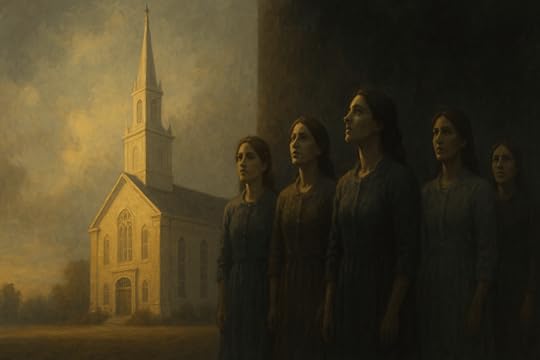 Image produced with AI
By Anonymous
In sacred halls where prayers ascend,
A silent echo finds no end.
The sisters’ voices, soft and low,
In shadows cast, unheard they go.
The pulpit towers, the quorum’s decree—
Yet none were built to carry me.
Emma stood with trembling hand,
The weight of Zion in her stand.
A paper, inked with heaven’s claim,
Yet branded with another’s name.
A revelation cloaked in flame—
She cast it in the fire’s breath,
Refused to share her husband’s death
Of trust, of choice, of love made ash.
Still history paints her in a flash
Of bitterness, not holy wrath.
Where was her voice when saints were led?
Why must her fire burn in dread?
Was not her heart as full of God,
Her path as firm, her knees as shod?
Eliza Snow, with poet’s grace,
Once dared to bless, to heal, embrace.
With hands outstretched, she called down light,
A priestess veiled in borrowed right.
The sick were soothed, the babies blessed,
Till power’s fear laid her to rest.
“No more,” they said. “This gift, too great,
Belongs to quorum, not to faith.”
And so the healing hands withdrew—
A hush where miracles once flew.
Relief Society, born free,
Was shuttered for its agency.
Brigham feared the women’s voice
Could challenge priesthood’s narrowed choice.
And so they paused the mighty thread—
The loom gone quiet, the sisters fled
To silence, waiting to be heard,
Their prayers like wings without a bird.
They taught of Her, the Mother Divine—
Then buried Her beneath the shrine.
“She’s too sacred,” the brethren say,
To name, to seek, to love, to pray.
Yet how do daughters know their worth
Without the One who gave them birth?
Maxine wrote with scholar’s pen,
Asked, “What of us? And where? And when?”
They labeled her a threat, a foe,
And silenced what they feared to know.
Her questions burned with holy heat—
But fire, it seems, is incomplete
When sparked within a woman’s chest;
The brethren only call it “mess.”
Kate Kelly knelt in temple square,
Not to storm, but just to care.
She asked for voice, for place, for part—
They tore her from the fold and heart.
Exiled for her hopeful plea,
While patriarchy claimed decree.
They said she fought the “wrong” way through—
Yet there was no right door to pursue.
And still today, the elder boy
Commands, while sisters serve with joy—
But never lead the flock or zone,
Though just as called, as kind, as grown.
No vote, no seat, no equal weight,
Just silent nods to close the gate.
A conference stand with suited line—
Where are the voices feminine?
The daughters taught to seek the skies
Now sit in pews with lowered eyes.
We bear the weight of untold things,
Of births and deaths and angel wings.
We build the kingdom stone by stone—
But do not speak when stones are thrown.
Oh, brothers, can you hear the cry
That echoes through the vaulted sky?
If roles reversed, would you not yearn
For seats at tables yet unturned?
To speak, to bless, to prophesy,
Not merely in the shadows lie?
We do not seek to steal or reign—
We seek to lift, to heal the strain.
To sit beside, not kneel below.
To bring the gifts we’ve longed to show.
To shape the Church with voice and hand,
And walk with you, not in the sand
That’s swept beneath the chapel door—
We are the saints you’re longing for.
So listen now: this is our plea—
A daughter’s voice, a prophet’s seed.
Not for rebellion, nor for pride,
But for the God who walks beside.
Let’s build a Zion vast and wide—
Where every voice is sanctified.
Where Emma’s tears are understood,
And Eliza’s power is called good.
Where Heavenly Mother walks the halls,
And every daughter hears Her call.
Until then, we weep, and work, and wait,
And whisper through the chapel gate:
We are still here. We are not gone.
Our fire, though smothered, still burns on.
Sunday Mornings, Sacred Stories: Spiritual Autobiographies at the Exponent II Retreat
Consider attending this year’s Exponent II Retreat on September 19-21, 2025, at the Barbara C. Harris Center in Greenfield, New Hampshire! Registrations opens May 3. Learn more here.
Editor’s Note: This post is part of the Exponent II Retreat Blog Series, offering a peek into the retreat’s cherished history and traditions. Spiritual Autobiographies, a Sunday morning staple since Exponent II’s first national retreat in 1983, were inspired by Lavina Fielding Anderson’s 1982 talk, “On Being Happy: An Exercise in Spiritual Autobiography.” Below, we’re sharing a powerful introduction to this tradition by Exponent II Founding Mother Judy Dushku, along with the moving essay, “The God I Don’t Believe In,” first published anonymously in 2015. Another example, “Claiming Space” by Margaret Olsen Hemming, appears in Fifty Years of Exponent II.
An Introduction, by Judy DushkuOn the Sunday that ends an Exponent retreat, the morning session features a few women invited to share their “spiritual autobiographies.” While the atmosphere at these lovely weekends in New Hampshire is reliably open to widespread self-disclosure, there is always the sense that we don’t get enough time to come to know one another deeply and well. One may participate in a workshop or discuss a presentation given on a particular topic; another may offer up a song or poem; but the spiritual autobiographies are longer and allow the women who give them to reveal much more of themselves. They have time to reflect and are able to put “where they are today” into a lifelong context of spiritual growing. We listeners learn that who we see in front of us is one part of a woman; but there have been times when other parts of that same woman were what we would have seen. We might never have known her in her complexity unless she shared it. There’s a great message in these long views for any of us: What we are today may not be what we become. And that is not only exciting, but also helpful. It is a testimony to possibilities, and how they just keep on revealing themselves.
At this September’s retreat, a dear friend and fellow retreater (who prefers to publish anonymously) and Margaret Olsen Hemming gave their spiritual autobiographies. The first autobiographer began as the picture of casual self-acceptance. She joked pointedly about how she doesn’t run around as much anymore at Exponent retreats. Those who haven’t known her over the years may not have gotten the joke, but they did sense that there was something special in that stated achievement. And there is. This woman has lived a life of such horrific psychological and physical sexual abuse at the hands of her father that at retreats during the last twenty years, she was scarcely able to stay in a room when others spoke of fathers or loving embrace or even gratitude to a Heavenly Father. When others shared their feelings about those subjects, she would literally flee to the woods, or hide in a cabin or under one. The retreats alone did not make this strong woman heal; but she explained how they were part of the healing package that she could depend on by coming back, as she pushed through years of work to learn to trust—especially men. She explained the particularly challenging path she had to push herself along to come to know her Father in Heaven, and to feel a safety in the idea that He was with her. Now a guide for others recovering from abuse, this Exponent sister had a beautiful story to tell of the power of sisterhood that fit wonderfully into the narrative of the retreat where so many spoke of the value of finding a place to feel safe and supported by women.
A younger, newer attendee to Exponent retreats, and also the new editor for Exponent II, Margaret has a different story. Raised in a loving, feminist family that she thought was typically Mormon, Margaret did not sense her differentness until moving to Utah and going to high school in a predominantly Mormon community. This difference was highlighted again when serving in AmeriCorps with teammates who shared her social beliefs, but questioned her religious affiliation. She insisted to both she was not split, but rather fully embraced both the radical ideas she had in common with her fellows in AmeriCorps, as well as the ideas from her devout LDS faith. Her quest to find peace with all this complexity led her to Exponent II, where she says she has found a place to explore this challenge. Who knew that this calmly nursing mom was capable of such unseen turbulence?
We normally don’t publish these autobiographies, but by way of explaining to those curious why there is so often such powerful devotion to these retreat experiences, we thought to publish the two from this year. They tell what we all discovered about two women we love at a retreat of caring sisters during a weekend in New England.
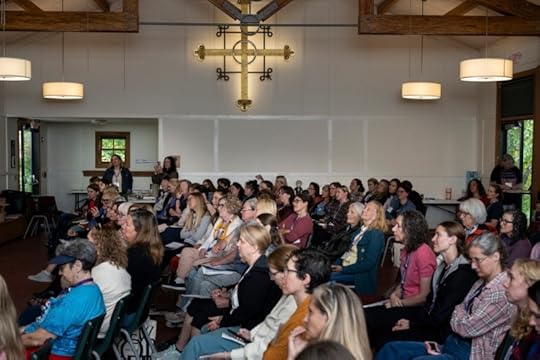 Photo Credit: Anna ReamThe God I Don’t Believe in, by Anonymous
The author is a mother and a grandmother and is making her first efforts to decorate her home with things she loves. She finds knitting in church to be a solace.
I used to have a lot of panic attacks and I’d feel like I just had to get up and run away. Maybe it’s too bad I don’t have them anymore—I got more exercise that way! But very recently, I realized that a lot of the panic attacks happened in situations connected to religion: church and the Exponent II retreat. I would hear things that would cause a terrible dissonance inside me, and I would flee. There were a couple different causes. One was that people were talking about positive experiences that I had never had and didn’t understand, like feeling a strong sense of community. But the other circumstance was that people were talking about a God that I eventually realized I did not believe in.
For this to make sense, I need to give you some background. I was born to a teenage mother who didn’t know much about being a mother. She had been told that you can feed your baby on the same schedule as you feed yourself, and then put the baby in bed after supper and let them cry. In three or four days they stop crying. And they do stop crying, because they have given up. So the first thing I learned in my life is that no one is going to come help me and there’s nothing I can do to change that. Then a few years later my father started to have sex with me, and told me it was my fault, and I believed all of that, so now I was a very bad person and fathers were not to be trusted. The Protestant church I grew up in didn’t put a lot of emphasis on God doing things for His children, so there wasn’t much dissonance there. But then as an adult I investigated and joined the Mormon church, and the dissonance started, and the panic attacks started.
People sometimes say it was easy for them to believe in a loving Heavenly Father because of the good relationship they had with their earthly parents. That works both ways. If earthly parents are not loving, it is very hard to think a Heavenly Father will be loving. So, to me, God was scary and capricious and did whatever He wanted to for his own purposes, no matter how much pain it caused me.
I didn’t want to believe God loved me. I already had one father who said he loved me, and I knew how that worked out.
But I had a couple of friends who kept insisting that God loves me and that it was a good thing. And I kept asking, “Doesn’t your balloon ever land?” They just kept insisting that I was wrong. Over time, they wore me down. Could it maybe be that they were right? I was starting to learn that the things my parents had done were not my fault. Was it maybe a little bit possible my friends were right? I began to think about the idea that God might be a Father who was kind and decent and truly loving—and it sounded so good! I wanted it to be true. I struggled and prayed for years, and eventually I began to think, for tiny moments at a time, that perhaps He really did love me, but I couldn’t hang on to the feeling. It would slip through my fingers after just a few minutes and then take months to find again.
After years of this, one day I had an idea. The idea was to write a letter to God, and then to write down the answer. I immediately thought it was a terrible idea, that it was probably some kind of heresy and I should forget the whole thing. Except I couldn’t forget it, and then I made the error of telling the two “balloon” friends, who both thought it was a great idea and I should do it immediately. I couldn’t stop thinking about it no matter what, so eventually I sat down and wrote my letter, crying and shaking so hard I could barely ready my own writing, and then I sat and waited for the answer.
The answer was from a Father who was loving and kind and patient, who saw my sins and loved me anyway, who wanted me to heal and grow. The answer had no condemnation, which at the time I couldn’t manage on the best day I’d ever had. The answer made me believe, in a way that I could never deny, that God loves me no matter what. And I never lose it anymore, and if I do, all I need to do is to say it, that I know my Heavenly Father loves me, and I feel it all again.
I continued writing letters for several months and they all helped me heal. One I remember in particular started when I was ina very bad mood but had an unshakable feeling that I needed to write a letter. I stomped around the house, livid, trying to locate a functioning pen. When I found one, I scribbled, “OK, OK, I’m here, what do you want?” There may have been an expletive or two in there. And there was no answer. “What, you won’t talk to me when I’m yelling?”
Finally there was an answer, very calm and quiet and not at all angry. “No, but you can’t hear me when you’re yelling.”
“Oh.”
My anger deflated and I proceeded to learn what my Father wanted to tell me. The letters helped me heal and reminded me consistently that He loves me.
But there was a lot of dissonance at church. The worst of it was caused by talks about a different kind of God: the God I don’t believe in.
This version of God is quite popular. I hear about Him a lot at church. The God I don’t believe in picks and chooses who He cares about, who He protects. I’ve noticed that many people are very willing to believe that God only protects some of His children, the ones that are in the right group: their group. The God I don’t believe in has a magic wand that He waves and magically stops bad things from happening to the chosen people. He heals some people’s bodies, and leaves other people to suffer. He is temperamental and capricious. I once heard Him described as letting bad things happen to us so we have to acknowledge how much we need Him—is this a God with thumbscrews? He rescues some children, and ignores the misery of other children. Eventually I figured out that either I had to stop believing in God entirely, or I had to believe that He is not at all like that.
He is not at all like that.
Years ago I heard a story in church about a girl who walked home through a park after a babysitting job. She saw a man sitting on a bench and he looked scary, so she prayed, and soon arrived home safely. Later that evening, she and her father were listening to the news and heard a horrifying item about a girl’s body found in the park. She told her father about the man she saw, they contacted the police, and their description helped the police find the man. When questioned as to why he didn’t bother the first girl, the man replied that she had not been alone, there were two men walking with her. My immediate and heartbroken reaction was to wonder what was wrong with the other kid that God couldn’t love her.
Of course, the answer is that nothing is wrong with the other kid. God doesn’t pick which children He protects because their parents taught them to pray, or because they belong to the right religion, or anything else. Bad things happen and God doesn’t stop those bad things from happening. I believe that one of Satan’s biggest and most successful PR campaigns has been to make humans believe that God protects those He loves, those He has chosen. If we believe that, then when something awful happens to us—we get mugged, we get sick, there is a natural disaster, there is a terrorist attack, anything—and we don’t get protected from it, we either hate ourselves for being the kind of person God cannot love, or we cease to believe a loving Father even exists. Either one suits Satan’s purposes.
I believe that all the promises of God, at least all the ones I know about, mean He will protect us spiritually so we will not become evil. God doesn’t see death as tragic. We are all going to die, the death rate on this planet is 100%, and when we die He gets us back. Becoming evil is the real tragedy. He promises to hold our hands and support us while we go through the terrible things that happen to us. And He does not stop the bad things from happening to us, because we signed up for this plan. What were we thinking? I imagine that we were thinking, “Great, I get agency, look how much it will help me grow,” and not thinking “Everyone will get agency, and some of them will use it to do really terrible things!” Maybe we had no way to even imagine the terrible things.
God loves us. He loves us all. He is not always enchanted by our behavior, but He always loves us. He doesn’t stop bad things from happening, He doesn’t stop helping us when we try to get through the bad things, and He never, ever stops loving us.
Sign up for the Exponent II monthly newsletter to stay updated with announcements and retreat registration information!
Featured image credit, Gloria Pak


