
Exponent II's Blog, page 26
May 20, 2025
Jesus, a Jedi, and a BYU Fan: The Good Samaritan Reimagined
A series of hopefully-not-too-presumptuous paraphrases of the parable of the Good Samaritan.
Guest Post by Rev. Katie Langston
—
A member of the Utah Utes booster club stood up to test Jesus. “Teacher,” she said. “What must we do to win the championship?”
He said to her, “What is written in the playbook?”
She answered, “Thou shalt play defense.”
“And what else?”
“You shall love the game with all your heart and with all your mind and your teammates as yourself.”
Jesus said, “You have said rightly. Do this and win.”
But wanting to make sure she was cheering for the winning team and not the losing team, the booster asked, “But who are my teammates?”
Jesus replied, “A certain Utes quarterback was on his way to the big rivalry game in Provo when he broke down on the side of the road and was stranded on the I-15.
“Now, by chance, the waterboy from the Utes saw him, but he was about to be late for warmups, so he kept driving by. Likewise, the special teams coach, when he drove past the place where the quarterback’s car was steaming off the side of the road, had to lead film study, so he told himself he didn’t have time to stop.
“But a BYU fan, with his face all painted blue and white with super tacky and much too large ‘Y’ flags flying on top of his Cougar-blue SUV, was moved with compassion. He stopped, called a tow truck with his own AAA coverage, and drove the quarterback down to Lavell Edwards Stadium.
“Which of these three, do you think, was a true teammate?”
The booster said, “The one who showed mercy.”
Jesus said, “Go and do likewise.”
—
A member of the Jedi council stood up to test Jesus. “Teacher,” he said. “What must I do to use the light side of the Force?”
He said to him, “What is written in the sacred Jedi Code?”
He answered, “You shall love the Force with all your soul and with all your strength and with all your mind and your brothers in the Force as yourself.”
And he said to him, “You have given the right answer. Do this and you will master the light side of the Force.”
But wanting to make himself more powerful than the rest, he asked, “But who is my brother in the force?”
Jesus replied, “A certain Jedi master was traveling from Tatooine to a distant corner of the Galaxy and was ambushed by a band of space pirates, who disabled his shields with torpedos, boarded his ship, stole all his cargo, and left him floating in space with his air supply dwindling.
“Now, by chance, one of the Jedi military commanders heard the Jedi master’s distress call, but he was en route to an important meeting of the generals and passed him by. Likewise, Han Solo and Chewbacca, when they came to the place where the ship was, were too busy fleeing a bounty hunter to stop, so they put their ship into hyperspeed and zoomed off.
“But a Sith Lord heard the call and turned around to investigate, and was moved to compassion. He brought the Jedi master aboard, fed him and gave him medical care, and repaired his ship. Which of these three, do you think, was a brother in the force to the man who fell into the hands of the space pirates?”
The Jedi Master said, “The one who showed him mercy.”
Jesus said to him, “Go and do likewise.”
—
A gun control activist stood up to test Jesus. “Teacher,” he said. “What must I do to confiscate all the weapons?”
Jesus said, “What do the political strategy books say?”
He replied, “You shall love your preferred policy positions with all your heart, might, mind, and strength and your allies as yourself.”
Jesus said, “You have said rightly. Do this and you will succeed.”
But wanting to make absolutely certain he knew who to target with his non-stop text messaging campaigns, he asked Jesus, “And who is my ally?”
Jesus replied: “A certain protestor was at a gun-control rally when things got heated. The protestor was caught up in a riot and was left on the ground, injured. One of her movement leaders saw her there but ran away quickly so as not to be among those rounded up by the police. A politician she was supporting also saw what had happened but was on the phone with his PR staffer trying to get out ahead of the story and didn’t do anything to intervene.
“But a counterprotester in military fatigues, who was open-carrying a formidable-looking rifle, saw her lying there and was moved with compassion. He picked her up, took her to the hospital, and waited three hours until she was discharged before driving her home.
“Which of these three, do you think, was an ally to the one who was caught up in the riot?”
The activist said, “The one who showed her mercy.”
Jesus said to him, “Go and do likewise.”
—
A voter stood up to test Jesus. “Teacher,” she said. “What must I do to Make America Great Again?”
Jesus said, “What does DOGE say?”
She said, “You shall love your country with all your heart, might, mind, and strength, and you shall love your fellow patriots as yourself.”
Jesus replied, “You have said rightly. Do this and America will be made great.”
But wanting to make sure America was *especially* great, she pressed further. “And who are my fellow patriots?”
Jesus said: “A certain member of the president’s cabinet was being harassed in a DC restaurant. A social media influencer of the same political party started livestreaming it so he could capture a viral moment and make everyone mad. Another member of the cabinet hurriedly paid for her meal and scooted out the back door before she could be recognized and likewise harassed.
“But an undocumented worker who was bussing tables came over, defended him, and cleared the harassers out of the restaurant. Then she bought him a drink and gave him dessert on the house.
“Which of these three, do you think, was a fellow patriot to the one who was being harassed?”
The voter said, “The one who showed him mercy.”
Jesus said, “Go, and do likewise.”
—
I stood up to test Jesus. “Teacher,” I said. “What must I do to inherit eternal life?”
Jesus said, “What is written in the Scripture?”
I replied, “Love the Lord your God with all your heart, with all your strength, and with all your mind, and love your neighbor as yourself.”
Jesus answered, “You have said rightly. Do this and live.”
But wanting to make *sure* I was righteous, I asked, “But who is my neighbor?”
Jesus answered, “A certain middle-aged lady from Hurricane was taking a hike out in Snow Canyon when she became overheated. She definitely should not have made the poor life choice to hike in the middle of the day during the summer, and this is absolutely hypothetical and not at all something anyone in this room would ever do.
“A park ranger drove by but was too annoyed that the guest had not packed more water, so he drove on. Likewise, a group of much wiser people, who were sitting safely in the shade, saw her from a distance and thought, ‘She isn’t very bright.’
“But a person she thought was her enemy came over and poured cool water over her head and gave her a sunhat and let her sit in the air-conditioned car until she could breathe again.
“Which of these three,” Jesus asked me, “do you think was a neighbor to you?”
I answered, “The one who showed me mercy.”
Jesus said, “Go and do likewise.”
—
Friends, who is that person for you?
Who do you struggle to see as your neighbor?
We all have them, but you know who does not?
Jesus.
By His grace, may we all be neighbors who give and receive mercy in the most unexpected places.
Amen.
Katie Langston is a doubter by nature and a believer by grace. She is pastor of mission and outreach at New Promise Lutheran Church in St. George, UT, director of digital strategy for Luther Seminary’s Faith+Lead, co-host of the Enter the Bible podcast, and author of the spiritual memoir, Sealed: An Unexpected Journey into the Heart of Grace. She lives in Hurricane with her husband, two daughters, a dog, and two cats. In her spare time, she enjoys hiking, cheering on the Minnesota Lynx, and watching the handful of television programs she can’t live without.


May 19, 2025
Relief Society: A Cool Women’s Organization to Learn about Men
Male voices and viewpoints in LDS Sunday church meetings have been dramatically overrepresented since the founding of the church, yet most members I interact with are completely unaware of the phenomenon. (But once you see it, I guarantee you’ll never stop seeing it!)
It was 2013 when I began to notice it for the first time. We were still studying Teachings of the Prophets in Relief Society and Priesthood meetings back then. That year was Lorenzo Snow, and one of the lessons was about the Relief Society. I had recently purchased a book about his sister – Eliza Snow – who had been the general Relief Society president for over two decades. I wondered if they would turn this chapter over to her, given the topic and his close relationship to Eliza. After all, we’d just spent well over a decade of Sunday lessons exclusively covering the teachings of male leaders, despite Relief Society being the weekly women’s meeting of the women’s organization. Surely one lesson (every other decade or so) could be about something a woman taught.
That didn’t happen. Instead the lesson talked about an all day Relief Society activity that women had planned and carried out, to which Lorenzo Snow was invited to stop by and speak at mid-day. He’d had nothing to do with the Relief Society before or after (as it was an entirely independent women’s organization at the time) or what was going on at the event, and yet he (with the important qualification of being a man) was invited to give the keynote address to the women. The lesson writers had to stretch things so far to write a lesson about the Relief Society – but keep it connected to a man – that it felt silly. I imagine them poring over historical documents until someone jumped up exclaiming, “Eureka, I found a connection! Lorenzo once spent an hour at a Relief Society event as a visitor!”
In his speech Lorenzo Snow brings up how important women are, and as his example explains that because the women stayed home and took care of everything by themselves, their husbands were freed up to travel overseas and spend years as missionaries for the church. “Thank God for the women of this Church!”, reads a quote by him in the manual. (This explanation by a church president is funny to me – isn’t a common excuse for polygamy that the women couldn’t take care of themselves and had to be married to a man to survive? Lorenzo Snow is praising women in this lesson for not needing men and doing everything on their own just fine.)
A year later in 2014 it was Mother’s Day in my ward. On that one day per year that we claim to honor women’s voices and value femininity so much, I was curious what the lesson in Relief Society would be. Believe it or not, it turned out to be a lesson about…drum roll…two men! The title was Joseph and Hyrum Smith, Witnesses for Christ. These male-centric lessons made it difficult to focus during class. How was everyone surrounding me so oblivious, and why did no one else notice the strangeness of us bragging about belonging to the “largest women’s organization in the world” while only ever learning about and discussing men?
This spring a short video by Jared Halverson went viral. In it, he pleaded with women to not leave the LDS church and stated his genuine shock that women were leaving religion more than men for the first time in history.
Shortly after, I appeared on a Mormon Stories episode with fellow Exponent II blogger Katie Ludlow Rich where we discussed why women are leaving for three hours.
Jared’s controversial clip was pulled from a much longer video on Youtube where Jared taught the entire Come Follow Me lesson titled “An Elect Lady”, covering D&C 23-26. Watching the full video, it felt equally absurd as the two lessons I just wrote about from 2013 and 2014. Jared talked first about how amazing it was that Emma, a woman, had an entire section given to her. This showed him that women were incredibly valued and important to God. I scratched my head and wondered how getting only one section for a woman out of almost 140 directed at men felt like something to brag about.
Jared then went on to give the most male dominated lesson possible, right after framing his lesson as the woman power lesson of the year.
To be very clear, I don’t think Jared is a bad guy. I don’t have any reason to believe he is purposefully sexist or misogynistic. My gut tells me he is a really nice guy who is so steeped in this patriarchal system that he (like so many other church members) is blind to what he’s doing.
In Jared’s lesson I carefully counted references to women or girls, and being incredibly generous to him, I counted only four women (or groups of women) out of thirty two references to either men or women.
First, the women he mentioned in his 90 minute lesson:
Historical women: Emma Smith
Women from his personal life:
His wife – but technically it was a story of something nice he did for his wife. (I told you I was being generous counting these!).
The story of him receiving revelation for a female student in his class, and how he told her what God wanted her to do.
A recap of the great advice he gives to the wives of newly called bishops.
Total: four women mentioned, only one by her name and as the main actor in the story.
And now, the men mentioned:
Historical men: John Whitmer, Oliver Cowdery, Hyrum Smith, Samuel Smith, Joseph Smith Sr, Joseph Knight Sr, Joseph Smith, male missionaries, Heber J. Grant, J. Golden Kimball, Brigham Young, Parley P. Pratt, W. W. Phelps, and he quoted a song written by a man.
Men from his personal life:
His patriarch
A high councilor in his stake
His bishop
A seventy who came to his mission in Puerto Rico
All of the priesthood leaders on the entire island
The elders from the mission
A district president discussing how to do his calling in three hours a week
First hour, meet with all the male priesthood leaders under him
Third hour – splits with the elders. (Second hour was just with his family – no mention of genders.)
Deity: Heavenly Father and Jesus (no mention of Heavenly Mother).
Total: twenty eight men, 17 mentioned specifically by name, and all of them were the main actors in their stories.
Can anyone imagine decades of Elder’s Quorum lessons where close to 100 percent of the lesson material was teachings by female leaders? Would men put up with the same lack of representation women and girls endure?
May 18, 2025
Guest Post: Milton Meets Mormon Midrash
“Milton Meets Mormon Midrash”: A review of Brighter and Brighter until the Perfect Day by Sharlee Mullins Glenn, reviewed by Maxine Hanks
This epic poem by Sharlee Mullins Glenn takes its title, Brighter and Brighter Until the Perfect Day, from the LDS Doctrine and Covenants, and like scripture, it is a visionary text of imagination and revelation. This work echoes biblical, Mormon, and apocryphal texts, and uses myth and poetry in mythopoeic quality. It also reconsiders Milton’s Paradise Lost in content and form, while challenging Milton via LDS theology.
Like Milton, it revisits the Genesis story, reimagining the creation of humankind and Adam and Eve’s fall from Eden, expressed in blank verse. Yet, unlike Milton, it unites orthodox and heretical Christianity, as does Mormonism. It offers “a coherent worldview that sees God, Christ, Satan, and all of humanity as manifestations of the same kind of being, separated only by degree.” [Foreword, Mike Austin]
Sharlee’s synthesis aims to “bring together various doctrines … agency … feminine divine … love … truths about intelligence, light, and matter into one coherent whole.” She uses theology as “speculative in nature” in “a literary experiment of sorts” with “creative excogitation” to “create a framework that could accommodate both revealed doctrine and reasoned speculation.”
Speculative theology lives between the traditional and revelational, the accepted and new, the known and unrealized. This is revelation or gnosis. And revelation itself is paradoxical; it partakes of and transcends previous knowledge. Revelation is living water emerging from the source, bursting through a reflective pool.
Sharlee’s epic is speculative and paradoxical and revelatory, like Mormon theology—it lives between the revealed and yet to be revealed, and synthesizes spiritual truths within the human and mortal truths within the eternal. It’s also Mormon feminist theology—envisioning an inclusive God, both male and female, who embodies a primordial unity of partnership as the blueprint for human society.
Speculative theology, revelation and paradox are central to feminist theology. New revelation is feminist because it breaks through male-centric views and patriarchal tradition to obtain further light and knowledge.
“Mormon feminist theology is by necessity speculative, since it has to move beyond current beliefs to reveal unrealized aspects of religion.” [Hanks, “Toward a Mormon Feminist Theology” Sunstone Symposium, 1990].
The LDS Restoration used both revelation (gnosis) and feminism to shatter old traditions, by asserting new revelation coming from direct personal relationship with God, and including women in theology.
Growing “brighter and brighter” toward perfection requires discerning truth from error, light from darkness. “That which is of God is light; and he that receiveth light, and continueth in God, receiveth more light; and that light groweth brighter and brighter until the perfect day…you may know the truth, that you may chase darkness from among you.” [D&C 50]
Sharlee sees this process as a dual one—via spiritual power from Christ, and purification by the Holy Spirit, “the life and the light, the Spirit and the power, sent forth by the will of the Father.” These attributes reflect two different members of the Godhead. This echoes Paul’s vision of “Christ [as] the power of God and the wisdom of God.” [1 Corinthians 1]
However, Sharlee interprets the Spirit as the divine feminine, a female member of the Godhead, who works together with Christ to redeem us. Both Christ and the Spirit (or Wisdom) assist us in discerning truth from error, thus grow into greater light. The implication of her reinterpretation of D&C 50 is that it seeks to remedy error with truth.
Yet Sharlee’s vision is faithful to Mormon theology as a Christianity that returned to the source of living revelation to correct tradition by restoring higher truth, wisdom, inclusion and reconciliation. Unlike Milton who saw heaven and hell as fundamentally separate realms, Mormonism married heaven and hell in hermetic relationship, as degrees of knowing and being, since all souls are family with shared divine light and humanity. “You will share relationship divine with every child of ours upon the earth.”
Sharlee reaffirms and recreates Mormonism’s daunting process of universal inclusion and redemption via spiritual relationship. She uses mythopoeia, to access a visionary realm beyond allegory where higher truths reside, as Tolkein theorized. Sharlee’s myth seeks a spiritual vision lost with Paradise, thus echoes the Silmarillion and Book of Moses by revisiting Genesis to reexperience creation.
“Before the world was formed” the “hosts of heaven, dressed in robes of light convened … a fellowship of beings who shone most brightly with the light of truth.” These are Ilúvatar beings or Aeons, the Elohim in the pleroma or fullness of heaven. El and “Elah” Father and Mother preside “unmatched in luminescence and in grace …They spoke as one though two … in truth and light. Intelligence … Eternal Life.“
In heaven, all beings, light and dark, have the same Source, all connected yet free to evolve any direction from God. Sharlee’s divine Mother acknowledges Satan as her wayward offspring—”Oh, Lucifer, my son.” This is much like the gnostic Sophia who gives birth to the demiurge (half god). Mormon theology sees Jesus and Lucifer as brothers, both sons of God, beings of light, but one is fallen. Mormon Jesus becomes Jehovah (Lord god), unlike the Gnostic Jehovah (demi-god), and the Hebrew Jehovah (most high god), and the Christian Jehovah (Father god).
Yet a deeper spiritual message common in all these traditions is “the anointed one” (messiah, christos, gnostikoi) who in this fallen world is awakened to divine light within, and manifests the truth in himself, then brings other souls to remembrance of our shared spiritual relationship to God.
Mormon Jehovah as Jesus redeems the world which he helped create; yet creation is also a combined effort of Gods with Jesus and heavenly hosts. Sharlee follows this premise further to suggest that redemption is a combined effort as well.
Sharlee reiterates the Mormon view that every soul inherits eternal light from God, yet each also receives “a portion of the light” that the Son possesses as well. In addition, Sharlee suggests that the divine Mother will attend to each soul, spiritually. Thus, each soul receives a triune dose of divine light.
Also, other beings of light or “seers we will appoint to be your guides” in the world to aid in spiritual remembrance of knowledge of true self as co-existent with God, not simply His Creation.
Sharlee’s theology of creation and redemption is distinctively Mormon, with echoes of Jewish, Hermetic, Christian and Gnostic beliefs, as Mormonism united features of those traditions. “The light you bear, the light you gain, the light you share…O God, may we receive Thy light…Illume our minds, enlarge our hearts Beam out thy blaze into our souls… before thee—radiant, whole.”
Mormon salvation is the recovery of divine intelligence, light and truth (D&C 93) yet this an embodied gnosis of spirit within flesh, anchored in human agency and relationship. Heaven and earth, spirit and flesh are related by degrees, one universal family. “For we must set you free for you to grow…You must return of your own free accord and join yourselves again, embodied souls, to us and to each other and to Christ…we are knit as one through quantum intertwining.”
Sharlee’s feminist midrash enters with Ora, the sister of the Son, daughter of El and Elah, who like her brother, offers a sacrifice to save the human family. She will delay her own mortality until all human beings have incarnated. Ora will be last, as Christ is first, Omega to his Alpha, “a paired redemption.” She says,
“As a spirit—I remain and choose to wait to clothe myself in flesh ‘til every other spirit has been born? Then I, unbound by body, could abide and act as witness, comforter, and guide…a bearer of the light… transmitting beams from Elohim’s own throne…not circumscribed by time or space, but omnipresent… in the Eternal Now— and in and through all things, creation’s breath and Source.“
Yet this midrash favors the Mother, Elah, over the daughter Ora, as partner of Christ. The Mother will set aside her divine body, to serve as the Holy Spirit for humanity. This is a unique feminist theology, even for Mormonism, yet this midrash can explain the absence of the Mother in both Christian and Mormon Godhead.
A female presence attending all human beings shows up in other theologies and cosmologies. In biblical apocrypha and Old and New Testaments, Wisdom/Hokhma/ Sophia appears repeatedly as dwelling with humanity. Christian texts cite the Holy Spirit in words with feminine or neutral gender.
In Mormonism, God is both Father and Mother who govern the world; yet a notion of divine Mother as co-redeemer with Christ, and member of the Godhead, is unrealized in Mormon theology (other than by feminists).
A mother and sister figure manifest in humanity as Mary the Mother and Magdalene the companion of Jesus, who embody the divine feminine in life.
Elah the divine Mother might serve as Holy Spirit, since gods have abilities beyond human conception. A female God could be a member of the Godhead and intercessor for the human family. In Catholic theology, Mary a human mother plays an intercessory role for humanity, which surely a divine being could as well.
The Holy Spirit sent by Christ to tarry with us, is feminine in the Hebrew and the Aramaic, and neuter in the Greek, not masculine until Latin translations. The feminine Shekhinah is the presence of Jehovah God among mortals in Judaism and Kabbalah. Wisdom/Sophia is the divine presence among humans who “maketh men prophets and friends of God” in apocryphal texts. And the Woman in Revelation is the body of believers converted by the Spirit. The sacred feminine is always a partner with God in human redemption.
One common theme of the sacred feminine is Her descent—from higher realms to lower, to enable redemption in the depths, after which, she ascends. Eve, Sophia, Shekhinah, Mary, and the Magdalene, all descend and ascend to enable salvation.
Sharlee illuminates Mormon redemption as possibly more than Christ-centered—as dual centered or sourced in more than one member of the Godhead. She says, “Christ’s atoning sacrifice” of forgiveness is coupled with the Holy Spirit as the “purifier…given the power to restore your injured souls.”
This reinterprets the role of Christ as power, and the Holy Spirit as purifier, both sent by the Father—yet the “power” of Christ is masculine while the “purifier” or Holy Ghost is feminine. This interpretation is possible since the biblical words for spirit and wisdom are feminine, or ungendered. Also, all references to the Holy Spirit or Holy Ghost in the D&C are ungendered, not masculine.
Sharlee’s feminist theology uses the Mormon doctrine of the godhead, but suggests there may be more in that partnership of gods than male figures alone. It also explains why the Mother as Holy Spirit, could be found in “clouds, in fire, and sunrise, and… dove… the cry of newborn babes…whisper of the breeze…in whirlwinds and …pillars of pure light, in wombs, and tombs… blades of grass.”
Sharlee’s theology says that Elah can’t be both embodied and omnipresent, so She retreats into her spiritual dimension to move upon the world. This is a Christian notion, that divine embodiment and omnipresence are mutually exclusive. The Holy Spirit solved a theological problem, yet still begs a question—is God truly limited in form, or does Godhood transcend form? Can God appear as human yet also as a pillar of fire or whirlwind or ray of light or spirit brooding upon the waters?
In theology, divine beings aren’t always stable or static, they shift, morph, change places as archetypal figures in a cosmic dance, sometimes trading genders or appearing in different forms, like wisdom and understanding or wind and fire. We humans tend to limit the divine to our perceptions.
A divine feminine who lives amid humanity is found in biblical and apocryphal texts, where Wisdom incarnates. “Wisdom calls aloud, she raises her voice in the public square; on top of the wall she cries out, at the city gate she makes her speech” [Proverbs 1]. “Wisdom exalteth her children, and layeth hold of them that seek her.” [Ecclesiasticus 4] “Wisdom is vindicated by all her children.” [Luke 7:35]
I have described the Mother in poetry as—”animating life all around me, in the eyes of every woman and man, in the songs of children, cries of babes, in laughter and pain, the world was your witness, the soul of every human being was your home.” [Dove Song, 2018, pp. 157-158].
Can we find the Mother’s presence only in theological ideas and words, mostly written by men? What if She is known in dreams, vision, music, singing, dance, art, food, female bodies, human touch, and love? One gnostic text asks: With what words shall we praise thee, or with what thought comprehend thy majestry? …How shall we extol thee?… Sophia answered, saying, “Ye shall dance, sing, feast, make music and love all in my praise. For mine is the ecstasy of the spirit, and mine also joy on earth.” [Liturgy of the Gnostic Sanctuary]
Mormon theology connects heavenly beings intimately with earthly ones as one spiritual family. Sharlee reiterates this unity where Eve and Mary and female prophets work together with El the Father, Elah the Mother, and their Son and daughter, all involved in universal salvation.
Yet here the Mormon notion of Jesus as physical offspring of the Father gets a traditional Christian tweak—by having the Mother as Holy Spirit convey God’s divine seed to Mary. “To you the Holy Spirit will convey the seed of El, for half divine the child must be to have the pow’r to overcome the world.” Mary is impregnated via the Spirit, in divine artificial insemination. This midrash seems an improvement.
However, we don’t learn who Ora the daughter will become on earth, other than a female prophet who reveals the divine Mother. She’s a mystery, but possibly Miriam, the first female prophet in the Old Testament, after whom all Miriams / Marys are named.
“Ora, treasured daughter of the light…will speak with power and with might—a prophetess of courage…once again revealing Mother God…ushered back and to the holy temple be restored, thus heralded by one so foreordained—a mighty prophetess who will proclaim the doctrine of the Mother God Divine.”
Sharlee’s re-creation of the Garden of Eden features two Elohim, Father and Mother, co-presiding over the genesis of humanity, which makes theological sense in Mormon theology with Father/Mother gods.
Yet Sharlee’s creation story also aligns with traditional interpretations of Genesis, where God makes a woman from man. He extracts an XX from an XY chromosome to create a female from a male. Yet if sex chromosomes can morph, Y may come from X, since the Y chromosome has been shrinking over time. And all embryos begin as undifferentiated or seemingly female, so males emerge from that original form. And every male is birthed by a woman.
In Genesis, the creation of mankind as “ha adam” can be read as generic human, an androgynous figure, who is separated by God into male and female beings. This mirrors the creation of life in the womb, where an embryo is “undifferentiated” then develops as male or female.
Interestingly, Sharlee’s forbidden fruit is animal flesh which transmutes Edenic beings into humans. This could offer a reason why ancient priests sacrificed animals to commune with God. It also mirrors the evolutionary leap of primitive humans whose brains rapidly developed after eating meat.
Sharlee’s 2nd coming of Christ is more than the return of Jesus, but a return of dual salvific figures—the Son who brings redemption and the Mother who brings purification, each returning in their own way. He descends to be with us on earth, and She ascends to be herself in heaven. This is a striking feminist theological idea.
“Jesus Christ, Redeemer of the World will come again… to reclaim all those He has redeemed. And God Shaddi Almighty will again take up Her body and ascend to take Her place upon the throne.” Interestingly, His descent and Her ascent coincide as connected, to accomplish our collective redemption.
This evokes the Christian Assumption of Mary into heaven and her Coronation as Queen. After Mary completes her role as mother of the redeemer, and intercessor for the human family, she ascends to reign with the Father and Son. Mary has long been depicted in Christian art and liturgy as assumed into heaven, like Christ ascended.
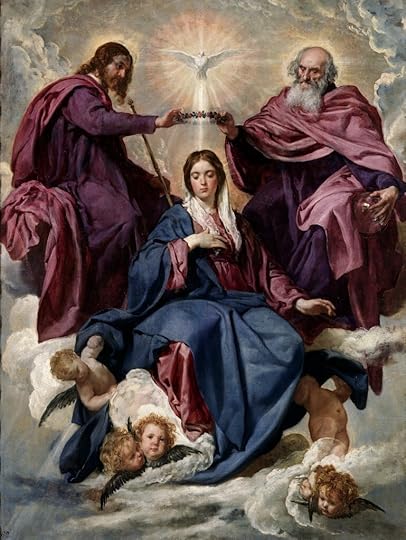 Coronation of the Virgin by Diego Velázquez,
The ascent of Mary as heavenly woman also evokes the Bride or Church redeemed and ascended to heaven after Christ’s atonement and ascent made it possible for all to follow. Sharlee likewise envisions this collective redemption of the human family, saying, “All who overcame the world, bearing tribulation, will be fed, and led to fountains pure and free.” This redemption or ascent of humanity coincides with the return of Elah the Mother to heaven. Hildegard von Bingen depicted such a redemptive ascent of the Church in the arms of Sophia as Mother.
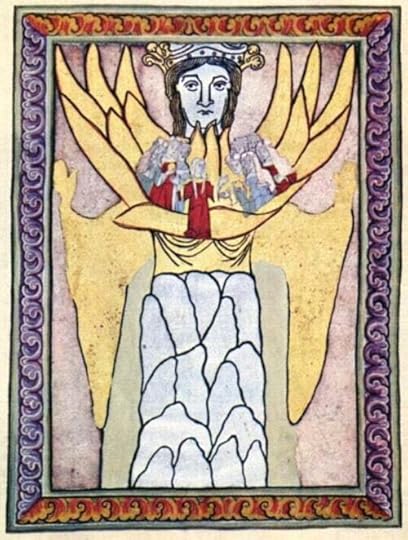 Sophia / Wisdom by Hildegard von Bingen
Sharlee’s midrash of Creation. Fall and Redemption could be used liturgically, just as the LDS temple endowment is a midrash of Genesis—completing the sacred story of Adam and Eve by redeeming them from the Fall and returning them to the presence of God. This epic poem parallels the temple endowment, yet it restores the missing female Elohim long omitted from LDS temple rites, like the loss of ancient Asherah long missing from Hebrew temples. Sharlee’s cosmology recovers the sacred feminine in the godhead to fulfill the Restoration’s dual-gendered divinity.
Theology always reflects a theologian’s own views, yet can’t be dismissed as merely human invention—if we are offspring of God with access to the divine. Also, one view of God, no matter how authoritative, can’t grasp all of God. It may take all of God’s offspring to know all of God, which is why salvation is universal.
“And none of them that my Father hath given me shall be lost.” [D&C 50]

Maxine Hanks is an historian and theologian focused on feminist work in Mormon tradition and Christian liturgy. She lectured in Women’s Studies at the U. of U., with bachelor’s in Gender Studies, masters’ work in History, graduate studies in theology at Harvard, and liturgy at Holy Cross. She writes and lectures on religious studies in Salt Lake.
May 17, 2025
What Happens When You Outgrow Your Advocacy?
Publishing my profile on the Ordain Women website in 2014 felt like a radical, subversive act. I did not add my last name and struggled with selecting a photo because hitting “publish” meant putting private, subversive, vulnerable thoughts out into the world wide web. Yet, women I admired were literally standing in lines outside the temple and facing in-person, physical rejection. I could find a sliver of their courage and post my profile.
I haven’t read this profile for years. I look at it today and it still embodies the heart of why I believe in women’s ordination and how I came to this belief. I still had years ahead of me to realize that this type of sensible, heartfelt post could never be enough to create any real, systematic change. Even sharing stories of literally crying to God in the temple, praying and receiving answers, and witnessing how rigid gender roles deeply hurt gender non-conforming loved ones could not make a difference.

But 2014 me had real hope and still believed in a church that could – and might even want to – change. In fact, this part of the profile sticks out to me. I said, “These inequalities did not necessarily lead to the idea of ordination for me until recently. I see many solutions within the culture and structure of the church that could address some of these inequalities. Some are as simple as changing which callings require priesthood authority, reinstating the previous Relief Society autonomy, and addressing some of the language we use within the church.”
I desperately wanted to stay in my faith tradition and hold fast to those covenants made. Even today, I think that a few, pivotal experiences changed me and forced me to continue progressing. Had I experienced compassion, respect, compromise, and openness earlier on, some of the changes we’ve experienced over the past ten years may have been enough. After all, when the LDS Church excommunicated Kate Kelly, I passionately quoted her saying, “Don’t leave. Stay, and make things better.”
Looking at the LDS Church in 2026, some might say, “Isn’t it better?” and “Look at the changes they’ve made” and ask, “When will it ever be enough?”
It’s true – women can now wear tank tops with garments, men don’t have to be the last speakers or say the closing prayer, girls and young women are made ushers, they’ve apparently removed some difficult language from the temple ceremony, the new “For the Strength of Youth” is less prescriptive, and some men faithfully call women “President.” Yet, here I am; a feminist who is never satisfied.
And I wish it was enough. Except, I’ve changed and grown over the past 10 years too. What would once satisfy me as an explanation for God’s inequality and inequity, what changes could once balm and bandage enough to soothe the pain and confusion of them in this life, stopped working. This happened, not because I am lost or wicked or led astray. This happened because I learned of my worth and I am no longer willing to settle for tradition and comfort in place of equality.

I’m also exhausted by incremental changes celebrated as major wins that ignore, deny, and diminish past pain. For example, while I’ am happy that LDS women now have more freedom to define “modesty” while wearing garments and may be more comfortable, I am angry that these change comes without discussion. What about the entire “mod” industry built on selling a third layer to garment-wearing women, so our sleeves wouldn’t show under cute dresses or little girls being objectified by putting shirts under dresses? How is something once so imbued with spiritual importance now simply an administrative change? How can current revelation around sleeves end discussion so thoroughly, erase women’s experiences, and become such a win for men?
And why can we receive revelation on sleeve length, but this inequality thing is a real mystery God won’t address?
I do not want leaders making incremental efforts to stop making an effort, or for leaders to put away their copies of Neylan McBain’s Women at Church. These genuine gestures and acknowledgments matter to many women and signal that men are listening, that they care, and that they will take action. The changes suggested, however, no longer give me buzzes of hope. They will never be enough for me now. I believe ordination for everyone is God’s plan and anything less requires upholding and perpetuating a harmful patriarchal system. Once I saw it, I could not un-see it.
After all this, I still don’t think Kate Kelly was wrong. She would later recommend that those staying evaluate their mental, spiritual, and physical health along the way. Please follow this advice because you don’t have to sacrifice yourself to stay in the church, to change it, or even to please people who say you should leave.

For many women, staying and pushing for, and celebrating incremental change is meaningful. It brings them hope and purpose. Even I “stay” in my own way by attending sacrament with my family and writing for this blog every month. But I do so in a way that represents purpose and faithfulness for me without worrying how that looks to or for anyone else.
People will always challenge us when we change and grow. They’ll remember past words and promises and mourn the loss of who they want us to be. But we are allowed to learn new things, gain deeper understandings, change our minds, and build and rebuild our belief systems. Outgrowing things you once advocated for often means that you were advocating for good, but now you’re advocating for better and best.
May 16, 2025
I Used To Work The Streets Part 2: How I’ve seen Abortion Laws Hurt the Most Vulnerable in Society.
My partner and I got a call on the radio, “2 Alpha”.
Allergic reaction emergency.
We put the ambulance in gear and took off toward the specified location. As we made our way into the apartment, we saw a young woman with two older men, one closer to her in age and the other much older.
The young woman was lying on the couch, with a heat pad wrapped around her waist and a miserable look on her face. My partner and I immediately began to assess her breathing and other vitals as we asked questions to figure out what the allergic reaction was.
The two men looked at me nervously as they tried to explain that the young woman was reacting badly to a prescription given.
“What is this prescription for?” I asked
Silence…
I asked more questions, but got confusing responses.
I looked at the woman, and I saw that in the time we have been there, she intermittently had pain in her abdomen. As I got her to describe more of her symptoms I asked, “Are you pregnant?”
“Yes, 8 weeks.”
“Is this prescription to abort the fetus?”
“Yes”
Nervous looks are exchanged between the young woman and the two men.
Fear was in the room.
“You are safe, you are not in trouble. This also is not an allergic reaction. This pill has forced your body into labor and the symptoms you are describing are normal. This is what it feels like to go into labor.” I tried to reassure everyone in the room. I was the only person in that room who had birthed children.
My partner, a young 20 year old male, looked at me with wide eyes and shrugged his shoulders, telling me he was clueless in what to add in advice and care.
Roe v. Wade had been turned over about a month prior and I knew the fear they had.
“I just got out of drug rehab, I can’t handle being a mom yet.” She told me as we walked to the bathroom to see if she was bleeding yet.
I explained to the young woman and the men with her, what to keep expecting and what all her options were now that their fears of an allergic reaction and getting arrested had subsided. They opted to go to the hospital themselves just to do a check up and make sure things were progressing like they should.
Note- these people were afraid to seek proper care.
I also told them about Utah’s Planned Parenthood locations (they had driven out of state for care because they were afraid to get help in Utah). I told the young girl about the education, guidance, and care she would get from them at the time (laws are changing fast).
It was clear in talking to this young girl, that she was not aware of many aspects of her own menstrual health and especially about being pregnant.
Her experience made me think about local elections that had just taken place and how one of the candidates I was researching (and did not vote for) was advocating for all things sex and sexual health related to be taught at home by the parents and left out of schools’ curriculum.
I don’t know about you, but my parents did not teach me about my sexual health other than, what to wear when I had my period and the penis makes one pregnant when it enters their vagina. Much of what I learned (that was true and helpful) about sex, female anatomy, and health issues regarding both- came from my husband when he was in medical school and books I read.
It made me think of the Utah legislature and the work done by The Policy Project to get period products in schools. There were male legislators that thought women could hold their period blood like urine and release it when they wanted to…like going to the bathroom.
Adult married men thought this.
I later sat with my partner in the ambulance as he questioned me about everything that had just occurred. Although he had been taught how to assist in emergency deliveries, he had not been exposed to anything like this before and as a young man, did not worry about what it meant to have Roe v. Wade turned over.
After this experience, I taught OB emergencies for a couple of years to EMTs earning their Advanced certification. I would bring up this experience to help them see the nuance of what they could encounter and how to help.
One of the most disheartening reactions from a student I received was when a young man asked, “did you call for the police to arrest her?”
“What?” I was surprised by the question, “No, no I did not.” I responded in reply. This is also not against Utah law until 18 weeks pregnant, but goes to show how unclear the issue and laws are to citizens.
First Responders deal with patients on drugs the majority of the time and many times we help and assist them in care without the police being dispatched with us. If our own safety is not an issue, we do not call the cops and we do not seek to get our patient in trouble so to speak. Students in my classes have never asked about calling the cops on people in these scenarios.
We care for their physical needs, that’s it. We save them.
There have since been laws passed in Utah that have limited where women are allowed to seek care when pregnant. This is not to speak of the myriad of other laws in other states that are criminalizing women and severely limiting their health care as well.
American’s like to think of themselves as being a superior first world country with state of the art health care and systems. Yet our women are severely under-educated about their own bodies and how they work. Their access to clinics that can protect them, teach them, and give them care are closing down.
I was my precinct’s delegate this last election cycle. I passionately spoke to my current Senator up for re-election about how upset I was that he voted for this bill that limited women’s access to care. I pointed out the hypocrisy of his pro life stance in regards to Utah repealing many of its protective gun bills and making it easier to access firearms.
Utah also passed a law requiring schools to teach gun safety…but don’t you dare talk about sex and how to be safe there.
I have felt many times when on the ambulance, that I was entering an alternative universe and looked at the people we as a society try to pretend don’t exist.
Not all issues impact each of us or affect our personal lives, but that doesn’t mean other humans don’t exist and are not negatively impacted by our naive lawmakers and laws.
My personal health and safety are not at risk. I live a very privileged life as many others do. The scary thing about that is, we privileged are the ones who tend to be more capable of or allowed to make change…running for office, voting for others, paying for health care etc.
To me, advocating for others and making it possible for them to advocate for themselves is akin to mourning with those who mourn and comforting those who stand in need of comfort.
I Used To Work The Streets Part One
Related Posts to I Used To Work The Streets.
Submit a guest post! Learn more about our post guidelines and use the submission form on our guest post submission page.
I Used To Work The Streets Part 2
My partner and I got a call on the radio, “2 Alpha”.
Allergic reaction emergency.
We put the ambulance in gear and took off toward the specified location. As we made our way into the apartment, we saw a young woman with two older men, one closer to her in age and the other much older.
The young woman was lying on the couch, with a heat pad wrapped around her waist and a miserable look on her face. My partner and I immediately began to assess her breathing and other vitals as we asked questions to figure out what the allergic reaction was.
The two men looked at me nervously as they tried to explain that the young woman was reacting badly to a prescription given.
“What is this prescription for?” I asked
Silence…
I asked more questions, but got confusing responses.
I looked at the woman, and I saw that in the time we have been there, she intermittently had pain in her abdomen. As I got her to describe more of her symptoms I asked, “Are you pregnant?”
“Yes, 8 weeks.”
“Is this prescription to abort the fetus?”
“Yes”
Nervous looks are exchanged between the young woman and the two men.
Fear was in the room.
“You are safe, you are not in trouble. This also is not an allergic reaction. This pill has forced your body into labor and the symptoms you are describing are normal. This is what it feels like to go into labor.” I tried to reassure everyone in the room. I was the only person in that room who had birthed children.
My partner, a young 20 year old male, looked at me with wide eyes and shrugged his shoulders, telling me he was clueless in what to add in advice and care.
Roe v. Wade had been turned over about a month prior and I knew the fear they had.
“I just got out of drug rehab, I can’t handle being a mom yet.” She told me as we walked to the bathroom to see if she was bleeding yet.
I explained to the young woman and the men with her, what to keep expecting and what all her options were now that their fears of an allergic reaction and getting arrested had subsided. They opted to go to the hospital themselves just to do a check up and make sure things were progressing like they should.
Note- these people were afraid to seek proper care.
I also told them about Utah’s Planned Parenthood locations (they had driven out of state for care because they were afraid to get help in Utah). I told the young girl about the education, guidance, and care she would get from them at the time (laws are changing fast).
It was clear in talking to this young girl, that she was not aware of many aspects of her own menstrual health and especially about being pregnant.
Her experience made me think about local elections that had just taken place and how one of the candidates I was researching (and did not vote for) was advocating for all things sex and sexual health related to be taught at home by the parents and left out of schools’ curriculum.
I don’t know about you, but my parents did not teach me about my sexual health other than, what to wear when I had my period and the penis makes one pregnant when it enters their vagina. Much of what I learned (that was true and helpful) about sex, female anatomy, and health issues regarding both- came from my husband when he was in medical school and books I read.
It made me think of the Utah legislature and the work done by The Policy Project to get period products in schools. There were male legislators that thought women could hold their period blood like urine and release it when they wanted to…like going to the bathroom.
Adult married men thought this.
I later sat with my partner in the ambulance as he questioned me about everything that had just occurred. Although he had been taught how to assist in emergency deliveries, he had not been exposed to anything like this before and as a young man, did not worry about what it meant to have Roe v. Wade turned over.
After this experience, I taught OB emergencies for a couple of years to EMTs earning their Advanced certification. I would bring up this experience to help them see the nuance of what they could encounter and how to help.
One of the most disheartening reactions from a student I received was when a young man asked, “did you call for the police to arrest her?”
“What?” I was surprised by the question, “No, no I did not.” I responded in reply. This is also not against Utah law until 18 weeks pregnant, but goes to show how unclear the issue and laws are to citizens.
First Responders deal with patients on drugs the majority of the time and many times we help and assist them in care without the police being dispatched with us. If our own safety is not an issue, we do not call the cops and we do not seek to get our patient in trouble so to speak. Students in my classes have never asked about calling the cops on people in these scenarios.
We care for their physical needs, that’s it. We save them.
There have since been laws passed in Utah that have limited where women are allowed to seek care when pregnant. This is not to speak of the myriad of other laws in other states that are criminalizing women and severely limiting their health care as well.
American’s like to think of themselves as being a superior first world country with state of the art health care and systems. Yet our women are severely under-educated about their own bodies and how they work. Their access to clinics that can protect them, teach them, and give them care are closing down.
I was my precinct’s delegate this last election cycle. I passionately spoke to my current Senator up for re-election about how upset I was that he voted for this bill that limited women’s access to care. I pointed out the hypocrisy of his pro life stance in regards to Utah repealing many of its protective gun bills and making it easier to access firearms.
Utah also passed a law requiring schools to teach gun safety…but don’t you dare talk about sex and how to be safe there.
I have felt many times when on the ambulance, that I was entering an alternative universe and looked at the people we as a society try to pretend don’t exist.
Not all issues impact each of us or affect our personal lives, but that doesn’t mean other humans don’t exist and are not negatively impacted by our naive lawmakers and laws.
My personal health and safety are not at risk. I live a very privileged life as many others do. The scary thing about that is, we privileged are the ones who tend to be more capable of or allowed to make change…running for office, voting for others, paying for health care etc.
To me, advocating for others and making it possible for them to advocate for themselves is akin to mourning with those who mourn and comforting those who stand in need of comfort.
I Used To Work The Streets Part One
Related Posts to I Used To Work The Streets.
Submit a guest post! Learn more about our post guidelines and use the submission form on our guest post submission page.
May 15, 2025
Guest Post: Wandering with Purpose
Guest Post by Ruth Ann Snow
In an October 2021 General Conference address, Sister Camille N. Johnson posed a series of reflective questions:
What kind of personal narrative are you writing for your life?
Is the path you describe in your story straight?
Does your story end where it began, at your heavenly home?
Is there an exemplar in your story—and is it the Savior Jesus Christ?
Not long ago, I would have answered those questions reflexively and emphatically—exactly as I was expected to, as an “all-in” woman of the Church. For most of my life, my feet were firmly planted on what I believed to be the straight and narrow path. There was no time, and certainly no room, for questioning. No detours. No stopping to examine the uneven ground beneath me or the incline that sometimes brought me to my knees.
I believed that pausing—to look around, to consider where I was, to listen to my internal compass—was not only unnecessary but dangerous. Difficulties on the path, I was taught, were distractions of my own making. The way forward was already charted, paved by the Priesthood. My job was not to question the map, but to keep walking.
For fifty years, I did just that. Head down, one foot in front of the other, eyes trained on a destination where eternal family togetherness was the reward. I avoided opposing views, uncertain terrain, and uncomfortable questions. I feared getting lost—or worse, ending up alone.
 Image by Maria Orlova
Sister Johnson goes on to warn:
“We will be judged by our book of life. We can choose to write a comfortable narrative for ourselves. Or we can allow the Master Author and Finisher to write our story with us, letting the role He needs us to play take precedence over other ambitions.”
To me, this framing—that diverging from the prescribed path is simply choosing comfort—is an oversimplification. It doesn’t reflect the deep spiritual wrestling that often leads someone to rethink their story. Stepping off the straight path, for many, is not an escape from responsibility but a step into deeper honesty.
Now, in the “second half” of my life, I’ve arrived at a kind of crossroads—a place where my personal narrative has deepened, diverged, and expanded. I’ve wandered in circles, climbed switchbacks, descended into valleys, and found myself on trails I never expected to walk. And finally, I’ve allowed myself to stop.
I rest.
I reflect.
I look around.
From this vantage point, I can see more clearly: life’s paths are many, not one. And very few of them are straight. I now believe that a faithful life is not defined by rigidity or predictability, but by trust in God—especially when the way is winding, mist-filled, or uncertain.
Jesus Christ—the Exemplar of my narrative—has walked with me through the steep climbs, quiet pauses, painful detours, and joyful ascents. I feel Him now not as I was told I should, but as He chooses to reveal Himself to me. And in that sacred reorientation, I no longer feel lost or weary. I feel held.
As John 3:16–17 reminds us:
“For God so loved the world, that he gave his only Son, that whoever believes in him should not perish but have eternal life. For God did not send the Son into the world to condemn the world, but that through him the world might be saved.”
My Exemplar does not wait only at the end of a straight, well-paved Church path. He walks with us on every road—especially the uncertain ones. Those unprecedented paths, with their curves and quiet places, have given my life unexpected meaning. It is in the wandering that I’ve encountered the Master Author—not just writing my story, but walking it with me.
And I have learned: a fearless path and a faithful path can be the same path.
Ruth Ann is a school principal, empty nester and girl mom who lives in Utah Valley.
Doctrine and Covenants Come Follow Me Lessons Plans: Summer 2025
In 2025, we’re studying Doctrine and Covenants for the Come Follow Me curriculum, and we’re here to help with our bloggers’ feminist and nuanced lesson plans! Exponent II is here for you as always with our longstanding strategy of teaching lessons with a feminist perspective, historical context and inclusive content and language.
Here are some nuanced lesson plans covering Doctrine and Covenants Come Follow Me that align with the May, June, July and August Come Follow Me curriculum. Is the lesson you need to teach not here yet? No worries! We’ll continue to post new lesson plans as the year goes on. Keep checking our Doctrine and Covenants Come Follow Me Lesson Plans collection to find the new lesson plans we’ll add throughout the year.
Come Follow Me: Doctrine and Covenants 41-44 “My Law to Govern My Church”Come Follow Me: Doctrine and Covenants 41-44 “My Law to Govern My Church”Come Follow Me: Doctrine and Covenants 45 “The Promises … Shall Be Fulfilled”
Come Follow Me: Doctrine and Covenants 45 “The Promises … Shall Be Fulfilled”Come Follow Me: Doctrine and Covenants 46–48 “Seek Ye Earnestly the Best Gifts”
Come Follow Me: Doctrine and Covenants 46–48 “Seek Ye Earnestly the Best Gifts”Come Follow Me: Doctrine and Covenants 49-50 “That Which Is of God Is Light”
Come Follow Me: Doctrine and Covenants 49-50 “That Which Is of God Is Light”Come Follow Me: Doctrine and Covenants 60–63 “I am with the faithful always”
Come Follow Me: Doctrine and Covenants 60–63 “I am with the faithful always”Come Follow Me: Doctrine and Covenants 71-75: “No Weapon That Is Formed against You Shall Prosper”
Come Follow Me: Doctrine and Covenants 71-75: “No Weapon That Is Formed against You Shall Prosper”Come Follow Me: Doctrine and Covenants 81-83: “Where Much Is Given Much Is Required”
Come Follow Me: Doctrine and Covenants 81-83: “Where Much Is Given Much Is Required”Come Follow Me: Doctrine and Covenants 84 “The Power of Godliness”
Come Follow Me: Doctrine and Covenants 84 “The Power of Godliness”Come Follow Me: Doctrine and Covenants 84 “The Power of Godliness”
Come Follow Me: Doctrine and Covenants 84 “The Power of Godliness”Come Follow Me: Doctrine and Covenants 88 “Establish … a House of God”
Come Follow Me: Doctrine and Covenants 88 “Establish … a House of God”Come Follow Me: Doctrine and Covenants 88 “Establish … a House of God”
Come Follow Me: Doctrine and Covenants 88 “Establish … a House of God”Come Follow Me: Come Follow Me: Doctrine and Covenants 88 “Establish … a House of God”
Come Follow Me: Come Follow Me: Doctrine and Covenants 88 “Establish … a House of God”Come Follow Me: Doctrine and Covenants 89–92 “A Principle with Promise”
Come Follow Me: Doctrine and Covenants 89–92 “A Principle with Promise”
Find more Doctrine and Covenants Come Follow Me lesson plans.
May 13, 2025
Guest Post: Temple Recommends, Integrity, and Meaning
Guest Post by Auburn

I could never forget the variety of strong feelings I experienced before and during my first temple recommend interview. Only twelve years old, I had just spent several weeks participating in the open house and dedication of the San Diego Temple. What a profoundly beautiful experience this had been for me! The temple had come to feel like home—almost living, and like a faithful friend. I spent many hours turning that awe and peace into communion while I served, feeling seen by God and a somewhat new, maturing sense of centeredness.
Exiting the temple after its dedication filled me with bittersweet yearning. While intensely sad I would not be invited to the upper floors again for several years, I was eager to return to connect with others and God through baptisms for the dead. I hurriedly scheduled my first temple recommend interview.
I don’t think I could convey to you the sanctity, earnestness, and care with which I approached this experience. I tried to stay in a spiritual frame all day. When my appointment time came, I remember wearing a dress to honor the reverence of the moment, and I remember listening intently to each question to answer meaningfully and honestly. After all, I was answering meaningful things for a most meaningful purpose, as though to the Lord Himself!
One question was wordy and utterly confusing, and when my bishop finished speaking I had no idea—absolutely none—what I’d just been asked. Awkwardly, “Huh?,” was all I could think to say. He repeated the lengthy question, leaving me just as confused as before. I tried to ask again for clarification when, frustrated, he tersely cut me off: “No, ok?! The answer is no.”
I was humiliated and ashamed. But even more than that, I was absolutely stunned. I had come expecting this to be a spiritual, meaningful process. In that moment, it hit me this was meant to be perfunctory.
The meaning-seeker in me has never stopped wanting the recommend interview—which asks an eclectic array of questions ranging from things I hold most dear to what underwear I’m wearing—to be authentic, to be meaningful. To be good. For many years, I’ve pondered, prayed, and sought a way to engage in this process with such authenticity and goodness. I have found no good solutions.
What I have found is that I am far from the only person who feels unable to bring my authentic self to this ritual. I have talked to many, many people about this—from the most conventional, orthodox temple recommend holders to the least—and every single person has said something resembling: “Well, I know I’m good with God, so I feel ok just saying each yes or no they want to hear.” Everyone has said this.
One of fifty-six questions asked in the temple recommend interview is: “Do you strive to be honest in all that you do?” And yet, the nature of this interview—the time allotted, the frequency and repetition of it, and the fundamental problem of asking 56 questions for a most sacred purpose while looking for roughly 16 binary yeses and nos—all but requires dishonesty and inauthenticity. (Yes, there are 56 questions embedded in the 16! I will list them at the end of this post. Can you answer each of them honestly? Would you ever?) Those of us who can receive temple recommends are rewarded, even as our binary yeses and nos inaccurately reflect both our inner selves and truly Christ-centered marks of discipleship. But those whose likewise compliant yeses or nos would be visibly at odds with what can be observed about their lives are kept on the outside. Every time we go through the motions, we affirm and reinforce this tragic stratification.
I think often of the Book of Mormon with its all-too-brief descriptions of beautifully unified, peaceful times—broken, it says, when “they began to be distinguished by ranks,” or “they began to be divided into classes.” I think of people like my grandfather, who didn’t have to serve in a second war but said yes when asked, tragically found it to be far more traumatic than his first experience in war, and came home addicted to the cigarettes that had been in his rations. He had no mental health or addiction support. Though loyal to God and church, and though he’d laid everything on the altar for others, he was ever after labeled “unworthy.” I think of people suffering from generational poverty who cannot wrap their heads around or afford tithing. There are as many stories as there are people who desire to be in the temple, who maybe even know they’re “good with God,” but are not allowed. I think of this sorting, my heart broken by it, and feel complicit when I rattle off the yeses or nos—when I comply with answering a question I feel a man should never ask me, or say that no, I do not support any practices contrary to those of the Church of Jesus Christ of Latter-day Saints (of course I do, and sincerely believe the Lord does!), or even, ridiculously, that yes, I understand the Word of Wisdom (does anyone?). The most piercing answer of all is that yes, I strive to be honest in all I do.
In addition to my sorrow for the marginalized and my complicated feelings of complicity, I feel deeply uncomfortable ritually affirming my honesty in the same interview that seems to systematically disallow it. I cannot escape the feeling that the purposes of this interview are not centered in our intimate relationship with God and our integrity as described. Rather, this ritual feels to me a conditioning exercise—a repetitive, meaningless process of going through compliant motions again and again, affirming in our minds the authority of church hierarchy and the conflation of the Church/priesthood with God. Not only do we train ourselves to perfunctorily tell priesthood leaders what they want to hear instead of considering our true thoughts, feelings, and experiences, we also exercise through ritual the centrality of their authority. We affirm in a ritualized way—to be granted access to an infinitely meaningful space—that belief in their (and prophets’) authority is necessary for worthiness, their assessment of worthiness is sacrosanct, they have correctly determined worthiness is indeed a valid concept, they have correctly determined God protects [His] temple from contamination by the “unworthy,” and they alone hold the keys to our desired spiritual access points. This is all further emphasized by the number of questions asking you to affirm you follow the teachings, practices, or doctrines—in other words, are disciples—of the Church of Jesus Christ rather than simply, fundamentally, of Jesus Christ.
(Allow yourselves the beauty of imagining: What might a truly Christ-centered temple admission process look like?)
In the process, we create strata—insiders and outsiders—the antithesis of the unity Jesus Christ modeled in life, embodied in Atonement, and calls us to lovingly create together. What would happen if we all took the time to honestly consider and answer every question—fifty-six thoughtful responses instead of 16 predetermined yeses and nos? What would this reveal about the process, about ourselves, about the meaningfulness (or not) of the questions asked? (Might these revelations change our hearts and, eventually, the recommend process itself?) Are we brave enough to actually “strive to be honest in all we do?” Could priesthood leaders learn to be patient enough to accept honest answers to the 56 questions they insist on asking? Might they learn to receive our grand variety of thoughts, feelings, and experiences with affinity and compassion, like Christ? How might this practice shift unhealthy assumptions and relationships?
How does it feel to consider—really consider—the meanings of and your answers to these questions?
1. Do you have faith in God, the Eternal Father?
2. Do you have faith in His Son, Jesus Christ?
3. Do you have faith in the Holy Ghost?
4. Do you have a testimony of God, the Eternal Father?
5. Do you have a testimony of His Son, Jesus Christ?
6. Do you have a testimony of the Holy Ghost?
7. Do you have a testimony of the Atonement of Jesus Christ?
8. Do you have a testimony of His role as your Savior?
9. Do you have a testimony of His role as your Redeemer?
10. Do you have a testimony of the Restoration of the gospel of Jesus Christ?
11. Do you sustain the President of the Church of Jesus Christ of Latter-day Saints as the prophet?
12. Do you sustain him as the seer?
13. Do you sustain him as the revelator?
14. Do you sustain him as the only person on the earth authorized to exercise all the priesthood keys?
15. Do you sustain the members of the First Presidency as prophets?
16. Do you sustain them as seers?
17. Do you sustain them as revelators?
18. Do you sustain the members of the Quorum of the Twelve Apostles as prophets?
19. Do you sustain them as seers?
20. Do you sustain them as revelators?
21. Do you sustain the other general authorities of the Church?
22. Do you sustain the local leaders of the Church?
The Lord has said that all things are to be “done in cleanliness” before Him.
23. Do you strive for moral cleanliness in your thoughts?
24. Do you strive for moral cleanliness in your behavior?
25. Do you obey the law of chastity?
26. Do you follow the teachings of the Church of Jesus Christ in your private behavior with members of your family?
27. Do you follow the teachings of the Church of Jesus Christ in your public behavior with members of your family?
28. Do you follow the teachings of the Church of Jesus Christ in your private behavior with people outside your family?
29. Do you follow the teachings of the Church of Jesus Christ in your public behavior with people outside your family?
30. Do you support any teachings contrary to those of The Church of Jesus Christ of Latter-day Saints?
31. Do you support any practices contrary to those of The Church of Jesus Christ of Latter-day Saints?
32. Do you support any doctrine contrary to that of The Church of Jesus Christ of Latter-day Saints?
33. Do you promote any teachings contrary to those of The Church of Jesus Christ of Latter-day Saints?
34. Do you promote any practices contrary to those of The Church of Jesus Christ of Latter-day Saints?
35. Do you promote any doctrine contrary to that of The Church of Jesus Christ of Latter-day Saints?
36. Do you strive to keep the Sabbath day holy at home?
37. Do you strive to keep the Sabbath day holy at church?
38. Do you [strive to?] attend your meetings?
39. Do you [strive to?] prepare for the sacrament?
40. Do you [strive to?] worthily partake of the sacrament?
41. Do you [strive to?] live your life in harmony with the laws of the gospel?
42. Do you [strive to?] live your life in harmony with the commandments of the gospel?
43. Do you strive to be honest in all that you do?
44. Are you a full-tithe payer? [For new members: Are you willing to obey the commandment to pay tithing?]
45. Do you understand the Word of Wisdom?
46. Do you obey the Word of Wisdom?
47. Do you have any financial obligations to a former spouse?
48. Do you have any other obligations to a former spouse?
49. Do you have any financial obligations to children?
50. Do you have any other obligations to children?
51. If yes, are you current in meeting those obligations?
52. Do you keep the covenants that you made in the temple?
53. Do you honor your sacred privilege to wear the garment as instructed in the initiatory ordinances? [Listen to priesthood leader read you a lengthy statement about wearing the garment.]
54. Are there serious sins in your life that need to be resolved with priesthood authorities as part of your repentance?
55. Do you consider yourself worthy to enter the Lord’s house?
56. Do you consider yourself worthy to participate in temple ordinances?
Our Bloggers Recommend: Voices of Latter-day Saint Women in the Pacific & Asia
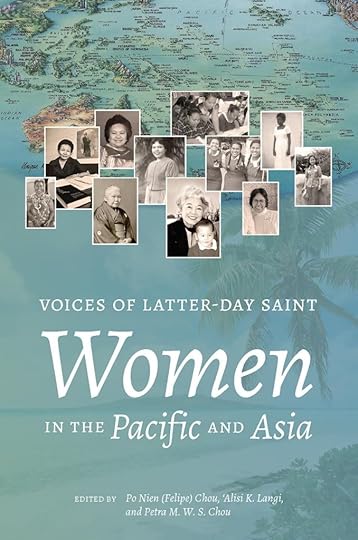
“The stories of early pioneer women in the Pacific and Asia, as well as modern-day pioneer sisters in this vast region, provide a beautiful tapestry of faith and sacrifice that has impacted the work of salvation since the early years of the Restoration. Their stories of faith, their sacrifices and experiences, and their important contributions to the establishment of the Church in the Pacific and Asia are immense.” (taken from Amazon, find the book here!)
A very important Related Post linked here.


