Mohammed Faris's Blog, page 8
September 25, 2019
Why We Need to Develop Faith-Based Critical Reading Skills
As part of the launch of Barakah Academy, we’re excited to partner with Omar Usman, who’ll lead our brand new Book Club inside the Academy. Below, Omar Usman puts forward a powerful case of why we need to develop faith-based critical reading skills. He also shares how we intend to develop these skills through our new Barakah Academy Book Club.
How do you filter what you read through the worldview of iman (faith)?
As the saying goes “if you read what everyone else reads, you’ll think what everyone else thinks”. And in an age of information overload and viral content, we’re reading what everyone else is reading more than ever. Hence, it can be difficult to nurture our Islamic worldview and find ourselves more secular in our thinking and approach to life.
A Muslim believes with certainty that the purpose of life is to worship Allah [SWT]. As Allah says in the Qur’an:
“And I have not created the invisible beings and men to any end other than that they may [know and] worship Me.” [Qur’an 51: 57]
That puts our world view immediately at odds with many ideals that are taught and promoted.
Books written from a secular perspective, by definition, adopt a different paradigm. This paradigm argues that by eliminating religion, you eliminate bias. Therefore, a secular worldview enables looking at the world through observable reality which is more tangible and less controversial than a faith perspective that many people may not believe in.
The problem with this is that a secular or even academic approach is its own worldview. It presupposes certain ideals. Business books and personal development books are full of assumptions; such as the ultimate goal being the fulfillment of one’s own potential.
'As the saying goes “if you read what everyone else reads, you’ll think what everyone else thinks”. And in an age of information overload and viral content, we’re reading what everyone else is reading more than ever.' Omar UsmanClick To Tweet
In a secular worldview, the potential must be measured on – again – “observable” realities. These measures often come down to tangible markers like money earned. I remember hearing a popular leadership author speak about the idea of adding value to others. He said when you add value, you get rewarded with certificates of appreciation – the green kind with president faces on them (i.e. dollar$!). Adopting this world view means acknowledging to some degree that those who add the most value to society are those who generate the most profit. Clearly, this is not the case and yet, people internalize it as motivation in their quest to succeed.
Intangible measures of success in a secular worldview will often come down to ideals such as ‘doing whatever makes you happy’, or ‘being so passionate that you never feel like you’re working’, or ‘be the best version of yourself.’
The secular paradigm will always be handcuffed by the popular ideals of society at any given time. That means the definition of “best version of yourself” is subject to change based on what society values. As an example, if society de-emphasizes the importance of family while lionizing the ideal of the individual – then the family can be seen as something that holds someone back from the personal success they feel destined for.
A faith-based world view is meant to be more holistic. Islamically, we do not separate religion from other aspects of life. Religion (deen) is a way of life. This way of life regulates not only how we define success, but also the means by which we attain it.
'A faith-based world view is meant to be more holistic. Islamically, we do not separate religion from other aspects of life. Religion is a way of life. This way of life regulates not only how we define success, but also the means by which we attain it' Omar UsmanClick To Tweet
The best version of yourself, from a faith lens, is fulfilling your purpose in life in being a true ‘Abd (slave) of Allah and fulfilling the rights and responsibilities of those around you as ordained by our Deen. This paradigm may very well mean that you’ll turn down a lucrative job due to the sacrifice it would require with family. Monetary gain is not a scoreboard by which to measure your value. Rather, monetary gain is looked at critically by how it was attained and for what purpose.
A faith-based world view demands much more than evolving ethics – it introduces a component of morality which simply cannot (again, by definition) exist in a secular paradigm.
Many books are written about leadership, communication, marketing, psychology, interpersonal dynamics, persuasion, media, and so on. A secular world view cannot regulate what people do with that information or education. For example, grit and perseverance are revered characteristics. They are part and parcel of every feel-good story in which someone works hard to triumph against all odds. Unfortunately, grit and perseverance are also found in the stories of those who rise to power and cheat or oppress others.
It is a faith-based world view that provides the regulation, by way of religious ethics, to ensure these tools are used for good. An Islamic world view means filtering what we learn through the lens of the Hereafter. What am I learning? How am I using it? How is this helping me to improve? How is this helping to improve the lives of others?
What we need then, is a way to critically examine and filter the information we consume. We must find a way to benefit from the observed realities in books while also understanding the biases that helped create the conclusions the author reached. We need to critically assess how we can implement the lessons learned in a way that increases our spirituality instead of decreasing it.
Which Leads Us To … A Different Kind of Book Club
It is with all of the above in mind that I am, alhamdulillah, excited to announce the launch of a new book club as part of the Productive Muslim Company’s new Barakah Academy that’s starting October 1st, 2019.
In this book club, we will tackle a theme each quarter. That means we will read 2-3 books every 3 months around one subject, looking at it from different angles.
In the next quarter (October-December 2019) we’ll cover the theme of Leadership and read 21 Laws of Leadership, Leadership BS, and The Leadership of Muhammad (saw).
Within the book club is a weekly reading plan to help you not only keep up but also develop a habit of reading. There will be additional resources every week to go deeper on the topics covered. You’ll also have a chance to engage with other members of the academy going through the book in a dedicated Slack channel as well as get your questions addressed during the quarterly mastermind calls.
If you’re tired of reading personal and professional development books whilst scratching your head wondering what our faith says about the concepts within, then this book club is for you. And if you’re not a regular reader, but want to get into the habit of reading, then this book is for you. We look forward to having you in the book club. Join us today!
The post Why We Need to Develop Faith-Based Critical Reading Skills appeared first on ProductiveMuslim.com.


September 15, 2019
Introducing The Barakah Culture Cards: Your Practical Guide to the Mindsets, Values & Rituals of Barakah Culture
The Barakah Culture Cards is a training tool for professionals and teams to help them identify the mindsets, values, and rituals that promote barakah culture in their personal & professional lives.
The purpose of the cards is to engage professionals and teams in a learning exercise that is both visual and hands-on and makes the concepts of living a Barakah culture more tangible and real.
Each deck contains 17 mindsets, 17 values, and 17 rituals that are drawn from Quranic verses, sayings of Prophet Muhammad [SAW] and Islamic tradition that promote Barakah Culture in a person and team.
It is our goal that with these cards, we can equip individuals and organizations with the tools to have a meaningful conversation on how to adopt Barakah Culture in their lives and fight the madness of ‘workism’ and the Hustle culture.
Where to get the Barakah Culture Cards?
Download the cards here.
Order our high-quality Barakah Culture deck of cards for yourself and team from our online store here and get them delivered to your address (alternatively, if you book a productive Muslim workshop for your team, each participant will get a free deck of cards).
How to use the Barakah Culture Cards for yourself or team?
There are several ways to use these cards, and you can use your imagination and creativity to come up with even more imaginative ways to make the most of these cards for learning and training purposes.
Below is our recommended way to use the cards:
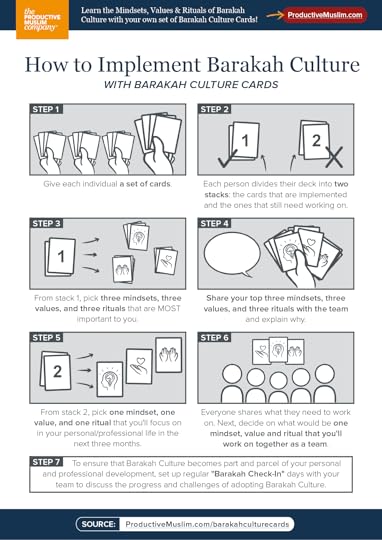
Step 1: Give each individual a set of cards.
Step 2: Ask each person to go through all the cards and divide them into 2 piles:
PILE 1: Place here the mindsets, values, and rituals that you’re currently adopting/implementing in your life.
PILE 2: Place here the mindsets, values, and rituals that you need to work on (or adopt in the future).
Step 3: From PILE 1, pick 3 mindsets, 3 values, and 3 rituals that are MOST important to you (this is not to say that the rest are not important, but these 9 cards are your non-negotiable ones, no matter the circumstances you face in life).
Step 4: If you’re playing these cards with a team, share your top three mindsets, values, and rituals with the rest of the team and explain why. This would lead to eye-opening discussions on what’s most important to each individual team member, and how all team members are complementing each other on Barakah Culture.
Step 5: From PILE 2, pick ONE mindset, ONE value, and ONE ritual that you’ll focus on as an individual in your personal/professional life in the next 3 months.
Step 6: If you’re playing these cards with a team; after everyone shares their one mindset, values, and rituals that they need to work on. Decide on what would be the ONE mindset, ONE Value, ONE Ritual that you’ll work on together as a team.
STEP 7: REGULAR CHECK-INS.
At this point, the exercise is over, however, to ensure that Barakah Culture becomes part and parcel of your personal and professional development, it’s important to set up regular “Barakah – CheckIn” days with yourself and team to discuss the progress and challenges of adopting Barakah culture in your personal/professional lives.
A FUN AFTERNOON WITH BARAKAH CULTURE CARDS
The following activity was inspired by Dubai Islamic Bank’s Shariah Department team who spent a Thursday afternoon engaging the Barakah Culture in a fun and educational way:
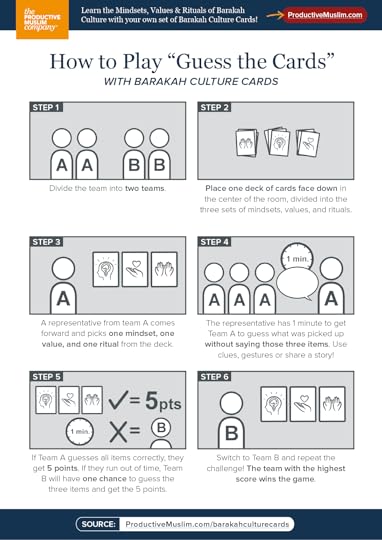
Divide the team into 2 teams: Team A and Team B.
Place one deck of cards face time in the center of the room divided into the 3 sets of mindsets, values, and rituals.
Ask for a representative from team A to come forward and pick one mindset, one value, and one ritual from the deck.
The Challenge: They have 1 min to get Team A to guess what is the mindset, value, and ritual they picked up without saying those 3 words! They can give clues or share a story, but they can’t use the 3 words they picked up.
If Team A gets the 3 words correctly, they get 5 points. If they can’t guess all 3 words correctly by the end of the 1-minute challenge, Team B will have one chance to guess the 3 words and get the 5 points.
Switch to Team B and repeat the challenge! The team with the highest scores wins the game.
The keyword here though is “play”. We want people to engage with these cards as a playful, yet meaningful and thoughtful, exercise.
We’re excited to release these Barakah Culture cards globally and we can’t wait to hear stories from individuals and teams on how these tools have helped them bring tangible success, motivation, and Barakah in their personal and professional lives. To share your story (or any feedback) you have with these cards, please email us on contactus@productivemuslim.com with the subject line: Barakah Culture Cards.
The post Introducing The Barakah Culture Cards: Your Practical Guide to the Mindsets, Values & Rituals of Barakah Culture appeared first on ProductiveMuslim.com.
September 14, 2019
[Podcast Interview] The Case for Faith-Based Professional Development Training
If you’re looking for an enjoyable and inspirational chat on faith, work, and personal development, then tune in to this podcast interview featuring Mohammed Faris, CEO, and Founder of the Productive Muslim Company.
In this interview, Omar Usman, podcast host and the new leader of the Barakah Academy’s Book Club, talks with Mohammed Faris about the progression of The Productive Muslim Company from Islamifying productivity literature to developing a unique faith-based personal and professional training company.
The interview covers how the Productive Muslim Company’s changed vision from the Carpenter to the Gardener mindset has impacted the team and work.
It also sheds more light on the new Barakah Academy and its promising Book Club that aims to help participants develop faith-based critical reading skills.
Other topics discussed in the interview:
How faith should drive you to be a better professional
Do religious values such as humility hold you back in a corporate environment? An answer from Surat Yusuf.
Barakah culture vs. Hustle culture and workism
The greatest email life hack ever
Should you do voluntary fasting like Shawwal if it means you’ll decrease performance at work?
The most profound thing about the character of the Prophet [SAW].
Revealed reality and observed reality
Reasons why professional training may fail.
Check out the full interview here:
The post [Podcast Interview] The Case for Faith-Based Professional Development Training appeared first on ProductiveMuslim.com.
August 29, 2019
The Productive Muslim “Money Masterclass” to Commence September 14th
The Productive Muslim Company announces the launch of a brand new Money Masterclass with Islamic Personal Finance Expert Sh. Joe Bradford, on Saturday, September 14, 2019.
The Money Masterclass is tailored to help professionals live the best version of themselves financially. Participants will gain clarity and control of their financial decisions, as well as help them develop a practical faith-based financial roadmap for the next 5 years and beyond.
As part of the company’s commitment to promoting Barakah Culture globally, this program intends to increase Barakah in participants’ lives by aligning their financial decisions to their faith-values.
Speaking of his first Money Masterclass experience, participant, Ifedolapo Sulyman Olanrewaju, MD, MHI, says: “The [Masterclass] provides new knowledge that introduces the Islamic paradigm to manage personal finance and also addresses the emotional and psycho-social issues that underpin our money decisions.”
The Money Masterclass is delivered by Islamic Personal Finance Expert, Sh. Joe Bradford.
He holds a Master of Islamic Law from the University of Medina and studied for 20+ years traditionally in the Muslim world. His expertise as an Ethical Finance Advisor on issues involving Muslims and Finance in North America spans a number of areas. Through this Money Masterclass, he’ll be your guide and provide you with a clear money action plan that will work for you, insha’Allah.
Details on the content delivered each week of the program can be found here.
Program Duration: Every Saturday for 6 weeks starting September 14, 2019.
Link to Register: https://productivemuslim.com/money
Registration Deadline: Friday, September 13th, 2019.
The post The Productive Muslim “Money Masterclass” to Commence September 14th appeared first on ProductiveMuslim.com.
August 21, 2019
3 Powerful Ways to Secure Your Children’s Future (If You Die & Leave Them Behind)
Join our upcoming webinar for LIVE and direct opportunity to learn 3 powerful ways to deal with the critical question: How to Secure Your Children’s Future Financially! Register here.
One of the most pressing concerns for all parents is their child’s future.
Many of us live in single-family homes, have only one breadwinner in the house, relatively small savings, and limited social network to rely upon.
How do we secure our families future in the face of adversity?
How is that even possible when future adversity is an unknown?
Our financial safety nets are non-existent and our social safety nets can wear thin. Some of us are living paycheck to paycheck, barely keeping up with all our expenses.
If the person who pays all the bills passes away, what does the surviving family do?
Having worked for more than a decade in the financial sector, I’m approached all the time with questions about how we as Muslims can best benefit from currently available financial products but also maintain our values as informed by our faith.
Finding that middle ground has been a goal of my career, whether that be when I was working as a senior Shariah advisor in Saudi Arabia, a real estate structuring advisor in Washington DC, or a personal financial coach in Houston TX.
One of the top questions I’m always asked is: “how can I provide for my children when I’m gone?”
This dilemma is universal and timeless. Even the Prophet faced with similar. Allah  addressed him:
“Say: If I knew the unseen I would accumulate all good and bad would never affect me.” [Qur’an 7: 188]
Commenting on this Imam al-Tabari said,
“If I had known what the future holds, I’d save for years of famine during years of prosperity.”
While the future is unknown even to the Prophet  , he left us with a model to emulate and best practices to implement that will secure our children’s future in this world and the next.
In this article, we’ll cover best practices to secure our children’s future in 3 parts:
What preparations can we make spiritually for facing this challenge?
How to prepare financially? with a specific focus on halal investment (instead of life insurance).
How to build a social safety net, and how strong families and filial piety can be one of the greatest forms of support we have when things are difficult.
Secure Your Children’s Future – Spiritually
In the story of Prophet Musa  (Moses) and Al-Khidr [Qur’an 18: 60-82], the two men passed by a town whose people were very inhospitable. Despite that, Al-Khidr saw a leaning wall in this town and decided to reconstruct it with his own hands for free, even though the people of that town didn’t deserve this generosity. Perplexed, Musa questioned this act of kindness to an undeserving town, Al-Khidr explained:
“And as for the wall, it belonged to two orphan boys in the city, and there was beneath it a treasure for them, and their father had been righteous. So your Lord intended that they reach maturity and extract their treasure, as a mercy from your Lord. And I did it not of my own accord. That is the interpretation of that about which you could not have patience.” [Qur’an 18: 79- 82]
So, God brought al-Khidr and Moses to a place they weren’t expecting to be, to do an act they weren’t expecting to do, to preserve a legacy left for two minors they did not know, simply due to the honourable position their father had with Allah on account of his righteousness .
Righteousness: The key to Divine Protection for Your Children
The quality of the father in the aforementioned story that guaranteed the protection of his children’s financial well-being was his righteousness and dedication to Allah . Some narrations mention that it wasn’t even the father, but the grandfather who was truly righteous, so this protection exceeds one’s children to one’s grandchildren.
And sometimes it’s hard for us to make that link between spirituality and real-life results, but this is what the Prophet Muhammad taught us and what the companions acted upon.
Allah said:
“Whoever is mindful of God, He gives him a way out, sustaining him from sources he never imagined. Whoever trusts in God, He is sufficient for him…” [Qur’an 65: 2-3]
When we mend the things between us and God in both public and private, God protects us and our children in ways that we never imagine.
Omar, in his famous message sent to Abu Musa, said:
“Whoever mends what is between him and God, God will suffice him of his creation. And whoever puts on airs and claims things not his to claim, God will debase him.”
To get to this level, we have to have a certain level of constant consciousness about our spiritual state and the return that our actions bring on us and our children. One of the Salaf (righteous predecessors) said that he can see the aftermath of his sin almost immediately manifested in his wife and his cattle’s rebellion against him.
Trust Allah
AND Tie Your CamelWorking on the spiritual aspects does not mean neglecting taking other means and adequately planning for our children’s future.
'Working on the spiritual aspects does not mean neglecting taking other means and adequately planning for our children's future.' Joe BradfordClick To Tweet
The man is Musa’s story was described as righteous. But he wasn’t a person who had nothing and strived for nothing. Had that been the case, he wouldn’t have owned property on which he built a wall inside of which stashed away money.
This shows that he implemented best practices in his life that would provide for his children materially. And this takes us to the next point: the financial preparation for your children’s protection.
2. Secure Your Children’s Future – Financially
So what are some of the practical means that you can take to protect your children’s future?
Saving money and investing is key to building a strong financial future for your kids. But how should you do this? Sometimes something as simple as putting a little bit of money away in savings can help start the process of securing your children’s financial future.
Typically if you were to approach financial advisor they would try to sell you on a number of different products that they claim would help give your child a firm foothold in your absence.
Unfortunately, many of those products are suboptimal; not only are they structured in ways that are forbidden for us as Muslims but their financial returns really aren’t that great.
Some will tell you to just start a savings account and allow the interest to accrue. But what you’re doing is loaning a bank your money at interest either through a simple savings account or by purchasing a bond, then allowing them to use that money while you are only paid half a percent of interest if you’re lucky. so not only are fixed income instruments impermissible because their loans at interest, but the returns are bad as well.
So what are some of the other things that would typically be offered to you to help provide for your children’s expenses in your absence?
Well in addition to simple fixed income instruments and savings accounts your financial advisor may ask you to open up an education account like a Coverdell ESA or a 529. They will tell you that part of a strong financial plan is a well-diversified portfolio. And that is true. But regardless of whether you put fixed income in an education account or not, you’re still going to have to deal with the morally problematic nature of loaning money at interest and quite frankly the bad returns.
So are there any other options that would both preserve your capital for your kids as well as give you better returns?
One product that is often offered to young parents along with a healthy dose of Doom and Gloom about the inevitability of death is life insurance. Advisors will say that You HAVE to have a life insurance policy and that it’s the only way you’ll have something left over for your family when you die. Now there are a lot of different life insurance products out there that are structured in different ways and the differences between them can be a bit confusing. Some advisors take advantage of this confusion and ramp up the emotional baggage to sell you on something that they’re going to take a commission from.
In this article, we will compare whole life insurance policies to investments. Because the average term life policy is 25 years, and we are projecting for retirement after 30+ years, term life doesn’t apply to our scenario. We want to focus on life insurance products that will have a long-term benefit, as well as, cash value after 30 years, namely whole life products.
So do you absolutely have to have life insurance in order to leave behind something substantial for your children?
The answer is no, and I’ll explain to you why.
Why Life Insurance is Not The Only (or Best) Way Secure your Children’s Future
Without getting into the Fiqh rulings of Life insurance, here’s why life insurance doesn’t make sense. Life insurance is a form of insurance that pays out a sum of money either on the death of the insured person or after a set period. It remains active for a specific term, a time, then it expires. So if you are 25 years old and buy a 25-year policy for example, then you reach 50 years of age and haven’t died then you’re out all the money you placed in that policy. Essentially, the insurance company says “Give me your money and I will guarantee that if you meet certain stipulations, I’ll give you some money back later. But if you don’t, you don’t get anything”. They then take your money and invest it in a pool, then pay dividends and profits to their shareholders.
Another type of life insurance, called “Whole and Universal” insurance combines term insurance with some form of savings or investment that can be cashed out later. The insurance company says: “You have a need, I have a need, let’s pool our money. When we put all our money together if any of us have a claim that needs to be paid, we’ll pay it out of the investment pool, otherwise, we’ll just invest the money we’ve gathered.” What they don’t tell you is that they get a sizable commission for selling these policies to you. This means that your policy takes an instant hit once you open it. Additionally, the returns on these policies are poor.
Now regardless of which type takes your insurance premiums, you as the consumer have no say in how those premiums are invested. What does that mean? It means that your insurance pool managers will probably look for safe, relatively low-risk investments. That means they’ll be looking for interest-bearing fixed income instruments, as well as equities that have low volatility. All in all, your money will most probably be invested in something clearly impermissible investments 9 times out of 10.
Could we create a permissible insurance policy? Well sure, if we structure a company as a Mutual that only invests in Shariah-compliant investments. Does one exist? For many of us, not at this time.
For many of us, especially those of us that do not have access to true Takaful products, this is something which is unavoidable. As I have explained in other articles is an issue that has to be dealt with at the regulatory level. While at times we have to buy insurance products to protect our property or our health, that doesn’t mean that we’re off the hook for making an ethical decision in how we go about doing that.
But even when we have the option to buy an insurance policy, do we really need one?
Halal Investment VS Life Insurance
What if instead of buying an insurance policy, you invested that money in a retirement account?
Let’s take the example of Ahmed and Omar. Both of them are concerned for their children’s future, but Ahmed is sceptical about life insurance and doesn’t like the idea of giving away his money for others to use in ways that he is opposed to morally. Omar, on the other hand, claims that it’s not his problem and that all he is concerned about is how much money is left for his kids when he dies.
Ahmed decides that he’s going to invest his money. He sees that the average return of the market is around 7.5%, so he decides he’ll open a retirement account that invests in Shariah-compliant equities. He deposits 20k in his account to start and over the next 35 years invests $5,500 yearly. The average monthly amount he’d invest would be $458. By the time Ahmed is 65 and wants to retire, he would have 1.2 million dollars in his account, before taxes.
Omar, on the other hand, decides to buy an insurance policy. He buys a policy with a payout of one million dollars, that he makes an initial payment for upfront to the tune of several thousands of dollars, then pays for monthly over the next 35 years. With an average monthly payment of $896 dollars a month, this policy would cost him $322,560. The insurance policy would have accrued a cash value of $617,104 after 30 years.
Ahmed has more than double the amount Omar has, and at a lower cost to himself as well. Best thing is, we’ve had complete control over our money and invested it in companies with halal activities. The same can’t be said for the insurance policy.
5 Reasons Why Investment is Better than Life Insurance
Here are the top five reasons why investing in a retirement account is better than life insurance:
A retirement account is more straightforward: you can fund it then buy stocks, mutual funds, gold, and real estate.
In some countries, your contributions to your retirement account are tax deductible. Your contributions to life insurance are a personal expense and are not deductible. Eventually, the policy will cost you more
With a retirement account, you have access to your money at any time. With insurance, you don’t (depending on the policy) and even then you’ll need at least 10-20 years to build up reasonable cash value you can withdraw, but those can be hit pretty hard by taxes when you withdraw them.
Retirement accounts are low cost. life insurance policies can be quite costly, with upfront fees usually going towards your agent’s commissions, and investment fees are pretty steep (3% vs. 1.5% in an IRA)
A retirement account is always yours, while if your insurance policy lapses you’ll have to pay surrender charges, meaning that you’ll not only lose your benefits but much of the cash balance as well (if any).
The No.1 Reason to Invest vs. Buy Life Insurance: Seeking Barakah
This short analysis bolsters what we know from the Sunnah of the Prophet . In a hadith collected by Ibn Maja, he said:
“Whoever sold a property and did not place its equivalent price into something similar, then its most likely than not Allah will not bless that transaction.”
What does the hadith mean? It means that if you take a large sum of money that was earned permissibly and invest it into something that is risky or impermissible, the blessing of Allah (Barakah) will be voided from that transaction. Likewise, when we invest in halal investments, we can be assured that we are using our hard earned halal wealth to build even more halal wealth. With insurance policies, it is not that certain. With this quick review of investment vs. life insurance, the former makes the most sense both spiritually and financially.
3. Secure Your Children’s Future – Socially
Who’ll Take Care of Your Children After You Die?
Today’s society places much emphasis on the nuclear family system. Husband, wife, and 2.5 children is seen as the norm. The extended family system is considered a relic, something that is out of date.
With most parents working in corporations, leaving home early and returning back late, neglect of children is a natural by-product. Add to this that these children are separated from their grandparents, uncles, aunts, and cousins.
When you’re alive, you’re able to maintain such a lifestyle through the help of daycare, nannies, and eventually, kids grow up to care of themselves. But what happens if you die and your children are still young?
'When you’re alive, you’re able to maintain a nuclear lifestyle through the help of daycare, nannies, and eventually kids grow up to care of themselves. But what happens after you die?' Joe BradfordClick To Tweet
In the past, the extended family (grandparents, aunts, uncles) all helped raise the extended family’s children – especially if one or both parents passed away whilst children were young. They stepped in and this fostered unity within the family and gave the children a greater sense of self despite losing one or both parents. Moreover, this extended family support ensured that children didn’t suffer financially when they lose their parents and that expenses and experiences were shared.
While many of us live and work far distances from our families, it’s important to keep the above in mind and ensure that our children are part of a wider social network of family and relatives and not an isolated unit in an increasingly uncertain world.
The Prophet
What this hadith is pointing to is the legacy that is left by inter-connected family relationships, and how generationally we benefit from them.
The Prophet
Denying the necessity of the extended family has been shown to not only narrow the experiences of the family as a whole but to have very deleterious effects on society (Sarkisian & Gerstel, 2012. Nuclear Family Values, Extended Family Lives).
Strengthening Social Relations
In advocating for closer family relations, we allow our children to not only honour their relatives but also become accustomed to those who may be their guardians if we were to pass away early in their lives.
Moreover, this ensures that when we draft an Islamic Will we can designate who will care for our children after we die, allowing our social preparations to extend well beyond our deaths.
By pooling our resources, maintaining close family ties, and saving for our futures, we can build spiritual, financial, and social wealth that will allow our families to prosper.
Secure Your Children’s Future with a Will
If you haven’t made an Islamic Will, remember that the Prophet said:
“No one that has anything that can be inherited should sleep for two nights without a will in his possession.” [Sahih Muslim]
For those readers in the USA, a service like MyWassiyah.com allows Muslims to create an estate plan in a Shariah compliant, legally valid, and cost-effective manner. By signing up today through this link (Affiliate link), you’ll support the work that Productive Muslim does as well as get 20% off your own Will.
All of this is part of the spiritual preparation that we must make as Muslims, using all means at our disposal to place our families in a situation that prepares them for the next life and preserves them in this life.
All of us are concerned for the future of our children. It is imperative that we take individual responsibility to be the best version of ourselves spiritually so that they may be provided for in the future. Part of that spiritual preparation is trusting that the means that a lot has given us are sufficient for creating a bright and fulfilling life for our kids where they are cared for by loving family members and can support themselves monetarily through the best of Halal earnings that we can provide for them.
My hope is that in this article, we’ve shown how trust in Allah , strengthening our families and making moral and ethical financial decisions can secure our children’s future against adversity in the best manner possible.
Don’t miss the opportunity to register for our LIVE webinar and engage further on this critical topic.
The post 3 Powerful Ways to Secure Your Children’s Future (If You Die & Leave Them Behind) appeared first on ProductiveMuslim.com.
August 19, 2019
The Productive Muslim South Africa Workshop & Book Tour (September 2019)
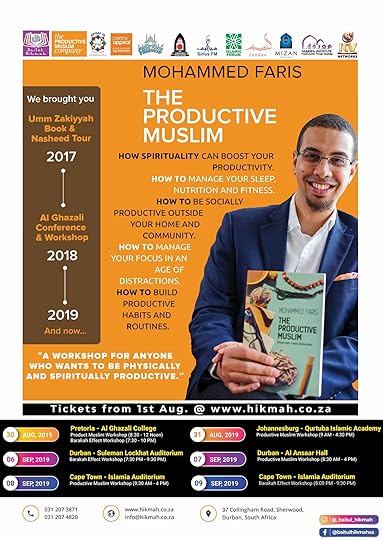
The Productive Muslim Company is pleased to announce a multi-city workshop & book tour in South Africa from August 30th until September 10th, with Mohammed Faris, Founder & CEO of the Productive Muslim Company in partnership with Baitul Hikmah Islamic Book & Gift Store (learn more here).
Watch Video Message from Our Founder:
Get your tickets today!
Faris will be visiting Johannesburg, Pretoria, Durban, and Capetown to conduct the following workshops:
The Barakah Effect Workshop: A deep dive into the concept of Barakah with practical tools and advice to attract Barakah in one’s life and business.
The Productive Muslim Workshop: A 1-day Workshop based on “The Productive Muslim Book” to help individuals manage their energy, focus, and time to live the best version of themselves: spiritually, physically, and socially.
For detailed program dates, venues, and times visit → https://hikmah.co.za/productive-muslim-workshop-book-tour-by-mohammed-faris/
Copies of our best selling book “The Productive Muslim: Where Faith Meets Productivity” will also be available for sale and signing at each of the events.
Faris has been delivering these workshops for the past 10 years in over 15+ countries. For the first time, they are coming to South Africa this September, insha’Allah.
We look forward to meeting our South African readers and friends soon!
Register for the event here: https://hikmah.co.za/productive-muslim-workshop-book-tour-by-mohammed-faris/
For more information about the South Africa Workshop & Book Tour, please visit www.hikmah.co.za or call 031 207 3871.
To host a Productive Muslim Tour/Workshop in your city/country, please visit: https://productivemuslim.com/workshops
The post The Productive Muslim South Africa Workshop & Book Tour (September 2019) appeared first on ProductiveMuslim.com.
June 19, 2019
How to Pick Yourself Up Post Ramadan
This article is a long one, but it’s for those of you who are serious about living the next best version of yourself post-Ramadan. If you’re not a reader and prefer to watch a video do register for our special webinar next week on Post-Ramadan Reboot for Muslim Professionals. We’ll take a deeper dive on some of the topics discussed in this article.
Strategies, Tips, And Tools To Design Your Next Best Self Post-Ramadan
Ramadan ended a few weeks ago, and by now you’re probably starting to settle back to your post-Ramadan routine.
You may have been able to keep up with some of your Ramadan resolutions (fasting a bit more, praying some parts of the night, giving charity often), or you may have crashed post-Ramadan and found it really hard to pick yourself up again – spiritually, physically, and socially.
If you’re someone who wants to maintain consistent improvement post-Ramadan and win the battle of life against your Nafs and Shaytaan (which seems to come back stronger after Ramadan), then you’ll find this useful.
This article also comes just a couple of weeks before our upcoming Productive Muslim Masterclass. A six-week immersive online self-development journey that combines spirituality and peak performance science and psychology.
Begin with Next Ramadan in Mind
Fast-forward to the 29th day of Sha’baan of next year, you’re hours away from knowing if Ramadan is tomorrow or not. You’re excited. Maybe a bit nervous. Busy with typical Ramadan preparations.
Unfortunately, the Angel of Death comes and takes your soul in those hours, and you’re deprived of witnessing the next Ramadan.
How do you feel?
The reason I bring this thought up is to help frame this article in your mind: Although you’re not guaranteed to live to witness another Ramadan, this does not mean that your journey of self-development and improvement should be on hold until next Ramadan comes.
There are many things you can do in between now and then and this is what this article is about.
'Although you're not guaranteed to live to witness another Ramadan, this does not mean that your journey of self-development and improvement should be on hold until next Ramadan comes.' Mohammed Faris, CEO The Productive Muslim CompanyClick To Tweet
A Framework To Develop Yourself Post Ramadan
The Productive Muslim Company is big on building frameworks that help us tackle some of our most profound self-development challenges. And one of the frameworks that we often use in our training and coaching is the following one:
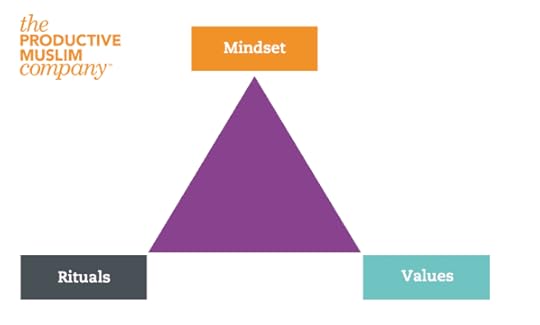
This framework simply states that if we want to design the next best version of ourselves post-Ramadan, we need to think of the Mindsets, Values, and Rituals that would help us make those changes post-Ramadan.
Mindsets: How You Think Affects How You Behave
It’s common knowledge among psychology circles that our thoughts have an impact on our actions (and vice-versa. More on that later). [“How Thoughts Influence Actions”. Psychology Today]. So how you think about your post-Ramadan period will impact how you behave. Below are 3 mindset shifts that you need to think about to help you upgrade your post-Ramadan experience.
1. Think Realistically
There’s an equation that I learned from a time management expert that helped me a lot manage my stress levels:
Expectations > Reality = Stress
Simply stated, when expectations exceed the reality, you’re only setting yourself up for stress and failure.
How do we do this post-Ramadan? Have you heard yourself say things like: After Ramadan, I’ll pray tahajjud every night, I’ll fast every Monday and Thursday, I’ll give charity every day, etc.? What happens when you don’t live up to those expectations? You fall for the classic Shaytaan trick of making you feel terrible that you didn’t live up to your expectations and fall for another psychological trap called the “What the hell effect.” [“How the What the Hell Effect Impacts Your Willpower”. Psychology Today]
Here’s how the what the hell effect works: You decide to eat healthily and stop eating sugar, and for the first few days, you’re doing great. Then you get invited over to your friend’s house, and they have an incredible dessert spread. Initially, you resist, but your friend insists, and you have a small piece of Halwa. Next think you know, you say to yourself, “What the hell, let me try everything else, I’ll restart my diet tomorrow.” Next day you feel so bad that you break your new diet, and another “what the hell” moment hits you, and you give up entirely on your new diet.
Think of how many times the “what the hell” effect impacted you when it came to your prayers, to voluntary fasting, to being present with your children. Allah SWT captures this phenomenon when he tells us about not following the steps of Shaytaan in a number of verses, like:
” O you who have believed, enter into Islam completely [and perfectly] and do not follow the footsteps of Satan. Indeed, he is to you a clear enemy.” (Qur’an 2: 208)
So how do you tackle these two traps: setting high and unrealistic expectations, and falling for the “what the hell” effect. The key is to set small, realistic expectations and then guard them with all your might until they become solid habits before you set higher expectations.
Here’s how this works: You want to pray tahajjud every night? Start by committing to pray 1xrak’ah of witr prayer after Isha prayers and before you sleep. It’s a small commitment, but you want to do it no matter what. Even on days you don’t feel like it, or you’re tired. Don’t get on the slippery slope of missing 1 day and then thinking “what the hell, I’ll never be able to pray tahajjud in my life.” And even if you do slip 1 day, don’t fall for the “what the hell” effect and instead pick yourself up the next day, stronger than ever. Once you’ve established this routine long enough and it has become part and parcel of your life, upgrade yourself and aim to pray 3 rak’ahs of witr, etc.
'The key is to set small, realistic expectations and then guard them with all your might until they become solid habits before you set higher expectations.' Mohammed Faris, CEO The Productive Muslim CompanyClick To Tweet
2. Think Holistically
The second mindset shift to consider is to think about your personal development journey holistically.
During the Productive Muslim Masterclass, we help individuals and teams think of how to live the next best version of themselves across all their roles, i.e., what does your next-best version of yourself look like as a Dad/Mom? as a professional? As a neighbor? As a Muslim? Etc.
Thinking holistically takes us away from the mind-trap that post-Ramadan self-development is only about rituals. It makes us recognize that the rituals form the bedrock and scaffolding to help us build our next best version across our roles.
To help you think holistically about your self development, complete our Productive Muslim Self-Assessment tool to figure out where you are today – spiritually, physically, and socially and where you need to go.
3. Think Long-Term
One of the primary reasons people give up their post-Ramadan resolutions is that they measure their success or failure based on a very short time frame, i.e., they measure how well they are performing in the first 2-3 weeks post-Ramadan. If they see no improvement, they give up!
Someone might say, “I tried fasting Mondays and Thursdays after Ramadan, but it was too hard, so I gave up.”
What if instead, we expanded our self-development journey beyond these first 2 weeks. What if we asked ourselves – how can I develop this new habit/routine in 12 months?
Here’s a thought: We tend to overestimate what we can do in a short period but underestimate what we can do over a long period.
Yes, waking up for fajr might seem hard in those first 2-3 weeks, but if you focus on developing this habit over 3, 6, 9 months, you’ll eventually crack it, and it’ll become easy for you.
A good metaphor for thinking long-term is that of a gardener. When the gardener plants his seed, waters his garden, and works hard all day on his farm. He doesn’t expect to see a mature tree the next day! He understands that growing a tree takes time, and there’s a lot of energy, focus, and time that goes into becoming a tree. Similarly, new habits and routines take time to take root, nurture and grow, if you think of them as a long-term project, and work on it every day, you’re more likely to succeed.
'One of the primary reasons people give up their post-Ramadan resolutions is that they measure their success or failure based on a very short time frame, If they see no improvement, they give up!' Mohammed Faris, CEO The Productive Muslim Company Click To Tweet
PRACTICAL TIPS
Think of your long-term goals post-Ramadan across all your roles (learn more about setting up long-term goals in our upcoming post-Ramadan reboot webinar. Click here to register).
Think of the obstacles you might face to achieve your goals (be realistic)
Think of how to overcome those obstacles – one step at a time.
Values: What Beliefs are driving your post-Ramadan life?
This section talks about a subtle but essential spiritual element when it comes to achieving a post-Ramadan goal. And that is to do with our Hearts and how connected we are with Allah SWT when it comes to achieving our post-Ramadan Goals.
Every day in our prayers we recite this verse →
“You Alone We Worship, and You Alone We Seek Help From” (Qur’an 1: 5)
This is a foundational concept in our faith that is critical for all our self-improvement endeavors. It involves two aspects:
You Alone We Worship: All your goals, all your self-improvement, and self-development, should be connected to the concept of you wanting to become the best ‘Abd’ (Slave) to Allah SWT. During the Productive Muslim Masterclass, we speak in detail of the Islamic-psychospiritual model of the human being and how being an ‘Abd’ (slave) of Allah SWT is such a foundational concept that we need to revive in our hearts to help us live the best version of ourselves.
You Alone We Seek Help From: This is the recognition that as part of us acknowledging that we’re slaves of Allah, then we need to ask Allah’s permission and tawfeeq (success) in all the goals that we want to achieve.
Let’s be honest; sometimes, the goals we set for ourselves post-Ramadan can be all about developing our self-esteem and self-image. We forgot the ‘why’ that should drive these goals, and hence we give up on them too quickly. If I’m trying to wake up for tahajjud just because I see it as another milestone in my self-development journey, and not as an act of worship that would get me closer to Allah SWT, I need to revise my intentions.
So how can we practically develop these beliefs/values in our lives:
Set Good Intentions: When you set any post-Ramadan goal, ask yourself – why am I doing this? Who’s this for? How can I become a better ‘Abd’ to Allah through this goal?
Always ask Allah to help with your goals: Make your goals as spiritual quests. Ask Allah SWT to help you stay physically healthy post-Ramadan, to fast regularly, to pray tahajjud, etc. Don’t be arrogant and rely on your means – you need Him. Ask Him.
Work hard: Good intentions and prayers don’t work on their own. Allah SWT would like to see the effort from you and He’ll take care of the results.
Rituals: What You Do Impacts How You Think and What You Believe
Earlier I mentioned that just like our thoughts have an impact on our actions. So does our action have an influence on how we think?
Here’s a simple experiment: Let’s say you’re upset, or in a bad mood. Grab a pencil and bite it between your teeth, forcing you to smile. Notice how your levels of happiness will increase, and you’ll feel better.
What does this mean for us, post-Ramadan?
This means that whether we feel like it or don’t feel like it – we need to commit to some rituals post-Ramadan that’ll help us improve how we think about ourselves and what we believe is possible post-Ramadan.
There are 3 key concepts to keep in mind though to ensure that you stick to your rituals post-Ramadan:
Choose to focus on not more than 3 new rituals post-Ramadan: It’s so tempting after graduating from Ramadan to feel that you can change your life 180 overnight and introduce so many new routines in life. Although it is doable, it’s tough and I’d rather you focus on a winning strategy instead. The winning strategy is to focus on 3 new rituals post-Ramadan, and once they become part of who you are, add some more.
Start small: This is critical. The smaller the change in your life, the longer it lasts. Start small but have the intention that you’ll want to grow this ritual over time.
Celebrate progress: When you do your small ritual – celebrate it. Feel good about it. Thank Allah SWT that he enabled you to make one small step towards the next best version of you and being His ‘Abd.’ Celebration will reinforce this ritual in your brain as something pleasant to be done again.
If you’re interested to learn about the 7 habits/rituals that every Muslim should develop post-Ramadan, check out our upcoming post-Ramadan reboot webinar.
What should happen when I make the above shifts in my Mindsets, Values, and Rituals?
Fast forward your life to the 29th of Sha’baan next year, it’s a few hours before Ramadan might be announced. You’re excited and giddy and can’t wait to find out.
You’ve spent the entire year, slowly but surely, upgrading your mindsets, values, and rituals and living the next best version of yourself: spiritually, physically, and socially.
You feel more ready than ever for Ramadan and for the next spiritual boost.
However, the Angel of Death comes to you in those hours before Ramadan and takes your soul away.
Do you have any regrets?
Or do you feel that you’ve done all you can to be a true Abd of Allah SWT throughout the year and you are ready to meet Him?
P.S. If you’ve enjoyed this article and wanted to go more in-depth on the practical strategies, tips and tools to help you live the next best version of yourself: sign up for our upcoming 6-week masterclass and immerse yourself in a self-development journey that combines spirituality and peak performance science and psychology. 3 out of 4 past participants mentioned that they are highly likely to recommend the masterclass to their family and friends – Join us today!
P.P.S. If you want to have a taste of the Productive Muslim Masterclass, do join our webinar on “Post-Ramadan Reboot For Muslim Professionals”. Claim Your Spot here.
The post How to Pick Yourself Up Post Ramadan appeared first on ProductiveMuslim.com.
May 18, 2019
Spirituality & the Keto Diet – A Prophetic Link
Disclaimer: What is outlined below is a generalization of scientific findings related to nutrition that I attempt to synthesize with traditional wisdom and practice. It is not a replacement for medical advice, nor is it intended to be a treatment plan for a medical condition. Any attempts to implement concepts below should be done under the supervision of a healthcare professional.
It is hard to blame anyone for being completely confused with the rapid pace at which new nutritional recommendations are being made. It seems like everywhere you look there are new fad diets circulating in the news, social media and celebrity Twitter feeds.
For Muslims in particular, this trend may elicit even more head shaking. After years of having to defend against skepticism and backhanded comments from incredulous individuals in dismay about our backward fasting practices, everyone is talking about fasting like the concept never entered the mind of a human being ever on the face of the earth.
Frustration aside, there is a lot we stand to gain from the advances in understanding nutrition and fasting through a Western lens. Even the most traditional non-Western urban societies are much closer in resemblance to Western culture than their predecessors 1500 years ago.
'It is hard to blame anyone for being completely confused with the rapid pace at which new nutritional recommendations are being made. It seems like everywhere you look there are new fad diets circulating in the news, social media and celebrity Twitter feeds.' Amr Madkour, MDClick To Tweet
And that means as much as we recognize, for example, the negative impact of a Standard American Diet (SAD, the most fitting acronym in the history of the English language) we need the same framework that produced that lifestyle to understand how to address it.
Modern science may even shed light on the past to address these problems in ways previously unimagined.
I have taken this all to heart, leveraging my background in medicine and a predilection to self-experimentation to develop a plan that incorporates the best of both worlds and times.
This year for Ramadan, I have a very specific goal: to be in a state of nutritional ketosis for the duration of the month.
Now, before you tune out what may sound like a fad diet approach to the holy month, let me add that I believe that this is completely in line with our deen (religion/way of life), the Sunnah of our Prophet , and an integral part of the journey to self-actualization; living the best version of ourselves.
We can benefit from an exciting field of research without getting sucked into the hype and misinformation that inevitably arises from the commodification of a “new” discovery.
Instead of struggling to focus, beating back hunger pangs and crushingly heavy eyelids, I propose we can approach this month in a way that improves our focus on worship and self-discovery, the depth of our connection with our Lord, and our resilience to engage this world and meet its challenges.
A good place to start this conversation is the current state of affairs when it comes to the average Muslim and Ramadan.
'Instead of struggling to focus, beating back hunger pangs and crushingly heavy eyelids, I propose we can approach this month in a way that improves our focus on worship and self-discovery' Amr Madkour, MDClick To Tweet
Misinformation on Muslims’ Health & Ramadan
It is a safe bet that we will hear at least once during this month about the negative impact our contemporary Ramadan culture has on us.
I have heard prominent figures lecturing on this topic, and already during one khutbah (sermon) this month, quote statistics that the average Muslim gains 5-10 pounds during Ramadan. But in a recent review of the medical literature, I have not found many high-quality studies that support this claim.
In fact, a recent systematic review [1] from earlier this year that included 70 different studies and almost 3000 participants showed a statistically significant drop in weight and body fat percentage in Muslims fasting around the world.
This is despite the fact that 11 of the 25 most obese countries in the world are Muslim-majority countries [2]. If anything, this is reassuring that despite our worsening problems with overweight, obesity, and associated health conditions, we still have the capacity to realize positive change in relatively short periods of time.
It is also evidence that our Creator has endowed us with a “physiologic fitra”; that is, an inclination for our bodily functions and processes to trend towards health under the right circumstances.
Our worldview is one of an integrated human being, without the distinctions between mind and body that is inherent in contemporary mainstream Western thought.
Our view holds there is a primordial nature to our being, and that would necessarily entail a physiologic aspect. More on this later.
It is quite natural to approach this month from the health angle. However, this approach is flawed because our imperative is to worship God , not to be beach ready.
Any objective other than fulfilling a commandment dilutes our sincerity in the act, and, at our peril, risks the rejection of an act of worship for being directed to other than God .
Rather, by utilizing our current understanding of metabolism, and approximating the physiologic states expected from the descriptions found in our tradition, we bring ourselves into closer alignment with the Sunnah for the sole purpose of perfecting God consciousness and worship.
With this in mind, let us reacquaint ourselves with examples from the tradition, but first a tiny bit of human metabolism.
Understanding How Your Body Functions
Most of us subsist predominantly on the burning of carbohydrates for fuel. We do this by eating or drinking a form of carbohydrates every day.
It is safe to say the vast majority of people in wealthy nations do this every single day, multiple times a day, for all of their lives (when was the last time you truly had nothing to eat for more than a day. If you can think of a time, usually it’s a major life event).
When our brain and muscles take their share of what is needed for their purposes, the rest of the sugar in our blood has to be stored in some way. That is either in the liver or as fat.
Our liver functions much like a savings account and our body fat much like a safety deposit box to store fuel in a different form of currency.
As long as we continue to use carbohydrates as a dominant source of energy, we have little incentive to use this stored energy. What’s more, the hormone used to signal excess-sugar storage (insulin) has to be sent out at higher levels to keep up with the increasing resistance of the body to dealing with all the excess supply.
This is the basic, highly simplified, start of metabolic syndrome (think: diabetes, high blood pressure, fatty liver disease, and obesity).
Even if it has not gotten to that point, if you can’t have a snack without crashing, you get hungry almost as soon as you stop being full, and your mood and level of focus throughout the day is highly dependent on having eaten, you may be struggling because you are completely dependent on this metabolic pathway to function.
The metabolism of a person who does not regularly have large sources of carbohydrates is quite different.
When carbohydrates are scarce, either because calories overall are limited, such as during times of food scarcity (intentional, as in time-restricted eating AKA intermittent fasting, or circumstantial, like famine), or because carbohydrates specifically are limited (think keto diet, very low carb diet, Atkins diet, etc), the body needs to use other sources of fuel.
When in need of energy, and dietary fats are available, fats are broken down into their basic parts, called ketones, which can be used throughout the body for energy.
When there are measurable levels of ketones in the blood, this is a state of nutritional ketosis.
When this happens regularly, the body, through a complex mechanism of gene signaling and activation will build the cellular apparatus to make use of ketones.
This process becomes increasingly efficient over time, and the body goes on to be adapted to ketosis, or “keto-adapted”. This source of energy does not require insulin to be available for your brain or muscles. As such, mental clarity and alertness is increased, the crash after sugar spikes is avoided, and a whole host of other beneficial cellular pathways in the body are activated.
In addition to weight loss, people frequently report better energy levels, focus, and relief from hunger.
When the consumption of food is time-restricted, such as fasting from sunrise to sunset, a whole host of physiologic processes come into play. These seem to play a major role in protection from obesity, cardiovascular disease, and endocrine dysfunction [3].
The immune system, for example, is directed towards the cells of our body that are malfunctioning to be broken down for energy.
Inflammation throughout the body decreases. This seems to be particularly important in the gut, which needs time to recover from the highly inflammatory activity of digestion. These two approaches to nutrition taken together may be a key to unlock some of the body’s most powerful tools for healing and health promotion [4].
So how do we reconcile this take on nutrition with the common recommendations to track all calories as the same, to eat small frequent meals, and to never skip a meal (especially breakfast because it’s the most important meal of the day)?
Essentially, most of what you have heard and what continues to be perpetuated about nutrition is, at best, misguided and outdated by about 20 years.
At worst, it has been heavily influenced by the food industry [5].
Eating multiple small meals a day does not help you lose weight, and skipping meals is not the worst thing that will ever happen to you (especially if it’s processed sugar for breakfast).
Eating fat is not what causes you to gain fat, and not all calories are the same. Restricting calories alone can help in weight loss for a short while, but study after study has shown that it almost always comes back because of the adaptive slowing of our metabolism [6].
'When the consumption of food is time-restricted, such as fasting from sunrise to sunset, a whole host of physiologic processes come into play. These seem to play a major role in protection from obesity, cardiovascular disease, and endocrine dysfunction.'Click To Tweet
The Prophetic LifeStyle & its Impact on the Body
Compare this with the example of the Prophet and his companions from the Seerah (biography of the Prophet ) and Shama’il (virtues and noble character of the Prophet ).
During that time the majority of people were not faced with the problem of excess. Indeed, hunger was the norm, as described in a hadith in which the Prophet would spend many consecutive nights and his family did not have supper, and most of the time their bread was barley bread. [Jami’ at-Tirmidhi].
The hunger would be so extreme at times, he and his companions would sometimes resort to tying stones to their stomachs to quell the pangs [Sahih Muslim].
On days there was no food in his blessed abode, the Prophet would declare himself to be fasting [Sunan Ibn Majah].
The Prophet
That is, the expectation is for a few morsels. The division of filling the stomach in thirds is to limit the most that should be consumed.
He was also reported in hadiths to be muscular and have toned physique. “His chest and stomach were in line, but his chest was broad and wide. The space between his shoulders was wide. The bones of his joints were strong and large (denoting strength).” [Shama’il Muhammadiyah, The Noble Features of the Prophet].
If we were to guess which forms of metabolism were predominant in that community, which is more likely? If we add on top of that a regular practice of fasting, all while continuing the vigors of an active pre-modern lifestyle, there is little doubt in my mind that our predecessors spent a significant amount of time in a ketogenic state.
One last bit of evidence to consider is the hadith on the breath of those who are fasting in which the Prophet was reported to say:
“By Allah in Whose Hand is the life of Muhammad, the breath of the observer of fast is sweeter to Allah than the fragrance of musk.” [Sunan an-Nasa’i].
There is no doubt that dry mouth contributes to bad breath, which is common during fasting, and this hadith is usually taken to mean that despite our perception of bad breath, God is pleased by the act of worship that produces it; thus it is sweeter than musk.
However, ketosis also has an effect on the breath. One of the ketones made is acetone, which is released in the breath and has a very distinct fruity smell. I find that be a much more compelling explanation for what is being referred to in the hadith.
So, What’s The Point?
Now, it may appear that I am advocating for a keto diet. It’s not quite that. What I am advocating for is a cyclic ketogenic state that can arise by a combination of caloric restriction, time-restricted eating (the least of what we do in Ramadan), significantly reducing carbohydrates and getting most of our nutrition from healthy fat.
Ramadan is a time where most of these things can happen, especially the first two, and the duration is limited.
The body very likely needs a balance between these different states of metabolism, and there isn’t a one size fits all. It also can’t be done haphazardly.
Reducing our intake to the extent described in our tradition rapidly for someone starting from a SAD diet (which is generally unhealthy) is unwise as it would ignore some harsh realities. Those include the fact most of us are not physically prepared or adapted to do this because of our modern lifestyles, and our food itself is far different in nutritional density than previously.
Our soil is depleted and we have less variation in our diet. We have also lost a lot of the diversity of our gut flora that likely plays an essential role for physiology (something called the “disappearing microbiome hypothesis”).
This is essentially another disclaimer that, despite the potential benefits, this is not a casual affair; a game plan, including consultations with a nutritionist familiar with this diet, is of the utmost.
Done correctly, I believe, this has the potential to transform Ramadan for many of us who are motivated to excel in all dimensions of life.
Ramadan is an opportunity to engage in a process of self-discovery and deep introspection with predictable regularity, fueled by the powerful realization an entire ummah is engaged in the same process.
Our first responsibility in the fulfillment of the trust our Creator places upon us is the mind, body, and soul on loan to us. It is with and through them that we engage the Divine will.
Speaking from personal experience, the focus in worship and sense of connectivity I have found in a state of ketosis is nothing short of a gift from our Creator . That we have exchanged the traditional lifestyle for a modern one means having to use the tools of the scientific method to understand how the average Muslim can use their physiologic fitra to help them on their spiritual journey.
Our integrated vision of the human being, not a separated mind and body, means one cannot benefit from an act spiritually without benefiting physiologically and cognitively. The inverse, I pray and trust is also true.
Anything true and of correct guidance in this is from Allah , any faults are my own. If you suspect I am wrong, please let me know as I continue to learn from my mistakes. If you are certain I am wrong and take a strong objection to this, I would ask, only partly in jest, to show me your six pack.
References:
Fernando HA, Zibellini J, Harris RA, Seimon RV, Sainsbury A. Effect of Ramadan Fasting on Weight and Body Composition in Healthy Non-Athlete Adults: A Systematic Review and Meta-Analysis. Nutrients. 2019 Feb 24;11(2). pii: E478. doi: 10.3390/nu11020478. Review. PubMed PMID: 30813495; PubMed Central PMCID: PMC6412279.
http://worldpopulationreview.com/coun...
Melkani GC, Panda S. Time-restricted feeding for prevention and treatment of cardiometabolic disorders. J Physiol. 2017 Jun 15;595(12):3691-3700. doi: 10.1113/JP273094. Epub 2017 Apr 25. Review. PubMed PMID: 28295377; PubMed Central PMCID: PMC5471414.
Longo VD, Panda S. Fasting, Circadian Rhythms, and Time-Restricted Feeding in Healthy Lifespan. Cell Metab. 2016 Jun 14;23(6):1048-1059. doi: 10.1016/j.cmet.2016.06.001. Review. PubMed PMID: 27304506; PubMed Central PMCID: PMC5388543.
https://www.theatlantic.com/business/...
Fothergill, E. , Guo, J. , Howard, L. , Kerns, J. C., Knuth, N. D., Brychta, R. , Chen, K. Y., Skarulis, M. C., Walter, M. , Walter, P. J. and Hall, K. D. (2016), Persistent metabolic adaptation 6 years after “The Biggest Loser” competition. Obesity, 24: 1612-1619.
The post Spirituality & the Keto Diet – A Prophetic Link appeared first on ProductiveMuslim.com.
April 29, 2019
The Ultimate Guide to Living the Best Version of Yourself in Ramadan
The Productive Muslim has compiled for you our best videos, articles, and worksheets to help you be the best version of yourself during Ramadan.
We recommend that you start with our free Productive Ramadan Online Course (which will only take few days to complete) and once you’re done, come back to this page and enjoy the rest of the articles, worksheets, and infographics!
1. Watch Our Productive Ramadan Online Course for Free
2. Dig Deeper into Ramadan Productivity with our Top Ramadan Articles
[Aiming for an Awesome Ramadan] Did You Set Your Goals Right?
5 Tips for Balancing Work, Home and Spiritual Obligations During Ramadan
Ramadan Daily Dua Plan: When, How and What to Ask For
6 Tips to Worship More Consciously This Ramadan
Open Your Heart to the Qur’an this Ramadan: Recite, Memorize and Internalize
3 Steps to Supercharge Your Health, Energy & Productivity this Ramadan!
Master Your Sleep This Ramadan
The Ramadan Workout Plan for Success
7 Tips to Tackle Hunger and Fatigue in Ramadan
[Ramadan Series] Are You Ready to Serve this Ramadan?
Exams and Ramadan: How Can You Make the Best of Both?
3. Impress your colleagues with our Ramadan Infographics
Top Ten Tips to ProductiveRamadan!
![Doodle of the Month [June]:Top Ten Tips to ProductiveRamadan! | ProductiveMuslim](https://i.gr-assets.com/images/S/compressed.photo.goodreads.com/hostedimages/1556796218i/27444576._SX540_.png)
[Doodle] Workplace Productivity: Facts and Advice for Ramadan

4. Prepare for Ramadan with our Worksheets and Planners
The Ultimate Ramadan Tools Review: Worksheets, Planners, Apps, and Doodles!
The Fasting and the Fit: 30-Day Ramadan Meal and Fitness Plan
5. Did we mention that our Productive Ramadan Online Course is now free?
We can’t stress the power of this course, please do watch it and enjoy :)
The post The Ultimate Guide to Living the Best Version of Yourself in Ramadan appeared first on ProductiveMuslim.com.
April 10, 2019
Barakah-Based Fitness vs. Superficial Fitness: 8 Mindful Ways to Change Your Fitness Perspective
On the surface, the mainstream fitness industry, by and large, promotes a superficial, sensual picture of success. We see images of chiseled abs, bikini bodies and proud smiles framing flexed muscles in gym selfies and advertisements. We are told that this brand of fitness will make us happier, more productive and improve our quality of life.
But beneath the surface, a darker reality lurks.
Average parents, teenagers and young adults struggle to find themselves in a fitness culture of self-objectification. Despite our hard work, we grow impatient at our stubborn layers of fat and wonder why our fitness role models seemingly don’t have any.
Instead of increased productivity and energy, we find body image issues and wounded self-esteem. Many of us jump into extreme diets or fitness routines, chasing an impossible body image standard, only to eventually burn out and quit.
After training thousands of Muslims of all ages and fitness levels for years, I have seen the damaging effects these superficial fitness trends have on our psychology, self-esteem, bodies, and motivation.
'After training thousands of Muslims of all ages and fitness levels for years, I have seen the damaging effects these superficial fitness trends have on our psychology, self-esteem, bodies, and motivation.' Amina KhanClick To Tweet
The multi-billion-dollar mainstream diet and fitness industry has been criticized by psychologists for promoting a hyper-sexualized, unrealistic, superficial approach to health and fitness (1). These trends have been observed in mainstream fitness promotional images for decades. One study conducted in 1989 reviewed fitness promotional material and concluded that “women are generally portrayed as sexual objects… the great majority of advertisements still idealize women as passive, less powerful and less active than men… and rarely exempt from sexual innuendo” (2). Hyper-sexualized trends persist in fitness workout programs and gyms today. A recent study interviewed both personal trainers and gym attendees and concluded that a prevailing view of “your body is your business card” dominates the modern approach to fitness (3). The psychological impact of these hyper-sexualized trends on body image and self-esteem cannot be understated. Thus, the fitness industry outwardly claims to empower men and women while at the same time acting as a vehicle for widespread self-objectification (4).
I believe a Barakah-based fitness model is the only way to see lasting changes that improve our health and productivity holistically. Changing our approach to fitness invites Barakah into our fitness pursuits and allow us to see greater impact and improvements in our health with the same effort.
'I believe a faith-based, spiritual fitness model is the only way to see lasting changes that improve our health and productivity holistically.' Amina KhanClick To Tweet
In a previous Productive Muslim article, the difference between Hustle culture vs. Barakah-focused productivity was discussed as a powerful mindset shift in terms of productivity. The Barakah effect argues that when we align our actions, mind, and soul to the way Allah wants us to live in this world, we will see increased productivity and impact in our lives. The same is true when it comes to our fitness!
When we shift our approach to fitness away from the superficial focus eschewed by mainstream fitness industry, we can experience Barakah in our health that will boost your long-term fitness results, overall health, and wellness, energy, confidence, and self-esteem in the process.
In the following infographic, I compare 8 ways in which someone following a Barakah-based fitness practice differs from someone following trends established by the hyper-sexualized, superficial fitness industry.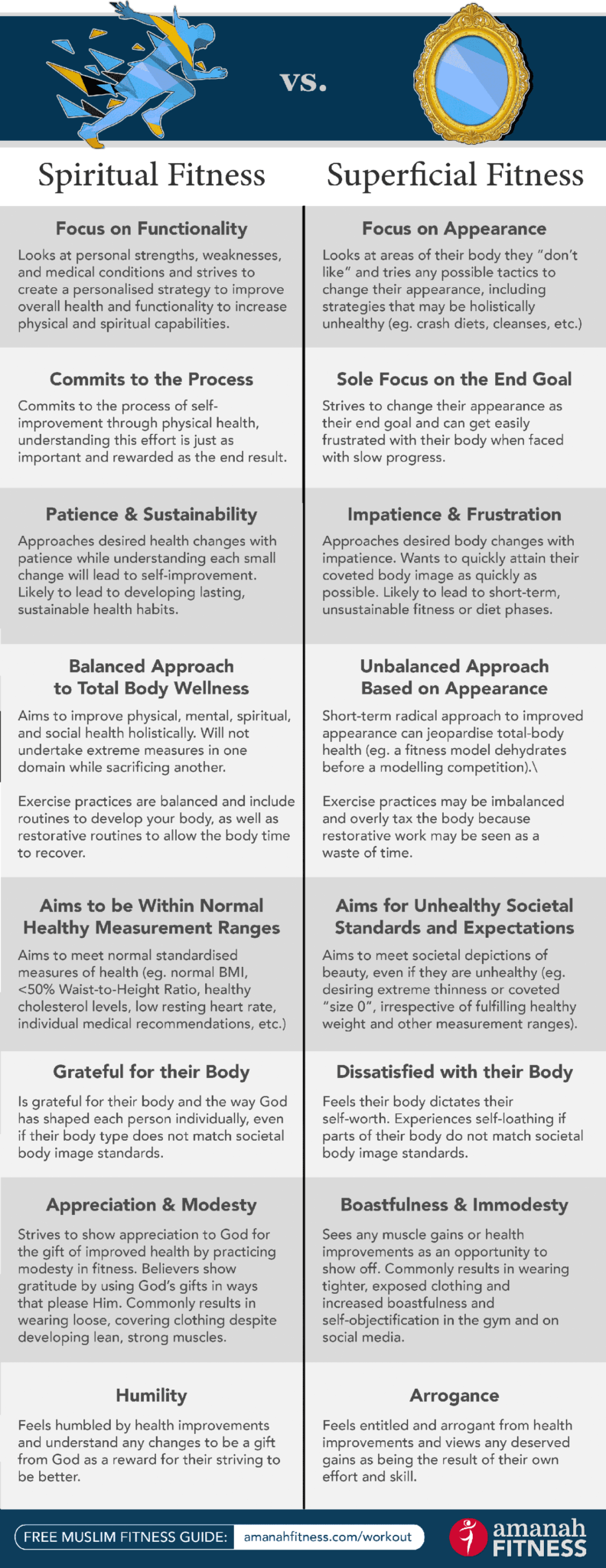
Download full infographic here
Focus on Functionality vs. Appearance
Someone with a Barakah mindset approaches fitness by looking at their personal weaknesses and medical conditions and strives to improve overall health and functionality to increase physical and spiritual performance. They understand the role of fitness is to improve worship and social impact, instead of just for the sake of appearance alone. Versus someone with a superficial approach to fitness looks at areas of their body they “don’t like” and tries any tactic possible to change their appearance, even if it is holistically unhealthy (eg. crash diets, cleanses, etc.). Many fitness enthusiasts start off with a superficial focus and eventually burn out after years of a healthy lifestyle because superficial appearance focus becomes difficult to pursue long-term. The body naturally changes with age, injuries and lifestyle shifts. If the purpose of fitness was only for the sake of superficial appearance, eventually a person will become demotivated and drop off. A functional approach to fitness is long-lasting and stands the test of time.
Commitment to the Process vs. the End Result
Someone with a Barakah mindset commits to the process of self-improvement in physical health, not just the end result. They understand they can be rewarded by Allah for their efforts to improve their body. This process is as valuable as the end result, which becomes deeply motivating to continue pursuing an active lifestyle. Versus someone with a superficial approach to fitness strives for changed appearance and can get easily frustrated with their body when faced with slow progress. Once again, this can quickly lead to burnout and getting discouraged.
Patience and Sustainability
Someone with a Barakah mindset approaches their desired health changes with patience while understanding each small change will lead to self-improvement. This is likely to lead to lasting, sustainable health habits. Versus someone with a superficial approach to fitness approaches desired body changes with impatience and wants to quickly attain their coveted body image as quickly as possible. This is likely to lead to short-term, unsustainable fitness or diet phases.
Balanced vs. Imbalanced Approach to Total Body Wellness
Someone with a Barakah mindset aims to improve their physical, mental, spiritual, social health holistically and will not undertake extreme measures in one domain by sacrificing another. Exercise practices are balanced and include routines designed to push yourself and develop your body, as well as restoration to allow the body time to recover. Versus someone with a superficial approach to fitness may engage in short-term radical approaches to improve appearance that can jeopardize total-body health. For example, a fitness model who severely starves and dehydrates before a modeling competition is sacrificing long-term health for short-term appearance goals. Exercise practices may be imbalanced and overly tax the body because restorative work may be seen as a waste of time.
Measurements of Success
Someone with a Barakah mindset aims to be within normal healthy ranges on standardized measurements of health and weight. They want to get inside the normal BMI range, click HERE. These standardized measures can be used to determine the healthy weight and other markers of good health for each unique body. Although no one measure of health is perfect (and certain measurements, such as BMI, have been criticized by health professions), taken together, these measurements can be used to approximate whether an individual is overall healthy in terms of weight and optimal performance for their body. However, these measures may not perfectly align with societal beauty standards. For example, the healthy BMI weight range for a woman who is 5ft4 inches is between 110 pounds to 140 pounds. Any weight within this range is considered healthy. However, societal beauty image standards impose an image that “thin is better”, so a healthy young woman who weighs 140 pounds may feel self-conscious, despite being within the normal healthy range. Someone with a Barakah mindset uses objective measurements to better understand their health, instead of societal beauty image standards. Versus someone with a superficial approach to fitness aims to meet societal depictions of beauty, even if they are unhealthy (eg. desiring extreme thinness or coveted size “zero” regardless of healthy weight ranges, which can lead to the development of eating disorders, etc.)
Gratitude
Someone with a Barakah mindset is grateful for their body and the way Allah has shaped each of us individually, even if they do not match societal standards of beauty. They understand pressures to conform to societal standards exist and can create mental and emotional pressure. Despite these pressures, they constantly remind themselves to be grateful for their body until it becomes a practiced habit. Versus someone with a superficial approach to fitness feels their body dictates their self-worth. They may experience self-loathing if parts of their body do not match societal beauty standards. This is an easy mindset to fall victim to in an overwhelming culture of fat-shaming. However, we can all work on shifting towards gratitude through positive self-affirmations, dhikr, and practicing other aspects of the Barakah-based fitness mindset.
Appreciation & Modesty
Someone with a Barakah mindset strives to show gratitude to Allah for the gift of improved health by practicing modesty in fitness. as believers show gratitude by using Allah’s gifts in ways that please Him. Versus someone with a superficial approach to fitness inadvertently falls into arrogance and immodesty. They view any muscle gains as an opportunity to show off. This commonly results in wearing tighter, exposed clothing and increased boastfulness and self-objectification in the gym and on social media. The fitness industry promotes a culture of self-objectification. However, as Muslims, we must be careful not to fall into these trends, as it is a perversion of the true objective of fitness: to better the body in servitude to Allah . Dressing modestly at the gym is not just “something Muslim women do”; it is an expression of gratitude to Allah for our bodies and should be taken seriously.
Humility vs. Arrogance
Someone with a Barakah mindset feels humbled by health improvements and understand any changes to be a gift from Allah as a reward for their striving to be better. They may dua to Allah for improved health in their journey and are thankful at their progress. This results in a positive attitude and mindset along all stateless of the fitness journey, despite potential setbacks. Versus someone with a superficial approach to fitness feels entitled and arrogant from health improvements and views any gains as being the result of their own effort and skill. Engaging in constant dua for good health (as is seen in the morning and evening adkhaar) is a strategy to shift towards a barakah based fitness mindset.
Final Thoughts
As Muslims, it’s important to remind ourselves that the importance of a healthy body has always been emphasized in the Islamic tradition.
Abdullah Ibn Umar narrated that The Prophet
This emphasis on our physical health is so fundamental to our Islamic rituals that we are instructed to ask Allah for health in our body multiple times every morning and evening as part of the Prophetic Morning and Evening Adhkaar Supplications.
“O Allah, make me healthy in my body. O Allah, preserve for me my hearing. O Allah, preserve for me my sight. There is none worthy of worship but You. O Allah, I seek refuge in You from disbelief and poverty and I seek refuge in You from the punishment of the grave. There is none worthy of worship but You.” (Recite three times in Arabic every morning and evening.) [Sunan Abi Dawud]
There are clear pearls of wisdom behind this faith-based/Barakah-based emphasis on physical health:
When our bodies are healthy, our productive and spiritual potential increases.
When we ask Allah
for improved health, we understand that good health is a blessing from God that we are in need of. This creates a culture of gratitude and modesty as opposed to arrogance and immodesty.When we ask Allah
for health, we are motivated to “tie our camel” by taking steps to enhance our functionality to reach improved levels of health every day.Notice that these supplications for health ask for and imply body FUNCTIONALITY and do not necessitate a sculpted, model-like physique or particular body image.
Functional fitness is defined as exercises that utilize the entire body with the intent of developing foundational strength to make every task in life easier.
To get started with functional training, you can download my modest Muslim Energy-Boosting workout guide – you will notice all the movements are bodyweight, balanced movements meant to strengthen your entire body for improved energy.
By focusing on functionality, gratitude, modesty and a balanced approach to total-body wellness, we can invite Barakah into our physical health by practicing faith-based fitness for maximum impact.
'By focusing on functionality, gratitude, modesty and a balanced approach to total-body wellness, we can invite Barakah into our physical health by practicing faith-based fitness for maximum impact.' Amina KhanClick To Tweet
A Barakah approach to fitness is based on the understanding that our bodies are an “Amanah” (trust) from Allah that we are meant to use to unlock our full potential in this life. Approaching fitness with this mindset creates a culture of God-consciousness instead of self-consciousness.
Someone who understands the role of our bodies in achieving our ultimate purpose in life will have a dramatically different FUNCTIONAL approach to their health, versus someone who approaches their health for superficial reasons.
Have you been affected by the superficial focus promoted by the mainstream fitness industry, either consciously or unconsciously? Leave a comment below!
References
(1) Hasyim, M., & Arafah, B. (2017). Sexuality For Sale At Television Advertising. Turkish Online Journal Of Design Art And Communication, 7, 89-101.
(2) Duquin, M. E. (1989). Fashion and fitness: images in women’s magazine advertisements. Arena Review, 13(2), 97-109.
(3) Hutson, D. J. (2013). “Your body is your business card”: Bodily capital and health authority in the fitness industry. Social Science & Medicine, 90, 63-71.
(4) Stern, M. (2008). The Fitness Movement and the Fitness Center Industry, 1960-2000. Business & Economic History On-Line, 6.
Stay tuned to the launch of The Barakah Academy: An online education platform for faith-based personal and professional development that will teach practical skills in line with Barakah Culture. If you’re interested to learn more, simply add your name to the waiting list here. Join the Barakah Academy Waiting List!
Join Barakah Academy Waiting List
The post Barakah-Based Fitness vs. Superficial Fitness: 8 Mindful Ways to Change Your Fitness Perspective appeared first on ProductiveMuslim.com.