Mohammed Faris's Blog, page 7
December 1, 2019
[Available Now] Grab Your Productive Muslim 1441-42H/2020G Wall Calendar Today
The Productive Muslim Company proudly announces the release of its 1441-42H/2020G Wall Calendar. This is your practical tool to help you plan your spiritual, professional, & personal goals for the year.
The intention behind this Calendar
We wanted to develop a highly functional calendar with beautiful aesthetics to deepen your awareness of the Islamic year and its spiritual seasons whilst helping you keep track of your annual to-dos and goals.
The calendar is great for personal and professional development planning. You can plan your spiritual activities (Umrah, I’tikaaf, Hajj) as well as personal and professional activities all in one place and see deadlines as they approach so you can prepare for them early.
Calendar features
The calendar spans 12 months Gregorian (2020) and Islamic months (1441-42H).
Larger boxes for writing inside each day.
Highlighted Days for Ramadan, Voluntary Fasting (Mondays and Thursdays, and the White Days, the 13th, 14th, and 15th) of each Islamic calendar month.
Designed to an optimal print size of 18 x 24 inches that fits at home, office, school, or mosque.
Download for FREE or Order from our Online Store
You can download the calendar for free from here. OR
You can order a high quality printed version from our online store and we’ll deliver right to your door.
This is a beautiful tool that will help you throughout the year insha-Allah. Grab your copy today and also gift it to those whom you care about.
The post [Available Now] Grab Your Productive Muslim 1441-42H/2020G Wall Calendar Today appeared first on ProductiveMuslim.com.


November 25, 2019
Barakah Academy Reflections: How Do We Develop Patience?
Have you ever thought about how to practically develop patience or why you need to develop patience in your life? Research shows that patience is one of the key factors to success and personal well-being [1]. From a spiritual point of view, Allah  says that patience is one of the most highly rewarded acts.
“Indeed, the patient will be given their reward without account [limit].” (Qur’an 39: 10)
And the Prophet  says that nobody can be given anything better or vaster than patience.
“Narrated Abu Sa`id
: Some people from the Ansar asked Allah’s Messenger (ﷺ) (to give them something) and he gave to every one of them, who asked him until all that he had was finished. When everything was finished and he had spent all that was in his hand, he said to them, ‘”(Know) that if I have any wealth, I will not withhold it from you (to keep for somebody else); And (know) that he who refrains from begging others (or doing prohibited deeds), Allah will make him contented and not in need of others; and he who remains patient, Allah will bestow patience upon him, and he who is satisfied with what he has, Allah will make him self-sufficient. And there is no gift better and vast (you may be given) than patience.” [Sahih Al-Bukhari]
But how do we practically develop patience?
This month at Barakah Academy, we had a thought-provoking discussion on this subject. It all started when Mohammed Faris, CEO & Founder of Productive Muslim, posed the question to the participants inside the Barakah Academy’s Slack workspace. He wrote:
“I always struggled with the question: “How do you practically develop ‘sabr (patience & perseverance?)” so that when calamities/trials hit you, you can push forward calmly without losing yourself to anxiety and stress.
It feels like an abstract concept that’s hard to prepare for (and you really won’t know if you have sabr (patience) or not until those calamities/trials hit you and observe how your nafs (inner self) react).
One thought that’s germinating in my mind recently is this idea of “developing one’s spiritual capacity/buffer” to deal with trials/calamities. Through the power of rituals (abundance remembrance of Allah , salawaat (sending peace and blessings) upon the Prophet, extra prayers, lots of Qur’an, sadaqah (charity), etc) you’ll build the spiritual capacity/buffer to absorb the shocks that are hitting you and not get too caught up with them when they occur.
Essentially, what these rituals do is help you develop a strong connection/bond with Your Creator so that you develop a strong spiritual grounding to hold you together in good times and tough times. What are your thoughts? How do you develop Sabr in your life?”
His question seems to have hit the right chord with many Barakah Academy members as some deep and heartfelt reflections were shared afterward.
Sidrah Siraj, an academy member from the UK, wrote
“Over the years I’ve tried to develop patience in little ways. One way is every so often I’ll create a dua (supplications) list. I’ll make a wish list of everything I would like in my life. Just before Ramadan, I went through it and the majority of the things on my list I gained. It was really humbling and I hadn’t even realized. Just taking that time to appreciate and look back helped. Also in my duas (supplications), I reiterate everything that I asked for in the past few years some of these things were health-related and again there was a pattern and I realized that these worldly issues I can work on (to a certain extent) but it was only by being patient and constantly turning to Allah did it help. I’ve come to that point in my life where I feel everything is in Allah’s hands, and I find that very liberating. I go to Allah for everything and all I need to do is rely on Him and Him only. All my life, He’s come through for me and when my dua hasn’t been accepted I understand exactly why it didn’t and that itself was a blessing. I basically now take a deep breath (sabr/patience) and talk and talk to Allah . It’s so simple. But it works. Breathe and make dua.”
Areefa Ally, academy member and Educator from Canada, wrote:
“While we must take the means to prepare ourselves, there are undoubtedly times that will shake us. We are warned that we would be tested in various forms. The key is how we react. Easier said than done, but we can take steps to respond with excellence.
For us, Muslims, we often forget the qualifying adjective beautiful when we talk about patience. Pondering that more may be helpful.
Pausing to question our thoughts vs the reality of a situation is also important.
Remembering to be thankful for everything Allah
sends our way even though it may not initially seem so at face value (challenging times can be a reminder to slow down and refocus, a learning opportunity, a form of cleansing, a push towards something better).If challenges involve other people, we are taught to think well of others and to pray for them. These are all things we can remind ourselves of and make a conscious effort to consider whenever situations arise. The best way to remember is to remind others. Lending a listening ear can also be a manifestation of sabr (patience). Please keep in mind: there are times when problems require actions we are not qualified to provide or that sabr alone won’t solve. My suggestions above are not catered to those. There are also times when sabr means not responding to certain stimuli. Please consult your heart and Allah
in all cases.”The powerful Words of Allah
on patiencePatience can be hard for many people, especially with the trials they’re facing in life. If you’re struggling with patience, let me share with you the best counsel/therapy I found on patience. It is from the Words of Allah in the Quran. Allah says:
“Whatever you have will end, but what Allah has is lasting. And We will surely give those who were patient their reward according to the best of what they used to do ” (Qur’an 16: 96)
This verse gives two powerful reminders:
1. “Whatever you have will end. And what Allah has is lasting”
Even your patience can end at some points, but Allah’s Mercy is lasting. Your energy can end, and Allah’s Help is lasting. Your strength, capacities despite how much you train and prepare…can end, but Allah’s Kindness is lasting.
You will not be able to show exemplary patience in every single situation. This is not human. Maryam (Mary) [peace be upon her], the best of all women, the one Allah made an example for believing men and women until the end of time… when her calamity escalated she said: “I wish I had died before this“. (Qur’an 19: 23) If someone was going through difficulty and out of pain said I wish I had died or said some other emotional thing, we would have judged them and judged their faith. But this is the woman with the strongest faith, best knowledge and closest connection with Allah . Yet, Allah recorded her weakness in His Book. Allah knows we’re human. Allah is showing us He’s Merciful enough to not judge us by our lowest moments. This brings us to the next point.
2. “And We will surely give those who were patient their reward according to the best of what they used to do”
Allah didn’t say according to every single moment of their patience period or every single calamity/test they faced. He rather said that He’ll judge by the best moments, the best performance. Do you know when the teacher gives 5 pop quizzes but only grades you for the best 2? If the teacher was merciful enough to grade you according to your best performance, then know that Allah is more worthy of showing incomparable Mercy towards the slaves He created with His Hands.
The message is: Increase in having “best moments” and don’t lose hope during low points, you can turn them into best moments with sincere repentance and increasing in good deeds to wipe out the bad ones. Allah loves the patient ones (Qur’an 3: 146). But He also loves those who repent (Qur’an 2: 222).
Some effective means to develop patience from the Qur’an
1. By asking Allah Himself to make you patient.
“And be patient, and your patience is not but through Allah…” (Qur’an 16: 127)
2. By being in the company of teachers and righteous companions in regular circles of knowledge if possible like (learning Qur’an…etc). The reminders and barakah of those circles have a tremendous impact on handling calamities with peace and groundedness.
“And keep yourself patient [by being] with those who call upon their Lord in the morning and the evening, seeking His countenance. And let not your eyes pass beyond them, desiring adornments of the worldly life, and do not obey one whose heart We have made heedless of Our remembrance and who follows his desire and whose affair is ever [in] neglect.” (Qur’an 18: 28)
3. In Chapter 70 of the Qur’an, Allah talks about beautiful patience (verse 5), then He gives insights (around 8 tips from verse 19 to 35) on what people can do to attain balance in good and bad times.
“Indeed, mankind was created anxious: when evil touches him, impatient, and when good touches him, withholding [of it]. Except for the observers of prayer – Those who are constant in their prayer, And those within whose wealth is a known right for the petitioner and the deprived – and those who believe in the Day of Recompense. And those who are fearful of the punishment of their Lord – Indeed, the punishment of their Lord is not that from which one is safe – And those who guard their private parts. Except from their wives or those their right hands possess, for indeed, they are not to be blamed – But whoever seeks beyond that, then they are the transgressors – And those who are to their trusts and promises attentive. And those who are in their testimonies upright. And those who [carefully] maintain their prayer: They will be in gardens, honored.” (Qur’an 70: 19: 35)
Practically speaking, in situations where we need to show patience, there can be 3 conditions:
We’re able to display beautiful, gracious patience. This is the best condition, it is what we need to aim for, and it is a great favor from Allah
. The Prophet (ﷺ) said, “The real patience is at the first stroke of a calamity.” [Sahih Al Bukhari]We react in an unfavorable way. Then the next best thing to do is immediate repentance and following the bad deeds with good ones. If we don’t show the best patience, then show the best repentance.
We feel completely down. Then we keep calm until this storm ends. It will end and we can still find Allah Forgiving, Accepting of the best, overlooking of the worst. But in low points, we do not approach the haram (unlawful) or leave the fara’ed (obligatory acts). And when one restores energy through the help of Allah (The Guide, The Healer) then hastening to repentance and maximizing good deeds to make up for the lapse.
Patience is a powerful trait and it is one of the Barakah Culture’s mindsets. It is a state of humility, hope, and reliance upon Allah . But if this turned into anger, displeasure with Allah or entitlement, then it loses its soul. Sometimes Allah allows us to break down to open room for repentance because repentance then can be a better state of humility. If one is not humbled by patience, they’ll be humbled by repentance. Allah opens both doors to access His Love, and Allah is ever Merciful to the believers.
If you’re looking for a place to practically learn more about the Barakah values and mindsets, then check our Barakah Academy. The Barakah Academy is your online platform to train with professionals who want to learn practical personal and professional development skills that are faith-based and linked with the latest research and science. It’s your global community of like-hearted professionals who want to live a better version of themselves spiritually, physically and socially.

Reference
[1] Schnitker, Sarah. (2012). An examination of patience and well-being. The Journal of Positive Psychology. 7. 263-280. 10.1080/17439760.2012.697185.
The post Barakah Academy Reflections: How Do We Develop Patience? appeared first on ProductiveMuslim.com.
November 20, 2019
How a Painful Work Experience Can Turn into a Powerful Opportunity for Peace & Growth
What happens when you go through painful work experiences? Do you pause to reflect on their meaning, and message for you? Do you allow them to teach you and help you grow, or do you numb your heart and mind until they pass?
Being more concerned about work outcomes can lead us to sweep our feelings under the carpet when we face a painful work experience ignoring thereby our holistic well-being. But the truth is, you’re not a work machine, you have feelings and emotions, and more importantly, nothing happens to you without a purpose. Allah says in the Qur’an:
“No calamity befalls ˹anyone˺ except by Allah’s Will. And whoever has faith in Allah, He will ˹rightly˺ guide their hearts ˹through adversity˺. And Allah has ˹perfect˺ knowledge of all things.” [Qur’an 64: 11]
When we explore organizational psychology & leadership research, we find abundant evidence for growth following stressful/painful moments [1]. Leaders report that painful moments of hardship were fundamental to their development and understanding of their values [2]. We also learn that people’s levels of cognitive awareness and reflection are among the reasons that allow them to construe benefit from adversity [3].
What we need to acknowledge is that painful work experiences WILL happen to everyone in any organization. The key here is how people can consciously turn those experiences into opportunities for peace, growth, and success.
This brings us to one of the 17 Barakah mindsets we identified as part of our Barakah Culture Toolset (See our Barakah Culture Cards) which is: introspection & self-accountability.
Introspection & self-accountability is a powerful mindset that helps us grow through painful work experiences in a way that brings internal and external peace and growth.
'What we need to acknowledge is that painful work experiences WILL happen to everyone in any organization. The key here is how people can consciously turn those experiences into opportunities for peace, growth, and success.' Dina Mohamed BasionyClick To Tweet
Three benefits of introspection & self-accountability
1. When you adopt the Barakah mindset of introspection and self-accountability upon facing a painful work experience; you reflect and think about where you went wrong and what you can do to change the situation, instead of playing the victim card of why you didn’t deserve this and who’s fault it is.
So the first benefit of such a mindset is that you start taking responsibility honorably for the mistake and figuring out how to tackle it.
Yes, reflecting on one’s own mistakes and blaming the self instead of others can be painful but it’s a sign that your nafs (self/ego) is uncomfortable with making the mistake and you could have done better. And that’s a good sign – it means your heart is alive. (We all know people who make mistakes and feel no regret; if anything they try to justify their mistakes which makes the situation even worse!).
2. The second benefit of the introspection and self-accountability mindset is that it ignites life in your heart and holds you accountable to a higher standard. Allah in the Qur’an gives an oath by the self-reproaching soul.
“I do swear by the Day of Judgment! And I do swear by the self-reproaching soul!” [Qur’an 75: 1-2]
In the above verses, Allah swears by the Day of judgment when people will be held accountable for their deeds. Then He swears by people’s self-reproaching soul that innately holds them accountable and rebukes them for their mistakes BEFORE the day of Judgement. If we don’t hold ourselves accountable in this life, we’ll surely regret in the hereafter.
3. Thirdly, when we introspect and hold ourselves accountable and think of our mistakes from a hereafter-perspective, we shift the focus to the Judge, and the Judge here is The Most Merciful. In the hustle culture we live in, we let our managers be our judge, and sometimes to them, we’re never good enough and our mistakes can never be forgivable. But knowing that Allah is The One who’ll ultimately judge us for our mistakes and that He forgives everything -once asked- no matter how big or how many times mistakes have been repeated brings a sense of ease and helps release us from the pain that’s gripping our hearts.
'Reflecting on one’s own mistakes and blaming the self instead of others can be painful but it’s a sign that your nafs (self/ego) is uncomfortable with making the mistake and you could have done better. That’s a good sign - it means your heart is alive!'Click To Tweet
From pain to hope
The word for ‘blamed’ in Arabic is لام ‘Lam’. Those 3 letters in ‘lam’ لام also form the word الم ‘Alm’ (Pain), i.e. Blame leads to pain. But, the same 3 letters can be rearranged to form the word امل ‘Aml’ (Hope).
The message is clear: Blaming the self can lead to pain. But pain is not a fixed, endless state. The pain must carry and turn into hope…
Hope because the heart is alive and not numb.
Hope that this is not the end (and we’ll be held accountable on the Day of Judgement with a Merciful Lord).
Hope for a better self that can come out of this situation and mistake
Hope in the mercy of Allah
that encompasses everythingHope in His promise that with difficulty there must be ease.
What exacerbates painful experiences for some people is their inability, lack of desire, or refusal to see any hope in their situations. But sometimes Allah places pain purposefully to guide people to Him and to a more meaningful realization about life.
“No calamity befalls ˹anyone˺ except by Allah’s Will. And whoever has faith in Allah, He will ˹rightly˺ guide their hearts ˹through adversity˺. And Allah has ˹perfect˺ knowledge of all things.” (Qur’an 64: 11)
Finding peace knowing that your pain is valued & rewarded
When we’re talking about painful experiences, we’re not necessarily talking about big disasters. It could be a very small event, but it did leave you feeling pain. Still, to Allah , your pain is not meaningless, purposeless or in vain.
Abu Sa’id and Abu Hurairah  reported that the Prophet said:
“Never a believer is stricken with a discomfort, an illness, anxiety, a grief or mental worry or even the pricking of a thorn but Allah will expiate his sins on account of his patience ” [Al-Bukhari and Muslim].
The Prophet cared for and valued the pain of a little child who was grieving over the loss of his little bird. Anas b. Malik said:
The Messenger of Allah
The Prophet didn’t say “brush it off, young man. Toughen up and move on. There are much bigger problems in life.”
Rather, the Prophet took the time to listen and validate the feelings of the little child, engage with him and console him mercifully. This is the mercy of the Messenger of The Most Merciful, imagine the mercy of the Most Merciful Himself!
Every small moment of pain you go through is seen and heard by Allah and is rewarded by Him. Be it a harsh word you read in an email, a tough meeting that left you uncomfortable or an unpleasant manager who keeps you on your toes, stressed and unable to enjoy life… All of those moments can be rewarded and they also happen for a greater reason.
“We have made some of you a trial for others. Will you ˹not then˺ be patient? And your Lord is All-Seeing.” [Qur’an 25: 20]
If one is patient, i.e. not giving up, rebelling or defensively turning away, it could be an opportunity for spiritual connection with Allah because Allah says, “Indeed, Allah is with the patient.” [Qur’an 8: 46]
So patience puts you in the ma’yya of Allah (the company and care) of Allah. Sometimes we get so self-absorbed or consumed by our lives that we completely forget about the One who gave us life. Those temporary moments of discomfort or pain help us slow down, remember Him, turn to Him and engage with Him.
While we might fixate on the current perceived pain and magnify it thinking it’s the end of the world, we are reminded through painful experiences that this life is not the end, it is just an episode and there is an eternal dimension to it. What are those moments, days, weeks, years of pain, in comparison with an eternity of unlimited pleasures if He is pleased with you…?
“Indeed, the patient will be given their reward without account.”[Qur’an 39:10]
'While we might fixate on the current perceived pain and magnify it thinking it’s the end of the world, we are reminded through painful experiences that this life is not the end, it is just an episode and there is an eternal dimension to it.' Click To Tweet
Shifting your mindset & taking action
As we mentioned earlier, pain is not the end. It’s a means to an end. The end is guidance, growth, and connection with Allah . In those painful moments, as a means of relief, try shifting from being ego-centric to being Allah-centric. When one is Allah-centric, he/she thinks about what pleases Allah , instead of what pleases the ego/self.
The nafs can be angry, vengeful, greedy, competitive, restless, hard to please and limited. But Allah is Ever Kind, Generous, Appreciative, doesn’t compare you to others, accepts and aids you in every step, His Name is the Peace and the Giver of peace; He owns everything and has no limits. The Real King.
Submitting to Allah instead of submitting to the self is liberating to the soul from the injustice and limitation of the self. So, in those moments, try thinking like an ‘abd’ (slave of Allah), instead of thinking of yourself as a false master who is entitled to receive everything and be served relentlessly. Free yourself from your own self for a while, and think about Allah . Ask yourself: Did you do something that displeases Him that needs repentance and seeking forgiveness? Are there shortcomings in your duty to Him or others?
When you’re more concerned about Allah , Allah will take away your concerns. The Messenger of Allah says:
“Whoever is focused only on this world, Allah will confound his affairs and make him fear poverty constantly, and he will not get anything of this world except that which has been decreed for him. Whoever is focused on the Hereafter, Allah will settle his affairs for him and make him rich in his heart, and his provision and worldly gains will undoubtedly come to him.” [Sunan Ibn Majah]
Thought experiment
Think about a painful experience you went through/or are going through currently, and ask yourself:
What does this experience make you grateful for?
What does this experience make you hopeful for?
What can you learn from this experience? How can it make you a better person?
Now, turn the answers into hamd (praise of Allah), tasbeeh (glorification of Allah), and dua (supplications to Allah). Praise Allah for the good things you’re thankful for, the countless moments of ease and well-being you experienced before, then glorify Allah above any negative/flawed perceptions, then seek the help of Allah, ask Him for resolutions and have hope in Him and His relief.
Are you going through a painful work experience? Can you use the above to the situation into a powerful mean for spiritual connection, peace, and growth? Let us know in the comments below.
If you enjoyed this article, order your set of the Barakah Culture Cards for the full list of Barakah Values, Mindsets and Rituals to adopt in your personal and professional life.
—
References
Affleck, G., & Tennen, H. (1996). Construing benefits from adversity: Adaptational significance and dispositional underpinnings. Journal of personality, 64(4), 899-922.
Boyd, E. M., & Fales, A. W. (1983). Reflective learning: Key to learning from experience. Journal of humanistic psychology, 23(2), 99-117.
Defense mechanism. Encyclopedia Britannica. Human Psychology.
Helgeson, V. S., Reynolds, K. A., & Tomich, P. L. (2006). A meta-analytic review of benefit finding and growth. Journal of consulting and clinical psychology, 74(5), 797.
Moxley, R. S., & Pulley, M. L. (2003). Tough going: Learning from experience the hard way. Leadership in Action: A Publication of the Center for Creative Leadership and Jossey‐Bass, 23(2), 14-18.
Tennen, H., & Affleck, G. (1999). Finding benefits in adversity. Coping: The psychology of what works, 279-304.
Tennen, H., & Affleck, G. (2002). Benefit-finding and benefit-reminding. Handbook of positive psychology, 1, 584-597.
The post How a Painful Work Experience Can Turn into a Powerful Opportunity for Peace & Growth appeared first on ProductiveMuslim.com.
November 17, 2019
Productive Muslim Retreat 2020: Book Today to Get Inspired and Reset Your Life
Registration for the Productive Muslim Retreat 2020 closes 15th December 2019. Click here to reserve your spot today. Watch the video below to learn more:
The Productive Muslim Company and HalalTrip.com are pleased to announce the 4th edition of the Productive Muslim Retreat that will take place between 7th-13th February 2020, on a 5* resort in Bintan Island, Indonesia. Learn more at the dedicated retreat website: ProductiveMuslimRetreat.com.
This retreat is designed for individuals, couples, and families who are looking for a meaningful escape that provides an uplifting and holistic experience – spiritually, physically, and socially – and help participants clear their mind, set new goals, and build new habits and routines for the next best version of themselves.

Download retreat brochure here
If you’re stressed, overwhelmed, or looking for a turning point in your life to recapture your spirituality, recharge your soul, body & mind, and find enough inspiration and direction for your next stage in life, then The Productive Muslim Retreat is the right opportunity for you, insha’Allah.
Impact of The Productive Muslim Retreat
AlhamduliAllah, participants of previous retreats were delighted and expressed how this experience gave them the needed practical knowledge, inspiration and direction in life. Read some of the testimonials below, or watch interviews on our retreat website here.
“The retreat allowed me to have an objective reflection on my habits, routines, and overall productivity. The focus of the Program on spiritual, mental, social and physical health was exactly what I needed for the growing demands and stresses of both life and work.” – Ahmed Boshnak, Consultant, Saudi Arabia.
“Different people will get different things out of the retreat. Someone who wants to work on their schedule – as I did – would definitely benefit..doing it with a teacher and fellow students. I brought four kids and my wife to this retreat and alhamdulillah we had a very enjoyable time.” – Abdur-Rahman Syed, Brand Strategist.
“I can’t really put this experience in words, but I know it’s definitely going to benefit me, benefit my family, and those people that I’m going to share this message with, and I’m looking forward to coming to another one.” – Aminah Ibrahim Abba, Student, UK.
“I think [The Retreat] is like a seed that is planted in me that will grow when I come back home. I just had a fantastic time here” – Farhana Baharos, Psychologist, The Netherlands.
Retreat Coach
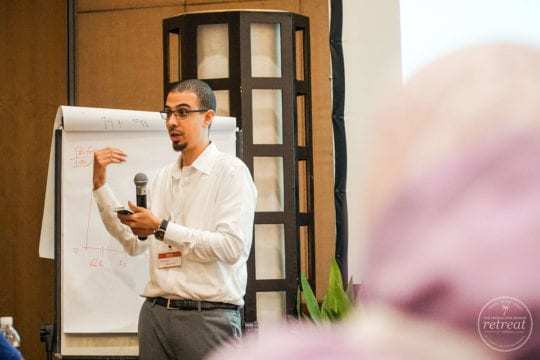
The retreat will be led by Mohammed Faris, Founder, and CEO of The Productive Muslim Company and author of “The Productive Muslim: Where Faith Meets Productivity” – who’ll guide the participants on a 7 day experience that will connect the spiritual tradition of the Islamic faith and cutting-edge peak performance science research to enrich and deepen the participants’ experience.
How to Book Your Spot
You can book a spot on the retreat in 3 easy steps:
Select your package from the retreat website here.
Complete Booking form
Finalize your booking with our logistics partner, HalalTrip.com over the phone or via email.
Due to limited capacity, participants need to reserve their spot on the 2020 retreat no later than 15th December 2019.
If you feel this retreat is the right getaway you need in your life now, then Bismillah, check out full details and register today here.
The post Productive Muslim Retreat 2020: Book Today to Get Inspired and Reset Your Life appeared first on ProductiveMuslim.com.
November 5, 2019
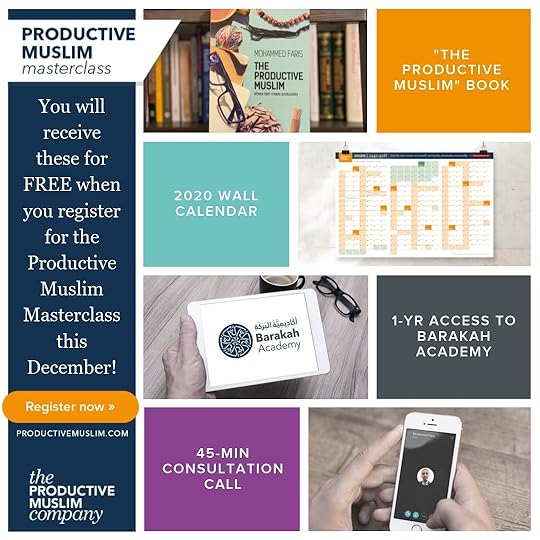
[The Productive Muslim Masterclass Commences Dec. 28] How this Masterclass Will Help You Live the Next Best Version of Yourself Across All Your Roles
What does it take to live the next best version of yourself across all your roles in life? What are you doing now to practically actualize your purpose as a true ‘abd (slave of Allah) and live a meaningfully productive life spiritually, physically and socially? How do you practically aim for success in this world and success in the hereafter without feeling lost, stressed or overwhelmed?
This is exactly why the Productive Muslim masterclass can be a turning point in your self-development journey, with the Will of Allah. The Productive Muslim Masterclass combines over 10 years of experience in productivity and peak performance science along with the Islamic knowledge that helps people live the best version of themselves spiritually, physically and socially.
Spare just 17 mins to listen to this powerful presentation by Mohammed Faris, CEO, and Founder of the Productive Muslim Company, as he walks you through exactly what will be covered in this transformative 6-week program, and how it can practically help you make smart choices to upgrade to the next best version of yourself.
If you’re hesitant about the results of this masterclass, visit the Masterclass Graduates’ Stories Page to watch and read inspiring stories from former graduates.
The next masterclass will commence on Saturday, 28th December 2019 (1st Jumadah 1441H) God-willing. Register Now Here.
The post [The Productive Muslim Masterclass Commences Dec. 28] How this Masterclass Will Help You Live the Next Best Version of Yourself Across All Your Roles appeared first on ProductiveMuslim.com.
November 2, 2019
[Order Now] The Barakah Culture Cards: Your Practical Guide to the Mindsets, Values & Rituals of Barakah Culture
The Barakah Culture Cards is a training tool for professionals and teams to help them identify the mindsets, values, and rituals that promote barakah culture in their personal & professional lives.
The purpose of the cards is to engage professionals and teams in a learning exercise that is both visual and hands-on and makes the concepts of living a Barakah culture more tangible and real.
Each deck contains 17 mindsets, 17 values, and 17 rituals that are drawn from Quranic verses, sayings of Prophet Muhammad and Islamic tradition that promote Barakah Culture in a person and team.
It is our goal that with these cards, we can equip individuals and organizations with the tools to have a meaningful conversation on how to adopt Barakah Culture in their lives and fight the madness of ‘workism’ and the Hustle culture.
Getting the Cards
Click here to order your own Barakah Culture cards OR get a downloadable version for free here.
version for free.
How to use the Barakah Culture Cards for yourself or team?
There are several ways to use these cards, and you can use your imagination and creativity to come up with even more imaginative ways to make the most of these cards for learning and training purposes.
Below is our recommended way to use the cards:
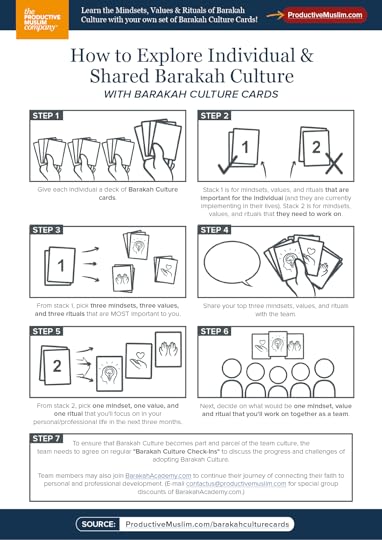
Step 1: Give each individual a set of cards.
Step 2: Ask each person to go through all the cards and divide them into 2 piles:
PILE 1: Place here the mindsets, values, and rituals that you’re currently adopting/implementing in your life.
PILE 2: Place here the mindsets, values, and rituals that you need to work on (or adopt in the future).
Step 3: From PILE 1, pick 3 mindsets, 3 values, and 3 rituals that are MOST important to you (this is not to say that the rest are not important, but these 9 cards are your non-negotiable ones, no matter the circumstances you face in life).
Step 4: If you’re playing these cards with a team, share your top three mindsets, values, and rituals with the rest of the team and explain why. This would lead to eye-opening discussions on what’s most important to each individual team member, and how all team members are complementing each other on Barakah Culture.
Step 5: From PILE 2, pick ONE mindset, ONE value, and ONE ritual that you’ll focus on as an individual in your personal/professional life in the next 3 months.
Step 6: If you’re playing these cards with a team; after everyone shares their one mindset, values, and rituals that they need to work on. Decide on what would be the ONE mindset, ONE Value, ONE Ritual that you’ll work on together as a team.
STEP 7: REGULAR CHECK-INS.
At this point, the exercise is over, however, to ensure that Barakah Culture becomes part and parcel of your personal and professional development, it’s important to set up regular “Barakah – CheckIn” days with yourself and team to discuss the progress and challenges of adopting Barakah culture in your personal/professional lives.
A FUN AFTERNOON WITH BARAKAH CULTURE CARDS
Here is a fun and educational way for using the Barakah Culture Cards in your organization.
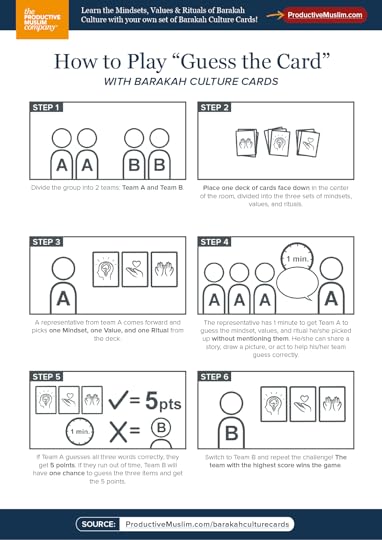
Divide the team into 2 teams: Team A and Team B.
Place one deck of cards face time in the center of the room divided into the 3 sets of mindsets, values, and rituals.
Ask for a representative from team A to come forward and pick one mindset, one value, and one ritual from the deck.
The Challenge: They have 1 min to get Team A to guess what is the mindset, value, and ritual they picked up without saying those 3 words! They can give clues or share a story, but they can’t use the 3 words they picked up.
If Team A gets the 3 words correctly, they get 5 points. If they can’t guess all 3 words correctly by the end of the 1-minute challenge, Team B will have one chance to guess the 3 words and get the 5 points.
Switch to Team B and repeat the challenge! The team with the highest scores wins the game.
The keyword here though is “play”. We want people to engage with these cards as a playful, yet meaningful and thoughtful, exercise.
Additional Discussion Prompts
Connecting Barakah Culture Cards to Issues: Identify issues affecting the team and organization. Connect the cause of the issue to a lack of any Barakah Values, Mindsets or Rituals. Discuss actionable steps.
Connecting Barakah Culture Cards to Experiences: Ask team members to share one Barakah Mindset, Value, or Ritual which they learned through experience and the impact that experience had on their personal and professional development.
Connecting Barakah Culture Cards to Family: Identify a card that represents a Value, Mindset or Ritual you have learned from a parent or grandparent, or that you have taught to your children. Share the value and what it means to you / your family.
We’d Love Your Feedback
We’re excited to release these Barakah Culture Cards globally and we can’t wait to hear stories from individuals and teams on how these tools have helped them bring tangible success, motivation, and Barakah in their personal and professional lives. To share your story (or any feedback) you have with these cards, please email us at contactus@productivemuslim.com with the subject line: Barakah Culture Cards.
Acknowledgments
All praise is due to Allah for enabling us to produce these cards and peace and blessings be upon our beloved Prophet Muhammad who is the embodiment of Barakah and role model for the Ummah. The following Productive Muslim Company team members and partners were involved in the development of these cards: Dina Basiony (Author), Aneesah Satriya (Designer), Mohammed Faris (Editor), Quratulain Tariq (Illustrator), Khadijah Alston (Logistics Coordinator), and Mohamed Hendi (Printing & Production). The cards are still a work in progress and we’d love your feedback to keep improving the quality and content of these cards with Ihsan.
The post [Order Now] The Barakah Culture Cards: Your Practical Guide to the Mindsets, Values & Rituals of Barakah Culture appeared first on ProductiveMuslim.com.
October 9, 2019
Ambassador Ebrahim Rasool: How the Qur’an Helped Me Find My Power Within & 7 Tips to Radiate Barakah
This article is courtesy of Amb. Ebrahim Rasool, former South Africa’s Ambassador to the United States. He has a long history of involvement in the anti-apartheid struggle in South Africa. He held several leadership positions and received several leadership awards. He has been active in mobilizing Muslims and the broader faith communities toward a deeper understanding of Islam and faith under conditions of oppression and currently under conditions of globalization. He is the founder of the World for All Foundation.
My accidental discovery and deliberative usage of my inner power – the Power Within – has been one of the more difficult of my life journey to share. The difficulty lies in both confessing how unconscious I was when uncovering my inner power as well as how desperate the circumstances when I realized that, unless I harness it, I may perish. However, I decided to dig deep into my soul to find the best way in which to make this journey accessible for an audience needing to search for an inner power in order to radiate outwardly the barakah or blessing inherent in its positive harnessing.
This journey goes back to 6 June 1987. After my first stint in apartheid South Africa’s prison, I spent the next 18 months ‘underground’, escaping the draconian powers that the state of emergency conferred on the already powerful police: the power to detain people without trial indefinitely, to disappear them, to isolate them in solitary confinement, and to interrogate them relentlessly. They finally caught up with me.
I was to spend the next 14 months as a political detainee, firstly in a Wynberg police cell, and then Pollsmoor prison, where Nelson Mandela too was a political prisoner. The first four months of my detention were in solitary confinement where the only people I engaged were the security branch interrogating me.
For this period in prison, especially the months of solitary confinement, the only resource I had was the Qur’an. It was the Qur’an around which my life and survival would depend. Every conscious moment was based on finding sustenance, strength, and power from the Qur’an. Around the morning prayers, I simply sought to complete as many Arabic recitations as possible. After breakfast, I memorized my favorite verses and chapters. In the afternoon I read it in English in a conscious search for meaning, my interpretations of which I recorded on the blank spaces left by Yusuf Ali. In the evening I did an index of the themes of the Quran on toilet paper (the only paper available) with the refill of a pen smuggled from a warden.
For me, the Qur’an was my conversation with God . It was about its melody, but also being attuned to its spirit. It was about its rules of worship and living, but also about its intent. It was about reading the history of Prophets, but for the purpose of being inspired to act today. At that moment in prison, the Qur’an was my conversation about how not to break and betray under interrogation, how to remain sane and in charge against your enemy, and how to remain intact by limiting the damage to my soul.
'The Qur'an had to be my guardian against my visible external enemies who asked the questions and issued the threats, as well as my insidious internal ones that exhort you to resignation, bitterness, hatred or rage.'Click To Tweet
However, it was not the Qur’an itself that stepped into the breach against my interrogators. Rather, it was the Qur’an that alerted me to the power within and linked it to the Source of Power.
The Qur’an was a manual on how to harness internal power to radiate barakah (blessing) externally. This was a journey that had seven tips I only made sense of in retrospect.
Tip 1: Plug into The Ultimate Source
The Prophet [SAW] said to his companion: “I will give you the ultimate treasure of paradise: Say ‘La hawla wa la quwwata illa billah (There is no power and no strength except with Allah).” [Sunan Ibn Majah]
This affirmation that all original power comes from Allah, the Ultimate Source of Power, is at once a statement of humility and a safeguard against arrogance; a possibility to share in this power and a warning against becoming a competitor source; and an invitation to access of this ultimate power and then to harness it for good. The Prophet did not seek to disempower us as human beings because such an interpretation would negate the unique characteristic of human beings to utilize the power of choice and decision, and would relegate us to the level of other creatures that possess instinct without a will, and hence are free of responsibility and accountability.
We are encouraged to be powerful devices. Every device has a unique and magnificent capability when it is powered up. However, this only happens when connected to a power source, whether plugged in or having a battery inserted. It has to be charged. Therefore, the precondition for discovering, uncovering and harnessing the power within is to submit first to getting charged from the power source, the Ultimate Origin of Power: Allah Al-Qawy (The All-Powerful, Source of Power)!
Tip 2: Be whole to be powerful: the Qur’an is not a supermarket
The first two weeks of my detention was defined by mixed emotion. I needed to be strong and powerful to resist the relentless interrogation. Simultaneously, it was about denial: I was not so powerful and important and therefore, I was sure to be released when the statutory two-week review occurred. In that period of hopeful desperation, my reading of the Qur’an was as if I was in a supermarket: I went to my favorite aisles – all the socio-political chapters – seeking the shelves with my favorite products – the verses exhorting unrelenting battle against injustice – and choosing my favorite brands – promises of martyrdom and paradise for my efforts. My reading was a relentless search for Divine affirmation for why I was in detention and the promise of Divine deliverance from suffering or Divine reward for sacrifice.
But was I reading the Qur’an – conversing with God [SWT]– any differently from the Muslims I was questioning: The Imam who stands up for Fajr, but not moved by it to stand for justice, who reads only to perfect the rituals? The devout who reads to affirm their length of pants and extent of hijab, but oblivious to human sacrifice? How different was I to those who choose the aisles and products and brands that only deal with their preoccupations? Was I, too, only reading the Qur’an to confirm what I know and who I am?
At the two-week mark, in a cruel blow to my hopes of release, the police indeed asked me to pack my belongings, sign my release form, and exit the door of the detention cells. As I stepped out, they re-arrested me, having complied with the letter of the law. As I reconciled myself to a long stint in prison, a verse from the Qur’an jumped at me:
“Do you believe in a part of the Scripture and reject a part?” [Qur’an 2:85]
This was the Qur’an telling me to be whole, comprehensive and complete if I were to access the ultimate source of power and plug into it. There is a middle way between the solitude of the ritualist and the activism of the jihadi that prevents the former from being a coward and the latter from extremism; between escapist spiritualism and soulless social commitment; and between the rules and regulations of Islam and the intents, values, and principles thereof. But to find this middle way, I needed to read the whole Qur’an, from cover to cover, engaging in the conversation with Allah [SWT], but not on my supermarket terms!
Tip 3: Be disrupted to disrupt: worship vertically and serve horizontally
Being whole allows social activism to emerge from a deep spiritual commitment, and ensures that spiritual commitment leads to social action. Those whose life is based on perfecting the rituals – their vertical worship – are reminded in the Qur’an that their standing at night must be balanced with their social commitment by day, and must, therefore, be tempered. Similarly, those whose activism – horizontal service – is so consuming that they find no time for meditation, reflection, and spiritual connection can be as one-dimensional.
For me, at that moment when the consequence of my social commitment was that I was vulnerable and isolated, I needed to disrupt my own life: how to interrupt my meetings so that I could pray; how to fast outside of Ramadan even in the midst of life and death struggles; how to donate from even the little you earn from an informal existence; how to have an ideological viewpoint that could be subject to scrutiny and ridicule in a world grown skeptical of God when so much suffering is justified in the name of religion.
My reading of the Qur’an then taught me that it could just be that in the very design of every prescribed worship, there was the dual impact of being disrupted to disrupt! Prayer, sometimes at odd times, vertically connects to God , but is simultaneously the means ‘to enjoin good and avert wrong’; while fasting teaches God-Consciousness and solidarity with the poor simultaneously; just as zakah purifies the giver while assisting those disadvantaged; and even the pilgrimage to Makka ultimately gains you knowledge of God , but only after you have come to know yourself. Indeed, the disruption to the self allows an even more powerful ability to disrupt the forces of injustice, poverty, hunger, ignorance and the many more. This is the barakah – the blessings that radiate horizontally – when the vertical axis is allowed to be disruptive. This vertical axis is the point at which the power flows from the Ultimate Source to the appliance.
Tip 4: A two-way conversation with God
: asking and listeningIn those desperate first weeks in prison, I was frantically communicating with Allah . I wanted to be relieved of my ordeal. I wanted to be released from prison. I wanted to withstand my interrogation. I wanted mercy and I wanted forgiveness and I wanted paradise and I wanted my family taken care of…. It was about me. It was an unfulfilling communication.
As Ramadan approached, and I was preparing for fasting, the prison authorities thought I was embarking on a hunger strike, the ultimate weapon of political prisoners, the decision to starve yourself and draw attention to the injustice you’re facing. Suddenly the menu changed: a mishmash of food became, by prison standards, a gourmet meal, served at the moment of your greatest hunger to entice you out of your hunger strike or fast, carefully weighed before serving and then at the point of collection to refute – even by a milligram – your claims to hunger strike. But resolve at that moment wasn’t my most important Ramadan lesson.
The lesson emerged from a more intensive reflection on the usual verses of the Qur’an that deal with the month of fasting:
“O ye who believe! fasting is prescribed to you as it was prescribed to those before you that you may (learn) self-restraint.
(Fasting) for a fixed number of days; but if any of you is ill or on a journey the prescribed number (should be made up) from days later. For those who can do it (with hardship) is a ransom the feeding of one that is indigent. But he that will give more of his own free will it is better for him and it is better for you that you fast if you only knew.
Ramadan is the (month) in which was sent down the Qur’an as a guide to mankind also clear (Signs) for guidance and judgment (between right and wrong). So every one of you who is present (at his home) during that month should spend it in fasting but if anyone is ill or on a journey the prescribed period (should be made up) by days later. Allah intends every facility for you He does not want to put you to difficulties. (He wants you) to complete the prescribed period and to glorify Him in that He has guided you, and perchance you shall be grateful.
When my servants ask you concerning Me I am indeed close (to them); I listen to the prayer of every suppliant when he calleth on Me; let them also with a will listen to My call and believe in Me; that they may walk in the right way. [Qur’an 2:183- 186]
It was especially verse 186 that caught my attention:
“When My servants ask you concerning Me, I am indeed close to them: I listen to the prayer of every suppliant when they call on me. Let them too, with a will, Listen to My call, and believe in Me; that they may walk in the right way.”
How many times have I missed Allah’s side of the conversation because I was obsessed with my needs and wants?
I was very good with the first part of the exchange, where I am listened to, but often oblivious to the reciprocal part: to listen with a will!
And Allah knows what distracts from listening to His message, the failure to listen diminishes our own power and barakah. The Qur’an therefore, advises even about the best time to enter into this conversation. The ‘reading of the Qur’an at dawn is ever witnessed.’ [Qur’an 17:78]
Allah is ever-present. Allah does not only suggest the time that is best, but at the moment of the Prophet’s [SAW] greatest vulnerability, when he was taking refuge in his cloak, a chapter of the Qur’an was revealed to elaborate the idea of this conversation, and to motivate for this to occur when distractions are at their most limited:
“Stand to pray by night, just a little, half the night, or even less, or a little more. And read the Quran in slow, measured, rhythmic tones. Soon will you receive an important message.” [Qur’an 73:2-5]
After emphasizing the time, duration and manner of reading, as well as the anticipation of an impending message, the rationale for such detail is unveiled:
“Truly the rising by night is most potent for governing the soul and most suitable for framing the Word of prayer and praise. True, by day there is for you prolonged occupation with ordinary duties.” [Qur’an 73:6-7]
I realized that I was not receiving the message – the other side of the conversation – because I was either distracted by my daily preoccupations or by my own obsessions. I needed to govern my soul to be free of these competing interests.
What was intriguing was the notion of ‘framing the Word.’ The Word of Allah, the text, is inviolable, but its framing requires a soul free of competing interests, biased intentions, the exigencies of now and here as the main determinants. For the Word to be heard, understood and internalized, the soul needs relative purity and discipline. In other words, for the Word to be suitably framed the text must at once be responsive to, but not overwhelmed by, the context – time and place – nor by the pretext – what needs you bring to it – and neither by the subtext – preceding scholarship. The solitude of the night may well be the best atmosphere for such a conversation where I may be liberated from fears and anxieties, distanced from anger or excessive affections, or devoid of distractions. A conversation thus framed, unleashes the power within because the link to the Ultimate Source thereof is unshakeable.
Tip 5: Intentionality: the power of establishing the purpose
The notion of niyyah – intention – is in danger of becoming cliché-ic or ritualistic. With a two-way conversation opening up falteringly, imperfectly, but ultimately empoweringly, I had, at last, the courage to ask ‘why?’ One of the whys was about the dozens of formulas we learned by rote before each prayer, ablution, entry to, and exit from, the toilet, the home, transport, and in almost every life event. Why the “I intend…”? Because I was building sufficient will to also listen, my mind was opening to meanings that transcended ritual. If God [SWT] says that human beings were created ONLY to worship, then is this an exhortation to be only in the mosque, in constant prayer and fast mode? Or is intention (niyyah) the mechanism with which to transform every act, event, or engagement in life into an act of worship? Have I understood worship only as ritual – which is crucial – but missed the even greater opportunity to transform life itself into worship by harnessing the power within and radiating barakah and blessing?
At every moment of loss, we remind ourselves about the two fixed points in life: our origin – ‘from Allah we come’ – and our destination – ‘to Allah we are returning’. What a privileged worldview we have in which we build purpose into everything we do, we build intentionality, because we are aware of our destination. We start not simply by expressing intentionality, but by purifying intention – ‘for the sake of God’. Thus, barakah is embedded – more obviously in the ritual acts of worship – but more importantly in the daily acts of life when working, playing, learning, relaxing, relating or pondering, if we allow them to be transformed by intentionality.
'(Niyyah) Intentionality transforms the mundane into the sublime, the worldly into the sacred, and the ordinary into the transcendent. This is our power at work!'Click To Tweet
Tip 6: Finding true north: what is worth dying for?
In the midst of my time in Pollsmoor Prison, a warden contrived to set up an encounter with Nelson Mandela. This was a moment that could make any ordeal worthwhile. Imagine meeting someone whose image, voice and words were banned and prohibited under apartheid. Imagine being with someone about whom you sang freedom songs and for whose freedom you marched and under whose inspiration you confronted the apartheid machinery. Now you met a leader, undiminished by almost 25 years in jail, optimistic about our future and knowledgeable about you, Ebrahim Rasool, a mere activist in a nation of heroes.
On reflecting on Mandela’s resilience, faithfulness and hopefulness, I was drawn to his words – which we recited in hushed tones – at the moment that he was to be sentenced to a lifetime in prison, where he and the other Rivonia Trialists stood between that life sentence and the death penalty. In anticipation of the death penalty, Mandela issued both a challenge to the judge and a statement of his life creed: “I have cherished the ideal of a democratic and free society. It is an ideal I hope to live for and to achieve, but if needs be, it is an ideal for which I am prepared to die.”
With those words, Nelson Mandela distinguished himself from populist leaders who manipulate for short-term achievements, but unable to sacrifice for long-term values; from extremists who are fully capable of dying for their cause, but unable to live it; and from leaders driven by rage and those inspired by the finest human ideals.
'To know what to live for, you must first know what is so worthwhile and valuable that you are prepared to die for its achievement and realization'Click To Tweet
Mandela was prepared to die for his ideals, but he was far more intent on realizing and living them.
At that moment in prison, I had my purpose renewed, I refined my goals, and clarified life values from personal ambitions, injury, and motives – I knew what was worth sacrificing and, if needs be, dying for! Then I knew what I wanted to live for! I was helped in that the quality of my conversation with God [SWT] was improving, I was developing a more conscious sense of intentionality, and now I was developing a life purpose in support of values. The power within was less latent and more apparent, and as people outside of prison were mobilizing for my release, spray-painting my name on walls, demanding my freedom, I knew that the barakah was radiating because in a small part my personal story became part of a bigger human and political narrative that could only advance the freedom we yearned for.
Tip 7: Take the plunge: “We will show you the way”
There is a fundamental difference between one’s inner power and one’s ability to control life. Rather than thinking that you can chart each course in your life, predict each choice at intersections on the road, and find the straightest way to a destination, the most important thing is often to pitch up at the departure point, to take the plunge into life! So many make perfect planning of this journey, perfect choices at intersections, perfect companions on the journey, perfect assurances of success the preconditions for living conscious lives, for harnessing their inner power and radiating their blessings to the world. To use a cliché: The perfect should not be the enemy of the good!
This came into perspective when I encountered the Chapter in the Qur’an called The Spider Al Ankabut:
“Those who strive in Our way, We will show them the way.” [Qur’n 29: 69]
There is very little to fear when you have taken the steps of plugging into the Ultimate Power when your reading of the Qur’an is whole and your conversation with Allah [SWT] is about both speaking and listening in ways that worship is a means to higher purposes, and when you have both intentionality and life purpose. When these frame your living, you must not fear your inner power and not withhold your barakah or blessing from the world, especially when your next iteration of the journey is yet unknown and your choices at the intersections of life are unclear. Allah [SWT] will show the way, but you have to take the plunge. The Prophet [SAW] once even advised that fatwas (rulings) from the heart may even become your guide.
Wabisah bin Ma’bad (May Allah be pleased with him) reported:
I went to Messenger of Allah (ﷺ) and he asked me, “Have you come to inquire about piety?” I replied in the affirmative. Then he said, “Ask your heart regarding it. Piety is that which contents the soul and comforts the heart, and sin is that which causes doubts and perturbs the heart, even if people pronounce it lawful and give you verdicts on such matters again and again.” [Ahmad and Ad- Darmi].
But we have to pitch up at the point of choice and decision. We must neither fear our power within nor withhold our barakah!
Want to unlock your power within? Join our upcoming 6-week Masterclass to learn practical strategies for tapping into the power within the Quran, Sunnah, and Peak Performance science to live the best version of yourself. Learn more here
The post Ambassador Ebrahim Rasool: How the Qur’an Helped Me Find My Power Within & 7 Tips to Radiate Barakah appeared first on ProductiveMuslim.com.
September 29, 2019
How Divine Affection “Al-Wadud” Can Help You Deal with Work Mistakes
Do you ever make a mistake at work, or perceive a mistake as a manager, and it overwhelms you with sadness, anxiety, or other negative emotions?
A few weeks ago, I was discussing with my supervisor a situation at work. I ended up overreacting or -as the supervisor said, “catastrophized” the situation. With a bit of introspection, I realized how my reaction was disproportionate to the issue at hand and I felt bad about my misjudgment. I was inclined to retreat and delve in self-blame which would have affected my mood, and productivity. But then I remembered a powerful verse from the Qur’an:
“And He is the Forgiving, the Affectionate” [Qur’an 85: 14]
This transformed my feelings. It replaced the negative self-talk that was playing in my head with self-compassion. I thought if Allah forgives mistakes affectionately, how can we not forgive ourselves in moments of unintended mistakes or perceived failure…? How can we let ourselves drown in negativity when Allah constantly gives us hope and pushes us to move forward?
For some people, negative self-talk after making mistakes can turn into self-torture and lead to depression, anxiety or self-hate even[1], as well as inhibit their creativity and productivity at work. However, the issue we need to remember is: mistakes happen and will continue to happen in every workplace. This is inevitable and unavoidable.
So the real problem is not how to avoid mistakes, but how we deal with them. Click To Tweet
When you make mistakes, how can you deal with the perceived failure so that you can grow as a person and turn an unfortunate event into success? Research has found that we can learn much more in moments of failure than those of success [1].
I wanted to approach this topic from a spiritual angle – specifically by reflecting on the Beautiful Name of Allah , The Affectionate (Al-Wadud), and how through understanding this Name and its manifestations, we can find solace in those inevitable office blunders.
How Divine Affection in the context of mistakes can lift you up
When you think of affection, what usually comes to your mind? Possibly how you feel towards someone you like or someone you’re in harmony and agreement with. But the question is: will you continue to have affection towards someone who’s done you wrong?
In the Qur’an, the Name of Allah Al-Wadud (The Affectionate, The Source of Affection) is mentioned twice. In both cases, it is not associated with those who’ve done great or has done likable things; it’s mentioned in the context of forgiving sins and mistakes.
“And He is the Forgiving, the Affectionate” [Qur’an 85: 14]
“And ask forgiveness of your Lord and then repent to Him. Indeed, my Lord is Merciful and Affectionate.” [Qur’an 11: 90]
In the first verse, notice how Allah specifically added His Name The Affectionate right after the Forgiving. So, it’s not like He’ll forgive but won’t like us anymore. It’s that He forgives simultaneously showing intense affection. There is no “and” for pause or interruption; as though the process of forgiveness did not decrease His Affection one bit or for one second.
When people make mistakes, they don’t expect to be met with affection. They actually expect the opposite and most often receive what they expect. This is because as human beings, we often operate from a scarcity mindset, a mindset that there’s not enough forgiveness and compassion to forgive mistakes. But this is not the Vastness of The Creator, and it’s not the Barakah Culture’s values of gentleness, mercy, and compassion that we aim to adopt in our professional work environments.
Think of the last time a colleague or a team member has done a mistake at work that cost you a great deal. What were your immediate reactions and feelings towards that person?
It is understandable that our most impulsive way to deal with the mistake is to tell the employee off. It takes the anger and frustration off your chest as a manger. It is also a way to make the employee more wary of repeating the same mistake, and it acts as a lesson (or an indirect warning) for the rest of the employees. But while this yields some positive short term results, research shows that it is NOT the most effective and productive way of dealing with mistakes.
Research shows that the most powerful way of dealing with mistakes is actually the most compassionate one [Emma Seppala, Science Director of the Center for Compassion and Altruism Research and Education at Stanford University]. There are several studies that suggest for practitioners (CEOs, top management teams) to practice more acts of compassion if they want to boost job performance of employees.[3] The Oxford Handbook of Compassion Science provides multiple research and evidence on how compassion can transform individuals, organizations and teams’ performance. Basically, the studies show that employees who feel compassion are more likely to persevere in challenging tasks than those who’re met with other emotions.
What compassion does is that it increases the employees’ loyalty, trust, and devotion to their work and manager. It creates a greater derive and willpower for success. And the opposite approach leads to the opposite results.
Neuroscience tells us that when we tell people off, a sense of fear and anxiety arise in them, which leads to reducing their creativity. Thus, it acts as a long-term counterproductive approach. According to James Doty, Director of Stanford University’s Center for Compassion and Altruism Research and Education, “If people have fear and anxiety, we know from neuroscience that their threat response is engaged, their cognitive control is impacted. As a consequence, their productivity and creativity diminish.” [Psychology Today]
How does that impact you?
Allah knows that when people make mistakes, deep down they’re inclined to not love themselves (and others don’t meet them with affection either), so He reminds us through His Name the Affectionate to re-love ourselves/others in order to grow and continuously learn and improve.
Yes, as people dealing with those who make mistakes, we can never measure up to Allah’s level of affection, but in our spiritual pursuit to connect with Him and seek His Closeness and barakah, we can attempt to reflect His Names more in our lives.
The Name of Allah the Affectionate can teach us to be more compassionate towards others who work with us/under us when they make mistakes. And this actually can bring more barakah professionally.
Compassion: The most powerful way of dealing with mistakes
In the next two sections, we’ll go a bit deeper and be more practical on how a leader should deal with an employees’ mistakes and how an employee should deal with their own mistakes from a spiritual and scientific perspective.
As a leader, how should you deal with mistakes
1. Leniency vs. harshness
Prophet Muhammad
Imagine being in a competition with a competitor whose main aim is to destroy you completely. You make a solid plan to win. You approach winning but towards the end, your team violates your instructions and their mistake directly results in your team’s catastrophic loss.
How will you react?
This might be a hypothetical nightmare for you. But it is – more or less- what happened to the Prophet in the battle of Uhud. The believers were defending themselves against those who were out to viciously prosecute and eliminate them and their message entirely from the surface of the earth. Despite early winning, some of the companions disobeyed the clear and direct commands of the Prophet . Their mistake directly led to major defeat as well as the injury of the Messenger of Allah himself.
But did Allah and His Messenger tell them off as a result of this mistake?
If there was a time to act angrily and tell people off, it would have been there and then. But instead, Allah told His Messenger:
“So by mercy from Allah, [O Muhammad], you were lenient with them. And if you had been rude [in speech] and harsh in heart, they would have disbanded from about you. So pardon them and ask forgiveness for them and consult them in the matter. And when you have decided, then rely upon Allah. Indeed, Allah loves those who rely [upon Him].” [Qur’an 3: 159]
Pardon them, forgive them and consult them. First, pardon, overlook the mistake because deepening people’s sense of guilt will lead to more despair rather than a willingness to move forward. And research shows that blame, especially the one conducted openly, provokes defensiveness as opposed to enhancing problem-solving tendencies[4]. Then, forgive them as when you supplicate for the forgiveness of others, you internally heal from negative feelings towards them. Then consult them as they are internally inclined to feel ashamed, outcasted and detached, so consulting them makes them feel re-engaged, revalued and accepted.
This teaches leaders to compassionately contain rather than humiliate and exclude their people. And this approach, if adopted, can increase employees’ loyalty, boost their desire to rectify any wrong, and prevent them from immersing in paralyzing guilt, and anxiety.
2. Pardoning & coaching
Your reaction as a leader correcting a mistake can have a deep spiritual, psychological and professional impact on your employees. So, an interesting way to consider while correcting a mistake is what Allah Mercifully says to His Messenger in this verse:
“Allah forgives you (O Muhammad)! But why did you give them leave to stay behind? (You yourself should have not given them leave) so that it would have become clear which of them spoke the truth and which of them invented false excuses.” [Qur’an 9: 43]
When Allah was giving instructions to the Prophet about correcting a certain situation, He started by saying “I forgive you”, then He said what needed to be done. On the other hand, when we correct someone by starting off saying for example: “This is unacceptable…you needed to do so and so” …before even thinking about the instruction you give, the person already feels threatened and expelled. You already aroused fear and anxiety in them, and this will most probably lessen his/her attentiveness and ability to correct the wrong. Imagine instead saying, “may Allah forgive you X…why so and so is happening?” OR, “I forgive you X, but why so and so happened, you needed to do XYZ instead”.
This way, the person knows there is a mistake and they have a healthy level of guilt that urges them to rectify the wrong, but they also still feel included. The situation doesn’t arouse feelings of threat, anxiety, or panic that have a negative impact on their productivity.
3. Do not let a mistake make you forget all the good
It’s important to know and understand that people cannot and will not perform in an excellent productive way all the time and in all situations. Their human nature and the mental/emotional/social circumstances in their lives will affect their performance. They might not open up to you about what is going wrong in their lives, but you can observe it in their performance and reactions.
Allah Himself is telling people that if they sincerely believe and actively attempt to do their best, He will judge them by the best of what they used to do and overlook their misdeeds.
“And those who believe and do righteous deeds – We will surely remove from them their misdeeds and will surely reward them according to the best of what they used to do.” [Qur’an 29: 7]
“That Allah may remove from them the worst of what they did and reward them their due for the best of what they used to do.” [Qur’an 39:35]
This is not a license to make mistakes. This is to say that if someone has a good record of doing well; it’s courteous to not let the mistakes they make out of their human nature make you forget all the good they presented.
Tip: if you do notice an unexpected shift in the performance/attitude of an employee, instead of thinking about the work retaliation, think about the human connection and their human condition. Either speak with the person directly in a friendly way checking on their health and life or find someone in the team most suited to do that. Maybe they’re going through a tribulation that is burdening them and just feeling that someone cares can lift the burden up a bit and boost their morale, and in turn boost their performance and loyalty to you and their work.
4. If you are merciful, you’ll be shown mercy
The Prophet
It’s important for us to remember that maybe we are in a position of control now and we can choose to show mercy and compassion or not. But, what goes around comes around. There will come a time when we too will need mercy. So what we plant for ourselves now is what we will reap later.
5. Do not harm or reciprocate harm with harm
A major rule in Islam is – as the Prophet said- “Do not cause harm, nor respond to harm with harm”. Be mindful not to harm people with words or actions. A word you might say casually or mindlessly to an employee can make them sleepless for days or scar them for years.
Narrated Abu Huraira:
The Prophet said, “A slave (of Allah) may utter a word which pleases Allah without giving it much importance, and because of that Allah will raise him to degrees (of reward): a slave (of Allah) may utter a word (carelessly) which displeases Allah without thinking of its gravity and because of that he will be thrown into the Hell-Fire.” [Sahih Al Bukhari]
So be careful with the words said in meetings, emails, or messages in whatever work platform you use. Your words can increase employees’ engagement and commitment, or it can lead to the opposite.
Anas said:
“I served the Prophet
This doesn’t mean to not take disciplinary actions if/when needed. If for some reason after coaching and training someone seemed to be unfit for the role, then you can let the person go in a dignified way without emotionally or psychologically damaging them.
Sadly, there are many reported cases of workplace bullying harboring mental and psychological health problems for those involved. Research shows that among the forms of bullying is judging a person’s work unjustly or in an offending manner, as well as restricting a person’s possibilities to express his or her opinions[5]. An initiative concerned with workplace bullying, the Workplace Bullying Institute, reports that the majority of workplace bullying is conducted by bosses.
In the Islamic tradition, major emphasis is put on how someone in power should treat those under him. We can recall here, for example, that Abu Mas’ud Al Ansari said,
“I was beating a slave of mine when I heard a voice from behind me saying “Beware, O Abu Mas’ud! Beware, O Abu Mas’ud! Allah has more power over you than you have over him [Allah is able to call you to account for this slave].’ I turned around and there was the Messenger of Allah
Just thinking about it, if, as the Prophet said, “removing harmful objects from people’s way in the road” is a level of faith as per a hadith, then how about removing the harm from people’s hearts, minds, and souls at work and beyond?
People have honor and dignity Divinely granted to them. As Allah says:
“And We have certainly honored the children of Adam and carried them on the land and sea and provided for them of the good things and preferred them over much of what We have created, with [definite] preference.” [Qur’an 17: 70]
So we are not allowed to humiliate the people whom Allah honored. Even when taking rightful disciplinary actions against them, it must always maintain their honor and dignity.
And treating people honorably, in-and-of-itself is a rewarded act of worship for you that brings you peace and blessings. Yes, some people make nasty mistakes. But consider this situation…
A man walks into the noblest, most holy, most sacred place of worshipping God, and then takes off his pants and urinates in it! How would you react?
This is something that the Prophet dealt with, and notice his calmness and compassion in dealing with the man who did that. Abu Hurairah reported:
A bedouin urinated in the mosque and some people rushed to beat him up. The Prophet (ﷺ) said: “Leave him alone and pour a bucket of water over it. You have been sent to make things easy and not to make them difficult.” [Al-Bukhari]
The Seerah (biography of the Prophet) is filled with lessons on how the Prophet meets ignorant behavior with compassion and forbearance. One of my favorite incidents, for example, is this:
Anas b. Malik reported: I was walking with the Messenger of Allah
The Prophet didn’t get offended nor did he react to the violent, ignorant behavior of that Bedouin. He calmly, mercifully and compassionately just smiled and helped him.
You might say that “this is the Prophet. I’m not a prophet, I can’t and I’m not expected to do that.” But in reality, Allah did not send an angel who we can’t emulate. Allah sent a messenger from us, a human being like us, to live the life we need to live in order to be our best self—if we want to live up to the best version of ourselves.
“There has certainly been for you in the Messenger of Allah an excellent pattern for anyone whose hope is in Allah and the Last Day and [who] remembers Allah often.” [Qur’an 33: 21]
“Certainly did Allah confer [great] favor upon the believers when He sent among them a Messenger from themselves, reciting to them His verses and purifying them and teaching them the Book and wisdom, although they had been before in manifest error.” [Qur’an 3: 164]
Thoughts for employees in dealing with mistakes
The discussion here is by no means an invitation for people to deliberately make mistakes, slack off giving their best at work or become passive and indifferent about their mistakes. Rather, remembering the Affectionate forgiveness of Allah is a means to help you deal with negative/destructive emotions that prevent you from pulling yourself up and moving forward productively.
It is important to know that you should not dwell in sadness or lose hope. There is always always a chance to rebuild yourself. Remember that sadness is one of the key tools of Satan…
“…that he may grieve those who have believed” [Qur’an 58: 10]
Satan wants you to lose hope and give up, but Allah wants you to have faith and He will help you move forward. So, do not grieve.
Even if a mistake led to you getting fired, Allah is still the Provider and He is The Affectionately Forgiving. The Barakah of Allah can open for you doors from where you never expected.
“…And whoever fears Allah – He will make for him a way out. And will provide for him from where he does not expect. And whoever relies upon Allah – then He is sufficient for him. Indeed, Allah will accomplish His purpose. Allah has already set for everything a [decreed] extent. [Qur’an 65: 2-3]
Most importantly, researchers tell us that among the healthy ways of coping with failure is to make a plan to move forward. And the verses about the Name of Allah, The Affectionate, already gives us a plan. Allah says in the other verse mentioning His Name the Affectionate:
“And ask forgiveness of your Lord and then repent to Him. Indeed, my Lord is Merciful and Affectionate.” [Qur’an 11: 90]
We know in the Islamic tradition that repentance has conditions and a plan to be accepted, which is to:
Regret the mistake (don’t be indifferent about it)
Stop the mistake, and
Sincere desire to not repeat the mistake and rectify the wrong.
So, the verse gives us the plan:
Ask forgiveness = apologize for the wrong
And then repent = Stop the wrong don’t make it worse, try to fix and not repeat as much as you can.
This is a plan of action instead of submitting to panic or paralyzing guilt.
Divine Affection means that Allah will forgive your wrong directly and affectionately once you seek it no matter how many times it’s repeated AND encourage you to be better so you won’t destroy yourself or others along the way. Not only that, but Allah also promises:
“Indeed, those who have believed and done righteous deeds – the Most Merciful will appoint for them affection” [Qur’an 19: 96]
So not only will He forgive, but since Allah is The Creator and Controller of hearts, He will appoint for you affection in the hearts of the right people once you start seeking rectification of the mistakes. You might find that people will love you and/or open doors for you without you even knowing how it happened.
This is Divine Affection that soothes the person and encourages self-betterment. It is holistic guidance to transform the person internally and externally.
Remember the work story I mentioned at the beginning of this article about “catastrophizing” a situation and feeling bad about it?
Well, after remembering the verse, I also remembered the Divine process:
I am affectionately forgiven by The Most High Himself (this helped me internally);
I can then do what’s within my capacity to correct the situation and maybe do something extra as well to make up for the lapse —which I did, and things went back to being peaceful internally and externally.
And it was then when I decided to write a reflection piece on the Name of Allah, The Affectionate and its implications to help anyone who may benefit from the reminder or the reassurance.
Discussion points:
The discussion here is for us to think about how the Barakah values of gentleness and compassion can fill the workplace with more peace and productivity rather than stress and anxiety. To cement this learning, answer the following questions:
When you make a mistake, are you able to affectionately forgive yourself, apologize and take actions to rectify the problem? Or, are you more inclined to run away, hide, not face people and/ or give up and ruin everything else further?
When a team member fails you, instead of blame and criticism, how can you affectionately and compassionately contain and help reform the person’s behavior?
If you’re looking for a place to practically learn more about the Barakah values and mindsets, then check our Barakah Academy.
The Barakah Academy is your online platform to train with professionals who want to learn practical personal and professional development skills that are faith-based and linked with the latest research and science. It’s your global community of like-hearted professionals who want to live a better version of themselves spiritually, physically and socially.
References
[1] Healthline. Negative Self-Talk: What it is & How to Deal
[2] Cannon, M., & Edmondson, A. C. (2005). Failing to Learn and Learning to Fail (Intelligently): how great organizations put failure to work to innovate and improve. Long Range Planning, 38(3), 232. doi: 10.1016/j.lrp.2005.04.011
[3] Hur, W., Moon, T., and Rhee, S. (2016), “Exploring the relationships between compassion at work, the evaluative perspective of positive work-related identity, service employee creativity, and job performance”, Journal of Services Marketing, Vol. 30 No. 1, pp. 103-114. doi: 10.1108/JSM-05-2014-0180
[4] Tjosvold, D., Yu, Z., & Hui, C. (2004). Team Learning from Mistakes: The Contribution of Cooperative Goals and Problem-Solving. Journal of Management Studies, 41(7), 1223-1245. doi: 10.1111/j.1467-6486.2004.00473.x
[5] Vartia, M. A. (2001). Consequences of workplace bullying with respect to the well-being of its targets and the observers of bullying. Scandinavian Journal of Work, Environment & Health, 27(1), 63-69. doi: 10.5271/sjweh.588
The post How Divine Affection “Al-Wadud” Can Help You Deal with Work Mistakes appeared first on ProductiveMuslim.com.
How Divine Affection Can Help You Deal with Work Mistakes (Yours & Others)
Do you ever make a mistake at work, or perceive a mistake as a manager, and it overwhelms you with sadness, anxiety, or other negative emotions?
Well, a few weeks ago, I was discussing with my supervisor a situation at work. I ended up overreacting or -as the supervisor said, “catastrophized” the situation.
With a bit of introspection, I realized how my reaction was disproportionate to the issue at hand and I felt bad about my misjudgment.
I was inclined to retreat and delve in self-blame which would have affected my mood, and productivity.
But then I remembered a powerful verse from the Qur’an:
“And He is the Forgiving, the Affectionate” [Qur’an 85: 14]
This transformed my feelings.
It replaced the negative self-talk that was playing in my head with self-compassion.
I thought if Allah forgives mistakes affectionately, how can we not forgive ourselves in moments of unintended mistakes or perceived failure…? How can we let ourselves drown in negativity when Allah constantly gives us hope and pushes us to move forward?
For some people, negative self-talk after making mistakes can turn into self-torture and lead to depression, anxiety or self-hate even[1], as well as inhibit their creativity and productivity at work
However, the issue we need to remember is: mistakes happen and will continue to happen in every workplace. This is inevitable and unavoidable.
So the real problem is not how to avoid mistakes, but how we deal with them.
When you make mistakes, how can you deal with the perceived failure so that you can grow as a person and turn an unfortunate event into success? Research has found that we can learn much more in moments of failure than those of success [1].
I wanted to approach this topic from a spiritual angle – specifically by reflecting on the Beautiful Name of Allah , The Affectionate (Al Wadud), and how through understanding this Name and its manifestations, we can find solace in those inevitable office blunders.
How Divine Affection in the Context of Mistakes Can Lift You Up
When you think of affection, what usually comes to your mind?
Possibly how you feel towards someone you like or someone you’re in harmony and agreement with.
But the question is: will you continue to have affection towards someone who’s done you wrong?
In the Qur’an, the Name of Allah Al Wadud (The Affectionate, The Source of Affection) is mentioned twice. In both cases, it is not associated with those who’ve done great or has done likable things; it’s mentioned in the context of forgiving sins and mistakes.
“And He is the Forgiving, the Affectionate” [Qur’an 85: 14]
“And ask forgiveness of your Lord and then repent to Him. Indeed, my Lord is Merciful and Affectionate.” [Qur’an 11: 90]
In the first verse, notice how Allah specifically added His Name The Affectionate right after the Forgiving. So, it’s not like He’ll forgive but won’t like us anymore. It’s that He forgives simultaneously showing intense affection.
There is no “and” for pause or interruption; as though the process of forgiveness did not decrease His Affection one bit or for one second.
When people make mistakes, they don’t expect to be met with affection. They actually expect the opposite and most often receive what they expect.
This is because as human beings, we often operate from a scarcity mindset, a mindset that there’s not enough forgiveness and compassion to forgive mistakes.
But this is not the Vastness of The Creator, and it’s not the Barakah Culture’s values of gentleness, mercy, and compassion that we aim to adopt in our professional work environments.
Think of the last time a colleague or a team member has done a mistake at work that cost you a great deal. What were your immediate reactions and feelings towards that person?
It is understandable that our most impulsive way to deal with the mistake is to tell the employee off.
It takes the anger and frustration off your chest as a manger. It is also a way to make the employee more wary of repeating the same mistake, and it acts as a lesson (or an indirect warning) for the rest of the employees.
But while this yields some positive short term results, research shows that it is NOT the most effective and productive way of dealing with mistakes.
Research shows that the most powerful way of dealing with mistakes is actually the most compassionate one [EMMA SEPPÄLÄ, Science Director of the Center for Compassion and Altruism Research and Education at Stanford University].
There are several studies that suggest for practitioners (CEOs, top management teams) to practice more acts of compassion if they want to boost job performance of employees.[3]
The Oxford Handbook of Compassion Science provides multiple research and evidence on how compassion can transform individuals, organizations and teams’ performance.
Basically, the studies show that employees who feel compassion are more likely to persevere in challenging tasks than those who’re met with other emotions.
What compassion does is that it increases the employees’ loyalty, trust, and devotion to their work and manager. It creates a greater derive and willpower for success.
And the opposite approach leads to the opposite results.
Neuroscience tells us that when we tell people off, a sense of fear and anxiety arise in them, which leads to reducing their creativity. Thus, it acts as a long-term counterproductive approach.
According to James Doty, Director of Stanford University’s Center for Compassion and Altruism Research and Education, “If people have fear and anxiety, we know from neuroscience that their threat response is engaged, their cognitive control is impacted. As a consequence, their productivity and creativity diminish.” [Psychology Today]
How does that impact you?
Allah knows that when people make mistakes, deep down they’re inclined to not love themselves (and others don’t meet them with affection either), so He reminds us through His Name the Affectionate to re-love ourselves/others in order to grow and continuously learn and improve.
Yes, as people dealing with those who make mistakes, we can never measure up to Allah’s level of affection, but in our spiritual pursuit to connect with Him and seek His Closeness and barakah, we can attempt to reflect His Names more in our lives.
The Name of Allah the Affectionate can teach us to be more compassionate towards others who work with us/under us when they make mistakes. And this actually can bring more barakah professionally.
Compassion: The Most Powerful Way in Dealing with Mistakes
In the next two sections, we’ll go a bit deeper and be more practical on how a leader should deal with an employees’ mistakes and how an employee should deal with their own mistakes from a spiritual and scientific perspective.
As a leader, How should you Deal with Mistakes
1. Leniency vs. harshness
Prophet Muhammad
Imagine being in a competition with a competitor whose main aim is to destroy you completely. You make a solid plan to win. You approach winning but towards the end, your team violates your instructions and their mistake directly results in your team’s catastrophic loss.
How will you react?
This might be a hypothetical nightmare for you. But it is – more or less- what happened to the Prophet in the battle of Uhud.
The believers were defending themselves against those who were out to viciously prosecute and eliminate them and their message entirely from the surface of the earth.
Despite early winning, some of the companions disobeyed the clear and direct commands of the Prophet . Their mistake directly led to major defeat as well as the injury of the Messenger of Allah himself.
But did Allah and His Messenger tell them off as a result of this mistake?
If there was a time to act angrily and tell people off, it would have been there and then. But instead, Allah told His Messenger:
“So by mercy from Allah, [O Muhammad], you were lenient with them. And if you had been rude [in speech] and harsh in heart, they would have disbanded from about you. So pardon them and ask forgiveness for them and consult them in the matter. And when you have decided, then rely upon Allah. Indeed, Allah loves those who rely [upon Him].” [Qur’an 3: 159]
Pardon them, forgive them and consult them.
First, pardon, overlook the mistake because deepening people’s sense of guilt will lead to more despair rather than a willingness to move forward. And research shows that blame, especially the one conducted openly, provokes defensiveness as opposed to enhancing problem-solving tendencies[4].
Then, forgive them as when you supplicate for the forgiveness of others, you internally heal from negative feelings towards them.
Then consult them as they are internally inclined to feel ashamed, outcasted and detached, so consulting them makes them feel re-engaged, revalued and accepted.
This teaches leaders to compassionately contain rather than humiliate and exclude their people.
And this approach, if adopted, can increase employees’ loyalty, boost their desire to rectify any wrong, and prevent them from immersing in paralyzing guilt, and anxiety.
2. Pardoning & coaching
Your reaction as a leader correcting a mistake can have a deep spiritual, psychological and professional impact on your employees.
So, an interesting way to consider while correcting a mistake is what Allah Mercifully says to His Messenger in this verse:
“Allah forgives you (O Muhammad)! But why did you give them leave to stay behind? (You yourself should have not given them leave) so that it would have become clear which of them spoke the truth and which of them invented false excuses.” [Qur’an 9: 43]
When Allah was giving instructions to the Prophet about correcting a certain situation, He started by saying “I forgive you”, then He said what needed to be done.
On the other hand, when we correct someone by starting off saying for example: “This is unacceptable…you needed to do so and so” …before even thinking about the instruction you give, the person already feels threatened and expelled. You already aroused fear and anxiety in them, and this will most probably lessen his/her attentiveness and ability to correct the wrong.
Imagine instead saying, “may Allah forgive you X…why so and so is happening?” OR, “I forgive you X, but why so and so happened, you needed to do XYZ instead”.
This way, the person knows there is a mistake and they have a healthy level of guilt that urges them to rectify the wrong, but they also still feel included. The situation doesn’t arouse feelings of threat, anxiety, or panic that have a negative impact on their productivity.
3. Do not let a mistake make you forget all the good
It’s important to know and understand that people cannot and will not perform in an excellent productive way all the time and in all situations. Their human nature and the mental/emotional/social circumstances in their lives will affect their performance. They might not open up to you about what is going wrong in their lives, but you can observe it in their performance and reactions.
Allah Himself is telling people that if they sincerely believe and actively attempt to do their best, He will judge them by the best of what they used to do and overlook their misdeeds.
“And those who believe and do righteous deeds – We will surely remove from them their misdeeds and will surely reward them according to the best of what they used to do.” [Qur’an 29: 7]
“That Allah may remove from them the worst of what they did and reward them their due for the best of what they used to do.” [Qur’an 39:35]
This is not a license to make mistakes. This is to say that if someone has a good record of doing well; it’s courteous to not let the mistakes they make out of their human nature make you forget all the good they presented.
Tip: if you do notice an unexpected shift in performance/attitude of an employee, instead of thinking about the work retaliation, think about the human connection and their human condition. Either speak with the person directly in a friendly way checking on their health and life or find someone in the team most suited to do that. Maybe they’re going through a tribulation that is burdening them and just feeling that someone cares can lift the burden up a bit and boost their morale, and in turn boost their performance and loyalty to you and their work.
4. If you are merciful, you’ll be shown mercy
The Prophet
It’s important for us to remember that maybe we are in a position of control now and we can choose to show mercy and compassion or not. But, what goes around comes around. There will come a time when we too will need mercy. So what we plant for ourselves now is what we will reap later.
5. Do not harm or reciprocate harm with harm
A major rule in Islam is – as the Prophet said- “Do not cause harm, nor respond to harm with harm”.
Be mindful not to harm people with words or actions.
A word you might say casually or mindlessly to an employee can make them sleepless for days or scar them for years.
Narrated Abu Huraira:
The Prophet said, “A slave (of Allah) may utter a word which pleases Allah without giving it much importance, and because of that Allah will raise him to degrees (of reward): a slave (of Allah) may utter a word (carelessly) which displeases Allah without thinking of its gravity and because of that he will be thrown into the Hell-Fire.” [Sahih Al Bukhari]
So be careful with the words said in meetings, emails, or messages in whatever work platform you use.
Your words can increase employees’ engagement and commitment, or it can lead to the opposite.
Anas said:
“I served the Prophet
This doesn’t mean to not take disciplinary actions if/when needed.
If for some reason after coaching and training someone seemed to be unfit for the role, then you can let the person go in a dignified way without emotionally or psychologically damaging them.
Sadly, there are many reported cases of workplace bullying harboring mental and psychological health problems for those involved. Research shows that among the forms of bullying is judging a person’s work unjustly or in an offending manner, as well as restricting a person’s possibilities to express his or her opinions[5]. An initiative concerned with workplace bullying, the Workplace Bullying Institute, reports that the majority of workplace bullying is conducted by bosses.
In the Islamic tradition, major emphasis is put on how someone in power should treat those under him.
We can recall here, for example, that Abu Mas’ud Al Ansari said,
“I was beating a slave of mine when I heard a voice from behind me saying “Beware, O Abu Mas’ud! Beware, O Abu Mas’ud! Allah has more power over you than you have over him [Allah is able to call you to account for this slave].’ I turned around and there was the Messenger of Allah
Just thinking about it, if, as the Prophet said, “removing harmful objects from people’s way in the road” is a level of faith as per a hadith, then how about removing the harm from people’s hearts, minds, and souls at work and beyond?
People have honor and dignity Divinely granted to them.
As Allah says:
“And We have certainly honored the children of Adam and carried them on the land and sea and provided for them of the good things and preferred them over much of what We have created, with [definite] preference.” [Qur’an 17: 70]
So we are not allowed to humiliate the people whom Allah honored. Even when taking rightful disciplinary actions against them, it must always maintain their honor and dignity.
And treating people honorably, in-and-of-itself is a rewarded act of worship for you that brings you peace and blessings.
Yes, some people make nasty mistakes. But consider this situation…
A man walks into the noblest, most holy, most sacred place of worshipping God, and then takes off his pants and urinates in it! How would you react?
This is something that the Prophet dealt with, and notice his calmness and compassion in dealing with the man who did that.
Abu Hurairah reported:
A bedouin urinated in the mosque and some people rushed to beat him up. The Prophet (ﷺ) said: “Leave him alone and pour a bucket of water over it. You have been sent to make things easy and not to make them difficult.” [Al-Bukhari]
The Seerah (biography of the Prophet) is filled with lessons on how the Prophet meets ignorant behavior with compassion and forbearance.
One of my favorite incidents, for example, is this:
Anas b. Malik reported: I was walking with the Messenger of Allah
The Prophet didn’t get offended nor did he react to the violent, ignorant behavior of that Bedouin. He calmly, mercifully and compassionately just smiled and helped him.
You might say that “this is the Prophet. I’m not a prophet, I can’t and I’m not expected to do that.” But in reality, Allah did not send an angel who we can’t emulate. Allah sent a messenger from us, a human being like us, to live the life we need to live in order to be our best self—if we want to live up to the best version of ourselves.
“There has certainly been for you in the Messenger of Allah an excellent pattern for anyone whose hope is in Allah and the Last Day and [who] remembers Allah often.” [Qur’an 33: 21]
“Certainly did Allah confer [great] favor upon the believers when He sent among them a Messenger from themselves, reciting to them His verses and purifying them and teaching them the Book and wisdom, although they had been before in manifest error.” [Qur’an 3: 164]
Thoughts for Employees in Dealing with Mistakes
The discussion here is by no means an invitation for people to deliberately make mistakes, slack off giving their best at work or become passive and indifferent about their mistakes.
Rather, remembering the Affectionate forgiveness of Allah is a means to help you deal with negative/destructive emotions that prevent you from pulling yourself up and moving forward productively.
It is important to know that you should not dwell in sadness or lose hope. There is always always a chance to rebuild yourself. Remember that sadness is one of the key tools of Satan…
“…that he may grieve those who have believed” [Qur’an 58: 10]
Satan wants you to lose hope and give up, but Allah wants you to have faith and He will help you move forward.
So, do not grieve.
Even if a mistake led to you getting fired, Allah is still the Provider and He is The Affectionately Forgiving. The Barakah of Allah can open for you doors from where you never expected.
“…And whoever fears Allah – He will make for him a way out. And will provide for him from where he does not expect. And whoever relies upon Allah – then He is sufficient for him. Indeed, Allah will accomplish His purpose. Allah has already set for everything a [decreed] extent. [Qur’an 65: 2-3]
Most importantly, researchers tell us that among the healthy ways of coping with failure is to make a plan to move forward. And the verses about the Name of Allah, The Affectionate, already gives us a plan.
Allah says in the other verse mentioning His Name the Affectionate:
“And ask forgiveness of your Lord and then repent to Him. Indeed, my Lord is Merciful and Affectionate.” [Qur’an 11: 90]
We know in the Islamic tradition that repentance has conditions and a plan to be accepted, which is to:
Regret the mistake (don’t be indifferent about it)
Stop the mistake, and
Sincere desire to not repeat the mistake and rectify the wrong.
So, the verse gives us the plan:
Ask forgiveness = apologize for the wrong
And then repent = Stop the wrong don’t make it worse, try to fix and not repeat as much as you can.
This is a plan of action instead of submitting to panic or paralyzing guilt.
Divine Affection means that Allah will forgive your wrong directly and affectionately once you seek it no matter how many times it’s repeated AND encourage you to be better so you won’t destroy yourself or others along the way.
Not only that, but Allah also promises:
“Indeed, those who have believed and done righteous deeds – the Most Merciful will appoint for them affection” [Qur’an 19: 96]
So not only will He forgive, but since Allah is The Creator and Controller of hearts, He will appoint for you affection in the hearts of the right people once you start seeking rectification of the mistakes.
You might find that people will love you and/or open doors for you without you even knowing how it happened.
This is Divine Affection that soothes the person and encourages self-betterment. It is holistic guidance to transform the person internally and externally.
Remember the work story I mentioned at the beginning of this article about “catastrophizing” a situation and feeling bad about it?
Well, after remembering the verse, I also remembered the Divine process:
I am affectionately forgiven by The Most High Himself (this helped me internally);
I can then do what’s within my capacity to correct the situation and maybe do something extra as well to make up for the lapse —which I did, and things went back to being peaceful internally and externally.
And it was then when I decided to write a reflection piece on the Name of Allah, The Affectionate and its implications to help anyone who may benefit from the reminder or the reassurance.
Discussion Points:
The discussion here is for us to think about how the Barakah values of gentleness and compassion can fill the workplace with more peace and productivity rather than stress and anxiety. To cement this learning, answer the following questions:
When you make a mistake, are you able to affectionately forgive yourself, apologize and take actions to rectify the problem? Or, are you more inclined to run away, hide, not face people and/ or give up and ruin everything else further?
When a team member fails you, instead of blame and criticism, how can you affectionately and compassionately contain and help reform the person’s behavior?
If you’re looking for a place to practically learn more about the Barakah values and mindsets, then check our Barakah Academy.
The Barakah Academy is your online platform to train with professionals who want to learn practical personal and professional development skills that are faith-based and linked with the latest research and science. It’s your global community of like-hearted professionals who want to live a better version of themselves spiritually, physically and socially.
[1] Healthline. Negative Self-Talk: What it is & How to Deal
[2] Cannon, M., & Edmondson, A. C. (2005). Failing to Learn and Learning to Fail (Intelligently): how great organizations put failure to work to innovate and improve. Long Range Planning, 38(3), 232. doi: 10.1016/j.lrp.2005.04.011
[3] Hur, W., Moon, T., and Rhee, S. (2016), “Exploring the relationships between compassion at work, the evaluative perspective of positive work-related identity, service employee creativity, and job performance”, Journal of Services Marketing, Vol. 30 No. 1, pp. 103-114. doi: 10.1108/JSM-05-2014-0180
[4] Tjosvold, D., Yu, Z., & Hui, C. (2004). Team Learning from Mistakes: The Contribution of Cooperative Goals and Problem-Solving. Journal of Management Studies, 41(7), 1223-1245. doi: 10.1111/j.1467-6486.2004.00473.x
[5] Vartia, M. A. (2001). Consequences of workplace bullying with respect to the well-being of its targets and the observers of bullying. Scandinavian Journal of Work, Environment & Health, 27(1), 63-69. doi: 10.5271/sjweh.588
The post How Divine Affection Can Help You Deal with Work Mistakes (Yours & Others) appeared first on ProductiveMuslim.com.
September 26, 2019
Introducing BarakahAcademy.com: Where Faith Meets Personal & Professional Development
The Productive Muslim Company is pleased to announce the launch of its brand new online education platform for faith-based personal and professional development training: BarakahAcademy.com.
Ever since the company’s rebrand last year, we’ve made it our mission to promote Barakah Culture globally and fight the onslaught of hustle culture on the modern Muslim professional.
Barakah Academy aims to facilitate faith-based personal and professional development for the global urban professional Muslim by offering practical skill courses, monthly mastermind calls, book club, and a community platform to train and graduate spiritually-intelligent professionals, entrepreneurs, and leaders that live balanced, meaningful lives and have a massive impact on the world around them.
Over the last 10 years, The Productive Muslim Company has been at the forefront of connecting Islam to peak performance science, and with Barakah Academy, we’re expanding our research to connect spirituality with all major topics under personal and professional development.
The launch of BarakahAcademy.com is the first step in a long-term mission that aims to:
Establish Barakah Academy as a leading global brand in faith-based personal and professional knowledge space.
Develop professional and executive education certification programs that are accredited by reputable Universities.
Develop world-class research that connects the mindsets, values, and rituals of the Islamic faith to personal and professional development training.
We hope you can join us at Barakah Academy today and be part of the above mission. Click here to join.
When you join Barakah Academy today, you’ll have access to the following:
1. Online Courses
These are short, practical, online courses covering key skills to live a life of Barakah on a personal and professional level.
All Barakah Academy courses have the following 7 distinctive elements:
Faith-based
Scientifically backed
Practical/Actionable
Skills Focused
Engaging
Clear ‘ROI’ and learning outcomes
Covering Personal and Professional Development
2. Book Club
The purpose of the book club is not just to help you read more books but to develop faith-based critical reading skills one book at a time. Here are 4 ways our book club is different:
Thematic: Each quarter we’ll set a specific theme for the book club that explores a personal or professional development topic.
Multi-Perspective: For each topic, we’ll explore 2-3 books that discuss the theme from different perspectives. We don’t expect you to agree with every book. That’s part of the process.
Faith-Based Critical Thinking: Each book you’ll read, you’ll be asked to think about it from an Islamic/spiritual perspective. This is about aligning what you read with your faith.
Curated Resources & Live Discussions: Explore the books you read deeper with curated resources that are sent every week OR you can join our live discussion at the end of each quarter to hear the latest insights.
3. Mastermind Calls
Every month, members of Barakah Academy will meet for one hour on a live audio conference to discuss a chosen topic that tackles the biggest challenges they face in living a life of Barakah. These calls are incredibly valuable and are worth the membership fees on their own!
4. Private Community
At Barakah Academy, we believe that when we connect sincere, faith-inspired, professionals like you, to discuss in real-time ways and means to live a life of Barakah, amazing things will happen.
That’s why at Barakah Academy, our community is on Slack – a real-time online collaboration tool – so that we can inspire each other, learn from each other, and build stronger, more meaningful connections in real-time – all to be faith-inspired professionals, leaders, and entrepreneurs in our day to day lives.
Inside the Slack workspace, members will be able to discuss topics, ask questions, celebrate successes and keep track of all the latest in the Barakah Academy and its Community.
Membership Plans
We offer two membership plans to make the Academy affordable for all.
Plan 1: Monthly Access
This offers:
Online Courses
Mastermind Calls
Book Club
Private Community
Certificates of Completion
30-Day Money-Back Guarantee
The monthly price is $25/month. Get your monthly access here.
Plan 2: Annual Access
This offers:
Online Courses
12 x Mastermind Calls
Annual Book Club Pass
Private Community
Certificates of Completion
30-Day Money-Back Guarantee
The annual price is $249/year ($50 DISCOUNT). Get your annual access here.
New members have a full 30 days money-back guarantee. If you decide during that time that the Barakah Academy is not right for you, you can ask for a full and prompt refund, and we’ll process that, no questions asked!
The post Introducing BarakahAcademy.com: Where Faith Meets Personal & Professional Development appeared first on ProductiveMuslim.com.