Mohammed Faris's Blog, page 9
April 7, 2019
3 Things You Can Do for Healthier Work/Personal Relationships
As a Holistic Health & Lifestyle Coach, I work with individuals to help them reach their goals and overcome blocks and obstacles in their way. Want to know a huge and very common obstacle that gets in the way of productivity? Unhealthy relationships!
It doesn’t matter how good you are with your planner, time management, or habits. It doesn’t matter how healthy you eat or how fit you are. If you don’t get a handle on cultivating healthy relationships in your life, you will lose a lot of time, energy, and faith.
It doesn’t matter how good you are with your planner, time management, or habits. It doesn’t matter how healthy you eat or how fit you are. If you don’t cultivate healthy relationships in your life, you will lose a lot of time, energy, and faith.Click To Tweet
As people who want to embody the Barakah-mindset, being God-centric instead of ego-centric and focusing on Allah’ pleasure & acceptance of our work and life drive us urgently to mend our relationships with others.
Allah Almighty says:
“The believers are brothers to one another, therefore, make reconciliation between your brothers and fear Allah, so that you may be shown mercy.” [Qur’an 49: 10]
And the Prophet  said, narrated AbudDarda’ who said that
The Prophet
So, in this article, we’ll discuss 3 things people in healthy relationships do and what you can learn from that.
1. Respectful Disagreement
It is healthy to disagree. We need to understand that conflict and disagreement are going to happen in life. Some people are very averse and resistant to conflict. No one is saying you should enjoy conflict or hope for it. It is, however, important to welcome it when it’s needed.
In this imperfect world, there is conflict. When it comes up, you can either have a healthy and respectful relationship with it or you can have an unhealthy relationship with it.
In this imperfect world, there is conflict. When it comes up, you can either have a healthy and respectful relationship with it or you can have an unhealthy relationship with it.Click To Tweet
In the following hadith, the Prophet showed how two people can both be right even if they have seemingly different positions.
Narrated Ibn Mas`ud: I heard a person reciting a (Qur’anic) Verse in a certain way, and I had heard the Prophet (ﷺ) reciting the same Verse in a different way. So I took him to the Prophet (ﷺ) and informed him of that but I noticed the sign of disapproval on his face, and then he said, “Both of you are correct, so don’t differ, for the nations before you differed, so they were destroyed.” [Sahih Al Bukhari]
Actually, an individual who aims to have respectful disagreement sees conflict as three things:
A growth opportunity
As human beings, we can be stubborn. That’s okay. However, those of us who are committed to living a more productive Barakah-life understand that we must get this in check. It’s problematic when someone allows their stubborn mentalities to stunt their growth.
All disagreements invite each party to view things from a different perspective. Even if you do not agree, being able to communicate with respect will inevitably foster growth.
Please note: The only time conflict is not a growth opportunity is in an abusive relationship, which can occur in intimate relationships as well as professional relationships.
A connection opportunity
A lot of times individuals who are in conflict end up further apart after the conflict.
However, if each party is willing to be respectful, conflict should result in a connection. Conflict can bring you closer together.
A lot of times individuals who are in conflict end up further apart after the conflict.However, if each party is willing to be respectful, conflict should result in a connection. Conflict can bring you closer together.Click To Tweet
Let’s use a marriage relationship for an example. Let’s say one spouse brings up a concern (you’ll see an example of this later on in the article). First of all, no one enjoys being put on the spot. It’s in our nature to feel uncomfortable when someone brings up a concern that may require us to look inward.
It’s really important to remember that these are opportunities to grow closer to our loved ones. A spouse who tells us that they have a concern isn’t saying they hate us or that we are terrible. They are actually saying “I need you to love me better in this way”.
It’s coming from a desire to gain closeness to you.
Please note this example would not apply situations where force, abuse, and vulgarity is used. That is never okay. This applies when a spouse is bringing up a legitimate concern that they want to be addressed. If the other spouse becomes defensive, now both spouses are on opposite teams.
There is not a chance for connection. Once the spouses are on opposite teams, toxic behaviors may ensue and the conflict may unwind to be a bigger problem than it needs to be.
But. if we viewed conflict as a connection opportunity, this can be avoided.
A taqwa opportunity
For those who believe that we will be held accountable for each action by Allah  , then really anything and everything is essentially a taqwa (God-consciousness) opportunity. That doesn’t mean that we can’t make mistakes or that we need to be perfect. It’s not difficult to be easy, and loving, and compassionate, and respectful when things are going your way.
It’s much harder to be respectful when it’s at odds with what you want.
Healthy disagreement is a chance to see a new perspective and balance. We are told we will be tested in the Qur’an:
“Do the people think that they will be left to say, “We believe” and they will not be tried?” [Qur’an 29:2]
Some Practical Tips for Respectful Disagreement
Don’t interrupt the person speaking
Listen to understand, not to respond. Unfortunately, most people listen to respond. Here are some signs for both:
Signs that you are listening to respond:
You cut the other person off before they finish talking
You immediately start talking about your point or agenda without taking a moment to connect with what the person just said
Signs you are listening to understand
You give the other individual time to talk and you do not rush them or cut them off
You apologize if you do cut them off and you change your behavior
You ask follow up questions to better understand them
Be willing to meet someone emotionally, even if you do not meet them logically
For example, let’s say your teenage child wants to go somewhere with someone that you do not approve. You know that the environment is not healthy for them and you know there will be great harm that is not age-appropriate to begin with. It would be helpful to practice empathy, put yourself in their shoes, try to envision why they want to go, and then communicate to them that you understand why they want what they want. This is what it means to meet someone emotionally. You can still logically disagree and even put your foot down (without being a dictator). A lot of people are afraid to emotionally agree because they think it means they are giving up their stance.
2. Self Responsibility
You are responsible for you. On the Day of Judgement, the Day when there is no shade but Allah’s shade , we are only going to stand up for ourselves. No one can do anything else for us. We cannot blame people for the things that we do or the things we are responsible for.
So how to practically foster self-responsibility?
Do not blame other people when they confront you with something you’ve done
At the same time, do not let others take advantage of you
Put yourself in the other person’s shoes
In order to bring this to life, I’ll share two examples of self-responsibility between husband and wife. One example will portray poor self-responsibility. The other will portray healthy self-responsibility.
For the sake of fairness, I will label it as spouse #1 and spouse #2 to get the point across that either spouse can be the husband or the wife.
A fictional example of poor self-responsibility between husband and wife:
Spouse #1: The other day when we were at your parents’ house, you told your family about my bad review at work, it really upset me. I asked you to keep that private. I feel disrespected and embarrassed.
Spouse #2: I didn’t mean to. You’re making a big deal about this. Plus you did the same thing to me before with your sister.
Spouse #1: I already apologized for that. I’m telling you this makes me feel disrespected and embarrassed.
Spouse #2: You know how my mom is. She got it out of me. It’s not a big deal. They would have found out anyway. I don’t want to talk about this anymore.
A fictional example of healthy self-responsibility between husband and wife:
Spouse #1: When you told your parents about my bad review at work, it really upset me. You told me you’d keep that between us. I feel so disrespected and embarrassed now.
Spouse #2: I am so sorry. I immediately realized I shouldn’t have said anything. I am sorry for both betraying your trust and for not coming to you to apologize. As you know, my mom is really good at prying information. Even so, I am totally responsible and should have kept my word. How can I make this right?
3. Team Mindset
When you are communicating, you want to be working on things as a team. When we communicate, we are working as a team. If there is a problem involved, it’s not you versus the other person. It is you two or you three, etc, versus the problem.
Practical action items/tips for team mindset
Pay attention to your tone, words, and actions. Are you being defensive?
Don’t have a “war-like mentality in a non war-like setting”
A fictional example of a poor team mindset between business partners:
Business Partner #1: I reviewed your new product idea. I don’t think it’s a good one. I think we should go with my new product idea since I invested more money in this business than you.
Business Partner #2: I know you invested more money, but we are equal partners as per our agreement. Actually, I conducted some market research and my product idea is a hit. Can we have a meeting to discuss?
Business Partner #1: I already sent my product idea to the manufacturer. Sorry.
A fictional example of a healthy team mindset between business partners:
Business Partner #1: I reviewed your new product idea. I have one too. Can we set up a meeting to discuss our concerns and come to a team conclusion?
Business Partner #2: Yes. I was also thinking we can conduct market research to get objective feedback outside our knowledge.
Conclusion
Keep in mind that if you struggle with anything mentioned, behavior does not change overnight. Focus on awareness and behavior modification. Here are some questions designed especially for the Productive Muslim company readers. Use them to reflect on the knowledge you’ve attained in this article. May Allah bless your relationships, personal and professional alike!
Assessment Questions
On average, approximately how much of my time is sabotaged due to poor communication?
Less than 1 hour per week
1-3 hours per week
3+ hours per week
What is your relationship to conflicts?
I avoid them like the Dajjal
I sometimes avoid them and sometimes embrace them
I view them as growth opportunities
In your personal relationships, do you take responsibility for your actions?
Yes
Sometimes
No
In your professional relationships, do you take responsibility for your actions?
Yes
Sometimes
No
Would you have more energy if your relationships mirrored the tips in this article?
Yes
No
Stay tuned to the launch of The Barakah Academy: An online education platform for faith-based personal and professional development that will teach practical skills in line with Barakah Culture. If you’re interested to learn more, simply add your name to the waiting list here. Join the Barakah Academy Waiting List!

Join Barakah Academy Waiting List
The post 3 Things You Can Do for Healthier Work/Personal Relationships appeared first on ProductiveMuslim.com.


February 19, 2019
How to Practically Set Personal Work Standards
Having recently completed the Productive Muslim masterclass I thought to myself: I have received many tools to improve my life – but how will I determine when to apply what I have learned?
The young engineer in me wanted to fix “everything”, apply all I learned to overhaul my mornings, evenings, and daily schedules.
Then, the older battle hardened 9-5er kicked in and said “whoaaaa there, shouldn’t we be a bit more cautious? I mean I don’t want to be over committing here”.
Both sides of my personal improvement equation were right. Urgency is important, but so too is doing so in a disciplined approach.
'Urgency is important, but so too is doing so in a disciplined approach' Ali ShahzadaClick To Tweet
All too often do we take off to change the world only to return frustrated by lack of progress.
As such, I decided to apply some of my professional training in my personal life.
'All too often do we take off to change the world only to return frustrated by lack of progress.' Ali ShahzadaClick To Tweet
Ask Shiekh Google about continuous improvement and he will share with you several methodologies, the two most relevant to me are Lean and Six Sigma.
Both methodologies were born out of the manufacturing industry, and look to help organizations improve their processes to maximize the quantity or quality of their outputs while maintaining or reducing their inputs.
This methodology has been tried and tested over generations and across multiple industries (i.e. aviation, healthcare, and banking), so why not my personal life?
A tool that stood out to me right away was one by the name of “Leader Standard Work”.
Its purpose is to enable an individual to document what is important for them, track how often they achieve it, and why if they didn’t.
Sounds perfect right?
I took to task designing one that better aligned to what life I was looking to achieve: a productive Muslim one!
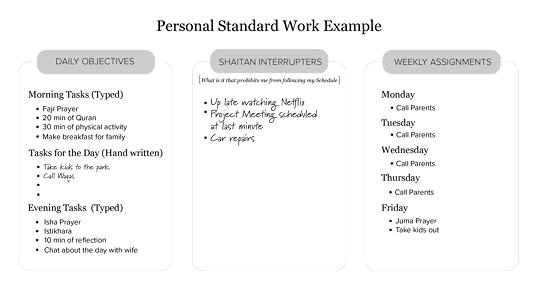
Below is a sample of what I created.
How to use this tool
The tool is designed to be a daily task organizer mixed with my ongoing priorities.
On the far left is a column for daily objectives. As mine was geared towards my family and spiritual life I focused on before and after work.
I had pre-typed those actions that I wish to occur consistently on a daily basis.
Below it I have left some room to hand write that which is important the day of.
On the far right is the same but for the week. The actions typed I would like to occur sometime during the week.
If it is something I would like to occur multiple times in the week but do not wish to tie to a specific day, I make multiple entries for. As such as any of my actions over the course of the day/week are completed, I check them off.
Now comes the most important part. In the centre of the sheet is a column titled “Flow interrupters” or as Brother Faris has coined “Shaitan interrupters”.
This column is meant to be used daily as a way to reflect what occurred during the course of the day/week that prohibited or did not allow me to check off a task I was supposed to do.
In my case, some of my Shaitan interrupters are Netflix (oh Daredevil why must you be so good?), ad-hoc Business meetings, and going to bed too late.
Now a novice would stop here and feel good with the knowledge of what is in their way.
But an expert like you would go further and answer the question: What must I do differently tomorrow/next week to reduce/eliminate the risk of this interrupter from happening again?
'But an expert like you would go further and answer the question: What must I do differently tomorrow/next week to reduce/eliminate the risk of this interrupter from happening again?' Ali ShahzadaClick To Tweet
Or what action can I regularly do to proactively stop this issue from occurring?
In my above examples, some proactive solutions are: Setting a timer on my Wi-Fi to stop it at a certain time of the night. (Be sure to get agreement on what that time is from anyone sharing the connection!). Plus, pre-blocking repeatable times in my work calendar for spirituality/family priorities.
As you can see this tool is very versatile and can be reformatted to be used for your professional duties, or reformatted to be focused on your monthly tasks.
The longer the cadence the more strategic versus task oriented the tool becomes.
I pray this tool helps you too, happy planning!
The post How to Practically Set Personal Work Standards appeared first on ProductiveMuslim.com.
January 25, 2019
Are You Good Enough? How Musa (AS) Tackled Self-Doubt
Do you experience self-doubt? Do you feel like an imposter at work? at home? In the big goals that you want to achieve in life?
You’re not alone.
I used to think confidence was a genetic trait imprinted on those destined to greatness. It was only after studying the lives of the accomplished- like prophets, business owners, athletes, change makers- that I came to a transformative realization: confidence must be built purposefully!
Musa  is the most mentioned prophet in the Qur’an. He is known to have stood fearlessly in the face of the Pharaoh in an attempt to free the people from tyranny: the epitome of bravery.
His courage and confidence were not built by happenstance, but rather a consequence of a very purposeful dua (supplication to Allah ).
Remember, Musa started off pampered and privileged in the Pharaoh’s palace but an unfortunate accident led him to flee and become destitute. Years later, still with a guilty conscience, Musa is called upon by Allah [SWT]. He must go back to the Pharaoh and intercede on behalf of the oppressed Israelites. At this point, Musa makes his emotional dua:
“[Moses] said,
My Lord, expand for me my breast [with assurance].
And ease for me my task
And untie the knot from my tongue
That they may understand my speech
And appoint for me a minister from my family -Aaron, my brother.
Increase through him my strength
That we may exalt You much
And remember You much.
Indeed, You are of us ever Seeing.”
The Quranic description is vivid. What resonates in this account is the internal struggle between feelings of inadequacy, confidence, humility and self-awareness.
We experience similar feelings.
Know that Your Feelings are Not Uncommon
How often have we felt that despite our qualifications, the task ahead of us intimidates us?
Everything within us and around us says that this is the right next move, yet we hesitate. It may be the presentation to our colleagues, a career change, writing an article, enrolling in a course, or advocating for someone wronged. This sensation of fear, overwhelm, and self-doubt, often leads to unhealthy paralysis.
Fortunately, we can repurpose these feelings to our benefit.
Allah [SWT] shows us how to do that in describing Musa’s dua.
First, Musa begins with recognizing the status of Allah [SWT] as The Lord, and that all success comes from Him[SWT]. He asks Allah [SWT] to expand his mind/chest and ease the affair; he then acknowledges his impediment and asks for its removal; in the last part, he pleads for a supporter from his immediate family.
I’ll elucidate the intricacies and implications of each step.
1. Remember Allah
& that You were Chosen to Do Your Own BestAllah [SWT] called upon Musa,
“Indeed, I am your Lord…and I have chosen you…” [Qur’an: Chapter 20, Verses 12-13]
Imagine being spoken to by The Mightiest Lord. What an incredible boost of confidence; the Creator of the Heavens and the Earth has chosen you to fulfil a role.
Everything starts with Allah [SWT].
Allah [SWT] is our Creator, Provider, Sustainer, and life’s Controller. When facing a new opportunity, a scary venture, it often gives us butterflies in our stomach. We feel an anxious sentiment of excitement. This is definitely out of our comfort zone.
How can we proceed in a way pleasing to Allah [SWT]?
Ask yourself “what direction does your moral compass point you?” Do those you respect and those who respect you consider this opportunity good for your growth?
Do you think 5, 10, 20 years from now you would look back on this decision positively?
Ultimately, is this new gig pleasing to Allah?
If yes, then continue :)
Facing a new opportunity often makes us nervous. Ask yourself “what direction does your moral compass point you?” Do those you respect and those who respect you consider this opportunity good for your growth?Click To Tweet
2. Ask Allah [SWT] to Expand You
Allah [SWT] had tasked Musa ,
“Go to Pharoah. Indeed, he has transgressed.” [Qur’an: Chapter 20, Verse 24]
Pharaoh, the same ferocious tyrant who massacred baby boys and enslaved populations. Imagine how Musa must have felt being asked to face the leader of the wicked. Undoubtedly daunting. In humility, Musa pleads
“My lord, expand for me my chest” [Qur’an: Chapter 20, Verse 25]
– as if the calling has constricted his chest.
Sometimes we feel our responsibilities are overbearing.
I can’t stop eating and drinking for 18 hours.
I can’t wake up at 5 am to pray. I can’t speak up to criticize the new work policy.
I can’t be successful at work and have a loving relationship with my family.
“I can’t do that.”
Can you think of the last time an advisor or mentor asked you to do something and this was your immediate reaction?
These statements are classic examples of what psychologist Carol Dweck calls “fixed mindset.” It’s opposite, “the growth mindset” has been associated with greater success and accomplishment.
Expanding your chest is the Islamic growth mindset.
If you perceive your resources to be scarce, you will feel constricted and this will restrain your ability to see success. Allah [SWT] is The One who grants us our resources, and the abilities to utilize those resources.
By asking Allah [SWT] to expand your chest, you may see the abundance of opportunity and obtain a vision of what success may look like.
3. Own Your Obstacles
Musa [Alayhis] pleaded:
“Make easy for me this task and untie the knot from my tongue,” [Qur’an: Chapter 20, Verses 26-27]
He took his greatest concerns and impediments to success directly to Allah [SWT].
How often do we choose to ignore our obstacles instead of acknowledging their presence?
A toxic manager, an early deadline, inadequate experience, a limited budget…etc. Obstacles not only impede our progress, they often present very real harm. This harm is magnified when compounded with an unhealthy level of anxiety and fear.
The Messenger of Allah, Muhammad , taught us “If Allah wants to do good to somebody, He afflicts them with trials.” [Bukhari]
In this lens, we see that obstacles by themselves are not evil. But rather, our obstacles, can be a means for us to draw closer to Allah and that which Allah deems good for us.
We learn from Musa to not ignore the obstacles in our way, but rather — as Author Ryan Holiday described — “The obstacle is the way.”
Every new endeavour comes with territorial unfamiliarity that stems from our own inexperience.
First, acknowledge this inexperience. “I have never done anything of this scope. I have never launched a product in this industry. I have never interviewed for this type of position.”
Once we characterize the nature of our inexperience can we humbly pray for the courage to overcome it?
If we ignore our fears and downplay our obstacles, we hinder our growth- our ability to be greater tomorrow than who we are today.
4. Build a Support Network- Starting with Your Family
Musa knew the critical nature of good company:
“and grant for me a helper from my family.” [Qur’an: Chapter 20, verse 29]
As a chubby high school freshman, I joined the wrestling team thinking that with enough training I could win at this individualized sport.
For the next three years, failure became my friend. My senior year was different; both in my success and in my approach. I swallowed my ego and solicited the help of my older, much more athletic brother in improving my stamina and technique.
His help led to my triumph. The sport became a family affair. In that season, Allah [SWT] showed me a lesson I continue to learn: those around you can either ground you or drown you.
Every success requires rock solid intentions and an unwavering vision of the destination. A friend may join you for the ride, but the family was placed by Allah to always be by your side.
Family comes first. I have often reflected on the beautiful dua in the Quran :
Our lord, grant us spouses and children who are coolness to our eyes and make us leaders of the pious! [Qur’an: Chapter 25: Verse 74].
If your spouse, family, and loved ones are not in support of your aspirations, kiss your dreams goodbye. Although there is value in garnering help from friends, I say first find support in your family by giving them support. Build their dreams, desires, and goals. Value their counsel. Appreciate their encouragement. And thank them when they critique you for straying. Let their presence be the twinkle in your eye.
—
With these steps in mind, apply the lessons of this dua to your own struggles; use the dua to not only acknowledge your fears and feelings but also embrace them to empower you.
As with other Quranic duas, this one carries weight not only because they are the words of Allah but also because they were used by the greatest people of the past when facing fierce tribulations. During our own tough times, internal feelings of inadequacy, fear, and self-doubt can bring out the worst in us. Honesty with ourselves, humility in making dua, and a family-centred support network help transform these feelings into the confidence and courage needed to succeed.
The post Are You Good Enough? How Musa (AS) Tackled Self-Doubt appeared first on ProductiveMuslim.com.
January 7, 2019
10 Reasons to Join Productive Muslim Retreat This March
Holidays are great for unwinding and relaxing, but what if a holiday could be more than a temporary break? What if it could be a profound experience too? An experience that revitalises and rejuvenates you. From choosing serene luxury locations to great food, to inspiring workshops, our retreat sets a new standard for holidays. Our retreat is the kind of holiday where you come to not only relax and get all the sun you need but gain a new perspective on where your life is going and learn how to unlock the best version of yourself.
'Our retreat is the kind of holiday where you come to not only relax and get all the sun you need but gain a new perspective on where your life is going and learn how to unlock the best version of yourself.' 10 Reasons to Join Productive Muslim Retreat now!Click To Tweet
If you’ve been thinking about joining the ProductiveMuslim Retreat this year, and are not sure about it, here are 10 reasons why you should join:
1. An Opportunity to Step Back
When you withdraw from your regular day-to-day life, you gather all your energies which are normally scattered across so many different obligations and focus on understanding where you are in life and where you’re heading.
At the retreat, you’ll get a chance to refocus and re-energize yourself to find inspiration for the next phase in your life.
2. An Inspiring Environment
Inspiration normally won’t strike while you aimlessly do the same stuff every day.
You need to be in a certain frame of mind that allows inspiration to take place. An island at a beautiful resort with mesmerizing views can help with that.
The retreat helps put you in that frame of mind: away from the grind of life, in a novel environment, with inspiring people around you.
'The retreat helps put you in that frame of mind: away from the grind of life, in a novel environment, with inspiring people around you.' 10 Reasons to Join Productive Muslim Retreat This MarchClick To Tweet
3. Precious Quiet Time
It’s a noisy world out there! But when you go on a retreat – you’ll finally find some quiet precious time to listen to the sea breeze, listen to beneficial reminders, and most importantly, listen to your soul and the inspiring people around you.
4. A Healthy Detox
In the ProductiveMuslim Retreat, we advise you on how to have a healthy diet and fitness schedule every day + we practice what we preach during the retreat. If you’ve been talking about going on that healthy detox, well this retreat is perfect for you!
5. Reconnect Spiritually
If you find yourself that you’ve plateaued spiritually, going through the motions of Salah without deep reflection, reciting few remembrances but not feeling them, then this retreat is for you.
We’ll inspire you to re-connect with your spirituality by making that powerful case between your spirituality and success, and work with you to re-connect to Allah [SWT] with daily Salah in a congregation, Fajr reminders, and evening reflections.
'If you find yourself that you’ve plateaued spiritually, going through the motions of Salah without deep reflection, reciting few remembrances but not feeling them, then this retreat is for you.' 10 Reasons to Join Productive Muslim Retreat This MarchClick To Tweet
6. Facilitate your Change
Change is hard, and change is not easy. And many of us fear to change because we fear the repercussions of change.
However, at the ProductiveMuslim retreat – you’ll be in a safe, non-judgmental environment, where we help facilitate your change for the better and give you the practical plans to continue on that change (whether spiritual, physical, or social) when you head home.
7. Find Yourself
Sometimes in the tornado of life – we forget or lose ourselves. We become zombies responding to the stimulus of the outside world from our beeping phones to demands from people around us.
When you come to the ProductiveMuslim Retreat – whether alone or with your family – you’ll find yourself. And start asking yourself critical questions, such as: How can I be the best version of myself: spiritually, physically, socially?
'At the ProductiveMuslim Retreat you'll find yourself. And start asking yourself critical questions, such as: How can I be the best version of myself: spiritually, physically, socially?' 10 Reasons to Join ProductiveMuslim RetreatClick To Tweet
8. Find Like-Hearted People
Every year participants from around the world come to this retreat for the same reason you’ll come for inshaAllah: They want to improve themselves, experience something new, and be around like-hearted people.
You’ll find friendships at the retreat that will last you a lifetime – and that can be powerful!
9. Challenge & Stretch Yourself
At the ProductiveMuslim Retreat – we believe in getting outside your comfort zone by asking you to do daily challenges that stretch you. Nothing too uncomfortable, and always a lot of fun. I can’t share more details about these challenges because they are a surprise ;).
10. Establish New Habits and Routines
The aim of the retreat is to inspire you to change and give you a blueprint for your new routine/lifestyle when you head back home. We hope the retreat becomes the catalyst that you’re looking for in your life!
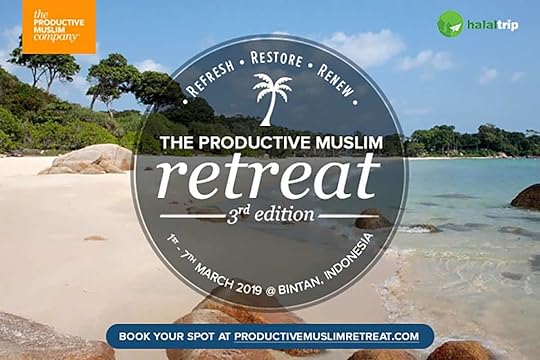
If all of the above reasons sounds interesting and convincing for you -then we recommend that you sign up for the ProductiveMuslim Retreat before spaces run out! Deadline for booking is 15th Jan 2019.
The post 10 Reasons to Join Productive Muslim Retreat This March appeared first on ProductiveMuslim.com.
December 20, 2018
How a Dentist Managed to Balance it All
Kahkshan Ali is a dentist and a mother who was struggling with balancing work, faith and family life. This is her review of the Masterclass. She talks about how the Masterclass helped her find balance and also feel happier, more at peace and less stressed, with the Will of Allah .
What inspired you to sign up for the ProductiveMuslim Masterclass?
I think it was the level of trust. You had started doing a little bit of one-on-one coaching. I’d been on about almost three years now and I’ve been part of Productive Muslim Academy. I already knew, Masha’Allah, your background. When I saw the Masterclass, I thought definitely. I already knew it was most likely going to be a good product because all the other things I’ve done so far had been very helpful.
What was your biggest challenge before taking the class?
I think the main thing would be the productivity for me. I’m working full-time and I’ve got a family. I’m trying to make sure that all the projects and things that I want to get done can be balanced with my family life. So I was struggling with that. I knew I have time, but where’s the time going?
What did you learn from the Masterclass that helped you resolve it?
The other reason I wanted to do a Masterclass through Productive Muslim Academy was being a Muslim. We need to combine our worldly life with our Akhirah [Afterlife]. It’s important to link the Dunya and Deen [worldly life with faith]. That’s what I love about this masterclass. I mean, I’m doing other kinds of coaching as you know, but none of them addresses being a Muslim.
When people do the masterclass, they’ll see this.
We do the whole thing about the Barakah effect, waking up [for Fajr] and getting your morning routine. Other coaches, you know, Robin Sharma and other people, they also talk about the 5:00 AM club. So as Muslims, we’re already supposed to be up for Fajr [dawn prayer]. So we’re naturally aligned with this successful habit of waking up early. So, learning that and getting that in order kind of set the tone for the rest of the stuff that we want to do.
What specific results can you see after the Masterclass?
Really getting management of my calendar, and of my time. I feel that I’ve really got a better balance now with managing time for my projects. I’m trying to do something else with my career right now and also spend time with my daughter, husband and parents.
So, I really am so much happier. It feels so much more at peace and less stressed.
What did you like about the ProductiveMuslim Masterclass?
In the past, I signed up for things and I never followed through. They’re either too long, or there’s too much involvement. They’re kind of going on and on.
I love the length of this Masterclass. It’s six main weeks and we had that extra session. So, it’s about seven actual classes.
I think it’s the perfect amount of time. It’s 90 minutes. We get so much in those 90 minutes and you can use the things immediately. We get our weekly experiments to do and that’s actually starting to get us into those positive habits. So it’s not too much and it can be done, even though I’m busy.
Final thoughts
I highly recommend the masterclass. As I said, I’ve done a lot of courses; I’ve done a lot of stuff so I know who’s out there.
Pricing-wise, I think it’s a phenomenal value really. I mean, Mash’Allah, it’s an excellent value for money. And you will actually get something really out of it.
I love the fact that we also have lifetime access to the recordings of the classes because they have so much detailed information. Plus, you’ve given us the slides and PowerPoint presentations and everything. So, I still go through my notes and I’m able to go back to the recordings. It is fantastic to be able to have that resource forever. So Alhamdulillah.
Join Our Upcoming Masterclass
The Productive Muslim Masterclass is a 6-week live online program that helps you learn practical, hands-on skills to win more days, overcome stress, and live the best version of yourself. Learn more & register for the next masterclass here:https://productivemuslim.com/
Register Now
The post How a Dentist Managed to Balance it All appeared first on ProductiveMuslim.com.
[Amazing Success Story] How The Masterclass Helped This Dentist Balance Faith, Work and Family Life
Kahkshan Ali is a dentist and a mother who was struggling with balancing work, faith and family life. This is her review of the Masterclass where she talks about what she learned, how the Masterclass helped her find the balance she needed and also feel happier, more at peace and less stressed, with the Will of Allah .
What inspired you to sign up for the ProductiveMuslim Masterclass?
I think it was the level of trust. You had started doing a little bit of one-on-one coaching, I’d been about almost three years now and I’ve been part of Productive Muslim Academy, you know, doing online. I want you guys. I already knew, Mashallah, your background and everything for coaching and then when I saw the Masterclass, you know, I thought definitely. It’s my trust in your academy and I already knew it was most likely going to be a good product because all the other things I’ve done so far had been very helpful.
What was your biggest challenge before taking the class?
I think the main thing would be the productivity for me just because I’m working full-time and I’ve got a family and trying to make sure that all the projects and things that I want to get done and balance that with family life, you know, happen. So I was struggling with that, I think, trying to feel like, yes, I know I have time, but where’s the time going?
What did you learn from the Masterclass that helped you resolve it?
You know, what I loved about it was you didn’t actually go right into that first. And for me, the other reason I wanted to do a Masterclass through Productive Muslim Academy, was being a Muslim, is that you know, we need to combine our worldly life with our Akhirah [Afterlife] linking the Dunya and Deen [worldly life with faith]. And that’s what I love about this. I mean, I’m doing other kinds of coaching as you know, but none of them of course, address being a Muslim. When people do the master class, they’ll see this.
We do the whole thing about the Barakah effect and, you know, waking me up [for Fajr] and getting your morning routine. And so to me, once I started setting that habit and you know, other people, other coaches, you know, Robin Sharma, other people, they also talk about, he talks about the 5:00 AM club. So as Muslims, you know, we’re supposed to be up for Fajr. So we get to be part of that, you know, a successful habit, waking up early. So, learning that and starting off with that and getting that in order and shape and kind of set the tone for the rest of the stuff that we want to do.
What specific results can you see after the Masterclass?
Really getting management of my calendar, you know, of my time. I feel that I’ve really got a better balance now with managing time for my projects because as you know, I’m also trying to maybe do something else with my career right now and also will spend time with my daughter and my husband. My parents were here, also. All of that. So, I really am so much happier. It feels so much more at peace and less stressed.
What did you like about the ProductiveMuslim Masterclass?
In the past, I signed up for things and I never followed through in the sense that I’m like, oh, you know, they’re either too long, let’s say, or you know, there’s too much involvement. And they’re kind of, you know, going on and on. I love the length of this Masterclass. I think that it’s the six main weeks and we had that extra session. So, it’s about seven actual classes.
I think it’s the perfect amount of time. It’s 90 minutes. We get so much in that 90 minutes and you can use the things immediately and we get our weekly experiments to do and then that’s actually starting to get us into those habits. So I really think that that is enough time. It’s not too much and it can be done, you know, even though I’m busy.
Final thoughts
I highly recommend it. As I said, I’ve done a lot of courses; I’ve done a lot of stuff so I know who’s out there.
Pricing-wise, I think it’s a phenomenal value, also, really, I mean, Mash’Allah. I think it’s an excellent value for money. And you will actually get something really out of it.
I love the fact that we also have lifetime access to the recordings of the classes and stuff because it’s something that there’s so much detailed information also. Plus you’ve given us the slides and the PowerPoint presentations and everything. So, I still go through my notes that I’ve taken and then, you know, being able to go back to the recording. So that is fantastic to be able to have that resource forever. So Alhamdulillah.
Join Our Upcoming Masterclass
The Productive Muslim Masterclass is a 6-week live online program that helps you learn practical, hands-on skills to win more days, overcome stress, and live the best version of yourself. Learn more & register for the next masterclass here:https://productivemuslim.com/
Register Now
The post [Amazing Success Story] How The Masterclass Helped This Dentist Balance Faith, Work and Family Life appeared first on ProductiveMuslim.com.
December 5, 2018
Barakah Culture vs. Hustle Culture: How to Win More Days Without Losing Your Soul
Over the last few years, a new breed of motivational/self-help experts appeared on YouTube and wrote books on what many are now calling “Hustle Culture.” The ideas expressed by those operating within this community emphasize that to be successful you should always be working hard, getting the “impossible” done, and cutting sleep to start the hustle at 4:00 am.
This culture has arisen from the pressures of living in a global knowledge economy where to succeed and stand out, you need to do more, achieve more, and get more things done than anybody else, or you just won’t make it in life—or so you are told.
Recently, there has been a backlash against this culture, led by Reddit co-founder Alexis Ohanian, who famously referred to it as “Hustle Porn” and described how this type of culture and mentality is destroying people’s lives and leading them to increased stress, depression, and anxiety.
The question is: If you want to be successful, what’s the alternative?
'Barakah Culture is about how to achieve more with less, instead of more with more through sheer grit and exhaustive drive towards material gain'Click To Tweet
In this article, I wanted to showcase a model of productivity, which clearly contrasts the Hustle culture so prevalent in the self-help industry today. This model of productivity, first introduced in my book “The Productive Muslim: Where Faith Meets Productivity,” is based on the Islamic concept of “Barakah.” It incorporates the idea that “increase” or “benefit” comes from Allah (SWT) and is achieved through the alignment of body, mind, and soul to how He wants us to live on earth. It’s about how to achieve more with less, through the blessings of Allah instead of more with more through sheer grit and an exhausting drive towards material gain.
If you’re new to the concept of Barakah, watch this talk I gave at World Domination Summit in Portland, Oregon (USA) in July 2017 on the topic of Barakah to learn more.
I explain below eleven ways that a culture rooted in Barakah is much more rewarding and sustainable than the soul-destroying hustle culture, and I suggest thought experiments for individuals and teams to practice implementing Barakah culture in a way that leads them to real success in this life and the next.
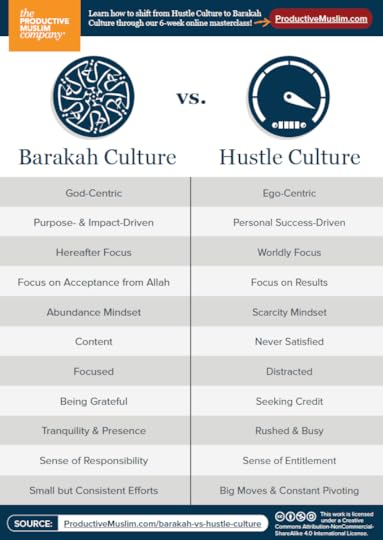
11 Ways Barakah Culture Outperforms Hustle Culture
Click here to download Infographic
1. God-Centric vs. Ego-Centric
إِلَّا ابْتِغَاءَ وَجْهِ رَبِّهِ الْأَعْلَىٰ. وَلَسَوْفَ يَرْضَىٰ
“But only seeking the countenance of his Lord, Most High. And he is going to be satisfied.” [Qur’an 92: 20-21]
لِّلَّذِينَ يُرِيدُونَ وَجْهَ اللَّهِ ۖ وَأُولَٰئِكَ هُمُ الْمُفْلِحُونَ…
“…those who desire the countenance of Allah, and it is they who will be successful.” [Qur’an 30: 38]
أَرَأَيْتَ مَنِ اتَّخَذَ إِلَٰهَهُ هَوَاهُ أَفَأَنتَ تَكُونُ عَلَيْهِ وَكِيلًا
“Have you seen the one who takes as his god his own desire? Then would you be responsible for him?” [Qur’an 25:43]
Barakah culture is centred around knowing and connecting with Allah (SWT); not only through formal acts of worship, but through every word, deed, and the daily choices one makes. It springs from the Islamic philosophy of ‘ebada (worship) that centres on the capacity that human beings have for making conscious decisions and submitting their will to that of their Creator. This entails being mindful of God by acknowledging Him and His commands and revolving one’s personal and professional life around what one’s Creator loves.
By way of contrast, Hustle culture is all about serving the self, one’s ego, or what the Islamic tradition calls the “nafs,” a subtle substance that comes into existence when the soul enters the body. The nafs grows as a child does, and over the years, if it’s not nurtured spiritually or disciplined, it remains childish. This is why all of us know at least one adult who continues to be self-centred and sulky when they are old enough to know better. In the business sector, this behaviour is often manifested in the obsessive drive for personal success, —even if it’s at the expense of serving Allah or meeting the emotional needs of their loved ones.
'Barakah culture is centred around knowing and connecting with Allah (SWT); not only through formal acts of worship, but through every word, deed, and the daily choices one makes.'Click To Tweet
If you watch the “wake up at 4” YouTube videos on Hustle culture, you’ll notice that the “star of the show” is holding a camera pointing towards themselves (their nafs?) hitting the alarm at four o’clock, making coffee, exercising, showering, working on their side business, and getting to work—all before they think anyone else even wakes up.
Perhaps the hustlers are not aware that millions of Muslims also wake earlier than most (even earlier than the self-proclaimed hustlers). The difference is the Muslim community does it for an entirely different purpose: to remember Allah, to pray, and to serve Him. And yes, some of them, also fit in other things in their “miracle morning” like exercising, showering, and working on their side business, but once they are done with their prayers.
'Hustle culture is all about serving the self, one’s ego, or what the Islamic tradition calls the “nafs,” a subtle substance that comes into existence when the soul enters the body.'Click To Tweet
Here’s the critical question: which do you think is more sustainable in the long run? Waking up early every day so that you can serve yourself? Or waking up early every morning to serve Allah (SWT) because you recognize , He’s my Eternal Sustainer and the fact that this is what you have been created for?
When life only revolves around you feeding your ego, you’ll find yourself spinning in circles – some days being super productive, others not so much – all depending on your mood and how your nafs feels that day. Contrasted with this self-centred way, when your life revolves around Allah, it has a ripple effect not only on how you think but how you behave around others and how you live your life, leading to increased barakah in this life and the next.
Thought E xperiments for Individuals :
Take a look at your day’s schedule and ask yourself how much of what you do is about you? How much of what you do is about serving Allah or others? How would that change if Allah (SWT) was your ultimate concern from the moment you wake up until you go back to sleep? How would you arrange your life differently? How would you plan your life around your prayers rather than your own comfort or the demands of your lifestyle?
Thought E xperiments for T eams:
How can we work like a God-centered team? Are we focused on pleasing Him? If yes, How does impact the way we work? Would a new team member/visitor/customer notice our God-centered approach?
2. Purpose- & Impact-Driven vs. Personal Success-Driven
وَأَنْ لَيْسَ لِلْإِنْسَانِ إِلَّا مَا سَعَى * وَأَنَّ سَعْيَهُ سَوْفَ يُرَى
“And that there is not for man except that [good] for which he strives. And that his effort is going to be seen –” (Qur’an 53: 39-40)
Barakah culture is about having a mission that extends beyond yourself. It stems from recognizing that your ultimate purpose is to worship Allah and act as His representative (khalifah)on earth.
وَإِذْ قَالَ رَبُّكَ لِلْمَلَائِكَةِ إِنِّي جَاعِلٌ فِي الْأَرْضِ خَلِيفَةً ۖ قَالُوا أَتَجْعَلُ فِيهَا مَن يُفْسِدُ فِيهَا وَيَسْفِكُ الدِّمَاءَ وَنَحْنُ نُسَبِّحُ بِحَمْدِكَ وَنُقَدِّسُ لَكَ ۖ قَالَ إِنِّي أَعْلَمُ مَا لَا تَعْلَمُونَ
“And [mention, O Muhammad], when your Lord said to the angels, “Indeed, I will make upon the earth [khalifah] a successive authority….” [Qur’an 2: 30]
This is a position of trust and responsibility and calls for individuals and teams to think about how their lives need to carry meaning and impact beyond their bank accounts or profit lines. It demands that we live lives, both individually and collectively, that honour our calling as God’s khalifah on earth rather than working to serve ourselves and our own desires because we know we will be held to account for the choices we made.
In contrast, Hustle culture is all about personal success, measured in terms of —money, power, and fame. Sometimes it’s sugar-coated as “financial freedom,” or “leaving a legacy.” Though, in the end, if you dig deeper, it’s about the person and serving their own ego, or nafs, as we mentioned in the previous point.
'Barakah culture is about having a mission that extends beyond yourself. It stems from recognizing that your ultimate purpose is to worship Allah and act as His representative (khalifah)on earth.'Click To Tweet
One way to test if a person is a purpose/impact driven vs. personal success-driven is to ask them to remove their name or any mention of themselves from whatever project they work on, or try to take the money, power, and fame off the table, and then see how far they go with the project. In other words, would they still give their 110% if they wouldn’t get fame, wealth, or power in return?
Thought experiment for I ndividuals
What do you consider marks of success? How much of what you believe to be “success” is linked to your personal attainment vs. the purpose/impact beyond you?
What can you do to shift your mentality away from a personal definition of success and towards an achievement that’s driven by a broader sense of purpose and measured by impact in your community?
Thought experiment for T eams
If you weren’t paid to be on the team, which activities would you do anyway? Do you have a vested interest in what the team is trying to accomplish, beyond your own material success?
3. Hereafter Focus vs. Worldly Focus
مَن كَانَ يُرِيدُ حَرْثَ الْآخِرَةِ نَزِدْ لَهُ فِي حَرْثِهِ ۖ وَمَن كَانَ يُرِيدُ حَرْثَ الدُّنْيَا نُؤْتِهِ مِنْهَا وَمَا لَهُ فِي الْآخِرَةِ مِن نَّصِيبٍ
“Whoever desires the harvest of the Hereafter – We increase for him in his harvest. And whoever desires the harvest of this world – We give him thereof, but there is not for him in the Hereafter any share.” [Qur’an 42: 20]
'Hustle culture takes a myopic, short-term view of life. It’s fed by YOLO mentality and acts that maximize pleasure for pleasure’s sake, and it pushes you to ‘get it all’ as quickly as possible—ideally yesterday.'Click To Tweet
Barakah culture is about taking a (very) long-term view of life and recognizing that there’s life after death, and a day will come when our words and deeds will be held to account. The result is either an eternal abode in Heaven or Hellfire. Operating with this belief makes you consciously focus your life on the three investments that Prophet Muhammad taught us would continue to exist after our death: our children and their prayers for us after we die, an ongoing charity that’s genuinely sustainable and beneficial to people, and developing and spreading a useful body of knowledge that’s timeless.
Hustle culture takes a myopic, short-term view of life. It’s about the next quarterly report, the following annual review, and the next carrot in the never-ending game of corporate snakes and ladders. It’s fed by YOLO (You Only Live Once) mentality and acts that maximize pleasure for pleasure’s sake, and it pushes you to ‘get it all’ as quickly as possible—ideally yesterday.
An author adopting Barakah culture will write his/her book to last a thousand years, so it counts as a knowledge that benefits society long after they have gone. An author adopting Hustle culture, on the other hand, will focus only on hitting the best-seller lists within the first weeks of launch and rush through his book project because he or she is trying to catch a new “trend” before it’s too late.
'Here’s the critical question: which do you think is more sustainable in the long run? Waking up early every day so that you can serve yourself? Or waking up early every morning to serve Allah (SWT)?'Click To Tweet
Thought Experiments for Individuals
How much time, energy, and focus are you putting in the three investments that will outlive you and your children? Are you actively developing a beneficial body of knowledge? Do you plan to build or support or set up an going charity)?
What small project could you start now and consistently focus on for the rest of your life?
Thought Experiment for Teams
What does it mean that we believe in the hereafter as a team? In heaven and hell? In a day of Judgment? How can we build a company/product that lasts for a thousand years and that benefits humanity?
4. Focus on Acceptance from Allah vs. Focus on Results
وَقُلِ اعْمَلُوا فَسَيَرَى اللَّهُ عَمَلَكُمْ وَرَسُولُهُ وَالْمُؤْمِنُونَ ۖ وَسَتُرَدُّونَ إِلَىٰ عَالِمِ الْغَيْبِ وَالشَّهَادَةِ فَيُنَبِّئُكُم بِمَا كُنتُمْ تَعْمَلُونَ
“And say, “Do [as you will], for Allah will see your deeds, and [so, will] His Messenger and the believers. And you will be returned to the Knower of the unseen and the witnessed, and He will inform you of what you used to do.” [Qur’an 9: 105]
عَنْ عُمَرَ، أَنَّ رَسُولَ اللَّهِ صلى الله عليه وسلم قَالَ إِنَّمَا الأَعْمَالُ بِالنِّيَّاتِ، وَإِنَّمَا لِكُلِّ امْرِئٍ مَا نَوَى، فَمَنْ كَانَتْ هِجْرَتُهُ إِلَى دُنْيَا يُصِيبُهَا أَوْ إِلَى امْرَأَةٍ يَنْكِحُهَا فَهِجْرَتُهُ إِلَى مَا هَاجَرَ إِلَيْهِ
Narrated ‘Umar bin Al-Khattab: Allah’s Messenger said,
“The reward of deeds depends upon the intention and every person will get the reward according to what he has intended. So whoever emigrated for Allah and His Apostle, then his emigration was for Allah and His Apostle. And whoever emigrated for worldly benefits or for a woman to marry, his emigration was for what he emigrated for.” [Sahih al Bukhari]
Barakah culture is focused on delivering work that is pleasing to Allah. It focuses on the two conditions required for our actions to be accepted:
Sincere, good intentions; and,
Sincere effort & action.
Hustle culture, on the other hand, is focused on material results, where the ends justify the means.
Some readers might ask, “Surely focusing on material results is better than intentions and actions? What’s the point of having good intentions and working hard, if there are no results to show for it?”
The philosophical difference stems from recognizing “Who’s in control.” Individuals operating within Hustle culture, believe that we are in control of our own lives and the material results we achieve. Barakah focused individuals, on the other hand, recognize that Allah’s ultimately in charge and that our hard work is never wasted in this world or the next as long as our intentions are pure and we sincerely put our best efforts forward, regardless of the material results we achieve.
A metaphor to help you understand the difference is the Gardener Vs. A Carpenter: The Gardener plants his seeds, waters his land, and works hard on his garden, yet if the garden doesn’t bear fruit as expected, he accepts it as Allah’s decree, renews his intentions, and works harder (and smarter) for next season. He’s not upset at the outcome of his garden because his intentions were pure and he did everything possible to help his garden grow. He also knows that the rest was not up to him.
أَفَرَأَيْتُم مَّا تَحْرُثُونَ. أَأَنتُمْ تَزْرَعُونَهُ أَمْ نَحْنُ الزَّارِعُونَ
“And have you seen that [seed] which you sow? Is it you who makes it grow, or are We the grower?” [Qur’an 56:63-64]
A Carpenter has a fixed image of what his product needs to look like to be deemed a success. He’ll set out to achieve that perfect chair or table or cupboard. If the product fails to match his imagination, he’ll get annoyed with his tools, at himself, and might even get depressed because he thinks he’s not good enough. He finds the thought of not being in control overbearing.
In other words, Barakah culture is about focusing on what you can control—your intentions and your actions—and leaving what’s not within your control to Allah (SWT). Hustle culture is living the daily stress of trying to control the uncontrollable, under the false impression that expectations always meet reality. This issue becomes more pronounced with Parenting. Parents who adopt a “gardener mindset” with their children—do their best and do not stress about how they might turn out. They tend to be more successful than those parents who adopt a “carpenter mindset” and try to turn their children into the fixed image they have in their mind. These parents will feel like failures if their children don’t meet their expectations, regardless of how hard they worked to raise them well. [See The Carpenter and The Gardener]
'Barakah culture is about focusing on what you can control—your intentions and actions—and leaving the rest to Allah (SWT). Hustle culture is living the daily stress of trying to control the uncontrollable.'Click To Tweet
Thought Experiments for Individuals
Do you have a Gardener mindset or Carpenter mindset? Ask your family.
When things don’t go according to your plan, how do you react? If you find yourself stressed, how can you shift your outlook?
Thought Experiments for Teams :
What failures have occurred in the past that were beyond your control? How did you react to those failures as a team? How did things turn out after the failure?
How can you shift your thinking from a focus on material results to focusing on intentions and quality work?
5. Abundance Mindset vs. Scarcity Mindset
الشَّيْطَانُ يَعِدُكُمُ الْفَقْرَ وَيَأْمُرُكُم بِالْفَحْشَاءِ ۖ وَاللَّهُ يَعِدُكُم مَّغْفِرَةً مِّنْهُ وَفَضْلًا ۗ وَاللَّهُ وَاسِعٌ عَلِيمٌ
Satan threatens you with poverty and orders you to immorality, while Allah promises you forgiveness from Him and bounty. And Allah is all-Encompassing and Knowing. [Qur’an 2:268]
Barakah is all about having an abundant mindset. A follower of this culture recognizes that blessings and bounty are from Allah, He’s Eternal, His Kingdom and Blessings are infinite and limitless. The Vastness of Allah (SWT) eliminates the fear of loss and limitedness.
عَنْ أَبِي ذَرٍّ، عَنِ النَّبِيِّ صلى الله عليه وسلم فِيمَا رَوَى عَنِ اللَّهِ، تَبَارَكَ وَتَعَالَى أَنَّهُ قَالَ: يَا عِبَادِي لَوْ أَنَّ أَوَّلَكُمْ وَآخِرَكُمْ وَإِنْسَكُمْ وَجِنَّكُمْ قَامُوا فِي صَعِيدٍ وَاحِدٍ فَسَأَلُونِي فَأَعْطَيْتُ كُلَّ إِنْسَانٍ مَسْأَلَتَهُ مَا نَقَصَ ذَلِكَ مِمَّا عِنْدِي إِلاَّ كَمَا يَنْقُصُ الْمِخْيَطُ إِذَا أُدْخِلَ الْبَحْرَ
Abu Dharr reported Allah’s Messenger (ﷺ) as saying that Allah, the Exalted and Glorious, said:”[…] O My servants, even if the first amongst you and the last amongst you and the whole human race of yours and that of jinns also all stand in one plain ground and you ask Me and I confer upon every person what he asks for, it would not in any way, cause any loss to Me (even less) than that which is caused to the ocean by dipping the needle in it.” [Muslim]
Hustle culture, on the other hand, is cutthroat. It’s a dog eat dog out there, and you need to be the earliest bird to catch all the worms. It’s about “limited resources,” “tough global competition,” “and you need to get what’s yours before everyone else does.” It’s turning human beings into beasts fighting over the crumbs of life, turning away refugees fleeing war or extreme poverty because they are scared “they’ll take over our jobs.”
…وَمَن يُوقَ شُحَّ نَفْسِهِ فَأُولَٰئِكَ هُمُ الْمُفْلِحُونَ
“[…] And whoever is protected from the stinginess of his soul – it is those who will be successful.” [Qur’an 59:9]
Walk through any Souq (traditional marketplace in the Muslim world) – in Madinah, Jerusalem, Cairo, Fez, Istanbul – and notice how you’ll see rows and rows of shopkeepers selling the exact same items for the exact same price. You might even catch one of them telling you not to buy from their store but to go to their friend’s shop because their friend didn’t sell enough today. That’s Abundance-mindset in action.
Thought Experiments for Individuals
What are you afraid to lose if you give some of your resources away? What do you think will happen if you do share these resources with an abundant mindset?
Thought Experiments for Teams
Who are your top competitors? What if you reached out to them and asked to help them solve a problem they face? What if you sent some of your clients to your competitors?
6. Content vs. Never Satisfied
قَالَ رَسُولُ اللَّهِ ـ صلى الله عليه وسلم ـ “ مَنْ أَصْبَحَ مِنْكُمْ مُعَافًى فِي جَسَدِهِ آمِنًا فِي سِرْبِهِ عِنْدَهُ قُوتُ يَوْمِهِ فَكَأَنَّمَا حِيزَتْ لَهُ الدُّنْيَا
It was narrated from Salamah bin ‘Ubaidullah bin Mihsan Al-Ansari that his father said: “The Messenger of Allah (ﷺ) said: ‘Whoever among you wakes up physically healthy, feeling safe and secure within himself, with food for the day, it is as if he acquired the whole world.” [Sunan Ibn Majah]
Barakah culture is about having ridaa, or contentment with where you are and what you have.
Hustle culture is about never being satisfied, never settling, and never accepting your current reality.
If you’re wondering whether this means that one should never be ambitious, the answer is: it depends:
If your ambition is God-centered, Hereafter-focused, purpose and impact driven, then you should seek that ambition while being content with where you are and what you have.
If, however, your ambition is ego-centred, worldly-focused and solely linked to personal success, whatever the cost, then you’re falling for the mirage success perpetrated by Hustle culture.
'Barakah culture is about having ridaa, or contentment with where you are and what you have. Hustle culture is about never being satisfied, never settling, and never accepting your current reality.'Click To Tweet
The power of contentment is that it makes you enjoy the blessings of life with all its trials and tribulations. Lack of contentment makes life hard to tolerate, especially when a calamity hits you and throws you off-guard.
Thought Experiments for Individuals :
The next time you feel discontent with your life, annoyed at the smallest things, pause and ask yourself: how can I be more content?
What are your ambitions in life? How many of them are God-centered, Hereafter-focused, and purpose- and impact-driven?
How would your life be if you were more content and stopped being stressed with “what if” and “if only” and “I wish I had…”?.
Thought Experiments for Teams:
What do you appreciate about your team and the work you do? What makes you content?
How can you manage your team/company’s ambitions while being content with the journey you have taken together so far?
7. Focused vs. Distracted
عَنْ عُمَرَ بْنِ سُلَيْمَانَ، قَالَ سَمِعْتُ عَبْدَ الرَّحْمَنِ بْنَ أَبَانَ بْنِ عُثْمَانَ بْنِ عَفَّانَ، عَنْ أَبِيهِ، قَالَ خَرَجَ زَيْدُ بْنُ ثَابِتٍ مِنْ عِنْدِ مَرْوَانَ بِنِصْفِ النَّهَارِ فَقُلْتُ مَا بَعَثَ إِلَيْهِ هَذِهِ السَّاعَةَ إِلاَّ لِشَىْءٍ سَأَلَ عَنْهُ . فَسَأَلْتُهُ فَقَالَ سَأَلَنَا عَنْ أَشْيَاءَ سَمِعْنَاهَا مِنْ رَسُولِ اللَّهِ ـ صلى الله عليه وسلم ـ سَمِعْتُ رَسُولَ اللَّهِ ـ صلى الله عليه وسلم ـ يَقُولُ:
“مَنْ كَانَتِ الدُّنْيَا هَمَّهُ فَرَّقَ اللَّهُ عَلَيْهِ أَمْرَهُ وَجَعَلَ فَقْرَهُ بَيْنَ عَيْنَيْهِ وَلَمْ يَأْتِهِ مِنَ الدُّنْيَا إِلاَّ مَا كُتِبَ لَهُ وَمَنْ كَانَتِ الآخِرَةُ نِيَّتَهُ جَمَعَ اللَّهُ لَهُ أَمْرَهُ وَجَعَلَ غِنَاهُ فِي قَلْبِهِ وَأَتَتْهُ الدُّنْيَا وَهِيَ رَاغِمَةٌ”
“The Messenger of Allah (ﷺ) said: “Whoever is focused only on this world, Allah (SWT) will confound his affairs and make him fear poverty constantly, and he will not get anything of this world except that which has been decreed for him. Whoever is focused on the Hereafter, Allah (SWT) will settle his affairs for him and make him feel content with his lost, and his provision and worldly gains will undoubtedly come to him.” [Sunan Ibn Majah]
Barakah culture is focused. It’s focused on Allah; focused on the Hereafter, on living a life of purpose and impact and on serving others. It comes with a clear direction in life, and its followers are actively encouraged to pursue it.
Hustle culture is distracted. It has a million projects to do at once. Its followers are scattered. They are pulled in so many different directions and on a never-ending emotional rollercoaster of ups and downs.
Once you start looking, it is easy to notice the difference between Hustle culture and Barakah culture – just, observe the respective morning routines:
An adherent to Hustle culture wakes up, and the first thing they do is check emails, respond to messages, and get on with their to-do list.
Meanwhile, a person immersed in Barakah culture wakes up, and the first thing they do is remember God, prays, recites Quran, and then tackles what they have in the day ahead of them.
You might say “Yeah, but the Hustle culture guy gets SO much done by the time your Barakah culture guy finishes praying.” Here’s where understanding the true meaning of Barakah becomes crucial: Barakah is not about running like a hamster on a wheel and knocking out as many things as possible from your to-do list. Instead, Barakah is about getting the right things done, at the right time, so that you are actually led to success and move forward in life. Put simply, you can spend a whole day in your inbox and knocking out to-dos but may still not move an inch towards your long-term goals.
Thought experiments for Individuals
When you wake up in the morning, what’s the first thing you do? If you said that you check your phone, then try this tomorrow morning: Get a basic analog alarm for your room and charge your phone in another place on silent/aeroplane mode. When you get up, remember Allah, pray, read, and resist the temptation to check your phone for at least 2-3 hours. Notice the difference in your mornings and how much truly purposeful/important work you get done that day.
Thought Experiments for Teams
Do you feel that you’re being pulled in a million different directions? Are you all busy but not getting real work done or moving the company forward? What needs to happen for your team to regain focus? What’s distracting its members? How can you ground yourself?
8. Being Grateful vs. Seeking Credit
وَإِذْ تَأَذَّنَ رَبُّكُمْ لَئِن شَكَرْتُمْ لَأَزِيدَنَّكُمْ ۖ وَلَئِن كَفَرْتُمْ إِنَّ عَذَابِي لَشَدِيدٌ
“And [remember] when your Lord proclaimed, ‘If you are grateful, I will surely increase you [in favor]; but if you deny, indeed, My punishment is severe.’ ” [Qur’an 14: 7]
Barakah culture allows you to recognize that whatever success you have is ultimately down to and a blessing from Allah. This leads a person to be in a constant state of shukr (gratefulness) for every small or large achievement, and even for failures because the culture permits you to recognize that there are blessings in difficulties and in overcoming the obstacles faced along the way. It also makes someone grateful for the people in his/her life who helped him/her to get to where they are now.
Hustle culture is about taking all the credit; a hustler gets annoyed/hurt when people don’t recognize them, don’t like their posts, or share their ‘brilliance.’ Their ego-centricity blinds them from realizing how everything had to work just right for them to achieve what they sought to accomplish. They are in a state of denial of the true Source of these blessings and are in a constant state of ingratitude.
Recognizing that success is from Allah alone not only makes you grateful but reminds you to ask for success from Allah. Now here’s where the genius lies: When you ask for success from Allah, will you limit what you ask? Or will you be purely selfish in what you ask? I hope not! When you ask for success from God, it should remind you to renew and purify your intentions because what you’re asking for has become elevated to a spiritual request. It’ll also encourage you not be ego-centric in your request, and remind you that you should seek purpose and impact within the success God provides.
Thought Experiments for Individuals
Write down your blessings. Don’t stop until you feel overwhelmed with gratitude, maybe even to tears. Trust me, it’s a humbling experience.
Thought Experiments for Teams
When you celebrate success, recognize who facilitated that success. Instead of seeking high-fives and lavish parties, how about all turning to Allah to thank Him, pitching in to donate to charity, or coming together to support a local project in a poor community?
9. Tranquillity & Presence vs. Rushed & Busy
وَعِبَادُ الرَّحْمَٰنِ الَّذِينَ يَمْشُونَ عَلَى الْأَرْضِ هَوْنًا وَإِذَا خَاطَبَهُمُ الْجَاهِلُونَ قَالُوا سَلَامًا
“And the servants of the Most Merciful are those who walk upon the earth easily, and when the ignorant address them [harshly], they say [words of] peace…” [Qur’an 25:63]
وعن ابن عمر رضي الله عنهما قال: أخذ رسول الله صلى الله عليه وسلم بمنكبي فقال: “كن فى الدنيا كأنك غريب أو عابر سبيل”. وكان ابن عمر رضي الله عنهما يقول: إذا أمسيت، فلا تنتظر الصباح، وإذا أصبحت، فلا تنتظر المساء، وخذ من صحتك لمرضك، ومن حياتك لموتك “ ((رواه البخاري))
‘Abdullah bin ‘Umar (May Allah be pleased with them) reported:
Messenger of Allah (ﷺ) took hold of my shoulders and said, “Be in the world like a stranger or a wayfarer.” Ibn ‘Umar (May Allah be pleased with them) used to say: When you survive till the evening do not expect to live until the morning, and when you survive till the morning do not expect to live until the evening. While in good health (do good deeds) before you fall sick; and while you are alive (do good deeds) before death strikes. [Al- Bukhari].
Barakah culture cultivates tranquillity and being present. It is about recognizing where you are in the moment and embracing the full meaning of being present in preparation for the hereafter that can come at any moment. It’s not about being sad about the past, because that’s over, and it’s not about being worried about the future, because that’s in Allah’s hand and is yet to come. Instead under this culture one focuses on how to do what’s most pleasing to God.
لِّكَيْلَا تَأْسَوْا عَلَىٰ مَا فَاتَكُمْ وَلَا تَفْرَحُوا بِمَا آتَاكُمْ ۗ وَاللَّهُ لَا يُحِبُّ كُلَّ مُخْتَالٍ فَخُورٍ
“In order that you not despair over what has eluded you and not exult [in pride] over what He has given you. And Allah does not like everyone self-deluded and boastful” [Qur’an 57: 23]
Under a Hustle, you are always rushed, always in ‘urgent’ mode. There’s no time to focus on what’s essential or even the present because you are continually living tomorrow: the next client, the next problem, the next financial crisis around the corner.
One might argue, “Isn’t it healthy to be worried about the future, so you can prepare for it?” Barakah Culture encourages you to prepare for the future. But why should you be continuously worried or stressed about things, especially after you’ve done all you can do?—that’s insanity.
If you stop someone with a Hustle culture mindset and ask for directions or for some help, they’ll likely glare at you with a “How dare you to bother me?” look. It’s as if they’re saying, “Don’t you know that I’m busy and have big important things to do?” Of course, they won’t say that; They’ll just say “Sorry, I have to go” and move on. What’s truly sad is when the person they just ignored is their parent, spouse, or child.
With Barakah culture as your mindset, you’re present and aware, and if someone stops you, you recognize that Allah sent that person to you and is testing you to see whether you’ll respond to their need and help, support, or at least learn from them.
Thought Experiments for Individuals
The next time you pray; pray as if it’s your first time praying as if you’re discovering every supplication the first time ever. Then notice the domino effect that this tranquillity and presence from prayer have on the next few hours in your day.
Thought Experiments for Teams
The next time you find yourself as a team rushing and “fire-fighting,,” empower any team member to call for a “time-out” and recognize that you’re all rushing. Get into the habit of asking what can be done differently and which steps can be taken to prevent future fires and encourage mindful purpose and presence in the workplace.
10. A sense of Responsibility vs. Sense of Entitlement
:أَخْبَرَنَا يَحْيَى بْنُ دُرُسْتَ، قَالَ حَدَّثَنَا أَبُو إِسْمَاعِيلَ، قَالَ حَدَّثَنَا يَحْيَى بْنُ أَبِي كَثِيرٍ، أَنَّ أَبَا سَلَمَةَ، حَدَّثَهُ أَنَّ عَبْدَ اللَّهِ قَالَ دَخَلَ رَسُولُ اللَّهِ صلى الله عليه وسلم حُجْرَتِي فَقَالَ:
“….فَإِنَّ لِعَيْنِكَ عَلَيْكَ حَقًّا وَإِنَّ لِجَسَدِكَ عَلَيْكَ حَقًّا وَإِنَّ لِزَوْجَتِكَ عَلَيْكَ حَقًّا وَإِنَّ لِضَيْفِكَ عَلَيْكَ حَقًّا وَإِنَّ لِصَدِيقِكَ عَلَيْكَ حَقًّا…”
It was narrated that ‘Abdullah said:
“The Messenger of Allah entered my apartment and said: “I have been told that you stand all night (in prayer) and fast all day.’ I said: ‘Yes (I do).’ He said: ‘Do not do that. Sleep and stand (in prayer); fast and break your fast. For your eyes have a right over you, your body has a right over you, your body has a right over you, your wife has a right over you, your guest has a right over you, and your friend has a right over you. I hope that you will have a long life and that it will be sufficient for you to fast three days of each month. That is fasting for a lifetime because a good deed is equal to ten like it.’ I said: ‘I feel able to do more.’ I was strict, so I was dealt with strictly. He said: ‘Fast three days each week.’ I said: ‘I am able to do more than that; I was strict, so I was dealt with strictly. He said: ‘Observe the fast of the Prophet of Allah, Dawud, peace be upon him. I said: ‘What was the fast of Dawud?’ he said: ‘Half of a lifetime.”‘ ‘Ata said: “someone who heard him told me that Ibn ‘Umar (said) that the Prophet said: ‘Whoever fasts every day of his life, then he has not fasted.” [Sunan An-Nisa’i]
If you are immersed in Barakah culture, you understand that we each are but a single organism in an ecosystem that has rights and responsibilities over us. This starts with the rights that Allah has over each of us and the responsibility that one has to fulfill as a slave towards His Lord. It pushes us to continue to meet the rights of the people around us, including family members, neighbors, guests, fellow Muslims, and humanity at large.
With Hustle culture comes a sense of entitlement. After a hard day at work, it is all about “me” time. It is a deserving mentality. The hustlers just want to tap on an app and get their next meal and a massage, watch some Netflix and go to bed early so they can wake up at 4:00 am and repeat the “Hustle cycle.” Family, neighbors, parents, etc, those are just after-thoughts. The hustler’s idea of “work-life” balance is WORK is life.
If you operate under Barakah Culture, it’s not about a work-life balance, it’s about a total life balance and recognizing that you’re a shepherd responsible for your flock and that as such your obligations go beyond work. Read Mastering Work-Life Balance: 3 Eye-opening Lessons from Prophet Muhammad .
Thought Experiments for Individuals
Take a piece of paper and draw a bar graph:
On the x-axis write down all the roles you have in life (e.g., father/mother, spouse, parent, son/daughter, etc.).
On the y-axis, put Performance which will be measured from 0 – 100%.
For each of your roles, give yourself a personal score linked to, “How well am I performing as a [fill in the role]? 50%? 70%?”
Repeat for all your roles. What do you notice?
Do this same experiment in 3 months and see if anything has changed.
Thought Experiments for Teams
As a team, are you helping each other achieve a total life balance? If yes, how so and how can you be sure? What rituals, HR policies, or ideas, etc. can you implement as a team to work towards a total life balance?
11. Small but consistent efforts vs. Big moves and constant pivoting
أَلَمْ تَرَ كَيْفَ ضَرَبَ اللَّهُ مَثَلًا كَلِمَةً طَيِّبَةً كَشَجَرَةٍ طَيِّبَةٍ أَصْلُهَا ثَابِتٌ وَفَرْعُهَا فِي السَّمَاءِ
تُؤْتِي أُكُلَهَا كُلَّ حِينٍ بِإِذْنِ رَبِّهَا ۗ وَيَضْرِبُ اللَّهُ الْأَمْثَالَ لِلنَّاسِ لَعَلَّهُمْ يَتَذَكَّرُونَ
وَمَثَلُ كَلِمَةٍ خَبِيثَةٍ كَشَجَرَةٍ خَبِيثَةٍ اجْتُثَّتْ مِن فَوْقِ الْأَرْضِ مَا لَهَا مِن قَرَارٍ
“Have you not considered how Allah presents an example, [making] a good word like a good tree, whose root is firmly fixed and its branches [high] in the sky?
It produces its fruit all the time, by permission of its Lord. And Allah presents examples for the people that perhaps they will be reminded.
And the example of a bad word is like a bad tree, uprooted from the surface of the earth, not having any stability” [Qur’an 14: 24-26]
“The Messenger of Allah (ﷺ) was asked about the act most pleasing to Allah. He replied:
That which is done continuously, even if it is small.” [Sahih Muslim]
Barakah culture is like a date palm tree. It takes years to grow, but once it produces, it is strong and rooted and bears sweet fruits regularly.
Hustle culture centres on “fail fast, fail forward” and constant pivoting. It glorifies “big launches” and “big moves” and is rarely rooted in anything long-term.
Here’s the interesting thing: to have any true impactful success, one needs effort and time. By being focused, present, sincere, and by doing your best work every day, it adds up to success beyond your imagination over a lifetime. If you’re always “pivoting” and “shifting gears,” you become like an uprooted tree that has no soil to cling onto and is left dry on the wayside.
Does this mean you should never change direction when conditions call for it? Again, it depends. If the environment and market conditions become too harsh for you to continue effectively, yes you can and should pivot, but only after exhausting all other options. Prophet Muhammad didn’t ‘pivot’ and migrate to Madinah until after 10 years in Makkah trying to call his people towards his Message. He waited until he reached a point where his life, and those of his followers, were in danger.
Thought experiments for I ndividuals
Take stock of your habits and routines – spiritual, physical, social, work-related – which ones are beneficial for you over the long-term (in this life and the next), and which ones are detrimental to your success?
What small habit/routine can you start to do and continue doing so that over a year (or a lifetime) it will yield fruit?
Thought experiments for Teams
What are you willing to continue doing for the next 5-10 years together?
When do you tend to pivot? Is it when the external conditions have changed? Or when you get too overwhelmed (afraid?) to do the purpose-driven work that’s ultimately more meaningful.
By now, you’re probably thinking, “Yeah, I see how Barakah culture makes more sense. But I’m not seeing good role models nowadays we can follow. All I’m seeing are these Hustlers with 2M views on YouTube who are ‘changing the world.’”
Perhaps there aren’t many people who live according to these 11 principles of Barakah culture, and even fewer of them are on YouTube. But they do exist, I’ve met them, and they are achieving tremendous worldly and—inshaAllah (God willing)—Hereafter success.
At The Productive Muslim Company, we want to activate a global professional workforce that not only understands Barakah Culture but actually experiences & promotes it.
That’s why, early next year – inshaAllah (God willing)- we’ll announce a major initiative called Barakah Academy: An online education platform for faith-based personal and professional development that will teach practical skills in line with Barakah Culture. If you’re interested to learn more, simply add your name to the waiting list here. Join the Barakah Academy Waiting List!
Join Barakah Academy Waiting List
I understand that it’s tempting to follow Hustle Culture, and it looks appealing for those who want to achieve their potential, but I hope I’ve showcased above a more Divinely inspired way of living a productive, meaningful life.
I would love to hear your thoughts and comments on Barakah Culture vs. Hustle Culture in the comments below. If you think of other principles to add, feel free to share. I’m here to learn and co-create with you this new narrative of what it means to live a life of Barakah.
Arabic word for The One Unique God, Creator, Owner, and Sustainer of everything in the universe.
The post Barakah Culture vs. Hustle Culture: How to Win More Days Without Losing Your Soul appeared first on ProductiveMuslim.com.
November 25, 2018
How I Found The Much Needed Balance Between My Faith and Professional Life
In July 2018, Jerry Muscadin, Program Manager from Florida, had enough of feeling unproductive, disorganised and helpless. Trying to balance work, family life, and growing in faith was proving to be challenging. He took the first step of his personal development journey by joining the Productive Muslim Masterclass, and we’re honoured to share what he had to say about his experience.
1. What inspired you to sign up for the Productive Muslim Masterclass?
I read the Productive Muslim book and told myself that was the type of personality and mindset I wanted to be around in my life. I wanted to feel comfortable and genuine in my skin where my religion, professional aspirations and goals were in sync with the divine commandments.
2. What challenges were you facing before attending this masterclass?
Before attending this class, my major challenges were time management and not having the best mindset to be productive. Now I am gearing up to become a better gardener and better at managing myself holistically instead of just managing my time.
3. How were these challenges making you feel?
Disorganized, frustrated, unproductive and unfulfilled in life. Constantly annoyed with my family (wife and children) because of the ongoing changes in my plans for them, for work or for vacation time.
4. Why did you trust The Productive Muslim Company to help solve these challenges for you (as opposed to other online courses or personal development programs)?
It was because of the Productive Muslim book that I read for the first time in Canada when I discovered it at the booth of a bookseller. I really loved the way the author synergistically and naturally merged activity to help one embrace their religion with any activity that would overall help them to become a better husband, employee and professional human being in their daily lives.
5. What surprised you about the masterclass?
How beautifully and graciously the deen can make us become, the very success story that the 1% people in the world are. We had the answer in our religion to be the very best leaders and citizens to impact our community and our world.
'We had the answer in our religion to be the very best leaders and citizens to impact our community and our world.' Jerry MuscadinClick To Tweet
6. What changed for you after attending the masterclass?
'Everything changed for me. I have gotten more connected with my inner self, my ibadah and activity to improve my true purpose in life whilst journeying through this world.' Jerry MuscadinClick To Tweet
Everything changed for me. I have gotten more connected with my inner self, my ibadah and activity to improve my true purpose in life whilst journeying through this world. The success of this world will only happen if I am focused on achieving greatness for the next world- the akhirah. My whole-self became happier and more focused on what mattered most by redefining the things I thought were most important.
I no longer want to fear death because of building a home/oasis here in this world while destroying the home in the next. Now I am working in building my oasis behind the wall of the unseen by working in this dunya but putting aside everything I can for the akhirah (doing my salah, doing ibadah, building and sticking to a consistent morning and evening routine etc… all based in pleasing Allah first and leaving the rest for His will to be done.)
7. What specific results can you share?
I cannot stop thinking about how I have been waiting for a course like this. These past few weeks have been the best weeks in my self-development since I became Muslim, and have been trying to combine my professional life with my spiritual life.
8. What would you say to someone on the fence about joining our masterclass?
You are wasting your time by not joining. It is a gift from Allah to concretely show you how you can become a productive Muslim and professional together without sacrificing one or the other.
'I cannot stop thinking about how I have been waiting for a course like this. These past few weeks have been the best weeks in my self-development since I became Muslim, and I am trying to combine my professional life with my spiritual life.' Jerry MuscadinClick To Tweet
The post How I Found The Much Needed Balance Between My Faith and Professional Life appeared first on ProductiveMuslim.com.
November 12, 2018
3 Powerful Ways to Secure Your Children’s Future (If You Die Early)
One of the most pressing concerns for all parents is their child’s future.
Many of us live in single-family homes, have only one breadwinner in the house, relatively small savings, and limited social network to rely upon.
How do we secure our families future in the face of adversity?
How is that even possible when future adversity is an unknown?
Our financial safety nets are non-existent and our social safety nets can wear thin. Some of us are living paycheck to paycheck, barely keeping up with all our expenses.
If the person who pays all the bills passes away, what does the surviving family do?
Having worked for more than a decade in the financial sector, I’m approached all the time with questions about how we as Muslims can best benefit from currently available financial products but also maintain our values as informed by our faith.
Finding that middle ground has been a goal of my career, whether that be when I was working as a senior Shariah advisor in Saudi Arabia, a real estate structuring advisor in Washington DC, or a personal financial coach in Houston TX.
One of the top questions I’m always asked is: “how can I provide for my children when I’m gone?”
This dilemma is universal and timeless. Even the Prophet faced with similar. Allah addressed him:
“Say: If I knew the unseen I would accumulate all good and bad would never affect me.” [Qur’an 7: 188]
Commenting on this Imam al-Tabari said,
“If I had known what the future holds, I’d save for years of famine during years of prosperity.”
While the future is unknown even to the Prophet , he left us with a model to emulate and best practices to implement that will secure our children’s future in this world and the next.
In this article, we’ll cover best practices to secure our children’s future in 3 parts:
What preparations can we make spiritually for facing this challenge?
How to prepare financially? with a specific focus on halal investment (instead of life insurance).
How to build a social safety net, and how strong families and filial piety can be one of the greatest forms of support we have when things are difficult.
1. Secure Your Children’s Future – Spiritually
In the story of Prophet Musa (Moses) and Al-Khidr [Qur’an 18: 60-82], the two men passed by a town whose people were very inhospitable. Despite that, Al-Khidr saw a leaning wall in this town and decided to reconstruct it with his own hands for free, even though the people of that town didn’t deserve this generosity. Perplexed, Musa questioned this act of kindness to an undeserving town, Al-Khidr explained:
“And as for the wall, it belonged to two orphan boys in the city, and there was beneath it a treasure for them, and their father had been righteous. So your Lord intended that they reach maturity and extract their treasure, as a mercy from your Lord. And I did it not of my own accord. That is the interpretation of that about which you could not have patience.” [Qur’an 18: 79- 82]
So, God brought al-Khidr and Moses to a place they weren’t expecting to be, to do an act they weren’t expecting to do, to preserve a legacy left for two minors they did not know, simply due to the honourable position their father had with Allah on account of his righteousness .
Righteousness: The key to Divine Protection for Your Children
The quality of the father in the aforementioned story that guaranteed the protection of his children’s financial well-being was his righteousness and dedication to Allah . Some narrations mention that it wasn’t even the father, but the grandfather who was truly righteous, so this protection exceeds one’s children to one’s grandchildren.
And sometimes it’s hard for us to make that link between spirituality and real-life results, but this is what the Prophet Muhammad taught us and what the companions acted upon.
Allah said:
“Whoever is mindful of God, He gives him a way out, sustaining him from sources he never imagined. Whoever trusts in God, He is sufficient for him…” [Qur’an 65: 2-3]
When we mend the things between us and God in both public and private, God protects us and our children in ways that we never imagine.
Omar, in his famous message sent to Abu Musa, said:
“Whoever mends what is between him and God, God will suffice him of his creation. And whoever puts on airs and claims things not his to claim, God will debase him.”
To get to this level, we have to have a certain level of constant consciousness about our spiritual state and the return that our actions bring on us and our children. One of the Salaf (righteous predecessors) said that he can see the aftermath of his sin almost immediately manifested in his wife and his cattle’s rebellion against him.
Trust Allah
AND Tie Your CamelWorking on the spiritual aspects does not mean neglecting taking other means and adequately planning for our children’s future.
'Working on the spiritual aspects does not mean neglecting taking other means and adequately planning for our children's future.' Joe BradfordClick To Tweet
The man is Musa’s story was described as righteous. But he wasn’t a person who had nothing and strived for nothing. Had that been the case, he wouldn’t have owned property on which he built a wall inside of which stashed away money.
This shows that he implemented best practices in his life that would provide for his children materially. And this takes us to the next point: the financial preparation for your children’s protection.
2. Secure Your Children’s Future – Financially
So what are some of the practical means that you can take to protect your children’s future?
Saving money and investing is key to building a strong financial future for your kids. But how should you do this? Sometimes something as simple as putting a little bit of money away in savings can help start the process of securing your children’s financial future.
Typically if you were to approach financial advisor they would try to sell you on a number of different products that they claim would help give your child a firm foothold in your absence.
Unfortunately, many of those products are suboptimal; not only are they structured in ways that are forbidden for us as Muslims but their financial returns really aren’t that great.
Some will tell you to just start a savings account and allow the interest to accrue. But what you’re doing is loaning a bank your money at interest either through a simple savings account or by purchasing a bond, then allowing them to use that money while you are only paid half a percent of interest if you’re lucky. so not only are fixed income instruments impermissible because their loans at interest, but the returns are bad as well.
So what are some of the other things that would typically be offered to you to help provide for your children’s expenses in your absence?
Well in addition to simple fixed income instruments and savings accounts your financial advisor may ask you to open up an education account like a Coverdell ESA or a 529. They will tell you that part of a strong financial plan is a well-diversified portfolio. And that is true. But regardless of whether you put fixed income in an education account or not, you’re still going to have to deal with the morally problematic nature of loaning money at interest and quite frankly the bad returns.
So are there any other options that would both preserve your capital for your kids as well as give you better returns?
One product that is often offered to young parents along with a healthy dose of Doom and Gloom about the inevitability of death is life insurance. Advisors will say that You HAVE to have a life insurance policy and that it’s the only way you’ll have something left over for your family when you die. Now there are a lot of different life insurance products out there that are structured in different ways and the differences between them can be a bit confusing. Some advisors take advantage of this confusion and ramp up the emotional baggage to sell you on something that they’re going to take a commission from.
So do you absolutely have to have life insurance in order to leave behind something substantial for your children?
The answer is no, and I’ll explain to you why.
Why Life Insurance is Not The Only (or Best) Way Secure your Children’s Future
Without getting into the Fiqh rulings of Life insurance, here’s why life insurance doesn’t make sense. Life insurance is a form of insurance that pays out a sum of money either on the death of the insured person or after a set period. It remains active for a specific term, a time, then it expires. So if you are 25 years old and buy a 25-year policy for example, then you reach 50 years of age and haven’t died then you’re out all the money you placed in that policy. Essentially, the insurance company says “Give me your money and I will guarantee that if you meet certain stipulations, I’ll give you some money back later. But if you don’t, you don’t get anything”. They then take your money and invest it in a pool, then pay dividends and profits to their shareholders.
Another type of life insurance, called “Whole and Universal” insurance combines term insurance with some form of savings or investment that can be cashed out later. The insurance company says: “You have a need, I have a need, let’s pool our money. When we put all our money together if any of us have a claim that needs to be paid, we’ll pay it out of the investment pool, otherwise, we’ll just invest the money we’ve gathered.” What they don’t tell you is that they get a sizable commission for selling these policies to you. This means that your policy takes an instant hit once you open it. Additionally, the returns on these policies are poor.
Now regardless of which type takes your insurance premiums, you as the consumer have no say in how those premiums are invested. What does that mean? It means that your insurance pool managers will probably look for safe, relatively low-risk investments. That means they’ll be looking for interest-bearing fixed income instruments, as well as equities that have low volatility. All in all, your money will most probably be invested in something clearly impermissible investments 9 times out of 10.
Could we create a permissible insurance policy? Well sure, if we structure a company as a Mutual that only invests in Shariah-compliant investments. Does one exist? For many of us, not at this time.
For many of us, especially those of us that do not have access to true Takaful products, this is something which is unavoidable. As I have explained in other articles is an issue that has to be dealt with at the regulatory level. While at times we have to buy insurance products to protect our property or our health, that doesn’t mean that we’re off the hook for making an ethical decision in how we go about doing that.
But even when we have the option to buy an insurance policy, do we really need one?
Halal Investment VS Life Insurance
What if instead of buying an insurance policy, you invested that money in a retirement account?
Let’s take the example of Ahmed and Omar. Both of them are concerned for their children’s future, but Ahmed is sceptical about life insurance and doesn’t like the idea of giving away his money for others to use in ways that he is opposed to morally. Omar, on the other hand, claims that it’s not his problem and that all he is concerned about is how much money is left for his kids when he dies.
Ahmed decides that he’s going to invest his money. He sees that the average return of the market is around 7.5%, so he decides he’ll open a retirement account that invests in Shariah-compliant equities. He deposits 20k in his account to start and over the next 35 years invests $5,500 yearly. The average monthly amount he’d invest would be $458. By the time Ahmed is 65 and wants to retire, he would have 1.2 million dollars in his account, before taxes.
Omar, on the other hand, decides to buy an insurance policy. He buys a policy with a payout of one million dollars, that he makes an initial payment for upfront to the tune of several thousands of dollars, then pays for monthly over the next 35 years. With an average monthly payment of $896 dollars a month, this policy would cost him $322,560. The insurance policy would have accrued a cash value of $617,104 after 30 years.
Ahmed has more than double the amount Omar has, and at a lower cost to himself as well. Best thing is, we’ve had complete control over our money and invested it in companies with halal activities. The same can’t be said for the insurance policy.
5 Reasons Why Investment is Better than Life Insurance
Here are the top five reasons why investing in a retirement account is better than life insurance:
A retirement account is more straightforward: you can fund it then buy stocks, mutual funds, gold, and real estate.
In some countries, your contributions to your retirement account are tax deductible. Your contributions to life insurance are a personal expense and are not deductible. Eventually, the policy will cost you more
With a retirement account, you have access to your money at any time. With insurance, you don’t (depending on the policy) and even then you’ll need at least 10-20 years to build up reasonable cash value you can withdraw, but those can be hit pretty hard by taxes when you withdraw them.
Retirement accounts are low cost. life insurance policies can be quite costly, with upfront fees usually going towards your agent’s commissions, and investment fees are pretty steep (3% vs. 1.5% in an IRA)
A retirement account is always yours, while if your insurance policy lapses you’ll have to pay surrender charges, meaning that you’ll not only lose your benefits but much of the cash balance as well (if any).
The No.1 Reason to Invest vs. Buy Life Insurance: Seeking Barakah
This short analysis bolsters what we know from the Sunnah of the Prophet . In a hadith collected by Ibn Maja, he said:
“Whoever sold a property and did not place its equivalent price into something similar, then its most likely than not Allah will not bless that transaction.”
What does the hadith mean? It means that if you take a large sum of money that was earned permissibly and invest it into something that is risky or impermissible, the blessing of Allah (Barakah) will be voided from that transaction. Likewise, when we invest in halal investments, we can be assured that we are using our hard earned halal wealth to build even more halal wealth. With insurance policies, it is not that certain. With this quick review of investment vs. life insurance, the former makes the most sense both spiritually and financially.
3. Secure Your Children’s Future – Socially
Who’ll Take Care of Your Children After You Die?
Today’s society places much emphasis on the nuclear family system. Husband, wife, and 2.5 children is seen as the norm. The extended family system is considered a relic, something that is out of date.
With most parents working in corporations, leaving home early and returning back late, neglect of children is a natural by-product. Add to this that these children are separated from their grandparents, uncles, aunts, and cousins.
When you’re alive, you’re able to maintain such a lifestyle through the help of daycare, nannies, and eventually, kids grow up to care of themselves. But what happens if you die and your children are still young?
'When you’re alive, you’re able to maintain a nuclear lifestyle through the help of daycare, nannies, and eventually kids grow up to care of themselves. But what happens after you die?' Joe BradfordClick To Tweet
In the past, the extended family (grandparents, aunts, uncles) all helped raise the extended family’s children – especially if one or both parents passed away whilst children were young. They stepped in and this fostered unity within the family and gave the children a greater sense of self despite losing one or both parents. Moreover, this extended family support ensured that children didn’t suffer financially when they lose their parents and that expenses and experiences were shared.
While many of us live and work far distances from our families, it’s important to keep the above in mind and ensure that our children are part of a wider social network of family and relatives and not an isolated unit in an increasingly uncertain world.
The Prophet
What this hadith is pointing to is the legacy that is left by inter-connected family relationships, and how generationally we benefit from them.
The Prophet
Denying the necessity of the extended family has been shown to not only narrow the experiences of the family as a whole but to have very deleterious effects on society (Sarkisian & Gerstel, 2012. Nuclear Family Values, Extended Family Lives).
Strengthening Social Relations
In advocating for closer family relations, we allow our children to not only honour their relatives but also become accustomed to those who may be their guardians if we were to pass away early in their lives.
Moreover, this ensures that when we draft an Islamic Will we can designate who will care for our children after we die, allowing our social preparations to extend well beyond our deaths.
By pooling our resources, maintaining close family ties, and saving for our futures, we can build spiritual, financial, and social wealth that will allow our families to prosper.
Secure Your Children’s Future with a Will
If you haven’t made an Islamic Will, remember that the Prophet said:
“No one that has anything that can be inherited should sleep for two nights without a will in his possession.” [Sahih Muslim]
For those readers in the USA, a service like MyWassiyah.com allows Muslims to create an estate plan in a Shariah compliant, legally valid, and cost-effective manner. By signing up today through this link (Affiliate link), you’ll support the work that Productive Muslim does as well as get 20% off your own Will.
All of this is part of the spiritual preparation that we must make as Muslims, using all means at our disposal to place our families in a situation that prepares them for the next life and preserves them in this life.
All of us are concerned for the future of our children. It is imperative that we take individual responsibility to be the best version of ourselves spiritually so that they may be provided for in the future. Part of that spiritual preparation is trusting that the means that a lot has given us are sufficient for creating a bright and fulfilling life for our kids where they are cared for by loving family members and can support themselves monetarily through the best of Halal earnings that we can provide for them.
My hope is that in this article, we’ve shown how trust in Allah , strengthening our families and making moral and ethical financial decisions can secure our children’s future against adversity in the best manner possible.
The post 3 Powerful Ways to Secure Your Children’s Future (If You Die Early) appeared first on ProductiveMuslim.com.
October 14, 2018
Why You Need to Take Your & Your Loved One’s Mental Health More Seriously
It seems that a week doesn’t go by without yet another high-profile suicide that shocks the world. These are people who by all appearances were successful and achieved all that they wanted, yet they chose to take the plunge towards death prematurely.
At the outset, I’m going to say that I’m not a mental health practitioner or an expert in suicide or depression. So if you’re suffering from suicidal thoughts or going through depression, please seek professional help today!
The reason for this article is that, whenever cases of suicide pop up in social media, I notice people dismissing them in two ways:
Thinking it’ll never impact them or their loved one.
Believing that it’s merely a matter of faith and that if you have faith then you would not have depression of suicidal thoughts.
These assumptions grossly underestimate the challenge of maintaining mental well-being in our modern society.
'People dismiss mental health by thinking it'll never impact them or their loved one. Or by thinking that if you have faith then you would not have depression or suicidal thoughts.' Mohammed FarisClick To Tweet
Mental health is just as important as physical health
We live in a knowledge economy where 80 per cent of our activity is mental. Whether we’re processing emails, managing projects or even trying to coordinate soccer practice for our kids with our spouse, we’re relying more heavily on our brains (and, by extension, on technology) to help us keep our lives together and be productive citizens of the world.
What happens when those mental abilities get stretched beyond their capacity, through stress or through traumatic events? Or what happens when we are afflicted with a mental disease because of our genes or our environment?
Replace the word ‘mental’ with the word ‘physical’ in the above paragraph, and you’ll know what to do: rest, and go see a doctor. However, we hesitate to make that decision when we were trying to figure out how to take care of our mental health.
I understand. Mental health is often a taboo topic. Anyone who sees a psychiatrist or mental health practitioner will be viewed with suspicion or pity by family members and colleague. Many would rather say that they are going to get a colonoscopy than admit that they are going through mental therapy.
We live in a knowledge economy where 80% of our activity is mental. What happens when those mental abilities get stretched beyond their capacity? What happens when we are afflicted with mental disease because of our genes or our environment? Mohammed FarisClick To Tweet
So here’s what we can do to take mental health more seriously
1. Make it part of your healthy living blueprint: just like you take care of your body with food, sleep, and exercise, ask yourself how you are going to take care of your brain and your mental health.
2. Regularly see a mental health practitioner even when you don’t have problems. Having a relationship with a mental health practitioner during the good times will make it easier for you to reach out to them during the bad.
3. Tap into the mindsets, values and rituals that faith offers to help you keep your mental health in check. Things like trusting Allah , believing in His Mercy, having compassion, praying, fasting, and going on pilgrimages are all powerful tools in your mental health hygiene toolbox.
Let’s start taking our mental health seriously, not just for ourselves, but for our family and children as well. And let’s aim to reach out, to make sure that our loved ones know we are there for them when they are depressed so that none of them ever reaches the point when they even think about taking their life.
If you’re looking for an opportunity to reset, renew and rejuvenate your life, and discover an understanding of your true purpose then check out our upcoming retreat. By incorporating Islam and modern day science, our retreat is a life-changing experience to discover how you can become the best version of yourself. Click here for more information.
The post Why You Need to Take Your & Your Loved One’s Mental Health More Seriously appeared first on ProductiveMuslim.com.