Mohammed Faris's Blog, page 2
July 16, 2025
The Sacred Art of Writing Books (& How AI Might Change It)
On Arafat Day, I made wudhu, faced the Qibla, set my intentions, and picked up my pen to start writing the opening supplication of my next book insha’Allah.
I started this tradition with my previous book, The Barakah Effect, to fuse the Barakah of Arafat into the book and kick-start the long writing process.
While writing, I felt dual emotions: heaviness and honor.
The heaviness came from the responsibility of tackling another deep topic and trying to approach it sincerely for Allah’s sake. There’s something weighty about putting pen to paper and not knowing how the journey will unfold, what you’ll learn, how it’ll influence you and others, and if Allah will accept it or not.
The honor came from holding the pen and realizing that Allah SWT honored this tool in the Quran. He swore by the pen in Surat Al-Qalam, made it the first of His creation according to some narrations, and chose it to teach humanity “that which it knew not” (Surat Al-Alaq).
As I held my pen, I wondered: in an age where AI can write entire books in hours, what makes human writing uniquely valuable? And how do we honor the sacred act of writing while engaging with these powerful new tools?
This question isn’t just interesting for me as an author; it strikes at the heart of what it means to be human.
The AI Writing DilemmaCreativity is a gift from Allah and a sacred trust (Amanah). We need to make the best use of it and ensure we use the best tools to honor it.
Traditional writing tools amplify our capabilities. They make our thoughts flow faster onto paper or help us edit more efficiently. But AI doesn’t just amplify; it can potentially replace core aspects of the thinking process.
When I ask Claude or ChatGPT to “write a chapter about gratitude in Islam,” and give it some pointers, it doesn’t just help me express my thoughts more clearly. It generates thoughts, structures arguments, makes up stories, and even selects which hadith or Quranic verse to include. The question becomes: whose creativity is this?
This isn’t about being anti-technology. It’s about understanding what we might lose of the divine gift of creativity if we outsource too much of our thinking to machines.
For example, neuroscientists show that writing by hand activates different brain parts than typing, leading to deeper idea processing and clear thinking. There’s something irreplaceable about the slow, deliberate practice of forming thoughts through pen-on-paper movement. Nowadays, we want to skip writing by hand and typing, to go straight to AI outputs based on voice prompts! Something will be lost along the way.
In a recent podcast interview, a well-known author mentioned that the important part of writing his books wasn’t the final manuscript but the struggle and his growth throughout that process. From an Islamic perspective, we talk about spiritual struggle (jihad al-nafs). Honestly, based on my personal experiences, I can tell you that writing is a struggle, especially when you try to write something beneficial for the Ummah. You not only need to fight your Nafs, but even Shaytaan tries to slow you down or stop you from writing. But this struggle isn’t just an obstacle. It is where real spiritual growth happens and you don’t want to lose that with AI.
What AI Can’t ReplaceAs I’ve wrestled with these questions, I’ve realized that there are aspects of writing that AI simply cannot replicate, no matter how sophisticated it becomes.
1. The Soul of Experience
When I wrote about my father’s passing last year, every word came from raw grief and hard-won wisdom. AI can analyze patterns in millions of texts about grief, but it cannot grieve.
Our experiences become the raw material for authentic writing.
2. The Weight of Intention (Niyyah)
Every time I sit down to write, I try to renew my intention. This niyyah isn’t just a nice ritual; it transforms the writing process.
AI cannot set sincere intentions.
3. The Gift of Spiritual Insight (Baseera)
But most importantly, AI will never access the spiritual insights Allah grants you when you sincerely seek answers from Him.
This divine insight—baseera—is about seeing connections and grasping truths that no data analysis can reveal.
AI can process millions of texts and identify patterns, but it cannot experience the moment of clarity when Allah opens your understanding to see something in a new light.
This spiritual insight transforms good writing into impactful writing.
A Framework for AI and Writing BooksHow do we engage with AI tools without losing our souls as writers?
I believe the answer lies in applying the same Barakah principles we use in life: intentionality, excellence (ihsaan), and meaningful effort.
 Principle 1: Lead with Conscious Niyyah
Before opening any AI writing tool, pause and ask: “What is my intention?”
Are you using AI because you’re genuinely stuck and need help brainstorming? That’s different from using it because you’re too lazy to think through a problem. Are you using it to help research and organize your thoughts? That’s different from having it write your entire argument.
I’ve started treating AI interactions like conversations with a research assistant. The AI is helpful for gathering information and exploring angles, but I remain the author responsible for the final thoughts and their accuracy.
 Principle 2: Maintain the Struggle
Remember, the difficulty of writing is a blessing. One of my favorite verses I remind myself of when struggling to write is the last verse in Surat Al-Ankabut, where Allah (SWT) says:
وَٱلَّذِينَ جَـٰهَدُوا۟ فِينَا لَنَهْدِيَنَّهُمْ سُبُلَنَا ۚ وَإِنَّ ٱللَّهَ لَمَعَ ٱلْمُحْسِنِينَ
“As for those who struggle in Our cause, We will surely guide them along Our Way. And Allah is certainly with the good-doers.”
(Quran 29:69)
The frustration of finding the right metaphor and the pain of rewriting and editing is where growth happens.
 Principle 3: Preserve Authenticity
Your voice, shaped by your unique experiences and struggles, is irreplaceable. AI can help you express that voice more clearly, but it cannot create that voice.
I always write my first draft by hand, without AI assistance, to ensure the core ideas and emotions come from me. Then, I might use AI for research, fact-checking, or suggesting alternative phrasings. But the piece’s soul remains mine (like this one!).
These three principles have become my compass for navigating AI in my writing, but implementing them consistently is harder than it sounds. The temptation to let AI do more thinking is real. The questions about where to draw the line keep evolving as the technology improves. I’m still learning what works and what compromises the authentic writing process.
Whether we use pen and paper, typewriters, computers, or AI-assisted tools, what matters is that we approach our writing as an amanah—a trust from Allah that we must handle responsibly, sincerely, and wisely. Our tools may evolve, but the responsibility remains the same: to use our words to benefit the Ummah and create something that will please Allah long after we’re gone.
I hope you’ll join me in this important conversation about preserving the soul of our writing in the age of AI.
The post The Sacred Art of Writing Books (& How AI Might Change It) appeared first on ProductiveMuslim.com.


July 7, 2025
🧗♂️ Why Self-Actualization Might Be Hurting Your Soul
Every time I browse the self-help section in a bookstore, my heart sinks.
I see glossy books making promises to help you “unlock your potential,” “become your best self,” and “design your dream life”.
Most of these books are based on Abraham Maslow’s hierarchy, which suggests that once we’ve satisfied our basic needs—food, shelter, safety, love—our ultimate goal should be self-actualization: becoming our fullest expression of ourselves.
On the surface, self-actualization sounds amazing. Who doesn’t want to reach their full potential?
But dig deeper, and you’ll discover that self-actualization can become a distraction from our ultimate purpose in life and that is to worship Allah SWT and become His Khalifah.
Think of these mantras:
You are the author of your own story.
Create the life you deserve.
Believe in yourself.
You are your own destiny.
Each of these statements sounds empowering, but they require two abilities that no human possesses:
Complete Knowledge of Your FutureTo self-actualize, you need to know what your “best self” looks like. This is where vision boards, 10-year plans, and detailed life blueprints come in. You’re claiming to know what’s good for you in the future.Complete Control Over All Variables
Self-actualization demands precise orchestration of your life. You must manage time to the minute. Outcomes must be engineered. Nothing can be left to chance.
Do you see the problem? In pursuit of self-actualization, we’re not just trying to better ourselves, we’re trying to become mini-gods.
Allah SWT says in the Quran:
أَرَءَيْتَ مَنِ ٱتَّخَذَ إِلَـٰهَهُۥ هَوَىٰهُ أَفَأَنتَ تَكُونُ عَلَيْهِ وَكِيلًا
Have you seen ˹O Prophet˺ the one who has taken their own desires as their god? Will you then be a keeper over them?
(Quran 25:43)
Self-actualization teaches that the universe should bend to our desires. It makes you believe you’re the center of the universe. It neglects the responsibilities you have towards others and forces you to “pursue your dreams/passions” at all costs.
Islam offers a healthy alternative. Instead of self-actualization, we’re called to become the best version of ourselves not for our own sake, but as devoted slaves (‘Abd) of Allah SWT.
Our purpose isn’t to fulfill our personal dreams and desires. Our purpose is twofold:
To be Allah’s devoted slaves (‘Abd Allah)This means we dedicate our lives to improving ourselves for the sake of Allah SWT. To be Allah’s vicegerent (Khalifah) on earth
This means using our talents and resources not just for personal gain, but to fulfill our responsibilities, improve our communities, establish justice, and make the world better for all of Allah’s creation.What does this mean in practice?
Imagine your desire to become a doctor or write a book or become a politician. You don’t set these goals for your own sake, you set these goals in the spirit of how it helps you become a better ‘Abd of Allah and better Khalifah.
How do we pursue self-improvement without falling into the trap of self-actualization? Here are three practical shifts:
Replace Vision Boards with High Himmah intentions.Instead of creating detailed pictures of your “dream life,” focus on setting high-quality intentions for Allah’s sake. Ask, “How can I use my skills to serve Allah and His creation?” instead of “How can I get what I want?”
 Plan Like a Gardener, Not an Architect
Architects create blueprints and expect precise outcomes. Gardeners plant seeds with good intentions, tend to them consistently, and trust Allah with the harvest. Plan your efforts, but detach from specific results. Who knows? Allah might have other plans for you.
 Measure Success by Servitude, Not Achievement
Instead of asking “Am I becoming my best self?”, ask “Am I becoming a better servant and Khalifah of Allah?” The metrics change completely. Success becomes about sincerity, consistent worship, and positive impact on others (starting with those closest to you), not just personal accomplishments.
When you stop trying to pursue your own desires and align your goals/intentions to be the best ‘Abd of Allah, you’ll find peace and Barakah in your life.
I’m not suggesting you abandon all goals or stop improving. I’m suggesting you change the why behind your efforts.
The irony? When you stop trying to self-actualize, you often achieve more than you imagined. This happens because you’re aligned with Allah’s plan instead of fighting against it.
Remember—your life’s purpose isn’t self-actualization. Your life’s purpose is to worship Allah. Don’t let any self-help book or guru convince you otherwise.
The post 🧗♂️ Why Self-Actualization Might Be Hurting Your Soul appeared first on ProductiveMuslim.com.
July 4, 2025
👁️ How Evil Eye & Envy Impact Your Productivity (And How to Protect Yourself)
Years ago, I attended a Quran memorization class at a local mosque. By Allah’s permission, I was making good progress, memorizing at a good pace.
One day, I bumped into a colleague from the Quran class. He asked about my memorization progress. When I shared how far I’d advanced, his face changed. He looked me straight in the eye and said three words I’ll never forget: “I envy you.”
I was taken aback. I tried to give him the benefit of the doubt, hoping he meant it positively.
After that encounter, I couldn’t memorize a single verse for an entire week! Not one. My teacher was surprised. I had been one of his quickest learners, and suddenly I was struggling with passages I’d previously mastered.
That’s when I reflected on the incident with my colleague. Perhaps I had been affected by the evil eye, and I needed to take serious spiritual steps to heal myself.
The Hidden Productivity KillerIn our productivity-obsessed culture, we analyze everything: our systems, habits, and environment. We track our output, optimize workflows, and measure performance. But one factor rarely makes it onto our productivity checklist: the spiritual dimension of our struggles.
The evil eye (al-‘ayn) and envy (hasad) are real forces that can derail our best efforts, cloud our judgment, and drain our energy in ways that no amount of coffee or calendar restructuring can resolve.
The Quran and Sunnah don’t treat these as mere superstitions. Allah SWT commands us to seek refuge from “the evil of the envier when he envies” (Quran 113:5), and Prophet Muhammad ﷺ said:
The evil eye is real. If anything could overtake the divine decree, it would be the evil eye.
(Muslim)
Yet many of us dismiss these spiritual realities as “superstitious” or “old tales,” especially professionals trying to “fit in” with secular workplaces.
I want us to understand this topic from a balanced perspective. There are usually two extremes: those obsessed and anxious about “nazar” and being envied, and those who dismiss such claims and expose themselves to the harm of the evil eye.
What’s the difference between Evil Eye and Envy?The Evil Eye occurs when someone intensely admires a blessing you have. It may accompany a feeling of deprivation, but it doesn’t mean they wish you harm. It can come from someone who loves you. A colleague or family member might admire your promotion and unknowingly affect you. You might even give yourself the evil eye when you’re amazed by your own success but forget to say “Masha’Allah.”
When the companion ‘Amir ibn Rabi’ah saw his fellow companion Sahl’s beautiful skin during a bath, he exclaimed in amazement. Sahl immediately collapsed. There was no malice, just overwhelming admiration without remembering Allah.
Envy, on the other hand, is darker. It’s the malicious desire for someone else’s blessing to be removed and given to the envier. When your colleague doesn’t just admire your success but actively wishes for your downfall, that’s envy.
How Evil Eye and Envy Impacts Your Professional LifeWe often think of the impact of the evil eye and envy on our personal lives—unexplained fatigue, relationship conflicts, or when something we cherish suddenly breaks.
I want to explore the effect of the evil eye and envy on your professional life. Here are some ways:
A Sudden Drop in Performance: You’re doing great at work, consistently hitting targets. Then suddenly you can’t concentrate. Projects that were easy now feel difficult. Your boss and colleagues wonder what happened to the “star performer.”You Lose Motivation or Unexplained “Burnout”: You launch a successful business or project, share your excitement on social media, then wake up the next day with no desire to continue. You feel a heaviness or tightness in your heart and can’t explain it.Unexpected Team Conflicts: You have an amazing team you’ve been with for years, but now you’re arguing over trivial matters or can’t stand working with them. The collaborative team spirit you once relied on has mysteriously evaporated.Mental Block: You’re writing a report, building an app, or developing a course. Progress is steady, then ideas stop flowing suddenly, and you question everything about your work and simply can’t continue.The Technology Troubles: I’ve experienced this firsthand. My presentation was ready, the tech setup was working perfectly fine during rehearsal, then mysteriously technical difficulties arose right before the start of the workshop. These tech issues aren’t always random.How do you protect yourself?Alhamdulillah, we’re given Prophetic guidance on protecting ourselves from the evil eye and envy. Here are 4 ways:
1. Keep It PrivateDon’t announce every success or blessing. Share your achievements selectively. That promotion, new business idea, or family milestone doesn’t need to be broadcast to everyone in your network.
The Prophet ﷺ said: “Seek help in fulfilling your needs by keeping them private, for everyone who has been blessed is envied.”
2. Protect Yourself and Others from Your Evil EyeDon’t think you’re immune from affecting others with an evil eye, even if you’re a “good person”. When you admire something -in yourself or others – say:
Masha’Allah la quwwata illa billah
(What Allah wills! There is no power except with Allah)
When you admire something in a colleague, add:
Allahumma barik lahu/laha
(O Allah, bless them with it).
This isn’t just politeness; it’s spiritual etiquette to avoid harming each other.
3. Don’t Forget Your Daily Wird (Litany)Your morning and evening athkar are your best spiritual shield from the evil eye and envy. If you don’t know them by heart, get the small remembrance books like Hisnul Muslim and make it a point to read the morning/evening remembrances after Fajr and after Asr. They’ll take 10-15 mins and provide daily protection..
4. Boost Your Spiritual Armor for Important EventsBefore important presentations, interviews, or launches where you’ll be in the spotlight, perform ruqyah on yourself:
If you have time, recite Surat Al-Baqarah the morning of the presentation.Be in a state of Wudhu when presenting.Increase your remembrance that day and ask Allah for protection.What if you got affected? What’s the solution?If you suspect you’ve been hit by evil eye or envy due to a sudden performance drop, loss of motivation, or mysterious obstacles, perform ruqyah on yourself by reciting the recommended Quranic verses on a bottle of water and drinking it. You can find Ruqya dua books online or at islamic bookstores. Do this regularly until Allah relieves you from this harm.
In my case, once I realized that my colleague might have hit my Quran memorization with an evil eye, I remember reciting Surat Al-Baqarah and reciting Ruqya verses and duas. Alhamdulillah, within a few days, my memorization ability returned.
Final adviceI hesitated to write this post because some might obsess over this topic, hindering their growth.
Remember there’s balance: acknowledge these spiritual realities without becoming paranoid. Not every setback is due to the evil eye or envy. Sometimes your productivity drops because you’re genuinely overworked, stressed, or need a break.
The key is to have your spiritual shields on. Just as you’d maintain physical strength by exercising, maintain spiritual strength.
Remember Prophet Muhammad’s ﷺ advice to the young companion, when he said:
O young man, I shall teach you some words [of advice]: Be mindful of Allah and Allah will protect you. Be mindful of Allah and you will find Him in front of you. If you ask, then ask Allah [alone]; and if you seek help, then seek help from Allah [alone]. And know that if the nation were to gather together to benefit you with anything, they would not benefit you except with what Allah had already prescribed for you. And if they were to gather together to harm you with anything, they would not harm you except with what Allah had already prescribed against you. The pens have been lifted and the pages have dried.
(Tirmdhi)
Yes, the evil eye is real, and envy exists, but Allah’s protection is stronger than both. Work with Ihsan, share your work when needed, maintain your spiritual defenses, and trust that what Allah has written for you can’t be prevented by a jealous glance or envious heart.
May Allah protect us all from the evil eye and envy and grant Barakah in all that we do.
The post 👁️ How Evil Eye & Envy Impact Your Productivity (And How to Protect Yourself) appeared first on ProductiveMuslim.com.
June 30, 2025
The Summer Challenge: How Lowering Your Gaze Supercharges Your Focus
قُل لِّلْمُؤْمِنِينَ يَغُضُّوا۟ مِنْ أَبْصَـٰرِهِمْ وَيَحْفَظُوا۟ فُرُوجَهُمْ ۚ ذَٰلِكَ أَزْكَىٰ لَهُمْ ۗ إِنَّ ٱللَّهَ خَبِيرٌۢ بِمَا يَصْنَعُونَ٣٠ وَقُل لِّلْمُؤْمِنَـٰتِ يَغْضُضْنَ مِنْ أَبْصَـٰرِهِنَّ وَيَحْفَظْنَ فُرُوجَهُن
“O Prophet!˺ Tell the believing men to lower their gaze and guard their chastity. That is purer for them. Surely Allah is All-Aware of what they do. And tell the believing women to lower their gaze and guard their chastity…”
Quran 24:30-31
The summer sun is blazing, and with it comes a challenge you probably weren’t expecting to read in a productivity article.
Everywhere you turn—whether it’s a quick grocery run, a jog in the park, or even scrolling through social media—you’re bombarded with images and people dressed in revealing clothes that pull your gaze in directions your heart knows aren’t beneficial.
The revealing nature of summer fashion & the immodesty we see all around us hijacks our heart and brain and makes it hard for us to focus, spiritually and mentally.
If you’ve been struggling to focus at work, have meaningful connections with people, or feeling distant from Allah SWT, it’s time to check your spiritual heart and ask yourself if you’ve opened the floodgates of your eyes to soak in everything it sees without a filter.
This isn’t about making you feel bad; it’s about recognizing our fitrah (natural disposition), and how if we leave our nafs unchecked, it can trap our minds and hearts in ways we didn’t expect.
Our Creator knows us and gave us the perfect prescription to help protect our hearts and minds from overtaxing ourselves with impure imagery when He commanded us to lower our gaze.
The True Cost of a “Harmless” GlanceSomeone might argue: “What’s the big deal? It’s just a look. Where’s the harm?”
Here’s what that momentary pleasure actually costs you:
Your Creative Edge DisappearsThe dopamine hit from an inappropriate look is stealing from your ability to find satisfaction in meaningful work. Your brain becomes so overstimulated that writing, problem-solving, or deep thinking feels boring by comparison.Your Focus Becomes Fragmented
Every inappropriate glance is like a browser tab that stays open in your mind. You think you’ve moved on, but part of your heart and mental processing power is still stuck on what you saw hours ago and those images will haunt you in your prayers, in your marriage, and when you least expect them.Your Spiritual Connection Weakens
Allah wants our hearts to be purely dedicated to Him. When our hearts are filled with imagery from inappropriate looks we saw in real life or on our phones, our prayer feels mechanical. Quran recitation lacks sweetness. That close connection with Allah that used to bring you peace? It feels distant and clouded.
The “pleasure” of looking lasts seconds but the productivity cost lasts hours (if not days)—and this doesn’t count the spiritual/akhirah cost of indulging ourselves in such looks.
Your Practical Summer Survival Guide Step 1: Let it bother you
One of the worst spiritual feelings is when you feel desensitized to haram. When you feel it’s “normal” to see someone half-naked. It needs to bother you, you should feel uncomfortable. This is the least part of faith: to see something wrong and your heart to feel it’s wrong.
 Step 2: The physical redirect
Yes, it might feel awkward at first, but literally turning your head away works. When you’re out for your morning walk/run and you’re about to approach someone not dressed appropriately, look down or to the side. It’ll be awkward at first, but it’ll become second nature over time.
 Step 3: Protect your environment
If you’re able to work from home during the summer, or change your environment in one shape or form so that you don’t expose yourself to inappropriate fashion—do so. This includes your digital environment and yes, deleting social media apps from your phone for the sake of your spiritual heart.
 Step 4: Reset your spiritual heart every prayer
The beauty of our deen is that we have the 5 daily prayers as ways to reset yourself and reset your heart. So use the opportunity of the 5 daily prayers to seek Allah’s forgiveness for what your eyes saw accidentally or intentionally. This constant cleaning of your heart will help bring that light to your heart insha’Allah.
“But It’s Impossible to Look Away”I understand. Our nafs will sometimes get the better of us. We’ll lose focus. We’ll look when we shouldn’t. We’ll feel frustrated with ourselves, guilty even.
This is where Shaytaan plays his trick. He whispers: “You failed again. You’re hopeless. Why even try?”
But listen carefully: you can lose a battle without losing the war for your soul. The moment you despair of Allah’s mercy is the moment you truly lose. Every sincere attempt to lower your gaze—even if it only lasts five minutes before you slip up—is a victory recorded with Allah.
The struggle itself is worship. This is jihad. When you fall, get up. Seek forgiveness. Try again. The war isn’t won by perfection; it’s won by persistence.
The BIG Productivity Prize for Lowering Your Gaze: Baseerah!Do you know when you’re stuck with a problem for days… and then you get that “Eureka!” moment? Ever wondered where that came from? Even more important, do you wish you had more of these moments?
Imam Ibn Al-Qayyim said:
So just as the servant restrained the light of his eye from falling upon the unlawful, Allah blesses the light of his sight and heart, thereby making him perceive what he would not have seen and understood had he not lowered his gaze.
Imam Ibn Al-Qayyim is speaking about baseera, a special kind of insight that comes from spiritual clarity.
When your mind isn’t constantly hijacked by overstimulation, you start seeing solutions you missed before. Ideas flow more freely. Problems that seemed impossible suddenly have clear paths forward.
Now that’s a productivity hack!
This Will Get Easier Over TimeThe beauty of lowering your gaze practice is that it gets easier. Just like any habit, the more you train yourself to redirect your gaze, the more automatic it becomes. Shaytaan will whisper that it’s impossible, but Allah promises to make the path easy for those who are sincere.
I’m no saint in this struggle. This is a reminder for me and for you that as the heat rises and the challenges increase, remember that lowering your gaze isn’t just about avoiding sin, it’s about optimizing your brain for the kind of deep focus and insight that leads to extraordinary productivity insha’Allah.
Your heart and your mind are sacred trusts (amanah). Guard them well.
The post The Summer Challenge: How Lowering Your Gaze Supercharges Your Focus appeared first on ProductiveMuslim.com.
June 26, 2025
🌱 The Productive Muslim’s Guide to Planning Your 1447H (#GoHijri)
For years, I’ve been on a mission to help Muslim professionals realign their lives according to the Hijri Calendar. I wrote an article on why the Islamic calendar matters more than you think and we built a mini-website with resources to help people #GoHijri (gohijri.org).
I’m particularly passionate about aligning our planning with the Hijri calendar both as individuals and organizations. Aligning our lives and companies with the Gregorian calendar may feel “professional” by worldly standards, but it leaves us spiritually depleted. What do January, February, March… etc mean spiritually? Compare this to Rajab, Sha’ban, Ramadan… it has a different ring!
Everything changed when I started planning my life according to the Islamic calendar chosen by Allah SWT for our Ummah. Several friends, including some who run companies, switched to Hijri planning and advocate for it now.
Today, I want to share the framework I’ve been using for years to plan each Hijri year. It’s the same system I teach in our Annual Intentions Masterclass every Ramadan, and it transformed my productivity and relationship with time.
Why the Hijri Calendar Changes EverythingMost planning systems focus on what you want to achieve. Hijri calendar planning starts with why you want to achieve it.
Ibn Ata’illah said:
“Praiseworthy planning is planning that seeks to enhance one’s relationship with God. Blameworthy planning is planning that revolves around the self and its appetites, heedless of one’s debt to God.”
Aligning your planning with the Hijri calendar brings profound results:
You remember your purpose: Every month is an opportunity to draw closer to Allah. For example, you remember fasting on special days like Ashura or the white days.You tap into spiritual seasons: You remember sacred months. Ramadan becomes an opportunity for spiritual growth, Dhul-Hijjah for reflection on sacrifice, Muharram for fresh starts, Rabi Al-Awwal for seerah review.You feel connected to the global Ummah: 1.8 billion Muslims worldwide sharing the same spiritual calendar – a clear marker of civilizational identity.You escape the secular hamster wheel: No more chasing arbitrary January goals, or consumerist holidays, disconnected from your faith.When your planning starts with the right calendar and intention, everything that follows becomes an act of worship.
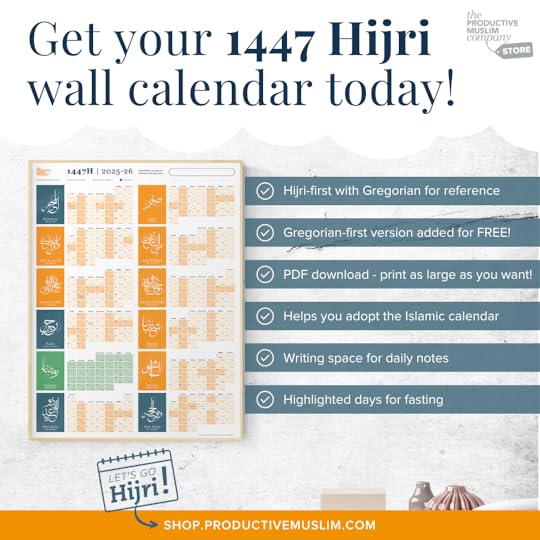
Speaking of aligning with the Hijri calendar, we’ve created a beautiful 1447H wall calendar with Islamic dates, and space for your intentions. It’s the perfect tool to keep your spiritual year visible and intentional.
Click here to get your copyThe Gardener’s Approach to Planning 1447HBefore we dive into the practical steps, I need you to understand a fundamental mindset shift.
Most planning systems treat you like a carpenter. You must set precise goals, create detailed blueprints, and execute with precision. If you don’t hit your targets, you’ve “failed.” A gardener plants seeds with sincere intention, tends to them consistently, creates the right growth conditions, and trusts Allah with the results. A gardener knows that growth happens in seasons, some of which are invisible.
This is the foundation of what I call “Gardener Mindset planning“, planning that seeks Allah’s blessing and operates according to His natural laws.
The 7-Step Framework for Planning Your 1447HStep 1: Set ONE High-Himmah IntentionBefore you plan anything else, you need a North Star, one overarching intention to drive your year. I call this “High Himmah Intention”.
A High-Himmah intention is:
God-centered: focused on pleasing Allah, not impressing peoplePurpose and impact-driven: serves your family, community, and/or Ummah at large.Nervously exciting: It gives you butterflies because you’re unsure you can achieve it, making you depend on Allah’s help, not your own abilities.Examples from some of our past students:
“To raise my children as confident Muslims who love their deen”“To write a book that helps young Muslims navigate modern challenges”“I want to build a business that creates halal employment for my community.”“To memorize the Quran and teach it to others”Step 2: Plan Across Three Core AreasPlan your 1447H across these three interconnected areas:
SpiritualCharacter traits you want to developActs of worship you want to strengthenIslamic knowledge you want to gainWays to remember Allah more often Personal/Financial Health and fitness intentionsHands-on skills to develop (e.g. baking, gardening)Business or career intentionsFinancial Budget/Investment plan
 SocialFamily relationships to strengthenCommunity service you want to provideFriendships to nurtureWays to serve the community/Ummah
The key is ensuring all three areas support your High-Himmah intention. If your North Star is raising righteous children, then your spiritual growth, physical health, and social connections should contribute to that intention.
Step 3: Think Process/Habits, Not AchievementsMost people set ambitious goals like “Memorize 3 Juz of Quran” or “Lose X kg.” But gardeners think in terms of processes and routines.
Break your intentions into specific processes or habits. For example:
If your intention is to “Memorize Quran,” break it down to “Aim to memorize 1 page per week.”Change “Run a marathon” to “Run 3 times per week: 1 recovery run, 1 long run, 1 speed run.”Instead of “Spend time with family,” write “Establish weekly family circle.”Step 4: Craft Specific DuasFor each major intention, formulate a specific dua:
Start with one of Allah’s beautiful names related to your need.Be specific about your request.Ask for sincerity, guidance, and tawfeeq (divine enablement).Example:
“Ya Rahman, help me memorize Surah Al-Baqarah this year with sincerity and understanding, and make it easy for me to review and retain what I learn.”
Write these duas down. You’ll return to them throughout the year, especially during blessed times like the last ten nights of Ramadan.
Step 5: Plan Your Learning JourneyEvery intention requires knowledge and skills. A gardener studies soil conditions, weather patterns, and growth cycles.
For each intention, ask:
What knowledge do I need to succeed?What skills should I develop?Who can mentor or guide me?What resources will help me grow?For example, if one of your intentions is to write a book, join our Book Writing Program (shameless plug!)
Step 6: Create Your Review RhythmGardens need consistent tending. Set up regular reviews:
Weekly: Which intentions are going well? Which need more support?Monthly: Am I still aligned with my High-Himmah intention? What needs adjustment?Quarterly: Take some time out at the end of each Islamic quarter and review your intentions. Take some time out, and ask yourself: What’s working? What isn’t? How is Allah guiding me?Step 7: Practice True Tawakkul (Trust in Allah)The most important step is to detach from specific outcomes while remaining committed to sincere effort. Your job is to plant, water, and tend. Allah will determine what grows, when it grows, and how much it grows.
Sometimes Allah gives you exactly what you planned. Sometimes He’ll give you something better. Sometimes He’ll teach you patience through delay. All are gifts.
3 Common Mistakes to AvoidAs you plan your 1447H, watch out for these pitfalls:
Over-committing: It’s better to do fewer things with ihsaan than many with mediocrity.Forgetting Your Season of Life: If you just had a baby or have elderly parents that need your help, you can’t plan like you did when you were single or when your parents were less dependent on you. Honor where Allah has placed you in life.Chasing Others’ Dreams: Your intentions should excite your heart, not impress others.Your Weekend ProjectThis weekend, spend 2-3 hours on this framework:
Identify your High-Himmah intention for 1447H.Brainstorm processes/habits for each of the three areas.Choose 3-5 projects to focus on in the first quarter (Muharram to Rabi’ al-Awwal).Write initial duas for your main intentions.Set up your review system.Pro tip: Download our beautiful GoHijri 1447H wall calendar to keep track of Islamic dates and your monthly intentions throughout the year. Get it here.
Final ReflectionThe Prophet’s ﷺ companions didn’t have productivity apps or goal-setting frameworks. But they had something more powerful: clear intention, reliance on Allah, and commitment to continuous effort for His sake.
As you plan your 1447H, remember you’re not just setting goals. You’re designing a year of worship. Every project becomes an act of ‘ibadah with the right intention. Even if you don’t achieve your 1447H intentions/goals due to illness, busyness, or even death, you’ll be rewarded for your intentions insha’Allah.
May Allah bless your planning, accept your intentions, and grant you success in this life and the next. Ameen!
Bismillah for 1447H.
The post 🌱 The Productive Muslim’s Guide to Planning Your 1447H (#GoHijri) appeared first on ProductiveMuslim.com.
June 20, 2025
📚 Your Book is Waiting to be Written (And We’re Here to Help)
This morning, I received a message from a community member that warmed my heart:
“Assalamu Alaikum Akhi Mohammed, I watched the recording of the book/AI session… It’s funny because I never thought of writing a book, but when you repeatedly said that it hurts you when you see self-help sections in bookstores and scarcely find Muslim, faith-based authors, it made me think… putting our thoughts, our souls on the page, it could definitely benefit others… I’m thinking maybe I should write…”
If you’ve ever felt a similar pull, but found yourself paralyzed by the process of writing and publishing a book, read on.
Whenever I meet people at conferences or sit with community members, I’m usually the guy who goes around saying “You should write a book.”
Our Ummah is filled with incredible souls who have life-changing insights, hard-earned wisdom, and transformative experiences. Yet most of these voices remain silent, their potential books trapped forever in their minds.
Let me share something that might surprise you: writing a book isn’t just about becoming an author, it’s about crystallizing your thoughts, deepening your understanding, and creating sadaqah jariyah (ongoing charity) of beneficial knowledge that continues benefiting people long after you’re gone.
Most aspiring authors though think their biggest challenges are:
“I’m not a good enough writer”“Who am I to write a book?”“What if no one reads it?”But after mentoring dozens of Muslim authors, I’ve discovered the real obstacles are much more practical:
Not knowing how to structure a book proposalFeeling overwhelmed by the book writing journey Lacking a clear roadmap from idea to finished manuscriptMissing the accountability and community needed to stay consistentThese aren’t character flaws, they’re simply gaps in knowledge and support. Gaps that can be filled.
That’s why I’m excited to share something we’ve been developing at The Productive Muslim Company over the past two years: The Book Writing Program for Aspiring Muslim Self-Help Authors

This isn’t another generic writing course. It’s a comprehensive 12-month program specifically designed for Muslims who want to contribute meaningful self-help books to our intellectual landscape.
The journey begins with an intensive 8-week sprint focused on getting you from intention to polished book proposal, followed by ongoing support as you write and publish your manuscript.
The program follows a proven 3-stage process:
Stage 1: From Intention to Book Proposal
Clarify your niyyah and book’s core messageUnderstand your publishing options (traditional vs. self-publishing)Craft a professional book proposal that publishers actually want to read Build the foundation for everything that followsStage 2: From Proposal to First Draft
Develop a research system that actually worksBuild sustainable writing habits Navigate the messy, beautiful process of your first draftStage 3: From First Draft to Publication-Ready
Learn the editing process that transforms rough drafts into polished manuscriptsPrepare for a successful book launchUnlike other writing programs, we don’t just focus on the mechanics of writing. We integrate the spiritual dimension of authorship:
Setting powerful intentions that sustain you through difficult writing daysIncorporating Islamic principles without overwhelming your message Building a writing practice that feels like worship, not workCreating books that serve the Ummah while remaining authentic to your voicePlus, you’ll have access to our unique BarakahFlow Virtual Co-Working Sessions, daily focus sessions where you work alongside fellow Muslims, creating the accountability and momentum that solitary writing simply can’t match.
I believe we’re living in a critical moment for Muslim intellectual contribution. The world needs our voices, our perspectives, our solutions. But those contributions won’t happen automatically, they require Muslim professionals like you to step forward and share what you’ve learned.
The next cohort begins Thursday, 7 Muharram 1447H (July 3rd, 2025). We’re limiting this cohort to ensure personalized attention. See details here.
If you’ve been feeling that pull to write, I invite you to book a free consultation call with our team. We’ll explore your book idea, discuss whether the program is right for you, and answer any questions about the journey ahead.
This isn’t about becoming the next bestselling author (though that might happen). It’s about honoring the trust Allah has placed in you by sharing the wisdom He’s given you through your experiences.
Your book is waiting to be written. The question is: Will this be the year you finally write it?
Book Your Free Consultation CallMay Allah grant you the courage to share your gifts with the world and the persistence to see your book through to completion. Ameen.
The post 📚 Your Book is Waiting to be Written (And We’re Here to Help) appeared first on ProductiveMuslim.com.
May 27, 2025
Introducing Shukr Cards: A Practical Tool for Gratitude and Connection
Gratitude (Shukr) is one of the most beautiful, elevated states a heart can live in. It transforms how we see the world, shifting our focus from what is missing to what is present, and from what went wrong to all that is going right. It helps us see Allah’s Hand in the fine details of our lives, both the highs and the lows. And ultimately, it brings more Barakah into our lives, just as Allah promises in this verse:
“If you are grateful, I will surely increase you.”
(Qur’an 14:7)
The Shukr Cards were created to help you nurture this sacred state in a deeply meaningful, lasting way. They’re designed to take you beyond lip-service thanks and into a daily experience of lived gratitude, through how you think, speak and act. At their core, these cards are a tool to strengthen your relationship with Allah, to build greater awareness of His mercy in your everyday life, and to increase your reliance upon Him through sincere Shukr.
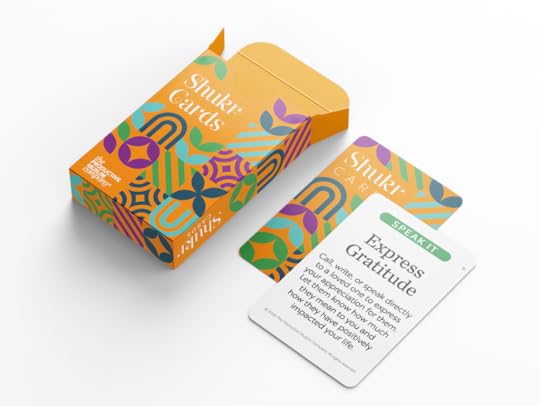
Each card invites you either to reflect, take action or speak from a place of focused gratitude. But it doesn’t end there. These cards are not just for private reflection or inner transformation, they’re also a catalyst for connection. Some of the most meaningful insights and experiences come from when we share our reflections with others.
Whether you pull a card during your quiet journaling, share it as a conversation starter with family or bring it into your workplace to nurture a culture of gratitude, the Shukr Cards are here to enrich your inner world, your relationships and your environments.
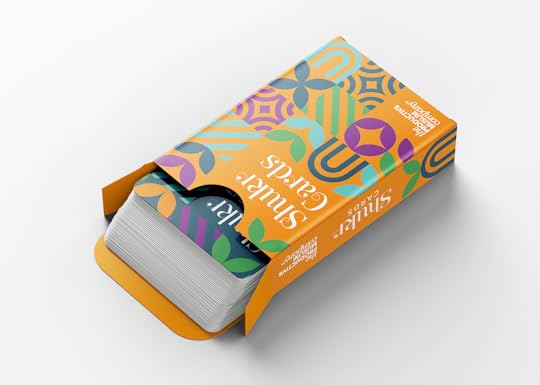 What’s Inside the Deck?
The Shukr Cards deck includes 55 thoughtfully designed cards, divided into four unique categories. Each one invites you to engage with gratitude in a deeper, more embodied way, through reflection, action, speech or through challenges that stretch you beyond your comfort zones.
1. Discuss It
These prompts guide you to reflect on your personal experiences, recognize Allah’s mercy in your journey and extract meaning from both the joys and the trials. Perfect for journaling, self-enquiry or heart-opening conversations with others.
“The most difficult time in my life taught me…”“One area in my life I surrender fully to Allah is…”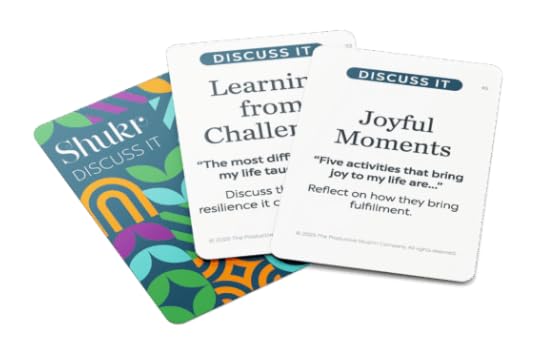
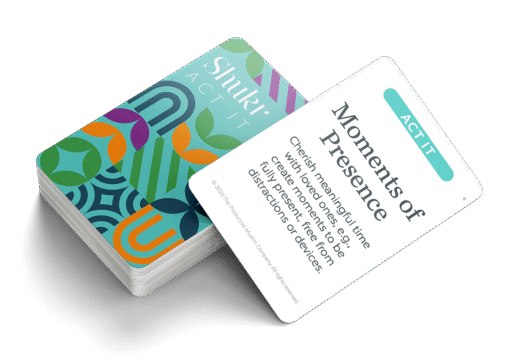
2. Act It
Gratitude is not just a feeling, it’s a practice. These cards prompt you to act on your Shukr through mindful, intentional deeds. Think of them as invitations to honor your blessings through service, presence or small acts.
“Volunteer your skills to help someone in need.”“Give something you love to someone else, for the sake of Allah.”3. Speak It
These prompts help you voice appreciation, reconnect with others and speak words that heal and uplift.
“Call or message someone to thank them for how they impacted your life.”“Say Alhamdulillah 33 times, each time thinking of a specific blessing.”
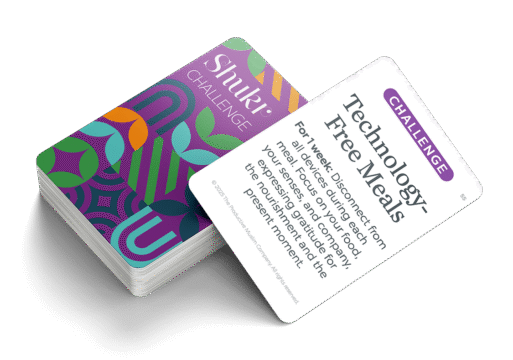
4. Challenge
These short-term practices help you stretch your gratitude muscle and step out of autopilot. They may seem simple, but done sincerely, they can powerfully shift your perspective and habits.
“Go device-free for one day and observe your presence and thoughts.”“Spend five minutes preparing for each Salah with full presence and intention.”Why Gratitude Matters in IslamGratitude is not just an emotion, it is a spiritual station. In the Qur’an, Allah describes gratitude as the path of the righteous:
“And few of My servants are truly grateful.”
(Qur’an 34:13)
Shukr is the essence of a heart that is awake to Allah’s favors. It opens the door to more blessings, eases resentment and draws us nearer to our Creator. The Prophet (saw) would spend long hours in prayer until his feet swelled, and when asked why, he said, “Should I not be a grateful servant?” (Bukhari & Muslim).
We often quote the ayah mentioned at the start of this article: “If you are grateful, I will surely increase you.” But how often do we pay attention to what Allah says next: “But if you are ungrateful, surely My punishment is severe.”
A grateful heart doesn’t come by chance, it requires conscious, daily effort. We live with a natural negativity bias, a built-in tendency to focus on what’s wrong. While this helps us assess risk, if left unchecked, it can easily become a habit – a lens through which we see life, people, and outcomes. Over time, it hardens into a mindset of scarcity and dissatisfaction.
That’s one of the key intentions behind the Shukr Cards: to constantly revive the heart. To help you notice the countless blessings nestled in every situation. To help you see the value, wisdom and mercy in what unfolds rather than falling into complaint. So that, inshaAllah, your heart becomes one that lives in constant remembrance and praise of Allah and never allows the seeds of ingratitude to take root.
How to Use the Shukr CardsThere’s no single way to use the Shukr Cards, they’re designed to be flexible, intuitive and personal while also being a soulful way to connect with others. Whether you’re using them alone or in a group, the cards are an invitation to slow down, reflect and live with more presence and gratitude.
Here are some suggestions to get started:
1. Pick a CardChoose one intentionally or at random. Let it guide your focus for the day or even the week. Place it somewhere visible to remind you throughout the day.
2. Set an IntentionBegin with the niyyah (intention) to grow in gratitude for the sake of Allah. This small step turns any reflection or action into worship.
3. Reflect DeeplyUse the Discuss It cards for journaling, quiet contemplation or meaningful conversations. They’re perfect for personal reflection, discussions with friends and family or even as a way to open your team meeting, inviting each member to share a response to nurture a culture of gratitude within the group.
4. Act MindfullyLet the Act It cards guide you into small but meaningful actions that embody gratitude. As a family, you might choose one card to focus on together for the week then come back after a few days to reflect on what you each experienced or noticed. These shared actions can create powerful ripple effects, deepening both your gratitude and your bond with one another.
5. Speak with PurposeThe Speak It cards are your reminder that Shukr is also an expression of words. Use them to reconnect with someone you’ve lost touch with, express appreciation to a colleague or practise more mindful dhikr throughout your day.
6. Embrace the ChallengeTry the Challenge cards when you want to stretch your mindset, break a pattern, or reflect more intentionally on life’s blessings. These practices are designed to shake us out of autopilot and invite conscious living. Invite your team or circle of friends to take on a weekly challenge together and reflect on the insights that follow.
7. Mix and MatchDon’t feel limited to one category. A Challenge card can be a great discussion point with a group. An Act It card can lead to insightful journaling or a family project. Let the cards flow into your life and relationships however they resonate with you.
8. Make it CollectiveThe categories beyond Discuss It aren’t just for solo use, they’re also great conversation starters. Use them as prompts to reflect together, deepen understanding and explore shared values. For example, a Challenge card about using minimal water might open up heartfelt discussions about waste, privilege and mindfulness. Or an Act It card about the sadaqah of smiling might lead to joyful exchanges and reflections on emotional generosity.
9. Keep a JournalCapture your reflections, actions and emotional shifts. Over time, you’ll notice patterns, growth and perhaps even how Allah is responding to your gratitude in ways you hadn’t noticed before.
10. Share the JourneyUse the cards in gatherings – with your family and children, your friends or your work colleagues. Whether it’s over lunch, after salah or at the start of a meeting, you’ll find that Shukr is contagious. The more it’s shared, the more it grows.
When Gratitude Feels Hard – Let the Shukr Cards Help You Be More GratefulGratitude doesn’t always come easily. Sometimes life feels heavy, uncertain or simply too fast and in those moments, it can be a struggle to access a sense of Shukr. That’s exactly why the Shukr Cards were created, to help you move from feeling stuck or disconnected into a more heartfelt, grateful flow.
These cards were born from a desire to help us reconnect with Allah through the everyday. In the chaos of modern life, our blessings can unintentionally become invisible in the noise. The Shukr Cards slow us down just enough to notice, reflect and respond. They help us give our thanks more consciously, not just with our words, but with our hearts, hands and habits.
Each card is a small nudge back to perspective, back to presence and ultimately back to Allah. Whether it’s a prompt that unlocks a hidden blessing or an action that lifts your heart, the cards are here to help you find your way, even on the harder days.
More than just a product, they are an invitation to live a life of greater awareness, appreciation and connection with the One who gave us everything.
We pray that they help you notice the light in your life, feel it more deeply and share it more widely.
Alhamdulillah, always.
/**/(function () { var scriptURL = 'https://sdks.shopifycdn.com/buy-butto... if (window.ShopifyBuy) { if (window.ShopifyBuy.UI) { ShopifyBuyInit(); } else { loadScript(); } } else { loadScript(); } function loadScript() { var script = document.createElement('script'); script.async = true; script.src = scriptURL; (document.getElementsByTagName('head')[0] || document.getElementsByTagName('body')[0]).appendChild(script); script.onload = ShopifyBuyInit; } function ShopifyBuyInit() { var client = ShopifyBuy.buildClient({ domain: 'barakah-academy.myshopify.com', storefrontAccessToken: 'cd908a76d21933623cefc174f039f0ff', }); ShopifyBuy.UI.onReady(client).then(function (ui) { ui.createComponent('product', { id: '9014996402427', node: document.getElementById('product-component-1748445537868'), moneyFormat: '%24%7B%7Bamount%7D%7D', options: { "product": { "styles": { "product": { "@media (min-width: 601px)": { "max-width": "100%", "margin-left": "0", "margin-bottom": "50px" }, "text-align": "left" }, "title": { "font-size": "26px" }, "button": { ":hover": { "background-color": "#da8300" }, "background-color": "#f29100", ":focus": { "background-color": "#da8300" } }, "price": { "font-size": "18px" }, "compareAt": { "font-size": "15.299999999999999px" }, "unitPrice": { "font-size": "15.299999999999999px" } }, "layout": "horizontal", "contents": { "img": false, "imgWithCarousel": true, "button": false, "buttonWithQuantity": true, "description": true }, "width": "100%", "text": { "button": "Add to cart" } }, "productSet": { "styles": { "products": { "@media (min-width: 601px)": { "margin-left": "-20px" } } } }, "modalProduct": { "contents": { "img": false, "imgWithCarousel": true, "button": false, "buttonWithQuantity": true }, "styles": { "product": { "@media (min-width: 601px)": { "max-width": "100%", "margin-left": "0px", "margin-bottom": "0px" } }, "button": { ":hover": { "background-color": "#da8300" }, "background-color": "#f29100", ":focus": { "background-color": "#da8300" } }, "title": { "font-family": "Helvetica Neue, sans-serif", "font-weight": "bold", "font-size": "26px", "color": "#4c4c4c" }, "price": { "font-family": "Helvetica Neue, sans-serif", "font-weight": "normal", "font-size": "18px", "color": "#4c4c4c" }, "compareAt": { "font-family": "Helvetica Neue, sans-serif", "font-weight": "normal", "font-size": "15.299999999999999px", "color": "#4c4c4c" }, "unitPrice": { "font-family": "Helvetica Neue, sans-serif", "font-weight": "normal", "font-size": "15.299999999999999px", "color": "#4c4c4c" } }, "text": { "button": "Add to cart" } }, "option": {}, "cart": { "styles": { "button": { ":hover": { "background-color": "#da8300" }, "background-color": "#f29100", ":focus": { "background-color": "#da8300" } } }, "text": { "total": "Subtotal", "button": "Checkout" } }, "toggle": { "styles": { "toggle": { "background-color": "#f29100", ":hover": { "background-color": "#da8300" }, ":focus": { "background-color": "#da8300" } } } }}, }); }); }})();/*]]>*/The post Introducing Shukr Cards: A Practical Tool for Gratitude and Connection appeared first on ProductiveMuslim.com.
December 18, 2024
Slow down your life with #SlowSalah
You’ve probably heard of slow cooking, slow traveling, maybe even slow living… but have you heard of slow praying, or what I like to call “Slow Salah”?
Before we dive into this concept, let’s explore why more and more people are embracing slow living in today’s world.
We can all feel that something is ‘off’ with our modern lifestyle. Life is accelerating at an unbearable pace, especially for those of us in the sandwich generation – juggling young kids, elder parents, and the prime of our career or business. We’re trying to manage so many things at an ever-increasing speed that it simply doesn’t feel humanly possible anymore.
The purpose of the slow movement is simple yet profound: to bring our ever-accelerating lives back to a human pace. But here’s the challenge: for many of us, we’re so used to rushing from one thing to the next that the idea of a slow, mindful life feels uncomfortably slow. It’s like when you watch a YouTube video or listen to an audiobook at 2x speed, and then try to watch or listen at the normal 1x speed – suddenly, it feels painfully slow!
“I have to speed up”You might ask: “Why should I slow down? I can keep up with this fast pace. I have so many things to do. I have no option but to speed up.”
I understand this resistance – I’ve been there too. But let’s explore this deeply.
Yes, you might be able to keep up with the pace now, but you’re likely speeding towards an inevitable burnout. Burnout isn’t just feeling tired – it manifests as emotional exhaustion, cynicism, reduced productivity, or simply “not caring about anything anymore.”
Think of it this way: a sprinter can run fast but only for a short distance. A marathoner, however, can keep going for long distances. The difference? Pacing. Elite marathoners actually train to slow down their natural pace to maintain endurance. They understand something crucial: long-term achievement requires strategic slowness.
Be the smart marathoner in your life. Figure out a ‘slow’ but sustainable pace that balances different areas of your life: relationships, work, health, and spirituality. The Harvard Business Review calls this “sustainable performance” – the ability to maintain high performance over the long term without burning out.
And yes, this might mean disappointing some people or taking longer to complete certain tasks. However, in the long run, you’ll likely achieve all you set out to accomplish, but at a much healthier (and more human) pace.
#SlowSalah: Antidote to Fast LivingOne of the first ways to help you slow down your life is to practice what I call “Slow Salah.” This isn’t just another productivity hack or wellness trend – it’s a return to how prayer was meant to be experienced.
Alhamdulillah, we are blessed as Muslims to have the five daily prayers that help us pause in the middle of our busy lives and turn to our Creator. But sadly, many of us rush through them trying to catch up with life.
The irony is that we rush through our meeting with our Creator, Who has control over everything in our lives, to hurry towards meetings with people or tasks that only Allah can facilitate in the first place!
The Prophet Muhammad ﷺ spoke directly about this issue. In a hadith narrated by Abu Hurairah, the Prophet ﷺ noticed a man praying in a hurried manner. He said to him, “Go back and pray, for you have not prayed.” This happened three times, until the man said, “Teach me, O Messenger of Allah.” The Prophet ﷺ then explained, “When you stand for prayer, perform wudu properly, then face the qibla and say takbir. Then recite what you can from the Quran, then bow until you feel at ease in ruku’, then rise until you are standing straight, then prostrate until you feel at ease in prostration…” (Bukhari)
The Importance of #SlowSalahSlow Salah is more than just praying slowly – it’s a deliberate antidote to our fast-paced life and the essential infusion of Barakah that we need in our daily life to achieve more with less.
This isn’t a luxury – it’s a necessity. We’re fighting our lower selves and Shaytaan’s whispers that push us to ignore what truly matters.
And the stakes are high! We don’t want to reach the end of our lives only to realize that most (if not all) of our prayers weren’t accepted because we rushed through them, treating them as items to check off our to-do list rather than precious moments of connection with Allah. After all, the first thing we’ll be questioned about on the Day of Judgement is our Salah. Not how much work we got done in the short life span we have.
How to Practice #SlowSalah1. Schedule Ample Prayer Time
Don’t squeeze prayer into 10-20 minute slots. Schedule 30-45 minutes at least. You might think that’s excessive when you have ‘more important’ things to do – but pause and reflect on that thought. Do you have anything more important than meeting your Creator?
2. #DropTheHammer
I wrote a newsletter once called #DropTheHammer – the concept comes from the inspiring story of a blacksmith who, upon hearing the adhan while lifting his hammer, immediately dropped it to answer the call to prayer. Make this your modern practice. When you hear the adhan, pause that email, step out of that meeting, save that document – whatever you’re doing can wait. The Prophet ﷺ said, “When the call to prayer is made, do not come to it running, but come to it walking and with calmness” (Bukhari). Notice the emphasis on calmness – even our journey to prayer shouldn’t be rushed.
3. Create a Distraction-Free Prayer Zone
Leave your watch and phone behind. Studies show that merely having your phone in view reduces your cognitive capacity, even when it’s turned off! Moreover, last week, I wrote about the “Tyranny of the Mechanical Clock” and how the constant awareness of time passing can create “time pressure,” leading to anxiety and rushed behavior. Immerse yourself in Allah’s Time without the constraints and constant ticking of the mechanical clock. If you must bring your watch/phone, keep it in your bag or car until you’re done.
4. Master Mindful Wudu
A Slow Salah begins with mindful wudu. Try this: use a small water bottle for your entire wudu. This practice, common among our predecessors, naturally makes you more conscious of each drop of water. The Prophet ﷺ used approximately one mudd (about 0.5-0.7 liters) of water for wudu, showing us that thoroughness doesn’t require excess. As you perform wudu, recall the hadith about how sins are washed away with each body part.
5. Perfect Your Prayer Movement
The Prophet ﷺ was meticulous about prayer movements, saying, “Pray as you have seen me praying” (Bukhari). Here’s a practical breakdown:
In ruku’ (bowing), wait until each joint settlesIn sujood (prostration), ensure your forehead, nose, and palms are firmly placedBetween movements, pause until your body is completely stillRecite at a calm, rhythmic pace6. Resist the urge to rush!
Every time you feel the urge to rush, acknowledge it and ignore it – this is your nafs (lower self) and Shaytaan speaking. Instead of giving in, use this as a trigger to slow down even further. Take a deep breath and remember: this moment of connection with Allah is more precious than anything I need to rush to.
7. Don’t rush off after Salah
Don’t jump up after saying salam. The Prophet ﷺ would remain seated for dhikr after prayers. You need a transition period between your deep/spiritual Salah and the worldly life – this time allows your prayer experience to settle in your heart before you rejoin dunya again fully. Use this time for:
– Required post-prayer adhkar
– Dua on anything on your mind
– Quran recitation
The Reality Check: Making Slow Salah Work in a Fast WorldI understand – the tips I’ve shared may seem idealistic. There will be times when you genuinely need to pray quickly. The Prophet Muhammad ﷺ himself would sometimes ‘lighten’ a prayer when he heard a baby crying, showing his mercy for the mother’s heart. But notice the language used: “lighten” the prayer versus “rushing through” prayer. One approach maintains the essence and focus of salah while being brief; the other sacrifices the prayer’s spirit in a hurried dash to the next task.
The key is making rushed prayers the exception, not the rule.
If this is too much, start practicing #SlowSalah with one prayer a day, perhaps with Fajr or Isha, when time pressures are lower. Then, gradually expand your slow salah practice to all your prayers.
The ultimate question isn’t whether we have time for Slow Salah – it’s whether we can afford the spiritual cost of rushed prayers. In a world that’s constantly pushing us to go faster, our salah can become our daily reminder to return to a more natural, human rhythm that will actually benefit us in this life and the Akhira.
I pray that Allah SWT gives us the wisdom to be mindful of Him at all times, the strength to resist the urge to rush through our prayers, and the consciousness to live our lives at a pace that brings us closer to Him. May we not reach the end of our lives, regretting all the precious moments we rushed through in our haste to get somewhere else. Ameen.
The post Slow down your life with #SlowSalah appeared first on ProductiveMuslim.com.
December 9, 2024
The Tyranny Of The Mechanical Clock
Look at your wrist or maybe at the corner of your computer screen – see those innocent-looking numbers telling you the time—what if I told you they aren’t so innocent, that those numbers are controlling your life in ways you never imagined?
It might sound odd for a productivity researcher to have anything against the clock. After all, isn’t the definition of productivity someone who is efficient with their time and always “on time”?
But what if I told you that this seemingly neutral tool—the mechanical clock—has warped our understanding of time and impacted our spirituality, health, work, and relationships? What if the stress you feel daily at work, the rushed prayers, the family moments you regret, and the constant anxiety about “being late” all trace back to a single cultural imposition: mechanical time?
In this article, we’ll explore how the mechanical clock transformed from a humble monastery tool into an instrument of cultural dominance that shapes every aspect of our modern lives. More importantly, we’ll discover how to reclaim our natural relationship with time—one that aligns with a God-centered, Barakah Culture approach to time.
How Mechanical Clocks Shifted Our Understanding of TimeImagine you were born in a village or city in the Islamic world, before European colonization. How would you tell time?
You’d probably tell time by a sundial in the courtyard of a mosque and by the rhythm of the five daily prayers. This wasn’t just true for the Islamic world— across ancient civilizations, from the Babylonians to the Chinese, time was measured through natural cycles and celestial events.
Time wasn’t “precise” – divided into 24 hours, each hour 60 minutes, and each minute 60 seconds. It was more free-flowing, more natural. Below is a description of how Muslim societies organized their time from a book called “Time Sticks: How Islam and Other Cultures Have Measured Time,” by Dr. Barbara Freyer Stowasser:
“The five Islamic ritual prayers endow the day with a specific pulse that remains a vital sign of time perception in Muslim societies. In a world of global time zones, atomic clocks, and affordable wrist watches, where day and night are measured in 24 hours of equal 60-minute length, the times of these five ritual prayers are pegged to the much older system of seasonal time and unequal hours. Even where this fact may merely imprint itself on the subconscious of all who dwell within earshot of a mosque’s adhan (call to prayer), it fosters a groundedness in the seasonal progression from shorter to longer units of daylight and then back again. Societies have lived by this system of time reckoning and time management through most of human history. For millennia, human labor took its cues from local, astronomical time. The day’s stretch between dawn and dusk determined the patterns of working, eating, resting, and praying. An hour was a one-twelfth fraction of the day or night whose length changed with the seasons, not an absolute or constant entity in its own right…Seasonal time is sometimes referred to as “organic” time, while the clock-measured time of 60 minutes per hour is said to have created “abstract” time.”
If you had to meet someone, you’d coordinate around prayer times (“I’ll meet you after Dhuhr at such and such place”) or social events (“I’ll meet you at my brother’s wedding after the walimah”). More importantly, time felt ‘slow’ because there wasn’t a device hurrying you from one thing to the next like a machine.
The transformation to the modern perception of time came gradually. Historical records show that mechanical clocks first appeared in European monasteries in the 13th century, initially (interestingly enough) to regulate prayer times. As historian David Landes notes in his seminal work “Revolution in Time,” these devices slowly transformed from religious tools into commercial and colonial power instruments.
When the European colonizers arrived with their modern weaponry and techniques, they introduced clock towers and watches as hallmarks of modernity. This wasn’t just a technological change – it was a philosophical one. As sociologist Lewis Mumford observed, “The clock, not the steam engine, is the key machine of the modern industrial age.” Suddenly, a new concept of time emerged, based not on the natural rhythm of the sun, moon, or prayer times but on mechanical precision.
You might wonder – what’s wrong with that? We just replaced one time system with another – a far ‘superior’ time system that’s more precise, more accurate, and is responsible for the advent of modernity and globalization. After all, how would factories, planes, trains, and global meetups across time zones work without the mechanical clock?
That’s all well and good, and I have no personal qualms against watches or clocks as an organizing system. However, I do have an issue when our concept of time becomes completely warped around the mechanical clock in a way that affects our spirituality, our relationships, our health, and our appreciation of time itself.
Beyond “Muslim Standard Time”How many times have you heard the expression “Muslims are always late”? By “late,” critics mean Muslims aren’t adhering to the mechanical clock’s strict precision—being somewhere at 6:00 PM on the dot. This criticism often comes with undertones suggesting a lack of respect for others’ time or professional incompetence.
But this perception misses something crucial about cultural relationships with time. European colonizers weaponized this notion of punctuality to emphasize their supposed superiority and make other cultures feel backward. They equated their mechanical precision with civilization itself, dismissing other ways of organizing time as primitive or disorganized.
Yet, we need to understand that people experience and value time differently, and these differences reflect deep cultural wisdom rather than deficiency. Anthropologist Edward T. Hall, in his groundbreaking work “The Silent Language,” introduced the concepts of “monochronic” and “polychronic” time orientations. Western societies tend to be monochronic – treating time as linear, segmented, and strictly scheduled. Many traditional societies, including Muslim cultures, are often polychronic – viewing time as flowing, with multiple activities happening simultaneously and relationships taking precedence over rigid schedules.
This isn’t about being “late” or “on time” – it’s about fundamentally different cultural approaches to time. In polychronic cultures, being present in a moment until its natural conclusion is often seen as more respectful than cutting off a meaningful interaction just because a clock says so. When a conversation needs to continue, when someone needs help, or when a situation requires more attention, the mechanical clock takes a back seat to human needs and relationships.
“Technology has also created the concept of linear time, a relatively recent Western invention that is replacing, or is poised to replace, the multiple, subjective, and situation-specific times of the past. The new form of clock-based time is producing a new global psychology in which time equals punctuality, efficiency, and economic rationality.” – Time Sticks, Dr. Barbara Freyer Stowasser.
This “global psychology” pressures us to see time only through the lens of mechanical precision. But consider this: In many traditional cultures, including Muslim societies, it’s more important to be present than just showing up at a predetermined moment while mentally rushing to the next appointment.
So the next time someone comments about “Muslim Standard Time” or cultural punctuality, remember: different isn’t deficient. These alternative approaches to time often preserve something we’re desperately trying to reclaim in our rushed modern world—the ability to be fully present, prioritize human connections, and let things take their natural course rather than forcing them into artificial timeframes.
How the Mechanical Clock Ruined Our SpiritualityWhen was the last time you truly enjoyed your prayers?
Most probably, it was a time when you felt you could pray without the time pressure to finish your prayers at a certain time dictated by a clock.
We tend to blame mobile phones for the epidemic of losing our focus in Salah. However, way before the advent of mobile phones and their annoying ringtones, clocks invaded our mosques and created a different type of distraction – a time distraction.
Ibn al-Qayyim wrote beautifully about the concept of “spiritual time” in his work “Al-Wabil al-Sayyib,” describing how the early Muslims would experience time during worship: “Their hearts were present with Allah, so time passed without their awareness of its passing.” This natural, spiritual experience of time stands in stark contrast to our modern experience.
Today, you walk into the masjid and face a huge clock with a countdown to the next prayer/iqamah as if we’re about to launch a rocket ship! The clocks started dictating when and how long each prayer would be, making you feel ‘uncomfortable’ and ‘frustrated’ when prayer is ‘late’ or is taking ‘too long’ because a clock on the wall says so.
This transformation would have seemed alien to our predecessors. During the Prophet Muhammad ﷺ time, different muathins (callers to prayer) would call to prayer at slightly different times, as authenticated in Sahih al-Bukhari, where Bilal would give adhan at dawn while Ibn Umm Maktum would wait until it was lighter. The athans were not all called at a precise time! Another example is when people entered the masjid, they would sit and wait for the Imam and only stand up for iqamah when the Imam entered the mosque—not when a digital display dictated it was time for Iqamah.
The impact on Friday prayers (Jumu’ah) has been particularly profound. Historically, the khutbah was a dynamic discourse that could extend or contract based on the community’s needs. Some of the most impactful khutbahs in Islamic history lasted well over an hour. But now – due to modernity’s demand that we work on Fridays, and accelerated by COVID – the Jumu’ah has been squeezed into a 15-20 minute show with strict start/end times, often losing the soul that was once the vibrant pulpit of the community.
We see the same issue at Islamic conferences. We invite prominent scholars with a wealth of knowledge and expertise, but instead of respectfully listening until they’ve completed their thoughts, we give them strict time slots. Sometimes, a scholar is in the middle of a heartfelt reminder that moves people’s hearts, and then the young volunteer timekeeper appears with a “5 minutes left!” note, disrupting the scholar’s train of thought and forcing a hurried conclusion.
Even Ramadan hasn’t escaped this transformation. The early Muslims spent significant portions of their nights in prayer, with flexible starting and ending times. The length of prayers varied based on energy, spiritual needs, and community circumstances. Today, we put strict mechanical clock boundaries on taraweeh/qiyam prayers, causing them to shrink from reciting one juz per night to a few pages to fit within predetermined time slots.
Time is God’s Creation – Not Dictated by MankindI know what you’re thinking – you might say: “Shouldn’t we celebrate this precision in how we organize our prayers? After all, doesn’t Allah say in the Quran: ‘Indeed, prayer has been decreed upon the believers at specified times’ (4:103)?”
Here’s my pushback: There’s a difference between being ‘on time’ according to the mechanical clock and being in harmony with the natural rhythms that Allah established. The specified prayer times in the Quran and Sunnah aren’t bound to mechanical hours – they’re tied to natural phenomena. Dhuhr isn’t permanently fixed at 12:30 PM or 2:00 PM; it begins when the sun passes its zenith, a time that shifts throughout the year.
Our traditional appreciation of time – one that values the natural order of time over mechanical precision and understands time as flowing rather than fractured – might actually be more aligned with the Qur’an’s vision of time as God-centered.
“Time is God’s creation. There can be no abstract time because God, ruler of the universe who is beyond time, is lord over time from the beginning to the end of creation. While time is a function of God’s omnipotence, so is its measurement a divine gift that God created for the benefit of mankind.” – Time Sticks, Dr. Barbara Freyer Stowasser.
The Arabs and early Muslims developed a sophisticated understanding of time based on natural observations. They had specific names for different parts of the day (duha, zawal, asr, etc.), each marking distinct periods that shifted with the seasons rather than being locked to fixed mechanical hours.
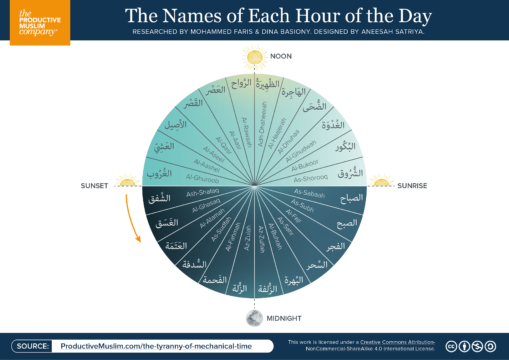
This disconnect between natural and mechanical time creates a deeper spiritual issue. Many modern Muslim professionals complain that prayer times are “inconvenient” because they don’t align with their 9-to-5 schedules. But consider this: If a king requested your presence at specific times determined by the sun’s position, would you reply, “No, I prefer to visit when it’s convenient for me”? How would the king react? And to Allah belongs the highest example.
When we dig deeper into the argument about prayer times being “inconvenient,” we uncover an issue of control. Someone says, “I want control over my life, including my prayer times.” Yet we forget that we are slaves of Allah, and a slave doesn’t choose when to meet their Master – they respond when called. We show up to prayer not when it’s most convenient for us but when Allah calls us.
“The Qur’an presents richly designed concrete and practical examples that establish God’s authorship of all celestial movements and their usefulness to the human race as devices to measure time. Night and day and even the 12 lunar months of the year are appointed times for the believing people. Reading the sky for the five prayers of the day and for the 12 months of the year is a constant reminder of divine power and providence. Despite the acts of the International Meridian Conference of 1884, time itself cannot be zoned.” – Time Sticks, Dr. Barbara Freyer Stowasser.
Interestingly, have you noticed that malls and restaurants rarely have visible clocks? The absence is intentional – our consumerist societies don’t want you to experience the passage of time when you’re fulfilling your role as a consumer. Casinos, too, never have clocks, so you waste your hours gambling. The message seems clear: spend as much time as possible in the market, but don’t linger too long in the mosque. That’s why our shopping centers are clockless while our mosques are filled with timers and alerts.
The Hidden Cost of Time Pressure on Relationships“Yalla! It’s time to go!”
“We’re so late!”
“What took you so long!”
These phrases probably echo through every family’s home (including my own), creating a constant undercurrent of tension between parents, spouses, children, and siblings.
Sometimes the time pressure is legitimate, like when you’re trying to catch a flight. But often, it’s simply habitual – a product of our warped perception of time. Sociologist Judy Wajcman, in her research on Pressed for Time: The Acceleration of Life in Digital Capitalism, found that modern families experience what she calls “time pressure contagion” – where one person’s sense of time urgency spreads anxiety throughout the household.
If we were supposed to go out at 8 pm and it’s 8:15 pm, we ‘feel late’, and for some of us, that creates genuine discomfort. We discount legitimate reasons for the delay – the kids took longer than usual to get ready, someone had unexpected bathroom needs, or you went for a quick errand to get flowers for your host. Instead of accepting these natural variations in how long things take, we let the mechanical clock dictate our emotional state.
Research from family therapist Dr. William Doherty shows that this “time pressure cooker” particularly affects parent-child relationships. In his book “The Intentional Family,” he found that parents’ obsession with punctuality often overshadows meaningful family moments. As a parent, I’ve felt the guilt of wanting to hurry my child towards our destination because “we were late” while my child wanted to stop and smell the roses. This constant rush creates what psychologists call “time-based conflict” – a form of stress that arises not from actual time constraints but from perceived pressure to conform to rigid schedules.
The impact is particularly visible in how we spend time together as families. Anthropologist Thomas Hylland Eriksen, in his work “Tyranny of the Moment,” describes how mechanical time has transformed family gatherings from organic, flowing experiences into highly scheduled events with clear start and end times. “Coming together as a family,” he writes, “has become less about being present with each other and more about managing a schedule.”
Think about your most meaningful family memories. Were they scheduled, timed events? Or were they spontaneous moments when no one was watching the clock? When we let mechanical time dictate our family life, we risk missing these precious, unscheduled moments of connection.
To be clear, I’m not encouraging people to be ‘fashionably late’ or disregard others’ time. Rather, I’m suggesting we need to distinguish between necessary time constraints (like catching a flight or attending a medical appointment) and artificial time pressure we create out of habit or use as a passive-aggressive tool to settle family scores.
There once was a man who would experience intense anxiety whenever his family took too long to get ready for outings. Like many of us, he’d find himself pacing, checking his watch repeatedly, and eventually erupting in anger – creating an atmosphere of tension that would cloud the entire family outing before it even began.
One day, realizing how this behavior was poisoning his family relationships and his own peace of mind, he made a conscious decision to transform these “waiting moments” into something meaningful. Instead of letting the mechanical clock fuel his anxiety, he began using these periods to recite Quran.
His wife later commented that this simple change had filled their family outings with barakah. The tension that used to accompany their departures was replaced with a sense of tranquility. His children no longer associated leaving the house with their father’s anger but instead would sometimes find him so peacefully engaged in recitation that they’d slow down just to avoid interrupting him.
When Time Pressure Affects Our Work (& Health)How many times have we induced unnecessary stress on ourselves because of the mechanical clock?
We’re working on something, and we’re in the flow – that beautiful state where time seems to disappear and our work feels effortless. Then we glance at our watches, notice the passage of time, and panic sets in. We either abruptly stop what we’re doing or hurry it along to a low-quality finish.
This isn’t just a matter of productivity – it’s about our health. Research from the American Psychological Association shows that time-related stress triggers the same physiological responses as being in physical danger. Our bodies release cortisol and adrenaline, our heart rates increase, and our immune systems weaken – all because a mechanical device tells us we’re “running late.”
Dr. Robert Levine, in his groundbreaking work “A Geography of Time,” describes what he calls “clock-time sickness” – a modern phenomenon where constant awareness of mechanical time creates chronic stress. His research across different cultures found that societies more rigidly bound to mechanical time show higher rates of stress-related illnesses.
This is why I personally don’t like wearing watches, especially when I’m writing (as I’m writing this, I don’t have my watch on and I can’t see my clock on my computer, so I have no idea what time it is, but I’m in the flow and won’t look at it!)
“Wait, you don’t wear a watch?!”
I do, but very occasionally. Mainly when I’m traveling or delivering a workshop and I have certain ‘mechanical clock’ deadlines to meet. This isn’t just personal preference – it’s backed by science. Research on “flow states” by psychologist Mihaly Csikszentmihalyi shows that one key characteristic of peak performance is losing track of time. When we’re constantly checking the time, we interrupt these flow states and reduce both our performance and our enjoyment of the task.
The Japanese even have a term, “karoshi,” meaning death by overwork, which often involves the tyranny of mechanical time – strict schedules, rigid deadlines, and the constant pressure to be “on time.” Similarly, the World Health Organization has recognized “burnout” as an occupational phenomenon, with time pressure being a key contributing factor.
I’m mindful of when I use the mechanical clock/watch rather than letting it dictate my life and stress me out all the time. This awareness isn’t about rejecting time management altogether—it’s about finding a healthier relationship with time that aligns with Barakah Culture and our natural rhythms rather than being at the mercy of hustle culture and all that it entails.
Many of history’s most productive individuals structured their days around natural rhythms rather than mechanical time. They worked when they felt most alert, rested when tired, and let their creative processes flow naturally rather than forcing them into predetermined time slots.
Reclaiming Our Relationship with TimeThe mechanical clock is a tool, just like the internet or AI – beneficial in many ways, and certainly crucial for modern transportation and global synchronization. However, just as we’re learning to be mindful of our use of smartphones and social media, we need to be intentional about our relationship with mechanical time.
As philosopher Marshall McLuhan famously observed, “We shape our tools, and afterwards our tools shape us.” The mechanical clock shaped not just how we measure time, but how we experience it. Each piece of technology comes with the worldview of its inventor. The mechanical clock emerged from a European worldview that saw time as linear, mechanical, and needing to be measured and synchronized.
Time is our most precious resource; therefore, whoever controls how you measure and use time, controls you psychologically and socially. The renowned scholar Seyyed Hossein Nasr argues in his work “Traditional Islam in the Modern World” that the adoption of mechanical time was more than just technological change – it was a fundamental shift in how we perceive our relationship with the divine and natural world.
This may sound extreme, but essentially, the mechanical clock was another way for colonial powers to reshape our understanding of time itself. That’s why I’m a strong advocate for organizing our day along the five daily prayers, not the 9-to-5 schedule, and our year according to the Hijri calendar (see GoHijri.org).
Practical Steps to Break Free from Time’s Tyranny1. Practice Time Pressure AwarenessNotice when you feel time pressure in your life, your salah, your relationships, and your workAsk yourself: Is this time pressure necessary? If not, find something else to replace it (adhkar, Quran, etc).2. Experiment with “Watch-Free” PeriodsTry not to wear a watch during weekends or evenings Experience “watch-free” walks or mosque visits or Quran recitationPractice reading or writing without time constraintsNotice how your stress levels and creativity change during these periods3. Heal Your Relationships with TimeWhen you notice yourself getting upset about ‘being late,’ pause and reflectAsk whether you’re responding to genuine time constraints or internalized pressureHave family discussions about time pressure and its impact on your relationshipsCreate “time-free zones” in your home where clocks are removed or coveredTalk about time pressure at work with your boss and colleagues and discuss how time pressure can be used selectively and not all the time!4. Reconnect with Allah’s Time SystemLearn to read the sun’s position for prayer timesFollow the lunar calendar for Islamic monthsSpend time in nature observing natural cyclesPractice timing activities by natural markers rather than mechanical time5. Establish Healthy BoundariesUse mechanical time when truly necessary (appointments, travel, etc.)Create buffer zones around scheduled events to reduce time pressureCommunicate your approach to time with family and colleaguesSet realistic expectations about timing and punctuality with family, friends, and colleagues. Final thoughts…Imagine walking into a masjid with no clocks on the wall. At first, you might panic since you won’t know how long you have until prayer starts. But gradually, you settle down, pray your two rak’aat tahiyyatul masjid, and start making dua. After some time, the imam appears, and everyone rises to pray. The prayer proceeds without time pressure – it feels ‘slower’ than usual, but instead of checking your watch (which you left at home), you’re simply present and focused on your salah. After prayer, there’s no big clock telling you to rush off… you spend quality time with adhkar and Quran before leaving the mosque when you feel spiritually nourished.
At work, this new relationship with time continues. You begin with your most important task, diving deep into your work without the constant interruption of clock-checking. Yes, you note the time for necessary appointments, but otherwise, you stay immersed in your work until it reaches its natural completion.
The evening comes, and you sit with your family for dinner. There are no watches on wrists, no clocks on walls, no phones on tables. Instead, there’s the beauty of unhurried presence with each other.
And when that familiar time pressure monster rears its head – as it’ll inevitable would- you recognize it for what it is: a reminder to be acknowledged and gently put in its place. You meet its urgency with dhikr and Quran, and its pressure with a loving presence for yourself and those around you.
The challenge before us isn’t to reject mechanical time entirely but to put it in its proper place – as a tool to serve us, not a master to rule us. By understanding its impact and taking practical steps to limit its influence, we can work toward a more balanced, healthy, and spiritually authentic relationship with time, insha’Allah.
The post The Tyranny Of The Mechanical Clock appeared first on ProductiveMuslim.com.
July 9, 2024
#GoHijri Friday Sermon
Below is a sample Khutba (Friday Sermon) that Khateebs around the world can use to emphasize the importance of adopting the Hijri calendar for Muslims. It highlights key points that Khateebs can elaborate on and customize according to the local context. Note: The standard openings and closings of a Khutba are not included, assuming that Khateebs are familiar with these elements.
IntroductionAllah SWT says in the Quran: “God decrees that there are twelve months- ordained in God’s Book on the Day when He created the heavens and earth- four months of which are sacred: this is the correct calculation. Do not wrong your souls in these months- though you may fight the idolaters at any time, if they first fight you- remember that God is with those who are mindful of Him.” (9:36)
Many of us may have memorized the names of the Islamic months when we were kids, or taught our own children the song that lists out all the Islamic months. Over time though, we forget – How many of us can confidently list the 12 Islamic months in order, the 4 sacred months, and also which month it is?This is because aside from a few important dates like Ramadan, Eid, Arafah, and Ashurah – the Islamic calendar doesn’t play much of a role in our lives other than as a cultural artifactReconnecting ourselves with the Islamic calendar can be a way of also reconnecting ourselves to Allah and following the sunnah of the Prophet (s).
Following the Islamic calendar is a form of worship, and facilitates worshipAllah says in the Quran: “He is the One Who made the sun a radiant source and the moon a reflected light, with precisely ordained phases, so that you may know the number of years and calculation ˹of time˺. Allah did not create all this except for a purpose (haqq). He makes the signs clear for people of knowledge”. (10:5)
Expounding on ḥaqq, al-Qurṭubī (d. 671 AH) states: “Allah did not intend to create the moon except with wisdom and accuracy, as a means to display His creation and wisdom, as evidence for His will and knowledge, and to reward all those who follow it.” Ibn ʿAṭīyah (d. 541 AH) defined al-dīn al-qayyim as “the law of God and following it.” Thus, the scholars did not view use of the Islamic calendar merely as a tool to measure time, but also as a form of worship.
We usually find ourselves making good preparations for Ramadan. When it comes to the fasting of Arafah or Ashurah however, many times we are caught completely off guard that those important days are coming. It’s usually not until the Juma before if the khateeb mentions it that we then quickly make plans to fast on those days. Reconnecting with the Islamic calendar allows us to plan for those days and other important events like the first 10 days of Dhul Hijjah the same way we might plan for important holidays or breaks on the Gregorian calendar. Simply knowing when the sacred months are can help us earn more good deeds when we make the intention of doing more because of being in a sacred month. Ibn Abbas (ra) said, ‘In all (twelve) months, Allah then chose four out of these months and made them sacred, emphasising their sanctity, making sinning in them greater, in addition to multiplying the rewards of righteous deeds during them’. [Tafseer Ibn Katheer]The Prophet (ﷺ) gave a sermon during his hajj and said: Time has completed a cycle and assumed the form of the day when Allah created the heavens and the earth. The year contains twelve months of which four are sacred, three of them consecutive, viz. Dhul-Qa’dah, Dhul-Hijjah and Muharram and also Rajab of Mudar which comes between Jumadah and Sha’ban.While Ramadan has special blessing, it is not the only month in which there is extra barakah. Reconnecting ourselves to the Islamic calendar equips us to seek that. Following the Islamic calendar allows us to fulfill sunnah actions we might otherwise ignoreThe Messenger of Allah (ﷺ) used to command us to fast the days of the white (nights): thirteenth, fourteenth and fifteenth of the month. He said: This is like keeping perpetual fast. We can only follow this sunnah consistently if we are following the Islamic calendar.It is a sunnah to go out and look for the new moon for the month, and there is even a dua associated with it – At the sight of the new moon (of the lunar month), the Prophet (ﷺ) used to supplicate: “Allahumma ahillahu ‘alaina bil-amni wal-iman, was-salamati wal-Islam, Rabbi wa Rabbuk-Allah, Hilalu rushdin wa khairin (O Allah, let this moon appear on us with security and Iman; with safety and Islam. (O moon!) Your Rubb and mine is Allah. May this moon be bringing guidance and good).”Tracking the monthly cycles of the moon (and thus the Islamic calendar) also gives us the ability to truly practice upon the ayaat of the Qur’an that push us to reflect on the cycles of the moon, and how perfectly they move in orbit. Distancing us from an Islamic identity is a trick of Shaytan to misguideOf the characteristics of those who are misguided are, “Those who prefer the life of this world over the life to come, who turn others from God’s way, trying to make it crooked: such people have gone far astray.” (14:3)
One of Shaytan’s biggest tricks is to make people feel that anything aligned to guidance is somehow backwards, or unsophisticated (i.e. to make it appear crooked). Alignment to a Gregorian calendar can be considered easier, and even more conducive to business. We should stop and ask ourselves why we are willing to accept another calendar as superior, or willing to compromise to make it easier for others rather than the other way around. We look to convenience but we ignore the cost – what are the consequences of following a Gregorian calendar? It forces us into a consumer mentality that encourage us to constantly spend to mark occasions – Black Friday, Cyber Monday, Prime Day, Valentine’s Day, Halloween, Mother’s Day, Father’s Day, and on and on. Contrast that with the impact of following a calendar that forces you to consider your acts of worship, when to increase your fasting, when to increase your good deeds, when to increase your recitation of the Qur’an, when to plan for Hajj, and so on. It may seem like a small act, but following an Islamic calendar in our personal lives is a way to reject the secular and reclaim the Divine. ConclusionProphet Muhammad (peace be upon him) said: “Know that whoever revives a tradition from my Sunnah if it has died out after me, he will have a reward like those who act upon it without diminishing any of their rewards. Whoever innovates a misguided heresy not pleasing to Allah and His messenger, he will have a sin like those who act upon it without diminishing any of the people’s burdens.”
While some may ask what’s the point, or if it is even worth the hassle, we should know that there is immense reward in reviving any sunnah of the Messenger (s). We can reconnect ourselves to the Islamic calendar in numerous ways – putting one up in the house, changing our phone display to show a Hijri calendar, or even going out regularly to look for the new moon each month. When we reconnect ourselves, our families, and our communities to the Islamic calendar, we all can play a role in reviving this special sunnah of the Prophet (s).Acknowledgement: You can follow Omar’s work at http://ibnabeeomar.substack.com. To invite him to conduct Khateeb and public speaking training in your community please visit https://www.ibnabeeomar.com/speaking
The post #GoHijri Friday Sermon appeared first on ProductiveMuslim.com.