Mohammed Faris's Blog, page 3
May 23, 2024
[Inside The Therapist’s Office 2 – Ep 6] The Whole Story
![[Inside The Therapist’s Office - Season 2 Ep 6] The Whole Story | ProductiveMuslim](https://i.gr-assets.com/images/S/compressed.photo.goodreads.com/hostedimages/1716492416i/35548580._SX540_.jpg) Image Credit: Aneesah Satriya
Image Credit: Aneesah Satriya
Six months earlier…
“SURPRISEEEEEEEEE” Everyone yelled when Zahra, the bride-to-be walked in. Salma had invited all the girls to celebrate her best friend Supa’s engagement to Ali, the hottest bachelor of the year with the support of adult entertainment services.
“Oh my God you know those irritating people who flutter their eye lashes and say ‘I’m so blessed’? Well, I’m one of them now.” Supa giggled. “I really am blessed. AlhamduleAllah”.
Salma forced a smile on her face even though she was seething with jealously; she literally thought her envy might emit a sizzling sound. But then again, she was positively sure none of them would notice the green eyed monster she’d been harboring deep into her soul for weeks. Salma covered it up so well. She’s throwing a party for Zahra! Would a jealous friend do that?
Oh if only they knew…
Zahra’s eldest brother Ibrahim and his wife Aisha waited in the car with Omar, Zahra’s twin brother, for the bride and her best friend to come down. They were all invited to the groom’s house for dinner, Ali, who also happened to be one of Omar’s friends.
Sitting in the backseat of the car between Salma and Omar, Zahra couldn’t help bouncing up and down with excitement.
“Ibrahim is married. I’m engaged. It’s your turn now, Omar!” She winked at her twin.
“Oh now I know why they call you Supa, coz you’re ‘Super Delusional’.” Omar mocked. “I’m happy for you Zoe, but just so you know, don’t go expecting to hear any wedding bells in my future.”
“First they won’t be bells, they’ll be old women’s shrills’ Zahra laughed. “And secondly, who wouldn’t want to find everlasting love? It’s the best feeling ever. Ibrahim, say something.”
Ibrahim didn’t reply or even smile. He kept on driving silently while Aisha sat next to him in the passenger’s seat, staring at the ‘Oscar’s Best Dressed posts’ on ‘Instagram’, completely detached from the conversation.
“Maybe there’s a special girl out there who might one day change your mind.” Salma fluttered her eyes, desperate to get Omar’s attention. She’s been in love with him since God knows when and yet he barely knew she existed.
“Trust me, she doesn’t exist. Besides, I’m not the marrying type. I’m more of the ‘fun-partying-watch-my-friends-get-hitched-and-shake-my-head-at-their-dubmness’type of guy.” Omar replied.
Salma was fuming, especially when everyone laughed at the stupid insinuation, even Supa! Well, as long as she was happy with Mr. Perfect, what did she care about other people’s feelings? Salma’s jealousy, resentment and anger were bubbling inside her like lava. She had to do something about it before the fire coming out of her ears burns through her Hijab.
“I heard you’re throwing a party for Ali, too” Salma commented. “Copycat!”
“Yeah, the difference is I know how to plan one. You invite a few girls to gossip in your living room. I on the other hand party like a rock star” Omar boasted.
“You mean dancing and drinking till dawn. Isn’t this what you’ve been planning for Ali’s bachelor’s party? Yeah, I definitely can’t compete with you.” Salma smiled wickedly. That should ruin the night she thought.
Omar threw her a dirty look and glanced quickly at his eldest brother Ibrahim, who was on the phone. Thank God he didn’t hear her snide comment. Of course Aisha made an unreadable face and turned away. It was his twin sister Zoe who was shocked and hurt the most.
“Alcohol?” She whispered. “Seriously Omar? I thought we talked about this. Is this how you want your future brother-in-law to start his life with me?”
The twins argued while Salma listened, taming her envy with a liberating conclusion that ‘Supa’ wasn’t that super after all. She had a reputation for having such great motivational and persuasive techniques, that some of their friends predicted Zahra would become one of those famous influencers or inspirational speakers. Yeah right! She couldn’t even get her own brother to believe in God.
“I’m sick of hearing this Zoe. You don’t need to be religious to be a good person.”
‘I say it because I love you. Just try to open your heart. I know you’ll eventually find your way back to God” She said softly.
“If God has a problem with me not believing in Him then He should take it up with me, man to man. Right here, right now!” Omar yelled.
It all happened at the same time
Omar was challenging the great Lord..
Salma was simmering with envy to the point of wishing evil upon her own best friend.
Aisha was disappointed they were almost there. She had secretly asked God to create an excuse big enough to stop them from going to the dinner party, just to spite her mother-in-law.
And Ibrahim, consumed with fear, passion and guilt, while checking his cell, he took his eyes off the road for exactly two seconds. The wrong two seconds.
And then the crash happened and everything went dark..
“Is everyone okay?” Ibrahim panted. The pipes on the truck they rammed into speared through their glass, completely shattering it. Ibrahim could hear the ambulances’ sirens approaching and was relieved to realize that even though the sharp pipes caused some minor injuries, everyone was still breathing.
They had no idea the car crash chose only one victim to pay the price.
“I can’t see anything…” Zahra whimpered.
A week later..
“Mom I don’t care if she’s blind. I love her and I promised her nothing would tear us apart. I know you disagree but it’s my life.”
Ali slammed the door behind him and went to see his beloved Zahra, who was still refusing to meet him. Her parents asked him to stay away and let her move on with her life.
“I’ve been praying day and night for them to agree. They will eventually. They know I can’t live with her.” Ali insisted.
“My daughter is a proud young woman, she’ll never agree to marry a man without his parents’ approval” Zahra’s mom said.
He left the building feeling crushed, got into his car and drove off like a maniac at the speed of lightening. This is when he got into a terrible accident too and was rushed into surgery about two hours later. The plastic surgeon said it might take years before a reconstruction could make him look half normal again. I also had a look at this website to see if we could pursue legal action. Seeking legal assistance from Gammill Law would be a great decision in guiding you during the legal process.
No one dared tell Zahra about Ali’s accident. She was now at the institution learning how to cope with blindness and trying to adjust to her new life. Although her anger at the world made this ordeal an impossible, endless struggle.
“I know you don’t want to see anyone..”
“See? You think I can ‘see’ anyone? I’m as blind as a bat you idiot!” Zahra snapped at the poor nurse.
“I’m sorry” Zahra’s mom apologized to the nurse. “Please don’t take her tone personally. She’s been through a rough time”
“There’s a woman here to visit, and she’s insisting to meet Ms. Zahra” The nurse continued.
“Who is she?” Zahra asked.
“Her name is Rehana”
Zahra clenched her jaws, and pressed a hand to her throat, feeling her veins about to pop from her suppressed rage. “Mom, give us a minute please.” She hissed. “I need to speak to Rehana alone”
Later that day
“Rehana honey tell me what happened” I ran to hug my friend who had been waiting for me on my porch. She was shivering and sobbing hysterically, I could hardly understand a word she was saying.
“I talked to Ibrahim’s sister” Rehana sniffled.
“You what? Rehana you told me it was all over! You said you had repented and closed that page.” I scolded.
“No Lilly you don’t understand. They got into a car accident and his sister Zahra lost her eyesight. She’s staying in the same special needs institution I volunteer at. I couldn’t not go see her. Especially after what Ibrahim said. He blames me for the accident and for everything that has happened.”
I tried to hide my disappointment and be supportive instead. After all, I wasn’t just her life long friend I was also her therapist now, ever since she finally decided to confess her sin and asked me to help her get back on the straight path.
“Ibrahim thought confessing the truth to his sister would help him clear his conscious. He admitted he got distracted while driving coz I was texting him.” Rehana gasped for breath. “I went to ask Zahra for forgiveness, but she wouldn’t listen. It was horrible.” Rehana sobbed. “Even after I swore I ended it with her brother, she called me the worst names. She said she couldn’t understand how good people like her end up suffering instead of devils like me. She’s right Lilly. She’s so right.”
“She’s angry, Rehana. No one knows what they’d do if they were in her situation.”
“She said she wasn’t gonna suffer the consequences alone, and then threatened to tell my husband and my parents. She said she’ll make sure this scandal follows me everywhere I go, at work and at the institution. She never gave me a chance to explain.” Rehana was shaking uncontrollably I could tell she was about to have a nervous breakdown.
“Somebody HELPPPP” I cried.
Later that night
“Psych ward? Are you people insane?” I asked the nurse when I went to visit the next day. “Rehana is fine. She’s just a bit stressed out.”
“Doctor’s orders, ma’am.” The bored nurse replied.
“I need to see her”
Rehana was sitting on the floor alone in a dimmed room, barefoot and her hair disarrayed. She looked exactly like the first time I met her in fifth grade sitting in detention outside the principle’s office. She had the kindest heart yet, ever since we were little girls; she always ended up getting herself in trouble.
“It’s over Lilly…” Rehana stared at the wall blankly.
“It’s not honey. Have faith in Allah. He can change the unchangeable. You know that, right?”
“Ibrahim hates me. Zahra hates me. My parents hate me. My husband hates me. And even you hate me..” Rehana bowed her head down in disgrace.
“I don’t hate you Rehana. I love you and I’m gonna help you through this.” I cried.
“It’s too late for me. I don’t deserve Allah’s forgiveness…”
“Please don’t say that. The door to repentance is always open..”
“I know Allah hates me for what I’ve done. Zahra’s right. I am the devil.”
“What happened to Zahra isn’t anyone’s fault. It’s an act of God, and God will never allow bad things to happen unless good comes out of it.” I insisted. “Allah loves us, Rehana.”
“I’ve done so much damage, Lilly. You don’t know how many people I’ve hurt and how many lives I’ve singlehandedly ruined.”
“There’s still time to learn from your mistakes and fix what you broke. Like Omar Ibn Al Khattab said, ‘sometimes the people with the worst past create the best future.’”
Rehana buried her head in her two pale palms. “Lilly, I really loved Ibrahim and I never wanted to hurt him or his family. Promise me you’ll help him fix his life and find happiness. Promise me you’ll help everyone who suffered because of my actions.”
“I’ll try” I replied, desperate to say something soothing.
“I left a letter to my husband asking for his forgiveness, please make sure he gets it” Rehana whispered before sliding out a gun from under the carpet she was sitting on.
Where on Earth would she get a gun in solitary? I wondered silently, my heart pounding so loud, evidently distracting my brain from coming up with a plan.
“Please, don’t” I pleaded. “Trust me, there are other options!”
“I wish that were true..” Rehana whispered.
“Noooooooooooooo”
A couple of weeks later
“She tried to take her own life?” Zahra repeated the question like an endless tireless echo.
“We stopped her at the last minute. Unfortunately she suffered major deficits and is now in a coma. Doctors don’t think she’ll wake up anytime soon”
I came to see Zahra at the institution, still overwhelmed and heartbroken.
“I can’t believe she tried to kill herself. Why? How can any Muslim do that? I swear I wasn’t gonna say anything. I’d never shame anyone that way. I didn’t mean it. I was just blabbering out of anger, I didn’t mean it.” Zahra slurred.
It took a couple of days for her to absorb the immense impact of her words. She couldn’t eat or sleep; she was practically going insane with remorse.
“My heart is gonna explode. I don’t know how to go back to my life as if nothing happened. I’m so angry and hurt I don’t think I can take this anymore.” Zahra cried.
“Rehana gave up the Lord’s endless mercy and submitted to the whispers of Satan. She forgot that He says “No one despairs of Allah’s soothing mercy except those who have no faith” [Qur’an: Chapter 12: Verse 87]. Her hopelessness affected so many people. Her loved ones will never be the same again and they’ll probably never forgive her. If you give up now… Zahra I don’t know what will happen to them, to Ibrahim, Ali, Omar, Salma, Aisha, your parents, your friends. It will change them. If you fall apart now, you’ll drop their hopes to their ground, shattering their faith and willpower. And like poison, this anger and bitterness will spread around and it won’t end. It will never ever end.”
“This is a huge burden to carry…” Zahra wept softly.
“Life is a test; it’s full of hardships. But we must remember the events that take place during our journey don’t control us, our decision do. And you have a decision to make. This is the tipping point Zahra, whatever you decide today will change everyone’s life forever….”
Three months later
“I can’t find Zahra” Aisha panicked; still holding her sister-in-law’s abandoned wedding gown. “I think she ran away”
“How could she possibly run away? She’s BLIND!”
To be continued…
What productive lessons have you learned from this episode? Share them with us in the comments!
Read Episode 1 | Episode 2 | Episode 3 | Episode 4 | Episode 5
If you haven’t read Season 1 of this series, you can read Inside the Therapist’s Office Season 1 for more insight on the pillars of Islam.
The post [Inside The Therapist’s Office 2 – Ep 6] The Whole Story appeared first on ProductiveMuslim.com.


February 23, 2024
Lessons from a Dying Parent
وَلَنَبْلُوَنَّكُم بِشَىْءٍۢ مِّنَ ٱلْخَوْفِ وَٱلْجُوعِ وَنَقْصٍۢ مِّنَ ٱلْأَمْوَٰلِ وَٱلْأَنفُسِ وَٱلثَّمَرَٰتِ ۗ وَبَشِّرِ ٱلصَّـٰبِرِينَ
ٱلَّذِينَ إِذَآ أَصَـٰبَتْهُم مُّصِيبَةٌۭ قَالُوٓا۟ إِنَّا لِلَّهِ وَإِنَّآ إِلَيْهِ رَٰجِعُونَ
أُو۟لَـٰٓئِكَ عَلَيْهِمْ صَلَوَٰتٌۭ مِّن رَّبِّهِمْ وَرَحْمَةٌۭ ۖ وَأُو۟لَـٰٓئِكَ هُمُ ٱلْمُهْتَدُونَ
We will certainly test you with a touch of fear and famine and loss of property, life, and crops. Give good news to those who patiently endure—who say, when struck by a disaster, “Surely to Allah we belong and to Him we will ˹all˺ return.” They are the ones who will receive Allah’s blessings and mercy. And it is they who are ˹rightly˺ guided.
My father, Abdullah Rubeya Faris, passed away last Thursday on the 5th of Sha’baan 1445H (15th February 2024).
To Allah belongs what He takes, and to Him belongs what He gives, and everything has its time.
This has been a long and difficult journey for him and for our family that started with a prostate cancer diagnosis in 2005, then increased in intensity in the last 12 months with his loss of mobility and a rollercoaster of medical emergencies until he reached his final breath last Thursday, and was buried after Jumuah prayers the next day.
When someone dies, we often reflect on their legacy and the life lessons they parted with us. And alhamdulillah, I learned so much from my dad – especially his mannerisms and kind conduct with people. However, in this article, I wanted to reflect on his death. I learned so much in this last year from him and the dying process that I want to capture these lessons firstly for myself and my family and secondly impart beneficial knowledge to any child or caregiver as they care for a dying parent, spouse, relative, or friend.
1. This is JannahAbout a year ago, my dad fell on the steps of a masjid as he was going for Isha prayer in his hometown of Dar-es-salaam, Tanzania. That fall led to a host of medical complications, a move to Dubai for treatment, and making him wheelchair-bound and in need of constant care.
During the initial days after his fall, a dear family friend turned to me and said, “This is Jannah.. what you’re doing is Jannah.. don’t let go of it… stay close to your dad”.
It was this reminder that flipped the situation for me from one of pain/loss to one of opportunity to get closer to Allah SWT.
This reminder kept ringing in my ears as the difficulties increased over the next several months.
2. Preparing myself spirituallyWhen my father first fell, I had a feeling that the end was near. I called my dear friend and scholar, Sh. Khalil Abdur-Rashid, the Muslim chaplain at Harvard University for advice and spiritual counseling, here’s what he said:
This is a blessing from Allah that you can make it and be with your father in his final days. So, first and foremost, you should thank Allah for this blessing.This is not easy, but this is part of Allah’s mercy. You can shed tears, but don’t despair.Think about what you want to say to him and take advantage of these moments to say what you want to sayAsk him for advice on how to live life, and listen and take the advice for the rest of your life, and pass it on to your children.Get his wishes and advice on how property should be handled, how his body is to be treated, and where to be buried. How should we carry on as a family after him? What Sadaqat to give. Record these wishes! In the final moments, hold his hand and say La ilaha illa Allah. This is a time when angels are descending – you’re in the company of angels. Don’t fear, and don’t be Sad. You’ll see your dad in different spiritual states. You’ll say your words of inspiration, and he’ll say his word. This is an incredible and humbling experienceThis is a time that’s also a reminder for you that your time is next. And start getting your affairs in order.Your father will finally get what he wants in Jannah – it’s only a matter of time, as Allah promises the believers.We are in a sacred time – the months of Rajab, Sha’baan, Ramadan, and then the Hajj months. A blessed time to pass away. Ask what Sadaqat he wants to give. Any debts he has? Any previous zakat? Salat? Fasting? Have these discussions sooner rather than later.I can’t say I lived up to all the advice above, but I often re-read and reflected on his advice.
3. Days are long, but the year is short“Reflection: the hardest thing about trials is not the initial shock or drama, the hardest thing about trials is the readjustment to a new reality and endurance to keep up with new reality” – A WhatsApp message I sent to my close circle of friends
You often hear that the days are long, but the years are short when raising children. I feel the exact phrase can be applied to a terminally ill parent who requires constant care and is given a bleak prognosis.
The daily constant requirement of feeding, clothing, cleaning, carrying, and taking care of dad (most of it done by my mother, may Allah bless her), along with mood swings and physical/mental pain, makes you feel tired/exhausted all the time.
Days bleed into weeks and months, and there’s a part of you that thinks, “Will this ever end/or get better?” and there’s a part of you that regrets thinking of that question and realizing that the end might be sooner than you think.
You learn to embrace the present, stop thinking/worrying about the future, and just be thankful for one more day and breath.
4. Activating Surf-Mode
Surf-Mode Definition: when life throws crazy challenges at you that all you can do is ride the waves.
Facing my dad’s mortality felt like facing waves upon waves of challenges and trials. Sometimes, the trial is medical, financial, or mental. You can’t stop the waves coming; all you can do is ride them.
Hence, I came up with the term “Surf Mode” to remind myself that instead of trying to ‘fight’ the waves, I should learn to ride each wave as it comes, no matter how big it gets. This emoji became my shorthand to my friends, telling them I was riding a new wave whenever they didn’t hear from me for a while.
“Verily, with difficulty comes ease.” (Quran: 94:5)
It’s easy to think that I lived a year of doom and gloom watching my father slowly fade.
However, the truth is that we witnessed Allah’s Lutf, gentleness, and ease throughout this trial.
From finding the right care team to Allah sending us the right people to remind us to be patient when we are about to fall in despair, to mini-miracles happening along that way that could not be “coincidences.”
Appreciating the “khair” in this situation has been my north star – and perhaps I won’t understand the full extent of Allah’s favor upon us during these trying times until late in my life.
6. The Jihad of serving a dying parentA man came to the Messenger of Allah (ﷺ), asking his permission to go out for Jihad. The Messenger of Allah (ﷺ) asked him, “Are your parents alive?” He replied, ‘Yes.’ The Messenger of Allah (ﷺ) then said to him, “Then your Jihad would be with them (i.e., in looking after them and being at their service.).” (Bukhari)
I have to admit – It wasn’t easy to care for Dad – and there were moments of frustrations and even, dare I say, resentment.
Now I understand why the Prophet called serving parents in old age as a Jihaad and why the Quran said, “Don’t say Uff.”
This is a message I sent to my PCM friends during this period:
“#RealTalk: Now that the “drama” of the hospital is behind us and we are entering the long-term care phase — I feel I’m being tested on this part of the verse… “say no word that shows impatience with them, and do not be harsh with them, but speak to them respectfully”…dad’s getting really frustrated with his condition and is overwhelmed with worry/anxiety and hence very sensitive/snappy… And Shaytaan is playing with my head and wants me to lose patience and utter the word “uff”…May Allah make it easy and keep our hearts pure.”
The year was a true Jihad against my nafs not to feel tired or resentful of the situation, a fight against my tongue not to express annoyance with dad’s constant demands.
I reached low points that only Allah knows, but I came out of them by His mercy.
May Allah forgive my shortcomings and accept the little I did for him – Ameen
7. Wanting to escape vs. being presentWhen someone is dying – depending on their circumstances – there’s a lot of waiting:
Waiting for the doctorWaiting for a procedure to completeWaiting for the patient to eat, sleep, use the bathroom, etcWaiting for deathOur usual reaction when we’re waiting for something is to pull out our phones and scroll through social media or text our friends/check our emails.
But the day I found myself getting addicted to scrolling through pointless YouTube videos while dad was in pain, I knew that something was off, and I was trying to escape mentally from the situation.
I realized that my nafs was not ready to be present to face dad’s mortality and the emotions that come with it; it wanted to distract itself with random Mr.Beast videos or “best goals of all time” highlights.
Over several weeks, I had to place strategies to fight this escapism, from deleting YouTube from my phone to forcing myself to read the Quran or do dhikr whenever I felt like escaping.
I wasn’t always successful, and sometimes I failed – but that was part of the Jihad.
8. The Endurance GameLearning from my cycling/running hobbies, I realized that to stick to caring for dad for several months required endurance and not just sprints.
And the secret to endurance is learning how to fuel yourself and recover while putting in the effort.
Finding time to rest, sleep, eat, and even exercise was necessary to build long-term endurance for caregiving.
Having said that, I couldn’t deny the guilt factor I felt whenever I went for a run or took a nap, knowing that dad was in pain or that my mom/brother was with dad instead of doing what they love.
I had to deal with that guilt by reminding myself that part of caring for someone is ensuring that you take care of yourself and the care team so that we can all be there for the long haul.
9. Having Difficult ConversationsOne of the most challenging conversations to have with a dying person is what they’d like to happen after they die.
From practical things like getting access to their bank accounts and knowing what assets/debts they have to their medical preference in critical situations.
One of my friends recommended I take a pen/paper and have this conversation once. As painful as it would be, it’ll be done once, and you’ll be done with it.
For dad, we talked about his assets/debts, but we never reached the point of his Wassiyyah (will). This reminded me that we all need to have a clearly defined Wassiyyah (will) before we die – to make it easier for our inheritors to know precisely what to do instead of interpreting what needs to be done.
The advantage of having this conversation once is that once that’s done – you can spend the rest of the time talking about everything else but the difficult stuff. You can share memories, ask their advice on your plans, or be present in silent moments of contemplation.
10. Planning your life around a terminally ill personWhen someone is dying, your time horizon fluctuates between a few hours to several months.
Sometimes, things looked good for dad, and we were optimistic that he’d be around for several months, and sometimes, things looked critical that we weren’t sure he’d live for another day.
Trying to plan life around this fluctuating time horizon was so tricky.
Ultimately, I learned to embrace the gardener mindset and pray istikhara on every small/big decision since I had no idea what the future held and let things unfold on their own instead of trying to ‘control the situation.’
11. Allah provides as per your intentionLast Ramadan, I made a dua, “O Allah, facilitate the outer and inner means for me to serve my parents with Ihsaan.”
At that time, I was living in Dallas (Texas), my kids were in school, and my family and I were pretty set in the US. I wondered if I could ever leave all that to be with dad in Dubai for his treatment. But subhanAllah, Allah fulfilled means for me to be with him beyond my expectations.
Initially, we planned to spend three months of summer with him, and then, depending on the situation, my family would return to Dallas while I stayed on.
However, a “random” call to a friend made me realize that I was eligible to apply for a 10-year residence visa, which meant I could rent an apartment, send my kids to school, and open a bank account locally.
Then there was a one-year contract that stalled for over a year, and that “suddenly” worked out, which enabled me to afford to live in Dubai for the year.
All of this was unplanned and purely a gift from Allah.
Those were the outer means Allah facilitated, but the inner means were things like the ease and calm with which my family and I accepted the move and the contentment that this was the right decision to make, Alhamdulillah.
12. Keeping Intentions Pure for Allah’s sakeرَّبُّكُمْ أَعْلَمُ بِمَا فِى نُفُوسِكُمْ ۚ إِن تَكُونُوا۟ صَـٰلِحِينَ فَإِنَّهُۥ كَانَ لِلْأَوَّٰبِينَ غَفُورًۭا
Your Lord knows best what is within yourselves. If you are righteous, He is certainly All-Forgiving to those who constantly turn to Him. (Quran 17:25)
It’s one thing to set pure intentions, and another is to keep them pure.
When people were commending me for staying with my father, I recognized that this was a test, and my niyyah fluctuated with the situation.
I kept asking myself: Was I truly doing this for Allah? Or just so people say, “Masha’Allah, Mohammed is sacrificing his time/life for his dad.”
Whenever I felt frustrated, I realized that my intentions weren’t pure. I had to push myself to purify the intention and accept this Jihad, no matter the consequences.
13. Enduring Pain With DhikrIf there was one thing that was constant on my dad’s tongue during this whole year of trial.. it was his remembrance of God.
He kept calling to Allah through his pain; he would say “La ilaha illa Allah” often, send salawaat, recite some Quran when he was feeling better, and generally make dua asking Allah to forgive him or make it easy for him.
I remember my heart smiling whenever he made a dua or a remembrance – it reminded me of a story of a sheikh who was once asked when should doctors make a decision to turn off life support. And his response was, “Is there a chance the patient can make one tasbih? or one istighfar?”.
Every tasbih, istighfar, and salaat my dad was able to make was a means of elevation alhamdulillah.
14. God Loves YouDeath came to a man in the time of the Messenger of Allah; may Allah bless him and grant him peace. A man said, “He was fortunate,” as he had died without being tried by illness. The Messenger of Allah, may Allah bless him and grant him peace, said, “Alas for you, what will let you know that if Allah had tried him with illness, He would have wiped out his wrong actions.” Muwatta Malik
There was a stretch when dad felt good enough to attend Jumuah prayers in his wheelchair. After Jumuah, we would go around the park and get some sun and fresh air.
In one of these walks, a security guard who remembered dad from an earlier encounter came running to him and said: “God loves you a LOT… that’s why He’s testing you.” – it was the most beautiful reminder of the benefit of illness and trials despite the pain.
15. Dealing with constant worryThe burden of worry was shared by my family – from worrying about dad’s symptoms and overall condition to managing our finances with the mounting medical and care expenses.
Amid a troubling period, I received this poem from a friend, which helped to keep my worries at ease:
“Some eyes stay awake, and some sleep,
Regarding matters that could be or not be.
As much as you can, keep worry away from the soul;
Weighing yourself down with worries is madness.
Your Lord sufficed you yesterday with what was;
He will suffice you tomorrow with what will be.”
(Imam Al-Shafii)
It’s true – every time I thought I was getting overwhelmed with worry (will he make it tonight? Can we afford a full-time nurse? Did the insurance get back to us)… Allah eased the worry and facilitated a way out.
16. The power of a mother/wifeThe rock in our family during this whole period was my mother.
Although my brother and I tried our best to be with dad and help out, my mother set the high bar for what a loyal, caring, and dedicated wife can be.
From sleepless nights when she checked on dad every few hours to the selfless care she gave him.
She was so concerned about his cleanliness and physical well-being that she’d go the extra mile in things we thought were “trivial” for someone who was dying.
She would brush his teeth, cut his nails, give him a shower or warm bed bath (even when he didn’t want to), treat his skin with cream, oil his limbs, cook him multiple meals (half he refused because he didn’t feel like eating especially towards the end of his life), wash his clothes, sit with him and converse with him.
Her endurance and persistence were exemplary, and I’ll always admire her, and I pray that my siblings and I can provide the same care for her as she gets older, insha’Allah.
17. Making Tough Medical DecisionsOne of the complex aspects of caring for a terminally ill person is balancing between medical interventions that would help someone stay alive and learning when to “let go” and not prolong the patient’s suffering.
I read a book a few years ago called “Being Mortal: Medicine and What Matters in the End” by Atul Gawande that helped with these decisions.
The key message of the book is a reminder that throwing medication and treatment at a dying person might be doing more harm than good. At some point, palliative (pain) management care is the best course of action for a peaceful and dignified death.
When you realize someone’s time is written, you start wondering how far do you want to go with medicine. If you can’t prolong life, then why prolong suffering?
I often found myself going back to that book’s lessons and the central question the author was trying to address: “How do we make life worth living when we’re weak and frail and can’t fend for ourselves anymore?”
We often grew up thinking that doctors can “fix it all” with some pills, surgeries, or a new piece of technology. Instead, I learned that death was humbling for us and everyone in the medical field.
One of the toughest medical decisions we had to make as a family was to sign an “Allow for natural death” form. The form stated that the doctors believed no further treatment would help and that we accept the consequences.
I felt that was the best medical decision we made.
18. The moment of deathOne day I was researching “How does someone die” and I learned that people die in 4 stages:
Stage 1: social death: when a person retreats to his room or hospital bed and is unable to engage in social lifeStage 2: psychological death: When a person’s personality changes, and goes through delirium, confusion, and the throes of death.Stage 3: biological death: when the organs start failing, and the body is unable to cope with the ‘system shut down.’Stage 4: Physiological death: this is the moment when the ruh leaves the body, and the person is pronounced dead.I witnessed my dad go through the first 3 stages in the last few months, but I always wondered how the moment of death would happen – where would I be… what would I say… Last Thursday, I got my answers:
At 3 pm, dad’s situation was getting critical, and I told my mom that we should spend the night at the hospital. So we decided to go home, have a quick bite, and rest a bit to prepare ourselves for a long, sleepless night.At 4 pm, my brother called me from the hospital saying that dad’s blood pressure and oxygen were dropping and we should rush back.At 4:30 pm, we reached the hospital, and we sat by dad’s side. Holding his hands, reciting Quran, doing athkar, and waiting…At 5:45 pm, I completed a khatam of the Quran next to His bedside and prayed for a beautiful end.At 6:10 pm, dad took three breaths.. and then he died.This was the first time I witnessed someone dying this close.
It was a moment of awe and spiritual depth that doesn’t compare to anything I had experienced before, and I thank Allah SWT that He inspired us to say what pleased Him at that moment:
إِنَّا لِلَّهِ وَإِنَّآ إِلَيْهِ رَٰجِعُونَ
To Allah, We Belong, and to Him, We Shall Return.
Going through this journey with dad was a personal journey of pain and loss for me and my family.
However, while we were dealing with dad’s pain in the comfort of a home and hospital, I couldn’t help but feel the pain of our brothers and sisters in Gaza who don’t get a chance to care for their ill or give their dead a decent burial.
I had a year to process that dad was dying and leaving us…many of our brothers and sisters had milliseconds as their children, parents, spouses, and relatives were blown to pieces by bombs dropped from the sky and sea.
Although this was a tough time for me and my family, it was even tougher for our Ummah.
The combination of witnessing death so close and witnessing the genocide happening in Gaza has fueled my desire to continue this work at Productive Muslim- for life is short, and the Ummah needs us to step up.
May Allah SWT make us a means of victory for our Ummah, and may Allah SWT use us and not replace us to save our brothers and sisters in Gaza and beyond.
The Journey Ahead and a moment of gratitudeI’m still processing my dad’s death…as I was telling my close friends “Alhamdulillah, I’m doing ok…not sure if it hasn’t hit me yet..or my grieving process started early..”
Despite the challenging year we endured – I’m thankful to Allah SWT that He guided us every step of the way.
I’m thankful for being part of the Ummah of Prophet Muhammad (peace be upon him) that taught us how to approach death, what to say and do at the moment of death, and how to treat and bury our dead with respect.
I’m thankful to my mother who showed us the meaning of sacrifice and loyalty.
I’m thankful to my brother, Rayyan, who was my thinking partner whenever we had to make tough decisions and for the many nights he stayed up while I went home to rest.
I’m thankful to my sister, Fatma, who was the spiritual rock in the family constantly reminding us to do good on behalf of my father.
I’m thankful to my wife, Farah, who eased my sacrifice and encouraged me to spend this year with my dad while she had to adjust to a new country and new surroundings.
I’m thankful to my children – who gifted my dad with so many smiles and laughter and gave me temporary relief from the burden of watching my father slowly die.
I’m thankful to my close network of advisors and friends who were there every step of the way, lending me a judgment-free space to rant, brainstorm, and express the ups and downs of my journey. I honestly couldn’t have asked for better friends.
I’m thankful to my extended family and dad’s network of close friends, who kept visiting us and showing us support.
Alhamdulillah.
I pray Allah SWT grants my father Jannat ul firdaws for the patience he displayed and grants us all a good ending.
If you read this article and you benefitted from it – please pray for my father and if you want, please give sadaqah on his behalf.
JazakumAllah khair.
The post Lessons from a Dying Parent appeared first on ProductiveMuslim.com.
February 11, 2024
Nurturing Barakah in our Creative & Entrepreneurial Journey with Peter Gould
My dear friend Mohammed Faris poses an excellent thought experiment in his profound new book, The Barakah Effect. “How can we build a company or product that lasts a thousand years and benefits humanity?”
It’s a bold question that invites us to reframe our perspective on entrepreneurship and design.
During the past twenty years, I’ve been developing my creative practice and leading my design consultancy, Gould Studio. At the same time, I’ve been seeking a holistic understanding of how design, entrepreneurship, and creativity can align with my Islamic faith.
This search resulted in defining and aspiring towards six spiritual principles that help guide and inform what I term ‘Heart-Centered Design. They are Intentionality (Niyah), Sincerity (Ikhlas), Excellence (Ihsaan), Contentment (Ridaa), Trust (Amanah), and Blessings (Barakah). My understanding of these words, including Barakah, is not well captured in single English words but used for convenience and familiarity. This is especially true when sharing these concepts with mainstream audiences unfamiliar with Arabic terms.
I have conducted training for product designers at companies like Apple and Google who were encountering these words and concepts for the first time. While notably familiar with terms like zen, wabi-sabi, and feng shui, none had really considered an ‘Islamic’ spiritual approach to design.
Steve Jobs was notably inspired by his many visits to Kyoto, and there is a clear influence on the simplicity experienced in Apple’s design philosophy. But it made me think, ‘Where are the designers and products inspired by the profound beauty in our Islamic tradition?’ In the wonderous cities of Fes, Istanbul, Damascus, Granada, Jerusalem, and Madinah, I discovered artistic & architectural marvels adorned with mesmerizing mosaic tiles and majestic calligraphy—an astounding and enduring creative legacy. It turns out I was thinking about it the wrong way. These beautiful creative efforts were designed for remembrance, not distraction. We don’t even know the names of the most incredible craftspeople, artisans, calligraphers, and designers who left us this incredible heritage. What we do, however, is their invitation to contemplate and remember God as a result of appreciating their work centuries later. The way I understand it, this experience exemplifies what Mohammed calls ‘the Barakah Effect’ in the context of design.
How, then, might we, as modern-day designers, entrepreneurs, and professionals, reconcile the deep understanding and spiritual practice of our creative predecessors with our hyper-digital, Hustle Culture lives?
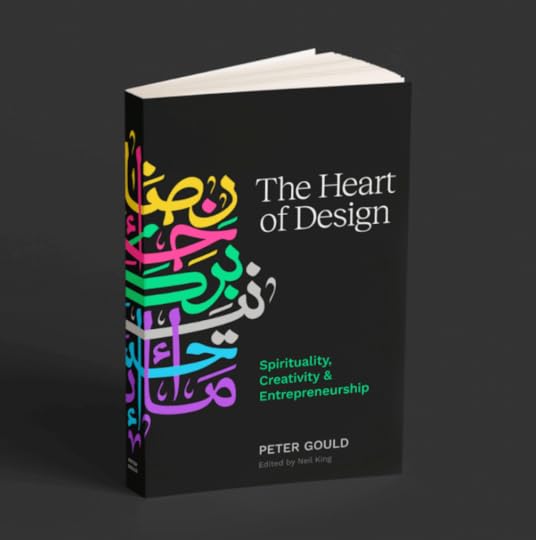
I don’t have any shortcuts for you. I’m afraid there is no quick checklist that will guarantee your next product or startup will benefit people a thousand years later. But what I can hope to share is a brief explanation of these timeless and universal spiritual concepts in relation to the design process and how they might foster Barakah in our work (a topic I will explore in detail in my upcoming new book, “The Heart of Design“).
Our creative vision and idea might be small and specific or bold and vast, but in all cases, we might apply these deep spiritual concepts as our ‘design values’ to inform a meaningful approach to our work and professional path. Let’s explore:
With clear intentionality (Niyah), we may commence our creative or entrepreneurial journey with direct alignment to our spiritual aspirations. We start with Bismillah, in the Name of God, and strive for a vision that serves a noble purpose. By reframing project success to be holistic and inclusive of spiritual well-being, not simply financial impact. With a commitment to design for remembrance and not for distraction. To create work that will inspire, inform, and respect our audiences – not pressure, rush, or addict, and to avoid fueling Hustle Culture. Secondly, our creative and entrepreneurial path should be one of sincerity (Ikhlaas). We are invited to practice design to illuminate hearts, empower livelihoods, and transform communities with a call to remembrance. To align our work to meaningful causes, clients, and projects that benefit humanity. To reconnect audiences to divine beauty & artistic perfection in God’s creation, present in the world at all times as the ultimate design. Thirdly, to embody and pursue excellence (Ihsaan). This means a commitment to quality and well-considered execution of design in all aspects, including the way we serve audiences, stakeholders, staff, suppliers, and natural resources. We may ask questions encouraging our startup & team to reflect on God’s divine names & attributes and how we might aspire to manifest them in our products. Perhaps a social enterprise will contemplate Al-Adl (The Just) or a product designer, Al-Musawwir (The Fashioner of Shapes). By seeking and maintaining a state of contentment with the Divine Wisdom that decides the outcomes of our affairs (Ridaa). This means practicing humility and gracefulness by appreciating success as a gift and reciprocally accepting challenges & setbacks as learning and wisdom on the path to growth. Cultivating awe and wonder at the Creative Majesty of Allah (SWT) and His design of the universe to inspire our humble efforts. Understand that our creative imagination, designer instincts & entrepreneurial efforts are a trust & responsibility to serve and empower others (Amanah) and not exclusively to further our material wealth. Taking the opportunity to reframe personal, community, and global problems as design challenges to be solved individually and collectively and embracing our professional journey as a way to foster a culturally diverse, global, like-hearted movement striving for a bright, shared future. Believing actively in the abundance of God’s blessings (Barakah) to enable our success, and the vast opportunities to design for good and positive change in a transformative, not transactional way and aspiring for far-reaching impact, with a very long-term interpretation of success that may come only in future generations. By embracing a co-opetition (not competition) mindset, knowing that together we are stronger.Returning to The Barakah Effect book, I love how Mohammed invites us to engage in ‘high-ummah’ projects that call us to pursue conscious, visionary, and spiritually grounded leadership with ambitious objectives. By applying these principles and asking deeper questions about our creative and entrepreneurial ambitions, I pray together, we may soon experience a generation of transformative products, brands, and companies that embody Barakah Culture and invite us to remembrance, not a distraction.
Peter Gould
Discover and support Peter’s forthcoming book, The Heart of Design
https://launchgood.com/heartofdesign
The post Nurturing Barakah in our Creative & Entrepreneurial Journey with Peter Gould appeared first on ProductiveMuslim.com.
January 10, 2024
The Case for Chief Murabbi Officers in Organizations
You just had an angry outburst at work, and you’re fuming – It’s the third one this week, and you don’t like this feeling and want to deal with it, but you’re unsure how. Suddenly, you hear a knock on the door. You don’t want to talk to anybody, but then notice it’s your company’s Chief Murabbi officer. You sigh, knowing what this conversation is about, but you welcome it because he’s here to help talk through your recent outbursts and support you with your spiritual and emotional well-being as you tackle this challenge.
I’ve been speaking to several CEOs, HR Directors, and managers at companies worldwide (small and big). They all face a consistent challenge of managing people’s spiritual and emotional challenges that get in the way of doing their best work and impact team and organizational performance. Challenges like envy, anger, ego-centricity, gossip, lying, arrogance, etc.
Typically, companies tackle the above challenges through ‘cognitive’ interventions like training, coaching, and giving feedback. However, some spiritual and emotional challenges can only be dealt with through a deeper, heart-centric, and spiritual-based approach.
Enter – The Chief Murabbi Officer.
A person or function/role whose sole purpose is dedicated to the spiritual and emotional well-being of leaders and employees at an organization.
The Arabic word “Murabbi” carries layers of meaning – at its core, a Murabbi is one who nurtures souls. This role is often viewed as belonging in formal educational contexts like schools and madrasahs. However, the essence of a Murabbi is someone who oversees the spiritual and emotional development and care of others. In some cultures, Murabbi is referred to as an elder person, someone who is wise (age and experience of life), and who is respected, and is invested in nurturing souls through spiritual and emotional intelligence.
We have the best example of a Murabbi in Prophet Muhammad (peace be upon him) who said “I was sent to perfect good character.” (Muwatta). You often see/hear reports of him gently, and compassionately correcting behavior and advising how to deal with some of the tough human spiritual and emotional challenges we face each day.
The Chief Murabbi is not an organization’s psychologist – nor an organization’s chaplain but a combination of a counselor, psychologist, and executive coach, with sound character and good standing – who can speak to people about their spiritual/emotional challenges and become a safe space for people to discuss these issues with them.
Imagine you visit your company’s Murabbi when you’re struggling with envy, and you want to speak to them in privacy about this topic, and they’d listen to you and give you practical ways to deal with your heart’s disease.
Or imagine getting a visit from the Chief Murabbi Officer when you have an angry outburst at an important meeting at work, and they’ll speak to you about what triggered that anger and how best to tackle it next time.
So many issues can be resolved through facilitated conversations with Murabbi officers that won’t have to go to HR for disciplinary measures, issues such as arrogance, toxic or inappropriate behavior, gossip, or taking undue credit.
For small organizations, this can be one person (ideally the leader). For larger organizations, this can be a function with multiple/qualified Murabbi officers. Some workplaces may need at least two Murabbi officers, one for male staff and the other for female staff, so men and women can feel comfortable being vulnerable with their respective officers.
Other notable features of this role:
It must be a highly respected role, so I’m giving it the C-suite title “Chief Murabbi Officer.”It needs to be a well-paid role on par with a leader in the organization and have a close working relationship with the C-suite and board members.The person must have a proven track record of people management from a spiritual tradition, e.g., an Imam with a track record of managing a diverse community or a trained Islamic psychologist/counselor.Their primary responsibilities include:To advise and counsel leaders and staff on spiritual and emotional challengesTo encourage good ethical behavior and advise against inappropriate behaviorBe the spiritual guide for the organizationThe person must understand the corporate environment and its various emotional and spiritual challenges.Must be likable and trustworthy, and people feel safe talking to them.Bonus: They must be trained in the Barakah Culture paradigm of productivity that we teach here at ProductiveMuslim.Are organizations ready for such a role? I would like to see if an organization is willing to experiment with this role for 12 months and measure the impact this role has on leaders and staff’s well-being.
Share your thoughts with me on LinkedIn if you’re interested in exploring this role.
The post The Case for Chief Murabbi Officers in Organizations appeared first on ProductiveMuslim.com.
December 21, 2023
Beyond Urgent: Prioritizing Life Using The Intention-Impact Matrix
You’re sitting at your desk on a Monday morning, looking at your to-do list and trying to figure out which tasks to prioritize for the day/week.
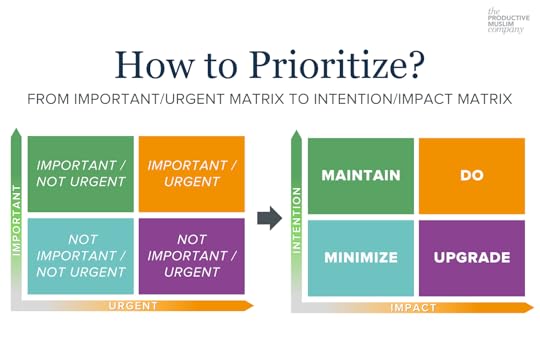
Normally, you’d use the classic Eisenhower Matrix to prioritize tasks according to their importance and urgency. Anything important and urgent, you’ll try to get done first and then you’ll focus on important but not urgent before getting to the urgent but not important.
While the above tool is useful – however, it has two shortfalls:
Most important/urgent tasks are set to you by others (your boss, family, colleagues, etc). So you’re constantly reacting to the never-ending external demands on your time, leaving little room for activities you care deeply about that may not fit into other’s demands.You constantly find yourself in firefighting mode, trying to get rid of urgent tasks and caught in the rat race of life – not having time for those impactful and meaningful projects that truly matter in the long run.In our busy schedule, when do we have time to prioritize activities beyond the urgent and immediately important? When do we have time to prioritize tasks that align with our deepest intentions or have an impact beyond ourselves?
Introducing The Intention-Impact MatrixThe intention-impact matrix is a conceptual tool we’ve developed at The Productive Muslim Company to help individuals align their tasks and actions with long-term impact and underlying intention. This is particularly aligned with our Barakah Culture approach to productivity.
This tool encourages us to reflect on the deeper reasons for undertaking tasks and their potential impact instead of reacting simply to what’s urgent and important at the moment.
It’s a 2×2 matrix with intentions on the y-axis and impact on the x-axis.
Intentions can be high or low. Intentions are high when they are spiritually driven, hereafter focused, and sincerely for Allah SWT. Intentions are low when they are worldly-focused and ego-centered (I discuss this hierarchy of intentions in more detail in my book The Barakah Effect, order here).Impact can be high or low. Impact is high when it affects others positively or will resonate beyond one’s lifetime. Impact is low when it only impacts yourself or has very short-term consequences.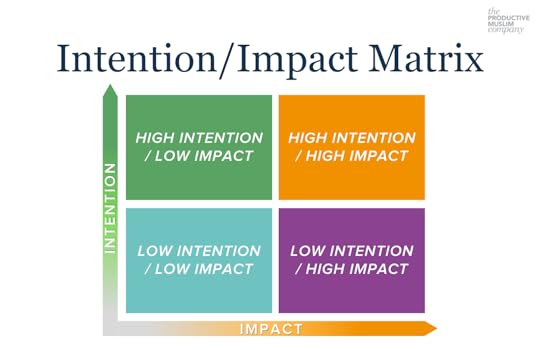
Here’s a brief explanation of the four quadrants in your Intentions/Impact Matrix:
High Intention/High Impact: These are activities taken with the highest intentions that have a substantial positive impact on others and/or resonate beyond one’s lifetime. It could involve social work, charitable acts, or significant projects with long-term benefits.High Intention/Low Impact: These involve personal practices that are important on an individual level and are done with pure intentions but may not have a broad or lasting impact on others. This includes personal rituals or habits contributing to one’s spiritual, physical, or mental development. e.g., exercise, reading, and private acts of worship like prayer and fasting.Low Intention/High Impact: Here, the actions have the potential for a significant positive impact, but the underlying intentions may not be spiritually driven. You might do the action for worldly gain or reputation and fame. If you find actions in this quadrant, it’s a call for you to reevaluate your intention to align potentially impactful actions with higher intentions.Low Intention/Low Impact: Activities that fall into this quadrant are neither driven by high intentions nor do they result in significant impact. These are often trivial or time-wasting activities that one should aim to reduce or eliminate, e.g., scrolling through social media or watching non-beneficial videos online.How do you use this matrix to prioritize your activities?Take stock of all your projects, tasks, and activities you have in life, and ask yourself where they fit in the above matrix.
You’ll need to ask two important questions about each activity you are engaged in:
What’s my intention?What’s the impact?For high intentions/high impact activities – prioritize them and focus on them on a daily/weekly basis. For high intentions/low impact activities – maintain what you can from them but don’t go overboard or at the expense of high intentions/high impact activities.For low intentions/high impact activities – upgrade your intentions and make them sincerely for God and not just for worldly gain/ego satisfaction.For low intentions/low-impact activities – minimize or eliminate from your life as much as possible.Compare the above to the Eisenhower matrix which focuses on just urgent/important and you’d realize that the Intention-Impact matrix adds a layer of spirituality and long-term thinking, leading to more Barakah in one’s life.
 Practical tips for implementing the Intentions-Impact matrix in your lifeUse our Barakah Journal to set daily/weekly intentions for the day. This will make you constantly think about your “intentions list” vs. “to-do list” each day/week. Try to upgrade your intentions on any activity you’re engaged in – you want to constantly connect all that you do (from the mundane to the most profound) with the higher intention of serving Allah SWT. (see discussion on how to elevate intentions in this Barakah Journal workshop video)Try having at least one activity in your day in the high intention/high impact quadrant. The activity doesn’t have to be big; it can be helping a friend, visiting a sick person, or caring for an older person.
I hope you find this tool useful and impactful. I’d love to hear your feedback on this matrix and what decisions it helped you make.
The post Beyond Urgent: Prioritizing Life Using The Intention-Impact Matrix first appeared on ProductiveMuslim.com.
The post Beyond Urgent: Prioritizing Life Using The Intention-Impact Matrix appeared first on ProductiveMuslim.com.
June 8, 2023
Productive Muslim Caregiver: 10 Tips to Ace the Art of Caregiving
I have been a caregiver to my parents for about ten years. During this period, I moved countries, completed my Ph.D., published a book, and recently became a certified trainer with the Productive Muslim company – alhamdulillah!
My friends kept asking me how I stayed focused and productive while juggling hospital appointments, surgeries, and being a full-time carer for my parents.
Below are my top 10 tips that I wished I learned when I started this journey, and I’m sharing them with you, hoping they might help you become a better caregiver for your loved ones insha’Allah.
1. Renew your intentionsIt can be daunting to be a caregiver, especially for a situation that lasts a long time. At times, it may feel overwhelming.
During these low moments, remember that caregiving is not a chore; it’s a privilege. It’s your ticket to Jannah and Allah’s pleasure if done with sincerity and Ihsan.
Remember why you’re fulfilling this role and the reward Allah SWT will bless you with in this life and the next.
Remember that as slaves of God, we must submit to His tests and know that He’ll not burden us with a role beyond our capacity.
Trust in Allah’s Wisdom; His plan is always perfect.
2. Ask Allah for Help“And perhaps you hate a thing, and it is good for you, and perhaps you love a thing, and it is bad for you. And Allah Knows, while you know not.” Surah Al-Baqara, Ayah 216
You’re not alone in this journey. Turn to Allah SWT in every aspect of your caregiver journey. Ask Him to bless you with Hikmah (Wisdom) and Sabr (Patience) to handle every situation with grace and resilience.
Always start any task with Bismillah and know that nothing can be done without Allah’s Help.
3. Compartmentalize Like a Pro“My success is not but through Allah. Upon Him, I have relied, and to Him, I return.” Surat Hud, Ayah 88
The art of caregiving lies in compartmentalization. You’re dealing with an ongoing situation, and it’s essential not to let it overshadow every aspect of your life. Balance is key; don’t let caregiving consume you.
Remember that this is a season of life you’re going through, and this, too, shall pass.
Dedicate the necessary time to focus on your role as a caregiver but pay attention to your other roles.
Try to segment the time you dedicate as a caregiver from your other responsibilities and get help to cover the times you’ll be away (more on this below).
4. Pour Your Heart Out to AllahCaregiving is stressful. And stress can create significant anxiety and fear, making you lose sleep and focus.
Unburden your heart through Duaa (supplication). Talk to Allah, express your fears, and seek His mercy and guidance. His closeness will be your comfort.
He SWT loves to hear your voice, He can solve your problems, He is so close to you, and He will answer your call.
5. Self-Care Isn’t Selfish“And when My servants ask you, [O Muhammad], concerning Me – indeed I am near. I respond to the invocation of the supplicant when he calls upon Me. So let them respond to Me [by obedience] and believe in Me that they may be [rightly] guided.” Surah Al-Baqara, Ayah 186
As hard as it is, try to care for yourself. Get some sleep, and nap when the patient naps. Eat healthy, and now and then, go for a walk or a jog to “work out the stress.”
To be an effective caregiver, you must prioritize self-care. It may seem idealistic, especially when things are overwhelming, but trust me; you can’t pour from an empty cup. So, recharge yourself to be there for others.
6. Ask and organize helpAs humans, we have limits. Acknowledge yours and learn to seek help.
But don’t just ask for help – tell those around you exactly how they can help you: Create a “Caregiver Task List” of all the tasks you do as a caregiver and ask your family and friends to choose what they want to do.
If you can afford it, consider hiring a professional home nurse – even for a few hours daily or weekly. They can make a big difference in the caregiving plan. This will not only give you a break from being the sole caregiver, but you’ll learn professional tips that only come from nursing schools.
7. Get regular quality breaksStaying cooped up at home or the hospital can be draining. You must change your environment now and then and leave the house or hospital.
Don’t think you’re a hero by being stuck in one place – it’ll affect your physical and mental well-being.
Go out and meet friends, attend events, and meet new people, or immerse yourself in nature – it’s therapeutic!
8. Master your breathingWhen you feel the situation is tense or highly anxious due to the patient’s worsening condition, take a moment to breathe deeply.
Unfortunately, most people don’t use their entire lungs when they breathe. Deep breathing can help you stay calm and relax your tense muscles. To learn breathing techniques, visit Breathwork.
9. Rearrange your prioritiesWhen you feel overwhelmed with life’s demands – consider blocking a 2-hour window for yourself and write down all the tasks and to-dos in your head. Then make firm decisions about what to do, delete, defer, or delegate.
Having a hard look at the collection of all your tasks and to-dos and making clear decisions on what to do with them would free up much mental space for you to focus on caregiving.
Overwhelm can be daunting. In such moments, reflect upon the Hadith of our Prophet (PBUH), where he said: “Give everything its due right.” and rearrange your priorities according to the rights owed to others (and yourself!).
10. Live in the momentRemember to live in the moment. Accept the unique circumstances, and don’t beat yourself up for not being as productive as usual. Focus on what you can do right now, not what you could be doing.
As my friend Nevine always says: You must live in the moment and ask yourself often: What Allah wants from me NOW? This one question can help you stay focused at the moment and not get distressed about your situation and what the future holds.
As a caregiver, you’re embodying the beauty of Ayah 32 in Surat Al-Maidah: “And whoever saves a life as if he saved mankind entirely.” Know that you’re not just caring; you’re saving a life. You’re saving the life of someone you love by caring for them, cleaning them, and helping them live as best as possible. It’s a long-term commitment that Allah sees and will reward you abundantly for He is “Al-Shakoor” (The One Who Appreciates and Rewards Abundantly).
May your journey as a caregiver and life giver be filled with Barakah and Sakinah (peace). You are an unsung hero in the eyes of Allah SWT.
May Allah SWT guide, help, forgive, and accept. Ameen!
Sincerely,
Suher Khirallah, Ph.D.
The post Productive Muslim Caregiver: 10 Tips to Ace the Art of Caregiving appeared first on ProductiveMuslim.com.
May 18, 2022
How to Pick Yourself Up Post Ramadan
This article is a long one, but it’s for those of you who are serious about living the next best version of yourself post-Ramadan.
Strategies, Tips, And Tools To Design Your Next Best Self Post-RamadanRamadan ended a few weeks ago, and by now you’re probably starting to settle back to your post-Ramadan routine.
You may have been able to keep up with some of your Ramadan resolutions (fasting a bit more, praying some parts of the night, giving charity often), or you may have crashed post-Ramadan and found it really hard to pick yourself up again – spiritually, physically, and socially.
If you’re someone who wants to maintain consistent improvement post-Ramadan and win the battle of life against your Nafs and Shaytaan (which seems to come back stronger after Ramadan), then you’ll find this useful.
This article also comes just a few weeks before our upcoming Productivity Masterclass: a six-week immersive online self-development journey that combines spirituality and peak performance science and psychology.

Fast-forward to the 29th day of Sha’baan of next year, you’re hours away from knowing if Ramadan is tomorrow or not. You’re excited. Maybe a bit nervous. Busy with typical Ramadan preparations.
Unfortunately, the Angel of Death comes and takes your soul in those hours, and you’re deprived of witnessing the next Ramadan.
How do you feel?
The reason I bring this thought up is to help frame this article in your mind: Although you’re not guaranteed to live to witness another Ramadan, this does not mean that your journey of self-development and improvement should be on hold until next Ramadan comes.
There are many things you can do in between now and then and this is what this article is about.
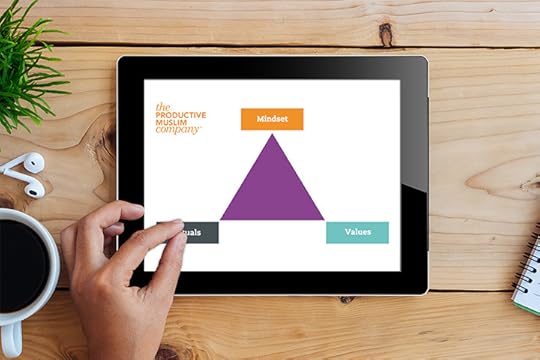
'Although you're not guaranteed to live to witness another Ramadan, this does not mean that your journey of self-development and improvement should be on hold until next Ramadan comes.' Mohammed Faris, CEO The Productive Muslim Company Click to Tweet A Framework To Develop Yourself Post RamadanThe Productive Muslim Company is big on building frameworks that help us tackle some of our most profound self-development challenges. And one of the frameworks that we often use in our training and coaching is the following one:
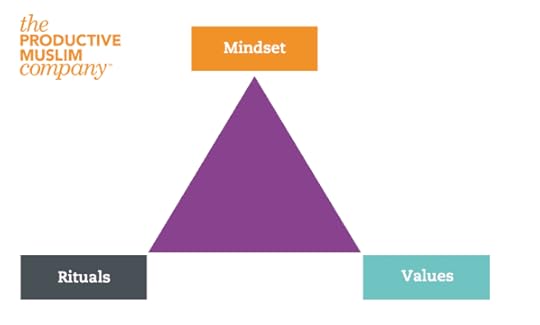
This framework simply states that if we want to design the next best version of ourselves post-Ramadan, we need to think of the Mindsets, Values, and Rituals that would help us make those changes post-Ramadan.
Mindsets: How You Think Affects How You BehaveIt’s common knowledge among psychology circles that our thoughts have an impact on our actions (and vice-versa. More on that later). [“How Thoughts Influence Actions”. Psychology Today]. So how you think about your post-Ramadan period will impact how you behave. Below are 3 mindset shifts that you need to think about to help you upgrade your post-Ramadan experience.
1. Think RealisticallyThere’s an equation that I learned from a time management expert that helped me a lot manage my stress levels:
Expectations > Reality = Stress
Simply stated, when expectations exceed the reality, you’re only setting yourself up for stress and failure.
How do we do this post-Ramadan? Have you heard yourself say things like: After Ramadan, I’ll pray tahajjud every night, I’ll fast every Monday and Thursday, I’ll give charity every day, etc.? What happens when you don’t live up to those expectations? You fall for the classic Shaytaan trick of making you feel terrible that you didn’t live up to your expectations and fall for another psychological trap called the “What the hell effect.” [“How the What the Hell Effect Impacts Your Willpower”. Psychology Today]
Here’s how the what the hell effect works: You decide to eat healthily and stop eating sugar, and for the first few days, you’re doing great. Then you get invited over to your friend’s house, and they have an incredible dessert spread. Initially, you resist, but your friend insists, and you have a small piece of Halwa. Next think you know, you say to yourself, “What the hell, let me try everything else, I’ll restart my diet tomorrow.” Next day you feel so bad that you break your new diet, and another “what the hell” moment hits you, and you give up entirely on your new diet.
Think of how many times the “what the hell” effect impacted you when it came to your prayers, to voluntary fasting, to being present with your children. Allah SWT captures this phenomenon when he tells us about not following the steps of Shaytaan in a number of verses, like:
” O you who have believed, enter into Islam completely [and perfectly] and do not follow the footsteps of Satan. Indeed, he is to you a clear enemy.” (Qur’an 2: 208)
So how do you tackle these two traps: setting high and unrealistic expectations, and falling for the “what the hell” effect. The key is to set small, realistic expectations and then guard them with all your might until they become solid habits before you set higher expectations.
Here’s how this works: You want to pray tahajjud every night? Start by committing to pray 1xrak’ah of witr prayer after Isha prayers and before you sleep. It’s a small commitment, but you want to do it no matter what. Even on days you don’t feel like it, or you’re tired. Don’t get on the slippery slope of missing 1 day and then thinking “what the hell, I’ll never be able to pray tahajjud in my life.” And even if you do slip 1 day, don’t fall for the “what the hell” effect and instead pick yourself up the next day, stronger than ever. Once you’ve established this routine long enough and it has become part and parcel of your life, upgrade yourself and aim to pray 3 rak’ahs of witr, etc.
'The key is to set small, realistic expectations and then guard them with all your might until they become solid habits before you set higher expectations.' Mohammed Faris, CEO The Productive Muslim Company Click to Tweet 2. Think HolisticallyThe second mindset shift to consider is to think about your personal development journey holistically.
During the Productivity Masterclass, we help individuals and teams think of how to live the next best version of themselves across all their roles, i.e., what does your next-best version of yourself look like as a Dad/Mom? as a professional? As a neighbor? As a Muslim? Etc.
Thinking holistically takes us away from the mind-trap that post-Ramadan self-development is only about rituals. It makes us recognize that the rituals form the bedrock and scaffolding to help us build our next best version across our roles.
To help you think holistically about your self-development, complete our Productive Muslim Self-Assessment tool to figure out where you are today – spiritually, physically, and socially and where you need to go.
Launch Self-Assessment (function() { var qs,js,q,s,d=document, gi=d.getElementById, ce=d.createElement, gt=d.getElementsByTagName, id="typef_orm_share", b="https://embed.typeform.com/"; if(!gi.call(d,id)){ js=ce.call(d,"script"); js.id=id; js.src=b+"embed.js"; q=gt.call(d,"script")[0]; q.parentNode.insertBefore(js,q) } })()
3. Think Long-TermOne of the primary reasons people give up their post-Ramadan resolutions is that they measure their success or failure based on a very short time frame, i.e., they measure how well they are performing in the first 2-3 weeks post-Ramadan. If they see no improvement, they give up!
Someone might say, “I tried fasting Mondays and Thursdays after Ramadan, but it was too hard, so I gave up.”
What if instead, we expanded our self-development journey beyond these first 2 weeks. What if we asked ourselves – how can I develop this new habit/routine in 12 months?
Here’s a thought: We tend to overestimate what we can do in a short period but underestimate what we can do over a long period.
Yes, waking up for fajr might seem hard in those first 2-3 weeks, but if you focus on developing this habit over 3, 6, 9 months, you’ll eventually crack it, and it’ll become easy for you.
A good metaphor for thinking long-term is that of a gardener. When the gardener plants his seed, waters his garden, and works hard all day on his farm. He doesn’t expect to see a mature tree the next day! He understands that growing a tree takes time, and there’s a lot of energy, focus, and time that goes into becoming a tree. Similarly, new habits and routines take time to take root, nurture and grow, if you think of them as a long-term project, and work on it every day, you’re more likely to succeed.
'One of the primary reasons people give up their post-Ramadan resolutions is that they measure their success or failure based on a very short time frame, If they see no improvement, they give up!' Mohammed Faris, CEO The Productive Muslim Company Click to TweetPRACTICAL TIPS
Think of your long-term goals post-Ramadan across all your rolesThink of the obstacles you might face to achieve your goals (be realistic)Think of how to overcome those obstacles – one step at a time.Values: What Beliefs are driving your post-Ramadan life?This section talks about a subtle but essential spiritual element when it comes to achieving a post-Ramadan goal. And that is to do with our Hearts and how connected we are with Allah SWT when it comes to achieving our post-Ramadan Goals.
Every day in our prayers we recite this verse →
“You Alone We Worship, and You Alone We Seek Help From” (Qur’an 1: 5)
This is a foundational concept in our faith that is critical for all our self-improvement endeavors. It involves two aspects:
You Alone We Worship: All your goals, all your self-improvement, and self-development, should be connected to the concept of you wanting to become the best ‘Abd’ (Slave) to Allah SWT. During the Productivity Masterclass, we speak in detail of the Islamic-psychospiritual model of the human being and how being an ‘Abd’ (slave) of Allah SWT is such a foundational concept that we need to revive in our hearts to help us live the best version of ourselves.You Alone We Seek Help From: This is the recognition that as part of us acknowledging that we’re slaves of Allah, then we need to ask Allah’s permission and tawfeeq (success) in all the goals that we want to achieve.Let’s be honest; sometimes, the goals we set for ourselves post-Ramadan can be all about developing our self-esteem and self-image. We forgot the ‘why’ that should drive these goals, and hence we give up on them too quickly. If I’m trying to wake up for tahajjud just because I see it as another milestone in my self-development journey, and not as an act of worship that would get me closer to Allah SWT, I need to revise my intentions.
So how can we practically develop these beliefs/values in our lives:
Set Good Intentions: When you set any post-Ramadan goal, ask yourself – why am I doing this? Who’s this for? How can I become a better ‘Abd’ to Allah through this goal?Always Ask Allah To Help With Your Goals: Make your goals as spiritual quests. Ask Allah SWT to help you stay physically healthy post-Ramadan, to fast regularly, to pray tahajjud, etc. Don’t be arrogant and rely on your means – you need Him. Ask Him.Work Hard: Good intentions and prayers don’t work on their own. Allah SWT would like to see the effort from you and He’ll take care of the results.Rituals: What You Do Impacts How You Think and What You BelieveEarlier I mentioned that just like our thoughts have an impact on our actions. So does our action have an influence on how we think?
Here’s a simple experiment: Let’s say you’re upset, or in a bad mood. Grab a pencil and bite it between your teeth, forcing you to smile. Notice how your levels of happiness will increase, and you’ll feel better.
What does this mean for us, post-Ramadan?
This means that whether we feel like it or don’t feel like it – we need to commit to some rituals post-Ramadan that’ll help us improve how we think about ourselves and what we believe is possible post-Ramadan.
There are 3 key concepts to keep in mind though to ensure that you stick to your rituals post-Ramadan:
Choose To Focus on Not More Than 3 New Rituals Post-Ramadan: It’s so tempting after graduating from Ramadan to feel that you can change your life 180 overnight and introduce so many new routines in life. Although it is doable, it’s tough and I’d rather you focus on a winning strategy instead. The winning strategy is to focus on 3 new rituals post-Ramadan, and once they become part of who you are, add some more.Start Small: This is critical. The smaller the change in your life, the longer it lasts. Start small but have the intention that you’ll want to grow this ritual over time.Celebrate Progress: When you do your small ritual – celebrate it. Feel good about it. Thank Allah SWT that he enabled you to make one small step towards the next best version of you and being His ‘Abd.’ Celebration will reinforce this ritual in your brain as something pleasant to be done again.What should happen when I make the above shifts in my Mindsets, Values, and Rituals?Fast forward your life to the 29th of Sha’baan next year, it’s a few hours before Ramadan might be announced. You’re excited and giddy and can’t wait to find out.
You’ve spent the entire year, slowly but surely, upgrading your mindsets, values, and rituals and living the next best version of yourself: spiritually, physically, and socially.
You feel more ready than ever for Ramadan and for the next spiritual boost.
However, the Angel of Death comes to you in those hours before Ramadan and takes your soul away.
Do you have any regrets?
Or do you feel that you’ve done all you can to be a true Abd of Allah SWT throughout the year and you are ready to meet Him?
P.S. If you’ve enjoyed this article and wanted to go more in-depth on the practical strategies, tips, and tools to help you live the next best version of yourself: sign up for our upcoming 6-week masterclass and immerse yourself in a self-development journey that combines spirituality and peak performance science and psychology. 3 out of 4 past participants mentioned that they are highly likely to recommend the masterclass to their family and friends – join us today!
The post How to Pick Yourself Up Post Ramadan appeared first on ProductiveMuslim.com.
April 11, 2022
10 Biohacks For High-Performing Muslims During Ramadan
Ramadan is an exceptional month where every high-performing Muslim wants to be at their best: spiritually, physically, and socially. However, it can also be a very challenging month with lack of sleep, lack of focus, and lack of energy.
Since the start of Ramadan 1443H, I have partnered with Mohammed Faris, founder of The Productive Muslim Company, to test out a few biohacks and measure their impact on our levels of energy, focus, and overall wellbeing.
We experimented using different combinations of what I’ll share below and used the Whoop 4.0 fitness tracker (affiliate link) to measure how each experiment impacted our sleep, strain, and recovery and recorded voice notes on how we felt throughout the day.
Before I share our top recommended biohacks for Ramadan, a quick introduction to biohacking and what it means for Ramadan.
What does biohacking mean?When you think of a biohack, you probably think of a pill you take that’s supposed to alter your biology. However, biohacking covers a spectrum, from aligning ourselves with nature to technology and supplements.
The best approach to biohacking is to start with self-awareness and mindfulness about your energy/focus levels and what works and doesn’t work for you—followed by tapping into nature and life rhythms to make the most of how your body interacts with nature. Finally, using supplements and technology to help you ‘mimic’ our ancestors’ fitra (natural disposition) lifestyle before modern electricity, internet, work schedules, etc.
A few points related to biohacking for Ramadan:
The purpose of this article is not to ‘cheat’ fasting or make fasting Ramadan ‘easy’. Instead, it is to help high-performing Muslims manage their energy and focus throughout the fasting month, especially those in critical roles like doctors and pilots.Before trying any of the hacks below – especially those that use supplements – we highly recommend that you speak to your doctor to confirm that it is safe to adopt them. Myself and The Productive Muslim company will not be held responsible for any harm caused by following these hacks without prior consultation with a medical doctor.Even with these hacks – you’ll still feel the difficulty of Ramadan. So following these hacks will not turn you into a super being. However, they can make your Ramadan much more high-performing than usual.Alright, bismillah, here are the top 10 biohacks I recommend for Ramadan.
10 Biohacks for Ramadan1. Wear blue light blocking glasses at night
وَجَعَلْنَا نَوْمَكُمْ سُبَاتًۭا
And made your sleep [a means for] rest
Quran 78:9
Blue light blocking glasses help mitigate the damage that post-Maghrib light exposure causes. This is a critical circadian rhythm hack.
Screen lights and most overhead lighting in the evening hours are proven to disrupt our natural sleep cycles. Evidence shows that our natural sleep hormones are suppressed, and our natural daytime stress hormones get boosted every time we expose ourselves to screen light or overhead lighting at night. This leads to poor quality sleep for almost everyone on the planet, 365 days a year! As a result, we are not getting the restorative sleep essential for good health.
During Ramadan, we will sleep less given the late iftars/Taraweeh prayers and waking up early for suhoor. So we need to optimize our sleep cycles to get better quality sleep while getting less quantity of sleep.
Blue-light blocking glasses can block up to 99% of the harmful blue light in the evening and ‘hack’ your sleep cycle to experience greater levels of deep sleep and REM.
Practical Tip: I know this might sound weird, but wear blue light blockers in the last hour before your designated sleep time (yes, including at the masjid at Isha/Taraweeh), and notice the greater energy and mental performance you have the next day during fasting hours.
2. Expose yourself to sunlight early in the morning
إِنَّ فِى خَلْقِ ٱلسَّمَـٰوَٰتِ وَٱلْأَرْضِ وَٱخْتِلَـٰفِ ٱلَّيْلِ وَٱلنَّهَارِ لَـَٔايَـٰتٍۢ لِّأُو۟لِى ٱلْأَلْبَـٰبِ
Indeed, in the creation of the heavens and the earth and the alternation of the night and the day are signs for those of understanding –
Quran 3:190
This is another essential circadian rhythm hack. Getting outside and witnessing morning sunlight (as close to post-fajr (dawn) as possible) causes us to make more of our sleep hormone (melatonin) at night. This practice resets our hormonal rhythms every day.
Furthermore, the full spectrum of light that the sun provides has also shown positive results in impacting the damage and strain that artificial light causes during the rest of our day.
Lastly, more interesting evidence is becoming available regarding the mental, emotional, and physical benefits of seeing the sunrise and sunset. Positive human genetic switches get activated when we witness the alternation of night and day, which Allah has mentioned in the Qur’an as a sign.
Practical Tip: Get out for 10 minutes in the morning as soon as possible and let the natural light of the morning enter your eyes. You will further improve your sleep quality, and you can experience greater biological system functioning. This doesn’t require looking at the sun. The sun’s light is powerful enough to register in our eyes without directly gazing at it.
3. Move More
The Prophet (ﷺ) used to go to the Quba’ mosque, sometimes walking, sometimes riding [Sahih Bukhari]
Note: The distance from the Prophet’s mosque to Quba’ mosque is roughly 7 km.
Movement is essential for a human being’s physical, mental, emotional, and even spiritual health. We all generally know that exercise is essential for good cardiovascular and metabolic health. We now know that it is a much bigger story than that. Not only is it essential for hormonal health and balance (and hormones drive almost every process in our bodies), but it also directly impacts our nervous system, cognitive functioning, and emotional state.
Sedentary living is one of the greatest contributing factors to nearly all chronic illnesses and even some degenerative mental diseases. Furthermore, deep down in the nervous system, a body that doesn’t move is perceived by itself as sick, weak, potentially incapable, and therefore in danger. What does our body do in response? It provides us with an abundance of stress chemicals to get us up and back in action! This daily dose of stress chemicals leads to a chronic inflammatory state that impairs our biological systems, leading to poor metabolic health, digestive issues, cardiovascular and cardiorespiratory health problems, endocrine system imbalance, depression/anxiety, etc. Can we truly show up as our best selves with high spiritual focus and performance levels under these conditions?
Ramadan is not a time to stop moving or continue our sedentary lifestyle. I’m sure we all can imagine how our righteous predecessors didn’t have the luxury of sitting all day, driving between locations, and ordering anything they needed at the touch of a button. The way for us to holistically improve our health during Ramadan and beyond is to mimic the way of our predecessors. And there is great news! It all can be done at home, and it takes a lot less time than we might think it will.
Practical Tip: Here are three main movement lifestyle hacks to implement this Ramadan:
Walking. Walking is free medicine, period. A day without walking is not a typical human day at all. Walking activates our largest muscles. This, in turn, benefits our blood glucose levels, bone density, metabolism, serotonin/melatonin production, sleep quality, and more. Twenty minutes a day should be the minimum. Any walking you can do directly after your iftar/suhoor is even better.Sit / Stand. Standing more often while working will activate the largest muscles in your body and save you from back/neck pain, unwanted fat storage, and stress chemical release. Try to stand for at least 10 minutes after every 30 minutes of sitting. Use an alarm to remind you.Move heavy objects. Like all of our human predecessors, we are designed to pull water out of wells, carry various objects, lift and stack, pick up animals, squat for multiple purposes, etc. Find a way to grab a safe but heavy object (it can be weights of course) and prioritize time daily to mimic the old ways! For extra help on this, look up farmer carries and functional movement patterns. That should get you started, and all you need is a few minutes per day! This practice helps to increase our glucose sensitivity, which many of us will want during Ramadan. 4. Eat Real Foodيَـٰٓأَيُّهَا ٱلنَّاسُ كُلُوا۟ مِمَّا فِى ٱلْأَرْضِ حَلَـٰلًۭا طَيِّبًۭا وَلَا تَتَّبِعُوا۟ خُطُوَٰتِ ٱلشَّيْطَـٰنِ ۚ إِنَّهُۥ لَكُمْ عَدُوٌّۭ مُّبِينٌ
O mankind, eat what is good and lawful from the earth, and do not follow Satan’s footsteps, for he is your sworn enemy.
Quran 2:168
We might get tomatoes thrown at us here! Nutrition can be a sensitive subject. There isn’t a one-size-fits-all approach, as we all have different genetics, ages, goals, etc. The real food approach is the best starting point to create a new relationship with food. It goes a little something like this:
the more ingredients it has, the less real it is If it comes in a box, package, or wrapper and has words you can’t pronounce, steer clear!The closer it looks to its original source, the better (from the animal, tree, ground etc.)More refined = Less realThe longer it is designed to last on a shelf, the worse it is for us.Lastly, implement the 80/20. Try to live like this 80% of the time and forget about the rest if you want to.At the end of our fast, we are open to receiving. The cells in our bodies will take in what we choose to consume, especially at iftar time. What we eat becomes our physical tissues and hormones, and enzymes that drive our systems. In many ways, we are what we eat! Fasting is perfect for us, but not accompanied by an inflammatory diet and lifestyle.
During Ramadan (and the rest of the year), our food choices will determine much about our daily health and well-being. Digestive issues (bloating, gas, cramping, heartburn, constipation, etc) are signs that what we are eating is likely not suitable for us as an individual. Furthermore, our gut health dictates our mood and sleep quality, which I’m sure we all want to improve.
The well-known “happiness” hormone/neurotransmitter serotonin is mostly produced in our gut. An inflamed compromised gut directly impacts our mood, but since serotonin is a precursor to melatonin (our sleep hormone), it also affects our sleep!
This Ramadan (and beyond), let’s commit to achieving better moods, focus, sleep, and energy through food.
Practical Tip: Ask yourself a couple of questions before you decide what to eat for iftar/suhoor:
Is this food “real”? And is this food from the tayyib category that Allah mentions in the Qur’an? 5. Nature mimicking nutrients/supplements – Vitamin D, Celtic Sea SaltHuman beings need vitamin D. Vitamin D is not a vitamin; it is a hormone. It is a master hormone in many ways, and all of our other hormones don’t function well without it. Insufficient vitamin D levels compromise us both physically and mentally. The best way to get it is sun exposure, but that isn’t always easy for everyone. Getting sufficient levels from our diet is very difficult. Test yourself rather than guessing, and make sure you supplement if needed.
We are likely spending too much time indoors during Ramadan (and all year long). That is why mimicking nature through vitamin D supplementation can be extremely important.
Another mimic that can be essential for many of us is related to minerals. Much of the water we are drinking is depleted of minerals. For that reason, prioritizing good quality water and adding a pinch of Celtic Sea Salt can be very beneficial. There are other mineral supplements, of course, but sea salt is an easy go-to, and it has over 70 essential minerals in it!
This can be very important during Ramadan as we tend to be minerally depleted at the end of a fast. Making sure that we restore minerals will help us ensure better biological functioning during this month.
Practical Tip: If you have time, go get tested for vitamin D levels in your body and other minerals. Otherwise, get a vitamin D supplement and throw some Celtic sea salt in your water to tap into this biohack.
6. Temperature Hacks – Cold and hotAs uncomfortable as this truth might sound, human beings are not meant to be comfortable all of the time. We harm ourselves by not getting enough beneficial stress. Our entire being is designed to grow stronger and become more resilient through small doses of various stressors. This is known as hormesis.
There are many types of hormetic stressors. Exercise and fasting are among the more familiar. One that doesn’t get enough attention however is temperature. Human beings were not created to sit in perfectly temperature-controlled rooms. When we never get hot or cold, we lose resilience in our health. This is why saunas and cold plunges are the craze. For now, we’ll keep it simple by just laying out some of the benefits.
Heat exposure benefits immune function, reduces inflammation, improves brain function (through BDNF), detoxes the body, etc. Cold exposure lowers body fat, improves blood sugar, boosts immune function, leads to better sleep quality, reduces inflammation, etc.A little of either can go a long way!
Practical Tips:
During Ramadan, and depending on where one lives, it might be challenging to get extreme temperature exposure. We don’t recommend sauna use during Ramadan, but if you are in a hot city, you might want to spend 10 to 20 minutes outside during the day. It can be in the shade if the air temperature is hot enough.
Cold is often easier to come by. There are ice vests, ice pits, cryotherapy, and just regular outdoor cold air and water for some of us. One way to get started is to do a couple of minutes in the shower of 10 seconds of warm water, followed by 20 seconds of max cold. This isn’t optimal as we will have the potential of wasting water, so as soon as you get used to it, try to shower only in cold water a few times per week! Focus on your breath and control your gasp response. This is an excellent Ramadan hack, as we can boost many of the benefits of fasting through this protocol.
7. Grounding – Touch NatureA man from the companions of the Prophet (ﷺ) traveled to Fadaalah ibn Ubayd (may Allah be pleased with him) when he was in Egypt. After a brief conversation he asked him: “Why do I not see any shoes on you?” Fadaalah replied: “The Prophet (ﷺ) used to command us to go barefoot sometimes”.
[Abu Dawud].
When was the last time you touched a tree or stone? When did you last have your bare feet on natural earth? When we ask these questions, people often are shocked when they realize it has been ages!
By now, you may have heard of grounding or earthing. It is the practice of connecting with the natural earth and the earth’s natural magnetic frequencies. This leads to an ion exchange that has many benefits, such as reducing inflammation, realigning our circadian rhythms (improving sleep quality), lowering stress chemicals, and more.
This is such an easy hack, and definitely, we can get 10 to 20 minutes here and there throughout the week during Ramadan. Once again, some of the benefits are similar to the benefits of fasting. Therefore this hack is an excellent way to get a boost.
Practical Tips: In your next morning walk (see Hack #2 above), take off your shoes and socks and walk barefoot on the grass/sand, and touch a tree with your hand and really connect with the tree as a spiritual being that worships Allah just like you do.
8. Quality Fastingۚ وَأَن تَصُومُوا۟ خَيْرٌۭ لَّكُمْ ۖ إِن كُنتُمْ تَعْلَمُونَ
… But to fast is best for you, if you only knew.
Quran 2:184
As we already touched on, fasting is a beneficial (hormetic) stressor. All biomarkers improve in a fasted state, such as blood sugar, lipids, blood pressure, etc. Fasting has also been shown to promote detoxification and balance our gut microbiome. How we Muslims do it, dry fasting (i.e. without water), is even more powerful.
Most importantly, fasting sharpens our spiritual faculties. When we hold ourselves back from food, drink, and our natural drives while at the same time guarding ourselves against actions and speech that we have been guided to avoid, our true virtuous nature can rise.
With this opportunity to work on ourselves during Ramadan, we should do our absolute best to get out of our way. How can we do that? By not pairing this time of fasting with lifestyle practices that lead to less than optimal performance, brain fog, digestive stress, and fatigue.
Practical Tip: Take the quality of your fasting and Ramadan to the next level by combining the hacks you’re learning in this article with your fasting for maximal spiritual and physical performance.
9. Breathworkوَٱلصُّبْحِ إِذَا تَنَفَّسَ ١٨
by the dawn that softly breathes:
Quran 81:18
Breathwork is our superpower. We take about 20,000 breaths per day, and each sends a direct message to our nervous system that determines much about our current mental, emotional, and physical state.
It is known that the vast majority of people alive today have an inverted breathing pattern, meaning most of us no longer breathe from the diaphragm, inflating our belly when we inhale and deflating our belly upon the exhale. Most of us do the exact opposite and from the chest rather than the diaphragm (abdomen), which causes the release of stress chemicals as it is a breathing pattern that mimics the fight or flight response. This causes inflammation, impedes digestion, and leads to many other biological system imbalances.
We can reconnect with our diaphragm while taking deep, slow breaths in our tradition. This is done through the slow recitation of the Qur’an. Watch videos of the well-known Qaris as they slowly recite and count how many inhales they take per minute. Interestingly, slowing down our breaths to about four or five breaths per minute has been shown to give us the benefits we need.
Practical Tip: This Ramadan, let’s try to connect with ourselves through proper breathing while reciting Qur’an and even in our dhikr practices. We also recommend using the Breathwrk app for guided practices on breathing.
10. Supplement with Nootropics (safely)A simple definition of nootropics is natural or synthetic substances that can be taken to improve mental performance in healthy people (Healthline). The most common nootropic is caffeine. Caffeine from high-quality sources and in the right doses can increase energy, boost mood, and have neuroprotective properties.
There are so many other nootropics (some referred to as “smart drugs”) ranging from simple and natural to synthetic and, in some cases, dangerous. We are not promoting the use of any nootropic substance without the consent of a medical professional. Also, some people can tolerate them, while others cannot, which is often the case with caffeine.
For those who are interested in experimenting with the cognitive benefits of nootropics, we have listed a few of the common ones used by the average person to the more avid bio-hacker below:
High quality Coffee OR Bulletproof CoffeeTime-release caffeine tabletsQualia, Ginkgo Biloba, Maca, Yerba Mate, Lion’s Mane, Modafinil (by prescription)If taken safely, you may find that supplementing them before starting your fast can help. This approach could be considered by those of us living in areas of the world where the fasting days are long, the work schedules don’t change, and you have high determination to accomplish the performance of ‘ibadah through the night.
These supplements can give you the cognitive functioning and mental focus you might need to seize the early part of your day with higher performance levels.
Practical Tips: We recommend that you don’t experiment with nootropics that you haven’t tried before during Ramadan, especially the synthetic ones. However, after Ramadan, you can experiment with some of the above after researching what works best for you. If you’re keen to experiment with one of the above, we recommend starting with Bulletproof Coffee, but of course in combination with a healthy approach to nutrition.
And that’s all! 10 Biohacks to help you maximize your spiritual, physical, and mental performance during Ramadan.
If you found this useful and want to share your biohacking experiments with fellow Muslims, join our Slack community and check out the #biohack channel.

The post 10 Biohacks For High-Performing Muslims During Ramadan appeared first on ProductiveMuslim.com.
February 4, 2022
Istikharah Notepad: A Practical Tool to Decide With Barakah
The Istikharah Notepad is a practical tool developed by The Productive Muslim Company to help you think through decisions with Barakah.
It is inspired by the guidance of Prophet Muhammad (peace be upon him). He taught his companions to seek istikharah (goodness) from Allah SWT and istisharah (counsel) from people whenever they have a decision to make.
The Barakah of making decisions with istikharah & istisharah is the knowledge that despite all the unknowns and potential outcomes of your decision, you can proceed without feeling regret because you did all you could at the time of making a decision following Prophetic guidance.
Prophet Muhammad (peace be upon him) said: ‘From (the signs of) the son of Adam’s prosperity, is his satisfaction with what Allah decreed for him, and from the son of Adam’s misery is his avoiding to request guidance from Allah, and from the son of Adam’s misery is his anger with what Allah decreed for him.”
A-Tirmidhi
In this article, we’ll explain why making decisions is hard, the process to make decision making easier, and how each question in the Istikharah Notepad is designed to help you follow this process.
/**/(function () { var scriptURL = 'https://sdks.shopifycdn.com/buy-butto... if (window.ShopifyBuy) { if (window.ShopifyBuy.UI) { ShopifyBuyInit(); } else { loadScript(); } } else { loadScript(); } function loadScript() { var script = document.createElement('script'); script.async = true; script.src = scriptURL; (document.getElementsByTagName('head')[0] || document.getElementsByTagName('body')[0]).appendChild(script); script.onload = ShopifyBuyInit; } function ShopifyBuyInit() { var client = ShopifyBuy.buildClient({ domain: 'barakah-academy.myshopify.com', storefrontAccessToken: 'cd908a76d21933623cefc174f039f0ff', }); ShopifyBuy.UI.onReady(client).then(function (ui) { ui.createComponent('product', { id: '7572168409339', node: document.getElementById('product-component-1644759261378'), moneyFormat: '%24%7B%7Bamount%7D%7D', options: { "product": { "styles": { "product": { "@media (min-width: 601px)": { "max-width": "100%", "margin-left": "0", "margin-bottom": "50px" }, "text-align": "left" }, "title": { "font-size": "26px" }, "button": { ":hover": { "background-color": "#da8300" }, "background-color": "#f29100", ":focus": { "background-color": "#da8300" } }, "price": { "font-size": "18px" }, "compareAt": { "font-size": "15.299999999999999px" }, "unitPrice": { "font-size": "15.299999999999999px" } }, "buttonDestination": "checkout", "layout": "horizontal", "contents": { "img": false, "imgWithCarousel": true, "description": true }, "width": "100%", "text": { "button": "Buy now" } }, "productSet": { "styles": { "products": { "@media (min-width: 601px)": { "margin-left": "-20px" } } } }, "modalProduct": { "contents": { "img": false, "imgWithCarousel": true, "button": false, "buttonWithQuantity": true }, "styles": { "product": { "@media (min-width: 601px)": { "max-width": "100%", "margin-left": "0px", "margin-bottom": "0px" } }, "button": { ":hover": { "background-color": "#da8300" }, "background-color": "#f29100", ":focus": { "background-color": "#da8300" } }, "title": { "font-family": "Helvetica Neue, sans-serif", "font-weight": "bold", "font-size": "26px", "color": "#4c4c4c" }, "price": { "font-family": "Helvetica Neue, sans-serif", "font-weight": "normal", "font-size": "18px", "color": "#4c4c4c" }, "compareAt": { "font-family": "Helvetica Neue, sans-serif", "font-weight": "normal", "font-size": "15.299999999999999px", "color": "#4c4c4c" }, "unitPrice": { "font-family": "Helvetica Neue, sans-serif", "font-weight": "normal", "font-size": "15.299999999999999px", "color": "#4c4c4c" } }, "text": { "button": "Add to cart" } }, "option": {}, "cart": { "styles": { "button": { ":hover": { "background-color": "#da8300" }, "background-color": "#f29100", ":focus": { "background-color": "#da8300" } } }, "text": { "total": "Subtotal", "button": "Checkout" } }, "toggle": { "styles": { "toggle": { "background-color": "#f29100", ":hover": { "background-color": "#da8300" }, ":focus": { "background-color": "#da8300" } } } }}, }); }); }})();/*]]>*/Why Making Decisions is HardMaking decisions is challenging for two reasons:
We don’t have perfect knowledge of what will happen in the future based on our decisions.We are not sure of the opportunity cost of each decision we make and whether there are better decisions we could have made.Allah SWT says in the Quran:
قُل لَّآ أَمْلِكُ لِنَفْسِى نَفْعًا وَلَا ضَرًّا إِلَّا مَا شَآءَ ٱللَّهُ ۚ وَلَوْ كُنتُ أَعْلَمُ ٱلْغَيْبَ لَٱسْتَكْثَرْتُ مِنَ ٱلْخَيْرِ وَمَا مَسَّنِىَ ٱلسُّوٓءُ ۚ إِنْ أَنَا۠ إِلَّا نَذِيرٌ وَبَشِيرٌ لِّقَوْمٍ يُؤْمِنُونَ
“Say [Prophet], ‘I have no control over benefit or harm, [even] to myself, except as God may please: if I had knowledge of what is hidden, I would have abundant good things, and no harm could touch me. I am no more than a bearer of warning and good news to those who believe.“
Quran 7:188
If you need to make a decision on a job offer, a business proposition, or a marriage proposal, you don’t have perfect and complete knowledge of the impact of this decision on your life. Moreover, once you decide, you forgo other opportunities that may or may not be better for you.
The indecision we go through because we’re not sure what’s good for us and the opportunity cost of our decisions can be paralyzing, especially when we have a lot of good choices in front of us.
We think that having more choices in life is better; however, as Dr.Barry Schwartz explained in his TED Talk, the more options you have, the more complex a decision can be, and the more regret you’ll feel after making a decision because you think you could have made better choices:
This abundance of choice and the accompanying indecision is exasperated in the modern era compared to previous generations. In the past, finding a job or spouse was limited to where you lived and whom you knew. Nowadays, with a click of a button, you can search for endless options for jobs and potential spouses globally.
So, how do we make decision making less stressful? How do we not get paralyzed with the abundance of choices and the challenges of analyzing all our options? Below is a four-step process to help in this regard.
The 4-Step Process to Decision Making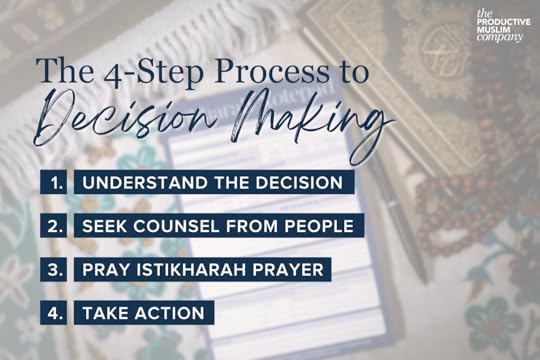 Understand the decision: You need to ask yourself powerful questions that give you clarity and perspective on the decision at hand.Seek counsel from people you trust or those who have more knowledge and experience than you and who can give you good, sincere advice.Pray istikharah prayer and seek goodness and Barakah in your decision from Allah SWT.Take action based on what your spiritual heart is inclined towards and trust Allah (Tawakkal) that He’ll give you what’s best even if things don’t work out your way.How does the Istikharah Notepad work?
 The Istikharah Notepad helps you systematically go through the above process by completing one sheet of paper per decision.
Step 1: Understand the decision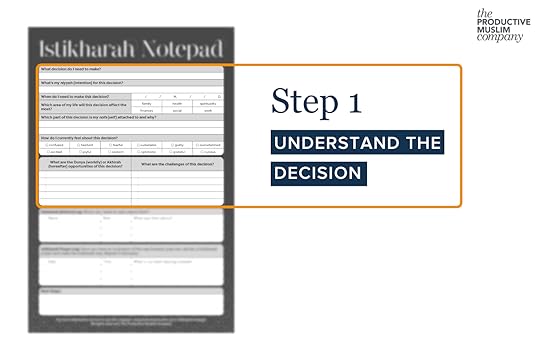
The first few questions in the Istikharah Notepad are designed to help you clearly think through the decisions. Here’s a breakdown of each question and how it can help you:
What decision do I need to make?It’s incredible how asking a simple question can help resolve a lot of indecision around a topic.
What is it exactly that you’re deciding on? Be specific. For example, let’s say you’re considering starting a business. What decision are you making? Is it whether or not to get into the business? Or what type of business do you need to get into? Or the business model you should explore?
Being clear on the decision you need to make is the first step towards making effective decisions and reducing the uncertainty around a decision.
Use this space in the Istikharah Notepad to write a clear statement on the decision you’re making.
What’s my niyyah (intention) for this decision?Once you understand what decision you need to make. Take a pause, and ask yourself why are you making this decision? What’s the intention behind it?
For example, you might realize that the reason you’re considering a job offer even though you already have a good job is that you’re bored and are looking for new exciting job opportunities. Or the reason for choosing a specific college degree is because it’ll look good on your CV even though you’re not interested in studying that topic.
Intentions are subtle, and they start from the heart. Our challenge is to purify the intentions behind every decision and make them for Allah SWT (we cover this topic extensively in our How to Use Barakah Journal webinar and in the introductory section of the Barakah Journal).
Understanding our intentions and trying to purify them so that they are for the sake of Allah SWT is a powerful step to get clarity on decisions and ensure that you make spiritually-intelligent decisions. Therefore, in this section of the Istikharah Notepad, write down what your niyyah (intention) is and assess your intention:
Is it for Allah SWT?Can you upgrade your intention from a Dunya (worldly) focus to an Akhira focus?What is your why telling you about this decision?These reflective questions are essential as they’ll help remove some of the layers of indecision surrounding the decision. You might get clarity on what your decision should be simply by thinking about your intentions.
When do I need to make this decision?The most stressful part about making a decision isn’t the decision-making process; it’s being stuck in the period before making the decision. We call this The Stress of Indecision. That’s why adding a deadline is vital to help you decide by a specific date and not give yourself the option to procrastinate on the decision-making process.
Some decisions have clear deadlines – e.g., you need to accept a job offer within 2 weeks, for example. Other decisions don’t have a clear deadline, and this is where we recommend that you put a deadline and stick to it.
As part of our #GoHijri campaign – we recommend that you put a Hijri date first before a Gregorian date. Perhaps there’s a subtle spiritual significance to a specific date that would inspire you to make a decision on that day, e.g., you might decide on an important project on the Day of Arafat.
Which areas of my life will this decision affect the most?Every decision you make will impact multiple areas of your life. The question is: which area will be affected the most?
For example, if you want to start a business, you might realize that the most affected area is your finances since it’ll take time for the startup to get off the ground, and you won’t have the security of a monthly paycheck. Knowing this, you’d need to make financial arrangements to ensure that you have a 6-12 months runway to cover your expenses while you work on your business and a backup plan in case your business fails.
Or you might realize that accepting that next promotion will affect your health and family life since it requires constant traveling and lots of late-night meetings.
Understanding which areas of your life will be affected by a decision helps you think through ways to mitigate the impact of a decision and/or have relevant conversations with those who’ll be affected so you can better agree on how best to manage the impact of a decision.
Which part of this decision is my nafs (self) attached to and why?This is perhaps the most challenging question to ask yourself in the notepad because it requires deep introspection and self-accountability.
Before I share how to answer this question, a quick preview of what we mean by nafs (self) here from an Islamic psycho-spiritual perspective so you can understand how to answer this question.
Your nafs is a subtle substance that comes into existence when our souls and bodies meet in this world. It is the part of us that has desires, likes and dislikes, and particular inclinations based on pleasure and pain. As Dr. Abdallah Rothman outlines in this article, while the nafs is not bad in and of itself, it has the tendency to lead us away from Allah SWT because it tends to be attached to this world. Our challenge – as spiritual beings – is to train and discipline the nafs to turn towards Allah and not be connected to this temporal world so that it can be successful in the hereafter.
Disciplining our nafs can be difficult, especially since our nafs is like a child. If it wants something, it wants it now (instant gratification) regardless of the consequences, and if it doesn’t want something, it’ll resist and throw ‘tantrums’ if you try to force it to do something that it doesn’t like.
Therefore, when it comes to decision-making, we need to be careful. Sometimes we make decisions that our nafs is inclined towards even though it might harm us spiritually and lead us away from Allah SWT. For example, let’s say you’re a hiring manager at a company and you have to decide between two candidates. Objectively, candidate A is better than candidate B, and your team thinks that candidate A is the best overall choice. However, your nafs is attached to candidate B because they come from the same background as you, or they are more attractive (this is sometimes referred to as implicit bias).
We need to be wary of making decisions that appeal to our nafs instead of what’s best for us (or the organization) in the long run.
So think deeply and introspectively about what part of a decision is your nafs attached to and why. Perhaps, for example, you’re attached to an idea/project because it was your idea, and even though objectively the idea may not work, your nafs doesn’t want to let go because it was your idea. Hence, you pursue the idea anyway at high costs.
Again, the purpose of this question is not to ‘judge’ what your nafs likes or dislikes, but simply to reflect and understand what your nafs is attached to so you can make better spiritually-intelligent decisions.
How do I currently feel about this decision?This is a quick ‘gut’ reaction check about a decision. How do you feel about the decision? Don’t overthink this section and choose from the available options. You can select as many feelings as you like.
Labeling the emotions surrounding a decision is a way to understand what your intuition is telling you about a decision.
You might think that you ‘fear’ a decision, but realize that it’s an excitement coupled with a sense of vulnerability. This is helpful information as you think through the decision and how best to proceed.
What are the Dunya (worldly) or Akhirah (hereafter) opportunities/challenges of this decision?The purpose of this question is to prompt you to think of potential opportunities and challenges you’ll face as a result of following through with a decision in this world and the next.
For example, you might consider a marriage proposal from someone wealthy but is not religious. From a Dunya perspective, the decision opens up the opportunity for you to move up the socio-economic ladder, afford more things, and generally be well-off. Moreover, from an Akhirah perspective, you now have access to wealth that you can use to give to charity, support your family, and fund community projects.
However, the challenges of this decision from a Dunya perspective could be social pressure to keep up with people from a higher class, being worried that family and friends may try to take advantage of you, being invited to lots of parties that waste your time etc. And from an Akhirah perspective, having to deal with family members who may be averse to any form of religiosity because they feel Islam is backward and not compatible with the modern world. Also, all this new material wealth may impact your spiritual and character development; you may start being arrogant and treating people with contempt, etc.
Every decision opens up opportunities and challenges for us in this world and the next. This section of the Istikharah Notepad helps you think through these opportunities and challenges and perform a cost-benefit analysis that is not just worldly but also considers the hereafter impact.
Step 2: Seek counsel from people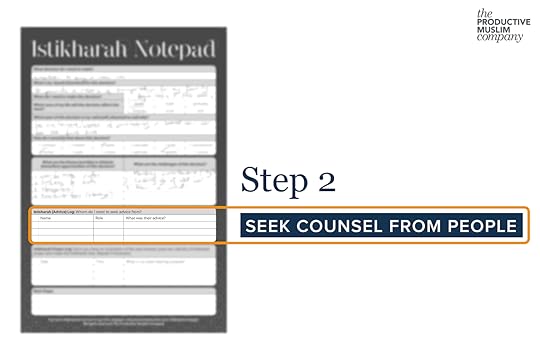 The Istisharah (Advice) Log
In Islam, we are encouraged to seek counsel or ‘shura’ from people concerning decisions we need to make.
Even if we think we’re smart and have good judgment, seeking counsel is encouraged. Prophet Muhammad (peace be upon him) sought advice and counsel from his companions, including before the battles of Badr and Uhud. Sometimes the advice was successful as in the battle of Badr, and sometimes it wasn’t as successful like in the battle of Uhud, but that did not deter the Prophet to seek counsel from the companions, as Allah SWT asked him to do:
فَبِمَا رَحْمَةٍ مِّنَ ٱللَّهِ لِنتَ لَهُمْ ۖ وَلَوْ كُنتَ فَظًّا غَلِيظَ ٱلْقَلْبِ لَٱنفَضُّوا۟ مِنْ حَوْلِكَ ۖ فَٱعْفُ عَنْهُمْ وَٱسْتَغْفِرْ لَهُمْ وَشَاوِرْهُمْ فِى ٱلْأَمْرِ ۖ فَإِذَا عَزَمْتَ فَتَوَكَّلْ عَلَى ٱللَّهِ ۚ إِنَّ ٱللَّهَ يُحِبُّ ٱلْمُتَوَكِّلِينَ
“By an act of mercy from God, you [Prophet] were gentle in your dealings with them- had you been harsh, or hard-hearted, they would have dispersed and left you- so pardon them and ask forgiveness for them. Consult with them about matters, then, when you have decided on a course of action, put your trust in God: God loves those who put their trust in Him.”
Quran 3:159
Allah says in the Quran – describing the believers:
وَٱلَّذِينَ ٱسْتَجَابُوا۟ لِرَبِّهِمْ وَأَقَامُوا۟ ٱلصَّلَوٰةَ وَأَمْرُهُمْ شُورَىٰ بَيْنَهُمْ وَمِمَّا رَزَقْنَـٰهُمْ يُنفِقُونَ
“And those who respond to their Lord; keep up the prayer; conduct their affairs by mutual consultation; give to others out of what We have provided for them”
Quran 42:38
The Barakah of istisharah is that you’re often led to the correct and most beneficial decision (not always, but often).
When Umar Bin Al-Khattab was considering entering a town with a plague, he sought advice from the companions who told him that it was best not to enter. Later he learned that there was a hadith by Prophet Muhammad (peace be upon him) explicitly discouraging people from entering a town with a plague (a concept we now know as quarantine).
When seeking istisharah from people, you need to seek istisharah from people who have knowledge/experience and can give you practical advice to act on. The person should be known for their honesty and trustworthiness and set their personal feelings aside to provide you with objective and straightforward advice.
This section of the Istikharah Notepad ensures that you a) seek shura from at least three people in your circle (feel free to seek istisharah from more people if you want) and b) capture their shura, so you have a log of what advice they gave you.
Step 3: Seek istikharah (goodness) from Allah SWT The Istikharah Prayer Log
The istikharah prayer is a special prayer taught by Prophet Muhammad (ﷺ) when we have a decision to make. It’s a powerful way to seek goodness and Barakah from Allah SWT on any decision you’re making.
Here’s how to pray istikharah prayer:
Step 1: Perform two rak’ah of optional prayer
Step 2: After the prayer, make the following supplication:
اللهم إني أستخيرك بعلمك، وأستقدرك بقدرتك، وأسألك من فضلك العظيم؛ فإنك تقدر ولا أقدر وتعلم ولا أعلم، وأنت علام الغيوب. اللهم إن كنت تعلم أن هذا الأمر خير لي في ديني ومعاشي وعاقبة أمري” أو قال: ”عاجل أمري وآجله ، فاقدره لي ويسره لي، ثم بارك لي فيه، وإن كنت تعلم أن هذا الأمر شر لي في ديني ومعاشي وعاقبة أمري” أو قال: ”عاجل أمري وآجله، فاصرفه عني ، واصرفني عنه، واقدر لي الخير حيث كان، ثم ارضني به” قال: ويسمي حاجته. (البخاري)
Transliteration: “Allahumma inni astakhiruka bi ‘ilmika, wa astaqdiruka bi qudratika, wa as-‘aluka min fadlikal-‘azim. Fainnaka taqdiru wa la aqdiru, wa ta’lamu wa la a’lamu, wa Anta ‘allamul- ghuyub. Allahumma in kunta ta’lamu anna hadhal-‘amra (and name what you want to do) khairun li fi dini wa ma’ashi wa ‘aqibati amri, (or he said) ‘ajili amri ajilihi, faqdurhu li wa yassirhu li, thumma barik li fihi. Wa in kunta ta’lamu anna hadhal ‘amra (and name what you want to do) sharrun li fi dini wa ma’ashi wa ‘aqibati amri, (or he said) wa ‘ajili amri wa ajilihi, fasrifhu ‘anni, wasrifni ‘anhu, waqdur liyal- khaira haithu kana, thumma ardini bihi.”
Translation: “O Allah, I consult You through Your Knowledge, and I seek strength through Your Power, and ask of Your Great Bounty; for You are Capable whereas I am not and, You know, and I do not, and You are the Knower of hidden things. O Allah, if You know that this matter (and name it) is good for me in respect of my Deen, my livelihood and the consequences of my affairs, (or he said), the sooner or, the later of my affairs then ordain it for me, make it easy for me, and bless it for me. But if You know this matter (and name it) to be bad for my Deen, my livelihood or the consequences of my affairs, (or he said) the sooner or the later of my affairs then turn it away from me, and turn me away from it, and grant me power to do good whatever it may be, and cause me to be contented with it). And let the supplicant specify the object.” [Al-Bukhari]
After you pray your istikharah prayer, see what your heart is inclined towards and write it down in the Istikharah notepad.
Although you can pray istikharah only once, there’s no harm in repeating your istikharah prayer 2-3 times, especially if new information/insight comes to you.
How do I know what my heart is inclined towards?There are a few signs:
You feel very comfortable regarding a decision and have no hesitation or concern.You see a dream that supports a decision.A person of knowledge and experience gives you a clear direction of what path to follow.You feel optimistic about a particular decision.Allah opens insights in your heart of the actual cost/benefit of a decision, so you make the most beneficial route.Step 4: Take action based on what your spiritual heart is inclined towards Next Steps
Many people are confused about istikharah prayer and not sure how “it works.”
The purpose of the istikharah prayer is that we are seeking Allah’s guidance and giving over our affair to Allah (tafweedh). Therefore, after taking all the above steps and praying istikharah, the next step is to take action in the direction our heart is inclined towards and have complete trust that Allah SWT will take care of the rest (even if things don’t go our way).
In his book A Journey to God, Dr. Jasser Auda captures this understanding in the following example: “If you are running a business trying to make a profit, there is a possibility that you may lose your investment. But if you pray istikharah and lose, think deeply about it. You might find that you lost some of your investment now, but that larger profits will follow in a different business in the future after you learned from the lessons of your loss. It is also possible that God made you lose so that you will reconsider many things, people, and plans in your life, which you examine in an effort to find out why you lost. You may continue to lose, but win a close friend who helped you during the time of your troubles. Therefore, your real success in the end may be from making a profit in another deal, reconsidering your plans, or even winning a friend. God knows whereas you do not know (Quran 2:216).” 3
Once you write down the next steps, say bismillah and take action!
Congratulations, you’ve made a decision in line with prophetic guidance, and insha’Allah you’ll have no regrets regardless of the outcome.
Questions about the Istikharah Notepad?I hope this article gave you a clear step-by-step guide to filling the Istikharah Notepad and how to make the most out of it. If you have further questions, please send us an email or ask us on Twitter and we’ll be happy to respond.
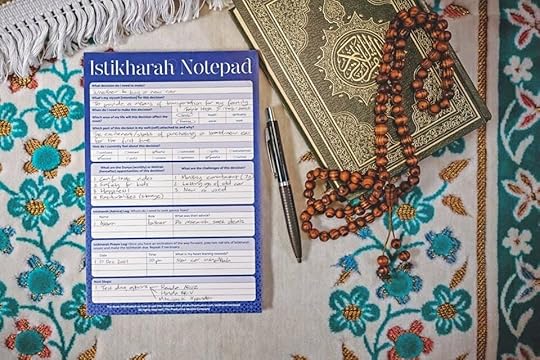
The post Istikharah Notepad: A Practical Tool to Decide With Barakah appeared first on ProductiveMuslim.com.
February 3, 2022
How Inferiority Complex Is Hurting You and the Ummah (and How We Can Fix This)
Islamic history is lit up with examples of Muslims who were world class leaders. They sat at the helm of flourishing empires and led on multiple frontiers ranging across medicine, mathematics, natural sciences and legal jurisprudence. In fact many of the inventions, innovations and discoveries that came from the Islamic world constitute much of the foundations of our modern society.
But we don’t see this level of leadership in the Muslim world today, instead we’re seeing a rapid decay of world impact. We’re witnessing a serious inferiority complex growing in our Ummah; As individuals, we feel inferior to non-Muslims. As businesses and organizations, we feel inferior to mainstream corporations. As an Ummah, we feel inferior to other Nations.
Why is this happening and what can we do about it? Read on…
Inferiority Complex is RealTo know your weaknesses in comparison to others is to be insightful and humble but to harbour a lingering sense of inferiority as a result of this awareness is dangerous. For example, knowing that your colleague is great at public speaking is not the same as feeling that your public speaking skills are worthless and will never improve in time regardless of how hard you try.
In today’s world, we’re immersed in a culture whereby looks, wealth, status and all things materialistic are used as the metric for success. Deep down we know that our spiritual values guide us away from idolising or chasing the material world but at the same time we’re saturated on the outside by people seemingly living exciting, glamorous and beautiful lives. It can be all too tempting to compare our own lives with the façade of today’s hyper-airbrushed world and this constant comparison quickly erodes away at our confidence and spirituality.
Post-colonialism seeded the idea that our western counterparts are somehow better. Although this may not be a conscious thought, it can manifest in our thinking and action in many ways. We can look at the lives and success of our western peers and so easily be drawn into the fantasy that they have the upper edge in this dunya. Sadly, left unattended this feeling can develop into an inferiority complex not just on an individual level, but an Ummah level as well.
Abul Hasan Ali Nadwi describes the decline of Muslim leadership and causes in his book Islam And The World (pg 173):
Dazzled by the power and progress of Western nations, Muslims began to imitate Western social and economic institutions regardless of the consequences, although they were much inferior to their own and consisted of little more than the ardent pursuit of material success. The prestige of religon was diminished. The teachings of the Prophet ﷺ were forgotten. All those ideals of life, which truthfully displayed within themselves both the spiritual and the temporal aspects of life and did not subordinate the former to the latter, ceased to impress the minds of the great mass of Muslim society. Their place was taken by ideals far inferior to them. Life was filled with frivolous desires and occupations to a degree that it had to eschew religious and spiritual craving and activities. If one were to compare the daily occupations of present-day Muslims with those of the aforementioned specimens of the old Islamic civilization, one would find it hard to believe that both professed the same ideology or that only a few generations separated one from the other.
Along with the distractions of this dunya constantly tugging at the soul, we’re also subject to the whisperings of Satan, who’s sole mission is to make us unappreciative beings.
[Satan] said, “For leaving me to stray I will lie in ambush for them on Your Straight Path. I will approach them from their front, their back, their right, their left, and then You will find most of them ungrateful.” (7:16-17)
If we’re not mindful of his influence and don’t take precautions to fortify our heart and mind with God-consciousness, we become even more vulnerable to his evil ploys. One of the ways he tries to enter the heart is by weakening the mind.
What is an Inferiority Complex?An inferiority complex is a feeling of inadequacy that’s not based on any rational judgements. It’s an emotionally-led feeling that holds us captive to constant comparisons which may drive us to wanting to be and act like others, and have what they have in order to feel good enough.
This feeling turns us into thirsty travelers on a desert land, constantly chasing the ‘mirage’ of what others have but never quenching our thirst with the water bottle that’s around our neck.
We can see examples in our Islamic history of people who rather than holding esteem in their faith, turned towards external factors to find a sense of self worth.
When Musa (as) and the children of Israel were saved from the tyrannical grip of Firoun (Pharoah), they witnessed first hand the Divine help of Allah SWT. They were freed from oppression and could live in peace under the prophetic leadership of Musa (as). But not long after the miraculous passage across the Red Sea, they came across a group of people who had taken up idolatry worship and the ignorant amongst them turned to Musa (as) and asked him to “make for us a God just as they have Gods.”
They forgot Allah and fell prey to the insidious idea that the faith they possessed was inadequate in comparison to what they perceived the people they encountered had in terms of faith and provisions. The seeds of inferiority had taken root within them.
“We brought the Children of Israel across the sea and they came upon a people devoted to idols. They demanded, “O Moses! Make for us a god like their gods.” He replied, “Indeed, you are a people acting ignorantly!” (7:138)
In the tafsir of Ibn Kathir (r) he said:
“It appears that the Children of Israel probably asked these people why they worshipped these idols, and they most likely told them that whenever they seek help from them they help them, and that they seek their provision from them. The ignorant ones among them may have been tempted to believe it, and so they asked Musa (as) to make a similar god for them as well.”
This is an example of how in the absence of God-consciousness we can falsely conclude that happiness and success lies in the superficial platforms promoted in a Godless society.
We can see parallels of how the inferiority complex is playing out in individuals, organizations and in Muslim society at large today. Let’s take a closer look at each of these levels.
Inferiority complex in the individualHave you ever stepped into work with feelings of trepidation? Feeling very conscious that you’re different; acutely aware that the sound of your name is different, the colour of your skin is different and that you have a set of rules and a value system that is not aligned with your workplace peers.
If we bring sharp focus to this, what can it stir inside a person?
For my client, Aisha, it made her feel like she didn’t belong at her workplace. She was a teacher working in an affluent neighborhood surrounded by a predominantly white upper class community. Rather than seeing herself as the intelligent, capable person that she was, she subconsciously felt second-rate to her colleagues and so therefore always felt inferior. This inferiority complex rooted itself in her words and behavior; she would always aim to be agreeable even if she held a different opinion and felt the need to prove her self-worth in everything she did.
“Never think that you’re not good enough. A man should never think that. People will take you very much at your own reckoning.”
Anthony Trollope
As this quote suggests, we teach people how to treat us. If we see ourselves as inferior, it makes it more likely that we will be seen in this way by others too.
Moreover, the state of the believer is to know that there is khayr (good) in every situation as related in the following hadith:
“Amazing is the affair of the believer, verily all of his affairs are good and this is not for no one except the believer. If something of good/happiness befalls him he is grateful and that is good for him. If something of harm befalls him he is patient and that is good for him” (Muslim)
Staying mindful of this helps us to elevate our thinking by the mere act of seeking the khayr in all situations, creating awareness in the heart of the blessings and opportunities present in the moment as opposed to dwelling on the negatives and how we’re perceived.
With this in mind, Aisha and I discussed an alternative perspective; perhaps Allah had given her an opportunity to be a role model and dispel myths surrounding the Muslim stereotype, that she showed great courage by the sheer fact that she goes in to work every day and upholds her values concerning manners and dress code. Immediately, this fresh perspective gave her more confidence in her true identity and strengthened her connection to Allah. The inner critic that would constantly compare her to others started to wane and she no longer felt the compulsion to fit in.
This feeling of not fitting in is all too familiar for the Muslim professional working in a predominantly western environment. The term “cultural cringe” is defined as an internalized inferiority complex that causes people to dismiss their own culture as inferior to the cultures of other countries. Inadvertently, we may feel the “cultural cringe” factor with our religious orientation too. In not wanting to feel alienated from social groups or hindered from potential work opportunities, a person might dismiss some of their spiritual practices and strive to adapt to the more commonplace practices of their environment in order to fit in and feel on par with their colleagues.
Regularly missing prayers, not requesting time out for Jumu’ah, feeling awkward about wearing a hijab or growing a beard, dropping inhibitions and placing oneself in inappropriate environments may be some of the casualties of such sentiment. In reality, this can create an internal conflict between one’s spiritual values and the desire to be like others, resulting in anxiety, stress and internal worry. Social anxiety: the fear of being rejected by others, can be one of the biggest triggers for the inferiority complex.
With these emotions brewing inside, the inferiority complex can feature front and center. Feeling that no matter what you do, you just can’t hit the mark or won’t be seen as worthy by others. Even high achievers can feel like failures and imposters. The constant second guessing and feelings of being a second-rate worker hinders performance levels. Confidence dwindles and this can branch off in two ways.
1. Shying away from opportunities out of fear of being “caught out” and not speaking up with authentic thoughts
2. Overcompensating behavior such as bragging to mask the feelings of insecurity.
Both these positions invite the ego to lead the way and we’re then left with ego-led behavior.
The Messenger of Allah (saw), said, “The strong are not those who defeat people. Rather, the strong are those who defeat their own ego.”
Sharḥ Mushkil al-Āthār 1645
A sense of inferiority is not a cognitive thing, it’s an emotional sense that is carried around privately and painfully. The emotions that can arise range from hopelessness and helplessness to anger, resentment, envy and defensiveness.
A person can feel completely incompetent at her job even though objectively they’re great at it but that’s the nature of the beast – there’s no rational thinking. You can be completely disconnected from the objective perceptions others may have of you to the extent that there is an outright refusal to see any evidence to the contrary of your beliefs, placing one squarely in the victim-mindset.
Inferiority complex in Muslim organizationsMuslims look to the west and see successful companies: The Googles, Apples, and Teslas of the world Often these companies adopt practices that are foreign to our traditional ways and sometimes these practices are against Islam – yet as mentioned previously, the generalized feeling of inferiority stemming from the idea that we are inadequate and that our ways of doing things are not good enough, can make us blindly follow in the footsteps of these companies as a result. And in the pursuit of success, we may become negligent of our spiritual obligations.
For example, we’re seeing a burgeoning growth in the Muslim entrepreneurial space. There are now Muslim companies competing in the Fortune 500 arena and the Muslim spend is now worth trillions of dollars and is a recognized sector on the world business platform. Although there is this growth, we can also see symptoms of the inferiority complex growing alongside this trend.
In today’s world, we see Muslim organizations and companies:
Fully immersed in hustle culture, working staff to the boneRelentlessly following formulas of mainstream organizations and copying Silicon Valley and corporate America in hopes of achieving the same high levels of success.Feeling a general sense of inferiority to the western world and as a result producing substandard products and services – believing this is all they are capable of?What if, instead, Muslim companies adopted sunnah practices with yaqeen (certainty) that Ar-Razzaq (The Provider) will deliver barakah-filled results? A few examples of such practices are:
Adopting an Abundant Mindset of mutual benefit and cooperation when dealing with competitors vs. the Scarcity mindset of cut-throat competiton.Adopting a Gardener Mindset with work where you set good intentions, work hard, but detach yourself from the results.Fulfilling the Sunnah of paying workers before their sweat dries (a concept now known as Pay On Demand)Working with staff to develop them spiritually, just like we develop them professionally.Organizing and structuring the day and meetings around prayer times Organizing business plans around the hijri calendar (#GoHijri) and even paying staff and offering holidays according to Hijri calendar. Being at the forefront to protect female employees from sexual harrassment and ensuring safe and mutually respective working relationships between genders whether online or in-personCreating time for employees to take a Qailulah (short mid-day nap) as was the practice of prophet Muhammad (saw).Making the intention of the business not purely about financial gain and profit but about service to the community and Ummah at large.The above ideas may seem ‘crazy’ in our modern corporate world, and may feel “unprofessional” – but what if thinking of the above as ‘crazy’ or ‘unprofessional’ is actually your inferiority complex talking to you? Yes, maybe not all of the above ideas are practical on a day to day level – but that doesn’t mean we shouldn’t be encouraged to explore and experiment with ways to grow our business with Barakah!
My point is this: Instead of feeling like the success formulas of corporate America and the like were the only valid ways to create successful companies, what would happen if Muslim organizations placed more faith in aligning the structure of their company and workday with faith-based practices such as the ones mentioned above? With the doors of barakah opened, imagine how this could yield even greater results.
Inferiority complex in the ummah on a global stageIn the same way that the children of Israel began to develop a sense of inferiority and feeling “second-rate” to the community of pagans they encountered, we can see parallels in our modern day society with the Muslims of today experiencing similar emotions. The media surrounding our religion is awash with labels such as Muslim terrorists and extremism. Muslims are under constant scrutiny, and this has made us sensitive and defensive. As a nation what impact might this have on our mindset and how are we responding as a result?
Here’s a few ways in which the inferiority complex has taken root in our ummah today. We may find ourselves:
Desiring to imitate aspects of non-Muslim lifestyles even though it is prohibited for the believerMinimizing the importance of certain aspects of our religion because it’s not convenient and feel it will hinder our life goalsJudging Islamic principles through a liberal secular lens.Find ourselves viewing certain practices as outdated concepts and not fit for purpose in today’s worldOnly valuing a practice in Islam if the science community or an academic validates it. For example, we know that fasting Mondays and Thursdays is a highly regarded sunnah, but did we only take it seriously when western scientists concluded that the 5:2 diet was a legitimate practice?Very often the inferiority complex is on a subconscious level, so most people are not even cognizant to it. However, we need to take a very conscious look at our intentions, choices and actions in order to determine whether we have mindlessly adopted some of these frames of thinking.
Islam is the last Divine Message to Mankind. We have the blueprint to live a life that is the most balanced, wholesome, and decent. Yet as a nation, we may have drifted away from this way of life because we have fundamentally forgotten who we are, where we came from and our ultimate purpose in this world.
And in this lies the antidote.
The antidote to the inferiority complexAn inferiority complex is fueled by the desire to attain the same levels of power, status and success as those perceived to be in superior positions. In order to shatter this complex, we need to bring our hearts and awareness to the ultimate source of power and honour.
“Whosoever desires honour, power and glory then to Allah belong all honour, power and glory…”?!
[ 35:10]
For the sincere believer, it is known that only in obeying Allah can one find honour, power and glory in this world but more importantly in the next. Holding tight to this reality, secures the heart of the believer from ever feeling inferior to any other culture or creed. It removes the temptation to yearn for what others have in the worldly sense as faith in Allah is what brings a level of contentment that far outweighs the love for anything else this world has to offer.
We are the children of Adam.
We are from the ummah of Prophet Muhammad (saw).
We can call ourselves Muslims because of the greats in our history; the noble prophets, the companions of the prophet and the generations to follow who sacrificed their lives so that we can practice today.
We have been given tawfeeq (direct guidance) to believe in the Oneness of Allah whose guidance and Help we know is always with us.
With this identity deeply embodied in the very fabric of our soul, we can stand confidently in any environment holding tight to our values and be fearless of worldly judgement. We can navigate any workspace or social gathering with firmness in our Muslim identity. Our hearts will steer away from feeling any form of inferiority complex or victim-mindset or FOMO (fear of missing out) because there is peace and contentment found in the promise of Allah:
“So do not become weak, nor be sad, and you will be victorious if you are indeed true believers.”
[ 3:139]
Alongside this understanding, it’s essential to create time for muhasabah (self-evaluation) in order to become more self aware, to be aligned to your fitra and increase in confidence that is rooted in Allah.
And it is for this reason that I developed the Confidence Masterclass – a transformational 6-week journey that combines Islamic spiritual practices with modern psychology to help Muslim professionals develop spiritually-centered confidence and remove any feelings of insecurity and inferiority.
During this masterclass, you will be guided through the Belief Model  framework – a systematic process designed to help you strengthen in all aspects of life pertaining to spiritually rooted confidence.
For example, Imran decided to join the masterclass to work on his spiritual confidence using the Belief model framework. Prior to this training and despite having a good job, family and comfortable lifestyle, most days he would wake up feeling uneasy and unsettled. He was feeling the pressure of constant comparisons and spiritually weakened by the busyness of life. However, after he completed this training, he described feeling more internal peace as a result of developing a stronger reliance upon Allah and how increased self-awareness gave him more control, emotional grounding and confidence in himself and life choices.
Let’s take a deeper look at Imran’s outlook before the training and how he felt at the end of the masterclass training…
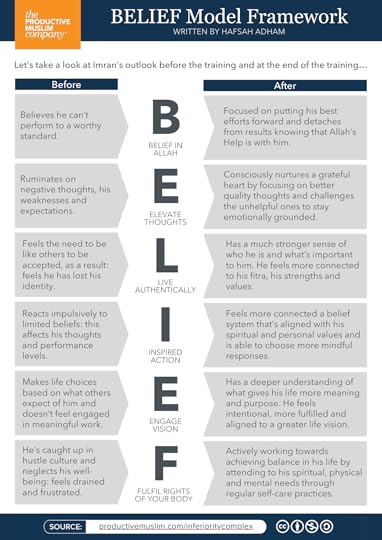
After working his way through the Belief model, Imran is a more confident, healthy, balanced individual who is still ambitiously working towards his life goals but with an active focus of how his work in this world can connect to the next. He’s no longer as concerned with external judgment or trying to fit in; his heart, mind and soul have found contentment in his deen and his feelings of self worth are rooted internally by his connection to Allah.
“Verily, Allah does not look at your physical features nor your wealth, but Allah looks at your hearts and actions.” (Muslim)
When we keep our sight firmly fixed on Allah, the fear of others dissipates. The inferiority complex disappears and what’s left is an energy, focus and determination to create meaningful lives with the hope that the reward will come in this life and extend to the next.
The post How Inferiority Complex Is Hurting You and the Ummah (and How We Can Fix This) appeared first on ProductiveMuslim.com.