Mohammed Faris's Blog, page 5
March 15, 2021
Success Story: Aisha Ahmed, Mindfulness Masterclass Graduate
Aisha Ahmed joined the 2nd cohort of the Productive Muslim Mindfulness Masterclass last December. Below is her story and how the Masterclass transformed her. Learn more about the upcoming Mindfulness Masterclass here.
My StorySo it was about 3 am on Friday in Nigeria, and my little girl had a fever. She also had a high fever the night before, but this time it was not going down. I reached out to the pediatrician’s office, and I was placed on a waiting list for an appointment. I looked at my to-do list for that day, and I had a major Clinical Pharmacy exam that morning at 8.00 am. By 7 am, as my baby’s temperature was finally down, I left her with the family setting out for my exam while waiting to hear back from the pediatrician.
Many of you readers might be in my same shoes some days: a full-time student, a working professional, and a mom – trying to balance your studies, career, and home. How do you stay sane, focused, and calm while juggling between all your roles and an ever-growing list of To-Dos?
Mindfulness Masterclass and MeMindfulness is a buzzword. Everyone seems to be talking about it these days. I never once considered that I would be learning about Mindfulness one day until I stepped inside the Mindfulness Masterclass at Productive Muslim. And I walked away with deeply meaningful tools for my spiritual-emotional well-being and a beautiful supportive community.
That morning, while I was driving to my exam, leaving behind my sick baby at home, what would you suggest I should have done to stay calm and focused?
My past self would have been too anxious and worried, not knowing what to think. But equipped with my new knowledge of Mindfulness, I knew I had to keep taking deep breaths to activate my parasympathetic system to calm down my brain’s fight or flight response, and I would do this while making Dhikr to cultivate the presence of Allah and His ever-flowing mercy.
Let me ask you a quick question: When was the last time you sat down between your busy day and took a few focused, deep breaths to invest in your well-being?
The best part about the Mindfulness Masterclass is how it revives the lost art of Islamic Mindfulness, how to cultivate the Presence of God to nurture ourselves spiritually why we are striving to be more Mindful. The intersection of the teaching of beautiful scholars like Ghazzali and modern-day research deeply resonated with my style of learning and self-development.
My Mindfulness Tools for greater Spiritual and Emotional Well-being and ProductivityBefore MindfulnessAfter MindfulnessI might have reacted to the events and not be productive spiritually or emotionally.Stop and Remember God:I learned how to practice pause through the Masterclass. Just pausing for a moment gives us the ability to cultivate greater wellbeing. Just make some Dhikr, make Du’a, and ask Allah’s guidance before I move on.I would not know how to cultivate calmness in the middle of a series of stress-provoking events.Breathe:
I learned how taking a deep breath activates my calm, and before I move forward, I can keep breathing and making Dhikr.I would get carried away by anxiety, anger, or frustration.Notice:
I learn to notice my body’s emotions as they arise and label them to help me regulate them before they take me too far away.I would respond to my family in a less than ideal way and it would ruin my day and possibly the week trying to repair all the mistakes I made – internally and externally.Respond:
What would the Prophet (SAW) do? I can take some time visualizing his response before I open my mouth or get carried away. This helped me respond to my husband and kids more calmly and stay silent when I wasn’t at my best, and by the end of the day, my husband told me: “We are so lucky to have you.”Focus on all the negative things and make things worse for myself and everyone around me.Create my own positivity anchor that can rescue me from stress and anxiety.
Here was mine: “Interrupt anxiety with gratitude Aisha.”Alhamdulillah that my baby’s fever is down at the moment, alhamdulillah I have support at home. Alhamdulillah, that I had a colleague who could support me getting situated at my exam. Alhamdulillah that I could step out for 30 seconds to check in on my daughter, the results came out, and she had malaria and had to take some shots. Alhamdulillah, the clinic isn’t too far from where we liveInvitation
The Islamic Mindfulness masterclass was a beautiful journey that I plan to keep going back to as you have lifetime access to this community once you sign up once. Join my colleagues and me at the next Mindfulness Masterclass, increase your awareness of your creator, and invest in your spiritual and emotional wellbeing.
Before I go, guess what I did once I got back from the doctor’s office after that crazy day?
I had another deadline! I sat with myself for a few minutes and then I got to work on this article.
Whether it is mindful breathing punctuated by Istighfar or a mindful wudhu followed with a khushoo-filled salah, the Mindfulness Masterclass was a gift that keeps on giving by Allah’s grace.
The post Success Story: Aisha Ahmed, Mindfulness Masterclass Graduate appeared first on ProductiveMuslim.com.


March 4, 2021
What Is Spiritually Centered Confidence?
The alarm goes off, and the day begins. After the usual morning rush, Sana makes her way into work. The week has gone pretty well so far, she received praise for her role in managing a large contract with a significant client, and her team has delivered on all the tasks she assigned them. All in all, she’s feeling confident.
As habit dictates, she sits comfortably in her chair, sips her coffee, and opens her email to see what today will bring. She instantly regrets looking at her internal mail first. Glaring at the top of her screen is an email from her boss. She hesitantly opens it, unconsciously moving her chair a little away from the desk as though that would help soften the blow somehow.
She stares at her proposal, the one she had spent days carefully crafting, that is now littered with comments and changes he wants to be made. As she skims through his notes, she feels like it’s not just her proposal in question, but herself as a person and her ability to do the job she was hired for. She feels instantly ashamed, irritated, and wrongly accused.
Impulsively, she hits reply and without hesitation lets her boss know why she made the choices she did. She presses send and feels in some way vindicated.
However, as the rest of the day transpires, his words weigh heavier and heavier in her mind. Self-doubt and the harsh inner critic are hijacking her mind making it harder for her to perform at work. She’s constantly second-guessing her decisions and wondering at what point she’ll get pulled up again. At the end of the day, she leaves with tense shoulders and a headache, summoning whatever energy she has to face her other roles of being a mother, wife, and home carer. In her heart, she already knows it’s going to be a tough evening as she’s feeling exhausted and defeated before even stepping out of the office. She sighs sadly, knowing her family won’t get the best of her, again.
Sana came to me because she was exhausted from being in this cycle. She felt she was on an emotional rollercoaster, feeling confident and great one minute but then deflated and riddled with self-doubt the next. She felt she lacked balance and was spiritually compromised. She had little to no energy and was worn out by the mental marathons she would run in her head with the constant comparisons and second-guessing her decisions and performance.
She felt she was on an emotional rollercoaster, feeling confident and great one minute but then deflated and riddled with self-doubt the next
Hafsah Adham
As we began our very first session, “Breathe” I said to her, “Take a few deep breaths and let’s slow down”.
As Sana and I worked together, she began to discover a new way of defining confidence allowing her to experience a new level of emotional stability, inner peace, and fulfillment in a more consistent way.
Why Confidence Matters?In today’s world, there are many definitions of confidence and it’s become a highly sought-after attribute. After all, confidence has become the gold standard in the workplace because we’re told that’s what we need to get noticed, get ahead, and achieve all our life ambitions. Nowadays, the self-help world offers you a whole array of quick-fix strategies and formulas to help fill up your confidence tank.
The reality is that we do need confidence as it plays a critical role in how you see yourself and in how you behave. It can improve your relationship with family and friends, job performance, your involvement in the community, and your ability to achieve from your smallest to biggest ambitions in life.
One of the most cited sources about self-confidence in the modern context refers to it as simply believing in oneself. As believers, this notion of believing in oneself is important but it comes with a caveat. We need to be extremely careful about where our confidence is coming from in each moment and what it’s pulling us towards in terms of our beliefs, character, and behavior.
Attaching confidence to what we do as opposed to who we are, creates a need to chase and focus on the external and neglect what’s within.
Hafsah Adham
It’s very tempting to build our confidence and construct our lives based on what we own and what we do. We can feel good about our physical appearance, how we performed at work, what the boss said, how much money is in the bank or even upon the degree by which we are socially accepted by others. These are all external forms of validation that are very temporary in nature. Attaching confidence to what we do as opposed to who we are, creates a need to chase and focus on the external and neglect what’s within. We become distracted from paying attention to what Allah sees.
The Messenger of Allah (SAW) said, “Verily, Allah does not look at your appearance or wealth, but rather He looks at your hearts and actions.”
(Sahih Muslim)
It is my hope that by the end of this article you will be able to distinguish the many different modalities of confidence ranging from healthy and spiritually enriching to others that are temporary in nature, toxic and serve only to inflate the ego, detracting from our spiritual wellbeing and our relationship with Allah.
How I came to understand Islamically rooted confidenceYou would never have guessed I suffered from low confidence or a paralyzing fear of public speaking. Why? Because I was great at masking it. I was like a chameleon, adapting to everything around me, and somewhere along the line, I lost my identity. I was a people-pleaser, a giver, a high-achiever who raced to serve every person’s needs—often to my detriment. Doing this left me burnt out, unfulfilled and exhausted. I was tired of the emotional rollercoaster of needing others to validate me and boost my confidence.
After years of spiritual and personal development training, I finally felt a sense of authenticity, acceptance, and connection to my true self. It was through this process that I realized a fundamental truth; the only way to experience unwavering self-confidence is to ground your identity, efforts, and focus on your faith in Allah.
I realized a fundamental truth; the only way to experience unwavering self-confidence is to ground your identity, efforts, and focus on your faith in Allah.
Hafsah Adham
It was at this stage I qualified as a Life coach so that I could help prevent others from making the same mistakes I did. By the mercy of Allah, for the past 6 years, I’ve been researching, teaching, and coaching clients on a new framework of confidence, one that is rooted in faith and not in ego. I have delivered lectures, workshops and coached hundreds of people around the world helping them make the paradigm shift from ego-led confidence to real inner confidence that is deeply rooted in their trust and relationship with Allah (SWT).
This confidence paradigm shift entails a holistic process of deeper inner work that’s rooted in Islamic principles. It’s designed to help us reconnect back to our fitrah with spiritually fortified confidence and resilience that can be present in the face of any challenging situation.
From Ego-Centered Confidence to Spiritually Centered ConfidenceIt is from the Mercy of Allah, that He has given us the capability to feel deeply rooted confidence within ourselves no matter what our external circumstances are. This confidence is solidified on the foundations of unwavering love and trust in Allah.
When confidence is rooted in Tawakkul (trust in Allah), it allows us to face even the hardest tests with grace and poise as modeled by our beloved prophets (peace be upon them). They faced undeniable hardships and struggles, yet had absolute confidence and trust in Allah, believing and knowing that nothing can happen to them or hurt them unless it was by Allah’s Will. With this spiritual armor, they would leave their homes each day with purpose and intentionality that was undeterred by outside events or other people’s words and actions. They were comforted and fuelled by these words of Allah:
“Say: Only what Allah has decreed will happen to us. He is Our Master: let the believers put their trust in Allah.”
(Qur’an 9:51)
Let’s examine a few distinctions to help us discern deeply rooted spiritual confidence from the superficial temporary platforms of confidence. We will specifically look at some of the consequences of adopting ego-led confidence compared to possible outcomes from developing spiritually led confidence, as detailed in the following infographic:
[image error]Superficial Confidence vs. Spiritual Confidence Infographic. Developed by Hafsah Adham, Designed by Aneesah SatriyaSelf Reliance Based Confidence Vs Tawakkul Based ConfidenceProbably one of the biggest concerns with following today’s formulas for confidence and success is that it puts us at risk of becoming forgetful of Allah. This can be a very subtle process and happen without us even realizing if we are not mindful.
The moment we align with the idea “it’s all on me”, we’re vulnerable to a whole host of problems. With this mindset, the burden of success is solely on us and it can create psychological issues such as anxiety, stress and make us very reactive to outcomes. For example, if a person delivers a presentation and receives negative feedback, it’s easy to take it very personally, giving way to self-loathing, negative self-talk and people pleasing behaviour. If the presentation received great reviews, without humility present and attributing the outcome back to Allah, any praise could feed directly to their ego, which in turn can create arrogance and an unhealthy disproportionate belief in oneself and their ability.
“Do not strut arrogantly about the Earth. You will certainly never split the earth apart nor will you ever rival the mountains in height.”
(Qur’an 17:37)
Some of the pitfalls of arrogance to be aware of include:
Inadvertently, we may fall into the trap of thinking the only factors at play is our own ability, effort and self-belief. This disconnects us from the reality that we are the slaves of Allah and rather than operating from a spiritual soulful place with purpose and humility, it sets up an identity based on ego with a penchant for external validation. The Prophet (SAW) said: He who has, in his heart, an ant’s weight of arrogance will not enter Paradise. (Sahih Muslim). Islamic tradition is about not inflating ego, this is called Jihad Un Nafs (struggle against the self) out of protection from becoming “full of oneself” and adopting a mindset independent of Allah. “The shy person and the arrogant one will not learn the knowledge.” (Sahih Bukhari). As we can see from this hadith, allowing arrogance to enter the heart shuts the door to valuable learning and insights. There’s also a real danger of not being able to do honest self-reflection (Muhasabah) for personal growth and development. We must also consider the undesirable characteristics and social behaviour that arrogance can bring out in someone. Are they concerned with other people’s feelings or more worried about protecting their own image?The reality is that Allah has blessed us with skills and abilities but ultimately, we ONLY achieve success by the mercy of Allah and because He willed it to happen. When we align that mindset with a deep sense of knowing that along with my ability, skills and efforts is the help and might of Allah, we can feel more assured going into any situation with high levels of self-confidence. If we have the help of Allah, what is there to fear?
“And He provides for him from (sources) he never could imagine. And if anyone puts his trust in Allah, sufficient is (Allah) for him. For Allah will surely accomplish his purpose: verily, for all things has Allah appointed a due proportion.”
(Quran 65:3)
Grounded with this inner confidence, we have the courage to listen to others, we can accept all outcomes and we have the capacity to entertain other people’s opinions.
“It is the mark of an educated mind to be able to entertain a thought without accepting it.” – Aristotle
Essential Self Vs Constructed SelfSubhanAllah, we are the creation of Allah. Let’s just take a moment to think about the significance of that. He designed us in perfect proportion and placed within us unique qualities and traits so that we can use these gifts to spread goodness and rahma (mercy) in the world.
“We have indeed created humankind in the best of moulds.”
(Quran 95:4)
Our essential self is the purest form of who we are (fitrah). This space is filled with compassion, goodwill and esteemed qualities that reflect our most authentic self. Our soul will feel most alive, spiritually engaged and thriving when we are living in integrity with our essential self.
But sometimes, in the process of trying to succeed in our environment, we can detach from our authentic self and become people that neither others nor even ourselves recognise. Here are some ways we can detach and fall into our constructed self:
We try to follow formulas of other successful people and don’t honour who we really are at a soul level. We lose our authenticity, afraid to show up as our real self out of fear of loss, judgement or rejection.We believe negative things that have been said about us in the past and build an entire life as a reaction to this. We become chameleon-like to fit in with others and our environment, this creates a gap between how we feel on the inside and how we show up on the outside. The larger the gap, the greater the inner friction and disturbance at a soul level. Reactive behaviour tends to have a few common traits; sensitive, protective and defensive. Reactive ego-led behaviour can easily masquerade as confidence, when we quip back if pressed or “fight our corner” during every conflict, we convince ourselves that we’re coming from a place of strength, but in fact it could be the protective armour we’ve created in order not to feel any discomfort.“… By the soul and (by) Him who made it perfect, and then inspired it to understand what is wrong and what is right for it. Truly is successful the one who purifies (his soul).”
(Qur’an 91:7-9)
As we learn from this ayah, the soul knows right from wrong. If we learn to slow down and pay attention to that quiet inner voice we will see that real courage and confidence is in showing restraint, being kind, showing mercy and carefully crafting responses with an awareness and care of how our behaviour affects others.
Self Care Vs Self NeglectBusy lifestyles and hustle culture can very quickly lead to self-neglect. This can have a cascading negative impact on multiple fronts (e.g. spiritual and emotional wellbeing, energy and confidence levels)
Sometimes in the rush of modern life, many people forgo a healthy diet. A poor diet not only affects our weight, but it can affect our mood and emotions. When our emotions are not healthy this can directly impact our confidence. For example, researchers are finding fascinating links between our food choices and mental health.
“Serotonin is a neurotransmitter that helps regulate sleep and appetite, mediate moods, and inhibit pain. Since about 95% of your serotonin is produced in your gastrointestinal tract, and your gastrointestinal tract is lined with a hundred million nerve cells, or neurons, it makes sense that the inner workings of your digestive system don’t just help you digest food, but also guide your emotions.” (Harvard Medical School).
There are countless references in the Quran and sunnah with regards to how we should manage our eating habits as food not only nourishes our body but the soul too.
The correlation between lifestyle choices and our emotional state extends to almost every aspect of our life. Some of the impacts of self-neglect include:
If we’re run down, overworked and feel under-valued, it won’t be long before we’re battered from exhaustion and begin to operate in a mental fog which makes it difficult to move forward with even our basic daily activities.Recharging is critical. If we don’t, we’ll be running on empty. We may still be able to serve others – but would they be getting the best of us? What’s the trade off? Poor choices around food, excess weight gain/loss, dark circles under the eyes, short fuse, health issues?How confident can we truly feel if our body is consistently getting insufficient sleep?Research shows that low energy gravitates us towards negative emotions such as resentment, frustration and even anger. If all our actions are judged by our intentions, we have to question how these negative emotions impact our intentions, even when we are serving our loved ones! Part of our duty as Muslims is to explore our intentions at deeper levels.Your body has a right over you and we have to make choices accordingly. Allah blessed us with ONE body and gave it to us as an amaanah (trust) that we will look after it, with this intention self-care becomes an act of worship.
Ibn al-Qayyim (r) stated:
“Health is one of the most precious favours Allah has bestowed upon His servants, the most generous of gifts, the most plentiful of His bounties. Rather, even more, [good] health is the most precious of favours without exception; so it is fitting that whoever is granted a portion of this fortune, that he cherishes it, preserves it and guards it against harm.”
A defining characteristic of a Muslim is loving and following the Sunnah. The best of mankind has instructed us to be mindful of our mind and body. Part of striving to follow our prophet (saw) in order to please Allah is through loving and taking care of yourself.
He ate well, he slept early, he was active, he gave himself rest and fulfilled the rights of his body.
From this, we can see self-care is not just a luxury but a necessity.
Ultimately…From the above we see that true confidence is rooted in Islamic principles. It requires us to take care of ourselves, to identify the true self and ultimately to rely on Allah. It is only through our relationship and awareness of Allah that our hearts can find peace as Allah tells us:
“Only in remembrance of Allah (swt) will your heart find peace”
(Qur’an 13:28)
If our confidence is independent of this reality, we may develop a scarcity mindset and seek abundance through wealth and status. We can lose a good night’s sleep worrying about our possessions and unfulfilled life ambitions. Everything becomes personal and we become very reactive to our circumstances. We may lose aspects of our character and become neglectful of our spiritual obligations, manners and empathy for others in the process.
It’s important to note that striving for the good of this world and having high ambitions is not inherently wrong, in fact we are advised to make duaa for it:
“Our Lord, give us in this world [that which is] good and in the Hereafter [that which is] good and protect us from the punishment of the Fire.”
(Qur’an 2:201)
We ask for the good of this world, but we don’t attach our hearts to it. In hope of being included as those who are truly successful (Al-Muflihoon) we strive to make our efforts count for us in this world and the next InshaAllah.
Aligning with this intention, means that we can aim high fearlessly with full trust that Allah will give us what is best and what we don’t receive in this world will, InshaAllah, be waiting to greet us in the next world. This spiritually rooted confidence liberates us from the shackles of chasing dunya and striving to fulfil society’s demands.
It’s in renewing our intentions and aligning our thoughts, decisions and actions with our higher purpose and finding our way back to our essential self that we can experience that rich, unwavering belief, knowledge and understanding that Allah’s help is near.
Back to Sana’s caseSana and I used the Belief model  to help raise her self-awareness and spiritually align her mind, body and soul with a more purposeful and intentional life.
She fully embraced the instruction in these comforting words from Allah:
“Allah never changes the condition of a people unless they strive to change themselves.”
(Quran 13:11)
She recognised that if she wanted to see change in her life, the point of action had to begin with herself first along with full trust that Allah, Al- Fattah (The Opener) will open the way for everything else to change.
By working through the Belief model , here’s a few of the changes she experienced with the Mercy of Allah:
I’m excited to partner with The Productive Muslim Company to launch a brand new 6-week masterclass on building spiritually-centered confidence. You can learn more about it at ProductiveMuslim.com/Confidence.
 Click here to learn more about The Productive Muslim Confidence Masterclass
This will be a 6-week masterclass that combines Islamic spiritual practices with modern productivity and psychology based on the BELIEF Model . Learn more here.
The post What Is Spiritually Centered Confidence? appeared first on ProductiveMuslim.com.
October 15, 2020
Adjusting to Fall-back time: A Professional Muslim Perspective
We’re getting closer to that time every year in the fall season when in the USA, and many other countries, the clock time is adjusted back by one hour (“fall-back”) from “Day Light Savings Time” (DST) to Standard Time (ST). For a busy practicing Muslim professional like me, this poses some challenges and requires several adjustments. In this blog, I share what these challenges are, and approaches to how we tackle these challenges.
Challenges caused by “fall-back”
In the USA, the DST lasts about 8 months — starts early March and ends early November. Most of this time coincides with longer days, warmer weather. As practicing Muslims, our lives revolve around routines and rhythms – most notably, obligatory prayers at specific times. As Muslim professionals, we adjust our busy professional lives around this routine of worship. I find it easier to marry the two during the DST season for a couple of reasons:
The days are longer, which means that I have more time between specific prayer (salah) times to complete my salah on timeMore importantly, because the clock advances by an hour during DST, during most of DST, Alhamdulillah, Asr and Maghrib prayer times (certainly in the Dallas area – my hometown — and in most of the USA) typically lie outside of the core or busy office hours (between 8am and 5pm), which makes it generally easier to offer them on time without work distractions.
And we settle into this comfortable routine during DST. Even though prayers times shift during the course of the DST period, but the above hold generally true. The “fall-back” in November disrupts this routine and is a double whammy in terms of impact:
The days are much shorter in winter which provides less interval between salah times. For example, in Dallas daytimes during DST last approximately 3-4 hours longer than in winterSalah times for Asr and Maghrib move to the core busy working hours of the day when my calendar is full of business meetings and represents a constant source of conflict.
So what do we do? Alhamdulliah, where there is a will, Allah  makes the way easy. I will document some of the best practices that work for me.
Approaches to deal with these challenges
Best practice 1: Start the work day as early as possible
Because of “fall-back”, Fajr prayer starts an hour earlier (in terms of clock time) than during DST, so that means we can get started with our workday earlier. I find that since Asr and Maghrib prayers follow in quick succession during the shorter days, it is difficult to plan “creative” or cognitive work between the two that requires uninterrupted focus. So starting earlier gives me that extra un-interrupted work time I need. In fact, it is a Sunnah of the Prophet  to start work early in the morning, since that is a time for barakah (blessings)
Alhamdulillah, this is actually mercy from Allah . Since the nights are longer during winter, we get more time to sleep at night, so we can wake up refreshed, and get started earlier. Compare this to summer nights, where it is difficult to get even 5 hours (in the Dallas area – even less if you live further north) of continuous sleep (especially if I get up for Tahajjud prayers), which means that during DST, I am often groggy in the morning and often feel like taking a nap after Fajr prayer, which we know is not a Sunnah of the Prophet .
Best practice 2: The lunch-time break is perfect for Zuhr salah
Another good thing about the standard time is that typically Zuhr prayer falls during the typical lunch hours (between 12pm and 1 noon). This represents a great opportunity to take care of Zhur prayers while we get a break in the work routine.
Best practice 3: Book your prayers well in advance in your meeting calendaring system!
As professionals, we all use online calendaring systems (such as Google Calendar or Outlook) to schedule our business meetings. Especially due to COVID-19, we may be traveling less, but it appears that our calendars are now busier with more and more online meetings throughout the day, especially during the “busy” time slots between 8 am-12noon and 1 pm-5 pm. The afternoon time slots are when we have conflicts with Dhuhr, Asr and Maghrib prayers.
We typically look at calendars to find “free/busy” time slots to book meetings. To avoid potential conflicts I go ahead and reserve time in my calendar (showing “busy” for others who want to schedule my time for meetings) for all my Zuhr, Asr and Maghrib prayers well in advance – specially the Asr prayers, since it is Sunnah to not delay Asr prayers, and it is easy to miss Asr prayer since it occurs in one of the busiest time of the work day.
I try to block off time for the Asr prayers at the earliest timeslot when the Asr time commences. For example in the Dallas area in early December, Asr time starts around 3:45pm (Hanafi calculation), so I try to book a recurring 15 to 30 min slot on my calendar starting at that time. Of course, I adjust the start time on the calendar as the time for prayer shifts. Please refer to any prayer time calculator (such as this one) for precise prayer times in your area.
Alhamdulillah, this really helps, as other people will try to schedule (most of) their meetings in non-busy/“available” time slots. In addition, this serves as a formal reminder to me take breaks from work for prayer. We’ve all had days when the day whizzed by so fast that Satan made us forget to pray.
Best practice 4: Shift personal time to the evenings
We often do find time during the DST period to squeeze in personal time for recreation (or exercise) during the daylight hours. That becomes rather difficult during Standard Time period due to short days. By comparison, evenings and nights – outside of working hours — are longer, so that’s the best time to take care of personal activities.
Is one better than the other from a Muslim professional’s perspective?
Given the adjustments that need to be made for the switch from DST to ST, I almost feel that we should just stick to DST all year. Matter of fact, strictly from the perspective of overlap prayer timings with work, I feel DST probably works better during the winter months and less so during the spring/summer/fall months. Many states in the USA are considering legislation to make this happen.
However, regardless of what man-made time/clock system we follow, Allah, in His infinite mercy, will show us a way to adapt. May Allah guide us, grant us his forgiveness and mercy and make it easy for all of us.
The post Adjusting to Fall-back time: A Professional Muslim Perspective appeared first on ProductiveMuslim.com.
August 17, 2020
We’re Going Hijri: The Productive Muslim Company to Align its Business with the Hijri Calendar
The Productive Muslim Company is becoming a Hijri-first company as part of its #LetsGoHijri campaign. Orienting the company’s business and planning to the Hijri Calendar will entail:
Aligning the Productive Muslim’s monthly newsletter with the Hijri calendar (issuing the newsletter at the beginning of every Hijri month).
Aligning the internal team meetings and planning with the Hijri calendar.
Aligning the Productive Muslim Masterclasses (The ProductiveMuslim Masterclass, The Money Masterclass, The Mindfulness Masterclass) with the Hijri calendar.
Aligning Barakah Academy‘s Live Events and the Book Club to the Hijri Calendar (all monthly events will take place according to the Hijri calendar).
Displaying the Hijri date on the Productive Muslim website and on every article.
Aligning team pay to the Hijri Calendar (and this means the team will get a bonus every 2 years – by Allah’s Permission).
About the #LetsGoHijri Campaign
For 15 centuries, the Islamic calendar has been the primary calendar for Muslims globally connecting the Islamic civilization that spanned from Spain to Indonesia.
Over the last 100 years, however, the Islamic calendar lost its status and we rarely organize our life around it anymore (except for Eid, Ramadan, and Hajj).
Unfortunately, we donât realize that we stand to lose much when we neglect this spiritual calendar thatâs aligned with the Divine Order.
Reviving the Islamic calendar is essential to align our lives with Barakah Culture and as Muslim professionals, we need to take responsibility to revive it today.
With that in mind, The Productive Muslim Company started the #LetsGoHijri campaign to revive the Islamic calendar in our personal and professional lives.
How to Be Part of the Campaign
Read this article on “Why the Islamic Calendar Matters More than You Think”.
Sign up for the campaign by going to our new campaign website GoHijri.org and click join the campaign.
Change your Facebook profile pic to this one to say that youâre supporting #GoingHijri.
Support the campaign by purchasing a digital or physical copy of our new Hijri-first calendar.
Download the #LetsGoHijri logo and the 10-day challenge infographic here and share across your social media accounts with the hashtag #LetsGoHijri. Tell all your family and friends about this campaign!
We understand that aligning our lives with the Hijri calendar might seem impractical – but if we are sincere to revive this spiritual calendar in our lives for the sake of Allah , and take active steps to resolve some of the practical challenges to align our lives/organizations with the Islamic calendar, we can make it happen, insha’Allah.
If youâre passionate about the Islamic calendar or know someone who is, weâre looking to build a small team to run a non-profit think-tank to advocate for the Islamic Calendar. Let us know your skills here.
#LetsGoHijri
The post We’re Going Hijri: The Productive Muslim Company to Align its Business with the Hijri Calendar appeared first on ProductiveMuslim.com.
August 6, 2020
What is Mindfulness and Spiritual Intelligence: An Islamic Framework
Mindfulness, of late, has become a buzzword and as Muslims, we might wonder what mindfulness has got to do with our faith?
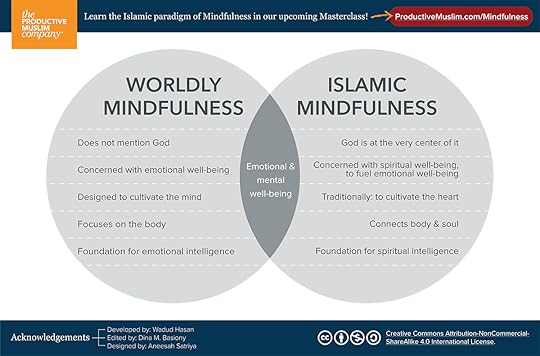
In simple words, mindfulness is our ability to pay attention to the present moment without getting carried away by all the distractions, emotions, thoughts, and feelings we experience. From an emotional well-being perspective, this concept can be very useful for Muslims. However, to us Muslims, this mainstream definition of Mindfulness is incomplete without God.
In this article, we discuss how Islamic mindfulness is different from secular mindfulness captured in this infographic below:
'The modern concept of Mindfulness is deeply beneficial to us Muslims, yet it is incomplete without God.' Wadud HassanClick To Tweet
Emotional vs. Spiritual Well-being
According to numerous neuroscience-based research, mindfulness is proven to have a strong correlation with emotional regulation and well-being [1]. In contrast, mindfulness, through an Islamic lens, is not just about mental and emotional well-being, but more importantly about spiritual well-being – which we believe can nurture our emotional health and is deeply rooted in our awareness of and relationship with God .
âMindfulness, through an Islamic lens, is not only concerned with our emotional well-being but also our spiritual well-being.â Wadud HassanClick To Tweet
Mind vs. Heart
The modern field of mindfulness is most fascinated with our brain, its roles in building and sustaining new habits, and its influence on our well-being. In Islam, the mindfulness of God is rooted in our heart – the Qalb. Prophet Muhammad pointed to his heart when he said: ]
âTaqwa ha-hunaâ “Mindfulness of God is here and he pointed to his chest three times” [Muslim]
Mindfulness in Islam, therefore, is a tool and practice to nurture the heart and soul, which are connected to the mind, which has been previously explained in the ProductiveMuslim’s article: What Islam Offers to Modern Self-Help: An Islamic Paradigm of Psychology.
âMindfulness in Islam is not only concerned with the brain but rooted at the heart and soul as the Prophet Muhammad (upon him be peace) pointed to his heart and said: âMindfulness of God is here.â Wadud HassanClick To Tweet
Emotional vs. Spiritual Intelligence
According to Daniel Goleman, one of the leading figures behind the modern emotional intelligence movement, mindfulness is the foundation for emotional intelligence, a key ingredient for success in our relationships, career, and leadership [2]. Islamic Mindfulness, on the other hand, deals with striving for excellence that goes beyond practicing emotional intelligence for career success to a deeper foundation of Spiritual Intelligence that influences our intention, drive, and behavior in pleasing Allah to achieve our eternal success through everything we do.
'Mindfulness is the key ingredient in emotional intelligence & mindfulness of God is the key ingredient in Spiritual Intelligence, which influences our intention, drive & behavior in pleasing Allah SWT to achieve our eternal successâ Wadud HassanClick To Tweet
Mindfulness, Spiritual Intelligence, and Productivity
Now that we have explored a few aspects of the difference between secular and Islamic Mindfulness, let us explore the relationship between Islamic Mindfulness and Spiritual Intelligence.
Mindfulness is the very foundation of emotional intelligence because being mindful of our selves: the impact of our thoughts, emotions, and actions on our personal productivity, our teams, and our organizations is the essence of Emotional Intelligence. When we add the additional layer of Mindfulness of God to that, we get Spiritual Intelligence!
Emotional Intelligence is our ability to be self-aware, to self-regulate, be empathetic, motivated, and effective in social skills such as communication, negotiation, and conflict management. Spiritual Intelligence, we propose, is the God-centric and Prophetic self-awareness, emotional regulation, motivation, compassion, and social influence that not only makes us productive and effective in our career but also turns our work as a worship of God. It helps us uphold the excellence of character mandated by God and exemplified by the Prophet Muhammad . The deepest motivation of developing Spiritual Intelligence comes from our belief that it is tied to Divine closeness, protection, guidance, blessings, and acceptance.
âSpiritual Intelligence helps us uphold the excellence of character mandated by God and exemplified by the Prophet Muhammad (upon him be peace).â Wadud HassanClick To Tweet
Secular vs Islamic Mindfulness
We shed light here on how the God-centric Islamic Mindfulness and Spiritual Intelligence model can be a win-win for Muslims in both worlds. According to Dr. Jon Kabat Zinn, one of the pioneers of the modern neuroscience-based mindfulness movement in the US, “Mindfulness is paying attention on purpose…in the present moment, non-judgmentally” [3]. Let’s examine each of the three elements of mindfulness mentioned by Dr. Kabat-Zinn through the Islamic lens:
Purpose
Presence
No Judgment
1. Purpose: The Spiritual Mindfulness of Intention:
Making an intention is an act of mindfulness as it requires focus and awareness. We are taught as Muslims that every action depends on intentions. Everything we do is for the pleasure of God , in the ways shown by our Prophet , and must be beneficial to us and/or other human beings. This spiritual process of making intention fuels our drive, motivation, and excellence in our work. As Ibn Ataâillah said, “actions are lifeless forms, but the presence of an inner sincerity is what endows us with life-giving spirit” [5]. And it is the mindfulness of our ultimate abode and the Day of Judgment that drives us to set all affairs right and show up with our best selves to serve God and His creation – whether at work or at home.
Abdullah ibn Umair
narrates that the Messenger of Allah
We make intentions according to the image of our best self even though we are only striving towards it. That is why it is reported that: âThe intention of a believer is better than his action. [5]
2. Presence: The Spiritual Mindfulness of Hudhur:
Our beloved Prophet taught us how to be present with the Creator and with the creation. The concept of Hudhur or being present with God was recommended as the #1 prerequisite of Khushu’ or a Mindful Salah by Imam Ghazzali in his Mysteries of Prayer, part 4 of his 40 volume magnum opus: Ihya Ulum Deen – Revival of Religious Sciences.
Allah
Hudhur in this verse means being deeply conscious of God (and all what this consciousness entails from doing what He pleases and abandoning what He’s displeased with). Presence of Mind is not just a requirement for our service to our Creator, it is the very ingredient to find success and satisfaction at our work. Two Psychologists at Harvard, Daniel Gilbert, and Matthew Killingsworth did a study on over 2200 people that found that our minds are wandering about 47% of the time [6]. We are spending half our waking life not present in the current moment and the study also found that the wandering mind was not a happy mind as there was a greater correlation of flow and satisfaction with a focused mind.
This concept of presence at work to give our best is also at the very core of the Islamic guidelines of Muamalat (interactions), which regards our work as worship given the right intention and due effort.
The concept of presence and focus is deeply rooted in the example of our beloved Prophet . When the Prophet interacted with people, he listened with his heart. He did not just turn his face but he turned his chest to the person he was listening to. Everyone felt heard by the Prophet and this is how we need to show up at work and at home to lead by example.
3. No Judgment: The Spiritual Mindfulness of Not Judging Any Situation as Negative
As Muslims, no judgment is something we practice when we are spiritually intelligent through the teaching of our beloved Prophet .
The Messenger of Allah
Learning to have the best expectation of God in every situation, being optimistic, looking at the positive side of every experience is an important characteristic of those who are Spiritually Intelligent and this needs training.
Spiritual Intelligence is knowing that being grateful and patient in every situation brings Godâs Pleasure and assistance and is rooted in mindfulness God, His attributes, and His promises. This is what can help a Muslim thrive at work or home even when facing challenges that will easily faze an average person.
Productivity through
Secular Mindfulness VS.
Islamic Mindfulness & Spiritual Intelligence
Purpose: Find a purpose that motivates you
Purpose: the Islamic intention deeply rooted in being aware of God and seeking His Pleasure gives us drive, motivation and success at work and home
Presence: Focus on the moment to maximize your potential
Presence: Being present with people through our deep connection to the example of The Messenger of God
. Prophetic Presence rooted in the Mindfulness of God helps us serve his creation to the best of our ability at work and home.No Judgment: Do not get carried away by emotion and be rational to be effective
No Judgment: Having spiritual intelligence and being mindful that no situation is bad for the believer. Through faith, patience, and gratitude, we can attract Godâs Divine pleasure and assistance, as well as be at an advantage to be more effective with the challenges at work and home.
Explore the New Mindfulness Masterclass
 The ProductiveMuslim Company is pleased to introduce the Mindfulness Masterclass: A six-week online masterclass that connects Islamic tradition with mindfulness science to help you deal with negativity, uncertainty, and the emotional rollercoasters of life. The class starts Tuesday, 21st Dhul-Hijja 1441H (11th August 2020G). Check out the detailed program and register today.
References:
https://www.psychologytoday.com/us/blog/the-new-resilience/202004/how-are-mindfulness-stress-and-your-well-being-connected
https://www.mindtools.com/blog/mindfulness-emotional-intelligence/
https://www.forbes.com/sites/keldjensen/2012/04/12/intelligence-is-overrated-what-you-really-need-to-succeed/#6e944414b6d2
Kabat-Zinn J. Full Catastrophe Living. New York, N.Y, Dell Publishing, 1991
Kitab Al Hikam by Ibn âAtaâillah Skandari
https://islamqa.org/hanafi/hadithanswers/122559
https://news.harvard.edu/gazette/story/2010/11/wandering-mind-not-a-happy-mind/
The post What is Mindfulness and Spiritual Intelligence: An Islamic Framework appeared first on ProductiveMuslim.com.
July 26, 2020
Why The Islamic Calendar Matters More Than You Think
In the 1950s, the United Nations received a proposal for the adoption of a uniform World Calendar. The World Calendar would be a 12-month calendar with two x 24 hour-waiting days (called âWorld Daysâ) to ensure the calendar starts on the same day each year, and hence the days of the week would never shift on any particular calendar day. Supporters of the World Calendar argued that this calendar would be accurate, elegant and as their tag line said, “Shouldn’t our calendars be as simple as the clock?”
At the outset, this seemed like a harmless proposal that would improve coordination and planning in modern society. You wonât have to print new calendars each year. And the school year and other holidays can be fixed on the exact same date each year. However, a more critical review of the proposal would make you realize that the World Calendar (intentionally or unintentionally) would impose homogeneity across cultures feeding global commercial interests that wanted to align consumer behaviors to a single Western Christian calendar.
Thankfully, Muslim nations and other religious groups opposed this proposal, which saw that the 2 x 24-hour World Days would disrupt the 7-day week cycle, thus disrupting Jumuah and other weekly religious holidays. The U.N. dropped the proposal in 1955.Â
The above is a cautionary tale of the power and importance of calendars in driving economic, political, and social interest. In this article, I want to share why calendars are important, why the Islamic lunar calendar matters (beyond calculating Ramadan, Eid, and Hajj), and how to align your personal and professional life to the Islamic calendar.
The Blessing of Calendars
For centuries, humans have observed the succession of days and nights, the waxing and waning of the moon, the movement of the sun, and the rhythm of seasons, and they used these cycles to measure time and organize their central activities around them (particularly for agriculture and trade). The Quran highlights this as a sign of Allah and His Divine Order for people to ponder.
ÙÙÙ٠اÙÙÙØ°Ù٠جÙعÙÙ٠اÙØ´ÙÙÙ Ùس٠ضÙÙÙاء٠ÙÙاÙÙÙÙÙ Ùر٠ÙÙÙرÙا ÙÙÙÙدÙÙرÙÙÙ Ù ÙÙÙازÙÙÙ ÙÙتÙعÙÙÙÙ ÙÙا عÙدÙد٠اÙسÙÙÙÙÙÙÙ ÙÙاÙÙØÙسÙØ§Ø¨Ù Û Ù Ùا Ø®ÙÙÙÙ٠اÙÙÙÙÙÙ Ø°ÙÙ°ÙÙÙ٠إÙÙÙÙا بÙاÙÙØÙÙÙÙ Û ÙÙÙÙصÙÙÙ٠اÙÙØ¢ÙÙات٠ÙÙÙÙÙÙÙ Ù ÙÙعÙÙÙÙ ÙÙÙÙ
âIt is He who made the sun a shining light and the moon a derived light and determined for it phases – that you may know the number of years and account [of time]. Allah has not created this except in truth. He details the signs for a people who know.â [Quran 10:5]
Beyond aligning with the natural Divine order, humans developed calendar systems mainly for economic, political, and religious reasons. It provides a rhythm and pattern for societies to follow in daily life.
Today, the Gregorian calendar is the predominant calendar used globally. However, we should not forget that for fifteen centuries, the Muslim world had an equal powerful time system that was the primary calendar for society from Indonesia to Spain.
Although Muslims worldwide still use the Islamic calendar, however, it’s been deregulated as a secondary calendar that we only refer to when we want to know when is Ramadan, Eid, and Hajj.
My argument in this article is that we stand to lose much when we don’t make the Islamic calendar the primary calendar to organize our lives, and we need to take responsibility for the revival of this calendar.
'My argument in this article is that we stand to lose much when we don't make the Islamic calendar the primary calendar to organize our lives, and we need to take responsibility for the revival of this calendar.' Mohammed FarisClick To Tweet
The Islamic Calendar: Restoring Divine Order
Ø¥ÙÙÙ٠عÙدÙÙة٠اÙØ´ÙÙÙÙÙر٠عÙÙد٠اÙÙÙÙÙ٠اثÙÙÙا عÙØ´Ùر٠شÙÙÙرÙا ÙÙÙ ÙÙتÙاب٠اÙÙÙÙÙÙ ÙÙÙÙÙ Ù Ø®ÙÙÙÙ٠اÙسÙÙÙ ÙاÙÙات٠ÙÙاÙÙØ£ÙرÙض٠٠ÙÙÙÙÙا Ø£ÙرÙبÙعÙØ©Ù ØÙرÙÙ Ù Û Ø°ÙÙ°ÙÙÙ٠اÙدÙÙÙÙ٠اÙÙÙÙÙÙÙÙ Ù Û ÙÙÙÙا تÙظÙÙÙÙ ÙÙا ÙÙÙÙÙÙÙ٠أÙÙÙÙسÙÙÙÙ Ù Û ÙÙÙÙاتÙÙÙÙا اÙÙÙ ÙØ´ÙرÙÙÙÙÙÙ ÙÙاÙÙÙØ©Ù ÙÙÙ Ùا ÙÙÙÙاتÙÙÙÙÙÙÙÙÙ Ù ÙÙاÙÙÙØ©Ù Û ÙÙاعÙÙÙÙ ÙÙا Ø£ÙÙÙ٠اÙÙÙÙÙÙ Ù Ùع٠اÙÙÙ ÙتÙÙÙÙÙÙÙ
Indeed, the number of months with Allah is twelve [lunar] months in the register of Allah [from] the day He created the heavens and the earth; of these, four are sacred. That is the correct religion, so do not wrong yourselves during them. And fight against the disbelievers collectively as they fight against you collectively. And know that Allah is with the righteous [who fear Him]. [Quran 9:36]
Before Islam, Pagan Arabs used a lunisolar calendar system to calculate their month and years. The months were calculated according to the lunar cycle; however, they would add 10-11 days to the lunar calendar to align with the solar calendar. Hence, the pre-Islamic Arabian calendar started and ended in the fall of each year.
The pre-Islamic Arabic months’ names are the same as the one we use in the Islamic calendar, and some scholars note that the Arabs inherited this calendar system from Prophet Abraham  and his son Prophet Ismaeel when they settled in Arabia. The proof for this is that the Arabs had the same four sacred months in their calendar as those in the Islamic calendar with very similar rituals, e.g., Hajj would be in Dhul-Hijja, and fighting was prohibited during the sacred months.
However, the Pagan Arabs manipulated these 12 months and each sacred month’s position to align with business and political interests. This manipulation of the months of the year was what Islam referred to as Al-Nasi’ (or in English intercalation) and was forbidden in the Quran. Allah says in the Quran:
Ø¥ÙÙÙÙÙ Ùا اÙÙÙÙسÙÙء٠زÙÙÙادÙØ©Ù ÙÙ٠اÙÙÙÙÙÙØ±Ù Û ÙÙضÙÙÙ٠بÙÙ٠اÙÙÙØ°ÙÙÙÙ ÙÙÙÙرÙÙا ÙÙØÙÙÙÙÙÙÙÙ٠عÙا٠Ùا ÙÙÙÙØÙرÙÙÙ ÙÙÙÙÙ٠عÙا٠Ùا ÙÙÙÙÙÙÙاطÙئÙÙا عÙدÙÙØ©Ù Ù Ùا ØÙرÙÙ٠٠اÙÙÙÙÙÙ ÙÙÙÙØÙÙÙÙÙا Ù Ùا ØÙرÙÙ٠٠اÙÙÙÙÙÙ Û Ø²ÙÙÙÙÙÙ ÙÙÙÙ٠٠سÙÙء٠أÙعÙÙ ÙاÙÙÙÙÙ Ù Û ÙÙاÙÙÙÙÙÙ ÙÙا ÙÙÙÙدÙ٠اÙÙÙÙÙÙ٠٠اÙÙÙÙاÙÙرÙÙÙÙ
“Indeed, the (nasiâ) – postponing [of restriction within sacred months]- is an increase in disbelief by which those who have disbelieved are led [further] astray. They make it lawful one year and unlawful another year to correspond to the number made unlawful by Allah and [thus] make lawful what Allah has made unlawful. Made pleasing to them is the evil of their deeds, and Allah does not guide the disbelieving people.” [Quran 9: 37]
According to Tafseer Maududi:Â âThe pagan Arabs practiced nasiâ in two ways:
Whenever it suited them, they would declare a sacred month to be an ordinary month in which fighting, robbery, and murder in retaliation were lawful for them. Then they would declare an ordinary month to be a sacred month in order to make up for the missed sacred month.
The other way of nasiâ was the addition of a month in order to harmonize the lunar with the solar year so that the Hajj would always fall in the same season and they would be saved from the inconvenience of the shifting Hajj seasons that are experienced by its observance according to the lunar year.â
When Islam came, it inherited the Arabic calendar; however, it purified it from the above pagan practices. Prophet Muhammad in his final Hajj, announced the end of “playing” with time through (nasiâ) intercalation and adopted a strictly lunar calendar (disconnected from the solar calendar) that we still use today. Through his sermon, it became clear that the dates of Hajj have occurred exactly at their natural and proper time after a long period of circulation, and that this will not change from that time onwards.
The practice of nasiâ was considered a rebellion against Divine Law and Order – trying to manipulate sacred months or shifting Hajj to suit economic interests. In essence, just like Prophet Muhammad restored the sanctity of the Ka’aba to its original purpose as a House of Worship for Allah , he restored the Islamic calendar to its Divine purpose reconnecting it to the lunar cycle and the perfect balance of the cosmic rhythm.
اÙØ´ÙÙÙ Ùس٠ÙÙاÙÙÙÙÙ Ùر٠بÙØÙسÙبÙاÙÙ
“The sun and the moon [move] by precise calculation,” [Quran 55:5]
Ø®ÙÙÙÙ٠اÙسÙÙÙ ÙاÙÙات٠ÙÙاÙÙØ£ÙرÙض٠بÙاÙÙØÙÙÙÙ Û ÙÙÙÙÙÙÙر٠اÙÙÙÙÙÙÙ٠عÙÙÙ٠اÙÙÙÙÙÙار٠ÙÙÙÙÙÙÙÙÙر٠اÙÙÙÙÙÙار٠عÙÙÙ٠اÙÙÙÙÙÙÙÙ Û ÙÙسÙØ®ÙÙر٠اÙØ´ÙÙÙ Ùس٠ÙÙاÙÙÙÙÙ ÙØ±Ù Û ÙÙÙÙÙ ÙÙجÙرÙÙ ÙÙØ£ÙجÙÙÙ Ù ÙÙسÙÙ ÙÙÙ Û Ø£ÙÙÙا ÙÙÙ٠اÙÙعÙزÙÙز٠اÙÙغÙÙÙÙار٠“
He created the heavens and earth for a true purpose; He wraps the night around the day and the day around the night; He has subjected the sun and moon to run their courses for an appointed time; He is truly the Mighty, the Forgiving.” [Quran 39: 5]
By removing human manipulation from the calendar system, Prophet Muhammad was sending a powerful message to His community that we need to submit fully to the Will of Allah in all matters including how we organize our day, months, and years and not try to manipulate the calendar for political and economic interests. This purification of the calendar from market interests is why the Islamic lunar calendar survived all these centuries without alterations (compared to the Roman/Christian calendar, which went through various adjustments and changes throughout the centuries).
'Can you see how much we lose when we disregard and forget the Islamic calendar? We genuinely lose on a robust spiritual calendar that would align us to a fitra (natural disposition) lifestyle, one that is aligned with the Divine Order.' Mohammed FarisClick To Tweet
A Civilizational Identity
After the death of Prophet Muhammad and specifically during the time of Caliph Umar Bin Al-Khattab , he assigned a calendar committee on how the new lunar calendar can be used as a unifying calendar for the growing Islamic empire. The committee chose Friday, July 16th, 622 CE, as the evening of the lunar crescent that marked the beginning of the lunar year in which Prophet Muhammad migrated from Mecca to Medina, hence the Hijri calendar began.
Although the calendar system was developed for practical reasons to conduct the Islamic caliphate’s affairs and correspondence, we cannot underestimate how much the institution of the Islamic calendar was essential in constructing a cultural and civilizational identity over unprecedented distances. One could travel from Morocco to India and find that everyone has Ramadan around the same time (plus or minus a day depending on moon sighting). People would come for Hajj from all over the Islamic lands and arrive in the same month (a miracle, given that this was before satellite communication and TVs).
Moreover, this was a low-maintenance calendar system. By adopting the strictly lunar calendar, any person living in Muslim lands could determine the start and end of each month by looking at the moon or visiting their local mosque. There was no need for complicated adjustments that plagued the solar calendars adopted by different religious and political authorities.
Sacred Time vs. Non-Sacred Time
In a powerful Friday Khutba, Sh. Abdul-Hakim Murad shares the critical importance of the Islamic calendar in today’s materialistic society. We live in a world where spirituality is removed from public space and hidden into private corners. Time is governed by clocks and a Gregorian calendar that’s devoid of spiritual meaning or significance. The Islamic calendar instead connects us to the spiritual realm through time and helps us organize our time into sacred and non-sacred days and months.
Consider the annual Islamic cycle (See Figure below): You start the year with a sacred month, and the blessed days of Ashura (sacred time), you then enter Safar (non-sacred time), then comes Rabi Al-Awwal which (leaving Mawlid debates aside) is considered a special time for many who commemorate the birth of Prophet Muhammad , then comes three months of Rabi-II, Jumada I, and Jumada II (non-sacred time), then enters Rajab (sacred time), then Sha’baan – which although is not a sacred month, but the Prophet Muhammad emphasized its importance, then comes the highlight of the year – Ramadan, followed by Eid in Shawwal, then we end the year with the two sacred months of Dhul-Qi’ da and Dhul-Hijja, before starting a new lunar year with the sacred month of Muharram.
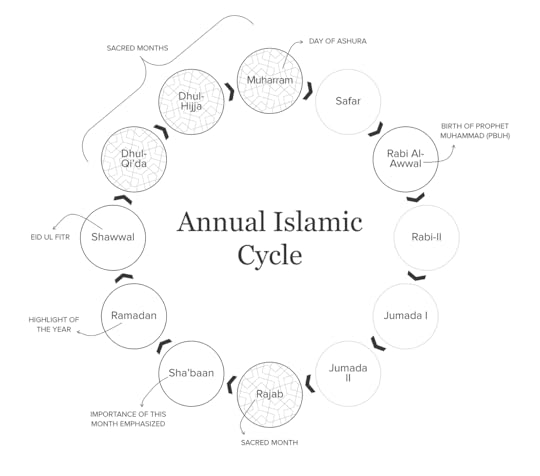
Moreover, within each month, there’s the rhythm of fasting created by the waxing and waning of the moon where we’re encouraged to fast on the White Days (the 13th, 14th, and 15th of each Islamic month) when the moon is full.
The Islamic calendar creates a spiritual rhythm to life through alternating between sacred time and non-sacred time. Moreover, the purpose of sacred time is to prepare us and purify us to be the best version of ourselves during the non-sacred time, just like the five daily prayers are meant to be daily purifiers to help us become better people outside of prayer times.
Compare the above rhythm with the flat, secular, Gregorian calendar of January, February, March, April, etc. which is devoid of any relevant meaning. Unfortunately, global corporations invest in creating special seasons around these months to drive consumer behaviors through seasonal gifts and exclusive’ deals.’ Hence we have the annual consumer cycle of New Year–> Valentine days–>Mothers day–>Fathers day–>Summer holidays–>Back to school–>Christmas etc.
Can you see how much we lose when we disregard and forget the Islamic calendar? We genuinely lose on a robust spiritual calendar that would align us to a fitra (natural disposition) lifestyle, one that is aligned with the Divine Order.
But isn’t it complicated to adopt the Islamic calendar?
Before I delve into the practical ways to align the Islamic calendar to your personal and professional life, I want to address a common argument against adopting the Islamic calendar as a primary calendar in one’s life. Mainly, that modern life is built around the Gregorian calendar. And with the challenges of accurately sighting the moon each Islamic month, it would be impractical to adopt the Islamic calendar in our personal and professional life.
There are a number of counter-arguments for this:
Let us firstly accept and submit that this is the calendar that Allah
and His Messenger chose for humanity. Therefore it must be the best calendar system to organize our life around.Early Islamic societies had to deal with the same issues of figuring out how best to align moon sightings across regions, hence the powerful scientific renaissance in Muslim lands, especially in Mathematics, Astronomy, and Geometry. This led to the adoption of a ‘civil’ Islamic calendar that was calculated astronomically and distributed across the Muslim world and an Islamic religious calendar that remained dependent on local moon sighting. With advances in technology, these two calendar systems have pretty much aligned with each other for most months (minus the annual Ramadan/Eid moon sighting debates).
If, as a community, we uphold the importance of the Islamic calendar in our lives, more serious efforts would be taken by Governments and technology companies to figure out a way to be able to use the Hijri calendar as a real alternative to the Gregorian calendar (already Apple, Google, and Microsoft allow adding the Islamic calendar to one’s digital calendar and smartphones).
Although we think that the Gregorian solar calendar is accurate, it’s not. Read the history of the Gregorian calendar and how it shifted from the Roman calendar to the Julian calendar and finally to the Gregorian calendar and the scientific, political, and religious alterations it went through. Even today, the fact we have to add an “additional day” every four years, is evidence that the solar calendar is far from accurate.
The Islamic calendar is perhaps the last institution we have as a global Muslim society that gives us a unique civilizational identity. It connects us at a deeper Ummah level – just see how the Ummah comes together during Ramadan and Hajj. This unity can be achieved outside Ramadan/Hajj by integrating our personal lives and institutions with the Islamic calendar.
My contention in this article is that we have much to lose – spiritually, psychologically, and socially – if we don’t accept the Divine calendar that Allah chose. Moreover, the pressure for a globalized “World Calendar” is far from over. I won’t be surprised if there’ll be a renewed effort towards adopting a World Calendar in the not-so-distant future. We need to start taking the revival of the Islamic calendar seriously today.
Conclusion: How to align the Islamic calendar to your personal and professional life?
I want to be clear that I’m not asking you to abandon the Gregorian calendar overnight; this will not be practical nor feasible in our modern life. However, I’m asking you to set your intentions to please Allah by aligning your life primarily to the Islamic calendar in whatever capacity you can. Itâs about living a Hijri-first lifestyle. Below are a few examples of how you can do this:
If you’re a professional, try to organize your vacations around the Islamic calendar.
If you’re a stay-at-home parent, organize kids’ activities around the Islamic calendar.
If you’re a business owner, pay your employees according to the Islamic calendar (your staff would love you since they’ll get a bonus pay every two years!).
If you’re a school principal, organize your school events around the Islamic calendar.
We can all do our bit, and it starts by setting the right intentions, taking responsibility to revive the Islamic calendar in our lives, and living by example to show others how it can be done.
My challenge to you is for the upcoming year 1442H, try to make the Islamic calendar your primary calendar in as many areas of your life as possible.
We need to start taking the revival of the Islamic calendar seriously today. My challenge to you is for the upcoming year 1442H, try to make the Islamic calendar your primary calendar in as many areas of your life as possible. Mohammed FarisClick To Tweet
References:
https://en.wikipedia.org/wiki/World_Calendar
âBy Noon Prayer: The Rhythm of Islamâ By Fadwa El Guindi
âThe Day Begins at Sunset: Perceptions of Time in the Islamic Worldâ by Barbara Freyer Stowasser
âThe Sacred Nature of the Islamic Calendarâ by Sh.AbdulHakim Murad.
Tafsir Ibn Kathir, Quran 9: 37.
Tafsir Maududi, Quran 9: 37.
The post Why The Islamic Calendar Matters More Than You Think appeared first on ProductiveMuslim.com.
July 21, 2020
The HEART of Spiritual Intelligence: How to Cultivate Hikma (Wisdom) During Uncertain Times
Maryam doesn’t seem to be managing her work/life commitments very well, especially with the unexpected COVID-19 challenges. She is a 35-year-old, 1st generation, successful Muslim professional working in a senior management role at a Fortune 10 company in Dallas, Texas. Though she is happily married with two girls, she has been experiencing major stress juggling between work, home, and self-care while trying to maintain her spiritual practices.
She wants to contribute to a financially stable household, but she is starting to lose motivation at her current job. She feels she is not able to give enough time to her girls and has not taken time out to nurture her marriage due to the daily grinds.
These challenges have become a bit more intertwined as the lines between her work and home life became blurry when she started working from home due to COVID-19. She also has her mom and in-laws at home during this quarantine period due to personal circumstances.
Maryam feels she is not her best self: she is generally more distracted, worried, on the edge, and realizes she needs to invest in herself to deal with the challenges and uncertainties more positively. She prays to Allah to grant her more Hikma (wisdom) to see the good in everything and know how to move forward in her life. But can more Hikma really help her?
[If you want to understand your own level of Hikma, take this free assessment]
What is Hikma and Why You Need it in Uncertain Times
Hikma or Wisdom from Allah is the ability to see the beauty and purpose in everything we go through in life. One of Allah Names is Al Hakeem- the All-Wise. When we trust His Wisdom and process everything through the wisdom revealed in His Book, we can gain more clarity and positivity in life.
Allah says:
âThe Most Compassionate. Taught the Quran. He created human beings. And taught him speech.â [Quran 55:1-4]
Significantly, Allah mentioned: “taught the Qur’an” even before the mention of the creation or the intelligent speech of human beings because the Quran gives humans the ultimate intelligence and guidance to deal with the ups and downs of life more gracefully. The Quranic knowledge is not only about the ‘aql or intelligence of the mind but also the spiritual intelligence of faith and guidance that is rooted in the heart.
One of the words used to describe the Quran is Al Hakeem: the wise book. Allah, The All-Wise, revealed the Quran to teach us wisdom. This type of intelligence is paramount to our success that Allah swears by it: â
 âYa, Seen. By the Quran, rich in wisdom!â [Quran 36: 1-2]
Allah revealed the ultimate wisdom or intelligence through the Divine revelations to His chosen messengers whom He instructed to teach and reflect His Hikma to people. Allah commanded the Prophet Muhammad :
âInvite to the way of your Lord with Hikma and kind teaching.â [Quran 16:125]
To revive dead hearts, guide lost people, bring certainty during the uncertainties of life, the quality Allah asked the Prophet to use was Hikma. The Beloved Prophet Muhammad not only needed to adopt a high level of wisdom when working on reviving barren hearts, but he was the perfect example of wisdom in his life dealing with all the challenges and uncertainties he faced when he started calling people to Allahâs path.
'Hikma or Wisdom from Allah SWT is the ability to see the beauty and purpose in everything we go through in life. When we trust His Wisdom, we can gain more clarity and positivity in life.' Wadud Hassan, founder of Mindfulness Matters Leadership Institute,Click To Tweet
Developing Hikma: the 6 Traits of Spiritual Intelligence
[If you want to understand your own level of Hikma, take this free assessment]
So how can we develop Spiritual Intelligence? There are 6 traits highlighted in a special chapter of the Quran where Allah teaches us wisdom through one of His chosen servants -regarded as a Prophet by some and a very special servant of Allah by others- called Luqman The wise. Allah dedicated an entire chapter of the Quran to his wisdom, Surat Luqman. Allah says:
âIndeed, We endowed Luqman with wisdom.â [Quran 31:12]
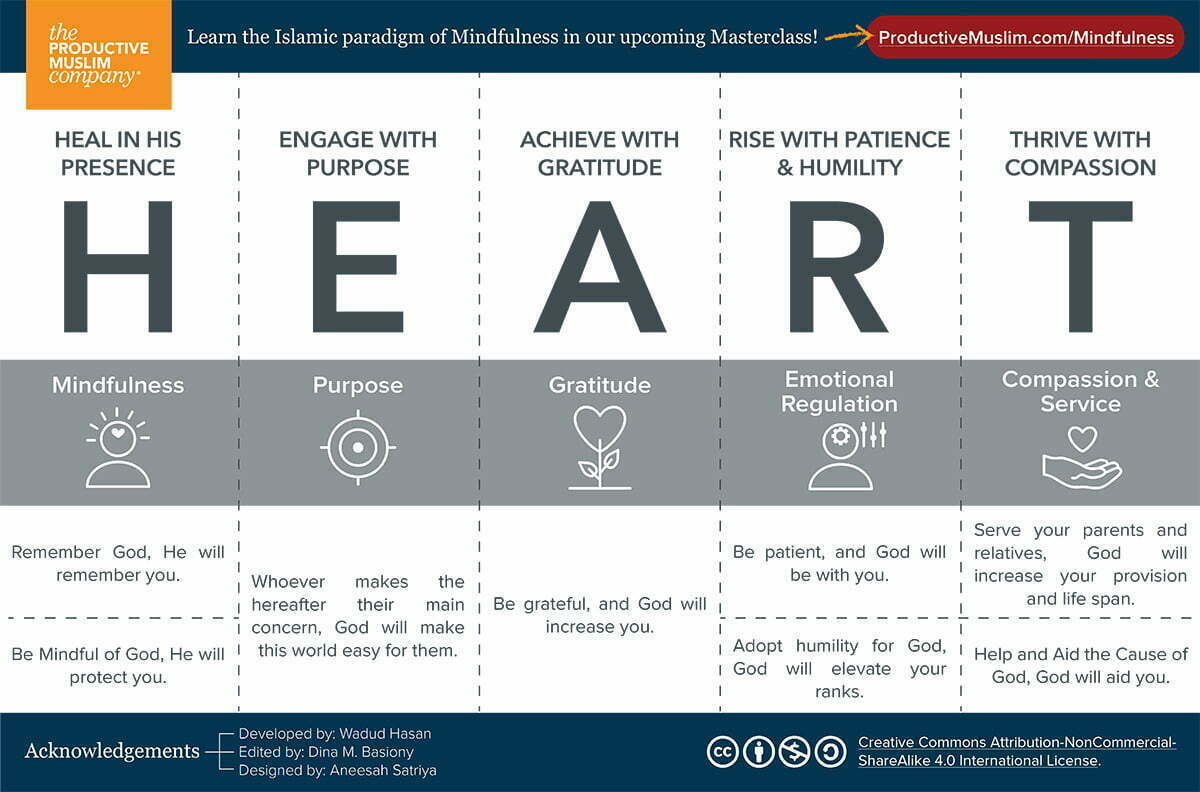
Luqman was called al Hakeem, the wise, and Surah Luqman captures his beautiful wisdom in the forms of his advice to his son. We propose the HEART of Spiritual IntelligenceTM framework here based on the advice of Luqman:
Central Message of the Verse
Quranic (Q) and Prophetic (P) Principles
H: Heal with Mindfulness of God
[31:13] Worship God Alone
Do not associate any partner with God, and it will be your right upon Him to protect you.
[31:16] Be Mindful of God, He is all aware
Remember God, He will remember you.
Quranic verse
Be Mindful of God, He will protect you.
Prophetic Hadith
[31:17] Be Excellent in Prayer
Prayer brings you under the protection of God.
Prophetic Hadith
Establish prayer, God will grant you success in everything you do.
Prophetic Hadith
Come to Salah, Come to Success.
Prophetic Hadith
E: Engage with Purpose
[31:14] God is our final destination
Whoever makes the hereafter their main concern, God will make this world easy for them.
A: Achieve with Gratitude
[31:14] Give thanks to God and your parents
Be grateful, and God will increase you.
R: Rise with Patience and Humility
[31:17] And bear with patience what befalls you
Be patient, and God will be with you.
Desire makes slaves out of kings, while patience makes kings out of slaves.
Imam Ghazzali
[31:18 -19] God does not like the arrogant
Adopt humility for God, Allah will elevate your ranks.
[31:19] Lower Your Voice
God does not give with harshness what he grants with gentleness.
T: Thrive with Compassion & Service
[31:14] Be Dutiful to Parents
The best of you is the best to his family.
Prophetic Hadith
Serve your parents and relatives, God will increase your provision and life span.
Prophetic Hadith
[31:17] Enjoin Good, Forbid Evil
Help and Aid the Cause of God, God will aid you.
Quranic verse
Benefit people and God will benefit you.
Prophetic Hadith
The heart of a believer embodies these beautiful traits of Luqman the wise as captured in the HEART of Spiritual Intelligence model. The HEART model, based on Quranic and Prophetic principles then, represents a type of intelligence that elevates a human being to the presence and pleasure of God and causes a ripple in the unseen system of God for protection, blessing, assistance, and elevation.
This Spiritual Intelligence was perfectly embodied by none other than our beloved Prophet Muhammad and here are some of those Prophetic qualities of Spiritual Intelligence you and I can strive to bring into our own lives:
1. Mindful of Allah
in everything I do:Feeling His presence in everything I do
Seeing His Wisdom and Power in all situation in life – good or bad
Experiencing tranquility in His remembrance
Transforming worries and weakness into relief and strength through reliance on Him
Turning my entire life as worship through being mindful of my intention
2. Focused on our purpose on earth so that everything is connected to:
Understanding our unique place and purpose in this world
Aligning my personal purpose with the Pleasure of Allah
Finding motivation in everything we do through my purpose
Filtering distractions and negativity by focusing on that which is best aligned to my purpose
Connecting the preparation of our return to Him and the Hereafter to everything we do
3. Deeply grateful so that we are:
Embodying an attitude of deep gratitude to God, and then parents, family, friends, and community
Internally aware of all the blessings in our life big and small, apparent and subtle, the special and the regular
Externally manifesting a radiating attitude of positivity and abundance
4. Patient and humble during difficulty and uncertainty with the highest expectation of:
Allah’s Presence
Promised Reward
Promised Relief
Using Prophetic silence to help regulate our negative thoughts, emotions
Thinking of others as better than the self, overlook their shortcomings, focus on their positive qualities,
Be humble while doing good:
Hide good deeds
Hope for Godâs acceptance and rewards
Fear our sins and shortcomings
5. Compassionate in the way I represent Allah
and His Prophet and connect with peopleReflecting the mercy Allah
Embodying the Prophet’s
compassion ofBeing a source of healing in peopleâs lives
Listening with no judgment
Making people feel safe through verbal and physical affirmation
Serving without any expectation from people and only to seek the compassion of God
âAnd whosoever is granted wisdom is indeed granted abundant good.â [Quran, 2:269]
Maryamâs Story
Applying the HEART Model
Before
After
H: Heal with Mindfulness of God
She was feeling distracted.
She is taking time out to incorporate Mindful breathing with Istighfar and Dhikr. She is treating Wudhu and Salah as spiritual self-care. She is starting to find healing in Quranic recitation and meditation. She is taking some time for only her and Allah SWT to let go, relax, find focus.
E: Engage with Purpose
She was feeling lost and confused about her meaning and purpose in life.
She is starting to look for wisdom in how everything that is happening in her life can be a way for her to get closer to Allah
. She has started reflecting and journaling to connect her values, interests, and strengths to the purpose of worshipping God, being of service to humanity, and preparing for the hereafter.A: Achieve with Gratitude
She was starting to focus on her negative thoughts and stressors in life.
She is now taking time every day to look for, reflect on, and express gratitude for all blessings â big and small.
R: Rise with Patience and Humility
She was losing her calm more often than usual.
She is taking time to pause, breathe, and make Dhikr before responding.
She realized that due to not taking time to take care of her spiritual, emotional and physical self, she started resenting others and seeing the faults in others.v
She decided to set healthy boundaries for personal self-care time and started journaling about the positive characteristics of everyone in her family. She is starting to reframe any negative thoughts into positive and saving her energy for her own self-development goals instead of trying to change or control others.
T: Thrive with Compassion & Service
She was coming across a little direct and at times not easily approachable.
She is now focusing on taking a pause before responding immediately. She is visualizing the Prophetic compassion in dealing with and serving others before taking action.
The HEART Model of Spiritual Intelligence is helping Maryam build herself up spiritually, physically, and emotionally. It’s helping her be more calm, mindful, and positive about her life instead of getting carried away by her ever-growing to-do list, demands of her home/career, and the stresses of juggling between all her roles and responsibilities.
Join our brand New âMindfulness Masterclassâ
 The ProductiveMuslim Company is pleased to present The Mindfulness Masterclass with Wadud Hassan, founder of Mindfulness Matters Leadership Institute. This is a six-week online masterclass that connects Islamic tradition with mindfulness science to help you deal with negativity, uncertainty, and the emotional rollercoasters of life. The class starts Tuesday, 21st Dhul-Hijja 1441H (11th August 2020G). Check out the program and registration details here.
The post The HEART of Spiritual Intelligence: How to Cultivate Hikma (Wisdom) During Uncertain Times appeared first on ProductiveMuslim.com.
June 30, 2020
Podcast interview: Why corporations need to adopt faith-based personal development training?
What does faith have to do with work? How can we leverage faith to allow professionals to reach peak performance without being stressed, drained, or overwhelmed?
In this interview, Mohammed Faris, CEO of the ProductiveMuslim Company shares his experience delivering corporate workshops on Barakah Culture vs. Hustle Culture.
Youâll hear first-hand stories of how his corporate clients (both in the East and the West) were skeptical about faith-based training, then ended up vouching for it.
More Interview Highlights
The Productive Muslim Company’s experience doing faith-based training in secular work environments
How to apply the barakah culture mindsets at work
How faith helps you with self-accountability
What data metrics look like in a barakah culture
Challenges of navigating career growth vs. family responsibilities
Next Steps
For Professionals: If you want to practically learn how to leverage faith and the lastest peak performance science in order to live a holistically better version of yourself spiritually, physically, and socially, then explore The Productive Muslim Masterclass. Read about its long-term impact on participants’ lives here.
For Companies: If your company is interested in helping your team and organization upgrade to a new level of performance that allows you to be productive while being fulfilled, not stressed or drained, then consult us for tailored training.
The post Podcast interview: Why corporations need to adopt faith-based personal development training? appeared first on ProductiveMuslim.com.
June 3, 2020
How Salah Will Guide Your ‘New Normal’
Every major consulting company and expert is trying to figure out what the ânew normalâ would be post-COVID19. In these moments of doubt of what the future holds, more than ever, we need to hold on to the certainties of life. One of them being Salah.
In this article, Iâll explore how Salah – the second pillar of Islam –Â can shift you from a state of confusion to assuredness, from a scarcity mindset to an abundance mindset, and from worry to hope, inshaâAllah.
A quick note before you continue reading: Salah is an obligatory act of worship upon every adult Muslim and therefore this article is not meant to undermine Salah into some form of âemotional well-being/meditationâ exercise. The purpose of this article is to showcase some of the powerful side-benefits of Salah that will deepen your experience with Salah (in addition to it being an act of worship and a gift from Allah ).
How Salah Recharges You Beyond Your Physiological Capacity
There’s a concept in peak performance science known as “Allostatic load”. The premise of this concept is that when difficulties arise in your life, there’s only so much physiological stress you can handle before you ‘switch off’, ‘burn out’, or breakdown. This constant wear and tear of our physiological capacity to handle stress is known as “Allostasis Load” and depicted in the graph below:
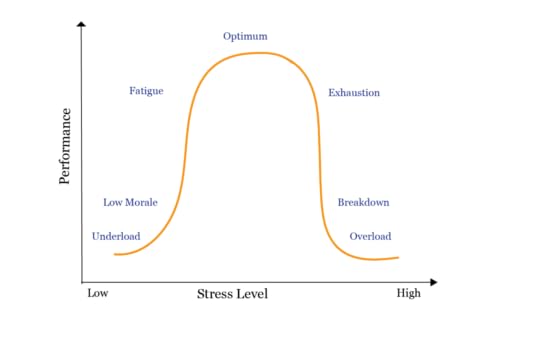 Each day – we are able to handle a certain amount of “Allostatic Load” and usually, we manage to replenish ourselves with good sleep, nutrition, and fitness. However, in extreme circumstances, e.g. war, famine, a global pandemic, the physiological stress can be so overwhelming that you start experiencing “Allostatic Overloadâ, the extreme pressure from our external realities is overburdening our internal capacity to handle them.
Allah in the Qurâan gave us two powerful tools to help us tackle difficulties in life: Sabr (Patience & Perseverance) and Salah.
ÙÙا Ø£ÙÙÙÙÙÙا اÙÙÙØ°ÙÙÙ٠آ٠ÙÙÙÙا اسÙتÙعÙÙÙÙÙا بÙاÙصÙÙبÙر٠ÙÙاÙصÙÙÙÙØ§Ø©Ù Û Ø¥ÙÙÙ٠اÙÙÙÙÙÙ Ù Ùع٠اÙصÙÙابÙرÙÙÙÙ
âO you who have believed, seek help through patience and prayer. Indeed, Allah is with the patient.â (Qurâan 2:153)
Sabr (patience/perseverance) is an internal, Barakah Culture Mindset, that you need to train yourself on and develop in life. However, Sabr can be ‘finite’ on a personal level, depending on your personal circumstances, environment, upbringing, and mental and emotional state (think about your grandparents and how much hardship they endured daily through life vs. our relatively comfortable lifestyle today). In order to increase our âSabr capacityâ, we need to connect to the second tool in the above verse, Salah.
Salah connects you to The Unlimited Source of Power -to the Divine – to help you harness spiritual energy throughout your day that you cannot get from this physical/material world. Whether youâre going through difficulties or not – Salah is your constant connection to the Divine that builds your internal capacity. This explains why Prophet Muhammad was instructed to pray additional prayers at night when he first received the revelation in order to handle the immense challenge of calling humanity to Islam:
ÙÙا Ø£ÙÙÙÙÙÙا اÙÙÙ ÙزÙÙÙ ÙÙÙÙ
ÙÙ٠٠اÙÙÙÙÙÙÙ٠إÙÙÙÙا ÙÙÙÙÙÙÙا
ÙÙÙصÙÙÙÙ٠أÙÙ٠اÙÙÙص٠٠ÙÙÙÙÙ ÙÙÙÙÙÙÙا
Ø£ÙÙ٠زÙد٠عÙÙÙÙÙÙÙ ÙÙرÙتÙÙÙ٠اÙÙÙÙرÙØ¢Ù٠تÙرÙتÙÙÙÙا
Ø¥ÙÙÙÙا سÙÙÙÙÙÙÙ٠عÙÙÙÙÙÙÙ ÙÙÙÙÙÙا Ø«ÙÙÙÙÙÙا
âO you wrapped ˹in your clothes˺!
Stand all night ˹in prayer˺ except a littleâ
˹pray˺ half the night, or a little less,
or a little moreâand recite the Quran ˹properly˺ in a measured way.
˹For˺ We will soon send upon you a weighty revelation.â (Qurâan 73: 1-5)
Building our capacity to deal with the spiritual and emotional onslaught of this pandemic – especially if it continues for a long period of time – won’t happen by us simply sleeping better, eating healthier, exercising more, or meditating to an app. We need to recognize that we need Divine Assistance every day, and especially in these circumstances, and establishing Salah in our routines is the key to bringing that Divine Assistance/Barakah into our lives.
In Times of Uncertainty, Salah Gives You Structure
We are creatures of habit. Habits give us structure; a necessary ingredient for psychological and mental stability. One of the major challenges of this pandemic is that we lost our habits and routines: we’re not commuting to work or going to school, can’t stop at our favorite restaurant for a bite, we can’t go to the gym or meet friends at a local coffee shop. This loss of habits and routines increases our anxiety because we don’t have the usual comforting sense of ânormalityâ and the usual scaffolding that gives our life structure seems to be breaking down.
This is where Salah comes in. Allah says in the Qurâan:
Ø¥ÙÙÙ٠اÙÙØ¥ÙÙسÙاÙÙ Ø®ÙÙÙÙÙ ÙÙÙÙÙعÙ
Ø¥ÙØ°Ùا Ù ÙسÙÙÙ٠اÙØ´ÙÙرÙ٠جÙزÙÙعÙا
ÙÙØ¥ÙØ°Ùا Ù ÙسÙÙÙ٠اÙÙØ®ÙÙÙر٠٠ÙÙÙÙعÙا
Ø¥ÙÙÙÙا اÙÙÙ ÙصÙÙÙÙÙÙÙ
اÙÙÙØ°ÙÙÙÙ ÙÙ٠٠عÙÙÙÙÙ° صÙÙÙاتÙÙÙ٠٠دÙائÙÙ ÙÙÙÙ
âIndeed, mankind was created anxious:
When evil touches him, impatient,
And when good touches him, withholding [of it],
Except the observers of prayer –
Those who are constant in their prayerâ (Qurâan 70: 19-23)
These five short verses of the Qurâan, capture the essence of human reality and it’s a response to the crisis now. We’re indeed full of anxiety and impatience, and we were (during the good times) ungrateful and not sharing the good with others, but there’s one group – the Qurâan promises – that won’t be in such a state and the first quality of that group is that they are those who pray constantly.
The power of Salah as a ritual is not only in the individual prayer in of itself – but it is a lifelong ritual that gives you structure, discipline, and comfort despite your circumstances. Whether you’re happy or sad, going through successes or failures, facing the death of a family member or the birth of a new child, you keep up praying five times a day.
In his book “Uncertainty”, Jonathan Fields talks about the importance of rituals and routines to help us deal with the uncertainty of life. And although many people are trying to re-introduce habits and routines in their lives (exercising at home, virtual coffee meetups with friends, etc) there’s a certain level of comfort and grounding that Salah provides that’s unmatched with any other habit or routine. And because itâs obligatory (i.e. you have to pray whether you feel like it or not), it is the anchor in your life, without which, you’ll constantly feel at loss. As one Productive Muslim Retreat participant once told me after realizing the importance of Salah in her life: âI need to pray, this was the missing anchor in my life, I realize I was floating without itâ.
Nothing can be more powerful in the face of uncertainty – than the certainty that “it’s time to pray” and you’ll have to stand in front of Allah and be present.
'The power of Salah as a ritual is not only in the individual prayer in of itself â but it is a lifelong ritual that gives you structure, discipline, and comfort despite your circumstances.' Mohammed Faris, CEO, The Productive Muslim Company Click To Tweet
How Salah Teaches Us to Be Present Despite the Distractions
One of the hidden victims of the global pandemic is our collective human focus. Although we’ve been slowly losing focus over the years due to the abundance of distractions through social media and phones, this global pandemic threw a spanner in the wheels of focus and our minds are spiraling out of control. From trying to figure out how to secure groceries, to worrying about our jobs and family. We are drowning in external and internal distractions that are making it hard to focus or be present.
Enter Salah. A simple, quiet ritual that asks you to ‘step out’ of your world and ‘step into’ a different dimension – the Dimension and Presence of the Divine . You stand there, facing one direction (the direction of Makkah), worshipping One Lord, in compliance with His Final Messenger – Prophet Muhammad (Peace be upon him). You don’t look right or left. But you’re there, in the moment – reciting, bowing, prostrating, glorifying, supplicating, and yes perhaps even crying. Then you exit the Salah – renewed, rejuvenated, mindfully present and ready to face the world.
This ability to ‘switch’ dimensions – from worldly, ego-centric focus (my to-dos, emails, family, groceries, etc) to a hereafter, Allah-centric focus is an extremely powerful skill that would help break through the cycle of distraction, anxiety, and purposelessness that this pandemic is throwing at us. Moreover, from a neuroscience perspective, this ability to switch from a narrow “Task Mode Network” way of thinking (e.g. I need to send this email) and into an expansive, out of this world “Default Mode Network” (Subhana Rabbia Al-A’la (How Perfect is Allah My Lord, the Most High), opens new horizons of thinking and contemplation that helps you see the Barakah and silver lining even in the direst of circumstances.
Salah is our key to being mindfully present on-demand, and it’s a blessing that we are invited to be in that state of presence and connection with the Divine at least 5 times a day. Read the following hadith, and approach your next prayer with the mindset that Salah is a conversation between you and Allah :
The Messenger of Allah said that Allah the Exalted had said: âI have divided the prayer into two halves between Me and My servant, and My servant will receive what he asks. When the servant says: Praise be to Allah, the Lord of the universe, Allah the Most High says: My servant has praised Me. And when he (the servant) says: The Most Compassionate, the Merciful, Allah the Most High says: My servant has lauded Me. And when he (the servant) says: Master of the Day of judgment, He remarks: My servant has entrusted (his affairs) to Me. And when he (the worshipper) says: You alone we worship and of You alone do we ask help, He (Allah) says: This is between Me and My servant, and My servant will receive what he asks for. Then, when he (the worshipper) says: Guide us to the straight path, the path of those to whom You has been Gracious not of those who have incurred Your displeasure, nor of those who have gone astray, He (Allah) says: This is for My servant, and My servant will receive what he asks for.â [Sahih Muslim]
'Salah is our key to being mindfully present on-demand, and itâs a blessing that we are invited to be in that state of presence and connection with the Divine at least 5 times a day.' Mohammed Faris, CEO, The Productive Muslim Company Click To Tweet
Salah Builds Your Grit/Resilience Capacity
You may have just lost a loved one due to COVID-19 or got the dreaded email from your boss that due to cost-cutting measures, the company is letting you go, or that big important client you were banking on, just canceled your contract due to cuts in budgets.
In the midst of your worry and concern, you hear the call to prayer, or your phone beeps to remind you it’s prayer time. You get up, make ablution, stand in front of Allah , and one of the first few words you say is:
اÙÙØÙÙ Ùد٠ÙÙÙÙÙÙ٠رÙبÙ٠اÙÙعÙاÙÙÙ ÙÙÙÙ
“Alhamdulillah Rabbi Al-Alamin..”
â[All] praise is [due] to Allah, Lord of the worlds -â (Qurâan 1:2)
You are expressing gratitude in the midst of these circumstances. At first, you’re not sure how you feel, but then you repeat this verse again and the feeling of gratitude starts to overwhelm you: You feel grateful for what He has blessed you with despite the circumstances, you feel grateful for having Faith even when the world around you is losing faith, and you feel grateful for the blessing of Salah that gives you solace and comfort every day.
This gratitude thatâs brought forth through Salah, coupled with the humility one feels in front of Allah through the bowing and prostrating, helps you recognize that you’re His slave and that He’s in Control. Once that recognition is internalized, it leads to building a unique form of resilience, that’s not ego-centered and reliant upon the self, but resilience that’s for Allah: beautiful, full of adab (respect/politeness), and sees nothing is âimpossibleâ.
This resilience is built through constant Salah hence why the verse above about Sabr and Salah was followed with verses that remind people about how to react when the tough get going:
ÙÙÙÙÙÙبÙÙÙÙÙÙÙÙÙÙ٠بÙØ´ÙÙÙØ¡Ù Ù ÙÙÙ٠اÙÙØ®ÙÙÙÙÙ ÙÙاÙÙجÙÙع٠ÙÙÙÙÙÙص٠٠ÙÙÙ٠اÙÙØ£ÙÙ ÙÙÙاÙÙ ÙÙاÙÙØ£ÙÙÙÙس٠ÙÙاÙØ«ÙÙÙ ÙرÙØ§ØªÙ Û ÙÙبÙØ´ÙÙر٠اÙصÙÙابÙرÙÙÙÙ
اÙÙÙØ°ÙÙÙ٠إÙØ°Ùا Ø£ÙصÙابÙتÙÙÙÙ Ù ÙÙصÙÙبÙØ©Ù ÙÙاÙÙÙا Ø¥ÙÙÙÙا ÙÙÙÙÙÙÙ ÙÙØ¥ÙÙÙÙا Ø¥ÙÙÙÙÙÙ٠رÙاجÙعÙÙÙÙ
Ø£ÙÙÙÙٰئÙÙ٠عÙÙÙÙÙÙÙ٠٠صÙÙÙÙÙات٠٠ÙÙ٠رÙÙبÙÙÙÙÙ Ù ÙÙرÙØÙÙ ÙØ©Ù Û ÙÙØ£ÙÙÙÙٰئÙÙÙ ÙÙ٠٠اÙÙÙ ÙÙÙتÙدÙÙÙÙ
And We will surely test you with something of fear and hunger and a loss of wealth and lives and fruits, but give good tidings to the patient,Who, when disaster strikes them, say, “Indeed we belong to Allah, and indeed to Him we will return.” Those are the ones upon whom are blessings from their Lord and mercy. And it is those who are the [rightly] guided. (Qurâan 2: 155-157)
Notice how we’re currently experiencing every form of the above trials in this global pandemic:
fear- check.
hunger – check.
loss of wealth, lives, and fruits (which include the fruit of our productivity) check, check, check.
But here Allah gives us glad tidings to those who “when disaster strikes” they turn to their Allah – not just in words, but also in Salah as the beginning of these verses reminds us.
And notice in the verse above, the beautiful reciprocity from Allah ; because we turn to Him with Patience and Salah, He turns to us with “Salawat” blessings and Mercy.
What more can a person want in a moment of difficulty like these than Divine Blessings and Mercy?
How Salah Helps You Push Forward with Purpose and Guaranteed Success
Imagine you just joined a new company, and on the first day at work, the CEO of the company invites you to their office and shares this news with you: “I want you to be the next CEO of this company. You’ve all what it takes and I’m sure that you’ll be in my seat one day”. What would your reaction be? How hard will you work for the company?
Allah
ÙÙد٠أÙÙÙÙÙØ٠اÙÙÙ ÙؤÙÙ ÙÙÙÙÙÙ
اÙÙÙØ°ÙÙÙÙ ÙÙÙ Ù ÙÙ٠صÙÙÙاتÙÙÙÙ Ù Ø®ÙاشÙعÙÙÙÙ
Successful indeed are the believers:
those who humble themselves in prayer; (Qurâan 23: 1-2)
Believers have succeeded. It’s guaranteed. Done.
You are successful despite the global pandemic. You are successful despite your job loss. You are successful despite your health challenges. You are successful. Think about the impact of believing you’re a success despite the circumstances.
But there are conditions for that success – the first one is to establish focused Salah in your life.
Salah is your key to success. Haven’t you heard the Adhan (call to prayer) call you “Come to Prayer, Come to Success”? This is Salah.
For so long, we’ve disconnected between “come to prayer” and “come to success”. We think that prayer is something that has nothing to do with success in life but as the verses above remind us, Salah is the prerequisite of success.
And it’s not any success, but true abundant immeasurable “Falah” in this life and the next. Yes, you might have setbacks in your life, but if you maintain your Salah, along with other qualities, you’ll achieve Falah.
And here’s the subtle but beautiful meaning in the choice of the word “Falah” for success. It’s very close to the name given for a farmer in Arabic “Fallah”.This reminds us to adopt the Gardener Mindset, have sincere intentions, work hard in the field of life, connect to the Divine through Salah, perfect our character, and inshaâAllah we’ll experience Falah beyond our wildest imagination.
Practical Resources to Deepen Your Salah
We hope that this article renewed your love and passion for the beautiful ritual of Salah. If you want to go deeper into the meaning of Salah and how to increase your focus, and understanding of each aspect of Salah, consider joining one of the following programs below. If you know of additional programs, please share them in the comments below:
Meaningful Prayer: A course on the vocabulary & linguistic beauty of Salah by Qalam Institute
An Introduction to the Meanings of Prayer: An introduction to the various aspects and mysteries of the ritual prayer (salat) and how they relate to contemporary life by Cambridge Muslim College
Share your story! How is Salah helping you define your new normal?
As part of our ongoing research on the power of Salah in our personal and professional lives, I would love to hear some stories from you on how Salah is helping you find a ‘new normal’ in these tough times. Please share them below in the comments and let us inspire each other to be of those who are constantly in Prayer.
The post How Salah Will Guide Your ‘New Normal’ appeared first on ProductiveMuslim.com.
April 18, 2020
Surat Al-Mulk: A Spiritual Antidote to the Global Pandemic
In this global pandemic, it is understandable that we have fears and anxieties. Reflecting on the current situation and the way out of this global crisis can make us feel overwhelmed. But is there a way to find peace, perspective and balance in approaching this situation?
This is what Surat Al Mulk (âThe Sovereignty’ Chapter 67 of the Qurâan) presents; it gives a powerful perspective and a means to find peace and answers to many of the fears and uncertainties ahead. In this article, we’ll share a few thoughts and lessons inspired by this Chapter.
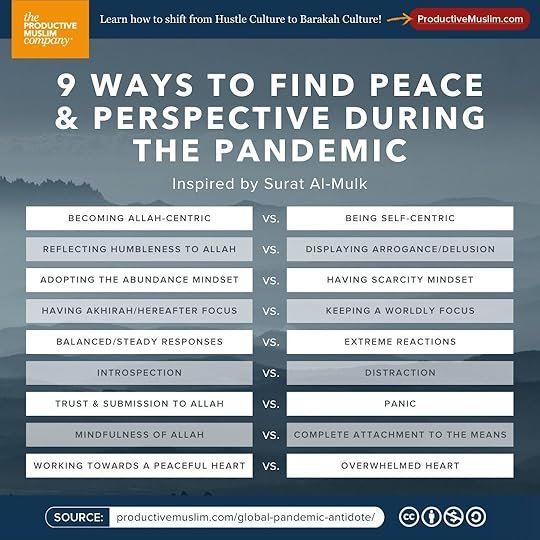
A Mindset Shift: Give up Control to The One in Control
تÙبÙارÙÙ٠اÙÙÙØ°Ù٠بÙÙÙدÙÙ٠اÙÙÙ ÙÙÙÙÙ ÙÙÙÙÙ٠عÙÙÙÙ ÙÙÙÙÙ Ø´ÙÙÙØ¡Ù ÙÙدÙÙرÙ
âExalted (Blessed) is He who holds all control in His Hand; and He has power over all thingsâ (Qur’an 67: 1)
On March 29, The Director-General of the World Health Organisation tweeted one word commenting on the global pandemic, and that was âHumilityâ. He explained in a later conference that this pandemic made us realize how vulnerable we all are. We are not in control, so we have to be humble. Even the worldâs greatest powers are humbled. Which world leader, king or CEO can come out and comfortably say, âdonât worry, I have everything under controlâ? None.
The first word of Surat Al-Mulk in Arabic is often translated to blessed or exalted. Yet, the word âTabarakaâ, is a superlative form for the word âBarakahâ that contains all meanings of exaltation, greatness, abundance, and permanence of virtues and excellences. When this superlative form of Barakah is describing God, it means He is Unlimitedly Superior over everything else in His creation, He has complete control and the entire dominion of the universe is in His grip.
Why is this relevant?
Humility
â Tedros Adhanom Ghebreyesus (@DrTedros) March 29, 2020
One of the primary Barakah Culture mindsets we promote at Productive Muslim Company is: being Allah-centric versus being Self/Ego-centric. This is important now more than ever as weâve realized how the self is limited and how incapable it is to deal with inevitable matters beyond our human capacity. If matters were strictly in the hands of our limited worldly means, we should certainly panic. But when we are directed to the Unlimited, we experience peace and tranquility knowing that He is capable over all things.
Before this pandemic, many of us were centering our lives around mini-gods we created and served with our time and utmost attention, like our work and relationships. Yet all these things are now submitting to new realities beyond their control. That career which was making us miss prayers, disconnect with our family, and be busy in the “rat race” of life is now potentially not going to survive this pandemic. Those social relationships which made us neglect our values all in the name of “fitting in” may not be accessible for a long time. It’s as if we’re being directed to let go of these ‘mini-gods’ and instead connect and pray to The One True God, Who’s truly in control. We realize the helplessness of all that we felt was important before, and we turn for help, peace and a feeling of vastness and abundance from The Vast, The All-Capable. When we align our will with The Will of the One in control, it can lift much of the fear and burden we experience.
âAnd it is Allahâs Will to lighten your burdens, for humankind was created weak.â (Qurâan 4: 28)
Lesson #1: Be Allah-Centric, not self-centric. The whole world from the East to the West is in His Hand. When we align with The One in control, the Capable Owner, not the limited creatures, this will give peace and alleviate much of our panic, stress, and anxiety.
'If matters were strictly in the hands of the limited worldly means, we can certainly panic. But when we are directed to the Unlimited, we experience peace and tranquility knowing that He is Capable over all things.' Dina Mohamed BasionyClick To Tweet
Dealing with the Fear of Death
اÙÙÙØ°ÙÙ Ø®ÙÙÙÙ٠اÙÙÙ ÙÙÙت٠ÙÙاÙÙØÙÙÙاة٠ÙÙÙÙبÙÙÙÙÙÙÙ٠٠أÙÙÙÙÙÙ٠٠أÙØÙسÙÙ٠عÙÙ ÙÙÙا ÙÙÙÙÙ٠اÙÙعÙزÙÙز٠اÙÙغÙÙÙÙرÙ
â[He] who created death and life to test you [as to] which of you is best in deed – and He is the Exalted in Might, the Most Forgiving -â (Qurâan 67: 2)
The modern world has difficulty processing death and is obsessed with Life. Yet, Allah highlights in this verse that He created death before He created life. The time, date, and scenario of our death have been decreed by the Creator before He breathed life into our bodies. In a hadith, narrated Abdullah bin Mas`ud, that âThe Messenger of God Muhammad, the true and truly inspired, narrated to us:
Verily the creation of each one of you is brought together in his motherâs womb for 40 days in the form of a nutfah (a drop), then he becomes an alaqah (clot of blood) for a like period, then a mudghah (morsel of flesh) for a like period. Then an angel is sent to him (by Allah) and the angel is allowed (ordered) to write four things; his rizq (sustenance), his (date of) death, his actions, and whether he will be a wretched one or a blessed one and then the soul is breathed into him.â [Sahih Al Bukhari]
This is an important reminder: The Coronavirus will not create anyoneâs death beyond the decree of the Creator Himself. It will not speed up or delay our death; our death date has already been decided before our souls were breathed into us. This necessitates that we donât panic over the Coronavirus itself. But to benefit from the pandemic as a strong reminder of the closeness of death.
When we are afraid and panicking over our lives and/or our loved onesâ life, what we can do is turn to the Creator of death and life remembering that He is The Incomparably Merciful and Compassionate. And we ask Him âO Allah, if you have decreed that this is the time for me/my parents/my children to return back to You, then descend upon us Your mercy and reassure our hearts, and make our meeting with You the best day weâve ever lived. And if you know that it is best for us to remain alive and increase in good actions in this life, then, give us steadfastness and enable us to do what is best for us to do in this life and protect us the way You protect your closest slavesâ.
Acknowledging that Death has been decided for us is to acknowledge that this life is not the end. It is a phase. And the phase must end sooner or later, so we accept that in peace and get ready and look forward to the coming eternal period. This is living with an Akhirah/Hereafter-focus (another Barakah Culture Mindset).
When we die, we go back to Allah, the Creator whose Beautiful Names include The Incomparably Merciful, The Source of Beauty, Light, Peace, Affection, Generosity. Going back to Allah is not a source of panic, rather it’s the ultimate moment of peace. As the Prophet taught: âNone of you should die but hoping only good from Allah, the Exalted and Glorious.â [Sahih Muslim]
Lesson #2: Be-Akhira Centered and not Worldly-Focused. When we remember that death is not created by Corona, but created by Allah, we donât overly fear Corona, but we take the necessary precautionary measures and turn to Allah. We only need to do as much good as we can do, and surrender to Him, and He is The Most Generous and Most Forgiving towards those who surrender to Him.
'The Coronavirus will not create anyoneâs death beyond the decree of the Creator Himself. It will not speed up or delay our death; our death date has already been decided before our souls were breathed into us.' Dina Mohamed BasionyClick To Tweet
Dealing with Panic over Safety & Security
Ø£ÙÙ ÙÙÙÙ ÙÙØ°Ùا اÙÙÙØ°ÙÙ ÙÙÙ٠جÙÙÙد٠ÙÙÙÙÙ Ù ÙÙÙÙصÙرÙÙÙÙ Ù Ù ÙÙ٠دÙÙÙ٠اÙرÙÙØÙÙ ÙÙ٠إÙÙ٠اÙÙÙÙاÙÙرÙÙÙ٠إÙÙÙÙا ÙÙ٠غÙرÙÙرÙ
âOr who is it that could be an army for you to aid you other than the Most Merciful? The disbelievers are not but in delusion.â (Qurâan 67: 20)
The greatest countries of the world have spent fortunes on armies and weapons, but all of this is not helping them fight an enemy so small that it canât be seen with the naked eye.
âOr who is it that could be an army for you to aid you other than the Most Merciful?â
There is no army, no guns and no tanks that can help anyone if Allah decided to affect them with the disease. Weâve seen people who have all the power and means to protect themselves still get affected, and weâve seen others with very humble resources remaining safe.
The Prophet explains â(There is) no ‘Adwa (no contagious disease that is conveyed without Allah’s permission).â [Sahih Al Bukhari]
This means that no disease will decide on its own who to infect beyond the permission and decree of Allah . The matter is beyond the calculated human control. These reminders are a means for people to reflect, turn to Allah and overcome their self-centeredness.
On the authority of Abu Abbas Abdullah bin Abbas who said âOne day I was behind the Prophet [riding on the same mount] and he said,
âO young man, I shall teach you some words [of advice]: Be mindful of Allah and Allah will protect you. Be mindful of Allah and you will find Him in front of you. If you ask, then ask Allah [alone]; and if you seek help, then seek help from Allah [alone]. And know that if the nation were to gather together to benefit you with anything, they would not benefit you except with what Allah had already prescribed for you. And if they were to gather together to harm you with anything, they would not harm you except with what Allah had already prescribed against you. The pens have been lifted and the pages have dried.â [Tirmidhi]
Lesson #3: Take the means but donât be attached to the outcomes/results, and increase your mindfulness of Allah. This is a reminder to reclaim our sense of humility instead of arrogance over our means and resources because weâve seen how the strongest of means can stand helpless if Allah wills.
Dealing with Fear over Scarcity of Resources & Provision
Ø£ÙÙ ÙÙÙÙ ÙÙØ°Ùا اÙÙÙØ°ÙÙ ÙÙرÙزÙÙÙÙÙ٠٠إÙÙ٠أÙÙ ÙسÙÙ٠رÙزÙÙÙÙ٠بÙÙÙ ÙÙجÙÙÙا ÙÙ٠عÙتÙÙÙÙ ÙÙÙÙÙÙÙرÙ
âOr who can provide for you if He withholds His provision? Yet they persist in their insolence and their avoidance of the Truth.â (Qurâan 67: 21)
The fear over the scarcity of resources and provision has led many people to hoard goods and empty supermarketsâ shelves. Peopleâs fears are understandable, some have kids or old parents and are afraid of not being able to go out if they have to quarantine themselves. On a more grand scale, with a looming global recession, there are legitimate fears of losing one’s job and means of income.
Itâs in the human instinct to hoard things and fear uncertainty, yet the above verse reminds us to embrace the abundance mindset knowing that sustenance is not confined by worldly resources, rather it comes from Allah .
One man came to the Prophet
This is the abundance-mindset. Our hearts should not be attached to whatâs on the supermarket shelves or any worldly provider, our hearts should be attached to the endless source, The One who provides from the heavens and the earth, and He is unboundedly and unlimitedly Vast and never affected by any circumstances.
To bring this meaning closer, in a powerful hadith, the Prophet narrates that Allah Almighty says:
âO My servants, if the first of you and the last of you, and the humans of you and the jinn of you, were all to stand together in one place and ask of Me, and I were to give everyone what he requested, then that would not decrease what I Possess, except what is decreased of the ocean when a needle is dipped into it.â [Muslim]
This is why the Prophet said that giving is a sign of faith because panic and withholding means one only sees worldly providers and disregards the Unlimited Source of Provision.
A man asked the Messenger of Allah Muhammad
And he also said,
“[…] charity is a proof (of oneâs faith), and patience is illumination, and the Qurâan is a proof either for you or against you. Every person starts his day as a vendor of his soul, either freeing it or causing its ruin.â [Muslim]
So, this is the time to believe in Allah and adopt the abundance mindset – especially with the month of Ramadan ahead of us – and in doing so, you will see how much vastness will enter your heart and life. The Prophet said: “If you all depend on Allah with due reliance, He would certainly give you provision as He gives it to birds who go forth hungry in the morning and return with a full belly at dusk”.
Lesson #4: Attach your heart to Allah and give. ÙAllah Almighty says in a Hadith Qudsi: âSpend (on charity), O son of Adam, and I shall spend on you.â [Bukhari and Muslim].The worldly resources are not our sole providers, they’re just means, our sustenance comes from above unlimitedly through Allah. Allah can open and create means where you couldnât imagine and couldnât expect.
Remembering our Ultimate Destination and Moving Steadfastly Towards It
Ø£ÙÙÙÙ ÙÙÙ ÙÙÙ ÙØ´ÙÙ Ù ÙÙÙبÙÙا عÙÙÙÙ ÙÙجÙÙÙÙ٠أÙÙÙدÙ٠أÙÙ ÙÙÙÙ ÙÙÙ ÙØ´Ù٠سÙÙÙÙÙÙا عÙÙÙ٠صÙرÙاط٠٠ÙسÙتÙÙÙÙÙ Ù
âWho is better guided: someone who falls on his face, or someone who walks steadily on a straight path?â (Qurâan 67: 22)
Because of the fear and uncertainty of the global pandemic, many people have found themselves panicking or feeling low and depressed. We need to challenge ourselves and truly recognize that this world is not the end. Weâre not going to stay here forever. This shall pass, like everything else.
Life is a journey; any journey has paths. And the straight path has a clear beginning and an end. In Islamic theology, Allah reminds us that we come from Him and weâre journeying back to Him; this reminder in times of difficulty is important because it brings to our attention the destination and that whatever weâre in is just one stop, not the final point.
âWe will certainly test you with a touch of fear and famine and loss of property, life, and crops. And give good news to those who patiently endureâwho, when faced with a disaster, say, âIndeed we belong to Allah and indeed to Him we will [all] returnâ Those are the ones upon whom are blessings from their Lord and mercy. And it is those who are rightly guided.â (Qurâan 2: 155-157)
Additionally, the straight path is in the middle of two extremes. one neither reacts with extreme hopelessness nor extreme indifference and obliviousness. The straight path is about balance and moderation in feelings and actions while moving steadily towards our ultimate destination.
The emotional and spiritual impact of remembering the destination is that one feels a sense of relief from sadness. Not necessarily because the situation has ended, but because regardless of how bad it is, it’s not the end. Therefore, the person gets internally strengthened and comforted due to connecting their hearts and souls with their Creator and remembering the vast relief that He has prepared in the destination to come.
âAs for those who say, âOur Lord is Allah,â and take the straight path towards Him, the angels come down to them and say, âHave no fear or grief, but rejoice in the good news of Paradise, which you have been promised. We [angels] are your allies in the worldly life and [are so] in the Hereafter. And you will have therein whatever your souls desire, and you will have therein whatever you request [or wish]â (Qurâan 41: 30-31)
Lesson #5: Look up to Him and have hope in Him and keep moving towards Him. Try not to spend too much time looking down in this world and getting absorbed in sadness, stress, and anxiety over matters beyond your control (and certainly donât look down to your phones and get sucked into endless cycles of negativity). Do as much as you can and leave the rest to Him.
Finding Mercy and Peace in the Trust & Submission
ÙÙÙÙ ÙÙÙ٠اÙرÙÙØÙÙ ÙÙ٠آ٠ÙÙÙÙا بÙÙÙ ÙÙعÙÙÙÙÙÙ٠تÙÙÙÙÙÙÙÙÙÙا ÙÙسÙتÙعÙÙÙÙ ÙÙÙÙ Ù ÙÙÙ ÙÙÙÙ ÙÙ٠ضÙÙÙاÙÙ Ù ÙبÙÙÙÙ
âSay, “He is the Most Merciful; we believe in Him and we put our trust in Himâ¦â (Qurâan 67: 29)
The Name of Allah that He chose to use in the above verse is Ar-Rahman, it is a superlative form of Merciful. It means the incomparably Merciful. The name of the womb in Arabic اÙرØÙ is extracted from this specific Name of Allah, Ar-Rahman اÙرØÙ Ù.Â
‘Abdur-Rahman bin ‘Awf’ said: ‘I heard the Messenger of Allah saying: “Allah, Most Blessed and Most High, said: ‘I am Allah, and I am Ar-Rahman. I created the Rahim (womb) and named it after My Name.…'” [Jamiâ at-Tirmidhi]Â
In the aforementioned verse, we are asked to say that we rely upon and put our trust in Ar-Rahman. If we reflect on this early stage of the womb: who was supporting the child in its motherâs womb? Who was feeding it and moving it around and taking care of it completely? It is Ar-Rahman. Even the mother, the most merciful upon her child, was not able to plan and do that on her own. It was a matter left to Allah to create all conditions of comfort for the childâs sustenance and survival in the motherâs womb, and He completely took care of that.Â
This is The One we believe in and trust now. And He is perfectly capable of taking care of us now like He’s taken care of us before.
Lesson #6: In remembering the vastness of His mercy, one can submit and trust in peace.
Does this mean we ignore public health measures?
Of course not. We are rewarded to take the means. And all the means that Allah has presented to us are part of His Mercy. The Prophet has instructed quarantine, not placing a patient with a healthy person and regular hygiene as precautionary measures. Another holistic perspective is what the Prophet taught in this hadith, for example, narrated ‘Uqbah bin ‘Amir :
âI asked the Messenger of Allah (ï·º), “How can salvation be achieved?” He replied, “Control your tongue, keep to your house, and weep over your sins.” [At-Tirmidhi].
The advice here canât be more relevant today:
âKeep to your house/Stay at home: This is the global request of health officials, and it has been recommended by the Prophet 1400 years ago. Staying at home allows one to collect his thoughts and emotions, and protect himself and others from any potential harm. â
Holdâ âyourâ âtongue: Neither flood others with every thought you have, nor open your soul to receiving every thought they present thus overwhelming and stressing your soul. Phone addiction and 24h exposure to media can be very troubling to the soul. Instead, make it a time of peace by unfollowing toxic/unfruitful content, and embrace the quietness and what itâs meant to bring internally.
Regret your sins/Cry over your sins: Just like the body is purified with water, the soul is purified with tears; the sincere humble tears of acknowledging one’s weakness and shortcomings. This humility brings in the powerful aid of The All-Powerful, The Most Merciful Himself. As the Prophet said, “no one will humble himself for Allahâs sake except that Allah raises his status.”
The imposed confinement and quietness we’re in calls for introspection and self-accountability. It opens room for reflection on oneâs purpose in life, shortcomings âandâ âthe way forward to mend one’s â âaffairsâ and evolve from this situation as a better version of oneself. â
The purpose of this article is not to negate the importance of taking the means, rather itâs about balancing between taking the physical means whileâ âconnectingâ âtheâ âheartâ âtoâ âTheâ Wise, All-Capable âHealerâ âHimself. This is a holistic approach that serves the body while attending to the needs of the soul, thus providing the much-needed balance, peace, and tranquility.
Final Thoughts
Before this pandemic, we were hustling. We were rushing, we were not being present in the moment. But now weâre in lockdown. The whole world is in lockdown. Allah has limited our bodies so that our hearts can move.
This is the time to return home in the physical and spiritual sense. Return home with our bodies, and return to Allah with our souls, because our souls too need to connect with its home.
“Indeed we belong to Allah and indeed to Him we will return”
âThose who have faith and whose hearts find peace in the remembrance of Allah- truly it is in the remembrance of Allah that hearts find peaceâ (Qurâan 13: 28)
The post Surat Al-Mulk: A Spiritual Antidote to the Global Pandemic appeared first on ProductiveMuslim.com.