Mohammed Faris's Blog, page 6
March 26, 2020
[The Productive Muslim Masterclass Commences 4th April 2020] How this Masterclass Will Help You Live the Next Best Version of Yourself Across All Your Roles
What does it take to live the next best version of yourself across all your roles in life? What are you doing now to practically actualize your purpose as a true ‘abd (slave of Allah) and live a meaningfully productive life spiritually, physically and socially? How do you practically aim for success in this world and success in the hereafter without feeling lost, stressed or overwhelmed?Â
This is exactly why the Productive Muslim masterclass can be a turning point in your self-development journey, with the Will of Allah. The Productive Muslim Masterclass combines over 10 years of experience in productivity and peak performance science along with the Islamic knowledge that helps people live the best version of themselves spiritually, physically and socially.
Spare just 17 mins to listen to this powerful presentation by Mohammed Faris, CEO, and Founder of the Productive Muslim Company, as he walks you through exactly what will be covered in this transformative 6-week program, and how it can practically help you make smart choices to upgrade to the next best version of yourself.

How can I develop the next best version of myself?
To consciously move towards your next best version, you need to master 3 things:
Master your energy
Master your focus
Master your time
These are the pillars of Productivity. Only by mastering these 3 pillars, will you be able to live your best life spiritually, physically & socially. Our live online masterclass will help you learn the practical hands-on skills you need to master the above 3 pillars from a faith-perspective as well as peak performance science perspective.
Visit the Masterclass Graduates’ Stories Page to watch and read inspiring stories from former graduates.
The next masterclass will commence on Saturday, 4th April 2020 (19th Shaâbaan 1441H) God-willing. Register Now Here.
The post [The Productive Muslim Masterclass Commences 4th April 2020] How this Masterclass Will Help You Live the Next Best Version of Yourself Across All Your Roles appeared first on ProductiveMuslim.com.


March 21, 2020
[Download Free Planners] Experience Barakah in your Planning without Overwhelm or Stress!
At the ProductiveMuslim Company, we promote the Barakah Culture model of productivity that helps people live the best version of themselves spiritually, physically and socially without stress, anxiety or overwhelm.
Among the Barakah Culture rituals we introduced in our Barakah Culture Cards is “Praiseworthy Planning”. Simply put, it’s about linking good intentions to your daily/weekly/life plans and having complete trust in Allah  in the outcome and results.
To achieve praiseworthy planning, we’ve developed our new free PDF planners to help you with your daily, weekly and routine planning, as well as with tracking your habits. Click here to download them all today.
For more guidance on how to use these tools, we’ve recorded the videos below explaining in detail the rationale behind the planners and how to reap the most results from using them, with the Will and Permission of Almighty Allah .
So, feel free to download and print the planners, watch the short tutorial videos below, and definitely share this resource with all your friends, colleagues and family members who can benefit from these free essential tools in their lives.
Download all planners here
How to Use the Daily Planner
How to use the Weekly Planner
How to use the Habit Tracker
How to use the Routine Planner
If you found these resources beneficial, then do not forget to share them with those who can benefit. Send people this link and spread the Barakah!
Want to unlock your power within?
Join our upcoming 6-week Masterclass to learn practical strategies for tapping into the power within the Quran, Sunnah, and Peak Performance science to live the best version of yourself.
Register Now
The post [Download Free Planners] Experience Barakah in your Planning without Overwhelm or Stress! appeared first on ProductiveMuslim.com.
January 31, 2020
#TravelingWhileMuslim: A Practical Guide for Muslim Business Travelers
As a business traveler, I travel frequently within the USA and abroad. Sometimes, practicing Islam during frequent business travels in non-Muslim majority countries (like the USA) can appear to be challenging for the Muslim professional.
Modern-day business travel is harrying enough for professionals, especially IT executives. On a typical travel day, I run through an airport to catch a flight, work on my upcoming presentation/proposal on the flight, pick up some airport food upon landing, hurry to catch a cab ride to the customer office, then lead a multi-hour workshop with demanding customers, and then sometimes rush back to the airport to catch a flight to the next destination. And, not to mention, I am on multiple business conference calls during the day (typically during the cab rides and waits in the airports while I am eating, as well as have a growing backlog of emails (and/or SMS/voicemails) to read/listen and respond to.
' Modern-day business travel is harrying enough for professionals, on top of this as Muslims we also have to worry about prayers (salah) on time, finding halal food at odd places like airports and address issues of Islamic cleanliness' Shamim AhmedClick To Tweet
On top of this, as Muslims, we also have to worry about daily obligatory prayers (salah) on time (amid travels and business meetings), finding appropriate halal food at odd places like airports and address issues of Islamic cleanliness – in a predominantly non-Muslim majority society which does not attend to our religious values and needs. However, I’ve found where there is a will, Allah makes the way easy.
Mastercard-Crescent rating Muslim Business Traveler Insights 2016 conducted an online survey and interviews with 250 frequent Muslim business travelers. Results showed that the top concerns for Muslim Business travelers are the availability of prayer facilities (78 %) and Halal dining options (71 %). [1]
In this article, I would like to document my practical experiences, resources, and tips on observing the tenets of Islam during my extensive travels. I am hoping this will provide some practical guidance for other frequent travelers in non-Muslim majority countries. I will describe my experiences from the following principal perspectives – prayers, food, cleanliness, and behavior.
Disclaimer: Please note that I am NOT an Islamic scholar. So this is not a scholarly thesis. This is a practitioner’s experiential guide in attempting to observe Islamic tenets amidst the bustle of modern business travels. I acknowledge there may be mistakes and shortcomings in my practices and approaches. I seek forgiveness from Allah for my mistakes. And I would appreciate guidance from scholars and knowledgeable folks for corrections and improvement.
Also please note that none of the practices I discuss here are new. They are all based on the Sunnah of our beloved Prophet  in the etiquettes of travel. This is simply an articulation of how to adapt and observe the Sunnah in the context of modern business travels. May Allah guide us, grant us his forgiveness and mercy and make it easy for all of us.
How to Keep up with the Daily Prayers (Salah)
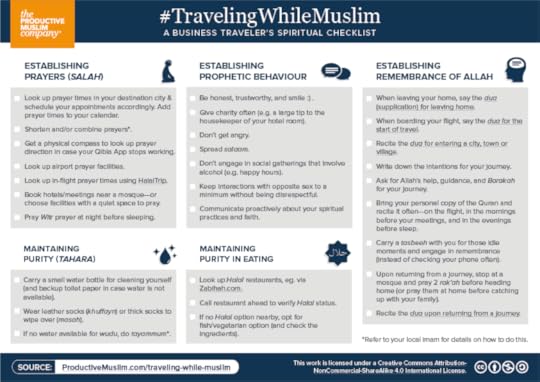
Let’s start with the most important topic of prayers (salah). Generally speaking, this is my top concern and priority during travel – how do I offer my obligatory prayers on time and not miss my prayers. There are several approaches I follow:
First, I observe the principle of qasr prayer (shortening and combining of prayers). This is major mercy from Allah
to ease the traveler’s affairs. This provides me with a broader window of time to offer Dhuhr (noon) and Asr (afternoon) prayers together as well as Maghrib (sunset) and Isha (night), as opposed to being available for each during its time-slot. I typically plan my workday so that I free myself up once between Dhuhr and Maghrib (typically in the airport, or in the office, or sometimes on flights) and once after Maghrib (typically after work in my hotel). Fajr (dawn) prayer is rarely an issue since I can offer that in the hotel.Planning is key to making the above approach work, especially during the shorter days in winter wherein praying Dhuhr/Asr is sometimes challenging.
When traveling by air, where permissible, I fly out early in the morning (since the gap between Fajr and Dhuhr prayers is the biggest) so that I arrive at my destination at least one hour before Maghrib – which allows me to pray Dhuhr/Asr together -especially when I am flying from west to east (thereby effectively shortening the daylight time). Else, I plan my transit in such a way that allows me to pray the Dhuhr/Asr at the transit airport.
To be prepared, I look-up the prayer times in the cities I am visiting or transiting through. You can use various sites like IslamicFinder.
Unfortunately, the based-laid plans can sometimes go awry (for example due to flight delays and other circumstances). Hence, I also consider the prayer times in-flight using sites like halaltrip.com (or their mobile app on the go), which provides me the correct prayer times and direction based on origin, destination and flight times – just in case I am forced to pray during the flight.
Some of my Muslim friends prefer to journey by night (i.e. red-eye flights) especially during winter months since nights are long. This provides the maximum allowable time between the mandatory prayers (Isha and Fajr) and probably the least disruption due to travel. I don’t like red-eye flights since I don’t sleep well on flights.
A couple of key points I’d like to include:
1. Praying at airports: I often pray at airports – either during travel or transit. I always look up whether the airport has prayer facilities – like the airport chapel. Alhamdulillah, most major airports in the USA have some form of a facility for worship. You can look-up the list of US airports with worship facilities in many sites such as halaltrip.com, Pew Research or Directory of Airport Chapels or the respective airport website. Alhamdulillah, my “home” airport (Dallas-Fort Worth) has the most number of chapels (5) – one in each terminal!
Most of the airport chapels have prayer rugs, so you can use them. When praying at multi-faith airport facilities, please be respectful of others who may be there. I have never had any trouble praying at chapels at airports. Matter of fact, I have had people going out of their way to provide me more privacy and some even ask about my prayer and faith. SubhanAllah, what an excellent opportunity Allah gives us for dawah on these occasions!
Often I have to transit through my “home” airport (DFW) since it is a hub for American Airlines. A question arises if I get an opportunity for prayer during transit – do I pray the full prayer (since I am within 50 miles of my home) or qasr (since I am in the middle of a journey)? The general guidance is that unless the journey has ended, we can observe qasr prayer since we are still in transit.
In airports where there are no worship facilities and it is impossible due to circumstances to pray while standing, I pray either sitting down or on a portable prayer mat if I can get appropriate space and privacy. The recommendation for mandatory prayers while seated (due to circumstances) is to make them up while standing later.
2. Praying at work/office: Sometimes, we have day-long meetings at my employers or customer offices, which requires me to pray at work. Generally speaking, I can find an empty meeting room where I can pray during a break. Some offices (like those of my employer) have dedicated “Wellness Rooms” which offer additional privacy for prayers. In general, I have never had anybody object to my prayers. Once at the General Motors headquarters in downtown Detroit, I had to explain to security why I took off my shoes since someone complained I was barefoot!
Sometimes I have to attend long customer or business meetings in the afternoon that cover the entire time of Dhuhr and Asr (especially during winter months when daytime is short). Depending on nature and criticality, it may sometimes be difficult to break out of such meetings. In such situations, I pray for Allah’s help and make my best effort. I remember once I broke out of such a meeting saying that I have another urgent meeting. When asked what other meetings could be more urgent than the meeting I was attending, I said “I have a meeting with God” – who can object to that?
3. Prayer direction: Where applicable, I use mobile apps to correctly determine the Qibla direction. HalalTrip and Qibla Compass are both great apps for this.
4. Praying inside the airplane: Occasionally, the only opportunity to offer prayer is during the flight. In such cases, I pray sitting on my seat, regardless of the direction of travel. To calculate the correct time of prayer while on a flight, I use the inflight prayer time calculator on halaltrip.com website. Only twice while flying Etihad Airways, I found dedicated space for prayer on an airline, but I have never seen that on US airlines.
5. Duas/dhikr before Maghrib time: Even though I generally combine Maghrib and Isha prayers at a later time, I always make time for duas and dhikr just before Maghrib time. Here is a list of the Sunnah/recommended duas and dhikr (or get the app “Fortress of the Muslim”). It does not normally take more than 15 minutes but has huge benefits.
6. Dhikr during travels: Ironically, I have found that occasionally travel actually provides me some much needed “downtime” for greater remembrance of Allah . As we are all armed with connected mobile devices, we feel we can be productive every minute even while we are on the go. However, think of specific pockets of time during travel when it is difficult to get meaningful work done – for example, going through airport security checkpoints, boarding/disembarking a flight, the times during takeoff/landing when they ask you turn off laptops, rushing through a transit airport to catch a connection, etc. I find these (and other such occasions) great opportunities to do Dhikr rather than idly thumbing through my smartphone. See examples of recommended Dhikr here.
'Ironically, I have found that occasionally travel actually provides me some much needed “downtime” for greater remembrance of Allah subḥānahu wa ta'āla (glorified and exalted be He).' Shamim AhmedClick To Tweet
How to Find Halal (Pure & Lawful) Food
Food is generally my second biggest concern during travel especially in places like airports or in the workplace. Typically I eat fish or vegetarian foods in such places, but such veggie/seafood may not necessarily be halal – they may contain alcohol or other meat by-products like chicken stock (you won’t believe how many so-called “veggie” products have chicken stock in them) or maybe contaminated by other haram (unpure/unlawful) food through use of common utensils.
When eating out, I always ask about ingredients in detail and do the best effort in due diligence, and leave the rest to Allah . It is generally difficult to find good fish (or seafood) in airports, where salads are the best option.
American salads (without meat) are generally a bland fair, and not very appetizing, so I look for Mexican and Mediterranean salads where possible. Such salads don’t just have leafy vegetables, but also feature nutritious beans (great source of protein and fiber) and delicious sauces. Specifically, at Qdoba, I have verified that their black bean and vegetable sauté do not have any meats in it. Additionally, Qdoba now features the tasty Impossible “vegetarian meats”, which is considered halal. Another popular option for me at airports include Panera Bread (they always have veggie soups and sandwiches) and Subway (veggie subs).
Outside airports and the workplace, I generally look up halal restaurants using Zabihah.com, which is a great resource (online or mobile app). However, it is always a good idea to call the restaurant ahead to verify the halal status.
Maintaining the Tahara ( Cleanliness/Purity) While Travelling
Another key thing that concerns me on travels includes the use of public bathrooms and ablution (wudu).
Use of public restrooms
We all know Islam emphasizes cleanliness. However, I often find private stalls in men’s restrooms – especially in airports – quite dirty. Using the toilet seat in a sitting position may in fact cause more uncleanliness (apart from the risk of infections) – use of porous toilet seat covers notwithstanding. In such circumstances, I found a ruling that says it is permissible to urinate while standing. I am not sure how women travelers deal with this issue.
Wudu (ablution)
Similar issues are related to wudu where we have no choice but to perform them in public restrooms. Taking off shoes and socks in unclean restrooms is somewhat concerning, so I am careful to take off one shoe at a time so my feet do not touch the ground. I ignore the stares that I get sometimes. During winter months, I sometimes wear leather socks (khuffayn) that makes it somewhat easier. Our Imam says that we can also do masah over regular socks, which also is a great blessing from Allah , especially during travels. Occasionally I perform wudu in the restroom on the airplane. But what happens when you are unable to go to the restroom in an airplane (for example when the seat belt sign is on) and the prayer time is elapsing? Well, as a backup, I carry a pair of clean stones in my carry-on bag so I can perform tayammum in a hurry.
Islamic Behavior while Traveling
Finally, I would like to discuss how we behave during travels. I am not going to discuss the usual guidance and restrictions on how Muslims need to carry themselves in public but focus more on how we behave in the modern workplace.
Some circumstances in the workplace are of concern. For example, we often have get-togethers (both in the workplace and during offsite dinners) I need to attend where alcohol is served. I make it well known to my colleagues (and customers) that I do not drink, and they always respect that.
I also generally never attend the “after dinner” drinking socials that are so common in professional circles. Most times, when these social occasions overlap with prayer times, I get out early or skip them altogether. Similarly, I do not engage in un-needed joking or small talk.
Interacting with members of the opposite sex in workplace contexts is also something I am very careful about. My philosophy is to keep such interactions to a necessary minimum without being disrespectful or awkward.
Communication about our Islamic practices in non-Muslim majority societies is key so that we are not misunderstood, especially in professional circles.
Consider for example, when we go to the common restroom to do wudu while in the workplace. Our colleagues typically relieve themselves, wash their hands and leave. To perform wudu, however, we need to take off our jacket and tie, roll-up our shirt sleeves, take off our shoes (and maybe socks) while performing wudu….all of which would look unusual to non-Muslims, and some of whom may even find it offensive. Hence it is important to communicate proactively about our practices.
Over time, people around you begin to better understand your ways. Most of my colleagues think of me as being “religious and disciplined” and most appreciate it.
One thing I have learned from my experiences is that we need to stand up for our Islamic needs. In the USA, discrimination in the workplace based on religion is considered illegal.
'Communication about our Islamic practices in non-Muslim majority societies is key so that we are not misunderstood, especially in professional circles.' Shamim AhmedClick To Tweet
Final Thoughts
I have spent a limited time working in Muslim majority countries (KSA and Emirates). Most of these issues I discussed here do not exist there. Most food everywhere is halal, people take breaks from work to pray, there are mosques in every street corner and airports, and people generally observe Islamic decorum in terms of behavior. It is not so in non-Muslim majority countries, so we need to conduct ourselves accordingly. Hopefully, I have provided you with some new insights based on my experiences.
I would be happy to hear back from you on your experiences and guidance. May Allah forgive our shortcomings and make our affairs easy in this world and the hereafter.
[1] Muslim Business Traveler Insights 2016
Join Barakah Academy to engage with like-minded global Muslim professionals on their journey to live the best version of themselves: spiritually, physically and socially.
The post #TravelingWhileMuslim: A Practical Guide for Muslim Business Travelers appeared first on ProductiveMuslim.com.
January 5, 2020
[Download Now] Barakah Culture Manifesto Wallpapers for Your Devices
The ProductiveMuslim Company is thankful and pleased to announce that, as per our readers’ suggestion, we’ve created downloadable Barakah Culture Manifesto posters for your electronic devices.
Download Options
For mobile
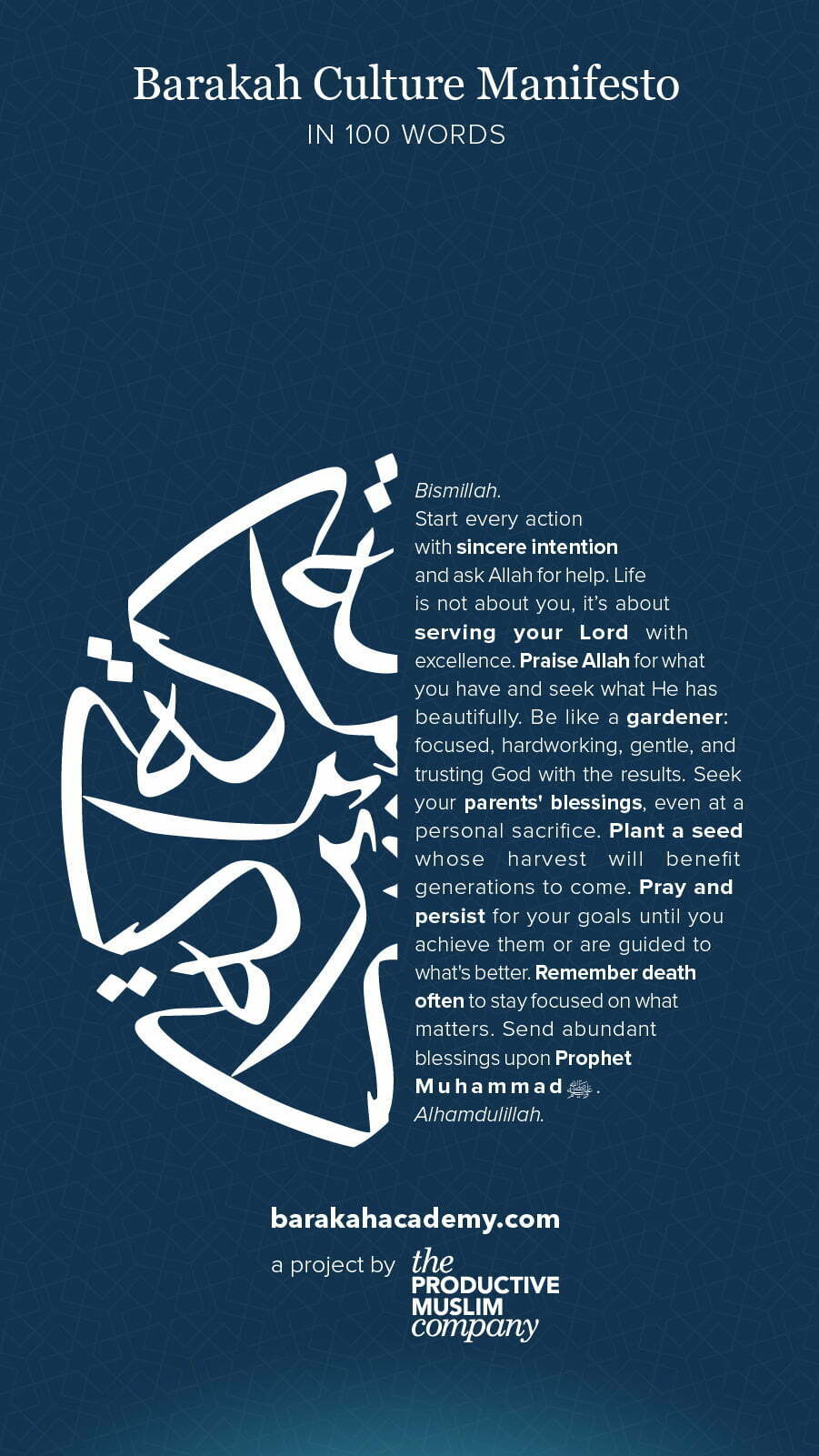
Click to download mobile version
For desktop
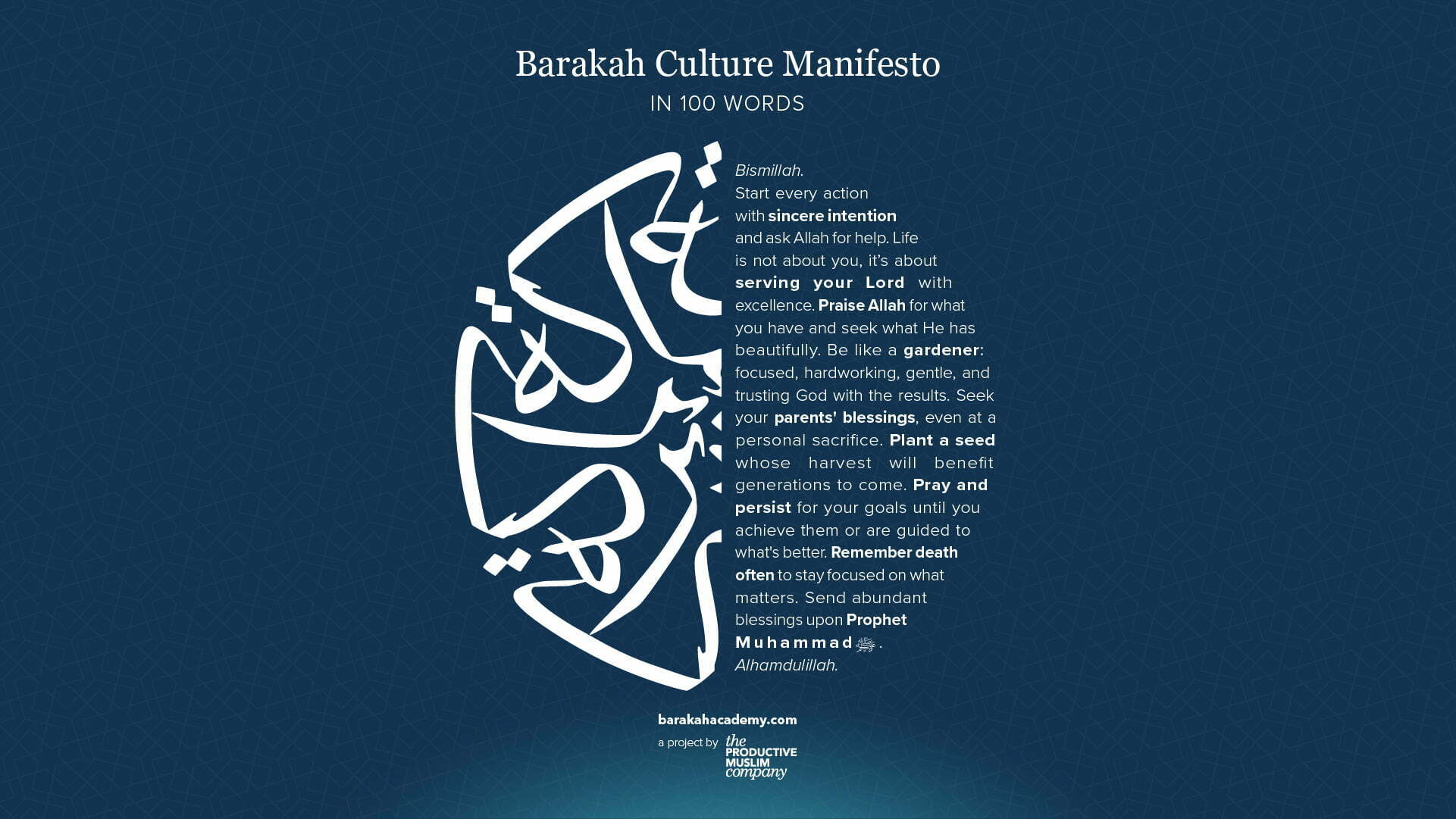
Click to download desktop version
For tablet

Click to download the tablet version
We pray that this is a powerful reminder for you daily to live life with Barakah. This can also be a great conversation starter and a means to spread the Barakah movement all around you, insha’Allah.
And may Allah put Barakah in all your efforts.
Click below to get the above Manifesto in high-quality 18″ x 24″ poster for your office, school or home.
Learn more about the Barakah Culture here, and find out the inspirational story behind writing the Barakah Culture Manifesto in 100 words here.
The post [Download Now] Barakah Culture Manifesto Wallpapers for Your Devices appeared first on ProductiveMuslim.com.
December 30, 2019
What Islam Offers to Modern Self-Help: An Islamic Paradigm of Psychology
Islam offers not only a theological framework within which we can position ourselves in relation to God, but it also offers a holistic map for how to navigate the human experience on a path of development of the self, or soul. While we may understand and believe that the Qur’an and Sunnah provide all of the guidance we need in life, many do not realize just how much is contained within this deen. With all of the influence of global trends toward secularism and the predominantly secular societies we live in, it can be easy to be persuaded by the assumption of a binary between religion and science. The institution of academia has fought hard to convince the world that the social sciences are in fact sciences rather than philosophical paradigms rooted in epistemology. In turn, the Muslim ummah has collectively bought into this story and forgotten its rich tradition of ‘ilm an-nafs (knowledge of the soul).
When you read about personal and professional development from just about any perspective or approach, the concepts and ideas are rooted in psychology. Modern psychology and its offshoots of personal development and self-help trends offer a lot of pertinent ideas and resources that all people, including the Muslim community, need desperately as societies become increasingly globalized and disconnected from the ancient wisdom that was inherent in more traditional, local communities and holistic lifestyles. But what these strands of pop psychology also bring with them are foundational assumptions about human nature, some of which are not aligned with the values and principles of an Islamic paradigm, which are baked into the cake. Without realizing it and/or without being fully aware of the repercussions of such philosophical and paradigmatic differences we can open ourselves up to hidden, often unintentional misguidance that can lead to a spiritual crisis, or worse, distance from our inner connection to Allah .
'There exists within the Islamic tradition an entire “science” of the soul or self which is completely aligned with and based upon the Qur’an and Sunnah and which offers practical solutions to everyday struggles faced by people in the modern world.' @RothmanAbdallahClick To Tweet
While this could be seen as a dilemma of whether to benefit from the good that these personal development resources have to offer and balance the potential pitfalls that they may present the Muslim trying to walk the path of Islam, fortunately, such a dilemma is unnecessary. There exists within the Islamic tradition an entire “science” of the soul or self which is completely aligned with and based upon the Qur’an and Sunnah and which offers practical solutions to everyday struggles faced by people in the modern world. In fact, this science of the soul is so advanced and comprehensive that it stands to offer entirely new insights to the popular field of self-improvement that even non-Muslims can benefit from. This is the legacy of the turath al Islam (path of Islam) as exemplified by our Beloved Prophet, peace be upon him, and is the birthright and heritage of every Muslim. Unfortunately, this knowledge has been all but lost and forgotten in the collective consciousness of today’s ummah. In this article, we want to share a glimpse of this turath and its impact on modern life and self-help.
The inherent psychology within Islam
Our perspective of Islam can often be one dimensional, especially if we have not done our own deep exploration of the teachings within the context of traditional Islamic spiritual education (tarbiyyah). As many followers of a religion, whether accepting that of their parents’ beliefs and rituals or individually choosing to follow the path set out by religious teachings, there is a tendency to see religion as a set of prescriptions that one must follow in order to be in God’s good graces. Religion has become institutionalized to the point that we make edifices out of the religion as a thing in and of itself, rather than understanding it as a path of guidance to follow in order to grow developmentally as a human being. What this can amount to is a relationship to the religion that is more transactional than it is transformational. We do what we have understood we are supposed to do with a belief that certain behaviors and actions or inactions will result in us being in God’s good grace, without necessarily transforming the state of our being or doing any work from the inside out. However, the Qur’an is replete with messages of the need for personal transformation and accountability within our innermost selves, as it says:
“[…] Allah does not change a people until they change what is in themselves” (Qur’an 13: 11)
What does it mean to change what is in oneself, what does that amount to, and how does one do this? These are all questions that could be assumed to be confined within the domain of the field of psychology, and yet the answers are all detailed within the Islamic tradition. What we have come to know as the academic discipline of psychology, a word which literally means the study of the soul, was not traditionally conceptualized as such in Islamic teachings because the study of the soul is embedded within the content of the entire Qur’an and Sunnah. The knowledge of the soul and its development is spread throughout the many branches of knowledge within the Islamic tradition, as there was previously no distinction or separation between the following of the religion and the individual effort to work on oneself in the process of inner transformation. We have become disconnected from the inherently holistic worldview which Islam posits and have adopted a disaggregated way of thinking about life and ourselves to the point that it is now necessary to present the Islamic knowledge of the soul in a condensed form that lends parity to that of modern psychology. Thus while our predecessors may not have needed to use terms such as “psychology” to distinguish such endeavors from other parts of the deen, it now becomes imperative for us to understand and define “Islamic psychology”.
'What does it mean to change what is in oneself, what does that amount to, and how does one do this? These are all questions that could be assumed to be confined within the domain of the field of psychology, and yet the answers are all detailed within the Islamic tradition.' @RothmanAbdallahClick To Tweet
An Islamic perspective of the self
Unlike popular conceptions within modern psychology and the dominant discourse of self-help and self-improvement which identifies the notion of the self as being centralized in the mind and in thought, an Islamic perspective of self includes multiple aspects of the whole being. Cartesian philosophy, which posits the notion of “I think therefore I am” has pervaded contemporary thought to the extent that most conceptions regarding the self within popular psychology are framed around the mind as the central location of human identity. We see this represented graphically in just about any poster or textbook that references psychology being accompanied by a picture of the brain, and by the name of the clinical field being termed “Mental Health”.
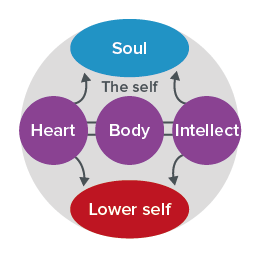
Often we see this brain or mind pictured in isolation, seemingly severed from the rest of its body, as similarly there is a tendency to see the body only as a housing for the mind as the core identity of the person. An Islamic perspective, conversely, necessarily posits that the human is a whole, integrated spiritual being which includes the body, mind, heart, and spirit.
'An Islamic perspective, conversely, necessarily posits that the human is a whole, integrated spiritual being which includes the body, mind, heart, and spirit.' @RothmanAbdallahClick To Tweet
Based on the writings and teachings of our learned scholars who have maintained an unbroken chain of transmission in how to interpret the Qur’an and understand the Prophetic tradition, we learn that within the Islamic ontological paradigm the true identity of a person is their soul, which is one integrated spiritual being, including the body. Thus an important distinction in Islamic psychology is that the central identity of the person is the soul, rather than the more narrowly defined notion of the self which is primarily conceived of as the construction of identity-based on personality and memories, which are confined to the temporal world, or dunya. A fundamental aspect of the Islamic conception of the soul is that the starting point in the soul’s journey is not limited to the moment of birth, but includes pre-existence. This goes back to the point of origin of all of the souls when they were created and Allah asked them “Am I not your Lord?” (Qur’an 7: 172). As the Qur’an narrates every single soul that will ever be created was there in that moment and replied: “Indeed we witness” (Qur’an 7: 172).
“And [mention] when your Lord took from the children of Adam – from their loins – their descendants and made them testify of themselves, [saying to them], “Am I not your Lord?” They said, “Yes, we witness.” [This] – lest you should say on the day of Resurrection, “Indeed, we were of this unaware.” (Qur’an 7: 172)
This critical moment in the trajectory of every human soul distinguishes the human identity as a soul that is in a state of witnessing that Allah is One and that they (each human being) are servants of the Lord. In other words, it is within our true nature to be dependent on the One God for subsistence and to recognize that Allah is in control of everything, a very different picture than the self that is in control of its own destiny as many popular narratives go in the self-help industry.
Fitrah: The soul’s true identity
The soul’s trajectory becomes a challenge or a test the minute they enter into the dunya in human form as that innate witnessing of their true nature becomes veiled to them, thus beginning the journey back to this witnessing. As Islam narrates, at the end of the temporary state of human life in the dunya all souls will again be made aware of Allah’s omnipotence as the veil is lifted from us, but what each soul has done in terms of their striving to uncover that witnessing in the time they had in the dunya will determine their relative state in the next life. Thus, an Islamic paradigm of psychology is not limited to this life, as contemporary psychology is, but rather includes both pre-natal and post mortem realities. The concept of fitrah, the innate natural disposition of the human being as this soul from its point of origin as a witness of tawhid (Oneness of God) is crucial to a conception of psychology from an Islamic worldview as it fundamentally defines both the picture of healthy functioning and a mechanism for understanding unhealthy functioning. Thus the definition of what we call mental health and wellbeing is connected to the spiritual state of the person, not just their relative level of comfort or happiness in the dunya.
The optimal state of the person then is to be in alignment with fitrah and to uncover that true nature of witnessing which is constantly being veiled and challenged by multiple factors within this life. When we are in a state of submission to the will of Allah we are in our optimal state of functioning and aligned with our fitrah. However, this is a difficult state to maintain as we have several factors impacting our ability to be in the state of remembrance of that true nature which is necessary to maintain optimal functioning. In addition to the external factors in the dunya that distract us from the remembrance of Allah , there is a constant struggle inside of us that we must engage in that amounts to a battleground in our soul. In order to be better equipped for the battle, it is important that we understand the terrain of the soul and how to navigate it.
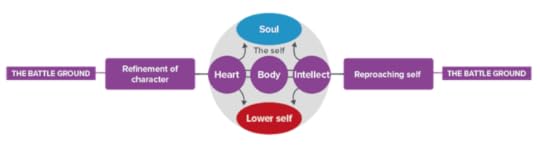
The structure of the soul
The soul in its pure state, before being covered and veiled from Allah’s reality, has the spark of the Divine breath that was breathed into us, known as the ruh. The ruh, or spirit, is the pure aspect of the human soul that is always there and which cannot be corrupted or misaligned. It is this pure and good aspect of our soul that allows us to always come back to the witnessing of Allah and provides the human being with a direct connection to Allah . While the ruh cannot be corrupted it most certainly can get covered over to the point that we are unaware and disconnected from this part of our soul. When we came into this world our souls were manifested in a physical form, in our bodies, in which we have the nafs, or lower self- the part of us that is bound to our temporal existence here in the world. This is the same self that most of the contemporary psychology deals with exclusively and is what we tend to be most familiar with, as it is how we experience ourselves in the world. This is the part of our self that likes what it likes, has desires and sways us in one direction or another. While it is not bad in and of itself, it has a tendency to lead us away from our fitrah and into a state of ghafla, or forgetfulness of Allah , because it is the part of ourselves that is oriented to the dunya and lives purely in this realm.
The ruh and the nafs can be conceived of as being two opposite poles of which we are constantly being pulled between in the battleground of our soul. We are spiritual beings having physical experiences here in this life and we are pulled between identifying and living in this seemingly separate reality where we are in control of our actions, through our free will, and our innate nature of knowing that we come from Allah and are dependent on Him for everything. The struggle between these two poles is essentially the manifestation of the paradox of experiencing duality in the temporal world while possessing an innate sense of the reality of Oneness (tawhid). Our work here in this life, and therefore our work in our personal and professional development, is to stay engaged in this struggle to constantly strive toward the remembrance of our fitrah to unlock or uncover our true potential as servants of Allah and the akhira as our end, rather than servants of our nafs and the dunya as our end. The central crux of where this battle takes place and what determines our relative outcome is located in the qalb, or heart, which, in an Islamic paradigm, is the center of the self/soul.
The word qalb in Arabic is a linguistic root that indicates turning one way or another. The word taqalab means “to turn”. So the function of the heart is that it can turn, either toward the ruh, or toward the nafs. The extent to which we are consciously able to turn our hearts toward the ruh and thus toward Allah is determined by several factors that cloud, block or impede our ability to do so. When we have unresolved emotional trauma from our experiences in life, whether real or perceived, it can manifest as blocks in our heart that further veil us from being able to witness Allah and turn to our higher nature. What we would normally conceive of as psychological imbalances are therefore not only cognitive but can be traced down deeper into our hearts, our qalb, where certain experiences have essential knocked us out of alignment with our fitrah and put our system out of balance. In addition to these internal manifestations of forces that pull us away from witnessing Allah and submitting to His tawhid, we also have external factors that are inherent in the dunya reality which distract us and pull us toward our nafs, or lower self, when we are in a state of an-nafs al amarah, or the soul that incites to evil. But here the evil can simply be the evil of forgetting our true nature and being subsumed in the illusion of individuation or self-direction.
Self-development as the development of the soul
The work of self-improvement or personal development is the work of constantly staying engaged in the effort to uncover the blocks on the heart, essentially cleaning the heart, and striving and struggling to stay in remembrance of Allah amidst the distractions and downward pulls of the dunya. One aspect of the structure of our souls that can help us in this struggle is the aql, which can be conceived of as the cognitive function, but which is a more Divinely connected kind of reasoning. In the Islamic model of the soul, the aql is not understood as the central driving aspect of the self but is actually better understood as a function of the qalb. In addition to the normal kind of logical reasoning that we attribute to the mind, the qalb has the ability to perceive and to see things as they are. The form of the word aql that is used in the Qur’an is an active verb y’aqiluna and it is used as a descriptor of a function of the qalb, so that the heart has the ability to perceive. It is in using this ability to perceive that the qalb possesses that we can effectively turn our hearts away from the veils of the dunya which result in a state of ghafla, and turn it toward Allah and the akhira, accessing through the point of Divine connection within us, the ruh.
We experience different qualities or characteristics of our soul depending on our relative position in the battleground of our soul. When we are subsumed by the covering on our heart and are in a state of an-nafs al ammarah, we can manifest character qualities that are destructive, such as anger, jealousy, and envy; these are called the muhlikat, or destroyers. And when we are engaged in the struggle of the jihad an-nafs (struggle of the self), attempting to reign in our lower tendencies toward individuation and self-direction, we are in a state of an-nafs al lawwamah, or the self-reproaching soul, where we take ourselves to account and make an effort to doing the work of turning our hearts. This can involve a process of thadhib al akhlaq, or the refinement of character, where through self-awareness we consciously try to change the muhlikat and attempt to emulate good character traits such as courage and wisdom and justice, called munjiyat, or saviors and were exemplified in the perfected character of the Prophet . These manifestations of muhlikat, or negative character, are signs of where we need to do the work on ourselves in our process of personal development with the goal of aligning with fitrah and evolving to our higher self, or the next best version of our self. When we have moments of success in this process we can experience the soul in a state of peace, which is the an-nafs al mutma’inah, or the soul at rest. While it is rare to fully achieve this state, we can get glimpses of it that keeps us motivated to do the work of striving toward that next best version, having more frequent experiences of the state of the soul in an-nafs al mutma’inah. This is the goal of personal development in an Islamic paradigm and there exists within the Islamic tradition a whole host of tools and guidance in the pursuit of the purification of the heart and soul.
An Islamic model of the soul

Click to download the full-sized image
The Islamic model of the soul presented here was developed as a result of the input of 18 scholars with expertise in various branches of knowledge within the Islamic tradition, the details of which are reported in Rothman and Coyle’s (2018) report of the research findings. According to this model, the human soul has an innately pure and good nature, fitrah, that comes from and is connected to God but that becomes covered over and forgotten as a natural part of life in the dunya. Throughout its life in the dunya, within the soul, there exists a dynamic interplay of conflicting forces that affect the psychological state of the person and determine relative levels of alignment or misalignment with fitrah (this process is represented by the purple elements in the middle of the model).
The qalb, which is the spiritual center of the person, and where the faculty of intellect is located as the aql, has the potential to turn in either of two directions which shapes the relative, transient outcome of this conflict. It can turn toward the lower impulses of the nafs and become further misaligned with fitrah by the influences of the dunya and shaytan (satan), resulting in increased negative characteristics of the muhlikat and a state of ghafla, (this process is represented by the red elements toward the bottom half of the model). Or it can turn toward the higher, Godly nature of the ruh with the remembrance of Allah and the akhirah (afterlife), resulting in increased positive characteristics of the munjiyat, and come more in alignment with the soul’s state of fitrah (this process is represented by the blue elements toward the top half of the model).
The relative state of the soul in relation to either of these two poles at any one time is articulated in three distinct stages of the soul’s development throughout life in the dunya, namely: an-nafs al ammarah bil su’, an-nafs al lawwama, and an-nafs al mutma’inah. The model posits that the soul has an inherent inclination toward growth and an upward trajectory in relation to this model, due to its primordial nature of knowing God, and that the Islamic tradition, as guided by the Qur’an and Sunnah, encourages and maps out a path for the human being to pursue this trajectory. This is demonstrated in the description of processes along the path that act as mechanisms for exerting effort in the dynamic interplay within the soul as it struggles between the two opposing forces, namely; jihad an-nafs, tahdhib al-akhlaq, and tazkiyat an-nafs.
Implications for Personal and Professional Development
If we locate our identity within our soul rather than just our self, or the persona that we project in our life, we have the opportunity to take personal transformation to a whole new level. Breaking through the barriers and limitations of our mind and mental worlds is often a critical and necessary step in unlocking our potential and getting to that next best version of our self. However, there are still limitations to our growth if we only conceive of and interact with the cognitive aspect. As the Islamic model posits, the cognitive aspect is one part of a whole, and by recognizing and opening to a more holistic vision of the self, that of the soul, we can access our deeper inner reality and grow in a more profound way.
By adopting an approach to personal development that is informed and guided by the Islamic model of the soul, we have an opportunity to unlock the secrets of the meaning of life and integrate our religious belief system and worldview with our daily life struggle. In fact, this is the necessary pathway to both deepening our understanding of and relationship to Islam and truly advancing our psychospiritual development. This involves not only reorienting our approach to the deen of Islam to be that of a path of self-development but reorienting our notion of self to be one that is centered in the heart.
The Prophet Muhammad
While this certainly has implications for physical health and the physical organ of the heart, our learned scholars teach us that the main intention in this statement was in explaining the nature of our spiritual heart as the center of the human being. The Qur’an tells us that our hearts have the ability to reason and perceive and it is only when the heart is polished that a person can truly see things “as they are”. And yet we rarely operate from a place that is centered in the heart in our orientation to our life in the dunya. We suffer from the nature of the plight of the human being in this life which is that we perceive ourselves as self-directed, individual units who are in control of our own destiny.
How can we possibly work toward achievement and productivity in our lives if we believe that we are not in control? This is the fundamental dilemma that philosophers and critics of religion have debated, and is the same paradox that many Muslims often do not find satisfactory answers to. How do we balance our free will and self-determination with a belief in qadr (destiny)? Self-help guidance often says that we need to have an internal locus of control in order to master our self and take control of our personal development. And yet deeply embedded within the Islamic paradigm and the worldview of a Muslim is that we have an external locus of control, that Allah is the One who is ultimately in control of our outcome. The secret to success in this endeavor of development as a Muslim is to embrace both of these realities, rather than choosing one, it is to embrace the paradox, by which we can witness tawhid (Oneness of Allah).
The post What Islam Offers to Modern Self-Help: An Islamic Paradigm of Psychology appeared first on ProductiveMuslim.com.
December 16, 2019
10 Reasons Why You Need to Join The Productive Muslim Retreat
Holidays are great for unwinding and relaxing, but what if a holiday could be more than a temporary break? What if it could be a profound experience too? An experience that revitalises and rejuvenates you. From choosing serene luxury locations to great food, to inspiring workshops, our retreat sets a new standard for holidays. Our retreat is the kind of holiday where you come to not only relax and get all the sun you need but gain a new perspective on where your life is going and learn how to unlock the best version of yourself.
'Our retreat is the kind of holiday where you come to not only relax and get all the sun you need but gain a new perspective on where your life is going and learn how to unlock the best version of yourself.' 10 Reasons Why You Need to Join The Productive Muslim Retreat Now!Click To Tweet
If you’ve been thinking about joining the ProductiveMuslim Retreat this year, and are not sure about it, here are 10 reasons why you should join:
1. An Opportunity to Step Back
When you withdraw from your regular day-to-day life, you gather all your energies which are normally scattered across so many different obligations and focus on understanding where you are in life and where you’re heading.
At the retreat, you’ll get a chance to refocus and re-energize yourself to find inspiration for the next phase in your life.
2. An Inspiring Environment
Inspiration normally won’t strike while you aimlessly do the same stuff every day.
You need to be in a certain frame of mind that allows inspiration to take place. An island at a beautiful resort with mesmerizing views can help with that.
The retreat helps put you in that frame of mind: away from the grind of life, in a novel environment, with inspiring people around you.
'The retreat helps put you in that frame of mind: away from the grind of life, in a novel environment, with inspiring people around you.' 10 Reasons Why You Need to Join The Productive Muslim Retreat NowClick To Tweet
3. Precious Quiet Time
It’s a noisy world out there! But when you go on a retreat – you’ll finally find some quiet precious time to listen to the sea breeze, listen to beneficial reminders, and most importantly, listen to your soul and the inspiring people around you.
4. A Healthy Detox
In the ProductiveMuslim Retreat, we advise you on how to have a healthy diet and fitness schedule every day + we practice what we preach during the retreat. If you’ve been talking about going on that healthy detox, well this retreat is perfect for you!
5. Reconnect Spiritually
If you find yourself that you’ve plateaued spiritually, going through the motions of Salah without deep reflection, reciting few remembrances but not feeling them, then this retreat is for you.
We’ll inspire you to re-connect with your spirituality by making that powerful case between your spirituality and success, and work with you to re-connect to Allah with daily Salah in a congregation, Fajr reminders, and evening reflections.
'If you find yourself that you’ve plateaued spiritually, going through the motions of Salah without deep reflection, reciting few remembrances but not feeling them, then this retreat is for you.' 10 Reasons Why You Need to Join The Productive Muslim RetreatClick To Tweet
6. Facilitate your Change
Change is hard, and change is not easy. And many of us fear to change because we fear the repercussions of change.
However, at the ProductiveMuslim retreat – you’ll be in a safe, non-judgmental environment, where we help facilitate your change for the better and give you the practical plans to continue on that change (whether spiritual, physical, or social) when you head home.
7. Find Yourself
Sometimes in the tornado of life – we forget or lose ourselves. We become zombies responding to the stimulus of the outside world from our beeping phones to demands from people around us.
When you come to the ProductiveMuslim Retreat – whether alone or with your family – you’ll find yourself. And start asking yourself critical questions, such as: How can I be the best version of myself: spiritually, physically, socially?
'At the ProductiveMuslim Retreat you'll find yourself. And start asking yourself critical questions, such as: How can I be the best version of myself: spiritually, physically, socially?' 10 Reasons Why You Need to Join ProductiveMuslim RetreatClick To Tweet
8. Find Like-Hearted People
Every year participants from around the world come to this retreat for the same reason you’ll come for inshaAllah: They want to improve themselves, experience something new, and be around like-hearted people.
You’ll find friendships at the retreat that will last you a lifetime – and that can be powerful!
9. Challenge & Stretch Yourself
At the ProductiveMuslim Retreat – we believe in getting outside your comfort zone by asking you to do daily challenges that stretch you. Nothing too uncomfortable, and always a lot of fun. I can’t share more details about these challenges because they are a surprise ;).
10. Establish New Habits and Routines
The aim of the retreat is to inspire you to change and give you a blueprint for your new routine/lifestyle when you head back home. We hope the retreat becomes the catalyst that you’re looking for in your life!
If all of the above reasons sounds interesting and convincing for you -then we recommend that you sign up for the ProductiveMuslim Retreat before spaces run out! Deadline for booking is 15th Jan 2020.

The post 10 Reasons Why You Need to Join The Productive Muslim Retreat appeared first on ProductiveMuslim.com.
December 12, 2019
Barakah Culture Manifesto in 100 Words
The following manifesto was written in the city of Barakah, Al-Madinah Al-Munawarah (The illuminated City), the city of Prophet Muhammad in November 2019:
Bismillah.
Start every action with sincere intention and ask Allah for help.
Life is not about you, it’s about serving your Lord with excellence.
Praise Allah for what you have and seek what He has beautifully.
Be like a gardener: focused, hardworking, gentle, and trusting God with the results.
Seek your parents’ blessings, even at a personal sacrifice.
Plant a seed whose harvest will benefit generations to come.
Pray and persist for your goals until you achieve them or are guided to what’s better.
Remember death often to stay focused on what matters.
Send abundant blessings upon Prophet Muhammad ﷺ.
Alhamdulillah.
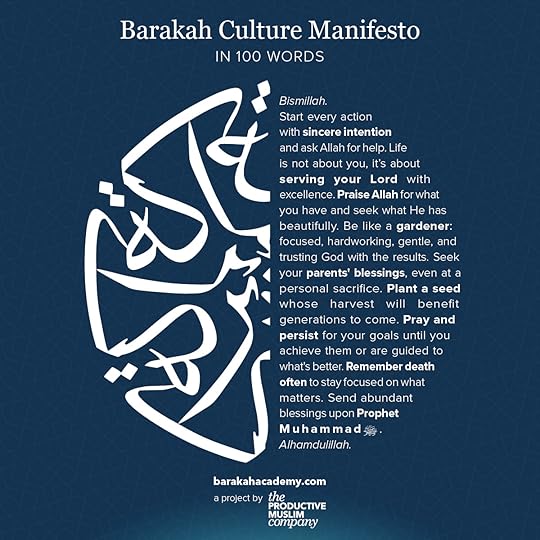
Click here to download manifesto poster or click below to get a high-quality print delivered to your home.
Backstory: Blessings upon Blessings
When I visited the blessed city of Prophet Muhammad in November 2019, I set the intention of writing a manifesto for the Barakah Culture that we’re spreading globally as part of our new company direction. What better place can someone write a ‘Barakah’ Culture Manifesto than in the city of our Beloved Prophet who supplicated for this city saying:
“O Allah, shower blessings upon us in our city, and in our fruits, in our mudd and in our sa’s, blessings upon blessings” [Sahih Muslim]
And He said as Anas b. Malik  reported that the Messenger said:
“O Allah, increase in Medina twice the blessings (You showered) on Mecca.” [Sahih Al Bukhari]
Thankfully -and all praise is due to the Decree of Allah -, I realized after arriving in Madinah that I forgot my writing journal and I only had a few scraps of hotel notepads to write down the manifesto!
Due to the limited resources, Allah inspired me to follow the Prophetic example of saying only a few words but capturing many meanings. So I sat from ‘Asr until Maghrib prayer in the Prophetic mosque writing, scratching, and re-writing until I came to the first draft of the manifesto with the Help of Allah .
After a few iterations with the help of my team and advisors, we were able to refine these words to precisely 100 words – alhamduliAllah.
We ask Allah to accept it from us and to put Barakah in these few words so that they spread globally and guide all those who read them towards living a life of Barakah and embracing the Barakah Culture.
If you’re looking for a place to practically learn more about the Barakah values and mindsets, then check our Barakah Academy. The Barakah Academy is your online platform to train with professionals who want to learn practical personal and professional development skills that are faith-based and linked with the latest research and science. It’s your global community of like-hearted professionals who want to live a better version of themselves spiritually, physically and socially.
The post Barakah Culture Manifesto in 100 Words appeared first on ProductiveMuslim.com.
December 6, 2019
How To Set Goals Like a Gardener?
As human beings, we’re driven towards setting goals and achieving them. Unlike animals, we are not content to simply sit, eat, reproduce, and sleep; we have an innate ‘meaning-seeking’ side to us that’s part of our fitrah (natural disposition) which ultimately is geared towards finding and fulfilling our ultimate purpose and that is to be a true ‘abd/slave of Allah .
The question is: If we’re naturally inclined towards setting goals – how do we go about setting goals that matter? And more importantly, how do we go about achieving them?
What’s wrong with the typical goal-setting techniques
Most self-help books teach a goal-setting framework that has the following basic steps:
Step 1: Have a vision of where you want to be X year(s) from now/or at the end of your life. They’ll ask you to do exercises such as “imagine your eulogy”, or create a vision board.
Step 2: Set long-term goals that will help you fulfill the above vision.
Step 3: Set short term goals/milestones that help you make progress towards your long-term goals.
Step 4: Use a daily/weekly planner to stay focused on achieving your short and long-term goals.
Makes sense? Absolutely. Does it work? Not always.
In fact, after coaching several people on achieving their goals, I’ve realized that the above techniques usually works best with short-term “SMART” (Specific, Measurable, Actionable, Realistic, & Timebound) goals and not so much with long-term important goals that take several months/years to achieve; here’s why:
The above framework assumes you have the perfect vision of what the future would look like based on your current circumstances and life ambitions.
It assumes you have perfect control of every conceivable factor towards achieving your goals (hence making you ultimately responsible for any failures in achieving them).
Below we are proposing a different framework for goal setting – one that is more rooted in Barakah Culture vs. Hustle culture and more in line with the Prophetic approach towards goal setting.
The framework we developed uses the analogy of the Gardener to help us think through the steps needed to setting up and achieving our goals from a Barakah culture perspective (T his framework will be taught live in a special 90-mins online workshop on Saturday, Dec 14th, at 10:00, am US CST. Click here to register).
Here are the steps and why they are important (and they work!):
Step 1: Set powerful intentions – not visions
It has been narrated on the authority of Umar b. al-Khattab that the Messenger of Allah (ﷺ) said: “(The value of) an action depends on the intention behind it. A man will be rewarded only for what he intended. […]” [Sahih Muslim]
إِنَّمَا الأَعْمَالُ بِالنِّيَّةِ وَإِنَّمَا لاِمْرِئٍ مَا نَوَى
When a gardener is planning their garden – they start with an intention/seed of what they want to grow. They might have an idea/vision of what that garden should look like, but ultimately they focus on planting the right seeds for their garden. As our Chief Editor Dina Basiony noted in a recent internal message to the team: “The word niyyah (intention) has the same roots as the word nawaat (seed نوى /نواة). And the verb “intended” in Arabic نوى is the same as the noun “seeds” نوى, they have the same roots”. Therefore, when you plan your goals, instead of focusing on the end result or vision board of how things ‘should’ be. Focus on the intentions/seeds of your goals (i.e. the Why).
Why is this important?
Our vision of what our future should look like changes with our life’s changing circumstances but our intentions – if sincere – remain robust through the changing seasons of life. For example, you might have a vision of being a successful best-selling author (which may or may not happen), but your intention is to spread beneficial knowledge which wouldn’t change regardless of whether you become a successful author or not.
We’ve all heard the hadith that actions are judged by intentions. This is a fundamental principle of goal setting from a Prophetic perspective. It’s not what you do that matters, but the intention behind it that matters the most. The more powerful the intention – the greater the reward for the action even if you don’t achieve your goal. As Prophet Muhammad
said: “He who supplicates Allah sincerely for martyrdom, Allah will elevate him to the station of the martyrs, even if he dies on his bed.”[Muslim]. This means that just for having the sincere intention to do something or achieving a certain goal, you’re considered a success in the eyes of Allah ! (Unlike traditional goal setting techniques that make you feel like a failure unless you achieve a specific goal).You can have multiple intentions associated with a single goal; so even if one or two of your intentions shift or are not conceivable, you can have other intentions that will drive your actions. Unlike having a single vision – where if it doesn’t work out – then you’re back to the vision board trying to come up with a new one.
Why does this work?
Focusing on intentions helps you stay focused on the WHY and be adaptive to changing your ‘vision’/goal as long as the intention remains the same.
The higher/loftier the intentions – the more connected your goals are to your ultimate purpose in life and that is to seek Allah’s
pleasure.If you get demotivated from achieving your goals – all you have to do is remember your intentions and they’ll re-energize you.
Intentions are deeply personal and only Allah
knows how truthful you are about them – so focusing on purifying our intentions is a consistent effort vs. a one time exercise.Step 2: Understand your season of life
One of the major flaws of traditional goal setting techniques is the lack of appreciation for the changing macro and micro seasons in a person’s life. You’re considered a ‘loser’ if you can’t achieve your goals even if things are outside your control and stacked up against you on a personal, business, and socio-economic level.
Think of a gardener; they don’t plant a seed just anytime in the year. They are in tune with the ebb and flow of the world around them and the changing seasons and climate, and only plant the right seeds at the right time. Failure to do so would guarantee the failure of their plants. Being conscious of the changing seasons in one’s life helps you focus on when you should ‘go for your’ goals and when you should perhaps park it until a better opportunity arises.
There are 3 types of ‘seasons’ to be aware of in your life as you set your goals:
1. The Macroeconomic Season: We don’t live in a bubble but are affected by the macroeconomic condition of the nations we live in. Think of the Global Recession that took place in 2008 and how many people were affected by it.
These economic cycles of life occur in every place and every time and part of being a smart gardener is to understand the implication of these seasons on the goals you’re trying to set.
The Qur’an tells us how Prophet Yusuf  understood that the 7 years of prosperity that Egypt was going through will be followed by 7 years of drought. Hence, he set up goals on how to manage Egypt’s resources to survive the drought years.
Being aware of the cyclical nature of the economy makes you more in tune with reality and not set your goals up for failure.
2. The Business/Professional season: Is your business/career going through a period of rapid expansion/growth or stagnation/decline? Understanding your business/professional season of life helps you decide which goals you should focus on for the upcoming year.
As a business should you focus on hiring, building systems and processes OR cutting costs and developing products? Similarly, as a professional, should you focus on leading those important projects at work or dusting your CV and upskilling yourself with new skills for your next career move.
The season that your business/career is going through should inform what type of goals you set up for yourself.
3. Your Human Life Season: Allah says in the Qur’an:
اللَّهُ الَّذِي خَلَقَكُم مِّن ضَعْفٍ ثُمَّ جَعَلَ مِن بَعْدِ ضَعْفٍ قُوَّةً ثُمَّ جَعَلَ مِن بَعْدِ قُوَّةٍ ضَعْفًا وَشَيْبَةً ۚ يَخْلُقُ مَا يَشَاءُ ۖ وَهُوَ الْعَلِيمُ الْقَدِيرُ
Allah is the one who created you from weakness, then made after weakness strength, then made after strength weakness and white hair. He creates what He wills, and He is the Knowing, the Competent. (Qur’an 30: 54)
When I was in my 20s, I read a powerful book that made me appreciate the different stages that are coming up in my life. It was called “The Seasons of a Man’s Life” by Daniel J. Levinson. It describes the different stages of a man’s life and what are the main objectives of each stage in one’s life.
Simply understanding what stage of life you’re in, can help you determine the goals that you set for yourself. For example, when you’re in early adulthood (pre 30 years old), you might want to focus on getting a degree, making career choices and marriage choices. Once you hit your 30s, you may want to focus on commitments related to family, and personal/professional achieving, etc. Moreover, you might be going through some specific circumstances that may not be conducive for certain goals, e.g. you’re going through a divorce or cancer treatment.
The above made me understand and appreciate the hadith of Prophet Muhammad that said: “Take advantage of five before five: your youth before your old age, your health before your illness, your riches before your poverty, your free time before your work, and your life before your death.” [Shu’ab Al Iman]
Acknowledging that there are appropriate goals for each stage in life – makes it more likely for you to achieve those goals than trying to be foolish and go against your natural strength and human life cycle – thus feeling incompetent when not successful.
Understanding the above seasons cannot be underestimated. Moreover, from another angle, they help explain how sometimes when you set a goal and for some reason, you’re not able to achieve it, they may be nothing wrong with your ability to achieve the goals – but it’s simply not the right season for it. This understanding takes away a lot of ‘stress’ and ‘depression’ when things are not achieved according to our own timelines and makes you more conscious of focusing on ‘being ready’ for the goal to be achieved vs. achieving the goal itself (a simple example to illustrate the point: you set up a goal to be married; instead of saying “I want to be married by age of X”…a gardener mindset would be “How can I be “marriage-ready” so when I meet the right person, I’ll be ready for this next big move in my life).
Step 3: Sharpen the process
A gardener has to follow a specific process if they want to make their garden a reality. Not following the process or skipping some steps could mean the end of their gardening aspirations. The more the gardener focuses on the process, the more likely they are to achieve their gardening intentions.
Similarly, when setting up goals, I advise my coaching clients to set up ‘process goals’ vs. ‘achievement goals’ and focus on optimizing the process vs. worrying about achieving certain goals. Here’s the difference:
Achievement Goal: I want to memorize the Qur’an in 5 years.
Process Goal: I want to memorize 1/2 a page a day for 3 days a week.
Achievement Goal: I want to lose 20lbs in 12 months
Process Goal: I want to run for 30 mins 3 days a week.
Achievement Goal: I want to be a published author in 1 year.
Process Goal: I want to write 500 words a day.
Why is this important?
Achievement goals turn the goals into a matter of success or failure; either you achieve it or don’t achieve it. Whereas process goals, turn the goal into a habit/routine that if you stick to it would eventually help you achieve the very goal you’re trying to achieve.
Moreover, process goals tap into the power of ‘making progress’ and feeling the success momentum of you taking concrete steps towards your goals vs. achievement goals that feel like a ‘mirage’ you may never achieve.
Also, if for some reason you’re not seeing progress – you’ll question the process vs. questioning the goal itself. This happens a lot with people who want to memorize the Qur’an or learn Arabic. If they are not able to memorize the Qur’an or learn Arabic, they feel bad about it and usually give up. If instead, they focused on process goals, they’ll question the approach they are taking to memorizing Qur’an/learning Arabic and try a different process to see if it works better for them.
Step 4: Detach from the results
You’ve set powerful intentions, you’ve planted your intentions according to your season of life, and you’ve sharpened your process – congratulations, you’ve now fully “tied your camel” as the Prophetic saying goes. Now comes the next part of the hadith, “trust in God”.
What this means is that you detach yourself from the fruits of your labor and genuinely believe that your success can come only from Allah .
Allah reminds us in the Qur’an:
أَفَرَأَيْتُم مَّا تَحْرُثُونَ
أَأَنتُمْ تَزْرَعُونَهُ أَمْ نَحْنُ الزَّارِعُونَ
“And have you seen that [seed] which you sow?
Is it you who makes it grow, or are We the grower?” (Qur’an 56: 63-64)
For many people steeped in Hustle culture and traditional goal-setting framework – this is a hard pill to swallow “What do you mean detach from results!? I’ve put SO much effort into this, I better get results”.
This is where spirituality and true tawakkul (trust in Allah) differentiates those of Barakah Culture vs. Hustle Culture; we work hard as if everything is under our control yet at the same time, we completely trust that results and the fruits of our labor is in Allah’s hands.
The beauty of detaching ourselves from the results is that our heart stays calm and sincere with all the ups and downs of trying to achieve our goals. If we achieve our goals, we give thanks. If things don’t go our way, we are patient seeking the reward from Allah for the beautiful intentions we’ve set for the goals.
Moreover, this approach makes us truly connect with Allah on a deeper level with our daily supplications. We’ll start making daily supplications for the goals we’re trying to achieve and turn our goals into spiritual quests.
Just think of a gardener, who sets the intention of planting an oak tree, chooses the right seeds and season, focuses on the process of tending for the tree, then supplicates sincerely to Allah to make his/her tree a reality – what spiritual state would that person be as the days/years go by (whether the tree grows or not) and what reward this person will get from Allah for showing total dependence on Allah for a goal that’s in Allah’s Hand.
Your whole experience with goal setting changes; instead of being a stressful/hustle culture endeavor; it becomes this meaningful, spiritually-driven approach that attracts Barakah & success in this life and the next – beyond your imagination.
Step 5: Seek Barakah
Abu Hurairah (May Allah be pleased with him) reported:
The Prophet (ﷺ) said, “While a man was walking through a barren land, he heard a voice coming out of a cloud saying: ‘Irrigate the garden of so-and-so.’ Thereupon the cloud drifted in a certain direction and discharged its water over a rocky plain. The streamlets flowed into a channel. This man followed the channel until it reached a garden and he saw the owner of the garden standing in its center, working with his spade spreading the water (changing the course of the water). He asked him: “O slave of Allah, what is your name?” He told his name, which was the same that he heard from the cloud. The owner of the garden then asked him: “O slave of Allah, why did you ask my name?” He replied: “I heard a voice from a cloud which poured down this water saying: ‘Irrigate the garden of so-and-so.’ I would like to know what do you do with it.” He said: “Now that you asked me, I will tell you. I estimate the produce of the garden and distribute one-third of it in charity, I spend one-third on myself and my family and invest one-third back into the garden.” [Sahih Muslim]
We always think of achieving our goals – but how many of us think of what to do with our goals once we achieve them.
Let’s say you did memorize Qur’an, or got that promotion, or passed that exam… what will you do with the results/fruits of that success?
The above story illustrates that the best use of success is to ‘reinvest’ that success in what brings benefit to you, those around you, and society at large.
This is going back full-circle to setting powerful intentions – and why you set off on this journey of achieving your goals in the first place (or planting the garden).
If the purpose was to simply fill your belly or feed your ego, you’ll find that the goals you achieve will lose its meaning after a while. But if the purpose was to truly please Allah , you’ll find that the goal becomes a blessing for you and propel you to achieve other goals for yourself and those around you.
Step 6: Plant for the long term
As you set off to achieve your goals in life, keep focused on gardening those activities that would matter in the hereafter:
وَمَا أُوتِيتُم مِّن شَيْءٍ فَمَتَاعُ الْحَيَاةِ الدُّنْيَا وَزِينَتُهَا ۚ وَمَا عِندَ اللَّهِ خَيْرٌ وَأَبْقَىٰ ۚ أَفَلَا تَعْقِلُونَ
“And whatever thing you [people] have been given – it is [only for] the enjoyment of worldly life and its adornment. And what is with Allah is better and more lasting; so will you not use reason?” (Qur’an 28: 60)
Yes, it’s great to achieve all those goals and awards of life – but weighing this appropriately helps you stay focused and not distracted with worldly goals that won’t mean much after we die.
This doesn’t mean we should neglect ‘worldly goals’ but it’s trying to focus our worldly goals on things that have an impact and that would last beyond our lifetime.
Anas ibn Malik reported that the Prophet, may Allah bless him and grant him peace, said, “If the Final Hour comes while you have a palm-cutting in your hands and it is possible to plant it before the Hour comes, you should plant it.” [Al Adab Al Mufrad]
And this is how you set goals like a gardener. If you enjoyed this article, join us for a special 90-mins live workshop on setting Annual Goals on Dec 14th, at 10:00 am US CST. Click here to register.
The post How To Set Goals Like a Gardener? appeared first on ProductiveMuslim.com.
December 2, 2019
A Year After Attending the Productive Muslim Masterclass: What Changed in Me Spiritually, Physically & Socially
As a professional and an educated Muslim man, I strive daily to be the better version of myself. During Ramadan, I did things that I did not think I was able to do. Time looked endless and eating was almost non-imperative. Yes, it’s a blessed month, however, it taught me that if I can focus on smaller tasks, manage my time correctly and coordinate my efforts to live a better lifestyle, I would be creating a better version of myself spiritually, physically and socially.
So I started wondering: What would that better version of myself be like? How would I feel daily? How would my day start? What would people notice once they see the new version of Me? Those were the questions I pondered on when I decided to join The Productive Muslim Masterclass a year ago. Now, 12 months later, I ask myself how did I live any other way before the Masterclass!
The impact of the Masterclass spiritually
I am now more in tune with my real purpose in life and how beautifully everything would be arranged and managed around that purpose. My main purpose right now in this world is to worship Allah , praise Allah and be Allah’s best ‘abd ( slave). I was worried about everything else in life forgetting about this critical aspect. Just praying and doing the ritual was not enough, 12 months later, I understand and reflect my true WHY in motion.
I am going to sleep immediately after I pray ‘Isha (evening) prayer and witr (last night prayer). I am keeping up with all my prayers right on time, or at least within 10 mins from the adhan (call to prayer). I am also completing all the sunnah and nawafil (voluntary prayers). I am building up an army around my kingdom (i.e. my heart – an analogy I learned in the Masterclass)-It’s what my wife and I tell our children to get them to do their Sunnah prayers as well.
What is amazing and mind-blowing, I cannot even leave any washroom (public or private) without making wudu (ablution) and needing to make two rak’at nafl after wudu. If I cannot find a spot where I can conduct two rakats after wudu, I make the intention to make the two rakats nafl as soon as I reach a clean and appropriate spot to conduct them.
Since the Masterclass and learning about the sleep cycles, I sleep after ‘isha around 10 pm and Allah
is automatically waking me up between 3:30-4:30 am for tahajjud (night prayer). I find myself mimicking a similar routine as the Prophet ; waking up, reaching for my siwak (organic toothbrush recommended by the Prophet) by my bed table, using my glow in the dark watch to tell the time instead of my cell phone and making a dua (supplication) and thanking Allah for His Mercy and Blessings. I don’t flinch at the time anymore, I am constantly persevering and being consistent in doing my tahajjud.Moreover, I hired a Qur’an/Arabic teacher to keep me accountable in reading my Qur’an 3 times a week with him and daily on my own. It’s really great because I set my environment so that I can create triggers to keep me on task and on schedule. My Qur’an teacher is abroad so his time works perfectly with my Qur’an reading after tahajjud and before fajr (dawn).
My teacher moved on to helping me focus on reading Qur’an in Arabic with tajweed (the set of rules governing how the Qur’an should be pronounced during its recitation). Now I have to find time to practice reading Qur’an in Arabic. (i.e minimum read Qur’an daily + 3x weekly with a teacher).
As I move on to putting into practice my new-found routine ( the Prophet
routine), I’m starting to read books on seerah (Biography of the Prophet ), and other Islamic topics to help purify my heart and soul even more.I am working on memorizing Qur’an daily and hadith (blessed sayings of the Prophet
)I am scheduled to do some khutbah (Friday sermons) at some of my local masjids and since I learn to manage myself better versus to manage my time instead, I am getting barakah (Divine blessings) to do more Islamic studies and reading.
I am more at ease remembering the Prophet’s saying:
“What comes your way was meant for you, what did not come your way was not meant for you” [Sunan Abi Dawud]
I have embodied the notion of “ tie your camel” also taught by the Prophet and explained in the Masterclass, to be worry-free, doubt-free of my actions as long as I follow the teachings of Islam, and the Sunnah (teachings of the Prophet ).
Moreover, I created a life that helps me to journey through this world with Islam as my core vehicle and the sunnah of the Prophet Muhammad as my compass, my guide, and my GPS.
I have totally adopted the ‘gardener mindset’ vs my ‘carpenter mindset’ that I had before. My wife and children think that I am always happy and never get mad about the change of plans anymore and are now feeling awkward about my calmness. I am now constantly referring to the equation of: “will power+ Natural laws+ Allah’s permission(duas)= outcomes” which was taught in the Masterclass.
I am making dua and talking to Allah every second as if Allah was in front of me. Whenever I need something or going to do something I sincerely express it in my prayer and ask for His permission. This true feeling of freedom and positive attitude is euphoric, almost surreal for my physical heart and for others to comprehend.
The impact of the Masterclass on me physically
Because everything is related and connected to my WHY, to my purpose in life, I am able to instinctively tell myself to do a better job at taking care of the amanah (trust) that Allah has given me to praise Him and worship Him; my Body- the vessel that houses my soul!
I got rid of my destructive mindset of “ it’s all or nothing” either I do my full P90X3 workout every day consistently or I don’t do anything at all. I tossed that thought process out of my mind, and 12 months later after the class:
I have incorporated SafeNet triggers to help me to exercises, not as a mode of losing weight or reaching a goal to lose a certain amount of weight but triggers that remind me to exercise as a lifestyle. Not a burden but a duty, a way of life and responsibility.
I am keeping up with my fasts on Monday and Thursday but now I am incorporating the white nights( 13-14 and 15 of every Islamic month) and focusing on eating two meals a day and water throughout the day.
I am pre-planning the weekly meals for my wife and I so we can maintain a good energy level and sustainability with the two meal maximum that we have daily.
My new eating habits have increased my cost for groceries financially but we are buying and making healthier eating choices without feeling guilty of poor eating choices or overweight.
I am exercising daily, at least 7 mins to 15 mins, my max is 30 mins; I usually mix my exercise with other outdoor sporting activities such as running, which I plan them not by time but by the number of miles I want to accomplish for that day/week.
I even find myself exercising when I am traveling as well; using the hotel gym or my hotel room without losing the routine because of traveling or Satanic/lower self whispers saying “ it’s too late, don’t worry about it”
I am not the type to go to the doctor on a regular basis, I didn’t even have a primary care physician for the longest time but this past year, I became more conscious by being proactive, visiting my primary care physician and checking my overall health (i.e regular physical, dental, and vision check-ups) annually.
Amazingly enough, learning about my sleep cycle and my energy levels throughout the day, I have better sleeping habits and a napping habit that works to keep the body healthy. My worship has improved by 10 fold, I am living a more balanced more productive life. I no longer feel like my work is mediocre.
Because I work from home, I am napping during the day. This has helped me stay and operate at my full potential daily.
Since the Masterclass, I have adopted running as my main physical activity and I have run since January of 2019 to date 390.1 miles.
After one year of putting these habits in practice, using a gardener mindset to help me overcome some of my pitfalls, my duas and my efforts truly created the lifestyle that I always dreamed of having all my life. I have been praying for a positive and happy permanent lifestyle like this: flexible, free from whispers and an environment that molds me into being the best version of myself daily, It’s no longer sporadic life like the seasons come and go!
And socially, that is another story.
The impact of the Masterclass on me socially
I am not a social butterfly like my wife. I don’t call and bring anyone or everyone into my life whenever I meet them. Byt after the masterclass, 12 months later, for the sake of building a legacy based on sharing and companionship of brothers in my circle and my community, I am starting to meet with one brother for halaqa. For instance:
I am doing more volunteer work with the non-profit organization I used to work for and I am getting more involved with them (food pantry, fundraising and more).
As a member of MGA-for ICNA, I got more involved with them in setting projects that are beneficial for the community. Dawah booth and picnic event where my wife and children and I volunteer.
I found more time for me to read books of interest and sharing the knowledge gained from them with others.
I am conducting khutbas in some masjids as they invite me and or as the non-profit needs me to conduct to help at fundraising events and so forth.
I started a halaqa group, for a band of brothers can share thoughts, struggles, and successes with each other while we learn the best way for us to conduct ourselves to keep up with the world we live in and our daily life.
I am happy to see I started my small consultancy side business.
I am managing myself to create quality time with my children, my wife, and my community.
I am attending a networking gathering where I learn and share my beliefs and field of work.
Making better and growing strong-rooted relationships with family and acquaintances ( i.e neighbors, co-workers)
Most of all I now have time to read books and learn from them notions, tips, and tricks to help me become a better consultant and a better servant leader in my field of study and my peer circle.
My goal is to be the best version of myself daily and push myself to its limitless stage where only Allah would know that endpoint. I want to follow the Sunnah of the Prophet . I am doing my best in following how he journeyed through this world. I intend to continue to surround myself with the people, the tools and the processes needed to become that better version of myself daily, weekly, monthly and yearly.
I strive to work and to live in this world to reach and enjoy the Akhirah (eternal afterlife) and not live and work for this world only. Let’s just say, I do only the activities that promote the notion that I am ‘tying my camel’ so that Allah would have Mercy and Compassion on me as I work toward trying to please Him . As a slave, I want to be the best SLAVE to my MASTER . I want and will continue by Allah mercy to do my very best and leave the rest to Allah . Inshallah khair ( God willing) I pray that I can be filled with noor (light), be a source of noor (light) and share that noor (light) with the people around me by the Grace, Mercy, and Compassion of Allah .
One of the most important intentions we have at the Productive Muslim company is the holistic impact our programs should have on participants’ lives. So we’ve gathered some of the most inspiring stories that highlight the impact of our 6-week Productive Muslim Masterclass on graduates’ lives on a new dedicated page: Masterclass Graduates’ Stories.
If you feel this Masterclass is what you need to start upgrading to your next best self holistically, then BismAllah, check out the details here. The next masterclass will begin on Saturday, 28th December 2019 (1st Jumadah 1441H), insha’Allah. For any questions, call us at +1 (214) 530-0023, or email us at contactus@productivemuslim.com
The post A Year After Attending the Productive Muslim Masterclass: What Changed in Me Spiritually, Physically & Socially appeared first on ProductiveMuslim.com.
December 1, 2019
Six Masterclasses & 195 Graduates: Read The Inspiring Stories of The Productive Muslim Masterclass Graduates
The ProductiveMuslim Masterclass is now entering its 7th edition with the commencement of the December 28, 2019 Masterclass.
One of the most important intentions we have at the Productive Muslim company is the holistic impact our programs should have on participants’ lives: spiritually, physically and socially. With that in mind, we’ve gathered some of the most inspiring stories we received that highlight the impact of our flagship 6-week Productive Muslim Masterclass on graduates’ lives on our new dedicated page: Masterclass Graduates’ Stories.
Read Our Graduates’ Letters to Their Future Selves
Besides video and written testimonials, you’ll find on this page, letters that our graduates’ have written to their future selves. This is the final assignment each participant needs to complete at the end of each masterclass: We ask participants to write a letter to themselves 12 months into the future, imagining what life would look like if they implemented everything they learned from the masterclass and lived the best version of themselves for 12 months.
Holistic and Inspiring Changes
Here are some of the inspiring messages shared in the Graduates’ letters:
[1]
“Although I’m a Muslim, I’m shocked about the lessons taught in the masterclass Session 1: ‘Intro & Define Your Best Self’, especially about the Qalb (the heart) […] Even my husband was overwhelmed by my changes. Usually, I don’t understand what he’s trying to do for the family as he’s the sole breadwinner. But after the masterclass, it seems I could handle stress, distractions, focus, manage time and plan for the better. Always kept in mind that I’m a human, not a robot. It’s OK to continue tasks on other days. I felt a lot of my time was wasted before the Masterclass. [The Masterclass] was very deep and made me feel the need to polish myself to do something meaningful. From that moment, whatever I did mostly, I would think about the higher self, like submitting my heart to Allah , and try to be the best ‘abd’ (slave) of Allah .”
[2]
“Thanks to the masterclass I understand by now that these things that I wanted to achieve [in life] have no real ‘backbone’. I wasn’t able to focus because my foundation was not right, I wanted to do all these things to gain some financial freedom and, yes, along the way I also wanted to help people. Which meant that I was mostly doing it for me and for others… But I forgot about the most important, which was Allah and my Akhirah [eternal hereafter]. I still vividly remember the lesson where Brother Mohammed explained to us the true meaning of ‘abd (slave of Allah): Everything that one does should be most and surely for Allah . Ever since I have tried to implement this in my life.”
[3]
“At the beginning of the masterclass, I aimed for the next best version of myself to be a person who prayed (on time), constantly counted my blessings by saying Alhamdulilah and a being a calmer family member (less snappy). Alhamdulilah over the past year I saw improvements in all those areas and more! If I tried to jot it all down I would probably run out of the time allocated time for this in my planner, but I will talk about the most important ones…”
You can find the whole collection of those deeply inspiring letters on the Masterclass Graduate’s Stories page. And if you’re new to learning about the Masterclass, here are our top 10 facts.
Top 10 Facts about the ProductiveMuslim Masterclass
1. The first Productive Muslim Masterclass took place in Jan 2018.
2. The Dec. 2019 Masterclass will mark the Company’s 7th edition.
3. To date, there are 195 graduates of the ProductiveMuslim Masterclass.
4. Masterclass participants come from all over the globe: US, UK, Canada, Saudi Arabia, Indonesia, Nigeria, Italy, Norway, Egypt, Germany, France, China, Bangladesh & more.
5. Participants come from various professional backgrounds: doctors, executives, entrepreneurs, lawyers, teachers, researchers, fresh graduates who need thorough direction in life…etc.
6. The Masterclass provides 6 LIVE sessions over the course of 6 weeks.
7. Each session is followed by a LIVE open-ended Q&A session with the instructor.
8. In addition to the 6 thorough sessions, each Masterclass participant also gets:
a. Lifetime access to all slides and recordings of the masterclass downloadable to their computer
b. A free copy of the best-selling book: “The Productive Muslim: Where Faith Meets Productivity” sent to their doorstep
c. A free Barakah Culture Cards deck
d. Free 45-minute 1-to-1 coaching call with a certified coach to help participants implement what they learned in the masterclass.
e. Free Productive Muslim Wall Calendar 2020G/1441H sent to their home
f. 1-year access to Barakah Academy an online learning platform and a community of Muslim professionals connecting spirituality to personal and professional development
9. Registering for the Productive Muslim Masterclass comes with a 30-Day Money-Back Guarantee. Meaning, you can try the first four sessions of the masterclass, and if you don’t like it, send us an email and you’ll get a full refund, no questions asked.
10. A detailed overview of the content of each session of the Masterclass can be found in this video tour.
You have one shot at life, and you deserve to know how to live the best version of yourself every single day. Our next masterclass will begin on Saturday, 28th December 2019 (1st Jumadah 1441H), insha’Allah. If you’re ready to register, then BismAllah, check out the details here. For any questions, call us at +1 (214) 530-0023, or email us at contactus@productivemuslim.com.
The post Six Masterclasses & 195 Graduates: Read The Inspiring Stories of The Productive Muslim Masterclass Graduates appeared first on ProductiveMuslim.com.