Geraldine DeRuiter's Blog, page 14
June 3, 2017
I Sent A Press-Release to Everyone Who’s Ever Sent Me a Press Release.
I’ve heard that living well is the best revenge. This always struck me as ridiculous because everyone knows that the best revenge is actual revenge, and if it subtly hearkens back to the way that you were originally wronged by the party in question, all the better.
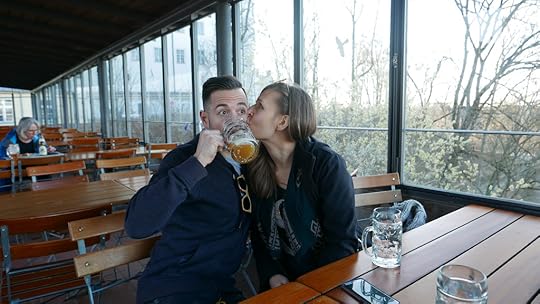
Seriously, how does gallivanting around the world with the love of my life punish those who have wronged me? Answer: IT DOESN’T.
As many of you know, I get inundated with press releases and spammy guest blog requests (they don’t so much write blog posts as they do hand you a list of domain names featuring some combination of the words “free,” “gambling,” and “penisfest.”) In 2013, I was getting half a dozen pitches daily to write about those sprays you put in the toilet before pooing so that no one will be able to guess that your shit stinks. These emails have been addressed to Deenie, Website Owner, Mrs. Rand, Dennies, and, my personal favorite, Nancy. (If you are new to the blog, my name is Geraldine.)
Even when I marked a message as spam, it would reappear in my inbox the next morning. It was the email equivalent of Prometheus’ goddamn liver. There was a whole, complicated, underground web of people spewing emails out at me like a grammatically problematic, sex-obsessed geyser. I’d get rid of one and another would take its place.
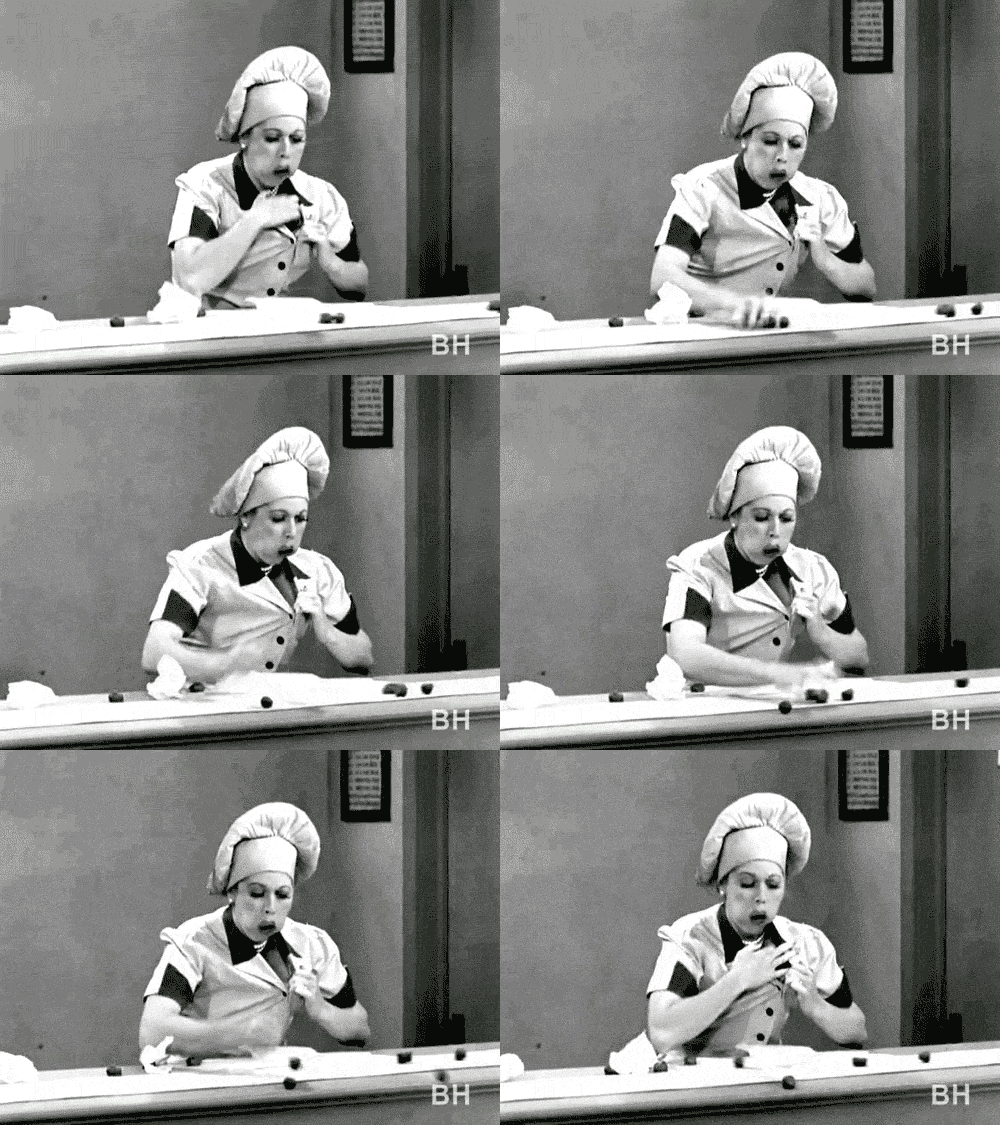
After a while, I started openly mocking them with elaborate replies – and it became a recurring series. But, like fooling around with guy with nipple piercings when you’re drunk and in college, it was one of those things that was fun at the time and in retrospect left me feeling badly. I soon found myself taking up a disproportionate amount of my and their time. So instead, I simply started collecting the emails of the most incredibly persistent senders. The ones who would email me three times in two days, asking why I hadn’t accepted their offer to write a guest post about FreePorn Timeshares.
After two or three years, I had several hundred names on this list. And I promised myself that one day, one day, I would send them my own press release as soon as I had some press that needed releasing.
Last month, my book came out. And last week, I compiled all those email addresses, and sent this message out:
Hey! It’s Geraldine. Remember me? I run an award-winning blog.
At some point in the past, you emailed me. It may have been a press release for an apparatus that enables women to pee while standing up, ads for your offshore gambling brothel, or, my personal favorite, an infographic about Turkish Delight (spoiler: NO ONE WANTS AN INFOGRAPHIC FOR TURKISH DELIGHT).
I asked you to take me off your mailing list, sometimes politely, sometimes not (sorry if I was a total dick to you). Sometimes you listened. Sometimes you kept emailing me for years and I couldn’t mark you as spam because a small part of me fell in love with you. I vowed to one day send you a press release of my own.
THAT DAY HAS ARRIVED.
I just published a travel memoir called ALL OVER THE PLACE: ADVENTURES IN TRAVEL, TRUE LOVE, AND PETTY THEFT. It’s really good. You should buy it to read while you eat Turkish Delight and urinate (while standing up or sitting down. Seriously, it’s your call).
It is available on Amazon, Barnes & Noble, and local booksellers everywhere. It is $4 for the e-version, which is crazy cheap. The hardcover is less than $20. Buy 10 of them and give them to your friends/enemies/other people you’ve sent unsolicited emails to. I have attached an infographic about my book, which isn’t so much an infographic as it is a box in which I’ve written the words “BUY MY BOOK.” I have also attached my official press release and a flowchart that I made while ostensibly sober.
That’s it. Thanks. (Also, don’t add me to your mailing list again or I’ll eat your pets.)
Ponies and Cupcakes,
Geraldine
Here is the flowchart I made: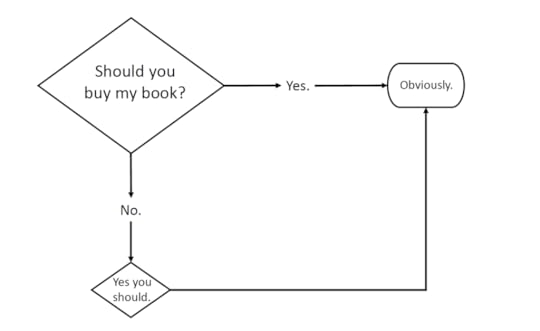
Here is the infographic that’s actually just a box:

I sent this email out, but unfortunately I only got *one* response (he told me my email was funny. I asked him to buy 18 copies. He has not replied). It’s almost as though people who have no idea who I am don’t care about my unsolicited press release. Yesterday, I emailed them again to see if they got my first message.
Hey, I just wanted to confirm that you saw my original email.
I really think you should buy a couple dozen copies of my book.
Still no reply. I’ll try them a couple more times and let you know what happens.


June 1, 2017
Melancholy and the Infinite Skies of Santa Fe
I thought Santa Fe was beautiful. Rand had been wanting to visit for years, had built it up in his mind so much that he had already asked me if I wanted to move there before we’d even set foot on the ground. He’d idealized so much that reality had trouble living up to what he’d imagined. This is something that Rand does often – he’s so convinced he’ll fall madly in love with a place that he’s always a little disappointed, even if it’s wonderful. In the early years of our relationship, I wondered if I’d suffer the same fate, because he’d built me up in his head and I was, at that messy time in my life, even more awful than I am now. But he accepted the ugly reality and loved me just the same.
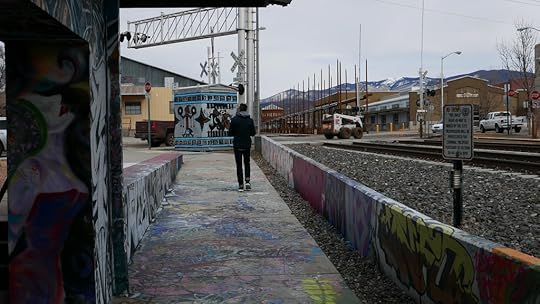
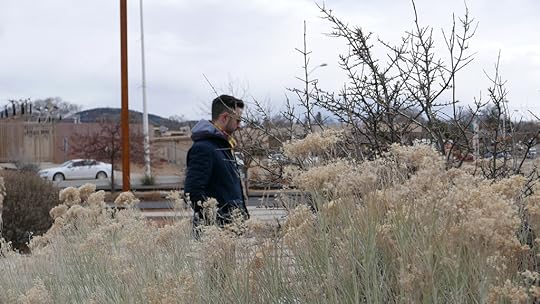
In the end, he loved Santa Fe as well. But for me, it was easier. I didn’t look at a single photo beforehand. I never do. People are always shocked when they find this out, because as a travel writer, it sounds lazy at best. But it means that I’m rarely disappointed. I have no expectations. I just want to see something new.
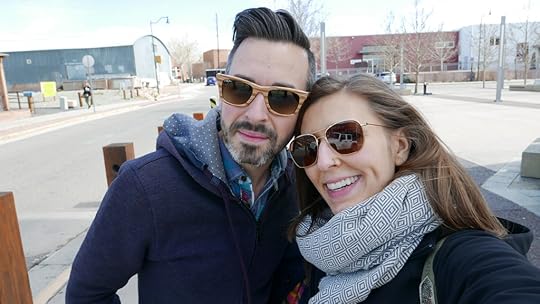
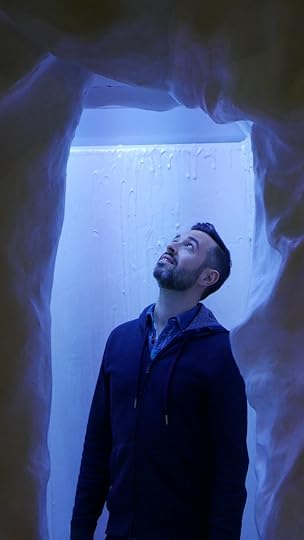
This feels like the opener from the Brady Bunch, where they’re all in different squares but looking at one another.
We had a nice trip. But when I reflect on it, I’m hit with a strange sort of melancholy – stronger than anything I felt while I was there. It was only a few months ago, but the things that still hurt my heart now were fresher then: the election, my dad’s death. The last year has been characterized by the painful sting of a lesson that it seems Rand and I are destined to learn over and over again: sometimes life doesn’t turn out like you thought it would. Keep your expectations in check.
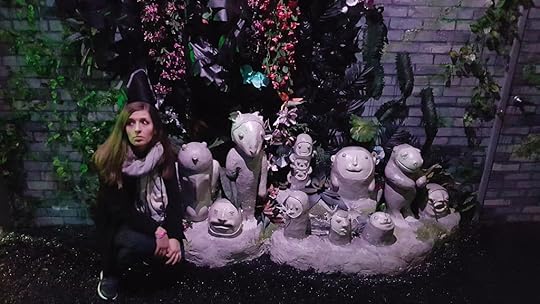
Chilling with some icy little creatures at Meow Wolf.
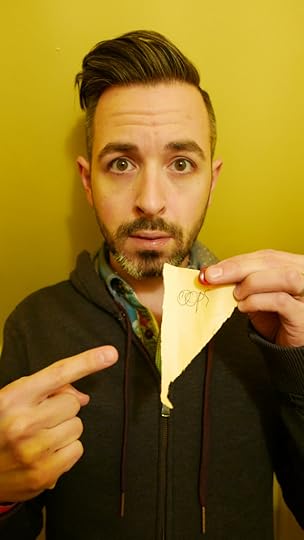
Rand at Meow Wolf. The note he’s holding says “oops.”
And perhaps it wasn’t just the sadness we brought with us, but something inherent in the rocky hills. New Mexico has the second highest poverty rate in the country (at more than 20%) and the third highest unemployment rate. It’s been ranked as the worst-run state in the nation. It’s also one of the most diverse states, and the thread between those two metrics – the idea that so many people of color live in poverty in America – is hard to ignore. The greatest trick in the handbag of institutionalized racism is economic oppression. But you probably know this. And you don’t need my privileged ass telling you.
It is a heartbreakingly beautiful and strange place. The sky is a vivid blue – it doesn’t have to compete with the deep cobalt of the ocean, or the greens of the trees like it does here in the northwest.
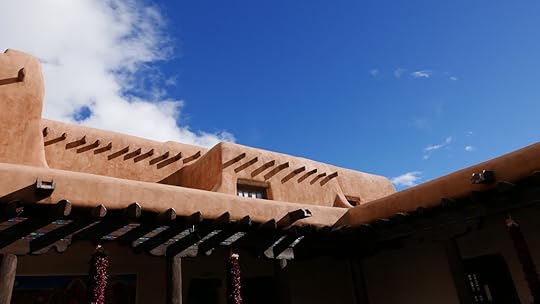
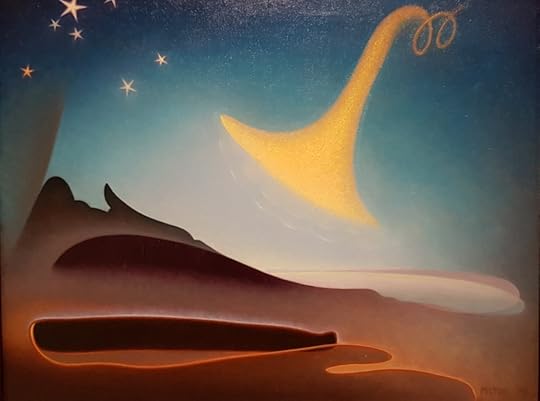
And the way it was echoed in the artwork was absolutely stunning.
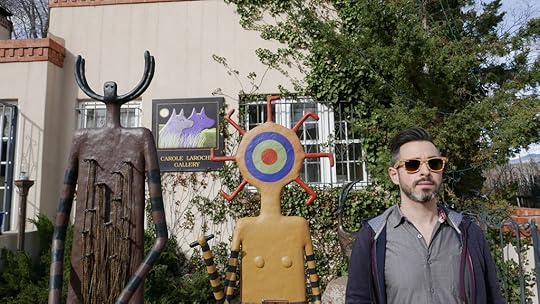
We wandered through art galleries and only sometimes felt unwelcome by owners who could tell we weren’t able to afford anything. This always makes me more uncomfortable than it does Rand.
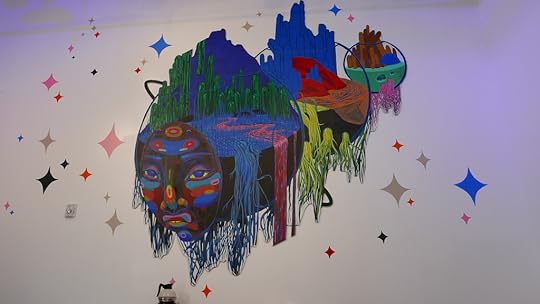
The altitude meant that the air was thin, and I teased Rand that I wouldn’t be able to move here because how would I bake in such a place? Would my bread dough rise? Would my cakes fall? But by then it didn’t matter, because he’d let go of that dream, and I saw him deflate a little as he did.
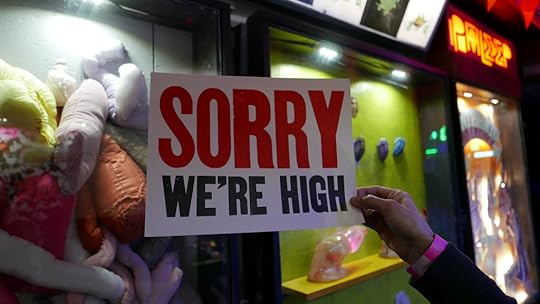
Sign at Meow Wolf.
It was so radically unlike any other place I’ve visited. Even little differences caught me by surprise. Every restaurant we went to had chile on the menu. Not chili with an “i” – I am not referring to the bean and meat laden stew that is ubiquitous in cook-offs around the country – but chile, a sauce of varying levels of heat made from either fresh green peppers or their dried red counterparts. Breakfast cafes, roadside diners, upscale places run by celebrity chefs all asked us the official state question: “Red or green?” Either is an acceptable answer, though those who opt for both reply simply “Christmas.”
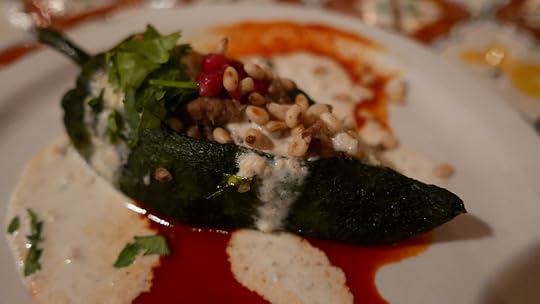
I failed to take a photo of either red or green chile because I ate it too quickly, apparently. But here is a photo of a chile, stuffed with meat and pine nuts. The food was lovely, and is so hyper-regional that you rarely find New Mexican cuisine outside of the state.
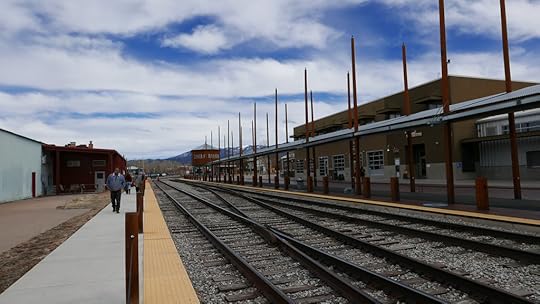
I never had more trouble driving than I did in Santa Fe. There was virtually no traffic, and the roads were flat and clear and straight, but my eyes kept drifting to the sky and the horizon. That infinite sky, that blue canvas changing color in the setting sun.
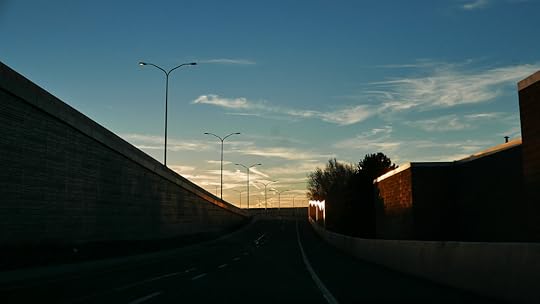
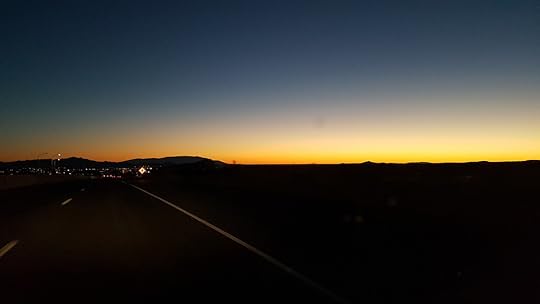
We had a splendid time. But on some level even I thought Santa Fe would be the answer to some unasked question. I’d kept my expectations about the town itself at bay, while still clinging to the notion that our long-awaited trip would somehow heal our hearts. Years of travel, years of existing on this planet and I still hold on to ideas like that despite having never once been proven right. New Mexico didn’t fix us. It couldn’t. Sometimes you are just sad and a little broken. Sometimes your dad dies and sometimes your plans don’t pan out.
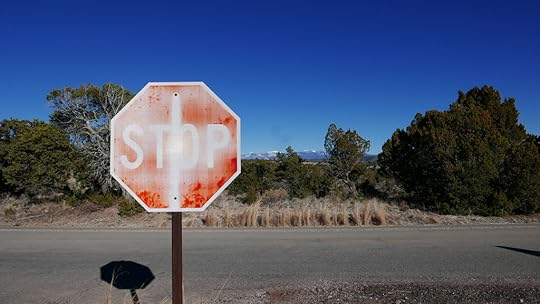
It’s not New Mexico’s fault. It’s still a nice place to visit.

May 22, 2017
Meow Wolf’s House of Eternal Return, Santa Fe, New Mexico
I spend a lot of time trying to make sense of things in my world. I’m often looking for explanations when there aren’t any, and inevitably find myself frustrated by the lack of answers. Why does Rand leave his shirt and jeans on the ground next to bed, stretched out, as though someone had been lying down in precisely that outfit and had suddenly vaporized? Why do I sometimes leave important, non-food items in the fridge? (Probably because I know I’ll look in there, eventually.) Why does my mother describe a fur vest with absolutely no safety features as “her work vest”? WHAT KIND OF WORK REQUIRES YOU TO LOOK LIKE YOU SKINNED A WOOKIE?
These are the mysteries of the world.
I keep looking for answers, even when there aren’t any. I suppose that’s why I was so bewitched by Meow Wolf’s House of Eternal Return. The massive interactive art installation was a winding mystery. Look hard enough, and some answers reveal themselves. But even when they don’t, the result is pretty magical.
When people found out we were going to Santa Fe, Meow Wolf came up frequently on the list of things to see. But when we asked people precisely what it was, replies were not exactly forthcoming.
“You just need to go,” they said.
And so Rand and I went with no prior knowledge and no idea what to expect, like our President plunging into the Middle East peace process.
Meow Wolf is a massive arts space, a mix of neon light and bright patterns that remind me of an early 90s childhood: of brilliant Lisa Frank stationary and mornings spent watching Mr. Wizard before heading to school. The current installation sprawling – part playground, part sculpture, it feels like a classic sci-fi novel and a choose-your-own adventure book in one.
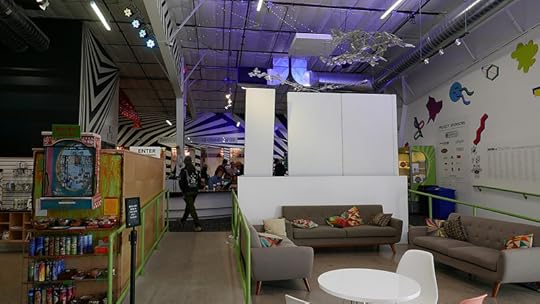
The lobby and gift shop at Meow Wolf.
The building itself was once a bowling alley – it’s now owned by George R.R. Martin (yes, he of Game of Thrones fame – but fear not, despite some creepy undertones, the place is family friendly).
The premise is this: in a large, peaceful Victorian home, a child has gone missing. He’s disappeared into another realm after delving too heavily into a departed grandparent’s scientific research. And soon you, as a museum visitor, will follow suit.
The exhibit begins with the house, massive and meticulously constructed.
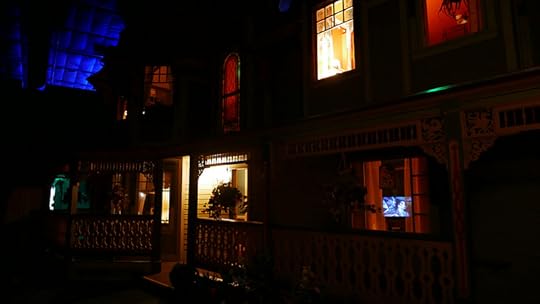
At first glance, everything seems commonplace, despite the fact that it feels like you are part of the weirdest open house ever – wandering through an actual home with a bunch of strangers.
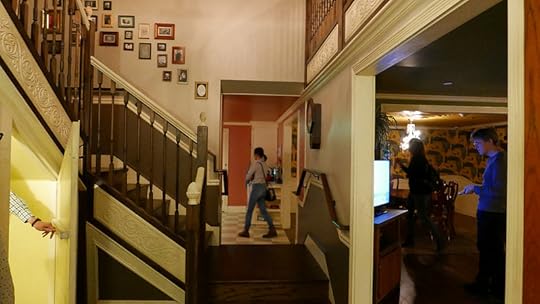
But if you look closer, you’ll find that nearly every object inside reveals a clue to what may have happened to the missing child.
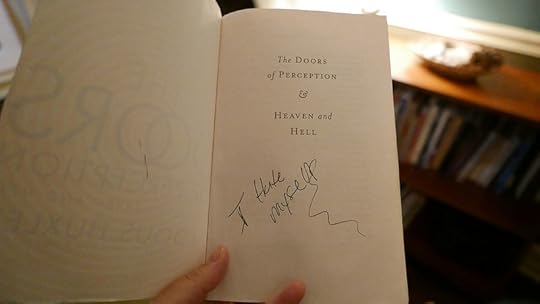
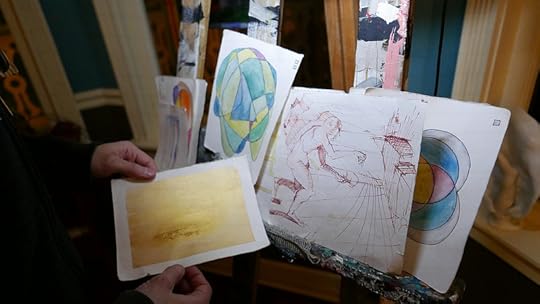
You rifle through books, you search through cabinets. You open up the fridge and find it’s a portal into another world.

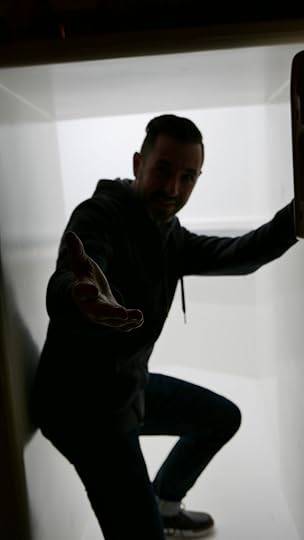
At some point, may find yourself crawling into a dryer.
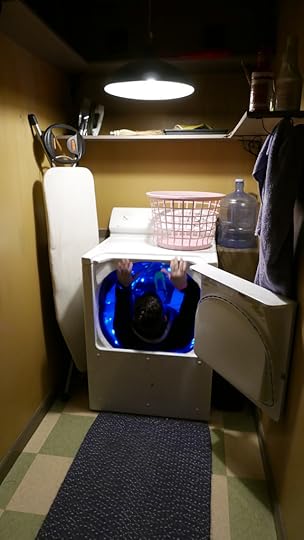
… or a fireplace.
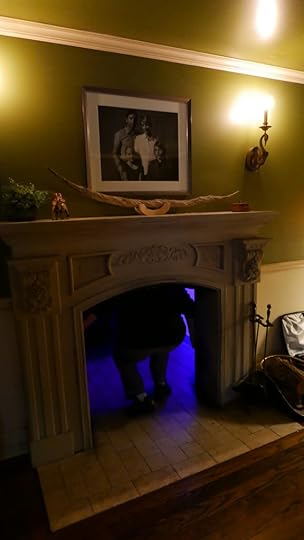
And then …

It was part M.C. Escher, part Dali, part A Wrinkle in Time and The Lion, The Witch, and The Wardrobe.
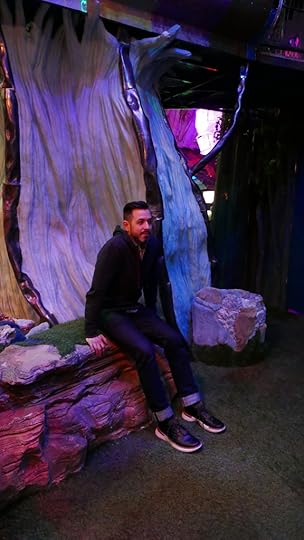
Rand, trying to figure it all out.
–
Every room is a work of art, everything is baffling, and all of it is wonderful.
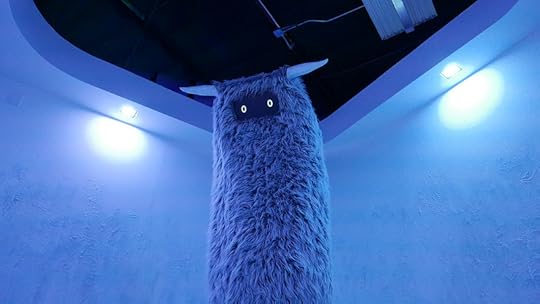

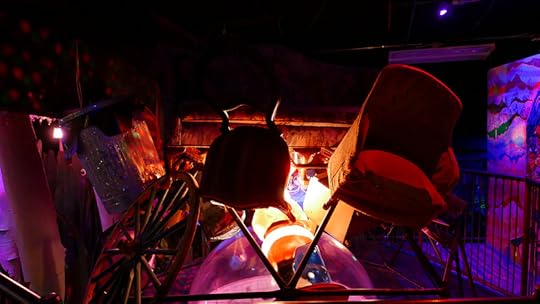
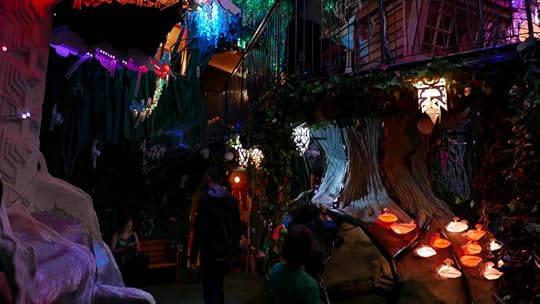
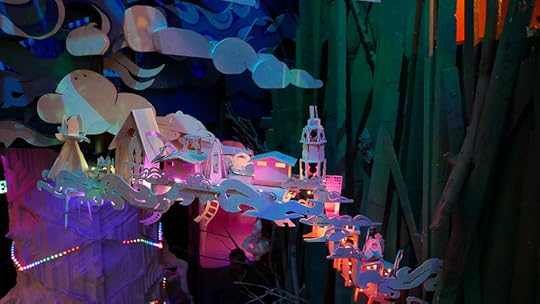
–
Some parts of the other realm hearkened back to the house. Like this room of brightly colored coral …

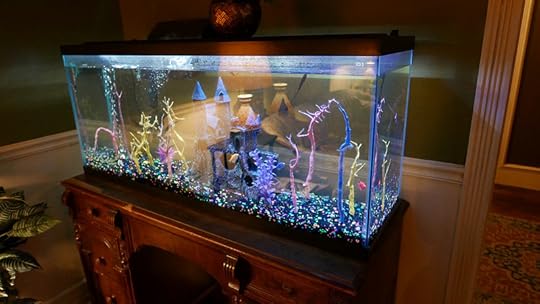
… and the fishtank we saw earlier.
–
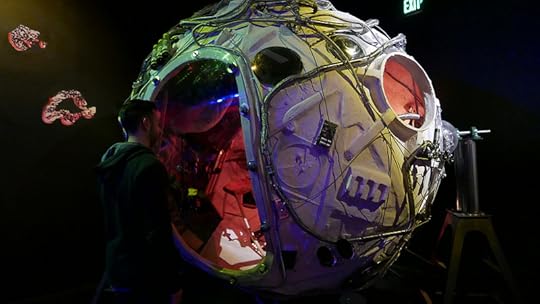
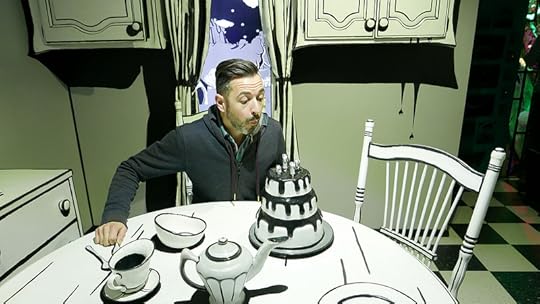
While other stuff seemed to stand on its own – spanning different genres.
–
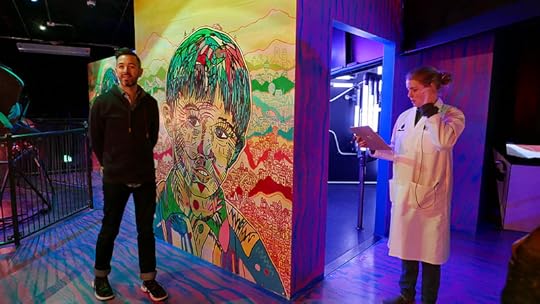
There are helpers throughout – people dressed in lab coats who are entirely in character, mumbling facts and figures to themselves while reading clipboards, but who will help you should the need arise.
–
For someone who is always trying to make sense of things, Meow Wolf was a little frustrating. What exactly was I supposed to do? Was it a game? Was it art? HOW DO YOU WIN? The harder I looked for answers, the more elusive they became.
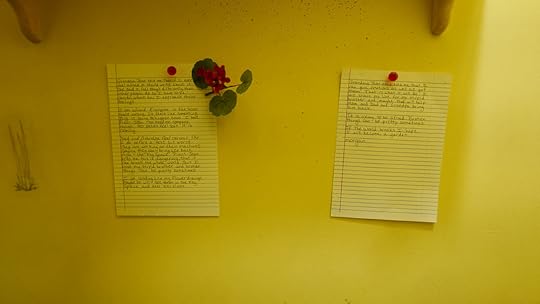
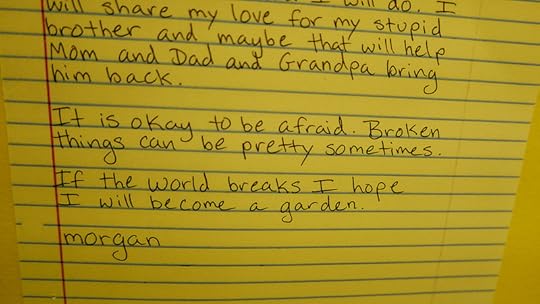
–
And I realized that there was no linear mystery to be solved, no clear end point. It wasn’t until I let go of all those ideas that I really started to appreciate the place.

–
Sometimes there are no simple answers. Sometimes life defies explanation. Sometimes, you just need to experience things for yourself.

May 16, 2017
I’m An American Traveler. Here’s Why I Won’t Pretend I’m Canadian.
The refrain I’ve heard again and again among American travelers over the last six months has been this: “Time to pretend we’re Canadian.”
That seems to be the best way to avoid having to explain, well, anything that’s going on in our country. We can gently maneuver around any awkward conversations about the demise of democracy and we can get out of answering that ever-present question, “What the fuck is going on over there?”
And I get it. I, too, have been tempted to pretend I’m from the Great White North, with its socialized healthcare and Prime Minister who looks like a long lost brother to Luke and Owen Wilson. I’ve seen countless episodes of DeGrassi. I can tell stories about when I was in “Grade 3”. I can systematically change my pronunciation of the diphthong /au/. PUT ME IN COACH, I’M READY TO PLAY HOCKEY OR WHATEVER!
This would be a simple and easy thing to do. But there are a couple of problems. I am from Seattle, or, as Canadians would call it, “the tropics”. We get 308 cloudy days a year. Canadians will look at my sun toasted skin, from those 57 almost-sunny days and know that something is amiss. And I’m not nearly polite enough to be Canadian. The other day I bumped into a mannequin and failed to apologize. A true Canadian would have. They apologize to everyone and everything. They apologize for the weather. It’s the national pastime, after curling.
But the main reason I absolutely won’t tell people I’m Canadian is this: I am American. And now, more than ever, I need people to know that fact.
My identity as an American is one I’ve fought for. My family history does not stretch back to sepia colored photos at Ellis Island. We haven’t been in the new world for so long that I needed to search a family tree to find out my history. I knew exactly what it was. My family came to the U.S. in the late 70s, bell-bottomed and big-haired. Because of this, I’ve been told time and again by people from all over the world that this country does not belong to me, nor I to it. That my European roots, and placement in the first generation of my family to be born in here somehow exempted me. But these things don’t conflict with my identity as an American. They simply confirm it. My family is made up of immigrants. My mother first waddled over here, heavily pregnant with me. My father first set foot on this country when he was a kid, fresh off the boat after spending time in a displaced persons camp in Germany. My friends have similar stories. They are the descendants of immigrants and slaves, they are the descendants of people who were displaced or slaughtered or overthrown. Our origin story is complicated and diverse and ugly. That is what it means to be American.
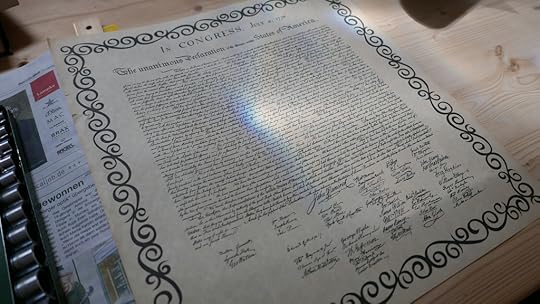
I found a copy of the Declaration of Independence in my dad’s workshop after he died. He lived in Germany for most of his life, and was born in Russia. But he was adamant: he was American.
I had a friend whose national identity came and went with the political tides. When our country shined, she did as well. She delighted in Obama’s election, high-fiving people as though she’d single-handedly made it happen. But whenever things turned dark, her language would switch from “we” to “you”. “You Americans did this.” or “Your country did that.” She was quick to disown it. It wasn’t her problem, and it wasn’t her country to fix.
This always bothered me, and yet I almost envied her for the freedom it offered. Her love for our home was conditional. Mine isn’t.
America has more than its share of problems. Our police brutality. Our systemic oppression and murder of young black men and women. We treat poverty as though it is a crime. We tell people that healthcare is not a right, and we make it so prohibitively expensive that only the wealthiest can afford it. We do not require maternity leave. We have eradicated Native American history. We’ve eradicated Native Americans. We are the only country in the world that still disputes climate change. We really need better access to birth control and sex education. College is too expensive. Schools are underfunded. Speaking more than one language should not be considered snobbish, but somehow, it is. The Supreme Court is still way too much of a sausage fest. We vilify Muslims on a daily basis. Our gun violence is staggering. I can go on. I can fill post after post.
These are America’s problems. And the second I separate myself from being an American is the second I abdicate responsibility. I’ve given myself an out. I don’t have to worry about it. I can critique without doing anything to make the situation better. I can judge the system without having to acknowledge how I benefit from it. It’s happening in someone else’s country, not mine.
If everyone who sees America’s problems claims to not be American, who is left to fix things?
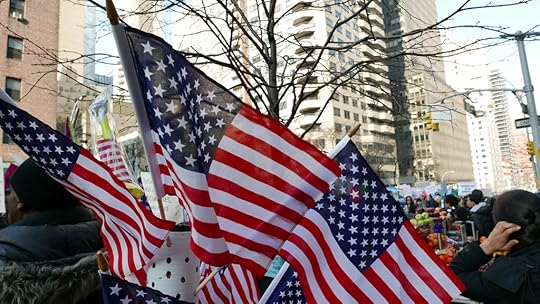
Seen at the Women’s March in NYC on January 21, 2017.
Last fall, when a tour guide in Turkey found out where we were from, he shook my husband’s hand.
“We haven’t seen Americans lately,” he said. And I realized the weight and responsibility we carried along with our passports. We were ambassadors for our home.
Now seems like a terrible time, politically, to tell people where I’m from. That’s precisely why I’m doing it. As I travel internationally, headlines from around the world announce the U.S.’s Muslim ban, the repealing of environmental regulations, the rise of anti-Semitic groups. I need to defy all of that as an American. I need the people I meet to know that the policies and actions of my government do not reflect the opinions of all Americans. They don’t even reflect the opinions of most Americans.
At a time when so many people in America living in fear of deportation because they aren’t citizens, it feels particularly wrong to pretend that I’m not one. At a time when people keep their ethnicity a secret out of fear of being targeted, I need to realize the privilege that comes from being a white woman with an eagle on her passport. There are people who were born here, whose families have been here for generations, who have never truly felt that this was their country. They’ve spent generations believing that the American dream didn’t apply to them because it didn’t. I have an obligation to work to make them feel as though this country is theirs, too. And I can’t do any of that if they think I’m from Vancouver.
I don’t deny Canada is a grand place. It gave us both Ryan Gosling and Ryan Reynolds. It gave us Drake and The Weeknd and … Keanu Reeves? Keanu is CANADIAN? (Dear god, all our best celebrities are from our neighbor to the north.) But Canada and its heartthrob Prime Minister don’t need good PR right now. And so there is no maple leaf on my backpack.
I will travel. People will ask where I’m from. And I will answer: I’m an American.
What’s that, you say? I don’t seem like an American? Sit down, friend. Let me tell you why you’re wrong.
For the people who inevitably ask: what if you are traveling somewhere that isn’t safe for Americans? Dudes, I go to central Europe most of the time. If you are in a place where you don’t feel safe, you need to do what makes you comfortable, and no one gets to judge you for that.

May 9, 2017
How to Explain Trump While Traveling Abroad
Being an American on the road, you often become an ambassador of sorts for your country and culture, and I find myself answering a lot of questions from friends, family, and the occasional well-meaning stranger about the U.S.
And while these questions usually run the gamut from pop to culture (No, I don’t know why peanut butter and jelly is a thing. Yes, our country is very, very large. No, I do not think I sound just like Rachel from Friends when I talk. Also, seriously, you realize that show ended 12 years ago, right? We have other TV shows, thank you very much, England. Many of which we stole from you), in the last few months, nearly every question I get while traveling is focused on one topic: President Trump. While on the road, I am asked on a near-daily basis to explain not only how our reality-star president was elected, but why he is still in office, and why we – the American public – “aren’t doing anything about it.”
For the record, I don’t often talk about politics on the blog. I tend to keep that to Twitter, where the abuse I receive for my opinions is quickly blocked and reported, and I can go about my day (after my blood pressure returns to some semblance of normal and I’ve eaten a cupcake or three). When I write about anything bordering political on the blog, it quickly becomes abusive on a platform which has always exclusively been safe and one that belonged exclusively to me (note: this abuse tends not to be from my usual readers, but from first-time trolls who have stumbled upon this site while presumably looking for something to rage-masturbate to). So I shy away from it here while being unabashedly politically vocal on more public forums. It’s a strange dichotomy.
But today I’m going to talk about how to explain the phenomenon of Trump to people who aren’t American, because it’s a question that keeps coming up for me and for a lot of other travelers. And it’s tricky to answer: a lot of Americans were stunned on election night. I sat in a bar, drunk for the first time in a decade, staring blankly at an enormous screen projecting the impossible results: that a man who bragged about sexually assaulting women was now President. Even seasoned journalists were taken aback – Brian Williams’ sigh embodying what so many people felt at that precise moment.
So for those trying to unlock this mystery from outside the United States, here are a few things to consider:
Hillary was hugely unpopular here in America. In Europe and the rest of the world, this can be rather confusing: she was highly respected and well-known as Secretary of State on the world stage, and incredibly well liked. A poll of the G20 countries found that 18 of them overwhelmingly supported Hillary. Only one – Russia – favored Trump. I spent the days leading up to the election working out of the local Democratic party headquarters, meticulously assembling buttons that read “MADAME PRESIDENT” and working the phone banks – and even so I could feel that there was a palpable dislike for Hillary that we were fighting against. I think that part of this was institutionalized sexism – anyone who tells me otherwise will receive a swift kick to the balls (because, let’s face it: virtually everyone who says it’s not about sexism is a cisgendered dude).
Now, when I say institutionalized sexism, I don’t mean that everyone who disliked Hillary was a sexist (though some, clearly, were). Instead, I mean that she was held to a different and higher standard than Mr. Trump. And she was consistently framed in a negative way – as being an out-of-touch, entitled woman. When Hillary expressed the need for affordable, widespread broadband in rural areas, her quote was cut up and taken out of context – so that it seemed like she was complaining about cell phone coverage in rural areas as a personal inconvenience, rather than a problem she was trying to fix. The media dedicated huge amounts of real estate to negative coverage of Hillary. Which brings me to my next point …
The news had a lot to gain in making the race close. In the U.S., the news is a big, money-making endeavor. Races that aren’t close aren’t interesting – and if fewer people watch the news, that means less ad revenue for those stations. In 2008, Obama decisively won the popular vote by 10 million votes and the electoral college by 192 votes (more on that later) – but coverage made the race seem appallingly close (even though McCain had always been the underdog), and kept viewers glued to their screens. In 2012, the same thing happened with Obama and Romney, even though the president won re-election easily. This election cycle, as Hillary started to pull away from Trump in the polls, negative coverage of her became even more salient – perhaps to give the appearance of a close race. Negative coverage sells more papers – and in this case may have swayed the public, too.
No one thought Trump would win. Seriously. No one. Not the pundits, not Nate Silver (our imperfect oracle), not even Trump himself (and now that he has, there’s a lot of talk around whether he actually wants the job.) So a lot of people who didn’t like Hillary or who weren’t that passionate about her just stayed home. Or people voted third party. Here’s seasoned ABC News commentators laughing at Keith Ellison’s predictions that Trump would soon be leading the Republican party.
The Comey Letter. There’s too much to unpack here in a simple blog post – and that’s part of the problem. Hillary had a private server. She was also hacked (but not on her private server). Misconceptions surrounding this issue fed into the already prevalent view that Hillary was corrupt or untrustworthy. Now, the truth has come out: that there was absolutely no reason to reopen the case, and that the only candidate under investigation during this time was actually Trump. And rather amazingly, both Trump and Pence have had some egregious security issues with their phones and computers (Pence was not only using a private email to discuss governmental issues, but he was actually hacked). But the timing of Comey’s letter was positively damning, and newspapers like The New York Times gave it a disproportional amount of coverage days before the election. The prevailing belief is that it likely cost her the election.
Corporations can donate to elections. This is baffling to a lot of my friends outside of the U.S. – lobbying is well-regulated outside of the United States. But in 2010, by a narrow margin, the Supreme Court upheld Citizens United, which said that corporate spending is equivalent to free speech, and it cannot be restricted. This means that for-profit organizations can give as much money as they want to support political candidates. Now, in this instance, both candidates benefited – and Hillary actually out raised Trump. But Trump said repeatedly said he’s going to do away with a lot of regulations on the coal and oil industry (and has already started doing so). This meant he had the support of powerful lobbies which represented the interests of people in key battleground states like North Carolina. It also means that politicians don’t need to appeal to the masses as much as they do their wealthy donors. Right now repealing Obamacare is drastically unpopular, but the GOP and Trump are pushing for it because it will provide a tax break to the wealthiest 1% of the population. GOP politicians are hoping they can win re-election with enough money, and not by adhering to what their constituents want.
Millions more people voted for Hillary than Trump. This becomes really confusing for a lot of people in countries where a simple majority will win you the election. In the United States, the presidency is determined by who gets more votes in the Electoral College, which is an antiquated system rooted in slavery. No, for real. See, back in the day, southern states had a large population of people (mostly slaves), but only a few people (white men) who could actually vote. Under a popular vote model, northern states would always win the election. The Electoral College, though, counted slaves as 3/5ths of a person (yes, yes it is fucked up) – so the more slaves you had, the more Electoral College votes you had. For states like Virginia, this is a big deal – if you won the state, you won all of its EC votes – and it had a ton. This is why so many of our early presidents were from Virginia. So the EC mitigates the votes of larger states, and overemphasizes the votes of smaller states. Because smaller states tend to go Republican, this creates some interesting electoral results.
Why do we still have the Electoral College, then? It’s something that a few states are reconsidering, but so far it hasn’t gotten a lot of traction. It’s very difficult to change U.S. institutions. Even our Constitution is 200 years old and it’s hard to update this stuff. Plus, people are worried that smaller states will not have their interests reflected in a national election.
Only 26% of eligible voters actually voted for Trump. He’s very much a fringe candidate. But his supporters were in the right states (see Electoral College, above). Trump ran as an outsider – but because he doesn’t have any experience in the political realm, he’s basically capitulated to what the GOP has wanted after getting elected. The GOP wants to destroy Obamacare (because, see above – it would mean tax breaks for their donors), which is something Trump specifically campaigned against. So what you have right now is an incompetent President going along with the doctrine of the Republican party – which was not even something the people who voted for Trump were in favor of.
 (Source)
Why are the American people letting the government ban Muslims, take away healthcare, remove environmental restrictions, and cut funding to hundreds of organizations that benefit the public? Oof. I get this question all the time, and it’s a doozy, because here’s the thing: we aren’t. But there isn’t much that you can do after an election has taken place. The biggest checks to a president are Congress and Senate. Right now, Republicans control both of those – and they are all for the President’s plans. When the vote to repeal Obamacare came before Congress, not a single Democrat voted for it – but every single Republican congressperson (with the exception of 4) did. When Trump signed a ban on Muslims, it was an executive order – so it wasn’t even up to a vote. It was just sort of decreed. The only check on it was from the U.S. Attorney General – who, at the time, was Sally Yates. Trump immediately removed her from office and appointed Jeff Sessions. Sessions has a history of voter suppression and racism – he is not a check on the President’s racist decrees. Under Sessions, the DOJ claimed that precedent for the Muslim ban was a court case defending segregation of pools in the 1970s. So now the only way to stop Trump’s Muslim ban is from the lower courts – and they’ve been suing him, because that’s the only check on him that remains, and the case will likely end up going to the Supreme Court. Unfortunately, the GOP (who again, controls everything) managed to make sure that Scalia’s vacant seat, which should have gone to Merrick Garland, went to Neil Gorsuch – who is staunchly conservative and may tip a judgement made by the court in Trump’s favor.
Okay, but can’t you like, rebel? What about sanctuary cities? A lot of Trump’s more hateful orders – like his racist crackdown on immigrants who are working in the U.S. illegally – need to be enforced on a local level, so it stands to reason that cities (which tend to be far less conservative than rural areas and are also hubs for immigrants) could simply refuse to enact Trump’s orders. And indeed, many, including my own beloved Seattle have done just that by declaring themselves “sanctuary cities.” But that resistance is already getting stomped down. And both Attorney General Sessions and President Trump have threatened to withhold federal funds from sanctuary cities. The governor of Texas just banned them in his state – threatening fines of up to $25,ooo a day to governmental entities that refuse to comply.
Why can’t you impeach him? Again, only Congress can do that. And there’s tons of grounds for why they could. The emoluments clause, for one (Trump never divested his private holdings, which supposedly he needed to do before taking office). But Congress is controlled by the GOP and Trump is doing their bidding, so they clearly aren’t going to vote to impeach. They’ll only get rid of him when he proves to be useless (there is a very clear scenario where they make him the scapegoat for all the unpopular legislation they’ve passed, and then get rid of him).
Plus, impeachment wouldn’t actually be great for us. See, Trump’s incompetent, but he wants the people to like him, and he might actually do the right thing in hopes that they will. But Pence – who would take office if Trump is impeached – is an incredibly dangerous human being. He caused an outbreak of HIV when he was governor of Indiana (he claimed that needle exchanges promoted drug use. They don’t.) and his stance on LGBTQ rights is abhorrent. Already a bubble has formed around the Vice-President, in an attempt to shield him from any wrong-doing on the whole Russia issue, so we can rest assured if Trump gets the boot, we’ll have to deal with President Pence.
Okay, how did the GOP get control of everything? This is crazy. The problem is that demographically, Democrats don’t vote in mid-term elections. Over the years, this meant that Republicans slowly took over more and more seats in the House and Senate. But wait – it gets worse. The second they gained control, Republicans set out to redistrict a lot of areas, ensuring that they would always have a majority of seats in state legislatures even if they were getting fewer votes that Democrats on a statewide level. In Michigan, for example, Republicans received 30,000 fewer votes that Democrats, but they hold 63 seats in the House of Representatives, as opposed to 47 for Democrats. But redistricting doesn’t fully explain the problem. There’s also been massive voter suppression efforts throughout America (in areas that have historically voted for Democrats). In Wisconsin, new voter ID laws meant that 200,000 people were unable to vote this election. Trump won the state by 22,000 votes. And statistically, minority voters have to wait twice as long to vote as white voters. In Georgia, Karen Handel, a Republican who is running in a special election against Democrat Jon Ossoff was enraged to learn that voter registration had been extended – meaning more people would vote in her race. She described it as Democrats trying to steal the election.
So, this will get fixed in the next election, right? Maybe. Maybe not. The next midterm election is 2018. Republicans control everything until then. And even if the next election happens, the voter suppression and gerrymandering efforts mean that it doesn’t matter if Democrats turn out in greater numbers (because that’s what they’re doing in a lot of states now, and it doesn’t matter).
Aren’t you mad? Every day is a constant state of panic, grief, and disbelief. This is why my Twitter feed is a never-ending series of attempts to channel my rage into 140 characters. But here’s the thing: the world is moving in the right direction. The U.S. elected Trump, but since then 6 European elections have had Nationalists underperform compared to the polls. So I suppose I’m cautiously optimistic. (I’m also privileged as f*ck, and live in a city where more than 90% of the population voted for Hillary – which helps on the optimism front.)
Can’t you all, like … take to the streets or something? We have and we are. But it doesn’t seem to be working – GOP respresentatives are avoiding their Town Hall meetings, and as I mentioned before, repealing Obamacare was drastically unpopular but the GOP still axed it. There are also bills proposed in five states to criminalize peaceful protest, but I don’t think those will come to fruition.
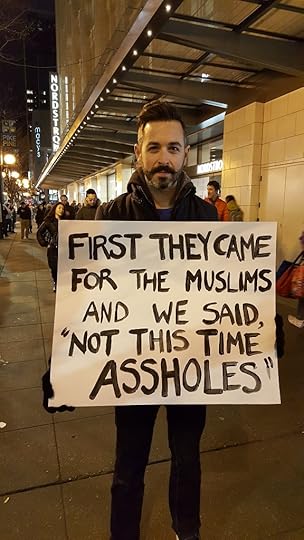
Rand at one of several marches we’ve been to this year.
Wait, so … is it safe for me, as a foreigner, to come to the U.S.? Rand and I had a long talk about this and the conclusion we came to is … we have no idea. On Election Day, someone spat on him for wearing a t-shirt that said “FEMINIST”, and he’s seen an increase in anti-Semitic comments and threats in his Twitter feed and elsewhere (I’ve seen a couple, too). There have been a rise of anti-Semitic attacks, as well as numerous attacks on women wearing hijabs – but keep in mind this is mostly happening to Americans. There is a rise of White Nationalist (neo-Nazi) groups in America right now, so that’s something to be concerned about, too. The ACLU has also listed travel advisories for people heading to Texas and Arizona, based on treatment of immigrants and people of color. Trump’s travel ban has been stricken down (at least temporarily) but it’s safe to assume that if you are from one of the Muslim countries on the list (which also align to countries where Trump does not have hotels, incidentally) you may have trouble at border control. Oh, and apparently a lot of border control agents are asking people to unlock their phones so they can search through them (illegally). So … I’m sorry. I just don’t know. Do what you need to do to make yourself comfortable.
If you are looking for further reading about the political climate that gave birth to a Trump Presidency, Ta-nehisi Coates’ piece for The Atlantic, “My President was Black” is excellent. The New Yorker‘s John Cassidy also took at look at the election in its immediate aftermath.

May 3, 2017
My Book is Officially Out in the World.
My book came out yesterday. It is out there floating in the world, while I sit at home in my pjs eating cake and repeating the words “I am an author” to myself over and over again. To be fair, I have been doing this weekly since I was 8, but now it carries with it a sort of veracity it did not have before.
I say these words again. I want to shout them. There is frosting in my hair and I am not wearing a bra and this is the uniform of a woman who is ready to conquer the world and who also hopes that the UPS guy does not judge her for looking like she just escaped from a sleep study.
My inbox and social media pages have been flooded with messages from my friends. I’ve tried to keep up with them and can’t. They are wonderful and supportive and utterly unhinged. I love them all. I want to run from the attention and bask in it and also eat cake. It is like my birthday. In a way, it is. It is my book’s birthday.
A few months ago, my friend Mike told me he was going to buy 50 copies of my book and spell my name out with it. I laughed, and figured he was joking, and this is my fault because I’ve known Mike long enough to have guessed that he was not. If Mike and I were in grade school, the teachers would make us sit across the room from one another and then send notes home to our parents saying that we are a bad influence on one another. The last time we were left to our own devices without Rand or Mike’s beloved calmly vetoing our plans, he and I ended up fully dressed and soaking wet in the middle of a pool. There were other victims, but we were the instigators.
Yesterday, Mike posted this to Facebook.
HE BOUGHT 50 COPIES OF MY BOOK AND SPELLED OUT MY NAME. I cackled like a fiend when I saw it.
And then my friend Pete made this.
Ordered the Limited Edition — bargain at $995. @everywhereist assured me it would double in value before she stopped returning my calls… pic.twitter.com/dCRHB2cCkT
— Dr. Pete Meyers (@dr_pete) May 3, 2017
And Tim and Alyssa did this (which is super cute but I’m putting a SEIZURE WARNING on it. High five to my neurologically temperamental brothers and sisters.)
And Melanie made this.
It’s here it’s here it’s here! @everywhereist pic.twitter.com/OpYDSd3e44
— Melanie Deziel (@mdeziel) May 2, 2017
And Chrissy and Skye sent me this:
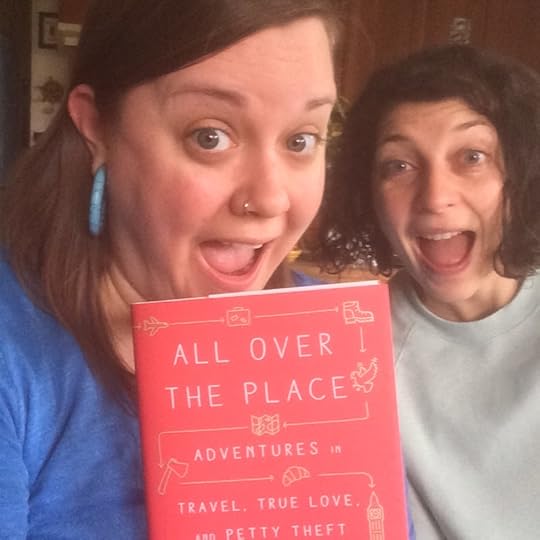
And Charlene tweeted this:
happy day! finally got my copies of @everywhereist‘s All Over the Place. can i ignore my inbox so i can start reading?#allovertheplace pic.twitter.com/mkOWiCYeW0
— Charlene Kate Events (@CharKateEvents) May 2, 2017
And Brad (who also bought way, way too many copies of my book) took this silly photo of himself and put it on the internet for everyone to see.
The wait is over! A big box of awesome books from @everywhereist showed up today. pic.twitter.com/3SMACJupoH
— Brad Feld (@bfeld) May 2, 2017
It went on and on. Basically everyone in my entire life started emailing me or tweeting at me or posting to Facebook and Instagram and a bunch of new social media platforms that I’ve never even heard of. And then people who I didn’t even know in real life started doing it. I just kept seeing photos of that bright coral cover again and again.
@everywhereist as I read your book, I think about the friends and family members that would enjoy it. #greatbook #everywhereist pic.twitter.com/C59DSfH1tG
— Paul N. (@PN_Drummer) May 3, 2017
If you need me, I’ll be in the yard w/ my new book… and some snacks. Congratulations, @everywhereist. Very well deserved. pic.twitter.com/F1A9SkiZkF
— Sheena Schleicher (@SheenaSchleichr) May 3, 2017
@everywhereist I already LOL’d & teared up by page 29, you wizard.
— Merry @AIMCLEAR (@MerryMorud) May 3, 2017
And then an excerpt of my book appeared in The Globe & Mail. And tomorrow I’m speaking at Town Hall in Seattle (*cough-cough* tickets are still available).
It’s been overwhelming and crazy and wonderful.
To everyone who has supported me, and this blog, and now the book: thank you. If you left a comment, or followed me on Twitter, or visited the blog, or BOUGHT WAY TOO MANY COPIES OF MY BOOK, then you helped make this happen, and I can’t begin to tell you how much all of that means to me. This has been a very strange and wonderful ride and I’m just trying to enjoy every single minute of it.
I have cake in my hair. I am not wearing pants. I am living the dream.

April 25, 2017
Why is It So Hard to Be Self-Promotional if You’re a Woman?
“What’s the hardest part about writing a book?”
I’ve been asked this question a lot lately, and my answer is what you’d expect: figuring out which darlings to fight for and which to cut, weaving a cohesive narrative, and finding an author bio photo of me that doesn’t have obscene words in the background.
You know, the usual.
What I did not anticipate, after my book was sold to a publisher, and after we finished the edits, was that actually telling people about my book would prove to be one of the hardest things I had to do. For the record, this should sound like utter bullshit. I mean, it sounds like utter bullshit to me. 11-year-old me has been waiting for this moment for COUGH COUGH years. And now we’re being sheepish about it? WHAT THE HELL, GERALDINE?
But as a whole Pandora station called “Geraldine’s Greatest Self-Disparaging Hits” plays in my head, this is what I find myself grappling with. Self-promotion is a very difficult task for me. I have to ask my friends and family and everyone in my social circle – people I love and respect and have peed next to in public bathrooms – to buy my book. I am asking them to spend time and money on me. And that act makes me profoundly uncomfortable.
While in Japan we struck up a conversation with a family from Chile. The father asked us what we did, and I quietly mumbled something about travel writing.
“That’s amazing!” he said, and wanted to know more. I shrugged my way through talking about the blog and stared at the ground like an awkward teenager.
“She’s also just finished a book,” Rand said, looking at me as though my omission was crazy.
“That’s not a big deal,” I mumbled about the realization of my childhood dream.
I have spent a lot of time trying to unpack why my reaction has been this way. Rand and I recently had a spat because he wanted to do some promotional work for my book. The problem with having a partner who is a digital marketer (YES, BELIEVE IT OR NOT THERE IS A DOWNSIDE. It’s not just sexy Google rankings talk all day) is that when you do something worth noting, they want to tell the world. I sat on our bed, tearfully begging him not to email anyone because they might feel obligated to buy my book or to help spread the word about the launch.
“Have you lost your mind?” Rand said. (The fight escalated to the point where I screamed, “YOU KNEW I WAS BAD AT SEO WHEN YOU MARRIED ME.”)
Rand’s support is so apparent, so evident, I started to wonder if there was something unusual about my near-pathological reluctance to promote my own work. I asked my friend Mike, who is a talented and award-winning children’s writer and illustrator, about his own struggles to be self-promotional.
“It definitely feels weird and icky sometimes … it feels awkward promoting one’s work, as if to say ‘Look how great I am!'”
All of that sounded like madness to me, frankly, because Mike. Is. Great. I kept asking around, and found that while Mike and a few other men I knew had discomfort promoting their work, it seemed like almost every single woman I knew did. So, like most people looking for social proof that they haven’t lost their mind, I asked on Twitter.
Question for women in my feed: do you have trouble promoting your work? Does it make you uncomfortable? Why? (I’m working on something)
— Geraldine (@everywhereist) April 24, 2017
And again and again, I heard the same response from women across professions (writers do not claim sole jurisdiction over this) – it is very difficult to sing your own praises. Heck, for many of us, it’s difficult to even mutter your own praises under your breath when no one is home. It feels rooted in the same misogyny that has so many of us second-guessing ourselves for promotions or recognition of any kind. There is a fundamental fear of being disliked, a belief that if we do promote our work we’ll be see as arrogant or opportunistic, demanding or difficult.
@everywhereist I have trouble promoting anything that is related to me…it’s the “I’m worthy enough” or even just “I’m worthy” that I struggle with.
— Julie Neimark (@JulieNeimark) April 24, 2017
Even those that did promote their work noted that they only shared an article once or twice – believing that there was a limit to how often to we could promote our own work before exhausting the goodwill of our social networks. A limit that we only seem to apply to ourselves. (Indeed, I’ve received this criticism from Rand as well – even when I share my work, I do so only once, and I don’t share everything I produce. I argue that I don’t want to annoy people – even as men and publications in my feed endlessly tweet out the same article again and again. The New Yorker keeps trying to make The Borowitz Report happen in my feed at least 5 times a day. I still follow them.)
Rachel Bloom’s brilliant “Lady Boss” video encompasses this duality – of trying to stand up for ourselves while still worrying about who we might offend in our quest to be valued and heard.
–
We float between believing in ourselves and being mired in self-doubt, often in the same breath.
@everywhereist YES! I go from feeling v capable to being wrecked by imposter syndrome about 4 times/day. I question every self-promotional thing I’ve said.
— Ashley (@BermanHale) April 24, 2017
And for many of us, it’s the self-doubt that overtakes the conversation.
@everywhereist So I think mine is partially imposter syndrome: everyone is going to hate it, so why promote it?
— Naomi Tomky (@gastrognome) April 24, 2017
I know both of these women. Naomi is a brilliant writer. Her voice is both poetic and direct, which is an amazingly tough thing to balance. Ashley is a damn rock star in her field. While I struggle with the lack of logic in their statements, I find myself applying the same flawed thinking to my own life.
“What if you are telling people to promote a book that isn’t any good?” I ask Rand, my voice cracking with panic.
He stares at me blankly for a beat. He pulls up my Goodreads reviews and points at it.
“Are you kidding me?” he says. “Look at these reviews. They. Are. Glowing. And these are from people who don’t know you. You’re worried about asking people who know and like you to buy your book?”
“NO ONE LIKES ME.”
(Ugh. Yes, this happened. Two days later my friend Ronell wrote this beautiful post which made me cry. And yet I still worry about not being liked.)
Amazingly, I can be simultaneously disgusted with both my self-doubt and the thought-of self-promotion. For those of us who can’t quite break free of the idea that women shouldn’t laud our own achievements, we find ourselves in a lose-lose situation. In either case, we’re being insincere.
@everywhereist 100%
The same I have a hard time taking a
compliment from someone.
Feels like I might over sell,
when in reality I probably under sell! pic.twitter.com/gB27OFCcyY
— Gabriela Cardoza (@CardozaGab) April 24, 2017
–
We do not extend this dynamic to our male counterparts, I’ve found. As Jenét succinctly puts it, this is a judgement we hold against ourselves. To be self-promotional is to be at odds with being a woman.
@everywhereist @amywestervelt This is what we’re raised to believe. This is the crap that society shoves onto us. It’s not feminine. It’s not attractive. You’re bragging.
— Jenét Morrow (@JenetAllDay) April 24, 2017
–
And when I find a woman who is able to promote and value her own work, I regard her like a unicorn.
@everywhereist No, I’m not uncomfortable promoting my work.
— Jenét Morrow (@JenetAllDay) April 24, 2017
I emailed Jenét about this – and, okay, maybe I also asked her to be my Obi Wan. She told me that growing up, the emphasis emphasis was put on racial equality, not on gender equality. (She laughed and said that it was implied that women were as good as men).
“I got the standard ‘You’re just as good as white people but know you have to work twice as hard for it matter.'”
And as a kid, she already knew that she was intelligent, and tough, and different. For her, the only option was to embrace it.
Her email touched on something critical: it’s impossible to divorce this issue from other forms of oppression or marginalization. #intersectionalfeminism (Even Mike, my illustrator friend who struggles with lauding his own work, is neither straight nor white.)
In Phoebe Robinson’s brilliant You Can’t Touch My Hair, she discusses how she needs to self-censor so that she’s not perceived as “an angry black woman”. She notes that she used to dim her own light to make other people – most notably white people – more comfortable. For so many women, it isn’t simply misogyny that keeps them quiet, it’s institutionalized racism, or ablelism, or homophobia, or transphobia. In sharing our work, we make ourselves even more vulnerable than normal. In lauding ourselves, we worry how we’ll be perceived.
@everywhereist When I say “like me”, I mean as a woman and as an ethnic minority, I get the impression that people think I should not be assertive.
— Grace Cheung (@gcheung) April 24, 2017
@everywhereist @randfish Yes, afraid that I’m not good enough. Have to channel my inner white dude for confidence.
— Li Chen (@Li__Chen) April 24, 2017
–
Whether we manage to laud our own work or not, we all seem to be unified under one sentiment about seeing women stifle their own voices:
@everywhereist @amywestervelt It breaks my heart.
— Jenét Morrow (@JenetAllDay) April 24, 2017
I have a lot of privilege at my disposal. I’m white, I’m able-bodied, I’m cis, and straight, and have a husband who is a frigging marketing juggernaut. My biggest obstacle is that I need to stop playing the soundtrack to Geraldine Sucks: The Musical, over and over in my head. I thought about what Jenét told me in her email.
“I believe with my whole heart that every woman can and should be their own hype man. Women absolutely are allowed to be proud of their achievements and the products they create. Fuck anyone telling me or any woman that promoting ourselves is bragging. That it’s not feminine (code for unattractive) or classy. Fuck all of that! Closed mouths don’t get fed. The end.”
And I’m working on that. I share other women’s work. I sing their praises, even if they are too scared to sing their own. And I’m trying to be less uncomfortable about talking about my own work. I spent twenty minutes deciding whether or not to include this next paragraph. But here it is:
I wrote a book. It’s good. It really is. That is hard for me to say, not because it’s not the truth, but because I don’t want you to think I’m bragging. But whatever. I worked really hard on it and I’m proud of it, so I’m going to brag. You should buy it. It’s available on Amazon, Barnes & Noble, and Indiebound. I recorded the audiobook, too, because I’m multi-talented and bilingual. I speak four languages in the book with some pretty solid proficiency.
Here’s my husband dancing with a couple copies of it:
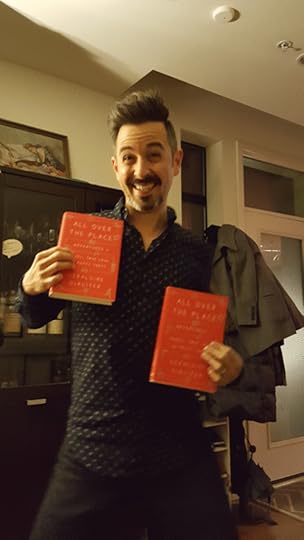
I hope you still like me after this grand display of non-self-loathing. If you don’t, well, I’m trying to be cool with that, too. Baby-steps, y’all. Baby steps.

April 18, 2017
Just a bunch of adorable animals in Turkey. Whatever. No big deal.
I’ve been reading the news coming out of Turkey through the haze of jet lag, trying to piece together the intricacies of the story while half asleep. I usually take a while to write about the places that we’ve traveled to (mostly out of laziness, but I will tell you the delay is due to contemplative reflection), taking for granted the fact that the political situation usually remains unchanged in that time. But the political tides in Turkey were already shifting when we were there last fall, and we – and everyone we met – seemed acutely aware of it. As we drove around Cappadocia, I told Rand that I would be sad if we were unable to return to Turkey.
That felt strangely prophetic. It seems unlikely that we’ll go back. At least, not for a very long while.
And now I find myself in a strange state of wanting to think about something besides Turkey and also being unable to think of anything else. And so I find myself settling on something safe within that framework.
I will think about Turkey. But I will also think about puppies. I hope you find this compromise acceptable.
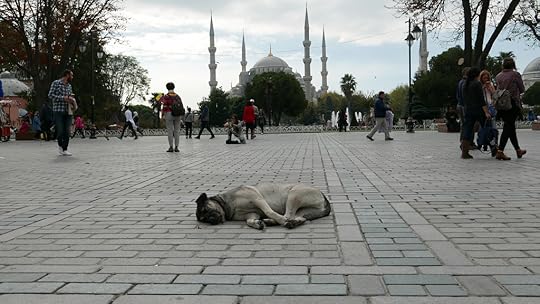
Dogs and cats roamed freely both in the sprawling metropolis of Istanbul and around the villages we visited. This is a phenomenon that always fascinates me – you don’t see this sort of thing stateside. Cats do not lounge in the sun in busy city squares, adorable puppies do not wander up to you while you are wandering through a rug shop. They do not roam the dusty roads near Cappadocia, they do not laze in front of the Hagia Sofia, subsisting on food scraps from tourists, belonging to no one and everyone all at once.
But in Turkey, they did. We saw skinny cats, covered in dust, from Istanbul to Cappadocia.
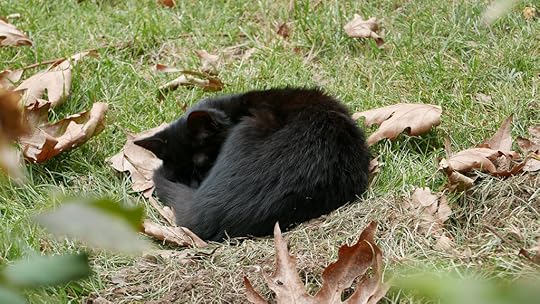
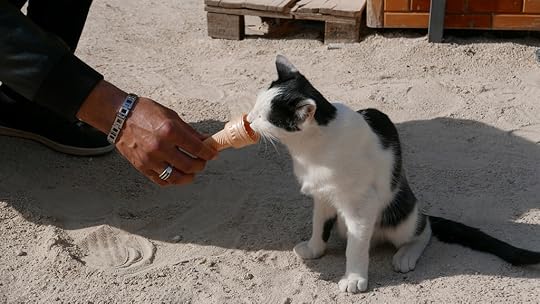
This seems like a very sweet, somewhat terrible idea.
And dogs that lazed about, no owner in sight.
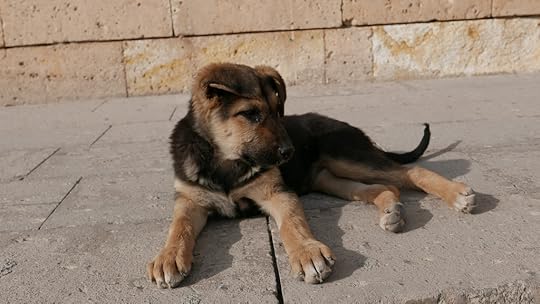
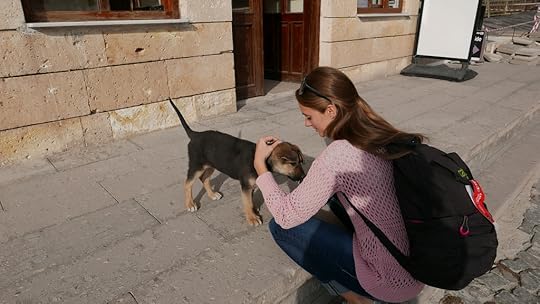
Emily made friends with the wee mite.
This little guy actually belongs to someone. So does the dog.
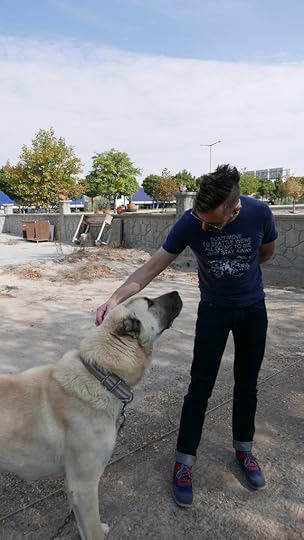
This is an Anatolian Shepherd – a breed that originated in Turkey.
There was a camel …
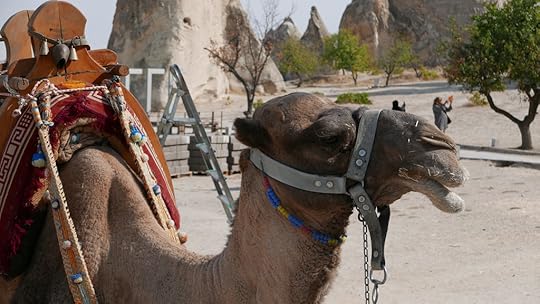
… and chickens.

And a guy with a coxcomb hairdo.

I was only allowed to take one of them home, though, and the guy with hair narrowly won against the puppy.

April 17, 2017
A Toddler in Turkey
We went to Turkey with our friends and their toddler.
This seems impossible now, six short months later. I suspect it will seem even more impossible in the coming years. But we went from Istanbul to Cappadocia, and he wandered in the dust and the sunshine.
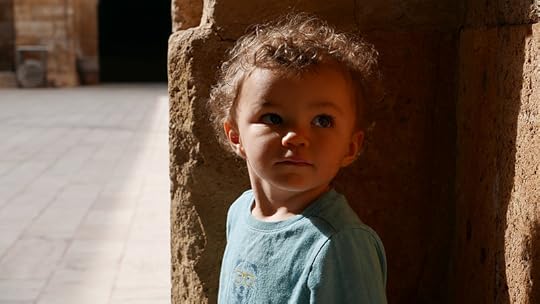
Imagine the hearts that will be broken.
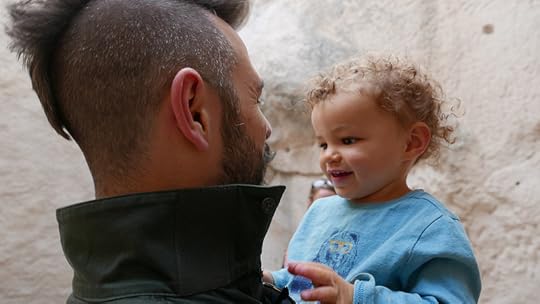
And he tried to eat my husband’s nose.
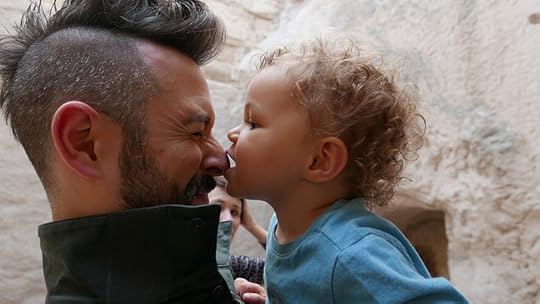
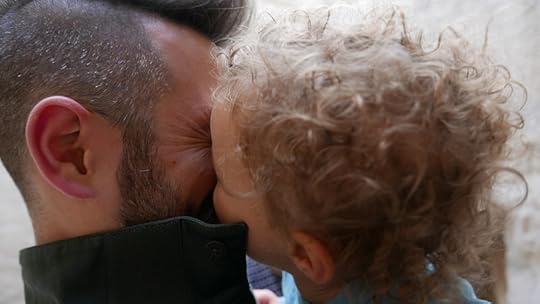
This is my signature move and the kid is totally stealing it.
I was nervous in Turkey. I realized after we left how anxious I’d been. The stories of the coup and the terrorist attacks throughout downtown and the bazaar hadn’t stopped me from exploring those areas, but it had left me with a deep seated feeling of unease. I had fun, I appreciated the beauty of it all, but I couldn’t relax, not for a single second. I asked Rand if he had been at all scared during our trip.
He said only once, when he hadn’t been thinking responsibly, and took the wee one up a steep flight of stone stairs as they explored.
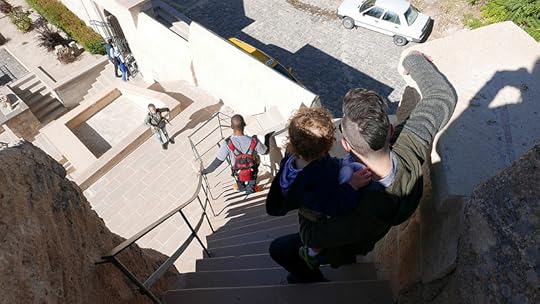
He worried about the tangible, about the things he could control. I worried about what I couldn’t. In the end, we were fine – not simply on those steps, but throughout Turkey. Through the endless spice market and around the mosques and in the airport.
I think of the wee one, who will not remember our trip. He will simply see photos of himself, running towards a camel or trying to grab Rand’s camera in the shadow of the Blue Mosque.
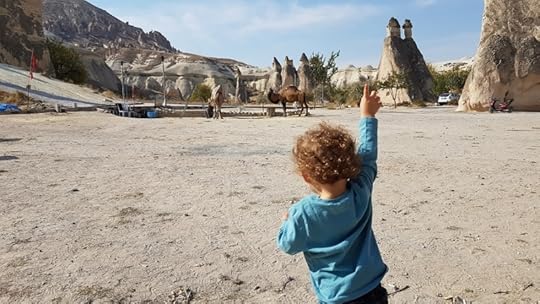

I see his face, looking up at me over the shoulder of his father and Rand.
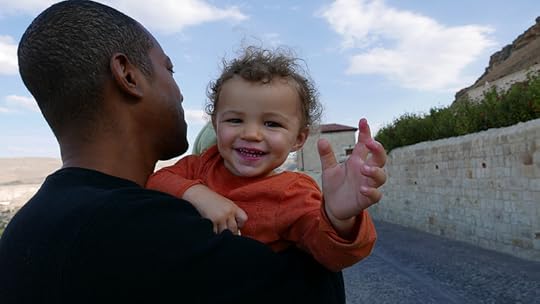
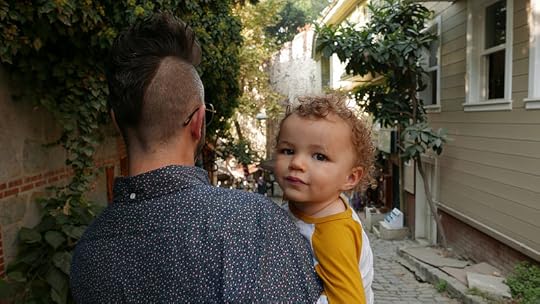
I wonder what the world will look like when he is grown. I wonder what Turkey will be like. And I hope that our first trip there is not our last.

April 9, 2017
The Creepiness of the Basilica Cistern, Istanbul, Turkey
Note: I’m currently in Japan this week, and it’s been a remarkable trip thus far. I need to take some time to tell you all about it, but right now I’m stuffing my face with rice balls and just delighting in how beautiful and clean everything is. So you’ll have to wait for my posts about Japan, but in the meantime, I hope you enjoy a few tales about the last time I was in Asia – when Rand and I wandered around Turkey last fall.
—————
I went by myself to the Basilica Cistern in Istanbul, because nothing says “me time” like creeping around a dimly lit, ancient underground cavern while water drips on you from god knows where and freaks you out.
In truth, Rand was busy with the conference and we’d yet to meet up with our friends who were traveling with us, so I had some time to kill. The cistern ranks high on most lists for what to see in Istanbul, and fans of Dan Brown (DON’T LAUGH, THEY EXIST) will recognize it from some pivotal scene in his book, Jesus Is An Alien And Also There Are Demons Or Something.
The cistern lies not far from the Hagia Sophia, and dates back to the 6th century, when the Byzantine Emperor Justinian needed a place to store fresh water for his palace. Historical texts note that 7,000 slaves were used in the construction of the reservoir, which is massive – covering nearly 100,000 square feet (roughly the size of two football fields) and holding 2,800,000 cubic feet of water. There are numerous columns inside the cistern, many of which seem to have been recycled from other buildings across the empire. Some are intricately carved.

This column is known as “The Crying Column”, and was erected for the slaves that died in the construction of the cistern. (Hey, you know what dead slaves might appreciate more than a column? NOT BEING DEAD OR ENSLAVED.)

The air inside is musty, cold, and thick with moisture. The yellow lights cast an eery glow, so that it was almost impossible to see the vastness of the place. Everyone spoke in hushed whispers, as the sounds of dripping water echoed across the dark expanse.
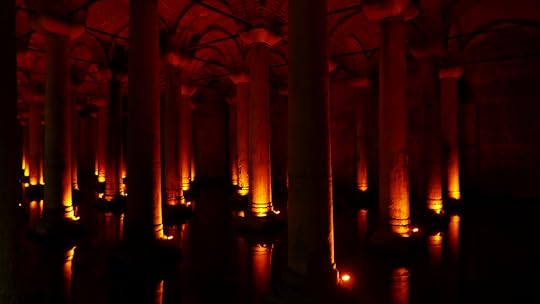
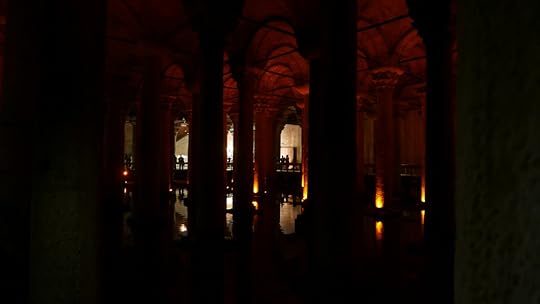
The most remarkable feature of the cistern is hidden in a corner.
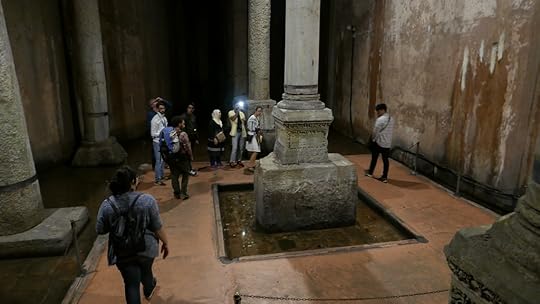

Here two giant Medusa heads sit at the bottom of columns – one is turned on its side, while the other is upside down.
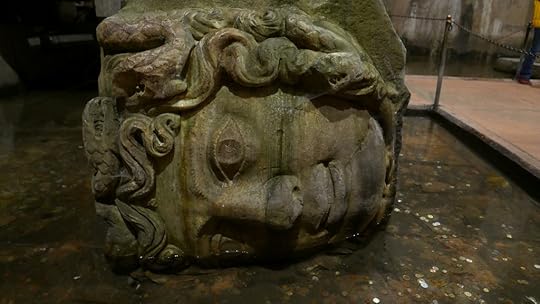
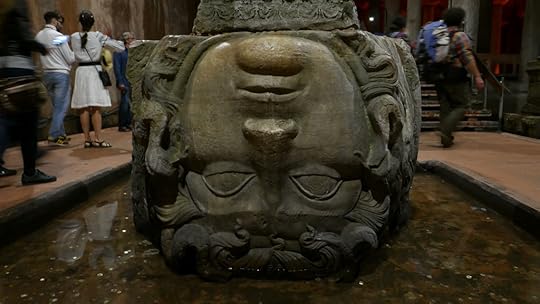
I have a headache just looking at her, and girlfriend has been holding this yoga pose for a millennium and a half.
The positioning makes for a striking scene, and the reason behind it remains somewhat up for debate. Personally, I’d like to think that the Byzantine builders were simply trying to mess with future generations.
It was in this corner that there was enough light to notice one other remarkable feature of the cistern. Swimming throughout it are schools of fish.
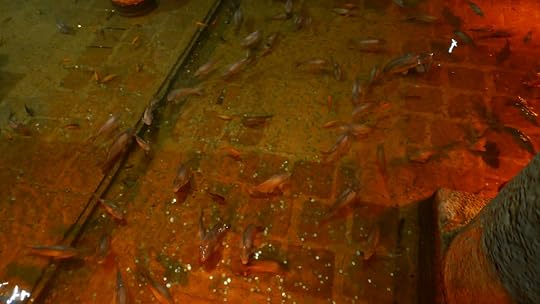
I was delighted by their presence. I meandered through the dark pathways, listening to the sound of their splashes, and realized that even in the most remote corners of the cistern, I never really was alone