Geraldine DeRuiter's Blog, page 11
February 5, 2018
The Liberty Bell, Philadelphia, Pennsylvania
I have written about my love for Philadelphia before, and it seems only right that today, the day after the Eagles won the Super Bowl, that I would write about that town once again. I mean no disrespect to Boston – a city that is near and dear to my heart, but I do mean a ton of disrespect to Tom Brady, whose gilded perfection I find wholly intolerable.
Give me humanity. Give me flaws. Give me an enormous bell with a massive crack in the front of it. One that I still hadn’t seen, despite all my trips to Philadelphia. On my last visit back east, I remedied this. I went to see the Liberty Bell.
If you go in the off-season, this is a very easy thing to do. There will be virtually no line, and you can walk straight to it. You can even get a photo of yourself standing in front of the Liberty Bell, with someone else crouching awkwardly in the background.
[image error]
These are not perfect tourist photos. Philly is not about being perfect. It is not about having a chiseled jaw and a supermodel wife or five Super Bowl rings. No. Philly is about having photos that sometimes look like iconic pieces of American history are pooping out humans and that is fine.
The Liberty Bell was originally commissioned in 1751 by the Philadelphia Assembly to mark the 50th anniversary of the state’s constitution, and would arrive from London the following year. It was so brittle, it cracked almost immediately after being rung. This wasn’t the famous crack that we now see today on the bell – that would happen later (though it’s unclear when). The bell was recast twice more by two local metal workers (Pass and Stow, whose last names appear on it) in an effort to make it stronger and to make its ringing more pleasant to the ear. Success was middling.
[image error]
Look, we’re all sort of fragile sometimes, okay, placard? No need to get judgy about it.
While virtually everyone is familiar with the bell, I realize that its significance was lost on me. When my niece asked about it a few weeks later, I fumbled for an answer.
“It’s … you know … it’s a big bell? With a giant crack in it? From the Revolution.”
“Did they ring it when we declared our independence from the British?”
“That sounds entirely plausible, so let’s say yes, but please do not ask follow-up questions.”
The truth is a little murkier than that. The legend is that on July 8, 1776, the bell was rung to announce the first public reading of the Declaration of Independence – an account that, while heartwarmingly patriotic, is pretty unlikely. By 1776 the State House steeple was crumbling – there’s no way that the bell could have been rung without bringing the whole damn thing down. But it likely rang in the years before then, to call people together for special announcements or important news, and oftentimes stuff that might have pertained to the revolution.
[image error]
After independence, it fell into obscurity until it graced the cover of Liberty, an abolitionist publication, in 1837. It soon became a widely known as a symbol of the anti-slavery movement, and took on the name The Liberty Bell (before then it was simply known as The State House bell). It’s hard to say when it got its signature crack – but it was most definitely there in February of 1846, when attempts to ring the bell in honor of George Washington’s birthday failed because of the zig-zag shaped fracture.
The bell was not recast again. Measures were taken to make sure the fracture didn’t spread further. And now it hangs, silent and broken, with Independence Hall watching over it in the distant. And this is a good home for it, because imperfect things and wonderful things are not out of place in a town like Philly.
Also, I really hate Tom Brady.


February 3, 2018
What Kill Bill Taught Me About Surviving Abuse
When I was 23, a few weeks after Kill Bill premiered, I dressed up as Uma Thurman’s character from the film for Halloween. In it, she wears a yellow jumpsuit that is itself an homage to Bruce Lee’s outfit in Game of Death. I searched for weeks for something similar, and finally found a pair of sweatpants and matching jacket in the perfect shade of yellow, affixing black electrical tape down the sides as trim. I even tracked down the Onitsuka Tiger sneakers she wore. It was a splurge that was well beyond my budget.
I did it anyway.
“I never, ever saw myself as even having an auxiliary part in an action movie,” Uma said in a 2003 interview with MTV. It’s 2018, and we’re still fighting for female-led action movies. Fifteen years ago, they were even scarcer. The 80s and 90s had given us female leads like Sigourney Weaver’s Ripley and Linda Hamilton’s Sarah Connor in the Alien and Terminator franchises. They were badasses, yes, and while I relished in this, their adversaries weren’t human, and they often had help from, well, guys. Until Kill Bill came along, there had been few examples of blockbusters where a woman fought on her own against human adversaries.
The premise was dark. Thurman played Beatrix (though we do not learn her name until the credits of sequel), a trained assassin who, finding herself pregnant with her boss’s child, tries to disappear and build new life. She ostensibly succeeds – acquiring new friends and a doting fiancé, who are ambushed and murdered on her wedding day (and she, heavily pregnant, is beaten brutally and left for dead). Over the next few years, she is raped repeatedly while she lies comatose in a hospital bed. She regains consciousness, and in her quest for revenge she is beaten, shot, stabbed, and entombed alive.
But she keeps going.
It was this that resonated with me, and not the character’s quest for vengeance, or its graphic, seemingly endless violence (one scene was so bloody that to get an R-rating it had to be filmed in black and white). In truth, I remember watching most of Kill Bill and its sequel with my hands over my eyes. It’s not that I am not inclined to confronting those who have wronged me – as my husband well knows – but I’ve always been better with words than a Hattori Hanzo.
For someone who was taught to accept that tragedies and violence were facts of life, Beatrix’s resilience made me feel safe. I loved that she gently spoke to her toes in a bid to get them moving after she awakened from her coma. I loved that her reaction, upon finding herself buried alive, was not to panic but instead to quietly destroy the tomb that held her, and then calmly walk to a nearby diner and ask for a glass of water. I love that she wept when she thought she’d lost her baby. I loved how she held her daughter as they watched television together, cuddled up on a bed.
She was a cold-hearted killer – make no mistake – but that’s what she was before everything she went through. Beatrix after her ordeal was not that different from Beatrix before. And that stuck with me: we might not be able to stop bad things from happening to us, but maybe, maybe, these things would not destroy us.
Let me be clear: the Kill Bill franchise was horrifying for me to watch at 23. Looking back, now that I’m 15 years older and hopefully wiser, it’s even more problematic. It’s not just the gratuitous violence, particularly against women; there’s serious racist undertones (which is a theme for Tarantino); a WoC is brutally murdered in front of her own daughter by the white protagonist; and even if someone is a gargantuan asshole, I’m just not sure how I feel about plucking out her remaining eye and leaving her in a trailer, blind, locked in with a venomous snake.
It was easy, though, fresh out of college and clueless, to get caught up in all of it. I regarded my hatred for blood and gore as a weakness, and I tried to work through it (thankfully, I failed). I could never find the film’s violence funny – despite everyone’s insistence that it was “cartoonish” gore – and in the end I latched on to the one thing about it that was redeemable – that at its center was a woman who, in spite of everything, survived. Now, reading what Thurman endured at the hands of Weinstein and Tarantino, both on set and off, the character she played all those years ago feels even more poignant.
We watched as a character was subjected to violence by people who were supposed to have cared for her, all for our entertainment. We didn’t realize how precisely reality was imitating art.
I’ll never watch Kill Bill again.
But I’ll never forget how I felt all those years ago, walking into a Halloween party flanked by my boyfriend and a tall, handsome couple we knew – all of them dressed as members of the Crazy 88, a violent gang that Beatrix defeats single-handedly. I was young, and in love, and in the company of friends. Invincible is not the right word for how I felt; I knew they couldn’t protect me from everything. I could be hurt. But I knew that afterwards, I would still get up again and again and again, and find that I was still me.

January 30, 2018
Moving On.
We’ve moved. After 7 years in the townhome we rented – longer than I’ve lived anywhere in my entire, Rand and I moved into our first house. It wasn’t far – just across town, but I was surprised by how hard it was, especially for two people who were constantly moving from one city to the next. I realized that it wasn’t the neighborhood I was having trouble saying goodbye to, but that chapter of my life. I took down a photo of someone I’m no longer friends with, and realized I will never put it – or any photo of her – back up on my walls.
People and cities change and there’s only so much time you can spend grieving what’s gone.
“This town got away from me,” a friend told us, just before he left Seattle for New York. His apartment in Brooklyn is barely more expensive than the one he had here, but it’s substantially bigger.
My cousin, who is moving to Queens next month, tells me how New York isn’t unreasonable anymore when compared with Seattle. I realize that I can try to hold on to this town, but not to the people in it. I watch tented cities build up on the side of the freeway, and feel a mix of immeasurable guilt and gratitude at being a homeowner. I ask Rand if we can afford our new place.
“I’m doing my best,” he tells me.
Every time something breaks, or needs replacing, or a support beam turns out to be just a collection of rats standing one on top of the other, I feel my chest tighten. And then I feel guilty for feeling guilty.
When I think about returning home from a trip, I still think about the old place where we once lived. Like so many things that we’ve long outgrown, I forget the bad. I don’t remember how impractical and small it was – I simply miss it. I miss our winding stairwell, and the photos that lined it. I miss our too-cramped living room. I miss the weird collection of paintings and souvenirs and tchotchkes that made it home.
[image error]
I miss my dad.
[image error]
[image error]
I packed up photos of him, and thought about how this new home we’ve found was made possible in part by the inheritance he left us. I could once again see that line of demarcation between the past, when my father was alive, and the world we live in now, the one he’s not a part of. Our old home straddled that line. This new one doesn’t. It’s the last the gift he’ll ever give us.
For the first few months in our new place, I spent my days crying. Rand watched me, unsure of what to do or say, and also, I think, understandably hurt.
I bought you this house and all you do is cry in it.
He never said that. Rand would never say anything like that. But I thought it for him.
[image error]
The people you think will always be there for you – the ones who you assume are a fixture in your life, will suddenly, through choice or circumstance, be gone. The adage isn’t a lie – you really can’t go home again, because either it’s changed or you have. I pack up photos of babies that are no longer babies, of couples newly divorced, of people now gone.
I walk around the house that my dad and my husband and in some small part I helped build. We had a small window in which we could buy – a small window of time when all the pieces fell into place. Two book deals. A stock sale. An inheritance. I think of every sacrifice my husband and father ever made for me and how some people work just as hard – or harder – and it’s not enough. I know I don’t deserve this house. I know I don’t deserve a lot of things that I’ve been graced with.
You put your life in a box, and if you’re lucky, you have a nice, warm place to unpack it. In the end, the one thing that makes you truly feel at home is the one thing that’s never left you.
[image error]
[image error]
And you just have to hope that will always be true.
We are exceedingly fortunate that we were able to buy a home. 144 people died in homelessness in King County last year. This article outlines some resources if you see someone without shelter who looks like they might be in danger.

January 21, 2018
The Ambiguity of Grace’s Story is Precisely Why We Need to Talk About It.
I haven’t written about babe.net’s story of a young woman’s evening with Aziz Ansari because I wasn’t sure what to say about it. I figured if I waited long enough, the issue would pass, and we could move on to other situations that are easier to assess. But the article has lingered in my mind, not just for the realness of it – of a graphic depiction of a night that felt wrong as it happened, and then worse in hindsight, a night that I and virtually everyone woman has experienced in some form or another – but because it doesn’t fit into a schema easily. It sticks around because we have no place to put it.
We end up packing it into the junk drawer of our psyche, and we encounter it every time we look for our keys.
The story, as told by a young woman identified only as Grace, does not make us comfortable. It does not offer us clarity. I’ve read it numerous times. There is simply not enough for me – or for anyone really – to make a definitive statement on what happened. I don’t want to speculate too much about that evening, or about Aziz Ansari’s nuanced understanding of harassment on Master of None, or even about that piece in The Atlantic (which, for the record, I thought was terrible).
So why am I bringing it up? Why even bother drawing more attention to a situation that is so damn nebulous and has been over-scrutinized by a bunch of people who weren’t there?
Because it’s such a familiar story. Not every shitty night we have is due to rape (though let’s be blunt: a fucking huge number are. Seriously, it’s pretty obvious that there’s a goddamn rape-edemic going on.) A lot of shitty nights we have are similar to Grace’s. There are a million different versions of it, but the tenor is always the same. You feel like your attempts to assert yourself are ignored, or laughed off, or shut down. You try to find solid footing but you can’t. This isn’t the night you had planned. But somehow it slipped away from you, or maybe you never had any control over it to begin with.
At some point, you go along with things because you realize that will be the easiest path for you.
These experiences aren’t easily classifiable – something doesn’t have to be assault for it to still be really shitty. Most of the things that happen to us as humans don’t fit binaries anyway – they can’t be categorized as black or white. These experiences fall into a grey area.
Grey is a difficult opponent – it’s like fighting vapor. It is, by its very nature, nebulous. It’s often only afterwards, when you are out of the grey, that the weight of it hits you. Of not only what happened, but what could have happened. Bad situations do not often become instantly bad. They do so slowly, and incrementally. That’s why being in a grey area is so scary – because it usually doesn’t get better, but it can often get worse. And there is a constant, unspoken worry that if you abruptly shut down grey, it will get worse even quicker.
Uncomfortable sexual encounters and assault are not the same, but oftentimes they both begin in the grey.
It’s impossible for me to read Grace’s account of the night and not, in some sense, be there. I still remember what it’s like to tell a guy I wasn’t ready to sleep with him and have the response be “Of course you are.” (Aside to that guy: fuuuuuuuuck you.) Repeatedly asking a woman where she wants you to fuck her does not allow for a reality in which she doesn’t want to fuck you. If a woman tries to deflect your non-stop advances with a vague promise of sex on a second date, and then you pour her a glass of wine and you say that constitutes a second date, you are ignoring a boundary she has set. When she says she wants to slow down and you gesture to your penis in a bid for a blowjob, you aren’t listening.
None of this is against the law. But it should be obvious that it’s still a shitty thing to do. And that’s why we need to have these conversations, uncomfortable as they are. Because we need to clear up the grey. We need to stop thinking that only bad guys and monsters are the ones who do shitty things to women, because then the good guys will never reflect on their own actions.
Consent is not a battle. It should not require convincing or bargaining or an extra bottle of wine. It is a conversation. And when one partner is so uncomfortable that they are mumbling answers, that makes for really shitty conversation. The whole point of sex that it be fun for everyone involved. I don’t know what the name is for giving a guy a blow job because after a couple of hours he fucking wore me down but “fun” is not the word that comes to mind. You can check off all the boxes to make sure something is consensual but that doesn’t mean you aren’t being a shit. I know that sounds complicated, but it shouldn’t be. And part of the way we clear this up is by talking about it.
“Don’t rape” and “Make sure sex is consensual” is Sex 101. Make sure that everyone is comfortable and that you aren’t being a pressuring jerk is, like, Sex 225. It’s a little more complicated. But not much.
It’s fucking exhausting to have someone push your boundaries, to tell them no, and have them continue to press you again and again, not knowing what it might turn into. And while “wearing a girl down” has historically been somehow socially acceptable and even a best-practice for dating (see Andi Ziegler’s amazing thread on the predatory plots of teen comedies from the 70s and 80s) it fucking shouldn’t be.
Because these experiences are so hard to classify, there are few narratives that we can embrace to help us make sense of them. We are simultaneously told that what we experienced wasn’t assault, that we need to be more assertive in saying no (even when no questions were explicitly asked of us), that we are shifting focus away from true victims.
I’ve told myself these things about my own experiences, while at the same time realizing how unfair that is. One of humankind’s best qualities is an ability to understand nuance. We are smart; we can multitask. We can acknowledge rape and what happened to Grace are two radically different things, but that each is a chapter in a never-ending book entitled Shit Women Have Dealt With Since the Beginning of Time.
And we can think about all of these things at once, because that’s what women have to do. We can hail Aly Raisman as the goddamn powerhouse she is, we can be infuriated over what she and literally hundreds of other athletes went through at the hands of a serial sex offender, we can be fucking livid that no one listened to them. We can shout from rooftops that one of the most egregious sex abuse stories in sports history is not getting the attention it deserves. And we can also listen to Grace’s story, and have some valuable conversations as a result.
Empathy should not be a scarcity. Acknowledging one woman’s bad night does not stop us from feeling rage for the experiences of millions of other women. Being upset about boundary-crossing does not stop us from being incensed about rape (and it certainly doesn’t mean that we’ve confused the two.) The #MeToo movement isn’t a competition of who has dealt with the most shit; it is an acknowledgement of the shit we all deal with, in all its multitudes.
Grace’s story is one that we all have. It’s profoundly uncomfortable because of its ambiguity. And that’s precisely why we need to talk about it.

January 17, 2018
My Post About Feminism Went Viral. Days Later, My Twitter Account Was Hacked.
Last week, I wrote about what happened when I tried making the cinnamon roll recipe from Mario Batali’s sexual misconduct apology letter. The inclusion of the recipe – in a letter apologizing for sexual harassment – was so ill-advised that it made the time my uncle brought a camcorder to a funeral seem like a good idea. But the fact that it was also a shitty recipe … well … (insert guttural growling sound). By the end of the night, I was a being made of pure rage, held together with icing, and it was in that mindset that I ended up writing about the recipe, and about all the bullshit that surrounded it.
(Oh, also, I am using Leslie Knope GIFs throughout this post because she’s my patronus right now.)
A lot of people ended up sharing the post. I suspect because these days, most of us are made up of pure rage. Most of us are tired of shitty things happening to us, and annoyed by the shitty apologies that follow, and the shitty recipes that accompany those apologies do nothing to temper our anger.
Most of the responses I received were positive, and in such a quantity to be overwhelming. The restaurant critic for The New York Times said this, which resulted in me lying down on the ground, staring up at the ceiling and mumbling incoherently for a good five minutes:
When I mentioned Mario’s cinnamon roll recipe recently I was haunted by the sense that I hadn’t fully conveyed its absurdity. I was right, I hadn’t. This piece does. https://t.co/Kw05u4prqn
— Pete Wells (@pete_wells) January 11, 2018
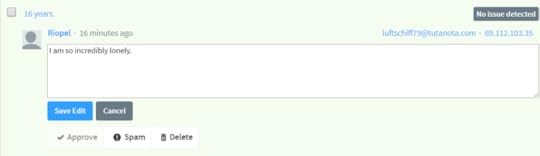
A few of the responses were awful, but I’ve found that having your own site means that you can edit hate comments. I often change them to what I think the author’s true intent was (before deleting them altogether).
Behold:

I’ve had posts go viral before, and even the ones that aren’t about inherently controversial topics have resulted in abuse and threats and insults, because I dared insult the Paleo diet, or I dyed our milk pink, or I didn’t like Soylent and the man-children couldn’t handle it.
And I’m used to all that. Or I’m getting used to it. It still amazes me when people say hateful things to me because, you know, it’s a fucking personal blog and seriously I barely have time to shower so how do you possibly have time to write me a treatise on why sexual harassment doesn’t exist, Larry?
You get used to insults being hurled at you on every forum imaginable. You’ll find that people will create accounts just so they can tell you how reprehensible of a human you are because you made cinnamon rolls. But somehow, these assholes still manage to surprise you.
On Sunday morning, I found out my Twitter account was hacked.
Those of you who follow me may have noticed that my profile picture – a snapshot of me taken in Belfast by my husband – was briefly replaced with a starry night sky. My name – previously just “Geraldine” (I don’t tend to use my last name because seriously who besides your great aunt is named Geraldine) was replaced with something that suggested sea life, misspelled to include two fucking umlauts.
My Twitter account briefly looked like it was run by a new-age German surf brand.
The only tweet that came from my account Sunday was one that said “like if your active,” – a goddamn typo, broadcast to fifty thousand people. The sort of punishment so decidedly cruel for a copywriter that I’d almost rather they’d sent out porn because porn serves a purpose and typos do not.
Then on Monday, a few more tweets went out, including a pinned tweet taking credit for having hacked my account. While it was up only briefly, it included a racial slur. On MLK Day, no less.
Then, slowly, all of my tweets began disappearing as the hacker “wiped” my account – deleting all my old content – while I could do nothing.
The account was briefly locked. Then it wouldn’t load.
Why? Because I wrote about cinnamon rolls?
Frantic, I filed ticket after ticket with Twitter, but was told that the email address I was writing from was never associated with my Twitter account (it was). The hacker had changed my contact info, my profile picture, my name, and had deleted every single tweet I’d ever written, and Twitter was telling me that because I wasn’t emailing them from the right address, there wasn’t anything they could do.
I watched as an account that I’d had for nearly a decade was systematically dismantled in front of me as I hit the refresh button.
Twitter is by far my largest social network – it’s where I’m most active and have the most followers. For writers, it serves a very specific purpose: it is directly tied to our livelihoods. When I was shopping my first book around, every single publisher I met with wanted to know what my Twitter following was. This isn’t simply vanity or a trivial marker of fame – this is my goddamn career. Twitter is how I let people know when I’ve written something new; it’s how I promote speaking events, book readings, and how I yell at airlines.
It is extremely important.
Unable to scream on that website, I screamed on Facebook, forgetting how amazing and connected and wonderful my friends are.
They jumped in from every corner of the internet, expressing their outrage. I received messages of support via every single medium I still had access to. I had people who rarely use Twitter logging in just to report that my account had been hacked. I had friends reaching out to their contacts at Twitter, trying to rectify the situation. I am still absolutely overwhelmed by the people who spent time and energy helping me.
I can’t begin to name all of the people who spent time on rectifying this. But a partial list: Sara, Kara, Courtney, Naomi, Shauna, Peter, Charlotte, Shauna, Marika, Chrissy, Zac, Pam, Jen, Andrea, Will, and basically everyone I know: thank you.
And of course Rand, who assured me that everything would turn out okay in the end.
I am a Luddite. I don’t know how to work the internet without my friends. I barely know how to work my blender without my friends.
Late Monday night, thanks to their (and your) efforts, I regained access to my account. Twitter has retrieved my lost tweets. My friend Marc used a piece of software he built to find everyone who I’d previously followed and then wrote a script that re-followed them again. And yes, the tweet that Lin-Manuel Miranda sent me is still there. I still don’t have all of my favorites, but I’ve been told that Twitter will get those back, eventually.
I went and looked the in DMs the hacker sent while he had control of my account. Here’s a screenshot that was included in one of the DMs – it’s from a forum in which they sell off Twitter accounts (as well as Instagram accounts). I’ve omitted their names because I don’t know if giving them credit is a good thing or not.

He was asking a friend of his – who is still active on Twitter – how to change the handle, and trying to sell off the account. This made me think that all of this was tangentially related to the post – my account got hacked not because of what I’d written but because it was getting a lot of attention.
But then I received this message from the hacker, who has since been kicked off Twitter:

Since the Twitter hacking, numerous hacking attempts have been made on the blog. It’s been relentless, and as a result, the blog is running slower than normal. It no longer seems like these are just opportunists trying to sell an account. It seems like a concerted attack.
BECAUSE I WROTE A POST ABOUT CINNAMON ROLLS.
This morning, my site was down again, and I panicked. But it wasn’t because of hackers. It was because of this:
I Made the Pizza Cinnamon Rolls from Mario Batali’s Sexual Misconduct Apology Letter https://t.co/BMCTFmrgeY. Sent to me by my daughter,Alexis. I read it this morning. Amazingly a pro pos ! Enjoy!
— Martha Stewart (@MarthaStewart) January 17, 2018
MARTHA STEWART READ MY ARTICLE AND TWEETED ABOUT IT AND GAVE MY BLOG THE HUG OF DEATH.
I’m starting to realize that’s just how it is. Lows follow highs which follow lows. As a woman, your work can’t garner positive attention – particularly about an issue that matters – without garnering negative attention. For every thousand people who tell you how much they relate to what you’ve said, someone will scream something terrible and hateful at you.
You just have to have faith that the good drowns out the bad. And if the good voices aren’t loud enough? Then you just say it to yourself.
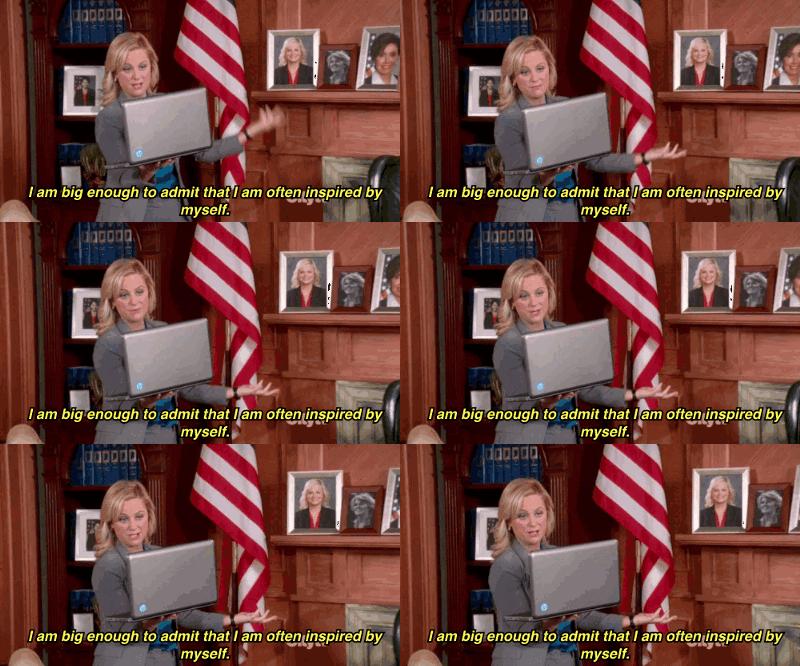
Over and over again.
P.S. – My friend Zac wrote a great piece about how to protect yourself from hacks, identity theft, and the like. You should read it.
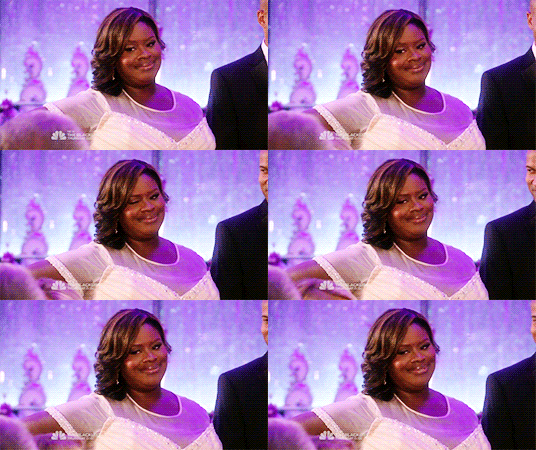
P.P.S. – Blog traffic is crazy high, and we’re putting in some security measures, so load time is slower than normal right now. We’re working on it.

January 10, 2018
I Made the Pizza Cinnamon Rolls from Mario Batali’s Sexual Misconduct Apology Letter
Last night, I made cinnamon rolls. I’m not a huge fan of cinnamon rolls, per se, but this recipe was included in Mario Batali’s sexual misconduct apology letter, and so I feel compelled to make them. Batali is not the first powerful man to request forgiveness for “inappropriate actions” towards his coworkers and employees. He is not the most high profile, and he is ostensibly not even the worst offender. But he is the only one who included a recipe.
And of course, the glaring question is why? Was his PR team drunk? Is life suddenly a really long, depressing SNL sketch? Do these cinnamon rolls somehow destroy the patriarchy? Does the icing advocate for equal pay?
I figure the only way to answer these questions is to make the damn rolls.
I bake a lot. Never one to pass up on a pun, my husband doesn’t bring me flowers, but flours. I’ve become skilled to the point that I can make a dessert from virtually anything, that I can have a small cake made from start to finish – including baking time – on the table in about half an hour.
Good baking, I’ve been told, comes from love, and treacly as that sounds, I find some truth in it. Good baking means being able to roll with setbacks and mistakes and ovens that for some reason run twenty degrees hot but only on Sundays, a metaphor so aligned with loving someone that it feels almost too obvious. Good baking requires an attention to detail and care that is hard to muster when you just don’t give a shit or you are distracted by your own rage.
Good baking means you have to trust yourself.
I find myself fluctuating between apathy and anger as I try to follow Batali’s recipe, which is sparse on details. The base of the rolls is pizza dough – Batali notes that you can either buy it, or use his recipe to make your own.
I make my own, because I’m a woman, and for us there are no fucking shortcuts. We spend 25 years working our asses off to be the most qualified Presidential candidate in U.S. history and we get beaten out by a sexual deviant who likely needs to call the front desk for help when he’s trying to order pornos in his hotel room.
Donald Trump is President, so I’m making the goddamn dough by scratch.
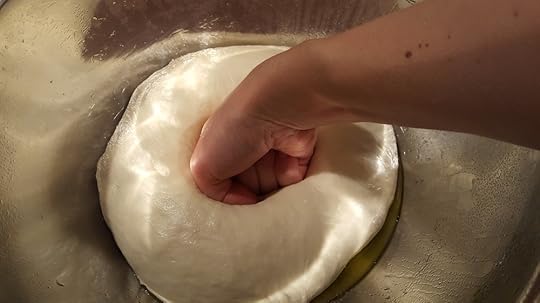
I’m punching down the dough because, according to Twitter, I hate men.
I use Batali’s recipe that he’s linked to, which I’ve made before, and I’m already hesitant. Pizza dough is chewy and crispy, not tender – the latter is what you’d hope cinnamon rolls would be. It’s a savory recipe – incorporating white wine and a generous amount of salt – and I feel like he’s shoe-horning it into a dessert where it doesn’t belong. He’s cutting corners because he gets to cut corners.
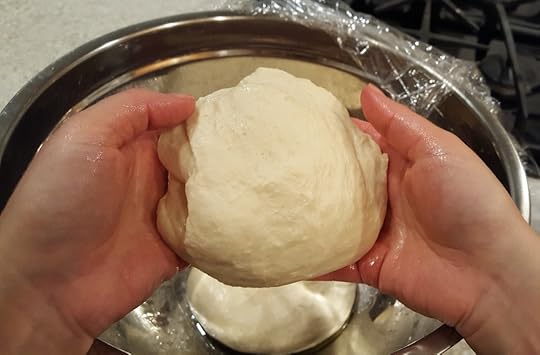
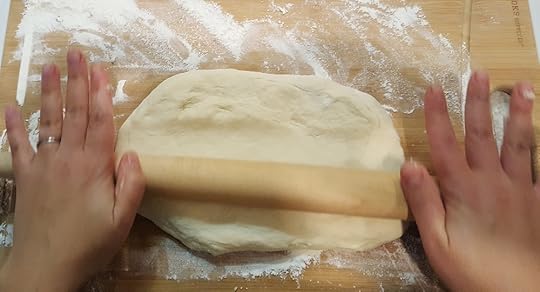
I roll out the dough – Batali specifies a thickness, but no dimensions, which is strange if you’re making a rolled dessert. There are pieces missing here, and I’m trying to fill in the gaps. The result will be sub-par because he hasn’t provided all the information, and I will blame myself.
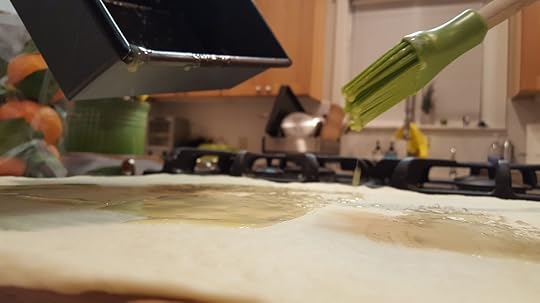
I baste a layer of melted butter over the dough.
A guy on Twitter tells me that I’m a vile man-hater. His feed contains a photo of my very-alive husband wearing a feminist t-shirt. Underneath he’s written the message “RIP.”
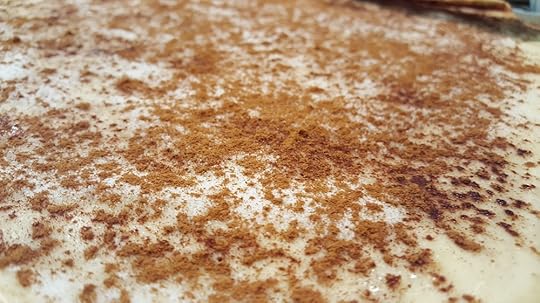
I sprinkle the sugar and cinnamon over the top.
I think about the time that I was an intern at a local news station, and assigned to hand out cake while celebrating some milestone (it had to do with the Salt Lake City Winter Olympics.) One of the producers I’d been working with closely walked up to the table.
“Do you want a piece?” I asked.
“Yeah,” he said, looking me up and down. “Oh, you mean of cake? No thanks.” He and another male staff member laughed while I stood, holding a piece of cake in each hand, dumbstruck.
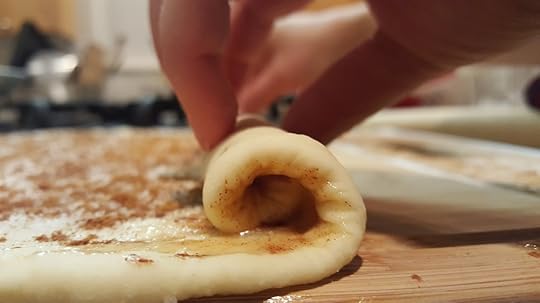
Batali does not specify how tightly to roll the dough. I do so too tightly because fuck everything.
I remember the time another producer walked his fingers across my lap while I was typing at a computer. I turned to stare at him, and he grabbed my badge which was clipped to my waist.
“I wanted to see how your last name was spelled.”
I think I’ve used too much dough.
I think about how the last conversation about compensation I had resulted in someone who made more yearly than I ever will telling me I was holding them “emotionally hostage” and then demanding to know, over and over again why I needed the money.
“Just tell me,” they demanded. “Tell me why you need it.” Over and over until it broke me.
If they are edible, I will eat every single one of these fucking rolls myself.
Batali says to cut them in slices roughly three inches thick, which is too wide. The rolls should not be that thick. I know this is wrong, but I do it anyway because that is what the recipe says. (I am not following my gut and cutting them thinner. If I had, I suspect the results would have been better. But for most of us, going off book isn’t an option.) There is no estimation of how many rolls the recipe should yield. Batali says to place the rolls in a small cake pan, but again, there are no dimensions.
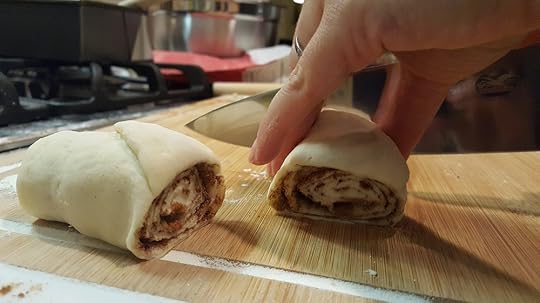
My husband hovers close by, doing a little excited jig. Few things delight him like elaborate desserts made for no apparent reason on a weeknight. But he soon links the pieces together and stops dancing.
“Oh, god,” he says. “These are those cinnamon rolls, aren’t they?”
I nod.
I put them in the oven. I think about how Michelle Williams made less than $1000 for a reshoot of a movie for which Mark Wahlberg made $1.5M.
Because I’ve rolled them too tightly, the middle pops up and out of one of the rolls.

One of the cinnamon rolls has a fucking erection.
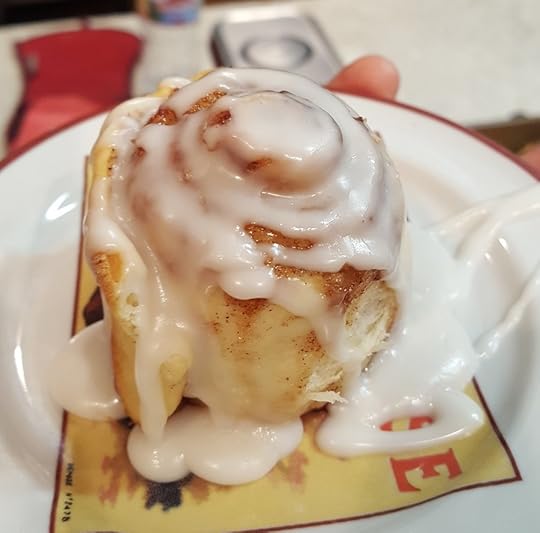
The recipe calls for too much icing, and the result is that the rolls are drenched in it. We’ve reached the “ARE YOU FUCKING KIDDING ME” portion of the recipe.

The pizza dough does not mix well with the sweetness. The icing is sickly sweet, the rolls themselves oddly savory. I was right about the texture – the dough is too tough. I hate them, but I keep eating them. Like I’m somehow destroying Batali’s shitty sexist horcrux in every bite.
I remind myself that is not how recipes work. That isn’t even how dark magic works.
I know that in the court of the internet, any output that is less than perfect will be blamed on me, and not on a hastily-written, untested recipe. I’ve made flaky pie crusts in the kitchens of Air BnBs using warped cutting boards and a bottle of wine as a rolling pin, but this won’t matter. I’ve fucked up the recipe.
Most women don’t even need to hear the shitty comments made to us anymore. We’ve heard them so many times, we can create our own.
Maybe if you spent less time whining about men who want to fuck you (which you should take as a compliment because who the hell would want to fuck you, anyway), and more time in the kitchen, this wouldn’t happen.
I throw the rest of the cinnamon rolls in the trash.
(Okay, fine, I eat two more.)
Of course you did. Jesus fucking Christ, you’re disgusting and your husband does not love you.
Batali’s another drop in the bucket. He’s not the first, he certainly won’t be the last (he already isn’t). The misogyny runs so deep that the calls now come from inside our heads. We blame ourselves. We hate ourselves. We wonder if our skirts are too short, if our bodies are too noticeable. If we’re asking for too much, or not enough. We don’t trust ourselves, even when we should.
We try to follow a half-written recipe and think it’s our fault when it doesn’t work.
We need to undo an entire humanity’s history worth of hate against women. Apologies are a good start.
Just skip the goddamn recipe.

January 9, 2018
Philadelphia on the First Snowfall of the Season
Our friends insist they are not romantics. When they were married in Philadelphia half a decade ago, an unexpected storm had shut down the city. No one showed up to open the church that day so they were married in the snowy lot outside, the drift coming up to their knees.
They celebrate their anniversary on the first snowfall of the season not because they are romantics, they insist, but because they are bad with dates. The result is that they never quite know when it will be. When the snow starts to fall, they make a reservation, they uncork a bottle.
They insist they aren’t romantics, but when they tell us this, I swoon.
This year, we were in Philadelphia for the first snowfall of the season. We are from the Pacific Northwest; any precipitation that isn’t rain is always a bit of a novelty.
[image error]
We walked through Philadelphia in the snow.
And I noticed how it stuck to his hair and his eyebrows.
[image error]
And how the city looked like a model train set.
[image error]
It never got dark. Deep lavender is the best that a night sky can achieve when there’s snow on the ground. This rebellion against darkness has always been my absolute favorite part of any snow day. Like the earth is defying its own bedtime.
[image error]
[image error]
We wished our friends a happy anniversary as they insisted that they were not romantics. We nodded.
They’re full of shit.

January 6, 2018
Other Stuff I’ve Been Up To: The New Yorker’s Tiny Shouts, Heckling Lin-Manuel Miranda, and More
Friends, I want you all to know: I haven’t just been neglecting the blog. I’ve also been going on political rants on podcasts, pitching my work to various publications (some of which actually publish my stuff. Thank god for drunk editors), and crafting post-apocalyptic tweets in the style of some of my favorite playwright/composers. As one does.
Those of you familiar with the blog know that I have no shortage of celebrity crushes. They mostly center around Jeff Goldblum, with the occasional exception made for Bruce Springsteen in an ungodly amount of denim. In recent years, I’ve added Lin-Manuel Miranda to my list of celebrities who I would be cool with kissing, if, say, like aliens happened to kidnap us both and were like, “WHAT THIS IS KISSING YOU SPEAK OF?” and we absolutely had to demonstrate for them in order to save the human race.
Rand keeps telling me that such a scenario is improbable, but he also keeps telling me that he bears absolutely no resemblance to Mr. Miranda.

I’m starting to think I have a type.
At the end of last month, I had a piece published in The New Yorker’s Tiny Shouts, in which I spoofed Mr. Miranda’s perpetually upbeat Twitter feed. And then I tweeted it. And then Lin-Manuel Miranda commented on it on Twitter AND I SORT OF DIED.
To recap: I am making fun of my celebrity crushes in The New Yorker.
Other things I’ve been up to:
I recorded an episode of my friend Mike’s podcast, which you should listen to not because I’m terribly interesting, but because Mike is, and he has a Scottish accent.
I wrote a piece for Refinery 29 about our trip to Japan and one very unclear pregnancy test.
My first piece for The New Yorker’s Tiny Shouts, which went up in the fall: Less Critical State Secrets.
Another podcast episode I recorded – with the guys from Rise Seattle – about the changing landscape of my beloved hometown.
After seven years in our old place (the longest I’ve ever lived anywhere, including childhood), Rand and I moved. We’re still in Seattle, so I suppose it isn’t the biggest of changes, but it’s definitely the end of one chapter and the beginning of another. It still feels new and a little scary, but I promise, when the dust settles a little, I’ll tell you all about it.
I’m working on a few other projects as well, but they’re barely beyond the idea stage. As soon as any of them have legs, I promise to bore you with all the details.
That’s it! Bye for now, friends!

January 5, 2018
16 years.
It happened last month without fanfare: Rand and I celebrated another year together. We’ve had so many anniversaries that they often pass by without us noticing them.
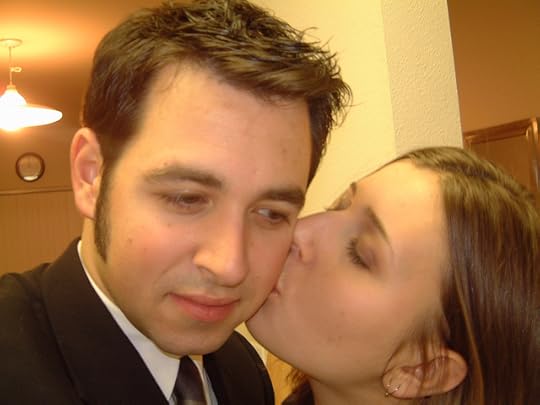

I understand now why Rand’s grandparents have to take a moment to remember how many years they’ve been together, why they both give different answers when I ask when they were married. It’s not that the time you spend together isn’t special. It’s just that there is so much history to sort through. So many birthdays and anniversaries and car rides and movies and dinners and breakfasts and dancing and laughing and fighting and making up and doing laundry. So naturally, you forget an anniversary here and there. (You also forget to do the laundry.)
If our relationship were a person, it would be able to drive a car. One day it will be old enough to vote, to buy a drink at a bar, to run for President. One day, our relationship will be older than I am now. And if I’m very, very lucky, one day, I will sit with Rand, and we will have to take moment to remember how many years we’ve been together, and when you ask us when we were married, we’ll each give different answers.

January 3, 2018
The Hot Decluttering Trend for 2018: American Apocalypse Purging
(Above: Trouble throwing out clothes? Try a signature look, like Aunty Entity’s all-season chainmail frock.)
It’s 2018. Time to start the new year off right by finally paring down your possessions, throwing out excess, and living simply. Because society as we know it might be over by March.
The Swedes have a practice that they refer to as “death cleaning.” They purge clutter regularly so that they will not burden their survivors with it in the event of their deaths. The Swedes understand that life is as fleeting as daylight in the winter months. They know that possessions mean nothing to a corpse. But the Swedes also are led by a prime minister with a steady gaze, a firm commitment to human rights, and only 36 thousand Twitter followers. So it’s safe to say that their home organization techniques don’t go far enough.
You’re an American living through the second year of a Trump administration. You need a home organization technique that acknowledges every second of this Presidency brings us closer to the brink of nuclear annihilation. You don’t need Swedish Death Cleaning. You need American Apocalypse Purging.
Face it: your democracy is in peril, your empire is crumbling, and your Beanie Babies aren’t going to appreciate in value. Wasn’t one of your resolutions to work out more this year? Ideally, transforming your body into a fighting machine that will survive a nuclear winter and the inevitable cannibal uprising? You can’t invest more time in you if you’re still trying to make jeggings work.
Sure, you could just throw everything in the basement, like you’ve been doing for decades, but the walls down there are at least 14-inches thick and far more resistant to radiation that the rest of your home. When you’re stuck in that subterranean shelter with your family members and a dwindling supply of canned goods, you’ll be kicking yourself for not having more storage space.
Remember, you can’t spell “we are the sole survivors of nuclear destruction” without “declutter”. And let’s be real: when did you last use that waffle iron?
The KonMari method was fine back in 2015 when we all thought we’d expire of natural causes. But the President has 280 characters now, so you don’t have the luxury of asking if an item brings you joy. Instead, look at the sum total of your possessions and ask yourself: Which of these items would cause the most damage to a healthy, 180-pound opponent? Begin training with it immediately.
Start separating your items into three piles labeled “Donate”, “Keep”, and “What is the Point of a Tax Cut When We’ve Turned All of North America Into a Hellscape?” Remember: once you’ve placed something in the “Donate” pile, you can’t take it back!
Don’t worry – it’s tough to start, but it’ll get easier as you go. Keep the things that are truly important to you. At the back of a closet, you find your wedding dress. You remember the joy you felt on that day. When the time comes, are you willing to eat your husband’s flesh in order to survive? You know the answer. You’ve always known. Once you’ve decided what you want to keep, treat yourself with fun but practical storage containers for your possessions (but don’t go overboard! We’re giving away stuff, remember?)
The trips to the Goodwill donation center have become so plentiful that the sorters have started to recognize you. They ask if you want a receipt. You nod. What value do you assign to your belongings? To your memories? To your own dwindling humanity? You write in $75. Be sure to save that receipt – it’s tax deductible! (Note: U.S. currency by the end of 2018 will likely be quaaludes and dried cat meat. Plan accordingly.)
Imagine the hours you’ve spent sifting through overstuffed drawers trying to find what you need. Now you can use that reclaimed time to contemplate your wasted existence. You were once nothing but potential. Here is the sewing machine; you were going to learn to sew. Here is your photography equipment; you were going to learn to take a decent picture. Here is the traditional French cookbook full of elaborate recipes that are well beyond your capabilities to recreate. That was a gift.
You should have spent that time training your body for the upcoming power grid wars. Your flesh is soft and weak. You are probably delicious. This will be your undoing. A friend expresses interest in the French cookbook, and you eye her suspiciously.
What the fuck, Carol.
If you are feeling truly inspired, trying putting your seldom-used possessions into a box with the date on it. After six months, if you haven’t opened it, just toss out the whole box! (Note: this technique is for the optimistic declutterer who thinks that something resembling society as we know it will exist in June.)
Look how much space you now have! How unburdened you feel! Isn’t is wonderful? Take a moment for yourself. Relax.
Your phone is buzzing. It’s probably just Carol, asking about that French cookbook again.
Fucking Carol.