Geraldine DeRuiter's Blog, page 15
March 28, 2017
Slip Sliding Away
By the time we land in Seattle, I am tired of people asking about the contents of the plastic toolbox. Both Rand and I have carried it from my father’s tiny Bavarian village to Munich to Amsterdam and now home, each of us now acutely aware of how ill-suited a container it is for transportation. The handle is uncomfortable, and you have to dedicate an entire arm to its heft. It is meant to sit on a shelf, as it did in my father’s home, and not to be carried halfway across the world, while fending off questions from mostly well-intentioned travelers and flight crew.
“Oooh, is that a pet carrier?”
“What’s in the box?”
“You got your husband to carry your cosmetic case?”
Most of the time I just smile (even through the misogynistic interrogatives), or let Rand answer. I am exhausted from jet lag, from having finally seen my father’s grave three months after he died, because his funeral was the week of Christmas and I couldn’t make it out. From having walked around his workshop, a place I rarely ventured into when he was alive because it was his space and I didn’t want to annoy him, and now that he is gone his absence hangs in the air. The silence of the house without him in it is deafening. I spend every day of our trip anxiously awaiting seeing his grave, worried that the entire weight of his death will hit me when I finally see it. But instead of catharsis I’m left with a strange denouement, like when a sneeze almost comes to fruition and doesn’t, and you rub your nose, knowing the feeling will now take longer to dissipate. There is no release valve for my emotions. They don’t boil over, like I want them to – they simply stay at a low simmer, so that when someone snarkily asks me if I’d gone fishing, I’ve worn through my facade of cheerfulness.
“My father died. These are his photos.”
I don’t know how my reply will make the asker of this question feel. I am uncharacteristically unconcerned. I’m having trouble focusing on anything besides what I can remember about my father, and the remnants of his past that are tucked into a plastic box that everyone keeps asking me about.
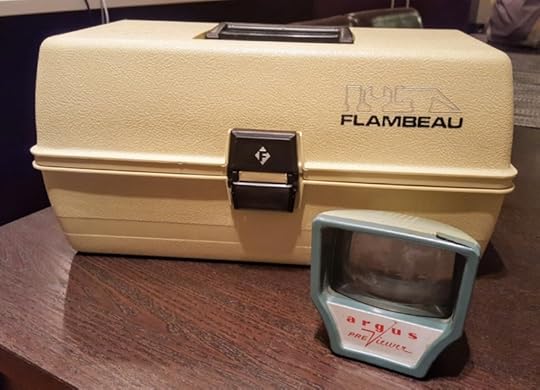
At home, I open it up and smell the stale, musty scent of old photos. I breathe it in hoping I’ll somehow absorb something – my father’s memories, or some part of him that was stored in there like a horcrux. But I inhale nothing besides a dry and woodsy scent that I am convinced is what the 70s smelled like.
There are lots of slides. Tiny plastic transparencies that would be impossible to make out were it not for the slide viewer that my mother gave me a few months back, in a surprisingly prescient move. They are all meticulously organized, my father’s handwriting denoting location and date. “March 1977, Edward is 6 Months.” “Rome, Summer, 1978.” I put the slides in, and the viewer illuminates and magnifies the images. My family’s past lights up on a tiny screen in my hands.
There are a few loose photos of my dad, but not many. Just enough to remind me of this seemingly impossible truth: once upon a time, my father was young and handsome and very much alive.
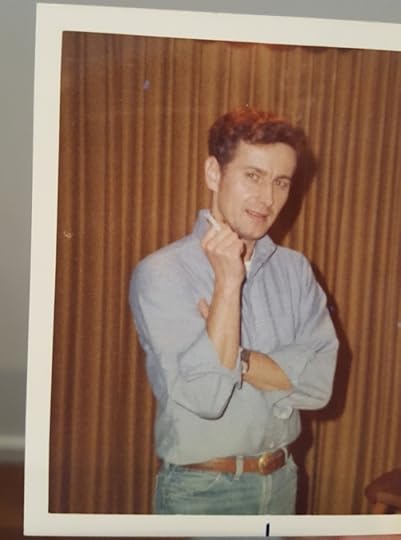
But more often than not, he is the photographer, and not the subject. And I try to discern all I can from that. Even if there aren’t enough tea leaves left to read.
I look at how he saw my mother.
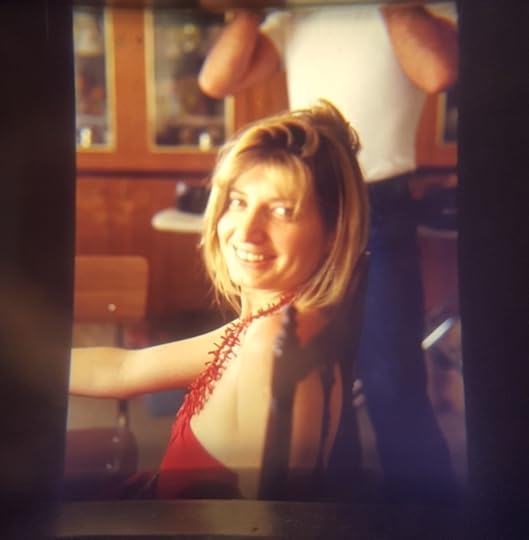
My dad, when I knew him, always seemed annoyed by my mother’s antics. But the photos here suggest that there was a time when he didn’t mind so much. That perhaps for a little while, he understood her. Or at least he tried to.
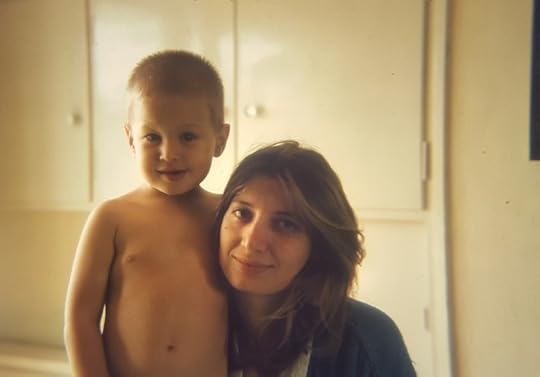
I follow my brother from newborn to toddler, every moment of his life painstakingly documented until sometime after he was three, when my mother left my father for America.
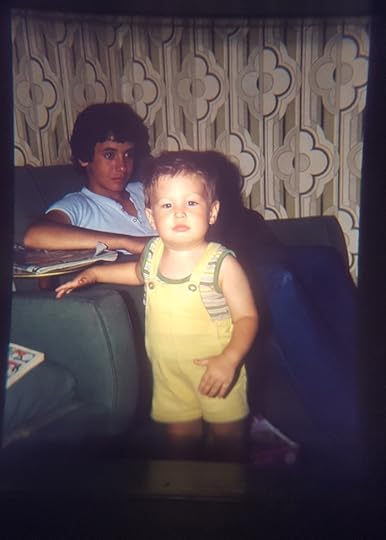
The photos become more scarce as the years go by, and by the time I am born, my father does not have originals or negatives or meticulously organized slides. He has only the photos my mother sends to him, a disjointed hodgepodge of images of us, now in America. They are no longer linear. Time jumps around as I rifle through pictures that are in no discernible order. I am a newborn. I am five, riding my pink Huffy with its white training wheels. I am a year old and eating bread like it’s my job.
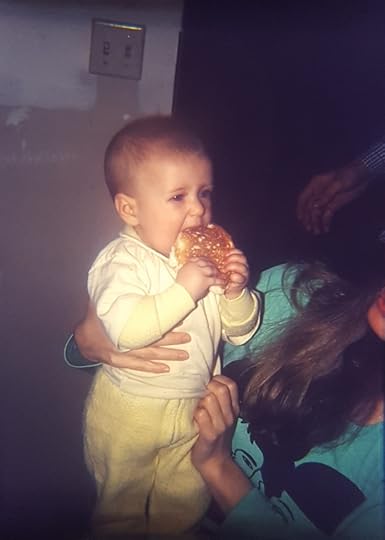
File this under: things that are in no way surprising at all.
My parents never lived together in my lifetime, at least, not that I can remember. They were always on separate continents, and when they divorced (sometime before I turned four), I remember processing the news with little discernible emotion. I’d never known them together, so their official split carried little weight. But flipping through slide after slide of the life they had together, I realize that my parents may have, for a brief glimmer of time, loved one another.
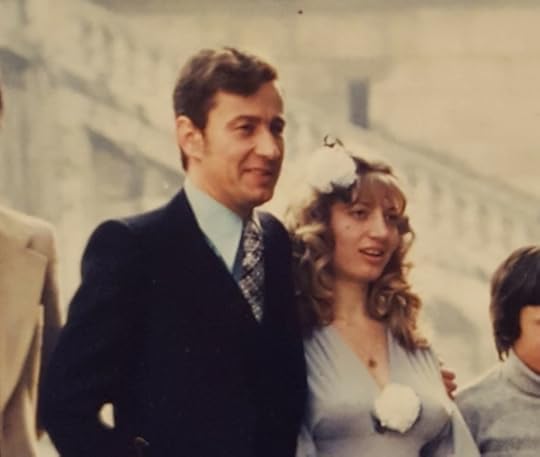
And this breaks my heart in way I hadn’t anticipated.
I ask my husband if it’s okay, and don’t elaborate. Even I am unclear what I’m referring to – I just want reassurance, which he is quick to offer. Everything is fine. My father was sick. He lived a relatively long time, all things considered. And yes, it was a good idea that he and my mother divorced.
“Your parents are the two most incompatible people who ever lived,” Rand says. “Honestly, it’s a miracle you even exist.”
He is loading the dishwasher, and pauses to look at me. “But I’m glad you do.”
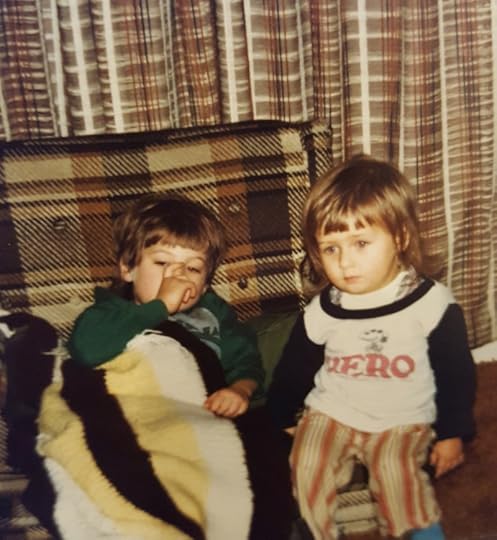
With my brother, circa 1983. I am the one dressed like a rodeo clown.
He reminds me that they did and do love me. I nod. I place the slides – evidence that my parents were once married and maybe even a little happy – back into the box. They are part of an equation that yielded an improbable result.
My mother + my father = me.
And I remind myself that now that he’s gone, this doesn’t change.


March 27, 2017
Erasing Lines at The Hagia Sophia, Turkey
Islamophobia has, understandably, been on my mind a lot lately. I’ve been watching as it slowly spreads across America – perhaps it’s always been around, just under the surface, but in recent months, with the election of our new President, it’s come to a rolling boil. He has villified Americans and foreigners alike, accused the Muslim community of sheltering radicalized terrorists, and signed an arbitrary Muslim ban on immigrants and visitors to America. (Now in its second iteration, after the first one was struck down on grounds it was unconstitutional).
The executive order is the manifestation of a multitude of shitty ideas. That all Muslims are terrorists. That denying refugees (many of them fleeing those exact terrorist groups we fear) into the United States will somehow make us safer. That Islam itself is the problem. And that somehow becoming isolationist will protect us.
It tries to draw a line of demarcation between “us” and “them.”
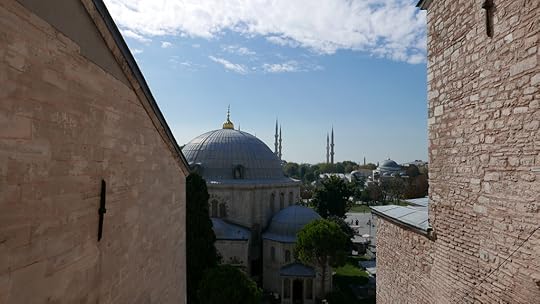
View of mosques from the upper floor of the Hagia Sophia in Istanbul
Turkey was my first and only trip to a Muslim country. And I wondered if this line of demarcation – albeit a slightly different version – existed there as well. I particularly wondered if we would notice it more markedly as Americans, and, in Rand’s case, as a Jew.
Somewhat surprisingly, it did not, despite the fact that people rather instantly identified us as Jews (which I found jarring – a very, very small percentage of my ancestry is Jewish). Without preamble, the owner of a sweet shop walked up and offered me candies noting that they were Kosher; a tour guide looked at me for a moment, asked where my family was from, and the said, “You’re Ashkenazi, yes?”
I was dumbfounded. He explained that a large percentage of the population in Turkey had Jewish ancestry. New research suggests that Ashkenazi Jews descended from here. And while many Jews are leaving the country for Israel or America, it soon became apparent to me that the lines between “us” and “them” are greatly blurred in Turkey.
No where was this better captured than the Hagia Sophia.
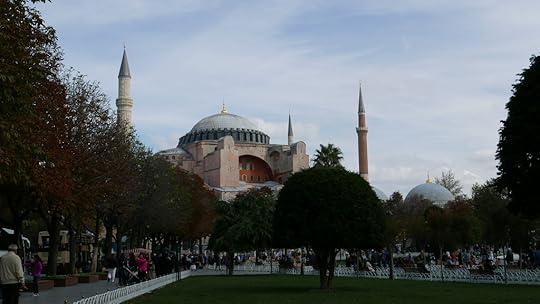
No single religion can lay claim to it. It was originally built in 537 AD as a Greek Orthodox Cathedral, and remained so for nearly 900 years, despite a brief 50-year stint in the 13th century during which is was converted to a Roman Catholic church. It became a mosque until 1453 (after Constantinople fell at the hands of Sultan Mehmet II) and remained as such until the 1930s, after which is was turned into a museum. (In Turkish, the name is Ayasofya, a far more phonetic spelling of its name.)
Over the centuries it has been decimated by earthquakes, desecrated by Crusaders, pillaged by invaders, looted by the Ottomans. The copper roof cracked. The interior fell into disrepair and was damaged by moisture and decades of neglect. It was engulfed by fire and rebuilt, twice. Today it is in a state of restoration, one with an indeterminable end date. The building, majestic and massive, has been through so many incarnations that it’s impossible to tie it to one religion.
I suspect this concept resonated with Rand. He identifies as atheist, but he’s Jewish by ethnicity, and when we first met and he told me he loved Christmas so we put a Star of David on top of our tree.
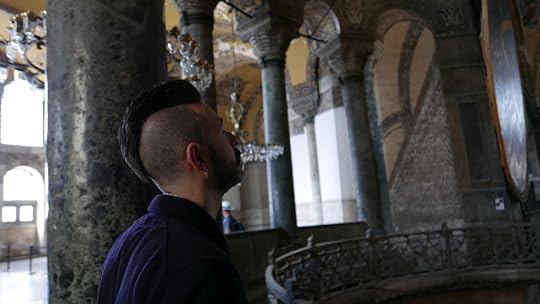
Entering the Hagia Sophia, he was quiet and wide-eyed. When he finally spoke, it was to tell me that this was one of the most remarkable places he had ever seen.
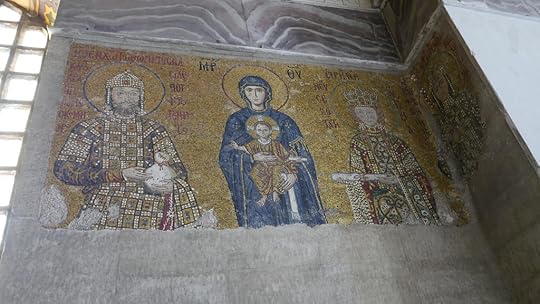
The building’s mosaics harken back to its time as a basilica. There were saints and apostles, the virgin Mary and the baby Jesus.
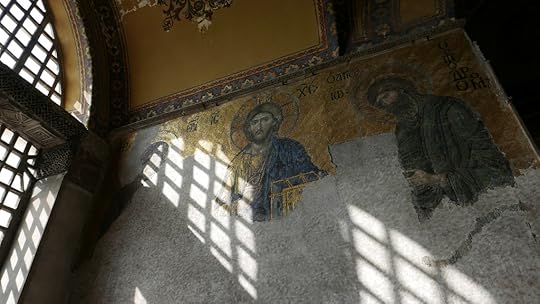
Architectural details that looked distinctly like those I’d seen in Catholic churches across Europe.
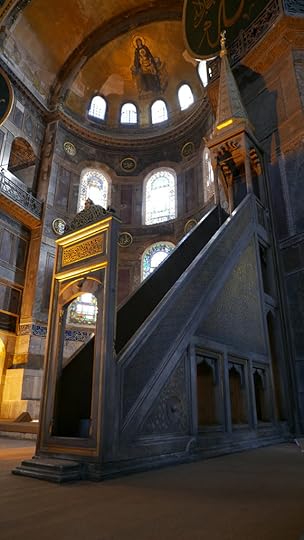


Did I mention I’m a recovering Catholic? There is something strangely familiar about every church I walk into. Every representation of a Savior I inherited, or a saint whose name I could never keep straight, is like an old friend. One who I don’t call often enough, because we really don’t see eye-to-eye on a couple of things and have grown apart.
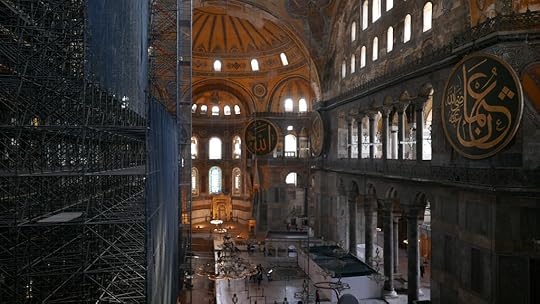
Alongside these mosaics are giants disks with Islamic calligraphy written on them – erected when the building became a mosque.
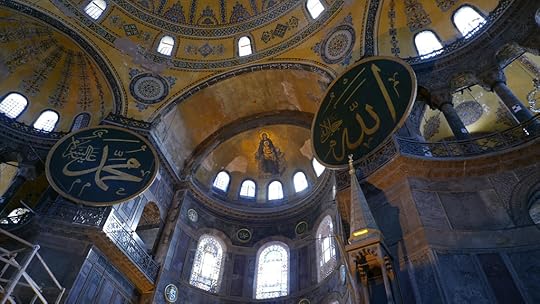
This was perhaps my favorite feature of the Hagia Sophia – the positioning of the disks alongside the Christian motifs seemed to acknowledge that its new identity did not erase its old one.
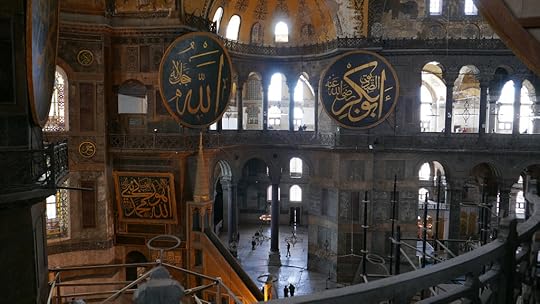
We all exist together.
There were other points of familiarity in the massive Cathedral. The six-pointed star (at the top of the chandelier) is a common symbol of Judaism, but does not exclusively belong to that faith. We saw it repeated time and again across mosques in Turkey, Rand pointing it out to me each time.
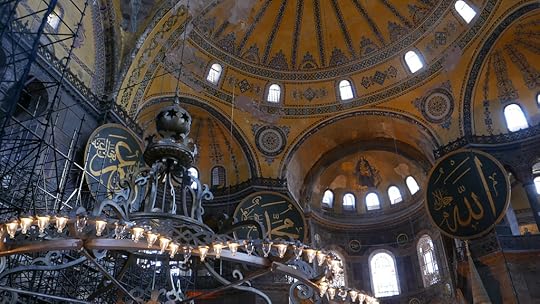
Today, different groups each have their designs on the Hagia Sophia. Some say that it should be be restored to its original function as a Christian Church. Others argue that it should be a Mosque. In the meantime, there is a small space designated as a prayer room for the museum’s Christian and Muslim staff. Twice a day the call to prayer rings out from the minarets of the Hagia Sophia. But because it is a museum, visitors may enter without removing their shoes, and women are not required to cover their hair, as we did in the mosques throughout the city.
In the present, the Museum straddles the lines of demarcation that so many are trying to draw in indelible ink. There is no us or them, there is simply a long and storied history written in calligraphy and mosaic.

March 21, 2017
A New Look for the Blog
Long time readers of the blog (hello, weirdos! I love you!) will probably notice that things look a little different around here. I’ve just relaunched the blog, which was redesigned and built by the fantastic team at The Medium.
If you’ve never had to redesign a blog, I’ll tell you truthfully: it’s normally not a fun process. I’ve been pretty lucky in the past, and have had a chance to work with awesome people, but inevitably there is some confusion and hurt feelings because HTML stresses me out. Working with The Medium, though, has been a joy from beginning to end. They dealt with my neurotic emails at all hours, they dealt with Rand and I being unresponsive because we were on the road or in a food coma, they dealt with the difficulties of working with a client who barely understands how the internet works (“Magic?” – me.) They were also really awesome when I dropped off the planet for a few weeks after my dad died.
And they created something beautiful, in spite of all of that. The new blog design takes a lot of elements and inspiration from the cover of my upcoming book, All Over The Place.
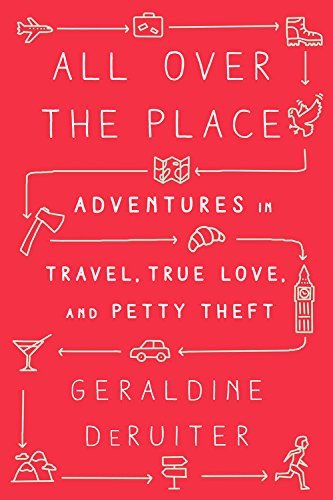
Also, yes, I talk about my book a lot because it’s sort of a big deal to me right now.
But the designers at The Medium didn’t simply pull icons from the book jacket – they made a couple of their own. I was particularly giggly over this one:

You guys. HOW ADORABLE IS CARTOON GERALDINE? I mean, I’m thirty-COUGH-COUGH-years old and I still get so flipping excited over drawings of myself.
The new site follows much of the same architecture as the old one, so navigating it shouldn’t be too much of an adjustment for you Everywhereist veterans. The biggest difference is that there are a ton of call-outs for the book (which, by the way, is on sale at Amazon right now for almost half price. Maybe consider picking up a copy or twelve? It’s never too early to start shopping for Arbor Day gifts.)
I haven’t checked through the entire site, so if anything looks weird, let me know. And if you want to see more work from the folks at The Medium (who have not asked me to write a post about them but I am anyway because they are AWESOME- HI, LISA, VINNY, AND JACQUI), you can check out their portfolio here.

Unhelpful Charts for Writers
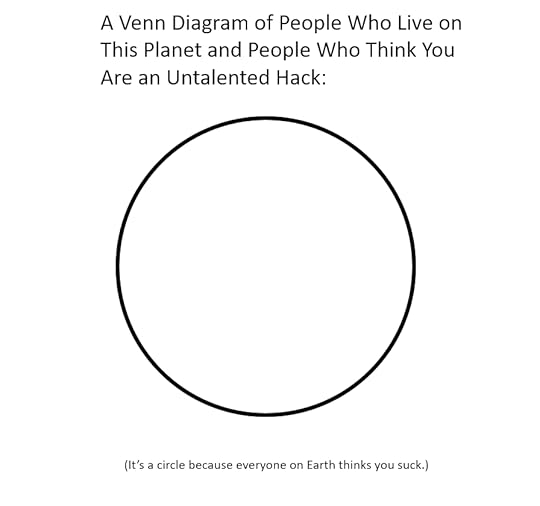
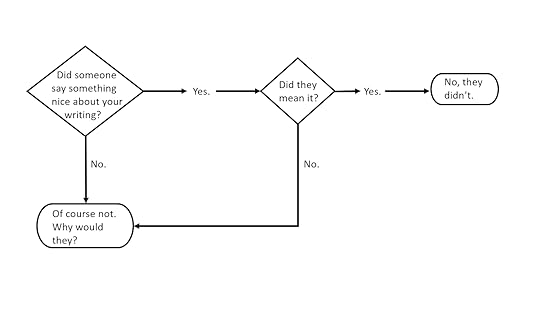
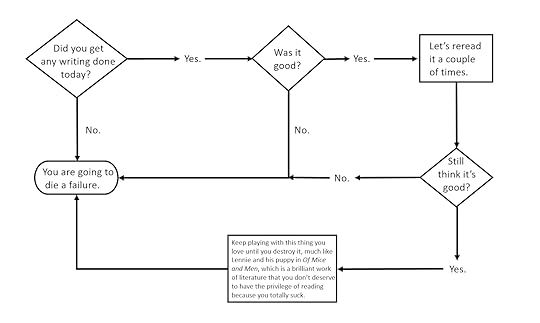
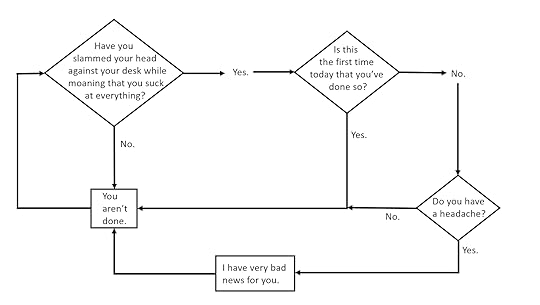
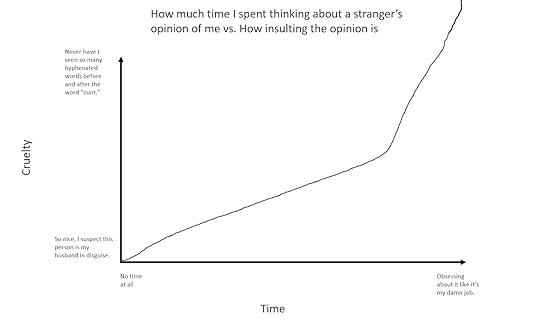
While I initially started this post with the aim of creating helpful charts for writers, that was soon abandoned because I don’t really know what helpful advice I have to offer about writing, other than to maybe not be sober while doing it. (And that’s not even my advice – pretty sure that Hemingway came up with that way before me.)
Writing can be difficult. I know that sounds really indulgent to say – I mean, I stand in front of a computer all day. How hard can that possibly be? My grandmother had to fetch water from a well and carry it back to her village in a ceramic jug on her head and I’m a sunlit office complaining because I don’t know what words I should make magically appear with my fingers.
But I suspect all writers feel that way. We are mired in self-doubt and neuroses. Even when we create something that a teeny part of us may actually think is good we still sort of hate it. And then we think of how ungrateful and useless we are because just the fact that we have running water, much less the opportunity to write, is a gift. That push-pull of self-loathing and doubt and gratitude is what makes us writers.
So rather than create any cogent advice, I decided to chart out the path of my neuroses as it comes to my work. I made a few flowcharts and diagrams. If you are a writer, you’ll probably relate. And for that, I am entirely sorry.
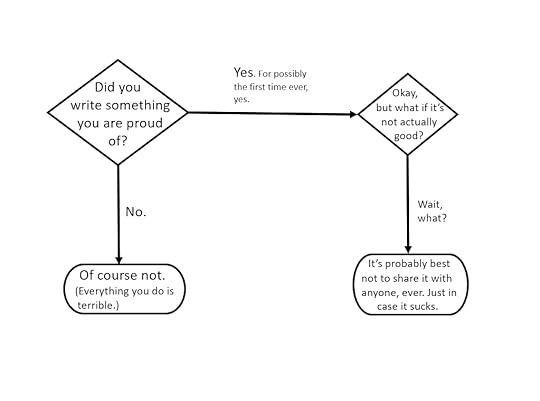
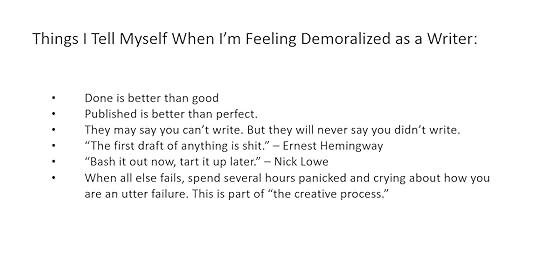

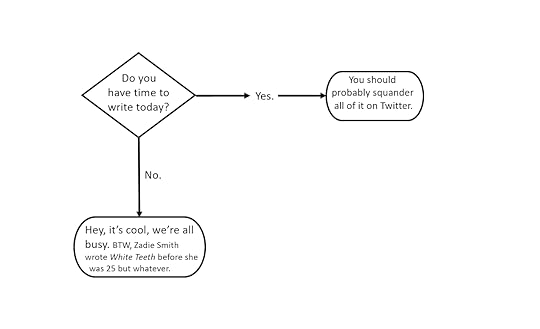
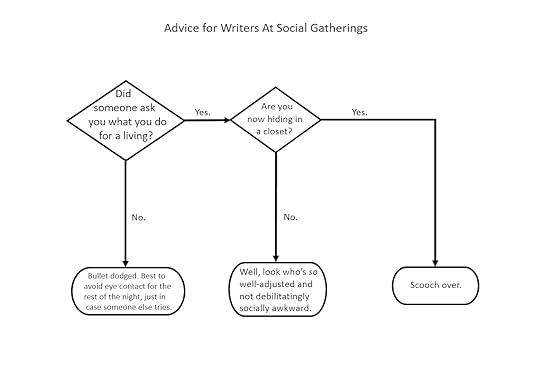

March 16, 2017
Galata Tower, Istanbul, Turkey
I am not afraid of heights. This is notable, because I have historically been afraid of: a Boston Terrier, my coat (I woke up from a nap and freaked out because I thought it was a cat), and my own shadow (it caught me off guard. At the age of 36). So having a small category of things that do not scare me feels like a triumph. I am fearless when faced with spiders or tall towers or speaking in front of crowds.
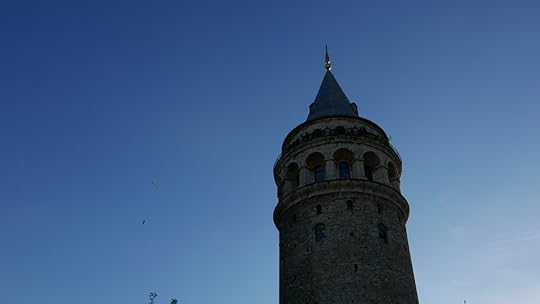
Despite my narrow fields of bravery, even the top of Galata Tower, a medieval stone structure in Istanbul, shook me a little, and I imagined that for those who are afraid of heights (or, more precisely, of falling from those heights), it would have been a terrifying experience. But I was mostly immune to this. For me it was simply lovely, and my nervousness about the tower’s height and stability was easily ignored.

Originally constructed in 1348, it was once the tallest building in Istanbul at nine stories tall (the observation deck on which Rand and I stood is roughly 160 feet high). Even today the views are remarkable, and you can walk around the entire observation deck and see the massive city and the Bosphorus stretching out around you (admission to the tower is just under five U.S. dollars). The air was remarkably clear (especially given Istanbul’s size), the water brilliantly blue, and at sunset – when we were there – the sun caught on distant mosques and we could hear the call to prayer echoing across the city.
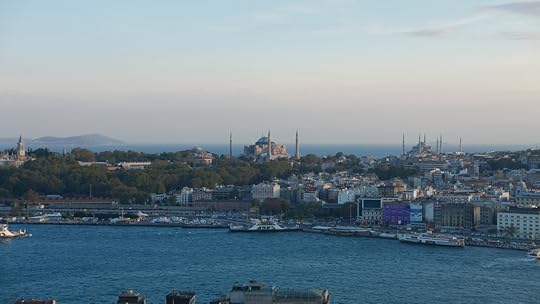
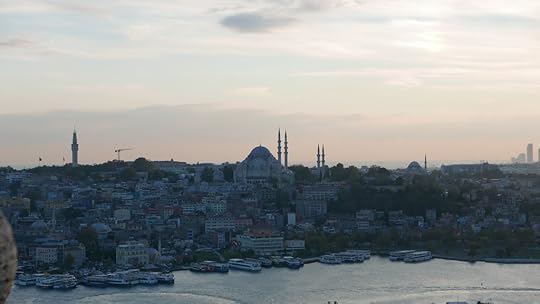
During the Ottoman empire, the vantage point offered by the tower was pragmatic – it was from here that fires could be spotted throughout the city. In a rather cruel twist of fate, Galata would be damaged by fire repeatedly over the centuries.
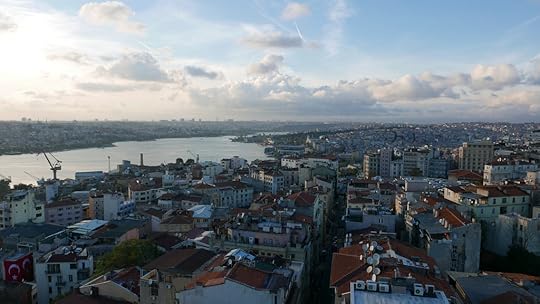
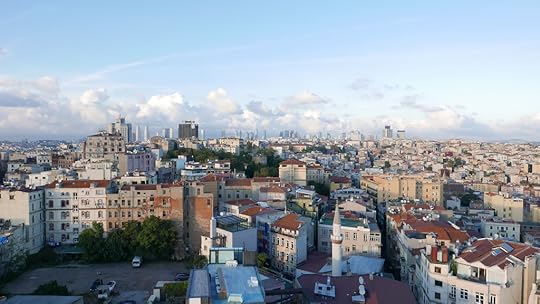
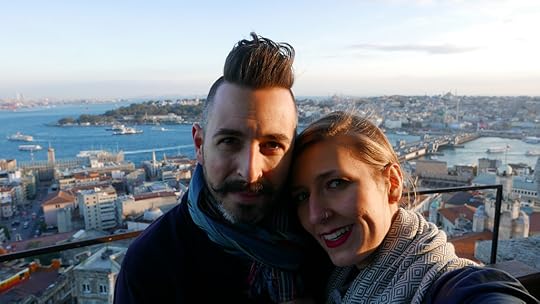
The observation deck is narrow – there were places where only one person could reasonably fit, but this didn’t stop people from trying to squeeze past one another. I was occasionally held up by the sheer volume of people, sometimes thrown against a metal guard rail, sometimes pressed against the wall of the tower. I kept pausing to take photos, and in the cluster of people, Rand and I were separated.
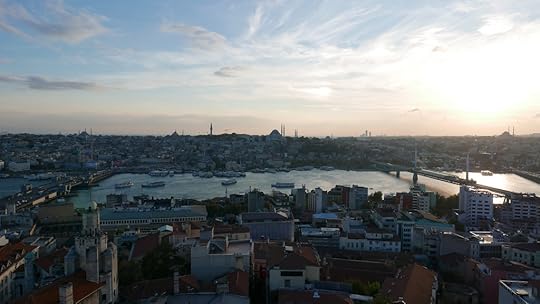
I found him again, of course. I always seem to.
Supposedly in the early 1600s it was from here that the legendary Ottoman aviator Hezarfen Ahmet Çelebi leapt, wearing a pair of constructed wings, and flew across the blue of the Bosphorus aided by the wind.
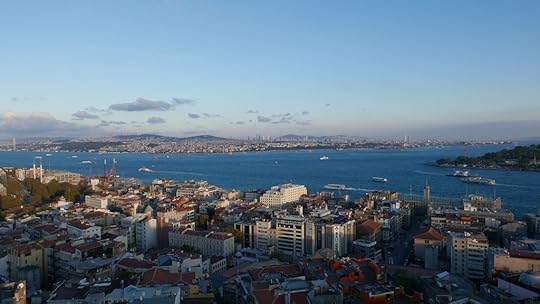
He landed on the Anatolian shores, some 2 miles away. He is credited with the first successful flight wearing artificial wings. (Alas, his success was cut short – his innovation frightened many, and he was eventually exiled to Algeria). I try to imagine the wind as it rushed against his face. How he saw the city in a way that no one had before. How elated him must have been when he touched down on the other side.
As for me, I’ll take my narrow window of bravery – there’s no need to push it any further. The view from the top of Galata Tower was more than enough.

March 8, 2017
The 10th Circle of Hell is Southwest Airlines
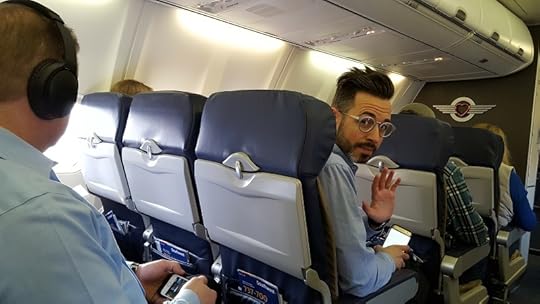
Pictured: Rand, the best person on this plane. Also pictured: Dude in headphones who screamed when people got too close to him.
I have this terrible habit of assuming that most people are generally good, contributing members of society, and not bat-shit barely-functioning assholes. Every now and then we may deviate from this norm (I once woke up angry with Rand because he’d done something to piss me off in a dream) but for the most part we adhere to a social contract that requires us to at least pretend that we’re simply scratching our nose when we are actually digging around for boogers.
And while I have seen all manner of weird things while on the road, I can safely say that nothing compares to what I saw on the Southwest flight that Rand and I took from Albuquerque to San Diego.
Generally, I don’t fly Southwest because I don’t hate myself. I fly Alaska Airlines, and the delta (ha!) between the two airlines is the same one that exists between Donald Trump and Obama: on some level, these two things are fundamentally the same (men who have held the office of president; commercial airlines) – but seriously, fuck no. No way. These things are not the same. One will get you where you need to go and the other is probably going to get us all killed OH GOD HOW DID THIS HAPPEN.
Ahem.
Anyway, Alaska’s big flaw is that they don’t really operate anywhere but the Pacific Northwest. Outside of the west coast, everyone assumes flying Alaska Air means you are from Alaska. They inevitably start asking questions, and I’m too embarrassed to admit I’m from Seattle so I just say things like “YES PENGUIN MEAT IS DELICIOUS”.
For those of you who are itching to point out that there are no penguins in Alaska: that is not the biggest problem you should have with that sentence.
ANYWAY.
Southwest does not have assigned seating. I mean, I’ve been to movie theaters that have assigned seating. It the cornerstone of any functioning society. It is what separates us from the Italians. Remove it, and people start strangling one another for free t-shirts. I’ve seen it.
Instead, Southwest is a fucking free-for-all. First come, first served. And that is where I think the root of all appalling behavior on Southwest flights originates.
Rand paid extra to have us board in an early group, because Southwest isn’t going to let its running-of-the-bulls-but-with-children-and-old-people-and-carry-ons seating structure stop them from having a social hierarchy.
I should note that the crew was actually lovely. But they are still part of this evil empire so I blame them, too. Sometimes the devil brings you ginger ale.
We boarded, and the crew announced that there was plenty of room on this flight, which meant that everyone became Gollum, screaming “MY PRECIOUS” while lying across an entire row. I’ve seen this tactic before.
Other people go the more passive aggressive route: they wear paper masks over their faces, despite showing no discernible signs of illness, to frighten away hypochondriacs.
Or they just act like assholes, which seemed to be the school of thought that most of the people on this flight adhered to.
We boarded, and as Rand was graciously putting my carry-on in the overhead, I guess he took a second too long to do it, because some woman passed him and said haughtily, “Uh, they check bags for free.”
OH SHIT, REALLY, LADY? THEY DO? Sorry I’m not fucking up to speed on Southwest’s amenities, but since they can’t even get seating right DO YOU REALLY THINK I’M GOING TO CHECK MY BAG SO THEY CAN SEND IT TO A DUMPSTER ON WHICH SOMEONE HAS HASTILY SPRAY-PAINTED THE LETTERS “SFO”?
I wanted to hurl myself at her like a cat thrown from a car. Instead, I restrained myself. For that, I deserved a cookie, which, like social contracts, is something else that Southwest does not have.
The problem with Rand is that when there is a fight for limited resources he is not strategic at all. He will absolutely not push over an octogenarian for a free sandwich, and that is why he will never get ahead in life or on a Southwest flight.
(Sorry. I don’t actually believe this. It’s the airline talking.)
Rand pointed to aisle and middle seat that were free, but taking a middle seat on a non-full Southwest Airlines flight is basically asking to get shivved.
By the time I realized that wasn’t going to work, the nearest seat available to me was an aisle seat a few rows back. There was a woman already in this row, seated by the window. She’d pulled the tray table for the middle seat down – a subtle way of saying “back the fuck up” – and glared at me as I sat down. Over the course of the flight, she proceeded to eat numerous hard-boiled eggs with her bare fingers. I hate her.
Opposite me was seated the asshole in headphones pictured above.
I call him an asshole because when another another passenger asked if they could take the window seat, this guy yelled, “ARE YOU KIDDING ME? THE ENTIRE PLANE IS EMPTY.” He then refused to move, but the other passenger just stood there, calmly waiting, and finally the guy stood up, visibly pissed, and let him take the window. He then mumbled a bunch of unrepeatable things under his breath.
And while I think there is a special circle of hell for all of these people, it does not compare to the gentleman who was seated across the aisle from me and one row back.
His actions made me question whether or not I was hallucinating. I thought my club soda had been drugged.
Roughly halfway through the flight, I heard a metallic clicking sound.
*CLICK*CLICK*CLICK*
I furrowed my brow. I knew that sound. But … no. No way. I turned, trying to identify the source.
And then I found it.
HE WAS CLIPPING HIS FINGERNAILS. I kid you not. They were flying everywhere like some unholy confetti. There is never a time in which that many pieces of genetic material should be airborne.
There are so many questions that I wanted to ask him.
What is wrong with you?
Are you actually an alien who is pretending to be human, and failing in the endeavor?
Why didn’t you do this in the bathroom? OR AT HOME?
You’re going to pick that shit up when you’re done, right?
What is wrong with you?
Is this your first time on a plane? And around other humans?
No, seriously, what the fuck is wrong with you?
Alas, only one of these was answered. When he was done, HE. SWEPT. HIS. FINGERNAILS. ON. TO. THE. GROUND.
THIS IS WHAT HAPPENS WHEN YOU DO NOT HAVE ASSIGNED SEATING. Everyone has an “it’s me or them” mentality that extends to the entire flight. *I* want to sit here. *I* want to be an asshole. *I* do not give a fuck that other people exist.
I stared, disbelieving. I looked around, to see if anyone else was appalled. Rand was asleep and rows ahead. Asshole dude was watching some video, oblivious to his surroundings. Hard-boiled egg woman was … holy shit, where did she get more eggs?
No. I was the only one who witnessed it. On Southwest, no one can hear you scream.