Geraldine DeRuiter's Blog, page 8
March 29, 2019
There is No Such Thing As Closure
I am scheduled to leave for Germany in several days. I have already told my husband that I don’t want to go, in a whining tone that stretches syllables out so far that the words they once formed are barely recognizable. As a woman nearing the aging of forty, this is how I am coping with the death of my father, who passed away *checks calendar* … a not insignificant amount of time ago.
I never imagined losing a parent would be an easy thing. But I reasoned that the death of my orderly, logical, unsentimental father would be different. I had loved him, and in his own way, he had loved me. And now he was gone. I had felt sadness – both the intense grief of the moment and the lingering aftermath of it. I felt the pang of finding reminders of him (a global stamp meant for a letter I never sent, a scrap of paper with his handwriting on it), witnessed the persistence of time that rudely passed on without him. I figured I had processed all of these things. Grief was something you push through and then it’s over, I thought, like a workout or a particularly terrible movie. You’ve done it. It’ll never crop up again.
I made the mistake of thinking that grief would be a linear thing. It never is.
Since before I could remember, my father and I lived on different continents. He came to visit my brother and me when we were small, dutifully staying in America for a month every year before returning to Bavaria. Neither Dad nor I seemed to enjoy the time we spent together (my father was never much a fan of children, and the sentiment appeared to be mutual) but I suppose we realized that it was the right thing to do. He never smiled in photos, but wore a scowl so enduring that all his descendants – even my infant nephew – have it.
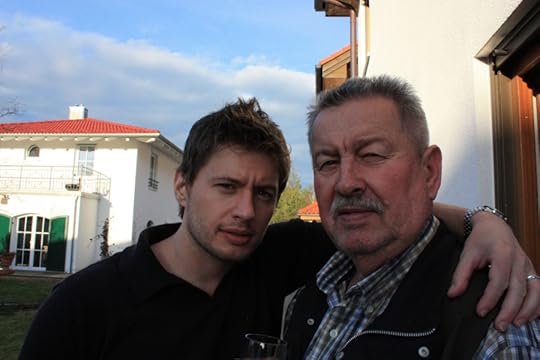
My brother and Dad, making the face that we all have.
His visits became less frequent as I grew older. When he came to visit me the summer before I turned 16, it had been five awkward, pubescent years since his last visit, and his response was a wide-eyed, “What the hell happened.” Not so much a question, but an answer unto itself.
It wasn’t until my mid-20s that my visits with my father approached a sort of regular schedule, thanks to my husband’s work. Each trip followed a similar pattern, and I suspected that my father, who’d spent 40 years in the same job and 60 with the same haircut (stalwarts which outlasted all three of his marriages), had always appreciated that. We arrived during the same time of year, we’d rent a car, drive to the house, explain to my stepmother that no, no, I was not pregnant, share a few meals together, walk through a few tiny Bavarian villages, and head home. Inevitably, we’d receive a few speeding tickets, forwarded to us from our rental car agency, after we got back.
I suspect that the declines in my father’s health were a relatively gradual thing. But seeing him only once a year, he seemed to age at an accelerated rate, much as I had for him. I resisted the urge to ask him what the hell happened. One year he was there, and then another year, he wasn’t.
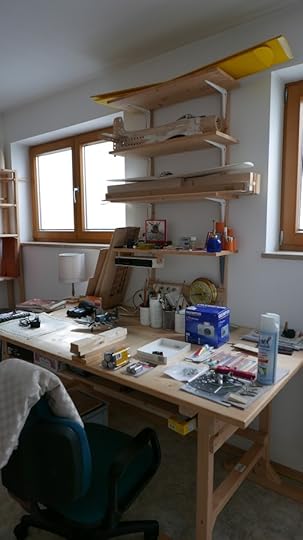
My Dad’s workshop. 3 months after he had passed away and it looked exactly the same.
I did not go to my father’s funeral.
“You have to,” my brother told me. “Only people who hate their fathers don’t go to their funerals.” It was a litmus test of sorts, though I could easily see the flaws in the logic: going to Dad’s funeral wouldn’t prove that I loved him, but missing it would prove that I did not.
The dying rarely ever consult anyone on when would be a good time to depart the earth, and my dad was never big on conveniencing others. His timing was terrible. He died in the middle of a snowy December and his funeral was set for the week of Christmas. Getting there would be near impossible.
My father had already been cremated, though no one was certain whether or not this was in accordance with his wishes. Dad didn’t make them known, because doing so would have required that he talk about his own impending death. My stepmother and I don’t speak a common language, so through my stepsister I asked if the funeral could be delayed for a few weeks so I could make it out. Through my stepsister, I was told that the funeral would not be delayed. Through my stepsister, I was also told that the request was not appreciated, either. Through my stepsister, I said nothing in reply. It was the worst conversation I’ve ever not had.
When I finally realized I wouldn’t be able to make it – the reality taking form slowly like a Polaroid, I wondered what the ramifications of it would be. I don’t know if it would have made a difference. Even if I’d gone, I’d still have to learn that grief was something that didn’t have precise lines of demarcation.
Months later, I would finally see his grave for the first time – a shockingly organic crag of rock (Bavarian aesthetics are different than American ones) that he shared with his most recent mother-in-law, whom he disliked intensely – and assumed it would offer me some measure of that thing we call closure. But to echo a friend of mine who recently lost his wife: closure is a myth. Death not a finite thing that we get over. Some things stay with us, and after enough time, we simply get used to weight of them.
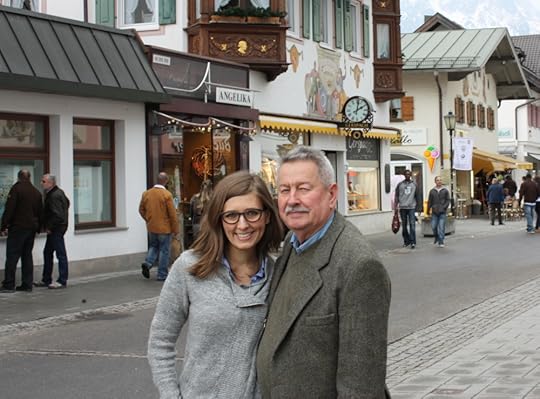
The problem with losing someone who has spent a lifetime on another continent is that the weight of that grief is so inconsistent. You don’t just lose them once. You lose time every time you forget that they are gone, which is often. On Saturday nights, I still find myself double-checking to make sure the ringer on my phone is turned down, remembering my father’s proclivity to call me at 7:00am on Sunday mornings. (“Why the hell are you sleeping?” he would ask, irritated. In reply, I would calmly explain the concept of time zones and weekends to him.) When I realize he will never wake me up at an ungodly hour on a weekend, I break down in tears. It feels like my own muscle memory has betrayed me.
There lies all my hesitation for this trip – I’ll be constantly confronted with the reality that my father is gone, and yet the loss doesn’t begin or end there. It carries on as it always does, popping up when I least expect it. One moment I’m fine, the next I’m not. I go to shut off my phone’s ringer in the middle of the night, and when my husband finds me much later, it is still in my hand.
It’s been years, but it doesn’t matter. Some cuts feels fresh because you’ve just remembered they’re there.


March 26, 2019
Relationship Advice: Buy a Big Ass Scarf
I am on occasion asked for relationship advice. I often do not know how to reply. The list of things I could tell people is long and winding, may be entirely irrelevant, and varies from season to season and day to day.
In summer, I learn to appreciate freckles and to not mind when the heat is so intense that you can barely touch one another without hearing a sizzling sound. In the spring, I feel like making elaborate tarts might be essential to a good relationship (no, there is no photo, it was gone too soon, leaving only flakes of crust in the bottom of the pan like petals of cherry blossoms). But I can’t say definitively because there is no control group. I’ve never not made tarts in the spring. And now, after so many years, it’s too risky not to.
That is where I am now, making tarts, watching winter receding so quickly I am suspicious. Spring can’t be here, not yet. That’s not how it works. March isn’t supposed to be sunny in Seattle. The last day of winter is not supposed to reach 80 degrees. We left a bar in the middle of the night yesterday and I braced myself for a cold that wasn’t there.
But I am not convinced; Seattle has taught me that the seasons can be more fickle than even my earliest dalliances with love. I’ve watched snow come down in April, turned the heat on July, had to convince my friends that August “really isn’t always like this” while we huddled, shivering, under an awning to avoid a downpour. Spring might be here in this moment, as I watch the light change in my office. But it isn’t here for good.
And so what advice do I have for love during those stubborn, lingering days of winter? The ones that hang on, miserably, and are made even longer by a late setting sun?
Simply this: wrap your beloved in a big ass scarf.

Now, you may already be in possession of a large scarf, but odds are, it is insufficient, because that scarf of yours still somewhat resembles a scarf. That is not what you want. You want a scarf that scarcely looks like a scarf. The sort of item that, when left draped over a couch could be mistaken for a throw blanket, or a cloak, or a circus tent. You want a scarf that forces people to redefine precisely what a scarf is. The kind of thing that makes people reference that meme with Lenny Kravitz wherein he is so enrobed in crocheted warmth that it defies the limits of space-time.
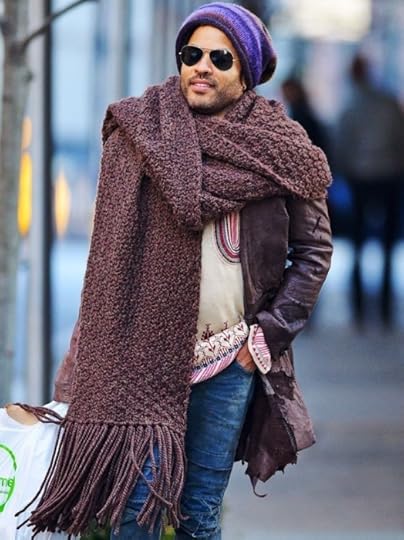
You want something that will lead to a discussion wherein the word “scarf” is said so many times that it just doesn’t sound right anymore. Scarf. Scarf. Scarf. Scarf.
Ahem.
Now, odds are, this scarf will start out as yours. Because you are terrified of being cold, and you think ahead, and the idea of wrapping a duvet around your neck appeals to you. But your beloved has not scrutinized the weather report as closely as you have. And so you may find that the two of you have escaped for the weekend, down to the town in which you were married, and your beloved is freezing.
And you are not. Even without the expanse of fabric that has been wound and wound around your neck like you imagine Rapunzel sometimes bundled her hair around her when she had a cold, you are just fine. And so you offer your husband your wrap.
He is reluctant at first.
And then you offer it again.
And he says no again. And you respect his answer.
But then he is shivering as you walk and he suddenly relents. You wrap it around him. And around him. And around him. (It takes a while.) He stops shivering. He looks at you like it is some sort of alchemy. It is not. It is simply a big ass scarf.
“This is amazing,” he whispers. He worries you are cold. You aren’t, but he holds you close anyway. He now radiates heat. The scarf makes his eyes twinkle. (Or maybe that’s unrelated.)

And so this is the advice I have for those last lingering days of winter: get yourself an enormous blanket of a scarf, and envelope your beloved in it. It will not make spring come any sooner. But it will take the chill out of the air.

March 21, 2019
Cambodian Rock Band at the Oregon Shakespeare Festival
Note: this post contains some content that may be upsetting for certain readers – including mention of torture and the Cambodian genocide.
—————
My trip to Cambodia feels so long ago – more than five years – that I have to remind myself that I was there. I look at the photos, and see myself looking so damn young that it almost startles me. I went to Cambodia with Nicci and we rode bikes to Angkor Wat and she would shout what vehicles were coming upon us and I would caution her about the monkeys that sat on the side of the road and we ate gelatinous fruits in air so damp and hot it felt like we were inside a sauna.

We went to Tuol Sleng prison and we visited the Killing Fields in one day, and it felt like there was nothing left of us after that. Even as spectators, as tourists, as white women with expensive cameras, even with all the veils of privilege and distance to insulate you, the history of the Khmer Rouge will leave you feeling like a hollow shell.
I remember how the tiles in Tuol Sleng still appeared to be stained with blood (I couldn’t – and still can’t – say definitively if they were). How a rusted bed frame sat in one corner of the room and someone explained that this was the same bed that prisoners had been chained to and tortured on. How of the more than 20,000 people to pass through the prison, only 7 survived.

This cell was only about three, maybe four feet wide at most. I remember thinking it looked no bigger than a closet.
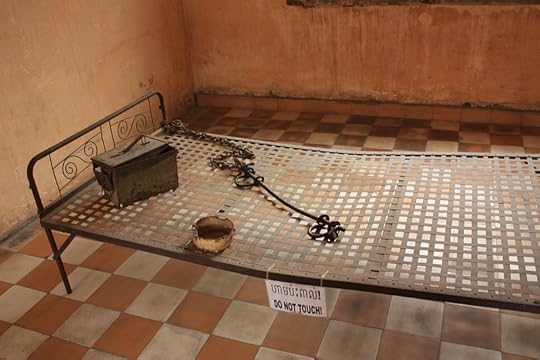
I may be remembering incorrectly (it’s been so long) but I think I read that the metal box once held scorpions used to torture inmates.
Later at the fields, we saw grounds that were sunken in from the decomposition of the bodies in the mass graves, and were instructed to stay on the paths less we disturb the remains. We were told that every time it rained, bits of cloth and bone and teeth would come to the surface and the groundskeepers would gently gather them up and put them in cases.


A tree at one edge of the fields bore a sign indicating that this is where children had been murdered (dashed against the trunk) in order to save bullets.
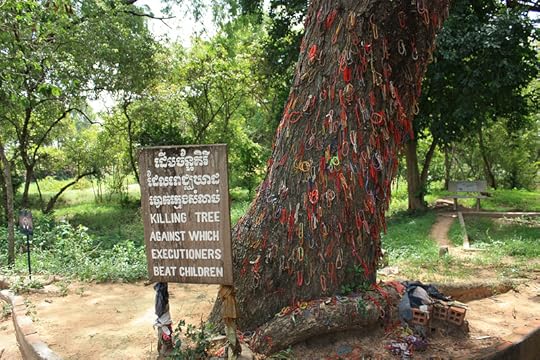
Monks walked the grounds, and butterflies fluttered in the heavy, still air. It remains one of the most terrifying places I’ve ever been.
I didn’t write too much about that trip to Cambodia. I started to, but it was hard to wrap my head around the experience, and returning home was so jarring, even though I’d only been gone for two short weeks divided across there and Vietnam. More and more time passed, and I neglected to talk about Cambodia. I wrote a book instead, with nary a mention of that trip.

The Killing Fields.
Perhaps it was deliberate – it’s easier to block it all out, to go on with the privilege of being comfortable and oblivious. The Khmer Rouge committed mass genocide, slaughtered millions, and destroying the country’s collective cultural, scientific, and artistic history. The U.S. played a critical role in their rise to power and securing their legitimacy and place on the global stage (we gave them weapons and money, we voted to give them a seat at the U.N., we helped to create the power vacuum and instability that enabled them to rise to power in the first place). I know these things without looking them up but somehow, in the intervening years, I’d allowed myself to forget.
Earlier this month, Rand and I were once again invited down to Ashland for the opening weekend of the Oregon Shakespeare Festival. One of the shows we’d be seeing was Cambodian Rock Band – a musical. It had been described as heartbreaking and funny and uplifting, and I’d noticed that the positive adjectives outweighed the negative, and paired with my own self-denial that was enough to convince me that this play would not ruin me.
It did, of course. I should have seen it coming, but I wanted so desperately to rewrite history.
The characters in the play feel subject to this same force. We know how the story ends, we know who dies (virtually an entire generation), and yet we are given the illusion that things might somehow turn out differently. The tension is almost too much to bear. I told Rand that if I was watching it all unfold on my television screen, I’d have changed the channel. But plays and real life have that much in common – usually, you can’t escape it. The only way out is through.
The play centers around Neary, a young American woman working for an NGO that is trying to bring Duch – a high-ranking officer who oversaw Tuol Sleng prison – to justice. Without warning, her father, Chum, shows up in Phnom Penh for a visit – his first time back in the country since he managed to flee the Khmer Rouge 30 years earlier. The play bounces backwards and forwards in time, from before the genocide, to the heart of it, to (nearly) present day. There are musical interludes (with tracks by Dengue Fever) that help to cut the extreme tension. But as soon as they are over, you are thrust back into the heart of it. (The symbolism was not lost on me – art offers us an escape.)
I don’t want to reveal too much about the plot – there are parts that you can anticipate as a viewer, but that’s a hard thing to avoid when a play is so deeply rooted in real-life horrors. Like I said: you know how the story ends. You simply have to watch the path unwind to see it get there. It’s agonizing at times.
The second act is peppered with the sort of violence and gore that you’d be accustomed to finding in a work by Martin McDonagh. But unlike McDonagh’s work, it isn’t violence for violence’s sake, but rather based on facts. It is the parts of the play that are ripped from history that are most disquieting. The tiles of Tuol Sleng are perfectly recreated. Even the main antagonist – Duch – is a real person, and not some contrived bogeyman. He is currently still alive, and would be the only member of the Khmer Rouge to face an international tribunal for his part in the Cambodian genocide. Abandoning your suspension of disbelief won’t protect you from this play. The details may not have happened, most of the characters may be fictional, but the large scale horrors are all real.
The performers in Cambodian Rock Band are excellent – transitioning from musical numbers to intense dramatic performances and comedic scenes with a sort of ease that leaves you reeling (but that is something I have grown accustomed to with the OSF). The show holds similar space in my heart as my visit to the prison and the Killing Fields did: I’m glad I went. I would tell others to do so, with the caveats that it is an intense and terrifying experience, one I will likely not repeat.
There is a part of me that wants to push it all into the recesses of my memory and focus on lighter things, like the other wonderful shows we saw that weekend. But I’ve learned that ignoring history doesn’t change it. And sometimes the best way to honor the dead is to remember.

March 15, 2019
When Online Threats Become Real. (It’s Not Just Trolling.)
(Note: this piece does not link to any of the shooter’s video or manifesto directly, but some of the news sites that I link to may do so. A few include screencaps of his 4-chan forum discussions. Please click with caution.)
49 people died yesterday, gunned down in two mosques in coordinated attacks across New Zealand. The intricacies of time zones and the international date line mean the date of their deaths was actually today, Friday the 15th. Waking up on this day here in the states with knowledge of what occurred feels strangely perverse, as though someone should have been able to stop the attacks through some sort of temporal witchcraft.
And in truth, it seems that someone should have been able to stop all of it. The shooter’s plans were laid out specifically on 4-chan. His manifesto (which I am not going to quote from directly, because he needs no more amplification and if you wish to read it, it is disturbingly easy to find – the UK’s Daily Mail even allowed visitors to download it directly) is peppered with inside jokes from the forums. His justification for the shooting is a mix of white supremacist rhetoric intermingled with “shitposting” (intentional misdirection and nonsense arguments meant to to obfuscate the truth and confuse or frustrate anyone who isn’t in the know) making joking references to the video games while he describes his motivations behind an attack that would leave more than four dozen people dead. It was a hate crime, acted out by an Islamophobe who wanted to be an Internet star.
While en route to the shooting, the shooter played an anti-Muslim song that was used in a propaganda video made by members of the Serbian Army as a tribute to war criminal Radovan Karadžić. The posters on 4-chan laughed at this detail and lauded his actions. They hailed him a hero. They anxiously looked forward to the attack and expressed excitement when it finally happened (“OP fucking delivered” one wrote, as though it was an innocuous reddit thread). They called for someone to “redeem” France in the same way.
He would publish a livestream of the attacks on social media (video would later be published to YouTube, Twitter, Reddit, Facebook, and numerous other online platforms). I haven’t watched the footage (and I won’t), but I’ve read that it’s from a first-person angle, a sort of sick parallel to the vantage point you’d see if you were playing a video game. We used to have to work harder at dehumanizing people. The internet has made it shockingly easy.
Most of the websites have scrambled to take the videos down, but they keep reappearing.
This most recent shooting is one in a seemingly endless stream of massacres carried out by another white supremacist angry at people who don’t look or act exactly as he did. They’ve become galvanized and radicalized on various social media platforms where they find like-minded bigots who share their same vitriol. They are terrorists, but that word is rarely used to describe them (particularly here in America, we are loathe to apply the t-word to mass shooters, particularly white ones, because the cognitive dissonance between claiming to fight terrorism while simultaneously embracing easy access to guns and a President who preaches bigotry and xenophobia would simply be too much).
When asked if he supported Trump, the shooter replied: “As a symbol of renewed white identity and common purpose? Sure. As a policy-maker and leader? Dear god no.”
But the President’s rhetoric and the shooter’s are nearly identical. What’s truly alarming is that it is the President who is echoing the shooter after the attack:
“We are experiencing an invasion on a level never seen before in history.”
“People hate the word invasion, but that’s what it is.”
Two quotes about immigrants in the past 24 hours. One from the US president, one from a document justifying a white supremacist terror attack.
— Lois Beckett (@loisbeckett) March 15, 2019
It’s been impossible for me to separate the conversations that the shooter had prior to the attack from the vitriol that plays out daily on social media platforms. The attacks themselves seem specifically engineered to be shared on social media. It creates a Catch-22 for anyone wanting to address the issue – because even condemning the shooter’s actions plays into his attention-seeking goals. The refrain “don’t feed the trolls” is repeated ad nauseam whenever the discussion of online hate comes up. And while we can (and arguably should) refuse to watch videos of the slaughter, or promote a manifesto of hate that the writer so clearly wanted spread, avoiding talking about online abuse, and the galvanization of hate, and the litany of death threats that have become commonplace for so many of us … well, that doesn’t seem the correct response, either. We need to address this garbage in order to fight it.
I’ve spent the last year gently wading into the cesspool of online hate and abuse (I’ve been giving talks about it and doing some research, ostensibly for a new book), although consistently doing so from the lofty position of privilege that I have as an able-bodied, college-educated, cis-gendered white American woman. I’m usually only ever a target because I’ve committed the crime of expressing my views while female, because I’ve dared to be happy and in love. This alone is enough to anger some lonely, cave-dwelling troglodyte.
I’ve received death threats and rape threats, had people make light of my brain surgery (and spread the notion that in the aftermath of it, I am mentally unfit), had my Twitter account hacked, received threatening letters at my home, and, perhaps most delightfully, been told that my marriage is fake and that we are destined for divorce (as a result, Rand and I have taken to whispering “sham marriage” to one another at nauseatingly romantic moments). I’ve lost sleep, had my husband install a security system, had to check with event organizers to see what kind of security they offered, and been so frightened by some of this that I haven’t talked about it, because I knew that doing so meant that the people behind it would know that they’d succeeded.
And still, I’ve had it relatively easy.
I’ve never been attacked for my skin color or my ethnicity or my immigration status or my religion or my gender identity or my sexual orientation. The President’s endless Twitter hate-fest never calls me out directly. I walk around in a bubble of relative safety. And I’m still terrified. So I can’t even fathom how people without all those layers of privilege must feel.
The refrain that I’m so often told is that there’s nothing to fear – that online threats are simply that. That the authors of such vitriol and hate are simply blowing off steam, or are merely trolling (a term that I am loathe to use – because it automatically suggests that online abusive behavior is somehow less egregious than it is and puts pressure on the targets of the abuse to solve the problem by perceiving it differently). But yesterday’s attack, and the countless ones that have preceded it (and, I fear, the seemingly endless ones that will likely follow it) have proven that there is no such thing as an “online” threat. A threat made via Twitter is a threat. If a terrorist posts their plans to 4-chan, it is no less potent because of the forum. And everyone who sees their hateful words and laughs along, everyone who cheers the outcome as thought it is a game, is an accomplice.
These platforms are part of why the threats exist in the first place – offering bigots a microphone for their hate, and an eager audience to amplify it. Dismantling toxic communities and banning hateful individuals needs to be a pre-emptive measure and a reactionary one. Take away someone’s platform, and you take away their power.
the two best examples we have of robust deplatorming are Milo and Richard Spencer aka “oh yeah… that guy” there is simply no evidence to suggest it makes them more alluring
— Brandy Jensen (@BrandyLJensen) March 15, 2019
We do need to look at the role that social media platforms play in all of this, and the responsibility they have to all of us. And we need to stop dismissing hate and threats when they appear. No one, absolutely no one, is allowed to say that “it’s just trolling” ever again. We can no longer ignore the relationship between online threats and offline violence, between hateful online forums and real world hate. There is no separation.

March 8, 2019
The Everywhereist On Live Wire Radio
I’m still weirded out when I’m asked to do interviews. I still feel like, even after all these years, that the blog (and even my book) are sort of a small, insular thing, and when people have heard of them, I find it oddly confusing. It’s like a stranger walking up to you and talking about the tub of hummus at the back of your fridge.
Like, of course I know about the hummus, and it’s not a secret or anything (I mean, it’s right there – in my fridge! For everyone to see!), but how does this random stranger know about it? And more importantly, why do they care about my hummus? HOW CAN IT POSSIBLY BE INTERESTING TO THEM, IT IS SO BEIGE AND GLOOPY.
(Also, oh my god, you guys, this analogy is so, so bad.)
And when I’m asked to do interviews for radio or TV, or when someone has read my book, my first response is always, “Wait, what? How on earth do you know about that?” Even after 10 years.
When the folks from Live Wire Radio contacted me, that was my initial reaction. I thought that maybe they had the wrong person. They were looking for another Geraldine DeRuiter. Obviously. Because I’ve listened to and loved their show, and so it seemed entirely implausible that they wanted me. So implausible that I joked on Twitter about how I now needed to change out of pajamas for the event. Because that is how I spend most of my days. In my pjs. On Twitter.
“I have to put on something besides pajamas because I’m going to be on the radio.” – thing I just said.
(I’m recording a live episode of @LiveWireRadio tonight at the Triple door in Seattle – see you there. I WON’T BE IN PJs.)
— Geraldine (@everywhereist) February 17, 2019
But then I found myself being interviewed by Luke Burbank and Elena Passarello on stage at the Triple Door.

If you want to listen the podcast, which was filmed live last month here in Seattle, you can find it here. We discuss the importance of keeping things that spark rage, and the blog, and the book, and I try to keep my vocal fry to a minimum. The other guests – Matteo Lane, Matiki Howell, and Valley Maker, are all brilliantly talented, beautiful, reasonable humans (also, Matteo and I spoke Italian to one another in the green room and he is a riot. Check out his stand-up immediately). Meanwhile, I looked like this:

THIS IS MY GAME FACE.
Oh, and that shirt I have on in all the photos from the event? It’s one half of a pair of pjs. I was going to wear something else, but then some guy on Twitter told me not to wear pjs, and … well, then I had to. The buttons kept gaping (because, you know, it’s not technically a shirt that’s meant to be worn in public) so I had to keep it closed with safety pins. I thought it still looked pretty cute. And I was pretty interesting. Not beige or gloopy at all.

February 4, 2019
The Importance of Keeping Things That Spark Rage
I had not worn the socks in years when I fished them out of the back of the drawer. They had survived the journey to college and six subsequent moves. They were one of the few relics of my past that had not been destroyed in the recent fire that consumed my mother’s home.
They are now so threadbare that I can see the entire pink pad of my heel, cracked with dry fissures, when I put them on. I gasp as I walk across the cold floor of our kitchen. Socks are simple things; they are designed to meet a basic need. These ones no longer do.
We are presently in the midst of a massive national decluttering. Thrift stores across the country have reported a huge surge in donations, which many attribute directly to the release of Netflix’s new show Tidying Up with Marie Kondo. Kondo, the titular host, has become an international star and organizational pedagogue. She exudes peace and stability, which it feels safe to assume comes from the immaculate order of her home. Her entire ethos is that decluttering will bring happiness – that the source of our anxiety and stress and troubles is that we simply have too much stuff. There is a problem with this hypothesis that is never discussed, because it is simply easier to clean out our closets: clutter may indeed be correlated with unhappiness, but that doesn’t mean it causes unhappiness. It may simply be a symptom.
According to Kondo, the litmus test for what we should keep and what we should throw out is an easy one: if something does not spark joy, get rid of it.
And perhaps that works for things that have been with us for six months, or twelve months, or even 18.
278 months though, is another matter. After that long, something becomes an artifact of your life. After 278 months, it cannot spark joy. It can barely hold itself together. After 278 months, you forget that throwing it out is even a possibility.
That is precisely how long ago the socks were given to me, by the first boy I ever loved, a boy who never really loved me back. He would break my heart and I would carefully put a few pieces of it back together before letting him do it all over again. He would dump me for another girl but show up on my doorstep in the middle of the night, eyes bright, and tell me that he loved me.
But he couldn’t leave her. (Of course he couldn’t leave her.)
I remember distinctly what he said when he gave the socks to me, shortly after we started dating in the fall of 1995. They were thick wool and green-grey in color.

“I’m giving you these for three reasons,” he told me. The first, he explained, was pragmatic: “You are always cold.” When I first met him, we’d just moved back to Seattle from Florida, and I was, at any given time, freezing. Weighing a scant 110 pounds, there was scarcely enough meat on my bones to keep me warm through the Pacific northwest winters.
The second reason was symbolic: he didn’t want me to have cold feet about us. He’d known I’d been unsure about dating him. Even then, with absolutely no experience to draw from, I knew to be wary.
And the last reason, he explained, was poetic: the socks matched the color of my eyes. Maybe it was dumb luck on his part, but I always marveled at how close he was able to get.
I wore them to school and around the house, would lounge in them on weekends, would carefully hang them to dry so they wouldn’t lose their shape. I am fairly sure I wore them as I sobbed when he broke my heart the first time, and the second time, and the fifth time.
He was constantly accusing me of melodrama and histrionics because I wanted him to break up with his girlfriend, because I wanted him to love only me.
“I left you because you were immature, sarcastic, and fickle,” he told me once. He had a talent for carefully carving away my self-esteem so that when he would inevitably show up again, I’d take him back, convinced no one else would want me.
Years later, I would repeated his criticisms of me to my husband, who chuckled quietly to himself upon hearing them.
“Those are your best qualities,” he said, kissing me on top of my head.
I have heard that you never forget your first love, but my problem was that I never could stop forgetting him. The machinations of what he did, the scheming, the lies – whenever he stepped back into my life, all memories of that vanished. I was simply happy that he’d returned. The one thing I couldn’t hold onto was the memory of the terrible things he did to me.
And inevitably, he would do them all over again. Through every cycle I’d destroy whatever mementos of him I’d gathered – letters, photos, gifts. It was an easy thing to do – they sparked only resentment and heartache. He was left with a clean palette. It’s easy to woo someone with selective amnesia. They only remember your good qualities.
The socks, somehow, survived all of this. They became one of the few ties to our collective past, a reminder of everything terrible thing that he’d done. I hoped they would protect me when my faulty memory wouldn’t, that they’d stoke enough rage and hurt that I could finally purge him from my life.
The concept of moving on is always impossible in the moment, but it happens. I would eventually give other boys a chance at breaking my heart, and a few bravely took up the mantle. I cried over new faces and new names as he faded into the recesses of my memory. I finally forgot about him.
The last time I saw the boy who gave me the socks was nearly two years ago, when he showed up at a reading for my memoir in Portland, a two-hour drive from his home. He positioned himself as last in line to have his book signed.
“Well, this is awkward,” he said when he reached my table.
No, it wasn’t, I told him. And I meant it. The years dull everything – love, pain, discomfort. He didn’t glimmer like before nor did he fill me with a sense of dread. The feelings, like everything else, had become worn and threadbare.
I had become a writer, just like I’d always hoped. I had traveled the world. I had married a dark-eyed man whom I adored; I learned what it meant to love someone who loved me back.
We made idle chit-chat for a few moments, and I found myself almost wistful about how we can move on from the past. Perhaps he sensed this. I can’t think of another reason for why he – in an abrupt non sequitur – began discussing sex acts that I had supposedly bestowed on partners I had after him.
I stared blankly, my mouth falling slack, his copy of my book still in my hands. He’d driven two hours to my reading to slut-shame me. In the intervening years, I’d managed to forget who he was. He was all too eager to remind me.
I have a drawer overflowing with socks. Most serve a utilitarian purpose. A few genuinely do delight me (Kondo would be proud). And tucked in the back are the wool socks I’ve kept for 23 years. There are things that we keep not because they bring us happiness but because they serve as some sort of record of the bullshit we’ve been through. They are the merit badges of our lives.
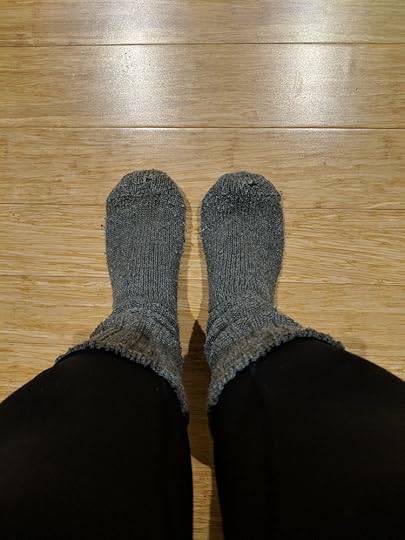
The socks do not spark joy; instead they remind me to not take the joy in my life for granted. I once loved a terrible human being. It’s a mistake I won’t repeat.
After two and a half decades in the chilly Pacific Northwest, and with slightly more weight on my frame, I am no longer consistently cold, though my feet still have the warmth of a cadaver. My husband recoils from their iciness in our bed, and then, sighing heavily, places them between his slender calves to warm them.
“Your toes are popsicles,” he whispers drowsily to me. I laugh.
“Love me, anyway,” I demand. And he does.

January 10, 2019
An Open Letter to Whoever Left Poo On My Toilet Seat.
Dear Friends,
As you know, Rand and I are social creatures. We thrive on seeing the people we love, on following the winding paths of your lives, on quietly building a history of private jokes and shared experiences together. We aren’t simply growing old with each other, we are growing old with all of you, and this brings my heart a sort of levity that I can scarcely describe. The closest I can come to is this: imagine a nest of baby squirrels inside your chest. It’s both squirmy and warm.
Usually, we host, because we bought this big, old, drafty house last year, and that is what you do with big, old, drafty houses. Our lives have become a pastiche of dinners and brunches characterized by noise and laughter and crumbs on the floor.
I am entirely okay with all of that.
What I am not okay with, my dear friends, is that one of you left poo on my toilet seat.
The events of which I speak, events which still have no name (because those of you who have read my book know that “apoohcalypse” is already taken), transpired a few weeks ago, but in the narrative of my life, when they occurred is meaningless. They are so burned into my memory that they have always existed, and will always exist. I can’t remember a time before them. It is as though they have always been with me. The first creature emerged from the primordial goo and stepped foot onto the earth and pooed on my toilet seat. That is the history of the universe.
But even eternal stories have a genesis, and this one occurred late one evening, after my guests had gone home, and I was tidying up. The toilet seat in the downstairs bathroom had been left up (a strange sight in our home, but alas, all our guests happened to be male on that evening) and I gently lowered it. And then I gasped like a blonde in a Hitchcock film. There it was.
Just sitting there.

Naturally, I announced my findings at full volume to my husband.
“SOMEONE LEFT POO ON THE TOILET SEAT.”
After 17 long years together, my beloved is accustomed to me screaming about bodily fluids and so his reply was calm and measured.
“There is often poo on toilet seats, my love. It was probably an accident.”
He had not seen the carnage, and so he was untroubled, his voice so tranquil, that for a brief moment I assumed everything was fine, too. (This is the power that men have – to take an absolute egregious situation of which they know nothing, and make it seem completely acceptable.)
This poo was fine. This poo was normal. And so I would clean up this very normal situation.
I put on a pair of rubber gloves and grabbed the bottle of Chlorox that I keep under the sink and I polished that toilet until it sparkled and my nostrils singed, until Lady MacBeth herself would have taken my hands and whispered, “Enough, dearest, enough. It’s clean.”
That much chlorine late at night in a non-ventilated space can do things to a person.

Husband: You’ve been at your computer for hours. Are you working on something important?
Me: … yes.
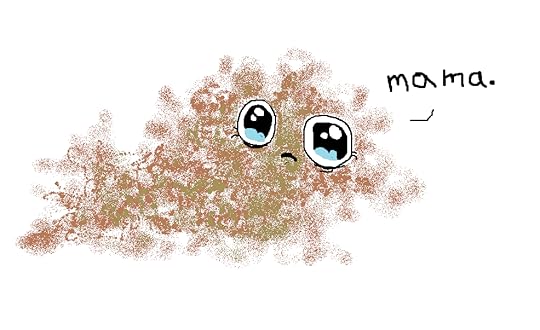
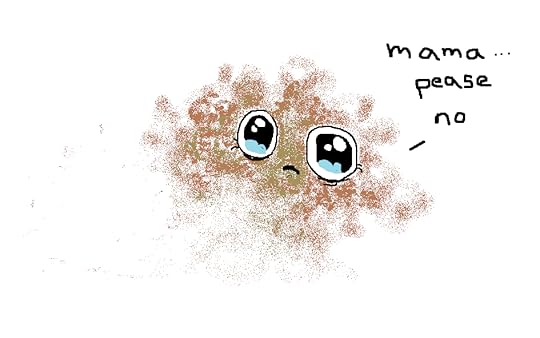
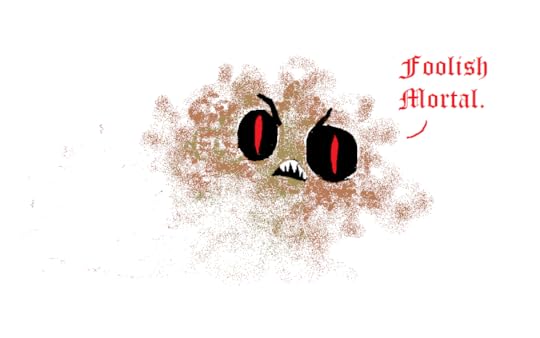
And it was only after I had eradicated all evidence of what had happened that I realized my initial rage and shock were not misplaced.
Rand was right; poo can often be found on toilets, but it usually hides on the underside of the seat, unseen until the seat is lifted. But this poo was not on the underside of my toilet seat (which, I will note, was and is splatter free). No, dear friends. This poo was on top of the toilet seat.
I explained this to Rand, watching as his face moved from confusion to understanding to utter disgust.
“Oh … oh god,” he whispered. “How much crap are we talking about?”
“It was like the smudge that one would find on a Catholic’s head on Ash Wednesday. Subtle but unmistakable.”

My husband is Jewish, and so this reference was mostly lost on him, but he quietly nodded and offered to clean it up.
“The deed is already done,” I explained.
“I am so sorry,” he said.
“So I am. I don’t know who it was, but I can never look at any of them the same way again.”
“Nor should you, my love. Nor should you.”
I have scrutinized this scenario, imagining the many ways in which that could have occurred. I have sat on that toilet seat (after attacking it with Chlorox again. Out damn poo, out) and tried to recreate the events of that night. Not only was I unable to replicate the results, I failed to understand how, once smeared, the poo went unseen. Presumably it was as visible when it was fresh as when I saw it. Feces does not develop slowly before our eyes, like some sort of bacteria-ridden Polaroid.
The question was, how many people had seen and ignored it? Until I lowered the toilet seat, I had no awareness of its existence. It was both there and it wasn’t at precisely the same moment. It was Shrodinger’s crap.
I went over the facts with a friend, who noted that there was very likely a second person who also played a role in Poopseatgate (I came up with a name). We can – if we are generous – allow for the possibility that the person who smeared the poo did so accidentally, and left the bathroom entirely unaware of what they had done. At least, we hope so. We assume that most grown adults, once aware that they’ve left feces somewhere, will take some measures to clean it up. We can fault this individual (Person 1) with being an inattentive wiper (“Or a poorly angled pooper.” – Rand), but not with willfully leaving poo on my toilet seat.
At least, that is what we hope.
That leaves us with Person 2. Presumably, they entered the bathroom after Person 1, and saw the poo on the seat. Rather than do anything about it, or gently call for the person who had occupied the bathroom before them, or bring it to my or Rand’s attention, or flee from the house weeping (all acceptable behaviors that I would have considered in their position), they instead lifted the seat, peed, and went on their merry way.
This person is a unequivocal monster.
Sometime later, I brought the events of that night up with a group of suspects friends and one of them said, in an attempt at camaraderie, “You know, one of the kids smeared crap on the wall of one of our bathrooms the other day.”
NO.
NO NO NO NO NO NO NO. NEVER SAY THIS TO A WOMAN WHEN SHE VOICES A CONCERN TO YOU. NEVER SAY THIS TO ANYONE. NEXT YOU WILL START TELLING ME HOW HARD IT IS TO BE A STRAIGHT WHITE GUY AND I WILL NOT BE HELD RESPONSIBLE FOR MY ACTIONS IF THAT HAPPENS.
The poo smearing that occurred in your home was poopetrated perpetrated by your child. But whoever left poo in my bathroom to harden like unholy spackle was not a child. It was a grown ass-adult. I should not be cleaning up grown-ass adult shit that is not my own. Because make no mistake – it is me, and not Rand, who does that. I get paid way less than him on an hourly basis. That does not mean that my time is less valuable to me. That does not mean that this is how I enjoy spending it.
If I complain to you about adult poo, DO NOT TELL ME ABOUT YOUR CHILDREN’S POO. Because if you draw that parallel, you better fucking believe that I will treat you exactly like a child.
I will point to the bathroom, screaming, demand to know who did this, and take away all computer and phone rights until someone cleans. that. literal. shit. up. And just in case there is any confusion about this for next time, I have left notes.
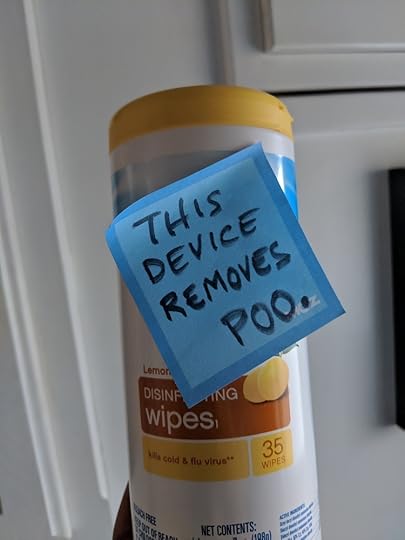
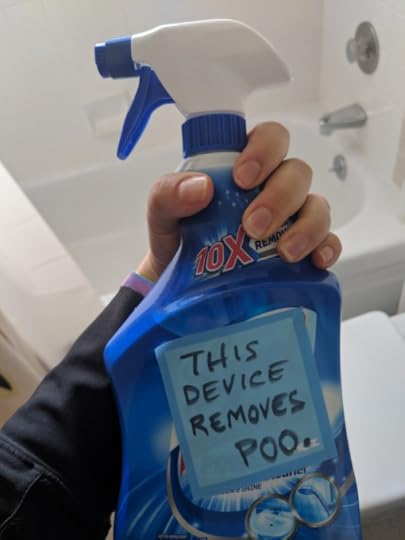

And just in case we need a refresher on this part:
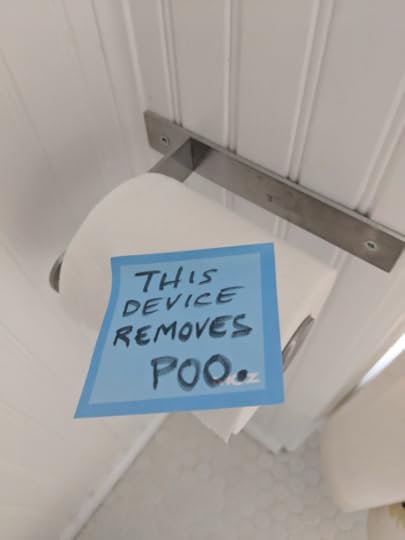
I mean, it doesn’t, not really. You need a bidet for that. But it’s a start.
Here is a small list of appropriate responses which may be used individually or all together:
“Oh, Geraldine, that sounds awful. We will endeavor to be more careful.”
“Thank you so much for cleaning up after us – we really do appreciate it.”
“It was probably me, because I’m a big smelly jerk. I’m very, very sorry.”
Dear friends, I work hard to make that bathroom pristine, not just for me and Rand, but for you. Every time I know you are coming over, I bleach that fucker. I scrub the floors. Like, I literally get down on my hands and knees and scrub the floors. I do this gladly, yes. But make no mistake: it takes and effort.
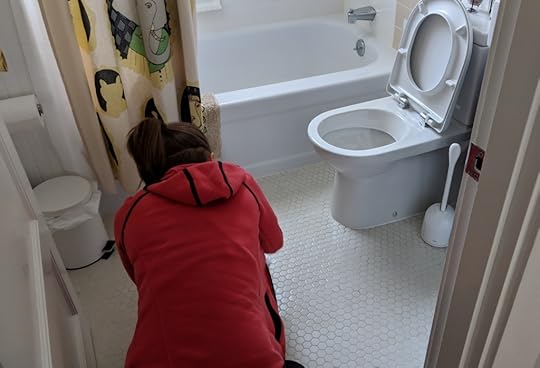
I don’t do this because I expect any accolades. I do it because I want you to be comfortable in my home. If you need to use the bathroom, I want you to, and I want it to be a glorious expanse of porcelain that smells like bleach when you walk in. I understand that it may get a little messy. That’s fine – I will gladly take care of a little mess in exchange for having you in my home. But please understand that when you leave poo on the seat? You also leave it on our friendship.

December 31, 2018
If I Had One Story Left To Tell
A few months ago, I had the pleasure of being on Dan Moyle’s podcast, The Storytellers Network.
I’m always a bit hesitant to go on podcasts. I love chatting with people, but my relationship with the spoken word isn’t quite what it is with the written one. I tend to ramble unless I have a good editor close by. But Dan was a wonderful and engaging interviewer – and his last question stayed with me long after he asked it.
If you had only one story left to tell, what would it be?
Just the notion of being through with storytelling almost made me cry (and in fact, you can hear my voice catching at just the thought). But I had an answer – one I was hesitant to share at first, because it almost felt too personal. (Even though the answer – and the story itself – would be of no surprise to anyone who’s spent more than 30 seconds with me.)
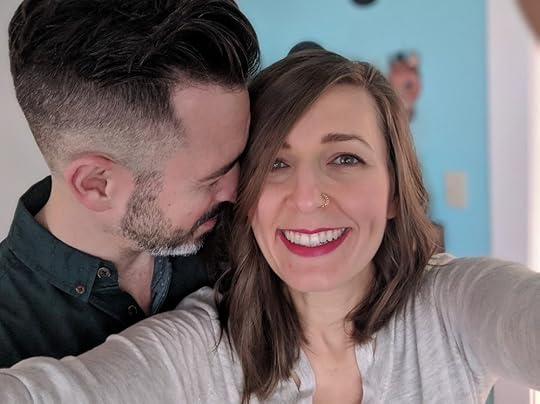
A few weeks earlier, Rand had been on the same podcast, and Dan had asked him the same question. And what I hadn’t realized (because at the time, Rand’s episode hadn’t yet gone live) was that we’d essentially given the exact same answer.
If we each had one last story to tell, Rand and I would tell the same one.
If you want to hear our answers, Dan was kind enough to edit them together here:
http://www.everywhereist.com/wp-content/uploads/2018/12/Geraldine_and_Rand-Last_Stories.mp3
And if you don’t have time to listen, you can probably guess. Because it’s the same story I’ve been telling all along.

December 21, 2018
Every Relationship In Love, Actually, Listed In Order of How Dysfunctional They Are.
It’s December, which means that you’ve probably read all of the daring thinkpieces about how Love, Actually is the greatest holiday movie, ever, despite its many, many flaws, or the other, more daring thinkpieces about how Love, Actually, is the worst holiday movie, ever, because of the aforementioned flaws. And I shouldn’t be adding gasoline to that already overrun fire. I shouldn’t. But dear ones, I’ve spent the last 11 months thinking about this post. It started haunting me on December 26th of last year, the same way you get an idea for a brilliant Halloween costume on November 1st, or how you start eating sugar cubes whole, like a racehorse, immediately after a dental cleaning.
And I need to exorcise this tiny demon inside of me, lest it start inviting its friends over for the most incoherent Christmas Pageant ever, complete with lobsters. But I’m getting ahead of myself. We’ll get there, friends. Patience.
Tradition would dictate that I summarize the plot of the film to you, but I’m not going to do that because it would require me to watch it again. By now you’ve either seen it or you’re my grandmother, who has been dead for the better part of two decades. Besides, I’m not entirely sure that the film has a plot besides … fucking? No, really. Everyone in this movie wants to have sex, and some of them succeed and some of them don’t. This isn’t so much a plot as “the human condition”, but in Love, Actually, all of the disparate story lines are tied together with the clever motif that … they are all friends or coworkers.
Seriously, that’s it.
A few people are related, but mostly everyone is friends with everyone else, and the audience is supposed to be blown away by the fact that people know one another (note: the trope of intertwined storylines has been done well, and if it interests you, check out the 1998 film Playing By Heart, the pilot episode of This is Us, or the Five Short Graybles episode of Adventure Time, all of which accomplish this task far better).
And look, there’s nothing wrong with a movie about people trying to bone, even if said boning has been (and I cringe at this) conflated with love. It is, fundamentally, a film about relationships, which wouldn’t be problematic except for one thing: nearly every single relationship portrayed in this movie is fucked up. Like, profoundly. As in, “you might not want to tell your therapist about this shit because they will probably have to report you to like, the therapy police or whatever” fucked up. And while the audience is let in on how screwed up some of those relationships are, we’re supposed to be cool with other ones.
Sadly, my ability to enjoy this holiday classic is dampened by my understanding of consent and feminism. I’ve decided to share my ruinous Christmas spirit with you by sorting every major relationship in Love, Actually from least to most dysfunctional. Unfortunately, in the end, they all sort of ran together in a huge clump of sex, codependency, and depression. Enjoy, and happy holidays.
Martin Freeman and Joanna Page. I’d seen Love, Actually a half dozen times before I even knew this storyline existed, because it is always left out of TV broadcasts (and Rand and I were way too broke in the early 2000s to go to the movies). Freeman and Page are stand-ins on the set of a racy film, where they meet and start chatting and it is all immensely kind, boundaried, and functional (they just happen to be naked and pantomiming sex acts, hence it being cut for American TV). They’re possibly the sweetest love story in the movie, so it’s understandable that they’ve been left out, leaving more room for the trainwrecks.
Colin and Jeannie, Carol-Anne, Stacey, and Harriet (Kris Marshall and January Jones, Elisha Cuthbert, Ivana Miličević, and Shannon Elizabeth.) The idea of an English guy going to America for the specific purpose of sleeping with a bunch of hot American women who are solely into him because of his accent feels unimaginative and objectifying for everyone involved. But these relationships seem to work. They’re annoying and clearly conceived by a 15-year-old boy, but they work.
(Also: women do not generally dress like this in the middle of winter in Wisconsin.)
At some point, Colin chooses (he gets to pick!) one of women to take back to England, presumably because she is the hottest, and I am increasingly curious as to how that was ascertained. Was it a fight to the death? Was it by blind vote? How. How.
But everyone is a consenting adult and they all seem to be having fun, so I wish them well and hope they use lots and lots of condoms.
Sam and Joanna (Thomas Sangster and Olivia Olson). Thomas Sangster plays Sam, who has a crush on one of his classmates, Joanna, played by Olivia Olson (he’s also going through some personal stuff that we’ll get to later). That part is sweet and normal. Where it gets weird is that Sam somehow decides to woo Joanna by learning the drums in two short weeks (HOW?) and somehow landing a role in the Christmas pageant (which makes no sense because PRESUMABLY PARTS WERE ASSIGNED PRIOR TO HIM LEARNING HOW TO PLAY THE DRUMS). And when that doesn’t work he busts through airport security to tell her he is in love with her. Even though, you know, HE HAS NEVER TALKED TO HER BEFORE.
But whatever. They’re kids. That’s what kids think love is. So it’s sweet.
Plus, it’s not like grown-ups are doing this ridiculous bullshit, right? RIGHT? (Spoiler: they are.)
Billy Mack and Joe (Bill Nighy and Gregor Fisher) Bill Nighy might be the best fucking thing about Love, Actually. He’s plays Billy Mack, a washed up rocker, and spends the entire movie lilting around like the love child of Keith Richards and a bottle of Viagra, with the haircut of the little girl on the Morton salt container. He’s an asshole, but he’s totally self-aware, unlike the other assholes in the movie.
After numerous failed marriages and love affairs, Billy ends up realizing that one of the best, most loving relationships he has is his friendship with his manager, Joe.
“It’s a terrible, terrible mistake, Chubs, but you turn out to be the fucking love of my life. And to be honest, despite all my complaining, we have had a wonderful life.”
But of course, he can’t express that in a functional way. Instead, he fat shames his manager so incessantly THAT HIS NICKNAME FOR HIM IS CHUBS. Billy is a raging asshole and his manager puts up with because codependency is a hell of a drug.
Jamie and Aurelia (Colin Firth and Lúcia Moniz) There was a time, when I was young and impressionable (i.e., stupid), that I swooned at the concept of falling in love with someone without actually speaking a common language. But then I actually fell in love and realized that talking is an important part of that. You should want to have conversations with your partner, and to share your ideas and feelings and be able to communicate with more than just smoldering glances, because it is very hard to convey complex messages in smoldering glances. A SMOLDERING GLANCE CANNOT TELL YOU IF YOU NEED TO UNLOAD THE DISHWASHER OR BUY MILK OR THAT ONE OF YOU HAS AN STD.
Yes, Firth and Moniz are adorable. Sure, he’s forty-something, recently been cheated on and rebounding with his 20-something *checks notes* … housekeeper? (You will soon learn that everyone in this movie is trying to bone their coworker or employee. Everyone.) Anyway, he learns to speak Portuguese and she learns English, which is maybe something that should have happened prior to them falling in love.
Daniel and Sam (Liam Neeson and Thomas Sangster) Neeson plays Daniel, a recent widower. Like, really recent. But apparently he’s like THE ONLY ONE WHO SEEMS TO CARE THAT HIS WIFE HAS JUST DIED. And everyone tells him to sort of suck it up.
“Get a grip, people hate sissies. No-one’s ever going to shag you if you cry all the time.” – Emma Thompson’s character, Karen, to Daniel. No, really.
(Is this an English thing? Or like, does he just have really shitty friends? Because I cannot imagine saying anything besides “THIS IS BULLSHIT AND I AM SO SORRY, HERE ARE SOME COOKIES” whenever my friends go through something traumatic.)
Anyway, Neeson’s stepson, Sam (Sangster, whose entire adorable head is made of cowlicks) is upset, but apparently he’s not really that upset about his mom dying, but rather because he’s in love (which feels like how a kid would react to a loss that big). And Liam Neeson decides that he will do everything possible to make this love blossom, including buying the kid a drum kit, even though what he really needs is a grief counselor. Honestly, the entire thing feels like a thin excuse to play Mariah Carey’s “All I Want For Christmas Is You” during the holiday play, which features lobsters and an octopus, and feels like you’re watching Zoobilee Zoo after drinking too much DayQuil.
Also, at some point Daniel tells Sam that if he meets Claudia Schiffer, they’re going to want to have sex in every room in the house, including Sam’s, so he’ll have to kick him out.
And he refers to him as a “wee motherless mongrel,” which feels like sort of humor that might be lost on a kid whose mom has just died. I’m cutting them both some slack, though, on account of they’re both going through a hard time. Stay strong, lads.
Sarah (Laura Linney) and everyone. Alright, so Sarah (Linney) is taking graphic dating advice from Harry (Alan Rickman), who seems to be her boss (see below), which is problematic in and of itself, but she also has one of the saddest, most textbook cases of a codependent relationship with her schizophrenic brother who lives in an institution. She’s his primary caretaker (and she calls him “babe” which is … sexually confusing). He calls her constantly, and she picks up the phone constantly.
It’s so extreme that it interferes with her romantic life in a scene that is absolutely agonizing to watch.
It’s heartbreaking and also infuriating. HANG UP THE FUCKING PHONE, SARAH. AND STOP TAKING DATING ADVICE FROM YOUR BOSS. AND FALL FOR SOMEONE WHO IS EMOTIONALLY MATURE ENOUGH TO REALIZE THAT YOU HAVE FAMILIAL OBLIGATIONS.
Juliet and Peter and Mark (Keira Knightly and Chiwetel Ejiofor and Andrew Lincoln). Keira Knightly was 18 (18!) when this film came out and she’s cast as a newlywed because … ugh, I don’t know. Every woman in this movie is much younger than her male counterparts. Anyway, Mark (Lincoln) and Peter (Ejiofor) are best friends, and Peter is married to Juliet (Knightly), who Mark apparently hates. But wait, that’s not correct! He actually LOVES her. And the reason he treats his best friend’s wife terribly is because he is so madly in love with her. Because obviously that’s what you do when you care about someone.
But what’s really messed up is this scene, which would be sweet were it not happening between a woman and her husband’s best friend:
Mark shows up and confesses love to Juliet while Peter unwittingly sits upstairs watching TV. It’s so unnecessary, and completely unfair to everyone involved. And it’s also really shitty of Juliet to not shut that thing down immediately.
Harry (Alan Rickman) and everyone. Let me be clear: the late, great Alan Rickman can do no wrong in my eyes. He was brilliant in Die Hard (which isn’t a Christmas movie. Nope. Don’t even start, pumpkins), and he is possibly one of the best parts of Galaxy Quest, a film that is made up almost exclusively of great parts. But dear god, he is a walking sexual nightmare in this movie. Harry (Rickman) works with Sarah (Linney), and at one point confronts her about being in love with another coworker.
Sarah is mortified but owns up to it, at which point Harry tells her to have lots of sex and babies with said coworker. Which is charming when it’s coming from Alan Rickman, the snarky girlfriend we all want and need, but it’s illegal when it’s coming from Alan Rickman, your goddamn boss. Harry is married to Karen (Emma Thompson), the mother of his two children. And THE FUCKER CHEATS ON HER WITH HIS SECRETARY. Karen actually finds the gift he’s going to give the other woman and thinks it’s for her, and the scene where she figures it’s not is fucking devastating.
Oh, and also, the necklace looks like a butt.
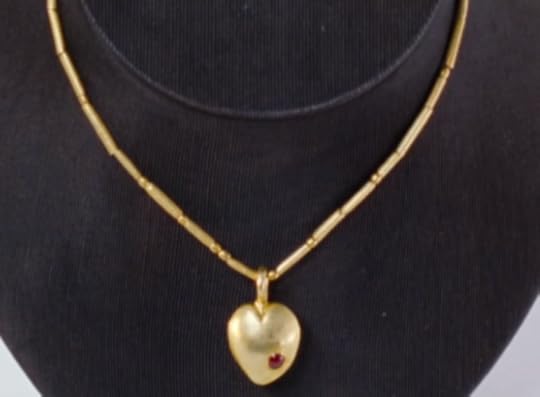
Emma Thompson is a thespian goddess who has a pair of Oscars and they made her cry over a necklace that looks like a butt and that is unforgivable.
David and Natalie (Hugh Grant and Martine McCutcheon). True story: the first time I saw Love, Actually, and Martine McKutcheon’s Natalie appeared on screen, I looked at Rand and said, “Holy crap, that woman is sorta shaped like me.” And I was so excited because having curves in the early 2000s was basically an unforgivable sin. Then, immediately afterwards, THE OTHER CHARACTERS SPENT THE ENTIRE MOVIE TALKING ABOUT HOW FAT SHE IS. Her dad even nicknames her “Plumpy.”
Let’s be clear: there is nothing wrong with being fat. But when we start joking that averaged sized women are fat, that is warping reality in a way that is unhealthy for everyone.
Anyway, Hugh Grant is David, the Prime Minister (insert heavy sigh). Even though he was 43 when the movie was filmed, everyone talks about how old he is. He immediately gets a crush on Natalie, who is a housekeeper at Downing Street, and it appears to be reciprocated but it’s hard to tell because he’s 15 years older than her and also he’s her boss and ALSO THE PRIME MINISTER. Like, what the fuck does consent even mean with that sort of power deferential?
Anyway, at some point, Billy Bob Thornton shows up as the President of The United States and David walks in on Natalie looking scared out of her mind while The President of the United States is like, leaning in creepily and appears to be licking her eye.
But here’s the fucking kicker: DAVID BLAMES NATALIE. I mean, he blames the President, too, and has this weird monologue in front of the press about standing up to the U.S., which probably ignites some sort of trade war and also manages to slut shame Natalie in the process. Then Prime Minister David relocates her to a less prestigious job.
To recap: she gets assaulted by the President, and the Prime Minister demotes her because he has a crush on her. That is a thing that happens in this movie about romance and Christmas.
David eventually has a change of heart, realizes he likes her, and tracks her down like a creepy ass stalker. When he finally finds her she keeps telling him that “nothing happened” with her and the President.
GIRL, YOU DO NOT OWE HIM AN EXPLANATION.
Anyway, this blatant abuse of power is so fucked up that it wins the award for most fucked up dynamic in a movie full of them. Yay!
I have tried time and again to glean some sort of moral out of this movie and the best I can come up with is that Love, Actually‘s goal is to illustrate how fucked up relationships can be. I supposed it succeeds in doing that, but that’s not what most people want from a romantic holiday movie. Every time I watch it, I find myself hoping that things will turn out okay in the end, even though I know they won’t. It feels like a perfect metaphor for a terrible relationship: you keep hurling yourself at it even though you know it’s all going to turn out to be a bunch of bullshit.
Love shouldn’t work like that. It can be difficult sometimes, but it’s also fun and rewarding and respectful. You grow and learn. You talk to one another. You celebrate your 18th Christmas together.
And then you go and watch Scrooged.
—–
P.S. – I didn’t include this relationship in the list above because I just learned it existed and it was cut from the final film – an unfortunate choice, in my opinion. It’s the story of the school’s headmistress and her longtime partner, and it’s just beautiful. And yeah, I gasped at the final scene because … well, just watch it and see.

December 11, 2018
Seeing Genoa for The First Time Again.
It is with some embarrassment that I tell you that I hated Genoa the first time I visited there, a decade and a lifetime ago. In my book, the only mention I make of the seaside city – the birthplace of Christopher Columbus, the location where Marco Polo was imprisoned for a year (because Italy was once a collection of kingdoms constantly at war with one another) – was that it was covered in dog shit. A statement which, this time around, proved untrue.
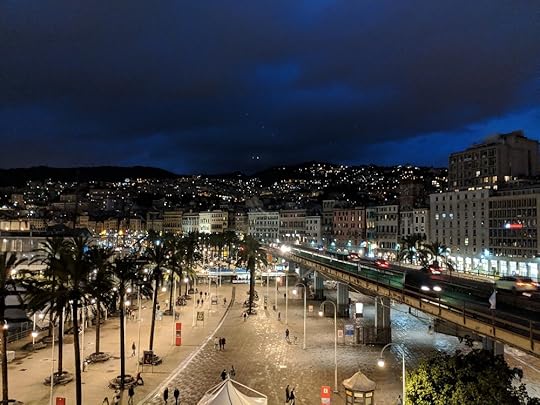
It is a firm reminder that first impressions can be woefully misleading, but when it comes to travel, many of us don’t have the luxury of ever correcting them. Not many people get to visit Genoa once, much less twice. (My life is charmed, I know.) Considering that, you’d think that I’d make a little bit more of an effort to be mindful. But this second, blissful time around was different and I’m willing to admit: I owe you an apology, Genoa. Even in the pouring rain, even when your streets are transformed into cobblestone-studded rivers by the non-stop downpour, you are are worth visiting.
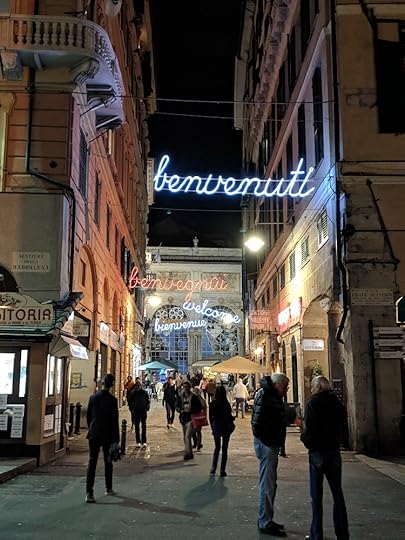
My beloved is in this photo and I didn’t realize it at first. It is now my favorite thing about it.
It is a funny little town, even by the Genoveses’ own admission. Our friend Giordana is from there, and she noted that sometimes people in Genoa could be a little brusk, but with the exception of one diabolical hotel clerk, I found everyone to be perfectly amenable. Not as flirtatious as the Romans, who whisper “Bella, dove vai” as you walk past, or as scheming as the Neopolitans who always seem to be trying to charm you into a Faustian bargain. (Am I generalizing? Is the sin less grievous when you are speaking of your own people? Of literally the places where your mother was born and where your grandparents walked together when they were young? Maybe. I don’t know.)
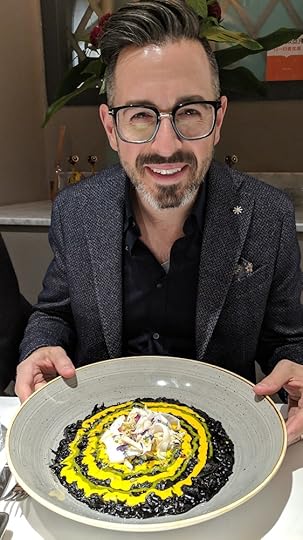
Look at this absurdly beautiful man and this absurdly beautiful dish.
The difference when I travel to the north – as opposed to central or southern Italy – is that I feel no true attachment to it. I feel only that strange geographic tension that exists between northern and southern Italy. I am comfortable there, I speak the language, I am a tourist who has her shit together and the sort of person you really want traveling with you. But I am a tourist nonetheless, and these places are not mine. And for a long time, I think that was the problem.
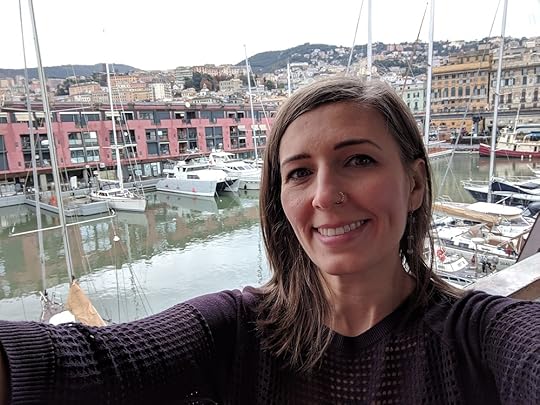
My skin looks like it’s made of sandpaper in this picture because I was tired and dehydrated and eating nothing but focaccia. Also, I’m almost 40 so maybe my skin just looks like it’s made of sandpaper now.
And so, rather than try to make northern Italy my own, I rejected it.
But darlings, darlings – I reject so many things already (mayonnaise, the vuvuzela, eating sushi in a landlocked state) that it seemed like my only option was to give Genoa another chance. Maybe I could see it for the first time again.
I can’t say definitely when the shift happened. Maybe it was when we walked through the narrow streets in the rain, or goofed off on the rooftops, or nibbled on fried anchovies by the water, or ate that focaccia, or that other focaccia, oh my god the focaccia.
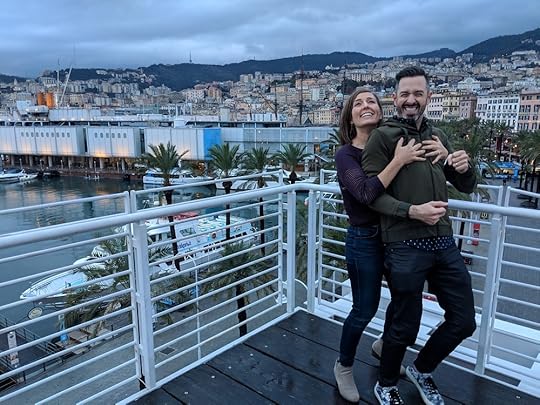
No idea what was going on here but just go with it, people.
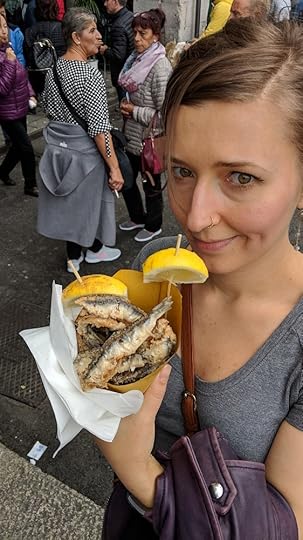
Just a girl, standing in front of you with a whole bunch of fried anchovies, asking you not to judge her when she eats all of them and then burps anchovy breath all over you.
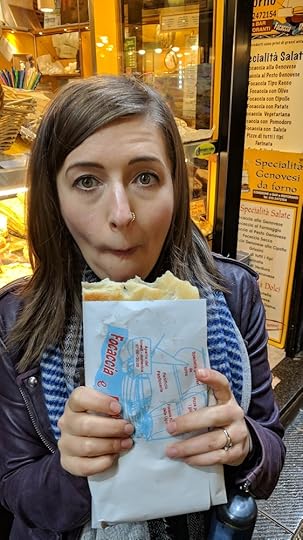
Look, some photos are flattering, and some photos capture the gestalt of who you are, and those are often not the same photo.
I know that Giordana wanted us to see her city how she saw it, to love it the way she did. She gave us recommendations and took us around and I could see her smile when she saw that we loved it. I know that feeling. When a stranger becomes smitten with your hometown. When they make it their own.
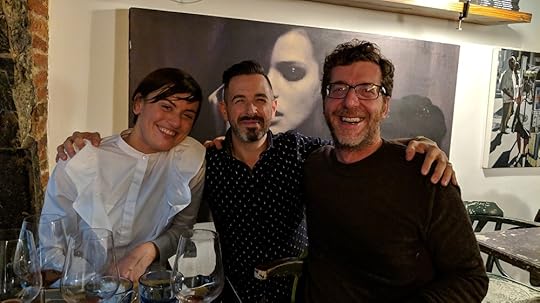
Giordana and my beloved and her beloved.
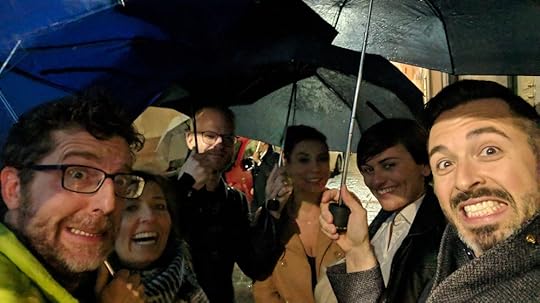
All of us in the rain.
I didn’t think that could happen with Genoa. But I guess I just needed to see it one more time.
And lucky me, I was able to do just that.