Geraldine DeRuiter's Blog, page 10
May 3, 2018
From the Mediterranean to Cheddar Bay.
My husband and I are driving through southern Oregon, like we have every summer since we were married. I see a Red Lobster.
I scream.
I tell him to pull over immediately. He ignores me. After more than a decade together he can distinguish between my “something is urgently wrong” scream and my “I need a cheesy garlic biscuit” scream (he is able to read nuance).
He keeps driving. I accuse him of not loving me. He disagrees. I tell him that I need endless shrimp. He counters that no one needs endless shrimp. I tell him that orcas do. I feel that this is a winning argument.
“You are not an orca,” he says.
I tell him that one day I will demand he take me there for my birthday, and he will be unable to deny me. He says nothing. The restaurant’s sign grow smaller in the side mirror.
My husband refuses to eat at restaurants with more than two locations. He does not understand the love that is ingrained in me. It predates him. We have to travel back to find its origins, to a time when everyone has terrible hair and most clothing is layered over a turtleneck. Welcome, dear friends, to the 1980s.
I am 4. Or 5. Or 6. My age correlates perfectly with the number of years my mother has been in America. She and her parents are Italian. In my earliest memories, she and my grandmother spend hours in the kitchen. They roll out pasta by hand. My mother stuffs cannelloni and makes bechamel. My grandmother makes giant pizzas covered in anchovies and the oil pools on top of the cheese. It is Seattle a decade before the internet. There is no such thing as fresh mozzarella in this new world. I am round-cheeked and sustained almost exclusively by carbohydrates.
By the time I am in the third grade, we have moved to Florida, a state which is almost completely surrounded by water. Maybe my mother thought a peninsula would be more like Italy. It is not. Florida feels like a primordial creature that has just endeavored to step out of the sea, and may go slinking into it again if you do not pay attention. The humidity makes everything wet. We do not have air conditioning. I am strange for having divorced parents. I am strange for speaking another language with my family. I am strange.
It is too hot to spend a lot of time in the kitchen. My nonna is growing older. My single mother is tired. They do not make fresh pasta anymore. The tradition is gone before I have time to realize what I’ve lost.
My family does not go to restaurants. My mother and aunt argue that there is no reason to when the food you make at home is better. (I am young. I do not think the food they make at home is better.) I become a child intent on being the subject of her own demise: I refuse to eat.
Every year or two, my uncle visits from Italy with his family. I do not realize that we are lonely until after they arrive and it dissipates. My grandparents smile. My mother laughs. My family does not feel small and isolated. Look, there are more of us now. We lovingly scream at one another in the same language. We are not an island. We are attached to something bigger. We are a peninsula. We are better than Florida.
(We still do not have air conditioning.)
My cousin and I collect tiny mollusks from the beach, pearly blue in color and barely the size of my fingernail. My aunt carries them home in my useless bikini top (the first time in its existence that it has actually carried anything of substance), and later will serve us a pasta studded with tiny clams. She will insist they are the same bivalves we collected. I am skeptical, but eat it anyway. (Twenty years later, she will admit to the deception: the clams were canned, and ours were discarded.)
After weeks of effort, my cousin and brother and I succeed in systematically breaking down our parents’ defenses. There are three of us and our whining is a magnificent chorus that spans two languages. Enough with your pasta. Enough with your recipes. Enough with my nonna’s hands, covered in salt to remedy the burns she sustained while cooking because her eyesight is failing. Take us out to eat.
Our choices are limited. We are in central Florida near the end of the twentieth century. Our upscale dining options are Red Lobster and Olive Garden.
We end up at Red Lobster because we are not going to Olive Garden. Contrary to what their extensive marketing campaign claimed, no Italian wants to go to Olive Garden. Our only option soon becomes an annual tradition. Some summers, we go twice.
The minute we step through the door, I feel an opulence I thought was inaccessible to me. This is the height of middle-class American casual fine dining. There is air conditioning. There are tablecloths. There is the sound of clinking silverware in the distance and a tank of lobsters by the door.
I marvel at these creatures, marked for death. I press my hand against the cool glass of their prison. I should be sad, but I keep thinking that their end will be noble. Besides, I am absolved of guilt for the demise of these particular crustaceous souls: no one at our table will order lobster. Even our extravagance has its limits.
Every meal comes with a salad, and we all opt to make ours Caesar. It is covered in cheese and croutons and I think how fancy Caesar must have been and how he is Italian, like us. I honor my heritage with bites of once-crisp lettuce now limp with dressing. When I later learn that Caesar salad was invented in Tijuana, I will refuse to believe it.
I almost always order the same thing: shrimp scampi and a baked potato with “the works.” I order my potato this way because it sounds elegant, and it costs the same as a potato with merely butter. I am getting the most for my dollar. I am savvy about money. When I am grown, I will be rich and eat here every week.
The visiting Italians marvel at the potato. They have never seen anything like it. I want them to fall in love with America. I want them to move here so I feel less alone and so that my grandparents are happy all the time, but they never will.
The shrimp swim in a tiny ramekin of butter and garlic. Scampi is an Italian word, I think proudly. The servers do not treat us like pariahs. We are regal. We are European. The Romans conquered the world, and now we have conquered Cheddar Bay.
The biscuits come in baskets, inexplicably mixed with spherical hush puppies that are doused in powdered sugar. The savory mixes with the sweet but we continue to eat basket after basket. My mother tucks a few in her napkin and smuggles them out of the restaurant in her purse. Two biscuits to later be shared among three children. It will be a bloodbath.
We do not order dessert. We do not order soda. I do not mind. I do not feel deprived. Those are for people who like to waste their money. We are too clever for that. Besides, there is an abundance before me. Behold the bounty of the sea, dredged up from the depths of the oceans, battered, and deep-fried. We have both tartar and cocktail sauce. We can have everything. For ninety minutes, we even have air conditioning.
I am so full that I have to unbutton my pants.
Time passes. We move back to Seattle. It is cold. My grandmother stops cooking. My grandfather stops eating. They leave us all in one fell swoop, my grandmother in the spring, my grandfather in the summer.
Six months later, I meet my husband. He is refined. He has straight white teeth and clean fingernails and impeccable taste. He takes me out to an Italian restaurant for our first date. The napkins are made of cloth and there are candles on the table. When he rests his forearms on the table instead of his elbows, I realize I am out of my depth. The owner stops by our table and I chat with him in my mother’s native language. This is calculated. I want to impress my date. It works.
Many years later, walking through Milan on a chilly night, I will ask him if he thinks it is neat that I speak Italian.
“Neat?” he says. “No. No, I do not think it is neat. I think it is a goddamn superpower.”
He takes me out to beautiful restaurants that neither of us can afford. When we are out of money we stay at home and cook. He obsesses over my family recipes and learns to make them better than I do. He learns to make them better than my grandmother did.
He cooks countless dinners for me, and on nights when I am finicky, he cooks two.
I accuse him of not loving me because he will spend hours in the kitchen preparing me a meal but will not take me to eat unlimited Cheddar Bay biscuits. This is the same argument I made to my mother more than twenty years ago.
We are driving through southern Oregon again. It is three days after my 33rd birthday. I do not know where my husband is taking me. I cannot see the now obvious conclusion of the story. I am in a state of disbelief when he pulls into the parking lot and opens the door. At dinner, he puts on a bib and beams at me over a brilliant red-orange lobster, and all I can see is his smile.
—————
Note: I’ve written about this before on the blog, but I reworked it into this piece and never found a home for it.


April 19, 2018
Cut Scenes from a Cafe In Quebec
I have an excellent memory. In the aftermath of my brain surgery, my biggest fear was that my ability to recount past events was damaged in some way. Under the haze of anesthesia, I walked around the park near our old home with Rand, struggling to piece together the last few days.
I’d struggled through the fog and was able to tell him what my days had consisted of – TV watching and eating food, mostly, with visits from friends interspersed here and there, and this, for him, was enough.
“See?” he said. “You’re fine.”
But fine was not enough for me. My memory does not operate in haze or in vagueness. It is precise, with hard, defined edges – a sort of miraculous sprawling thing that I inherited from my father, as my brother did, and, it seems, my nephew as well. We do not sort of remember things. We either remember, or we do not. And for the most part, we remember.
In my younger years, when there were fewer experiences to rifle through, I could simply close my eyes and wander through the past in a scene that I’d recreated in my mind, describing the carpeting and the walls, and the clothes people had on. A few moments in my life have managed to retain that same clarity, but now there have been so many trips and so many moments and so many experiences that they run the risk of blending together. Ask me what I’ve done for the last decade and I will tell you that I’ve been in love and I did a little writing. The details, after that, get a little sparse.
I don’t know if this is a result of the passing of too many years, or the fact that I go to bed too late on most nights, or that I spent my junior year of college smoking pot. My powers of recollection are still better than most people’s. They’re just not what they used to be.
This panics me, and when I tell Rand this, he laughs. That’s how it is for normal people, he explains. He rarely remembers anything. That’s why I created this blog in the first place. Because he would so easily forget the trips we’d been on.
It’s fine, I tell myself. The big stuff, the important stuff, will remain. I might lose the little stuff. Alas, it’s just little stuff.
Shuffling through my photos from last week’s trip to Quebec City, I find that many of them are not simply photos, but tiny videos. Rand explained this to me in a cafe as we waited for a friend to join us for lunch. I had a new phone, and a feature called “motion” was turned on.
“It just means that you take a tiny video when you snap a photo.” Rand suggested I turn it off. It drains your batter super quick, he said. And I did, but not before I had unwittingly recorded a dozen tiny moments between he and I. They are insignificant.
http://www.everywhereist.com/wp-content/uploads/2018/04/GandRandQuebec.mp4
There is no sound, but I read his lips and know exactly what he said when he thought I was simply taking a photo, and I smile.
And I see the way his eyebrows raise when I kiss him and I just die a little.
http://www.everywhereist.com/wp-content/uploads/2018/04/GandRandQuebec2.mp4
They’d have been lost, but I caught them, and now they’re here, and I watch them again and again.
“We’re getting old,” Rand told me as we sat at the table, and I laughed and agreed. I told him we have maybe five minutes left to be young.
“Let’s take a picture,” I said, so we could remember them.
[image error]
It worked better than I could have anticipated.

April 17, 2018
Knight Scoop, I Love You.
It is a strange statement of fact to say that I was on Japanese television long before I ever watched it. The circumstances of our engagement (which, for the uninitiated, was a very public proclamation involving the purchase of a local television commercial and, on my part at least, a great deal of screaming) meant that we were featured on no less than three television programs in Japan, and after repeated viewings I can safely say that I have no idea why they decided to feature us or what those programs were about.
I cannot attempt to write broadly about another country’s television programming any more than I could write about American television as a whole. In many countries, television is a massive behemoth, spanning genres and decades, and while no one would argue that there is one program that can encapsulate an entire country’s zeitgeist, it remains true that there is something uniquely delightful about arriving in a new place and trying to get a feel for it simply by turning on the television. This is not to say that you will succeed. But often times, you will be entertained.
And while scripted television programs are often all the same (indeed, a lot of times you will simply be watching the exact shows you see at home dubbed into another language), unscripted television – the world of reality TV programming and game shows – often plugs into a cultural in a way that other shows do not.
“Your game shows have a lot of screaming,” a friend of mine from Northern England tells me, and I nod, because, well, she’s right. “They’re very noisy.”
“And yours are … god, they’re just so calm,” I say. The prizes seem, by American standards, to be downright paltry. (I don’t mean to disparage – there is a sort of delightful purity to a baking competition wherein the grand prize is a ceramic cake stand. People are far less stabby when there’s not half a million dollars at stake.)
I’ve seen Dancing With the Stars in New Zealand – a country of 4.5 million people, and the locals we were watching it with were elated because one of the dancers was also their dental hygienist. And in Italy, I found a game show that sort of resembled Wheel of Fortune, with the addition of a bunch of women in cocktail dressers who were … backup dancers? For the host? And at some point they just kept doing these dance breaks?
So when Rand asked me if I wanted to watch a Japanese reality show wherein a panel of “experts” solves mysteries and problems that are submitted to them by viewers, I answered yes immediately, before I even understood what Knight Scoop was about. Watching the show, I instantly understood the premise, but now, as I try to explain it, I find myself struggling. The world is a big place, I suppose. It can be strange and lonely, and isolating, so sometimes it’s nice to have a total stranger come into your life and try to figure out why your father hasn’t spoken to your mother in 25 years, despite still being married and living in the same small apartment. Or have them bake a giant loaf of french bread for you – a loaf the size of a person – because you’ve always dreamed of carrying it through town. Or to have a puzzle expert help you figure out the ring puzzle in the waiting room of your doctor’s office that’s been taunting you for 15 years.
This is the premise of Knight Scoop. Viewers write to the show’s “detectives” (a panel of comedians and entertainers) with a problem or mystery – no matter how humble or small or obscure or seemingly impossible. Solving the mysteries is the sole focus of the show – there is no prize to be won beyond that. Sometimes it’s nice when reality TV is closer to the reality we live in. The mysteries that we truly want to solve are small and strange and hardly ever come with a cash prize. But when the pieces fall into place, you want to laugh and spin around and hug someone.
These were modest requests, but the resolutions felt grand. Yes, it was television. But it left me feeling better about the world, and that is a rare thing.
We watched as many clips as we could find on YouTube. The quality fluctuated wildly, and whenever we found a video where the images and subtitles were reasonably clear, we rejoiced. But slowly they began to disappear from the site, and now, as an American, Knight Scoop is near impossible to watch due to copyright and distribution issues.
“I can’t find it anywhere,” Rand told me sadly. I mentioned it to a Japanese friend of mine, and she shook her head, explaining that she had no idea where I’d find it here in America, and with subtitles. Then we spent far too long summarizing for one another different episodes we’d seen.
What had quickly become one of my favorite shows was now virtually gone. I sift through Google search results, trying to find some snippet of an episode, but I keep coming up short. It’s just one more small mystery, in a world that is full of them.
Update: I found some episodes online, and they’re dubbed. I’m basically screaming right now (no telling how long they will remain up).
This one is of a little girl who never loses a thumb wrestling match.
And this one is about eggs exploding in the microwave.

April 6, 2018
OSF Opening Weekend 2018: Sense & Sensibility, Destiny of Desire, and Henry V
A strange thing happens when you become a theater nerd of the highest order – you develop a relationship not just with the characters within a play, or even the play itself, but – if circumstances allow – with the theater company as a whole. Every season takes on its own personality, and you find yourself wistfully remembering all the shows that made it what it was – the actors, the plays, the characters, the sets, the costumes, even the weather, and the way that the sky looked.
This is how I mark my visits to Ashland – by the shows that weave themselves into that chapter of my life. And so now I cannot think of Medea/MacBeth/Cinderella without thinking of my brain surgery, and I cannot read Hamlet without feeling rain on my face, and Shakespeare will forever be Bill DeMeritt. Don’t @ me.
It is too early to say what this season will mean to me. I know the shows will be stellar – they always are (and if you wish for an objective review, go elsewhere, because this is my favorite place in the world) – but how will they tie into the narrative that I am constantly writing with this twinkly eyed fool who hasn’t seemed to realize that he’s far, far too good for me?
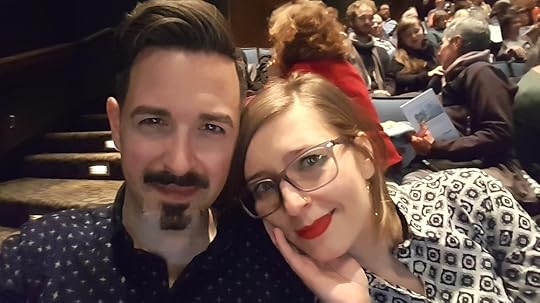
We went down for opening weekend. The air was full of nervous energy and falling snow. Four plays opened the start of season, of which we saw three – Destiny of Desire, Sense and Sensibility, and Henry V (we skipped Othello, since we have tickets for it later in the season, and we long ago learned that four plays in two days doth break my brain.)
I have seen the film version of Sense and Sensibility countless times. I know the story by heart. Because of this, and the fact that we’d just seen another Austen play a few months ago, Rand suggested we skip it.
In response, I politely threatened to burn all his underwear. He was able to read nuance; we went to see Sense.
In between acts I would list an actor’s entire resume for him. This time it was Amy Newman, flitting across the stage as Fanny Dashwood, every line that left her lips a mix of acid and sugar.
“She was in the Odyssey,” I told Rand, “and Merry Wives of Windsor. And Roe.”
The shows do not exist in a vacuum for me anymore. Actors I recognized now carried with them the histories of characters from seasons past. When Nancy Rodriguez and Armando McClain – as Eleanor Dashwood and Edward Ferrars – finally kissed, I cried, because I had not been waiting two hours for it – I had been waiting years.

Left to Right: Nancy Rodriguez, Armando McClain, and Emily Ota. Photo: Jenny Graham.
“I find myself … wondering why the fuck things can’t just go right (FOR JUST ONE DAMN SEASON) for Nancy Rodriguez.” – me in 2016
Also, a small complaint: Marianne’s dismissal of Colonel Brandon is a lot more believable when Colonel Brandon isn’t incredibly debonair and has a voice that sounds like you somehow made a souffle out of velvet and sex.

Marianne (Emily Ota) listens to Colonel Brandon (Kevin Kenerly) and my husband had to stop me from screaming “GET IT GIRL.” Photo: Jenny Graham.
I flipped through the program, squealing like a kid discovering a long sought-after trading card whenever I saw an actor had returned to the company after years away at other theaters.
“Do you remember him?!”
“Umm … no?”
“ARE YOU KIDDING ME? HE WAS THE LEAD IN PIRATES OF PENZANCE.”
“That was seven years ago.”
“YES AND NOW HE IS BACK.”
I saw past the mustache and recognized Eddie Lopez immediately when he walked out onto the stage in this year’s telenovela-inspired Destiny of Desire. The play was delightfully self-aware; the audience and the actors seemed to share a knowing wink about how over the top it all was. And just when I was ready to dismiss it as a ridiculous, farcical comedy, an actor would emerge from offstage and deliver a line about the sociopolitical realities of life as a Latino in the United States.
It is absurd for a nun to reveal a sequined evening gown beneath her habit. It is absurd that every day, a person dies of thirst trying to cross the border between Mexico and the United States. We just don’t usually see that absurdity side-by-side.

Ernesto (Eddie Lopez) cradles the body of his daughter, Victoria Maria (Ella Saldana North) in what I swear is a comedy. Photo: Jenny Graham.
Good theater is not about the binaries of black and white, but about all the things that exist in between. It’s comedies that make you think and tragedies that make you laugh and villains that make you weep for them and heroes that infuriate you.
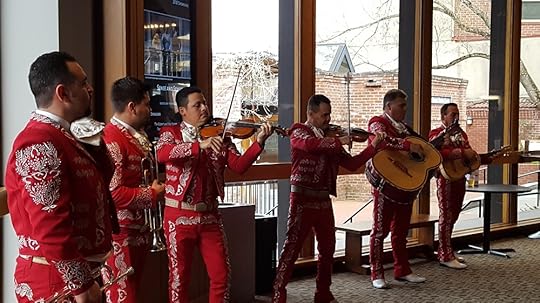
And at the end of the show, a mariachi band played.
Age cannot wither my love for this place, nor custom stale it.
Still – I won’t lie – I walked into Henry V with a dose of trepidation – we’d not seen Henry IV Part 1 or 2, and histories are not generally my or Rand’s favorite. But the OSF was able to breathe life even into the Bard’s old words, and thanks to a talented cast and a Henry who was young in face but already weary of the world, it felt new again. Even as the battle dragged on, the play did not.
And even in a story about war, I found myself delighting in a brief but achingly romantic scene between Henry and Katherine.

This could have gone on for an hour and it still would have felt too short. (Jessica Ko as Katherine and Daniel José Molina as Henry. Photo: Jenny Graham.)
I don’t quite know how this season will feel when it’s through. Perhaps I will remember this year as the one where things fell into place. Where the two leads I’d been hoping would get together finally did. I think of the moment when the couples in all of these radically different shows finally kissed, and everything was, for a little while, absolutely wonderful.
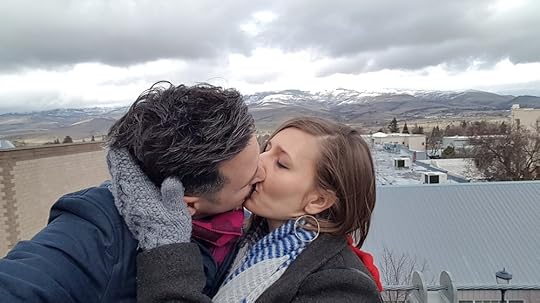
Maybe when I look back on this year – one that marks the tenth anniversary of being married to the love of my life – I’ll find that those romantic moments, some unexpected, some long-awaited, are what have stayed with me. We’ll just have to wait and see.

March 22, 2018
If Twitter Responded To Abuse Reports Honestly
I spend too much time on Twitter. And, frankly, it’s awful. Every day is like wading through a sea of poop to try and find a cupcake, and even when you find that, it’s like, “Well, I can’t possibly eat this cupcake. It’s covered in poop.”
As a writer, Twitter becomes a sort of necessary evil. It becomes the conduit by which I and others share our work, by which I poll people outside of my immediate social circle for ideas, how I try to foment interest in a new project, and where I learn how to properly use words like “foment.”
It also is a total waste of time, and for someone with a history of fucking brain tumors, I should really know better. I spend hours on Twitter – and online in general – every day. At the same time that I argue that I don’t have time to work out or do laundry or put on actual pants, I spend hours fighting with people on a website and half of them aren’t even real people.
THIS HAS NOTHING TO DO WITH MY WORK. I’M JUST SCREAMING AT ASSHOLES OR BOTS THAT ARE TRAINED TO BE ASSHOLES.
I spend my days ignoring most of my mentions because they are filled with abusive comments or insults. But occasionally, one will slip through, and I will report it, because there is little recourse. A block gives the troll exactly what they want. A block is more credit than they deserve (Rand disagrees. Block, he tells me. Block with abandon).
And Twitter, time and again, gives me this message.
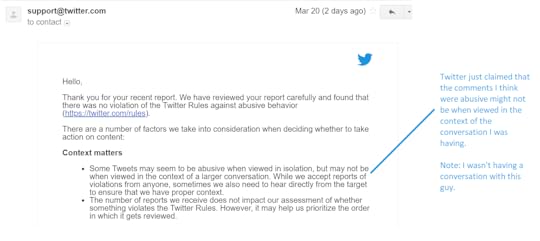
They give everyone this message. In response to threats and harassment. In response to targeted abuse and vitriol. They don’t do this in other countries. In Germany and France, where hate speech is outlawed, Twitter has taken action against stuff like this. But in America, it’s a free-for-all
In honor of my wasted morning, and what inevitably feels like will be my wasted life, I’ve rewritten some of Twitter’s responses to my abuse reports to better reflect reality. (A big shout-out to @evanskaufman, who gave me the idea for this post when he sent me this deliciously sarcastic tweet.)
Twitter, feel free to use these. They’re a little more honest than your current replies.
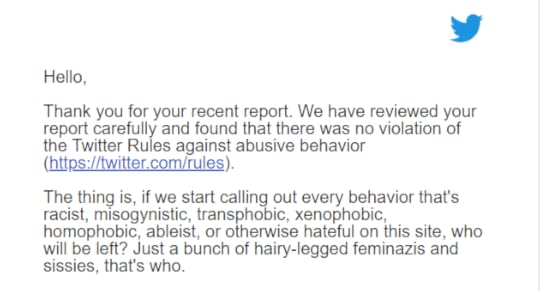
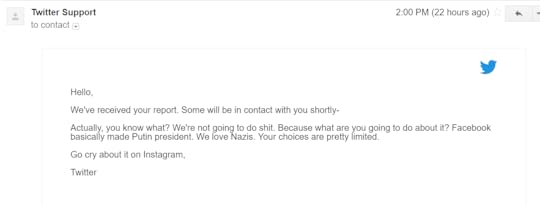
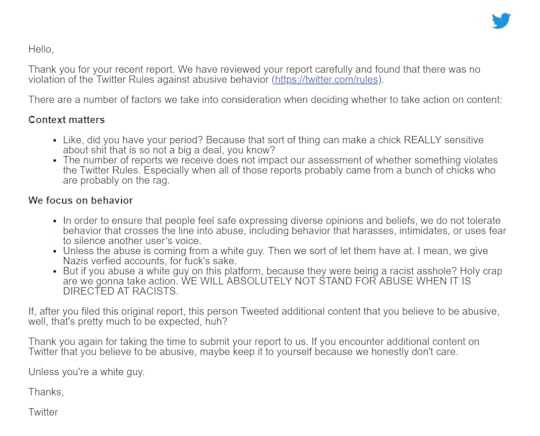
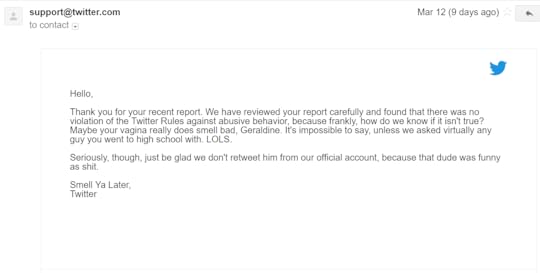
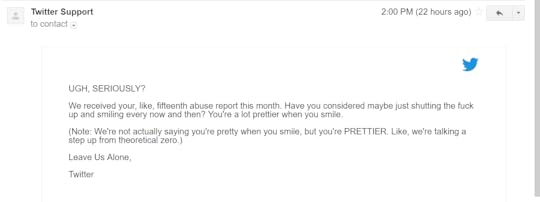
I’m currently procrastinating from working on a new book proposal which – wait for it – will require me to spend more time on Twitter. To quote from Luke O’Neil’s brilliant article about our addiction to the internet and all its ills, “Our brains are broken because we’re the ones who broke them.”
I’d like to think that if maybe Twitter were a little more honest with their brand message, it would be easier to avoid (but I might just be lying to myself). Like, imagine if they actually sent out tweets like these, which better align with reality:
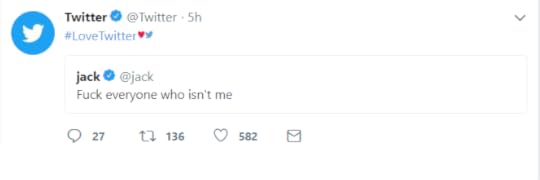
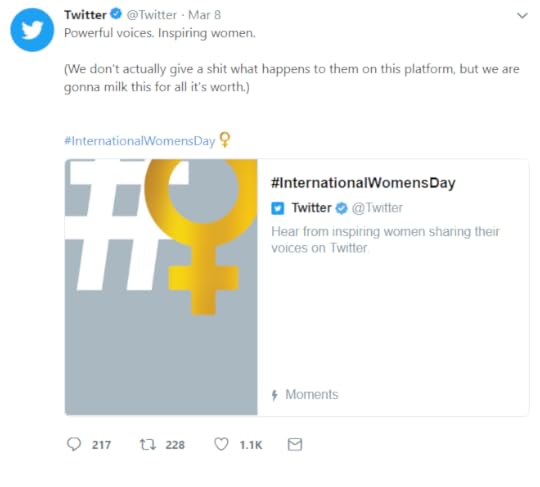
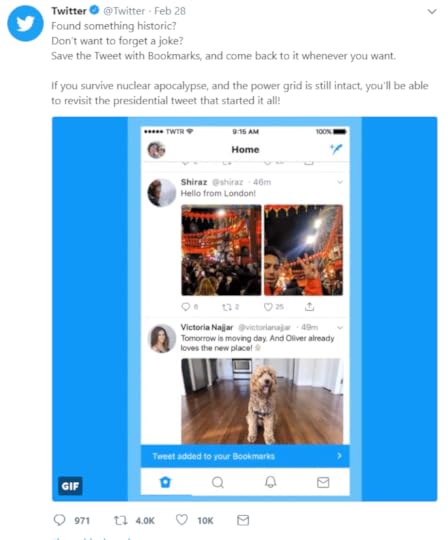
Anyway, if you need me, I’ll … I’ll probably be on Twitter.
Jesus Christ.


March 19, 2018
Pillow Fight.
It is a truth universally acknowledged, that a married man in possession of a house will one day find himself in a shouting match with his spouse about something trivial like throw pillows. All of this will likely happen at IKEA. If that man has refused to go to IKEA, because he has justly concluded that the furniture retailer is actually Dante’s tenth circle of hell, then the fight will take place at home, after his spouse has concluded that hellish shopping visit, which for some reason she decided to undertake by herself on a Saturday.
Why did she do this? She works at home. She literally could have gone any other day of the week. The answer is unclear even to her. Moths are drawn to the flame, only to erupt in a tiny burst of fire when they reach their destination. My version of self-immolation is a Swedish furniture retailer on a sunny weekend.
I will forget that the furniture I see in the charming but sterile showrooms requires hours of construction and a degree in civil engineering. I put the boxes onto my palette confidently. If my FJÄLKINGE bookshelf were impossible to build, then why did I have to fight a pair of weeping pregnant women for the last one? (I did you a favor, ladies. This shit is designed to collapse on your children.)
Everything in the store is slightly off in a way that will not make sense to you until you get it home. There is a fatal flaw in the design, but it’s $19.99 and bright orange, so you are too distracted to notice. Take, for instance, this table, which has a huge handle coming out of the top of it.

The placement of this handle prevents us from being able to easily put things on top of the table, which, for those new to the world of furniture, IS THE SOLE PURPOSE OF A TABLE. But this one has a handle, because the designers at IKEA got a “table” confused with a “basket.” This is an easy mistake to make. They are both things that exist in the world. Like pubic hair and cereal.
I spent a good portion of my day in this world – one where furniture is not furniture and couples are around me are fighting in as many languages as appear on the fabric label of my VÄGMÅLLA throw blanket (I heard French, German, Spanish, and Russian during my visit – IKEA is like the UN of marital discord). I made it out with everything on my list, and my only additional purchases were a few throw pillows. I would consider this a coup over the corrupt powers that run IKEA. This was a victory. I deserved praise. And maybe a head rub. And some cookies.
WHAT I DID NOT DESERVE, RAND FISHKIN, IS YOU GETTING ALL SNARKY ABOUT MY GODDAMN PILLOWS.
I am unable to properly recreate our exchange because I am Italian, and when I get angry, my vision turns blood red and my ears are flooded with the sounds I presume followed my ancestors into war; lots of screaming in Latin and the distinct cracking sound that human bones make when they break.
“Thank you very much for going to IKEA, but …” he spoke delicately, because he knew I was about to behead him. “I … I am not a fan of those pillows.”
“What?”
“Those pillows are bad.”
These are the pillows in question.

[image error]
This color is really nice for picking up dandruff.
I picked dark navy and light yellow because my brain temporarily stopped working. They go with nothing in my house. It is not that my husband was wrong, it is that he doesn’t realize that I WENT TO IKEA ALONE AND MADE IT OUT ALIVE AND YES, THE PILLOWS ARE NOT GREAT, BUT THEY DON’T HAVE FOAM SPIKES POKING OUT THE FRONT, OR WEIRD HANDLES EVERYWHERE, LIKE EVERYTHING ELSE AT THE STORE. And because of that fact alone, these pillows are a goddamn success. These pillows are perfect. He had better fucking love these pillows.
“Those are the janky pillows you would get in college,” he said.
“YOU ARE THE JANKY PILLOW I GOT IN COLLEGE,” I screamed back.
The fight progressed. There may have been tears. I can’t remember from who. At one point, I pressed the pillow lovingly against his face. His reply, muffled, was either “I love you and I am sorry” or possibly “I can’t breathe.”
I have arranged the pillows around the house, where they mock me with their discordant color palette and weird velvety texture. I hate these pillows. But he is not allowed to hate these pillows.
Later, I went to TJ Maxx. I love TJ Maxx, because you can buy jam and housewares and polyester underwear that comes up to your nipples. I have heard that in other parts of the country, TJ Maxx stores carry designer labels, but in the outskirts of Seattle, they carry brands you have literally never heard of outside of a TJ Maxx. Wolfgang Puck has an extensive line of cake pans; this does not feel like a stretch. Daisy Fuentes makes curtains; interestingly, this doesn’t feel like a stretch, either. At TJ Maxx, anything is possible.
The pillow section was extensive. I immediately texted my beloved.

[image error]
At this point, Rand refused to reply, so I escalated the situation with bad puns and threats to put pillows in the toilet.
[image error]
[image error]
[image error]
HE FINALLY REPLIED:
[image error]
Let me just snap that little olive branch in two.
[image error]
I maintain that my IKEA pillows are not that bad. I hate them nonetheless. Rand was right. I will never let him know.

March 14, 2018
We Have To Talk About the Dead Dog on the United Flight. Sorry.
(Note: the adorable little guy pictured above is not the dog from the story. I bumped into him while shopping and thought he was a weird, furry keychain dangling from a guy’s bag at first.)
If you read the news in the last two days, you might have caught the story that is presently haunting me: a mother, traveling with her children on a United flight, paid extra to bring her French Bulldog in the cabin. After boarding, a member of the flight crew insisted she store the dog in the overhead compartment, where people put their suitcases. The dog whimpered and cried for a while, and then it stopped. When the flight landed, they found that the dog had died, likely from suffocation.
A lot of people are asking why the woman didn’t fight against the flight attendant more. This reaction is understandable, but also unfair. We’re angry that the dog died, and we’re used to feeling like flight crews don’t care about humans, much less dogs (and United has the worst track record when it comes to their treatment of animals). So we place the onus on the owner, who must have been crazy to allow that to happen.
I’m a travel writer (mostly). I’ve been on a lot of flights. I was on four last weekend alone. And I know how utterly terrifying and confusing it can be. Flying puts you in a position where you largely feel powerless. Just yesterday I wrote about how a TSA agent made me take off my sweatshirt – claiming it was a jacket – and go through security in a skimpy tanktop that I had no intention of anyone seeing. I wanted to speak up, but I also know that every time I’ve escalated a situation like that one, it hasn’t gone well for me.
I’ve noticed the similarities in comments on both my blog post and the news story about the dog. Yes, what happened was wrong, but why didn’t you stand up for yourself?
I’m not the first woman to hear this criticism, and I won’t be the last. But the assertion that we’re choosing to be victims is bullshit. No one chooses to be a victim. The truth is this: for a lot of us, speaking up makes a situation worse. Being on a plane is already a terrifying thing. If you disagree or upset flight staff, you could be accused of violating federal law. And the wording of the law is incredibly vague:
An individual on an aircraft in the special aircraft jurisdiction of the United States who, by assaulting or intimidating a flight crew member or flight attendant of the aircraft, interferes with the performance of the duties of the member or attendant or lessens the ability of the member or attendant to perform those duties, or attempts or conspires to do such an act, shall be fined under title 18, imprisoned for not more than 20 years, or both. However, if a dangerous weapon is used in assaulting or intimidating the member or attendant, the individual shall be imprisoned for any term of years or for life.
If you interfere with the duties or performance of a flight attendant, you can get up to 20 years in prison. There’s a good chance that you won’t be found guilty, but the wording is unclear and the risk is huge. And even if you aren’t charged with violating the law, a whole host of things could happen to you, including financial penalties, being removed from your flight, being added to the no-fly list, or (if applicable) deportation. And we don’t know what someone’s circumstances are; simply stepping off a flight because you are unhappy is the realm of the rich and the privileged.
Now, imagine: flying on a plane with your two children (one of whom is an infant) and not speaking the same language as the flight attendant. Imagine being told that even though you paid to carry your dog in the cabin, you have to put it in an overhead compartment. Some part of you has to be freaked out – you can’t fight with the flight attendant. There’s also some presumption that a trained professional who works for an airline wouldn’t advise you to do something that would kill your dog.
And remember, most airlines won’t put up with any dissent – even if you later comply. Alaska Airlines recently told me I couldn’t bring my smart bag on their flight (even though it’s not prohibited by the FAA and other airlines allow it). I fought them on the issue (which made the situation worse, I assure you) and eventually I agreed to throw out my bag. Alaska still threatened to not let me board after the bag was thrown away. I had to literally beg them to let me on.
And get this: after I ditched my bag (which they told me they were going to detonate along with unattended baggage), they put the bag on the flight after having checked it under someone else’s name.
[image error]
I don’t know who Lauren (?) Williamson is, but I’m fairly certain she’s another passenger and not an Alaska employee.
I have no doubt that being a flight attendant is harrowing work. And the power dynamic between passengers and crew has been intentionally skewed, because that’s how you maintain order among 300 smushed inside a flying metal canister. But if they are going to wield that kind of power over their customers, they need to do so with empathy and understanding and mindfulness. The issue here is not why this passenger didn’t fight for her dog’s life. The issue is why an airline would endanger that dog’s life in the first place.

March 13, 2018
The Real Reason I Hate Traveling Alone.
When I got home, I cried. Finally.
Rand hugged me, wore that same worried look he gets on his face when something goes wrong and he’s not there for it. For a long time I wondered what it was about me that meant the second I went on a trip on my own, things started to fall apart.
I figured it was something I was doing. But I’ve started to wonder if maybe I have that wrong. Maybe I have trouble when I travel without Rand for one very simple reason: a woman on her own is treated differently. Maybe the reason I hate traveling by myself has nothing to do with the fact that I’m traveling by myself.
I did my best. I shrugged off the drunk guy who loudly proclaimed that I was hot, over and over again at the airport bar. I didn’t look at him when he started talking in detail about my appearance. He liked my shirt. He he had many feelings about my face. A few frantic laughs escaped my mouth. His friend told me to just ignore him, and, never directly looking at either of them, I did.
They eventually walked away. You can’t bring a bottle of water through security, but you can bring a drunk asshole.
Traveling on my way from Albuquerque to Los Angeles on that same trip, a TSA agent yelled at me to take off my jacket.
I stared at him blankly. I was not wearing a jacket. I was wearing a hoodie – small, form-fitting, thinned from nearly a decade of wear. No one in their right mind would call it a jacket. I was wearing a camisole underneath it – not something that I planned on anyone seeing.
I was initially confused.
“I’m not wearing a jacket.”
“Ma’am, you need to remove it.”
“You mean my hoodie?”
“TAKE IT OFF.”
It is a scary thing to go through airport security under normal circumstances. The power deferential is too big. To be screamed at that you need to take off your clothes – not your coat, or your shoes, or your belt, but your actual clothes – by a dude who won’t deign to look you in the eye adds a level of bullshit that I can’t quite articulate. I stood, arms crossed tightly over my chest. Another agent stared at me for a long while, and I contemplated picking my nose to get him to shift his gaze. This thought, as I stood wearing a glorified sports bra, almost made me laugh. It gave me hope of some control in a situation where you have none.

The offending hoodie. Not pictured: the teeny tiny camisole I had on underneath it.
Waiting for my pat-down (I won’t go through the body scanners. For those that feel that this equates to me consenting to take off my hoodie, it doesn’t. I have literally had hundreds of pat-downs. I’ve never had to do so in a camisole), I was tempted to ask the agent what would have happened if I was part of any number of religious groups that don’t allow for bare arms. In the end, I said nothing. I just wanted to catch my flight home; it was completely within this agent’s power to stop me from doing that.
“I’d have contacted the ACLU, and I’d have sued him,” a colleague in the travel world told me when I recounted the story to her. I wrinkled my brow. I don’t have the resources – not in time, finances, or emotion – to sue someone for making me take off my sweater. But unless you have those things, there isn’t much recourse. You stare straight ahead, you take off your hoodie, you cry afterwards.
“You are doing a disservice to people who can’t speak up, who don’t have your privilege or your platform,” she said. And she’s not wrong: those of us with privilege and a microphone have an obligation to speak up for those that don’t. But are we obligated to speak up for ourselves even when we don’t feel safe doing so? Or when speaking up can make the situation worse?
“I know you have comebacks. I know you can put these guys in their place,” Rand told me, as I fired off a scathing reply to a piece of hate mail I received for my cinnamon roll piece. “But I worry …”
He trails off there. I know the things he’s worried about. The hackers who got into my Twitter account. The ones who’ve tried to hack this site. The threats I’ve gotten via the blog or by email. For a travel blog.
A scathing response is likely to provoke more rage than no response at all. I press my forehead against my desk. Sometimes, I have no answer. I want tell the drunk guy in the airport bar that he should spend the next four hours trying to piss in his own mouth and show him a diagram I made that he might find helpful. I want to give the TSA agent in Albuquerque a lesson ON WHAT A JACKET IS. I want to tell the guy who sent me an email about how I cuss too much to go fuck himself until he passes out from dehydration.
I am not going to do any of that.
I am grateful for the paradigm shift that is now allowing women to speak out against this bullshit. But I’m also empathetic of women who don’t say anything out of fear of incurring more wrath. We can’t condemn people for being quiet about their harassment if it’s not safe for them to be anything but quiet about their harassment. The burden that we’ve place on the abused and the harassed to speak up is out of step with where we are as a society. Sometimes we are understandably frightened of what might happen to us and our loved ones. And sometimes we speak up, and absolutely nothing happens. There are no consequences for our abusers; there are only consequences for us. They remain in power. They continue to climb the ranks. And worse still: they now know we’re going to be a problem for them.
Being a woman and traveling on your own should not be a terrifying thing. But sometimes it is. The shit that happened on this trip was minor. It was every day stuff. I see women dealing with bigger issues on an everyday basis; hell, I’ve dealt with bigger issues. But even the things that “aren’t that big a deal” are shrouded with the worry that things could take a turn for the worst. So I never relax. I say this as a very, very privileged woman. I never fucking relax when I’m traveling alone.
“I want you to be okay when you’re on the road by yourself,” Rand says to me when I get home, and I nod. I want that, too. I know he feels guilty, because he was a thousand miles away and couldn’t do anything to help. And I want to tell him that I was right there, and I couldn’t do anything, either.


February 23, 2018
I Watched All the Fast and the Furious Movies in A Week.
Over the last week, I have watched the entire Fast and the Furious series. The impetus for embarking on such an artistically dubious project was a promise that I made years ago to my husband, probably while drunk. I told him that the next time I was struck with the sort of mind-numbing illness that allows one to do little besides produce mucus, I would watch the entire series and write about it. I rarely get sick, my husband has a terrible memory, and at the time, there were only four films in the canon. I assumed I would never have to make good on my promise. I was wrong.
Up until this point in my life, the most significant thing that could be said of my relationship with the Fast and Furious oeuvre is that I had never seen them at all. In the 17 years since the first film came out, I felt no glimmer of temptation to watch any one of them; it wasn’t that cinematic snobbery kept me away, but that we existed in two different worlds. Mine is filled with cellulite and public transportation.
But the cold that plagued me for the last few weeks had sealed my fate. I lay on the couch, unable to move. I’d gone through all of The Good Place, This is Us, and Crazy Ex-Girlfriend. (For those wondering: I am a clearly an Eleanor; do not start watching if you haven’t; Team Nathaniel.) My husband knew this. My white blood cells were up, and my excuses were dwindling.
There are now eight films in the series. They were inescapable.
Everyone who learned of this project made it clear that the first four films were terrible, and that I would have to endure them as payoff for the fifth film. I would suffer through them as man suffers through life on earth for the reward of heaven, which in this case is Dwayne “The Rock” Johnson and a plot that felt positively Shakespearean by comparison. As promised, that fifth film would shine like a beacon for me. I cannot see it objectively. If you are dying of thirst, you do not complain if the water that saves your life is lukewarm. Fast 5 is a masterpiece, or perhaps it just marks the moment when I lost my mind.
The rest of the films blur together in a haze. There are moments that stand out (every time that Michelle Rodriguez genuinely smiles caused my heart rate to increase far more than any on-screen explosion) but seen in close proximity to one another, the plots, the car chases, the villains become almost interchangeable.
Let us try to sort through this cloud of explosions and hand-to-hand combat and tank-tops worn to formal events. Let us go back to where it all began. Every great story has a beginning, and The Fast and Furious also has one.
The first installment in the series came out in summer of 2001. This is America during that narrow epoch at the beginning of the millennium before the attacks on the World Trade Center; a simpler time, when an entire police force was able to devote seemingly infinite resources to figuring out who stole a bunch of TVs with built-in VCRs. My husband comments on how young Jordana Brewster looks in the first film, and I find that we are the same age. As the series progresses, she remains lovely, but her face loses the roundness of youth. I become acutely aware of my own mortality.
The plot is de rigueur for an action film – Brian O’Connor, a rule-bending cop (Paul Walker) goes undercover to infiltrate a gang of thieves by befriending their leader, Dom (played by Vin Diesel who growls through his performance with a sort of brutish charm). The lines between good and bad are obscured. So are the lines between “acting” and “staring blankly at something slightly off-camera.” Someone notes that it is Point Break with cars, but this comparison is unfair. A bad movie, if gloriously entertaining, has merit. Stupid and fun is fine. Stupid and boring is not.
The first entry in the FF canon leaves absolutely no need for a sequel. And yet there will be so many more. I have not the energy to describe them to you individually, and let’s be honest, dear friends: it doesn’t matter. Watch any of these films, hell, watch the trailer and tell someone that you’ve seen them all. In some sense, it will be true.
You may think, “Ah, but what if they ask me trivia questions about the films to prove whether or not I’ve seen it?”
At which point I must ask: Who is this person? Why are you hanging out with them? Do people often assess your value as a human based on your knowledge of action films? At any rate, should that happen, just offer them this – it is the ranking of the Fast and the Furious films in order from most tolerable to “oh god”
Five
Six
Four
Seven
Eight
Two
One
You will need to pepper the third film (which has a 37% rating on Rotten Tomatoes) somewhere near the end, for, dear friends, I must confess: we skipped it. It was only available for purchase and not for rent, and consequently far more expensive. Someone correctly ascertained that anyone actually willing to see Tokyo Drift will do so regardless of price. It’s the film equivalent of a condom in a minibar – the cost, in the end, is irrelevant. I later learn that supposedly the events of Tokyo Drift were to have occurred after the sixth film in the series. Like physics and gravity, time is meaningless in the Fast and Furious franchise.
“What if the real Tokyo Drift was in our hearts all along?” I whisper to my husband.
“That doesn’t even make any sense,” he says.
This will not stop me from repeating this refrain no less than 30 times over the course of the week.
It is cold outside – this February is particularly bitter in Seattle, but on our television is a world of endless summer. The Furious universe is not small – it begins in L.A., moves to Miami, then across the world, to the Dominican Republic, Mexico, Spain, Monaco, Brazil, Cuba, Japan – almost always in sun-drenched climes. (There is a brief jaunt to Russia, but the main purpose of this, from a plot perspective, appears to be “DUDE WHAT IF WE PUT A LAMBORGHINI ON ICE”). There are miles of roadway and expanses of taught bronze skin. These are easy distractions when the films don’t make sense, which is often.
As we work our way through the series, the humble street racers of the first few films will become the world’s most capable freelance counter-terrorism unit in a transition that is both imperceptible and instantaneous. Ludacris (who is, without hyperbole or sarcasm, absolutely delightful in this series) somehow makes the leap from garage owner/amateur bookie to one of the world’s best hackers. Tyrese Gibson goes from embittered con to jester in zero easy steps. Being able to drive a car also means being able to ride on top of one with ease. Everyone is suddenly expertly skilled at hand-to-hand combat and also parkour. They also all have six pack abs. Seeing their very human beginnings, there is something inspirational about where they end up – perhaps we are all destined for greatness. We just don’t have the right script.
When a film presents a protagonist with super human powers, we accept it handedly. Such is the magic of film. The FF series reinvents their characters half-way through from mechanics and racers and criminals to quasi-superheroes – yes, this stretches our suspension of disbelief – but does it do so significantly more than anything else? We’ve already been asked to abandon all notions of reality, of plot structure, of gravity. Why do law enforcement agencies keep hiring Paul Walker’s character, even though he keeps committing like, a whole bunch of crimes? Why does Jordana Brewster’s Mia, who seems like a reasonable, intelligent, tough woman, make such wildly bad life choices? Why would you surrender to police on the grounds that you are “tired of running” and then IMMEDIATELY BREAK OUT OF PRISON? WHY WOULD THE FEDERAL GOVERNMENT THINK THE RIGHT MAN FOR THE JOB IS A GUY WHO IS REALLY GOOD AT DRIVING FAST CARS AND HAS LITERALLY NO OTHER CREDENTIALS?
To fully appreciate the canon, these questions must go unanswered. We must practice acceptance and forgiveness and a prevailing disregard for continuity. A villain who murders a beloved protagonist will suddenly be invited to family dinner. (Ancillary drinking game: take a shot every time Vin Diesel refers to his group of vigilante race car drivers – some of whom he barely knows – as “family”. You will have cirrhosis immediately.) Cops become criminals. Criminals become heroes.
A character who dies in one film will be resurrected in another. And an actor who dies during the filming of one movie will live on forever and ever.
Walker, who was the heart of the franchise, starring in every film but Tokyo Drift, died during the filming of Furious 7. The circumstances of his death (a car accident, the details of which are heartbreaking and awful) cast a shadow over the movie. Furious 7 was completed thanks to CGI, existing footage, and the help of Walker’s brothers, who served as stand-ins for the actor. The result is an installment in a franchise that has never been remotely concerned with reality now blurring the line between fact and fiction so heavily as to almost destroy the fourth wall. The loss of Walker is palpable on all of the actors’ faces, and the last 20 minutes of the film are essentially an homage to him. From a narrative perspective, it makes little sense, but the tribute does not feel out of place.
That is the problem with the Furious series. I very much want to write it off as blindingly stupid, but every now and then it will do something delightful or brilliant or downright heartwarming. Take its treatment of women – a universally problematic issue for the entire genre, the films aren’t entirely terrible with their portrayal of female characters.
In one scene, a female lead who has lost her memory and was believed dead (which isn’t how amnesia works, or how death certificates work, or how plot structure works, but whatever), returns and encounters her former lover. He never makes a single overture or move to the woman he adores – he’s well aware that to her, he’s a veritable stranger. He does look at her longingly, but stops when she tells him to.
Later, when her memory returns, she asks him why he didn’t tell her about their relationship (which was far more intimate than the audience is led to believe).
“Because you can’t tell someone they love you,” he says.
Here, in the midst of a positively moronic action movie is one of the most nuanced and beautiful examples of understanding consent I’ve seen in pop culture. But while the series avoids the usual tropes of threatening women with sexual violence, it still manages to reduce some powerful female characters to merely being tools of reproduction or emotional weak spots for male protagonists. It seems absurd to be disappointed in a franchise that is essentially a really long Hot Wheels commercial for not consistently writing awesome parts for women, but it’s hard not to hold Furious to a different standard. The main cast is more diverse than other mainstream action films – characters code-switch between English and Portuguese and Spanish; they have ties to Brazil and Cuba and the DR. They are connected to the world around them, and haven’t been scrubbed of cultural identity for the comfort of white audiences (one scene features The Rock leading a group of tween girls in the haka before their little league soccer game. The representation isn’t clear or perfect – dance is Maori, and someone describes The Rock as “Samoan Thor” – but it is still miles ahead of most other films of the genre.)
I am touched and impressed, and then everyone starts jumping out of cars and catching one another mid-air and I feel my brain cells atrophying.
In short, nothing about these movies is simple. And after watching all eight of them (I’ve said the phrase “Tokyo Drift” more times than anyone who was actually involved in the making of the film, so I’ve decided this counts as seeing it), I assure you they are paradoxically more complex and far more stupid than you could ever imagine. In the end, I am left not knowing what to do.
These movies are absolutely asinine. I can’t stop talking about them. Please help.

February 6, 2018
Two Tricks To Becoming A Better Writer
Last weekend, I briefly opened up my Twitter DMs and told people to message me their questions about travel or blogging, or, failing that, implored them to simply send me cat gifs. I was amazed by the response – dozens of people replied, absolutely no one took the opportunity to tell me I was a raging asshole, and the gifs were wonderful.
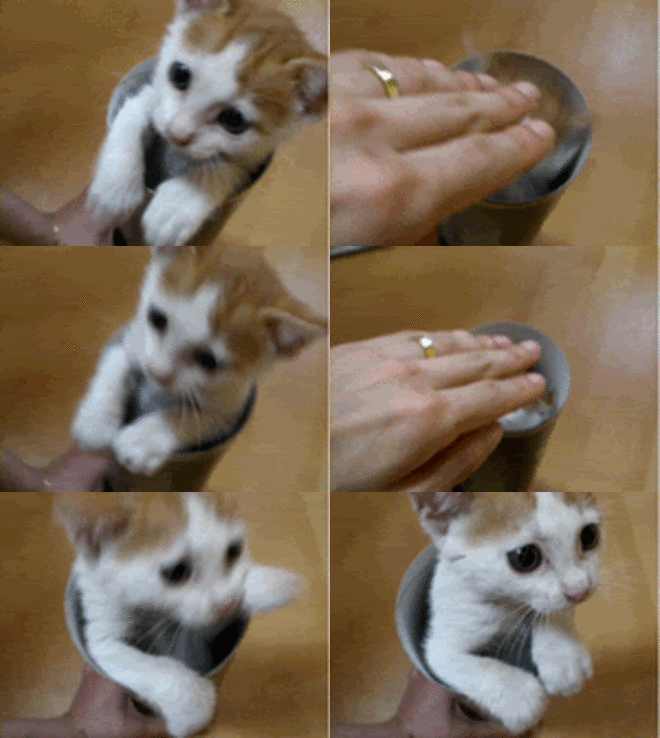
One question kept coming up again and again, and because it’s one I get often, I wanted to share the answer here on the blog. The thing I am always asked, especially now that I’ve published a book, is this: How do I get better at writing?
Now, when I first started getting this question, it struck me as the literary equivalent of asking Cousin Eddie from Christmas Vacation for fashion tips. Like … perhaps you should look elsewhere? Maybe?
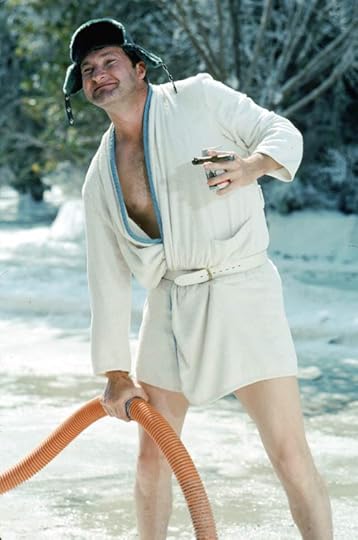
Although to be fair, Randy Quaid is ROCKING this look.
But I realized people weren’t asking me how to become a great writer, or even a good writer (WHICH IS GOOD, BECAUSE I DO NOT KNOW). They were simply asking how to become better. And I realized I can answer this question! Because I am not great, but I am way better than I was.
I started this blog nearly nine years ago. And if you go back and read some of my early posts, well … they’re bad. I’m not being falsely modest here. The writing is awkward and stilted and it doesn’t even sound like me. I hadn’t found my voice, or figured out what the goal of this site was. I didn’t even really know what a good blog post entailed. Slowly, with time, those things sorted themselves out. I got better. I figured out how to write a blog post. I still keep those early posts up, because I think it’s important that people see the progression of this site and know that things don’t improve overnight.
There are two things that I did that contributed to me become a better writer. Neither is terribly interesting or innovative or sexy. Neither is a quick fix. You’ve probably heard both of these pieces of advice before, but that’s because they work.
Just Keep Writing. I suspect everyone hates this answer, because it’s just so damn frustrating. Like, I just have to keep doing it? That’s it? But believe me – it works. The way that we get better at anything is to do it over and over again. Have you ever watched a baby do something? Babies suck at pretty much everything. There are so many things we do on a daily basis that are now second nature to us, but there was a point in time that we had to figure out how to do those things. So why do we think writing is different?
–
I suspect it has to do with the mechanics of writing itself. A poorly constructed sentence and a great sentence are essentially the same. They’re both made of words and punctuation. But imagine a wonderfully constructed house and a terribly constructed one. You can often tell just by looking that one is better than the other. You can tell that more work and energy and time has gone into one versus the other. But with writing, that’s not as evident. When we see a beautifully written paragraph, we just assume that the writer is talented. We often don’t see the time or work that went into it. We don’t think about the hours spent revising and rearranging and reworking sentences. It’s hard to see that in the finished product, especially because sometimes we’re able to write something brilliant right off the bat. That makes us think that all writing, if we were truly good at it, would be effortless.
–
Writing is easy. Good writing is not. The path between mediocre writing and good writing is not a linear one. I can’t tell you how many times I’ve sat at my computer and beat my head against my keyboard, and wrote garbage for days, which I kept deleting. And then, finally, I wrote something that was worth keeping. At first glance, it seemed to be totally unrelated to all the other stuff I’d written. But it’s not. See, I had to wade through all that worthless stuff to get to that good sentence. That journey isn’t often evident in the final product but it’s still critical.If you want to get better at writing, keep at it. Know that you will write things that you hate. Know that for every one fantastic sentence you keep, you might write twenty that you delete.
–
Read the Stuff You Wish You’d Written. Admittedly, I am not the world’s most confident person, so this is difficult for me. Sometimes, when everyone is raving about a piece of work, I’m inclined to run from it. But I should be doing the opposite. If something is wonderful, if something makes you burn with envy because it’s so good and you really wish you’d written it yourself, then that is absolutely the sort of thing you should be reading. Great artists became great by studying other artists. It’s no different with writing. If something is being hailed as a work of genius, you need to study it. Take it apart, look at all the pieces, and try putting it back together again. Pay attention to sentence structure and word choice. If a paragraph resonates with you, ask yourself why. (This is also a great tactic to do with a piece of work that you hate.) This isn’t about copying or plagiarism – it’s about understanding the mechanics of writing.
–
Some will argue that such an analytical look at a piece of art is antithetical to its existence, but I’m inclined to disagree. Entire fields of study have been built around analyzing literature. And while poring over Dorothy Parker isn’t going to necessarily give you a blueprint of how to be brilliant, it might make you more mindful as you write, and force you to pay attention to stuff that you wouldn’t normally – and all of that will make you a better writer.
–
Besides just that, I’ve found that reading wonderful stuff, especially in the genres in which we’d like to write, can be incredibly inspirational. Just think of how many times you’ve read something, or listened to a song, or watched a movie, and afterwards your brain just goes into overdrive? It’s called filling your creative gas tank – and it’s something that a lot of us forget to do. Plus, it’s a great way to combat writer’s block. Whenever I’m having trouble getting words down, I try to consume something wonderful – in hopes that I might regurgitate something not terrible.
Honestly, that’s it. It’s the same advice I give again and again. If you want to get better at writing, keep at it. And if you want to write well, then you need to read well.