Chris Chelser's Blog, page 5
November 23, 2017
Soulless Cry #71
#71
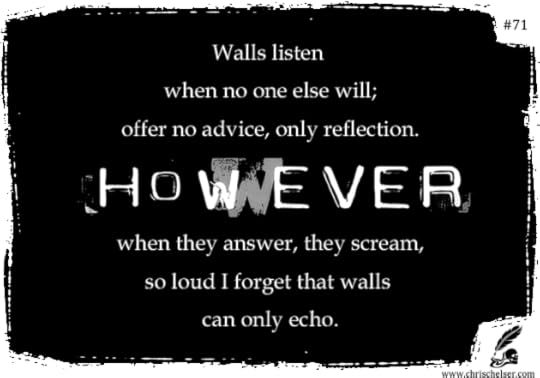
Walls listen
when no one else will;
offer no advice, only reflection.
However
when they answer, they scream,
so loud I forget that walls
cn only echo.
Het bericht Soulless Cry #71 verscheen eerst op Chris Chelser.


October 16, 2017
Fair Game for Self-Publishing
Little did I know that one business trip would change everything for this shy self-publishing author.
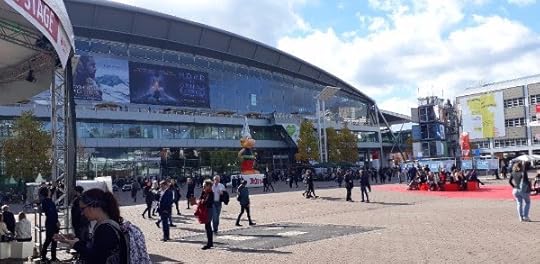
“It’s huge,” my friend warned me before I left. “I’ve been there, and really, you’ll need days to see it all.” She was, of course, talking about the…
Frankfurt Book Fair
As it turned out, needing days hadn’t been an exaggeration:
5 buildings with a total of 13 floors, full of stands hosted by publishers and other book and print-related companies from all over the world;
multiple stages with readings, lectures, interviews;
books of all kinds, on everything you could think of;
then more books…
…literally millions of books!
Good thing I arrived early that first day, because it took me hours to stroll the enormous halls, take in everything, and locate the stands I wanted to visit.
And to see where The Devourer had been put on display! 
October 1, 2017
Where Has The Horror Gone?
In the age of mass media, horror enthusiasts needn’t go to a bookstore or cinema to get their fix. And for once, it’s not the Internet that is to blame.
A Dying Fire
Every day and every night, the syndicate news channels spew one horror story after another. There is enough drama to satisfy our every craving for fear and terror. And should the world fail to be on fire, the news writers add drama to whatever is happening with a few choice words: calling a collision a “car accident” doesn’t turn any heads, but “disaster” still gets a response.
It’s no secret that we are desensitising at an alarming rate. Hundreds get killed in a natural cataclysm, yet we shrug and check our Facebook status. News outlets desperately try to fan the flames of this dying fire by using ever more superlatives, but fact remains that the number of people who give f*** all about anything is dwindling faster than ever before.
You can only fan a flame so many times before it starves.
Horrific Methods
Unfortunately, the horror side of the entertainment industry feeds off that same dying fire. The audience isn’t scared – or even mildly uneasy – unless they care. Unless they empathise with at least one of the characters and their situation. The artists’ job is to make them care. Feed the fire, as it were.
But that has become an uphill battle in all media.
Film Effects
The movie industry responded to the growing desensitisation of the audience by adding more gore, more sensation and more terror. Rather than investing in audience empathy, movies were formatted to maximise exposure to whatever scares or repulses us not just on a subconscious level but on a biological level (remember Human Caterpillar, anyone?).
Shock horror is a matter of timing, but since even that is no longer fail-safe, films call on low-frequency sounds these days. Those vibrations go straight to the basic parts of your brain, making you feel sick and upset despite yourself. The sense of horror no longer comes from the story or the imagery, but from a biological hot wire added to the soundtrack. That isn’t good horror; that’s cheating. But very effective all the same.
While tricks like these work, in the long run the audience will become less sensitive with each consecutive exposure. Like drug addicts need more and more to get the same buzz.
Upping the stakes indefinitely borders on the ridiculous. Small wonder that cynical horror comedies have sprouted like mushrooms in recent years…
Mind you, recent horror movies can be marvellous. You needn’t look further than the remake of IT. At the same time, this remake is also much more explicit and in-your-face than the original film ever was. Shock over suspense, because people can’t be anything less than frightened senseless after watching it. Right?
Could be, but creating by that rule, what else is the industry sacrificing in the long run?
Publishing Format
Books face challenges of an entirely different order than visual stories.
In reading, sensory input is determined by the reader. The writer only has word choice, description and word value at his/her disposal to conjure the illusion of sensory perception. Some writers know tricks to tap into the reader’s psyche and guide it where the story needs to go – similar to the art of misdirection in stage magic -, but for the most part they must rely on black letters on white paper to scare their readers.
Good writers get that job done and have us shivering with fright as if we are living what they describe, but too many horror books adhere religiously to the genre format. While 99% of all stories have roughly the same structure (Hero’s Journey, Three-Act Construct), genre formats dictate exactly what kind of event must happen where in the story.
This is why so many horror stories seem alike. Or thrillers, whodunnits and romance novels, for that matter. Here, too, repeated exposure to the same input desensitises the reader. They may continue to read horror books, but whether they will feel any of the emotions the writers hoped to elicit remains to be seen.
Internet Breaks the Mould
Since the arrival of the Internet, anyone can publish anything, regardless of content or quality. For the horror genre, this provided a new treasure of scary stories known as creepypasta. These usually short, urban myth-like stories get shared on social media sites and seem to be particularly popular with teenagers.
The often anonymous authors of these stories are blissfully unaware of genre limitations as posed by the publishing industry. Subjects and level of horror vary (as does quality), but overall they can be very entertaining and, because their lack of genre format, surprising.
In this, the horror folklore on the Internet has stayed true to the one essential ingredient of horror fiction: the element of surprise.
Challenge to Creators
Daily overexposure to horror and suffering makes us indifferent to the news, but it also has us laughing out loud at fountains of blood, creepy noises and yet another dumb teen getting ripped to shreds by the resident psycho/monster/alien/whatever.
It simply doesn’t surprise us anymore. Yet a major component of fear, and by extension the horror genre, is the unpredictability. The threat to the hero can be anything, as long as it is to some degree unexpected, unknown, unseen or uncontrollable.
For artists working in the genre, this is an extra complication. You know the story you’re telling, so how to capture that feeling in words or film when your own stories no longer scare you? Perhaps this is the reason so many writers and film makers resort to the tried-and-tested genre format. You rely on the format to ensure thrills for your audience when you cannot feel them while you are creating.
However, going through the motions to tell your story is no longer a reliable option. The audience has it figured out and is accustomed to the effect. They can predict each carefully measured step in the format. And if a horror story is predictable, it becomes laughable.
Ridicule is the death strike to a story. It’s a sign that the audience has lost all empathy.
Overstatement Kills
Adding more ready-made scares and over-the-top gore isn’t going to put the horror back into horror stories. Following a standard format won’t make the audience empathise, nor will it imbue a story with the suspense needed to trigger the fear and shivers the audience seeks.
But restoring the unpredictable in horror fiction, however essential, will not be easy. People are exposed to the unimaginable on a daily basis, where this inflated superlative is presented as reality. The entertainment industry can try to trump that, but such attempts are more likely to contribute to the situation than solve it.
Overstatement doesn’t inspire empathy. Not for people suffering in real life, and certainly not for fictional characters. Perhaps if news outlets stuck to the facts and left meting out horror to artists in the genre, both would find a much more empathic audience.
Het bericht Where Has The Horror Gone? verscheen eerst op Chris Chelser.
September 21, 2017
Comparing Virtues – Part 2: Watching TV
Last time in this modern debate of reading a book versus watching TV, we discussed some of the benefits and problems of reading books.
Now it is time to take the argument to the screen.
Effortless Entertainment
More than anything, watching TV is effortless. Where computer games require interaction and movement (of your thumbs, at the very least), TV doesn’t even require you to stay awake.
You sit, you consume, and that’s it. Very relaxing after a long day! Or night. Or after you just woke up… An continuous and ever-represent source of entertainment.
The best thing: it’s inexhaustible. Whatever tickles your fancy, there is more. binging on series, shows, movie franchises… Over-indulgence was never easier!
Of course the endless stream of input does block your output. Multitasking is a fable, and there is no such thing as doing something while you’re watching TV in the background. And as long as your brain is in ‘input’ mode, consuming the images flashing across the screen, it can’t swtich to ‘output’ mode.
And that kills your productivity – in everything!
A Whole New World
All the same, watching TV is an alternative way to learn about the world and listen to stories. Movies and documentaries are no less than books in that respect. Adding audio and movement to the sensory range of images, some subjects or processes can even be explained more clearly in video than in a book. A picture is a thousand words, they say. That goes extra when that images moves.
How much benefit you take away from staring at a screen does depend on what you watch. Hour after hour of sitcom reruns and Marvel movies can be very entertaining and relaxing, but I’m sure you’ll agree that the educational value there is, at best, limited.
On the other hand, art is in the eye of the beholder. So is what we learn.
Cost of the Screen
TV can be incredibly cheap. Large TV-sets are expensive, but internet costs very little, Youtube is free, and streaming services like Netflix play even on the smartphone you already have anyway. Unless you insist on the newest iPhone, in which case that screen is going to be very expensive after all…
Watching TV can drain your time, but it doesn’t require an investment of time. TV shows and movies are available 24/7 on any device with an internet connection. The time of scheduling your agenda around your favourite show or movie in the cinema is long gone. Televisionised stories are now available around the clock, regardless of where you are and what your budget is.
Just like books, really.
Nothing New Under The Sun?
Movies began as an art form that could do what neither books nor photography could manage. Stories were written especially for the silver screen, but soon people realised that movies were a wonderful way to introduce people to classic novels, legends and fairy tales.
To this day, a great many movies and series are based on books. Haven’t read ‘Pride & Prejudice’? Pop in the DVD and see what you’ve been missing. Want to know what it was about Stephen King’s ‘IT’ that scared people so? Catch it on film. As with many films, you even get to choose between the classic adaptation and the remake.
But screen adaptations are always mere summaries of a book. Short stories may lend themselves to be scripted, but a 1200-page novel won’t even fit a 3×3-hour trilogy. Small wonder that what makes it to screen is rarely more than an eviscerated version of the original story.
Characters, subplots and sometimes the entire main theme are sacrificed for the sake of time. If you have seen Spielberg’s Jurassic Park and then read the Michael Crichton novel it was based on, you may wonder if they really are the same story.
Nevertheless, a large number of books I read, I picked up because I had enjoyed the movie adaptation. In many cases the book contained depths the film hadn’t touched on, and in others the film version cut out all the dead meat that made the written story intolerable.
Pros & Cons
Stories on a screen are engaging and easy to consume. The stories may be thin and demand little of your concentation, but provided you select your shows and movies with care, they will encourage you to explore and learn as much as a good book does.
However, a poor choice of viewing material is an absolute deathtrap for your productivity and creativity – not to mention your time.
Concluding: Moral High Ground?
In terms of cost, books and TV/movies are similar. Both come in hand-held pocket format these days, and we’re spoilt for choice in both media. So those arguments are out the window.
Everything else comes down to the Moral High Ground Argument that TV is the pits and books are sacred. We are taught this from a young age:
“Don’t waste your time on TV, go read a book!”
“Books sharpen your mind!”
But some books are pure drivel, while some movies are gold. For me, certain TV series taught me more insights than 8 psycho-therapists could.
What’s more: with the increasing importance of screens and TV in modern society, there will soon be a generation that watches firsts and (maybe) reads later. The quality of screen productions is changing dramatically, too. The most insane ideas are put out there, but other productions are of immensely high quality and research that emulates life in the past, present and future. CGI has become nearly indistinguishable from reality – aiding our imagination instead of replacing it.
There is no One True Answer. Books no longer have the Moral High Ground over TV and movies.
Now this choice is just about what YOU need. Want to unwind after a long day and mindlessly stare at something? Go watch TV. Found a compelling story in print? Go read. Found a compelling story on screen? Go watch it. Want some peace and quiet? Go read.
The important thing is that you listen and enjoy the stories. How you do that is entirely up to you.
Het bericht Comparing Virtues – Part 2: Watching TV verscheen eerst op Chris Chelser.
September 14, 2017
Comparing Virtues – Part 1: Reading
The moving screen is an enthralling thing. We all know the hypnotic qualities of the TV and computer, and how they capture us when really we should – or want – to be doing something else. The little angel and the little devil on our shoulders start arguing: start reading one of those unread books, or just flop down on the couch in front of the TV?
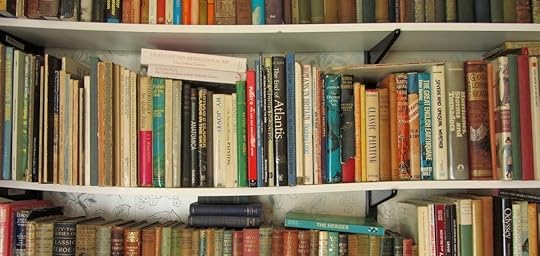
Our conscience can debate the issue forever (usually while our eyes are glued to a screen), but as in an debate, there are pros and cons to both options.
In this first post, let’s argue the case for reading.
Full Control
When you read, your brain translates the black-on-white squiggles to full-colour images. You decide what you see – and what you don’t. Your imagination is more seamless than the best CGI, the main characters can look any way you want them to, and skipping icky scenes is easier when you don’t need to peer between your fingers to see if they’re over yet.
Despite the apparent dullness of words on paper, reading is visually versatile. The mind can be so wrapped up in the images conjured by the words that it gets confused about what is real and what is imagined (in fact, the brain has a hard time telling which perceived reality is real even at the best of times). Which is why a good book can immerse a reader in its story.
However, if we don’t put any effort into translating words to images, we don’t get to see anything at all. But that is not always the reader’s fault. Not all people see images when reading. That doesn’t make them bad readers – on the contrary! – but it can take the pleasure out of reading for fun. For them, a story that comes with prepared visuals (film or comics) may be more entertaining.
Limited Senses
A book can trigger the brain to produce not only visual associations, but also smells, sounds, taste and touch. However, they are all imagined. No blaring musical scores, loud explosions or distracting sound effects.
That can be an advantage if you’re as sensitive to noise as I am, but it’s also more considerate towards your fellow bus passengers, who are blissfull unaware of what story you are engrossed in. Also saves you embarrasing looks if you happen to be reading Fifty Shades of Grey or the like!
But while you can imagine the sound of the hero’s voice or the songs of Tolkien’s elves, the imagination of sound doesn’t quite stimulates the same parts of the brain that make you enjoy music. Just as reading about a delicious cake isn’t the same as tasting it.
Cost of Reading
Books take their toll, too. Printed books tend to be expensive to purchase, especially if you insist on buying new and popular titles. Thrift stores and discounts can be a solution, but their choice of titles is often limited.
E-books tend to be cheaper – even free – but not always. Even when they are, the required e-reader won’t come cheap. Like any machine, it can run out of power, and not all file formats will open on just any device. Of course an e-reader is lighter and takes up less space than a hardcover or paperback, but still for many people digital books can’t hold a candle to old-fashioned paperbacks.
Although, if you like classics – or simply aren’t in a rush – there are multiple sources where you can get a copy of your book, either printed or digital, for next to nothing!
Mental Gymnastics
Of course the First And Foremost Argument For Reading, the one everyone always mentions whether they agree with it or not, is that reading is a workout for the mind.
Like muscles, the more you use your brain, the better it becomes. Because you must create your own sensory input, your brain needs to work hard. Processing new insights, thoughts and ideas help fuel your own creativity and command of language, too.
All this does require a fair amount of concentration, though. More so if the story you are reading is a complex one. Jogging your mind is all very well, but at the end of the long day’s work, that concentration may well be more than we can muster. At which point, we give up and scroll through our Facebook feed instead.
Pros & Cons
In short, reading engages the senses, imagination and provides exercise for the brain while entertaining us.
That’s all very lofty, but at the same time reading can be expensive and exhausting. Especially when you’re trying to read War & Peace after working two jobs and putting the kids to bed…
So it’s fun and rewarding, but reading can also put a strain on you – on your eyes, if nothing else.
Join me here for Part 2, where the little shoulder imps battle out the pro’s and con’s of watching TV!
Het bericht Comparing Virtues – Part 1: Reading verscheen eerst op Chris Chelser.
September 13, 2017
“The Devourer” Book Trailer
Not the Hollywood ones where they show the whole story in 2 minutes, but the short little teasers. I know I do, which is why I’m so excited the The Devourer now has it own book trailer!
More on The Devourer here,
or hop on over to Amazon
to grab the Kindle and/or paperback!
Het bericht “The Devourer” Book Trailer verscheen eerst op Chris Chelser.
September 12, 2017
The Bare Bones of…”IT” (novel)
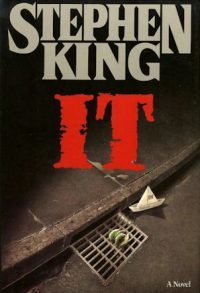 The movie adaptation of Stephen King‘s “IT” (the one with Tim Curry; haven’t seen Bill in action yet) scared me breathless. Yet when I got my dirty little fingers on the novel, much to my surprise I was bored to tears!
How on Earth did that happen?
Handling Backstory
Of course, movies and books speak with their audience in very different ways. While movies have the advantage of the “1 picture = 1000 words” equation, they lack time and opportunity for extensive characters and background development. And while books have ample opportunity to explore the concepts at the foundation of the plot, anything that isn’t described or at least hinted at, does not exist to the reader.
As such, the first scene the movie adaptation is a classic: the little boy playing in the gutter with his toy boat. The toy boat disappears down the drain and when the boy wants to look for it, there is a clown in the drain. A clown with a white face, red nose, red hair and sharp teeth. It’s called Pennywise, it says, just before it lures the boy closer and kills it.
They took this scene directly from the novel. A good start for both versions!
But from there, the paths diverge. The story of the ‘Loser’s Club’ remains more or less the same, but where the movie – by necessity – stays on this plot, the novel digresses. By miles.
Typically, horror stories have a slow build. They use plenty of exposition about the assorted creepy stuff before climbing a quick crescendo to an explosive. This kind of suspense requires careful pacing on the part of the writer: how much exposition is too much?
Quite early on, King treats us to extensive backstory, not all of which proves important to the plot. Such tangents were well-known feature in 19th century literature, but have been frowned upon since. Still, this is the King of Horror, literally, so he has more artistic leeway than we’d be willing to grant most authors.
Trilogy of Narratives
For me, however, this is where “IT” spirals out of control. A major part of the book is made up by the ‘trilogy of narratives’: Pennywise assaults in a recurring pattern, showing up every so often to claim its victims. King enthuses about this by recounting several of these events throughout time, and giving each of these sub-settings their own plots and subplots, like encapsulated short stories within the overall story.
This kind of story structure is an interesting concept in and of itself (one I have used, too), but a lot of its charm is lost when each sub-story is identical to the other: town is peaceful; along comes Pennywise; unsuspecting people becomes its victim one way or another; everyone is scared, until Pennywise goes again and people stop dying.
Every story confirms what the reader understands quite early on, namely that ‘it’ is terrifying. However, after several of such confirmations, none of them related to the main protagonists, the message dulls. “Yes, yes, ‘it’ is a scary monster. Get we get on with the story now?”
Not a question I want to be asking myself when reading a suspenseful horror story.
Overexposure Kills
Too much of anything dulls the senses, even when that ‘anything’ is toe-curling horror. That’s how we manage to watch the most inhumane images on the 24/7 news channels and shrug.
Still, even the best of stories can fall into the trap of overexposing the audience to its chief ingredient. Like with the news feeds, at best it results in an audience that no longer cares. At worst, overexposure alienates the audience to the point of repulsion. (The Passion of the Christ, anyone?)
Luckily for people like me, “IT” comes in an abridged version, too.
Het bericht The Bare Bones of…”IT” (novel) verscheen eerst op Chris Chelser.
July 17, 2017
Review: Kalbrandt Institute
Goodreads Review by Caroline Cairn

I was thrilled with myself for finding this book.
The writing is not only excellent, but more importantly, the characters are fabulous: three-dimensional, multi-faceted and realistic. The short stories are all linked through our main character, Eva, who is such an engaging woman, and all the plots offer an original take on the haunting place phenomenon. Now that’s what I like! So many books are carbon copies of each other, it was refreshing to read something different.
I can’t wait to know more about “Jonathan”. Oh yes, I do…
I am intrigued by this series, and judging by this first offering, I will definitely read the next. I only hope I won’t have to wait too long!
Het bericht Review: Kalbrandt Institute verscheen eerst op Chris Chelser.
Review: Kalbrandt Institute
Goodreads Review by GracieKat:

I absolutely loved this book. I’m eagerly awaiting the second.
I loved the way the story-within-the-story was set up. I love psychometry and think it’s under-used in horror in general. The main character, Eva, was pretty likeable. As were the characters within the shorter stories.
I love the idea of the institute itself. It has been done before but the author does a good job of making it pretty fresh. The files that Eva ‘reads’ are all done very well. They cover different time periods and the workers of the Institute all have their unique abilities. While the abilities are pretty typical for a supernaturally themed book they are used in a bit more inventive way. Not to spoil anything but in the first story, a typical haunted house type story, the way Cat implements her abilities is a bit different and really caught my attention.
At the entrance of ‘Jonathan’ I was afraid it was going to go into a more romantic direction but it did not. Yet. There’s still the possibility looming in future books but I’m going to trust the author to not go in that direction.
My only problem with it (and it’s pretty minor) (view spoiler)
Other than that very, very minor issue which did not diminish my enjoyment at all, it is a great book start. There’s some very good writing and creativity to be had. There also seems to be an over-arching story to it that leaves it a bit open at the end but the book itself is satisfactorily ended.
Which I love. Love. LOVE! I am getting so sick of books that do not end but end on cliffhangers specifically designed to make you buy the next one but does not resolve even slightly the current book you’re reading. Maybe the authors think that it will urge you to buy the next book to see how it all turns out. Nope. It does the exact opposite for me. A good author with a series in mind can satisfactorily close the current book but leave some bits a mystery.
I definitely would give it a look.
I received the book for free through http://www.scifiandscary.com/ (which you should really check out) in exchange for an honest review.
Het bericht Review: Kalbrandt Institute verscheen eerst op Chris Chelser.
Review: Kalbrandt Institute
“A wonderful book to read on long winter nights, with very atmospheric stories that range from delightfully spooky to deep and philosophical, with the frame narrative ending in an unexpected twist.”
– Birte, reader
Het bericht Review: Kalbrandt Institute verscheen eerst op Chris Chelser.