Chris Chelser's Blog, page 7
March 29, 2017
 Photo:

February 8, 2017
6 Lies About Ghosts
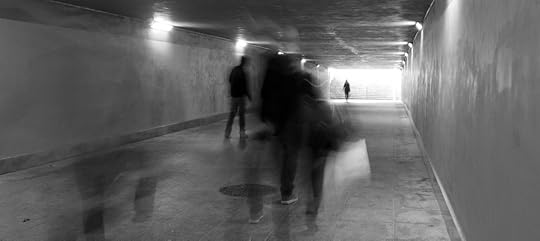 Photo by Damian Siwiaszczyk
Like gods and nature’s spirits, the belief in ghosts has been around ever since the first human tribes sat around the fire and told stories about their ancestors. How the spirits of those who lived before looked out for them, while warning of those who harboured a grudge. Add 20.000 years and modern entertainment industries, and we have this: six lies about ghosts you still believe.
#1 – You always notice when ghosts are around
Sorry to disappoint you, but this is very much an “alternative fact” spawned by movies and the human tendency to lie to ourselves to preserve our sanity.
Because ghosts are like spiders:
They creep us out for no good reason.
There is a lot more of them than there is of us puny mortals.
Dozens of them share our living space at any given moment, but we rarely notice them.
In fact, you need to be either very sensitive to their type of energy (like some people are sensitive to other people’s moods) to notice them – unless of course they make an effort to get you to notice them.
Ghosts are like spiders.
#2 – Ghosts are always hostile
Are you kidding me? Ghosts are dead people. Do you mean to tell me that all people always hostile to everyone?
Okay, the news sites can make it seem that way, but look around in your own life. The nice lady behind the store counter, the co-worker who make you laugh, the friendly bus driver, your significant other. They are kind, right? (And if you S.O. isn’t, ditch them.)
Like humans, ghosts can be real bastards. But like us they are capable of more emotions than only fear, anger and frustration. It’s true that strong negative emotions are easier to detect than serenity, so if you do sense a ghost, there is a statistically significant chance that they are troubled in some way.
#3 – Ghosts are always unhappy dead people and murder victims
If a person died a (long) time ago, chances are that their life and/or death left a traumatic impression. Like a living person clinging to the unresolved past, such ghosts tend to haunt and their fears and frustrations make them stand out.
However, ghosts can also be “freshly departed”. People who died recently have a tendencies to hang around family and friends for a bit before moving further away from the physical world. This is perfectly normal and a majority of ghosts fall in this category.
Other ghosts are long departed, but like to visit living friends and relatives from time to time.
And even the ones who died horribly might stay by choice. I once met an army officer who had died in the trenches of WWI. He knew he was dead, but stayed on the battlefield to look out for a number of soldiers who hadn’t realised the war was long-since over.
#4 – Ghosts spy on you
Yes, ghosts are everywhere, but like you, they have a life. Well, not a living life, obviously, but they are mostly occupied with their own interests. Which, like with normal humans, tends to revolve around themselves.
I mean, people in the street barely give each other a first glance, never mind a second. So why would you be worried about ghosts staring at you when you’re naked? They really couldn’t care less.
#5 –Ghosts become tangible at will
They’d wish. Ghosts cannot become tangible. Not even poltergeist.
“But what about slamming doors and lying dinnerware?”
Ghosts can influence the energy that makes up the physical world. Most forms of divination, like reading cards and scrying, rely on this. That influence can be weak, intentionally or not, or it can be very strong, in which case it might amount to what’s generally known as poltergeist activity.
Ghosts can influence the energy that makes up the physical world.
“Can’t they touch you?”
Generally speaking, no. Their energy is of a totally different order than that which makes up our tangible bodies, so our nerve system doesn’t register a ghost’s touch as it would physical touch. That said, there are cases of scratch marks and bruising. Insofar as these experiences are genuine, it’s again a case of influencing the material to show a certain response rather than actual nails scraping down your back.
#6 – Ghosts always look the way they did right after they died
I’m very happy to debunk this! While in some cases a ghost’s appearance – if indeed you “see” them – reflects their fears and pain caused by their death, I’m very pleased that 99% of the time, they look better! Even the many ghosts I encountered in the Ypres Salient showed nothing of the horrendous injuries that had killed them.
So what do ghosts look like?
If you knew the person in life, they might take on the form you remember best. Often ghosts seem of prime age, though. Mid-twenties to mid-thirties is popular. Depending on when they last lived, their clothes tend to resemble that period’s equivalent of standard daywear. Or they might go with a plain shirt and jeans. Anything goes when it comes to that.
Did I cover all ghost tropes, or did I miss one of your favourites? Let me know in the comments below!
Het bericht 6 Lies About Ghosts verscheen eerst op Chris Chelser.
January 31, 2017
 Photo by
 January 25, 2017
Soulless Cry #70
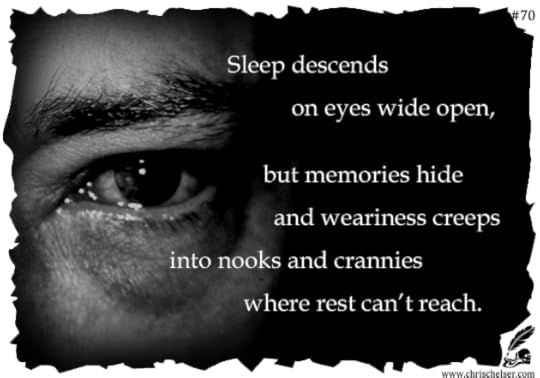
#70:
Sleep descends
on eyes wide open,
but memories hide
and weariness creeps
into nooks and crannies
where rest can’t reach.
Het bericht Soulless Cry #70 verscheen eerst op Chris Chelser | Official Author Website.
January 18, 2017
Populist Witch Hunts
Want to know more about this colourful character? Click here.
 Photo by Luc Viator
Modern Witch Hunts With A Modern Hammer
“Witch.” The sound alone conjures up image of ugly crones with warts, black cats, and a supersonic broomstick. The very word is obscene: an unholy insult to scare children and offend adults.
Of course, society is so much wiser and more civilised now. We may detest those who are not exact copies of our ideal self, but we don’t immolate, drown or hang by the neck until dead. “Immolate” means to burn someone, by the way. But hey, stakes are a thing of the past, right?
Screw that! The witch hunts aren’t over. Not by a long shot.
First, let’s correct a few erroneous but annoyingly common misconceptions:
Witches are not a folk tale only invented at the end of the Middle Ages.
The Catholic Inquisition did not conduct witch hunts.
Modern wiccans are not witches in the original sense of the word, so that is not where this post is going.
Then why are you – yes, you – at a realistic risk of becoming a victim of modern witch hunts?


 Witch No. 3 by J.E. Baker
Het bericht Populist Witch Hunts verscheen eerst op Chris Chelser | Official Author Website.
Populist Witch Hunts
“Witch.” The sound alone conjures up image of ugly crones with warts, black cats, and a supersonic broomstick. The very word is obscene: an unholy insult to scare children and offend adults.
Of course, society is so much wiser and more civilised now. We may detest those who are not exact copies of our ideal self, but we don’t immolate, drown or hang by the neck until dead. “Immolate” means to burn someone, by the way. But hey, stakes are a thing of the past, right?
Screw that! The witch hunts aren’t over. Not by a long shot.
First, let’s correct a few erroneous but annoyingly common misconceptions:
Witches are not a folk tale only invented at the end of the Middle Ages.
The Catholic Inquisition did not conduct witch hunts.
Modern wiccans are not witches in the original sense of the word, so that is not where this post is going.
Then why are you – yes, you – at a realistic risk of becoming a victim of modern witch hunts?
Ancient Witchcraft
The concept of witches has existed since the Ancient Greek. Longer, actually, but there aren’t any written accounts going that far back, because Greek scholars didn’t believe in writing anything down. But that’s a story for another time. Back to witches.
In the olden days, anything not understood was called “magic”. Since public education hadn’t been invented yet, “things not understood” covered a wide range of topics: biology, herbology, astronomy and climatology, psychology and a ton of other –ologies.
People weren’t dumb, they just didn’t know any better. Even the scholars.
An above-average understanding of “magic” was called “witchcraft”. So everyone who had such knowledge and wasn’t officially cleared to be knowledgeable – usually meaning women and peasants m/f – was a “witch”. Makes sense, right?
For the longest time, being believed capable of witchcraft wasn’t a bad thing. Cultures around the world revered and even venerated such individuals as shamans, gurus and other (semi-) holy people. No harm done. On the contrary: these were the people you turned to for answers.
Enter the various “One True Belief” religions…
Witches In Organised Religion
When organised religion came about, it brought rules of play:
“Let there not be found among you anyone who immolates his son or daughter in the fire, nor a fortune-teller, soothsayer, charmer, diviner, or caster of spells, nor one who consults ghosts and spirits or seeks oracles from the dead.” – Deuteronomy 18:11–12
The Old Testament forms the basis of the Jewish, Christian and Islamic belief systems, so it’s no surprise that in large parts of the world, those few sentences went a long way – in the wrong direction, eventually.
Early Christianity distinguished between white and black magic. White magic/witchcraft was beneficial and therefore not a problem, whereas black witchcraft was severely frowned upon. The penalty for black magic? Confession, repentance, and charitable work.
What, no stakes? Shocking, I know.
In fact, in Medieval times, the official doctrine of the Roman Catholic church was that witches did not exist. Heretics, yes, but not all heretics were witches and not all witches were heretics. For centuries, organised religion, at least in Europe, had no quarrel with witches.
So what the Hell went wrong?
Fear And Ignorance Breed Destruction
The second half of the Middle Ages was not kind to the poor Europeans. Repeated failing of crops undermined the whole economic system, and the standard of living dropped dramatically. Political and social unrest inhibited society to recover, and the Black Plague nailed the coffin shut. For a third of the population, that wasn’t a figure of speech…
The populus vulgaris, the ordinary folk, suffered the most. They always do. Centuries of church indoctrination had taught them to turn to God for answers, and they simply didn’t understand what they had done to offend Him. The real cause of their misery was a combination of factors like climate change (Little Ice Age), social and religious revolutions which led to wars, but climatology, sociology and bacteriology were nowhere near to being discovered. So God got the blame.
People were afraid. Afraid of more hardship, more pestilence, and of incurring the unexplained wrath of their Almighty. Terrified to wits’ end, they would do anything to appease him, no matter what the cost.
That is always a dangerous oath: “no matter what the cost”. It tends to turn out devilishly expensive.
Speaking of that guy: everything evil was Satan’s doing, so of course anything strange, anything not understood within the community was the work of the Devil. And what more certain way to anger God than worshipping the Devil?
Ergo, strange people doing strange things had to be scary Devil worshippers.
And what is scary must be destroyed. That’s the most primal reaction to fear. Humans are worse than animals that way.
What is scary must be destroyed. It’s the most primal reaction to fear. Humans are worse than animals that way.
Which must have been the point where someone remembered the Bible mentioning “immolate” in the same verse as “people doing strange things”, and put two and two together.
Fortunately, the Inquisition proved to be better at calculus than the average mob.
“Nobody Expects The Spanish Inquisition!”
The boys of Monty Python certainly got that right. Nobody – not the people, not the clergy, not the Pope – expected the Inquisition to get involved in witch trials. The Inquisition safeguarded religious purity, and witch trials had nothing to do with religion or heresy.
Roman Catholicism had denied the existence of witches for centuries, remember? So why would the Pope send his police force on a witch hunt? Of course, if an “outbreak” of witchcraft suggested a community was straying from the good Catholic fold, the inciting elements had to be removed. If that removal needed to be permanent, so be it. Other than that, the Inquisition had precious little interest in claims of women flying on broomsticks.
And what’s with witches always being women, anyway? Sure, men were tried for witchcraft as well (often acused of being a werewolf), but the specific persecution of women originates from the unadulterated drivel that is the Malleus Maleficarum.
The specific persecution of women originates from the unadulterated drivel that is the Malleus Maleficarum.
The Lies Of The Hammer
The Malleus Maleficarum, or Hammer of Witches, is the most famous witch hunters’ tool, widely used and cited whenever another stake was lit.
Yet the Hammer was a farce, the collected rants of a lone demented and disgraced monk by name of Heinrich Kramer. Its blighted pages consist solely of fabricated facts and allegations, strung together with false claims of papal authority. A lot like today’s politicians draw from inaccurate or outright falsified research to back up their claims to their voters, actually.
A lot like today’s politicians draw from inaccurate or outright falsified research to back up their claims to their voters, actually.
In truth, the Church never endorsed the Malleus Maleficarum or its author. They even cautioned the Inquisition to steer clear of the Hammer’s teachings, which were at best unsubstantiated.
How in Hell’s name did that ever become popular? Simple: in the same three steps that make populist politicians popular:
Spew a surplus of aggressive rhetoric that demonizes certain activities, attributes and backgrounds only shared by a minority of the population.
Blame said minority and their sympathisers for all that is wrong in society.
Call for the destruction of said extended minority. To Hell with evidence. Accusations are sufficient to establish guilt and warrant execution.
Now there was a language the poor folk understood! It echoed their primal instincts and gave their fears a focus: anyone who was not like them.
That message spread across the continent like wildfire thanks to the new printing press, further fuelling the mass hysteria that “witches” were to blame for pretty much every misfortune and posed a real and immediate threat.
And so the Hammer went down in history. Not as a horrific pamphlet that inspired a craze that sent tens of thousands of innocent men women and children to their deaths, but as the Church’s supposed justification for that massacre.
Except the Church didn’t head the witch hunts. The people did, with their wide-eyed frenzy that everything they fear – and they fear everything – must be destroyed. Utterly, completely, and in the worst possible way. Preferably right here and now.
Does that aggression sound familiar? Does it make you think of the Holocaust, of genocides and terrorism? Of the populist politicians screaming that the very existence of their country is threatened by some poor haphazard fugitives, because they have a different culture, skin colour or religion?
It damn well should.
Modern Day Stakes On Your Doorstep
Modern witches exist, but they are not the pagans or wiccans. Today’s witches don’t know or care about magic or unusual knowledge, nor do they need to. It is sufficient that they are different – and since every person is unique, “being different” is not a long shot.
Society’s fear still prey on the outcasts. Refugees and immigrants are accused and condemned. Ethnic, religious and sexual minorities are shunned, blamed and hunted now as were the suspected witches as recent as a last century.
Anyone deemed “strange” in the eyes of local, national or global society is sacrificed to the alter of social paranoia. By the governments, by the groups and companies, by individuals – and ultimately by you.
The Hammer of Witches is back, and it’s called “24/7 mass media”.
The Hammer of Witches is back, ladies and gentlemen, and it’s called “24/7 mass media”. It is the populists’ tool of choice, like the Malleus Maleficarum once was for the most malicious of witch hunters. And like the crowds on the old village squares, we sit behind our screens and cheer them on as they light the stakes. As if nothing changed in 400 years.
History likes to repeat itself. Read up on the atrocities of recent witch hunts worldwide, and ask yourself if this is what you want for your own future.
The choice is yours.

From time to time, the Kalbrandt Institute Archives’ leading man, Cael Kalbrandt, takes the blog stage to share his thoughts and views with a liberal dose of sarcasm, profanity and gritty realism.
Photo by Luc Viator
Het bericht Populist Witch Hunts verscheen eerst op Chris Chelser.
Populist Witch Hunts (Full Post)
January 11, 2017
The Pain Game (Full Post)
The Pain Game
Not quite the blogpost I had planned for today, but clear thinking is impossible when you’re repeatedly curled up in foetal position for days on end. However, that little setback did put me in the perfect position to study the mind’s response to pain. Especially excruciating pain…
 Photo: Vincent Bozzo
A bout of enteritis brougth on some terrible and very painful cramps. They were only cramps, I kept telling myself. But even “only cramps” proved sufficient to hotwire my brain.
In short, my body threw a Happy Potter-style Cruciatus Curse on itself. This is what it did.
Waves of Agony
Pain caused by cramps hits in waves. The muscles contract, causing pain. Then they relax a fraction and the pain diminishes. The variations on this theme are endless:
A single wave may come on, peak and fade away in any period of time. Minutes are usual, but sometimes it does a hit and run in a matter of seconds.
A new wave may start before the previous one has ebbed away entirely. Depending on how much they overlap, the pain can seem practically continuous.
The intensity of waves can vary, too, depending on when they “crest”.
Pain can literally short-circuit your brain.
Your suffering depends greatly on that last point: intensity. The more intense the pain, the more it hinders you to function normally. “Well, duh.” Indeed, this makes perfect sense when you twist your ankle, break an arm or otherwise hurt yourself in a way hinders physical movement. But we tend to forget that pain can literally short-circuit your brain.
So how does that happen?
Four Steps To Meltdown
Agony is a subjective thing. What hurts one person might be a light sting to another. But regardless of how intense you deem your pain to be, it will fall into one of these four classifications:
Minimum pain – Discomfort only. Easily ignored.
Mild pain – Present, but easily pushed to the background.
Severe pain – You stop in mid-action, unable to think of anything but the pain and how to alleviate it.
Excruciating pain – Unbearable. Instinct takes over, resulting in unintelligible wailing and/or movements.
The first three stages cover a wide range. However severe your agony and however low your threshold of pain, chances are it rarely becomes excruciating. In fact, as long as you can come up with the word “excruciating” to describe what you’re feeling, you’re still well within Stage 3.
Why? Because at Stage 4, complex language is out the window, along with all other civilised behaviour.
Basic Instinct
When severe pain becomes excruciating, something snaps in our brain. This point is quite literally a breaking point: your behaviour changes dramatically from one moment to the next. You can tell yourself when it happens and when it stops – albeit in hindsight, because:
One moment you can utter complete sentences; the next you forget how to string words together. (Interestingly, curse words are the last to go.)
One moment you visualise and think in clear images; the next all your mind produces is abstract art.
One moment you are self-conscious and aware of others in your presence; the next you barely realise anyone is there, never mind care what they think of you.
And when the pain recedes just enough, everything snaps back into place.
When severe pain becomes excruciating, our brain reverts to our basic animal instincts.
The key to this strange breaking point lies in how our brains are structured.
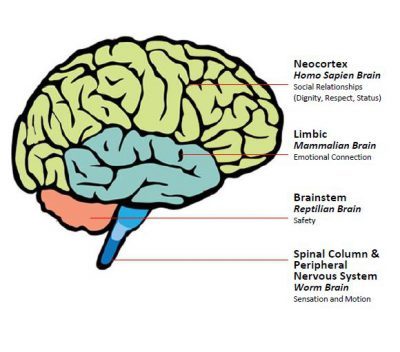
The neocortex is what makes us human and capable of complex thought. The limbic system is the mammalian brain, which controls our emotions. Further down is the reptilian brain, which controls our response to fear and threats.
Normally, the neocortex has little problem overriding the instinctive responses of the limbic system. Yes, we get angry at that smug co-worker taking credit for our work, but we refrain from punching him in the face. Yes, we fall in love and feel attraction to that stranger on the subway, but we refrain from jumping them and tear their clothes off. Most of us do, anyway.
Extreme pain changes that game.
A little pain triggers a response from the mammalian and reptilian brains, but nothing the neocortex can’t override: we grin and bear it. But when the pain becomes too intense, the neocortex can no longer override the responses from the limbic system. Instead, the limbic system overrides the neocortex: we howl, we scream, we fail to control of our actions – in truth, we no longer try to control them. We just act any which way.
Puppets On A String
Thus I lay curled up on the bathroom floor in the middle of the night, crying and wailing like a beaten dog, begging for someone – anyone – to take away the pain.
Until it receded. The cramps subsided, my limbic system’s signals weakened and the human part of my brain took the wheel again. But not for long. The next wave hit and I was back in “mindless whimpering dog mode”. After less than a minute it subsided, but thus reprieve didn’t last, either, and soon I was howling again.
This continued for hours, my conscious mind switching on and off like a light. And me? During the dips between waves, I just lay on the stone-cold tiles and wondered at my strange reactions.
In the end, the brain is a funny thing. This biochemical electricity plant has evolved in such a way that we humans believe to be in charge of ourselves. But when the fat hits the fire, it also proves that we are barely even human at all.
Het bericht The Pain Game verscheen eerst op Chris Chelser | Official Author Website.
January 4, 2017
Hacking Your Fear of Failure

Fear is the essence of horror. So as a writer of horror fiction, naturally I’m an expert fear manager, right?
On paper, yes. In reality, I’m always more or less terrified of one thing in particular. And so are you, whether you realise it or not.
The Commonest Fear
Extreme fear is high profile. The list of phobias is endless. But the most common everyday fear is as insidious as is it crippling. Everyone suffers from it. “Not me!” you say? Think again. Think of…
…failure. Nobody wants to be a failure. No one wants people laughing at them. You may not call it fear, but your shoulders tense. You feel queasy and your palms become sweaty. All at the mere thought of failing to…
It doesn’t really matter what failure you dread. Missing a target in school, work or (other) social situations is a favourite, but we all remember at least one occasion where we dreaded our imminent and inevitable failure to act like a half-decent human being.
Fear of failure is annoying at best, and at worst debilitating. It can kill careers if left to roam unchecked. If worst comes to worst, it can even kill people.
Fear of failure is annoying at best, and at worst debilitating. Artists know it as “writer’s block” or “a creative blackout”. Business people know it as “indecisiveness” and “weakness”. It can kill careers if left to roam unchecked. If worst comes to worst, it can even kill people. At the very least, fear of failure keeps you from doing something you want to do.
You deserve better than that. You deserve a fighting chance.
Fear 101: The Basics
Fear is a fascinating subject, but you don’t need an in-depth psychology course to hack your fear of failure. What you do need to know about fear, is this:
Fear is a primitive reaction to the appearance of a perceived threat. It’s the biological equivalent of a machine’s emergency mode. Telling yourself you don’t need to be afraid will not work, because the primitive part of our brain cannot reason. The ‘emergency switch’ is either on or off.
Whether the threat is real or imagined is moot. The primitive brain doesn’t distinguish between a hypothetical predator and a real one: a lion is a lion is a lion, and lions eat humans so they are a threat. End of discussion.
There are 3 possible responses to fear:
‘Fight’ – An aggressive reaction aimed at destroying the threat, preferably through violence. Kill the lion!
‘Flee’ – The drive to act is directed at running away, hiding or otherwise putting a safe distance between you and the lion.
‘Freeze’ – Like a deer caught in a car’s headlights, you do not run or do not defend yourself. You simply stand there as the lion mows you down.
You can’t reverse fear. You can only ride it out. On the bright side, the physical discomfort of fear fades quickly once the brain turns off the emergency switch. Did you know that the shaking in your limbs after a scary situation is your body’s way to speed up the recovery process?
The physical discomfort of fear fades quickly once the brain turns off the emergency switch.
So the key to hacking your fear is convincing your brain to resume normal operations. But how do manage that when fear dominates your every thought?
The body’s internal communications doesn’t rely on words, but on chemical cocktails. And just as a spike of certain hormones automatically trigger the emergency mode of fear, so a change in the body’s chemical balance automatically takes the brain out of that emergency mode.
Human bodies are like cars: you do not need to know how they work in order to drive them in the right direction.
Sounds complex? So are cars, but you do not need to know how they work in order to drive them in the right direction.
Think of your body as an organic machine: pull a lever and it responds. The trick is to know which lever to pull. Once you do, you can hack your body’s internal communications and stop your fear from taking over control.
Here is how.
Step 1: Determine how you are responding to fear.
Not all fears are equal. Take stock of your behaviour (or ask someone you trust for their observation) to discover which of the three responses are at work:
Are you cursing at how unfair your situation is? How others have it better or easier? (fight)
Are you procrastinating by doing household chores or suchlike? (flight)
Are you hiding in bed, or in binge-watching movies or a TV show, or are you drinking/eating when not really thirsty/hungry? (flight)
Are you staring into space/at a computer screen? (freeze)
These are just a few questions to show you what to look for. What are you doing instead of that what you need to do?
Step 2: Redirecting the drive that your fear triggered.
All 3 possible responses are caused by a host of chemical reactions in your body. Adrenaline is the best known factor in this process: the stress hormone that makes you want to do something – anything!
The problem is that while your brain is in emergency mode, that drive is solely focused on dealing with fear. So you need to redirect that energy:
When you fight – Go do something physical. Train, run, do a chore that requires heavy lifting. The adrenaline in your blood will burn up faster when you exert your muscles, and as soon the adrenaline level has dropped, your brain will automatically drop out of emergency mode.
When you flee – You are already in motion (often literally) but it is aimless: you are running away from something instead of toward a goal. Redirecting directly to what you meant to do is counterproductive at this stage. First try to sit still for a while and think of something not related to the tasks at hand. A hot cup of coffee or tea helps. The heat in the pit of your stomach tricks the mind into calming down. Alternatively, do some menial tasks or do physical training to help get rid of excess adrenaline.
When you freeze – This is both the most difficult and the easiest to come out of. The difficulty lies in the fact that you need to get moving – literally – when your instincts tell you not to. What makes it easier is that because you are not yet moving, you can – with baby steps – start moving directly towards the intended goal. The trick here is to get started with the smallest increment of action you can come up with. “Can I just… get out of bed?” for example. This article by Derek Doepker explains how and why this works for everything you want to get up and do but can’t.
Whatever your situation, you will find that once you can take your mind off that which you fear, the physical effects of being afraid will gradually diminish and disappear. You will feel calmer, better, and likely more confident about the task at hand, too: your brain’s normal operations are resuming.
Step 3: Check and Balance
Fear is tenacious, the chemical cocktail it causes addictive. The physical effects can become less noticeable in a matter of minutes, but beware of premature celebrations. It takes time for those chemicals to leave your bloodstream. While they are still present, the feeling of fear can kick in again extremely fast.
So as you go through Step 2, be honest with yourself about how you feel. Don’t blame yourself for needing a few tries. Or a few more. Your boss or a deadline may be breathing down your neck, but you won’t be able to perform to the best of your abilities while you are still afraid.
With a little practise, you will be surprised at how fast you can go from frightful to focused.
Step 4: Find out what works for you
Calm again? Good. But you’re not done yet.
Being afraid is human and fear raises its ugly head more often than we care to count. Just because you have found courage once is no guarantee for the future. To illustrate: I may have held a tarantula on my hand, called it cute and meant every word, but I still cringe whenever I see a fat garden spider.
Facing your fear isn’t a one-off. You will have to do it time and again.
That is why you need to experiment with what method calms you quickly and effectively.
Does working out help? Then take it a step further and see if it makes a difference whether you lift weights or do cardio training.
If household chores help you calm your mind, perhaps ironing shirts works better than hoovering or vice versa.
Frozen? Perhaps taking a hot shower helps, or maybe you find that you prefer to do other small activities first to get moving.
Call a friend, talk to a co-worker, consult your doctor or a psychologist if that makes you feel more comfortable.
Try different solutions and learn what they do for you – or don’t do. Record your results for future reference, for example in a journal.
Step 5: Creating a habitual battle tactic
Whatever you find works best for you, make this a habit.
Every time your fears engulf you and hinder you in doing what you want to do, apply your preferred methods. Every time. Again, not all fears are equal, so your approach may vary depending on the situation. The important thing is that whenever you are scared, you do something to break away from its grasp.
This repetition will breed a habit that becomes increasingly easy to deploy when you need it.
Whatever you find works best for you, make this a habit.
Fear and fear management are fascinating subjects. There are more ways to hack your fears and take control of your brain’s emergency switch, but these steps will get you good results with the least effort. They have been tried and tested by yours truly, for years and under the most adverse conditions, and I can vouch for them.
Of course I cannot promise you that if you follow these steps, you will never be afraid again. No one can make such a promise. After all, fear is also a survival technique we actually need. But knowing what you know now, you do hold the power to reduce crippling fears to a manageable nuisance.

The Insecure Writer’s Support Group
A safe haven for insecure writers of all kinds!
Het bericht Hacking Your Fear of Failure verscheen eerst op Chris Chelser | Official Author Website.