Chris Chelser's Blog, page 2
October 10, 2018
From The Archives: P/35413/SRP


The bombardment hadn’t relented since this morning. The ground trembled incessantly. In the corner of his eye, a dark shape moved. Almost habitually Roger glanced at the barbed wire along the top of the parapet. In the tangled mess hung a soldier, arms spread wide in the wire, head lolling backwards. With every explosion, he swayed. They’d have taken the poor sod down long ago if not for the bullets that came flying whenever someone tried. The only ones who could reach him without getting themselves killed, were the rats.
‘Yeah, I know I should be helping the lads. Don’t judge me,’ Roger grumbled at the corpse. ‘We’ve been at it since dawn, again. Can’t feel my legs any more than that bloke just now.’
The corpse grinned, lips and cheeks chewed off by vermin. Roger snorted when he noticed the empty sockets. ‘Fat bastards finally ate your eyes, did they? About bloody time. That blank stare of yours sucked all the pleasure out of a man’s thirty-second break.’
Suddenly, a lull between the shells. Shouts in the distance, but too far away to concern him. A blessed moment in which nothing made a sound. He counted, eyes closed. One, two, three, four, f—
Shouts as a group of the stretcher bearers came up from the forward lines. He took one last draw and he dropped his cigarette. It disappeared between the planks of the duct board, where it was devoured by the mud. He wished the ground would swallow him, too.
From The Kalbrandt Instite Archives – Book II: Monsters

Het bericht From The Archives: P/35413/SRP verscheen eerst op Chris Chelser.


October 9, 2018
The “Monsters” Selection Procedure
In an earlier post, I told you about the desire for diversity that spawned the idea of The Kalbrandt Institute Archives, and how this led to Eva’s explorations forming the framework for the memories she retrieves from the files in the archive.
Each file has its own cast and setting in time and space, but each book has a central theme. Since there are so many different monsters, ghosts, intriguing artefacts and mysterious monuments, how could I possibly select just one over all the others?
I can’t. So instead of choosing one, I choose five.
Turning Tropes
In each book, I aim to show as many variations of the theme as will fit in the overall narrative. Since I have always loved ghost stories, that is what I started with.
However, it irked me that most ghost stories picture ghosts as malevolent or a phenomenon. I ‘d must rather see them for what they are supposed to be: people without a body. I was determined to turn that trope upside down and present five ghosts that break with the stock ghosts in the genre, and . For good measure, I added five different, not-so-standard psychics to observe them:
Cat can see and hear the deceased people as if they are still alive;
Adan Yasin uses spells and amulets to drive out poltergeist;
Martin Schultz uses electromagnetic recordings to converse with a ‘grey lady’;
Hakon’s clairvoyance picks up on spectres that are not even ghosts anymore;
Angela, a psychometrist like Eva, is confronted with possession.
Feeding Expectations
Change a thing enough, it becomes fresh. Change a thing too much, it becomes unrecognisable.
I love giving old tropes a new spin, but writing in the horror genre, there is a limit to how many genre conventions that can be ignored before a book deviates too much from what the reader hoped for when she picked it up.
With that in mind, I deliberately add one or two files to the book that fit the standard requirements: typical plot for the theme, classic story structure, recognisable theme elements, etc. But even so, I try to give a twist to these basics. Haunted houses, for example, feature in three of the five stories of Book I. Of those, only one is a classic abandoned-and-remote mansion, which still manages to turn its own trope upside down.
One of the best parts of plotting the Kalbrandt Institute files is playing with genre expectations and tropes, and see how much I can change and tweak them without losing their essence.
Not the Usual Suspects
When the time came to select monsters to populate Book II, I began with tossing out the standard were-beasts, tentacled creeps, aliens and faceless serial killers. Most of those are done to death, but more importantly, they wouldn’t fit the Institute’s reality.
As Cael said himself: “Don’t be absurd. Vampires don’t exist.”
The short list of qualifying monsters featured from ten names. Some I discarded quickly, others made it to a first draft before I decided their story wouldn’t fit the way I wanted it to.
Ultimately, I decided to include one genre-standard giant creature as well as one monster from classic mythology. Everything else would be only too real. Because why invent a serial killer when history named the man who made genocide efficient? And why invent a zombie virus when the living dead are, in fact, not imaginary at all?
If you like my stories and want to help me write more, please take a moment to go here to see what difference a cup of coffee can make.
October 8, 2018
From The Archives: F/25852/YA
The bead ran a ragged pattern across the sheet, then spelt L, U, I with individual letters.
‘“Lui”? “Him”?’ He frowned. Him and you, the same person? Couldn’t be, since he wasn’t dead. Unless… unless this had nothing to do with him.
He scanned the writing on the sheet again. All words, all phrases were either written in first person, or in the formal second person. Je, moi, mon, vous, votre, etc. But there was no reference to a third person, or to anyone who was not part of the conversation.
Yet the bead was trying to refer to someone other than him or the ghost moving the bead. A third person.
‘With “vous”, you mean the person whom you used to address by means of this board?’
“Oui”.
‘So I would be right to think there are two of you in this house?’
The bead didn’t move.
‘And you used to be Monsieur Chevalier.’
“Moi”, the bead confirmed.
‘And the other?’
The bead rolled onto “vous”. Adan snorted. Typical for ghosts not to concern themselves with names. Maybe a prompt would help, but he recalled he didn’t know the name of the major. He wouldn’t get any wiser by pursuing this line of thought. He glanced at the sheet.
‘Of the two of you, were you the first to die?’ he asked, still whispering.
“Oui”.
Good. By process of elimination that as good as confirmed the hostile ghost to be that of the major. But still…
‘…why did you stay?’
From The Kalbrandt Instite Archives – Book I: Hauntings

Het bericht From The Archives: F/25852/YA verscheen eerst op Chris Chelser.
October 7, 2018
Sir Percival in the Third Reich

I already confessed that Indiana Jones and the mythical artefacts he chases across the world were a childhood love of mine. The two movies where he must outrun the Nazis are by far my favourites.
But did you know the Nazis’ interest in the Grail was historically accurate?
Ahnenerbe
The mastermind behind the search for the Grail wasn’t Hitler himself, but rather his henchman, Himmler. Himmler is best known as the leader of the SS, the famous black-clad soldiers in their Hugo Boss-designed uniforms. He was also obsessed with occultism and legends that confirmed the Aryan heritage as the Nazis saw it.
To this end, Himmler established a research organisation in 1933: the Ahnenerbe. It encompassed far more than archaeological and occult research – in fact, it was involved in anything that Himmler believed would “further humanity”, or rather the Aryan race.
While academic in nature, the Ahnenerbe was part of the SS organisation and likewise based at Wewelsburg castle. Himmler had the castle renovated. Part of those renovations involved preparing a room known as the Grail Room, where a dais had been prepared to hold the Grail once it was found.
But what he was looking for wasn’t the cup of Christ.
The Shape of the Grail
Himmler didn’t want the Grail out of religious piety. In fact, he disliked Christianity because of its Semitic roots. To him the Grail was not a relic, but a source of power with which to vanquish the enemies of the Third Reich. Neither did he believe it to be a cup. According to him, the Grail was a stone; a gem fallen from the crown of Lucifel. No, that isn’t a typo: he believed that Lucifer was, as the name suggests, the “Bringer of Light”. Not the devil, but a teacher of mystic knowledge.
It is likely he got these notions of Lucifer, the Grail and mystic knowledge from a rather obscure book that was published in the early 1930s: Crusade Against the Grail. Its author was a young mythologist and historian who had spent much of his life studying the legends of the ancient German tribes as well as the history of the Cathars of the Languedoc, in the south of France.
This author was Otto Rahn.
The “Real” Indiana Jones
It is said that Rahn was a major inspiration for Indiana Jones. His research certainly influenced the premise of Raiders of the Lost Ark and of course The Holy Grail. The man himself never lived to see that legacy. He didn’t even live to see the start of World War II.
Six years earlier, in 1933, Rahn was struggling to raise interest for his newly-published work. He had very little success, until he received an anonymous telegram instructing him to come to an address in Berlin, all expenses paid. Rahn went, and was met by Himmler himself. Himmler loved Rahn’s research and offered him a job as researcher. It meant Rahn would have to become an officer in the SS, but the Ahnenerbe would fund his work. Himmler even commissioned Rahn to write a second book.
Rahn agreed, but not out of conviction: “A man has to eat. What was I supposed to do? Turn Himmler down?”, he said on the matter.
The Legend of Parsifal
Why was Rahn’s research so influential? Because of sheer blind faith.
Even as a boy, Rahn had been determined to find the Grail. He was convinced even then that the legend of Parsifal (Percival in English) as handed down by the medieval troubadour Wolfram von Eschenbach contained hidden clues to the location of the Grail.
It is here that the Grail became linked to the Cathars of the Languedoc, and specifically to Montsegur. Rahn was certain he would find the Grail there, so he wrote in his first book.
Legends that are roadmaps to hidden treasure, Herr Kalbrandt. In their legends, passed on by Wolfram von Eschenbach and his peers, the Cathars predicted the existence of the Grail Castle, a mighty vestige atop a mountain. A paradise of remembrance and insight, far from the rest of the world. Below it, deep within the mountain, they predicted tunnels of knowledge.’ Wüst grinned like a cat that got the cream. ‘Why, Obersturmführer Rahn has already entertained us with a description of the vaults beneath our very feet.’
The Kalbrandt Institute Archives – Book II: Monsters, File C/37065/SAJ
The true problem was that Himmler took Rahn’s reasonings as gospel. He believed Rahn’s musings were not ideas, but facts. Hence he insisted Rahn continued his work. Rahn travelled to France, and to various other places, searching for the Grail. He found nothing. Legends and tenuous connections between German legends, with Parsifal at its centre. But no Grail, and no evidence of its existence.
Meanwhile, Himmler had that dais prepared for the day Rahn brought the Grail to its “rightful home” in Wewelsburg…
Tragic Ending
So much blind faith could only end in tragedy. And it did.
To say Rahn’s relationship with the SS was forced is an understatement. He was openly homosexual and outspoken about his anti-Nazi sympathies. As punishment – or perhaps a warning – he was stationed at the Dachau concentration camp for some time, but this only made him so appalled that he tried to resign from the SS.
But no one left the SS. Ever. In March 1939, Rahn was found frozen in the mountains of Tyrol. His death was reportedly suicide…
If you enjoyed this post, please take a moment to leave a comment and share this article on social media. Thank you !
Het bericht Sir Percival in the Third Reich verscheen eerst op Chris Chelser.
October 6, 2018
From The Archives: C/37065/SAJ

‘This is a terrible idea,’ he said, and stubbed out his cigarette end in the overflowing ashtray. ‘Absolutely terrible.’
Nevertheless he took out a thick folder from the top drawer of his side of the partner desk and opened it. Scrutinising every page, he removed all notes, copies and newspaper clippings that might be deemed offensive by anyone reading over his shoulder. Then he added several sheets of blank paper. For the minutes. Because there should be minutes. Minutes he could trust.
‘A terrible, terrible idea,’ he said again, and proceeded to check the remaining pages for a second time.
At the window, his back to the office they shared, Cael let out an irritable sigh. ‘Don’t be dramatic. These men are archaeologists, not the Spanish Inquisition.’
‘Are you certain? Because word has it they wield disturbingly long knives.’
‘Pettiness is ugly on you, Alexis.’
‘Pettiness? You believe I’m being petty?’ Alexander slammed his hands on the desk and shot to his feet. ‘In a few minutes, we will be entering a meeting with the people who conducted a pogrom not a fortnight ago. A pogrom, Cael! Yet somehow you are still seriously considering cooperating with these people?’
‘Without a shadow of a doubt.’
‘They encouraged destruction, pillaging, even killing. Nearly one hundred innocent people died that night!’ He gauged his friend for a response, but detected none. ‘Does any of this even register with you? Do you realise what it means?’
Cael let a lungful of smoke escape from between his lips. ‘I do.’
‘Do you really?’ Alexander said, glaring. ‘I know you. Those deaths are barely a footnote to you.’
From The Kalbrandt Instite Archives – Book II: Monsters

Het bericht From The Archives: C/37065/SAJ verscheen eerst op Chris Chelser.
October 5, 2018
Structuring the Archives

Impatient as I am, I created The Kalbrandt Institute Archives series to cover as many subjects as possible within one project. As a consequence, the classic story structure doesn’t work.
The standard 3-act (or 5-act, if you prefer) story arc is designed for a single plot with subplots. When you weave multiple plots together, you have to switch focus between them. Just look at Game of Thrones.
But where the Game of Thrones intersects the plots, permitting a classic structure for each plot in itself, the stories from the archives were going to be stand-alone stories that do not touch on one another. Their only link – at least initially – is be Eva, who reads them.
All Plots Are Equal
Assembling apparently unrelated stories into a single, coherent story is a unique challenge. The answer, however, was obvious:
Eva’s overarching narrative puts the individual stories into a wider context. Because all stories are in fact memories, she also has the power of hindsight. At times, modern insights allow her to understand more than people could centuries ago, leading her to draw conclusions that the original author of a file never could have. Playing with this adds significance to what Eva witnesses.
This doesn’t mean that Eva’s story is less important than the stories from the archives, or vice versa. I deliberately wrote some of the files so they would still be complete short stories, even when taken out of context. Others, like Nasir and Hakon’s adventures in Egypt (Hauntings), are deeply intertwined with how Eva reads them and cannot be separated from the rest of the book.
Likewise, Eva’s decisions and actions are strongly influenced by what she has learned from the files. Her story doesn’t make sense without them.
Stubborn Monsters
While writing Monsters, two stories gave me particular difficulty when it came to finding the right way to tell them.
Leo de Burdino’s story was initially suitable as a novel in its own right. Introducing the characters and the world of the Knights Hospitaller in 1347 while adhering to historical and scientific facts felt like being caught between a rock and a hard place: the timeline of events was simply too long for a short story.
I resolved that by reducing all crucial events to short scenes and presenting them in a non-chronological structure. The jumbled feeling fits in with Eva’s previous readings of centuries-old memories, but from the point of view of storytelling, this structure allowed me to condense the narrative while keeping the pace and suspense, but not diminishing the impact of Leo’s harrowing experiences.
“Too harrowing” was also the unanimous complaint of my beta-readers, who found the first draft of Dr Roger Stanley’s descriptions of World War I casualties a bit too vivid. Originally that story ran from start to finish, without interruption. People who read that version asked me to take pity on their sanity and add breaks. Eva concurred with them, and so I rewrote Roger’s memories to appear in several briefer instances.
Multi-Purpose Stories
Regardless of how I structure the individual files, the memories are all integrated into Eva’s story. She is the leading lady, and each file must move her story forward.
Some files teach Eva new things about the use of her powers. Others show important aspects of the Institute, its activities and its agents. Again others contain information that is essential to the overall plot. For me, the trick is to write the file stories in such a way that they serve all three purposes and still let them be stories in their own right.
That is what I love best about writing this series: vastly different stories with changing casts and diverse settings, and yet each one has to fit in with the overall story as well as with each other. A complex puzzle that by the end of Book IV will come together as one story.
If you like my stories and want to help me write more, please take a moment to go here to see what difference a cup of coffee can make.
October 4, 2018
From The Archives: C/44230/NTD

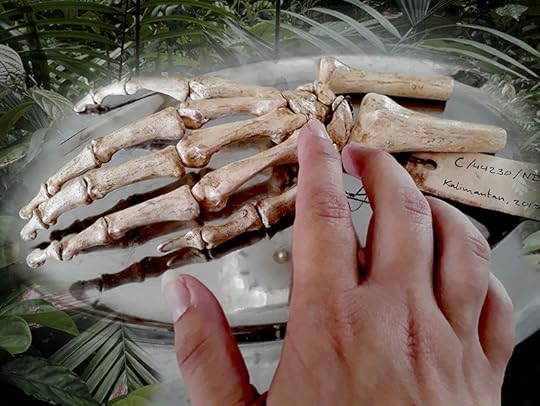
Chandra didn’t see them coming, but she felt them, those sharp knives plunging into the front and back of her right shoulder. Clammy, living leather rubbed against the side of her face. She wanted to scream, but something heavy collided with her head and her breath escaped with a sigh. A cable as thick as a barrel coiled around her and squeezed. Squeezed! She struggled to break free, but in vain. A dry snap, like the bones under her feet. Only closer, muffled. The writhing muscle wrapped around her body, slow and languid like a malicious lover. The fine scales scraped across her skin like blunt razor blades, tearing cloth and drawing blood. Another snap. She gulped, desperate for air, but her lungs refused to draw in as little as a mouthful. Against her will, her body began to go limp.
READ FULL STORY >>
From The Kalbrandt Instite Archives – Book II: Monsters
Het bericht From The Archives: C/44230/NTD verscheen eerst op Chris Chelser.
October 3, 2018
Black Death: A Tiny Mass Murderer
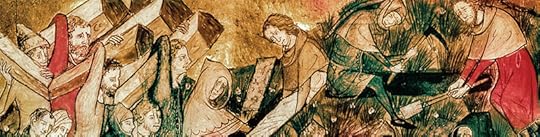
October, 1347. Twelve ships entered the harbour of Messina, Sicily:
“The people who gathered on the docks to greet the ships were met with a horrifying surprise: Most of the sailors aboard the ships were dead, and those who were still alive were gravely ill.”
This is the standard passage telling of the Black Death arriving in Europe. While doing research for Leo’s story, I had my doubts about the accuracy of this description. After all, these were large ships. If most sailors were dead and the others too ill to manage them, how was it possible that these ships – or at least the majority of them – made the journey to Genua, Venice and even Marseille?
More likely, it was but one ship where the plague had manifested so severely. But it was enough. In the years that followed, millions of people in Europe and the Middle-East would die of this plague.
Naming the Culprit
The symptoms of the Black Death are the stuff of nightmares even now: horrendous pains, black blisters, coughing and vomiting blood. Patients writhe in agony for hours or even days, knowing it could only end in death.
But while we now know what causes diseases, and have adequate treatment that saves lives, our medieval ancestors had no idea what had brought down such suffering on them. Much was blamed on the influence of bad stars: ‘influenza’. It was as good a guess as any. With the treatments Leo and his colleagues had at their disposal, a more accurate diagnosis wouldn’t have made a difference.
To this day, scientist are not completely certain which disease was responsible for decimating Europe’s population in the mid-14th century, but the most likely culprit is the bacterium Yersinia pestis.
This tiny murderer wreaks enormous havoc on a human or animal body. Depending on where it attacks first, it infects your lymph nodes until they swell and turn black (bubonic plague), liquefies your lungs until you drown in your own blood (pneumonic plague), or rides the bloodstream where it causes fatal septicaemia (septicemic plague).
Black Death in all its nasty variations still exists today. Fortunately, Yersinia pestis responds to antibiotics, which dramatically increases the patients’ chances of survival.
If you find treatment in time.
A Nefarious Killer
Normally when your body is infected with pathogens, the immune system kicks into gear and fights the intruders.
To the death. Yours or the intruders, whichever comes first.
Yersinia pestis is such a dangerously effective killer because it not only knows how to avoid your immune system, but cuts off your body’s ability to control that defence mechanism. What white blood cells do try to fight Yersinia pestis have no effect, no matter how hard they try to fight the infection.
Then, as an extra insult to that injury, the bacteria corrupt your already paralysed immune system by settling down and multiplying inside the key parts of your defence system: the lymph nodes. From there, the bacteria spread to the rest of your body, damaging your tissue where they go.
This tissue damage causes the pain and (internal) bleeding. Only if the progress of that damage is stopped in time by means of medication or an inordinate amount of luck can you survive. For the people of the Middle Ages, such luck was in short supply.
Except perhaps for one man…
Leo cried out as another bolt of agony shot through him, this time spreading from the other side of his body. Another wave of putrid odours rose into the fetid, spinning atmosphere. Desperate, he snatched his commandeur’s words like they were lifelines.
‘You will live,’ he grated. ‘You will. It is in your blood.’
‘No, sir. The pestilence is in the blood.’
‘Yes, in the blood…’ Leo panted. ‘That is why he will live…’
If you enjoyed this post, please take a moment to leave a comment and share this article on social media. Thank you !
Het bericht Black Death: A Tiny Mass Murderer verscheen eerst op Chris Chelser.
October 2, 2018
From The Archives: 124/BL
Darkness pressed behind his eyes. It engulfed him – for a moment, perhaps an era – like a wave of warm seawater. He spluttered as some if it dripped down his throat.
‘Stay awake and just swallow,’ De Laval commanded. ‘I have never done this before, but if you’re right, it may save your life.’
His body felt weightless, as if he were still floating on the water. He licked his wet lips. They stung and tasted of copper. More droplets seeped into his mouth and onto his tongue.
‘It would be faster if you drank from the cut,’ he heard De Laval say, ‘but I think the priests would take offense.’
‘How could they not?’ wheezed Charteris somewhere to the side. ‘No, keep your phial and its vile contents. I prefer to place my faith in God.’
‘Christians have no qualm about drinking the blood of Christ.’
‘Symbolically,’ Charteris said with spite. ‘And you…You are not Him.’
‘I never made a claim to the contrary…but if my blood can make a difference, be it only for the two of you, perhaps… perhaps my existence serves a purpose yet.’
Grasping at straws of reality, Leo reached for the safety of the cross hovering nearby. His fingers caught in the soft, white purity of the symbol, just as the blackness that surrounded it extended to take him in.
From The Kalbrandt Instite Archives – Book II: Monsters

Het bericht From The Archives: 124/BL verscheen eerst op Chris Chelser.
October 1, 2018
Why I created the Kalbrandt Institute

When I turned my writing hobby into my profession, I faced a precarious situation for a writer. Because from thereon out, I needed to create projects I would want to stick with until the bitter end.
A prickly problem indeed. Over the decades, I have always had too many story ideas. Furious scribbling to keep up with the plot bunny farm spewing subjects, themes, characters and settings earned me a hard drive full of unfinished stories, but little else. Deciding to write for publication didn’t change that.
I’m also terrible at choosing one thing when I see a way to have my cake and eat it… Cue maniacal laughter!
Umbrella Universe
The solution to my cake story problem was to create a universe that could encompass everything I might ever want to write, regardless of subject or setting. A framework where stand-alone stories can link into a single, overarching continuity – a bit like Pixar’s movies.
Given my penchant for mythology, psychology and history, it went without saying that these elements would form the basis of that universe. The trimming came from my love for libraries, paranormal phenomena and curiosity cabinets, with a bit of Indiana Jones as a cherry on top.
Thus the magical realism of the Kalbrandt Institute was born, together with its enigmatic founder, Cael. The perfect umbrella universe to cross time and space at will.
The Kalbrandt Institute Archives series is essentially an introduction into this world. Together with Eva, who is also a newbie, the reader explores the Institute. Bit by bit she gets to know its activities, the massive castle and the agents who work there throughout the centuries. Her story lays the foundations for the universe’s premise, and who knows what will come after?
Freedom Within A Framework
Having a single continuity does mean that every story has to fit in. That limits my options, but those limitations push my creativity as a storyteller. I love a challenge, and this is one I have set myself.
At the same time, the Institute is a breeding ground for diversity. The organisation recruits agents from all over the world, selecting solely on the usefulness of their knowledge and skills. Cael couldn’t care less about race, religion or any of the other peculiarities of a person that gets society’s knickers in a twist.
That gives me tremendous freedom in one area: the cast of each story is by default a mixed bunch. Even if a plot doesn’t revolve around the peculiarities of its cast, I will try to touch on them within the story’s context.
To me, the Kalbrandt Institute is a sandbox full of storytelling potential, and I love playing with all that.
If you like my stories and want to help me write more, please take a moment to go here to see what difference a cup of coffee can make.