Chris Chelser's Blog
February 20, 2025
Kalbrandt Book III coming this autumn
It’s been a good while since the release of Book II: Monsters, but this year Eva’s adventure finally continues in Book III: Artefacts!
As the intrigue she recently discovers expands in all directions, Eva still has a job to do. Her abilities as a psychometrist take her to memories of different places and times… some of which make less sense than others:
a forgotten Roman emperora night on a bald mountain a twisted treasure mapa terrifying princessa literally heart-stopping peek in her boss’ private life……and why in blazes does she keep smelling ozone?

Leave your email address below, and I will keep you informed as the release date draws closer!
Book Release UpdatesYour Name:
*
Your Email:
*
I give permission to Chris Chelser and Azera Publishing to email me about new book releases. I can opt out at any time.
*
Yes
Submit
If you are human, leave this field blank.
Δdocument.getElementById( "ak_js_1" ).setAttribute( "value", ( new Date() ).getTime() );


February 13, 2024
What will be back?
Good question! In the time I have been offline, I have given serious consideration to how and where I want to make my titles available. And how I keep in touch with you.
As you may have noticed, I have taken down all my social media channels. Those won’t be coming back. Social media is a leech to me, and while I enjoy a lot of the interactions, the main platforms are even more of a cesspit now than ever before. I’m not exposing myself to that, and I won’t ask you to.
What is back, is the first of my free stories! Just the ones I like best for now, but there is more on the way.
What will also be back soon, is the e-book versions of my titles. Right now they are available at Smashwords, but I’m still debating leaving them there when the time comes.
Finally, the printed books. They will be making their return in the course of the next few months. However, not as POD from Amazon and the like, but rather as orders that open periodically. I will collect all orders for that title, order a run, and add a personal touch before your book goes on its way to you. I’m still chewing on this one, but expect this later in 2024.
More updates coming soon. Stay sharp!
~Chris~
January 31, 2024
I’m Not Dead!
Although you’d be forgiven for thinking I was, seeing as I’ve not published a thing in ages and all my social media channels have gone offline.
Long story short: the pandemic hit me hard in my mental health, and all the monsters in my head came crawling out. Just not on to the pages of my drafts.
What I did write about that process resulted in a steep personal development as well as a career switch: psychology had always been a hobby, but now I made it my day-time profession.
But I haven’t forgotten my fiction writing. Eva and Cael have been clamouring so loudly that I decided to give The Kalbrandt Institute Archives a fifth book in the series. Yes, I know I’m still working on Book III!
My other project that was upcoming years ago, The Ship That Tried To Sink Itself, outgrew itself in a way I had never dared to dream of. What began as the first chapters in the hard life of bosun Billy and his stern, tormented Captain went on to develop into a full-fledged psychological model that now forms the basis of my work as a psychologist and speaker: Ship Psychology. Their story is my story, in the deepest sense. Theirs was and remains a horror story befitting the rest of my writing, and it still wants telling.
First, I’m going to relaunch this brand-new website with links to all my existing books, which are still out there, looking for you to read them.
See you again soon!
~Chris~
August 27, 2019
The Emperor’s Forgotten Son
The Roman Empire has had many illustrious and infamous rulers, but I have always taken a particular interest in Marcus Aurelius. He went on record as the last of the Five Good Emperors, and his death marked the start of the Empire’s decline.
Why? Because Marcus broke with the tradition set by his four predecessors.
The title of emperor was hereditary, as were many things. To facilitate rights of ownership and inheritance, it was not uncommon in Roman high society to adopt adults, thereby choosing who inherited – or who succeeded. The Good Emperors all selected and adopted the best-qualified man as their co-ruler and successor.
Necessity did play in this practice when there was no (legal) male offspring in the first place – and the law excluded daughters. Marcus Aurelius, however, did have a natural son: Lucius Aurelius Commodus.
Bad Seed
Contemporary records say that Commodus was handsome but not too bright. He had no interest in affairs of state or in the calm, Stoic philosophy of his father. This was obvious even before Marcus died and left Commodus as sole emperor.
If Commodus was recognisably unqualified
for the job, why would Marcus have made the boy co-ruler and sole successor?
One of the reasons historians consider is that grief drove Marcus to favour his only surviving son. Marcus and his wife Faustina had 13 children, including two sets of twins. Only five children survived into adulthood, of which four were daughters.
The historians’ argument certainly has merit. Marcus’s grief over losing so many children is understandable and shows evidently in the personal notes he left for his son. By the way, these notes – a collection of thoughts, ideas and memories – are now known as Meditations.
Unfortunately for the Empire, Commodus took little note of his father’s advice. Cassius Dio, a contemporary of Commodus, describes him as guileless but ignorant, cowardly and impressionable. The touch of megalomania that he acquired didn’t help, and he was assassinated 12 years into his reign.
Shell Game of Sons
Yet Marcus didn’t mean to put all his eggs in one basket. When he gave Commodus the title of Caesar, it was together with his younger brother Marcus Annius Verus. Possibly their father would have made them both his co-rulers in time. Except Annius Verus died only three years later.
Perhaps Marcus could find no suitable candidate to adopt as co-ruler for his surviving son. His own co-ruler, Lucius Verus, had already died, so perhaps the strain of being the sole ruler of so large and empire forced Marcus to appoint someone to help him. Perhaps politics forced his hand: Commodus was bound to have had supporters to his claims as successor elsewhere in government.
Or perhaps something else happened. A forgotten turn of event that someone took great pain to hide.
What caught my eye in all this is the fact that Commodus had a twin brother. Of this older twin, nothing survived but his name: Titus Aurelius Fulvus Antonius, died 165 AD at the age of four. A footnote in history, along with his other dead siblings.
But, isn’t history (re)written by the victors?

Het bericht The Emperor’s Forgotten Son verscheen eerst op C.H. Chelser.
May 1, 2019
The Ship – chapter 4 snippet
“What in hell’s name were you doing down
there, lad?”
“Those gems we talked about,” I huff
between Richard’s prodding. At the surgeon’s instructions, I turn my face
further. “They’re down there, Harold. In the back of the powder magazine.”
“Are they now? Wonderful,” Harold chides,
hands planted in his sides. “Too bad retrieving them didn’t exactly go without
a hitch. What in blazes happened in there?”
At that moment, David joins us. The master armourer sports a frown that rivals James’s.
“Two
dozen powder kegs exploding is what happened,” he reports. “The captain had a
fair point, Will. Your little scavenger hunt all but ripped the stern apart.
Still might, too. The surviving kegs are bound to leak powder, so one spark is
all it takes to set off what’s left. Which is plenty for us to,” he
gesticulates a big explosion, “go out in a marvellous display of fireworks.”
His
sarcasm rubs too much salt in my wounds. “Fuck
you. It wasn’t my fault! I’ve handled powder kegs a million times before, and I
swear I moved and inspected them according to proper protocol. Everything was
fine, right—Ngh!” I clench my jaw when Richard plucks at a chunk of torn flesh.
I swat away his blasted pincers and glare at David. “Right up to the moment I
picked up one keg and it felt a fraction too heavy.”
The master armourer puckers his lips in
thought. “Kegs are always the same size and weight. I stacked and secured them
myself. I’d have noticed if any of them were off.”
“Just a slight difference. I noticed, but then I didn’t have time to put the keg back before…” I pointedly mimic his explosion gesture. Some charred flesh crumbles from my thumb. David turns an interesting shade of green.
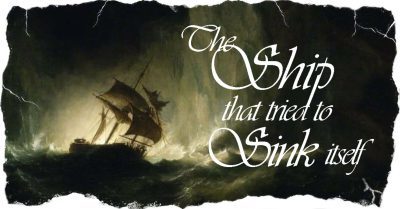
Het bericht The Ship – chapter 4 snippet verscheen eerst op C.H. Chelser.
Ship Psychology – a non-fiction project
Practical psychology has long-since been an interest of mine, in no small part due to my own mental health challenges. When regular psychotherapy didn’t catch on, I decided to help myself – through my characters. Much of this process ends up in my stories.
However, this practical method to understand why you do what you do proved too valuable to too many people not to share in its own right.
Your Mind As A Ship
Being you is easier when you stop fighting yourself.
In the last two years, what began as fragmented daydreaming about a ship, her captain and her crew grew into a fully-fledged method to understand the clashes between my thoughts, my emotions, and my behaviour. As you will have guessed, The Ship That Tried To Sink Itself is the novelised retelling of what I discovered about myself.
When I shared this concept with friends, they began to recognise their own Ship. Soon various people with different backgrounds and different issues told me the model helped them to make sense of themselves.
A Practical Approach To Understanding Yourself
Seeing how useful this model is to people, I have launched a website dedicated to the Ship Psychology method as it developed. Here, I will explain the model, how it works, why it works, techniques to make it work for you, and demonstrations of the insights it can bring you.
If this sounds interesting, please vitsit the Ship Psychology website.
 Click the image to visit the Ship Psychology website.
Het bericht Ship Psychology – a non-fiction project verscheen eerst op C.H. Chelser.
“Ship” Cosplay – part 1
To bring my books to more conventions and other real-life events, I’m working on a costume of James, the Captain from The Ship That Tried To Sink Itself.
James’s own outfit isn’t completely finished yet, but in this post, I want to give you a first glimpse of his long-time companion: the Kraken.
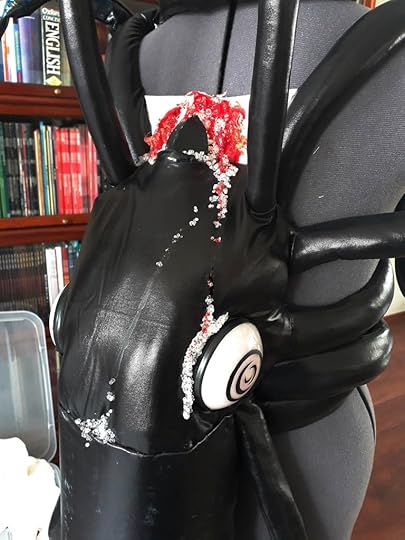
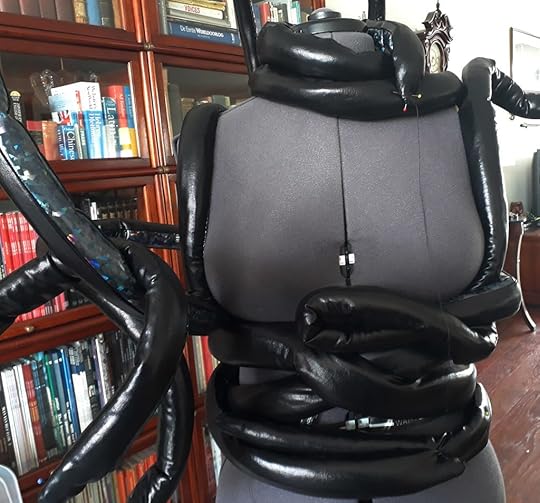
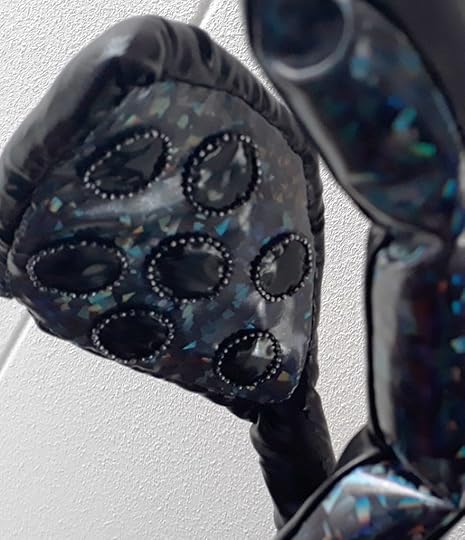
As the fresh scars on his forearm confirm, James is trained well and therefore denies claims of a monster sinking its teeth into his back. He may have some scratches from a recent battle, but he’s perfectly fine, thank you very much.
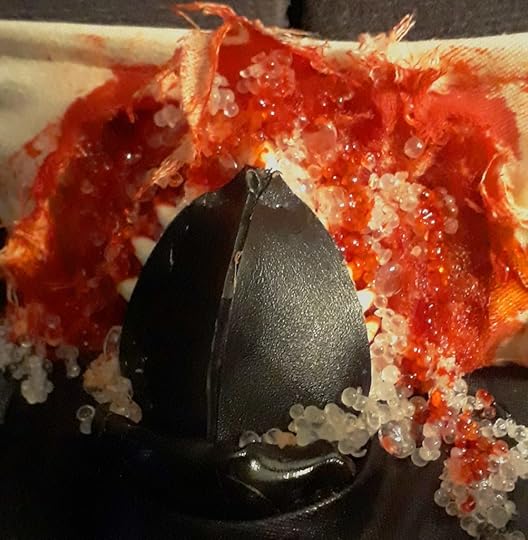
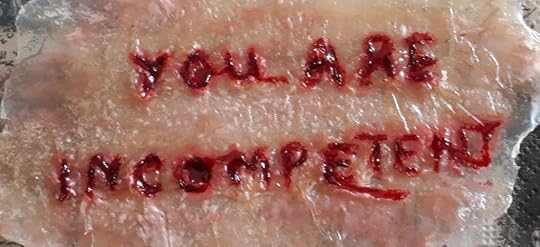
The Kraken makes its first on-screen appearance well in the book. However, from the moment James assumed command of the Ship, something is lurking in the shadows. Is the Kraken closer than he knows, or is something else out to get him?
If you want read a preview of the first few chapters, drop me a line any time.
Het bericht “Ship” Cosplay – part 1 verscheen eerst op C.H. Chelser.
December 22, 2018
It’s beginning to look at lot like…trouble!
Since Book III of The Kalbrandt Institute Archives starts in the last days before Christmas, a preview of the opening chapter makes for a perfect Season’s Greetings card.

It is that time of year again. Since half November, the streets and shops of the village in the valley have been decked with elaborate light crowns, jolly snowmen, shiny presents, and a steadily increasing number of green and red decorations. On the first Advent Sunday, small wooden stalls popped up selling handmade crafts, hot food and glühwein beneath cheap loudspeakers belching a continuous string of tinny carol choirs.
Christmas at its best, Eva concluded after spending the better part of the afternoon strolling across the market.
Maureen opted to disagree. “Blame it on my Catholic upbringing,” she said when they stamped the snow from their boots in the castle’s main entrance. “I’m all for secularisation, but I draw the line at a plastic Baby Jesus rocking in a battery-operated manger.”
Eva sniggered. Christmas decorations were gaudy by default, but that one had been hilariously tasteless. “At least my new mini-tree is just a tree.”
“Still a plastic tree,” Maureen said with a scoff and she peeled herself out of her padded coat. “But I’ll admit those roasted chestnuts tasted good.”
“You seriously never had any before?”
“Never. First time I bothered going to a Christmas market, to be honest. Coffee?”
In the Chapel lounge, Maureen coaxed the coffee machine into pouring two Italian espressos while Eva stacked their coats and bags on a lop-sided chair. As soon as she sat down on the couch beside it, her phone chortled a noise. She dug it up from her pocket to open the message.
“Yesim Guzman,” she said when Maureen handed her a tiny cup of coffee. “Should I have heard of him?”
“Her. Yesim is a lawyer and the Institute’s official figurehead. You know, the one signing the documentation for the government and anyone else who can’t know our real boss is immortal. What does she want?”
“According to this, Cael has left something for me. She wants me to pick up at her office before the end of the day.”
Maureen reclined, smirking over the rim of her cup. “Here we go. New game, new odds. Make it count, Eva.”
Want to receive updates on this and other books in progress? Subscribe here!
Het bericht It’s beginning to look at lot like…trouble! verscheen eerst op Chris Chelser.
November 11, 2018
Lest We Forget…
…that the Great War was not about clean monuments, plastic poppies, and solemnly bowed heads.

While Roger Stanley is a fictional character, the events he describes were all too common during the Great War:
The bombardment hadn’t relented since this morning. The ground trembled incessantly. In the corner of his eye, a dark shape moved. Almost habitually Roger glanced at the barbed wire along the top of the parapet. In the tangled mess hung a soldier, arms spread wide in the wire, head lolling backwards. With every explosion, he swayed. They’d have taken the poor sod down long ago if not for the bullets that came flying whenever someone tried. The only ones who could reach him without getting themselves killed, were the rats.
‘Yeah, I know I should be helping the lads. Don’t judge me,’ Roger grumbled at the corpse. ‘We’ve been at it since dawn, again. Can’t feel my legs any more than that bloke just now.’
The corpse grinned, lips and cheeks chewed off by vermin. Roger snorted when he noticed the empty sockets. ‘Fat bastards finally ate your eyes, did they? About bloody time. That blank stare of yours sucked all the pleasure out of a man’s thirty-second break.’
Suddenly, a lull between the shells. Shouts in the distance, but too far away to concern him. A blessed moment in which nothing made a sound. He counted, eyes closed. One, two, three, four, f—
Shouts as a group of the stretcher bearers came up from the forward lines. He took one last draw and he dropped his cigarette. It disappeared between the planks of the duct board, where it was devoured by the mud. He wished the ground would swallow him, too.
‘A hand! Quickly!’
The cry set Roger’s numb legs off into a run. Down the line of incoming casualties, a soldier was haemorrhaging. Shrapnel wound in his right side, the bearers explained as they frantically tried to stop the blood that poured from the gash like wine from a broken bottle. The bearers’ paper-thin bandages were of more use in the lavatories, so Roger pressed both hands on what he estimated was a ruptured vein. There was no space. They were blocking the trench, but it couldn’t be helped.
One, two…
Within seconds, his fingers were slick with blood that spilled out despite leaning in with his full weight. The soldier’s face paled rapidly. Too rapidly.
… three, four…
The bleeding slowed, but the man gasped, a sweat breaking out on his forehead.
Roger cursed when he felt the body jerk. Convulsions. More curses as he let go. Without pressure, the gash spat out more blood. Briefly. By the time it stopped, Roger had already wiped his hands on his uniform and moved on to the next patient.
Its front bearer cast a dark look at the fresh blood staining the duct boards and mixing with the mud that trickled down the trench beneath their feet.
‘Don’t imagine this one’ll keep himself together for long, either,’ he said to Roger.
Taking a look, Roger immediately agreed. The bloke on the stretcher groaned, suggesting he was at least semi-conscious, but his exposed windpipe gave a peculiar quality to the noises spluttering out of his neck. Not that his breath bypassed the man’s mouth, exactly, because there was none. His lower jaw had been ripped clean off.
Read more of Roger’s memories in The Kalbrandt Institute Archives: Monsters, which you can download for free.

Het bericht Lest We Forget… verscheen eerst op Chris Chelser.
October 11, 2018
Writing Where It Hurts
It is no secret that writing good stories is not as easy as many people believe it is. If translating your thoughts into words isn’t hard enough, the first draft is followed by numerous rewriting and editing rounds. A writer revisits every one of their stories ad nauseam before – and if – it ever sees publication.
What happens if a story is particularly painful to write?
You do it anyway. Stories, like truth, will out.
Grades of Difficulty
Not all stories are created equal. A story with little emotional traction is easier to write than one where the author puts their sanity in the balance. Consider a text message on your phone: if you tell someone you’d like to hang out tonight, it’s a matter of seconds. If you are asking that someone out on a first date, you’ll likely take much longer to find the right words.
While every writer worth their salt will put more of themselves into their work than they may realise, what makes a story difficult varies per writer and per story.
My love for ghost stories made writing Book I of the Kalbrandt Institute series rather smooth. Each story had its own technical challenges, but I’m comfortable writing about spirits, even the nasty ones.
Monsters turned out to be – pardon the pun – a very different creature.
A Matter of Perception
Chandra’s story gave me the least trouble by far. A straightforward creature fic that required research on the setting but little else, it was finished first. Next came the Libyan expedition. That required extensive research on subjects I never thought I’d be looking into, which made it fun to puzzle the team’s discoveries together.
So far, so good.
Earlier I talked about the technical issues that plagued Leo’s story. A greater challenge was that I had miscalculated how much effort it would cost me to see the world through the eyes of medieval doctor. Not just the horror he is confronted with, but his mindset and the mindset of his time. Leo’s religious and professional beliefs are genuine to him, yet so alien to me that at times it hurt to empathise with him. Fortunately, William Charteris saw both of us through.
Memory: Tread Carefully
Artistic license thrives where detailed accounts of historical events are absent or limited. That option is out the window when extensive, accurate accounts remain. Writing about such a time is all the more precarious when society still has a vivid memory and opinion about the events and people in question.
Call me a glutton for punishment, but knowing I would be entering a minefield didn’t stop me.
At the inception of Monsters, I had already decided that I wanted to pit Cael against one of the greatest human monsters in recent European history: Nazi general Reinhard Heydrich. The juxtaposition of two men who share both physical and mental similarities was an image that wouldn’t leave me alone.
But when it came to writing that confrontation, set before the Second World War began, I feared I wouldn’t be able to balance the officer Heydrich appeared to be then with the monster he would later turn out to be. The hindsight knowledge adds suspense but also a pre-existing resentment, triggered by events which hadn’t happened yet at the time of the story.
I was lucky to have a German consultant who was willing to set her own abhorrence aside to navigate me through these tricky waters. By comparison, reading up on Otto Rahn’s research, on which this story hinges, was a walk in the park!
After that, I couldn’t imagine that the last story would pose a bigger problem than this one.
I was wrong.
The Dead of Night
Another monstrosity that had my attention early on was the Great War. My interest – and indeed my emotional investment – in the soldiers’ lives in the trenches of the Ypres Salient in particular goes back two decades. I had seen the battlefields, the old interviews with survivors, and the uncensored photographs that you won’t see in any of the museums. In all, I had a good idea of what I was getting myself into.
Maybe because of those sights, I dreaded envisioning what I wanted to write. So I procrastinated. A lot. For months. Until deadlines loomed, everything else about the book had been written, my house was spic and span, and there was nowhere left to run.
In the end, I wrote Roger’s story at night. The darkness and the loneliness helped to see what I had been running from, as well as his response to it all. I typed with crooked fingers, shivering despite the sweltering summer heat. My mind wanted to shut down emotionally, but I refused to let it. I’ll admit I cried a lot, then.
Two nights from dusk till dawn to get it all on paper. Three more nights to rewrite and edit. Then my beta readers told me the story was too intense. The solution was simple, but implementing it meant I had to revisit those scenes all over again. It got done, surprisingly fast, but I was emotionally numb for a week afterwards.
Stories are not created equal. Sometimes what the story needs, hurts the writer to put into words. This is why so many aspiring writers give up. To those who persist, facing that dread and finishing anyway is its own reward.
And Now…
…Monsters is finished. Tomorrow, they are ready to meet you. All I can do now I hope that you will enjoy the thrill of their company!

If you like my stories and want to help me write more, please take a moment to go here to see what difference a cup of coffee can make.