
Will Buckingham's Blog, page 27
February 11, 2013
At the Bulgarian Cultural Institute
This is just another quick post to pass on some news. Londoners who are regular, or irregular, visitors to this blog, may be interested in an event that I am doing at the Bulgarian Cultural Institute in South Kensington on Friday 15th February.
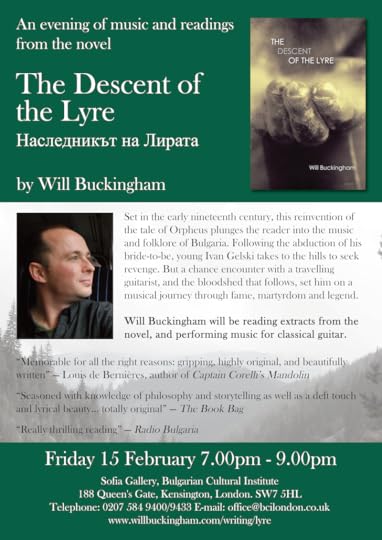
I’ll be talking about, and reading from, my novel The Descent of the Lyre, as well as playing music for classical guitar. I’ll be joined by linguist and writer, Dr. Andrew Caink, from the University of Westminster, who will be asking me questions about the book, and pianist Lydia Hind, who will be performing Bulgarian-influenced music for piano.
The event is free, although the BCI will be inviting donations on the night. All welcome—just turn up for 7pm.
 The Descent of the Lyre at the Bulgarian Cultural Institute


January 31, 2013
Moonlighting in the Museum
Just a quick update to post a link to a paper that’s just been published online in the Museological Review. I’ve been moonlighting a little bit in the world of museums, thanks to Museoscope‘s Elee Kirk, and we decided to collaborate on a paper last year that tied together Calvino’s Invisible Cities and empirical work on children’s experiences of museums. Our main drift is that the utopian quality of museums is often personal and intimate, to the extent that it eludes capture as ‘data’, and that this matters for the way that museums might go about—in an increasingly instrumentalised age—arguing the case for what they do.
January 29, 2013
Philosophers and Dinner Dates

My goodness, two posts in two days… But don’t assume that this is going to be the way of things from here on in: I just thought I’d post to say that there’s a little interview with me over on the Bloomsbury philosophy blog, about Levinas, philosophy, which philosopher I’d like to have over for dinner, and my forthcoming book Levinas, Storytelling and Anti-Storytelling. It’s a chatty, breezy kind of interview. Here’s an extract:
What particular areas of philosophy interest you and why?
As a writer of philosophy (rather than as a reader, where perhaps my interests are more eclectic), I’m particularly interested in ethics. However, I see ethics as being far more than a body of theory. What I’m really interested in are the ways in which it is possible to give shape to human lives and human action, and how it might be possible to live a little more kindly, generously and graciously. Here I don’t think that the Western philosophical tradition has a monopoly, and so I’ve long been interested in other approaches to philosophy, for example those stemming from the Buddhist traditions and, more recently, the rich resources of Chinese thought…
You can read the full interview here. The book is out on Valentine’s day: an ideal gift for that Levinasian significant Other in your life…
January 28, 2013
Interview on Bloomsbury Blog
My book on Levinas and storytelling is due out in a couple of weeks (on Valentine’s day, no less — the ideal gift for that significant Other in your life…); and so here, in advance of the book’s publication, is a quick interview about the book, about creative reading, and about the tricksy problems of inviting philosophers over for dinner. Click the link here to go to the interview.
The Rhetoric of Urgency
 Back in the days when I was a more assiduous Buddhist meditator than I am today, I frequently came across the old, and well-known, Zen saying that you should meditate as if your hair was on fire. As with many such sayings, it is not really clear where this piece of curious advice comes from (although I’d be happy if any readers of this blog, more knowledgable than I, could let me know); but at the time, the saying rather appealed to me. However, as time has gone on, I have become less sure about it.
More recently, I’ve been thinking a bit about the rhetoric of urgency that appears in Buddhism. So, for example, the traditional Buddhist retreat is often infused throughout with this burning sense of urgency. You get up at some unholy hour (three o’clock for the hard-core, six for the spiritually lax), wash (in cold water for the truly serious) and dress, then you sit for an hour or two on your meditation cushions, before you’ve even had a chance to have breakfast. And so the day continues, punctuated by talks about the preciousness of this opportunity you have been offered (“These retreat conditions are rare and hard to come across… you are most fortunate to be here… grasp this opportunity and make diligent effort… there’s a possibility that you may even die before you take your next breath, there’s no time to waste… it’s as rare as a turtle popping it’s head up through the hole in the middle of a wooden yoke floating on the surface of the ocean…” &c. &c. &c.), or else by perpetual reminders that the thread of your life is running out, so it’s never to early to start reflecting upon death, decay, and the fleetingness of things.
Now, I’ve done quite a lot of this in the past, but these days, I confess that it’s not really what I want to be doing. And this may of course be because I’ve simply become slack, a spiritual lightweight, a fair-weather meditator. But I’m not sure that this is the only reason. The thing is, I have also come to have certain doubts the rhetoric of urgency that underlies these practices. It is not, of course, that there is never any place for urgency in the world; but I do wonder whether it is wise to live one’s life under the aspect of perpetual urgency. Of course, the statistics being what they are, if anything I should be reflecting more upon urgency as time goes on; but somehow, with the incremental loss of at least some of the hair that might once have provided fuel for magnificently burning locks, I have also become rather more relaxed about things.
Why is it, then, that this kind of urgency no longer appeals to me as it once did? Is it just a fading of my former youthful zeal? In part, perhaps, it is. But I think that it is not only this. It is also a matter of how we relate to change, transformation and the passage of time. Recently, I was reading François Jullien’s book, The Silent Transformations, a slim book that is so very rich and suggestive that I cannot really do justice to it here. Jullien talks about how curiously difficult it is to think about those countless transformations of which we are a part: how melting snow becomes water, how the view of the outskirts of Paris on the train becomes the countryside, how love turns into indifference or indifference into love, how youth turns into old age, and so on. Our lives are made up of countless “silent transformations” (which, I think, is a translation of the Chinese 潛移默化 qián yí mò huà, literally “hidden movement and quiet change”), such that we never quite catch ourselves in the act of ageing or of becoming a different person from the person we once were. We notice that we have aged, that we have changed, or that this or that person that we know is different from before, but these transformations are indeed quiet and hidden.
What I love about this idea of “silent” transformation is its gentleness, its freedom from drama. It does not hysterically shriek that time is passing and that we need to do something before it is too late: instead it quietly solicits our attentiveness, asking us to look to the subtle and labile nature of the multiple changes that are already in process. Jullien spends a good deal of time talking about what he calls—against Badiou—the ‘mythology’ of the event. There is a certain strain within continental philosophy that is obsessed with the idea of the ‘event’ as a break with the existing order of things, a kind of rupture that is necessary for something new to happen: because without some kind of break in the order of things, so the story goes, there could be nothing of newness in the world. Events of this kind—events that seem to be a break with the existing order of things—could be called noisy transformations: like the events of the nightly news, they monopolise our attention, so that we don’t notice those quieter transformations that are happening all the time. And I can’t help wondering if the very drama of these noisy transformations blinds us to the fact that even these events are not really such a break in the order of things at all (hence Jullien’s ‘mythology’ of the event): instead—but only if we ignore the noisiness and the drama and look a bit more patiently and calmly—we can see, in retrospect, that the seeds of these transformations had been growing for a long time.
The rhetoric of urgency encountered in certain Buddhist texts and contexts seems to me to be in the thrall of this noisy obsession with events, with the hope for some kind of dramatic break with what has gone before. I sit on my cushions, and I struggle to get somewhere, because I’m caught between two possible dramas: it’s either (to put it crudely) death or Awakening, whichever is sooner. In my intoxication with this whole dramatic shebang, I simply lose my attentiveness to those quiet, almost indiscernible transformations that are taking place around me and within me. This obsession with drama can also, I think, lead to a somewhat curious orientation towards life: a kind of alienated, gleam-in-the-eye zeal, underpinned by a terrible fear of disappointment—because if I don’t get there, if the hoped-for event doesn’t take place, then somehow my life has gone awry.
I still think that meditation practice is a good thing, but for me these days, meditation has very little to do with any kind of urgency. Instead, the reason I still meditate is this: because in the quieting down that happens within meditation, in the relative stillness and freedom from urgency, it becomes possible to begin to discern once again the subtlety of those silent transformations, hidden movements, and quiet changes that are taking place all the time, those things that are crowded out by the obsessive clamour of event after event, the intoxication we have with the unfolding of drama after drama. And in this way, returning again and again to meditation reminds me that, whatever apparent dramas and events may be taking place, nevertheless life is, in the end, not something to be surmounted.
January 23, 2013
BCI Literature and Music Evening
Another brief post about the up-coming event at the Bulgarian Cultural Institute on the 15th February. The full details can be found on the poster attached below. There’s no admission cost, but guests are invited to make a small donation to the BCI on the night.
The evening will also feature music for piano (played by the excellent Lydia Hind), and also for guitar (played by myself!). There’s an invite/poster in PDF format that you can download here. All welcome on the night, but if you want to be absolutely certain of securing a ticket, then do contact the BCI at the contact details below.
January 13, 2013
Reading and Music Evening at the BCI, 15th February
 Guitarist, by Gustave Courbet (1819–1877). Courtesy Wikimedia Commons
This is just a quick post to point visitors to some information about the up-coming event I’m planning at the Bulgarian Cultural Institute in London, where on the 15th February I’ll be reading from and discussing my novel, The Descent of the Lyre, and playing some music for the classical guitar — a mixture of pieces by Fernando Sor and arrangements of Bulgarian folk tunes. It should be a fun evening, all are welcome, and you can find more information on my events page.
January 4, 2013
Comments!
Just a quick update to apologise to anybody who has been having trouble commenting on this site. Although sleek and elegant, I was finding that the comments system that I was using was not working for any other users of the site. So I have reverted to a less sleek and less elegant solution, which (I hope) should work. Apologies for any trouble caused!
December 28, 2012
Introducing Happiness in the Twelve Days of Kindle Sale
 Introducing Happiness: A Practical Guide
I’m very pleased to say that my little book on the philosophies of happiness, Introducing Happiness, A Practical Guide is available in the Twelve Days of Kindle sale, where—if you live in the UK at least—you can snap up a Kindle copy for a mere ninety-nine pence.
The offer is on until the end of the seventh of January. The link to the book is here. Apologies to non-UK visitors: the offer, as far as I can see, is limited to the UK (although do check by clickinghere).
Happy reading!
Happiness, Again…
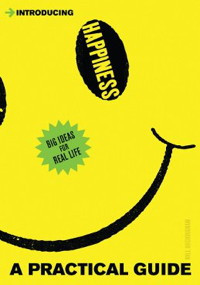 Just a quick post to say that if anybody wants to snap up a copy of my Introducing Happiness book, it is available as a part of the 12 Days of Kindle promotion for a short period for 99p in the UK. The offer ends January 7th. The link to the book in the UK is here.
The book is a breezy introduction to philosophies of happiness, and takes a broad kind of approach: from Mencius and Zhuangzi, to the practices of Buddhism, to Schopenhauer’s gloominess, to Epicureanism and Stoicism, to the strange world of contemporary positive psychology, to those freewheeling Cynics of the ancient world.
Apologies to friends elsewhere in the world: I think that this offer is only available here for those who live on this damp, rainy little island. But then, we probably need cheering up the most…
Will Buckingham's Blog

- Will Buckingham's profile
- 181 followers

