
Will Buckingham's Blog, page 25
April 7, 2013
Not At All Strange
If I’ve been relatively quiet over the past week or so, the main reason for this is that I’ve had my head down, seated here at my desk in Albi, France, and I’ve been editing like crazy, working on what I hope is the penultimate draft of my novel Goat Music. I’m here for two weeks, and so I’m more or less half way through; and it’s been a productive stay so far—I’m on track, I think, to have the draft done by the time I catch the train home next Saturday, which means that I can get an early copy to my publisher some time soon after.
I thought I’d say a bit more about the book here. The novel arose out of a fascination with the story of the musical contest between Apollo and Marsyas that began back when I was an art student. Set in mythological Greece, it plays on the story of the satyr’s competition with the god. The myth, in brief, goes like this: Marsyas challenges Apollo to a contest in music; Apollo wins by means of tactics that are not entirely fair; and then, having won, he flays the satyr alive for his presumption in challenging the gods.
My unease with this story lies in the fact that, for much of European history—although Apollo wins the contest by what could be called unfair means, and then exacts the most horrible punishment by flaying satyr alive—the tendency amongst commentators has been to side with Apollo, to see Marsyas as a fool who was justly defeated, and to proclaim Apollo’s brutality as a victory for all that is good.
Thus, as one Renaissance writer put it,
‘Marsyas means: a man who always lives in error. And it is the same to say Marsyas in Greek and Ironius in Latin, since both of them wish to argue with Apollo – that is, the wise one… Marsyas was defeated and Apollo flayed him: this means he stripped him of his errors and assigned to him the truth, and made it clear to people how little brains he had in him.’
That quote comes from the fifteenth century text, the Ovidio Volgare, and it does not stand alone. In fact, there’s a whole tradition behind this favouring of Apollo, the torturer, over Marsyas, the victim. After all, no less a thinker than Plato had the Socrates of the Republic saying, ‘The preferring of Apollo and his instruments to Marsyas and his instruments is not at all strange.’
But isn’t it strange to favour Apollo’s instruments—which include not only the lyre, but also the flaying-knife—to the pipes played by Marsyas? Isn’t there something profoundly unsettling in the tendency to turn this story of brutality and its justification into an allegory of wisdom (in the form of the god) ‘assigning to truth’ those who are in error?
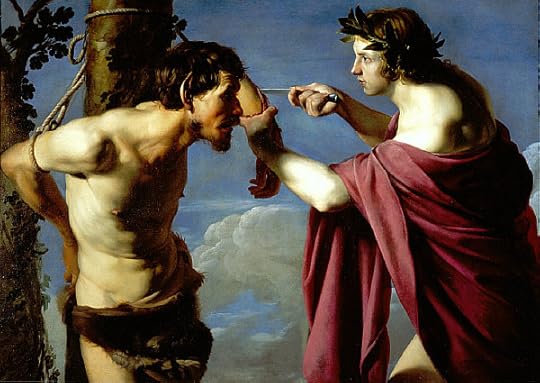
Bartolomeo Manfredi (1616-20): Apollo and Marsyas
One of the reasons this myth exerts a pull over me is that I cannot help but feel there are contemporary resonances not only of the myth itself, but also of the rhetoric that, since Plato, has surrounded it, a rhetoric that all too often translates naked brutality into the high-minded language of moral justification. I cannot help finding echoes of Plato’s ‘not at all strange’ when I hear government ministers announcing the latest cuts to services that are there to help those who need it most; and I cannot avoid seeing the same rhetoric at play as the gods of international monetary system sharpen their knives for austerity measures that strip away the livelihoods and hopes of ordinary people.
And it is the rhetoric that chills me most. It is one thing for Apollo to run rampant with his flaying-knife: but it is quite another drown this out with the sweet, reasonable music of the god’s lyre, to cover over the brutality and the horror that comes from assigning others to ‘truth’ with soothing justifications. Sometimes when I listen to the news, it occurs to me that in those calm and reasonable debates, everybody is playing Apollo’s tune, whilst meanwhile—somewhere out of earshot—Marsyas is screaming in terrible agony.
And with this dispiriting thought, I should stop blogging and get back to editing the manuscript; but let me leave you with this, taken from Tony Harrison’s The Trackers of Oxyrhynchus.
Wherever the losers and the tortured scream
The lyres will be playing the Marsyas theme.
You’ll hear the lyres playing behind locked doors
Where men flay their fellows for some abstract cause.
The kithara cadenza,the Muse’s mezzo trill
Cover the skinning and the screaming still.
Wherever in the world there is torture and pain
The powerful are playing the Marsyas refrain.


March 30, 2013
Wrestling Goats in Albi
I’m writing this from Toulouse railway station, where I’m awaiting the train to Albi. I caught the train to Paris yesterday evening, and then the overnight train down here to Toulouse. I’m here in France to spend a couple of weeks working on the final draft of my next novel, Goat Music. It has been a long time in the works, this book, and so it’s good to have the chance to spend time wrestling the draft into shape.
As a writer, I tend to work in concentrated bursts. I am in awe of those otherworldly figures who rise up at morning the morning, sharpen their HB pencils, and write longhand for two hours whilst the house is still quiet, calmly piling up the pages beside their desk. But I don’t work like this, and never have. I’m all fits and starts, sometimes not touching my writing for days on end, and then hiding away to spend hours and hours writing intensively (this is what I euphemistically refer to as a “holiday”).
I should have access to the Internet in the room I am renting (cheap, basic, looking out onto a little square – on paper at least it is perfect), so I’ll post here to update on my progress to let visitors know if I am getting the better of the goat, or vice versa. Happy Easter all!
March 27, 2013
Descent of the Lyre e-book now on GoodReads
The GoodReads listing has been updated with the new edition. See the link here. There are also a few sample chapters available online.
Here are a couple of reviews and blurbs, to whet your appetite.
“Blends history and myth… lyrical and well-written.” The Bookseller
“This is a book that is memorable for all the right reasons. The story is gripping and highly original, and it is beautifully written” Louis de Bernières, author of Captain Corelli's Mandolin.
“It’s just a good novel, a very good read, and a highly memorable tale told simply. Buckingham also writes compellingly as a guitarist, the descriptions of the music also sounding like music, in how the words sit on the page and how the phrases are paced, as well as their effect on the characters… I enjoyed this novel very much for its feeling of being a fable, a handed-down tale, constructed from bits and pieces of fact and fiction, blended back into myth.” Vulpes Libris
March 21, 2013
Lyres, Kindles and Book Awards
I’m delighted to say that my novel, The Descent of the Lyre, has been shortlisted for the East Midlands Book Award. It’s a very strong shortlist, and so it’s great to be on it. You can find out more about the award here.
Meanwhile, the book has just been issued in Kindle format, where it’s £5.99 in the UK and less than $10 in the USA. So if you are a Kindle user, and are given to fables about Spanish guitarists, the myth of Orpheus, Bulgarian saints, banditry and fierce alcohol, then get yourself a copy. The book is also available in handsome hardback.
You can find out more about the book on my personal website, where you can listen to extracts, watch the book trailer (book trailers being the in thing), listen to extracts and read reviews. The link is here. But, for the mean-time, here are some review extracts to whet your appetite…
~ @ ~
“Blends history and myth… lyrical and well-written.” The Bookseller
“This is a book that is memorable for all the right reasons. The story is gripping and highly original, and it is beautifully written” Louis de Bernières.
“Seasoned with knowledge of philosophy and storytelling as well as a deft touch and lyrical beauty… it feels totally original.” The Book Bag
~ @ ~
The prize-winning book will be announced in June at the Oakham Literary Festival. Wish me luck!
March 20, 2013
Great images, non-objects and fog
It’s been foggy lately—the kind of fog that makes the edges of things blur into indistinctness; the kind of fog in which forms dissolve into the background, or loom again, imprecisely shaped, out of the greyness. I’ve been thinking a lot about fog lately, because I’ve been reading François Jullien’s book The Great Image Has No Form, or On the Nonobject Through Painting. The title is admittedly something of a mouthful, the first part coming from chapter forty one of the Daodejing, which reads 大象無形, dà xiàng wú xíng, “the great image is without form”, but it’s a fascinating read.
The central question of Jullien’s book is this: how did it become possible, in Western thought, to “posit an object of perception, simultaneously isolate it, and abstract it in a stable and definitive form?” (p. xxi). So Jullien sets out looking not so much at painting as representation, but as de-representation. This, in other words, is a book that is about vagueness, about that which is indistinct, about the mist and fog that swirls through Chinese painting, about the mountains that simultaneously arise out of, and are dissolved into, the cloud.
I don’t want to say too much about the book here, because I’m still in the process of thinking about it; and it is the kind of book that—like a mountain fog—creeps up on you, that works not so much by giving you something to get your teeth into, but by a kind of blurring of those things that had hitherto seemed clear. Nevertheless, a couple of things struck me. One was Jullien’s aside about the sketch—here, I think, he’s following Merleau-Ponty—as more closely mirroring human perception than the painting that follows from it, precisely because perception itself is sketchy, as demonstrations of inattentional blindness and change blindness amply demonstrate (incidentally, ever since I have become convinced of the sketchiness of perception, I have also become a bit spooked out by the strange voodoo by means of which my brain convinces me that perception is not in fact this sketchy). Another was the notion of the subject itself as something that is blurry and indistinct. Here’s a nice quote:
The Zhuangzi teaches us to de-occupy ourselves, but not because the “self” is detestable and we must flee it or ascetically deny it, but because we need to recover from the consistency of the subject, to rid ourselves of it and “forget” it, in the terms of the Zhuangzi… in such a way that we no longer have to posit the world as an object opposite us, to be known and manipulated. (p. 164)
Somewhere—either on this blog, or on its predecessor thinkBuddha.org—I wrote about the passage in the deeply strange German philosopher, Franz Rosenzweig, where he suggests that most of the time our experience is simply not that of being a subject, separated off from the world, confronting a world of objects that is opposite us. We only become a subject (“I”) looking at an object (“a tree”, perhaps) when somebody says “what are you up to?” and we say, “Oh, I’m looking at a tree…” And it seems to me that this is a similar, but perhaps more far-reaching, insight.
As always with Jullien, there are huge vistas here, and if it is true that the devil is in the detail, the detail itself is often obscured by fog. Smoke and mirrors, his detractors might say. But perhaps there is also a virtue to thinking by means of smoke and mirrors, reflections and indistinctnesses. Perhaps the philosophers’ Cartesian obsession with that which is “clear and distinct” risks drawing them away from the truth to which they claim to aspire…
As I as thinking about all of this, I went to visit a good friend of mine, a poet, who lives out by Rutland Water, which is a large man-made reservoir. We drove through the fog to the reservoir, and then went down to the shoreline, where we took refuge in a hide set up for birdwatchers.
Fog hung over the lake. In the distance—it was impossible to say how far off—were the dark smudges of trees, appearing through the mist and disappearing again. I tried to trace the point at which the ripples of the water faded into the fog, the dividing line between one thing and another; but found all such attempts to draw boundaries (as if things were objects drawn by the pen of Hergé!) came to nothing.
And yet, this was not some kind of notion of oneness along the lines of certain vacuous new-age ideas, because this itself is a notion that itself is far too clear, far too distinct. It was rather a question, as I stood there, of a kind of de-occupying, de-positing, de-representing… It was a matter, that is to say—in this sketched world of blur and indistinct boundaries—of becoming sketchy myself. And I am aware, of course, that ‘sketchy’ is—in colloquial English, at least—a term used most frequently as an insult, applied in particular to people such as French philosophers…
The Descent of the Lyre: Now on Kindle!
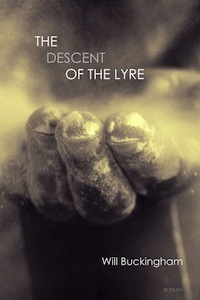
I’m delighted to say that my EMBA shortlisted novel, The Descent of the Lyre is now available for sale on Kindle as well as in traditional hardback. You can get hold of the Kindle versionhere in the UK and the USA.
March 16, 2013
Lyre on the East Midlands Book Award Shortlist
Well, I’m tremendously excited to announce—at the end of a very long and very busy day at the States of Independence independent publishers’ fair here at De Montfort University—that my novel, The Descent of the Lyre, is on the shortlist of the East Midlands Book Award.
I’m absolutely delighted with this news. The novel is published by Roman Books, a relatively new press with considerable ambitions, and I’m up against some formidable contenders. The full list is here:
Will Buckingham – The Descent of the Lyre, Roman
John Gallas – Fresh Air, and The Story of Molecule, Carcanet
Graham Joyce – Some Kind of Fairy Tale, Orion
Jon McGregor – This Isn’t the Sort Of Thing That Happens To Someone Like you, Bloomsbury
Alison Moore – The Lighthouse, Salt
Neil Roberts – A Lucid Dreamer, The Life of Peter Redgrove, Random House
Jonathan Taylor – Entertaining Strangers, Salt
This is an impressive list by any standards, and it makes me realise what a darned literary part of the country I live in. As an example of the calibre of some of my fellow shortlisted writers, Jon McGregor won the 2012 International IMPAC Dublin award, whilst Alison Moore was also shortlisted for the Booker. It’s good, too, to be nominated alongside my colleague and very good friend, the Jonathan Taylor.
The final award will be announced in June. Which gives you time to buy all the books on the list, and make up your own mind…
March 15, 2013
How the Revolution Began
After reading Julian Baggini’s piece on burning the Encyclopædia Britannica in Aeon Magazine, I couldn’t resist reposting this story about book-burning that I wrote way back (as one of my series of Yijing-based stories), and that was published on Necessary Fiction back in 2010. The story was called ‘How the Revolution Began’, and featured not a blazing encyclopaedia, but instead whole libraries of burning books, culminating in a set of blazing dictionaries.
~@~
First they banned novels, because they said — reasonably enough — that the world was complicated enough and the problems of the world grave enough, without the distraction of imagined worlds and non-existent problems. I was a young man back then. I remember standing outside the City Hall and watching the people bring cart-loads of dreams, fantasies and imaginings to fuel the pyres set up by the authorities. And perhaps I was not alone in feeling a kind of glee at the sight of those cheery orange and yellow flames, at the satisfying crackle of paper going up in smoke.
Afterwards, it was strange how quickly we adjusted. We got used to reading other things on the bus as we travelled to work. We filled the empty spaces on our shelves with ornaments. We got by.
Two years later, they outlawed books of poetry. There were protests, mainly from the poets themselves, but the reasoning of the authorities was sound: light verse, they said, was inconsequential; ballads were stories in disguise, and thus should, for the sake of consistency, go the same way as novels; love lyrics fostered delusion; sonnets were impossibly elitist; limericks inclined the mind to disrespect; and haiku — well, haiku were just downright odd, and foreign with it. Besides, nobody had read any poetry for years, even if — unaccountably — there were many who persisted in writing it.
Non-fiction lasted a little longer. By now I was a student and like many of my peers, I spent hours seated on the bus or in roadside cafés, reading works on philosophy, economics, science, history, medicine. And whilst we sometimes longed for a good couplet or two, for the simple pleasure of a story, there was plenty still to nourish us. Yet, during the year of my graduation, a new decree was issued, and the philosophy books were gathered together, heaped up outside the City Hall, and went the same way as the poetry and the fiction: Laozi and Leibniz, Marx and Mahavira, Al-Ghazali and Albertus Magnus — all of them destroyed in the fires until only their names remained.
Next, after a break of only a few months, came history; and then, over a period amounting to more than ten years, the various divisions of the natural sciences. Economics and medicine were the last to go, so that, by the time I reached middle age and my waist began to spread, the only book remaining on my shelf was the dictionary. Good, solid, authoritative, uncontroversial: a book of words, but not of thoughts. And even that languished: with only the dictionary on our shelves, we had all long lost our taste for reading.
Nevertheless, we continued to go on living. On the bus, freed from our books and newspapers, instead we gazed from the windows, or hummed softly to ourselves. Our conversations were few. We nodded to each other in greeting as we passed, but did not speak. When we visited each other’s houses, we arrived in silence, drank together without exchanging a single utterance, and departed with wordless smiles.
Then one winter, the decree came. We were to come to the City Hall and hand in our dictionaries. There was snow on the ground that morning. Some of us had pocket dictionaries, some desk editions, others dictionaries in multiple volumes, one for each of the letters of the alphabet. And after all that had happened, I was surprised by the heaviness in my heart as I too joined the queue of people who registered their books — mine was old-fashioned and heavy, in two volumes, with a blue binding bearing the name of an almost forgotten university — and then passed them to the officials where they were loaded onto carts.
We returned to our homes, not meeting each other’s eyes. And we saw the familiar orange glow over the roof-tops of the pyres by the City Hall. The bookshelves in my house were, at last, empty. There was nothing more to burn. I sat down in a chair, poured myself a glass of wine, and — unaccountably — found myself weeping.
Some time in the afternoon, when the light was failing and the orange glow was becoming ever stronger against the darkening sky, something unexpected happened. A strong breeze blew up from the east, sweeping down the valley towards our town. It circled around the pyres and took up the pieces of ash. Charred fragments of paper rose into the air, a strange and shimmering cloud spiralling upwards, and they caught on the breeze and fluttered beyond the square where they began to rain down on our houses and our gardens.
And the people of our town emerged into the streets to find words, strange words, lying there in the snow, in no particular order, lacking any logic: Gorgonzola; Trigonal; Indium; Fossiliferous; Rodeo; Stentorian; Nombril. Some words formed themselves into lines that, in a time already forgotten, somebody had laboured whole weeks on end to write, others seemed to suggest newness by the power of chance conjunctions, giving rise to new thoughts. And as I hurried into the street to witness this spectacle, I heard something to which I had long become unaccustomed — the sound of voices, of conversations, of shouts, the tentative beginnings of songs. I saw others like myself, standing before their houses, gazing down at the charred words in the snow with wonder, pointing, gesticulating, speaking, calling out nonsense syllables, testing out new combinations of words and sounds, smiling and laughing with delight.
This, then, was how the revolution began.
March 14, 2013
Interview with a Dormouse
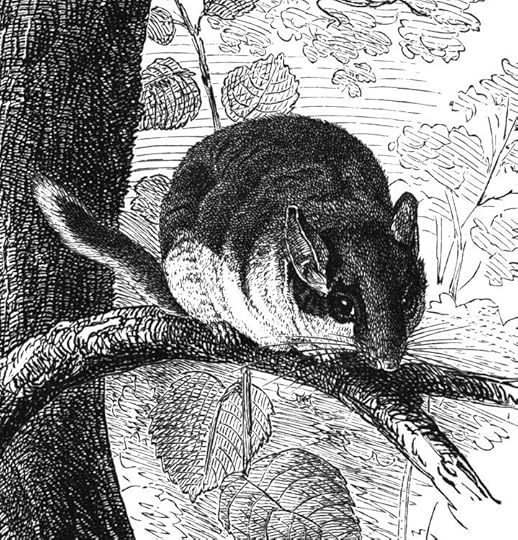 Image: Wikimedia Commons
The Dormouse over on the website of Shakespeare & Friends, the wonderful English language bookstore in Varna, has interviewed me about my novel, The Descent of the Lyre. It is, I think (although I can’t be sure), the first time I have ever been interviewed by a dormouse, and you can read the interview here.
March 13, 2013
The Myriad Things — Reloaded
 The Myriad Things
Just a quick post to say that I’ve recently given my blog site, TheMyriadThings.com, a bit of a facelift. Since giving the site a new lick of paint, I’m hoping to be blogging a bit more frequently over there.
The Myriad Things is, as the name suggests, a miscellaneous collection of bits and pieces—short essays on this and that, ideas, snippets and stories, an unsystematic collection of everything from the Moomins to Mao Zedong.
Will Buckingham's Blog

- Will Buckingham's profile
- 181 followers

