
Will Buckingham's Blog, page 23
July 25, 2013
Website Back in Action
Apologies to anybody trying to access this website over the last week or so, and finding it inaccessible. I’ve spent this morning giving a stern talking-to to some badly behaved WordPress plugins that were causing the problem, and now everything seems to be up and running again.


July 18, 2013
Oldham Book Award 2013 Shortlisting
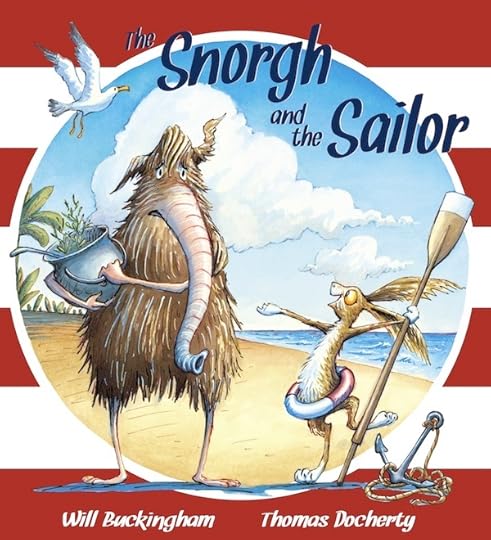
Just a quick update, this. I was very pleased today to hear that The Snorgh and the Sailor has been shortlisted for the Oldham Book Award for 2013 in the Key Stage 1 Brilliant Books category. You can see the full shortlisting here: http://www.oldham.gov.uk/brilliantbooks.
July 3, 2013
The Appendix
If you haven’t yet come across The Appendix, which is a new journal of narrative and experimental history, then head on over to their website to subscribe. They’ve got a fantastic range of content, and it’s a beautifully conceived and produced piece of work. The July 2013 issue includes some extracts from The Descent of the Lyre, along with some thoughts on the novel’s blend of history and fiction. Articles from this issue of The Appendix will be published online over the coming couple of months, with my article on the Lyre due out online some time in August. But no need to wait, as the journal is a thing of beauty: head over to their website and subscribe today!
June 17, 2013
Interview in Left Lion magazine

Head over to the excellent Left Lion magazine for a wide-ranging interview about writing, music, The Descent of the Lyre, philosophy and all kinds of other things. The link is here: Interview on Left Lion.
Festivals, Awards, Reviews for The Descent of the Lyre
Thursday is fast approaching, the day when the East Midlands Book Award is announced. I’m shortlisted for The Descent of the Lyre, along with Alison Moore, Jon McGregor, my colleague and friend Jonathan Taylor (with whom I share an office!) and others. The award will be announced on Thursday, and I’m looking forward to the evening event over in Oakham.
Meanwhile, the book has had a wonderful review in Nottingham’s excellent Left Lion magazine. Aly Stoneman’s review says,
“Buckingham draws on the ancient myth/metaphor of the hero’s journey, where the he must pass through a period of suffering to gain enlightenment. His fluid, economical prose follows a rich oral tradition of storytelling and myth-making, drawing the reader into the heart of the story… the result is a unique, timeless and enjoyable work of literature.”
You can find the link to the latest issue of Left Lion here (be warned, the PDF is rather large!). Meanwhile, I’m practising the guitar for an event at the Lowdham Book Festival, where I’ll be reading from the book, and playing music including arrangements of Bulgarian folk music. The event is next Saturday 22nd June, and you can find out more on the book festival website. Tickets £3!
June 14, 2013
Up North With the Donkey-Rat
Just a quick post this, as I have a train to catch up to Newcastle, and—before that—a lost mobile phone to track down (that’s the trouble with mobile phones: they move around, so it’s hard to remember where you last put them… I like my phones affixed to the wall). I’m heading up to Newcastle for a conference on Working Wonder, back in the Fine Art department where I did my undergraduate degree. I’m looking forward to being in what is probably my favourite city.
I’m doing a paper on the diviner Guo Pu (郭璞), and an interesting tale that I first came across in Writing Against the State: Political Rhetorics in Third and Fourth Century China by Dominik Declercq. The tale concerns Guo Pu’s encounter with a strange creature. The account Declercq draws from comes from the seventh century compilation, the Jin Shu 晉書, but this is drawn in turn from the fourth century Sou Shen Ji 搜神記 (see here). Here’s the passage I’m talking about.
From the Sou Shen Ji: 郭璞過江,宣城太守殷佑,引為參軍。時有一物,大如水牛,灰色,卑腳,腳類象,胸前尾上皆白,大力而遲鈍,來到城下,眾咸怪焉。佑使人伏而取之。令璞作卦,遇遯之蠱,名曰“驢鼠。”卜适了,伏者以戟刺,深尺余。郡紀綱上祠請殺之。巫云:“廟神不悅。此是郱亭驢山君使。至荊山,暫來過我,不須觸之。” 遂去,不复見。
Guo Pu crossed the river, and the head of Xuancheng prefecture, Yin You, made him a military adviser. Once there was a creature, large like a water-buffalo, grey in colour, with stumpy legs, its legs like an elephant, its chest at the front and the tip of its tail white, very strong and dull-witted; and it came up to the city walls. The crowd were all astonished. Yin You got his men to stalk and trap it. Then he ordered Guo Pu to perform a divination. He got the hexagrams “dùn” [䷠ 遯/遁 “fleeing - retreat”] changing to “gǔ” [䷑ / 蠱 “work on what has been spoiled”]. Having performed appropriate divinations, he said its name was “Donkey Rat.” One of the men who had stalked it pricked it with a spear, a foot deep. A prefectural official went to the temple to ask if it should be killed. The oracle said, ‘The temple god is displeased. This [creature] was sent from Lake Gongting by the Lord of Donkey Mountain [Mount Lu, 廬山 Lushan, with Lü / 驢 here substituted for Lu 廬]. It came as far as Jingshang, and recently passed by me here. You must not touch it”.
What my paper is about is the question of where the wonder is in this tale. I’m interested in the Western imperative to wonder—which appears everywhere from Brian Cox’s mop-headed stargazing, to the homilies of the religious on BBC radio’s Thought for the Day, to the wide-eyed enthusiasm of the artists. Roughly, my argument (and it is rough) is that wonder is a curious kind of notion that has an ethical force in the West, and that is in need of further examination, and that what we take for wonder may be rooted in a particular relationship to the unknown (or the unknowable) that is not as universal as we imagine. Along the way I’m going to be talking about great chains of being, flat ontology, and—of course—the 萬物 or ten thousand things. All in fifteen minutes. Well, I can but try…
The main reason I’m saying any of this, however, is that it is an excuse to show you the following picture I made of a donkey-rat, a piece of photoshopping of which I am inordinately proud. If you see one of these wandering around your way, do let me know. I’d love to meet one…
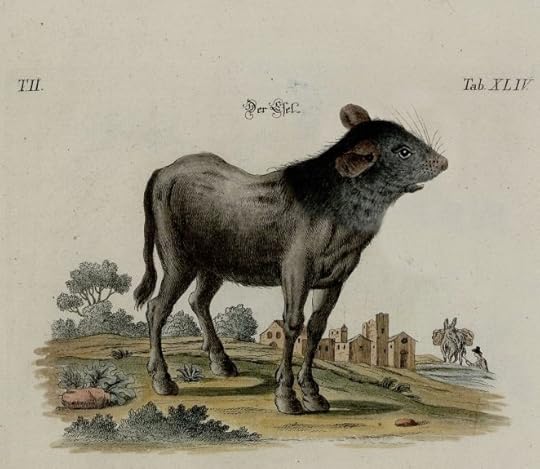
A Donkey-Rat in its natural habitat.
June 11, 2013
Brief Thoughts on Creativity
Lately, I’ve been thinking about creativity. I’ve been thinking about what it means to bring new ideas, thoughts and stories into being. And, in particular, I’ve been thinking about fairy dust.
Part of the reason for all this is that I’ve been hard at work over the last few weeks writing a paper which is due to be published later this month in National Taiwan University Studies in Language and Literature. The paper is called “Participation, Pattern and Change” and is about what I am calling participative creativity. The main idea behind the paper is that whilst creativity is still frequently seen as the intervention of something unworldly into the world—either a god, or a god-like infusion of genius into the mundane, or some kind of fairy dust—when it comes down to this, this is a pretty bad model for how we go about writing stories, composing music, painting pictures, coming up with new thoughts and hypotheses, finding new solutions to problems. So the paper explores a ‘participative’ model of creativity, drawing on my current favourite text, Liu Xie’s sixth century Wenxin diaolong 文心雕龍 (“The Literary Mind and the Carving of Dragons”) and on Lucretius’s De Rerum Natura (“On the Nature of Things”). My aim is to set out a model that can account for literary creativity whether in China or in the West, one that does not have recourse to fairy-dust notions of creation ex nihilo.
What is at stake here, is the question of what the conditions are that are necessary for creativity. As a teacher of creative writing, sometimes I come across students who claim, curiously, that they are not ‘creative’; and when this happens, I wonder what it is that they think that they are missing. It is my suspicion that they are in the grip of unhelpful notions of what it means to create. There is a widespread and popular idea of creativity as something akin to fairy dust: intangible, a bit sparkly, not entirely of this world, and rather hard to procure. And this fairy-dust notion of creativity is, I think, what lies behind the brainless notion (a notion that is adhered to in the face of all evidence to the contrary) that creative writing cannot be taught. This is an idea that is so boringly widespread, and so clearly evidentially false, that it is hard to know why people still maintain it in newspaper column after newspaper column. What this particularly numbskull notion seems to boil down to is this: either you have fairy dust or you do not. And it’s not down to you, or down to whoever is teaching you, whether you have fairy dust: it is, ultimately, down to the fairies (and who knows what they are up to?).
I’ll post a link to the paper when it is published. But here I want to just mention a wonderful book by James Austin (who some visitors to this blog may know as the author of Zen and the Brain), called Chase, Chance and Creativity: The Lucky Art of Novelty, which explores the role of chance in creativity, and which I think makes some interesting inroads into the question of what it is to teach creativity. Our relationship with chance, Austin points out, is not just a kind of victimhood in the face of blind chance. In fact, Austin divides chance into four different categories. I’ll set them out below.
Chance I: Blind luck, things just happen.
Chance II: Chance that favours those in motion (or, as Austin writes, “the posture of creativity is forward-leaning”)
Chance III: Chance that favours the prepared mind.
Chance IV: Chance born out of a distinctive personal “flavour”, out of the fact that it is an idiosyncratic individual who is engaging with the world.
What’s interesting about this is that, from the point of view of teaching creative writing (or creativity in general), although Chance I is out of our hands, chance II, II and IV are not. Chance II is a matter of keeping moving, of going out and rambling over the hills, of seeing what you turn up in libraries (I tell my students, sometimes, that they should hand around in library shelves waiting to be mugged by passing books; Walter Benjamin talks about walking down the street and being mugged by passing ideas). Chance III is a matter of accumulating a wide store of reading and of experience on which to draw (something that Liu Xie, in particular, insists upon). Finally, Chance IV is a matter of cultivating idiosyncratic interests and obsessions, because out of these strange juxtapositions, interesting things can arise. And all of this can boil down into really quite practical advice. Keep moving and keep exploring the world. Keep accumulating experience and reading. Follow those things that matter to you, and cherish your idiosyncratic interests. It is this, ultimately, that makes creativity participative, because it is about getting involved in the stuff of the world, rather than pulling down something unworldly from a mythical location outside the world.
What it cones down to is this. I don’t believe (or I don’t think I believe) that there is such a thing as an inherently uncreative person; but I do believe that there are more or less creative practices or even forms of life. And these can be taught.
June 4, 2013
Bits and Pieces
I’ve been rather slow with updates here on WillBuckingham.com and also over on TheMyriadThings.com, in part because of changing web-hosts, which has been a long and rather arduous process (there have been quite a few sites to move), in part because life has been more demanding than usual in the last few weeks, and in part because I’ve had multiple writing projects and proposals on the go with deadlines looming left, right and centre.
But I thought nevertheless I should update the site to say that I’m now happily set up on the new server, and my websites should now be behaving rather better, and also to pass on the pleasing news that I’ve recently been made a Reader in Writing and Creativity at De Montfort University.
More anon about some upcoming events—conferences, talks and the like. But now back to those manuscripts that need my attention.
May 14, 2013
Back online
Well, it’s been a hell of a week ever since the servers running this site went into meltdown, but I’m now back in action. Just a quick request: if you emailed me in the last week and are urgently expecting a reply, could you resend? A few emails may have gone astray whilst the gremlins were doing their worst.
Do not adjust your sets
Well, after six whole days of having no access to email or to any of my various websites—thanks to a server meltdown—I’m glad to say that I’m now back in action. Apologies for the long, wintery blankness here on TheMyriadThings.com, but other than sending exasperated queries to tech support for the entire week, and lots of anxious pacing to and fro, there has been little that I have been able to do.
I’m currently reviewing how I host my sites behind the scenes; but I’m very glad that the site is back in action. Hopefully WillBuckingham.com is not far behind. If you’ve sent me any email over the past week, then please do re-send if you haven’t heard back, as your email has probably merged with the ether. And the ether, as everyone knows, doesn’t exist…
Will Buckingham's Blog

- Will Buckingham's profile
- 181 followers

