Blair Bancroft's Blog, page 55
September 15, 2013
EDITING - "Modern" Punctuation
 Up close & personal with a frog at Chatfield Hollow State Park, CT
A quick trip to Connecticut last week - where Susie and I visited sites old & new.
 Mailbox for the new "Fire Palace" in Branford, CT
 While in New Haven, we stayed only a few blocks from the house used in the Adam's Family. Which has been bought refurbished, and expanded by Yale into a conference center.
~ * ~
"Modern" Punctuation - for good or ill
As both a writer and an editor, over the past couple of years I have been attempting to adjust to the contemporary approach to punctuation, which is definitely not what I learned in English class way back when. Certain changes, I find, I can accept. Others? Forgetaboutit! Below are some of the changes I am trying to incorporate into my own writing and into the fiction edits I do for others. (I am talking about fiction only here - I am unsure if "modern" times have caught up with the academic world or not!)
Grace Note 1: The general trend is definitely toward "Less is More." The assumption is, we can use less punctuation and still write sentences readers can understand. Sentences that offend neither eye nor ear (for I suspect we all "hear" the poetry in good prose in our heads, even if we've never stopped to think about it before.) Sentences we don't have to stop and read a second time to understand the meaning. Clear sentences that warm our hearts, curl our hair, tickle our funny bones, or scare the daylights out of us. Clarity is all important. I will never be "modern" enough to believe in the philosophy that says: "If you can read a sentence without punctuation don't put any in." Aargh!
Grace Note 2: I would suggest that "modern" punctuation is subjective; i.e., not mandatory. If you ignore it, however, don't be surprised when a copy editor makes changes. I also suggest that classic punctuation still seems appropriate for historical novels, though I make a conscious effort not to clutter a sentence with too many commas.
New punctuation I can live with - most of the time:
1. Most short compound sentences can do without a comma in the middle. Emphasis on short.
Betty walked down the street but John went the other way.
2. Introductory phrases of 3 or 4 words can do without a comma at the end of the phrase. (I make subjective choices on these - the "new" rule doesn't work 100% of the time.
Early next morning I dressed and went to work.
3. Certain phrases at the end of a sentence can do without a comma dividing them from the main part of the sentence. (Also a subjective call .)
It was raining hard as I ran down the street.
4. Not so new (& true mostly of Romance genres): Colons & semi-colons are rare - very likely considered too academic. The colon has been replaced by an M-dash or by using two separate sentences. Semi-colons have been replaced by simple commas (and, yes, that creates 2 separate sentences divided by a comma). You can also use a period, creating two separate sentences. Or use an M-dash.
It was dark and cold, the moon was rising.
Grace Note 3: Enjoying being contrary, I used both colons and semi-colons in my latest book, Brides of Falconfell.
5. N-dash. I personally use the N-dash for stuttering dialogue. Other authors simply use a hyphen. The choice seems to vary from publisher to publisher.
"I–I'm so c–cold my teeth are chattering."
Grace Note 4: M- and N-dashes are found in Insert - Symbols, or, faster & easier, by using ASCII codes. M-dash = Alt +0151 on your keypad (Num Lock on). N-dash = Alt + 0150 on your keypad. [These numbers will not work on your QWERTY keyboard, only on the keypad.]
Some "oldies" that authors need to remember:
1. Do NOT put a comma before "and, but, then, while, etc." if these conjunctions connect two compound verbs; i.e., ONE subject with two verbs that follow it.
John played baseball in the afternoon but went to a nightclub that night.
Exception: a comma may be inserted for clarity or for emphasis.
2. A clause beginning with "even" does not need a comma before it. (Though I tend to do it every time.)
That's the last thing I'd ever do even if you paid me.
3. Do NOT use a full sentence (subject & verb) as a dialogue tag. (He said, she replied, he asked, etc., are okay, but not a long sentence that can stand independently.)
Wrong: "You know something," John rubbed the side of his nose, "that's just plain crazy."
Correct: "You know something . . .? John rubbed the side of his nose. "That's just plain crazy."
or (though not all copy editors agree) "You know something"—John rubbed the side of his nose—"that's just plain crazy."
4. I'm still seeing manuscripts without a Hard Page End at the end of every chapter. Don't "space" this - it's essential to every professional author. Hard Page End = Control+Enter. [One of my clients swore she'd done that on every chapter - turns out, she hadn't always held the two keys down at the same time.]
5. I'm also still seeing manuscripts with Manual Indents. These are an absolute no-no these days in both print and e-publishing. Set up Auto tabs. [For how to do it - or how to change a ms from manual to auto tabs, see my blog, Tab Conversion
Some "changes" I reject - the choice, however, is up to you:
1. Not adding an "s" to possessive names ending in S. For example: Nicholas' instead of Nicholas's. You have only to pronounce the word to discover that leaving off the s is ridiculous as we pronounce it quite clearly when we say the name.
2. Ellipses. The trend is all toward using an ellipsis with no spaces, perhaps because the almighty god, Microsoft Word, made it an automated "built-in." Sigh. I don't like those three little side-by-side periods, which provide more of a hiccup than a proper space in the narration or dialogue. I don't like it even if a space is put on either side of those three miserable periods. I'll stick with the Chicago Manual of Style, thank you very much. Ellipses were designed to provide a pause, and only . . . [space-period-space-period-space-period-space] does that.
~ * ~
Thanks for stopping by,
Grace
Sept. 22: The wind-up to this Editing series: "Questions you should ask yourself"
Sept. 29: Updated Index to my Writing & Editing blogs
Blair's Website Editing Service


September 1, 2013
EDITING - The Difference a Word Makes
 Way down upon the Suwanee - Labor Day Weekend 2013
 Self-portrait of a real estate investment broker on Labor Day weekend
~ * ~
Update on What Grace is Reading:
I generally order a number of Kindle books at once, some on pre-order, so several weeks later it's not unusual to find some puzzles on my Index. Recently, I stared at a certain title, having no idea why I'd ordered it. The author's name struck no bell. But it seemed to be the only "unread" book on the list, so I opened it. Two pages in, I went back and checked the author's name, because even that little amount was all it took for me to realize this was no ordinary book, but one of a quality only a very few authors on my Kindle book list could boast.
Author: Robert Galbraith. Huh? And then I remembered. Paying no attention to the title (as usual), I had ordered the first of a new mystery series by J. K. Rowling, writing as Robert Galbraith. According to the publicity I read, when The Cuckoo's Calling didn't sell well, the news that Robert Galbraith was really J. K. Rowling was "leaked," and the sales skyrocketed.
Is this a mystery worth reading? Frankly, it's amazing. As always, Rowling needs an editor, taking too many words to say what she has to say, but nonetheless each word is a gem . . . The characterizations are brilliant, leaping off the page, the plot intricate enough to satisfy any mystery fan. Our local Orlando reviewer wasn't far off in likening Rowling's style to a mix of Charles Dickens and Agatha Christie. Plus very few authors have the intimate knowledge of the world of fame and the famous which Rowling exhibits.
The Cuckoo's Calling is not for those who want a quick, fun read. It's about as far from a Cozy as one can get. But for those who enjoy long books with a stunning cast of characters, sensitive, detailed descriptions, plus a complex whodunit, this is the book for you. J. K. Rowling lives up her reputation, and then some. Like a kid waiting for the next Harry Potter, I can hardly wait for the next mystery in this series.
~*~
EDITING - The Difference a Word Makes
Some time ago—I believe it was on one of RWA's chapter loops—someone made the statement that they just couldn't believe that certain famous authors took hours pondering the exact right word for a sentence. The commenter seemed to think it was ridiculous for an author to be so fussy. Since I was younger and less experienced at that time, I made no rebuttal. You could say, however, that today's blog is it. Yes, a single word—or sometimes a revision of only two or three words—can make a huge difference. Examples:
He took her by the arm.
He grabbed her by the arm.
She turned the baby onto his back.
Gently, she turned the baby onto his back.
She cried.
She burst into tears.
An actual edit from my very first New York print book:
Original: He was everyone’s idea of what a tough cop should be. Dirty Harry with straight black hair, hard brown eyes and a slash of a mouth that looked as if he didn’t know the meaning of the word smile.
Editor's version: He was every woman's fantasy of what a gorgeous cop should look like. Complete with straight black hair, hard brown eyes and a mouth which looked like he knew how to kiss.
Just a change of word, here and there, but what a difference! And, of course, because it was my first NY book, I didn't protest, but you can be sure that when Love at Your Own Risk went indie, the original version was back in place.
~ * ~
Below are some examples culled from my recent edits of Brides of Falconfell. And, no, there are no earth-shaking changes that might have warranted spending half a morning figuring each one out - I don't claim to be a great literary author. But hopefully the examples will be enough to give you an idea of how important very simple changes can be to every author's work. And why self-edits are so important. Examples:
I'd have to think about it tomorrow.
I'd think about it tomorrow. ("Less is More" - shorter is more dramatic)
The demeanor of the perfect fell away.
The demeanor of the perfect housekeeper fell away. (why we all have to edit - sometimes it's simply a mistake)
She swung the shotgun with all the weight she must have put behind the blow to Fraser's head . . .
She swung the shotgun with all her considerable weight . . . (less awkward, more drama)
Shot peppered the bottom of our hole . . .
Shot peppered the bottom of the shake hole . . . (changed for clarity & drama)
It might have been a belated wedding night . . .
The Solstice might have been a belated wedding night . . . (clearer reference & better grammar)
When the dowager made such a pointed remark about when Justine would be leaving . . .
When the dowager made such a point of asking when Justine would be leaving . . .
(nearly as long but less awkward)
Justine and her problems had simply flown from my head.
Justine and her assertions had simply flown from my head. (stronger)
...a wife to demonstrate that, truly, his amatory interests were not in his own kind.
...a wife to demonstrate that, truly, his amatory interests were not in his own gender. (clarity - no doubt about what is meant)
I promised Fraser we would not go but a few feet . . .
I promised a frowning Fraser we would not go but a few feet . . . (more colorful)
I jumped up and nearly ran from the room.
I jumped up and dashed out of the room. (stronger & less awkward)
I stumbled to my feet with such haste, only the rapid footwork of one of the footmen saved my chair from falling over.
I stumbled to my feet with such haste, only quick thinking by one of the footmen saved my chair from falling over. (I really liked "rapid footwork but felt "feet, footwork & footmen" in one sentence was too much.)
I'd last seen Maud's maid sobbing in the kitchen . . .
I'd last seen Maud's elderly maid having hysterics in the kitchen . . . (stronger)
"She what?" I whispered, echoing Nettie's tone.
"She what?" I whispered. (extra words diluted meaning*)
*allowing too many words to detract from the impact of a big moment is something I see frequently in the books I edit.
After a moment's argument with my insatiable curiosity . . .
After a momentary tussle with my insatiable curiosity . . . (more colorful)
He pointed in two nearly opposite directions in hollows between the hills . . .
He pointed toward two widely separated hollows between the hills . . . (less awkward)
Even though we entered through a little-used side door, I thought I hear the rustle . . .
Even though we entered through a little-used side door, I thought I heard the rustle . . .
(Those typos will get you every time)
People who looked to me for guidance (even if hard-pressed to choke back their snickers). I was not supposed to be growing roots at the end of my chaise-longue.
People who looked to me for guidance. I was not supposed to be growing roots at the end of my chaise-longue. ("snickers" is anachronistic & I ended up eliminating the entire thought)
~ * ~
Thanks for stopping by,
Grace
Blair's Website Editing Service
Next Mosaic Moments - September 15, 2013
August 25, 2013
Debunking "Male" Quotes
 To add a bit of color to today's blog, find the ET in this photo. (His name is Harry)~ * ~
All information below (except for one Grace Note) is excerpted from "Anonymous was a Woman" by Fred R. Shapiro, Yale Alumni Magazine, Jan/Feb 2011.
"I would venture to guess that Anon, who wrote so many poems without signing them, was often a woman."—Virginia Woolf, A Room of One's Own.
Grace note: Mr. Shapiro agrees with Ms Woolf and without delving too deeply into the obvious male dominance behind the misattributions he found, simply offers them as evidence of the world women have lived in for so long - and which, though improved, still rears its ugly head.
"He who has achieved success who has lived well, laughed often, and loved much; who has enjoyed the trust of pure women, the respect of intelligent men, and the love of little children; who has filled his niche and accomplished his task; who has left the world better than he found it, whether by an improved poppy, a perfect poem, or a rescued soul; who has never lacked appreciation of earth's beauty or failed to express it; who has always looked for the best in others and given them the best he had; whose life was an inspiration; whose memory is a benediction."
Oft attributed to Ralph Waldo Emerson or Robert Louis Stevenson, the above was written by Bessie A. Stanley of Lincoln, Kansas, in 1905. She earned $250 as the first-prize winner in a contest sponsored by the magazine Modern Women.
***
"I disapprove of what you say, but I will defend to the death your right to say it."
Usually attributed to Voltaire. The real author: Evelyn Beatrice Hall (1868-1919), the English author of The Friends of Voltaire (published 1906).
***"Iron Curtain"
Used by Winston Churchill in 1946 to describe the divide between the USSR & the West, it was coined by Ethel Snowden (1881-1951), an English suffragette, in her 1920 book Through Bolshevik Russia. "We were behind the 'iron curtain' at last!"
***
"The only difference between the rich and other people is that the rich have more money."
Ernest Hemingway attributes this quote to Scott Fitzgerald , but it actually comes from a remark made to Hemingway by Mary Colum (1884-1957) at a lunch in 1936.
***
"Now I know why nobody ever comes here; it's too crowded."
Often attributed to Yogi Berra, the quote comes from a Montana newspaper in 1941, which attributes it to a "flutterbrained cutie named Suzanne Ridgeway."
***
"We will overcome."
This anthem of the Civil Rights movement, long associated with Pete Seeger, was first used in 1946 in a strike against the American Tobacco Company, where Lucille Simmons created and sang it on the picket line. Seeger's only change, years later, was altering "will" to "shall."
***
"Just say the lines and don't trip over the furniture."
Usually attributed to Noel Coward in his play, Nude with Violin (1956-58). But it is listed in a "Best Quote" book as originating with actress Lynn Fontanne (1887-1983) in 1954, when she said: "We move about the stage without bumping into the furniture or each other."
***
"Our deepest fear is not that we are inadequate. Our deepest fear is that we are powerful beyond measure. It is our light, not our darkness, that most frightens us."
Frequently attributed to Nelson Mandela, these words first appear in the book A Return to Love (1992) by Marianne Williamson (1952-).
***
"Does it really matter what these affectionate people do—so long as they don't
do it in the streets and frighten the horses!"
Oft attributed to King Edward VII or an 18th c. general, the words are most likely by the actress Beatrice Stella Tanner Campbell (1865-1940), allegedly her response when told about an actor being enamored of a young leading man. ***
Tidbits:
"If you make it here, you make it everywhere." (later incorporated into "New York, New York") & "That does not compute."
Julie Newmar, 1959 & Julie Newmar, 1964
***
"No time like the present."
English novelist & playwright, Mary de la Rivière Manley (1663-1724)
***
"No man is a hero to his valet."
Anne-Marie Bigo de Corneul (1614-1694), hostess of a Parisian salon and much-cited wit
***
"Twinkle, twinkle, little star . . ."
From Rhymes for the Nursery by Ann Taylor (1782-1866) & Jane Taylor (1783-1824)
***
"Mary had a little lamb . . ."
Sarah Josepha Hale (1788-1879), one of the first major U.S. female writers
***
"Laugh and the world laughs with you;
Weep, and you weep alone."
The American, Alla Wheeler Wilcox (1850-1919), in her 1883 poem, "Solitude."
***
"E.T. phone home."
Written by screenwriter Melisssa Mathieson (b. 1950) for the film, E.T. The Extra-Terrestrial.
~ * ~
Special Note: I have just updated my Best Foot Forward brochure ( (editing & copy editing services). If anyone would like a copy, click here
Thanks for stopping by.
Grace
Also updated this week, my website: Blair Bancroft
August 18, 2013
CAPE COD 2013
We enjoyed Cape Cod so much in 2012, all eight of us went back again this year.
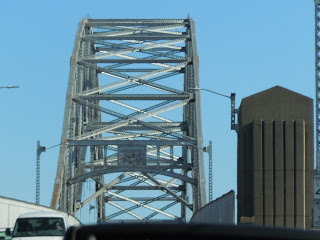 The big moment - crossing the Cape Cod canal via bridge built in 1933
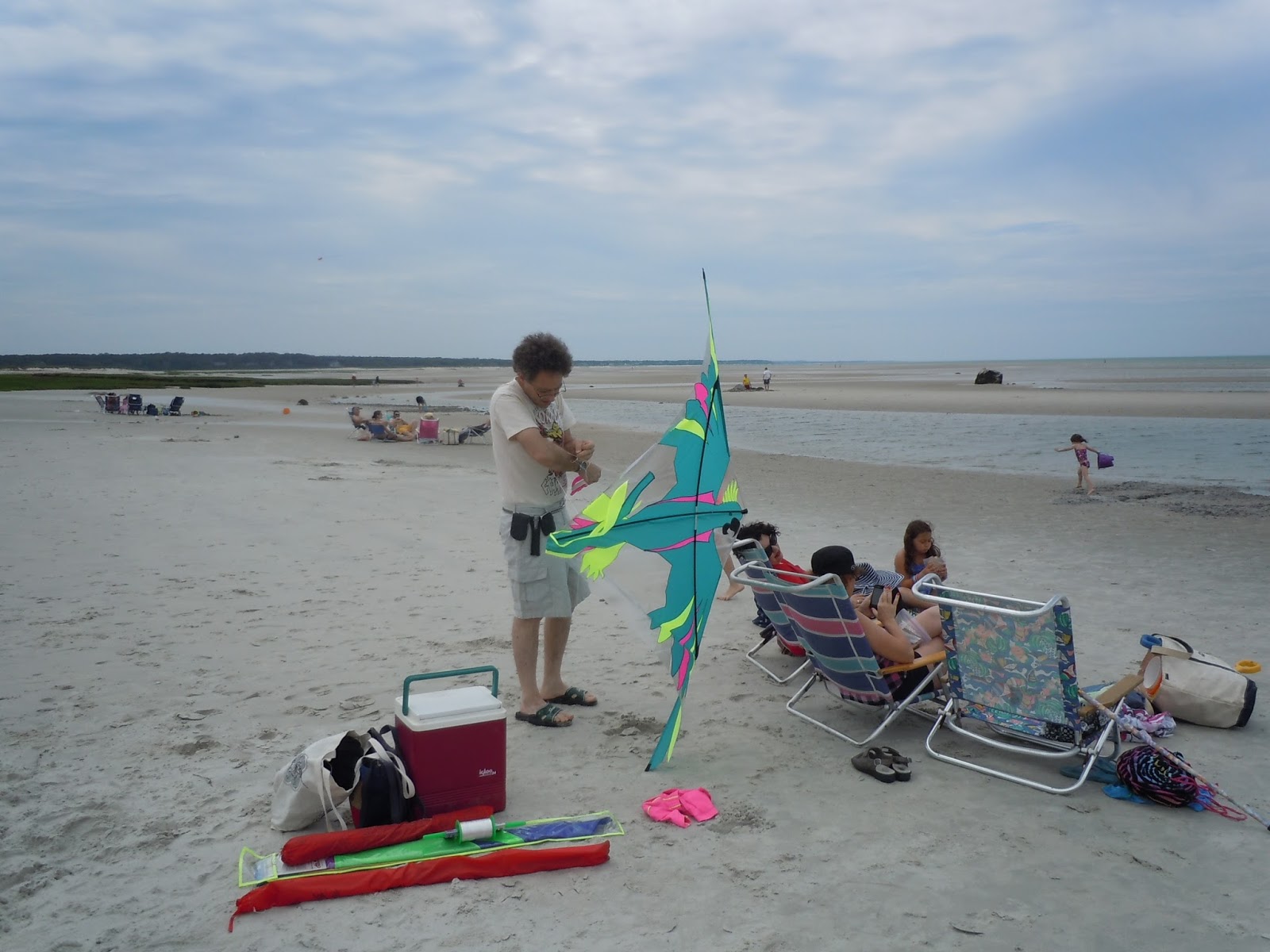
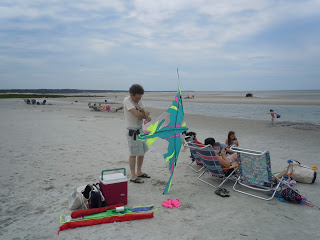 My son David mounting a kite while the rest of the family takes it easy
 The tide goes out nearly a mile at Skaket Beach - this taken from only part-way out
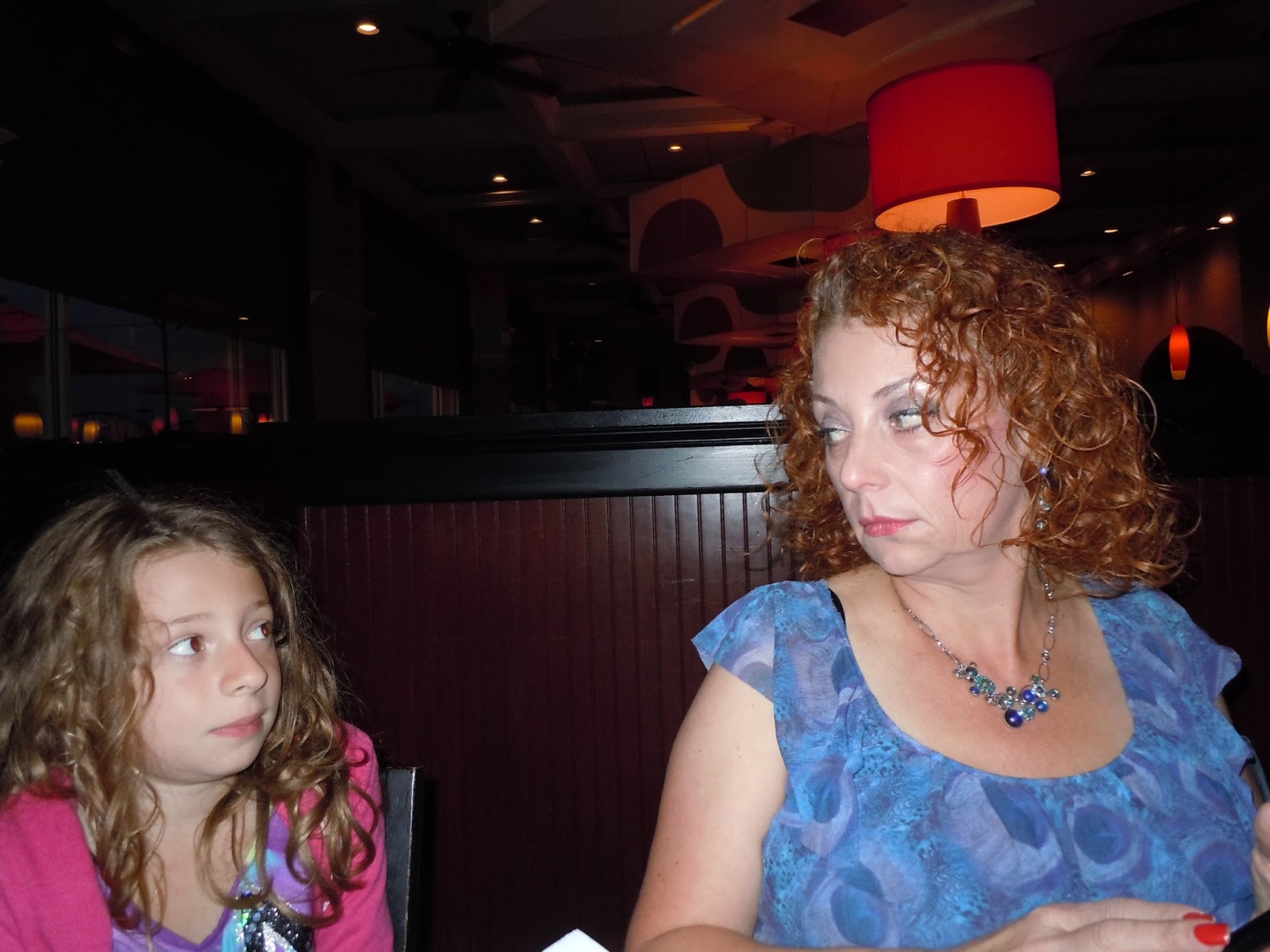
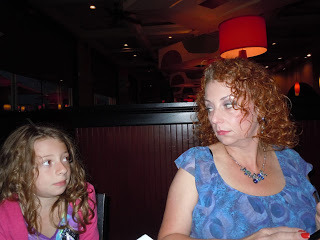 "The Look" - one of the less blissful moments at our Father's Day dinner
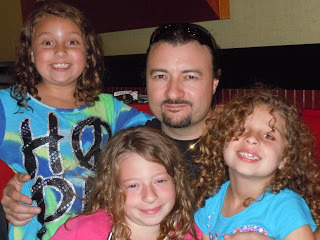 After 5 or 6 tries - Hailey still has that lingering "look"
Susie's smartphone literally hit the pavement in Boston, and we didn't get a replacement until just before Father's Day dinner in Hyannis. The following morning I got my camera back and set out to record the Cape I recalled from all my many visits in the past - and living in Wellfleet when I was four.
 Orleans Town Cove
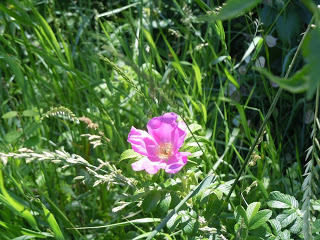 Wild rose at the edge of Orleans Town Cove
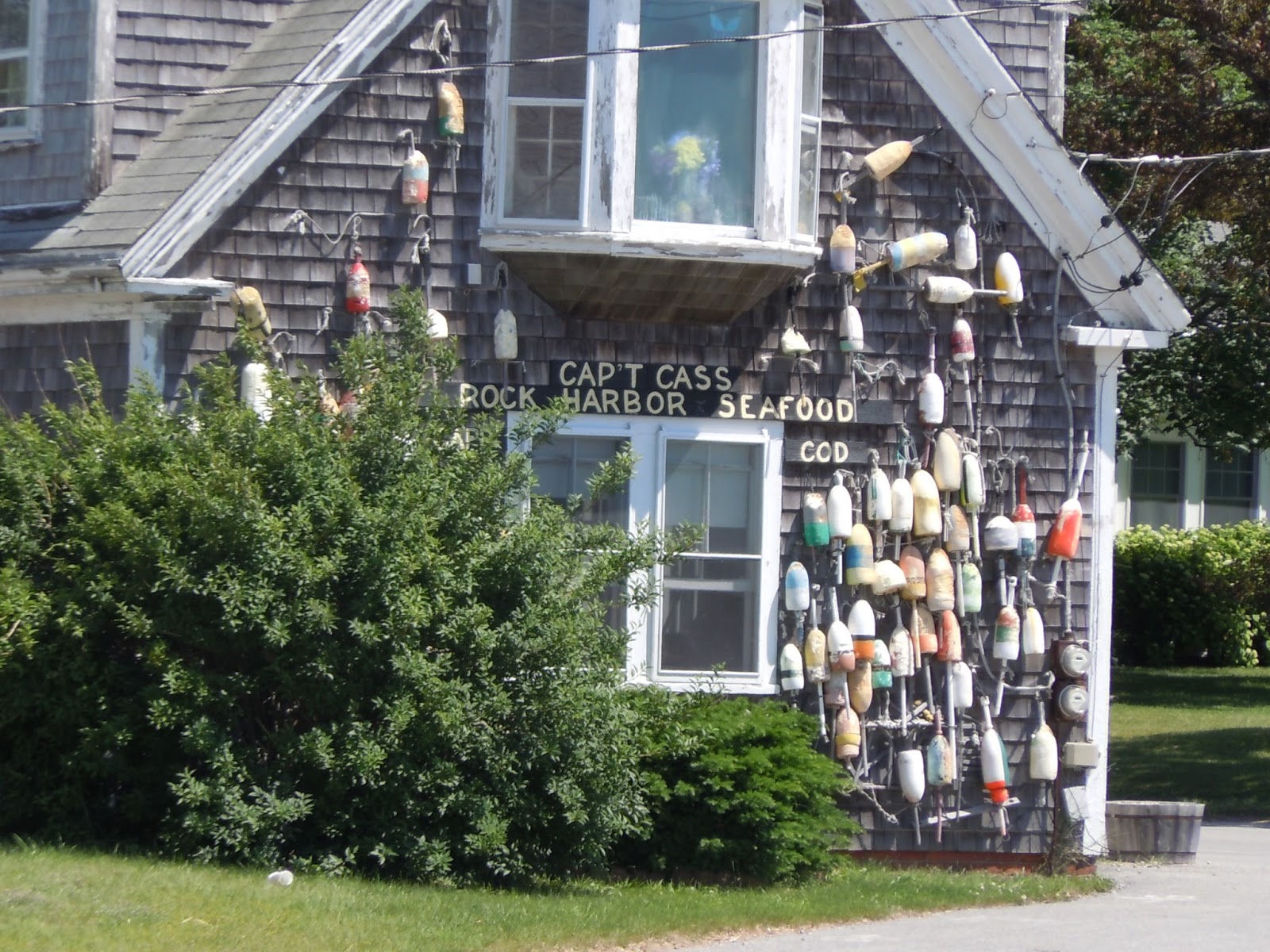
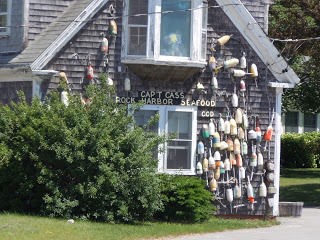 Rock Harbor, Orleans
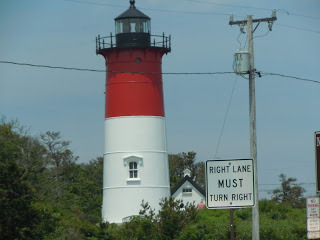 Nauset Light - a functioning lighthouse in Eastham
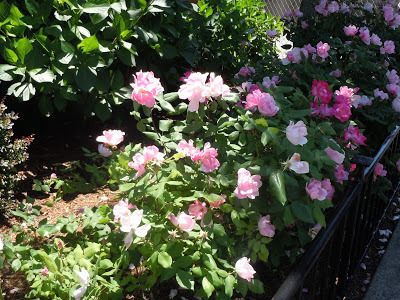
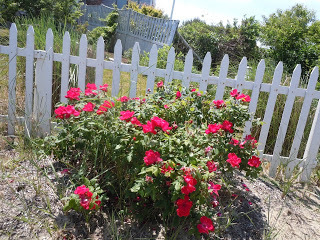 Roses were coming into bloom all over the Cape
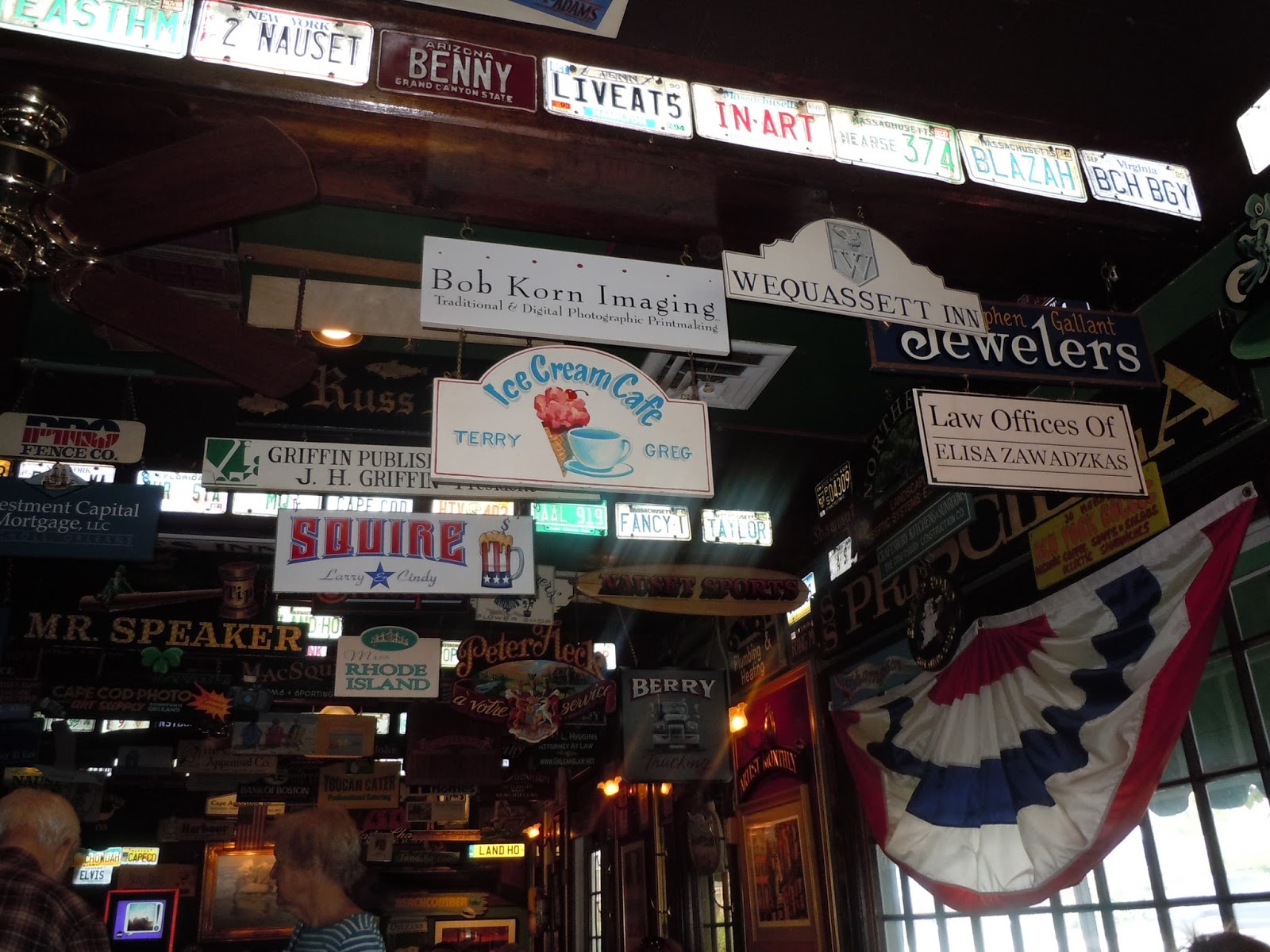
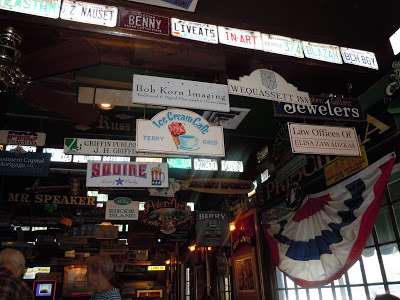 A small portion of the decor in the restaurant beloved by Orleans locals
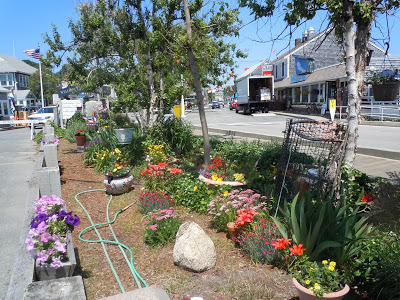 On the way to the dock, Provincetown
 Shop Therapy, Provincetown
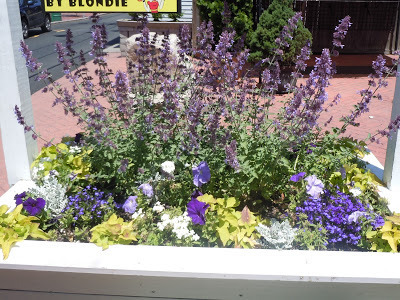
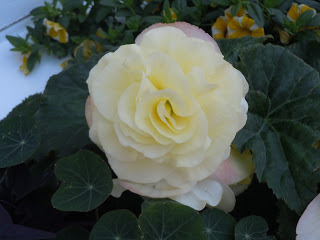 Flowers everywhere in Provincetown
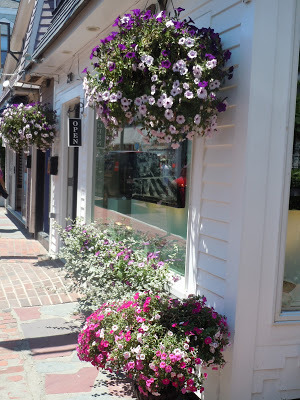
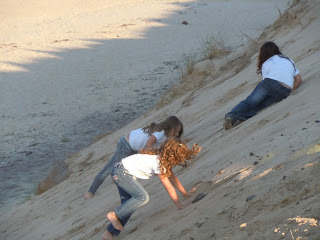 Continuing a 3-generation family tradition (now illegal)
When we lived in Wellfleet many years ago, my father would stand on the "backshore" (Atlantic), point straight out, and say: "There's nothing but ocean between here and Spain."
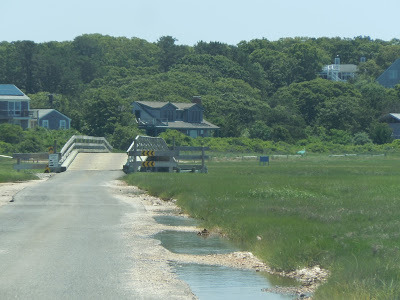 Lieutenant's Island is separated from the mainland by a salt marsh at least as long as a football field. Until fairly recently there was a wonderful old rickety bridge that spanned the entire marsh. I tried it once, a heart-stopping experience. But when we went back this year, the old bridge had clearly bit the dust, to be replaced by nothing more than the sturdy structure seen above, which crosses the marsh's main tidal channel. If you take a good look at the road, you will see that it shows signs of being covered by water at each high tide - we see not only puddles but a beat-up road that looks as if it floods twice a day! Clearly, residents of the island had to give up convenience in order to build a replacement bridge they could afford.
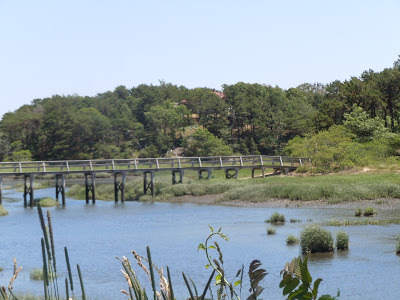 Uncle Tim's Bridge, Wellfleet - right out of my childhood (for walkers only)
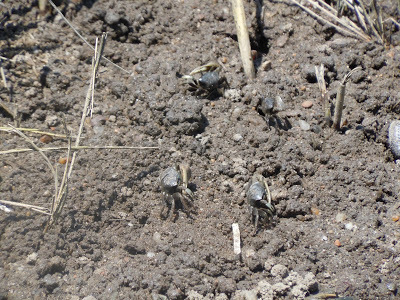 Fiddler crabs in salt marsh near Uncle Tim's Bridge
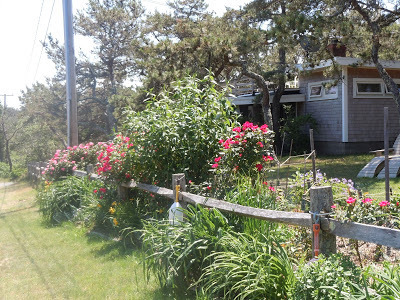 Typical Cape Cod fence in June
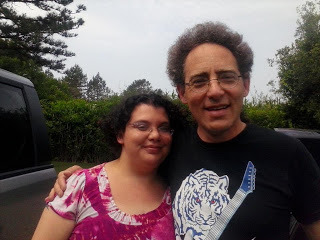 On the night before we left the Cape, David & Becka got engaged
And a fond farewell to one of my most favorite places on earth.Hope we make it back next year.
Thanks for stopping by.
Grace
 The big moment - crossing the Cape Cod canal via bridge built in 1933
 My son David mounting a kite while the rest of the family takes it easy
 The tide goes out nearly a mile at Skaket Beach - this taken from only part-way out
 "The Look" - one of the less blissful moments at our Father's Day dinner
 After 5 or 6 tries - Hailey still has that lingering "look"
Susie's smartphone literally hit the pavement in Boston, and we didn't get a replacement until just before Father's Day dinner in Hyannis. The following morning I got my camera back and set out to record the Cape I recalled from all my many visits in the past - and living in Wellfleet when I was four.
 Orleans Town Cove
 Wild rose at the edge of Orleans Town Cove
 Rock Harbor, Orleans
 Nauset Light - a functioning lighthouse in Eastham
 Roses were coming into bloom all over the Cape
 A small portion of the decor in the restaurant beloved by Orleans locals
 On the way to the dock, Provincetown
 Shop Therapy, Provincetown
 Flowers everywhere in Provincetown


 Continuing a 3-generation family tradition (now illegal)
When we lived in Wellfleet many years ago, my father would stand on the "backshore" (Atlantic), point straight out, and say: "There's nothing but ocean between here and Spain."
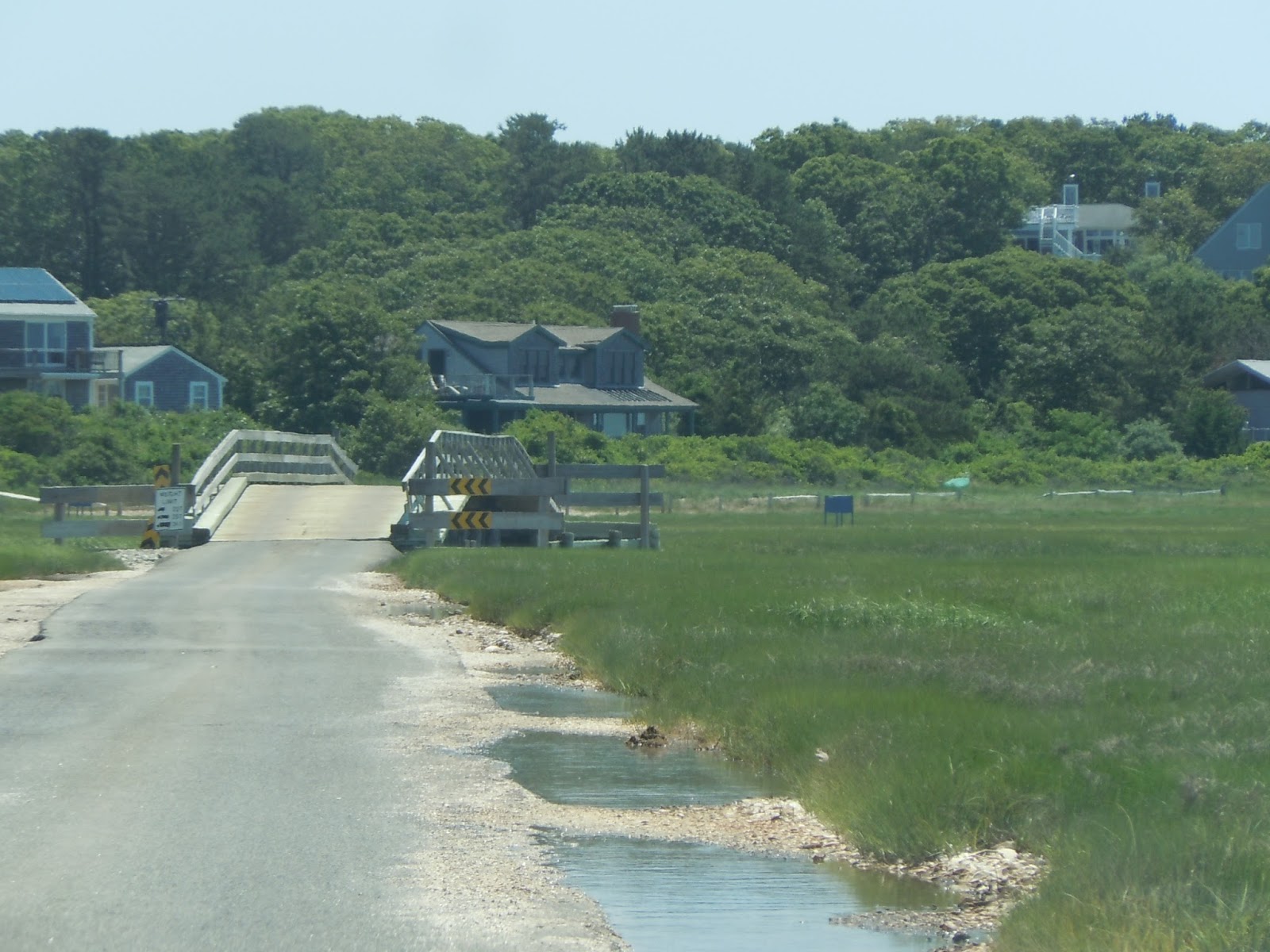 Lieutenant's Island is separated from the mainland by a salt marsh at least as long as a football field. Until fairly recently there was a wonderful old rickety bridge that spanned the entire marsh. I tried it once, a heart-stopping experience. But when we went back this year, the old bridge had clearly bit the dust, to be replaced by nothing more than the sturdy structure seen above, which crosses the marsh's main tidal channel. If you take a good look at the road, you will see that it shows signs of being covered by water at each high tide - we see not only puddles but a beat-up road that looks as if it floods twice a day! Clearly, residents of the island had to give up convenience in order to build a replacement bridge they could afford.
 Uncle Tim's Bridge, Wellfleet - right out of my childhood (for walkers only)
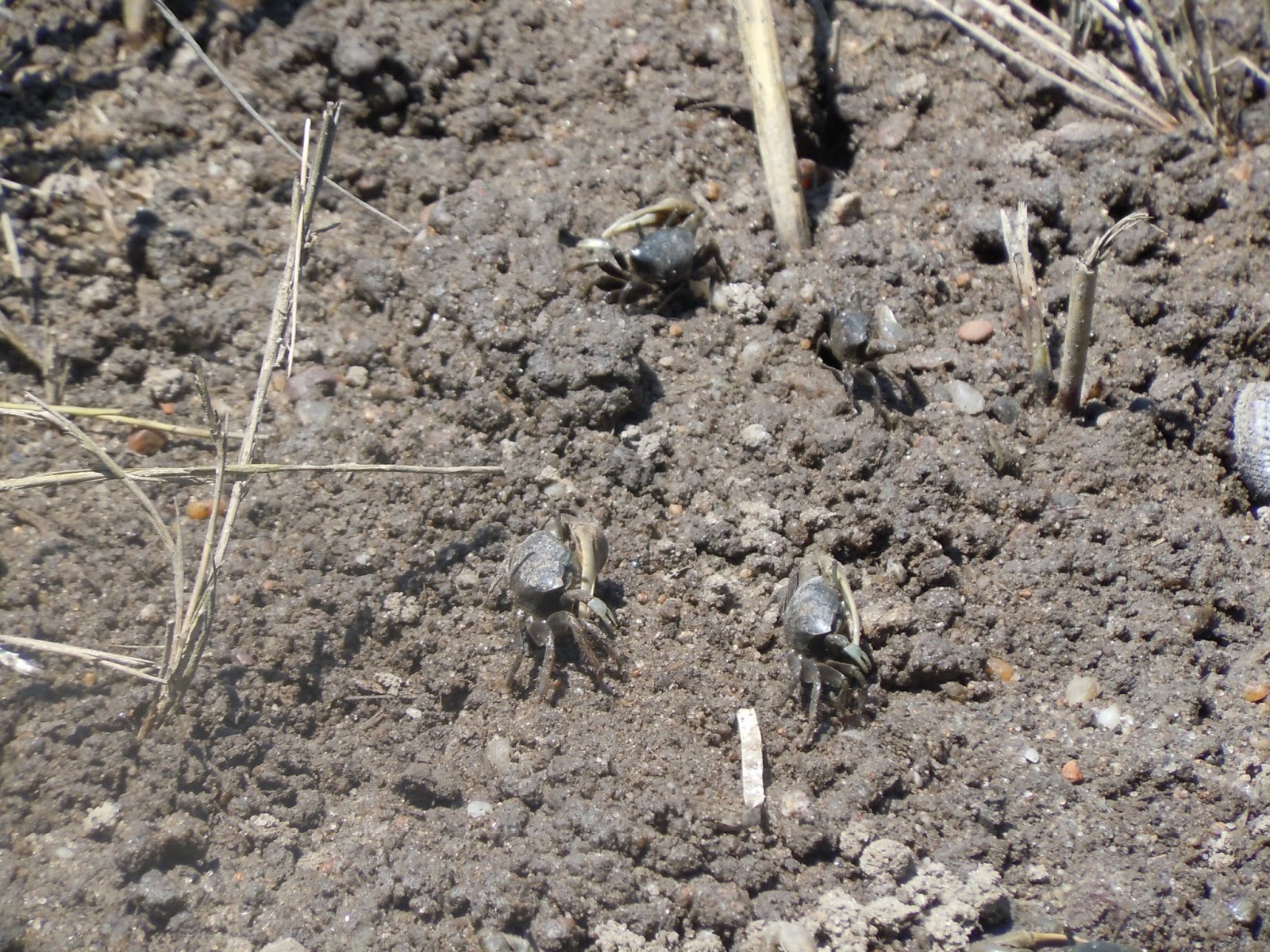 Fiddler crabs in salt marsh near Uncle Tim's Bridge
 Typical Cape Cod fence in June
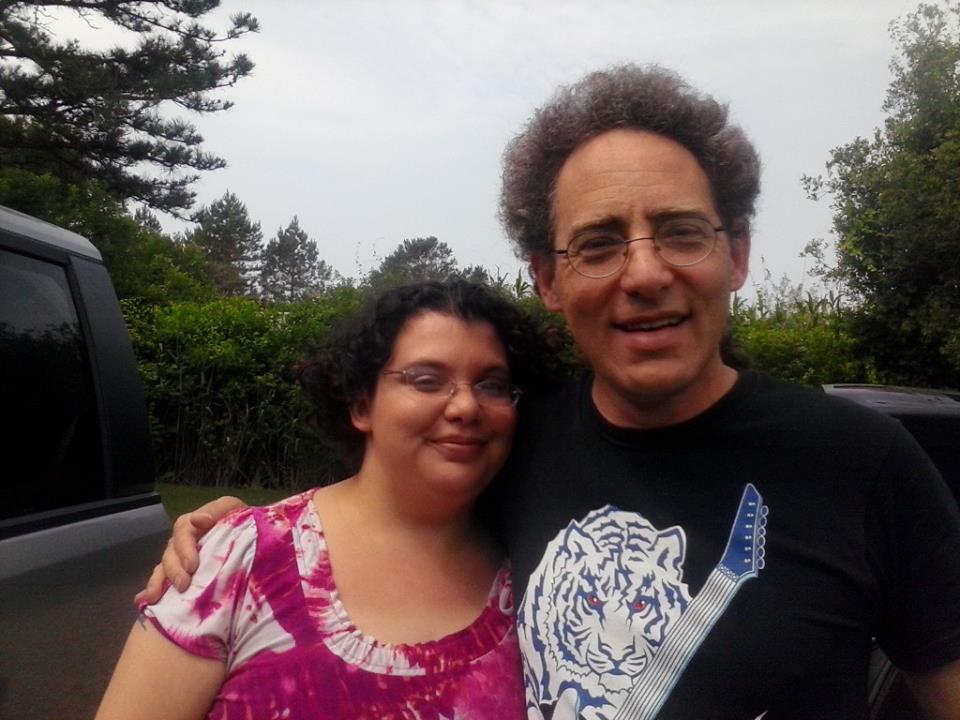 On the night before we left the Cape, David & Becka got engaged
And a fond farewell to one of my most favorite places on earth.Hope we make it back next year.
Thanks for stopping by.
Grace
August 11, 2013
EDITING - Treacherous Words
In recent years some words have become so abused, their misuse threatens a change in the rules of grammar. Sorry, but I'm a strong advocate of keeping the beauty of the English language as it is. Yes, accept new words as they join the mainstream but don't forget the tried and true. I mean, would you really like to hear Tevye belting out: "If I was a rich man . . ."
The list of oft misused and confusing words goes on and on. I'm going to list a few of them below. Hopefully, writers will find the list helpful.
Most abused:
1. who & that. This one has gone totally out of control, sending me into clenched teeth mode in book after book. Or cringing while listening to the nightly news. (No, not all news anchors mess up, thank goodness.) It's really so incredibly simple -
Who is for people. That is for animals and places.
The girl who ran the marathon . . . The man who was skinny dipping . . .
The dog that ate the cat . . . She sat on a bench that was broken.
Do you really want to be dehumanized into a "that"? Or do you and your characters want to be a hearty "who"? (As in Dr. Seuss's beloved Horton Hears a Who)
2. who & whom - in this case "who" is threatening to push "whom" out of general use. No matter how improper, the vernacular "Who're you talking to?" is replacing the classically correct "To whom are you speaking?" Nonetheless, unless you're writing dialogue for someone who would not speak grammatically - use who when it's the subject of the clause, whom when it's the object of a preposition. (to whom, by whom, for whom, from whom, etc.)
But—sigh—if you don't want your characters to sound like grammar nerds, you may have to waffle a bit between the "correct" and what people actually say.
3. it's & its - The difference is obvious, but for some reason many people just don't stop to think. Or they have some vague notion that putting in an apostrophe makes them sound more erudite.
"It's" is a contraction. Use it only when you mean, "It is."
It's a beautiful day today.
"Its" is a possessive.
Referring to a book: its contents
Referring to a salmon swimming upstream: In its long journey to return to its spawning grounds . . .
4. imminent & eminent I heard a newscaster mangle this one only a month or so ago.
Imminent - something that is about to happen.
The bomb explosion is imminent.
Eminent - distinguished
As Professor Emeritus, he is the most eminent member of the Architecture Department.
5. I can't hardly wait should be I can hardly wait.
6. He/she could care less should be He/she couldn't care less.
7. alright & all right - Like "irregardless" alright does not exist except in error. Admittedly, it has existed in error so many times it's doing its best to push the correct version right off the page. But, really, folks, the correct version is all right. Never, ever alright. [Please note correct use of it's & its.]
8. Pronoun Mash-up - Subjects & Objects.
Jimmy and me went to the movies. You and Jimmy are going to the movies. Both of you are the subjects of the sentence. Therefore it should be: Jimmy and I went to the movies.
John bought tickets for him and I. Him and I are objects of the prepostion "for." (They are both passive - they didn't do anything). Therefore it should be: John bought tickets for him and me.
Bob is older than me. The implication is: Bob is older than I am. Therefore, the correct phrase is: Bob is older than I.
Here's the one children love to use at the beginning of sentences, because they are the center of their world and must come first: Me and Mary or Me and George. The correct, and less egotistical, version is: Mary and I, George and I. Unless, of course, they are the Objects of the sentence (the ones the action was done to). Veronica beat George and me at tennis. (Note: well-mannered people put themselves last.)
9. lay & lie - a lot of people are challenged by these two, primarily in their use as verbs not nouns.
lay & lie as verbs:
I lay the book on the table (present tense - I'm doing it right now.)
I laid the book on the table (past tense - I did it yesterday.)
But if a person is doing it to his/herself . . .
I lie down on the bed (present tense - I'm doing it now.)
Betty lay down on the bed (past tense - she did it last night.)
lay & lie as nouns:
The scout was sent out to get the lay of the land.
That man could really tell some tall lies.
10. may & might - Most books are written in past tense. While editing for Best Foot Forward, I've recently found authors dropping into the present tense when using "may."
Wrong: If the men saw her, they may think . . .
Right: If the men saw her, they might think . . .
11. their, there & they're - these three trip us up all the time, but usually just because we aren't thinking.
their - possessive (like its): their books, their computer, their house
there - refers to a location. There they are! Down by the river.
There were twenty people in the room.
they're - a contraction of they are & absolutely, positively not to substituted for either one of the above. Nor vice versa.
A toughie:
I would never have thought to list the two words below until they were the subject of a recent rather tart discussion on RWA's BeauMonde loop. (I suspect those shocked by people ignorant of the difference between these two words may have been Brits or nurses, where these words are evidently featured in the curriculum. Frankly, I don't recall ever having anyone point out this difference in my New England high school English classes or in my Ivy League college. So it's time we all learned . . .
Prone - lying down, face down
Supine - lying down, face up
Other troublesome words:
Note: There are a surprising number of sound-alike words that pop up when we edit; usually, they're merely a case of our brains going one way, our fingers another. The following list of words, however, could use some reinforcement in our minds. They're so easy to miss, even while editing.
In alphabetical order: (with definitions deliberately aimed at casual)
affect & effect - the simplest way around these two: affect is a verb, effect is most commonly used as a noun.
Affect (influence) - verb:
How is my going to Boston in June going to affect (influence) your vacation?
Effect (result) - noun:
The effect of the baby learning to swim is that I won't worry so much.
Effect (bring about) - verb:
The government says it's going to effect a change in the economy.
biannual - twice a year
biennial - every two years
The conference meets biennially in Orlando.
canon - This can be defined as a rule. As a musician I think of it as an ancient word for "round" (like "Row, Row, Row Your Boat")
cannon - This is the one you shoot. It's big, it booms loudly, the shot traveling long distances.
capital - The city that is the seat of government in a state or country
capitol - The building where the government meets
chord - more than one note of music played at the same time - the sound can be harmonious or dissonant
cord - This is the one you use to tie up a package, or maybe the bad guy
cite - If you quote a reference, you are citing it.
site - a certain place, location John is at the building site today.
sight - As in "Oh, what a glorious sight!"
cue - If you can't remember your lines in a play, the prompter gives you a cue.
queue - If you're standing in line for a bus, you're in a queue.
dam - a structure that blocks the flow of water in a river
Past tense: dammed
damn - a common expletive
Past tense: damned
emigrate - to leave the country of your birth & move to another
immigrate - to enter a new country
When my ancestors emigrated from Scotland, they became immigrants to the United States.
farther - a distance which can be measured in inches, feet, metres, etc.
further - theoretical distances
She moved farther way from me on the cold stone bench.
The boss declared we would not discuss this matter any further.
ingenious - An ingenious person is smart, clever, and inventive.
ingenuous - An ingenuous person is naive, trusting.
If a person is both ingenious and unscrupulous, he/she might take advantage of a person who is ingenuous.
peak - If you climb to the top of a mountain, you are at the peak.
peek - Peeping Tom is the name we call someone who likes to peek in windows.
pique - If you get mad at someone, you in a pique. If you like to ask questions, some say your curiosity has been piqued.
principal - the person who runs the local high school
principle - the rules we live by (or should!)
stationary - you can't move!
stationery - paper you write on (usually of a better-than-average quality)
who's - a contraction of who is and not to be confused with the possessive below.
whose - Whose candy spilled all over the floor?
your - possessive Is that your computer?
you're - a contraction of you are. I need to know when you're going into town.
~ * ~ Thanks for stopping by.
Grace
Next week: Photo essay - Cape Cod 2013
For Grace's books as Blair Bancroft, click here.
The list of oft misused and confusing words goes on and on. I'm going to list a few of them below. Hopefully, writers will find the list helpful.
Most abused:
1. who & that. This one has gone totally out of control, sending me into clenched teeth mode in book after book. Or cringing while listening to the nightly news. (No, not all news anchors mess up, thank goodness.) It's really so incredibly simple -
Who is for people. That is for animals and places.
The girl who ran the marathon . . . The man who was skinny dipping . . .
The dog that ate the cat . . . She sat on a bench that was broken.
Do you really want to be dehumanized into a "that"? Or do you and your characters want to be a hearty "who"? (As in Dr. Seuss's beloved Horton Hears a Who)
2. who & whom - in this case "who" is threatening to push "whom" out of general use. No matter how improper, the vernacular "Who're you talking to?" is replacing the classically correct "To whom are you speaking?" Nonetheless, unless you're writing dialogue for someone who would not speak grammatically - use who when it's the subject of the clause, whom when it's the object of a preposition. (to whom, by whom, for whom, from whom, etc.)
But—sigh—if you don't want your characters to sound like grammar nerds, you may have to waffle a bit between the "correct" and what people actually say.
3. it's & its - The difference is obvious, but for some reason many people just don't stop to think. Or they have some vague notion that putting in an apostrophe makes them sound more erudite.
"It's" is a contraction. Use it only when you mean, "It is."
It's a beautiful day today.
"Its" is a possessive.
Referring to a book: its contents
Referring to a salmon swimming upstream: In its long journey to return to its spawning grounds . . .
4. imminent & eminent I heard a newscaster mangle this one only a month or so ago.
Imminent - something that is about to happen.
The bomb explosion is imminent.
Eminent - distinguished
As Professor Emeritus, he is the most eminent member of the Architecture Department.
5. I can't hardly wait should be I can hardly wait.
6. He/she could care less should be He/she couldn't care less.
7. alright & all right - Like "irregardless" alright does not exist except in error. Admittedly, it has existed in error so many times it's doing its best to push the correct version right off the page. But, really, folks, the correct version is all right. Never, ever alright. [Please note correct use of it's & its.]
8. Pronoun Mash-up - Subjects & Objects.
Jimmy and me went to the movies. You and Jimmy are going to the movies. Both of you are the subjects of the sentence. Therefore it should be: Jimmy and I went to the movies.
John bought tickets for him and I. Him and I are objects of the prepostion "for." (They are both passive - they didn't do anything). Therefore it should be: John bought tickets for him and me.
Bob is older than me. The implication is: Bob is older than I am. Therefore, the correct phrase is: Bob is older than I.
Here's the one children love to use at the beginning of sentences, because they are the center of their world and must come first: Me and Mary or Me and George. The correct, and less egotistical, version is: Mary and I, George and I. Unless, of course, they are the Objects of the sentence (the ones the action was done to). Veronica beat George and me at tennis. (Note: well-mannered people put themselves last.)
9. lay & lie - a lot of people are challenged by these two, primarily in their use as verbs not nouns.
lay & lie as verbs:
I lay the book on the table (present tense - I'm doing it right now.)
I laid the book on the table (past tense - I did it yesterday.)
But if a person is doing it to his/herself . . .
I lie down on the bed (present tense - I'm doing it now.)
Betty lay down on the bed (past tense - she did it last night.)
lay & lie as nouns:
The scout was sent out to get the lay of the land.
That man could really tell some tall lies.
10. may & might - Most books are written in past tense. While editing for Best Foot Forward, I've recently found authors dropping into the present tense when using "may."
Wrong: If the men saw her, they may think . . .
Right: If the men saw her, they might think . . .
11. their, there & they're - these three trip us up all the time, but usually just because we aren't thinking.
their - possessive (like its): their books, their computer, their house
there - refers to a location. There they are! Down by the river.
There were twenty people in the room.
they're - a contraction of they are & absolutely, positively not to substituted for either one of the above. Nor vice versa.
A toughie:
I would never have thought to list the two words below until they were the subject of a recent rather tart discussion on RWA's BeauMonde loop. (I suspect those shocked by people ignorant of the difference between these two words may have been Brits or nurses, where these words are evidently featured in the curriculum. Frankly, I don't recall ever having anyone point out this difference in my New England high school English classes or in my Ivy League college. So it's time we all learned . . .
Prone - lying down, face down
Supine - lying down, face up
Other troublesome words:
Note: There are a surprising number of sound-alike words that pop up when we edit; usually, they're merely a case of our brains going one way, our fingers another. The following list of words, however, could use some reinforcement in our minds. They're so easy to miss, even while editing.
In alphabetical order: (with definitions deliberately aimed at casual)
affect & effect - the simplest way around these two: affect is a verb, effect is most commonly used as a noun.
Affect (influence) - verb:
How is my going to Boston in June going to affect (influence) your vacation?
Effect (result) - noun:
The effect of the baby learning to swim is that I won't worry so much.
Effect (bring about) - verb:
The government says it's going to effect a change in the economy.
biannual - twice a year
biennial - every two years
The conference meets biennially in Orlando.
canon - This can be defined as a rule. As a musician I think of it as an ancient word for "round" (like "Row, Row, Row Your Boat")
cannon - This is the one you shoot. It's big, it booms loudly, the shot traveling long distances.
capital - The city that is the seat of government in a state or country
capitol - The building where the government meets
chord - more than one note of music played at the same time - the sound can be harmonious or dissonant
cord - This is the one you use to tie up a package, or maybe the bad guy
cite - If you quote a reference, you are citing it.
site - a certain place, location John is at the building site today.
sight - As in "Oh, what a glorious sight!"
cue - If you can't remember your lines in a play, the prompter gives you a cue.
queue - If you're standing in line for a bus, you're in a queue.
dam - a structure that blocks the flow of water in a river
Past tense: dammed
damn - a common expletive
Past tense: damned
emigrate - to leave the country of your birth & move to another
immigrate - to enter a new country
When my ancestors emigrated from Scotland, they became immigrants to the United States.
farther - a distance which can be measured in inches, feet, metres, etc.
further - theoretical distances
She moved farther way from me on the cold stone bench.
The boss declared we would not discuss this matter any further.
ingenious - An ingenious person is smart, clever, and inventive.
ingenuous - An ingenuous person is naive, trusting.
If a person is both ingenious and unscrupulous, he/she might take advantage of a person who is ingenuous.
peak - If you climb to the top of a mountain, you are at the peak.
peek - Peeping Tom is the name we call someone who likes to peek in windows.
pique - If you get mad at someone, you in a pique. If you like to ask questions, some say your curiosity has been piqued.
principal - the person who runs the local high school
principle - the rules we live by (or should!)
stationary - you can't move!
stationery - paper you write on (usually of a better-than-average quality)
who's - a contraction of who is and not to be confused with the possessive below.
whose - Whose candy spilled all over the floor?
your - possessive Is that your computer?
you're - a contraction of you are. I need to know when you're going into town.
~ * ~ Thanks for stopping by.
Grace
Next week: Photo essay - Cape Cod 2013
For Grace's books as Blair Bancroft, click here.
August 4, 2013
BOSTON & PLIMOUTH PLANTATION 2013
Below is a photo essay culled from two days in Boston, followed by a stop at Plimouth Plantation on our way to Cape Cod. Lots of history, both past and present.
 Cassidy, composing a note to leave at the Marathon Bombing Memorial in Copley Square
 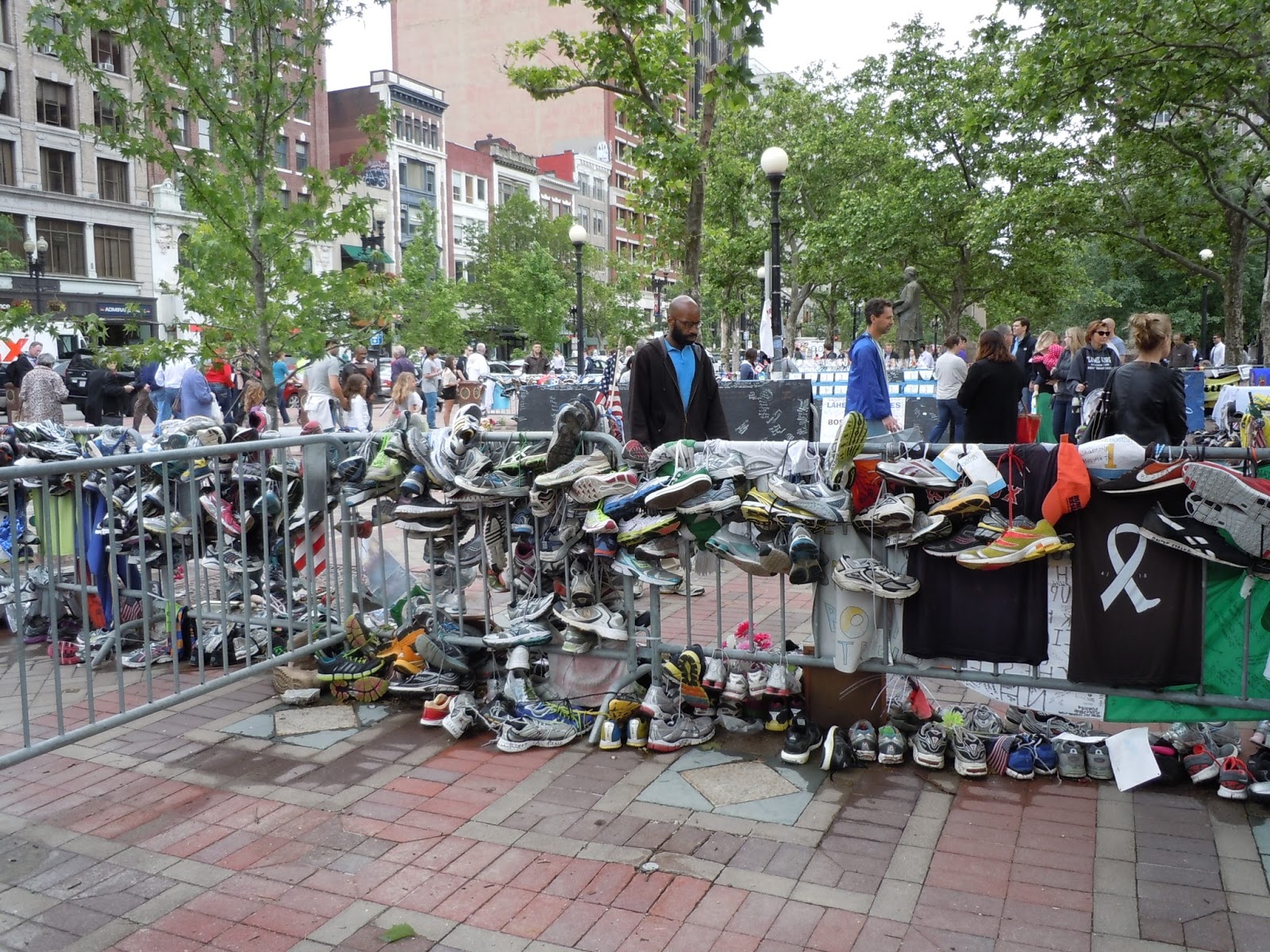 The Memorial from another angle - Copley Square, Boston, June 2013
 Replica of ship involved in the Boston Tea Party - December 16, 1773
 Hailey tossing a tea bale
 The U.S.S. Constitution, framed in our tour boat's window - Bunker Hill Monument in the distance
 Mama & babies on Boston Common
 No caption needed!
 Boston Common, June 2013
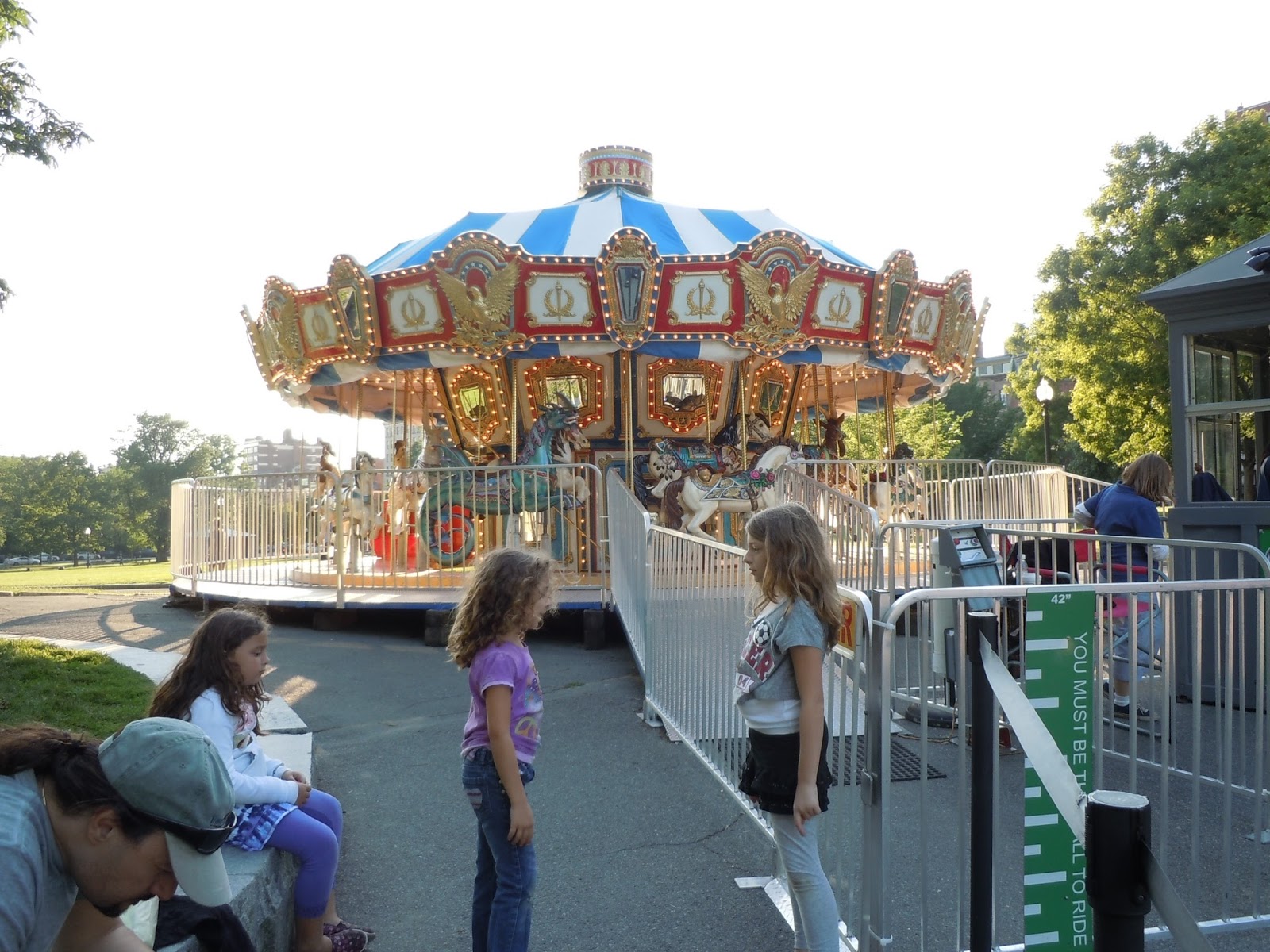 The Last Hurrah of a very full day in Boston (something for everyone)
The next day, on our way to Cape Cod, We stopped at Plimouth Plantation, where I got a big surprise. At the Native American village, members of various tribes take turns as greeters and crafters, so there are always actual Native Americans on site. When the man in the wheel chair told me he was an Abenaki, I actually shrieked. History: my five-greats grandfather was a 12-year-old drummer for Montcalm in the battle where England won Canada from France. When the French lost and the man we assume was his father was killed, he ran away. If the Abenaki hadn't taken him in, he would have died. He lived with the Abenaki for many years, eventually becoming a courier de bois, trapper, etc. He lived to age 112 - I've seen his grave in upper New York state - and, incredibly, one of his descendents (my mother's great-aunt) lived to be 100 and could actually remember seeing him when she was a child. Definitely weird, as he must have been born c. 1747. Anyway, the gentlemen below enjoyed the story as much as I did telling it. We shook hands with a right good will.
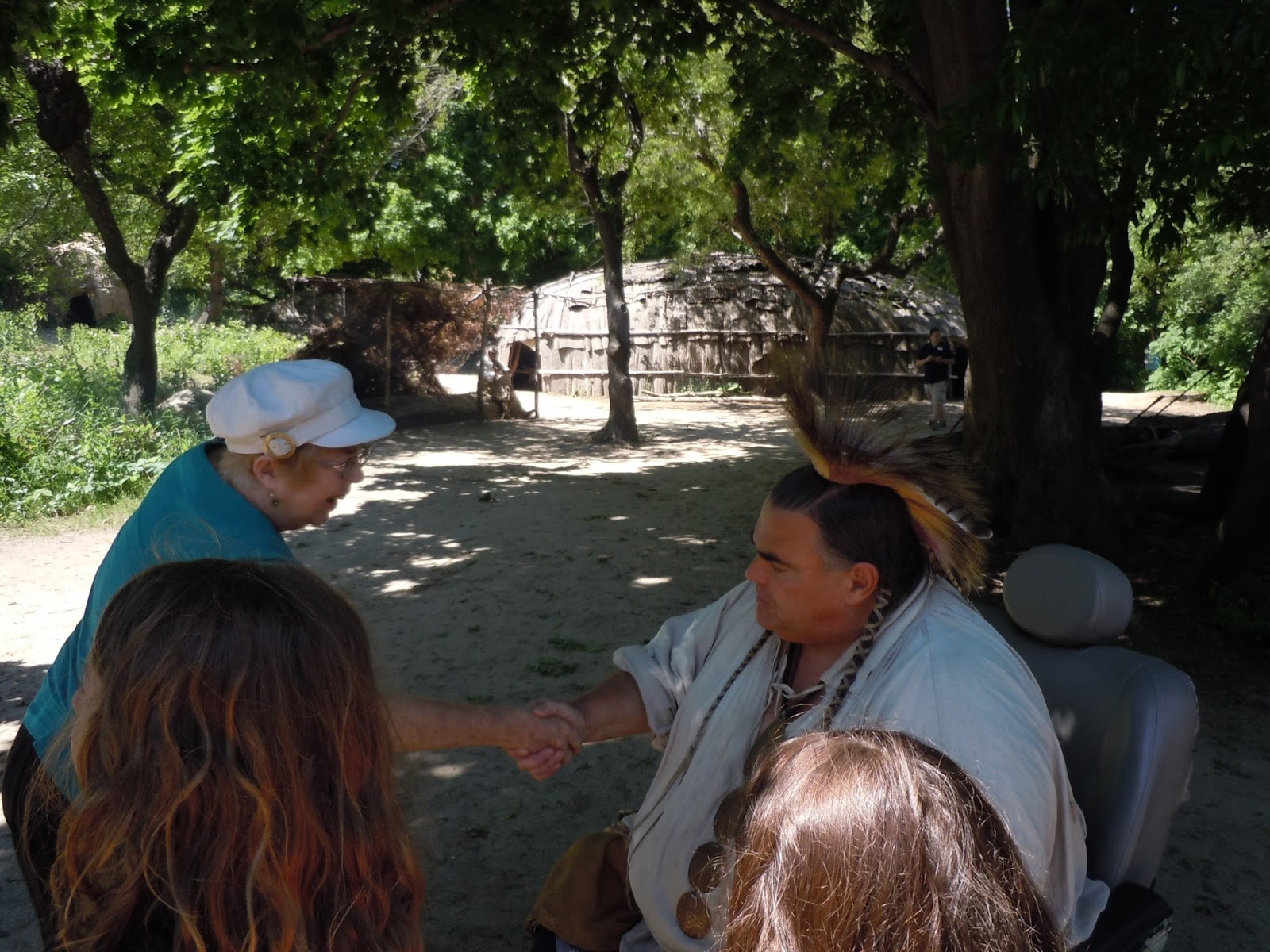 Grace & member of Abenaki tribe
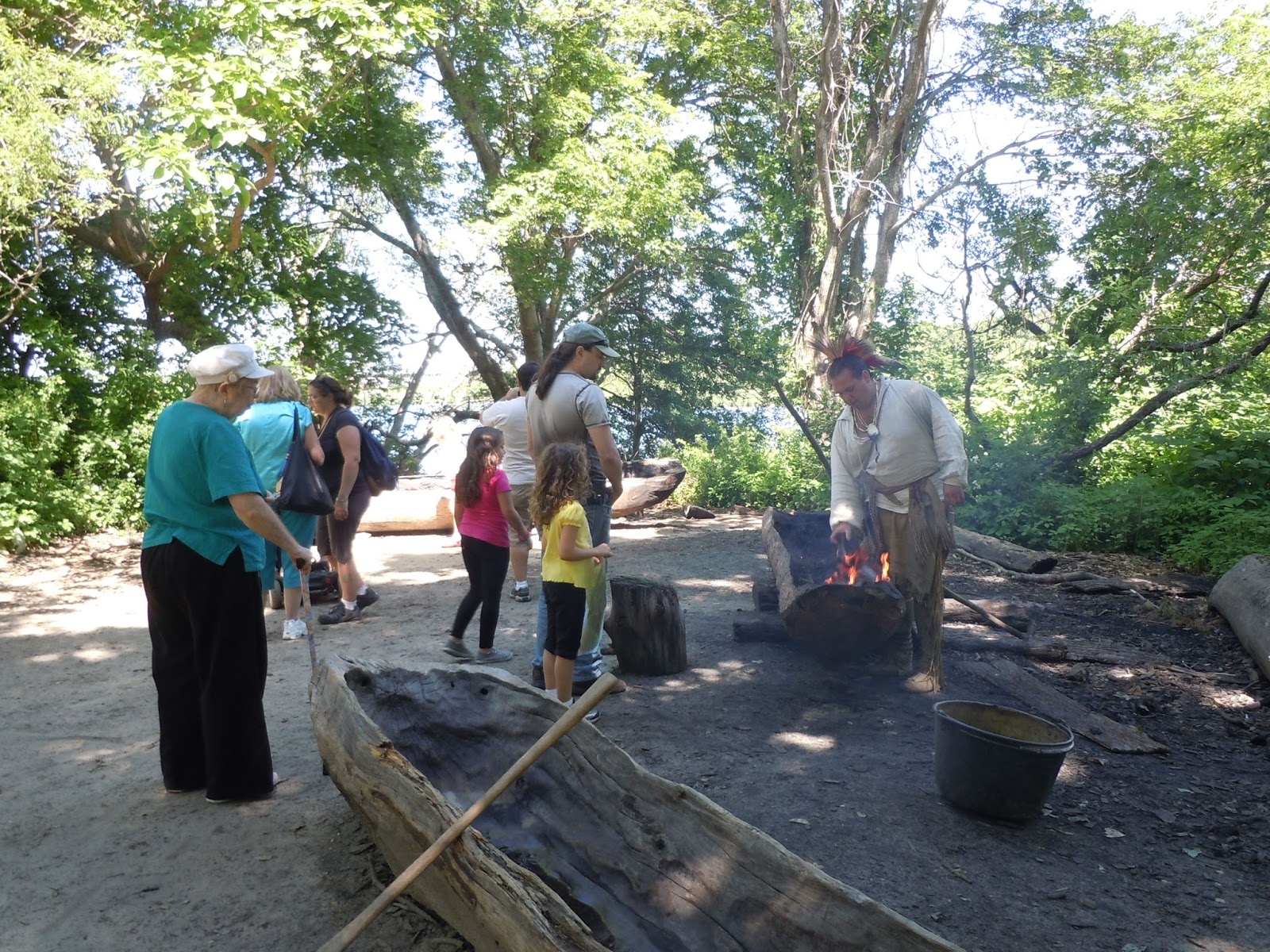 Checking the "burn" on a log canoe
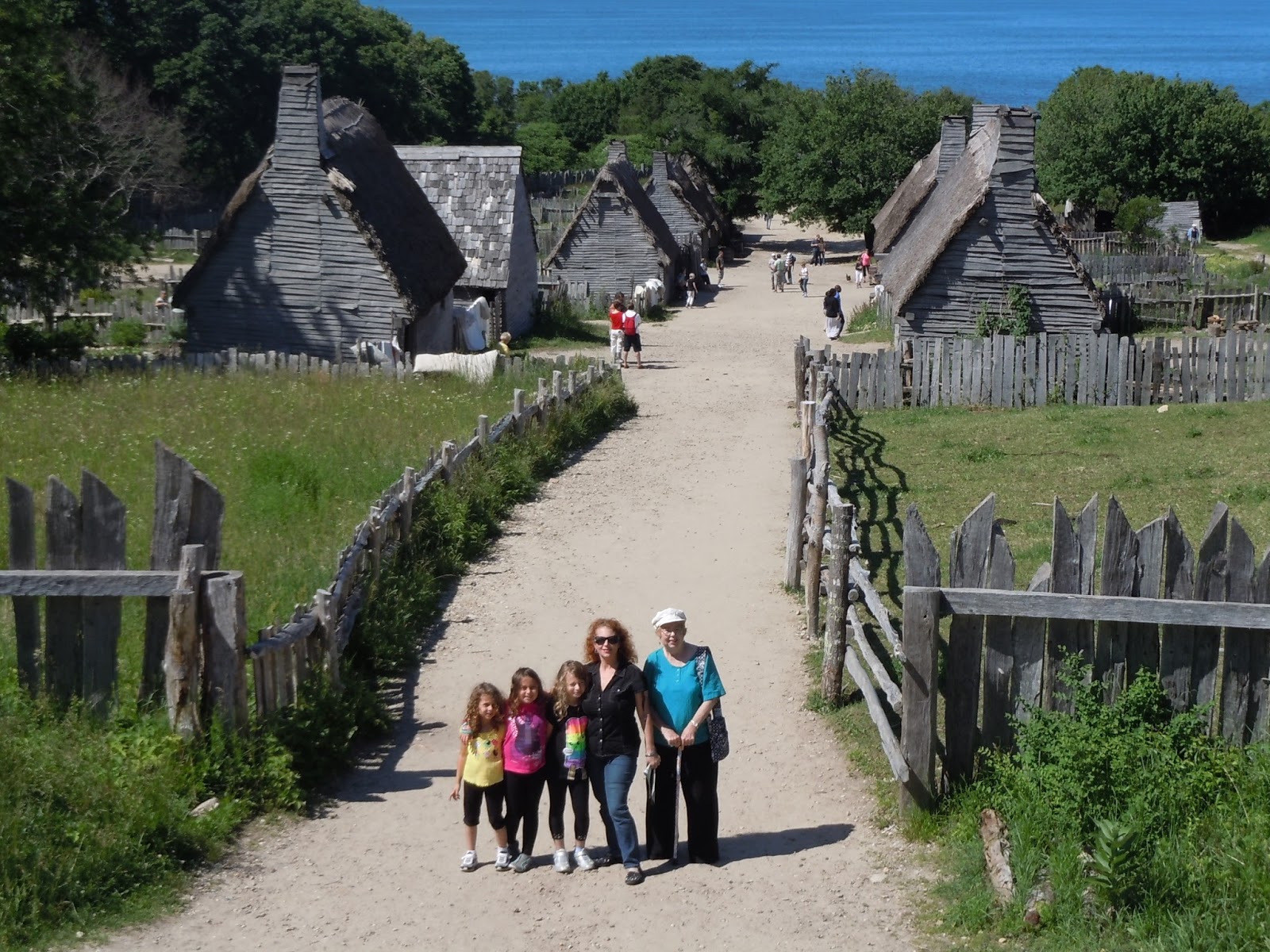 Where the Mayflower settlers lived (reproduction), as seen from 2nd floor of the fort
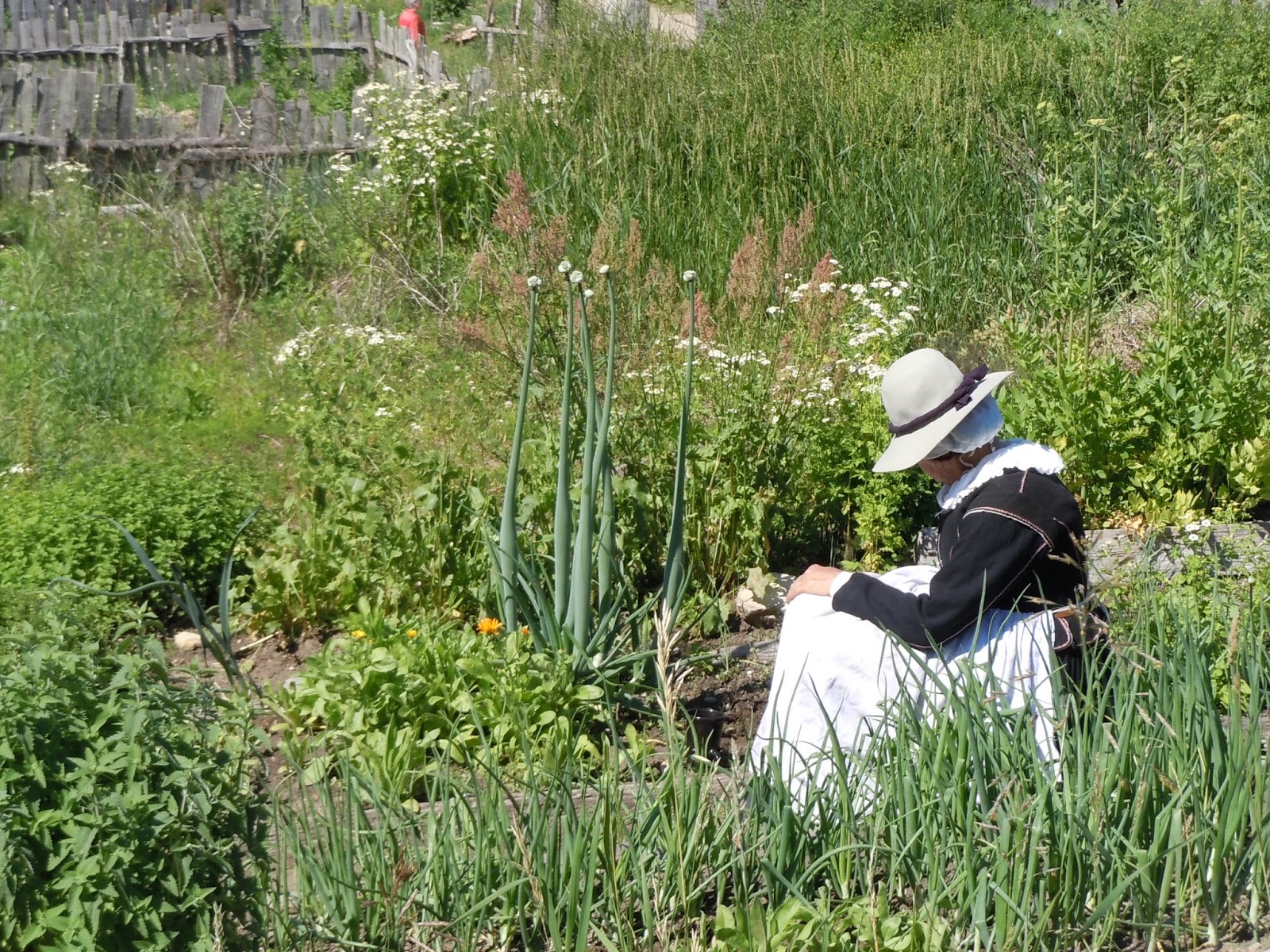 All "settlers" stay in character at all times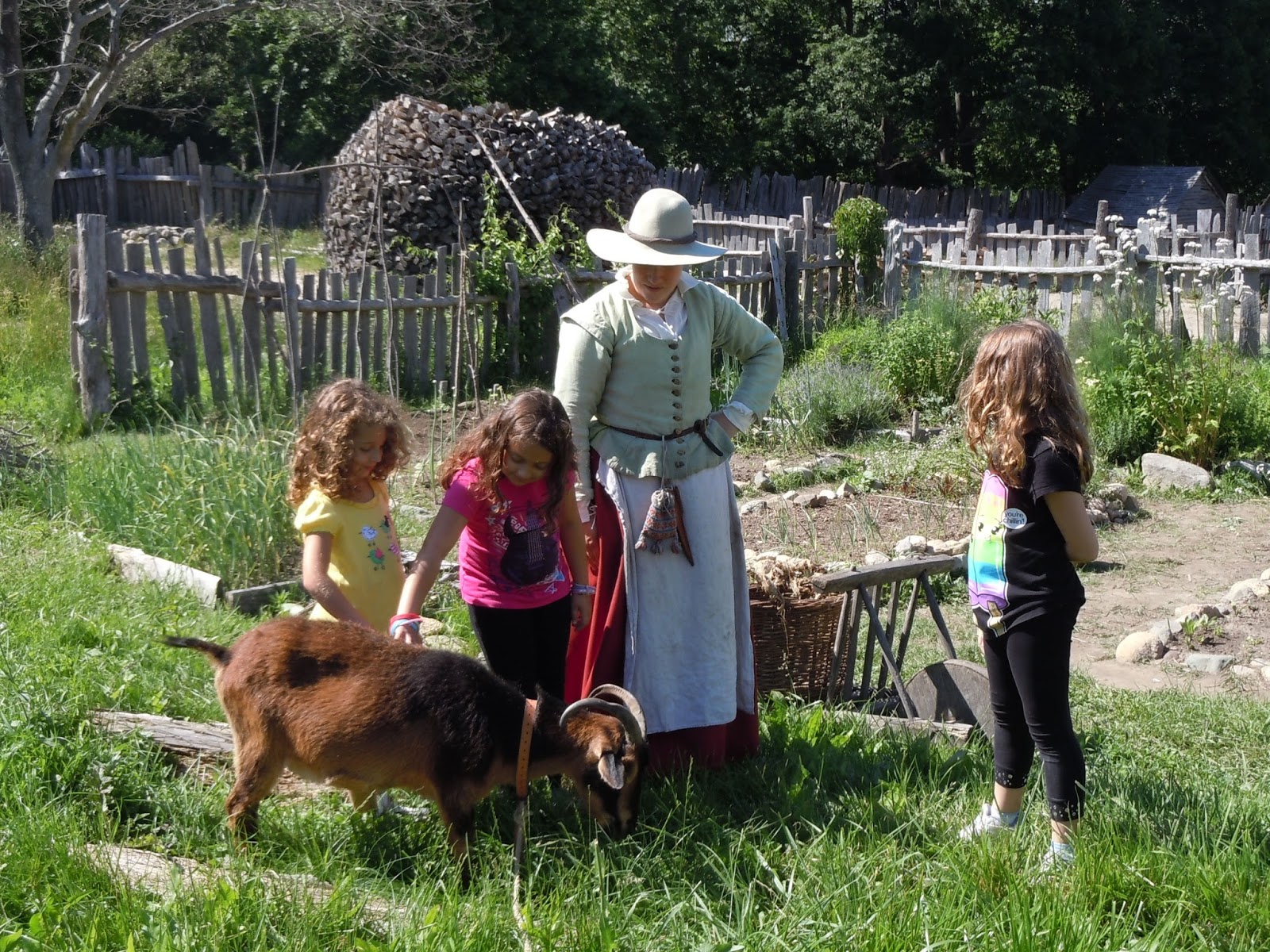


 And a fond farewell to Plymouth Plantation, Plymouth, MA
Thanks for stopping by.
Grace
Next week: EDITING - Treacherous Words
July 28, 2013
EDITING - Show vs Tell, Part 2

On Saturday I viewed a new venture for Reale Realty (my daughter is owner/broker), a brand new home - 1921 Hamilton Lane, Orlando. (They took over the project mid-stream from the builder.) Believe me, it's the ideal family home - oodles of room, high school across the street, play park just down the block. Full of upscale details like cooled wine storage in master bedroom as well as kitchen, pull-out microwave, window-seat storage, fully finished basement & wrap-around porch! And then there's that shower big enough for a party! Garage is under the house, approached from the street in back.) For more photos, please click on Investisource Scroll down to 1921 Hamilton.
~ * ~
I've been working with my EC Blush editor on Florida Wild this week, and that brought up an important topic I'm also going to insert before Part 2 of "Show vs Tell."
Working with an Editor
Rule # 1(which equates to the classic business credo, "the customer is always right" - except you're not the customer):
Whether you're working with a New York editor, an e-publisher editor, or a private editor, you've got to be willing "give." Both NY publishing houses and e-publishers have their own style sheets. And their style sheets may differ from what you were taught in school, what you used all the way through college. In a major NY publishing house, you will have an editor and a copy editor. The editor will point out awkward sentences, suggest plots changes, character changes, dialogue changes; i.e., a whole range of things he/she hopes will improve your book. The copy editor (usually a new hire, just out of college) is looking for grammar and punctuation problems, checking facts and continuity; i.e., performing an overview of the "nuts & bolts" of your manuscript, not making suggestions on the style or content of your writing. And, yes, they make mistakes. Copy editors you can challenge. I once had one put a decimal point before 9mm! Then again, they just might be right. Have a good grammar book handy so you can check before you complain.
When e-publishing came along, the editing scene changed, the job of editing and copy editing falling on the shoulders of a single editor, working with an author electronically, usually via MS Word's Track Changes. (Electronic submission and editing proved so much easier, by the way, that it has become the norm for the entire publishing industry, print & e.) In most publishing houses there is a Senior Editor who resolves disputes between the Author and his/her editor. And, yes, you have the right of complaint. That's what scrawling "Stet" in the margin was for back in the good old days and what the "Reject" icon is for on the Track Changes menu. But you'd better add a really sterling comment on why you don't agree!
When all the sound & fury is done, however, that Senior Editor is going to win. So save yourself a lot of angst and accept it. If that's what a particular publisher has in its "Style Sheet," then that bit of punctuation is written in stone. You wanna be published? Take your lumps and give in. Being a Chicago Manual of Style devotee, I fought tooth and nail against the rules of a certain e-publisher whose Style Sheet basically says: "If the sentence makes sense without punctuation, don't use any." Aargh!
But I learned my lesson. I don't complain any more. I bite the bullet and hit the "Agree" icon straight down the page, trying not to wince as all my beautiful commas and that final "s" in my possessives are stripped away, my ellipses compressed into a fraction of the space they once took. (Hey, that's not a pause, that's a hiccup!)
So whether this is your first time working with an editor or your fiftieth, you're the one who has to decide: Do you want to have things your way, or do you want to have a check arriving every month for the books you've sold? Ninety-nine times out of a hundred, that answer should be self-evident. As for working with a private editor, you have much more flexibility. You can accept or reject what your editor says—though never, ever ignore a dangling participle! Keep in mind, however, that you paid for that person's expertise, so it might be a good idea to seriously consider he/she might know what they're doing. Think carefully before hitting the "Reject" icon. We may work at home at odd hours, and in a remarkable array of casual clothing, but we do have a "boss" out there. And that "boss" has a "boss" who has a "super boss." And if you want to be paid for your labor, it's likely you're going to have to compromise.
In summary, don't let ego get in the way of your good sense. Put in different terms, don't let your devotion to The Chicago Manual of Style stand in the way of making money!
~ * ~
Show vs Tell, Part 2
Today's Show vs Tell example is from a First-person manuscript. It's a real challenge not to fall into "tell" mode when there's just one person tasked with "presenting (showing)" the entire book. I hope I've sufficiently massacred a scene from my current work in progress, Brides of Falconfell,to demonstrate what I mean.
Note: I did three new Show/Tell examples in all. (One third-person example was posted last week.) If anyone would like to see Example 3 - based on an all-male scene from Rogue's Destiny - please e-mail me privately at Blair Bancroft
Example of First Person in "Tell" Mode: (the perfectly dull version you do not want to write)
When I visited the nursery the next morning, Violet was wearing a party dress with tiny puff-sleeves and a high-waisted skirt. It was clear her mother’s long illness had not stunted her growth.
I asked Nanny Roberts if there were any trunks of old clothes in the attic and she said yes, but they were probably silks, satins, and the most delicate linens. “Perhaps some undergarments?” I suggested.
Mrs. Roberts took a deep breath and declared there was only one way to find out. And off we went, Nanny leading us down a long dark passage which seemed to follow the ridgeline of the roof. The attic, when we finally got there, was dimly lit, and it took a long while to find enough suitable fabric. The garments we chose were heavy. I wondered how the ladies of the eighteenth century had managed to walk.
And then came a more serious problem. Either I sought out Martha Beaseley, the family seamstress, which would alert Mrs. Maxwell to our being in the attic, or I attempted to create the garments myself. It was a dilemma, but Violet was enough of a challenge without instigating another confrontation with Mrs. Maxwell so soon.
Violet had the strangest expression on her face when I bent down to kiss her. I wondered if she was excited by the thought of new clothes.
When I returned to my room, I spread the mound of treasures on my bed. Perhaps I was overly optimistic about Violet’s new clothes. No, surely Bess and I together could get the job done.
Example of same scene in "Show" mode: (hopefully, a more active, colorful version)
The next morning I visited the nursery and found Violet arrayed in another party dress, this one with tiny puff-sleeves and a skirt falling from a high waist in a series of ruffles that ended half-way between her knees and ankles. Whatever the effect of her mother’s long illness, ’twas clear it had not stunted Violet’s growth.
“Are there trunks of old clothes in the attic?” I asked Nanny Roberts.
“Indeed, miss, I’m sure there are, though probably only the best were kept.”
Silks, satins, the most delicate linens . . . I heaved a sigh. “Perhaps some undergarments?” I suggested.
Mrs. Roberts’s took a deep breath, her plump breast swelling to pouter pigeon proportions. “There’s only one way to find out,” she declared.
“Must we ask Mrs. Maxwell for a key?” I asked, my voice dropping to a totally unnecessary whisper.
“The door at the top of the servants’ stairs is kept locked,” she told me, her gray eyes lit with a conspiratorial gleam.“but not the door from the nursery corridor.”
“A-ah.” I smiled. “Come, Violet,” I said. “Today we are going to explore the inside of the house.”
And off we went, with Nanny Roberts leading us through a small door at the end of the corridor and down a long dark passage which seemed to follow the ridgeline of the roof. I carried a single candle inside a glass chimney, while Mrs. Roberts wielded the nursery’s straw broom, a clear necessity, for no one had come this way in a very long time except creatures I didn’t care to think about. My skin crawled but I could not show fear in front of Violet, so we kept moving forward. Falconfell seemed to have grown twice as broad since yesterday’s circumnavigation.
At long last, another door. If it was locked, I was going to be hard put to suppress a scream. Of frustration, of course, not a fear of small dark places with multiple webs and rodents.
The door creaked open. Light! After the corridor we’d just traversed, the dim light from small attic windows seemed like the brilliance of the sun at high noon. I carefully set down the candle just inside the immense attic storage space and stood quite still, my eyes widening at the jumble ranging before me. Broken and cast-off furniture, rolled carpets, small trunks, large trunks, sea chests . . .
Where to begin?
More than a hour later, defeated by red eyes, runny noses, and hacking coughs, we slipped back into the passage beneath the roofline and carefully closed the door. Nanny Roberts juggled both broom and candle as my arms were laden with a surprising array of garments from sturdy petticoats to ancient livery to linen and muslin gowns with so many yards of fabric I staggered under the weight. Merciful heavens, how had the ladies of the eighteenth century managed to walk? Perhaps their hoops took most of the tonnage.
And now a more serious problem, I thought as we finally emerged into the space outside the nursery with its broad windows overlooking the valley. Either I sought out Martha Beaseley, the family seamstress, which would mean Mrs. Maxwell discovering our raid upon the attic, or I attempted to create the garments myself. Fortunately, I’d spent a full three months in my elder brother’s household when his children’s beloved nanny had rushed away to attend her father’s final illness. During that time I had mended enough gowns and skeleton suits to have a good idea of how they were constructed. The gowns, fortunately, being much easier than the fitted boys’ garments with all those buttons.
Coward! my inner voice mocked as I determined to make the gowns and undergarments myself. But Violet was enough of a challenge without instigating another confrontation with Mrs. Maxwell so soon. I would give Hammersley time to work a miracle in that direction if he could.
When I bent down to give Violet a hug, she had the strangest expression on her face. Excitement? Had she enjoyed our morning’s adventure beyond the confines of the nursery? Or was it hope—someone other than Nanny was noticing her at last? Or did she possibly feel a thrill at flaunting the rules, for there could be no doubt she sensed that Nanny and I had stepped beyond that bounds of what was expected. I looked straight into those unfathomable dark eyes, so like her Aunt Maud, the witch, and promised to return later that afternoon.
Fate was kind and I managed to slip back to my room without being caught with my great mound of treasure. I spread the various items out across my bed . . . and grimaced. What was that saying about biting off more than one could chew? I would have to enlist Bess’s aid. Between the two of us, we’d get the job done.
Excerpt from Brides of Falconfell by Blair Bancroft (a work in progress)
~ * ~
Thanks for stopping by.
Grace
For Blair's website, please click here.
July 21, 2013
EDITING - Show vs. Tell
 Birthday Girl - not my martini, but it made a good photo - I was drinking Glenlivet!
 Susie & Grace 7/19/13
Getting back to EDITING . . .
The "Why" of Show vs. Tell
1. “Telling” is presenting a story in classic “storyteller” mode. The narrator stands off to one side and describes the scene, rather like TV narration of a scene for the blind. Everything is “described,” rather than “lived.”
Another way of saying this is that the Author narrates the story rather than allowing his/her characters to demonstrate the story.
2. “Showing” a scene is inevitably going to take more words, because it’s necessary for the Author to get inside the heads of the main characters and allow them to show us what is happening. Showing involves more “theater.” A person’s thoughts, dialogue, and actions, using colorful descriptive words. An author must get right inside the hero’s and heroine’s heads and let us see what they see, hear what they hear, feel what they feel. “Showing" paints a picture, a lively, interesting picture, while “Telling” merely recites what is happening without adding any “pizzazz” to the story.
3. “Telling” is oh-so-much-easier than “Showing.” Nice, straight declarative sentences. Get the action out there. Never mind that your readers fall asleep. The campfire’s pretty - who needs to listen to what the storyteller is saying?
4. “Showing” requires WORK. What are the people in this scene seeing? Why are they there? What are they thinking? What do they say to each other? What are they accomplishing? Does the joy shine through? The sorrow, anger, frivolity - whatever it is you want that scene to do? Or did you just lay it out there - poor, naked bare bones, white and shivering, begging for sparkling dialogue, descriptive language, colorful settings, inner thoughts, etc., to flesh them out, bring them to life?
5. To add to #4 above, “Showing” does not simply mean letting the hero and heroine tell the story instead of the author, but making sure your hero and heroine do so in the most descriptive, colorful, dramatic, romantic, humorous, horrific, or tragic way possible. Do not settle for the ordinary. Fight for the extraordinary. Be all you can be. Sitting down at your computer and “telling” us your story in mostly declarative sentences or a lot of dialogue with no introspection is absolutely, positively NOT the way to go.
6. Mechanics.
a. There are a number of telltale signs to look for. Was and were are perfectly okay—the best authors use them all the time—but if you find you’re using them over and over in nearly every sentence, THEN you just might be “telling” instead of “showing.”
b. The same for: It was & There were. Yes, there are times when you can use them, but in general try to find another way to go.
c. He felt, she knew, he thought. Many times these and similar phrases are unnecessary. They take you out of the protagonist’s head and put you in the author’s head instead. Let us discover what the hero/heroine feel or know from his/her Point of View. And make sure revealing what they are thinking is also from their point of view, not the author's. If it’s a really direct, first-person thought (Oh no, they think I did it!), use italics. If you’re writing the thought in third person, no italics.
d. The litmus test: does your sentence sound like something your hero or heroine is thinking, seeing, feeling? Or does it sound like you, the author, are “telling” your readers what your hero and heroine are seeing and hearing and how they are feeling?
e. “Betty was a short-tempered shrew.”
The above sentence is perfectly okay if the protagonist says it in Dialogue or thinks it in Introspection.
The sentence is Wrong if the author is “telling” us this fact about Betty, a fact that has not been introduced into the book by any of the previous character, primary or secondary.
[Exception: if you are an author with the stature of Nora Roberts, you can use Author POV, because Nora was using it back when it was still considered okay, and what editor or agent would dare tell someone as successful as Nora what she can and cannot do?] My personal opinion: Author POV, when done right, can be wonderful (see the opening pages of The Witness, Nora’s latest). But if you’re a beginner in an era (like now) when Author POV is out of favor, avoid it like the plague. Keep in mind that it probably went out of favor because so few authors were using it well. They went over the edge into “storyteller” mode and lost their readers.
~ * ~
I wrote my first example of Show vs. Tell for an RWA chapter workshop way back in 2003. I decided it was time to update, so I massacred three more excerpts from my manuscripts for this series. Why always my manuscripts? Well, would you really like me using your manuscript as an example of "bad"? Or messing up your exquisite prose in the name of teaching?
Example of “Telling”: (Events narrated by the Author, with little thought for colorful description, dialogue, introspection, or drama) - [The scene, as originally written, follows.]
Geoffrey and his little sister climbed into the rowboat while Victoire held it steady. Geoff sat in the stern, his sister in the bow. Victoire shoved the boat into deeper water and scrambled on board. Sitting in the center seat, she took up her oars.
The sun shone, birds twittered, a duck paddled past. In the distance they saw two swans. Victoire allowed the boat to drift, savoring her enjoyment in being part of the Tarleton family. The best thing that had ever happened to her. Except for Jack. She frowned.
“Miss?” Geoff asked.
Guilt swept over her. She shouldn’t be worrying about Jack when she had the children with her. She pulled on the oars, heading toward a good fishing spot near the center of the lake. But the boat didn’t feel right. The oars were harder to pull. Her feet were suddenly cold.
“Water!” Geoff said. Serena let out a cry.
When Victoire looked down, water was already an inch deep. She should turn around, she thought, but they were almost in the middle of the lake . . .
She hauled on the oars, putting every ounce of strength into each stroke. A glance over her shoulder told her they weren’t making any progress. She could swim, of course, but what of the children?
Icy water gushed in. They were going down. They had to get out. When Geoff told her he could swim, Victoire told him to jump overhead and swim for help, while she did everything she could to keep the boat afloat.
She told Serena to hang on, think of hot chocolate and a warm fire. At last Geoff reached the bank, was running for the house. They would be saved. And then she would find out what had just happened.
Example of "Showing": (The scene above as originally written for Rogue’s Destiny)
Victoire held the rowboat steady while Master Geoffrey Tarleton and his five-year-old sister Serena climbed in, young Geoff taking the seat at the stern, while his sister perched on the narrow seat in the bow. Victoire, having grown up around boats of every variety, managed to hitch up her skirts, give the rowboat a shove into deeper water, and scramble aboard before the children drifted off without her. For a moment she balanced precariously, arms wide, as the boat bobbed beneath her, and then she was seated on the center seat, the oars grasped firmly in her hands.
Behind her, little Serena clapped her hands and giggled. They were afloat. The sun shone, sparkling off the lake’s clear water. Birds twittered in the trees, circled overhead. A duck squawked, paddling furiously out of the rowboat’s path. In the distance two white swans glided majestically against a lacy backdrop of willow branches. Victoire heaved a sigh. Magnifique! All was right with the world.
Well, perhaps not quite. She glided the oars through one long stroke, two, three, then allowed the boat to drift as her mind did the same. She could scarcely remember a time when she had been so content. Being part of a family, a real family like the Tarleton’s, had been so long ago she could scarcely remember it. But these last few weeks had reminded her how glorious it could be. Two parents who loved each other, three beautiful children, including Andrew, the baby. Warmth. Caring. Living at The Willows was the best thing that had happened to her in a very long time.
Except, possibly, Jack. Silent Jack. Jack, the enigma. Jack, who had turned his back on her.
“Miss?”
“I’m sorry,” Victoire murmured, her wandering thoughts brought up short by young Geoff’s quizzical look. How could she fuss over her own problems when her hosts had endured so much, coming very late to the happiness they now enjoyed? After flashing her warmest smile, Victoire plied her oars with a right good will, pulling them steadily toward an expanse of lily pads near the center of the shallow lake. A spot where, they knew from past experience, fish lurked, just waiting to be caught.
Victoire suddenly frowned. The boat didn’t feel right. She was pulling harder on the oars, huffing a bit. Cold. About her feet.
“Water!” Geoff yelped. “We’re leaking, miss.” Serena squealed.
Victoire looked down. Incredibly, water was already an inch deep in a boat that had been sound not two days hence. Turn around! But they were almost in the middle, the shoreline a good fifty yards in any direction. Faster to just keep going than attempt to turn around . . .
“It’s over my boots, miss,” Geoff said, amazingly steady—truly his parents’ child. Serena, not so stoic, began to whimper.
Victoire hauled on the oars, putting every ounce of strength into each stroke. Glanced over her shoulder. Dear God, they weren’t making any progress at all. But Serena, bless her, was curled up on the narrow bow seat, her feet tucked under her. Sniffing, but controlling the wails which had to be welling up in her throat, because Victoire could feel them in her own. She could swim, of course, but the children—
“Geoff,” she panted as she fought the increasingly sluggish rowboat, “do you swim?”
“Yes, miss.”
Thank God. “Serena?”
The long pent-up wail burst from the little girl’s throat. Her brother answered for her. “Not very well, but she can float.”
Water was gushing in, as if every seam between the planks had suddenly opened up, turning into bubbling geysers filling the boat with water.
They were going down. In water still icy from a hard winter, forty yards from shore, with two young children, the boat was going down.
Surely the boat, made of stout wood, would turtle, allowing them to cling to it. But she couldn’t count on it. Not in time. The water was cold, like the waters of Lower Canada. They had to get out before it sapped their energy, making it impossible for them to save themselves.
Water. Again, water. Her life seemed linked to watery disasters.
Not this time!
“Geoff!” Victoire thrust an oar into his hands. “I know you can swim, but clothing and cold water make it hard. Hold this tight, don’t let go. Use it to help you get to shore as fast as you can. Bring help. I promise you I’ll take care of Serena. Now, go!”
Without the slightest hesitation, the boy tumbled out of the boat into the water. Grasping the oar in both hands, he kicked hard, heading for shore. Victoire tossed the second oar into the water, turned and grabbed Serena just as the boat began to go under, stern first. Tears streaked the little girl’s face, but Victoire heard no sound. It was as if they were enveloped in their own tight bubble, Victoire, Serena, and the oar she had to find. Now, this very minute!
And . . . there, she had it. She draped Serena’s arms around the oar, told her to hold on tight. Placing her own hands to each of side of the little girls, she slipped her body in behind her. And then they were moving. Slowly, so slowly. But ahead, thank God, she could see Geoff already half way to the shore. If he didn’t grow too cold, lose his grip . . .
No! She wasn’t about to abuse the Tarleton’s hospitality by drowning their two oldest children.
But it was cold, so very cold . . .
In between reciting every prayer she ever learned at the convent, Victoire inserted encouraging words for Serena. Hang on, hang on, just a little farther. Geoff will bring help. Think hot chocolate, a warm fire, how happy your mama will be to see you . . .
And, yes! Geoff was scrambling up the bank, running for the house.
They were going to make it. They were. She would not let this child die. And when she could stop hanging on, stop kicking, stop praying so desperately, she would take the time to analyze what had just happened. And why.
~ * ~
Thanks for stopping by.
Grace
Next week: a Show-Tell example using first person - a bit trickier as First Person inevitably makes the main character a narrator.
July 14, 2013
Blair's "Other" Books
I frequently complain that everyone thinks I only write Historicals - Regencies in particular - yet my Medieval, The Captive Heiress, recently won the 2012 IDA awards and my Romantic Suspense, Shadowed Paradise, received Second in Suspense. So a moment out from my latest Editing series to take a look at my "other" books, whose genres are: Contemporary Romance, Romantic Suspense, Thrillers, and Mystery.
As with my other recent book lists, I am going to challenge myself to write a blurb "off the top of my head"; i.e.,without looking at any prior material.

Love at your Own Risk
This is the book where I bowed down to category "rules & regs" and wrote to formula. Sold it on the first try. Sigh. It's short, it's cute, all 50,000 words of it. And came out the same month as my 140,000-word epic e-novel of the Peninsular War, The Sometime Bride. If I didn't claim both books, I doubt anyone would believe they came from the same author. It was a case of "Bite the bullet if you want to sell to New York."
Actually, Love at your Own Risk has a special place in my heart because it's set on Cape Cod, and what could offer more Conflict than Homicide Detective meets Defense Attorney?

Shadowed Paradise
Shadowed Paradise is serious Romantic Suspense, with a serial killer providing his own intermittent mad commentary between the attempts of a widow with major baggage and an ex-government agent-turned-developer to make new lives for themselves.
Remarkably, a number of the incidents in the book are true, including the dog & skull tale.
Golden Beach, Book 1

Paradise Burning
As you can guess from the covers, Paradise Burning is a follow-up to Shadowed Paradise, with several characters from the earlier book providing back-up for the beleaguered couple in this book. There is also a highly unusual, and controversial, secondary romance.
Logline:
An author hires a researcher for a book on the trafficking of women and children—a researcher who happens to be his estranged wife. After studying instances from all over the world, they discover trafficking in their own back yard.
Golden Beach, Book 2

Orange Blossoms & Mayhem
Our heroine is a troubleshooter for a business that arranges exotic weddings and vacations. All goes well, if occasionally frantically, until she is asked to create a series of Fabergé eggs arranged as Russian nesting dolls. After that, from Peru to France to good old Golden Beach, Florida, everything goes wrong. An intrepid heroine, the Russian Mafia, Interpol - this one is a Thriller.
Golden Beach, Book 3

Death by Marriage
A mystery in a costume shop and a look at seaside Golden Beach, Florida, as opposed to the jungle interior in the Paradise books or the "downtown" of Orange Blossoms.
Logline:A talented young designer can't resist the urge to investigate who murdered one of her favorite customers. The new police chief from Nebraska is an eyeful, as, in reverse, is an old friend who turns up with a serious case of PTSD. And then there's the elderly customer who is being scammed out of a fortune, more deaths, our heroine's brother being accused of murder . . .
Golden Beach, Book 4

Florida Knight
Although many scenes in this book take place in state parks in Central Florida, the heroine lives and works in Golden Beach, this time in the agricultural "orange grove" part of town. Florida Knight is a mystery, a romance, and a look at the Florida branch of the Society for Creative Anachronisms during the years I was a member while living in the town I've renamed "Golden Beach."
Logline: A Florida Highway Patrolman and a member of a Medieval re-enactment group clash as he tries to find out how his brother was badly injured in a tournament. She has come to Golden Beach to escape an abusive relationship and thoroughly enjoys whaling on men each weekend at Medieval tournaments (fought with long poles wrapped in duct tape). He is appalled at the thought of wearing a costume.
Florida Knight presents Medieval Times in contemporary Florida - and, yes, Virginia, it really exists. I lived it, giving away my "garb" only when I moved to Orlando.
Golden Beach, Book 5
Note: In future Golden Beach books, I plan to have more crossover characters from the various "Beach" books.

Florida Wild
Although the action takes place in and around Orlando, the owner of the Private Security agency in Florida Wild is the eldest son of the family who arranges exotic weddings and vacations in Golden Beach in Orange Blossoms & Mayhem. Others in the agency, including the heroine of Florida Wild, are his cousins. Florida Wild will be published by Ellora's Cave Blush later this year.
Logline: A young woman who wants to get off the phones at a private security agency and out into the field does so with a vengeance as she saves the life of an Arab child and becomes involved in kidnapping, murder, and a massive manhunt, which ends with her worst nightmare, fighting for her life at the apex of a wooden rollercoaster. (Seen in the background on the cover.) And, oh yes, mustn't forget the hunky American whose sister is married to an Arab prince.

Limbo Man
Based on a true story told by a retired CIA agent at the Ivy League Club in Sarasota.
I have to admit to a particular fondness for this one. Take one Russian obsessed with his father's guilt. Add an FBI agent on loan to Homeland Security because she speaks Russian . . . and has other assets. Stir in a host of government bosses, spies, secret agents, and criminals from both their families, and you have the ingredients for a Thriller. Though surely our hero and heroine are about as likely to be attracted to each other as they are to find the nuclear bombs they're looking for. Then again . . .somewhere between New York City, Connecticut, Colorado, New Jersey, Orlando, Siberia, Teheran, Moscow, and St. John's, there's a lot of room for non-nuclear fireworks.
Added factual tidbit: Just this week the Army Corps of Engineers announced it is going to dig up the "track field" at the elementary school mentioned in Limbo Man. Plus the yards of even more houses than it dug up c. 2007-2009, when the Corps found more than 400 unexploded bombs and literally "tons" of bomb debris. History of this debacle: the elementary school and several upscale housing developments were built on the old Pine Castle Bombing Range (WWII) with no disclosure to the buyers. (But you know Orange County knew about the bombing range when it built that school on Ground Zero of what was once called the Pine Castle Jeep Bombing Range! Hmm - perhaps they thought bombs were biodegradable.) The airfield, by the way, became Orlando International Airport.
The Art of Evil
I'm hoping to have my hardcover mystery, The Art of Evil, ready for indie pub sometime late in 2013. Its setting is Sarasota, which is but a hop, skip, and jump from "Golden Beach." The Art of Evil is set on the thinly disguised sixty-six acres John & Mable Ringling left to the State of Florida, including the Art Museum, their waterfront mansion, and their oversize garage featuring circus memorabilia.
Special Note for those not familiar with Florida: the background in all my Florida books is authentic. I have lived here for 30+ years now and am careful to keep my settings authentic.
Thanks for stopping by.
Grace
Next blog: I was having a hard time choosing which EDITING topic should come next - until I read a book this week that made every amateur mistake "how to" authors preach against. (And it wasn't an indie book either!) So . . . next week: examples of that ultimate classic, "Show, don't Tell."
For Blair's website, click here.
July 7, 2013
EDITING - Dangling Participles


BIG SURPRISE last week. I was notified by the International Digital Awards that The Captive Heiress won first place in Young Adult for 2012. And Shadowed Paradise, one of my Golden Beach books, took second place in Suspense.
WELCOME to Mosaic Moment's New Look. A friend of a friend took a photo of an egret (or maybe that's a heron) out of her hotel window here in Florida, and it was so lovely I asked permission to use it in my blog. My web mistress kindly turned it into a banner, and today is its debut.
DANGLING PARTICIPLES
I have been writing and editing for more years than I care to remember, and only recently has a bugaboo out of my school days reared its ugly head when I was reading, judging contests, or editing professionally. And, yes, it's the dreaded Dangling Participle. Why now, after a hiatus of so many years? Yes, it's likely English teaching isn't what it used to be, but I think it's more likely English is becoming the victim of "short speak." We don't interact with each other with written letters, not even as much with long phone calls any more. We e-mail, we text, and we tweet. And since so many have not been taught how to type properly, texters couldn't use ten-finger type even if they wanted to, and tweeters are confined to so few characters, English gets short shrift. Plus the fact that most of us seem to be inherently lazy, settling for the least number of characters to communicate what we want to say.
If you're an author, or aspiring author, this can be a problem, with your social messaging tending to contaminate the more classic style needed to express yourself in a book. Even if you're writing bright and breezy teen stories, the basic rules of grammar still apply (except in dialogue). So "short speak" might be one reason why Dangling Participles are once again rearing their ugly (and often embarrassingly funny) heads.
The horrid truth is - Dangling Participles make readers laugh at you. So you really, really don't want to do it. Let's take a look at some examples, so you will never again be guilty of constructing a sentence in this fashion.
Since my English teachers were extremely diligent, and the very thought of constructing a sentence with a dangling particple gives me not only the shivers but a mental blank, I have borrowed from Manuscripts I Have Known. I have "doctored" these examples until I hope even their own mother/father won't recognize them. But I hope those who are guilty of this shocking authorial solecism will recognize themselves and self-edit all Dangling Particples out of existence before submitting their work to an editor, agent, writing contest, or—Heaven forbid—readers! Believe me, you don't want readers laughing at what you said, compared to what you meant to say.
Dangling Particple - general rule (as expressed by Grace):
The opening descriptive clause of a sentence should match the subject of the sentence. (Almost inevitably, the subject is the first noun after the comma.)
Examples - and possible fixes:
A math professor at MIT, she was certain he could get her admitted.
[Meaning as is: "she" was a math professor at MIT]Revision with author's intended meaning:
Her boyfriend was a math professor at MIT, so she was certain he could get her admitted.
Still dressed in her chambray shirt dress, the top buttons were undone.
[Meaning: the top buttons were still dressed in her chambray shirt]
The top buttons of Meg's chambray shirt dress were undone.
Tracing the piping on the edge of her suit, Beth’s breathing grew shallow.
[Meaning: Beth's breathing traced the piping on the edge of her suit.]
As Beth traced the piping on the edge of her suit, her breathing grew shallow.
Lined with parked cars and wandering pedestrians, navigating downtown was tough.
[Meaning: navigating was lined with parked cars & pedestrians]
Since the street was lined with parked cars and wandering pedestrians, navigating downtown was tough.
Arriving at the gloomy mansion, her mood plunged to terrified.
[Her mood arrived at the mansion - without our heroine perhaps?]
When she arrived at the gloomy mansion, her mood plunged to terrified.
Idling in the midst of the crowd, her stomach growled.
[Somehow I doubt her stomach was idling among the crowd.]
Idling in the midst of the crowd, Marge was horrified when her stomach growled.
Or, more colorfully,
While Marge idled in the midst of the crowd, her stomach protested with an audible growl.
Scanning the room, the tall windows, the pile of gifts on the table, the place was empty.
[No way did the place scan the room.]
After scanning the room, the tall windows, the pile of gifts on the table, Fred found the room empty of people.
Glancing at Tom and his friend, a sliver of annoyance reared its ugly head.
[Slivers of annoyance do not glance.]
As Hilary glanced at Tom and his friend, she felt a sliver of annoyance rear its ugly head.
~ * ~
'Nuff said. DO NOT USE DANGLING PARTICIPLES!
Thanks for stopping by.
Grace
The EDITING series will continue with some other common writing errors.
Also coming soon: Cape Cod 2013 & and a Blog Index Update.