
Blair Bancroft's Blog, page 54
November 30, 2013
BLACK THURSDAY
 Backseat Beauties - Thanksgiving week 2013
Hint for your next Thanksgiving: Riley, the one in the middle above, cut fancy shapes in a variety of fruits and skewered them, along with red grapes, for a light & delicious holiday dessert.
 The Thanksgiving Food-shopping Train
~ * ~
Regular readers of Mosaic Moments will recall my rant from last year about Black Friday. This year it's worse, the only applicable term, Black Thursday. How certain members of the general public, as well as retailers, can so demean a holiday meant for remembering the founding of our nation and for giving thanks for the blessings in our lives is beyond my comprehension.
We sat down Thursday evening, fourteen at table, only three adults and three children with any measure of English ancestry (the place of origin of our Founding Fathers). But all gave thanks, and not one was planning on shopping in the next thirty-six hours. (And, no, I didn't bring up the subject - some of the men did.)
Having already expressed myself strongly on the subject of overeager shoppers and retailers encroaching on a precious national holiday for absolutely no reason as the goods will be there waiting at bargain rates just as well at 9:00 a.m. on Friday as they are at 8:00 p.m. on Thanksgiving. (Or 8:00 A.M. on Thanksgiving, as some stores offered this year!) The whole concept is absurd, a big put-on, mostly by big-box stores, designed by corporate executives with no soul, only greedy eyes on ways to tease the public away from family, friends, and tradition (whether turkey, football, or good old-fashioned conversation). It's wrong, it's mostly fake, and it appalls me to see people falling for the hype. But this morning's Orlando Sentinel featured an editorial more acerbic than anything I could come up with. The following excerpts are from a contribution by Jack A. Chambless, a professor of economics at Valencia College (Orlando) and a senior fellow with the James Madison Institute in Tallahassee. [I have put all direct quotes from the professor in blue.]
Prof. Chambless begins his article by detailing the leisurely and pleasant activities he enjoyed last year on the day after Thanksgiving. He goes on to say:
What I did not do was join the total insanity that is called "Black Friday." Let me be clear ...
Living in American where people would just as soon shoot a gun or their middle finger at you on a normal day, is just about the last place in the world you want to be when Wal-Mart is having a sale on DVD players.
I saw on the news last year where a parent got arrested for leaving his infant in the car while he joined in the trampling and steep discounts at an electronics store. I saw other broadcasts showing hundreds of people storming into stores like the running of the bulls. In this case, it was the running of the credit cards.
Assuming there were very few atheists, Muslims, or Jews mingled in with the herds of shoppers, it would be safe to assume most of these folks were stomping on each other, kicking and screaming in preparation for the celebration of Jesus' birth.
How painfully ironic, isn't it? The man who taught the world about modesty, giving, love and sacrifice now has to watch as Americans all over the place try to kill one another in order to save 22 percent on a doll dressed like a prostitute.
One horrible thing about Black Friday is that it gives people who hate capitalism (see Obama voters) some legitimacy to say, "See, these dirty, profit-grabbing, selfish, rich businesspeople are making their workers come into work on Thanksgiving and forcing people to leave their cranberry sauce early in order to fight like animals in the African plains to save money on Chinese pajamas."
Do they have a point?
Prof. Chambless goes on to mention Say's Law – which states "supply creates demand." Which, in short, seems to put the blame on the "big box" executives whose attitude is:
So they open at 8 p.m., their $8-per hour workers leave their Thanksgiving dinner early, or eat it earlier, and customers (not me) prepare to stampede one another four hours earlier than last year. If it is a success, next year it will be 11 a.m. Twenty years from now, Black Friday will be a week before Halloween. (Grace note: to me this would be a lot better than encroaching on Thanksgiving.)
The professor adds, clearly in an effort to be less biased, that certainly the stores have a right to open whenever they want, and workers don't have to stay with these stores - they could get a job elsewhere. (Grace note: In this economy??) He also suggests customers have a responsibility to rise up and shout, "Enough!" But if they really love shopping more than eating, so be it. "Freedom, remember?"
...you will never see me partake in this awful illustration of capitalism at its best/worst. I will be at home, relaxing and shaking my head at the maniac I saw on YouTube hitting someone with a chair in order to get the next kid's toy that he will give to celebrate Jesus' birthday.
And thank you, Professor Chambless, for joining my voice in the wilderness. What did I do on Black Friday? I wrote what I hope will be a zinger of a wedding scene for Sorcerer's Bride, Book 2 of my Futuristic Paranormal series, Blue Moon Rising. I filled one dishwasher load after pretty much totaling my pots and pans for my contribution to the previous day's Feast. I worked on this blog. I played a game and did some puzzles from the Jacquie Lawson Advent Calendar. It is now 4:30 p.m., and I'm still in my robe. In between chores I rested and read Death Comes to the Village by Catherine Lloyd. An absolutely lovely day. I hope your day went as well. My advice: Shop online, shop catalogs, shop small boutique businesses. Ignore the soulless big boxes. That's the only way this madness is going to stop.
~ * ~Thanks for stopping by,
Grace
Next week: Spain & Portugal, Part 4
For Blair's website with book covers & blurbs, click here
For Grace's editing service, click here


November 23, 2013
BELLE, a Regency Darkside
 Troop 1668 performing at the Orlando Museum of Art
For a bit of holiday cheer and a very special moment (and no, that's not just Gramma talking), click on the video link below.
From YouTube - my grandgirls doing "The Cookie Song" with Girl Scout Troop 1668 (Junior Scouts & Brownies) at the Orlando Museum of Art on Sunday, November 17. The cookie parody to the tune of "The Twelve Days of Christmas" was written by my daughter Susie, who also directs.
For "The Cookie Song" click here
~ * ~
I too have been busy this week, uploading a new genre under a new pseudonym. Belle is Book 1 in The Aphrodite Academy series. The new pseudonym is due to not wanting to shock any of my tried and true traditional Regency fans. For cover, blurb, and Author's Note, please see below.

While attempting to put on a good face for her first London Season, Lady Arabella Pierrepont goes home each night to endure the raucous attention of her father’s gaming partners. One evening, when Baron Pierrepont reaches a new low, offering his daughter’s virginity to the next winner, Gabriel, Viscount Ashford, helps Arabella escape. He takes her to The Aphrodite Academy, where she is given three choices: the respectable but dull life of a companion, a marriage well below her station in life, or training to become one of London’s finest courtesans. Since she has taken men in dislike and would like nothing better than to drain their purses dry, she chooses the scandalous life. But none of the armor she has thrown up can protect her when the highest bidder for her services is Lord Ashford, the one man she considers a hero. Both must grow wiser and listen to their hearts before Belle can put the abuse she suffered behind her and Gabriel can shed the casual sexual practices of the so-called Regency gentleman.
Author’s note: I think of The Aphrodite Academy series as “Regency Darkside,” stories that go beyond the usual Regency Historical to explore what might have happened to young women, from ladies to tavern wenches, for whom life was unkind—young women with no family or friends willing to help when their lives fall apart. In this series each girl will each find The Aphrodite Academy, or it will find them. The headmistress is a widowed baroness, left in charge of a remarkable fortune by a husband whose proclivities were as eclectic as they were enthusiastic. She has, perhaps not surprisingly, barred all males from the grounds of the Academy, where she offers academic classes, arranges suitable positions for some of her students, and offers training in the fine arts of the courtesan to those who wish it .
The language is saucy, the sex occasionally graphic. But the stories are driven by plot and character, not the sex scenes.
~ * ~
Thanks for stopping by,
Grace, who now writes as Rayne Lord as well as Blair Bancroft
Rayne is sharing the BB website at: click here
November 17, 2013
Word Perfect to Indie Pub
This week's bit of color - this year it was Riley's turn to sing with the Deerwood Chorus at the Amway Arena. (Chorus in the red shirts & khaki pants)
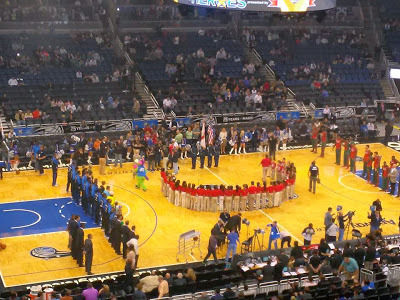 The National Anthem before a Magic's game ~ * ~I may be the only romance writer in existence who writes in Word Perfect, but I've been typing professionally since Noah built the Ark (or at least it seems that long) and when I saw my first word processing machine in 1981 (IBM - $10,000), I went absolutely wild. I had to have one. I'd been typing my mother's manuscripts since I took typing my freshman year in high school, I'd studied advanced typing (oh, wow, electric typewriters!) and shorthand before going to New York to audition for Broadway, knowing I would need a good-paying part-time job until I got a singing job. And it paid off - got the first job I applied for - in a legal office. And yet, for all my skill in English and shorthand, I had to retype something like twelve pages of my first effort because I spelled "judgment" one way and my boss spelled "judgement" the other way! (But, oh joy, I went on tour with The National Company of The Sound of Music within three months of moving to New York City.)
Later, after I was married I began my first attempts at writing novels and discovered my mother might make only minor corrections here and there when writing her children's books. Not so with me. I simply tore apart my first drafts, which meant multiple retyping of every single page of four or five hundred pages (because, yes, I was long-winded too).
So when I saw the IBM Displaywriter, I thought it was the most awesome thing I'd ever seen. It had all of 250K memory, and it wrote in umpteen languages. All I had to do was switch keyboards (and, no, I don't remember how I did it, but suddenly my QUERTY keyboard was typing in French or Italian or Spanish with all the right accents - all I had to do was look at the pretty pictures in the instruction manual to figure out which key typed what. I even got a job from the Yale transcribing a series of lectures in French. Looking back, the whole thing astounds me. But one thing I learned from all this was that IBM knew how to word process. So when PCs began to join the computer scene (with 8K memory which you could pay to enhance to 16K), it was pretty easy to sneer at Microsoft. And even when they developed a word processing program, it couldn't hold a candle to the one I was already using. When I was absolutely forced to use my husband's PC, I'd just about tore my hair out attempting to make early versions of MS Word behave.
And then a company in Canada (Lotus?) created a really good word processing system that actually worked on PCs - and allowed graphics! It was a major breakthrough. And of course both Microsoft and Corel found a way to mimic it, leaving the poor Canadian company by the wayside. (Or maybe one of them bought it, I don't know.)
But in the long run, MS Word never did catch up, its only triumph over Corel, the Track Changes editing program, which has become the standard for the publishing industry. The graphics I can produce with Word Perfect for promo materials are unsurpassed. If I hit "print," I don't get the whole darn manuscript instead of just the page I wanted. It makes gorgeous columns, etc. But nonetheless Microsoft rules the industry, so if you want to indie pub from Word Perfect (or programs other than MS Word), you're going to have to bend a little, work longer and harder . . .
So here's what you need to do for Word Perfect. Hopefully, my suggestions can be adapted to other word processing programs as well.
Note 1: You will need a copy of MS Word - a version with "doc" available as an alternative to "docx." (At least my older copy of MS Word - with "doc" only - is the version recommended by Smashwords' very knowledgeable Mark Coker.)
Note 2: if your manuscript is divided into several documents, arrange them into one. (When creating, never, repeat never, use separate documents for each chapter. It's unnecessary and makes it tedious to put the documents into one long doc.) I personally do 5 chapters per doc as I write, but whatever method you use, be sure each chapter is separated from the next by a Hard Page End - Control+Enter.] And be sure you use Auto Tabs, not Manual Tabs.)
From Word Perfect to Indie Pub - Step by Step
1. Turn on View - Reveal Codes.
2. Delete all codes at the beginning of your manuscript. (Since Times New Roman is the default, this should not affect your font. Bascially, you're getting rid of headers, page numbers and double spacing. If your Auto Tabs disappear, put them back in. [Format - Paragraph - Format - First Line Indent - .5]
3. Keeping your attention on the Codes at the bottom of the screen, go through your manuscript for "wonky" codes and extra spaces. This is not a "quickie." It's tedious and time-consuming but will pay for your effort by getting rid of codes that could put glitches in your ms when it's published. The two codes I most frequently need to get rid of: italics where no italics should be and manual tabs that creep in, even though you'd swear you'd never touched the tab key. You will also find two spaces between words or sentences where there should only be one. Sometimes there's an extra space at the beginning or end of a paragraph. Just keep scrolling down. You'll be surprised at what you find. (But don't stay at it too long at any one sitting - the brain begins to go numb.)
4. When finished, turn off Reveal Codes.
5. Save the entire manuscript to Rich Text Format (which has a lovely "W" indicating it is compatible with MS Word). Say bye-bye to Word Perfect.
6. Open MS Word. Bring up the RTF copy of your manuscript which is in Word Perfect.
7. Save the document as a Word doc. Be sure you save it into MS Word; otherwise it will save itself right back into Word Perfect! That's two changes in one step - change from RTF to Word doc. Then Save into Microsoft Word.
8. Click on the ¶ symbol in the Tool Bar. This will turn on what few codes you can reveal in MS Word: hard returns at the end of a paragraph, manual tabs (which should not exist in your ms as online publishing won't recognize them), and the spaces between words and sentences.
9. At the top of the Word document, Select All - choose Format - Paragraph. Change the standard .5 indent to .3. [No sense in doing it earlier as the Auto Tab can revert back to .5 during translation from Word Perfect to RTF to MS Word.]
10. Do a final complete edit of your manuscript with codes on, fixing manuscript errors as necessary, in addition to eliminating codes you don't want (manual tabs, extra spaces, etc.) [And, yes, for all that work in Word Perfect's Reveal Codes, you'll still find some codes that need fixing.] See also #s 11-13 below.
11. As you go along, change all Chapter headings to 14-font (or 16 if you prefer). [Not a necessity - it simply looks better.]
12. At the same time, highlight the chapter title and change the paragraph indent from .3 to 0, and center.
13. Highlight any Location & Date lines and change the paragraph indent from .3 to 0. These lines should end up flush left. Turn off ¶.
14. Don't forget to run a final spell check.
15. Use Alt+F9 to check for a sneaky "1" that likes to insert itself at the very beginning of any manuscript converted from Word Perfect to Word. Delete it! Turn off Alt+F9.
16. Don't forget to add something about yourself at the end of the book, plus info on other books you may have available.
Congratulations - you should be ready to upload to the online site(s) of your choice.
Thanks for stopping by,
Grace
For Blair's website with book covers & blurbs, click here
For Grace's editing service, click here
 The National Anthem before a Magic's game ~ * ~I may be the only romance writer in existence who writes in Word Perfect, but I've been typing professionally since Noah built the Ark (or at least it seems that long) and when I saw my first word processing machine in 1981 (IBM - $10,000), I went absolutely wild. I had to have one. I'd been typing my mother's manuscripts since I took typing my freshman year in high school, I'd studied advanced typing (oh, wow, electric typewriters!) and shorthand before going to New York to audition for Broadway, knowing I would need a good-paying part-time job until I got a singing job. And it paid off - got the first job I applied for - in a legal office. And yet, for all my skill in English and shorthand, I had to retype something like twelve pages of my first effort because I spelled "judgment" one way and my boss spelled "judgement" the other way! (But, oh joy, I went on tour with The National Company of The Sound of Music within three months of moving to New York City.)
Later, after I was married I began my first attempts at writing novels and discovered my mother might make only minor corrections here and there when writing her children's books. Not so with me. I simply tore apart my first drafts, which meant multiple retyping of every single page of four or five hundred pages (because, yes, I was long-winded too).
So when I saw the IBM Displaywriter, I thought it was the most awesome thing I'd ever seen. It had all of 250K memory, and it wrote in umpteen languages. All I had to do was switch keyboards (and, no, I don't remember how I did it, but suddenly my QUERTY keyboard was typing in French or Italian or Spanish with all the right accents - all I had to do was look at the pretty pictures in the instruction manual to figure out which key typed what. I even got a job from the Yale transcribing a series of lectures in French. Looking back, the whole thing astounds me. But one thing I learned from all this was that IBM knew how to word process. So when PCs began to join the computer scene (with 8K memory which you could pay to enhance to 16K), it was pretty easy to sneer at Microsoft. And even when they developed a word processing program, it couldn't hold a candle to the one I was already using. When I was absolutely forced to use my husband's PC, I'd just about tore my hair out attempting to make early versions of MS Word behave.
And then a company in Canada (Lotus?) created a really good word processing system that actually worked on PCs - and allowed graphics! It was a major breakthrough. And of course both Microsoft and Corel found a way to mimic it, leaving the poor Canadian company by the wayside. (Or maybe one of them bought it, I don't know.)
But in the long run, MS Word never did catch up, its only triumph over Corel, the Track Changes editing program, which has become the standard for the publishing industry. The graphics I can produce with Word Perfect for promo materials are unsurpassed. If I hit "print," I don't get the whole darn manuscript instead of just the page I wanted. It makes gorgeous columns, etc. But nonetheless Microsoft rules the industry, so if you want to indie pub from Word Perfect (or programs other than MS Word), you're going to have to bend a little, work longer and harder . . .
So here's what you need to do for Word Perfect. Hopefully, my suggestions can be adapted to other word processing programs as well.
Note 1: You will need a copy of MS Word - a version with "doc" available as an alternative to "docx." (At least my older copy of MS Word - with "doc" only - is the version recommended by Smashwords' very knowledgeable Mark Coker.)
Note 2: if your manuscript is divided into several documents, arrange them into one. (When creating, never, repeat never, use separate documents for each chapter. It's unnecessary and makes it tedious to put the documents into one long doc.) I personally do 5 chapters per doc as I write, but whatever method you use, be sure each chapter is separated from the next by a Hard Page End - Control+Enter.] And be sure you use Auto Tabs, not Manual Tabs.)
From Word Perfect to Indie Pub - Step by Step
1. Turn on View - Reveal Codes.
2. Delete all codes at the beginning of your manuscript. (Since Times New Roman is the default, this should not affect your font. Bascially, you're getting rid of headers, page numbers and double spacing. If your Auto Tabs disappear, put them back in. [Format - Paragraph - Format - First Line Indent - .5]
3. Keeping your attention on the Codes at the bottom of the screen, go through your manuscript for "wonky" codes and extra spaces. This is not a "quickie." It's tedious and time-consuming but will pay for your effort by getting rid of codes that could put glitches in your ms when it's published. The two codes I most frequently need to get rid of: italics where no italics should be and manual tabs that creep in, even though you'd swear you'd never touched the tab key. You will also find two spaces between words or sentences where there should only be one. Sometimes there's an extra space at the beginning or end of a paragraph. Just keep scrolling down. You'll be surprised at what you find. (But don't stay at it too long at any one sitting - the brain begins to go numb.)
4. When finished, turn off Reveal Codes.
5. Save the entire manuscript to Rich Text Format (which has a lovely "W" indicating it is compatible with MS Word). Say bye-bye to Word Perfect.
6. Open MS Word. Bring up the RTF copy of your manuscript which is in Word Perfect.
7. Save the document as a Word doc. Be sure you save it into MS Word; otherwise it will save itself right back into Word Perfect! That's two changes in one step - change from RTF to Word doc. Then Save into Microsoft Word.
8. Click on the ¶ symbol in the Tool Bar. This will turn on what few codes you can reveal in MS Word: hard returns at the end of a paragraph, manual tabs (which should not exist in your ms as online publishing won't recognize them), and the spaces between words and sentences.
9. At the top of the Word document, Select All - choose Format - Paragraph. Change the standard .5 indent to .3. [No sense in doing it earlier as the Auto Tab can revert back to .5 during translation from Word Perfect to RTF to MS Word.]
10. Do a final complete edit of your manuscript with codes on, fixing manuscript errors as necessary, in addition to eliminating codes you don't want (manual tabs, extra spaces, etc.) [And, yes, for all that work in Word Perfect's Reveal Codes, you'll still find some codes that need fixing.] See also #s 11-13 below.
11. As you go along, change all Chapter headings to 14-font (or 16 if you prefer). [Not a necessity - it simply looks better.]
12. At the same time, highlight the chapter title and change the paragraph indent from .3 to 0, and center.
13. Highlight any Location & Date lines and change the paragraph indent from .3 to 0. These lines should end up flush left. Turn off ¶.
14. Don't forget to run a final spell check.
15. Use Alt+F9 to check for a sneaky "1" that likes to insert itself at the very beginning of any manuscript converted from Word Perfect to Word. Delete it! Turn off Alt+F9.
16. Don't forget to add something about yourself at the end of the book, plus info on other books you may have available.
Congratulations - you should be ready to upload to the online site(s) of your choice.
Thanks for stopping by,
Grace
For Blair's website with book covers & blurbs, click here
For Grace's editing service, click here
November 8, 2013
Spain, Part 2
On to Madrid and the Palacio Reale.
Below is a postcard, plus a personal photo, of the Royal Palace, where it's said guerrilla warfare was born when a thirteen-year-old prince refused to leave the palace when the French sent Mameluke guards to take him into exile—a move that incited ordinary citizens to revolt against their former allies. Although the revolt was swiftly put down, the spark lit in the Plaza de Oriente on May 2, 1808, would help turn the tide against Napoleon (and encourage Britain to send troops to the Peninsula), although it would be five long years before the French were finally driven back behind the Pyrenees into France.
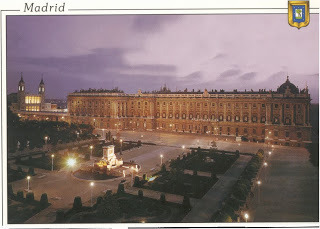 Plaza de Oriente & Palacio Reale
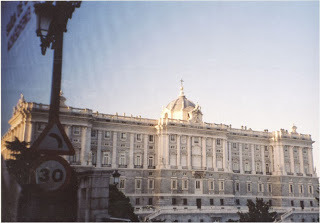 Palacio Reale, Madrid - side view
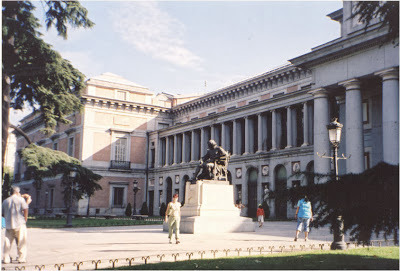 The Prado, Madrid - one of the world's great art musuems
Set on a mountaintop surrounded on three sides by the broad Tagus river, Toledo has remained almost unassailable through the centuries. It is the famed home of the Toledo blade and the Alcázar. The fortress was built in Roman times and nearly destroyed in a siege during the Spanish Civil War (1936). It has been rebuilt and is now a museum. And, yes, Toledo craftsmen still make swords and knives of every description.
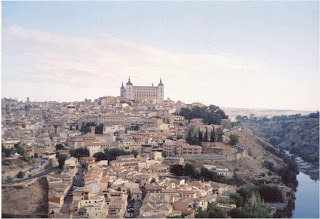 Toledo - the Alcázar at the top
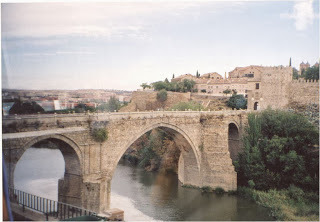 Ancient Bridge, Toledo
Below, the Venta Quixote, a 16th c. inn Cervantes used as a setting for Don Quixote. (Their pea soup was amazing!) And, yes, they still have windmills in the area, although they were too far away for a good photo. (And I do mean windmills, as in Don Quixote, not modern wind turbines, which we also saw all over Spain.)
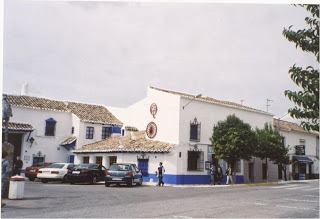 Venta Quixote
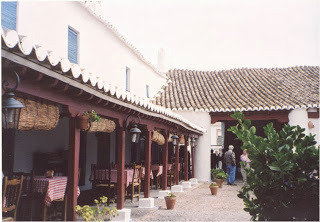 Courtyard, Venta Quixote
The Alhambra, one of the great wonders of the world, is indescribable. I post here only a tantalizing bit of the whole, which includes many cats (our guide brought cat kibble to distribute to the grateful population). The only ugliness in the Alhambra are some great stone fortifications left from Medieval times when Crusaders occupied the Alhambra. (There was also some destruction when French soldiers in Napoleon's time attempted to blow up part of the sprawling palace.)
The palace fountains, pools and waterfalls are naturally fed from water on the hillside above. There are also extensive formal gardens on the hillside. (I did not attempt the climb.)
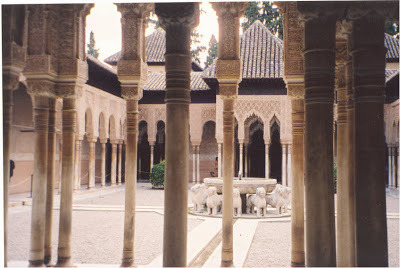 The harim, the Alhambra
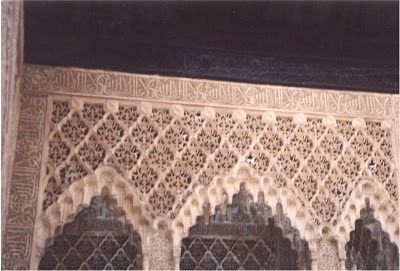 One tiny portion of thousands of intricate details
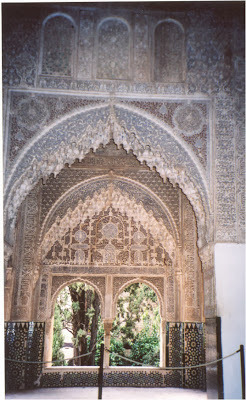 The harim - inside
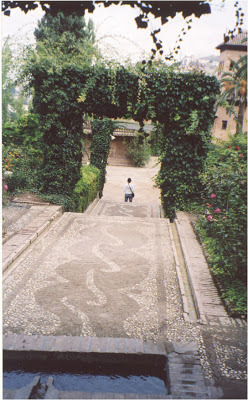 One of many garden & pool areas in the Alhambra
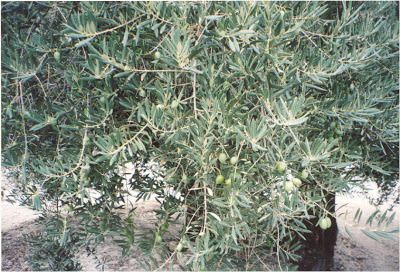
After leaving the Alhambra, we nagged our guide and driver to let us have a close-up of olives growing - olives are the main crop assigned to Spain by the European Union. And finally our bus sneaked off on a back road and we were given ten minutes to wander through the edge of someone's olive grove.
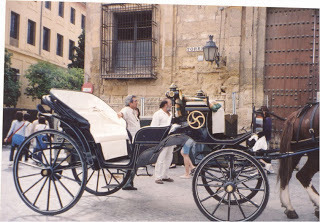 A carriage in Cordoba
My favorite photo in Seville wasn't the cathedral or even the incredibly narrow cobbled streets and ancient houses. It was a garden I found by peeking through iron bars set in an open window - and discovering a fairyland, a private garden taking up all of a small courtyard in the center of a three-story residential building. It was exquisite - and carefully tended. I only wish I could have gotten a better angle through the bars to show more of it.
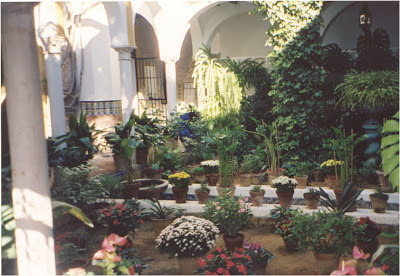 I even used this garden in a book (one not out yet).
And with a look inside Seville's great cathedral, we say goodbye to Spain - though not to the Iberian Peninsula.
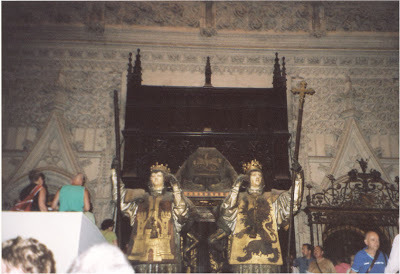 The burial site of Christopher Columbus - inside Seville's cathedral
Thanks for stopping by,
Grace
Next week: probably Portugal 2 - the Mediterranean Coast
For Blair's website with book covers & blurbs, click here
For Grace's editing service, click here
Below is a postcard, plus a personal photo, of the Royal Palace, where it's said guerrilla warfare was born when a thirteen-year-old prince refused to leave the palace when the French sent Mameluke guards to take him into exile—a move that incited ordinary citizens to revolt against their former allies. Although the revolt was swiftly put down, the spark lit in the Plaza de Oriente on May 2, 1808, would help turn the tide against Napoleon (and encourage Britain to send troops to the Peninsula), although it would be five long years before the French were finally driven back behind the Pyrenees into France.
 Plaza de Oriente & Palacio Reale
 Palacio Reale, Madrid - side view
 The Prado, Madrid - one of the world's great art musuems
Set on a mountaintop surrounded on three sides by the broad Tagus river, Toledo has remained almost unassailable through the centuries. It is the famed home of the Toledo blade and the Alcázar. The fortress was built in Roman times and nearly destroyed in a siege during the Spanish Civil War (1936). It has been rebuilt and is now a museum. And, yes, Toledo craftsmen still make swords and knives of every description.
 Toledo - the Alcázar at the top
 Ancient Bridge, Toledo
Below, the Venta Quixote, a 16th c. inn Cervantes used as a setting for Don Quixote. (Their pea soup was amazing!) And, yes, they still have windmills in the area, although they were too far away for a good photo. (And I do mean windmills, as in Don Quixote, not modern wind turbines, which we also saw all over Spain.)
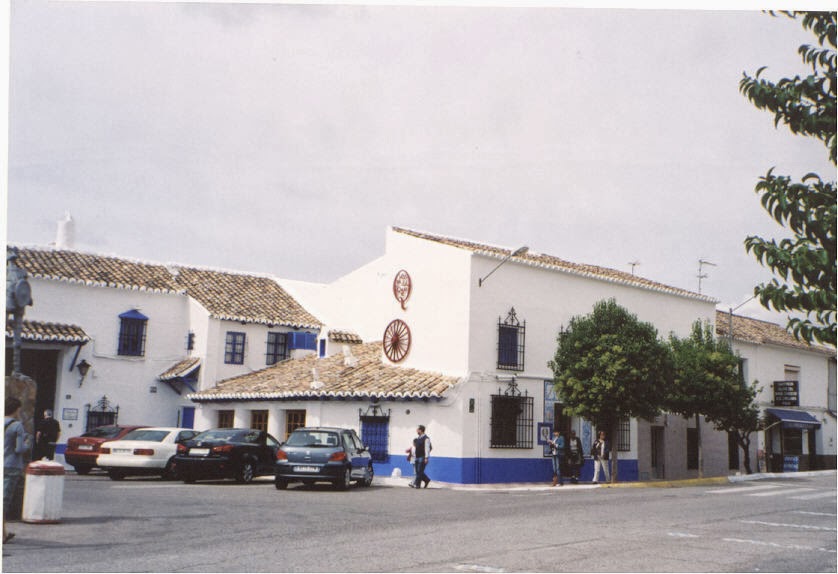 Venta Quixote
 Courtyard, Venta Quixote
The Alhambra, one of the great wonders of the world, is indescribable. I post here only a tantalizing bit of the whole, which includes many cats (our guide brought cat kibble to distribute to the grateful population). The only ugliness in the Alhambra are some great stone fortifications left from Medieval times when Crusaders occupied the Alhambra. (There was also some destruction when French soldiers in Napoleon's time attempted to blow up part of the sprawling palace.)
The palace fountains, pools and waterfalls are naturally fed from water on the hillside above. There are also extensive formal gardens on the hillside. (I did not attempt the climb.)
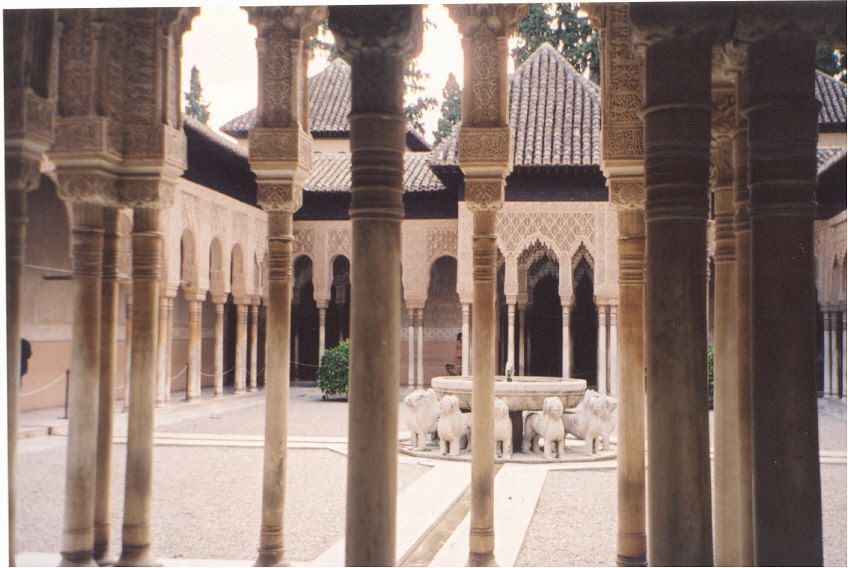 The harim, the Alhambra
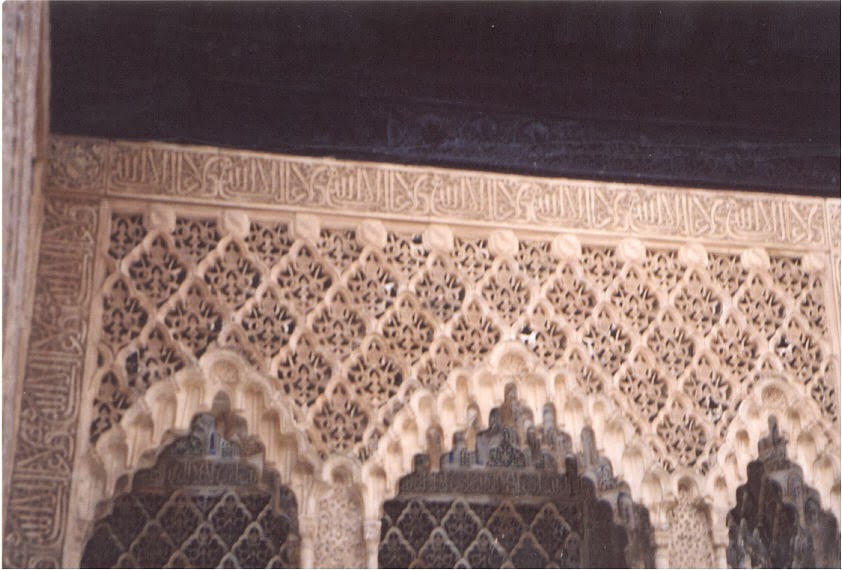 One tiny portion of thousands of intricate details
  The harim - inside
 One of many garden & pool areas in the Alhambra
After leaving the Alhambra, we nagged our guide and driver to let us have a close-up of olives growing - olives are the main crop assigned to Spain by the European Union. And finally our bus sneaked off on a back road and we were given ten minutes to wander through the edge of someone's olive grove.

 A carriage in Cordoba
My favorite photo in Seville wasn't the cathedral or even the incredibly narrow cobbled streets and ancient houses. It was a garden I found by peeking through iron bars set in an open window - and discovering a fairyland, a private garden taking up all of a small courtyard in the center of a three-story residential building. It was exquisite - and carefully tended. I only wish I could have gotten a better angle through the bars to show more of it.
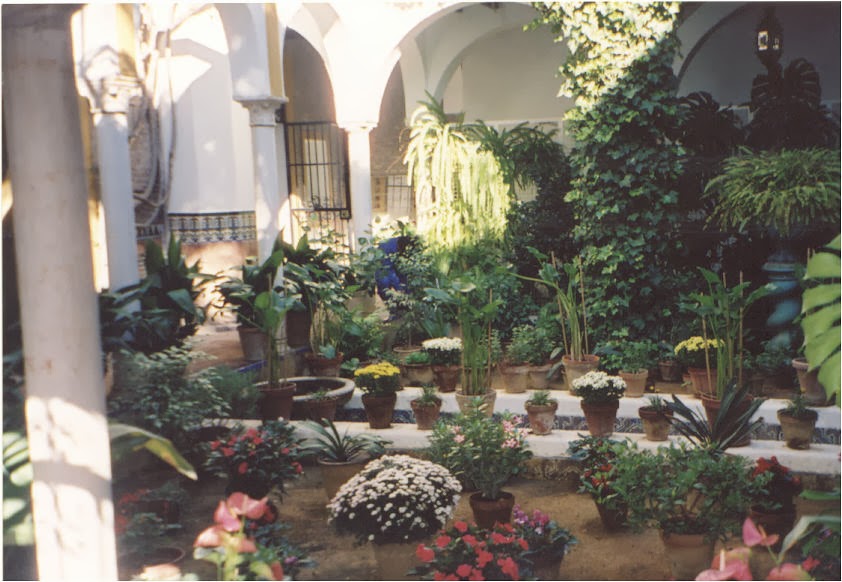 I even used this garden in a book (one not out yet).
And with a look inside Seville's great cathedral, we say goodbye to Spain - though not to the Iberian Peninsula.
 The burial site of Christopher Columbus - inside Seville's cathedral
Thanks for stopping by,
Grace
Next week: probably Portugal 2 - the Mediterranean Coast
For Blair's website with book covers & blurbs, click here
For Grace's editing service, click here
November 2, 2013
Spain, Part 1
Continuing our travels in Portugal and Spain:
We drove north from Oporto, Portugal, into Spain—first stop, Santiago de Compostela, a pilgrimage site for more than a thousand years.
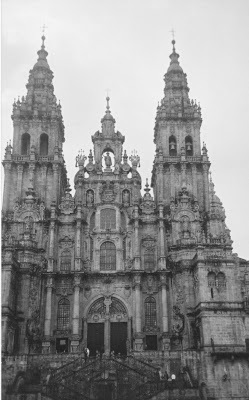 Gothicked-up Medieval Cathedral - Santiago de Compostela
Because several of us were interested in La Coruña (Corunna), our guide arranged a side trip there. Of course houses had filled in the space where the battle occurred, both flat ground and the hillside behind, but at least I could now picture it properly and discovered I hadn't mangled the facts too badly when writing Tarleton's Wife. The harbor, I assume, remains the same, except it's now filled with pleasure boats, as well as fishing boats. The town square was also intact and easy to visualize as it was back in January 1809. A bit of the ramparts also remain, now a park in tribute to General Sir John Moore, who died at Corunna.
For those who don't know the story, in 1808 an army of 35,000 British and Spanish troops set out to defeat the French on the Iberian Peninsula. It ended with the British army making a nightmarish retreat through the mountains to the Spanish coast, with the French army on their heels. When they got to "Corunna," less than half the necessary ships (245 sent from England) had arrived, and they were forced to fight a battle just outside the town. The British won, holding the French off long enough for those still alive to escape in a mass military evacuation that wouldn't be seen again until Dunkirk in World War II. It was one of the British army's most dramatic moments, though far from its finest hour. [The number of troops involved varies with the telling. Some say 5000 died on the trek through the mountains; some say 10,000 were evacuated, some say more, nearly all of them listed as sick or wounded.]
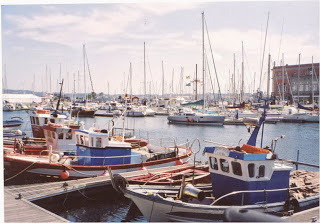 Harbor at La Coruña
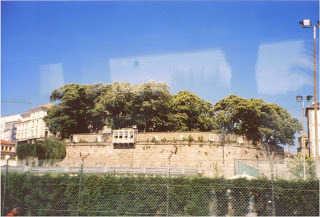 Remaining ramparts at La Coruña
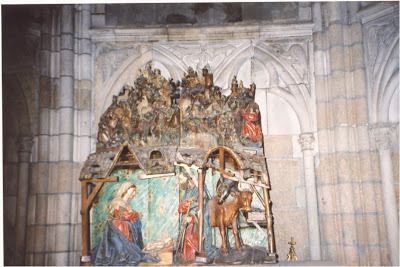 Crèche in Léon cathedral, carved from a single tree trunk
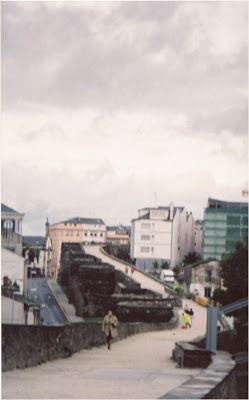 Roman Wall still in use in Lugo
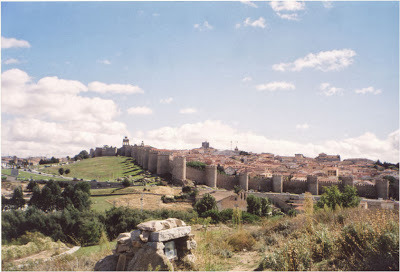 The walled city of Avila
If there are Peninsular War buffs who haven't seen The Pride and the Passion with Gary Cooper and Frank Sinatra - it's worth joining Netflix to see it. Although pure fiction, adapted from The Gun by C. S. Forester, I doubt there's a Regency fan whose heart won't thrill to this one. (Picture Gary Cooper in full Brit naval uniform and a gun as big as most people's houses.) [You don't even want to know how many photos I took of Avila! - while standing at a rest stop on a hill above the city]
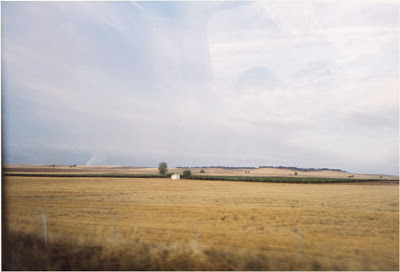 Mile after mile of the "plains in Spain" - with what looks like a very modern irrigation sprayer (horizon left)
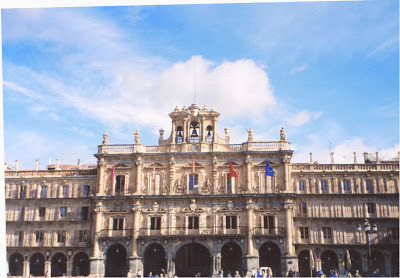 Part of the main square in Salamanca
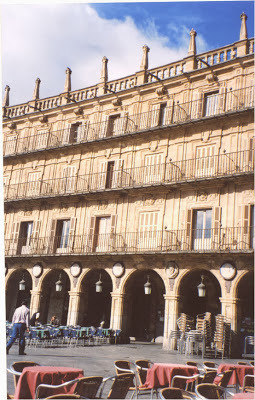 Lunch in Salamanca
While we enjoyed lunch in the main square in Salamanca, I marveled that I was actually there - at the site of another famous name from the Peninsular War. Like La Coruña, Salamanca's central core seems little changed from the past - if you discount people in modern dress and a "cleaning zamboni" that rolled by while we ate!
Two weeks ago, I intended to end the photo essay on Portugal with a postcard I bought from a street vendor along the banks of the Douro River. But somehow after scanning it was downloaded into the wrong folder and forgotten. So I add it here - a little special color to end today's blog, even if it is a product of Portugal (or should I say, "they"?). [Clearly, Europeans don't have to answer to Puritan ancestors.] Note the artist signed each painting.

Thanks for stopping by,
Grace
For Blair's website with book covers & blurbs, click here
For Grace's editing service, click here
We drove north from Oporto, Portugal, into Spain—first stop, Santiago de Compostela, a pilgrimage site for more than a thousand years.
 Gothicked-up Medieval Cathedral - Santiago de Compostela
Because several of us were interested in La Coruña (Corunna), our guide arranged a side trip there. Of course houses had filled in the space where the battle occurred, both flat ground and the hillside behind, but at least I could now picture it properly and discovered I hadn't mangled the facts too badly when writing Tarleton's Wife. The harbor, I assume, remains the same, except it's now filled with pleasure boats, as well as fishing boats. The town square was also intact and easy to visualize as it was back in January 1809. A bit of the ramparts also remain, now a park in tribute to General Sir John Moore, who died at Corunna.
For those who don't know the story, in 1808 an army of 35,000 British and Spanish troops set out to defeat the French on the Iberian Peninsula. It ended with the British army making a nightmarish retreat through the mountains to the Spanish coast, with the French army on their heels. When they got to "Corunna," less than half the necessary ships (245 sent from England) had arrived, and they were forced to fight a battle just outside the town. The British won, holding the French off long enough for those still alive to escape in a mass military evacuation that wouldn't be seen again until Dunkirk in World War II. It was one of the British army's most dramatic moments, though far from its finest hour. [The number of troops involved varies with the telling. Some say 5000 died on the trek through the mountains; some say 10,000 were evacuated, some say more, nearly all of them listed as sick or wounded.]
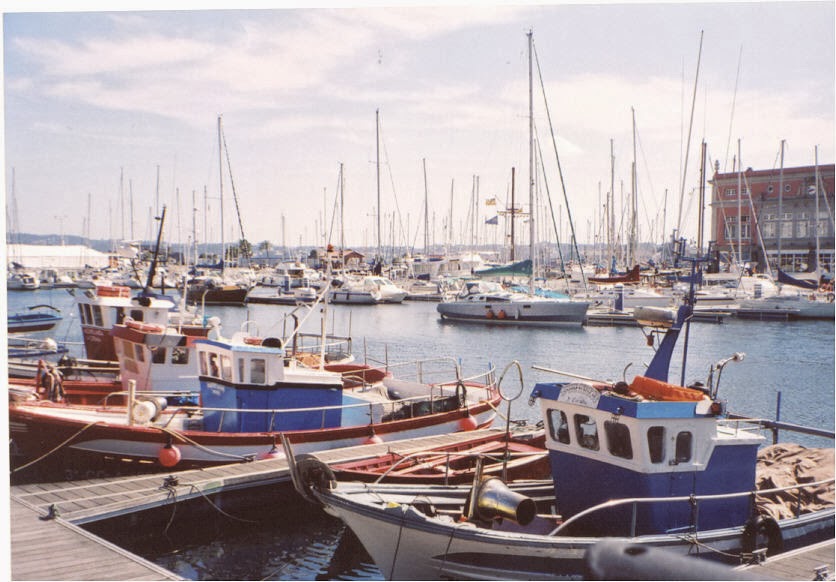 Harbor at La Coruña
 Remaining ramparts at La Coruña
 Crèche in Léon cathedral, carved from a single tree trunk
 Roman Wall still in use in Lugo
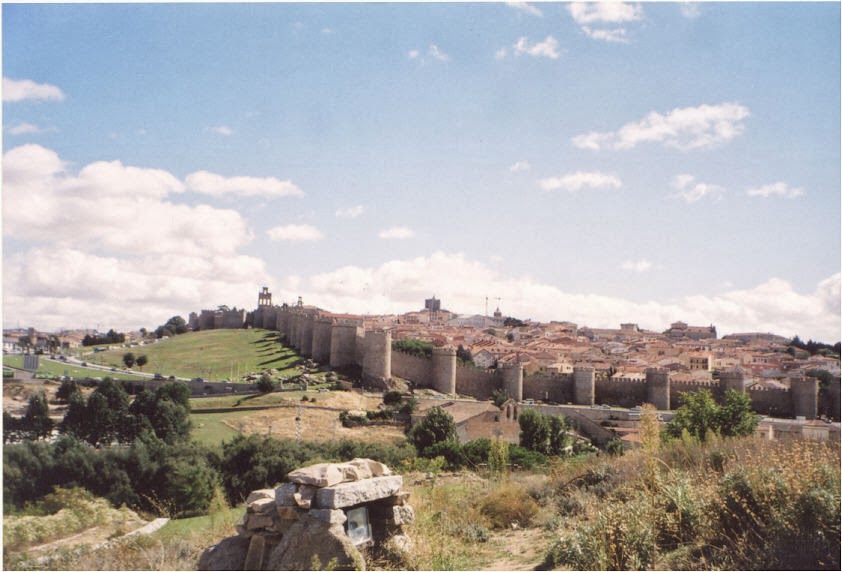 The walled city of Avila
If there are Peninsular War buffs who haven't seen The Pride and the Passion with Gary Cooper and Frank Sinatra - it's worth joining Netflix to see it. Although pure fiction, adapted from The Gun by C. S. Forester, I doubt there's a Regency fan whose heart won't thrill to this one. (Picture Gary Cooper in full Brit naval uniform and a gun as big as most people's houses.) [You don't even want to know how many photos I took of Avila! - while standing at a rest stop on a hill above the city]
 Mile after mile of the "plains in Spain" - with what looks like a very modern irrigation sprayer (horizon left)
 Part of the main square in Salamanca
 Lunch in Salamanca
While we enjoyed lunch in the main square in Salamanca, I marveled that I was actually there - at the site of another famous name from the Peninsular War. Like La Coruña, Salamanca's central core seems little changed from the past - if you discount people in modern dress and a "cleaning zamboni" that rolled by while we ate!
Two weeks ago, I intended to end the photo essay on Portugal with a postcard I bought from a street vendor along the banks of the Douro River. But somehow after scanning it was downloaded into the wrong folder and forgotten. So I add it here - a little special color to end today's blog, even if it is a product of Portugal (or should I say, "they"?). [Clearly, Europeans don't have to answer to Puritan ancestors.] Note the artist signed each painting.

Thanks for stopping by,
Grace
For Blair's website with book covers & blurbs, click here
For Grace's editing service, click here
October 27, 2013
Fort Wilderness
My husband and I took our children to DisneyWorld the year it opened, and I recall driving by the entrance to Fort Wilderness, Disney's camping area, when it was little more than a path off a back road that ran between the hotels at Lake Buena Vista and the Magic Kingdom. But in all these many years since, even after moving to Orlando, I'd never actually seen Fort Wilderness. Until this month.
My visiting niece, whom we hadn't seen in years, spent several days at the University of Central Florida and wanted to get together when her work there was done. (She works for a company based in D.C. that educates people, particularly young people, on the evils of smoking.) The only problem - for the first time ever her cousin Susie and family were spending that particular weekend at Fort Wilderness. Oops.
So there was I, who hates driving on I-4, fighting my way past downtown Orlando, Sea World, Universal, I-Drive, and all the traffic that goes with four Disney theme parks, plus water parks, plus Downtown Disney, etc., etc. - quickly discovering that the road to Fort Wilderness has grown to something like eight lanes barricaded by toll booths, expecting parking fees. Aargh!
Except . . . when I said we were visitors to Fort Wilderness, we were waved through, after being told to "go right," requiring an interesting maneuver across at least three lanes of traffic. Fortunately, most of the drivers were as bewildered as I was, so no problem.
I know there are statistics somewhere on how many "not acres but square miles" Disney bought when it decided to set up shop in Orlando, but let's agree it's a lot. And all of it heavily landscaped with trees so no matter where you drive, you are surrounded by "wilderness" right up until the moment you arrive at the vast parking lot of the theme park you had in mind. (Apologies to Orlando residents, who know all this, but my blog has readers around the world.)
The Fort Wilderness campground, however, is one vast forest. The natural pine and live oak forest was tweaked just enough to make campsites, each one with trees and bushes separating it from the next site. And it's huge. Almost all families rent golf carts during their stay there, so they can move easily from campsite to pool to lakefront to restaurant, hayrides, and other on-site attractions. There is also a dock at the lake, providing boat service which transports guests from the campsite to the theme parks and/or the many stores and restaurants in Downtown Disney.
My niece and I spent only an afternoon and evening there, but it was a unique experience. I was so busy looking around - and hanging on while my daughter drove a golf cart like she was doing the Daytona 500 - that I didn't take a single photo. The ones below I stole off Susie's Facebook page.
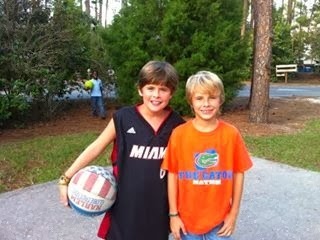
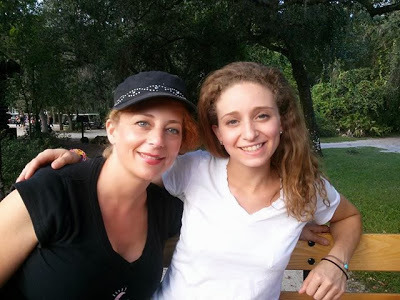 Cousins - frankly, no one had noticed the resemblance until this photo
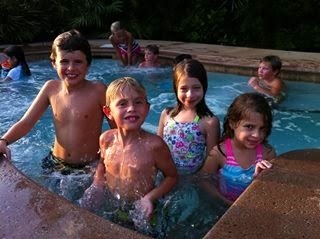
A couple of days before the grandgirls left for Fort Wilderness, one of them confided, "There are going to be boys there." (Sons of the family who arranged the trip.)
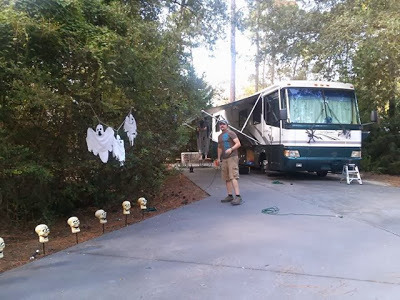 "Hardshell" camping - they have tent sites as wellFortunately, our family was warned that campers at Fort Wilderness decorate for all the holidays. We drove up and down in the golf cart, amazed by the inventiveness of the decorations - none, however, quite as clever as the people who hadn't gotten the message and rose to the occasion by outlining a large Mickey Mouse head on the pavement - with pine cones! (Sorry, no photo.)
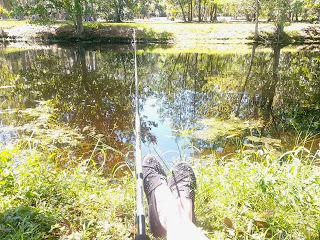 The real estate broker "gone fishin'" again (near the pool area)
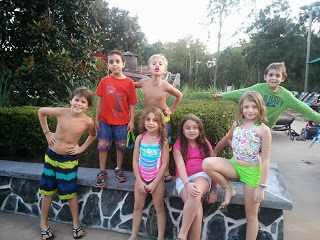 Yes, Virginia, there will be boys (pool area)
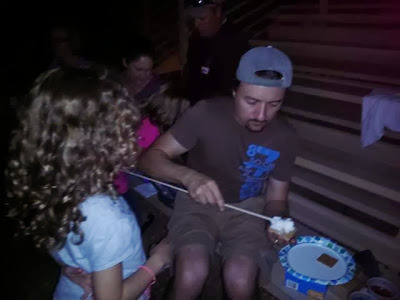 Making s'mores with Daddy
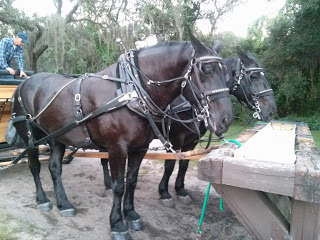 Our next-to-the-last activity of the day - a Hayride
 And for a grand finale, everyone gathers at the lake to watch the fireworks at the Magic KingdomThe photo above is definitely "telephoto" - the fireworks were WAY across the lake, very colorful but the "booms" were mere thuds.
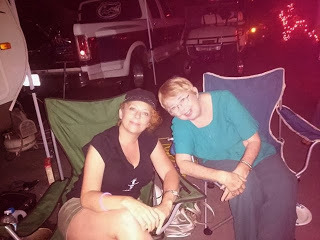
All in all, a delightful experience for a family of non-campers. And, oh yes, a farewell photo before my niece and I climbed into my car and headed back to reality of I-4, leaving the "campers" to a second night in the "wilderness."
~ * ~
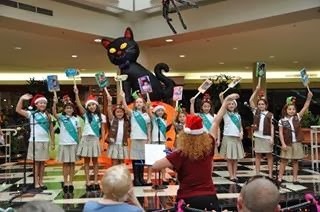
Christmas at Halloween! Ordinarily I'd be grumbling about rushing the season, but below is a photo of Girl Scout Troop 1668 singing their "cookie" song to the tune of "The Twelve Days of Christmas" plus several blatantly Christmasy songs in front of the Halloween decorations at Florida Square Mall. The occasion: auditions for Orlando's Christmas festivities at Lake Eola. Believe me, the girls are a "shoo-in." Truly excellent. Cassidy was a featured soloist, Mom directing.
Thanks for stopping by,
Grace
Next week: Very likely, Spain
For a look at Blair's books, click here.
My visiting niece, whom we hadn't seen in years, spent several days at the University of Central Florida and wanted to get together when her work there was done. (She works for a company based in D.C. that educates people, particularly young people, on the evils of smoking.) The only problem - for the first time ever her cousin Susie and family were spending that particular weekend at Fort Wilderness. Oops.
So there was I, who hates driving on I-4, fighting my way past downtown Orlando, Sea World, Universal, I-Drive, and all the traffic that goes with four Disney theme parks, plus water parks, plus Downtown Disney, etc., etc. - quickly discovering that the road to Fort Wilderness has grown to something like eight lanes barricaded by toll booths, expecting parking fees. Aargh!
Except . . . when I said we were visitors to Fort Wilderness, we were waved through, after being told to "go right," requiring an interesting maneuver across at least three lanes of traffic. Fortunately, most of the drivers were as bewildered as I was, so no problem.
I know there are statistics somewhere on how many "not acres but square miles" Disney bought when it decided to set up shop in Orlando, but let's agree it's a lot. And all of it heavily landscaped with trees so no matter where you drive, you are surrounded by "wilderness" right up until the moment you arrive at the vast parking lot of the theme park you had in mind. (Apologies to Orlando residents, who know all this, but my blog has readers around the world.)
The Fort Wilderness campground, however, is one vast forest. The natural pine and live oak forest was tweaked just enough to make campsites, each one with trees and bushes separating it from the next site. And it's huge. Almost all families rent golf carts during their stay there, so they can move easily from campsite to pool to lakefront to restaurant, hayrides, and other on-site attractions. There is also a dock at the lake, providing boat service which transports guests from the campsite to the theme parks and/or the many stores and restaurants in Downtown Disney.
My niece and I spent only an afternoon and evening there, but it was a unique experience. I was so busy looking around - and hanging on while my daughter drove a golf cart like she was doing the Daytona 500 - that I didn't take a single photo. The ones below I stole off Susie's Facebook page.
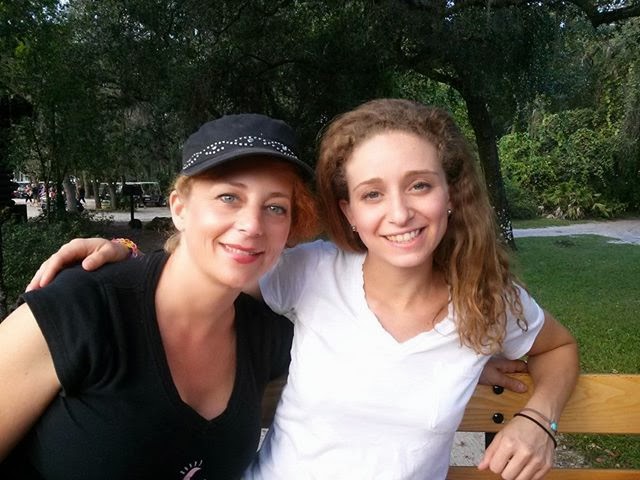 Cousins - frankly, no one had noticed the resemblance until this photo
A couple of days before the grandgirls left for Fort Wilderness, one of them confided, "There are going to be boys there." (Sons of the family who arranged the trip.)

 "Hardshell" camping - they have tent sites as wellFortunately, our family was warned that campers at Fort Wilderness decorate for all the holidays. We drove up and down in the golf cart, amazed by the inventiveness of the decorations - none, however, quite as clever as the people who hadn't gotten the message and rose to the occasion by outlining a large Mickey Mouse head on the pavement - with pine cones! (Sorry, no photo.)
 The real estate broker "gone fishin'" again (near the pool area)
 Yes, Virginia, there will be boys (pool area)
 Making s'mores with Daddy
 Our next-to-the-last activity of the day - a Hayride
 And for a grand finale, everyone gathers at the lake to watch the fireworks at the Magic KingdomThe photo above is definitely "telephoto" - the fireworks were WAY across the lake, very colorful but the "booms" were mere thuds.
All in all, a delightful experience for a family of non-campers. And, oh yes, a farewell photo before my niece and I climbed into my car and headed back to reality of I-4, leaving the "campers" to a second night in the "wilderness."

~ * ~
Christmas at Halloween! Ordinarily I'd be grumbling about rushing the season, but below is a photo of Girl Scout Troop 1668 singing their "cookie" song to the tune of "The Twelve Days of Christmas" plus several blatantly Christmasy songs in front of the Halloween decorations at Florida Square Mall. The occasion: auditions for Orlando's Christmas festivities at Lake Eola. Believe me, the girls are a "shoo-in." Truly excellent. Cassidy was a featured soloist, Mom directing.

Thanks for stopping by,
Grace
Next week: Very likely, Spain
For a look at Blair's books, click here.
October 19, 2013
Portugal, Spain, & Priceless Quote
I ran into a great quote this week - I sat there, Kindle in hand, and howled. (Of course the males among us may not find it as funny.) From A Study in Silk by Emma Jane Holloway - the young heroine is supposedly Sherlock Holme's niece. Speaking, her Holmes grandmother, mother of Sherlock:
"Finding a proper husband is rather like selecting a hound. They all have more bark than bite, my girl. One day you'll look across the breakfast table and realize the only option left is obedience training."
~ * ~
PORTUGAL & SPAIN, Part 1
A few years ago I traveled to Portugal and Spain with my daughter-in-law and her sister. The photos are scanned from Kodak moments as I resisted giving up my Nikon for digital until it simply stopped functioning one day. Nonetheless, the trip was somewhat off the customary European tourist routes, and I hope some of you will find the photos of interest.
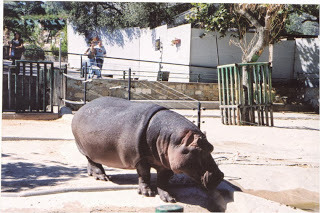
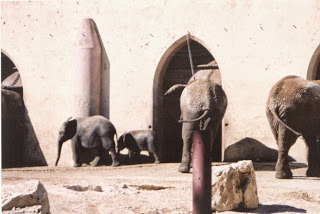
After our all-night flight from the U.S., we were dead tired but decided we should take advantage of our only free time in Lisbon. So we walked from our hotel to the Lisbon zoo, a delightfully large and shady place where we seemed to be the only tourists, something that's always fun. (People stared at us as if we were part of the exhibit.)
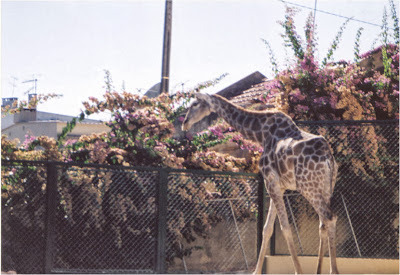 The flowers in Lisbon looked remarkably familiar to Floridians.
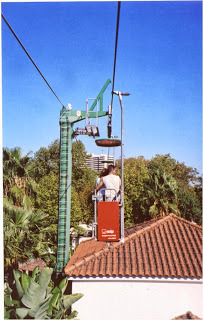 Cable car ride above the zoo
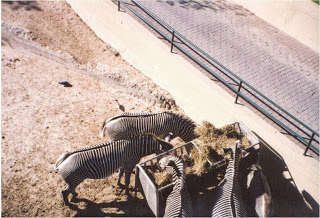 Zebras as seen from cable car
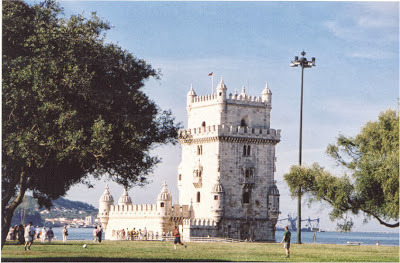 Fort on the Tagus RiverIf my memory doesn't fail me, this is the fort where Portugal's great explorers had to bring the treasure they found in the New World. (That's right, the government got it. Presumably the explorers were amply rewarded, however.)
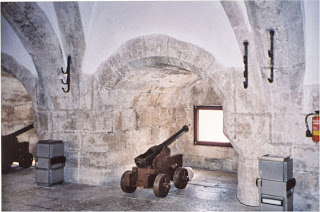 Cannons inside the fort
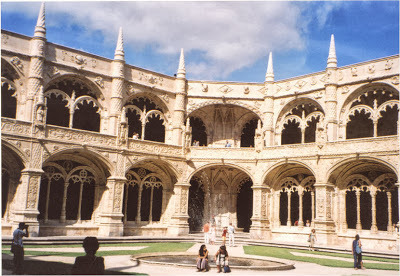 The cloister of Geronimos monastery
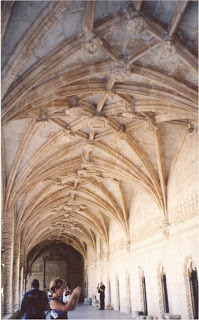 The cloister's Gothic ceiling
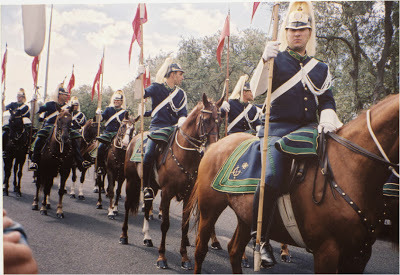 These horsemen at the cloisters were translated as "the band," but to me they were Lisbon's version of the Horse Guards
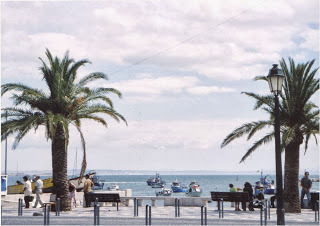 We had lunch at the harbor in Cascais
The next day we were off to see the more of Portugal, starting with the walled city of Obidos, one of the very few where the entire ancient city wall is still standing.
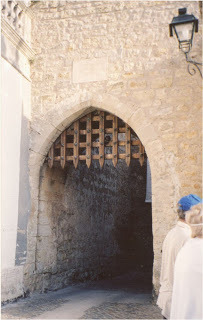 Entrance to Obidos, complete with portcullis
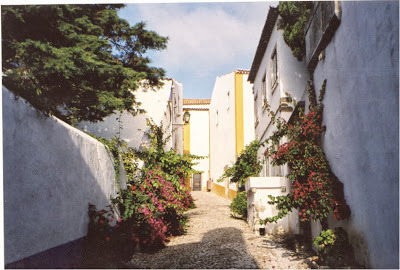 In spite of the narrow streets, cars actually drive here - 'Ware, walkers!
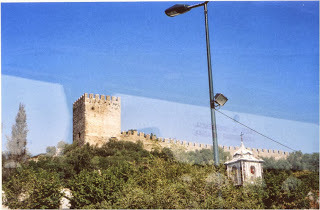 A look back at Obidos from the bus - and yes, it has a genuine wall-walk
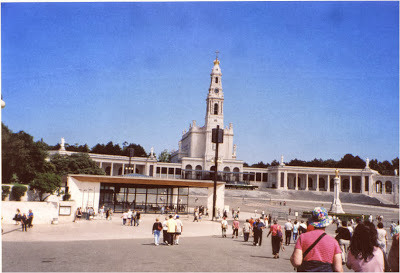 On to Our Lady of Fátima, one of the most visited shrines in the world
Below are modern-day versions of the boats Wellington used to cross the Douro River at Oporto and surprise the French, who were expecting him on the other side of town. (1809, during the Peninsular War against Napoleon.) The boats, once used to haul grapes to the wineries, are now mostly for pleasure. But the creation of "port" continues, unabated.
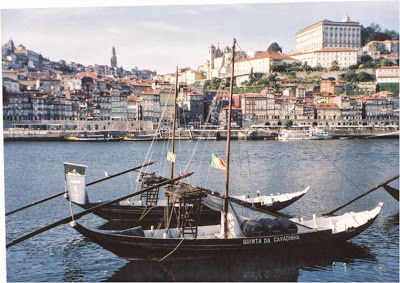 Boats on the Douro in Oporto, home of port wine
~ * ~
Addendum for BeauMonde members who want to see a "ha-ha":
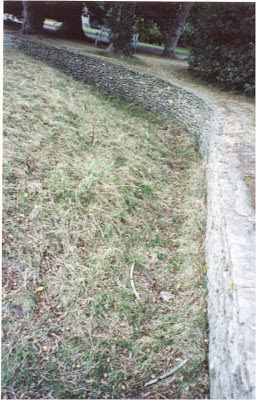 Ha-ha at Laycock Abbey
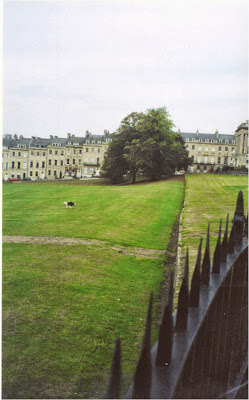 Side view of ha-ha at the Royal Crescent, Bath
Thanks for stopping by,
Grace
Next week: Spain . . . or maybe Fort Wilderness . . . or ?
For a look at Blair's books, click here.
"Finding a proper husband is rather like selecting a hound. They all have more bark than bite, my girl. One day you'll look across the breakfast table and realize the only option left is obedience training."
~ * ~
PORTUGAL & SPAIN, Part 1
A few years ago I traveled to Portugal and Spain with my daughter-in-law and her sister. The photos are scanned from Kodak moments as I resisted giving up my Nikon for digital until it simply stopped functioning one day. Nonetheless, the trip was somewhat off the customary European tourist routes, and I hope some of you will find the photos of interest.
After our all-night flight from the U.S., we were dead tired but decided we should take advantage of our only free time in Lisbon. So we walked from our hotel to the Lisbon zoo, a delightfully large and shady place where we seemed to be the only tourists, something that's always fun. (People stared at us as if we were part of the exhibit.)

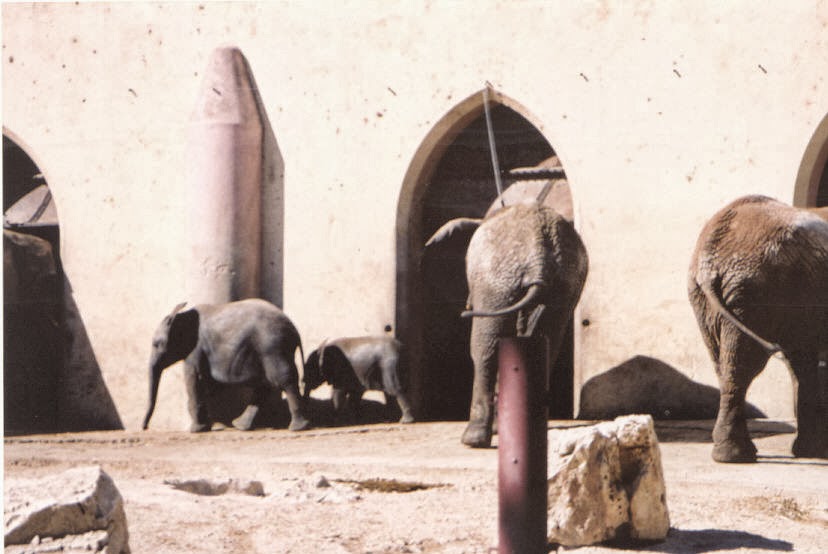 The flowers in Lisbon looked remarkably familiar to Floridians.
 Cable car ride above the zoo
 Zebras as seen from cable car
 Fort on the Tagus RiverIf my memory doesn't fail me, this is the fort where Portugal's great explorers had to bring the treasure they found in the New World. (That's right, the government got it. Presumably the explorers were amply rewarded, however.)
 Cannons inside the fort
 The cloister of Geronimos monastery
 The cloister's Gothic ceiling
 These horsemen at the cloisters were translated as "the band," but to me they were Lisbon's version of the Horse Guards
 We had lunch at the harbor in Cascais
The next day we were off to see the more of Portugal, starting with the walled city of Obidos, one of the very few where the entire ancient city wall is still standing.
 Entrance to Obidos, complete with portcullis
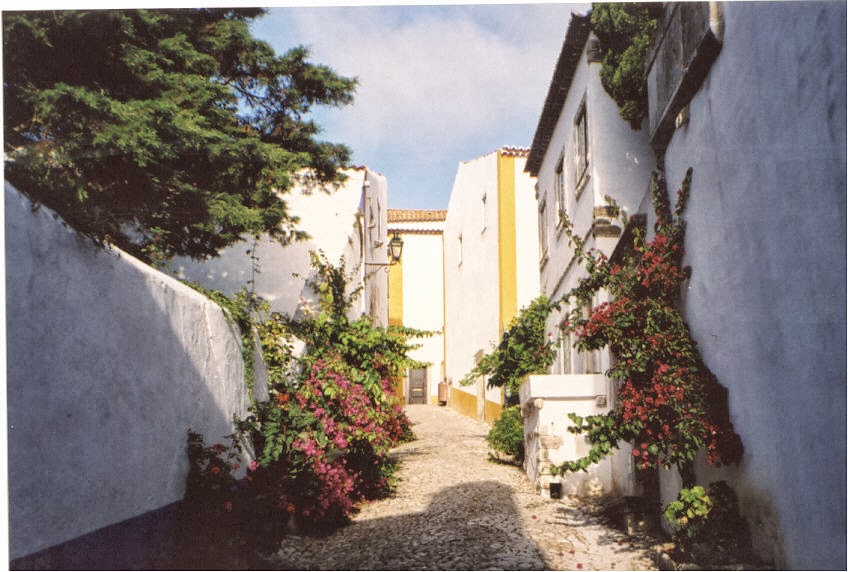 In spite of the narrow streets, cars actually drive here - 'Ware, walkers!
 A look back at Obidos from the bus - and yes, it has a genuine wall-walk
 On to Our Lady of Fátima, one of the most visited shrines in the world
Below are modern-day versions of the boats Wellington used to cross the Douro River at Oporto and surprise the French, who were expecting him on the other side of town. (1809, during the Peninsular War against Napoleon.) The boats, once used to haul grapes to the wineries, are now mostly for pleasure. But the creation of "port" continues, unabated.
 Boats on the Douro in Oporto, home of port wine
~ * ~
Addendum for BeauMonde members who want to see a "ha-ha":
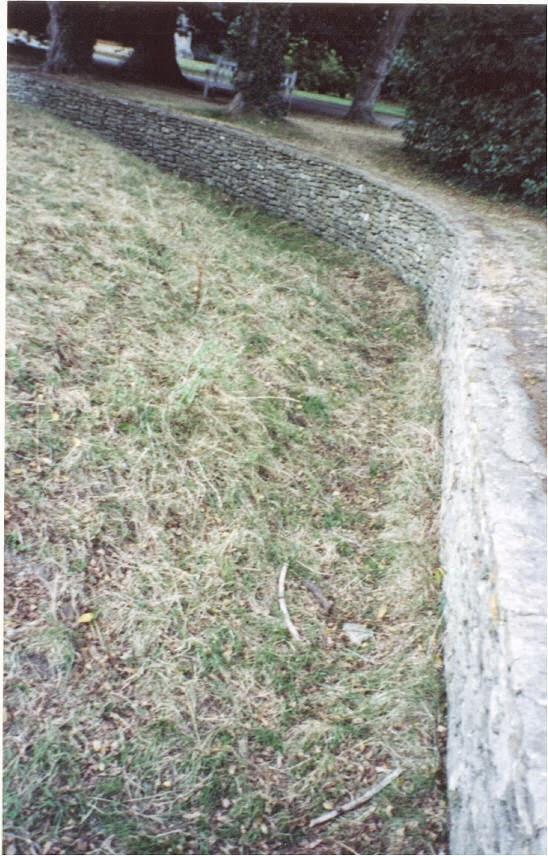 Ha-ha at Laycock Abbey
 Side view of ha-ha at the Royal Crescent, Bath
Thanks for stopping by,
Grace
Next week: Spain . . . or maybe Fort Wilderness . . . or ?
For a look at Blair's books, click here.
October 13, 2013
Questions Fiction Writers Should Ask Themselves
 Sunrise en route to Miami - not bad for thru the windshield of a moving car
 Daughter Susie - photographer on both photos above - crowing on Facebook about the lowest temperature in Orlando since May, but take a good look at the odometer on her Honda SUV!
~ * ~
Grace Note: I had an interesting experience last weekend at Moonlight & Magnolias, a conference presented by the Georgia Romance Writers. Five minutes before my 2-hour workshop - TOTAL BLACKOUT. When the hotel's generators kicked in, we had Exit lights, hall lights & an elevator no one quite trusted. (A friend told me she refused to chance it to get from the 10th floor down to my workshop in the ballroom.) Waiters put a slender taper in the center of each round table, which seated eight, and one on the podium. I laughed and said, "Anyone have a flashlight?" I sat near the edge of the stage and went through 11 of 13 pages of my workshop before the lights were finally restored over an hour later. (We skipped the "writing" bits as no one could see well enough to write. Sigh.) Anyway, it was an adventure. Glad I hadn't planned a power point presentation.
QUESTIONS FICTION AUTHORS SHOULD ASK THEMSELVES(The final installment in my latest Editing series)
Before you edit, whether it's chapter by chapter, or the whole thing at once, there are some questions you should ask yourself. Keep them in mind as you read all those precious bon mots you wrote. Should they go or stay? Do they need amplification or a "Sayonara, Baby"?
Note: Other than saving the conference workshop questions for last, most of the following were scribbled down some time ago, and I have typed them up with no effort to organize them into any particular order.
1. Have you identified your characters as each appears "on stage"? Or have you given your readers nothing more than first names and not so much as a hint of who they are, what they do, or why you bothered to put them in your book?
2. Have you ignored those names briefly mentioned on page one, proceeding with "he, she, him, her, they, them" until the reader is ready to scream? Not only is the reader unable to identify who you mean as they haven't had time to absorb the hero's or heroine's names, but they have no idea if you're referring to the main characters, secondary characters, or the housemaid who stumbled into the room to light a fire. Using people's names not only makes them real to the reader, it avoids massive confusion in the manuscript.
3. Did you start off your book with the Point of View of a secondary character? Not a good idea. Readers expect the initial POV to be that of the Hero or the Heroine. Or the Villain, if that's the genre you're writing.
4. Did you make your secondary characters so interesting you detracted from the impact of your Hero and Heroine? (I'm amazed at the number of times I've seen this particular error.) In a nutshell - don't do it!
5. Have you added "color" to your descriptions? For Characters, move beyond hair and eye color to a more in-depth description, including hints of personality if possible. (Admittedly, this is harder to do in an era where Author POV is frowned upon, but find a way to get it in there somehow.) For Setting - don't have your characters speaking in front of a blank canvas. Let your readers see through their eyes where they are - private home, condo, mansion, big business, small shop, city, country, cruise, US, Europe, Asia, etc. Readers will be so much more comfortable if they can not only picture the characters but see them against a well-drawn background.
6. Are you writing in Present Tense - quite common in Young Adult & New Adult these days? If so, stick to it. Don't wander back into Past Tense.
7. Have you developed the romance over a period of time? It's a real disappointment to most readers when the Hero and Heroine have just met and suddenly they're having all sorts of wild emotional thoughts about each other. A good romance, the ones readers savor, develop the romance over many chapters, with the protagonists' feelings for each other (often hostile at the beginning) gradually changing from toleration to interest (or possibly one-sided interest, frustrated interest, etc.) before finally metamorphosing into something we can all agree is a romantic relationship (whether sex is involved or not).
8. Have you added Narrative and Action to your Dialogue scenes? Yes, clever dialogue can add color and move your story forward, but readers also want to know what the characters looked like when they spoke, their inner (silent) reactions to what the other person said, and what they were doing while they spoke. Action and Introspection, as well as clear "tags" are needed in Dialogue. Note: if three or more characters are "on scene," you must add a tag every time. Don't leave readers frowning at the page, scratching their heads.
9. Did you take enough time to emphasize important points? For example, I've seen manuscripts which said something like, "Jack fell down the stairs," and then went on to something entirely different, leaving readers to wonder how Jack fell. Was he hurt? How is the story affected by Jack's fall? If an "event" happens in your manuscript, make sure readers can not only see it but understand it and feel its impact.
10. Did you dump the whole backstory in the first few pages, boring your readers to tears? By now I think almost all authors know they shouldn't do this, that backstory needs to be inserted a bit at a time, enough to identify our characters, give readers an idea of who these people are, etc., but definitely not loaded all at once into the beginning of a book.
11. Did you heed all those warnings about backstory and were afraid to put in any backstory at all? Believe me, this is worse than dumping it all at once. I don't know how many manuscripts I've read where the characters were simply miraculously there on the page - no identification, no hints given why their conversation, action, or thoughts might be of interest, no indication the book is a romance, suspense, mystery, or whatever. Again, talking heads against a blank background. This is wall-banger stuff. The reader doesn't know who these people are, why he/she should bother to read about them Frankly, if the plot/conflict/characters are that confusing, this one's for the Goodwill pile.
12. Are you writing a series and started your second book as if every reader read the first book just yesterday and remembers who all the characters are, all the details of the setting, plot, conflict, etc., so naturally you don't have to repeat yourself? Allow me to tell you: 1) you want to expand your readership to those who never saw the first book; 2) even if every person did read your first book, they're not going to remember it! Everything you want readers to know about your characters, about the setting, about past events, must be in the pages of the new book. The characters must be identified all over again, the places where they live and work, and all past events relevant to the current plot. [The same advice applies to every book in a series, whether it's No. 2 or 22.]
13. Is there enough Conflict to carry the story? Unless you're writing the simplest Category romance (Harlequin/Silhouette's shorter books, for example), Conflict has to be ramped up. Conflict is not bickering between the Hero and Heroine. It's a genuine, serious problem, like the enmity between the Montagues and Capulets. Both External and Internal Conflict are important. External Conflicts are the outside influences on the Hero and Heroine: Parents, Job, Bad Guys, Illness, a Bomb, etc. Internal Conflicts are the Hero's and Heroine's private thoughts when agonizing about these problems and about their relationship with each other. For a good story, you need to have both strong External and Internal Conflict.
14. Are you making an effort to use colorful or dramatic words, particularly when making important points? Or have you allowed yourself to stick to workaday words of one syllable and a string of clichés? Did you accept your first draft, or did you go back and work on that sentence, paragraph, page until it shines with color, emotion, action, and depth?
15. Have you added interesting secondary characters - without allowing them to overshadow your main characters? Secondary characters can add an enormous amount to a story - the heroine's BFF, the hero's best buddy, wise Gramma or Grampa, or those marvelous weird ones à la Janet Evanovich. And then there are the endless supply of the really nasty, jealous, mad, or just plain mean. Secondary characters add sparkle, contrast, a chance for comic dialogue - or tragedy. Just keep them in their place!
16. Do you have so many secondary characters that the Hero and Heroine are eclipsed? Don't let those colorful secondary characters seize the bit and run with your story. They are there to support your h/h, not overshadow them.
17. Have you written 50 words to describe something when 20 words would draw a clearer picture? I've frequently seen writing where the author seemed to think that throwing erudite words or involved sentence structure into a paragraph made it sound more literary. Well, maybe it did. It was also less intelligible. In fact, in fiction it's downright disconcerting to see a simple thought or action, requiring ten words at most, twisted and tortured into twenty or thirty words which totally obscure what the author wants to convey. Find colorful words, active verbs. "Show" don't "tell, keep it simple. Draw a clear picture. Less is more. Whichever phrase works for you, hold it tight as a reminder not to drown your good intentions in a sea of unnecessary words.
18. Is your plot an unintentional mystery, perhaps the thoughts and feelings of the main characters as well? Did you put all those important details of who, what, where, when, and why in your Synopsis and forget that readers never see a synopsis? Or did you simply live with your characters in your head for so long you forgot readers don't know Word One about them. Cardinal rule: Everything you want readers to know must be in the pages of the manuscript.
19. Have you ignored Motive? It's amazing what you can have your characters get away with as long as you explain why they're doing it. Abberant behavior? Give a reason - readers will likely forgive them. Without an explanation? Forgetabout it. Goodwill box by page 20.
20. Does every scene move the story forward? There's nothing like a bunch of people sitting around, just chitchatting, to slow a book to zero. Do not write Dialogue for the sake of writing dialogue! Whether Dialogue, Narration, Action, or Introspection, every scene must move the story forward.
21. Have you made every effort to use proper grammar, spelling, and punctuation? Yes, it counts. Why should a publisher pay an editor and copy editor to "fix" your mistakes when they can get a book just as good from someone who knows the rules?
22. Did you check your facts? Did you do enough research that readers won't be tossing your book at the wall because you got the facts wrong for your hero's or heroine's profession? Or maybe you allowed a bastard or an adopted daughter (oh horrors!) to inherit a British title. Or did put your Georgian heroine in a siimple Regency round gown? Don't shoot yourself in the foot by ignoring necessary research.
Here are the six major questions I used to close my workshop in Atlanta:
1. Have you created interesting characters your readers will want to root for?
2. Have you made their motivations clear - why your characters do what they do?
3. Have you amped up the Conflict, putting roadblocks in the path of Happily Ever After?
4. Have you written clever, but relevant dialogue?
5. Have you fleshed out your story with clear but colorful narration?
6. Have you self-edited more than once? Have you proofread until you're sick of the whole blasted manuscript?
If so, you're probably ready to submit. Go ahead, take the plunge.
Thanks for stopping by.
Grace
For a look at all Blair's books, covers & blurbs, please see Blair's Website
For a brochure for Grace's editing service, please click here.
September 28, 2013
BRIDES OF FALCONFELL
My brand new Regency Gothic, Brides of Falconfell, has just gone "live" on Amazon and Smashwords, with Barnes and Noble, Sony, and other online sources coming soon. Below is the cover, which so beautifully illustrates the gloom and lurking evil of a "Gothic" novel. (Which, hopefully, I've "tarted up" with bits of Regency humor here and there.)
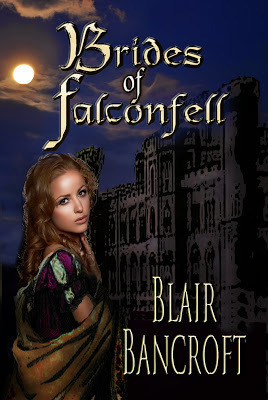
Miss Serena Farnsworth, spinster, is a managing female, the general crutch for her extended family, for whom she functions as nurse, companion, and household organizer. In short, she lives a life of service devoid of romance. Until she is invited to attend an invalid at a gloomy Gothic-style estate in Northumberland, where she encounter two suspicious deaths, personal animosity, a needy child, and even needier father. Add witchcraft, poison, shake (sink) holes, Mid-summer Eve revels, and a variety of odd characters, as well as the certainty someone is trying to kill her, and Serena finds herself surrounded by a miasma of evil. The lord of the manor should be of help, but he, alas, is a prime suspect in the murder of the Brides of Falconfell.
Author's Note: Brides of Falconfell is a tribute to the great era of Gothic novels, written by Victoria Holt, Mary Stewart, Phillis Whitney, and other talented authors of that time. The books—more Jane Eyre and Rebecca than Pride and Prejudice—have several common elements: they are told in first person, as both heroine and reader must be isolated, unable to know what the other characters are thinking. Frequently, the heroines are married and begin to suspect their husbands of murder. There is often a child, usually the hero's from a previous marriage. A large, gloomy mansion is a must, where murder, madness, and evil abound, with the heroine escaping death by the skin of her teeth. I have put all these conventions in Brides of Falconfell and chosen an isolated location at the very "top" of England as a setting. I hope you will enjoy my personal attempt at "Gothic Revival."
A 20% free read is available at Smashwords - click here
Blair Bancroft (aka Grace)
~ * ~
Thanks for stopping by.
Grace
Oct. 13: The final installment of my latest Editing series: "Questions You Should Ask Yourself"
For a look at all Blair's books, covers & blurbs, please see Blair's Website

Miss Serena Farnsworth, spinster, is a managing female, the general crutch for her extended family, for whom she functions as nurse, companion, and household organizer. In short, she lives a life of service devoid of romance. Until she is invited to attend an invalid at a gloomy Gothic-style estate in Northumberland, where she encounter two suspicious deaths, personal animosity, a needy child, and even needier father. Add witchcraft, poison, shake (sink) holes, Mid-summer Eve revels, and a variety of odd characters, as well as the certainty someone is trying to kill her, and Serena finds herself surrounded by a miasma of evil. The lord of the manor should be of help, but he, alas, is a prime suspect in the murder of the Brides of Falconfell.
Author's Note: Brides of Falconfell is a tribute to the great era of Gothic novels, written by Victoria Holt, Mary Stewart, Phillis Whitney, and other talented authors of that time. The books—more Jane Eyre and Rebecca than Pride and Prejudice—have several common elements: they are told in first person, as both heroine and reader must be isolated, unable to know what the other characters are thinking. Frequently, the heroines are married and begin to suspect their husbands of murder. There is often a child, usually the hero's from a previous marriage. A large, gloomy mansion is a must, where murder, madness, and evil abound, with the heroine escaping death by the skin of her teeth. I have put all these conventions in Brides of Falconfell and chosen an isolated location at the very "top" of England as a setting. I hope you will enjoy my personal attempt at "Gothic Revival."
A 20% free read is available at Smashwords - click here
Blair Bancroft (aka Grace)
~ * ~
Thanks for stopping by.
Grace
Oct. 13: The final installment of my latest Editing series: "Questions You Should Ask Yourself"
For a look at all Blair's books, covers & blurbs, please see Blair's Website
September 22, 2013
UPDATED INDEX to Writing & Editing Posts
 For "color" this week, we have Gatorland's prize white gator - photo from 2011~ * ~
INDEX to Grace's Writing & Editing Posts, 2011-2013
2011:
The Writing 101 series
1. Formatting a Manuscript - May 9, 2011
2. Nuts & Bolts, Part 1(grammar, punctuation) - May 16, 2011
3. Tab conversion (from manual to auto) - June 5, 2011
4. Nuts & Bolts, Part 2 - June 16, 2011
5. I Ran Spell Check, I'm Done, Right? (self-editing) - July 5, 2011
6. The Final Steps (self-editing) - July 14, 2011
2012:
EDIT THE BLASTED BOOK series
1. Intro to Self-editing - April 1, 2012
2. Should you hire help? - April 28, 2012
3. Manuscript Format for the 21st Century - May 6, 2012
4. Writing No-No's - May 28, 2012
5. Point of View - June 18, 2012
6. Anatomy of an Edit, Part 1 - August 5, 2012
7. Anatomy of an Edit, Part 2 - August 19, 2012
HOW TO DEVELOP YOUR CHARACTERS series
Part 1 - What you need to discover about your characters - October 15, 2012
Part 2 - More questions about your characters - October 29, 2012
Part 3 - The Rest of the story - November 5, 2012
2013:
DICTIONARY FOR WRITERS series (5 parts) - February. 4 - April 7, 2013
REMINISCENCES OF CONTROVERSIES series (3 parts) - May 13 - May 26, 2013
[a look at a number of “writing” controversies over the past decade or so]
EDITING series
Part 1 - Layering - June 30, 2013
Part 2 - Dangling Participles - July 7, 2013
Part 3 - Show vs Tell 1 - July 21, 2013
Part 4 - Show vs Tell 2 - July 28, 2013
Part 5 - Treacherous Words - August 11, 2013
Part 6 - The Difference a Word Makes - September 1, 2013
Part 7 - “Modern” Punctuation - September 15, 2013
Part 8 - Questions You Should Ask Yourself - October 13, 2013
Miscellaneous:
1. Guideposts for Critiquing - January 28, 2011
2. Writing Mistakes, Near Misses & Just Plain Strange - March 4, 2011
3. Shortcuts for Writers (ASCII codes) - March 18, 2011
4. Rules for Romance - September 18, 2011
5. More Rules for Romance - October 16, 2011
6. How Not to Write a Book - December 20, 2012
7. Branding - Bah, humbug! [writing multi-genre] - January 21, 2013
8. How Does Your Novel Grow? - April 28, 2013
9. Updated Index to Grace’s Writing & Editing series, 2011-2013 - September 22, 2013
~ * ~
Grace Note: Although there is one more post in the current Editing series, I needed to update the Index as a handout at the two-hour workshop I'm giving at the Moonlight & Magnolias Conference in Atlanta. If any of my blog readers plan to attend, please come by and say, "Hi."
Thanks for stopping by.
Grace
September 29: BRIDES OF FALCONFELL, a Regency Gothic, debuted at Amazon & Smashwords on Saturday, Sept. 21, & will be featured on next week's blog.
October 13: The final post in the recent Editing series: "Questions You Should Ask Yourself"


