
Blair Bancroft's Blog, page 53
February 15, 2014
USING ITALICS
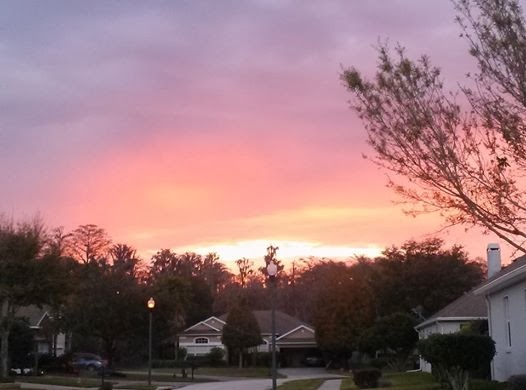 Orlando Sunset, February 2014
(from Florida, the only state in all 50, incl. Hawaii, without snow on 2/13/14)
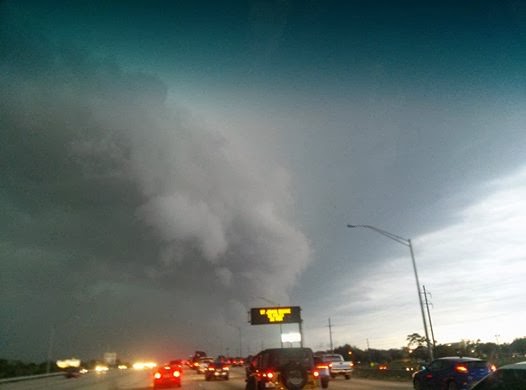 The other side of Florida - Frontal Boundary coming in on 2/12/14
~ * ~
FORMATTING FOR THE 21ST CENTURY
Not long ago an author on one of my e-loops asked a question about italics, and I was surprised because I'd been an editor for so long I'd forgotten some authors have never made the switch to the way manuscripts are typed in the Computer Age, when they can go directly from manuscript to published with only a few changes in format. I suppose I should have realized the problem, however, as I well recall the battle in the early nineties over formatting. I don't know about other book genres, but in Romance many diehard authors and editors refused to join the modern age—it was Courier, underlines for italics, and 250-words-per-page, or - @#$%$% - it wasn't a proper manuscript!)
Grand sigh . . . Shaking head . . . You've got to be kidding!
In the early nineties, when I began to write fiction, I had been using a word-processing machine with italic capability for ten years. Was I going to return to Courier, a typewriter font that had been around since the late 19th century? And underlines? No way. I approached this problem—which I simply couldn't take seriously—by submitting all my manuscripts in Times New Roman with italics, no matter what RWA (Romance Writers of America) said. This was before I realized their rules were strongly biased toward Harlequin/Silhouette short "category" romances, where word-count was a God worshipped by editors. (And, of course, the only time I was asked to change the manuscript to Courier and underlines was by a "category" editor who had not yet adjusted to counting the final number of pages in anything but Courier.) As for RWA contests, I simply didn't enter the ones that specified "Courier at 250-words-per-page." I figured that if that particular RWA chapter had not yet adjusted to the Computer Age, they weren't going to like any manuscript from me, as I tended to write "mainstream," not "category" aimed at H/S, as beginners were expected to do at that time.
But the whining during this transition period you wouldn't believe. The sobs, the screams - "Contestants submitting in TNR were getting more words to the page. Unfair!" I recall posting an e-mail stating I was also an editor and contest judge, and I could tell by the first page if a manuscript was any good or not, so what difference did a few extra words make?
Nearly twenty-five years have passed since those days, TNR has triumphed, electronic submissions are the norm, indie publishing is the phenomenon of the twenty-first century, and yet there still seem to authors out there who need to know more about about italics. So that will be the focus of this week's Mosaic Moments: the use of italics in manuscripts, which is now the same as the use of italics in both print- and e-books.
Basically - computers make it possible for authors to format books the same way a publisher does. (About the only time you might have a problem is if you think you absolutely have to have "dropped caps." My advice? You don't need to follow print format that slavishly. I've seen some really horrifying examples on my Kindle of what happens when even professional formatters tried adding a dropped cap to an opening word.)
In a nutshell - an author no longer has to underline in place of italics, because italics are readily available. An author can change a double-space manuscript to a single-spaced manuscript in the blink of an eye. (Well, maybe three blinks.) We can change a 5-space indent to a 3-space (publisher's) indent just as easily. And we can kick a manuscript into fully right justified. So where do we find the "rules" for twenty-first century manuscripts? The same place publishers have gone for book formatting for decades - in The Chicago Manual of Style. And, yes, there are some independent publishers out there doing their best to bend the "publishers' bible" to suit themselves, but my advice is to ignore them. Submit a manuscript that follows traditional publishers' book-formatting rules. If your manuscript is selected by a publisher who sets their own rules, then swallow their malarky and smile. That's how publishing works. I have some books where I simply hate my publisher's approach to punctuation, but did I grab up my manuscript and say, No, you can't have it? I did not. I like those monthly checks!
Over the next two Mosaic Moments I'm going to try to present the rules of italics in manuscripts, whether you're formatting for submission to a publisher or for translation into an independently published book. Hopefully, you'll find the list helpful.
THE USE OF ITALICS
1. Forget you have an Underline icon on your computer. It's passé, useless except perhaps for complex non-fiction outlines.
2. Emphasis. This is the one use of italics almost everyone understands. Some sentences simply don't read right unless you can show special emphasis on a certain word.
Example:* Maid: “Perhaps ’tis just as well, miss. If you be going to the park, you’ll not want anyone to recognize you, particularly with that man. And if you be going to his part of town, then heaven forfend anyone should see your face.”
3. Foreign words. The general rule: use italics for all foreign words unless they are common enough to be found in an English dictionary. Since dictionaries tend to vary, I sometimes use italics anyway. The latter is a subjective decision each author must make for her/himself. But there is no option for the vast majority of foreign words. They require italics.
Special note: it is expected that you will translate any foreign phrase, either directly or indirectly, as soon as you use it. Readers don't like to be left guessing. The era when French was everyone's second language are long gone. Beyond, si, non, gracias, merci, señor, señora, mademoiselle, and monsieur, and maybe the Russian da and nyet, most foreign words need explanation.
Example: Morituri te salutamus. We who are about to die salute you.
Example:* . . . as if a single glimpse of a courtesan might taint their eligibility for the ton.
Note: In the second example, without italics, ton, a derivative from the French, would just be 2000 pounds.
4. Referencing. When you are referring to a word, phrase, or letter of the alphabet, not using it directly.
Example:* Nick: "Surely there must be satisfaction in flaunting yourself before him in the very carriage he gave you."
Cecilia: Flaunting? But the rest of the sentence put paid to her indignation. "What do you mean by the very carriage he gave me? Did you not sell it?"
Example:* “Mr. Lovell says Nick’s a force of nature, and I reckon he’s right. Place seems empty without him.”
A force of nature. Yes, that description suited him.
*Dialogue from Cecilia, a Regency Darkside novella (in progress)
~ * ~
More on the use of italics next week.
Thanks for stopping by.
Grace
For Grace's website, listing all books as Blair Bancroft & Rayne Lord, click here.
For a brochure for Grace's editing service, Best Foot Forward, click here.


February 8, 2014
READING OLD FAVORITES
 Frozen alligators - photo from Polk County Sheriff's Department
It's been a while since I've been able to post a bizarre Florida tale, very unusual in this state where the bizarre is often a daily occurrence. But Friday's Orlando Sentinel (Feb. 7, 2014) published a beaut. The headline: Baby twins, frozen gators, meth, ammo discovered in Polk house. Evidently, the reporter is well aware of Florida's penchant for the strange because the story begins: "Only in Florida would deputies search a home and find two frozen alligators, meth in a box of baby wipes, a live bass in an aquarium, ammo and homemade drug pipes—all within reach of twin infants." The gators, the article continues, were a gift. The couple planned to stuff and display them. The gators' size was not stated, but the reporter estimates they were small enough to stuff into a plastic garbage bag (c. 3 feet?). The meth was allegedly for sale, the ammo were rounds for an AR-15 semi-automatic. Also found - a marijuana plant. The twins are now in state custody.
Actually, the above is a step up from some of the awfulness that's been rampant in Central Florida lately. On the one hand, we have the fantasy worlds created by our famous theme parks and the income from all the hotels, restaurants, and shops that go with them. On the other, senseless shootings, theft, road rage, human trafficking, people crashing cars through buildings, a toddler drowning in an open septic tank. So enjoy the bizarre story above for what it is: a true tale where nobody died or even got hurt. (Not counting landing in jail, of course.)
~ * ~
Grace's reading - January & February, 2014
I always read a great deal, but over the past couple of months I've doubled or trebled the usual amount. And when I began to compile a list, the irony struck me. Almost all of them involved World Building. Not intentionally, but when I examined my list of both "new reads" and "old favorites," nearly every last one of them involved a look into a part of our own world not seen by most of us or a look at new and/or altered worlds that came out of authors' imaginations. Perhaps a surprising reading twist for an author who usually writes about the demandingly detailed, hopefully historically accurate, Regency era or about the Florida I see around me every day. Yet perhaps that's what we all do - look to books to provide us with something fresh and different from our daily lives.
Where did I turn first when I found myself pretty much confined to the house? I checked my Kindle and was delighted to discover my pre-order of Julie Hyzy's latest, Home of the Braised, had turned up. Oh joy! Her series about Olivia, the White House chef, who seems to spend more time embroiled in murder mysteries than in the kitchen, is always a delight. The background is not only authentic but a wonderful peek "below stairs" at the White House, not to mention all those equally delightful White House recipes.
And then there was Naomi Novik's Blood of Tyrants, the latest in her Temeraire series, a dramatic alternate history view of the Napoleonic Wars, not just in Europe but on the high seas, and in the far reaches of China, Australia, and South America. If you can let your imagination soar to talking dragons filling the Regency skies, don't miss Ms Novik's series. (But be sure to start at the beginning.) Her world, which combines classic attitudes and manners of the early nineteenth century with a world where opposing dragon squadrons fight battles in the sky, is truly remarkable. As are her characters, both dragon and human.
I also caught up on the last two Laura Resnick books in her Esther Diamond series: Polterheist and The Misfortune Cookie—as luck would have it, reading the Christmas-set book over Christmas and the Chinese New Year book over that holiday. Ms Resnick never fails to please with her wacky version of a Jewish heroine teamed with an ancient mage to save present-day New York City from an endless variety of demons, ghosts, and other forms of paranormal evil. Ms Resnick's ability to create her special world by adding even more bizarre characters to NYC than it already has is not to be missed. (Picture our heroine as a Hanukkah elf in a department store Christmas display!)
After that, I delved into previously read favorites, retrieving all six books of the Soulless series from my Kindle archives. Gail Carriger should be awarded some kind of blue ribbon for world-building. In the very first paragraph of Soulless she moves her proper young heroine from conventional London society into a world of vampires, with a burly hero of a werewolf entering soon after. And then we discover we're sharing a steampunk world with an incredible cast of characters, including a highly pragmatic, soulless heroine, gay vampires, Scottish werewolves, a woman who dresses as a man, and villains who would like to see an end to all who aren't "human."
Next I turned to old favorites on my bookshelves, first choosing Linnea Sinclair's Futuristic , Finders Keepers , which I absolutely love. Talk about a matched pair of strong, intelligent, super capable people - this hero and heroine take the prize. Action, adventure, and star-crossed love, all in one neat package. Loved it just as much the third time around. (Perhaps because I'm such a wimp myself.) For SciFi fans, the tech details are also superb. World Building at its best.
I feel almost as strongly about Jayne Castle's "Ghost" series. Again, probably because the heroines are all intelligent, independent, and feisty, and the heroes are "to die for." Swaggeringly Alpha, enough to make the most DIY girl willing to cry, "Oh thank God I don't have to handle this alone." And no, I'm not talking about Earth-types ghosts. Ms Castle's heroes all deal with nasty varieties of energy on an Earth-like planet far, far away. If you haven't encountered the world of "Harmony," I strongly recommend it. Warning to the guys: these books are Futuristics, with strong romance as well as adventure.
I've lost track of the number of times I've read Susan Elizabeth Phillip's First Lady. Every time I seem to get more out of it, perhaps because this time I'd also read the sequel, which came out some years later. This is a pip of a story, clever and heart-warming on at least a dozen different levels. Ms Phillip's creates an entire world inside the confines of an RV. A story not to be missed.
I suppose everyone has their favorite Nora Roberts. I've often thought mine was Carnal Innocence, but after re-reading Honest Illusions , I think that has to take my personal prize. I'm not usually a fan of heart-wrenching, but the vivid descriptions of magical illusions and the marvelous array of characters, larcenous though they are, are truly priceless, presenting the very special worlds of professional magic and jewelry theft, which I suspect few of us have attempted to delve into on our own.
And then I discovered I'd somehow missed the grand finale to Lindsay Burkoker's Emperor's Edge series. I immediately downloaded it to Kindle and just finished the wind-up to these truly remarkable seven books. Ms Buroker's world began in an arctic-like climate with the discovery of alien technology, moved on to a harsh steampunk world of non-stop action and adventure, in which she took the young assassin/villain in Book 1 and made him the anti-hero of five of the remaining six books. (Now that's being creative!) And in Book 6 she took time out from mayhem to continue the love story of the couple in Book 1, now resident in a peaceful tropical climate, and thus set up the longed-for HEA in Book 7. Very skillfully done, though this is not a series for the faint of heart. The action is violent and sometimes hard to take.
Back to another "old favorite." I'm currently working my way through Janet Evanovich's Stephanie Plum series. Since I'd already re-read Books 1-4, I began with 5 and am now up to 8. The books are so saucy, clever, and imaginative, they simply take my breath away. (Though I admit to a strong preference for the ones who feature Ranger!) Ms Evanovich creates her special world out of modern-day Trenton, NJ, most particularly the section she calls "the Burg." Her descriptions of the world of the Burg and the characters in it are at least half her books' appeal. They are simply amazing. For those who might have missed this series - Stephanie is a struggling, and frequently inept, bounty hunter who succeeds through persistence, good intuition, and good luck, while besieged by non-stop disasters of every kind. If you enjoy humor with your mysteries, this series is for you.
Grace note: I have a number of other favorite books and favorite series, but since they weren't read in the last six weeks or so, I'm not including them here.
Summary. For many years now, when asked who my favorite author was, I'd answer: "Nora Roberts and Janet Evanovich." More recently, I've added Gail Carriger. You might call her the Janet Evanovich of Steampunk. But I can guarantee all the authors mentioned above not only write great books, they also present them well. They are polished professionals, as are their editors and formatters. Mistakes are few and far between.
I hope what you read here will encourage you to check out some great books you might have missed. Be brave, try something new!
Thanks for stopping by.
Grace
For Grace's website, listing all books as Blair Bancroft & Rayne Lord, click here.
For a brochure for Grace's editing service, Best Foot Forward, click here.
February 1, 2014
WORLD BUILDING, Part 4
 Photo from the Jackson Gallery, shared on Facebook by Alice Orr
The above bit of art amply illustrates how I feel when I see a manuscript full of easily fixed mistakes, which any second reading would have caught, but the author just didn't give a @#$%.
~ * ~
WORLD BUILDING, Part 4
Welcome to the final segment of my series on World Building.
So far we've created climate, cultures, governments, religions & traditions, and begun to build the many smaller details needed to let your readers share a world that is only in your imagination. Today, the many more details needed to paint the right picture.
Planets, Cities & Palaces. You may, or may not, need more than one planet in your story. In Blue Moon Rising I needed a whole slew of different places. Regulon-held planets, neutral planets, lawless planets. And each planet needed a major city or focal point. They ranged from the vast capital city of Titan on the planet Regula to a tavern on fun-loving Tatarus. I also ended up with three palaces, one each on Regula, Psyclid, and Blue Moon. Whatever you write, you need anchors, places your characters can call their own. Or places that represent goals they have yet to meet. Never fail to establish a base for your important characters.
Places & Other Peoples. In Rebel Princess, my heroine lives four years in the intensely solitary confinement of something called the Regulon Interplanetary Archives, a place that almost becomes a character in its own right. Many other places needed names as well: Nebulon Sector, Sebi Desert, Azulian Sea. And then there were those pesky aliens, foreign to both Regulons and Psyclids: the Nyx, Pybbites, Herculons, and Zylons. And never forget: when you invent a new word or phrase, write it down!
Transportation. Some things don't have to be different. (Most readers don't really want to learn to speak Klingon, just a few words here and there!) In addition to making something up out of thin air, you can stick to words most people will recognize, such as: hovercar, hovercycle, groundcar, tran (transport van). But if you don't make up at least a few names that are a bit exotic, readers are likely to go, "Ho-hum."
Food & Drink. A few special names, particularly for various liquors, seemed essential for Blue Moon Rising. Well, perhaps not essential, but they felt right. For example, I enjoyed creating a blue liqueur called Lunelle, made only on Blue Moon.
Plants & Animals. From the Moonflower on Blue Moon (source of Lunelle) to a snake called the krall, to something called a fireflicker, I created a touch of the exotic for the non-two-legged creatures in Rebel Princess and Sorcerer's Bride. As long as you don't overdo it, these are just more of the many colorful details that turn your book from ordinary to special.
Epithets, Profanity & Expressions. This category was, perhaps, the most fun. Not wanting to offend with "Earth" profanity, I had a whale of a time creating words unique to the cultures of Regula and Pysclid. (With Psyclids occasionally stealing Reg profanity, as their own is so mild in comparison.) So far, both books are liberally sprinkled with words like: Pok, Dimi, Fyd, Fizzet & Fizzeting, as well as expressions such as "Altairian bottomfeeder," "Sirian slime snake," and the "Green Hells of Tantalus." All in good fun, I hope. (In spite of those contest judges who thought they were "typos"!)
And, of course, the General Vocabulary just grew and grew. From chrono and crystos, dushani and enlasé to plasti, meshug, portapad, ridó, and veriball. And, no, if I hadn't written down all three pages of them, I never would have been able to reproduce them here - or in Blue Moon Rising.
~ * ~ Summary. What's that expression? The secret's in the details. Well, it certainly is when writing. Even more so when building a world from scratch. First, you paint the broad canvas, and then you start filling in the rest, pretty much in order of importance: main characters, secondary characters, their special gifts. Then layer in all the details of their world(s), the special things that spark the imagination. Consider every aspect of your worlds. Make the details believable. Make them shine in your readers' minds. Almost nothing is impossible if you present it in a plausible manner. Even a world where the peace-lovers finally band together and use the powers of their very special minds to get rid of those big, bad bosses from Regula Prime.
Thanks for stopping by.
Grace
For Grace's website, listing all books as Blair Bancroft & Rayne Lord, click here.
For a brochure for Grace's editing service, Best Foot Forward, click here.
January 25, 2014
WORLD BUILDING, Part 3
 Would you believe - ice skating in Florida? (I made those hats, by the way.)
WORLD BUILDING, Part 3
To review Parts 1 & 2:
1. Create your physical world(s) - climate, landscape, architecture, clothing. Create noticeable contrasts, whether on just one world or on several different worlds.
2. Create a map, whether elaborately drawn with the intent of including it in your book or simply a hand-drawn sketch to keep locations straight in your mind while you write.
3. Create your main characters - name them, taking the time to find names that exemplify your characters. Don't settle for ordinary "Earth" names unless that's the "feel" you want for a particular character. (If you really like to plan ahead, you can draw up a complete Character List before you begin. For me, it's usually only the four or five characters in the initial scenes.)
~ * ~The next steps:
Special gifts. When creating the characters for your imaginary world or worlds, be sure you endow at least some of them with special gifts. Whether you're writing Paranormal, Fantasy, Futuristic, or SciFi, the strange and wonderful is expected. If readers of these genres wanted an Earth-like world, they'd be reading Contemporary Romance, Romantic Suspense, Historical, etc. The special gifts you invent are limited only by your imagination.
Grace note: Part way through Book 1, I scribbled down a list of likely Psyclid paranormal talents and then, of course, when it was time to endow a second princess with a "gift" in Book 2, I made it something I had never considered before. Demonstrating that, even with lists, creativity is possible.
Government. A great many books involving World Building deal with problems of government, frequently the classic rebels vs. an authoritarian government. Whether you're talking fairies, dragons, or evil empires, detailing governments is usually essential. Readers need to know the hero and heroine are fighting for the greater good (or against something more than a vague cloud on the horizon). For my Blue Moon series, I ended up with three governments: an emperor and High Council for the military world of Regula, a long-suffering royal couple (parents of my heroines) on the peaceful but "Regulon-occupied" world of Psyclid, and a dashing young hero on Blue Moon, who is plagued by a Hierarchy who tend to believe they, not he, are in charge.
The above brief summary should make it clear that problems of government not only provide an overall arc for the series but add depth to many scenes. In addition, there are also governmental problems on a lower scale, such as the many problems encountered by the military on Psyclid as they find their firm, pragmatic hands losing control of slippery Psyclid minds. So the concept of "government" works on many levels.
Religion & Tradition. Frequently, religion and tradition are closely allied with government. We have only to look at our own dissenting Pilgrim fathers rejecting the firm hold of England's church and state for an example. The choice is yours, of course. You can ignore religion and tradition if you choose. You create your world - you make it what you want. But throughout history - for better or for worse - religion and tradition have had a huge impact on civilization. Therefore, consider that we are not unique. Religion and tradition might be as important in the future as they are on Earth at this moment. And they too can add depth to your story - conflict, motivation, color, etc. In the Blue Moon series my two cultures worship different gods—the Regulon god, masculine; the Psyclid god, feminine. But I have not made it a bone of contention, simply a fact of life, accepted with tolerance. Again, this is my story - I can write it any way I want to. I don't have to assume they hate each other because of religious differences. Your choice.
A Thousand Details. And then come all those little details that make your story a depiction of another world, not just ordinary Earth creatures going about their daily lives on a planet far, far away. Again, people like me may make up most of these details as we go along - though never forget to record them for future reference! Others will want to create the whole kit and kaboodle up front, before writing Word One. Whichever way you go about it, you need to make your world a special place, something that will come alive in readers' minds, keeping them fascinated and turning pages. Something recognizably different from Planet Earth in 2014.
As an example, for the Blue Moon series I created typed lists of the following, mostly from scribbles written down as I wrote the original. Here are the categories I found necessary: after Special Gifts, Government, Religion & Tradition - War Craft; Armaments; Starships (exact names); Transportation; Planets, Cities & Palaces; Places & Other Peoples; Jumpgates; Food & Drink; Birds & Animals; Plants; Epithets, Profanity & Expressions. And, finally, a General Vocabulary.
Each author, of course, must devise what is necessary for his/her worlds. The above list is intended only to give you an idea of how extensive the differences need to be to separate your world from good old Earth and the way the people who live here think.
Mini-descriptions of the categories mentioned above:
War Craft. Not everyone is going to need war craft, but again, many Fantasy/SciFi tales are filled with them. For Rebel Princess, I needed them in Chapter 1, so vocabulary-building began immediately. I scribbled huntership, scoutship, shuttle, etc., on a yellow pad, adding new names as needed. Clearly, these are not "new" words, simply words I intended to use in the Blue Moon series.
Armaments. How do your war craft fight - rockets, lasers, fighter planes? Or something more exotic? My Regulons are pretty conventional; the Psyclids positively scary in their deviation from the norm. Whatever you create, don't forget to write down your ideas, so you don't have P-11 laser fire erupting from a Tac-9 handgun. Or a Tau-15 atmosphere fighter plane shooting at a target in space. Repeat: whatever you create, make a list. Don't trust to memory.
Starships. I called this category "Starships" but it ended up being any vehicle that could make its way through space, from a battlecruiser to a merchant ship. If I named it, it went in this list—no longer a generic term, but an exact ship. Example:
Orion, later the Astarte - Tal's huntership
Archer, later the Gemma - the Orion's scout ship
General Vocabulary. This is a list of invented words that simply grew and grew. Words needed to make the future (or your fantasy) sound different from our present, encompassing new tools, new techniques, new discoveries, even familiar words that subtly evolved through the centuries. For Rebel Princess these words developed into quite a long list, which increased even more with words created for Book 2, The Sorcerer's Bride. Unless you have a eidetic memory, this list is a "must." Otherwise, you're bound to mess up and forget those newly minted words. By the end of Book 2, my list ran to three typed pages, not including Profanty,, Transportation, War Craft, Place Names, Food, etc., all listed separately!
~ * ~
The above seven categories of world-building were necessary before I got to the end of Chapter 1, Book 1. And my worlds just kept building from there—a Space Academy training ship, the military planet Regula, the infinite quiet of something called the Regulon Interplanetary Archives, the contrasting beauty of a terraformed Blue Moon, the raucous fun of Tatarus - a planet thoroughly enjoying its position in a neutral zone, the stark architecture of a space station, the dark underbelly of a rim planet known as Hell Nine, and finally to Psyclid, the planet full of people with skills of the mind (currently occupied by Regulon troops).
~ * ~
Coming next: More details on the building blocks needed to create the worlds of Blue Moon Rising. And how those details can relate to the worlds you need to build.
Thanks for stopping by,
Grace
For Grace's website, listing all books as Blair Bancroft, click here.
For a brochure for Grace's editing service, Best Foot Forward, click here.
January 18, 2014
FLORIDA WILD
I'm very pleased to announce that FLORIDA WILD, a Romantic Suspense set in Orlando area,is now available from most online vendors. (The cover artist really "nailed" my Hispanic-Miccosukee-Irish heroine. Hmm, the hero's not so bad either!)
Re the fictional theme park called Florida Wild: I hasten to say that publishing, with the exception of do-it-yourself, moves at a snail's pace, so I actually wrote about an Orlando version of the London Eye at least six months before the first announcement that one was planned for I-Drive. The roller coaster, seen in the background on the cover, also plays a vital role. It is a wooden one, based on my son's description of the coaster at Lake Compounce in Bristol, Connecticut. (The YouTube video below was not available at the time I wrote Florida Wild but I'm delighted to see, except for the few Florida-style embellishments I added, I got it right.)
For Lake Compounce video, click here
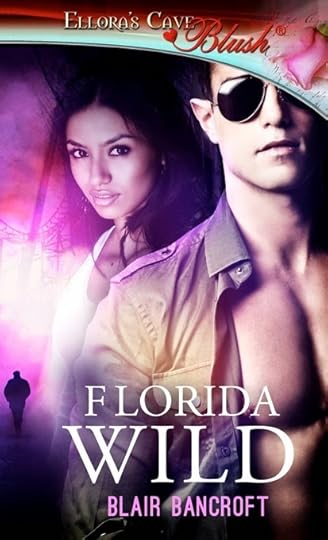
Log line: A fledgling PI finds herself in the midst of an international incident with only an oversize mystery man to help her through a maze of Middle-eastern politics, Florida rednecks, and all-too-elusive love.
Cass Wilder is looking for excitement, both on the job and in her personal live, a wish that is more than fulfilled when she saves an Arab child at a theme park and is plunged into international intrigue, her sole companion a man whose motives might be questionable.
Michael Dillon, a here-today, gone-tomorrow government agent, is forced to turn to a fledgling PI for help in a very personal chase that takes them from the UCF campus to the Florida backwoods, where he not only regains his kidnapped sister but loses his heart.
For link to Amazon Kindle, click here.
For link to B&N's Nook, click here.
~ * ~
The other side of the coin:Speaking of "Florida Wild," the past few months have not been good for those wonderful, often eccentric, moments for which Florida is noted. No Python Hunts, no exotic kite-flying, etc. [Though, locally, the Singing Trees at First Baptist of Orlando certainly qualified as wonderful, as were those little Girl Scouts (Juniors & Brownies) singing their hearts out for Christmas.]
Sadly, however, this past year most of the news has been full of political idiocy, hit-and-run accidents, and gun violence, topped (incredibly) by a retired police officer in the Tampa area shooting a man for texting his babysitter during the previews to a movie! The kindest thing I can say is: Alzheimer's??
Definitely a year when Fiction - my version of Florida Wild - is preferable to Reality. Let's hope I have something more benign to write about at the beginning of next year.
~ * ~
Thanks for stopping by,
Grace
Next week: WORLD BUILDING, Part 3 - All those little details
Re the fictional theme park called Florida Wild: I hasten to say that publishing, with the exception of do-it-yourself, moves at a snail's pace, so I actually wrote about an Orlando version of the London Eye at least six months before the first announcement that one was planned for I-Drive. The roller coaster, seen in the background on the cover, also plays a vital role. It is a wooden one, based on my son's description of the coaster at Lake Compounce in Bristol, Connecticut. (The YouTube video below was not available at the time I wrote Florida Wild but I'm delighted to see, except for the few Florida-style embellishments I added, I got it right.)
For Lake Compounce video, click here

Log line: A fledgling PI finds herself in the midst of an international incident with only an oversize mystery man to help her through a maze of Middle-eastern politics, Florida rednecks, and all-too-elusive love.
Cass Wilder is looking for excitement, both on the job and in her personal live, a wish that is more than fulfilled when she saves an Arab child at a theme park and is plunged into international intrigue, her sole companion a man whose motives might be questionable.
Michael Dillon, a here-today, gone-tomorrow government agent, is forced to turn to a fledgling PI for help in a very personal chase that takes them from the UCF campus to the Florida backwoods, where he not only regains his kidnapped sister but loses his heart.
For link to Amazon Kindle, click here.
For link to B&N's Nook, click here.
~ * ~
The other side of the coin:Speaking of "Florida Wild," the past few months have not been good for those wonderful, often eccentric, moments for which Florida is noted. No Python Hunts, no exotic kite-flying, etc. [Though, locally, the Singing Trees at First Baptist of Orlando certainly qualified as wonderful, as were those little Girl Scouts (Juniors & Brownies) singing their hearts out for Christmas.]
Sadly, however, this past year most of the news has been full of political idiocy, hit-and-run accidents, and gun violence, topped (incredibly) by a retired police officer in the Tampa area shooting a man for texting his babysitter during the previews to a movie! The kindest thing I can say is: Alzheimer's??
Definitely a year when Fiction - my version of Florida Wild - is preferable to Reality. Let's hope I have something more benign to write about at the beginning of next year.
~ * ~
Thanks for stopping by,
Grace
Next week: WORLD BUILDING, Part 3 - All those little details
January 11, 2014
WORLD BUILDING, Part 2
 Happy New Year from the grandgirls!
WORLD BUILDING, Part 2
Creating a world (or worlds) from scratch
Regular readers of my blog know I may hammer over and over at the importance of editing what we write, but I try to avoid telling anyone how to write. There are many approaches to writing a book - each author has to use what works best for him/her. The same applies to World Building. All I can do in this series is describe how I did it for my Futuristic Paranormal series, Blue Moon Rising, and hope some of you may find it helpful.
I began the book I originally called Blue Moon strictly for the fun of it. I had always enjoyed Science Fiction but knew I didn't have the technical expertise to write it. And then I discovered the genre called "Futuristic" (Romantic SciFi) and thought, "Well, what the heck, why not?" It was only as I neared the end of the book that I realized I'd written myself into what needed to be at least a three-book series. And that's when reality struck. I'd made a list of names before I began to write, but otherwise I'd simply winged it—fortunately, scribbling down each "invented" word as I came to it (well, most of the time), just as I did each new character added to the original bare-bones Character List.
But it became apparent that if I were going to write more than one book, a concrete, well-organized list of all the things in my worlds was going to have to be created. Aargh! For years my only gesture toward "organization" was a notebook full of names: Regency nobility, common English, Spanish, French, & Arabic names, etc. And, yes, I used classic legal-sized storage envelopes to corral hardcopy research for each book. I also had a personal Regency reference and vocabulary I had created through the years, stored on my computer. But something that listed all the details of the new world I'd been creating . . .? Oops.
As soon as I finished Book 1 (now titled Rebel Princess), I went out and bought a 4" ring binder. Really, I did. (Those who know me will realize how ridiculous that sounds for an "out of the mist" writer like me.) And I started typing up all those scribbles - and, believe me, they seemed endless. But when Ellora's Cave Blush accepted my three-book series and I was faced with writing Book 2, that notebook made all the difference. Without it, I never could have kept my worlds straight.
Some authors, of course, would need to put that 4" ring binder together before they started Book 1, and that's okay. Just because I would have gone nuts (and been bored to death) trying to create all that from scratch before writing Word One doesn't mean that someone else isn't right to want it all laid out before he/she begins.
Moving back to the beginning - the planning stage . . .
If you are writing Fantasy, it's likely you will be sticking to one world, though probably a world with many different facets (Examples: Anne McCaffrey's Dragonriders of Pern series; C. L. Wilson's Tairen Soul series; the HBO series Game of Thrones). Most series of this nature benefit from a map; if not included in the book or the opening montage (as in Game of Thrones), a rough map drawn solely for the author's benefit always helps. If you don't get your new world straight in your head, no one else is going to!
In the case of Blue Moon, however, I was creating a world in the Star Trek/Star Wars mold - more than one planet, more than one culture (although most of mine were based on Old Earth). First came a Military culture from the planet Regula, a race of conquerors with starships named after ancient Greek and Roman gods. The primary counterculture - Psyclid, a peaceful planet where the inhabitants have gone the other way, developing their minds rather than their military might. I gave both planets earth-style climates but created vastly different styles of architecture and clothing. And for Psyclid, three moons, one of them misty blue.
For the citizens of Regula, I chose names for both males and females from countries known for their formal military attitudes on Old Earth; primarily German, Austrian, Russian, and East European. For the people from Psyclid, I got more creative, tweaking recognizably artistic names into something even more unusual. (Example: the heroines of Books 1 & 2, sister princesses, are L'ira and M'lani.) For last names I was even more obsessive, struggling through page after page in an old Orlando phonebook, writing down names by hand that seemed to fit my two worlds. And, yes, it was hard work and time-consuming, but I never, ever, would have thought of some of the actual names I found. (Example: the last name of my Book 2 hero, the sorcerer, Jagan Mondragon).
I also printed off lists of the ancient Greek & Roman gods, and that was all I had when I began. Everything else evolved as I needed it: government, paranormal skills, unique vocabulary, types of weapons, transportation, etc. (more on these later).
That's where I was when I sat down and wrote the opening scene, suddenly grabbing words out of the air, like "hologlobe" and "Tau-15" fighter. Was I picturing the bridge of the Enterprise? As I look back, it seems likely, but I wasn't actively conscious of it. The Orion was simply a starship on a training mission with a bunch of cadets from the Regulon Space Academy, one of whom is a Psyclid princess in disguise, determined to become something she was not raised to be. And the rest of the chapter seemed to write itself.
Summary. Before beginning to write, do what you have to do to familiarize yourself with the world(s) you've created. Have a concrete picture of your world - draw a map. Name your main characters. (You don't have to be as obsessive as I was and create pages of names!) Have a good idea how your characters live, how they talk, how they look at their world. In other words, have a fully grounded Setting before you drop your characters and your plot into it. If you have two contrasting worlds, as I did, make sure everything from their names to their architecture, clothing, and thoughts reflect how different they are.
Next blog: The many other things you have to invent for your world(s)
~ * ~
True story: I entered Book 1 (now Rebel Princess, debuting sometime in 2014) in two RWA contests (allowable as this was a new genre for me). In the first contest, I won First in Fantasy, Futuristic & Paranormal. In the second contest, I received appalling marks, including a "1" in Mechanics (the basic Nuts & Bolts of grammar and spelling I am always preaching about!)
Why? All the "typos" in my manuscript.
Reality: Those "typos" were the vocabulary words I had so carefully made up for my future worlds. Sigh. Clearly, not everyone "gets" SciFi.
~ * ~ Thanks for stopping by.
Grace
For Grace's website, listing all books as Blair Bancroft, click here.
For a brochure for Grace's editing service, Best Foot Forward, click here.
December 28, 2013
WORLD BUILDING, Part 1
In keeping with my practice of adding a bit of color to each blog (and for which I thank my daughter's Facebook page for most of the photos), below is what may be a "first."
Most people have attended a house closing at one time or another - formal atmosphere, conference table, big chairs, lots of paperwork, lots of signatures, etc. Well, on our way to the steam train in Tavares last week (mom, dad, three children & two grandmothers), we took a short detour to a title company, where we pulled up, and a young man ran out with paperwork which was completed on the hood of the SUV. Elapsed time: 5-7 minutes. (Guess that's what happens when you buy so many houses it becomes routine.)
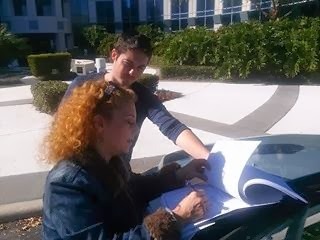
WORLD BUILDING, Part 1
ATTENTION, all authors: World-Building is for everyone! This week I finished the first draft of The Sorcerer's Bride, Book 2 in the Futuristic Paranormal series, Blue Moon Rising. So it seemed a good time to blog about the intricacies of World Building. But before we get down to what I had to do for Blue Moon, let's talk about the kind of world-building all authors must do, even if they aren't writing a series or setting a book in an unknown world in some future time.
SETTING. Anyone who has ever entered a fiction contest has probably been scored on this category. And, believe me, it's not an also-ran. What would Downton Abbey be without its exotic setting? And every successful author of that oh-so-popular genre, Regency Historical, knows how much study is involved to get that setting right. Or let's say your setting is Medieval. Do you know your Book of Hours, that marriage must be on the church steps, not inside? Have you read about the persecution of women preached by men like St. Bernard? Do you understand the differences between the Medieval twelfth century and the Renaissance of the fourteenth century? The changes in culture, fashion, and politics, the enormous influence of religion? If you want to do it right, the challenges are many.
Whether your setting is the American Old West, the Scottish Highlands, the Old South, the streets of New York, Victorian London, or a small New England town, you need to incorporate a proper feel for the location into your novel. Your story won't come alive without all those little details about the people who live, love, and work in the place you chose for your setting.
Another example: What would your classic "Cozy Mystery " be without details on all those small-town shops where the intrepid heroines manage a business and stick their noses into murder at the same time? Plus all those recipes, craft ideas, etc., that are featured in so many of them. For these books, setting is an integral part of the genre.
A personal example: Even the simplest novel requires a well-described setting. In one of my first published books, a 50,000-word Precious Gem for Kensington, Cape Cod, Massachusetts, is as much a character as my beleaguered lovers. (Now available as an e-book under the title Love At Your Own Risk)
Basically, every book needs "color." Just as our characters need to wear clothes, our books need to be dressed up with those details that proclaim: this author really knows the place he/she is writing about. For contemporary settings, if all else fails, try Google Earth and a street map. (I found these an enormous help when I couldn't get to Lyon, France, to take a good look at Interpol's headquarters.) And I have no idea how I'd have managed to contrive all my English settings without the maps and guidebooks I picked up on my many visits.
But simple geography - knowing your way around - is not enough. You must create households (or lack thereof) that fit your characters lives. Put those dwelling places in the proper setting, which could be anything from an empty endless plain to a mountain village, a farming town, or a sophisticated city. Then you need to build layers on those initial bare facts, keeping at it until you can understand your characters' placement in their world. After that comes the really hard part - you have to describe that world so your readers can see what you see. In summary, expand your world from geography and bricks and mortar into jobs, life-styles, the everyday struggles, the humor, the dangers, whatever makes your world tick.
Sometimes the research necessary to build our worlds can be very demanding, so much so that many authors stick to one historical period. I still recall the staggering amount of research I did when I decided to do a twelfth century Medieval for Young Adults. After writing Regency for many years, I found myself challenged by a whole new universe. Different customs, different clothing, different religion, different wars, sports, games, and dances. Fortunately, I seem to have gotten it right, as it continues to be my best-selling book in England - a tough audience! (The Captive Heiress, suitable for age 12 to adult.)
Okay, I have to admit I think authors who create settings from the contemporary world around them have the easiest task. (At least, if they are observant.) Next come those who build their worlds from carefully recorded history. Third are those who build fantasy worlds from what already exists (such as those who write Contemporary Paranormal or Urban Fantasy). And then there are authors who must create worlds from scratch - worlds out of time and context, alien worlds with cultures far removed from what we know. I like to think my Blue Moon series comes somewhere between the last two - a future culture far, far away, but one that hasn't become detached from its roots.
In a nutshell: the most successful authors create a detailed world around their characters in every book they write. (If they're fortunate enough to be writing a series, then they simply expand that same world with each new book.)
Best advice: If you've been neglecting that all important thing called "Setting," adjust your thinking. Show your shining story against a backdrop it deserves.
Next week, a look at why I had to give up my time-honored practice of "winging it" (well, at least to some extent) when I set out to write a three-book series set in a time and place where everything had to be created from the imagination.
~ * ~What Grace is reading this week:
I just happened to hit Laura Resnik's Christmas and New Year's paranormal mysteries at the exact right time of the year. Although I recommend her entire series, Polterheist and The Misfortune Cookie are not to be missed. (You may never eat a fortune cookie again.)
And then I took an actual paperback off my shelf, one of my all-time favorites, First Lady by Susan Elizabeth Philips. A real treat, even the third time around (though I missed the ease of reading on my Kindle).
Thanks for stopping by.
Grace
Next week: The enormous amount of work involved in creating a setting on a planet (or four or five) far, far away.
To view Grace's books as Blair Bancroft, click here.
To ask for a brochure for Edits by Best Foot Forward, click here.
Most people have attended a house closing at one time or another - formal atmosphere, conference table, big chairs, lots of paperwork, lots of signatures, etc. Well, on our way to the steam train in Tavares last week (mom, dad, three children & two grandmothers), we took a short detour to a title company, where we pulled up, and a young man ran out with paperwork which was completed on the hood of the SUV. Elapsed time: 5-7 minutes. (Guess that's what happens when you buy so many houses it becomes routine.)

WORLD BUILDING, Part 1
ATTENTION, all authors: World-Building is for everyone! This week I finished the first draft of The Sorcerer's Bride, Book 2 in the Futuristic Paranormal series, Blue Moon Rising. So it seemed a good time to blog about the intricacies of World Building. But before we get down to what I had to do for Blue Moon, let's talk about the kind of world-building all authors must do, even if they aren't writing a series or setting a book in an unknown world in some future time.
SETTING. Anyone who has ever entered a fiction contest has probably been scored on this category. And, believe me, it's not an also-ran. What would Downton Abbey be without its exotic setting? And every successful author of that oh-so-popular genre, Regency Historical, knows how much study is involved to get that setting right. Or let's say your setting is Medieval. Do you know your Book of Hours, that marriage must be on the church steps, not inside? Have you read about the persecution of women preached by men like St. Bernard? Do you understand the differences between the Medieval twelfth century and the Renaissance of the fourteenth century? The changes in culture, fashion, and politics, the enormous influence of religion? If you want to do it right, the challenges are many.
Whether your setting is the American Old West, the Scottish Highlands, the Old South, the streets of New York, Victorian London, or a small New England town, you need to incorporate a proper feel for the location into your novel. Your story won't come alive without all those little details about the people who live, love, and work in the place you chose for your setting.
Another example: What would your classic "Cozy Mystery " be without details on all those small-town shops where the intrepid heroines manage a business and stick their noses into murder at the same time? Plus all those recipes, craft ideas, etc., that are featured in so many of them. For these books, setting is an integral part of the genre.
A personal example: Even the simplest novel requires a well-described setting. In one of my first published books, a 50,000-word Precious Gem for Kensington, Cape Cod, Massachusetts, is as much a character as my beleaguered lovers. (Now available as an e-book under the title Love At Your Own Risk)
Basically, every book needs "color." Just as our characters need to wear clothes, our books need to be dressed up with those details that proclaim: this author really knows the place he/she is writing about. For contemporary settings, if all else fails, try Google Earth and a street map. (I found these an enormous help when I couldn't get to Lyon, France, to take a good look at Interpol's headquarters.) And I have no idea how I'd have managed to contrive all my English settings without the maps and guidebooks I picked up on my many visits.
But simple geography - knowing your way around - is not enough. You must create households (or lack thereof) that fit your characters lives. Put those dwelling places in the proper setting, which could be anything from an empty endless plain to a mountain village, a farming town, or a sophisticated city. Then you need to build layers on those initial bare facts, keeping at it until you can understand your characters' placement in their world. After that comes the really hard part - you have to describe that world so your readers can see what you see. In summary, expand your world from geography and bricks and mortar into jobs, life-styles, the everyday struggles, the humor, the dangers, whatever makes your world tick.
Sometimes the research necessary to build our worlds can be very demanding, so much so that many authors stick to one historical period. I still recall the staggering amount of research I did when I decided to do a twelfth century Medieval for Young Adults. After writing Regency for many years, I found myself challenged by a whole new universe. Different customs, different clothing, different religion, different wars, sports, games, and dances. Fortunately, I seem to have gotten it right, as it continues to be my best-selling book in England - a tough audience! (The Captive Heiress, suitable for age 12 to adult.)
Okay, I have to admit I think authors who create settings from the contemporary world around them have the easiest task. (At least, if they are observant.) Next come those who build their worlds from carefully recorded history. Third are those who build fantasy worlds from what already exists (such as those who write Contemporary Paranormal or Urban Fantasy). And then there are authors who must create worlds from scratch - worlds out of time and context, alien worlds with cultures far removed from what we know. I like to think my Blue Moon series comes somewhere between the last two - a future culture far, far away, but one that hasn't become detached from its roots.
In a nutshell: the most successful authors create a detailed world around their characters in every book they write. (If they're fortunate enough to be writing a series, then they simply expand that same world with each new book.)
Best advice: If you've been neglecting that all important thing called "Setting," adjust your thinking. Show your shining story against a backdrop it deserves.
Next week, a look at why I had to give up my time-honored practice of "winging it" (well, at least to some extent) when I set out to write a three-book series set in a time and place where everything had to be created from the imagination.
~ * ~What Grace is reading this week:
I just happened to hit Laura Resnik's Christmas and New Year's paranormal mysteries at the exact right time of the year. Although I recommend her entire series, Polterheist and The Misfortune Cookie are not to be missed. (You may never eat a fortune cookie again.)
And then I took an actual paperback off my shelf, one of my all-time favorites, First Lady by Susan Elizabeth Philips. A real treat, even the third time around (though I missed the ease of reading on my Kindle).
Thanks for stopping by.
Grace
Next week: The enormous amount of work involved in creating a setting on a planet (or four or five) far, far away.
To view Grace's books as Blair Bancroft, click here.
To ask for a brochure for Edits by Best Foot Forward, click here.
December 21, 2013
A CHRISTMAS STORY
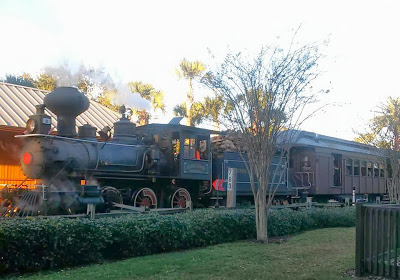
Before I get to a true story dating back to World War II, here's a pic of the Tavares Steam Train. Seven of us took their "Santa Ride" this week, and I must say they do it well. Not only Santa and Mrs. Claus, but singing elves, a chorus of white-coated singing chefs, plus cocoa, cookies, and a ride past Lake Dora and lovely decorations on both sides of the tracks. There is also an open wooden car with benches, plus a genuine caboose. A truly fun experience. (And a voucher for all of us for a free ride when the train isn't confined to a half-mile of track, due to repairs!)
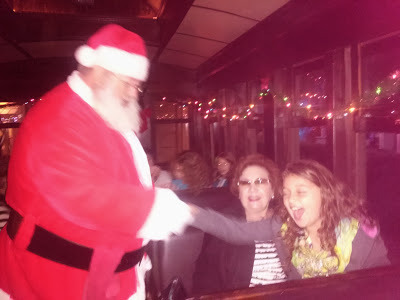 Riley, a bit reluctant to give Santa a hug (with her "other" gramma looking on)~* ~
A World War II Christmas Story
My husband loved to tell this tale - I even helped him write it up for a religious magazine a quarter century ago. He is no longer with us, but this is such a nice story, I'd like to keep it alive.
~ * ~
My husband was fortunate in his war experiences. Refusing officer training since all new officers were being sent to the Pacific and he wanted to see Europe, he ended up as the Staff Sergeant for the Colonel in charge of an Ordnance battalion, stationed near Bath, England (where he learned "change ringing"). The battalion's primary duty was preparing vehicles, especially tanks, for what would be the Normandy invasion. After the invasion, his battalion tagged along, keeping everything in good repair.
On Christmas Eve they were bivouacked near a nameless French village. (The Germans had removed all mileage and town signs.) My husband and a friend decided to walk into town, and on the way they passed a small Catholic church. Since my husband was interested in both European architecture and organs, they tried the door, found it open, and went inside. And, lo and behold, there was an ancient pump organ. My husband immediately tried it but found it lifeless. (He was one of those gifted people who could play by ear.)
The two soldiers continued their walk and were invited into a French home and fed supper. While there, they attempted to ask about the organ, but the language barrier was total. On their way back to base, they entered the church once again, took the organ apart, laying each piece along the front benches of the church. They then spent the night repairing and putting it back together. (And perhaps not surprisingly considering they were in Ordnance, it worked.)
The only problem, no one came near them that entire time. They never found out the name of the village, never knew if the villagers discovered the organ was usable again. My husband always hoped, of course, that people in that French village considered it "the Christmas Eve miracle of the restoration of the organ."
My husband was Elliott H. Kone, who later founded the Yale Audio-Visual Center and the Yale Guild of Carillioneurs. He was Jewish.
~ * ~
For those who missed this really unusual no-bake treat the last time I posted it:
STAINED GLASS COOKIES*
1 cup (6 oz.) semisweet chocolate chips
2 tablespoons butter
1 egg, lightly beaten
3 cups pastel miniature marshmallows**
½ cup chopped pecans or walnuts
1 cup flaked coconut
1. In a heavy saucepan, melt chocolate chips and butter over low heat, stirring occasionally. Stir a small amount into the beaten egg, then return all to pan. Cook and stir over low heat for 2 minutes. Pour into a bowl; let cool for 15 minutes. Gently stir in marshmallows and nuts. Chill for 30 minutes. (I stirred the chocolate mix into the marshmallow mix - no difference.)
2. On a long sheet of waxed paper, shape dough into a 1½-inch-diameter log. Place coconut on another sheet of waxed paper. Gently roll log over coconut to coat sides. Wrap up tightly, twisting ends to seal. (I twisted & clipped with plastic clothes pins.)
3. Freeze for 4 hours or overnight. Remove waxed paper. Cut into 1/4 - 3/8" slices. Store in an airtight container in the refrigerator.
TIP: Stash a batch of cookies in a plastic container in the freezer for use anytime. They unfreeze very quickly.
*Originally, “Cathedral Cookies” - recipe from Taste of Home’s Best-Loved Cookies, December 2012.
** The only place I've found colored mini-marshmallows is in the baking section of a Super Wal-mart.
~ * ~A Very Merry Christmas to my Christian readers A Most Sincere Happy Holidays to those of other faithsAnd may 2014 be kind to us all.
Thanks for stopping by.
Grace

 Riley, a bit reluctant to give Santa a hug (with her "other" gramma looking on)~* ~
A World War II Christmas Story
My husband loved to tell this tale - I even helped him write it up for a religious magazine a quarter century ago. He is no longer with us, but this is such a nice story, I'd like to keep it alive.
~ * ~
My husband was fortunate in his war experiences. Refusing officer training since all new officers were being sent to the Pacific and he wanted to see Europe, he ended up as the Staff Sergeant for the Colonel in charge of an Ordnance battalion, stationed near Bath, England (where he learned "change ringing"). The battalion's primary duty was preparing vehicles, especially tanks, for what would be the Normandy invasion. After the invasion, his battalion tagged along, keeping everything in good repair.
On Christmas Eve they were bivouacked near a nameless French village. (The Germans had removed all mileage and town signs.) My husband and a friend decided to walk into town, and on the way they passed a small Catholic church. Since my husband was interested in both European architecture and organs, they tried the door, found it open, and went inside. And, lo and behold, there was an ancient pump organ. My husband immediately tried it but found it lifeless. (He was one of those gifted people who could play by ear.)
The two soldiers continued their walk and were invited into a French home and fed supper. While there, they attempted to ask about the organ, but the language barrier was total. On their way back to base, they entered the church once again, took the organ apart, laying each piece along the front benches of the church. They then spent the night repairing and putting it back together. (And perhaps not surprisingly considering they were in Ordnance, it worked.)
The only problem, no one came near them that entire time. They never found out the name of the village, never knew if the villagers discovered the organ was usable again. My husband always hoped, of course, that people in that French village considered it "the Christmas Eve miracle of the restoration of the organ."
My husband was Elliott H. Kone, who later founded the Yale Audio-Visual Center and the Yale Guild of Carillioneurs. He was Jewish.
~ * ~
For those who missed this really unusual no-bake treat the last time I posted it:
STAINED GLASS COOKIES*
1 cup (6 oz.) semisweet chocolate chips
2 tablespoons butter
1 egg, lightly beaten
3 cups pastel miniature marshmallows**
½ cup chopped pecans or walnuts
1 cup flaked coconut
1. In a heavy saucepan, melt chocolate chips and butter over low heat, stirring occasionally. Stir a small amount into the beaten egg, then return all to pan. Cook and stir over low heat for 2 minutes. Pour into a bowl; let cool for 15 minutes. Gently stir in marshmallows and nuts. Chill for 30 minutes. (I stirred the chocolate mix into the marshmallow mix - no difference.)
2. On a long sheet of waxed paper, shape dough into a 1½-inch-diameter log. Place coconut on another sheet of waxed paper. Gently roll log over coconut to coat sides. Wrap up tightly, twisting ends to seal. (I twisted & clipped with plastic clothes pins.)
3. Freeze for 4 hours or overnight. Remove waxed paper. Cut into 1/4 - 3/8" slices. Store in an airtight container in the refrigerator.
TIP: Stash a batch of cookies in a plastic container in the freezer for use anytime. They unfreeze very quickly.
*Originally, “Cathedral Cookies” - recipe from Taste of Home’s Best-Loved Cookies, December 2012.
** The only place I've found colored mini-marshmallows is in the baking section of a Super Wal-mart.
~ * ~A Very Merry Christmas to my Christian readers A Most Sincere Happy Holidays to those of other faithsAnd may 2014 be kind to us all.
Thanks for stopping by.
Grace
December 14, 2013
EDITING SCOLD
 "Singing Trees" - The Creation, December 2013One doesn't have to take the story of The Creation literally in order to enjoy the striking symbolism of the annual Singing Trees performance at First Baptist Orlando. (Long-time readers of Grace's Mosaic Moments may recall the hair-raising tale recounted in my first two blogs, detailing my attempt to drive my three grandchildren home from the Singing Trees performance of Christmas 2010!) This year's performance, told in song and dance, and with the aid of some very large animals and a sinuous snake, was a true spectacle. And the music, as always, was glorious. [Orlando area residents - consider putting it on your holiday schedule for next year.]
~ * ~
EDITING SCOLD
I was going to begin my World Building series this week, but a book I just read sent me into shock mode and a brief postponement of my plans. As we all know, it's close to impossible to publish a book without an error or three. Typos no one noticed, a missing word here or there. It's expected. Even the best old-time print publishers get caught by this publishing inevitability. But a book that looks like no one bothered to check it, let alone fix it? Now that's just downright unacceptable. I don't care whether you're a best-selling multi-published author or some high school student on his/her first publishing venture, there is no excuse for not presenting a well-polished book. (Exception: Authors writing for New York print publishers and royalty-paying e-publishers. They should turn in a clean, proof-read manuscript, but after that the publisher becomes responsible.) My words today are primarily addressed to those who are doing their own publishing.
Some suggestions:
Have a critique group read your book, making note of copy edits as well as story.
Have friends read your book - not as sycophants but as careful critics.
Have colleagues read it - again, with care, not a quick once-over.
Have Mom, Dad, Aunt Susie. read it. (Well, one can always hope.)
Hire a professional editor and/or copy editor.
One of the above should work for you. Or, if you're like me, you simply edit and proof your own work until you truly believe it's as close to flawless as it's going to get.
And yet . . . just this week a friend e-mailed me about a couple of errors in my naughty novella, Belle. And yes, they were critical errors - the wrong name for the hero in one place and an incorrect pronoun that rendered a sentence senseless. I immediately found and fixed them and uploaded the corrected version to Amazon. (Since Belle is having some difficulty making it to B&N via Smashwords, it's the corrected version that will finally appear there.) Simply put, I make a real effort to present the nuts and bolts of my work with as much quality as I hope went into the writing.
And I expect others to do the same.
Alas, this week I happily downloaded the latest in a series of books I have enjoyed over the past few years, only to discover the author seems to have skipped the proof-reading phase of this one. Because I do not want to make this personal, I will avoid specific examples, but here is what I found:
1. Soundalike words used in place of the proper word. Quite a few of them.
2. A totally incorrect soundalike word used over and over again, clearly indicating the author did not know the difference between the two.
3. Other incorrect words which might have been either author misconception or simply typos.
4. Non sequiturs - words in the middle of a sentence that made no sense - probably meant for deletion but which never made it.
5. In one place, an entire paragraph was displaced, completely mangling the end of a chapter.
***
It's possible some bad things may have been happening in the author's life when editing time came along. But the impression a reader gets is that the author has written so many successful indie-published books, she no longer has respect for her readers. "Just write it and upload it. Why bother to look it over?" That's the message I got. To say I was disappointed is putting it mildly. I just couldn't empathize with the characters as I had in the past.
The moral of this tale is one I'm sure you don't have to be told: For the sake of your book, for the sake of your readers, for the sake of pride in your accomplishment(s), EDIT THE BLASTED BOOK!
~ * ~
Hmmm, that's two rants, almost back to back. I promise to get to World Building next time round - though that will likely be after Christmas.
Thanks for stopping by,
Grace
For Blair's website with book covers & blurbs, click here
For Grace's editing service, click here
December 7, 2013
Spain & Portugal 4
Before we finish off our trip to the Iberian Peninsula, here is a recipe which deserves to be passed along. Every year I put half a pound of Jimmy Dean sausage into my turkey stuffing for Thanksgiving and freeze the rest for cassoulet. Cassoulet might be called France's downhome recipe for everyday eating with delight. I've had this particular recipe for more years than I care to remember, and its piquant taste never fails. I've also added a few of my "extras" to an addendum at the end.
Cassoulet
½ lb. bulk pork sausage
1 small onion, sliced (½ cup)
1 clove garlic, minced
½ lb. (1½ cups) cooked ham, cubed
2 tablespoons snipped parsley
1 bay leaf
2 15-oz. cans navy beans
¼ cup dry white wine
Dash ground cloves [don't overdo it!]
In skillet, cook sausage [breaking it into small pieces], onion, and garlic till meat is lightly browned and vegetables are tender; drain off excess fat. Add ham, parsley, and bay leaf; mix well. Stir in undrained beans, wine, and cloves. Pour into 1½-qt casserole.* Bake, covered, in 325° oven for 45 minutes. Uncover and bake for 40 to 45 minutes more, stirring occasionally. Remove bay leaf. Serve in bowls. Makes 6 servings.
*I use a 2-2½-qt casserole.
I also add 4 or 5 whole green peppercorns and fresh garden herbs.
If desired, a drained can of chick peas may be substituted for one of the cans of beans. (Add a bit more wine.)
For the ham, I usually get a single slice of Black Forest ham, a half-inch thick, at the Publix Deli.
~ * ~
And now to finish off the travels of Tina, Nicki, and Grace through the Iberian Peninsula . . .
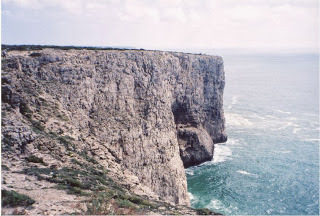
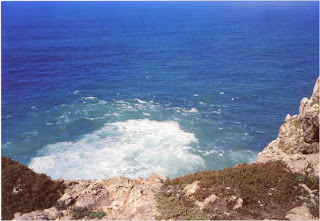
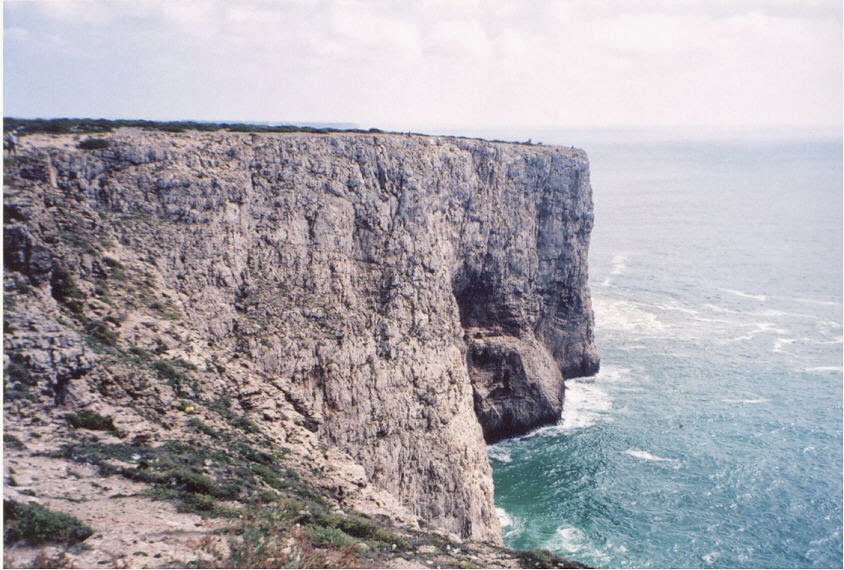
We crossed the border back into Portugal at its southern coast. Below, a look at the cliffs at Sagres.
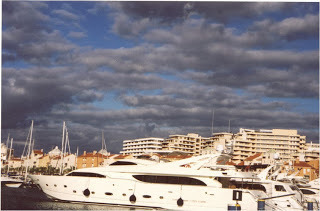
We arrived at Villamouro, a coastal resort full of fancy hotels, beaches, boutiques, restaurants, and expensive boats in a U-shaped harbor.
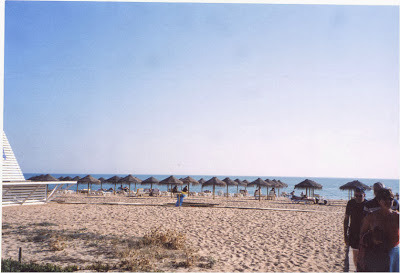 The beach in front of our hotel
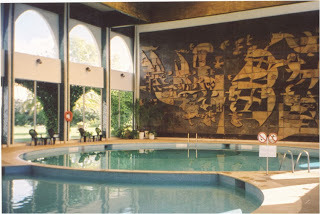 Our hotel's indoor pools
We decided to take a boat trip to see something called "the grottoes." One of our party took one look at the boat, started humming the theme from Gilligan's Island, and walked back down the dock. The rest of us decided it wasn't the Minnow and stayed on board. Ours is the one with brown stripe toward the back of the line-up below, a power boat, not sail.
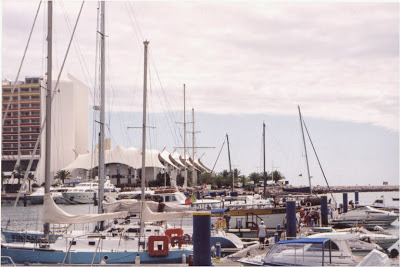 A portion of the harbor - Villamouro, Portugal
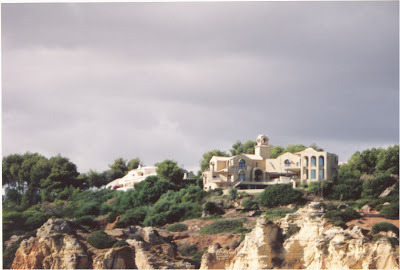 Perched on a clifftop
Some people live really well, but swimming - not so much. Even if a small sand beach could be found, the climb down & back up would be daunting. One presumes that's a pool at the front of this mansion. The view, however, must be spectacular.
After many minutes of spectacular cliffs, an occasional town, and numerous resorts and private residences, we arrived at "the grottoes," where our boat plunged through humungous waves in order for us to get a good look at what we'd paid to see. Thoughts of S. S. Minnow chased through our heads. It seemed only splinters would be left if we got any closer.
 One of several "grottoes"
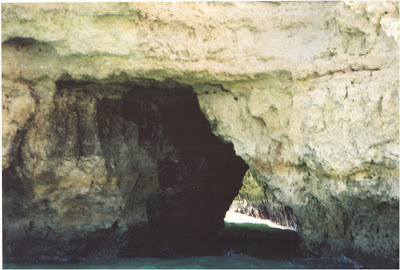 Grotto close-up - note pass-thru to sandy beach
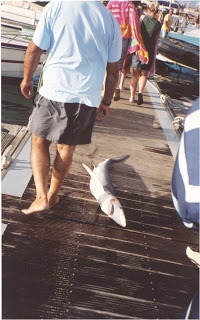
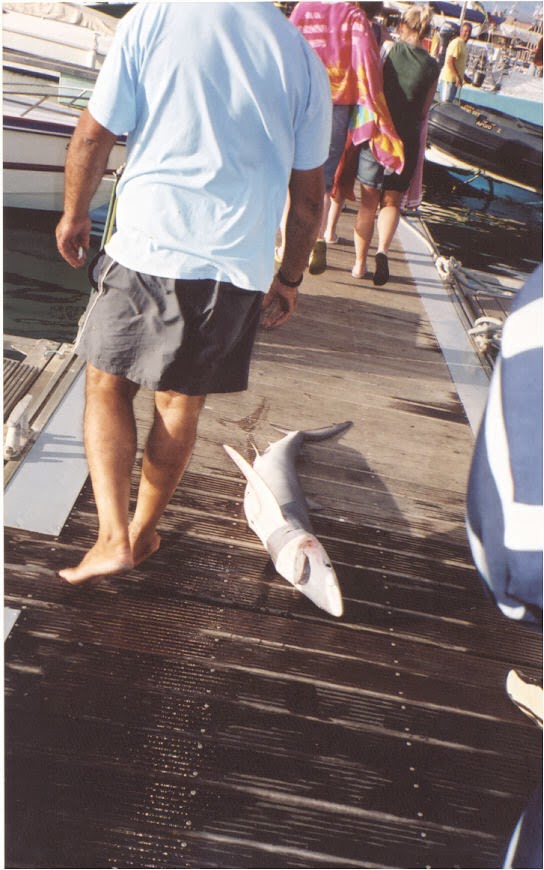
When we returned to Villamouro harbor at dusk, a fisherman had just laid out his catch for the day, a small shark.
And, finally, as our group headed back toward Lisbon and our flight home, we got to see cork trees. They can only be harvested every nine years. Below, an unharvested branch. And a harvested trunk.
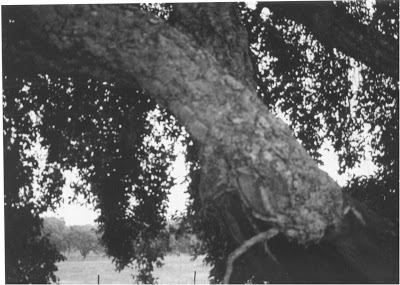 Branch of a cork tree
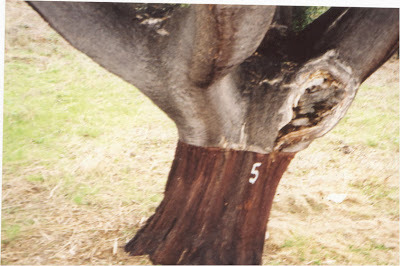 Cork tree - bareAll I can say after our tour of Spain and Portugal is to urge more people to visit. The Iberian Peninsula is full of history, wondrous sights, and friendly people. Consider it for your next vacation.
Thanks for stopping by,
Grace
Coming soon: The Challenges of World Building
For Blair's website with book covers & blurbs, click here
For Grace's editing service, click here
Cassoulet
½ lb. bulk pork sausage
1 small onion, sliced (½ cup)
1 clove garlic, minced
½ lb. (1½ cups) cooked ham, cubed
2 tablespoons snipped parsley
1 bay leaf
2 15-oz. cans navy beans
¼ cup dry white wine
Dash ground cloves [don't overdo it!]
In skillet, cook sausage [breaking it into small pieces], onion, and garlic till meat is lightly browned and vegetables are tender; drain off excess fat. Add ham, parsley, and bay leaf; mix well. Stir in undrained beans, wine, and cloves. Pour into 1½-qt casserole.* Bake, covered, in 325° oven for 45 minutes. Uncover and bake for 40 to 45 minutes more, stirring occasionally. Remove bay leaf. Serve in bowls. Makes 6 servings.
*I use a 2-2½-qt casserole.
I also add 4 or 5 whole green peppercorns and fresh garden herbs.
If desired, a drained can of chick peas may be substituted for one of the cans of beans. (Add a bit more wine.)
For the ham, I usually get a single slice of Black Forest ham, a half-inch thick, at the Publix Deli.
~ * ~
And now to finish off the travels of Tina, Nicki, and Grace through the Iberian Peninsula . . .
We crossed the border back into Portugal at its southern coast. Below, a look at the cliffs at Sagres.
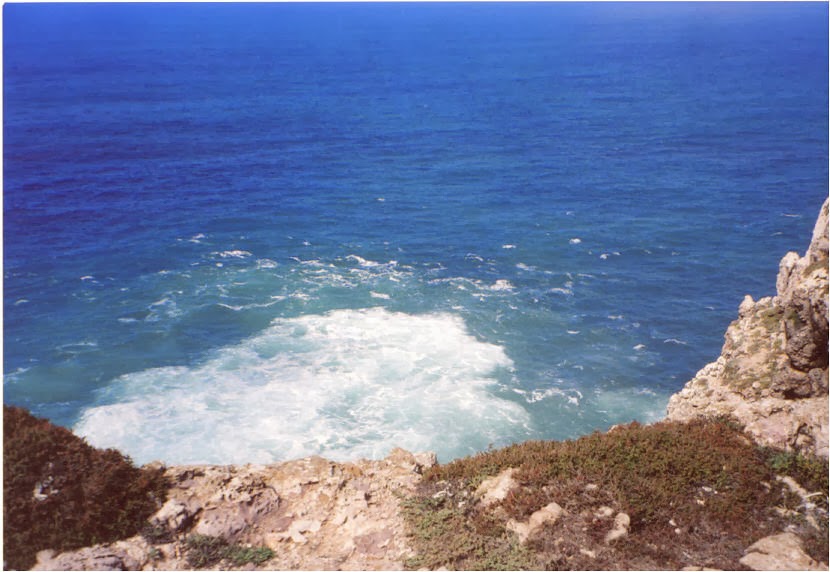
We arrived at Villamouro, a coastal resort full of fancy hotels, beaches, boutiques, restaurants, and expensive boats in a U-shaped harbor.
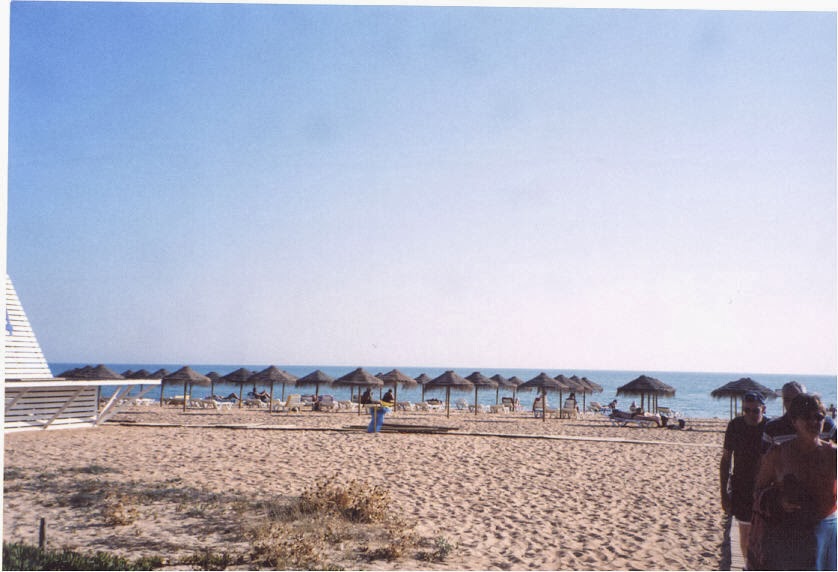 The beach in front of our hotel
 Our hotel's indoor pools
We decided to take a boat trip to see something called "the grottoes." One of our party took one look at the boat, started humming the theme from Gilligan's Island, and walked back down the dock. The rest of us decided it wasn't the Minnow and stayed on board. Ours is the one with brown stripe toward the back of the line-up below, a power boat, not sail.
 A portion of the harbor - Villamouro, Portugal
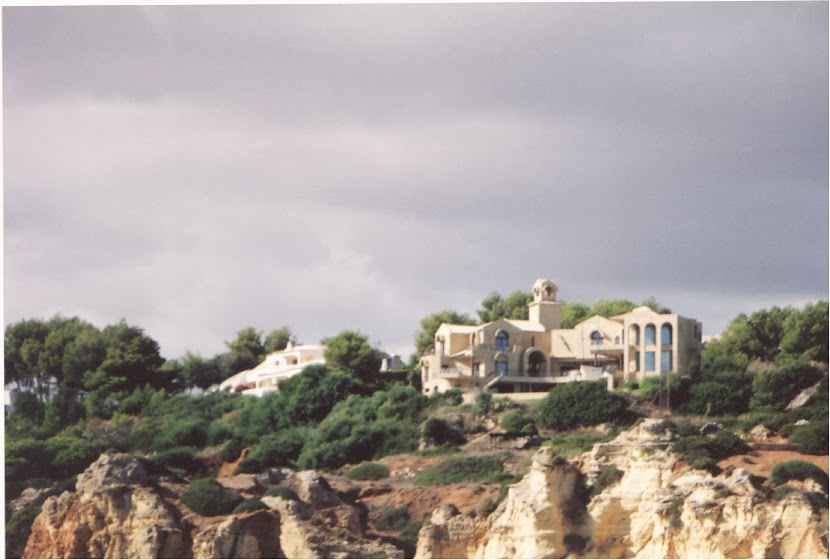 Perched on a clifftop
Some people live really well, but swimming - not so much. Even if a small sand beach could be found, the climb down & back up would be daunting. One presumes that's a pool at the front of this mansion. The view, however, must be spectacular.
After many minutes of spectacular cliffs, an occasional town, and numerous resorts and private residences, we arrived at "the grottoes," where our boat plunged through humungous waves in order for us to get a good look at what we'd paid to see. Thoughts of S. S. Minnow chased through our heads. It seemed only splinters would be left if we got any closer.
 One of several "grottoes"
 Grotto close-up - note pass-thru to sandy beach
When we returned to Villamouro harbor at dusk, a fisherman had just laid out his catch for the day, a small shark.

And, finally, as our group headed back toward Lisbon and our flight home, we got to see cork trees. They can only be harvested every nine years. Below, an unharvested branch. And a harvested trunk.
 Branch of a cork tree
 Cork tree - bareAll I can say after our tour of Spain and Portugal is to urge more people to visit. The Iberian Peninsula is full of history, wondrous sights, and friendly people. Consider it for your next vacation.
 Thanks for stopping by,
Grace
Coming soon: The Challenges of World Building
For Blair's website with book covers & blurbs, click here
For Grace's editing service, click here


