
Blair Bancroft's Blog, page 59
November 25, 2012
IN HONOR OF THANKSGIVING
In my 2011 "Reflections on Thanksgiving," I ranted about Black Friday. Alas, things have only gotten worse, with the media now proclaiming, "Gray Thursday"! Gray Thursday? Can they possibly mean Thanksgiving? Thanksgiving, the most American of all our holidays? The holiday that extends across ethnic backgrounds, religion, education, age, etc. The holiday which inspires more travel than any other time of the year - 43,000,000 according to this week's television news.
Why is Thanksgiving such a universal American holiday? Because if you are an American—if you appreciate what being an American means—you celebrate Thanksgiving. And, if it's at all possible, you find a way to celebrate this very special holiday with family. And possibly extend the holiday feast to friends with no family of their own.
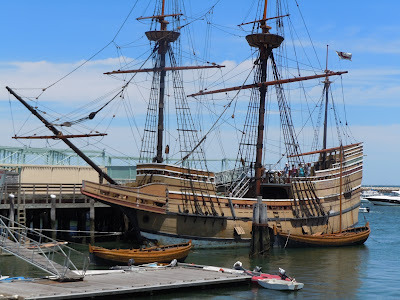 Mayflower replica, Plymouth, Massachusetts
What makes Thanksgiving so special? After all, we have a lot of holidays, from the birthday of our country to the birthdays of great men, to honoring our veterans, so what makes this one stand out? Because 156 years before we became the United States of America, we were a tiny colony on the shore of Massachusetts. A colony of Pilgrims, religious dissenters who suffered two months on board the sailing ship Mayflower, hoping to settle in Virginia—where Jamestown had become the first English colony in the New World— only to end up at the end of a promontory considerably farther north. The place now known as Provincetown on Cape Cod. There, they found a spring. What joy to have fresh water after two months at sea. But the land was narrow, scarcely a mile wide, and sandy. No good for farming, for keeping themselves alive. So they got back on board the Mayflower and continued on. Farther along the cape's "arm," they stopped again. This time they were greeted by natives, the people Christopher Columbus had erroneously named "Indians." [The place, now commemorated as "First Encounter Beach," is on the Bay shore in Eastham, Massachusetts. We stopped there on our trip to Cape Cod last summer.]
But the soil was still sand, so once again they set sail. The next landing was more productive and the Pilgrims joined the New World's first wave of "immigrants." Conditions were harsh, many died, but when spring came they cleared land and planted seeds. And that Fall, they stopped to give thanks - for their survival, for food, for help from the Indians, for the new land they were settling. [Today's Plymouth offers a replica of the Mayflower, which you can explore, and an excellent reproduction of the buildings and crafts of the early colony at what is called "Plymouth Plantation."]
Over the years this First Thanksgiving has become an inspiration for a holiday which emphasizes giving thanks for all we have, particularly for the love of family and friends, for a roof over our heads and food on the table. It is also a time when, thanks mostly to volunteers, we do our best to provide "Thanksgiving" for those who have little or nothing. Nor does our government forget our men and women in uniform. Thanksgiving is truly the "universal" holiday.
And yet . . . retail America, particularly the "big box" stores, are turning Black Friday, the traditional start of the Christmas shopping season, into "Gray Thursday," encroaching more and more on America's most precious holiday. If the owners of these corporations were going to be out there, staffing the stores on the Thanksgiving, maybe this crass play for money and more money wouldn't be so bad, as I'd like to think only those hard-shelled enough not to give a @#$% about Thanksgiving would be shopping on the holiday. BUT these corporate giants are infringing on the most sacred American family holiday by requiring their workers to be front and center for this madhouse of consumerism. Employees must cut short their holiday to run back to work at eight, nine, midnight, four a.m., five a.m. You name the time, and some store has compromised the holiday tradition in order to offer people an opportunity to trample all over each other so they can buy a 40" TV.
NOT AT OUR HOUSE! This Thanksgiving at 6:30 p.m. we sat down thirteen to dinner - twelve family plus one "friend." [The rest of the nineteen (the brand new American citizens) who joined us last year were creating their own holiday tradition for friends visiting from Miami.] This year my son-in-law (born in Argentina) started a new tradition. He asked each person at the table, in turn, to tell what he or she was thankful for. After the adults spoke, he asked his daughters (ages 6-9) to read a list of ten things they had written down for which they were thankful. (They had to compose these lists on their own.) It was a moving experience and, as sometimes happens, it all came together in a perfect moment.
After we stuffed ourselves with an incredible array of food, we sat around the table and talked. Just talked - in English and Spanish. None of the thirteen of us was rushing off to the mall. We enjoyed Thanksgiving for the family day it was meant to be. For the giving of thanks, not the gimme-gimme of "What can I buy & how cheap can I get it?"
Has our family had some of those Thanksgiving disasters or blow-ups that people sometimes moan about? Yes, we have, so, believe me, I particularly treasure this year's ideal Thanksgiving. And I want other people to have their very special Thanksgiving moments and not be forced to give it all up in order to go to work so crass consumerism can push our most American holiday all the way back to August.
If you agree with me, I hope you will pass this blog post on to others.
~ * ~
Next week: "Best Foot Forward" will likely come before "How Not to Write a Book"
Thanks for stopping by,
Grace
Grace's books as Blair Bancroft


November 17, 2012
LADY OF THE LOCK
In the summer of 2006 I traveled England's Kennet & Avon canal (see England at 3mph - Blog Archives - Feb 11 & Feb 23, 2011), so Lady of the Lock has been a long time in the making. Two things held it up: the crash of the traditional Regency market as Signet and Kensington shut down their Regency lines, and by the time indie publishing came along, my research materials had disappeared during my move to Orlando in 2007! But thanks to my son cleaning and organizing my garage last winter (with a magnificent array of shelving), the box containing detailed maps of the K&A canal and Bath, plus a host of other items collected during that trip, finally turned up. I practically cried. At last I could write Lady of the Lock.
It's quite possible Lady of the Lock contains more than most people want to know about building a canal - and very likely some wholly erroneous details I made up when my research failed me. But I hope any lapses on my part will not detract from the overall story, which I intended to be both heart-warming and humorous in spite of a whole series of "black moments." For cover and blurb, please see below.
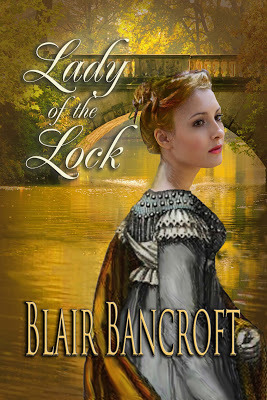
At age eleven, Miss Amanda Merriwether encounters a rather rude young man on the banks of the Kennet & Avon canal and embarks on a decade-long relationship which suffers enough blows to discourage the strongest will. The young man is the Marquess of Montsale, heir to a dukedom; she, the daughter of the architect/engineer who designed the Kennet & Avon, a man the nobility consider little better than a tradesman. Scarcely a suitable family background for a marchioness! But the blood of a man capable of heading a massive construction project that has taken most of her lifetime to build runs through Amanda's veins. Even when she finally learns to spurn her long-time love, somehow a spark remains.
Grace Note: Lady of the Lock is a "traditional" Regency in the style of my previous Regencies, Lady Silence, A Gamble on Love, A Season for Love, The Temporary Earl, The Harem Bride, The Courtesan's Letters, Steeplechase, and my two Christmas novellas, Mistletoe Moment and The Last Surprise. The canal is real, the dates of construction real. All else is fiction. The man who actually designed and supervised the building of the Kennet & Avon canal was John Rennie, a Scotsman. His career includes a number of other canals, major bridges, and docks and harbors. His design for London Bridge was carried out by his son after Rennie's death. One of the outstanding architect/engineers of his time, John Rennie is buried in St. Paul's Cathedral.
Lady of the Lock is currently "live" at Kindle and Smashwords. Best guess for Nook, Sony, and other e-readers, 2-3 weeks yet. (Please remember - Smashwords offers a 20% free read.)
Thanks for stopping by.
Grace
Coming soon: "How Not to Write a Book" or "The Sad Tale of Rogue's Destiny"

It's quite possible Lady of the Lock contains more than most people want to know about building a canal - and very likely some wholly erroneous details I made up when my research failed me. But I hope any lapses on my part will not detract from the overall story, which I intended to be both heart-warming and humorous in spite of a whole series of "black moments." For cover and blurb, please see below.

At age eleven, Miss Amanda Merriwether encounters a rather rude young man on the banks of the Kennet & Avon canal and embarks on a decade-long relationship which suffers enough blows to discourage the strongest will. The young man is the Marquess of Montsale, heir to a dukedom; she, the daughter of the architect/engineer who designed the Kennet & Avon, a man the nobility consider little better than a tradesman. Scarcely a suitable family background for a marchioness! But the blood of a man capable of heading a massive construction project that has taken most of her lifetime to build runs through Amanda's veins. Even when she finally learns to spurn her long-time love, somehow a spark remains.
Grace Note: Lady of the Lock is a "traditional" Regency in the style of my previous Regencies, Lady Silence, A Gamble on Love, A Season for Love, The Temporary Earl, The Harem Bride, The Courtesan's Letters, Steeplechase, and my two Christmas novellas, Mistletoe Moment and The Last Surprise. The canal is real, the dates of construction real. All else is fiction. The man who actually designed and supervised the building of the Kennet & Avon canal was John Rennie, a Scotsman. His career includes a number of other canals, major bridges, and docks and harbors. His design for London Bridge was carried out by his son after Rennie's death. One of the outstanding architect/engineers of his time, John Rennie is buried in St. Paul's Cathedral.
Lady of the Lock is currently "live" at Kindle and Smashwords. Best guess for Nook, Sony, and other e-readers, 2-3 weeks yet. (Please remember - Smashwords offers a 20% free read.)
Thanks for stopping by.
Grace
Coming soon: "How Not to Write a Book" or "The Sad Tale of Rogue's Destiny"
November 12, 2012
FLORIDA ELECTIONS - EMBARRASSED AGAIN
On Election Day, November 6, 2012, I drove to my polling station, the local country club, easily found a parking space, walked thirty feet to the club, being greeted by smiling poll workers along the way. I walked into a large room, crossed to the second long table where my precinct's records are kept (two precincts vote in the same room). With only one person before me, I waited no more than two minutes before it was time to show my license, sign my name in the record book, and receive my ballot. I then sat down at one of four large round tables and filled out the lengthy (4-pages, legal length) ballot. When every oval was correctly filled (or skipped, as I could not in good conscience vote for either candidate in one particular race), I re-checked my ballot - still comfortably seated at the table - before taking it to the ballot-scanning machine. There I encountered another helpful, smiling poll worker, who watched me feed the pages into the machine and then handed me my "I voted" sticker.
The above experience has been mine through all the elections I've experienced since I moved to Orlando five years ago (and similar to my experiences for a quarter century in Venice, FL). Each time television news programs show long lines, yet on Election Day I walk straight in and vote. Why? Until this week I hadn't stopped to analyze the problem. But when I did . . .
On Election Day 2012, less than five miles east and west of where I voted, students at the University of Central Florida and voters in the predominantly African-American Pine Hills communities waited in line for hours and hours and hours. Anyone in line when the polls closed at seven o'clock was allowed to vote. Which meant that some people were still voting when the vote-count began and it became apparent just how close the Florida race was going to be. The television news showed people in line keeping in touch through their smart phones and determined to wait to vote, no matter how long it took, because they could see their vote was really going to matter.
I, along with the rest of Florida (except for the poor souls still in line), sat in front of my TV and watched with avid interest as state after state was "called" by the experts for Obama or Romney. The Florida count was 50-50, 50-49, 49-50, see-sawing back and forth between the candidates. The Electoral College votes mounted. Florida was going to do it, I was sure. We were going to be the decisive state. Wow!
But - what? Ohio - in a later time zone - got their votes counted before Florida. New Mexico, Colorado - way west of Florida - got their votes in. The Presidential election was essentially over, Obama giving his victory speech, and Florida's votes weren't counted yet. Romney conceded - and Florida's votes weren't counted yet. The entire "voting map" was colored in with red and blue states, except Florida which was a sickly blue on some maps and yellow on others.
For FOUR DAYS! Yes, our votes did count, but it didn't seem like it. It seemed as if all those determined voters stuck it out in line for nothing. Because on election night, their votes were not counted as red or blue by the news media. The State of Florida, once again the laughingstock of the nation.
Why? The following is my opinion, but, providentially, it was borne out by a column in Sunday's Orlando Sentinel, so I don't think I'm too far out of line. It would seem that the Florida Legislature, far too full of people with their own agendas rather than people concerned about good government for the State of Florida, not only tried to mess with the Florida Constitution and State Supreme Court, they were determined to make it as difficult as possible for voters in certain districts to make themselves heard. I, who vote at a country club, had everything made easy. Students, blacks and Hispanics - who tend to vote for the more liberal candidates - had everything made as difficult as possible to cast their votes.
One of the rays of hope in all this is that it appears the man scheduled to be the next Speaker of the Florida House was voted out of office. (A recount is in the works as the vote difference is about 123 votes - yet more proof that every vote counts.) The Supreme Court judges the Legislature wanted to oust were retained by the voters. Most of the ridiculous and convoluted amendments to the Florida Constitution were voted down. Which means . . .
You might be able to fool voters once, but not twice. Common sense ruled. Wow, special-interest politicians, I guess we voters are smarter than you thought we were.
Is there any hope of fixing the Florida election system? I'm not optimistic, since it isn't just the present administration which has manipulated the system. But no one likes to have egg on his/her face. Young, old, Republican, Democrat, Independent. It's EMBARRASSING. Not just the United States, but the whole world sees Florida as a backwater swamp that can't even get its votes counted until four days after the elections. And if we go back to those hanging chads, where a political nobody from Florida was allowed to decide the outcome of a national Presidential election . . . Ah, well, don't get me started on that!
So perhaps the politicians in Tallahassee will be forced to do something about election reform at long last. Forced to create a more equitable system of polling stations. Forced to make fair rules and stick to them so the various Supervisors of Elections aren't left tearing their hair and wondering how they can make their way through the morass of Legislative obstacles. (Is that the shadow of Jim Crow I see?)
I've lived and voted in Florida for thirty years. And most people I know are really trying to do the right thing, to vote for people they believe will do their best for Florida. So how have we gotten ourselves into this untenable situation? I guess we're just going to have to be smarter, more discriminating. Pay more attention to who's going to Tallahassee and not just who's going to Washington.
I was planning to tell a couple of election horror stories that happened here in Orlando, but I've decided they don't fit in this post. I may write about them at another time or I may be able to swallow my indignation, as the losing half of the electorate must, if we are to function as a country again, not two separate belief systems with a chasm between. I'm old enough to remember when this country "worked," when we all pulled together, finding reasonable compromises when necessary, to make it great. We need to find our way back.
No, we must find our way back - so we can move forward!
~ * ~
Thanks for stopping by.
Grace

The above experience has been mine through all the elections I've experienced since I moved to Orlando five years ago (and similar to my experiences for a quarter century in Venice, FL). Each time television news programs show long lines, yet on Election Day I walk straight in and vote. Why? Until this week I hadn't stopped to analyze the problem. But when I did . . .
On Election Day 2012, less than five miles east and west of where I voted, students at the University of Central Florida and voters in the predominantly African-American Pine Hills communities waited in line for hours and hours and hours. Anyone in line when the polls closed at seven o'clock was allowed to vote. Which meant that some people were still voting when the vote-count began and it became apparent just how close the Florida race was going to be. The television news showed people in line keeping in touch through their smart phones and determined to wait to vote, no matter how long it took, because they could see their vote was really going to matter.
I, along with the rest of Florida (except for the poor souls still in line), sat in front of my TV and watched with avid interest as state after state was "called" by the experts for Obama or Romney. The Florida count was 50-50, 50-49, 49-50, see-sawing back and forth between the candidates. The Electoral College votes mounted. Florida was going to do it, I was sure. We were going to be the decisive state. Wow!
But - what? Ohio - in a later time zone - got their votes counted before Florida. New Mexico, Colorado - way west of Florida - got their votes in. The Presidential election was essentially over, Obama giving his victory speech, and Florida's votes weren't counted yet. Romney conceded - and Florida's votes weren't counted yet. The entire "voting map" was colored in with red and blue states, except Florida which was a sickly blue on some maps and yellow on others.
For FOUR DAYS! Yes, our votes did count, but it didn't seem like it. It seemed as if all those determined voters stuck it out in line for nothing. Because on election night, their votes were not counted as red or blue by the news media. The State of Florida, once again the laughingstock of the nation.
Why? The following is my opinion, but, providentially, it was borne out by a column in Sunday's Orlando Sentinel, so I don't think I'm too far out of line. It would seem that the Florida Legislature, far too full of people with their own agendas rather than people concerned about good government for the State of Florida, not only tried to mess with the Florida Constitution and State Supreme Court, they were determined to make it as difficult as possible for voters in certain districts to make themselves heard. I, who vote at a country club, had everything made easy. Students, blacks and Hispanics - who tend to vote for the more liberal candidates - had everything made as difficult as possible to cast their votes.
One of the rays of hope in all this is that it appears the man scheduled to be the next Speaker of the Florida House was voted out of office. (A recount is in the works as the vote difference is about 123 votes - yet more proof that every vote counts.) The Supreme Court judges the Legislature wanted to oust were retained by the voters. Most of the ridiculous and convoluted amendments to the Florida Constitution were voted down. Which means . . .
You might be able to fool voters once, but not twice. Common sense ruled. Wow, special-interest politicians, I guess we voters are smarter than you thought we were.
Is there any hope of fixing the Florida election system? I'm not optimistic, since it isn't just the present administration which has manipulated the system. But no one likes to have egg on his/her face. Young, old, Republican, Democrat, Independent. It's EMBARRASSING. Not just the United States, but the whole world sees Florida as a backwater swamp that can't even get its votes counted until four days after the elections. And if we go back to those hanging chads, where a political nobody from Florida was allowed to decide the outcome of a national Presidential election . . . Ah, well, don't get me started on that!
So perhaps the politicians in Tallahassee will be forced to do something about election reform at long last. Forced to create a more equitable system of polling stations. Forced to make fair rules and stick to them so the various Supervisors of Elections aren't left tearing their hair and wondering how they can make their way through the morass of Legislative obstacles. (Is that the shadow of Jim Crow I see?)
I've lived and voted in Florida for thirty years. And most people I know are really trying to do the right thing, to vote for people they believe will do their best for Florida. So how have we gotten ourselves into this untenable situation? I guess we're just going to have to be smarter, more discriminating. Pay more attention to who's going to Tallahassee and not just who's going to Washington.
I was planning to tell a couple of election horror stories that happened here in Orlando, but I've decided they don't fit in this post. I may write about them at another time or I may be able to swallow my indignation, as the losing half of the electorate must, if we are to function as a country again, not two separate belief systems with a chasm between. I'm old enough to remember when this country "worked," when we all pulled together, finding reasonable compromises when necessary, to make it great. We need to find our way back.
No, we must find our way back - so we can move forward!
~ * ~
Thanks for stopping by.
Grace
November 5, 2012
HOW TO DEVELOP YOUR CHARACTERS, Part 3
The most important lesson to be gained from this series on "How to Develop Your Characters" is:
No Cardboard Characters Allowed!
No characters taken verbatim from movies, television, or other people's books. No characters skimmed off the top of your mind without thought. (Except one-sentence walk-ons who don't really need a lot of depth.) Yes, movies, TV, or books might give you that germ of an idea, but you must take it and make it your own. Figure out who these people are, what made them who they are, and are they worthy of a place in your story? If not, keep mining the depths of their characters until they are. Or get rid of them!
But how are you going to let your reader know what you've discovered about your characters? Are you going to sit down and write a couple of brilliant paragraphs telling us about them, as Nora Roberts told us about Tucker Longstreet? Sadly, today's market, particularly the romance market, says, "No." There are, however, several acceptable ways to "show" readers your characters rather than "tell" us about them.
1. Dialogue. When writing dialogue, always keep in mind the depths of your character's personality. Would he or she really say that? As the book progresses, you reveal the various characters' personalities by what they say to each other. (It's possible your character might develop to the point where you have to go back and change previous dialogue because you suddenly realize he/she "would never say that."
2. Narration. You can use your characters' actions to reveal more about them. Do they pace the room? Run hands through their hair? Do they remain calm, even cold, poker-faced, in time of trouble. Are they strong and silent, or do they talk all the time? Do they cry, panic, run for cover? (Hm-m-m, the last is definitely not recommended for anything but secondary characters. Modern heroes and heroines are expected to be stalwart.)
3. Introspection. Most important, and all too easily forgotten, is Introspection. This is revealing the Point-of-View characters' thoughts through narration. [Beginning writers are urged to keep to the Point of View of Hero, Heroine, and Villain (if applicable).] It is all important for an author to get inside his/her main characters' heads and let readers see the story through their eyes. Do not stand on the outside and be a narrator! Get inside the Hero's and Heroine's heads and let us see what they see, hear what they hear, feel what they feel. This is what grabs readers' hearts and makes them care about your characters. Repeat: readers do not want you to tell the story. They want you to let your characters show them what is happening.
~ * ~
A Note on Villains. I know no one who does a more evil villain than Karen Rose. I knew her before her first book was published and became an avid fan. The problem is, I had to stop reading Karen's last book. Really evil, sickly evil, villains just aren't my thing. They make me squirm. That's not why I read. But for those who do like something stronger than your usual villain, I strongly recommend reading Karen Rose's books and noting how she creates her villains. I've heard Karen speak on this subject twice now, and she has prepared herself with an excellent understanding of the inner workings of evil minds. She didn't just jump in and say, "I'm going to write a Bad Guy today."
For those of us who prefer something less strong . . .We still have to take the time to understand our bad guys and gals. Why would they be so mean? Is it money, jealousy, something twisted in their past? Or are they simply bad seeds? I personally prefer what I call Jack Higgins-style villains. I like to see some contrast in their personalities, something not all bad. I prefer villains who are not insane or basically evil. And, as Higgins has done, I like to see an occasional villain be redeemed. As he did with the villain who became the hero in a subsequent series of books. Or the German sub commander readers liked so much he had to resurrect him!
Whatever style villain you want to write, don't make him skin-deep. Justify the villainy with solid motives, glimpses into his/her background, and plenty of Introspection, showing us his/her thoughts. My best villain, I believe, is in Shadowed Paradise. I was almost shocked to discover that those scenes just flowed out, needing almost no revision over the several versions of the book that have appeared before its present incarnation as an online indie pub. Truthfully, I'm still not sure where that villain came from. An excellent example of a character taking over and telling his own story!
~ * ~
Look to friends, relatives, and not-friends for inspiration. Everywhere you go—Wal-Mart, Target, a sports arena, national park, Disneyworld, international travel sites—keep your eyes and ears open, your imagination quivering for input. Newspapers, TV, movies, the mall, the neighborhood—pay attention! Absorb the feel. Be aware. The world around us is a gold mine of characterization. No, not copying, but catching those tiny sparks that can lead to an explosion of something new. A smile, a frown, a slouch, an accent, a burst of laughter, a baby gurgling, the guy who yells, "Bitch!" because you passed him. A political rant that makes you wince. Any and all can inspire ideas that move your characters from two-dimensional to three.That take a cardboard stereotype and turn it someone readers can laugh and cry with, love or hate . . . and want to keep turning the pages (or flipping that button on their e-readers).
Or you can make every last bit of it up, straight out of your imagination. As long as you take the time to discover your characters and don't settle for a thin façade, it's okay to grab your characters out of the "cloud."
How to Develop Your Characters? Just plunge right in, ask the questions a good reporter must ask: Who, What, Where, When & Why? Whether your character is good or bad, sweet or annoying, weak or strong, figure out what makes them tick. And don't forget to share the parts that are important to the story with your readers. The rest, more subtly, will take care of itself.
~ * ~
Thanks for stopping by.
Grace
Coming sometime in November - LADY OF THE LOCK, a new Regency by Blair Bancroft in the tradition of Jane Austen and Georgette Heyer

No Cardboard Characters Allowed!
No characters taken verbatim from movies, television, or other people's books. No characters skimmed off the top of your mind without thought. (Except one-sentence walk-ons who don't really need a lot of depth.) Yes, movies, TV, or books might give you that germ of an idea, but you must take it and make it your own. Figure out who these people are, what made them who they are, and are they worthy of a place in your story? If not, keep mining the depths of their characters until they are. Or get rid of them!
But how are you going to let your reader know what you've discovered about your characters? Are you going to sit down and write a couple of brilliant paragraphs telling us about them, as Nora Roberts told us about Tucker Longstreet? Sadly, today's market, particularly the romance market, says, "No." There are, however, several acceptable ways to "show" readers your characters rather than "tell" us about them.
1. Dialogue. When writing dialogue, always keep in mind the depths of your character's personality. Would he or she really say that? As the book progresses, you reveal the various characters' personalities by what they say to each other. (It's possible your character might develop to the point where you have to go back and change previous dialogue because you suddenly realize he/she "would never say that."
2. Narration. You can use your characters' actions to reveal more about them. Do they pace the room? Run hands through their hair? Do they remain calm, even cold, poker-faced, in time of trouble. Are they strong and silent, or do they talk all the time? Do they cry, panic, run for cover? (Hm-m-m, the last is definitely not recommended for anything but secondary characters. Modern heroes and heroines are expected to be stalwart.)
3. Introspection. Most important, and all too easily forgotten, is Introspection. This is revealing the Point-of-View characters' thoughts through narration. [Beginning writers are urged to keep to the Point of View of Hero, Heroine, and Villain (if applicable).] It is all important for an author to get inside his/her main characters' heads and let readers see the story through their eyes. Do not stand on the outside and be a narrator! Get inside the Hero's and Heroine's heads and let us see what they see, hear what they hear, feel what they feel. This is what grabs readers' hearts and makes them care about your characters. Repeat: readers do not want you to tell the story. They want you to let your characters show them what is happening.
~ * ~
A Note on Villains. I know no one who does a more evil villain than Karen Rose. I knew her before her first book was published and became an avid fan. The problem is, I had to stop reading Karen's last book. Really evil, sickly evil, villains just aren't my thing. They make me squirm. That's not why I read. But for those who do like something stronger than your usual villain, I strongly recommend reading Karen Rose's books and noting how she creates her villains. I've heard Karen speak on this subject twice now, and she has prepared herself with an excellent understanding of the inner workings of evil minds. She didn't just jump in and say, "I'm going to write a Bad Guy today."
For those of us who prefer something less strong . . .We still have to take the time to understand our bad guys and gals. Why would they be so mean? Is it money, jealousy, something twisted in their past? Or are they simply bad seeds? I personally prefer what I call Jack Higgins-style villains. I like to see some contrast in their personalities, something not all bad. I prefer villains who are not insane or basically evil. And, as Higgins has done, I like to see an occasional villain be redeemed. As he did with the villain who became the hero in a subsequent series of books. Or the German sub commander readers liked so much he had to resurrect him!
Whatever style villain you want to write, don't make him skin-deep. Justify the villainy with solid motives, glimpses into his/her background, and plenty of Introspection, showing us his/her thoughts. My best villain, I believe, is in Shadowed Paradise. I was almost shocked to discover that those scenes just flowed out, needing almost no revision over the several versions of the book that have appeared before its present incarnation as an online indie pub. Truthfully, I'm still not sure where that villain came from. An excellent example of a character taking over and telling his own story!
~ * ~
Look to friends, relatives, and not-friends for inspiration. Everywhere you go—Wal-Mart, Target, a sports arena, national park, Disneyworld, international travel sites—keep your eyes and ears open, your imagination quivering for input. Newspapers, TV, movies, the mall, the neighborhood—pay attention! Absorb the feel. Be aware. The world around us is a gold mine of characterization. No, not copying, but catching those tiny sparks that can lead to an explosion of something new. A smile, a frown, a slouch, an accent, a burst of laughter, a baby gurgling, the guy who yells, "Bitch!" because you passed him. A political rant that makes you wince. Any and all can inspire ideas that move your characters from two-dimensional to three.That take a cardboard stereotype and turn it someone readers can laugh and cry with, love or hate . . . and want to keep turning the pages (or flipping that button on their e-readers).
Or you can make every last bit of it up, straight out of your imagination. As long as you take the time to discover your characters and don't settle for a thin façade, it's okay to grab your characters out of the "cloud."
How to Develop Your Characters? Just plunge right in, ask the questions a good reporter must ask: Who, What, Where, When & Why? Whether your character is good or bad, sweet or annoying, weak or strong, figure out what makes them tick. And don't forget to share the parts that are important to the story with your readers. The rest, more subtly, will take care of itself.
~ * ~
Thanks for stopping by.
Grace
Coming sometime in November - LADY OF THE LOCK, a new Regency by Blair Bancroft in the tradition of Jane Austen and Georgette Heyer
October 29, 2012
HOW TO DEVELOP YOUR CHARACTERS, Part 2
My personal approach to developing characters is pretty laissez-faire. I have, of course, spent some time thinking about these people and their possible problems before I even attempted to name them (as we did in Part 1). For how can I know what names are right for them if I haven't "met" them yet? That's one of the great things about being an author, we don't have to "take what we get," we can create exactly the people we want. (Wow, if only we could do that in real life!) I guess that's why so many people enjoy the fantasy world of romance.
But beyond a general idea of my main characters' personalities, creating their names and a bit of family background, I let these people develop on their own. This, however, is not a method that works for everyone, so today I'm going to suggest some more questions you might want to ask yourself about your characters, particularly the hero, heroine, and villain (if applicable). If you wish, you can extend the same questions to your most important secondary characters.
First, a not-apocryphal tale.
My mother, Wilma Pitchford Hays, was an author. While I was growing up, she wrote serial stories for Modern Romances, a Dell publication. We lived quite a ways from New York City, but I can recall her getting all dressed up, complete with hat and gloves, to go into the city to meet her editor. After each discussion, the editor would always escort her "upstairs" to Mr. Delacorte's office to speak for a few minutes to "the boss." (Sorry, I don't think I ever knew which Delacorte brother it was.) But according to my mother, he evidently had an eye for an attractive author!
When my mother paid my last college tuition, she switched to writing children's books (for three different age levels) and became well-known in that field. But I never forgot the story she told me when I was in high school and she was writing one of her serial romances for Dell. She said she never intended for her heroine and the two men vying for her love to all end up in a lake at the same time. The characters simply took over, and it happened, just like that. Since this was an open-ended story, where the readers got to decide which man triumphed, I expect this caused quite a stir. Did she have to drown one of the men? I don't think she ever told me that. But the concept of characters grabbing a story and running with it stuck in my mind. And it's certainly happened to me. Some days I start out intending to write A, and suddenly my fingers are typing B, or maybe something so very different I should call it XYZ.
Is this good? For me it has been. The new zig or zag always seemed to be more creative than what I'd planned. Which is why I'm an "out of the mist" writer, always willing to accommodate fresh ideas.
If, however, this new idea takes you off on a tangent not relevant to the story, then it's bad. Change your intended plot angle, change your setting, change the point of view, but never wander more than a few inches off the path of the story you're telling.
Questions you might want to ask about your characters:
1. What makes your main character (or characters) tick? Are they tough and streetwise or sweet and innocent? Sophisticated, loud, sarcastic, a wise-guy or gal? Sly or honest? Thief or Protector? Full of humor or never cracks a smile? Arrogant or humble? Loner or People Person? Maybe a Turtle - hard outside, soft inside? A Clam (90% of the males of the species)? Or maybe a Brick - hard through and through. (If so, he'd better be the villain.)
2. What triumphs or anguish have your main characters suffered in the past? How has it affected them? (The same for the villain.)
3. Are your hero and heroine different from the main characters in your previous books? If not, figure out how you can make this pair of main characters unique. Even if you're writing a series, you will want to add some new quirk to your primary character's personality that might not have shown up before. And you will want to provide a different set of secondary characters for your main character to play against.
4. Have the hero and heroine met before? If so, was it significant?
5. Do some of the secondary characters know each other? If so, how? Do they work together, party together, study together, etc.
6. What is the major conflict between the hero and heroine? Is it a product of their background, lifestyle, inner angst? Or are they more beset by outside forces (someone's trying to kill them)? If you're dealing mostly with inner conflicts, you need to get inside your main characters' heads and show your readers what they are suffering, and why.
7. What do your main characters do for a living? Even if you're writing an historical, your characters undoubtedly have a particular job they are expected to do, although that job might have been "inherited," rather than the "choice" we expect to have today.
8. How does their job relate to their goal in the book? Do they love what they do or hate it? Are their actions in the story from a sense of duty, a need for revenge, frustration with the life they have, desperation to save someone? Or maybe save themselves. Perhaps their everyday life has nothing to do with the action of the book. This is just one more thing you need to consider. And while doing it, you might find a whole new aspect (or even a small detail) to add to your story. Tinker, tailor, soldier, spy. The jobs are different and so are the personalities required to do those jobs.
Reminder: Keep in mind that, whatever you decide, your hero and heroine must be likable. They can have faults, but the reader must be able to trust that those faults will be overcome. Even if one or both starts off perfectly obnoxious, there must be something that indicates this attitude won't last. (Kind to children, animals, his/her grandmother, gives to charity, etc.)
~ * ~
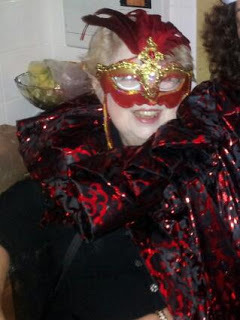 The best photo of me in years! - taken at a Halloween party Saturday night
Next blog: More questions, a closer look at villains, and some wind-up elaboration on the tricky topic of "How to Develop Your Characters."
Thanks for stopping by.
Grace
For Grace's books as Blair Bancroft, please see Blair's website For info on edits & copy edits, contact Best Foot Forward at editsbyBFF@aol.com

But beyond a general idea of my main characters' personalities, creating their names and a bit of family background, I let these people develop on their own. This, however, is not a method that works for everyone, so today I'm going to suggest some more questions you might want to ask yourself about your characters, particularly the hero, heroine, and villain (if applicable). If you wish, you can extend the same questions to your most important secondary characters.
First, a not-apocryphal tale.
My mother, Wilma Pitchford Hays, was an author. While I was growing up, she wrote serial stories for Modern Romances, a Dell publication. We lived quite a ways from New York City, but I can recall her getting all dressed up, complete with hat and gloves, to go into the city to meet her editor. After each discussion, the editor would always escort her "upstairs" to Mr. Delacorte's office to speak for a few minutes to "the boss." (Sorry, I don't think I ever knew which Delacorte brother it was.) But according to my mother, he evidently had an eye for an attractive author!
When my mother paid my last college tuition, she switched to writing children's books (for three different age levels) and became well-known in that field. But I never forgot the story she told me when I was in high school and she was writing one of her serial romances for Dell. She said she never intended for her heroine and the two men vying for her love to all end up in a lake at the same time. The characters simply took over, and it happened, just like that. Since this was an open-ended story, where the readers got to decide which man triumphed, I expect this caused quite a stir. Did she have to drown one of the men? I don't think she ever told me that. But the concept of characters grabbing a story and running with it stuck in my mind. And it's certainly happened to me. Some days I start out intending to write A, and suddenly my fingers are typing B, or maybe something so very different I should call it XYZ.
Is this good? For me it has been. The new zig or zag always seemed to be more creative than what I'd planned. Which is why I'm an "out of the mist" writer, always willing to accommodate fresh ideas.
If, however, this new idea takes you off on a tangent not relevant to the story, then it's bad. Change your intended plot angle, change your setting, change the point of view, but never wander more than a few inches off the path of the story you're telling.
Questions you might want to ask about your characters:
1. What makes your main character (or characters) tick? Are they tough and streetwise or sweet and innocent? Sophisticated, loud, sarcastic, a wise-guy or gal? Sly or honest? Thief or Protector? Full of humor or never cracks a smile? Arrogant or humble? Loner or People Person? Maybe a Turtle - hard outside, soft inside? A Clam (90% of the males of the species)? Or maybe a Brick - hard through and through. (If so, he'd better be the villain.)
2. What triumphs or anguish have your main characters suffered in the past? How has it affected them? (The same for the villain.)
3. Are your hero and heroine different from the main characters in your previous books? If not, figure out how you can make this pair of main characters unique. Even if you're writing a series, you will want to add some new quirk to your primary character's personality that might not have shown up before. And you will want to provide a different set of secondary characters for your main character to play against.
4. Have the hero and heroine met before? If so, was it significant?
5. Do some of the secondary characters know each other? If so, how? Do they work together, party together, study together, etc.
6. What is the major conflict between the hero and heroine? Is it a product of their background, lifestyle, inner angst? Or are they more beset by outside forces (someone's trying to kill them)? If you're dealing mostly with inner conflicts, you need to get inside your main characters' heads and show your readers what they are suffering, and why.
7. What do your main characters do for a living? Even if you're writing an historical, your characters undoubtedly have a particular job they are expected to do, although that job might have been "inherited," rather than the "choice" we expect to have today.
8. How does their job relate to their goal in the book? Do they love what they do or hate it? Are their actions in the story from a sense of duty, a need for revenge, frustration with the life they have, desperation to save someone? Or maybe save themselves. Perhaps their everyday life has nothing to do with the action of the book. This is just one more thing you need to consider. And while doing it, you might find a whole new aspect (or even a small detail) to add to your story. Tinker, tailor, soldier, spy. The jobs are different and so are the personalities required to do those jobs.
Reminder: Keep in mind that, whatever you decide, your hero and heroine must be likable. They can have faults, but the reader must be able to trust that those faults will be overcome. Even if one or both starts off perfectly obnoxious, there must be something that indicates this attitude won't last. (Kind to children, animals, his/her grandmother, gives to charity, etc.)
~ * ~
 The best photo of me in years! - taken at a Halloween party Saturday night
Next blog: More questions, a closer look at villains, and some wind-up elaboration on the tricky topic of "How to Develop Your Characters."
Thanks for stopping by.
Grace
For Grace's books as Blair Bancroft, please see Blair's website For info on edits & copy edits, contact Best Foot Forward at editsbyBFF@aol.com
October 22, 2012
THE LAST SURPRISE
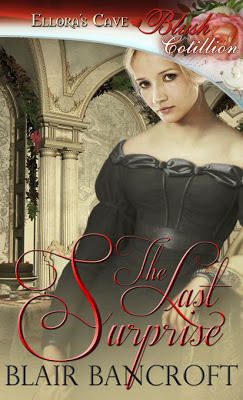
Not all surprises are good ones. Lady Christine Ashford, daughter of the Earl of Bainbridge, is enjoying a glorious first season in London when tragedy strikes. Suddenly, she and her two younger sisters are thrust from the glitter of the London ton to the far reaches of Yorkshire, where they must live with relatives until the new earl returns from his diplomatic post in Canada. To compound Christine’s grief, her Yorkshire cousin decides she and her generous dowry are just what he needs, making her situation untenable.
The problem seems to be solved when the girls’ guardian, Harlan Ashford, the new Earl of Bainbridge, returns and makes Christine an offer of marriage. But the shock of her father’s death and the intrusion into their lives of a perfect stranger make it difficult for her to adapt to being a bride. As Christmas approaches, Christine is faced with two unhappy sisters and a decidedly unhappy husband. She has a decision to make—maintain her strict mourning and intransigent behavior or save her marriage. Is it possible one last surprise, a happy one, can bring Christmas spirit to a house of mourning? And perhaps love as well?
Note: Blair Bancroft is Grace's alter ego.
Ellora's Cave Link: http://www.jasminejade.com/p-10368-the-last-surprise.aspx
Amazon Link: http://www.amazon.com/Last-Surprise-Christmas-Surprises-ebook/dp/B009RQV23W/ref=sr_1_1?s=digital-text&ie=UTF8&qid=1350915535&sr=1-1&keywords=The+Last+Surprise
DON'T GO AWAY! See Suwanee Addendum below:
 Shot in the driveway of our Suwanee neighbor's house. And, yes, that's a rattlesnake!
 I'm inclined to think there's such a thing as getting too far away from civilization.
~ * ~
Coming Soon: Part 2 of "How to Develop Your Characters"
Thanks for stopping by.
Grace

October 15, 2012
HOW TO DEVELOP YOUR CHARACTERS
At a booksigning at Orlando’s Central Library last August, a young lady asked me: “How do you develop your characters?” I gulped and thought fast, because I never took a writing class, read a “how to” book, or even stopped to think about it before. Fortunately, I managed to come up with at least the germ of a reply, but I vowed on the spot to examine the subject more thoroughly and write a blog post about it. So here is Part 1.
CHARACTERIZATION
Put quite simply, there is nothing more important than characterization when writing fiction. Even the best Action/Adventure books and the best Erotica feature well-drawn characters. Are there many books that don’t? You betcha! (And I never get beyond the first ten pages.) But most readers demand more than guns/swords/chase scenes/explosions or heaving bosoms and graphically delineated bare body parts. For which writers like me, who really care about our characters, are eternally grateful!
As I have written when critiquing hundreds of contest entries for the Romance Writers of America: readers want to love their hero and heroine. They want to empathize with them, feel their joys, their sorrows, the warmth of that final Happily Ever After. It’s all right for these main characters to have faults. In fact, faults, whether major or minor, usually add color to the story. But readers always need to know that these faults are going to be resolved. Or perhaps realize that the fault is so minor it can be more endearing than annoying.
Secondary Characters are important too. Even though they might not have a Point of View (the story is not being seen through their eyes), they can add an immense amount of color to your book. Villainy, humor, anger, spice, annoyance, etc. The secondary characters can be a sounding board for the Hero’s and Heroine’s thoughts or actions. They can provide shock, condemnation, comic relief. They allow exposition of ideas and plot action through dialogue with the Hero or Heroine. They can also be the Villain or the Bad Guys. As long as you don’t allow them to overshadow the Hero or Heroine (which can happen all too easily), Secondary Characters are vital to a good book.
So how do you make your readers empathize with your characters?
Where do you start?
1. NAMES. Your characters can’t come to life until they have names, first and last. When approaching a new book, I spend a lot of time looking through my old baby-name books, searching for first names. I scribble a bunch of possibilities on a yellow legal pad, and then I go on a search for last names. For example, for my Regency books I have a notebook full of typical surnames for the English upper classes. And long lists of less noble English surnames, most of them garnered from the phone book! I also have a book listing all the towns and hamlets in England, an excellent source of last names for that era. If I need foreign first names, an Internet search can be very helpful. Last names? Again, the phone book, adjusting for possible Americanized spellings. (Of course, if you’ve given up phone books, you may have to look elsewhere!)
When I have a list of first and last names on my yellow pad, I try pairing them up, seeing which ones will work. Which one best suits my hero . . . which best suits my heroine. Naturally, as I do this, I am forced to think about them, molding vague outlines into more human form. After that, I use a similar method to develop names for the characters in the book’s first scene. As well as any important characters who appear later in the book.
Is this name search important, worth spending the time? For the Hero, Heroine, and major Secondary Characters, absolutely. The names should suit the people you have in mind. And the process of choosing will help anchor these people in your mind. They go, for example, from “Heir to a duke” and “Engineer’s daughter” to the names you see in the list below. They rise off the paper and become people.
2. CHARACTER LIST. After I have created names for my Hero, Heroine, and the characters in the book’s first scene, I type up a Character List. I put the character’s name first, then who they are. (If I don’t know the physical description yet, I add it as soon as it becomes clear.) Example - the first few entries from my newest book, Lady of the Lock (Release Date - c. November 2012):
Character List - Lady of the Lock
Bourne Granville Hayden Challenor, Marquess of Montsale [From Lady Silence]
Heir to the Duke of Carewe [added later: brown hair, flint gray eyes, mother - Rosalind]
Amanda Grace Merriwether - a young lady of the upper middle class
[added later: bronze hair, green eyes, mother - Caroline]
John Merriwether, her father, a canal architect/engineer [added later: blond, blue eyes]
Lady Eulalia Tynsdale - wealthy & eccentric dowager baroness
Note: at the beginning, before I’ve named everyone, part of the list might read:
Lady Tynsdale’s companion
Nasty mother & daughter in Bath
John’s young engineers
Butler in Bath
As the book progresses, I add each new character to the list, from friends of the h/h to butlers, housekeepers & maids. In Lady of the Lock, the list eventually ran to three pages, plus a scribbled entry for the name of a horse!
3. FAMILY BACKGROUND. Although you may not use all the people in your main characters’ backgrounds in your book, it is helpful to figure out what their background is. Were they raised with the proverbial silver spoon, or did they struggle in poverty? Were they only children, or was the hero hen-pecked by a bevy of sisters? Did the heroine constantly struggle to keep up with a host of brothers? Is his/her aunt or grandmother kindly or a shrew? Does the father dote on his daughter, or is he, perhaps, a monster? Has the hero been on his own since an early age? Is he a bastard? Or is his greatest obstacle learning to stand on his own two feet, because he has led too privileged a life? Is there an uncle who wants to do away with the heroine because he will inherit her fortune? Or is the heroine someone who is willing to sacrifice her happiness for her family? Do we have a wounded hero who returns from war to a country where no family waits? Or one who is deluged with so much love and “help” that he has to get away? Do we have a policeman from a long line of law enforcement, or is he the first of his “old money” family to join the force?
The list of questions you should ask yourself could be endless, but usually only a short Q&A will be enough to get you started. The rest of your characters’ personality traits or outside influences can develop as you go along. Don’t mire yourself down with endless note cards, storyboarding, movie star photos, etc. Get your names down, decide on your main characters’ background and consequent personalities, and let the rest develop as you begin to know your character better. As you craft dialogue that is “right” for that character. As your character interacts with the other characters in a variety of ways. Each scene should speak to you, as well as to the reader. Telling you who these characters are.
Special Note on Character: For those who missed Nora Roberts’s description of Tucker Longstreet, posted in “Edit the Blasted Book, Part 5,” please check out my blog for June 18, 2012. It is the most perfect example of delineating a character in a few brief paragraphs that I have ever seen. Warning: It is in Omnipotent or Author POV, which seems to be out of favor at the moment. But that doesn't keep this passage from being an outstanding example of characterization. You can always use it as a shining example of how you should develop your hero or heroine in your mind before you begin to write.
For my other blogs on writing topics, see “Index to Writing Blogs,” August 26, 2012.
~ * ~
Next Blog: In Part 2 of “How to Develop Your Characters,” I’ll list more questions you can ask yourself in an effort to create characters with depth, characters readers can empathize with, characters readers can love, hate, laugh with, etc. (From the many notes I wrote myself today, I suspect this topic may run to a Part 3.)
Thanks for stopping by.
Grace, who writes as Blair Bancroft
Blair's Website
or check out my books on Kindle, Smashwords, Nook, et al

CHARACTERIZATION
Put quite simply, there is nothing more important than characterization when writing fiction. Even the best Action/Adventure books and the best Erotica feature well-drawn characters. Are there many books that don’t? You betcha! (And I never get beyond the first ten pages.) But most readers demand more than guns/swords/chase scenes/explosions or heaving bosoms and graphically delineated bare body parts. For which writers like me, who really care about our characters, are eternally grateful!
As I have written when critiquing hundreds of contest entries for the Romance Writers of America: readers want to love their hero and heroine. They want to empathize with them, feel their joys, their sorrows, the warmth of that final Happily Ever After. It’s all right for these main characters to have faults. In fact, faults, whether major or minor, usually add color to the story. But readers always need to know that these faults are going to be resolved. Or perhaps realize that the fault is so minor it can be more endearing than annoying.
Secondary Characters are important too. Even though they might not have a Point of View (the story is not being seen through their eyes), they can add an immense amount of color to your book. Villainy, humor, anger, spice, annoyance, etc. The secondary characters can be a sounding board for the Hero’s and Heroine’s thoughts or actions. They can provide shock, condemnation, comic relief. They allow exposition of ideas and plot action through dialogue with the Hero or Heroine. They can also be the Villain or the Bad Guys. As long as you don’t allow them to overshadow the Hero or Heroine (which can happen all too easily), Secondary Characters are vital to a good book.
So how do you make your readers empathize with your characters?
Where do you start?
1. NAMES. Your characters can’t come to life until they have names, first and last. When approaching a new book, I spend a lot of time looking through my old baby-name books, searching for first names. I scribble a bunch of possibilities on a yellow legal pad, and then I go on a search for last names. For example, for my Regency books I have a notebook full of typical surnames for the English upper classes. And long lists of less noble English surnames, most of them garnered from the phone book! I also have a book listing all the towns and hamlets in England, an excellent source of last names for that era. If I need foreign first names, an Internet search can be very helpful. Last names? Again, the phone book, adjusting for possible Americanized spellings. (Of course, if you’ve given up phone books, you may have to look elsewhere!)
When I have a list of first and last names on my yellow pad, I try pairing them up, seeing which ones will work. Which one best suits my hero . . . which best suits my heroine. Naturally, as I do this, I am forced to think about them, molding vague outlines into more human form. After that, I use a similar method to develop names for the characters in the book’s first scene. As well as any important characters who appear later in the book.
Is this name search important, worth spending the time? For the Hero, Heroine, and major Secondary Characters, absolutely. The names should suit the people you have in mind. And the process of choosing will help anchor these people in your mind. They go, for example, from “Heir to a duke” and “Engineer’s daughter” to the names you see in the list below. They rise off the paper and become people.
2. CHARACTER LIST. After I have created names for my Hero, Heroine, and the characters in the book’s first scene, I type up a Character List. I put the character’s name first, then who they are. (If I don’t know the physical description yet, I add it as soon as it becomes clear.) Example - the first few entries from my newest book, Lady of the Lock (Release Date - c. November 2012):
Character List - Lady of the Lock
Bourne Granville Hayden Challenor, Marquess of Montsale [From Lady Silence]
Heir to the Duke of Carewe [added later: brown hair, flint gray eyes, mother - Rosalind]
Amanda Grace Merriwether - a young lady of the upper middle class
[added later: bronze hair, green eyes, mother - Caroline]
John Merriwether, her father, a canal architect/engineer [added later: blond, blue eyes]
Lady Eulalia Tynsdale - wealthy & eccentric dowager baroness
Note: at the beginning, before I’ve named everyone, part of the list might read:
Lady Tynsdale’s companion
Nasty mother & daughter in Bath
John’s young engineers
Butler in Bath
As the book progresses, I add each new character to the list, from friends of the h/h to butlers, housekeepers & maids. In Lady of the Lock, the list eventually ran to three pages, plus a scribbled entry for the name of a horse!
3. FAMILY BACKGROUND. Although you may not use all the people in your main characters’ backgrounds in your book, it is helpful to figure out what their background is. Were they raised with the proverbial silver spoon, or did they struggle in poverty? Were they only children, or was the hero hen-pecked by a bevy of sisters? Did the heroine constantly struggle to keep up with a host of brothers? Is his/her aunt or grandmother kindly or a shrew? Does the father dote on his daughter, or is he, perhaps, a monster? Has the hero been on his own since an early age? Is he a bastard? Or is his greatest obstacle learning to stand on his own two feet, because he has led too privileged a life? Is there an uncle who wants to do away with the heroine because he will inherit her fortune? Or is the heroine someone who is willing to sacrifice her happiness for her family? Do we have a wounded hero who returns from war to a country where no family waits? Or one who is deluged with so much love and “help” that he has to get away? Do we have a policeman from a long line of law enforcement, or is he the first of his “old money” family to join the force?
The list of questions you should ask yourself could be endless, but usually only a short Q&A will be enough to get you started. The rest of your characters’ personality traits or outside influences can develop as you go along. Don’t mire yourself down with endless note cards, storyboarding, movie star photos, etc. Get your names down, decide on your main characters’ background and consequent personalities, and let the rest develop as you begin to know your character better. As you craft dialogue that is “right” for that character. As your character interacts with the other characters in a variety of ways. Each scene should speak to you, as well as to the reader. Telling you who these characters are.
Special Note on Character: For those who missed Nora Roberts’s description of Tucker Longstreet, posted in “Edit the Blasted Book, Part 5,” please check out my blog for June 18, 2012. It is the most perfect example of delineating a character in a few brief paragraphs that I have ever seen. Warning: It is in Omnipotent or Author POV, which seems to be out of favor at the moment. But that doesn't keep this passage from being an outstanding example of characterization. You can always use it as a shining example of how you should develop your hero or heroine in your mind before you begin to write.
For my other blogs on writing topics, see “Index to Writing Blogs,” August 26, 2012.
~ * ~
Next Blog: In Part 2 of “How to Develop Your Characters,” I’ll list more questions you can ask yourself in an effort to create characters with depth, characters readers can empathize with, characters readers can love, hate, laugh with, etc. (From the many notes I wrote myself today, I suspect this topic may run to a Part 3.)
Thanks for stopping by.
Grace, who writes as Blair Bancroft
Blair's Website
or check out my books on Kindle, Smashwords, Nook, et al
October 6, 2012
WAY DOWN UPON THE SWANEE RIVER, Part 2
 The Suwanee, which was leveed long enough ago that trees have grown up
To view the Suwanee, you have to climb 8-10 feet up the levee. To fish, about 20 feet down.
Today's blog is a continuation of last week's tale about my trip to the Suwanee in northern Florida. If you haven't read Part 1, you can scroll down and find it below this post.
Cliffhanger: What was a deputy sheriff doing at the family hideaway in the middle of nowhere at 3:15 a.m.?
Would you believe, someone in this back end of nowhere saw the truck driving past at 2:30 a.m. and called the Sheriff's Department because they were afraid we were thieves about to take furniture OUT of the house? We reassured the deputy that we were bringing items IN, not taking things out, and that the home was under new ownership. (I guess with a mother, grandmother and three young children all hovering in the background, the three men didn't look too criminal.) We also told him we were delighted to discover that such a good watch was kept on such an outlying area. Whew! Now we could finally go to bed.
I paid little attention to my room in the middle of the night, except to take great care winding my way through the narrow corridor to my bed. But while huddling in there the next day, editing a manuscript, while our three guys tiled and laid floorboards so diligently there was no place to walk, I made a list of the contents of the room: an ugly utilitarian desk with high top, obviously salvaged from the original furnishings. But it was mostly hidden behind an anonymous 4 x 6 wood panel the men dragged in just before starting the floors. In a corner by the desk: numerous 10-foot strips of white molding, five fish poles (with a good-size fish net on top of the desk extension). Also in front of the desk was a huge cardboard carton (30x30x30?), which was supposed to contain pillows but was later discovered to be full of assorted comforters and blankets. (Note: I'm just getting started! )
I laid out my water glass and eyeglasses on an unopened, upturned box of an 18-piece set of pots and pans (which the kitchen was not yet ready to receive). My cosmetics bag sat on a pistol target! At the end of my bed were three folding chairs (folded) and five huge cartons of canned vegetables. The closet (doorless) was stuffed with an assortment of unidentifiable oddments. About all that stood out in the jumble was a sewing kit I had put together for my daughter at some time . . . and a liquor bottle. Oh yes, my room was also doorless. I didn't get a door until late Saturday morning - when we talked the guys into taking a break from doing floors.
 Kitchen under constructionThis is the kitchen on Labor Day weekend. Fortunately, by the time I arrived a couple of weeks later the kitchen had acquired a coffee pot, a toaster, and some utensils. (No sugar.) So, thank goodness, we were able to have coffee & pastries for breakfast.
 Kitchen area and a bit of the unfloored living room
 The reason why underbrush & some trees had to be cleared
I'm told the entire woods was filled with them!
I am happy to say that when we walked down to the river, we did not see a single one of the above. It is, however, exactly like the spider we hit when we were creeping past the truck on the grass verge during our emergency on the Florida Turnpike. No wonder the little girls screamed every time we rolled down the window to talk to the men. They were certain the spider was clinging to the car, just waiting to jump in. We did see some some insects on our walk to the Suwnee—about 3-4" long, wearing a yellow & brown camouflage pattern. We eventually discovered they were praying mantises. Very odd, as the ones I'd seen in Connecticut were c. 6" and lime green. (The difference between lawn mantises and woods mantises?)
 Living Room with new floor, new furniture, new sheer curtains & draperiesWhile the men sawed, glued, grouted tile, and moved large appliances, the five females drove to town (an hour round-trip). I shopped for groceries (including two kinds of sugar!) while my daughter bought the curtains, draperies, & couch cushions seen above, plus a "grout sponge" the men said they absolutely had to have. Also the kitchen towel, oven mitts, knife set, etc., seen below. By Sunday the place was almost looking civilized. My room? Still exposed to the outside world (no curtains), but at least I had a door between me and the hallway!
 Kitchen by Sunday afternoon Now that we had a full floor, genuine wood dining table and six chairs, plus a just-hung chandelier, we had our first meal in the hideaway. Hamburgers grilled on the screenless screen porch (which also contained mountains of timber and a skill saw). With the addition of chips, salad & dressing from the groceries we bought in town, we dined in what seemed like true splendor after all the chaos.
We even found some time to play. I thought to help the six-year-old play poker but when I advised folding, she returned a resounding "No!" And won. On the family's next visit, however, the nine-year-old beat everyone with a Royal Flush, as can be seen below.

I hope you've enjoyed this all-too-true tale of "Way Down Upon the Suwanee River." When I sang Stephen Foster's song as a child in New England, I never expected to actually see the river. Or spend a couple of nights in a hideaway along its banks.
Thanks for stopping by. If no other unusual adventures crop up, I hope to get back to writing topics in my next blog, most likely a response to a question I was asked at a recent book-signing: "How do you develop your characters?"
Grace
P.S. If you're so inclined, please check out my website at http://www.blairbancroft.com/ or simply search "Blair Bancroft" on Kindle, Nook, Smashwords, Sony et al.

September 30, 2012
WAY DOWN UPON THE SUWANEE RIVER
Or There's Such a Thing as Too Far AwayOr A Visit to Spider, Snake & Rodentville, Not Far south of the Okeefenokee*
When I was growing up, Stephen Foster was a beloved composer of American music. We sang his songs all the time. I knew most of them by heart. But he wrote about a South that no longer exists - and rightly so - and we turned our backs on his music, along with the culture that spawned them. The only time we hear a Stephen Foster song now is just before the running of the Kentucky Derby when the singing of “My Old Kentucky Home” still brings tears to the eye.
*If you don't recognize the word, the Okeefenokee is a very large swamp in southern Georgia.
A couple of weeks ago I was strongly reminded of Foster’s “Suwanee River,” which begins: “Way down upon the Suwanee River, far, far away . . .” Because that is where I surely was - after a nightmare trip to get there.
Here’s how it happened.
Our extended family has acquired a hideaway “down upon the Suwanee River.” And, yes, it is definitely “far, far away” from Orlando. Very far away - 3½ hours if nothing goes wrong. (You’ll notice the italics on “if”! And, no, I had no hand in picking it out.) Since my daughter and son-in-law run a real estate investment business and do frequent rehabs, they were not put off by a manufactured home that required them to “start from scratch.” At the time I visited, half the new flooring was in, a couple of bedroom rugs, living room furniture, two dining tables + chairs, and an odd assortment of beds. We were bringing with us a truckload of appliances and “fixings,” including range, refrigerator, dishwasher, and TV.
In addition to the renovations already under way, they had been forced to hire a contractor to thin out the trees and brush around the house as the very large spiders in that area spin webs from tree to tree, making it necessary to “broom” one’s way to the river. Not to mention the rattlesnakes. (I think the grandchildren have been traumatized for life.) The camouflage-colored praying mantises, however, are kind of cute. But the house was now supposed to be ready for "camping out" company and I was invited to see it for the first time.
Friday night. We set out late, several hours past the time we were supposed to leave, but we still should have arrived before midnight. (Fortunately the grandgirls, ages 6-9, are nightowls). My daughter Susie, son-in-law Mike, the girls & I were all in an SUV, playing “chase” car to the truck, which was being driven by Mike’s cousin and a friend. We were connected by walkie-talkies, and the men were thoroughly enjoying doing Smokey and the Bandit jokes as we hit the Florida Turnpike.
My daughter, who was driving, did not like poking along behind the truck. She finally got fed up and passed them. We were about a half mile ahead when the walkie-talkie squawked: “The truck’s on fire. Come back, come back!”
And there we were backing up on the Florida Turnpike! (On the grass, of course.) But backing up, nonetheless, toward a truck that was stopped dead on the grass verge with no lights while three lanes of traffic whizzed by at 70+ mph. When we finally got there, smoke was pouring from the front of the truck. “Turn around,” came the order, “so we can see.” So Susie somehow manages to turn the SUV around without straying into the traffic lanes and we focus the headlights on the truck. (We can now see the billows of smoke even more clearly.) Mike, meanwhile, has jumped out and the men have all disappeared somewhere inside the truck.
New orders: we have to drive to the back of the truck and turn on our blinkers so drivers can see the broken-down truck. This is easier said than done as the truck is so far off the road, all the grass left is at a 40° angle down to the brush below. Very carefully we ease the SUV around the truck on the soft, rain-soaked grass and are making progress when we run into a giant spider in a web that must have been three or four feet across. The little girls’ screeches add to our already jangled nerves.
We finally make it, but the SUV’s rear end is now facing the truck, so once again Susie has to turn around, pointing our headlights at the truck and starting our red emergency blinkers. Mike’s cousin finds a large industrial flashlight in the rear of the truck and stands there swinging it and waving traffic around us. Fortunately, luck was with us, but it was a very bad half hour or so. The problem turned out to be an fire in the electrical system, not in the engine. A fire extinguisher put it out, and Mike managed to fix the problem. The joy when we saw the truck’s lights come back on!
After that, of course, we had to find a place to pull off, eat, and unwind a bit. But there was a lot more Florida Turnpike left, plus I-75, plus back roads that led to dirt roads that led to more dirt roads. We arrived at 2:30 a.m. and after all that, the truck had to be backed down a long, curving, tree-lined driveway so all the appliances could be unloaded in the morning. At 3:15 a.m., when I was just beginning to get settled in my room (more on that in the next installment), I hear one of the little girls running by, calling, “Mommy, Mommy, there’s a stranger at the door!”
Would you believe a Deputy Sheriff? At 3:15 a.m. in the middle of nowhere?
More on “Way down upon the Suwanee River” in my next blog.
~ * ~ Addendum to "What Graces Reads":
I failed to list one of my favorites in the "Unclassifiable" category - Lindsay Buroker's marvelous series, The Emperor's Edge. It's action/adventure in a star system far, far away, which is hanging somewhere between the steam age, the agrarian age, and the dawn of modern weapons. (Sci Fi Steampunk with a dash of Magic?) Buroker took an Imperial assassin from an early book and parlayed him into the coolest, coldest, most impossible hero, who is mellowed only a degree or so each book by the humanitarian impulses of his new boss, the female leader of "The Emperor's Edge." The series is strictly for those who like a good story. If you want hot sex, look elsewhere.
Thanks for stopping by.
Coming soon: How to Develop Your Characters

When I was growing up, Stephen Foster was a beloved composer of American music. We sang his songs all the time. I knew most of them by heart. But he wrote about a South that no longer exists - and rightly so - and we turned our backs on his music, along with the culture that spawned them. The only time we hear a Stephen Foster song now is just before the running of the Kentucky Derby when the singing of “My Old Kentucky Home” still brings tears to the eye.
*If you don't recognize the word, the Okeefenokee is a very large swamp in southern Georgia.
A couple of weeks ago I was strongly reminded of Foster’s “Suwanee River,” which begins: “Way down upon the Suwanee River, far, far away . . .” Because that is where I surely was - after a nightmare trip to get there.
Here’s how it happened.
Our extended family has acquired a hideaway “down upon the Suwanee River.” And, yes, it is definitely “far, far away” from Orlando. Very far away - 3½ hours if nothing goes wrong. (You’ll notice the italics on “if”! And, no, I had no hand in picking it out.) Since my daughter and son-in-law run a real estate investment business and do frequent rehabs, they were not put off by a manufactured home that required them to “start from scratch.” At the time I visited, half the new flooring was in, a couple of bedroom rugs, living room furniture, two dining tables + chairs, and an odd assortment of beds. We were bringing with us a truckload of appliances and “fixings,” including range, refrigerator, dishwasher, and TV.
In addition to the renovations already under way, they had been forced to hire a contractor to thin out the trees and brush around the house as the very large spiders in that area spin webs from tree to tree, making it necessary to “broom” one’s way to the river. Not to mention the rattlesnakes. (I think the grandchildren have been traumatized for life.) The camouflage-colored praying mantises, however, are kind of cute. But the house was now supposed to be ready for "camping out" company and I was invited to see it for the first time.
Friday night. We set out late, several hours past the time we were supposed to leave, but we still should have arrived before midnight. (Fortunately the grandgirls, ages 6-9, are nightowls). My daughter Susie, son-in-law Mike, the girls & I were all in an SUV, playing “chase” car to the truck, which was being driven by Mike’s cousin and a friend. We were connected by walkie-talkies, and the men were thoroughly enjoying doing Smokey and the Bandit jokes as we hit the Florida Turnpike.
My daughter, who was driving, did not like poking along behind the truck. She finally got fed up and passed them. We were about a half mile ahead when the walkie-talkie squawked: “The truck’s on fire. Come back, come back!”
And there we were backing up on the Florida Turnpike! (On the grass, of course.) But backing up, nonetheless, toward a truck that was stopped dead on the grass verge with no lights while three lanes of traffic whizzed by at 70+ mph. When we finally got there, smoke was pouring from the front of the truck. “Turn around,” came the order, “so we can see.” So Susie somehow manages to turn the SUV around without straying into the traffic lanes and we focus the headlights on the truck. (We can now see the billows of smoke even more clearly.) Mike, meanwhile, has jumped out and the men have all disappeared somewhere inside the truck.
New orders: we have to drive to the back of the truck and turn on our blinkers so drivers can see the broken-down truck. This is easier said than done as the truck is so far off the road, all the grass left is at a 40° angle down to the brush below. Very carefully we ease the SUV around the truck on the soft, rain-soaked grass and are making progress when we run into a giant spider in a web that must have been three or four feet across. The little girls’ screeches add to our already jangled nerves.
We finally make it, but the SUV’s rear end is now facing the truck, so once again Susie has to turn around, pointing our headlights at the truck and starting our red emergency blinkers. Mike’s cousin finds a large industrial flashlight in the rear of the truck and stands there swinging it and waving traffic around us. Fortunately, luck was with us, but it was a very bad half hour or so. The problem turned out to be an fire in the electrical system, not in the engine. A fire extinguisher put it out, and Mike managed to fix the problem. The joy when we saw the truck’s lights come back on!
After that, of course, we had to find a place to pull off, eat, and unwind a bit. But there was a lot more Florida Turnpike left, plus I-75, plus back roads that led to dirt roads that led to more dirt roads. We arrived at 2:30 a.m. and after all that, the truck had to be backed down a long, curving, tree-lined driveway so all the appliances could be unloaded in the morning. At 3:15 a.m., when I was just beginning to get settled in my room (more on that in the next installment), I hear one of the little girls running by, calling, “Mommy, Mommy, there’s a stranger at the door!”
Would you believe a Deputy Sheriff? At 3:15 a.m. in the middle of nowhere?
More on “Way down upon the Suwanee River” in my next blog.
~ * ~ Addendum to "What Graces Reads":
I failed to list one of my favorites in the "Unclassifiable" category - Lindsay Buroker's marvelous series, The Emperor's Edge. It's action/adventure in a star system far, far away, which is hanging somewhere between the steam age, the agrarian age, and the dawn of modern weapons. (Sci Fi Steampunk with a dash of Magic?) Buroker took an Imperial assassin from an early book and parlayed him into the coolest, coldest, most impossible hero, who is mellowed only a degree or so each book by the humanitarian impulses of his new boss, the female leader of "The Emperor's Edge." The series is strictly for those who like a good story. If you want hot sex, look elsewhere.
Thanks for stopping by.
Coming soon: How to Develop Your Characters
September 23, 2012
GRACE'S RUSSIAN CONNECTION
A long time ago, during the Cold War, a group of twelve adventurous Americans traveled 10,000 miles in what was then known as the USSR, the Union of Soviet Socialist Republics. I was one of them. I had prepared for the trip by studying Russian one-on-one with a young woman at Yale. She and her husband had defected from the USSR at a time when one did not ask how they managed it. She was Moscow-born, and that is the Russian I learned. Not one word of English was spoken during my lessons, including the very first, so it was “learn conversational Russian or bust.”
My roommate on the trip had studied Russian too and was making her second trip to the USSR. Also with us was a man who had been a merchant seaman on the Murmansk Run during WWII. (For the youngsters among us - the Murmansk Run was the extremely hazardous northern route used to bring supplies to the Russians, who were our allies during WWII. If the German subs didn’t get you, the freezing conditions would.) Because he had been iced-in one winter in Murmansk, he too had a pretty good command or Russian. And all he had to do during our tour was mention “Murmansk,” and we were what those of us from New Haven called, “paesan.” We were, in fact, amazed at our welcome. At that time, stylish clothing hadn’t made it to Russia, and if a tourist was well-dressed, it was assumed he/she was German. When I replied each time, “Nyet, ya amerikanskaya,” I was welcomed with surprise and even joy. Our governments might have been at odds, but the Russians remembered American aid and took us to their hearts. Their most frequent question: “How do you live?” Try answering that one on five months of Russian instruction!
Those of us who spoke Russian made a point of leaving our group and sitting next to Russians on Aeroflot flights. We talked to people on street corners, anywhere we could strike up a conversation. The only time I couldn’t communicate with the “man on the street” was in Siberia, where an accent, which could be compared to a Texas drawl, reduced me to speaking with college students only. The most humorous of my Russian encounters was with a taxi driver - in Moscow, I think it was. I told him where we wanted to go in pretty good Russian and he returned a whole spate of words so fast I couldn’t follow. When I asked him to speak more slowly, he laughed and said: “Ah, you speak Russian, but you don’t understand it!” My only disaster - when I told a young military pilot he might fly to the United States one day and he thought I meant “defect.” I fished madly through my dictionary, trying to explain I meant as a tourist, but he abruptly got up and changed seats, obviously fearing my dreadful American influence.
Our tour took us places you can’t find in tourist brochures any more. In Moscow, we saw the Kremlin from its ancient churches and museum with its gorgeous array of Fabergé eggs to the modern government assembly hall. We visited the university in Novosibirsk, Siberia, and then on to Irkutsk, which is just north of Mongolia. Irkutsk is situated on Lake Baikal, the largest fresh water lake in the world due to its one-mile depth. And then we flew north to see the Bratsk dam, at the time the largest dam in the world. Bratsk is way up there in the Siberian wilderness. We turned back west to what was then Soviet Central Asia, Kazhakstan and Uzbekistan, where the architecture changed abruptly from ugly to exotic. Evidently, Stalin architecture made no inroads in the Muslim-influenced south. I’ve got to admit that standing in a square, looking up at a blue-domed mosque and thinking, “I’m in Samarkand!” was a special moment. (But, no, Baikonur and the Soviet space program were not on our tour of Kazhakstan.)
We ended our journey in Leningrad (which now has its original name again - St. Petersburg). What can I say about the Hermitage, the former royal palace and now one of the great art museums of the world, except that they sneaked us into the room where the Impressionist art was hidden in case it might pollute the minds of the populace (or give them ideas “outside the box”). And, oh yes, a very burly female guard scolded me for touching the malachite on one of the huge vases. Fortunately, she stopped short of wrestling me to the ground.
As for Petrodvoretz, Peterhof, Peter the Great’s castle by the sea - whatever you want to call it - if you’re ever in St. Petersburg, don’t miss it. The cascade running down to the Gulf of Finland and the garden full of artificial trees and innocent statuary that suddenly spray water over the unwary are absolute “musts” of any Russian tour. And I understand the palace has some furniture now. It did not when I saw it, the restoration yet in its infancy after long years of war and Stalin’s animosity toward Russia’s monarchist history.
Many years have gone by. It now takes me an age to read a word in Cyrillic, but I remember the events of that journey with astonishing clarity. It was a seminal moment in my life. Since then I’ve been to Machu Picchu twice, seen the ramparts at Coruña where Sir John Moore died, lunched in the main square at Salamanca while attempting to picture it when Wellington was beating at the walls. I’ve traveled the high passes of Switzerland on a mountain train and glided the canals of Venice in a gondola, not to mention seven trips to the British isles and standing in awe in the eerie silence of dusk on the field at Culloden. But none of my travels ever made a greater impression than those 10,000 miles in the USSR.
And, naturally, over the years that Russian connection has cropped up in my books. Here’s a list:
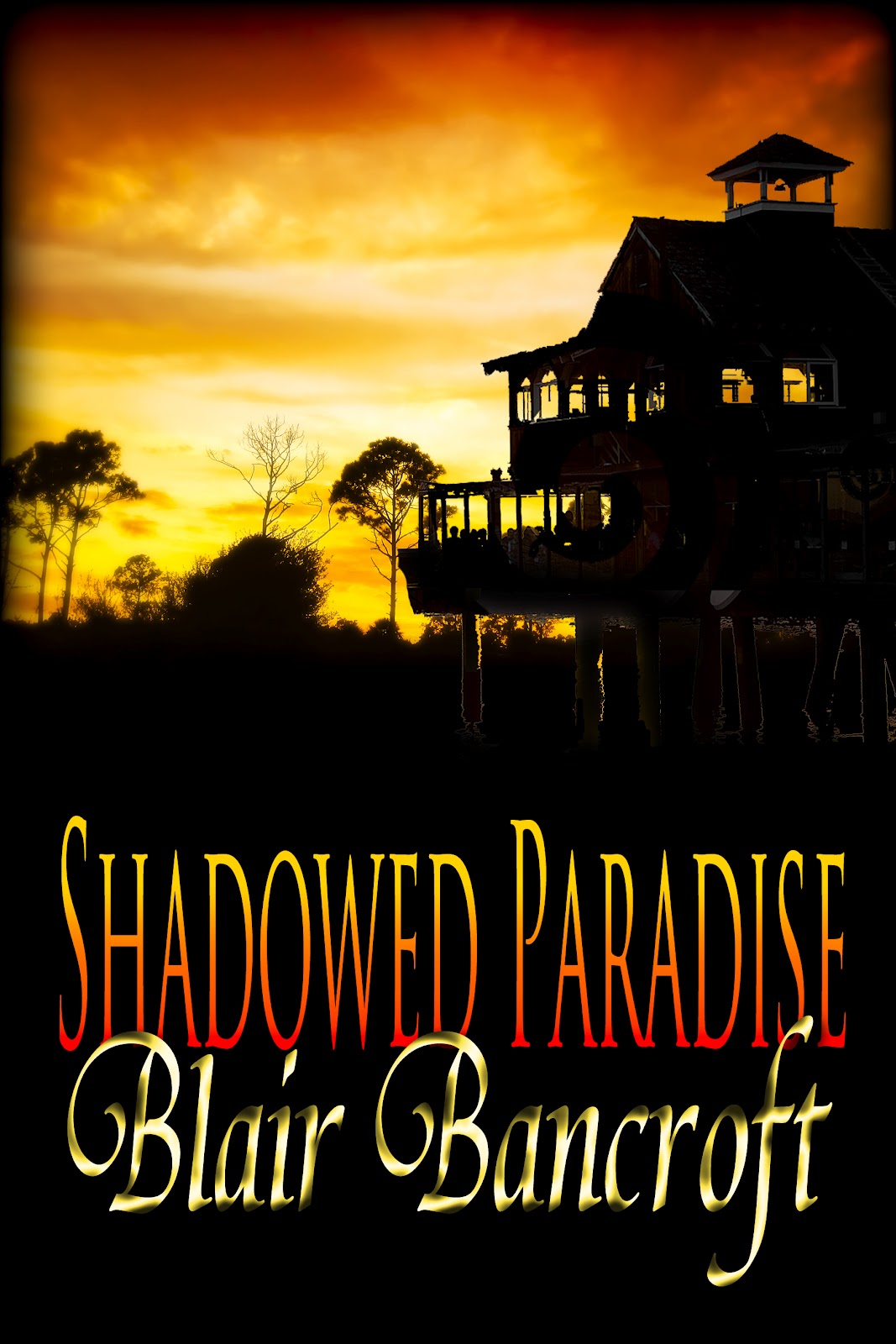
Shadowed Paradise. A subtle Russian connection through a hero whose father defected by jumping ship in the Cuban straits. Brad Blue speaks idiomatic Russian and was likely a spy before he zigged when he should have zagged. He’s now building a multi-million dollar development of “Key West” homes in the Gulf Coast resort and retirement community of Golden Beach, Florida.

Paradise Burning. Brad Blue gets to use his Russian background to assist an estranged husband and wife who are researching a book on international trafficking in women and children, only to discover that the Russian mafia has set up a brothel almost within their own backyard.

Orange Blossoms & Mayhem. Laine Halliday, a troubleshooter for her family who own an exotic wedding and vacation business in Golden Beach, encounters a good deal more trouble than usual when a Russian mafioso wants his bride to step out of nesting Fabergé eggs! In a tale that ranges from Peru to Interpol headquarters in Lyon, France, Laine scrambles to keep one step ahead of gangsters and save a Russian bride. Not to mention a Brit Interpol agent.

Limbo Man. The strongest Russian connection of all. The amnesiac hero doesn’t know if he’s a good guy or a bad guy, Russian or American. He’s told he’s a Russian arms dealer, but that doesn’t feel right. What he does like is his “minder,” a female FBI agent on loan to Homeland Security. As his memory begins to creep back, they race to save the U.S. from the detonation of two antique Russian nukes.
Note: Only Limbo Man is not anchored by the not-so-imaginary town of Golden Beach, Florida. The settings for Limbo Man range from the U.S. to Siberia and Iran and back again.
~ * ~
Thanks for stopping by.
Grace
Coming soon: "Way Down Upon the Suwanee River . . ." or "There's Such a Thing as Too Far Away."
Or "A Visit to Spider, Snake & Rodentville, Not Far South of the Okeefenokee."


