
Blair Bancroft's Blog, page 60
September 14, 2012
FLORIDA KNIGHT

Florida Knight went live this week on Kindle & Smashwords (with Barnes & Noble, Sony, et al coming soon). This "modern medieval" didn't need any outside research. I lived it all. Well, not the heroine's abuse, thank God, but I've lived the Medieval life in Central Florida and believe I've reproduced it pretty accurately as the background for Florida Knight. I was a long-time volunteer for the Medieval Fair held annually on the John & Mable Ringling Museum complex in Sarasota and also a long-time member of the Medieval re-enactment group, the Society for Creative Anchronism, which is very active in Florida. All the outside help I needed to write this book came from Charles Abbott, FHP retired, to whom I am very grateful. Any mistakes are mine. For blurb, please see below. (And please note the play on words in Delle Jacob's cover.)
When Michael Turco's brother is injured in a tournament at a Medieval Fair, the Florida Highway Patrol lieutenant suspects it wasn't an accident and begins his own personal investigation. Which causes him considerable anguish when he has to enlist the aid of Kate Knight, who is his entree into the Lord and Ladies of Chivalry (LALOC), a Medieval re-enactment group. Kate, who has been fighting her way out of abuse for years, is equally appalled. Michael will pose as her boyfriend, and she, who has been celibate for years, will be forced to share a postage-stamp-size tent with him nearly every weekend until the mystery of a series of disasters at Medieval Fairs and LALOC events is solved.
Michael has his own problems, finding the adjustment to LALOC's Medieval lifestyle, including costumes he can't believe he's wearing - and bowing to a chair? - a severe trial. He must also cope with a multitude of quirky personalities among Medieval enthusiasts who take themselves very seriously indeed. Plus a rash of new, ever more serious "accidents." And then there's Kate, who seems to be mellowing until she gets a good look at him in full FHP uniform.
~ * ~
"Lords and Ladies! Prepare thyself for an enchanting tale of mystery and romance!" Heather Eileen, Romance Junkies
For Florida Knight at Amazon, click here
For Florida Knight on Smashwords, click here
And don't forget Smashwords offers a 20% free read of all my books.
~ * ~
Grace's Russian connection - next blog, I promise.
Thanks for stopping by.
Grace


September 9, 2012
WHAT GRACE READS
What Grace Reads - Before & After Kindle
Twenty months ago I bought a vanilla model Kindle - and just in the nick of time as my book shelves were full. I’ve been sold on e-readers for years - the Kindle was my third - but I have to give the Kindle credit for exploding the concept onto the psyche of the general public. (We are forever indebted to Gene Roddenberry, the genius behind Star Trek, for coming up with the idea in the first place and inspiring an entire generation of young tech designers to bring his TV creation to life.)
While looking over the list of books I’ve read on Kindle - must be close to 300 - I decided to take a good look at my bookcases full of hardcovers and paperbacks. Why were these the books I brought with me when I moved to Orlando? And what authors have I kept on Kindle to remind me to keep an eye out for their latest books? So for the fun of it, I made a list, figuring it would tell me something about myself and just might be of interest to others.
I hope you find some unknown treasures among them.
Note: What you will not see below is a list of current historical romance or romantic suspense authors. Most of them are my colleagues, and I wouldn’t think of naming one over the other!
Traditional Regencies
Georgette Heyer. I sacrificed her mysteries when I moved five years ago, but I believe I have all her Regencies, which instilled in me a lifelong love of the Regency period. I have read them all at least three times.
Clare Darcy. Although not as numerous as Heyer’s, her Regencies are delightful, except, if I recall correctly, for Eugenia whom I wanted to slap upside the head for being such an idiot.
I also have a large collection of Regencies by Joan Smith and Joan Wolf (who, I believe, are no longer writing in this genre, though their backlist can be found online). Smith’s are more humorous, all are excellent.
Historical.
Dorothy Dunnett. Her two lengthy historical series are works of art - The Lymond Chronicles and The House of Nicollò. When you read them, the details are so perfect you’d swear she time-traveled to those eras. (Or was, perhaps, re-incarnated from that time.) Stunning and indescribable, although I have to admit I have never found the time to give all twelve 600-page books a second read.
Mysteries.
Dorothy Dunnett - again.. Her Johnson Johnson mysteries are unsurpassed. (Her loss to cancer was a true loss to literature.)
Janet Evanovich. Her Stephanie Plum series (but not the spin-offs which are too farcical for my taste). And, yes, I’m a Ranger fan.
J. D. Robb. Her Dallas & Rourke series.
Kate Ross. Her four Julian Kestrel novels, particularly the last, are outstanding. (Another author lost far too young.)
Rhys Bowen. All her series, but the Royal Spyness series is bucking to become my favorite.
Blaize Clement. Her pet-sitter series (set in Sarasota County, which I know so well).
C. S. Harris. Her Sebastian St. Cyr series.
Victoria Laurie. Her psychic mystery series (although I'm partial to the early ones, set in my old stomping grounds of New Haven and the Connecticut shoreline).
James Lee Burke. His Dave Robicheaux Louisiana series.
Randy Wayne White. His Doc Ford novels, mostly set in Florida
Romantic Suspense.
Mary Stewart. Everything she wrote, although The Ivy Tree remains my all-time favorite. I must have read it at least four times.
Madeline Brent. Moonraker’s Bride. Another book I take out and savor with regularity. Very humorous for a book containing high drama.
Maud Lang. Summer Station. This Australian-set book blew me away. Another book with both humor and drama.
As for authors currently writing Romantic Suspense, again, I have to plead the Fifth. But must give a special mention to Jane Ann Krentz, who writes Romantic Suspense, Historical Romance as Amanda Quick, and Sci Fi as Jayne Castle, all genres I particularly enjoy. (And write myself.)
Sci Fi/Futuristic.
There are three authors I turn to when my spirits need a boost. Two of them are Jayne Castle and Linnea Sinclair. Jayne’s books are closer to Futuristic, while Linnea always provides enough scientific details to qualify as Sci Fi. But both write romance set against imaginative worlds and do it exceedingly well. (They inspired my Blue Moon series, which has yet to see the light of day.)
Action/Adventure.
Jack Higgins. All his mainstream books, and I confess to having read nearly every one of his earlier “men’s fiction” tales from long, long ago.
Taylor Stevens. The Vanesssa Michael Munroe series, beginning with The Informationist. (The Innocent just came out and I haven’t read it yet.) Highly dramatic mainstream action/adventure.
The Unclassifiable.
Gail Carriger. I generally won’t touch a vampire or werewolf story with a ten-foot pole, but in Carriger’s Souless series she writes a mix of Victorian/Vampire/Werewolf/Steampunk that is indescribable, dramatic, and often hilarious - although the heroine’s antics while pregnant were enough to make me go, “Aw, come on!”
Naomi Novik. Her dragon series, set during an alternative rendition of the Napoleonic wars, is impossible to classify as it is so far beyond what we normally think of as Fantasy. She writes dramatic and heart-wrenching tales about talking dragons and English heros who don’t always come to a happy ending.
Category.
The third author I turn to when my spirits are down is the Australian Lucy Walker, who wrote simple little romances about people living in the Outback. You could call them Australian cowboy tales, all with wonderfully innocent heroines and stalwart outback men. And, yes, I have a shelf full of them and still go back occasionally to visit a world that existed fifty or sixty years ago.
~ * ~
Well . . . if I don’t count all the current Historical Romance and Romantic Suspense authors I didn’t name (so I wouldn’t get my head combed with a joint stool, as the old expression goes), it appears I like Regencies, mysteries, and books by people who can really write up a storm. These are the authors who have filled my soul with wonder and kept me going through thick and thin. These books have brought me enormous hours of pleasure and will continue to do so for as long as I can lift a book or hold an e-reader. And thanks to modern technology, the older books mentioned above are still available. Try one or two . . . or more. Enjoy!
Thanks for stopping by.
Coming next: Grace's Russian Connection - and how I've used it in my books

September 2, 2012
TARLETON'S WIFE - in PRINT
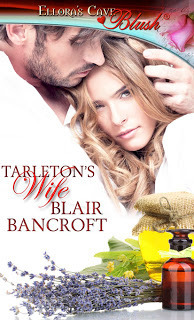
I received my copies of the new print version of Tarleton's Wife this week, and of course that had to take precedence over other promised blogs. Not only do I really like the depiction of Major Tarleton and his wife, but herbs play an important role in the story, and I was delighted to see them included on the cover.
A bit of background: Tarleton's Wife is my first published book. It came out as an e-book & CD in 1999 and in print in 2000. It has been with Ellora's Cave Blush for several years now, and frankly the new print version came as a surprise. Tarleton's Wife is my second favorite book, right after The Sometime Bride, so I am particularly pleased to see it done up in such an attractive version. Here's the new cover. Please tell me what you think.
Julia Litchfield, who has followed the drum all her life, is statuesque, independent, courageous, closer to handsome than pretty. Not at all the petite, sweet type her father’s aide-de-camp Major Nicholas Tarletonprefers. But on his deathbed in Spain, the major marries Julia so she will have a roof over her head when she returns to England.
Eighteen months later, when Julia has established an herbal business to aid the major’s tenants and is contemplating a new life with an old friend of his, Nicholas Tarleton returns home—with a Spanish fiancée at his side. And no recollection of his marriage to Julia. In the dramatic weeks that follow Julia nearly loses both men in her life before the final resolution of a conflict of love and honor that might have challenged Solomon himself.
~ * ~
Note: Cross-over characters from both Tarleton's Wife and The Sometime Bride can be found in O'Rourke's Heiress, and my next full-length Regency Historical (not yet begun) will finally provide a spouse for the gentleman who keeps getting left out.
Links to Ellora's Cave, Kindle & Nook can be found on my website: Blair Bancroft
Thanks for stopping by.
Grace

A bit of background: Tarleton's Wife is my first published book. It came out as an e-book & CD in 1999 and in print in 2000. It has been with Ellora's Cave Blush for several years now, and frankly the new print version came as a surprise. Tarleton's Wife is my second favorite book, right after The Sometime Bride, so I am particularly pleased to see it done up in such an attractive version. Here's the new cover. Please tell me what you think.

Julia Litchfield, who has followed the drum all her life, is statuesque, independent, courageous, closer to handsome than pretty. Not at all the petite, sweet type her father’s aide-de-camp Major Nicholas Tarletonprefers. But on his deathbed in Spain, the major marries Julia so she will have a roof over her head when she returns to England.
Eighteen months later, when Julia has established an herbal business to aid the major’s tenants and is contemplating a new life with an old friend of his, Nicholas Tarleton returns home—with a Spanish fiancée at his side. And no recollection of his marriage to Julia. In the dramatic weeks that follow Julia nearly loses both men in her life before the final resolution of a conflict of love and honor that might have challenged Solomon himself.
~ * ~
Note: Cross-over characters from both Tarleton's Wife and The Sometime Bride can be found in O'Rourke's Heiress, and my next full-length Regency Historical (not yet begun) will finally provide a spouse for the gentleman who keeps getting left out.
Links to Ellora's Cave, Kindle & Nook can be found on my website: Blair Bancroft
Thanks for stopping by.
Grace
August 26, 2012
INDEX TO WRITING BLOGS
I am very pleased by the Stats that tell me a lot of people have taken the time to read my blogs on Writing and Editing. (Thank you for that!) So before taking a break with more frivolous topics, it occurred to me I should make an index to all the writing-related articles I've posted since I first blogged in January 2011 about a nightmare journey home from a Christmas program with my grandchildren.
So here it is. Hopefully, this will make it easier to find the topics of your choice.
INDEX
to Grace's Writing & Editing Blogs
2011:
The Writing 101 series
1. Formatting a Manuscript - May 9, 2011
2. Nuts & Bolts, Part 1(grammar, punctuation) - May 16, 2011
3. Tab conversion (from manual to auto) - June 5, 2011
4. Nuts & Bolts, Part 2 - June 16, 2011
5. I Ran Spell Check, I'm Done, Right? (self-editing) - July 5, 2011
6. The Final Steps (self-editing) - July 14, 2011
2012:
EDIT THE BLASTED BOOK series
1. Intro to Self-editing - April 1, 2012
2. Should you hire help? - April 28, 2012
3. Manuscript Format for the 21st Century - May 6, 2012
4. Writing No-No's - May 28, 2012
5. Point of View - June 18, 2012
6. Anatomy of an Edit, Part 1 - August 5, 2012
7. Anatomy of an Edit, Part 2 - August 19, 2012
Miscellaneous:
1. Guideposts for Critiquing - January 28, 2011
2. Writing Mistakes, Near Misses & Just Plain Strange - March 4, 2011
3. Shortcuts for Writers (ASCII codes) - March 18, 2011
4. Rules for Romance - September 18, 2011
5. More Rules for Romance - October 16, 2011
Grace's Archives.
The Archive menu to the right of the screen should allow you to find the articles you want. And I'd very much appreciate hearing which topics you found most helpful. Questions are also welcome. Blair Bancroft
Next week: the topic originally promised for today - Grace's favorite reads
Thanks for stopping by.
Grace (who writes as Blair Bancroft)
For Blair's website, click here.

So here it is. Hopefully, this will make it easier to find the topics of your choice.
INDEX
to Grace's Writing & Editing Blogs
2011:
The Writing 101 series
1. Formatting a Manuscript - May 9, 2011
2. Nuts & Bolts, Part 1(grammar, punctuation) - May 16, 2011
3. Tab conversion (from manual to auto) - June 5, 2011
4. Nuts & Bolts, Part 2 - June 16, 2011
5. I Ran Spell Check, I'm Done, Right? (self-editing) - July 5, 2011
6. The Final Steps (self-editing) - July 14, 2011
2012:
EDIT THE BLASTED BOOK series
1. Intro to Self-editing - April 1, 2012
2. Should you hire help? - April 28, 2012
3. Manuscript Format for the 21st Century - May 6, 2012
4. Writing No-No's - May 28, 2012
5. Point of View - June 18, 2012
6. Anatomy of an Edit, Part 1 - August 5, 2012
7. Anatomy of an Edit, Part 2 - August 19, 2012
Miscellaneous:
1. Guideposts for Critiquing - January 28, 2011
2. Writing Mistakes, Near Misses & Just Plain Strange - March 4, 2011
3. Shortcuts for Writers (ASCII codes) - March 18, 2011
4. Rules for Romance - September 18, 2011
5. More Rules for Romance - October 16, 2011
Grace's Archives.
The Archive menu to the right of the screen should allow you to find the articles you want. And I'd very much appreciate hearing which topics you found most helpful. Questions are also welcome. Blair Bancroft
Next week: the topic originally promised for today - Grace's favorite reads
Thanks for stopping by.
Grace (who writes as Blair Bancroft)
For Blair's website, click here.
August 19, 2012
EDIT THE BLASTED BOOK, Part 6B
WELCOME! to the final post in the EDIT THE BLASTED BOOK Series. I hope you've found it helpful. As always, suggestions, additions, and complaints are welcome. Use Comments below or e-mail: Blair Bancroft
Please note this is a continuation of my last blog and not intended to be read without reading Part 6(A) first.
II. At the End of Every 5 Chapters
Repeat all the steps in Section I. [STOP SCREAMING! - This is real editing, not giving your book what my mother called “a lick and a promise.”]
This time, pay particular attention to:
1. Has the story really moved forward - a lot - in these five chapters?
2. Do you need to add (or delete) certain things now that you know your characters better?
3. Is the story moving in the direction you planned? If you’ve strayed, should you get back on track, or is the new version better? Adjust all details accordingly.
4. If you’ve done your due diligence, you should now have five reasonably coherent chapters with a story line that is beginning to make sense.
5. Repeat the above process for each 5-chapter segment.
III. At the End of the Last Chapter.
Go back to Chapter 1 and repeat all steps in Section I for the entire book.
Pay attention to absolutely everything from typos to clarity to continuity. Did the hero have dark hair in Chapter 1 and become a blond by Chapter 6? Do your sex scenes tend toward heaving bosoms, laving tongues, and more parts insertion than can be found in a hardware manual? If so, please add genuine emotion and toe-curling sexual tension. And once again, are your h/h likable? Will your readers want to root for them?
If you make a great many changes on this editing run-through, you may have to go on to IV.
IV. Re-edit from the Top.
I try to avoid this one if I can, but it’s happened. The most important thing to remember is: Nora Roberts may get it right the first time. 99.99% of the rest of us don’t. Writing is WORK. It’s a job. If you want to get paid, you have to treat it with the serious respect it deserves. Spend the time necessary to take your words from vanilla to Rocky Road, from Ho-hum to Oh Wow!
New apochryphal tale: You’re going to invite your boss (editor/publisher) for dinner. Are you going to wear sweat pants and feed her/him a fast-food hamburger on a paper plate? Are you going to offer a pie you dropped on the kitchen floor and is now flecked with yucky uglies? Or are you going to dress professionally, spend the time necessary to set a beautiful table, cook a good, maybe great, meal, which you eat while indulging in intelligent conversation before presenting a sparkling, spotless Key Lime Pie for dessert?
A no-brainer, right? Except for all the careless contest entries I’ve seen, I wouldn’t believe it possible anyone would settle for the yucky uglies. But it happens. Moral of this story: don’t let it happen to you. If you want to be successful, don’t shirk the work!
~ * ~
Grace Note: Don’t hesitate to ask questions about any of the sections of EDIT THE BLASTED BOOK. For more on the basic Nuts & Bolts of writing, please see the Writing 101 series in the 2011 Archives of Grace’s Mosaic Moments. And if all else fails, I offer a professional editing, copy editing, and critique service as Best Foot Forward. For a brochure, e-mail editsbyBFF@aol.com.
~ * ~
A list of my currently available books can be found on my website, www.blairbancroft.com. I believe there are 20 or more now, with a couple lingering from the days before indie publishing. Also, a brand new print version of Tarleton's Wife (not yet on my website) is just out and can be found at Ellora's Cave - Blush, Amazon, and Barnes and Noble.
Coming next: What Grace reads for the fun of it
Thanks for stopping by.
Grace

Please note this is a continuation of my last blog and not intended to be read without reading Part 6(A) first.
II. At the End of Every 5 Chapters
Repeat all the steps in Section I. [STOP SCREAMING! - This is real editing, not giving your book what my mother called “a lick and a promise.”]
This time, pay particular attention to:
1. Has the story really moved forward - a lot - in these five chapters?
2. Do you need to add (or delete) certain things now that you know your characters better?
3. Is the story moving in the direction you planned? If you’ve strayed, should you get back on track, or is the new version better? Adjust all details accordingly.
4. If you’ve done your due diligence, you should now have five reasonably coherent chapters with a story line that is beginning to make sense.
5. Repeat the above process for each 5-chapter segment.
III. At the End of the Last Chapter.
Go back to Chapter 1 and repeat all steps in Section I for the entire book.
Pay attention to absolutely everything from typos to clarity to continuity. Did the hero have dark hair in Chapter 1 and become a blond by Chapter 6? Do your sex scenes tend toward heaving bosoms, laving tongues, and more parts insertion than can be found in a hardware manual? If so, please add genuine emotion and toe-curling sexual tension. And once again, are your h/h likable? Will your readers want to root for them?
If you make a great many changes on this editing run-through, you may have to go on to IV.
IV. Re-edit from the Top.
I try to avoid this one if I can, but it’s happened. The most important thing to remember is: Nora Roberts may get it right the first time. 99.99% of the rest of us don’t. Writing is WORK. It’s a job. If you want to get paid, you have to treat it with the serious respect it deserves. Spend the time necessary to take your words from vanilla to Rocky Road, from Ho-hum to Oh Wow!
New apochryphal tale: You’re going to invite your boss (editor/publisher) for dinner. Are you going to wear sweat pants and feed her/him a fast-food hamburger on a paper plate? Are you going to offer a pie you dropped on the kitchen floor and is now flecked with yucky uglies? Or are you going to dress professionally, spend the time necessary to set a beautiful table, cook a good, maybe great, meal, which you eat while indulging in intelligent conversation before presenting a sparkling, spotless Key Lime Pie for dessert?
A no-brainer, right? Except for all the careless contest entries I’ve seen, I wouldn’t believe it possible anyone would settle for the yucky uglies. But it happens. Moral of this story: don’t let it happen to you. If you want to be successful, don’t shirk the work!
~ * ~
Grace Note: Don’t hesitate to ask questions about any of the sections of EDIT THE BLASTED BOOK. For more on the basic Nuts & Bolts of writing, please see the Writing 101 series in the 2011 Archives of Grace’s Mosaic Moments. And if all else fails, I offer a professional editing, copy editing, and critique service as Best Foot Forward. For a brochure, e-mail editsbyBFF@aol.com.
~ * ~
A list of my currently available books can be found on my website, www.blairbancroft.com. I believe there are 20 or more now, with a couple lingering from the days before indie publishing. Also, a brand new print version of Tarleton's Wife (not yet on my website) is just out and can be found at Ellora's Cave - Blush, Amazon, and Barnes and Noble.
Coming next: What Grace reads for the fun of it
Thanks for stopping by.
Grace
August 5, 2012
EDIT THE BLASTED BOOK, Part 6
ANATOMY OF AN EDIT, Part 1
In the last two sections of “Edit the Blasted Book,” there will be some repetition. My father, a Superintendent of Schools, always said it took three repetitions for an idea to sink in, so forgive me if I’ve emphasized some of these points before.
Note 1: Because of the length of this blog, I have left out examples. Please feel free to use Comments or e-mail ( blairbancroft@aol.com ) to ask questions about anything you don’t understand (or want to tell me I got wrong!)
Note 2: The "Anatomy of an Edit" below is based on the way I write and edit. I certainly don’t claim it’s the only way, but it’s worked for me through more than a quarter century of writing (since word processing came along), and I hope my process will give you some idea of just how much time (beyond the initial input) must be devoted to your work before it will be ready for publication. As a long-time contest judge, all too often I see entries where the author appears to have dashed off the work, done no editing, no proofreading, and just sent it off, evidently assuming his/her first draft was perfect.
Wrong! Writing is WORK. You may be able to do it in your PJs/caftan/sweat suit and slippers, but it’s still a job. A hard, demanding job, requiring hours of work beyond the simple act of typing words onto a screen. Below, see my personal “Anatomy of an Edit.”
I - THE FIRST TIME AROUND
A. The “Nuts & Bolts” of Editing
1. Edit at the end of every chapter. (If you just keep going and going and going, you are going to face such a massive editing job you’ll end up being overwhelmed and careless in your edits. You will be in danger of leaving out entire characters and/or situations that might have been born if you had edited chapter by chapter, allowing your book to gradually expand into sub-plots, more complex characters, more color, etc.)
Being of the old school, I prefer to do my editing on hardcopy. Seeing the words on paper seems to inspire me to more creative additions. But if you feel you can edit well on screen, that’s fine. (You might, however, try editing hardcopy just to see if the editing process works better for you that way.)
Special note: check your Header. I recently received a contest entry with a typo in the header, which was repeated, of course, on every page!
2. Run Spell Check on the entire chapter. (Option: since I print hardcopy at the end of every scene, I run Spell Check scene by scene.)
3. Itemized Nuts & Bolts. As you read over your chapter, your mind may boggle over all the things you need to look for. I promise you, it becomes easier with experience. Here’s a list - and I’m sure many more items could be added. Look for:
a. Typos not caught by Spell Check, plus missing or “extra” words.
b. Errors in grammar or punctuation. We all make them in the heat of the moment, but make an effort to straighten these out as you go along. Dangling participles can be particularly tricky.
c. Use italics, not underlines. Underlines are pre-word processing. (Unless you insist on using Courier - a 19th c. font! in which case underlines are necessary as italics don’t show up well.)
d. Watch out for awkward sentences. (It made perfect sense when you wrote it, but re-reading shows it is confused, convoluted, or maybe downright weird.)
e. Lack of color. Did you write a “vanilla” sentence, barely more than an outline of what you were thinking? Do you need more colorful adjectives, more dramatic verbs? Did you toss off a Big Moment with just a sentence or two, instead of giving it the detailed drama it deserved?
f. Little Fixits. Perhaps your sentence needs only one new word, perhaps an exchange of phrases (a swift “reverse”), or the removal of an extraneous “and” or “that” to read more smoothly.
g. Did you obscure your point in too many words? Can you find a way to say the same thing more clearly and dramatically, using less words, less repetition?
h. Did you write “bare bones,” little more than an outline of what you had in your head? Do you need to expand a sentence, a paragraph, a scene, to make it more clear, give it impact, paint a more colorful portrait?
i. At the end of each scene, particularly at the end of each chapter, has your story moved forward? Or did you get caught up in cute social chitchat or a long description that took the story nowhere?
j. Did you put a Hard Page End at the end of your chapter? I find it difficult to believe how many people are still “carriage-returning” (Entering) to get to the next page. Which does not allow for any insertions or deletions without moving the title of the next chapter all over the page. Basic manuscript rules: Always use a Hard Page End. Always begin a new chapter on a new page. [Hard Page End: Use Insert - Break or, easier, Control + Enter.]
Repeat of an Apocryphal Tale: If an editor has two books of similar quality - good story, good writing, appealing characters - but one is almost perfectly presented (good spelling, grammar & punctuation, well-researched facts) and the other is going to require many hours of work by both an editor and a copy editor, as well as the publisher’s money to pay for their time, which book do you think the editor is going to choose?
B. Editing in Depth - the Harder Stuff
1. Opening. Does your opening grab the reader and hang on for dear life? Did you spend time crafting your first sentence until it was a real zinger? Are your opening pages attention-grabbing without failing to give us an idea of who the characters are?
2. Setting. Have you painted a good backdrop for your story? Have you let your readers know whether you are in the country, city, house, condo, US, Europe, etc.? Have you made clear the approximate date? (A Location and Date line above the body copy can do wonders here.) Have you written enough description so your characters aren’t talking heads, speaking against a blank canvas? However you handle Setting, don’t leave your readers in the dark.
3. Characters. Readers want to love the hero and heroine, empathize with them, root for them. If your h/h have negative characteristics, then you must find a way to justify them, explain. Because without likable main characters - or the surety of their redemption - you have nothing. Readers also expect clear identifications and physical descriptions. These descriptions also apply to all but the least important secondary characters as soon as they are introduced. (All too often I see contest entries where the author described setting, characters, and plot in the synopsis and failed to put this information in the manuscript. Please keep in mind that readers never see the synopsis. Everything you want the reader to know must be in the pages of the manuscript.)
Take one more look: Did you give the heroine 90% of the Point of View and leave the Hero's thoughts a mystery (Or vice versa)?
4. Conflict. Does your story have internal and external conflict for both hero and heroine? In other words, do they have personal conflict from past or present events, and at the same time, do they have outside forces giving them a hard time? The outside force can be something they are facing together (as in most romantic suspense plots), or it can be a separate outside problem each must face.
5. Dialogue. Did you go all lopsided on Dialogue because it’s easier to write? None of that pesky introspection or having to describe a setting or an action scene or something as simple as the hero mounting his horse? If so, no matter how clever or cute your dialogue, you don’t have a classic romance, because Romance requires the hero and heroine to “agonize” over their problems. They have to have doubts, black moments, etc. This doesn’t work too well in just dialogue. If you try it, it usually sounds contrived. Angst, agonizing, great joy, and love scenes work far better in Narration.
6. Narration. As in Dialogue, don’t overdo it. Pages and pages of narration without dialogue can become deadly. Readers expect a pretty even balance between Dialogue & Narration. Also: stick to third person for introspection, leaving first person italic insertions for emphasis. (Unless, of course, you’re writing the whole book in first person!) Whatever you do, do not have your characters talk to themselves - this is a red flag of amateur writing. Express your characters’ thoughts as third person introspection.
7. Plot. Is your plot adequate for whatever length book you are writing? I.e., if you’re writing a novella, you probably won’t have any sub-plot(s). You’ll also have less secondary characters. But if you’re writing a full-length novel, you will need something more than boy meets girl, they fall in love, they break up, they reconcile & live HEA. Does your plot have enough “meat” to fill out a 75,000-100,000 word book without adding meaningless padding? If not, you need to add some additional colorful (comedic, dramatic, villanious, etc.) characters and sub-plot.
Take one more look: do your opening pages sound like a romance when you’re really writing a thriller? A comedy when it’s romantic suspense you had in mind? Be sure you provide clues right from the beginning so your readers won’t get a sudden nasty surprise, discovering this is a different book than they thought they spent their good money on.
8. Style. Have you put your sentences together with style? Arranged your sentences into intriguing paragraphs? Polished your paragraphs into a cohesive whole?
Have you given your hero and heroine clear points of view, sticking with the story through each pair of eyes for a reasonable length of time before making a switch? If you use more than two points of view, have you made the switches sterling clear, right there at the beginning of the switch and continuing in the new POV for a reasonable length of time? Never forget the rule: Thou Shalt Not Head-hop!
Does your style "Show" instead of "Tell"? Have you burrowed right inside the head of each Point of View character and made us see what they see, feel what they feel, hear what they hear? Or - oh horrors! - did you, as author, stand on the outside of the story and "tell" us what is happening. You might have thought you're an updated version of the ancient storyteller, but in today's romances, even more important than "Thou shalt not head-hop" is the rule: Show your story, don't tell it!
~ * ~
NO! This is absolutely, positively not the end.
Don’t you dare quit editing just because this is where today’s blog runs out!
NEXT BLOG - the final installment: EDIT THE BLASTED BOOK, Part 6 - Anatomy of an Edit, Part 2
Thanks for stopping by.
Grace
For a list of my available books as Blair Bancroft (and links to Kindle, Nook & Smashwords), please see my website, www.blairbancroft.com

In the last two sections of “Edit the Blasted Book,” there will be some repetition. My father, a Superintendent of Schools, always said it took three repetitions for an idea to sink in, so forgive me if I’ve emphasized some of these points before.
Note 1: Because of the length of this blog, I have left out examples. Please feel free to use Comments or e-mail ( blairbancroft@aol.com ) to ask questions about anything you don’t understand (or want to tell me I got wrong!)
Note 2: The "Anatomy of an Edit" below is based on the way I write and edit. I certainly don’t claim it’s the only way, but it’s worked for me through more than a quarter century of writing (since word processing came along), and I hope my process will give you some idea of just how much time (beyond the initial input) must be devoted to your work before it will be ready for publication. As a long-time contest judge, all too often I see entries where the author appears to have dashed off the work, done no editing, no proofreading, and just sent it off, evidently assuming his/her first draft was perfect.
Wrong! Writing is WORK. You may be able to do it in your PJs/caftan/sweat suit and slippers, but it’s still a job. A hard, demanding job, requiring hours of work beyond the simple act of typing words onto a screen. Below, see my personal “Anatomy of an Edit.”
I - THE FIRST TIME AROUND
A. The “Nuts & Bolts” of Editing
1. Edit at the end of every chapter. (If you just keep going and going and going, you are going to face such a massive editing job you’ll end up being overwhelmed and careless in your edits. You will be in danger of leaving out entire characters and/or situations that might have been born if you had edited chapter by chapter, allowing your book to gradually expand into sub-plots, more complex characters, more color, etc.)
Being of the old school, I prefer to do my editing on hardcopy. Seeing the words on paper seems to inspire me to more creative additions. But if you feel you can edit well on screen, that’s fine. (You might, however, try editing hardcopy just to see if the editing process works better for you that way.)
Special note: check your Header. I recently received a contest entry with a typo in the header, which was repeated, of course, on every page!
2. Run Spell Check on the entire chapter. (Option: since I print hardcopy at the end of every scene, I run Spell Check scene by scene.)
3. Itemized Nuts & Bolts. As you read over your chapter, your mind may boggle over all the things you need to look for. I promise you, it becomes easier with experience. Here’s a list - and I’m sure many more items could be added. Look for:
a. Typos not caught by Spell Check, plus missing or “extra” words.
b. Errors in grammar or punctuation. We all make them in the heat of the moment, but make an effort to straighten these out as you go along. Dangling participles can be particularly tricky.
c. Use italics, not underlines. Underlines are pre-word processing. (Unless you insist on using Courier - a 19th c. font! in which case underlines are necessary as italics don’t show up well.)
d. Watch out for awkward sentences. (It made perfect sense when you wrote it, but re-reading shows it is confused, convoluted, or maybe downright weird.)
e. Lack of color. Did you write a “vanilla” sentence, barely more than an outline of what you were thinking? Do you need more colorful adjectives, more dramatic verbs? Did you toss off a Big Moment with just a sentence or two, instead of giving it the detailed drama it deserved?
f. Little Fixits. Perhaps your sentence needs only one new word, perhaps an exchange of phrases (a swift “reverse”), or the removal of an extraneous “and” or “that” to read more smoothly.
g. Did you obscure your point in too many words? Can you find a way to say the same thing more clearly and dramatically, using less words, less repetition?
h. Did you write “bare bones,” little more than an outline of what you had in your head? Do you need to expand a sentence, a paragraph, a scene, to make it more clear, give it impact, paint a more colorful portrait?
i. At the end of each scene, particularly at the end of each chapter, has your story moved forward? Or did you get caught up in cute social chitchat or a long description that took the story nowhere?
j. Did you put a Hard Page End at the end of your chapter? I find it difficult to believe how many people are still “carriage-returning” (Entering) to get to the next page. Which does not allow for any insertions or deletions without moving the title of the next chapter all over the page. Basic manuscript rules: Always use a Hard Page End. Always begin a new chapter on a new page. [Hard Page End: Use Insert - Break or, easier, Control + Enter.]
Repeat of an Apocryphal Tale: If an editor has two books of similar quality - good story, good writing, appealing characters - but one is almost perfectly presented (good spelling, grammar & punctuation, well-researched facts) and the other is going to require many hours of work by both an editor and a copy editor, as well as the publisher’s money to pay for their time, which book do you think the editor is going to choose?
B. Editing in Depth - the Harder Stuff
1. Opening. Does your opening grab the reader and hang on for dear life? Did you spend time crafting your first sentence until it was a real zinger? Are your opening pages attention-grabbing without failing to give us an idea of who the characters are?
2. Setting. Have you painted a good backdrop for your story? Have you let your readers know whether you are in the country, city, house, condo, US, Europe, etc.? Have you made clear the approximate date? (A Location and Date line above the body copy can do wonders here.) Have you written enough description so your characters aren’t talking heads, speaking against a blank canvas? However you handle Setting, don’t leave your readers in the dark.
3. Characters. Readers want to love the hero and heroine, empathize with them, root for them. If your h/h have negative characteristics, then you must find a way to justify them, explain. Because without likable main characters - or the surety of their redemption - you have nothing. Readers also expect clear identifications and physical descriptions. These descriptions also apply to all but the least important secondary characters as soon as they are introduced. (All too often I see contest entries where the author described setting, characters, and plot in the synopsis and failed to put this information in the manuscript. Please keep in mind that readers never see the synopsis. Everything you want the reader to know must be in the pages of the manuscript.)
Take one more look: Did you give the heroine 90% of the Point of View and leave the Hero's thoughts a mystery (Or vice versa)?
4. Conflict. Does your story have internal and external conflict for both hero and heroine? In other words, do they have personal conflict from past or present events, and at the same time, do they have outside forces giving them a hard time? The outside force can be something they are facing together (as in most romantic suspense plots), or it can be a separate outside problem each must face.
5. Dialogue. Did you go all lopsided on Dialogue because it’s easier to write? None of that pesky introspection or having to describe a setting or an action scene or something as simple as the hero mounting his horse? If so, no matter how clever or cute your dialogue, you don’t have a classic romance, because Romance requires the hero and heroine to “agonize” over their problems. They have to have doubts, black moments, etc. This doesn’t work too well in just dialogue. If you try it, it usually sounds contrived. Angst, agonizing, great joy, and love scenes work far better in Narration.
6. Narration. As in Dialogue, don’t overdo it. Pages and pages of narration without dialogue can become deadly. Readers expect a pretty even balance between Dialogue & Narration. Also: stick to third person for introspection, leaving first person italic insertions for emphasis. (Unless, of course, you’re writing the whole book in first person!) Whatever you do, do not have your characters talk to themselves - this is a red flag of amateur writing. Express your characters’ thoughts as third person introspection.
7. Plot. Is your plot adequate for whatever length book you are writing? I.e., if you’re writing a novella, you probably won’t have any sub-plot(s). You’ll also have less secondary characters. But if you’re writing a full-length novel, you will need something more than boy meets girl, they fall in love, they break up, they reconcile & live HEA. Does your plot have enough “meat” to fill out a 75,000-100,000 word book without adding meaningless padding? If not, you need to add some additional colorful (comedic, dramatic, villanious, etc.) characters and sub-plot.
Take one more look: do your opening pages sound like a romance when you’re really writing a thriller? A comedy when it’s romantic suspense you had in mind? Be sure you provide clues right from the beginning so your readers won’t get a sudden nasty surprise, discovering this is a different book than they thought they spent their good money on.
8. Style. Have you put your sentences together with style? Arranged your sentences into intriguing paragraphs? Polished your paragraphs into a cohesive whole?
Have you given your hero and heroine clear points of view, sticking with the story through each pair of eyes for a reasonable length of time before making a switch? If you use more than two points of view, have you made the switches sterling clear, right there at the beginning of the switch and continuing in the new POV for a reasonable length of time? Never forget the rule: Thou Shalt Not Head-hop!
Does your style "Show" instead of "Tell"? Have you burrowed right inside the head of each Point of View character and made us see what they see, feel what they feel, hear what they hear? Or - oh horrors! - did you, as author, stand on the outside of the story and "tell" us what is happening. You might have thought you're an updated version of the ancient storyteller, but in today's romances, even more important than "Thou shalt not head-hop" is the rule: Show your story, don't tell it!
~ * ~
NO! This is absolutely, positively not the end.
Don’t you dare quit editing just because this is where today’s blog runs out!
NEXT BLOG - the final installment: EDIT THE BLASTED BOOK, Part 6 - Anatomy of an Edit, Part 2
Thanks for stopping by.
Grace
For a list of my available books as Blair Bancroft (and links to Kindle, Nook & Smashwords), please see my website, www.blairbancroft.com
July 16, 2012
Eight Days of Nostalgia

Before this shot, I didn't know it was possible to take a digital double exposure. When my son-in-law sent this to me, I could only gape and ask how he did it. His reply: "accident." This is my five-year-old granddaughter, Cassidy, steering a "duck" on the Charles River in Boston. Of all the youngsters on board, including two older sisters, she was the first to raise her hand when the captain asked for a volunteer! Although this photo was taken on the last day of our vacation, I felt it deserved "lead" position.
Why I took my daughter & family, plus son & significant other to Cape Cod for a week.
My father's first job out of Harvard Graduate School was principal of the high school in Wellfleet on Cape Cod. I was four. Nebraska born and raised, my father always said he took one look at the ocean and never went back. Even though a better-paying job took our family off the Cape the next year, we returned to visit every single summer until my parents finally retired to Orleans on the Cape. Since I was teaching music in Newton (near Boston) at the time, I visited them on a regular basis. Basically, Cape Cod has been a part of my life for more years than I care to admit to, and I really wanted to go back for another look.
Was it worth the effort?
Oh my, yes, and then some! We had a whale of a time.


Staring at us, I swear!

Bye-bye!
My daughter decided long before we left Orlando that she wanted to go "whale watching" on her birthday, so that's exactly what we did. (Photos are by my daughter & her husband.) I figured we'd churn around off Provincetown for 3 hours and be lucky to see one whale. We must have seen 30 or 40! A trip well worth taking.

Riley, Hailey & Cassidy On the dock on the way to the Dolphin IX for our whale excursion.
Sand dunes in Wellfleet, below: Two of my grandchildren plunging down the dunes at Cahoon's Hollow in Wellfleet (No photo by me as at the time I was trying to act as if I didn't know who those people were!) The responsible middle child, having been warned by me that dune-running was forbidden by the federal government (!) refused to join in the fun. But because I'd told them how I loved doing it when I was little (their Mommy too), there they go. And, yes, they were "shut down" shortly thereafter, though very gently, by a ranger.

Our home away from home in Orleans:
 4 bedrooms, 3 living areas, 2 flatscreen TVs, deck, porch swing, wind chimes, and every amenity you could think of from Baggies and Bandaids to an enclosed outdoor shower with hot & cold water + foot shower. Modern kitchen with huge pine table for 8, two fireplaces, ceiling fans, nautical-themed photos . . . I could go on and on. And one block from Skaket Beach, where you can walk a mile out into Cape Cod Bay at low tide. Below - just a small portion of the house's elaborate landscaping.

Cape Cod scrub - view from the house's deck - wind keeps the trees & shrubbery low
Rental house photos by Grace!
In 1979 my mother wrote a children's book for The Weekly Reader, entitled, The Ghost of Penniman House. So naturally we had to take her great- grandchildren there. Penniman House is marked by the jawbones of a great whale, which I remember seeing when I was little. (I assume it's from a whale Captain Penniman caught.) That's Cassidy again, so think 5-year-old size for comparison.


View from a hilltop just up the road from Penniman House.

Naturally, we had to stop in Plymouth on the way back to Boston, where the family toured the replica of the Mayflower (below).


Then on to Boston for this view of the skyline from our "duck."
I'm happy to report I took the above four photos myself!

We nearly got arrested waiting for my daughter to take this photo of the Constitution (Old Ironsides), with another "tall ship" behind it, at the Charlestown Naval Yard. (Evidently, she managed to get the camera lens through a hole in the chain-link fence.) The Constitution has just been refurbished for a 200th celebration of its victory in the War of 1812. It's the oldest still-commissioned vessel in the U. S. Navy.
And back to Cape Cod's Skaket Beach for the traditional sunset photo:

Thanks for sharing my Eight Days of Nostalgia.
Next blog: EDIT THE BLASTED BOOK, Part 6 - Anatomy of an Edit

June 18, 2012
EDIT THE BLASTED BOOK, Part 5
The Intricacies of Point of View
Note: if I ever put all my writing blogs into one book, Point of View should go under “Writing,” not “Editing.” After all, it’s a lot better to get it right the first time than have to go back and tear those chapters apart to get the POV straight. But my blog series, Writing 101, was created in 2011, so for the moment POV is going into EDIT THE BLASTED BOOK, Part 5.
OMNIPOTENT (AUTHOR) POINT OF VIEW:
Read the following passage carefully. I consider it the most brilliant example of Omnipotent Point of View I have seen in the Romance genre. That opinion is not simply my own. This passage was read from the stage on Awards Night at the RWA Convention in Chicago in 2000. Today, however, so-called POV purists would label this remarkable passage “Author Intrusion” and tell the author to find another way to present it. Aargh! See for yourself:
From Carnal Innocence by Nora Roberts, Bantam, 1992: Tucker Longstreet enjoyed women, perhaps not with the abandon his baby sister enjoyed men, but he’d had his share. He was known to tip back a glass, too—though not with the unquenchable thirst of his older brother. For Tucker, life was a long, lazy road. He didn’t mind walking it as long as he could do so at his own pace. He was affable about detours, providing he could negotiate back to his chosen destination. So far he’d avoided a trip to the altar—his siblings’ experiences having given him a mild distaste for it. He much preferred walking his road unencumbered. He was easygoing and well-liked by most. The fact that he’d been born rich might have stuck in a few craws, but he didn’t flaunt it much. And he had a boundless generosity that endeared him to people. A man knew if he needed a loan, he could call on old Tuck. The money would be there, without any of the sticky smugness that made it hard to take. Of course, there would always be some who muttered that it was easy for a man to lend money when he had more than enough. But that didn’t change the color of the bills.Unlike his father, Beau, Tucker didn’t compound the interest daily or lock in his desk drawer a little leather book filled with the names of the people who owed him. Who would keep owing him until they plowed themselves under instead of their fields. Tucker kept the interest to a reasonable ten percent. The names and figures were all inside his clever and often underestimated mind. In any case, he didn’t do it for the money. Tucker rarely did anything for money. He did it first because it was effortless, and second because inside his rangy and agreeably lazy body beat a generous and sometimes guilty heart. He’d done nothing to earn his good fortune, which made it the simplest thing in the world to squander it away. Tucker’s feelings on this ranged from yawning acceptance to an occasional tug of social conscience.Whenever the conscience tugged too hard, he would stretch himself out in the rope hammock in the shade of the spreading live oak, tip a hat down over his eyes, and sip a cold one until the discomfort passed. Which was exactly what he was doing when Della Duncan, the Long streets’ housekeeper of thirty-some years, stuck her round head out of a second floor window. “Tucker Longstreet!”
~ * ~
Obviously, in addition to an illustration of Omnipotent Point of View, this is one of the best introductory character descriptions in the history of novel writing. BUT, unless you’re a multi-published author with a devoted readership and a flexible editor and publisher, DON’T DO IT! Particularly if you’re writing Category (primarily Harlequin/Silhouette novels under 80,000 words).
HERO, HEROINE, VILLAIN.
The current thought seems to be that authors struggling to be published should stick to the Point of View of the Hero and the Heroine, with the POV of the villain allowed, if applicable. And, yes, I know a few successful first-time authors didn’t follow that rule, but do you want to be published or not? Do you want to insist on doing it “your way” and suffer being told time and time again that your POVs are flawed?
Many non-Category publishers will tolerate multiple POVs (usually up to 4 or 5), as long as the secondary POVs add to the story. But you have to be able to make the switches in a highly professional manner. Therefore, once again, newbies are advised to stick to Hero, Heroine, and Villain. And no matter how many POVs you choose, there is one cardinal rule:
Thou shalt not head-hop!
Keep in mind that some editors feel strongly that authors should write only one POV per scene. I personally don’t agree with this, as many readers prefer to see important scenes through the eyes of both main characters. But if you’re going to switch:
1. Make the switch apparent in the very first words of the first sentence of the paragraph.
2. Once you’ve made the switch, stick to that character’s POV until the end of the scene. Jumping from one head to the other, then back again is an absolute no-no. Even Nora Roberts, queen of slippery POVs, does it only on rare occasions.
SHOW VS. TELL
Which brings us to what is meant by Point of View. In ancient times Storytellers entertained people by reciting tales handed down by memory. They stood outside the story itself, telling their listeners what happened. Today’s novels, particularly romance novels, require that the Author get inside her main characters’ heads and show us the story through their eyes. Readers want to see what they see, hear what they hear, feel what they feel. DO NOT TELL. SHOW!
Which means, for example:
1. A hero or heroine cannot know the name of someone to whom he/she has never met.
2. A heroine can only speculate about what the hero is thinking. She can’t know unless he tells her. And vice versa.
3. A description, such as Nora Roberts’ description of Tucker Longstreet, has to be given by someone who knows him, not by the author. (Do I agree with this? No, but the attitude among editors, agents, and contest judges at the present moment is too prevalent to be ignored.)
4. Backstory has to be presented from the viewpoint of the Hero, Heroine, or Villain, not inserted through Author Omnipotence.
INTROSPECTION. Introspection is the term for presenting the hero’s and heroine’s Point of View through their thoughts. In almost all instances, this is done in third person. Save first-person (I) and second person (you) for significant exclamations and/or for emphasis. And when you use first- or second-person, put those words in italics.
Example 1 - Wrong:Mary drove down Main Street toward her old home. I don’t really want to see it, she thought. I’m just torturing myself.
Example 2 - a possibility, but not recommended:Mary drove down Main Street toward her old home. I don’t really want to see it, she thought. I’m just torturing myself.
Example 3 - a standard presentation of introspection:Mary drove down Main Street toward her old home. Seeing it would be torture, but she couldn’t stay away.
Notice the complete change in Example 3. Third-person also incorporates a more professional approach to presenting her thoughts. It’s always best to get right inside a character’s head and present his/her thoughts so seamlessly that no “he thought” or “she thought” is needed.
Additional Note: Even when you are deep inside your main character’s head, you need to toss in a name now and again; i.e., avoid a barrage of “she” or “he.” Readers like to identify with their heros and heroines. Identification becomes really tough when the character’s name is seldom mentioned!
And, remember - above all, THOU SHALT NOT HEAD-HOP!
~ * ~
I’m taking a brief vacation - more Mosaic Moments coming up in mid-July. Meanwhile, I’d be pleased if you checked out my nineteen books (as Blair Bancroft) on Kindle, Nook, Smashwords, et al. (Plus, there are still a few paperbacks out there on Amazon, I believe.) And don’t forget the 20% free reads available on Smashwords.
For edits, I can be contacted at: editsbyBFF@aol.com
Thanks for stopping by. Grace

Note: if I ever put all my writing blogs into one book, Point of View should go under “Writing,” not “Editing.” After all, it’s a lot better to get it right the first time than have to go back and tear those chapters apart to get the POV straight. But my blog series, Writing 101, was created in 2011, so for the moment POV is going into EDIT THE BLASTED BOOK, Part 5.
OMNIPOTENT (AUTHOR) POINT OF VIEW:
Read the following passage carefully. I consider it the most brilliant example of Omnipotent Point of View I have seen in the Romance genre. That opinion is not simply my own. This passage was read from the stage on Awards Night at the RWA Convention in Chicago in 2000. Today, however, so-called POV purists would label this remarkable passage “Author Intrusion” and tell the author to find another way to present it. Aargh! See for yourself:
From Carnal Innocence by Nora Roberts, Bantam, 1992: Tucker Longstreet enjoyed women, perhaps not with the abandon his baby sister enjoyed men, but he’d had his share. He was known to tip back a glass, too—though not with the unquenchable thirst of his older brother. For Tucker, life was a long, lazy road. He didn’t mind walking it as long as he could do so at his own pace. He was affable about detours, providing he could negotiate back to his chosen destination. So far he’d avoided a trip to the altar—his siblings’ experiences having given him a mild distaste for it. He much preferred walking his road unencumbered. He was easygoing and well-liked by most. The fact that he’d been born rich might have stuck in a few craws, but he didn’t flaunt it much. And he had a boundless generosity that endeared him to people. A man knew if he needed a loan, he could call on old Tuck. The money would be there, without any of the sticky smugness that made it hard to take. Of course, there would always be some who muttered that it was easy for a man to lend money when he had more than enough. But that didn’t change the color of the bills.Unlike his father, Beau, Tucker didn’t compound the interest daily or lock in his desk drawer a little leather book filled with the names of the people who owed him. Who would keep owing him until they plowed themselves under instead of their fields. Tucker kept the interest to a reasonable ten percent. The names and figures were all inside his clever and often underestimated mind. In any case, he didn’t do it for the money. Tucker rarely did anything for money. He did it first because it was effortless, and second because inside his rangy and agreeably lazy body beat a generous and sometimes guilty heart. He’d done nothing to earn his good fortune, which made it the simplest thing in the world to squander it away. Tucker’s feelings on this ranged from yawning acceptance to an occasional tug of social conscience.Whenever the conscience tugged too hard, he would stretch himself out in the rope hammock in the shade of the spreading live oak, tip a hat down over his eyes, and sip a cold one until the discomfort passed. Which was exactly what he was doing when Della Duncan, the Long streets’ housekeeper of thirty-some years, stuck her round head out of a second floor window. “Tucker Longstreet!”
~ * ~
Obviously, in addition to an illustration of Omnipotent Point of View, this is one of the best introductory character descriptions in the history of novel writing. BUT, unless you’re a multi-published author with a devoted readership and a flexible editor and publisher, DON’T DO IT! Particularly if you’re writing Category (primarily Harlequin/Silhouette novels under 80,000 words).
HERO, HEROINE, VILLAIN.
The current thought seems to be that authors struggling to be published should stick to the Point of View of the Hero and the Heroine, with the POV of the villain allowed, if applicable. And, yes, I know a few successful first-time authors didn’t follow that rule, but do you want to be published or not? Do you want to insist on doing it “your way” and suffer being told time and time again that your POVs are flawed?
Many non-Category publishers will tolerate multiple POVs (usually up to 4 or 5), as long as the secondary POVs add to the story. But you have to be able to make the switches in a highly professional manner. Therefore, once again, newbies are advised to stick to Hero, Heroine, and Villain. And no matter how many POVs you choose, there is one cardinal rule:
Thou shalt not head-hop!
Keep in mind that some editors feel strongly that authors should write only one POV per scene. I personally don’t agree with this, as many readers prefer to see important scenes through the eyes of both main characters. But if you’re going to switch:
1. Make the switch apparent in the very first words of the first sentence of the paragraph.
2. Once you’ve made the switch, stick to that character’s POV until the end of the scene. Jumping from one head to the other, then back again is an absolute no-no. Even Nora Roberts, queen of slippery POVs, does it only on rare occasions.
SHOW VS. TELL
Which brings us to what is meant by Point of View. In ancient times Storytellers entertained people by reciting tales handed down by memory. They stood outside the story itself, telling their listeners what happened. Today’s novels, particularly romance novels, require that the Author get inside her main characters’ heads and show us the story through their eyes. Readers want to see what they see, hear what they hear, feel what they feel. DO NOT TELL. SHOW!
Which means, for example:
1. A hero or heroine cannot know the name of someone to whom he/she has never met.
2. A heroine can only speculate about what the hero is thinking. She can’t know unless he tells her. And vice versa.
3. A description, such as Nora Roberts’ description of Tucker Longstreet, has to be given by someone who knows him, not by the author. (Do I agree with this? No, but the attitude among editors, agents, and contest judges at the present moment is too prevalent to be ignored.)
4. Backstory has to be presented from the viewpoint of the Hero, Heroine, or Villain, not inserted through Author Omnipotence.
INTROSPECTION. Introspection is the term for presenting the hero’s and heroine’s Point of View through their thoughts. In almost all instances, this is done in third person. Save first-person (I) and second person (you) for significant exclamations and/or for emphasis. And when you use first- or second-person, put those words in italics.
Example 1 - Wrong:Mary drove down Main Street toward her old home. I don’t really want to see it, she thought. I’m just torturing myself.
Example 2 - a possibility, but not recommended:Mary drove down Main Street toward her old home. I don’t really want to see it, she thought. I’m just torturing myself.
Example 3 - a standard presentation of introspection:Mary drove down Main Street toward her old home. Seeing it would be torture, but she couldn’t stay away.
Notice the complete change in Example 3. Third-person also incorporates a more professional approach to presenting her thoughts. It’s always best to get right inside a character’s head and present his/her thoughts so seamlessly that no “he thought” or “she thought” is needed.
Additional Note: Even when you are deep inside your main character’s head, you need to toss in a name now and again; i.e., avoid a barrage of “she” or “he.” Readers like to identify with their heros and heroines. Identification becomes really tough when the character’s name is seldom mentioned!
And, remember - above all, THOU SHALT NOT HEAD-HOP!
~ * ~
I’m taking a brief vacation - more Mosaic Moments coming up in mid-July. Meanwhile, I’d be pleased if you checked out my nineteen books (as Blair Bancroft) on Kindle, Nook, Smashwords, et al. (Plus, there are still a few paperbacks out there on Amazon, I believe.) And don’t forget the 20% free reads available on Smashwords.
For edits, I can be contacted at: editsbyBFF@aol.com
Thanks for stopping by. Grace
June 11, 2012
DEATH BY MARRIAGE
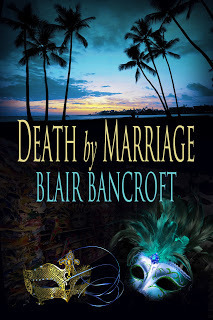
Death by Marriage is a not-quite-cozy mystery set in my favorite Florida Gulfcoast town of Golden Beach. I have a lot of personal involvement in this one, beyond being the author. I ran a business called DreamWeaver - Costumes & Creations for three years in the exact place in the exact town described in the book. The murders, I'm happy to say, are pure fiction.
A personal disaster in New York City sends promising clothing designer Gwyn Halliday fleeing home to the sleepy Gulfcoast resort and retirement community of Golden Beach, Florida, where she turns her talents to designing costumes. Five years later, her shop, DreamWear - Costumes and Creations, is a success, providing rental costumes to native Floridians, local retirees, and to the snowbirds and tourists who flock to the area each winter. Gwyn has come to terms with being an exotic blossom in a sea of seniors when one of her customers is killed (wearing DreamWear's best Santa suit), and she suspects the so-called "boating accident" was murder.
In rapid succession Gwyn meets the new Chief of Police (from landlocked Nebraska), runs into a former crush (now suffering from PTSD), and begins to suspect an elderly senior is being targeted by a series of scams (one possibly lethal). And then her brother becomes a suspect. Gwyn is well aware she should stick to costumes, but what's a girl to do when things get personal?
Author's Note: Golden Beach is an actual Florida Gulfcoast town, whose residents would prefer to keep its real name secret. Only a few of my Golden Beach books have cross-over characters, but all share the same idyllic setting. (Or at least it was before I made bad things happen there.) In addition to Death by Marriage, the Golden Beach books are: Shadowed Paradise, Paradise Burning, and Orange Blossoms & Mayhem. Coming in the summer of 2012: Florida Knight.
~ * ~
Thanks for stopping by.
Grace
Next - EDIT THE BLASTED BOOK: The Intricacies of Point of View


A personal disaster in New York City sends promising clothing designer Gwyn Halliday fleeing home to the sleepy Gulfcoast resort and retirement community of Golden Beach, Florida, where she turns her talents to designing costumes. Five years later, her shop, DreamWear - Costumes and Creations, is a success, providing rental costumes to native Floridians, local retirees, and to the snowbirds and tourists who flock to the area each winter. Gwyn has come to terms with being an exotic blossom in a sea of seniors when one of her customers is killed (wearing DreamWear's best Santa suit), and she suspects the so-called "boating accident" was murder.
In rapid succession Gwyn meets the new Chief of Police (from landlocked Nebraska), runs into a former crush (now suffering from PTSD), and begins to suspect an elderly senior is being targeted by a series of scams (one possibly lethal). And then her brother becomes a suspect. Gwyn is well aware she should stick to costumes, but what's a girl to do when things get personal?
Author's Note: Golden Beach is an actual Florida Gulfcoast town, whose residents would prefer to keep its real name secret. Only a few of my Golden Beach books have cross-over characters, but all share the same idyllic setting. (Or at least it was before I made bad things happen there.) In addition to Death by Marriage, the Golden Beach books are: Shadowed Paradise, Paradise Burning, and Orange Blossoms & Mayhem. Coming in the summer of 2012: Florida Knight.
~ * ~
Thanks for stopping by.
Grace
Next - EDIT THE BLASTED BOOK: The Intricacies of Point of View
June 4, 2012
BLATANT PROMO
When I began this blog in January 2011, I called it Grace's Mosaic Moments so I could feel free to blog about whatever struck my fancy. Well, this week I decided to go "commercial," blatantly advertising an Editing Special at Best Foot Forward and displaying a list of all my books that are currently available. (Blair Bancroft's books, not Grace's. Grace writes e-mails and blogs. She also edits. Blair writes novels.)
BEST FOOT FORWARD.
Best Foot Forward is Grace wearing her editor's hat. Qualifications: Twenty years as editor of an educational publishing company, twenty years editing my own work, fifteen years judging over 400 RWA contest entries, and eighteen months of working with authors as Best Foot Forward. I've been attempting to pass along what I've learned in my blog series, EDIT THE BLASTED BOOK (a work in progress). Also, please see the Archives for my 2011 blog series, WRITING 101.
Editing Special at BEST FOOT FORWARD.
All too often I see books at BFF which I wish I'd seen in those vital first chapters when they were just getting started - those first chapters that unpublished authors submit to contests, agents, and editors. Those all-important first chapters that make or break a book. Don't compound errors by going blindly forward, making the same mistakes over and over. Get help up front. Hopefully, your critique will be validation that you're on the right track. If not, you'll have a much better idea of what you're doing wrong and how to fix it. So . . .
Three chapters (calculated at 12,000 words and including BFF's volume discount and the RWA member discount) would come to c. $185.00. The current BFF Special, however, is:
Editing, copy editing, and critique of your FIRST THREE CHAPTERS - $100.00
For a brochure, contact editsbyBFF@aol.com
~ * ~Books by Blair Bancroft
Traditional Regencies Lady SilenceA Gamble on LoveA Season for LoveThe Temporary EarlThe Harem BrideThe Courtesan's LettersSteeplechaseMistletoe Moment
Regency HistoricalsTarleton's WifeThe Sometime BrideO'Rourke's Heiress
MedievalThe Captive Heiress
Suspense, Mystery, Romance (contemporary)Love At Your Own RiskShadowed ParadiseParadise BurningOrange Blossoms & MayhemLimbo ManAirborne - The Hanover Restoration
Coming SoonDeath by Marriage
For links to the books above, please see my website: www.blairbancroft.comOr go directly to Amazon Kindle, B&N Nook Books, or Smashwords.A 20% free read of all my books is available through Smashwords. www.smashwords.com
Thanks for stopping by.
Grace/Blair

BEST FOOT FORWARD.
Best Foot Forward is Grace wearing her editor's hat. Qualifications: Twenty years as editor of an educational publishing company, twenty years editing my own work, fifteen years judging over 400 RWA contest entries, and eighteen months of working with authors as Best Foot Forward. I've been attempting to pass along what I've learned in my blog series, EDIT THE BLASTED BOOK (a work in progress). Also, please see the Archives for my 2011 blog series, WRITING 101.
Editing Special at BEST FOOT FORWARD.
All too often I see books at BFF which I wish I'd seen in those vital first chapters when they were just getting started - those first chapters that unpublished authors submit to contests, agents, and editors. Those all-important first chapters that make or break a book. Don't compound errors by going blindly forward, making the same mistakes over and over. Get help up front. Hopefully, your critique will be validation that you're on the right track. If not, you'll have a much better idea of what you're doing wrong and how to fix it. So . . .
Three chapters (calculated at 12,000 words and including BFF's volume discount and the RWA member discount) would come to c. $185.00. The current BFF Special, however, is:
Editing, copy editing, and critique of your FIRST THREE CHAPTERS - $100.00
For a brochure, contact editsbyBFF@aol.com
~ * ~Books by Blair Bancroft
Traditional Regencies Lady SilenceA Gamble on LoveA Season for LoveThe Temporary EarlThe Harem BrideThe Courtesan's LettersSteeplechaseMistletoe Moment
Regency HistoricalsTarleton's WifeThe Sometime BrideO'Rourke's Heiress
MedievalThe Captive Heiress
Suspense, Mystery, Romance (contemporary)Love At Your Own RiskShadowed ParadiseParadise BurningOrange Blossoms & MayhemLimbo ManAirborne - The Hanover Restoration
Coming SoonDeath by Marriage
For links to the books above, please see my website: www.blairbancroft.comOr go directly to Amazon Kindle, B&N Nook Books, or Smashwords.A 20% free read of all my books is available through Smashwords. www.smashwords.com
Thanks for stopping by.
Grace/Blair


