Meredith Bond's Blog, page 8
May 16, 2015
Show me the numbers
Other brave authors have written about their battle with depression and I have written here about my own struggles with my publishing adventure not working out exactly the way I’d hoped, but today I’m going to do something which I probably should have done a while ago—I’m actually going to tell you my numbers.
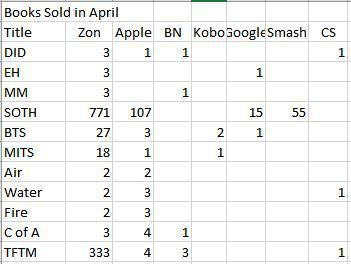 Now, if I were really brave I’d post these on Facebook because it seems as if that’s where problems are originating.
My fellow Washington Romance author Kieran Kramer posted an incredibly important video today to our WRW discussion group—a video of a special program done by Katie Couric for Yahoo News Special about depression and anxiety in teens and young adults which has some absolutely horrific numbers: 1/3 of students in high school and college report feeling depressed at some point in the past twelve months; ½ (ONE HALF!!) report severe anxiety; and One in Ten (!!) report having considered suicide in the past twelve months. These are astounding numbers! These are terrifying to all parents! This is something everyone should be paying attention to.
But equally important are the number of creative people who suffer from depression—myself included (thank goodness, only occasionally, and not in a severe way). Self-published authors are susceptible in particular because we have unreasonable expectations.
Both the problems of teenagers and those of authors I link back to Facebook and social media. We all (me included) post all of the wonderful things that happen to us on social media. Because of that it’s all that we’re seeing—how fantastic we are all doing, how many books we’ve sold, all of the awards we are winning, what list we’ve made—and I’m not saying that we shouldn’t post these fantastic things on FB because we should, they deserved to be celebrated.
But what isn’t being posted is how few books we are selling on a daily basis, all of us who don’t place in a contest, those who don’t make any lists. This isn’t surprising, we don’t want to brag if we don’t achieve. But if the average author doesn’t see this, how are they to know that how they are doing is the norm?
Like authors, teens are experiencing the same thing—they see how wonderfully their peers are doing, what a great time they’re having, how well they’re doing in school—and they’re comparing themselves to what they see online and becoming depressed thinking themselves less than everyone else.
The truth is that not everyone is doing as well as they’re projecting. They don’t post about the hours they’re spending studying. The C they got on their last paper or exam. How lonely they feel away from their family and high school friends. This is understandable, but it’s not promoting a healthy, complete picture and, unfortunately, teens are suffering and dying because of this.
In my very small way to combat this trend, I’d like to share with you what I’ve been up to: I didn’t place in any of the three contents into which I submitted my work, and have pretty much decided to stop spending money on submitting to contests (there was recently a discussion on a loop I follow where other authors came to the conclusion that readers don’t really care about how many contests your work has won—I’m good that). I haven’t made it on to any lists and in fact, my sales numbers are really not exciting.
When I sell one book—One!—I celebrate. Every single sale is something to celebrate because I don’t sell many books. On a good day, I will sell four or five books out of the ten books that are my own (not an anthology published with other authors or my one short story which I published independently). That’s not four or five of each of the ten books, that four or five books total. That’s a good day. Most days one or two books will be sold. That’s it.
Of my free book, Storm on the Horizon, about 20 copies are downloaded every day. I wish those downloads translated into more sales, that’s why I offer the book for free, but I don’t see a large number of people turning around and buying the next book in the series. I don’t go into the why, I’m just telling you the reality of my numbers so that you have something to compare your numbers to.
If I thought about the why, I’d probably stop writing forever, but I love to write. I love what I write. I write because writing makes me happy. And I write stories that I want to read. I wish more people would write Regency-set paranormal romances because I want to read them. But they don’t. It’s an odd thing to write (which is my explanation as to why a lot of my books don’t sell, that and the fact that I don’t advertise very much and probably don’t have as good metadata as perhaps I could—but I do my meager best in both of those areas).
My sincere hope—the reason why I wrote this blog—is that what I’ve written here has you thinking both about what you might do for your children (if you have teens or younger kids)—to help them see that not everything is posted on social media (they know this intellectually, help them to feel it emotionally, maybe by reaching out to those friends who haven’t posted on social media recently maybe because they have no good news to post)—and for you to feel better about yourself and your numbers (if you’re published) whatever they may be. If you haven’t published—this is reality: you won’t sell a lot of books and that is not why authors publish their work. They do so for the same reasons I publish mine, because they have to. Because they want to share their work with the world—or at least that very small part of the world who might be interested in reading it.
And I want to thank you all for reading—you’re presence here (whether you respond or not) means the world to me. Thanks!
And please share that Katie Couric video with anyone and everyone you know who has or will have teenagers. This is a vitally important epidemic that is going on and it needs to be talked about (we talk about measles and flu epidemics, why don’t we talk about epidemics of depression and anxiety—it’s killing our children too).


May 9, 2015
May is Short Story Month
 I just learned that May is Short Story Month! How fantastic is that? Um… really fantastic, in case you’re wondering.
Short stories are wonderful for so many reasons:
They’re more manageable for a new writer who has never written a novel before.For some people writing a whole novel (50,000+) can be a daunting endeavor. But thinking about writing a short story and someone might say, “Yeah, I could probably manage that.” Five to fifteen thousand words is a lot easier to wrap your mind around than fifty (or 100,000).
They’re terrific in-betweeners for writers working on a longer piece of work.We are all being told to publish more frequently, but for some people writing a novel is a six-month (or longer) undertaking. Putting out a few short stories while you’re working on your masterpiece is do-able. And it keeps your name in reader’s minds.
It boosts the number of published works you have to your name.Amazon and other e-retailers apparently love authors who have a lot of titles. Putting out short stories and novellas gives you more titles to your name. Currently, I’ve got thirteen titles out there, but that includes one novella and two short stories. Is that cheating? Nope. I’ve got thirteen titles, that’s all anyone cares about.
Short stories allow you to explore characters or concepts that probably aren’t substantive enough for a full length novel.I’m doing this with the short stories I publish in my monthly newsletter (what? You didn’t know that I give away a short story almost every single month in my newsletter? Well, now you do. Sign up here.). I play around with time periods (a Vallen story set in Shakespeare’s time - check. One set in the time of Guttenberg - check.) and concepts (what’s it like to be the second high priestess and to follow in the footsteps of someone great—I’m publishing the third segment of the story of Bridget’s daughter, “Harvesting Magic”, in my May newsletter along with a link to the first two segments in case you missed them, and I’m working on another short story to explain other aspects of the Vallen world for the summer newsletters).
Writing short stories is a great way to hone your craft.They are stories. They need to be structured in the same way as a full-length novel, only without the subplots and a more simple overall plot. Need to work on dialogue? Write a short story heavy with it. Need to practice using the five-senses? Write a short story with someone who is very sensitive to smells or tastes or who is blind and relies on all of his other senses to help him navigate the world.
Short stories allow you to try out new things and take a risk.Is there a concept you’d love to try? A genre that you’ve never written in which you think you might enjoy? Some really weird and wacky idea that you’re just not sure will fly (A story about Lilith? I had to try it. "In a Beginning" is available to purchase separately or part of the anthology of horror and paranormal stories, Tales from the Mist)?
A short story provides you with a great risk-free environment to try out these odd ideas. If it doesn’t work, you haven’t wasted months trying to write it. If it doesn’t sell, you’re not out hundreds of dollars you might otherwise spend to get a full-length novel edited, formatted, with a great cover design, and promoted. Yes, you should still get your short story edited and formatted, but maybe you can design your own cover, and you should do some promotion of the work, but everything costs less with a shorter story. Or maybe what you want to test out is a new editor (without investing load of money) or maybe you want to see if you can format that book yourself (always easier with a shorter story). So, go ahead, experiment, what can you lose?
May is short story month! Have fun with it! Write a short story! Submit it for publication in an anthology or just throw it out there on Amazon (and other e-retailers) and see what happens.
And don’t forget to get your free short stories from me by signing up for my newsletter. Thanks!!
May 2, 2015
Penny for your thoughts
 I don’t know about you, but I seem to have a running conversation going on in my head all the time. Yeah, I talk to myself, but at least I do it silently. It’s a rare occasion that there is absolute silence in mind—so rare that I actually notice it when it occurs.
My daughter once told me that she narrates her life in her head—in the third person. It makes me wonder if she reads too much, if that’s possible.
Your characters talk to themselves too. Internal dialogue is a vital part of a novel. It allows us to know what a character is thinking and feeling. The question is, is it possible to have too much internal dialogue?
I believe the answer is yes.
When a character is thinking, they’re rarely doing anything else. This stops the action cold.
Too much of a character doing nothing but thinking and our readers are going to get bored. And then there are the other characters who are standing around waiting for the POV character to do something, but they’re just standing there, thinking. Awkward!
Rarely do writers have action and thoughts coincide. It certainly can be done, but to do so, the thoughts, by necessity, need to be short—kind of crammed in between the action. This keeps the internal thoughts to minimum.
This is a good thing.
Yes, we do really want to know what the POV character is thinking and feeling, but we’d rather see it being shown, rather than be told how he’s feeling. It’s much more powerful. The ideal is to show the characters feelings and have the internal thoughts coincide.
Too often do I see (or read, actually) characters just standing around thinking. It’s really not exciting. Yes, I want to know what they’re thinking, but I’d rather get it in little bits than in a longer dump that stops the forward momentum of the book.
Margie Lawson suggests that when you edit, you highlight your internal dialogue in yellow and your external dialogue (what people say out loud) in blue. That way you can see when you’ve got too much internal dialogue—it looks like someone peed all over your book. Not a good thing!
So, yes, do write internal dialogue. It’s a vital part of a book and really what makes novels so much more fun than reading, say, a script. But do be careful about how much thought you put in to your book. Keep things moving along, and let us know what your characters are thinking all at the same.
What do you think when the action stops in order for the POV character to think about what’s going on? Does it bother you? Do you like to know what the character is thinking? Do you also narrate your life, or just talk to yourself like I do?
April 25, 2015
Are you done yet?
Steven King famously said that he knows when he's finished writing a book when he gets to the end--he's known for being a fly-by-the-seat-of-your-pants writer. I'm not. I’m a plotter. I plot out my book in great detail before I ever begin writing.
When I do finally begin to actually write the book, I already know exactly what's going to happen, when, to whom, why, and how it will all turn out--I've even been known to write the ending first (I did that with my Children of Avalon series where after plotting out the first book. Before I even started writing the first book, I wrote the very last scene of the last book. Of course, that didn't stay the last scene, it ended up that I had some more wrapping up to do after that highly exciting scene, and I didn't use that scene exactly as I'd written it by the time I got there, but I had something down. I knew exactly how the entire series would end.
The thing is, I'm sure even Steven King has an idea of where his story is going as he writes. He knows generally where he's got to end up, so he knows when he's gotten there. He knows when he's reached the end of the book.
But that's not actually the end of writing.
After you've written those beloved words, “The End”, you've got to read through the book, edit it. How do you know when you're done that part? Many (most?) writers could go on fixing things, changing a word here and there, forever.
But, naturally, you can't do that. You've got to stop sometime and proclaim your work done.
It helps to have a date by which you have said you'll be finished, then once you reach that date, assuming you're mostly on schedule (which, granted, you most likely won't be, but try to get close) you just say enough's enough.
It also helps if you've got readers lined up to read your work once you are finished. If there are people out there waiting for it, you've got to deliver it within a reasonable amount of time.
The idea is that no work of fiction is ever going to be completely, absolutely perfect. You make it as good as you can and then hand it off to a professional editor who will make it better. Once you’ve gone through making the changes suggested by her/him, then you have to say that’s it, it’s done. If you don’t, if you keep tinkering with it, you’ll never finish!
So, my recommendation for writers who are writing their first book and worried about when it will be perfect, when it will be finished, I say, don’t try to make it perfect because you can’t. There will always be things to change. Just get it so that you’re happy with it and then move on.
I know that’s easier said than done, but be strong. Let it go. Because there is nothing more satisfying than typing “The End” and meaning it.
http://meredithbond.com/blog/wp-content/uploads/2015/04/The-End.mp4
April 18, 2015
Confidently Confident
I’m sure I’ve said this before, but I’ve got a great class this semester. My Chapter One class is filled with people who comment, ask great questions and inspire terrific thinking about whatever topic we’re covering that day. This past week, I asked them for what they’d like to read about on this blog and they gave me three great answers, so for the next three weeks, I’ll be covering topics of their choosing. If you would like me to cover a particular topic, please don’t hesitate to contact me either through the “Contact Me” link on this site or directly at merry@meredithbond.com. Thanks!
Confidence! That was the first topic I was asked to address and it’s a great one for every writer because we all are beset by those nasty little gremlins who like to hijack our brains and tell us that what we’re doing (no matter what it is) is no good, useless or just plain stupid. This is even worse for writers because we’re putting ourselves out there for the entire world to see and read.
We pour our hearts and souls into our writing. How could we not worry about what others will think while we’re doing so?
I hate to say this, but it’s all on you, kid. You have to have the confidence to go forward with what you are doing. You have to find that well of confidence deep within you—the one that got you to sit down to write in the first place.
First of all, what you’re doing is important. No matter what you write—whether it’s romance, mystery, fantasy or memoir, you’ve got an important story to share. Whether people are reading to learn something, experience something they never could experience on their own, or just escape from their reality for a little bit, it’s important that you give them the opportunity to do so. We all need that. So know that your writing is important not just to you, but to those who pick up your book to read it.
Secondly, if you’ve spent the time to study the craft of writing, you are on your way to writing the best book you possibly can and that’s all that anyone can ask of a writer. But just because you’ve taken one class, don’t think you know everything. Writing is a practice—we practice it every day. Writers read articles on writing all the time (either on blogs like this or in professional magazines like the Romance Writers Report). We read books on writing (in almost every class, I suggest a book to read on the topic I’m teaching). We continue to learn and grow and get better, so don’t expect that your first attempt will be fabulous. It won’t. But with practice and learning, it will get better. (And don’t rule out all that you can learn from a professional editor: when you send in your work to a good developmental editor, they’ll tell you all the ways you can make your book better from character consistency to niggling points of grammar and punctuation.)
And finally, if you love what you write, there’s a good chance that someone else will too. That love, that passion that is keeping your fingers tapping away at the keyboard will show through your writing. It is hard work, but there is nothing more satisfying than reading through a well-crafted scene that you’ve just written. That is what makes it all worthwhile.
So have the strength, the confidence, to keep going. You are doing something important. Something that others need to read. Something that gives you the opportunity to express yourself and your passion.
What keeps you going?
April 11, 2015
Life happens. It’s all right.
 I hearby, with absolutely no authority to do so, grant you the right to have life happen. It happened to me these past few weeks, it can happen to you.
So often my writing students ask me how to balance work, family and writing. I tell them to just do it. I tell them that it can be done. I tell people this not because I did so (I haven’t had a regular full time job in a long time), but because I know that many people do it.
I had the good fortune to have a husband who earned enough money so that I could stay home with our children. I took shameful advantage of this by teaching my kids to read by the time they were three (I didn’t know that they weren’t supposed to be able to do that and apparently neither did they since they managed it just fine), playing math games with them and sitting down and just playing with them—until I got bored of being a mommy (I need more intellectual stimulation than young children can give me). So I began to write.
Somehow children don’t get “Mommy’s busy working right now, please come back in about three hours when she’s done.”
So, I would take breaks from my writing to deal with children. I never really begrudged these breaks because I knew that being there for my children was really why I was home, but I still really enjoyed my writing time (even going so far as to put my youngest into daycare so that I could carve out a little bit more time to write). But what I didn’t have was a full-time job on top of my parental duties. I merely had two jobs: mommy and writer.
There are a lot of people who have three: mommy, writer, and something else equally important and perhaps more so since it brings in $$ or does something important like saving lives. So how do people who have three jobs juggle them? Well, they write either late at night after the kids are asleep or they get up super early to write before the kids get up. They write at their lunch breaks and any moment within the day they get the chance.
These are incredible, amazing, dedicated writers and I am in complete awe of such people.
However, every so often something happens to throw even the best organized writer off schedule—life! Life happens. People die, get sick, get married, move, whatever. And these things just make it impossible to continue to write.
So, I hearby give you permission to take a break, deal with whatever it is that you have to deal with and then get back to it as soon as you can.
I’ve been doing that myself these past two weeks (now that I've got not three, but actually four jobs--a few of them part-time--my life is a little more of a balancing act).This is the first time in over ten years that I haven’t written for more than a day or two at a stretch. It’s been really, really weird! But I have to admit, I was so busy I hardly even noticed… until things began to calm down and I had a moment to catch my breath.
You know exactly where my mind went the first time it didn’t have to make a list of all the things I needed to do. Yup! Straight to the book I’d been working on when I was forced to take a break. But having that guilt-less time to do what I needed to do was incredibly wonderful.
I gave myself permission to do that and you can too.
If you know that for a short time you just won’t be able to keep up with everything, let yourself not do so. Give yourself permission to put aside your writing until what you have to deal with is dealt with. It feels so good! And it’s all right, really! Your book will still be there when you get back to it. Your fans will still be waiting for it whenever you get it to them. Don’t worry. Just do what you need to do.
Happily, I’m now ready to get back to my writing. My house is for sale and we’ve got people coming to see it and making offers already (whew!). It looks better than it has ever looked—even better than when we bought it oh-so-many years ago. All we need to do now is try to live in it without it looking like anyone is doing so.
So don’t worry. Be happy, and we’ll see you when you get back!
April 4, 2015
Gray is beautiful
 My teenage daughter is teaching me to appreciate gray, as in heroes who are not all white and wonderful and villains who are not all black and cruel. In the middle we can have interesting gray characters who swing both ways.
With a gray character you don't know whether they're a good guy or a bad guy. They could be the shape shifters of Campbell fame -- those people who start out good, but end up being bad guys, or vice versa, but even that sinks us down into defining them as either good or bad, white or black.
Why can't there be villains who are frequently good? A villain is after all simply a person who is stopping our hero from attaining their goal. They don't have to be a bad person. Parents and teachers are frequently the villains in children's lives, stopping them from doing what they want to do--usually for their own good.
And what about a good person, a hero, who does bad things. They could be doing these things for a good reason-- to protect someone else or for a myriad of other good reasons.
Gray characters open up your story to so many interesting possibilities. They make for more interesting characters, more true to life characters. Aren't we all taught when we first begin writing or studying the writing of others that a perfect character is a boring character, and not true to life. This just takes that same idea to its extreme by having your gray character be one who is not so clearly defined as as a hero or villain. It's easy, as we read, to try to figure out who is a "good guy" and who is "bad", but isn't there a thrill when someone acts in a way you hadn't expected? Yes, there could be disappointment when someone we like acts badly, but it is balanced by the joy when a bad character dies something good or heroic.
The best part is when you surprise your reader. Keep them guessing. Suspense, after all is half the fun of reading a book--to find out what happens.
 A note to my readers: I've gotten a number of emails recently from people wanting to know when A Rake's Reward is coming out. I can't tell you how much it thrills me to know that the other books in The Merry Men Quartet have been so enjoyed that you need the next book! Unfortunately, I've had to take a short break from writing while I move from my home of the past 17 years to a new place. I'm nearly done with the hard part--cleaning out and putting my house up for sale--so soon, very, very soon, I will get back to writing Rake. I hope to get it done and published, at the latest, by the end of the summer. Thank you so much for your patience! (And, yes, I am working on making some characters gray and having them do the unexpected.)
March 28, 2015
Writers Read
 Before any of us were writers, we were readers, and in all likelihood we still are. Avid readers, in fact. But what kind of reader are you? And what do you read?
I've always been astounded at the rate at which my daughter reads, even when she was a young child, she could read a Harry Potter novel (even the really long later ones) from start to finish in a day. I never thought she would be able to retain anything reading at that rate, but then she and her father (also a very fast reader) would discuss the book in great detail (much to my chagrin because, as the slowest reader in the house, I was the last to get the new book and they would start to spoil it for me). My daughter still inhales books (whenever her busy college life allows) like they were peanut butter & jelly sandwiches. Delicious, sweet, easily and quickly consumed.
Me, I savor my books like a fine pastry. I read slowly. Sometimes, I'll even pause and reread as I'm making my way through a book, just to enjoy a scene a second time (if I'm not in a rush to see what happened). I thoroughly enjoy the books I read and take my time over them. What I don't do (which I do with pastry, quite often) is pick them apart as I'm reading (peeling apart the layers of a croissant is fun, peeling apart the pieces of a novel, not so much).
But I know that a lot of writers do that. They can't help it. Once you know what should be there and all the layers that go into a fine novel, it's hard not to take it apart. But if you do that, it's much harder to actually enjoy the book, the story. You're no longer reading for pleasure, your pulling it apart and analyzing it. I refuse to do that when I'm reading for pleasure.
Yes, I'll go back to a well written book and do it later, but the first time I read a book, I simply lose myself in the story and read like a reader--except for the occasional pause to appreciate a particularly fine turn of phrase.
Now, as to what a writer reads… should you read the genre you write? I say yes. Sometimes, especially for a new writer, it’s hard to read what you’re writing and not copy the voice of the writer whose work you’re reading. When I first started writing, I would deliberately read Georgette Heyer in order to copy her voice. I wanted my books to sound just like hers. I learned. I learned to have confidence in my own voice in my own books.
Today I read anything and everything. I read books in the same genre as I write, and I try to read books outside of my genre—literary novels, historical novels, and mysteries as well as romance of all sorts (it’s one reason why I love judging the Rita—it forces me to read romances that I wouldn’t normally read). Biographies are loads of fun to read and really help me get a handle on characters—what makes a person interesting. And every now and then, I’ll even pick up a work of non-fiction in a topic which interests me, although I’ve never been a big reader of non-fiction outside of the classroom.
So what is it that you read? And how? Do you pick things apart as you read or are you able to turn off your inner editor and just get lost in a good book?
March 21, 2015
How fast?
 The prevailing wisdom for the past year or so has been to publish as fast as you can , as often as you can. But does this work? Can it be sustained? What's the advantage? Are there disadvantages?
Of course, the reason I'm asking this now is because after a year or more of intense publishing of books --I just released #13! I find myself without the time to write for the first time in a long time.
I've got one more Merry Men Quartet book to release, but I saved the hardest for last.
This book is the one I wrote with two demanding young children at home and I will be the first to admit that I didn't give it the attention it needed.
All right, I'll be completely honest here--when I read it through after not looking at it for so many years, I hated my heroine. She needs a complete character overhaul. The basic story is all right. The hero is pretty wonderful. But the heroine needs to be completely rewritten, which will, naturally, change most of the book--to at least the intent of it. It will go from be an angst ridden thing to something which I hope will turn out to be more of a comedy (everyone keeps secrets from the other main characters to hopefully humorous affect).
As you can tell, I've got great ideas of how I'm going to rewrite this book, and I'm really eager to get started on it--but my husband and I have just bought a new home. It needs a lot of attention before we can move in and I've got to prepare my current home to be sale-ready (I've got two weeks! Eek!). Which leave me precisely no time to write. I can just barely keep up with the courses I'm teaching and my formatting work.
So what happens to my book? What happens to my attempts at publishing so many books so quickly? Well, life happens. I'm not going to try to kill myself to keep up with a schedule that just isn't possible. In my way, I will do one thing at a time and do the very best job I can at each thing as I do them. The book goes on hold. The house takes precedence just now. And hopefully my realtor is right and once the house is ready, it'll sell quickly. I am working on getting a contractor to manage the renovations at the new place which will free me up to sit in my empty new home and write. I'm rethinking starting my internet until we actually move in, then I'll be forced to write. 
But, as I mentioned, I have done my best to publish a lot of books in a short period of time. This is what it looked like for me:
February, 2013 Storm on the HorizonMarch, 2013: An Exotic HeirApril, 2013 In a Beginning, short storySeptember, 2013, Dandy in DisguiseMarch, 2014 Air: Merlin’s ChaliceApril, 2014: Water: Excalibur’s ReturnMay, 2014: Fire: Nimuë’s DestinySeptember, 2014: The Merry MarquisDecember, 2014: Children of Avalon Box SetFebruary, 2015: Under the Mange Tree in Love Least Expected AnthologyFebruary, 2015: Rerelease of Storm on the HorizonMarch, 2015: Bridging the StormThat’s twelve books published in just two years from February of 2013 to March of 2015. That’s a lot!
And what has this book publishing blitz gotten me? Hopefully, happy readers. But, honestly, my sales haven’t sky rocketed. My name isn’t all that better known that it was two years ago. Yes, I’m earning more money, but only because I have more books for people to buy, not because any one or two books are selling so very well.
Was it worth it? Well, yes. I’ve got lots of books out there, selling. A good number of them I had written earlier or were re-releases which just needed a bit of tweaking before being published. But I’m now at the end of my stock of books. Now, once I’m done with A Rake’s Reward, I’ll be back to writing books from scratch – well, Bridging the Storm was written from scratch, too. But I won’t have any more books in my pocket, so to speak to just pop out there. My publishing schedule will slow down (and not just because I don’t have the time to write). Does this matter?
Personally, I don’t think so because, as I say, my sales haven’t picked up dramatically with the number of books I’ve published. Which leads me to not worrying so much about not having time to write just now. I’ll get my book done because you can’t stop me from writing for very long (I just might go mad, which would not be pretty), but it’s definitely not worth it to kill myself to keep up this push to publish.
What do you think? Have you seen or heard of anyone really hitting it big because of the number of books they’ve published? Or are you trying to do so?
March 14, 2015
How to become a publisher in 5 easy steps
I had the pleasure of speaking at the Chesapeake Romance Writer’s conference “Pages to Publishing” this weekend (which is why this blog is a day late… sorry!). There I gave my “Jumping into Self-Publishing” talk to a wonderful group of people. But speaking one-on-one to some people afterward just reinforced som ething which I’ve spoken about with a number of my clients as well—becoming your own publisher can be well… maybe this will help:
Step 1: Learn all that you need to do to publish a book.
That means reading everything you can get your hands on on-line and attending conferences and take courses from people who have done it before.
Step 2: Panic.
Step 3: Calm down and break apart the process.
Really, it’s quite manageable if you take it one step at a time:
Finish writing your book.Get it professionally edited.Get a professional cover madeFormat it for publication for each vendor where you plan to sell your book (there are many which overlap – Nook, Kobo and Apple iBooks all take epub, only Smashwords, KDP and CreateSpace have their own individual formats) or hire a professional formatter (like me).Upload your book everywhereMarket the hell out of it –better yet, start doing that about a month before you upload it and put it up for sale.Step 4: Call in help from all your friends, acquaintances, relatives and people you’ve randomly met here and there.
Truly. This is not something that someone can easily do on their own. They need the help and knowledge of professional editors, book cover designers, formatters and generally other people who have done this before. As I mentioned to one of my clients, publishing a book “takes a village”.
Step 5: See your work go up on all e-retailers and bask in your glory—because you deserve it! You are a publisher!