Meredith Bond's Blog, page 7
July 25, 2015
Stolen Organization
I’m a thief. I admit it! I steal people’s ideas and make them my own… well, after smushing them around in my head for a little while, fooling around with them and changing them to fit my needs. So… maybe when I finally claim them as my own they actually are, it’s just that the spark for the idea came from someone else. But, hey, ideas have to start somewhere, right? New ones don’t just pop up out of the blue. All ideas are derivative of something, right?
So my new idea, the one I promised last week to tell you about is for my new writing notebook. For every book I write I organize it in a different way. A few times I’ve managed to re-use an organizational method, but usually I start afresh with something new and different. Something which fits the book I’m writing.
So far I’ve used binders, just a pad of paper and a folder to keep loose papers in, 3x5 cards, Scrivener, OneNote, a huge piece of paper (actually two taped together) on which I wrote my W graph in thick marker, and a bulletin board.
With my current WIP, I’m using an Arc Notebook (from Staples). It’s the kind with a dozen rings and you can put in paper, take it out, shift things around… it’s like a binder only with the pinching rings. I like it because the paper you buy for it is really nice heavy paper that takes my fountain pen ink. It also comes in two sizes – I’ve been using their smaller size for years as a diary/calendar. Now I’ve bought a notebook size one and I’m loving it.
Here’s how it’s organized: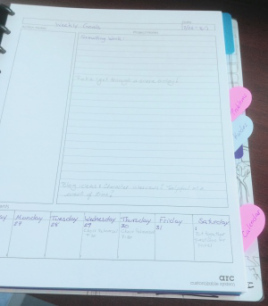
So, there you have it, my new notebook for my WIP. What about you? Do you keep a notebook for each book you write? Do you use the same sort of organizational method for every book? Or are you a pantser and don’t worry about any of this until the book is done?


July 18, 2015
Don’t Look Now
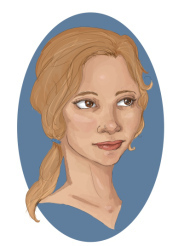 My daughter had an epiphany last week. She realized that she doesn't have to write like I do.
Being the wonderful child that she is, she's taken my writing class twice and learned all she could about writing from me.
In my class, I try to teach a number of different ways people might organize their writing as well as a ways they might consider the process. My daughter took in all I was saying and then looked to see how I organized myself and my writing. She watched my process and then tried to emulate that.
I'm a plotter. I carefully plot out my whole book before I write. I fill out character sheets and generally examine every aspect of my novel-to-be before I start writing. After trying to write this way for years, she’s now realized that my writing process just hasn’t worked for her. She may be a pantser.
She has always been more artistic than me—she's got a fantastic eye for color and has inherited her father's ability to draw (thank goodness! I can't draw to save my life). It's taken her years of practice, but she can now draw some pretty incredible people--she loves to sketch out her characters and works hard at getting them just right, just as she sees them in her mind's eye. I really envy her that talent.
Like all children, though, she has always tried to do things in the same way as she's seen her parents do them before attempting to branch out and find her own way. This has now moved to her writing and I can only sit back, the proud mother, and watch her grow to become the writer she wants to be--one who doesn't plot first.
When she came to me with this revelation, I reminded her of the wisdom of both Jennifer Crusie, who likes to talk about her "Don't Look Down" first drafts (don’t worry about where you’re going or how you’re getting there, don’t stop for anything, just fly with it and get it all down) and Nora Roberts, who famously said that you can't edit a blank page. My daughter was thrilled and so happy with this idea that she could just write, getting all of her ideas and story written and then worry later about crafting what she'd written into a coherent, well organized story. "You don't have to do the story structure first," she gushed to me.
"Nope, you don't," I happily replied.
If she can just write and not get bogged down by story structure or grammar (something she tends to be a little compulsive about), then I will stand back and cheer her on. Write that draft. Get everything out. Then worry about what you've got and shape it into the wonderful story it can be. As she said, she's got to create the block of marble and then, like Michelangelo, chip away at it to reveal the sculpture within.
And while she revels in her new found ability to just write, I'm having fun with a new organizing notebook I'm developing.
I love celebrating differences! And I'll tell you all about my notebook next week.
I hope you haven’t missed it! Air: Merlin’s Chalice is free just about everywhere (Amazon, Kobo, Smashwords and Google Play) and An Exotic Heir is just 99 cents everywhere (Amazon, B&N, Kobo, Smashwords and Google Play). These prices go away Sunday, so get them now while you can!
July 11, 2015
A Stand-Off
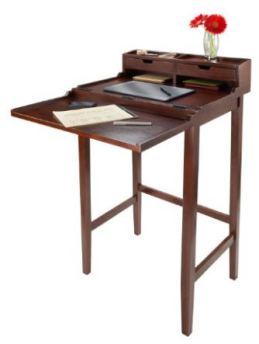 I’m so excited! I am soon to join the latest craze in office work. I’m getting a standing desk. It’s not as ambitious as a treadmill desk but not as lazy as sitting in a comfy office chair all day.
For years I’ve used an exercise ball as my “desk chair”. It forces me to (usually) sit up straight and engage my abs while I work, which is good for my horrible back (slipped disk, generally knotted muscles so bad I make massage therapists weep). Every now and then, in our old house, I would pick up my laptop and move it over to a half-height bookshelf in my den and stand there and work. It was fine. It was almost comfy. I worked up to standing a good portion of the day. But then my husband would complain about my laptop and my papers sitting on the bookshelf in the den (if I forgot to move them back to my desk in the office).
When we moved, I told my husband that I really, really wanted a standing desk. He proposed that I use the bar table we were planning on using as our kitchen table (the kitchen in the condo is too small for an actual table, and we’ve had this bar table acting as a printer stand for years). While the construction was going on, we placed the bar table in our sun room and I used it for my desk. It was great. But then my husband complained that all of my papers and laptop were there, how were we supposed to eat?
Um…
That motivated him to find me a real standing desk. My husband is an expert on-line shopper. When he wants to find something, nine times out of ten, he can not only find what he wants, but he can find it at an amazing price. He found me a beautiful standing desk—at Amazon of all places.
It’s due to arrive next week and I can’t be more excited! We’re going to put it in the sun room, which I like because it’s got windows all around (it’s also not air conditioned or heated, but fans and space heaters should solve that problem). But the best thing is that I’m going to be able to stand and work and have my own space to do so.
Of course, I’ve already bought a gel mat to stand on (the sun room has a beautiful tile floor which just kills your feet if you stand on it for too long). And I’ve read up on standing while you work.
We, of course, have all heard about the benefit of doing so—better for your posture, better for your health, keeps your metabolism at work, lowers the risk of cancer, ups your mood and alertness—all great stuff. And I’ve read that I shouldn’t stand still all day either. The point of working at a standing desk is that you move. Take a walk around every so often (when I’m formatting, I put on pop music, so if I’m standing, it’s really easy to bop and move along with the music and doesn’t interrupt my formatting hardly at all). And when I get tired, I can just pick up my laptop and move over to my desk in the office. Easy! Good for my health! I’m so excited!!
As soon as I get my desk, I’ll be sure to post a picture of me standing at it on Facebook!
Oh, and to celebrate my move being finally over, and starting my new life as an apartment dweller, I’ve put the start of my Children of Avalon series and my Merry Men series on sale. Air: Merlin’s Chalice is free wherever I could make it so—Smashwords and Google Play (I set it to free on Kobo, but they haven’t updated it); and An Exotic Heir is reduced to 99 cents everywhere. The sale lasts until the 14th, the day after we officially sell our house, so don’t wait, get your copies now!
July 4, 2015
Go It Alone or Get Help?
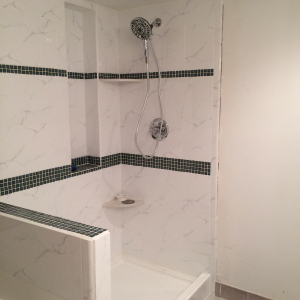
Gobs of grout and crooked walls.
Involved in all of my moving plans was the renovation of the kitchen and bathrooms of my new condo and the repainting of the whole place. This is not work I am qualified to do, therefore I had to hire other people to do it for me. Do I wish I could have done it myself—yes! Could I have done so? Nope.
My husband, despite his economics Ph.D., is a very artistic person. He's got a great eye for color and line and has terrific design sense. He was in charge of designing the kitchen and bathrooms, giving me veto authority. I'm a handier person than he is. I understand the mechanics of fixing things, even if I can't always do it myself. (Traditional gender roles? Who needs them?) so it was my job to see his design implemented. It's also a lot easier for me to do this since I work from home and my husband has a regular office job.
So, for the past month I've been dealing with the construction company we hired to do all the work and the subcontractors they sent over to my home to do the actual work. To say that it's been a nightmare would be understate the issue, I'm sad to say. I've had to manage the two men (one for the kitchen, one for the bathrooms) from making sure they arrived to work on time, to telling them what to do and making sure they did it in a professional manner—not accepting shoddy workmanship (I've had them redo so many pieces of the job, it's ridiculous!)
The thing is, there's no way for one person to be able to be an expert at everything. The construction company sent over one man to rip out all the fixtures in my bathrooms, retile the shower, install a lighting fixture, and do all the plumbing. He's had to be a general worker, demolition crew, tile expert, electrician and plumber. No one person can be an expert in all those areas and so I've had to work with this man to try and figure out the right way to do all of this and sometimes it took more than one try to get it right.
Likewise, not every author can be a writer, editor, cover designer, formatter and expert marketer, we need to hire specialists to do the different pieces for us. Does this mean that one person cannot do it all? No, not at all. It's just that they then have to have the patience to do things two or three times before they figure out the right way to do it.
Or they could just hire experts to do each piece for them.
Guess which one I advocate for?
I'm happy to say that after the man comes back on Monday to install edging tiles to the inset shelf that was built for the shower in my bathroom (because we didn't realize that they would be needed and instead of these tiles, he just filled in the edges with globs of grout which looks awful), it will all be done! The apartment is painted (by professional painters), professional movers brought my furniture and belongings in on Thursday, and I can now rest easy knowing that I only have 75 more boxes to unpack (about half of which are filled with books, which are quick and easy to unpack).
Have a great weekend everyone and do some relaxing for me!
June 27, 2015
Holy Plotting, Batman, a Writing Duo
There aren't that many people who write with a partner. It's pretty much just a handful who do so, and even fewer parent-child teams. Well, I might just be about to enter this elite group.
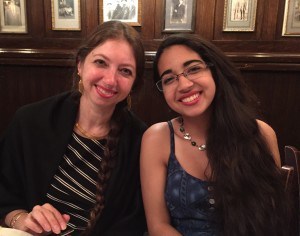 Last evening while out driving with my daughter, Nina, who has returned from college for the summer, she started telling me about the magical world she's created and the novel she's begun writing. I can tell you, it made my motherly heart go pit-a-pat hearing about the wonderful creativity she's got and the fact that she's really trying hard (in her extremely limited free time at college) to write a book.
Our conversation then streamed into epistolary novels and we both agreed that that would be a fun thing to write. Naturally, the next thing she said was, "We should write one together!"
One of my daughter's favorite books when she was in middle school was Sorcery and Cecilia, or The Enchanted Chocolate Pot, by Patricia C. Wrede and Caroline Stevermer,
a regency-set epistolary novel about two young women, their romances and adventures with magic (it's a great book, no matter how old you are, I highly recommend it).
The story of how the book was written enthralled both me and my daughter almost as much as the novel itself! It was born out of a writing exercise by two friends who had no plot to begin with, just two characters, which they each took on as their own identities as they wrote letters to each other. From these letters grew the plot and the story.
My daughter and I really wanted to do something along those lines at the time, but life and school got in the way.
Well, Nina is now looking at a summer filled with online classes and other tasks which will take up not quite all of her time and, while I've got plenty of my own work to do, I'm wondering how I could possibly pass up a chance to write a book with my own child (my son and I once came up with an idea for a story, but then he thought I was going to write it on my own. I thought he was going to write it. It never got written, but it’s still there in my file of stories to maybe, someday write)?
So, last night as we both sat down with our knitting, Nina and I began to plot. We aren't going to attempt to replicate the magic of creating a plot as you go as they did in Sorcery and Cecelia, but will, instead, do this the normal way of plotting out a story, creating characters and then beginning our letters to one another to build the story. I fully expect things to twist and turn and not stay within the confines of the very sketchy plot we thought up last night, but I'm open to whatever may come out of this.
I've never tried to write with anyone else. My husband has, at times, helped me plot, but then he's left me alone to do the actual writing. With this book, we’re plotting it together and then, I guess, each of us will work on our own, writing our letters but riff off of each other depending on what occurs in the letters.
I've always thought it would be fun to write an epistolary novel. Now I have to figure out exactly how one does that--how to write scenes, action and dialogue all within the confines of a "letter" without "telling" too much. And then I've got the added dimension that my letters are actually going to be written in response to someone else's letters—not ones that I’ve written from another person’s point of view-- and we've got to build a coherent story from all this!
Whew! This is definitely going to be a writing challenge for both of us! But fun, I think. My daughter and I are already extremely close, hopefully this exercise will draw us even closer, and who knows, maybe we'll even end up with a novel at the end of the summer!
Have you ever tired writing with a partner? How'd it go?
June 20, 2015
Paying Attention
 I keep a list of blogs for this website on my tablet. Most of the time they're blogs I've written, because, for some reason, I usually write my blog on my tablet (all my other writing I do on my computer, but blogs somehow always flow better when I'm writing on my tablet--weird!)
But in my list of blogs, I've got ideas for blogs to write in the future as well as those I’ve already written. Sometimes they're the beginning paragraph, sometimes it's just a sentence reminding me of what I wanted to write about, sometime a link to another blog I read which got me thinking. When looking through this list today to find something to write about I found this one:
Paying Attention (that was the title)
When you can focus, you need to know.
That's it. That's all I wrote.
What does that mean?? I haven't the foggiest idea!
Clearly at the time I had an idea in my head and I either thought that that would trigger the idea or I was interrupted before I could finish writing it down.
The point I'd like to make is today is that writing down your ideas is vitally important. We're writers. We get ideas all the time for blog posts, for stories long and short. But we've got to write them down in a way that will make sense to us later. We've got to take that time to write as much as we can about the story, the characters, whatever it is that sparked the idea. If we don't we end up with things like "When you can, you need to know."
When you can pay attention? You need to know what?
When you can pay attention, you need to write down your ideas because otherwise they'll be lost to you forever! Ideas are too important to be lost.
Yes, some ideas are horrible and deserve to be lost, but not until you've considered at least twice. I've found a few doozies while cleaning out my stuff as I packed for my move. Honestly, I wonder why I thought some of these ideas were good (nope, sorry, not going to share my stupid ideas), but at least I wrote them down fully.
For one idea, I've not only got a full page describing the plot, but paragraphs on the hero and heroine describing what sort of people they are. This is great! If the idea had been a good one, or the characters less silly, then I might have actually fleshed the idea out more and written the book. (I also found my beginning notes on the book I'm currently rewriting and now understand how I came to create such a stupid, annoying heroine. I was going for someone very complicated and angry. I failed.)
But the point here is that ideas are wonderful. You should write them down immediately, but do so in a way that: a) you will find your idea when you're looking for one (I have my list of blog ideas on my tablet. I know exactly where to look when I need one) and; b) you can understand what your idea was because one sentence (and one that doesn't really make any sense no matter which way you try to read it) doesn't help.
If you have any ideas about what you might want to see me blog about, I'd appreciate you sending them to me because my list is getting pretty sparse.
Thanks, as always!
June 13, 2015
Writing Shorts
Is it self-publishing or readers which is driving more and more writers to writing short stories?
 I started thinking about this when I sat down to write a new short story for my newsletter (in which I always try to include a piece of a short story or a vignette--you can sign up for it here). It's easy for me to write short stories in my Vallen world since it spans all of history and there are a lot of fun things within it that I can explore using whichever time period I feel like writing. So far I've got a story set in medieval times, a Shakespearean, one set around the time of Guttenberg, and this new one will be modern, set in the 1980s.
Writers are also writing a lot more short stories now to include in anthologies which have become very popular.
Traditional publishing houses have always put together anthologies of similar writers, but usually they included novellas, not short stories. Now you can find all sorts of anthologies of both short stories and novellas put together by the authors themselves (I've got short stories in three anthologies). But is this trend happening because writers want to write short stories and this is a good way to publish them or is it because readers are demanding more shorter stories to read? Perhaps a combination of both?
People just don't have the time to read a whole novel any more, so we hear. They don't have the attention span. I think that's kind of ridiculous, personally, because no one is forcing readers to read an entire novel in one sitting. It's just as easy to put in a book mark and then pick up the story again later as it is to finish a short story. But the point is, short stories and novellas are very popular with readers for whatever reason.
Personally, I love the new trend of authors writing prequels to their books in a short story or novella. From a writer's point of view it gives you a publication which you can price low or put out for free to draw readers to your books. From a readers perspective, you get to learn more about the characters of the books and explore something which made them the person they are in the book which follows.
But it is self-publishing which has allowed this sort of thing to happen. No traditional publisher would have published a short story or novella just on its own. And they certainly wouldn't have priced it at 99 cents or given it away for free. Self-published authors, on the other hand, are doing this all the time now, and I believe some traditionally published authors are beginning to do the same independent of their publishers.
So are we publishing all this short fiction because it's easy to do so or because readers are gobbling it up? What do you think?
While you mull that over, I'll get back to writing my short story, which will fill my need for something to put into my newsletter, provide a prequel to a book I plan on writing soon and be another entry in my solo anthology which I'll put out as soon as I've got enough short stories to make a book--5000 words doing triple duty!
June 6, 2015
Professionalism
 There’s been an interesting discussion amidst RWA members as new rules for membership are soon to be imposed.
Starting soon all RWA members who wish to have a vote must prove that they are serious about becoming a published author by proving that they are actively writing and working toward that goal. To be admitted into the Published Author Network of the RWA, you must have earned a certain amount of money with your writing.
I can understand that the organization only wants people who consider themselves serious, professional writers to be able to have a voting membership. It is, after all, a professional writer’s association.
The discussion concerning entry into PAN, however, got pretty heated with many differing opinions. In light of the fact that anyone can become a “published author” merely by uploading anything at all to Kindle Direct Publishing, it’s understandable that the RWA wants to ensure that only truly professional writers who take their work seriously be admitted to this (some would argue, elite) sub-group. But is it right that the criteria to enter the group is how much money you earn with your books?
If that were the case, I wouldn’t qualify. (I’m already a member due to my previously traditionally published work.)
Does this mean that I’m any less than a professional author? No.
I produce professional quality books. I take my work very seriously and consider myself a professional author. So why should I be excluded from this group just because I haven’t heard so much from my writing?
I think it’s because the RWA doesn’t actually have enough staff to have someone look through each and every book published by authors applying for PAN membership. If they did, then they could easily make the professionalism of an author’s work the criteria.
And then there was raised, the issue that some authors publish one book and then stop writing or publishing for whatever reason. Does that make those authors ineligible to be members of PAN?
I would argue, yes, since the organization is meant for people who are and want to continue to be professional authors. If you are no longer writing and publishing, you were a professional author, but are no longer.
I tend not to take part in these discussions on-line or get involved in organizational politics, but I thought these ideas, concepts, of what makes someone a professional author was interesting. There are so many hundreds, if not thousands, of people who want to become authors. We do need to have gatekeepers to ensure that our professional organizations are populated by those who are working toward becoming a professional author.
What do you think? Should there be a monetary criteria for entrance into PAN? Into any professional writer’s association? And if not monetary, then what?
May 30, 2015
The End.
The End.
The words that every writer loves to write. It gives such a fantastic feeling of completion. Of accomplishment. It can be a relief when a book has been particularly difficult to write. It can be a moment of sadness that the people (characters) with whom you’ve spent the last few months (more or less) writing and living with are now going to leave your life—at least until you get the book back from your editor and you have to visit with them again to make your corrections.
 But what about those words that come right before those two beautiful ones? What about the actual ending of your book? How do you write that?
For me, writing the end of the book is nearly as hard as writing the beginning. It’s usually something I do three or four times before I get it just right.
The ending of a book is nearly as important as the beginning, as well. It’s how you leave your reader. Just as you want to entice your reader to enter your fictional world at the beginning of your book, you need to entice her to pick up your next book (if you have one or when you have one) and stay in that world. So, the end of your book is actually a marketing tool for your reader to continue reading your work.
So, what’s involved here?
Well, you’ve got to tie up all of the threads that have been running through the entire book—meaning all plots and subplots. Or, if this book is one of a series with more to follow, you’ve got to leave your reader, not hanging so much as wondering.
Leaving your reader hanging, not knowing if a character lives or dies, or in some equal sort of peril can be just plain cruel. On the other hand, if you leave them wondering what happens to the character just before they get into peril (a great way to begin the next book, with the character stepping into such a situation), then they’ll care enough to want to buy the next book, but not angry at you for leaving your character (and them) in such a horrible situation (honestly, I once got so annoyed with a writer who ended every book in her series with the heroine sure to be killed that I just stopped reading everything she wrote).
If you’re writing a mystery, naturally, the mystery has to be solved. But then what? What are the consequences? Do we know what will happen to the killer? Do we care? What about the detective? What will happen to them (presumably our hero)? Will you leave the door open for a next in the series or is that it, are they out of the crime-solving business? Do you leave your reader wondering about this or satisfied with what they’re planning on doing with their life?
If you’re writing a romance, do you end with your hero getting down on one knee (either figuratively or literally) to ask for the heroine’s hand? Or do you leave us wondering if he’s ever going to get up the nerve to do so? Or does she ask him? There are so many possibilities. I always toyed with the idea of including the wedding in the book and then having the hero and heroine riding off into the sunset to live their newly married life. And, what do you think, are readers tired of books ending with a proposal?
Endings are tricky things. You want to leave your reader satisfied and a little sad that the book is finished. But you also want to leave them happy that things worked out the way they did. You want to complete the story and yet you may want to leave the door open for a sequel.
So, what do you think? Do you have problems with your endings? Do you know how your book is going to end when you start writing or is it a surprise for you when you get there? Do you have problems writing the end or does it just flow into a natural conclusion?
May 23, 2015
Commencement
I have had the pleasure of attending two graduations this past week–my son’s from college and my nephew’s from high school. Both young men have worked extremely hard for the past four years to get to this day. Celebrating it with them has truly been a wonderful. But commencement, these new beginnings has made me think of my own new beginnings–every time I sit down to start a new book.
Beginning a book has a good deal in common with moving on from high school or college.
First of all, there is the big question of what you’re going to do now. Where you’re going to go–what your book is going to be about. Just like starting a new school or a new job, when you start a new book you’ve got to have a goal in mind–where is that book going to end up? And how are you going to get there–some idea, be it a detailed outline or only a few major turning points is necessary in both life and writing.
Also when you have a new beginning in life as well as a book, you’re going to be meeting all sorts of new and wonderful people–your hero and heroine are there waiting to meet you and you will have the pleasure of getting to know these new friends. There, of course, will be some not so pleasant people, there always are.
To move forward in this new adventure both in life and in writing, you need to be captivated. You need to actually be looking forward to what is to come–you’ve got to grab your reader’s attention straight off the bat and pull them in, making them care about what’s about to happen. Likewise, if my nephew wasn’t so excited about going to college, my son excited to start his new job, they might not bother embarking on this new adventure in their lives. Happily both are eager to get started, so should you be when you begging a new book and your reader be when reading this book after you’ve published it.
Once you know what you’re going to do, where you are going and are eager to get started, then it’s just a matter of sitting down and getting to work–that is, of course, the hardest part, but it’s also the wonderful part because it leads to happy endings–like Commencement.