Pooja K. Agarwal's Blog, page 5
June 7, 2022
Retrieval practice is not a test (so stop calling it that)
Have you heard of the "testing effect" or "test-enhanced learning?" Let's clarify: Retrieval practice is not a test; it's the opposite.
When you're talking about retrieval practice, stop using the word "test." But why? Read more below. (Fun fact: the word "testing" appears only once in our book, Powerful Teaching.)
More ways you can get involved in the science of learning:
Get the link for our informal Zoom party this Friday, June 10
Download all of our free resources from Google Drive
Explore our newest list of cognitive scientists. You can follow them on Twitter!
Retrieval practice is not a test
Photo by Andrea Piacquadio (Pexels)
When we talk about retrieval practice, we are not talking about testing. The phrase “testing effect” is commonly used in the research literature (and increasingly in blogs and social media). However, retrieval practice in the classroom takes many forms that differ from the typical use of a test.
Retrieval practice includes low-stakes and no-stakes writing prompts, brief quizzes, flashcards, Kahoot, Quizlet, etc. Research demonstrates that frequent retrieval while students are initially learning information boosts their long-term memory, higher order thinking, and transfer of knowledge. Retrieval practice isn't the same thing as traditional exams or standardized testing. It's the opposite: Retrieval practice is a learning strategy, not an assessment strategy.
Here’s how we define retrieval practice: “an active attempt by a student to recall or recognize, and then reconstruct their memory of knowledge during initial learning” (Agarwal, Nunes, & Blunt, 2021).
Summative tests and exams engage students in recalling what they've learned. But the first time students retrieve should not be a midterm or a final exam. In other words, retrieval practice is literally the process of practicing retrieval (the active attempt) that shapes learning, not exams or tests.
The terms “testing,” “testing effect,” and “test-enhanced learning” create confusion between retrieval practice, summative assessments, and standardized testing. Retrieval practice is not a test, so stop calling it that.
Learn more in Powerful Teaching Join our Zoom party on Friday, June 10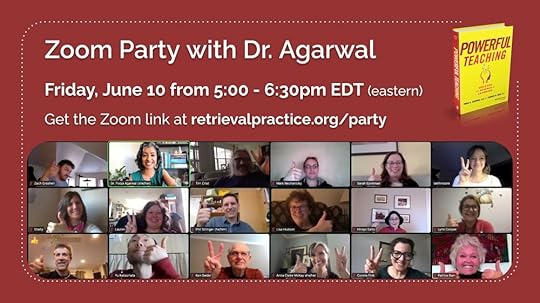
Join Dr. Pooja K. Agarwal, cognitive scientist, co-author of Powerful Teaching, and founder of RetrievalPractice.org, for a Zoom party Friday, June 10 from 5:00pm - 6:30pm eastern! Click here to get the Zoom link.
Theme for June 10: balancing retrieval practice, grading, and assessments (which ties in perfectly with today's update that retrieval practice is not a test).
Engage in breakout groups with educators from around the world
Live, informal, and un-recorded (Want a presentation? Watch this keynote on YouTube with Dr. Agarwal)
Stop by any time and stay for as long (or as little) as you’d like
Everyone is welcome: K–12, higher ed, non-profits, teachers, administrators, scientists, etc.
Get the link for our Zoom party on June 10 All of our downloads are FREE
Photo by lookstudio (Freepik)
Did you know that all of our resources and downloads are FREE? Get them from our Google Drive!
Free practice guides written by cognitive scientists
Free professional development Powerpoint and Google Slides
Free book club resources for Powerful Teaching and Make it Stick
Free translations in Spanish and additional languages
Download our free resources

May 17, 2022
This is what a cognitive scientist looks like [UPDATED]
Want to know about the science of learning? Ask a scientist. Here's a list of 35 cognitive scientists you need to know. They publish the newest research on retrieval practice, actively engage in science communication with educators on Twitter, and demonstrate diversity beyond the traditional ivory tower.
In our list of cognitive scientists, we've provided Twitter handles, Google Scholar profiles, recommended research publications, areas of expertise, and more. Follow them, cite them, interview them, and reach out to them.
Each cognitive scientist has rigorous scientific training and multiple publications in peer-reviewed academic journals, with an unparalleled understanding of experimental design, statistics, and retrieval practice. Search our list by area of expertise: STEM learning, study strategies, social-emotional learning, metacognition, myth busting, and more. (Scroll down or click here for our older profiles of cognitive scientists.)
Are you sharing the science of learning in your classroom, organization, blog, podcast, or social media? If you want to unleash the science of learning, get to know these cognitive scientists ASAP.
Research Expertise Study skills 21 STEM learning 13 Metacognition 12 Online learning 12 Spacing 12 Social-emotional 11 Early childhood 8 Neuromyths 8 K–12 7 Meta-analysis 6 Tech tools 5 Transfer of learning 5 Interleaving 4 Outside the U.S. 4 Misinformation 3 Concept mapping 2You should know these cognitive scientists
Want to know about the science of learning? Ask a scientist. Here's a list of 35 cognitive scientists you need to know. They publish the newest research on retrieval practice, actively engage in science communication with educators on Twitter, and demonstrate diversity beyond the traditional ivory tower.
In our list of cognitive scientists, we've provided Twitter handles, Google Scholar profiles, recommended research publications, areas of expertise, and more. Follow them, cite them, interview them, and reach out to them.
Each cognitive scientist has rigorous scientific training and multiple publications in peer-reviewed academic journals, with an unparalleled understanding of experimental design, statistics, and retrieval practice. Search our list by area of expertise: STEM learning, study strategies, social-emotional learning, metacognition, myth busting, and more. (Scroll down or click here for our older profiles of cognitive scientists.)
Are you sharing the science of learning in your classroom, organization, blog, podcast, or social media? If you want to unleash the science of learning, get to know these cognitive scientists ASAP.
Research Expertise Study skills 21 STEM learning 13 Metacognition 12 Online learning 12 Spacing 12 Social-emotional 11 Early childhood 8 Neuromyths 8 K–12 7 Meta-analysis 6 Transfer of learning 5 Interleaving 4 Outside the U.S. 4 Misinformation 3 Concept mapping 2You should know these cognitive scientists ASAP
Want to know about the science of learning? Ask a scientist. Here's a list of 35 cognitive scientists you need to know. They publish the newest research on retrieval practice, actively engage in science communication with educators on Twitter, and demonstrate diversity beyond the traditional ivory tower.
In our list of cognitive scientists, we've provided Twitter handles, Google Scholar profiles, recommended research publications, areas of expertise, and more. Follow them, cite them, interview them, and reach out to them.
Each cognitive scientist has rigorous scientific training and multiple publications in peer-reviewed academic journals, with an unparalleled understanding of experimental design, statistics, and retrieval practice. Search our list by area of expertise: STEM learning, study strategies, social-emotional learning, metacognition, myth busting, and more. (Scroll down or click here for our older profiles of cognitive scientists.)
Are you sharing the science of learning in your classroom, organization, blog, podcast, or social media? If you want to unleash the science of learning, get to know these cognitive scientists ASAP.
Research Expertise Study skills 21 STEM learning 13 Metacognition 12 Online learning 12 Spacing 12 Social-emotional 11 Early childhood 8 Neuromyths 8 K–12 7 Meta-analysis 6 Transfer of learning 5 Interleaving 4 Outside the U.S. 4 Misinformation 3 Concept mapping 2May 10, 2022
Join our Zoom Party on Friday, May 13, 2022
Get ready to party! Join our Zoom party with founder Dr. Pooja K. Agarwal on Friday, May 13, 2022 from 5:00-6:30pm eastern. Access the Zoom link at retrievalpractice.org/party.
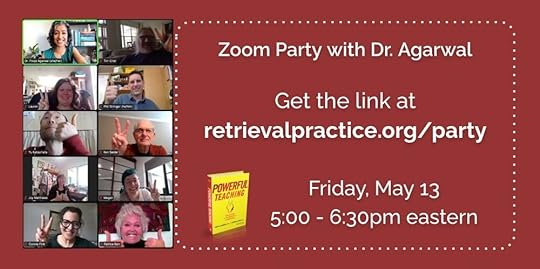
Connect with educators, share Powerful Teaching strategies, swap retrieval practice activities, and unleash the science of learning.
Engage in Q&A and breakout groups with educators from around the world
Informal and un-recorded (Want a presentation? Watch this keynote with Dr. Agarwal)
Stop by any time and stay for as long (or as little) as you’d like
Everyone is welcome: K–12, higher ed, non-profits, teachers, administrators, scientists, etc.
Get the Zoom Link Have you joined our Facebook Group?
Do you have a question about a specific teaching or learning situation? Join and post in our Powerful Teaching Facebook group.
Our group includes more than 2,000 educators from around the world, who likely have the exact same question or challenge as you do. They can benefit from your question and you can benefit from their expertise.
Join our Facebook GroupJoin our Zoom Party on Friday, May 13
Get ready to party! Join our Zoom party with founder Dr. Pooja K. Agarwal on Friday, May 13 from 5:00-6:30pm eastern. Access the Zoom link at retrievalpractice.org/party.
Connect with educators, share Powerful Teaching strategies, swap retrieval practice activities, and unleash the science of learning.
Engage in Q&A and breakout groups with educators from around the world
Informal and un-recorded (Want a presentation? Watch this keynote with Dr. Agarwal)
Stop by any time and stay for as long (or as little) as you’d like
Everyone is welcome: K–12, higher ed, non-profits, teachers, administrators, scientists, etc.
Get the Zoom Link Have you joined our Facebook Group? Do you have a question about a specific teaching or learning situation? Join and post in our Powerful Teaching Facebook group.
Our group includes more than 2,000 educators from around the world, who likely have the exact same question or challenge as you do. They can benefit from your question and you can benefit from their expertise.
Join our Facebook GroupApril 28, 2022
Save the date for our Zoom parties and watch the SXSW EDU keynote
Three updates:
Save the date for our live Zoom parties
Watch Dr. Agarwal’s keynote from SXSW EDU
Watch Dr. Agarwal bust myths with Kari Byron, host of MythBusters
Join a live Zoom Party this summer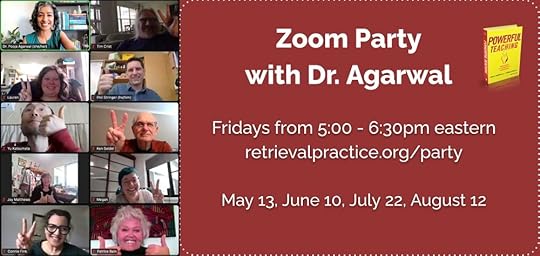
Save the date! We'll be hosting live Zoom parties on May 13, June 10, July 22, and August 12 from 5:00pm - 6:30pm eastern.
Our first "office hour" with Dr. Agarwal was so popular that more than 50 educators joined us live. So, we're changing the format: For our upcoming Zoom parties, connect with educators from around the world, share strategies from Powerful Teaching, and unleash the science of learning.
Engage in Q&A and breakout groups
Informal and un-recorded
Stop by anytime for as long (or as little) as you'd like
Everyone is welcome: K–12, higher ed, non-profits, etc.
Visit retrievalpractice.org/party for info. Registration will be available soon.
Learn more about our Zoom parties Watch Dr. Agarwal's keynote at SXSW EDUCouldn't attend the recent SXSW EDU conference? You're in luck! Watch Dr. Agarwal's keynote from SXSW EDU on YouTube and visit retrievalpractice.org/sxsw for highlights and key takeaways.
You can also watch her interview with Kari Byron, host of the popular show MythBusters, where they bust the myths of learning styles, brain games, and studying while listening to music. Enjoy!
April 6, 2022
Join Dr. Agarwal's virtual office hours on Friday, April 8, 2022
Chat with Dr. Agarwal during her office hours on Zoom Friday, April 8, 2022 between 5:00pm - 6:30pm EDT (eastern time)! Go to retrievalpractice.org/officehours for the Zoom link and more info.
Office Hours with Dr. Agarwal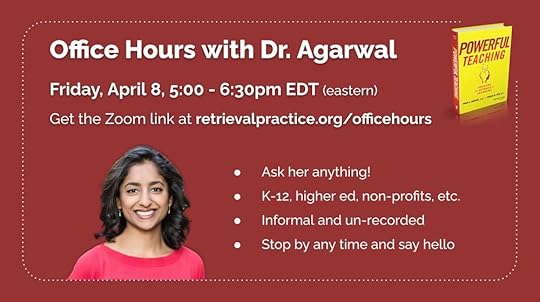
On Friday, April 8, 2022 from 5:00pm - 6:30pm EDT (eastern time zone), join cognitive scientist Dr. Pooja K. Agarwal for her office hours on Zoom.
Ask her anything! Learn more about retrieval practice, Powerful Teaching, the science of learning, free resources, etc.
Everyone is welcome: K-12, higher ed, non-profits, etc.
Join the informal, un-recorded conversation
Stop by any time, for as long as you like or just to say hello
Get the Zoom Link for Office Hours ICYMI: 5 new resources and downloads
Photo by gratisography
We've been working hard behind the scenes to bring you 5 new resources:
Powerful Teaching updates, including a Parent's Guide, a Spanish translation, free templates, and a Facebook group with 2,000 teachers
Practice guides by cognitive scientists, including our new guide on effect sizes (ever wondered what John Hattie's effect sizes really are?)
Free slides for your professional development (yes, please use them!)
A downloadable database of retrieval practice research in authentic classrooms, with a recently published literature review
A new FAQ as a quick reference for all things retrieval practice
Join Dr. Agarwal's virtual office hours on Friday, April 8
Chat with Dr. Agarwal during her office hours on Zoom Friday, April 8 between 5:00pm - 6:30pm EDT (eastern time)! Go to retrievalpractice.org/officehours for the Zoom link and more info.
Office Hours with Dr. Agarwal On Friday, April 8 from 5:00pm - 6:30pm EDT (eastern time zone), join cognitive scientist Dr. Pooja K. Agarwal for her office hours on Zoom.
Ask her anything! Learn more about retrieval practice, Powerful Teaching, the science of learning, free resources, etc.
Everyone is welcome: K-12, higher ed, non-profits, etc.
Join the informal, un-recorded conversation
Stop by any time, for as long as you like or just to say hello
Get the Zoom Link for Office Hours ICYMI: 5 new resources and downloads Photo by gratisography
We've been working hard behind the scenes to bring you 5 new resources:
Powerful Teaching updates, including a Parent's Guide, a Spanish translation, free templates, and a Facebook group with 2,000 teachers
Practice guides by cognitive scientists, including our new guide on effect sizes (ever wondered what John Hattie's effect sizes really are?)
Free slides for your professional development (yes, please use them!)
A downloadable database of retrieval practice research in authentic classrooms, with a recently published literature review
A new FAQ as a quick reference for all things retrieval practice
March 5, 2022
Download these 5 free resources to unleash learning
The world has changed and teaching has changed. But here’s one thing hasn't changed: The importance of learning and the frustration of forgetting. Here are 5 new resources and downloads, all free, all by cognitive scientists, all to empower you to unleash the science of learning.
Recommended resources to unleash learning Photo credit: Gratisography
We've been working hard behind the scenes to bring you 5 new resources:
Powerful Teaching updates, including a Parent's Guide, a Spanish translation, free templates, and a Facebook group with 2,000 members
Practice guides by cognitive scientists, including our new guide on effect sizes (ever wondered what John Hattie's effect sizes really are?)
Free slides for your professional development (yes, please use them!)
A downloadable database of retrieval practice research in authentic classrooms, with a recently published literature review
A new FAQ as a quick reference for all things retrieval practice
Download Our New Guide on Effect Sizes