Pooja K. Agarwal's Blog, page 3
September 19, 2024
Let’s play Powerful Teaching Bingo!
Wow – it’s been 5 years since my book, Powerful Teaching, was published!
I am proud of my accomplishment, and even more than that, I’m proud of all the work you have done to implement the science of learning in your classrooms and schools. It is immensely rewarding to visit and hear from teachers around the world about how they’re transforming students’ long-term learning with evidence-based teaching.
I hope you’ll join me in celebrating the 5-year anniversary of Powerful Teaching with a few resources I’ve put together:
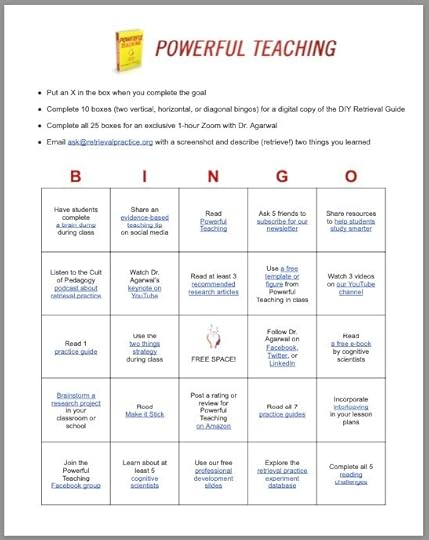
NEW: Play Powerful Teaching Bingo and receive an exclusive digital DIY Retrieval Guide. If you complete all the boxes, I’ll host a private 1-hour Zoom for your organization!
Watch my unboxing video from the first day I received the book
Watch the original book launch video (cringeworthy) and a never-before-released bloopers video
Download free templates and figures from Powerful Teaching
Keep reading to learn about how teachers have been using Powerful Teaching strategies around the world and how to join me for virtual and in-person professional development (with a free webinar in October!).
One more way you can help me celebrate: please consider posting an honest rating or review on Amazon for Powerful Teaching. It’s an awkward ask, but it makes a huge difference in getting the science of learning into the hands of educators. The more we can reach teachers, the more we can help those that matter most — our students.
Play Powerful Teaching Bingo Powerful Teaching in the making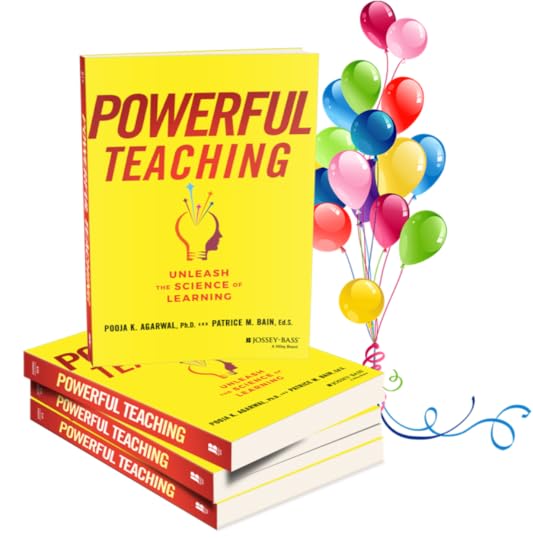
Powerful Teaching was first published in 2019, but did you know its history goes much further back? Here are some of the milestones:
2006: My co-author, Patrice Bain, and I met and started conducting groundbreaking research on retrieval practice in her classroom with my Ph.D. advisor (Henry L. Roediger, III) and the authors of
2008: I published my first peer-reviewed journal article on retrieval practice, examining open-book vs. closed-book quizzes (click here for all my research publications)
2010: Our research expanded into multiple classrooms and thousands of students in the entire public school district
2011: We published our research findings from Patrice’s classroom
2014: I launched my website and published on retrieval practice
2016: I started my newsletter, which has grown beyond anything I could have imagined
2019: Powerful Teaching was published!
Patrice and I started formally writing Powerful Teaching around 2017, but our collaboration has spanned nearly 20 years. Fast forward to today and Patrice just published her newest book, Powerful Classrooms. In her book, Patrice curates stories and strategies that educators around the world have been developing and implementing to improve students’ long-term learning.
I’m excited for Patrice’s new adventures and I’m thankful for our long friendship, which is captured in our never-before-released bloopers video from our book launch.
For even more fun, play my new Powerful Teaching Bingo. If you complete two bingos, receive an exclusive digital version of the DIY Retrieval Guide with discussion questions. If you complete all 25 bingo boxes, I’ll host a free private 1-hour Zoom for you and your organization!
Has my book been helpful in transforming your teaching and your students’ learning? Join educators like you and rate or review Powerful Teaching on Amazon. These 5 years have been so meaningful for me and it really means a lot to have your support!
Rate Powerful Teaching on Amazon Powerful professional development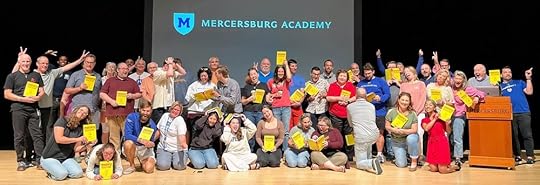
I love visiting schools. This year, I’ve been fortunate to share the science of learning in person and via Zoom with K–12 schools, universities, ed tech developers, and non-profits. I thrive on the energy that educators bring to our discussions and I always get inspired with new ideas.
One example is this newsletter from Mercersburg Academy, where Julie Maurer (Associate Head of School) curates evidence-based tips for her school. She includes research from , resources from The Learning Scientists, and practical classroom strategies. Mercersburg Academy hosts a Summer Institute each year, so check their website for more info about the 2025 institute. Do you write a newsletter about the science of learning for your school? Let me know!
If you’re interested in a virtual or in-person keynote or workshop with me, send an email to ask@retrievalpractice.org for pricing and availability. I have only 3 spots remaining for customized virtual PD in 2024, and I’m already booking virtual and in-person events for 2025.
I recognize that budgets for professional development can be limited. That’s why I’m hosting a free webinar this fall! Learn about the science of learning, energize your teaching, and see first-hand how to make professional development interactive and memorable.
Save the date for my free webinar:
Wednesday, October 23 at 5:00pm ET


July 25, 2024
Re-designing a course? Get creative with these reflection questions
By Pooja K. Agarwal, Ph.D.
Oh. My. Gosh. I love course design. In my book, resources, and talks, I’ve always focused on low-prep, low-stakes strategies you can use to boost students’ long-term learning. But I’ve never written about the big picture: how to design (or re-design) an entire course.
Inspired by recent conversations with my teacher-friends, I’d like to share three tools to help you re-design a course for the new school year:
Reflection questions to move beyond “what worked and what didn’t”
A subscribers-only Zoom party on Friday, August 9 (subscribe here for more info)
A reflection Google Form to request specific feedback for your course
It can be exciting—and daunting—to design assignments, lectures, projects, presentations, grading structures, and assessments. Join me and educators from around the world as we exchange new ideas to transform your course into a rewarding learning experience for you and your students.
P.S. Did you know that I have a YouTube channel at youtube.com/@retrievalpractice? I’ve curated hundreds of videos on teaching, learning, studying, and research by cognitive scientists.
Reflection questions for course re-design
Photo credit: No Revisions via Unsplash
Throughout my 15 years of writing and speaking with educators, I’ve been a big advocate of brief activities to implement retrieval practice and research-based learning strategies. One thing that didn’t dawn on me until recently was how much I love course design – the big picture of learning objectives, readings and assignments, projects and presentations, grading structures, attendance and deadline policies, and more. For me, course design is like a big jigsaw puzzle and it’s so satisfying when everything just fits.
During the summer break, I spend a few weeks unwinding from the hectic school year with sleep, exercise, TV, travel, and read (click here for my summer reading challenges). At this point in the summer, my teaching cap is back on, with a lot of energy spent on how I can make my courses even better before the fall. To get me started, I always revisit one of my favorite books about course design, On Course by James Lang. In his book Small Teaching, Lang highlights small, quick, and practical strategies for retrieval practice.
Summer is a perfect time to ideate and create. Once you pick a specific course to re-design, it’s easy to reflect on what went well and what didn’t go well (what I call “course remorse”). Here are additional questions to engage in deeper reflection:
What is a lesson or activity that is particularly memorable for you? Why does it stand out?
What is an aspect of your course that frustrates you? (lecture slides, a course policy, assignment requirements, etc.)
What is something specific you love about your course? What would you adjust to love it even more?
Ponder three things: what is something you want to start doing in your course, something you want to stop doing, and something you want to keep doing?
Note that these questions are not about your students’ thoughts on your course. These questions emphasize what you find frustrating and what you enjoy about your course. Keep in mind that you can re-design parts of your course that are already going well, too.
Join our Zoom Party on August 9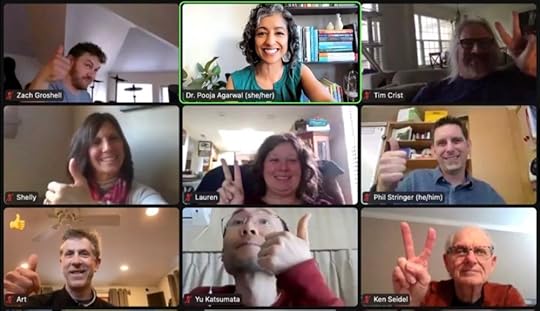
Whether you’re a K–12 educator or in higher ed, you might find course ideas on social media, from colleagues, and/or a teaching center on your campus. But how often do you get the opportunity to share what works for you and learn what works for others from a brand new community of educators like you?
Back by popular demand, I’ll be hosting a Zoom Party on Friday, August 9 between 5:00pm - 6:30pm eastern (EDT), exclusively for newsletter subscribers. Not a subscriber? Sign up for my newsletter to receive the Zoom link.
Last summer, hundreds of educators from around the world joined me in chatting about research, teaching, study strategies, neuromyths, and more. The informal vibe led to lasting friendships, with many of us meeting up in person and keeping in touch (Hi Shelly!).
Join me and get some fresh ideas beyond your usual sounding board. Here’s how the Zoom Party works:
Live, informal, and un-recorded
Stop by any time and stay for as long (or as little) as you’d like
You can share ideas, be a wallflower, or anything in between
No need to RSVP, but I recommend completing our “pre-reflection” Google Form for specific feedback on your course
Note: Because we’ll be focusing on course design (lectures, grading structures, course policies, etc.), this Zoom Party may be most helpful for high school, college, and graduate school educators, but all are welcome to join.
When: Friday, August 9 from 5:00pm – 6:30pm eastern time (EDT)
Zoom link: Subscribe to my newsletter for access
Google Form for pre-reflection: https://forms.gle/ggWE18EZCY2C2wWP9 (optional)
Can’t attend the Zoom Party, but interested in a virtual workshop? Email me at ask@retrievalpractice.org for more information.
April 29, 2024
Switch from reviewing to retrieving in 5 minutes or less
By Pooja K. Agarwal, Ph.D.
It’s exam time. Are you holding review sessions for your students?
Here’s how to switch your review sessions to *retrieve* sessions with a 5-minute brain dump.
This is one of the simplest switches you can make from getting information into students’ heads to getting information out of students’ heads. Reduce anxiety, increase confidence, improve metacognition, and boost students’ memory for course material beyond their final exam.
P.S. Are you wrapping up your end-of-school budget? I hope you’ll consider purchasing my book, Powerful Teaching! Email me (ask@retrievalpractice.org) for information about a bulk discount.
Lesson plan for a quick brain dump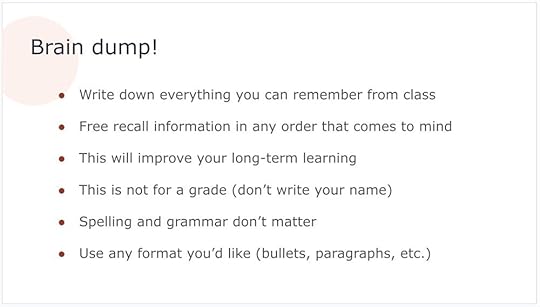
It’s the end of the school year and students are going to cram. Why? Because it works. As decades of research demonstrate, cramming improves learning in the short-term, but it leads to forgetting in the long-term (download my practice guide PDF for more info, which I co-wrote with cognitive scientist Dr. Shana Carpenter).
As I like to point out, easy learning leads to easy forgetting. Think about your own experience in high school and college: you would anxiously cram for an exam, get a good grade, and then forget everything.
Even though students are going to cram, how can you make review sessions more productive? Turn them into “retrieve sessions” with a brain dump. Known as “free recall” in the scientific literature, my colleagues and I have published research on the benefits of brain dumps: they’re a simple activity for retrieval practice, they help students organize their knowledge, and they improve metacognition (how students think about their own learning). Brain dumps boost learning for a wide range of grade levels and content areas, too.
Here’s my lesson plan:
Hand out blank paper to students
Go through some basic instructions: write down everything you can remember, this is ungraded, and use any format you like
Give students 5 minutes to write silently
You’re done! No need to follow up with a class discussion; simply launch into your review session as planned. Your students will already have a sense of accomplishment, and a better sense of what they do (and don’t) need to cram.
Tips for a successful brain dumpUsing blank paper provides students with space to draw and retrieve concept maps without worrying about complete sentences, handwriting, spelling, or formal punctuation (check out more research on concept maps by Dr. Janell Blunt).
Instead of an anxiety-provoking countdown or alarm, my students love this radial timer (I embed the YouTube video in my Google Slides with the audio muted).
You can simply move on after the brain dump, follow it with think-pair-share (don’t skip the think step), or include it in a fun activity I developed called Leave One Add One.
Check out my tips when students can’t retrieve anything (they can retrieve something, I promise).
Incorporate brain dumps earlier in the semester or school year so that your students will be familiar with ungraded retrieval practice and they’ll know what to expect.
Don’t grade your students’ brain dumps; don’t even collect them. Keep the big picture goal in mind: brain dumps are a learning strategy, not an assessment strategy.
Let your students keep the brain dump as notes and encourage them to use brain dumps as a study strategy to boost their learning independently at home.
March 8, 2024
Inclusive resources to level up your science of learning initiatives
Happy International Women’s Day, everyone! 🎉
I’m a scientist and I love science. But when it comes to inclusion in science, there are many systemic problems. For example, did you know that…
Women scientists are cited less often than men
Women scientists are underrepresented as senior authors on research publications and senior faculty at universities
Women scientists are underrepresented as invited speakers at conferences and professional development events
Whether you are an educator in K–12 or higher ed, here’s what you can do to amplify and advance women in STEM:
Update your citations with these 10 recommended research publications by women, BIPOC, and LGBTQ+ cognitive scientists
Invite cognitive scientists from underrepresented backgrounds to your schools and universities, as speakers for professional development, and as guests on your podcasts and blogs
I am proud of the much-needed and ongoing inclusion efforts in cognitive science. Continue reading to learn more about organizations who are leading the charge, research on inequities in STEM, and tips for what you can do to make the science of learning more inclusive and equitable for students, educators, and our communities.
I encourage you to also learn more about International Women’s Day. We’re in this together and we all need to celebrate women’s achievements, raise awareness about discrimination, and take action to support gender inclusion.
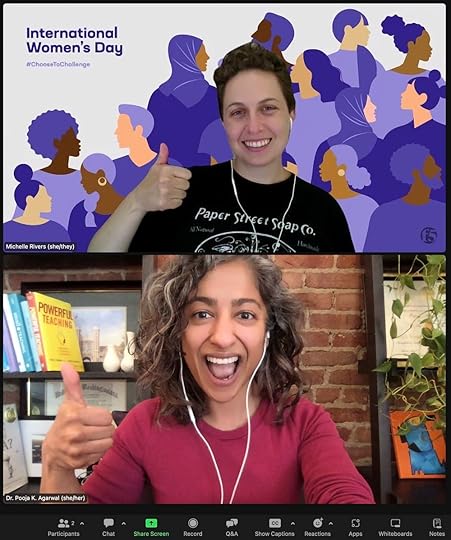 Celebrate inclusion in cognitive science!
Today, I had the pleasure of Zooming with my colleague and friend, Dr. Michelle Rivers. As always, our conversation was energizing, validating, and thought provoking.
In my newest publication, I reflect on the relationships and collaborations I’ve built across our growing community of women, BIPOC, and LGBTQ+ experts on retrieval practice research, including organizations such as SPARK and Women in Cognitive Science. These support systems are integral to my own professional development and science communication efforts, for which I am deeply grateful.
In addition, I continue to be inspired by the blog, podcast, and resources by The Learning Scientists, an all-woman team that dedicates their time and energy to sharing the science of learning with millions of people around the world. In their new publication, Turning Roadblocks into Speed Bumps, cognitive scientists Dr. Megan Sumeracki, Dr. Cynthia Nebel, Dr. Althea Kaminske, and Dr. Carolina Kuepper-Tetzel reflect on science communication, retrieval practice research, three specific “road blocks” they have encountered, and next steps in implementing evidence-based strategies with teachers and students.
On this International Women’s Day, take five minutes to download 10 recommended publications of recent research, and explore my list of 40 exceptional cognitive scientists.
I also encourage you to learn more about why inclusive citations are critical for women in STEM and how to contact a cognitive scientist near you.
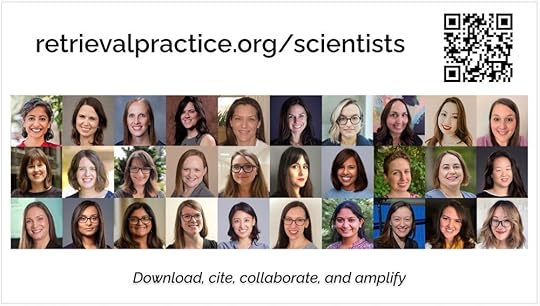 Learn more about women in cog sci
January 15, 2024
Worried about AI? Here are 8 flexible prompts for retrieval practice
Retrieval practice doesn’t require more class prep for us or ChatGPT for our students.
Here are 8 no-prep prompts for retrieval practice I’ve developed over my 10+ years of teaching for students to get information out of their heads without using AI. I’ve also included a variety of new resources I highly recommend.
P.S. Interested in virtual or in-person professional development for your school or organization this year? Email me at ask@retrievalpractice.org for more information!

Photo credit: Freepik
Flexible prompts to boost learning without AIYour students might be wondering: Why do I need to learn anything, when I can just look things up on Google, ChatGPT, etc.?
Yes, students are going to use AI and ChatGPT – including my students. And yes, students can look up information easily, but remind students that in order to think, they need to have something to think about.
Here are 8 flexible prompts you can customize for your students:
What would you like to remember about [topic]? Why is this important to you?
What was really memorable for you about [topic]? Why did it stand out to you?
What is one thing that’s surprising or confusing to you about [topic]?
What is one thing I didn’t ask you about [topic] that you learned?
What is an example of [topic] from your own life?
How does [topic] relate to your favorite TV show or movie?
What is a retrieval practice question I can ask the rest of our class? (create an open-ended question and share the answer to your own question)
What is a question you have about [topic] that you’d like to discuss during class? What do you hope to learn from the discussion?
Why these prompts are effectiveWhether you’re prepping a new course or you’ve been teaching for more than a decade, here’s why I recommend these prompts:
You can save yourself time because you don’t have to come up with new questions each week.
You can use them with a range of subject areas and course topics, including STEM, language arts, and foreign language classes.
You can use them for a range of grade levels, from K–12 to graduate school.
You can customize them for in class activities (entry or exit tickets), Canvas or LMS discussion boards, ed tech tools (Flip is a personal favorite), Google Forms, synchronous Zooms, etc.
You can reduce students’ reliance on ChatGPT because these prompts ask students about how class topics relate on a personal level. (The prompts aren’t AI fool proof, of course, so I recommend asking students for as much detail as possible in their responses.)
You can encourage students to use elaboration, an evidence-based strategy that takes retrieval practice to the next level (check out my 1-minute video on elaboration and this 3-minute video by The Learning Scientists).
Additional tipsIn my book Powerful Teaching and in my SXSW keynote, I shared additional no-prep activities, including brain dumps and two things.
My literature review of 50 classroom experiments indicates that there is no optimal amount or timing of retrieval practice, so embrace flexibility. Do what works best for you and your students.
Keep in mind that retrieval practice is a learning strategy, not an assessment strategy. Keep it low stakes!
Read FAQs about retrieval practice New resources about the science of learning!
Read: My new publication of personal reflections on science communication and the development of retrievalpractice.org
Watch: A new LinkedIn Learning course on the science of learning by cognitive scientist Dr. Janell Blunt
Listen: A new podcast episode by The Learning Scientists with a refresher on all their free resources
Read my new publicationMake class prep easy with 8 flexible prompts for retrieval practice
I’m creating a brand new course this spring semester for my college students. Yikes.
If you’ve created a course from scratch before, you know the feeling – the energetic sprint to plan everything in advance, but also the anxiety that class prep is going to eat up all your time for the next few months.
Here are 8 no-prep prompts for retrieval practice I’ve developed over my 10+ years of teaching. I’ve also included a variety of new resources I highly recommend. Good luck this spring!
P.S. Interested in virtual or in-person professional development for your school or organization this year? Email me at ask@retrievalpractice.org for more information!
Photo credit: Freepik
Flexible prompts to boost learningRetrieval practice doesn’t require more class prep. Here are 8 flexible prompts you can customize for your students:
What would you like to remember about [topic]? Why is this important to you?
What was really memorable for you about [topic]? Why did it stand out to you?
What is one thing that’s surprising or confusing to you about [topic]?
What is one thing I didn’t ask you about [topic] that you learned?
What is an example of [topic] from your own life?
How does [topic] relate to your favorite TV show or movie?
What is a retrieval practice question I can ask the rest of our class? (create an open-ended question and share the answer to your own question)
What is a question you have about [topic] that you’d like to discuss during class? What do you hope to learn from the discussion?
Why these prompts are effectiveWhether you’re prepping a new course or you’ve been teaching for more than a decade, here’s why I recommend these prompts:
You can save yourself time because you don’t have to come up with new questions each week.
You can use them with a range of subject areas and course topics, including STEM, language arts, and foreign language classes.
You can use them for a range of grade levels, from K–12 to graduate school.
You can customize them for in class activities (entry or exit tickets), Canvas or LMS discussion boards, ed tech tools (Flip is a personal favorite), Google Forms, synchronous Zooms, etc.
You can reduce students’ reliance on ChatGPT because these prompts ask students about how class topics relate on a personal level. (The prompts aren’t AI full proof, of course, so I recommend asking students for as much detail as possible in their responses.)
You can encourage students to use elaboration, an evidence-based strategy that takes retrieval practice to the next level (check out my 1-minute video on elaboration and this 3-minute video by The Learning Scientists).
Additional tipsIn my book Powerful Teaching and in my SXSW keynote, I shared additional no-prep activities, including brain dumps and two things.
My literature review of 50 classroom experiments indicates that there is no optimal amount or timing of retrieval practice, so embrace flexibility. Do what works best for you and your students.
Keep in mind that retrieval practice is a learning strategy, not an assessment strategy. Keep it low stakes!
Read FAQs about retrieval practice New resources about the science of learning! Read: My new publication of personal reflections on science communication and the development of retrievalpractice.org
Watch: A new LinkedIn Learning course on the science of learning by cognitive scientist Dr. Janell Blunt
Listen: A new podcast episode by The Learning Scientists with a refresher on all their free resources
Read my new publicationOctober 23, 2023
Here's how to request mid-semester feedback that's refreshingly helpful
Feedback helps us learn and grow as teachers, but it’s nerve-wracking. I’ve taught in the classroom for more than 10 years and I still feel tense before looking at students’ responses.
To make the process less nerve-wracking and more productive, I’ve created a new Google Form template you can use to request mid-semester feedback from students. Click here to view the template and click here to copy it directly to your Google Drive to edit the form (it will show up in your Google Drive as “Copy of Mid-Semester Feedback Template”).
For mid-semester feedback, use a “start, stop and keep” reflection approach – for you and your students. Ask students what they want you (the teacher) to start/stop/keep. But more importantly, ask students what they want to start/stop/keep for themselves and their own learning progress – an opportunity to engage students’ metacognition. The template also includes two open-ended retrieval practice questions to celebrate and strengthen students’ learning: “What is one thing you’ve learned in our class and why is it memorable for you?” and “What is one thing you’ve learned in a different class and why is it memorable for you?”
The reflection template is adaptable for grades 6+, including college students and graduate students, and it should take students no more than 5–10 minutes to complete. By using start/stop/keep as a reflection tool, combined with some simple retrieval practice, you can shift the vibe away from complaints and dislikes, and instead, toward celebrating students’ learning and accomplishments.
P.S. Do you use resources by my friends The Learning Scientists? They want your feedback! Click here to complete their brief survey.

Photo credit: Gratisography
Tips for requesting mid-semester feedbackTip #1: Keep the tone light hearted. Pitch this as a reflection tool, not a feedback survey. You can even add a meme to emphasize that this isn’t a course rating or evaluation form. The questions are simply for thinking through how things are going and what everyone can do collectively going forward. For my classes, I include the template questions as a section in the middle of one of my weekly Google Form mini-quizzes to give the vibe that the start/stop/keep reflection is nothing special or separate from our routine, and they can simply skip the section.
Tip #2: Keep the Google Form optional, including the two retrieval practice questions. You can add the Google Form to your LMS, email it to students, or give them a QR code to complete it on their phones outside of class. I discourage incentivizing responses with candy or points. The goal of this activity isn’t to get the most responses; the goal is to receive helpful responses. I’ve been using the start/stop/keep feedback strategy since 2016 and approximately 35% of my college students opt-in to provide responses (which is pretty good, in my book).
Tip #3: The Google Form does not have to be anonymous. When framed as a reflection tool, students feel more open to sharing how they’re doing and how they feel about the course. Plus, requesting help models your own learning from feedback as the teacher. By mid-semester, my students know that I always strive to improve my teaching, and that I genuinely take their feedback into account. When the form is non-anonymous, I’ve found that students are kinder in their language and more creative with their suggestions.
Tip #4: Share the feedback you received. The next time your class meets, share an aggregate of what students want to start/stop/keep for their own learning (my students often say they want to start arriving on time and stop procrastinating, which always gets a few laughs from the rest of class). You should also share the feedback you received about what you could stop/start/keep, ideally with at least one actionable step you will take to improve your teaching. Keep in mind that students who choose to respond are usually the ones who understand that changing the course structure mid-semester isn’t going to happen, so their suggestions are refreshingly realistic and practical.
Idea: A question I’d like to add in the future is to ask students what is something they like about how a different professor teaches. I rarely have the time to observe other teachers, so I’d love my students’ perspective on what works well in their other classes. Let me know if you try this out!
 Responses from my students
I included mid-semester feedback and reflection questions on my mini-quiz last week. Here are some responses I received: what students want me to start/stop/keep and what they want to start/stop/keep for themselves. I promise I didn’t exclude negative comments from the list below; I feel that the positivity and kindness from my students is a result of my class culture and the four tips above. Based directly on student reflections, I’ve made a number of changes to my courses over the years, with ideas I never would have thought of myself.
What my students want me (Dr. Agarwal) to start:
Pairing up small groups differently for discussions (e.g., by first letter of first/last name), that way we get to speak with different people every time.
I feel it would be neat to have a 5 or 10 minute period at the beginning of class for general questions about psychology, related or unrelated. Just a thought!
I would like you to tell me anytime when I’m not doing my best and give me some tips to improve my skills.
I would love to have more debates in class!
I would love to have a five minute stretching period or a five minute dance party. I believe it would help connect us all better.
What my students want me to stop:
I feel like the Retrieval Practice Google Forms (mini-quizzes) could be a little shorter. It does take some time for me to complete it.
I personally dislike the "3 sentences" for some of the more personal questions on the Retrieval Practices, as oftentimes, I find myself writing fillers as some of the psychological situations don't really apply to me. I believe people should have their own choice as to how much they want to write about their personal experiences. If they wish to expand, go ahead. Otherwise, if it doesn't really apply to them, I don't know how they're suppose to answer the question.
I think I would prefer if, instead of the Flips, we thought about the question at home and then discussed our opinions for a while in class.
This is a real thinker for me. Not to say there is such a thing as a perfect professor. I just am not able to think of something off the top of my head that I would want you to stop doing.
What my students want me to keep:
Everything. Keep showing us videos and articles, putting us into groups to discuss things, giving us a good amount of breaks, and opening our minds.
Keep the live captions! I like that I can read what you're saying off the board because it keeps me focused and also I have trouble hearing certain things, so I never miss any of the information.
I really think the retrieval practices are very effective and I do prefer them than tests. They're a very cool way for us to reflect on what we've learned and they also urge us to think critically about what we're reading about.
———
What my students want to start doing for themselves:
I wish to contribute more real-life examples, as I find those to be the most interesting for our class. I've been trying to think of some situations that my family and I have encountered and I'll try to draw on those.
I’m really doing my best but I would like to participate more and get an A.
Talking more in class, I feel like I could participate more.
I want to start eating beforehand, so I'm not super hungry throughout class.
What my students want to stop doing:
I want to stop talking too much. I don’t think I do, but I will try to keep a limit on how much I've contributed.
Checking my phone for no reason, it's just a really bad habit and most of the times I check it for no reason.
I want to stop thinking that what I have to contribute is not important. I catch myself not speaking in class or taking myself back because I get so nervous to speak in front of my peers.
Stop feeling tentative to speak up in class!
What my students want to keep doing:
Learning. Plain and simple.
Stay happy and hungrier to learn.
Keep showing up and learning!
I think for now I am making a good job with keeping all of the deadlines and retrieval practices, so I hope I will keep it that way until the end of the semester.
I have a specific homework schedule that I've only started to implement during this semester thanks to study tips in this class, so I'd like to keep that up.
August 28, 2023
Start these 3 classroom habits ASAP!
Arguably, the best habits are the ones we don’t think about. Start early and practice them often.
Here are 3 learning habits to establish in your classroom ASAP and more retrieval practice activities you should incorporate right now. Don’t wait until later in the semester — students already have a lot to remember and retrieve.
One thing I’m excited about: My college is switching to Canvas this fall. Email me with your favorite Canvas tips and tricks, and good luck on the start of the school year!
P.S. Are you located near Colorado? Join me on Saturday, September 30 at the Denver Museum of Nature & Science.
Photo credit: Keira Burton via Pexels
Three classroom habits to start ASAPHabit #1 (this isn’t related to retrieval practice; it’s just a personal favorite): Enable live captions or subtitles on Google Slides and Powerpoint! This is really easy, it supports universal design principles, and it improves accessibility for all students. There is some emerging research that captions and subtitles improve learning and motivation, too.
During presentation mode in Google Slides, the Mac keyboard shortcut is ⌘ + Shift + c (click for more info for Google Slides). During presentation mode in PowerPoint, simply press the letter J (click for more info for PowerPoint). I recommend positioning the subtitles at the top of the projection screen. Keep in mind that the captions are more accurate the closer you stand to your computer (I also use a bluetooth microphone in all my classes). The live captions might be distracting at first, but my students have given me very positive feedback!
Habit #2: Engage students in a brain dump or two things as an entry ticket or exit ticket. Spend one minute or less having students write down everything (or just two things) they remember from class. The key: Don’t grade it! Keep retrieval practice no-stakes to emphasize it’s a learning strategy, not an assessment strategy.
Habit #3: Always make time for the “think” step in think-pair-share. We often skip the think step, but that’s when the magic of retrieval practice takes place, before the pair and share.
Retrieval practice activities for the first day of class More resources and recent pressHow to teach a good first day of class by James Lang (author of Small Teaching) via Chronicle of Higher Education (subscription required)
How to learn something new every day via Vox
Today I Learned via Bored Panda
My recent podcast interview with Teaching in Higher Ed
Register for my keynote talk on Saturday, September 30 at the Denver Museum of Nature & Science
July 18, 2023
Here are five reading challenges to learn about learning

Photo credit: wayhomestudio via freepik
Great teachers are always thinking about how to improve their teaching, and implementing evidence-based strategies in the classroom is critical. Here are five reading challenges to encourage you to learn about the science of learning.
Important: make sure you remember what you learn! Engage yourself in retrieval practice and retrieve two things after each book, practice guide, and research article you read. Share your two things with our communities on Twitter and Facebook, make a list of what you’ve learned to boost your long-term learning, and let me know which reading challenge you complete. Happy reading!
Reading challenge #1 (beginner): Read one bookFor an introduction to the science of learning:
I hope you have my book, Powerful Teaching, on your reading list. My co-author and I share more than 20 years of research expertise and 25 years of teaching experience to bring you the most powerful and practical classroom strategies to transform learning.
Have you already read Make it Stick and Small Teaching? Here are 16 more books on the science of learning to add to your list.
Make sure to check out the newest book on the science of learning by The Learning Scientists, Ace That Test
To level up your reading:
Read my 7 free practice guides on the science of learning, with practical tips to implement retrieval practice, spacing, interleaving, metacognitive strategies, and more.
Read a free e-book on the science of learning, co-written by nearly 100 cognitive scientists. Challenge yourself by reading at least three chapters (it’s a whopping 538 pages in total).
Here are my two recommended articles for learning about retrieval practice research in schools – I challenge you to read just one.
Read my literature review in Educational Psychology Review to get caught up on all the retrieval practice research that’s been conducted in authentic classroom settings. (click here for a summary)
Read my research article in the journal JARMAC on how high school students study and why retrieval practice reduces test anxiety.
Read 10 recommended journal articles written by women, BIPOC, and LGBTQ+ cognitive scientists.
Read 37 research articles from my literature review on retrieval practice (click here for tips on how to access research articles)
Read 40 research articles by these featured cognitive scientists (links in each profile)
As of today, RetrievalPractice.org includes more than 100 teaching resources based on the science of learning – all by scientists you can trust, all with practical classroom tips, all free. If you complete all 5 reading challenges, email me and let me know!
Here are five reading challenges to learn about learning this summer
Photo credit: wayhomestudio via freepik
While you’re getting some much-deserved rest and relaxation this summer, I’m sure you’re also thinking about how to improve your teaching for the upcoming school year. Here are five summer reading challenges to learn about the science of learning.
Important: make sure you remember what you learn! Engage yourself in retrieval practice and retrieve two things after each book, practice guide, and research article you read. Share your two things with our communities on Twitter and Facebook, make a list of what you’ve learned to boost your long-term learning, and let me know which reading challenge you complete. Happy reading!
Reading challenge #1 (beginner): Read one bookFor an introduction to the science of learning:
I hope you have my book, Powerful Teaching, on your summer reading list. My co-author and I share more than 20 years of research expertise and 25 years of teaching experience to bring you the most powerful and practical classroom strategies to transform learning.
Have you already read Make it Stick and Small Teaching? Here are 16 more books on the science of learning to add to your list.
Make sure to add a new book on the science of learning to your summer list, Ace That Test by The Learning Scientists!
To level up your summer reading:
Read my 7 free practice guides on the science of learning, with practical tips to implement retrieval practice, spacing, interleaving, metacognitive strategies, and more.
Read a new free e-book on the science of learning, co-written by nearly 100 cognitive scientists. Challenge yourself by reading at least three chapters (it’s a whopping 538 pages in total).
Here are my two recommended articles for learning about retrieval practice research in schools – I challenge you to read just one.
Read my literature review in Educational Psychology Review to get caught up on all the retrieval practice research that’s been conducted in authentic classroom settings.
Read my research article in the journal JARMAC on how high school students study and why retrieval practice reduces test anxiety.
Read 10 recommended journal articles written by women, BIPOC, and LGBTQ+ cognitive scientists.
Read 37 research articles from my literature review on retrieval practice (click here for tips on how to access research articles)
Read 40 research articles by these featured cognitive scientists (links in each profile)
As of today, RetrievalPractice.org includes more than 100 teaching resources based on the science of learning – all by scientists you can trust, all with practical classroom tips, all free. If you complete all 5 reading challenges, email me and let me know!