
Jennifer Bohnhoff's Blog, page 24
August 28, 2021
Horses from History: Man o' War
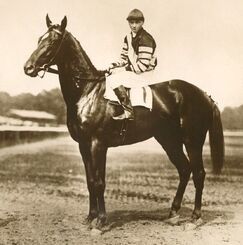 Even though he never ran the Kentucky Derby, Man o' War is perhaps the most famous thoroughbred race horse of all time.
Man o' War was born in March of 1917. He was named for his owner, August Belmont, Jr., who joined the United States Army soon after the colt's birth. Belmont was 65, but World War I had inspired him to serve overseas, in France, despite his age.
Man o' War, who was also called Big Red, won an amazing 20 of his 21 races. His only loss was, ironically, against a horse named Upset, and came after a bad start, where he was reportedly facing the wrong way when the starter raised the tape.
The talented horse never ran the Kentucky Derby because his owner, Samuel Riddle, thought that the spring weather in Kentucky was too unpredictable. Considering that it has snowed on Derby day more than once, he may have had a point. In 1989, the race time temperature in Louisville was 43 degrees, a little cool for a horse to run 1 ¼ miles without straining his muscles.
After his racing career, Man o’ War was put out to stud. He sired many famous racehorses, including the 1929 Kentucky Derby Winner Clyde Van Dusen and War Admiral, who won the Triple Crown in 1937. Another of his progeny, Hard Tack, became the father of Seabiscuit, the small horse that came to symbolize hope during the Great Depression.
Man o’ War died in November of 1947 at the age of 30, which is advanced for a horse. His body was embalmed, then placed in a giant, custom-made casket. It took 13 men to carry the 1,200 pound horse to his grave. His death was reported in The New York Times with the kind of pomp that was usually reserved for celebrities and politicians.
 Jennifer Bohnhoff is a former educator who is now devoting her time to writing historical fiction. Her next book, A Blaze of Poppies, will be published in October 2021 and tells the story of a female rancher from New Mexico and her experiences as a nurse during World War I.


August 25, 2021
For the Fallen
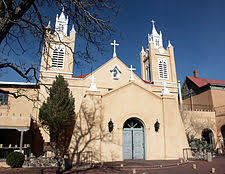 Laurence Binyon was in his 40s when World War I broke out. He'd never seen battle, and like many naïve and romantic people, he didn't understand the devastation that was to come. Binyon wrote this poem just a month into the war, while sitting on a cliff overlooking the sea in Cornwall. Later he would sign up to be an orderly with the Red Cross. His brief stint in a hospital in France changed him, and his poetry, significantly.
In early September I will feature another Binyon poem. I think it would be interesting for readers to compare them.
For the Fallen
By Laurence Binyon
With proud thanksgiving, a mother for her children,
England mourns for her dead across the sea.
Flesh of her flesh they were, spirit of her spirit,
Fallen in the cause of the free.
Solemn the drums thrill; Death august and royal
Sings sorrow up into immortal spheres,
There is music in the midst of desolation
And a glory that shines upon our tears.
They went with songs to the battle, they were young,
Straight of limb, true of eye, steady and aglow.
They were staunch to the end against odds uncounted;
They fell with their faces to the foe.
They shall grow not old, as we that are left grow old:
Age shall not weary them, nor the years contemn.
At the going down of the sun and in the morning
We will remember them.
They mingle not with their laughing comrades again;
They sit no more at familiar tables of home;
They have no lot in our labour of the day-time;
They sleep beyond England's foam.
But where our desires are and our hopes profound,
Felt as a well-spring that is hidden from sight,
To the innermost heart of their own land they are known
As the stars are known to the Night;
As the stars that shall be bright when we are dust,
Moving in marches upon the heavenly plain;
As the stars that are starry in the time of our darkness,
To the end, to the end, they remain.
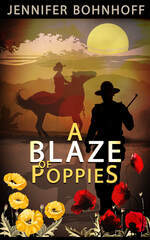 A Blaze of Poppies, Jennifer Bohnhoff's novel about New Mexicans involved in World War I, will be published in October and is now available for presale on Amazon.
August 24, 2021
Break of day in the trenches
The darkness crumbles away.
It is the same old Druid Time as ever.
Only a live thing leaps my hand,
A queer sardonic rat,
As I pull the parapet’s poppy
To stick behind my ear.
Droll rat, they would shoot you if they knew
Your cosmopolitan sympathies.
Now you have touched this English hand
You will do the same to a German
Soon, no doubt, if it be your pleasure
To cross the sleeping green between.
It seems, odd thing, you grin as you pass
Strong eyes, fine limbs, haughty athletes,
Less chanced than you for life,
Bonds to the whims of murder,
Sprawled in the bowels of the earth,
The torn fields of France.
What do you see in our eyes
At the shrieking iron and flame
Hurled through still heavens?
What quaver—what heart aghast?
Poppies whose roots are in man’s veins
Drop, and are ever dropping,
But mine in my ear is safe –
Just a little white with the dust.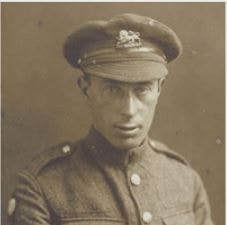 Isaac Rosenberg
1890-1918
Image © The Imperial War Museum & The Isaac Rosenberg literary estate
It is the same old Druid Time as ever.
Only a live thing leaps my hand,
A queer sardonic rat,
As I pull the parapet’s poppy
To stick behind my ear.
Droll rat, they would shoot you if they knew
Your cosmopolitan sympathies.
Now you have touched this English hand
You will do the same to a German
Soon, no doubt, if it be your pleasure
To cross the sleeping green between.
It seems, odd thing, you grin as you pass
Strong eyes, fine limbs, haughty athletes,
Less chanced than you for life,
Bonds to the whims of murder,
Sprawled in the bowels of the earth,
The torn fields of France.
What do you see in our eyes
At the shrieking iron and flame
Hurled through still heavens?
What quaver—what heart aghast?
Poppies whose roots are in man’s veins
Drop, and are ever dropping,
But mine in my ear is safe –
Just a little white with the dust.
Isaac Rosenberg1890-1918
Image © The Imperial War Museum & The Isaac Rosenberg literary estate
August 21, 2021
Treasures from the National World War I Museum
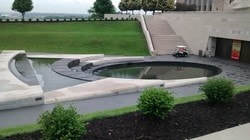
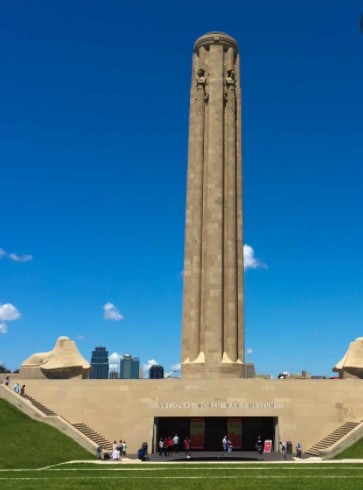
If you have never been to the National World War I Museum and have any interest at all in the Great War, you need to put this place on your bucket list. Located in Kansas City, this site looks like a war memorial on the outside. It has reflecting pools, somber statuary, and a tall tower. It is a quiet place that has the dignity and gravitas of a cemetery.
The museum itself if located below the monument, and it is filled with wonderful, interactive exhibits and enough information and artifacts to make your head spin. When I went to this museum, way back in May 2015, I had no plans to write a novel about World War I. I can’t say that this visit is the sole reason I wrote Blaze of Poppies, but it certainly contributed to it. There were so many things to think about. Here are three that didn’t make it into the book, but I find very interesting.

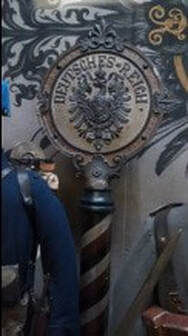 This is an Imperial German Border sign. Made of painted cast iron, a series of these marked the border between Germany and France.
Compare it to the shoulder of the uniform on the left edge of this picture, and you realize how large it is.
In August of 1914, an elite French strike force penetrated the border on the southern flank of the engagement and captured many of these.
It’s so much more beautiful than the signs I see along the highway marking borders these days. 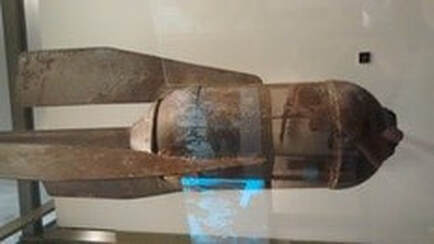 This is a ML 9.45-inch Heavy Trench Mortar. It was about five feet long, weighed two hundred ninety-eight pounds, was shaped like a pig, which is why it was sometimes called the ‘Flying Pig.’ It was also called a ‘Sausage,’ a ‘Rum Jar’ and ‘Minnie.’” These mortars were used by French, Belgian, and U.S. troops and had a range of 490 yards, which means they were useful when enemy lines were close.
Kind of gives new meaning to the phrase "When pigs fly."
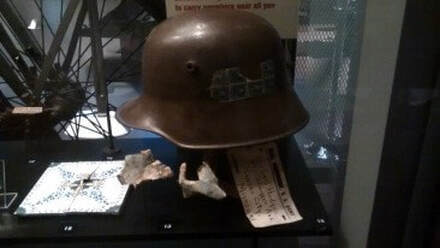 But this was my favorite display of all. Someone, I know not who, sent this Austrian helmet home as a souvenir to someone who lived in Kansas City. He didn't package the helmet in a box. He just a tag with an address and stuck stamps directly to the helmet.
When I was a kid and lived in Hawaii, we did pretty much the same thing with coconuts. We used a marker to write the address on the husks, stapled stamps to it, and off it went!
People were always delighted to get a coconut in the mail. I'm willing to guess whoever got this helmet got a chuckle out of how it was sent. Jennifer Bohnhoff' is a novelist who lives in the mountains of central New Mexico. Her novel A Blaze of Poppies tells the story of a young rancher willing to do anything, even go to war, to keep her ranch in the borderlands near the New Mexico- Mexico border during the WWI years. It will be published in October 2021. You can preorder a copy now.
The museum itself if located below the monument, and it is filled with wonderful, interactive exhibits and enough information and artifacts to make your head spin. When I went to this museum, way back in May 2015, I had no plans to write a novel about World War I. I can’t say that this visit is the sole reason I wrote Blaze of Poppies, but it certainly contributed to it. There were so many things to think about. Here are three that didn’t make it into the book, but I find very interesting.
This is an Imperial German Border sign. Made of painted cast iron, a series of these marked the border between Germany and France. Compare it to the shoulder of the uniform on the left edge of this picture, and you realize how large it is.
In August of 1914, an elite French strike force penetrated the border on the southern flank of the engagement and captured many of these.
It’s so much more beautiful than the signs I see along the highway marking borders these days.
This is a ML 9.45-inch Heavy Trench Mortar. It was about five feet long, weighed two hundred ninety-eight pounds, was shaped like a pig, which is why it was sometimes called the ‘Flying Pig.’ It was also called a ‘Sausage,’ a ‘Rum Jar’ and ‘Minnie.’” These mortars were used by French, Belgian, and U.S. troops and had a range of 490 yards, which means they were useful when enemy lines were close.Kind of gives new meaning to the phrase "When pigs fly."
But this was my favorite display of all. Someone, I know not who, sent this Austrian helmet home as a souvenir to someone who lived in Kansas City. He didn't package the helmet in a box. He just a tag with an address and stuck stamps directly to the helmet. When I was a kid and lived in Hawaii, we did pretty much the same thing with coconuts. We used a marker to write the address on the husks, stapled stamps to it, and off it went!
People were always delighted to get a coconut in the mail. I'm willing to guess whoever got this helmet got a chuckle out of how it was sent.
Jennifer Bohnhoff' is a novelist who lives in the mountains of central New Mexico. Her novel A Blaze of Poppies tells the story of a young rancher willing to do anything, even go to war, to keep her ranch in the borderlands near the New Mexico- Mexico border during the WWI years. It will be published in October 2021. You can preorder a copy now.
August 17, 2021
A Poem to Lead Men Into Battle
When I first began plotting out a novel set in World War I, it was tentatively entitled Agnes Goes to War. Then I came across this poem, and it moved me enough that I retitled the novel The Destined Will, used this poem as a preface, and named my lead male character Will. Two different critique partners suggested that the title wasn't inspiring and that readers wouldn't bother with a poem so long at the beginning of a novel, so I dropped both, and the novel became A Blaze of Poppies. 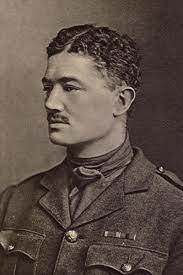 Julian Grenfell's parents were members of the Victorian high-society group called “the souls.” He attended Oxford's Eton and Balliol Colleges where he was known as a superb athlete and sportsman. He excelled at boxing and steeplechase, but most loved to take his greyhound hunting. Like many aristocrats of his time, he sketched and wrote poetry.
Grenfell joined the Royal Dragoons in 1910. He served in India and, after the outbreak of World War I, transferred to France, where he received a Distinguished Service Order and refused a staff position in order to continue fighting.
On May 13, 1915 during the Battle of Ypres, Grenfell volunteered to run messages during a heavy bombardment. He was seriously wounded when a shell splinter struck his head, and died in a Boulogne military hospital thirteen days later. 'Into Battle' was published alongside his obituary in The Times. Into Battle by Julian Grenfell The naked earth is warm with Spring,
And with green grass and bursting trees
Leans to the sun's gaze glorying,
And quivers in the sunny breeze;
And life is Colour and Warmth and Light,
And a striving evermore for these;
And he is dead who will not fight,
And who dies fighting has increase.
The fighting man shall from the sun
Take warmth, and life from glowing earth;
Speed with the light-foot winds to run
And with the trees to newer birth;
And find, when fighting shall be done,
Great rest, and fulness after dearth.
All the bright company of Heaven
Hold him in their bright comradeship,
The Dog star, and the Sisters Seven,
Orion's belt and sworded hip:
The woodland trees that stand together,
They stand to him each one a friend;
They gently speak in the windy weather;
They guide to valley and ridges end.
The kestrel hovering by day,
And the little owls that call by night,
Bid him be swift and keen as they,
As keen of ear, as swift of sight.
The blackbird sings to him: "Brother, brother,
If this be the last song you shall sing,
Sing well, for you may not sing another;
Brother, sing."
In dreary doubtful waiting hours,
Before the brazen frenzy starts,
The horses show him nobler powers; --
O patient eyes, courageous hearts!
And when the burning moment breaks,
And all things else are out of mind,
And only joy of battle takes
Him by the throat and makes him blind,
Through joy and blindness he shall know,
Not caring much to know, that still
Nor lead nor steel shall reach him, so
That it be not the Destined Will.
The thundering line of battle stands,
And in the air Death moans and sings;
But Day shall clasp him with strong hands,
And Night shall fold him in soft wings. A Blaze of Poppies is a novel set on a ranch in southwest New Mexico and in France during World War I. You can read more about Jennifer Bohnhoff, its author, here. Preorder A Blaze of Poppies here
Julian Grenfell's parents were members of the Victorian high-society group called “the souls.” He attended Oxford's Eton and Balliol Colleges where he was known as a superb athlete and sportsman. He excelled at boxing and steeplechase, but most loved to take his greyhound hunting. Like many aristocrats of his time, he sketched and wrote poetry.Grenfell joined the Royal Dragoons in 1910. He served in India and, after the outbreak of World War I, transferred to France, where he received a Distinguished Service Order and refused a staff position in order to continue fighting.
On May 13, 1915 during the Battle of Ypres, Grenfell volunteered to run messages during a heavy bombardment. He was seriously wounded when a shell splinter struck his head, and died in a Boulogne military hospital thirteen days later. 'Into Battle' was published alongside his obituary in The Times. Into Battle by Julian Grenfell The naked earth is warm with Spring,
And with green grass and bursting trees
Leans to the sun's gaze glorying,
And quivers in the sunny breeze;
And life is Colour and Warmth and Light,
And a striving evermore for these;
And he is dead who will not fight,
And who dies fighting has increase.
The fighting man shall from the sun
Take warmth, and life from glowing earth;
Speed with the light-foot winds to run
And with the trees to newer birth;
And find, when fighting shall be done,
Great rest, and fulness after dearth.
All the bright company of Heaven
Hold him in their bright comradeship,
The Dog star, and the Sisters Seven,
Orion's belt and sworded hip:
The woodland trees that stand together,
They stand to him each one a friend;
They gently speak in the windy weather;
They guide to valley and ridges end.
The kestrel hovering by day,
And the little owls that call by night,
Bid him be swift and keen as they,
As keen of ear, as swift of sight.
The blackbird sings to him: "Brother, brother,
If this be the last song you shall sing,
Sing well, for you may not sing another;
Brother, sing."
In dreary doubtful waiting hours,
Before the brazen frenzy starts,
The horses show him nobler powers; --
O patient eyes, courageous hearts!
And when the burning moment breaks,
And all things else are out of mind,
And only joy of battle takes
Him by the throat and makes him blind,
Through joy and blindness he shall know,
Not caring much to know, that still
Nor lead nor steel shall reach him, so
That it be not the Destined Will.
The thundering line of battle stands,
And in the air Death moans and sings;
But Day shall clasp him with strong hands,
And Night shall fold him in soft wings.
A Blaze of Poppies is a novel set on a ranch in southwest New Mexico and in France during World War I. You can read more about Jennifer Bohnhoff, its author, here. Preorder A Blaze of Poppies here
August 14, 2021
The Symbolism of Poppies
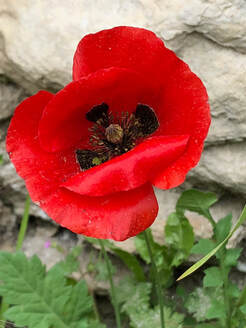 Fallaner, CC BY-SA 4.0 , via Wikimedia Commons Although poppies are the birthday flower for those born in August, they are most frequently associated with World War I and remembering the soldiers who died during that war. The use of poppies as symbols of death is far older than the early twentieth century. It stretches far back, into ancient times.
The ancient Greeks connected poppies with sleep because of the sedative nature of its sap. After her daughter Persephone was abducted by Hades, the gods gave Demeter, the goddess of harvest, a poppy to help her sleep. Afterwards, poppies sprang from Demeter’s footsteps. She transformed her mortal lover, Mecon, into a poppy.
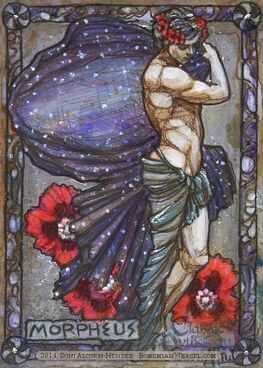 Morpheus, the Greek god of dreams, is frequently represented with poppies. The drug morphine, which is derived from poppies, got its name from Morpheus. Nyx, the god of night, is also associated with poppies. Hypnos, the god of sleep, and his twin brother Thanatos, the god of death, wore crowns of poppies.
 Death and sleep have been intertwined concepts for a long time. In the Bible, Daniel 12:2 describes the dead as "those who sleep in the dust of the earth.” Shakespeare has Hamlet compare sleep to death (line 72).
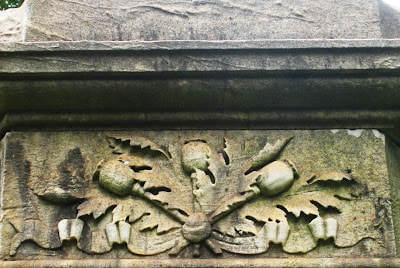
Victorians decorated tombstones with poppies representing eternal sleep.
 The association between poppies and sleep continues today. In The Wizard of Oz, Dorothy, Toto and two of her companions fall asleep crossing a field of poppies. In the movie version, the Witch of the West casts a spell over a poppy field. The book, however, explains that the field itself has the power to make cause sleep:
“They now came upon more and more of the big scarlet poppies, and fewer and fewer of the other flowers; and soon they found themselves in the midst of a great meadow of poppies. Now it is well known that when there are many of these flowers together their odor is so powerful that anyone who breathes it falls asleep, and if the sleeper is not carried away from the scent of the flowers he sleeps on and on forever. But Dorothy did not know this, nor could she get away from the bright red flowers that were everywhere about; so presently her eyes grew heavy and she felt she must sit down to rest and to sleep.” –L. Frank Baum, The Wizard of Oz Poppies became associated with World War I because of a poem written by a Canadian doctor who was stationed in Belgium during the war. Lieutenant Colonel John McRae wrote In Flanders Fields, which talks about the poppies growing among the new grave markers, on May 3, 1915 after officiating at the funeral of his friend and brother in arms, Alexis Helmer. His poem was published in Punch Magazine and became an instant sensation.
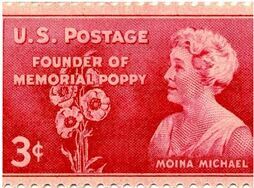 Moina Michael, an American working at the YMCA Overseas War Secretaries Office in New York, read the poem and was so moved that she vowed to wear a poppy on her lapel to honor the men who had died in war. She bought silk poppies for her colleagues, then lobbied to have the poppy adopted as a symbol of national remembrance.
At the same time, a French woman Anna Guérin was also promoting silk poppies. The director of the “American and French Children’s League,” Ms. Guérin adopted the poppy as the charity’s emblem. The charity provided war veterans, women, and children with fabric to make artificial poppies, which were then sold to help fund the rebuilding of war-torn regions of France and to assist orphaned children. In Britain, a similar campaign raised money to help Veterans in find employment and housing.
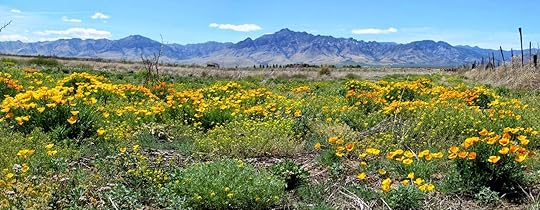 The poppies that grew in the fields of Flanders were blood red. The poppies that grow in Southern New Mexico, when my novel
A Blaze of Poppies
begins and ends, are the bright yellow Mexican poppy. Southern New Mexico is part of the Chihuahuan Desert, the largest desert in North America. It receives between six and sixteen inches of rain a year. When the spring rains come, parts of the dry, brown desert explode into fields of brilliant yellow poppies. If red poppies remind man of sleep, death, and remembering the dead, the bright Mexican poppies must surely symbolize the renewal of life in all its brilliance and hope.
The poppies that grew in the fields of Flanders were blood red. The poppies that grow in Southern New Mexico, when my novel
A Blaze of Poppies
begins and ends, are the bright yellow Mexican poppy. Southern New Mexico is part of the Chihuahuan Desert, the largest desert in North America. It receives between six and sixteen inches of rain a year. When the spring rains come, parts of the dry, brown desert explode into fields of brilliant yellow poppies. If red poppies remind man of sleep, death, and remembering the dead, the bright Mexican poppies must surely symbolize the renewal of life in all its brilliance and hope.Agnes Day, the main character in A Blaze of Poppies begins her story on a ranch in the dry New Mexican desert. It leads her to the field hospitals of France, where she witnesses the death and destruction of war first hand. But it is poppies that blaze the trail back to her beloved ranch. Jennifer Bohnhoff is a former history teacher who lives in the mountains of central New Mexico. Her novel A Blaze of Poppies is due out in October, 2021 and is currently available for preorder.
August 10, 2021
A Poem for a Horse
A Soldier’s Kiss 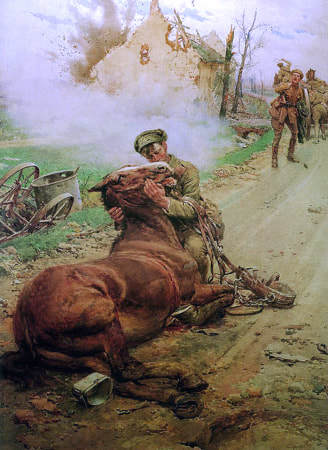 'Goodbye, Old Man,' by Fortunino Matania Only a dying horse! pull off the gear,
And slip the needless bit from frothing jaws,
Drag it aside there, leaving the road way clear,
The battery thunders on with scarce a pause.
Prone by the shell-swept highway there it lies
With quivering limbs, as fast the life-tide fails,
Dark films are closing o'er the faithful eyes
That mutely plead for aid where none avails.
Onward the battery rolls, but one there speeds
Heedlessly of comrades voice or bursting shell,
Back to the wounded friend who lonely bleeds
Beside the stony highway where he fell.
Only a dying horse! he swiftly kneels,
Lifts the limp head and hears the shivering sigh
Kisses his friend, while down his cheek there steals
Sweet pity's tear, "Goodbye old man, Goodbye".
No honours wait him, medal, badge or star,
Though scarce could war a kindlier deed unfold;
He bears within his breast, more precious far
Beyond the gift of kings, a heart of gold.
by Henry Chappell Known as the Railway Porter Poet because he worked at Bath Railway Station, Henry Chappell (1874 - 1937) is most known for a WWI poem entitled "The Day." A collection of his poems is available as a free download here.
Fortunio Matania (1881–1963) was an Italian artist noted for his realistic portrayal of World War I trench warfare and other historical scenes.
Jennifer Bohnhoff is a writer who lives in the mountains of central New Mexico. Her historical novel about World War I, A Blaze of Poppies, will be released this fall and is available for preorder.
'Goodbye, Old Man,' by Fortunino Matania Only a dying horse! pull off the gear,And slip the needless bit from frothing jaws,
Drag it aside there, leaving the road way clear,
The battery thunders on with scarce a pause.
Prone by the shell-swept highway there it lies
With quivering limbs, as fast the life-tide fails,
Dark films are closing o'er the faithful eyes
That mutely plead for aid where none avails.
Onward the battery rolls, but one there speeds
Heedlessly of comrades voice or bursting shell,
Back to the wounded friend who lonely bleeds
Beside the stony highway where he fell.
Only a dying horse! he swiftly kneels,
Lifts the limp head and hears the shivering sigh
Kisses his friend, while down his cheek there steals
Sweet pity's tear, "Goodbye old man, Goodbye".
No honours wait him, medal, badge or star,
Though scarce could war a kindlier deed unfold;
He bears within his breast, more precious far
Beyond the gift of kings, a heart of gold.
by Henry Chappell Known as the Railway Porter Poet because he worked at Bath Railway Station, Henry Chappell (1874 - 1937) is most known for a WWI poem entitled "The Day." A collection of his poems is available as a free download here.
Fortunio Matania (1881–1963) was an Italian artist noted for his realistic portrayal of World War I trench warfare and other historical scenes.
Jennifer Bohnhoff is a writer who lives in the mountains of central New Mexico. Her historical novel about World War I, A Blaze of Poppies, will be released this fall and is available for preorder.
August 7, 2021
Back to School: Cookies and Teachers
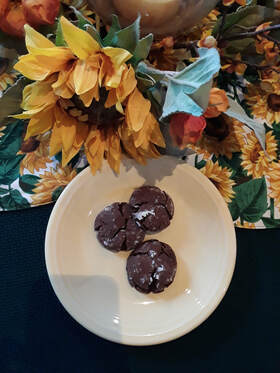 It’s August, which should mean high summer.
For many of us, though, school is starting. Here in the mountains of New Mexico, the sunflowers start to bloom about the same time the school bells start to ring, and the smell of chili roasting wafts on the air. All of these are signs that summer is on the wane and fall is coming.
These cookies really have a bit of a fall feel to them. The molasses gives them an earthy, satisfying taste that calls me home. Time to settle in and enjoy the last of the season before fall, with all its activities, starts again.
Molasses Chocolate Crinkles
½ cup (1 stick) butter, softened
½ cup molasses
½ cup cocoa
¼ cup sugar
1 tsp baking soda
1 tsp cinnamon
1 tsp vanilla
¼ tsp salt
1 ½ cups flour
Topping: ¼ cup powdered sugar
Heat oven to 350
Beat all ingredients except flour until mixed.
Add flout just until blended
Form into 1: balls and roll in sugar
Place 1” apart on cookie sheet
Bake 9-10 minutes until puffed and cracked.
Cool 1 minute before removing from cookie sheet.
 Over the years, there have been many outstanding teachers in the history of the USA. They worked to make the world a better place by improving the educational system and teaching practices. Their contribution changed the whole perception of education and shaped our society. Here are famous educators who have made a difference in the world.
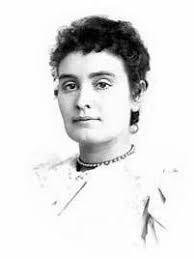
Anne Sullivan
Anne Sullivan reimagined special education, using her experience and natural pedagogical talent. She is famous for being a teacher of Helen Keller, a deaf and blind girl. Anne became her educator and eventually a friend. Being visually impaired herself, Sullivan knew what the girl was experiencing. It allowed her to choose special teaching techniques to help Hellen communicate with the world. Anne would take her hand and spell each word on the girl’s palm. This creative method proved to be effective, and soon, Hellen learned more and more words. With Anne’s help, Helen Keller became a well-known author, political activist, and the first blind-deaf person to earn a bachelor’s degree.
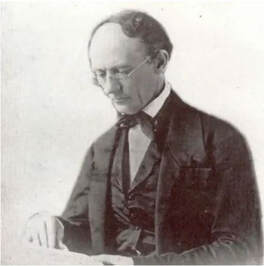
William McGuffey
William McGuffey was born in 1800 and was such a precocious child that he began to teaching classes at age 14. While teaching in Ohio and Kentucky, McGuffey saw that there was no standard method to teach students how to read; often, the Bible was the only book available.
McGuffey paused his teaching career to attend college himself. By age 26, he was Professor of Languages at Miami University in Oxford, Ohio. In 1835, his friend Harriet Beecher Stowe asked him to write a series of readers for the publisher Truman and Smith. McGuffey Readers, a series of books for elementary school students, was used in American schools for the next 70 years.
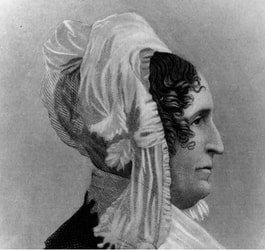 Emma Willard
Emma Willard made education accessible for women. She founded the first higher education institution for females in America, the Troy Female Seminary. The school still exists as the Emma Willard School. Emma Willard made the promotion of education her life-long aim. She fought for women’s rights to achieve higher education of the same quality as men could get. In her institution, female students studied science, mathematics, philosophy, and other subjects that were not previously available to them. Willard’s progressive outlook prioritized equality changed the perspective people had on education. Vivian Paley
Vivian Paley was a preschool teacher and the author of numerous books. She emphasized the importance of storytelling and play for the development of children. Paley believed that teachers who promoted fantasy and make-believe evoked the most interest in their students. She made her lessons memorable for students and encouraged them to express feelings and ideas in the classroom. Vivian Paley received numerous awards acknowledging her contribution to preschool teaching.
Sal Khan
Sal Khan tried to make education more accessible to people around the world. This American educator founded the Khan Academy, and online platform that granted people access to educational topics. It covers many different school subjects, including math, computing, history, and the arts. His use of technologies revolutionized education.
 Jennifer Bohnhoff taught English, Social Studies and History at the middle school and high school level. She is now retired so that she can devote her time to writing historical novels.
August 3, 2021
DULCE ET DECORUM EST
 Gassed, by John Singer Sergeant Bent double, like old beggars under sacks,
Knock-kneed, coughing like hags, we cursed through sludge,
Till on the haunting flares we turned our backs,
And towards our distant rest began to trudge.
Men marched asleep. Many had lost their boots,
But limped on, blood-shod. All went lame; all blind;
Drunk with fatigue; deaf even to the hoots
Of gas-shells dropping softly behind.
Gas! GAS! Quick, boys!—An ecstasy of fumbling
Fitting the clumsy helmets just in time,
But someone still was yelling out and stumbling
And flound’ring like a man in fire or lime.--
Dim through the misty panes and thick green light,
As under a green sea, I saw him drowning.
In all my dreams before my helpless sight,
He plunges at me, guttering, choking, drowning.
If in some smothering dreams, you too could pace
Behind the wagon that we flung him in,
And watch the white eyes writhing in his face,
His hanging face, like a devil’s sick of sin;
If you could hear, at every jolt, the blood
Come gargling from the froth-corrupted lungs,
Obscene as cancer, bitter as the cud
Of vile, incurable sores on innocent tongues,--
My friend, you would not tell with such high zest
To children ardent for some desperate glory,
The old Lie: Dulce et decorum est
Pro patria mori.
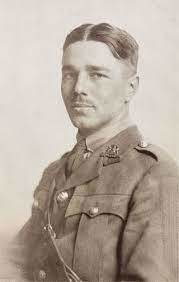 Wilfred Owen was a sensitive young man who considered joining the clergy. He volunteered to help the poor and sick in his parish until the tepid response of the Church of England to the sufferings of the underprivileged and dispossessed disillusioned him. He then taught in France for two years, returning to England and joining the army after the war began. Owen's first few letters home to his mother in the early winter of 1916 indicate that he was enamored with the glamor and excitement of war, but in less than a month reality had taken hold and he had seen enough. The events depicted in "Dulce et Decorum Est" occurred on January 12, 1917. By then, he was ready to deny Horace's Latin admonition to the Romans that it was sweet and good to die for one's country. Owen died on November 4, 1918, just days before the war ended.
  The memorial in front of where Wilfred's old school, Birkenhead Institute, once stood. 88 of its students, including Wilfred, died in WWI. Jennifer Bohnhoff's World War I novel, A Blaze of Poppies, will be published in October 2021. It can be preordered here.
July 31, 2021
Fort Bayard: Southern New Mexico Site
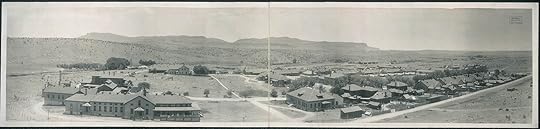 I've written about Fort Bayard's history before. You can read all about it here.
 Fort Bayard has been on my mind a lot lately. I had intended to go down and revisit it during spring break this year. Travel restrictions surrounding the COVID-19 pandemic put a stop to that. So, instead, I did as much research as I could online. I found some good information, but nothing is as good as actually being in a place.
Fort Bayard ceased to be a military post when the last detachment of the 9th U.S. Cavalry departed on January 12, 1900. That doesn't mean that the site was abandoned. The War Department had already issued an order issued on August 28, 1899 that authorized the Surgeon General to establish the first military sanatorium dedicated to the treatment of Army officers and enlisted men suffering from pulmonary tuberculosis. Major Daniel M. Appel, an Army surgeon, arrived at Fort Bayard on October 3, 1899 to organize the hospital.
Fort Stanton had undergone a similar conversion, becoming a sanatorium for tubercular merchant seamen in April 1899. Fort Stanton was transferred to the Department of Interior in 1896, and then to the U.S. Marine Hospital Service, a bureau within the Treasury Department, in 1899, Fort Bayard remained within the Army under the auspices of the Army Medical Department.
. The Spanish-American War. drove the need for sanatorium for the Army's soldiers and veterans. In the humid, tropics of Cuba, more soldiers succumbed to disease than enemy fire. Many soldiers serving in the Philippines returned with pulmonary disease. At 6,100 ft. and with a dry, sunny climate, Fort Bayard seemed a perfect place to restore health to diseased lungs. Fresh air and sunshine was considered so important to healing that patients who were ambulatory stayed outdoors at least eight hours daily throughout the entire year, and dormitory windows remained open. By March 1902, over 600 patients had been treated at the sanatorium.
World War I created another upsurge in the need for a hospital dedicated specifically to injuries and illnesses of the lungs. The cold, damp trenches of Northern France were breeding grounds for pneumonia, and gas warfare damaged thousands of dough boy lungs. The Great Influenza of 1918-19, often referred to as the Spanish Flu, also contributed to pulmonary disease.
By 1920, the Army involvement with medicine for veterans was changing. In May the War Department closed the sanatorium and transferred most of its corpsmen, physicians and patients to other facilities in an effort to consolidate services. Most patients were moved to Denver.
 Jennifer Bohnhoff lives in the mountains of central New Mexico and writes historical fiction. Her novel, A Blaze of Poppies, is set in Southern New Mexico and France during the 1910s. Some of the action takes place at Fort Bayard. Available October 2021, you can preorder this book now.


