Jason SurfrApp's Blog, page 22
October 4, 2015
Realize what you are selling is not for everyone
Years ago I remember letting these instincts drive my decisions. People would ask, “Jason, who is IWearYourShirt for? What type of companies should buy?” And I would reply, “It’s for everyone! Everyone should pay me to wear t-shirts!” There’s no doubt that IWearYourShirt could have attracted a very wide audience, but that doesn’t mean it should have. In fact, I believe that’s part of what led that business to eventually closing down. It wasn’t focused narrowly enough, and when you try to create something for everyone, you end up creating something for no one.
What I’ve come to learn over the years, through selling a lot of different things (sponsorships, courses, books, software), is that the products you are selling will have more success if you focus on these two things:
Thing #1: Making your customers badass
This is not my original idea. I’m borrowing it from Kathy Sierra who wrote a book titled Badass: Making Users Awesome. In the book, Kathy explains why your goal shouldn’t be to sell the benefits of your product or service, it should be to make your customers badass at whatever your product or service is supposed to help them do.
I applied this thinking to the smaller and more focused version of my sponsorship course, How To Get Sponsorships For Podcasts. The title of the course itself should say it all. If you have a podcast or are thinking about creating a podcast and you want to get sponsors for it, that course is made for you. It’s not a course that will help you get sponsors for your website, event, 5k run, etc. I drew a very clear line in the sand and on the sales page I focused heavily on explaining how sponsorships can bring revenue and legitimacy to your podcast. Both things that help podcasters feel badass.
The thing you are selling is not going to make everyone awesome. It just isn’t. And the more you focus on trying to please everyone, the less you’ll be able to create those 1,000 true fans (or 100 true fans, or 10 true fans!).
What product or service are you selling and how is that making your users badass? How is it making them a better photographer, Mom, freelancer, zoologist, professional snuggler (this is a real job people get paid for…)? What can you change right now on your sales page that focuses less on the features and more on the outcome a buyer should expect to see for themselves or their business?
Thing #2: Your customers should align with what you stand for
It’s easy to accept money from anyone. It’s really hard to say no to money once you understand that you need to surround yourself with the right customers.
I love the Jim Rohn quote:
“You are the average of the 5 people you spend the most time with.”
The same thinking applies for the customers you attract. If you are a happy-go-lucky person and you don’t dissuade pessimistic-debby-downers from buying your product, you will eventually start to dislike your business. Not because you dislike those people, but because your business and the people who have paid for it are not in alignment with who you are as a person.
Now, this doesn’t mean your business has to be touchy-feely if you are. It also doesn’t mean that your customers need to be your exact clones. It just means that you should be clear with who you want to surround yourself with crystal clear with who you don’t want to surround yourself with.
I am sure you can imagine what it would feel like if you had to constantly cater to and serve a group of customers that you didn’t see eye to eye with? The answer is: not good. And feeling not good would lead to you not enjoying running your business. Yes, we all need to make money so we can continue doing what we want to do in life, but not at the expense of loathing our businesses.
When I set out to sell my future with BuyMyFuture, I didn’t envision all the scenarios in which I would turn people away from giving me $1,000. But here are a couple of people I’ve specifically told not to pay me $1,000:
People who want to learn how to make money from passive income
People who want “work from home jobs”
People who aspire to be “lifestyle entrepreneurs”
People who ask if I have shortcuts and hacks to success
People who want to build up their real estate businesses
People who want guarantees that I’ll be creating stuff for them for 30-40 years
People who want me to tell them they’ll make their money back right away
People who aren’t willing to put in any work or effort on their own
People who hate unicorns (if you’ve seen the BuyMyFuture video, you’ll get this)
You may be thinking, “okay Jason, not making a few thousand dollars, that’s not a huge deal.” How about turning away 30+ buyers: $30,000+? That’s a pretty big deal, right? Well, that’s exactly how much money I’ve turned away in customers that weren’t right for BuyMyFuture.
I’ve learned my lessons, though. I’ve sold products to people who weren’t the right fit and who I couldn’t help become more badass. Making an extra chunk of money seems great, but the long-term effects those customers will have on my business, and more importantly, the effects those customers could have on the BuyMyFuture community? That is the more critical thing to worry about.
I recorded a short audio podcast that talks more about turning people away:
You should feel equally proud of what you sell as to who you sell it to.
For anyone reading this who is selling their first product or service, this is a hard thing to realize and understand. But if you have the luxury of realizing and understanding this idea early, you’ll be way ahead of the game (about 8 years ahead of me!).
If you’re a few years into your business, there’s still plenty of time to identify who you want to be selling for and finding more of those people. Who are your favorite existing customers? List out everything you know about them (or can find out about them) and search for the places where those people hang out. Also, be more clear on your sales page and with your sales copy to attract those types of (badass) people.
The post Realize what you are selling is not for everyone appeared first on Jason Does Stuff.


September 28, 2015
Know What It Takes

For those of you still with me, let’s get real.
Let’s talk about exactly what it takes to be successful and to feel true happiness.
There are people in this world that will tell you there’s a formula for success. That you can read one self-help book and learn the 13 Steps To Ultimate Riches and Happiness. You might even be able to find a podcast about becoming a millionaire in just 7 minutes per day. But the majority of the people creating those types of messages are doing one specific thing: Playing a psychological game with you and convincing you to buy/consume their substance-less product.
Now, of course, there are exceptions to this rule. There are people who create amazingly helpful content that can steer you in the right direction to building a business and a life that bring you true success and happiness. But rarely do those people pitch success and happiness as fame, fortune, etc.
I have reached a level of success and happiness that I am extremely proud of. Do I have a formula for you to follow? Do I have a simple set of steps that can be accomplished in one sitting? I do not. But what I do have is a set of tenets that have helped me, that continue to help me, and that I know will help you on your journey.
Let me be 100% clear: Saying that I have success does not mean I have a bank account overflowing with money. Success to me is defined by my values and if my life and business are in strong alignment with those values.
I believe the tenets I’m about to share with you apply to both life and business. These are not absolutes. These do not need to be read or followed in any step-by-step fashion. Some of these will even come and go. But these tenets are what it takes:
Effort
This is where it starts and this is the secret sauce. I do not know a single person who has poured countless amounts of effort into something and gotten zero results. Unfortunately results do not always equal money. Results can sometimes be important lessons that needed to be learned. Effort is necessary, and luckily for you, you are in complete control of how much effort you can put into your business and relationships. Effort is not limitless and should not be overused. You must take breaks from effort so that you can reflect, learn, iterate, and make changes.
Sacrifice
All success comes with sacrifice. A business is not created by magically adding three extra hours to the end of a 24-hour day. A relationship is not improved by staying exactly the same and making no changes. Sacrifices must be made to achieve success. Those sacrifices can come in many forms and can come at many unexpected times. But you must ask yourself when you’re staring potential sacrifices in the face, “does doing this help me or hinder me from achieving what I want?” Prepare yourself for sacrifices. They may be some of the most fulfilling things you can do.
Thick Skin
It is impossible to please everyone. Whether you’re putting your business out in the world or you’re putting yourself in front of new people, you will get turned down. You will get denied. You might even get harassed to some degree. Building up thick skin takes time. If you’re just getting started, unkind words will affect you. But the more you understand that the opinions of other people don’t matter if they aren’t in alignment with what you’re striving for in life, then the better off you will be.
A Vision
What is it that you are setting out to do in this world? Who are the people you want to surround yourself with? You don’t have to want to make an incredible change or impact on the world (you certainly can though). But you do need a vision. You need an idea. You need something that’s bigger than you. If you’ve never had something to strive for before, that’s okay. Start with something small. Work toward recognizing that vision. Once you can grasp it in your hands, find a new vision and work toward that one.
Support
You will need help. You will need someone by your side. Having support is a shortcut to overcoming obstacles and failures. Pride is a tricky thing. Asking for help can feel embarrassing and uncomfortable. But true growth comes after getting through uncomfortable moments. And even if you were to succeed by doing everything on your own, who would you share your success with it? Success is a drink much sweeter when shared.
Grit
It takes digging deep. It takes getting through rough patches. It takes hunkering down and not accepting things for the way they’ve always been. There will be pivotal moments. There will be times when you have extremely difficult decisions to make. Are you going to have what it takes to clench your fists and fight for what you believe in and want in life?
Consistency
You have to put in the work. You have to make it a priority to regularly and repeatedly take action. No one says you have to consistently do things well. No one says you have to be perfect. No one starts out doing everything the right way. You simply have to show up and show up often.
Authenticity
Be unapologetically you. It’s easy to copy the success of others. It’s easy to make money following the tactics of other people. But you won’t enjoy the rewards that come with copying and emulation. Unauthentic success is hollow success. You might not believe me if you haven’t experienced this for yourself before. But following the footsteps of others, and ignoring the uniqueness of your own footsteps, will lead you down a lonely path. Be true to who you are and don’t fight what separates you from the rest of the people in the world. Appreciate your difference.
“Very little is needed to make a happy life; it is all within yourself, in your way of thinking.” – Marcus Aurelius
Time, the fears of others, and the pressures of society skew our perspective. It’s up to us to use these tenets to correct the crooked lens through which we look at the world. These are just the building blocks. You must search within yourself to find the additional tenets that matter most to you and that need your attention.
The post Know What It Takes appeared first on Jason Does Stuff.
September 20, 2015
Learn To See Beyond Boundaries
During the recession of 2008, when companies were cutting back all spending, I decided it would be a good idea to ask people to pay me to wear a t-shirt everyday. Nearly everyone on this planet has purchased a shirt from a company and then walked around promoting that company without even really realizing it. I could have seen the recession as a boundary. I could have seen my lack of knowledge of social media or content creation (I didn’t even own a digital camera at the time) as a boundary. Heck, I probably should have seen the fact that I was a complete nobody living in a small relatively unknown town in Florida as a boundary.
But I refused to see any of those things as boundaries. I didn’t let any of them stop me in my pursuit of doing something that felt right to me.
We’ve all had those feelings in our gut. You know the ones:
This doesn’t quite feel right.
I’m meant for something bigger than this.
Why couldn’t I be the person that’s doing XYZ thing?
In 2008 I let those feelings start guiding my decisions. I stopped worrying about the fears and limitations set by other human beings (who are intrinsically no different than me). I started to give myself permission to chase down opportunities that I created for myself and that I alone had the audacity to try.
Most people don’t see divorce as a business opportunity. (Well, unless you’re a divorce lawyer I guess, then you are actually the only person on this planet that wants to hear about divorces). When my Mom went through a divorce a few years ago, it left me with a last name I no longer wanted. What do you do when you have to carry a name that doesn’t give you any meaning or sense of identity? During a difficult family conversation I remember trying to add a little levity and said, “what if I sold my last name??” A pretty outlandish thing to say, right? Well, it’s an even crazier thing to think that it could ever become a profitable business idea.
And then there’s the the book publishing industry. Most people would agree it’s broken. When I finally mustered up the courage to write my first book, I asked people who had already written books for their advice. Almost every single one of them said some variation of: “Jason, you won’t make money with a book as first time author, just use it as a marketing tool.” Even when I made the decision to try to get 204 companies to sponsor my book, I was selling something intangible that was difficult to explain (because it hadn’t been done before).
My point to these various stories is this:
You can accept boundaries and let them stop you from doing what you want to do, or you can look beyond them and see opportunities.
The phrase “this is how it’s always done” is not how things always have to be done. The first time I decided to look past a set of boundaries and trust my instincts, it was scary. It’s not easy doing things differently. It’s not easy standing out from the crowd. And it’s certainly not easy to execute unique ideas.
I am not an artist. I am not a musician. I don’t consider myself to have a skill set that is easily explained and confined in an easy-to-understand box. But I’ve come to embrace my un-confine-ability as one of, if not the strongest asset I have.
This is not a “How To” article. I don’t have 17 easy-to-do steps that can make you successful or better understand who you are as a person. However, I hope this article creates a small spark for you. I hope that it triggers something in you that helps you see opportunities beyond boundaries that are currently sitting in front of you.
No one is going to hand you a set of clearly defined directions that guide you to a successful future. The most fulfilling path in life is the one you create for yourself.
Listen to your instincts
Give your internal voice a shot. In fact, give it multiple shots. Trust yourself and see what happens. You won’t get it right every time by listening to your gut, but believe me when I say that the validation you get from trusting yourself is incredible.
Ignore fear
Fear is manifested. Unless you are trying to something you’ve already done before (with the exact same set of circumstances), you should do everything in your power to ignore fear. Understand that it exists in your mind, but don’t let it control you.
Stop searching for a magic bullet
Instead, search for all the magic bullets: Search for better people to surround yourself with. Search for inspirational moments. Search for the steps that lead you to a business and life that feels congruent to who you are. Search within yourself to figure out what really matters to you.
Start investing in yourself
When was the last time you actually invested in yourself? Whether that was a financial investment in helping you overcome a boundary in your life or a personal investment that increased your happiness and well-being?
If you give yourself the chances (and you’ll need more than one) to look beyond boundaries and see potential opportunities, the rewards will come. It may take time and effort, but things worth having always require time and effort.
The post Learn To See Beyond Boundaries appeared first on Jason Does Stuff.
September 13, 2015
Find Your Core Values
There I was, sitting in my cubicle, photoshopping reflections off of a cellophane package. A meaningful task, worthy of the graphic design degree I was seeking at the time. I got asked to go into my boss’s boss’s office and was promptly fired due to company restructuring.
This was the first moment it occurred to me that working for someone else might not be for me.
Let’s rewind the tape a bit. It was 2002. I had just turned 20 years old. I was going to college to get a degree in graphic design.
The job was a part-time design internship at an Internet coffee company. You did read that correctly, somehow I’d found a part-time internship AND probably one of the very first Internet coffee companies. I was, at least, paid for the hours I spent airbrushing gray smudges off of clear plastic photos of coffee gift bags. Oh, and I also worked some real design magic when I whipped up the weekly email newsletter with the “Coffee of the week!” I can still remember the halloween edition and how proud I was of the clip art bats I carefully placed around the Pumpkin Spiced Dark Roast.
After six-ish months of photoshopping coffee beans, mugs, clear plastic bags, and clip art bats, my fruitful design career was coming to an end. I sat in a chair and listened to a man twice my age tell me, “it’s not you or your skill set, it’s that we’re going through growing pains” and “don’t worry, you’ll land on your feet” and “thanks for your time, grab a coffee bag of your choice on the way out.”
I was only 20 years old, I was barely making $200 per week, and this was the first and last time I ever got fired from a job.
I remember driving home that day thinking one distinct thought: I don’t ever want to feel this way again.
But alas, I was just a kid. I was still in college. I didn’t have big hopes and dreams at the time. I didn’t have a ton of ideas. I didn’t have any entrepreneurial friends. All I had was the path that sat in front of me, a path that felt like it was the only thing available.
We’ve all felt this way. Like there’s only one path. Like there’s only one “right” way to do something. But what I’ve learned over the years is that there are more paths than we think and it’s up to us to invent our own path when the one laid out in front of us doesn’t feel right.
I couldn’t have imagined the life I have today back when I was 20 years old and getting fired from my part-time design internship photoshopping clip art bats. But I’m certain I wouldn’t have the life I have today without the experience of being fired from that less-than-amazing job.
It’s not always about knowing how you want to feel; sometimes it’s about knowing how you DON’T want to feel.
A few years after that experience, I found myself sitting in another cubicle, yet again faced with the path that sat in front of me. I was at another design job, working for another company, running the very same rat race. I remember feeling completely unfulfilled, like I was simply in the wrong place. There were so many moments sitting in my second cubicle design job when I was reminded of that first coffee gig. I was constantly confronted with the same environment I had sworn to avoid at all cost. I remember thinking to myself: “There has to be more than this.”
But I didn’t get fired from my second design job. Instead, I created a plan to fire myself from that job. I created a 6-month plan after multiple meetings with a friend who was also fed up with the 9-5 world. We continued to commute and work for the companies that paid us a consistent salary, but we spent hours every evening building our first company. A company where people wouldn’t be able to tell us what to do. A company where we called all the shots. And a company where we could actually reap the rewards of hard work and effort.
After 6-months of double duty, I was able to leave the 9-5 world forever. I had no clue what my life would look like from that point forward, but at least I had learned that the 9-5 world was not the life for me.
Redefining my values
Looking back now, it’s clear to me that in 2002, I had no well-definied values. How could I? I was 20 years old and just doing everything I thought I was supposed to be doing in life. In 2007 when I left my second (and final) cubicle job, I still didn’t have a clear set of values, but it was at that time that I started to really take a look at what I wanted out of life. That was the point I realized that just because other people did things a certain way (or had certain values), that didn’t mean I had to do them the same way.
That new path I started to create for myself in 2007 has taken many different diversions over the years. Just when you think you’re on one path, yet another one another appears. Then when you start going down that path, oops, here pops up another one. But, throughout those twists and turns, I’ve discovered what my values are, which continues to help guide me down the paths that appear before me.
Control
As it relates to my life and business, control is my highest value. It would be easy to say I’m a control freak and leave it at that. But it’s much deeper than that. Control means that I am solely responsible for my daily decisions. No one can dictate the time I spend working, not working, traveling, watching hours of Netflix on end (Daredevil was soooo good), or anything else in my life.
But it hasn’t always been easy to take control of my life and my business. Just a few years ago I ran a business (IWearYourShirt) that I thought gave me full control, but really took almost all my control away. I certainly didn’t have a “boss” who could fire me at any moment, but without realizing it, I had built an unhealthy business that I couldn’t find my way out of.
We understand what it means to live healthy lives, but we don’t have systems and processes to understand if we’re running healthy businesses.
Flexibility
The second value that’s important to me is flexibility. At a moment’s notice, I love being able to change my plans. If I start working on a new business idea and I don’t like it, I can stop. If an opportunity lands in my inbox that I never saw coming, I want the ability to be able to drop everything I’m doing and chase down that opportunity.
My schedule at my previous cubicle jobs was incredibly inflexible. I never realized how much of an impact that had on me until I created a lifestyle that allowed me to do whatever I wanted with my schedule. If I want to book a flight to Iceland tomorrow and spend the next week there, I have the flexibility to do that. I don’t have to ask anyone permission. I don’t have to use vacation time. I can make arrangements for someone to watch my dog Plaxico and I’d be on my way.
Knowing what it feels like to have true flexibility is not something I’ve been given, it’s something I’ve earned through hard work, determination, and understanding how important it is to me.
Everything I do now goes through my value filters of control and flexibility.
When a new business idea pops in my head, I make sure that it gives me full control at nearly every angle and continues to provide me the level of flexibility I’ve come to enjoy.
When a life decision appears in front of me, I ask myself: “Does this give someone else control over my life? Does this hinder my ability to life a completely flexible life?” If the answer is even a smidgen “no” to those questions, I don’t do it. Because, no matter how great the opportunity may look, if it doesn’t align with my values, it won’t be good for me in the long run.
I’ve been spending a lot of time thinking back to that moment in 2002 when I got fired from airbrushing clip art bats. I wonder how I ever allowed myself to be stuck on that path. How I ever lived or moved forward without having core values to filter my life and business decisions through. But I understand now that it’s necessary to go down the wrong paths.
You can’t recognize the right paths in life if you don’t know what the wrong paths look like.
I would encourage you to take a look at the path sitting in front of you. Is it the direction you want to be going? Do you have values that you can check your path against? You might not find the right path for years (it took me 13 years), but that’s okay. If you can take one step in the right direction today, the path you may not have ever seen coming will appear before you know it. But you have to be willing to take the step. You have to be willing to take a chance. Your path and your values won’t just land in your lap. You have to go out and find them.
The post Find Your Core Values appeared first on Jason Does Stuff.
September 2, 2015
See Behind The Scenes: How We Work and Travel
The life of an entrepreneur is a funny thing. Some days you find yourself not being able to remember the last time you ate a meal or took a shower, feeling exhausted and creatively drained. The next you’re on a plane headed to some huge meeting or event, brimming with excitement and nervousness.
But what does the life of an entrepreneur actually look like? Hang on tight, I’m about to share a slice or two of it with you!
This year marks the ninth year that I’ve been unemployable. Oh wait, I mean self-employed. Since 2007, I’ve worked for myself and owned or co-owned my own business. My girlfriend Caroline, who will be joining the fun in this article, has been living the entrepreneurial life with me since 2011. In that time we’ve managed to figure out ways to work at our maximum efficiency levels, at home and on the road, while still enjoying a life of flexibility.
Working at home: our desks
Let’s start with where the majority of the entrepreneurial magic happens: The desks. You’ll notice some stark differences between Caroline’s desk and my desk, but that’s because we work very differently. Caroline is always doing something with her hands, usually creating a beautiful piece of art through multiple mediums. And me, well, if I’m at my desk, I’m usually typing away on my keyboard (actually, 99% of the time that’s exactly what I’m doing).
I’m not exactly sure when it happened, but at some point after college I became a little bit of a neat-freak. Okay… Truthfully, I’m a little OCD with how tidy I like my workspace. But hey, there’s a reason for this. When my workspace is clean and free of clutter, I can easily get in the zone (my zone is kind of like when Bugs Bunny drinks “Michael’s Secret Stuff” in Space Jam).
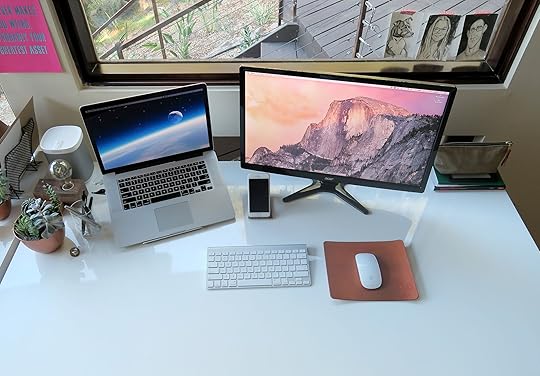
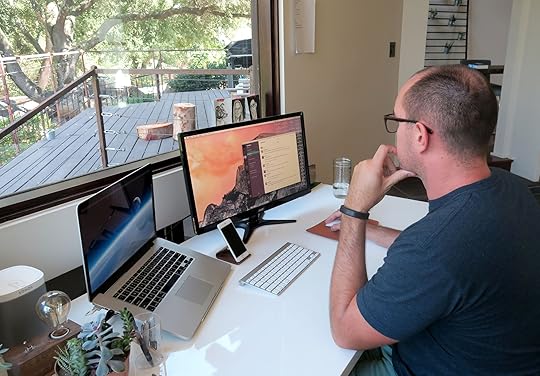
As you can see, I don’t use an overly expensive setup. And yes, this is what my desk looks like almost all the time (like I said, I’m OCD, deal with it). Here are my desk essentials:
15″ Retina Macbook Pro
Acer 24″ Monitor
aluminum laptop stand
Bamboo IPHONE STAND
UGMONK leather MOUSE PAD
WAX canvas DOPP KIT
If the cleanliness of my desk soothed your inner-OCD-monster, then I want to forewarn you about Caroline’s desk: It’s a creative jungle! But in the best of ways obviously… Caroline has learned that having a tidy desk is not conducive to flexing her creative muscles. Being overly organized actually hinders her ideas from flowing freely from her imaginative mind. Trust me, I’ve tried imposing my organized will on her and it didn’t work out so well for either of us. I’ve come to appreciate her workspace because of the work it allows her to create. Just as long as her stuff doesn’t touch my desk (hah!).
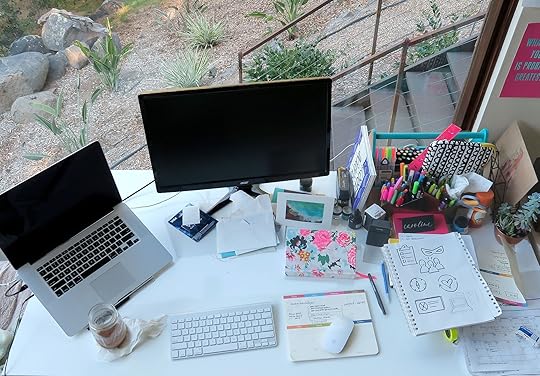
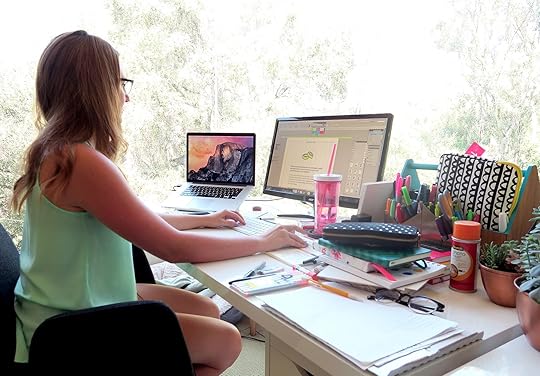
I’d run out of bullet points if I let Caroline rattle off all the stuff on her desk, but there are a few key items that she simply can’t live without:
15″ RETINA MACBOOK PRO
ACER 24″ MONITOR
Ban.do classic agenda
Ban.do iPad Case (used for markers)
Assorted Sharpies
Warby Parker Ripleys
Working on the road: travel fun
One of the things Caroline and I value most about working for ourselves is the flexibility to be able to pick up and go at a moment’s notice. Over the years we’ve become very efficient when it comes to packing for trips.
The things we carry with us at all times
Much like the limited amount of things I keep on my desk, I don’t travel with a ton of stuff. I used to bring lots of extra things along as just in case items. But I always found myself never actually using those items and have challenged myself to travel with much less.
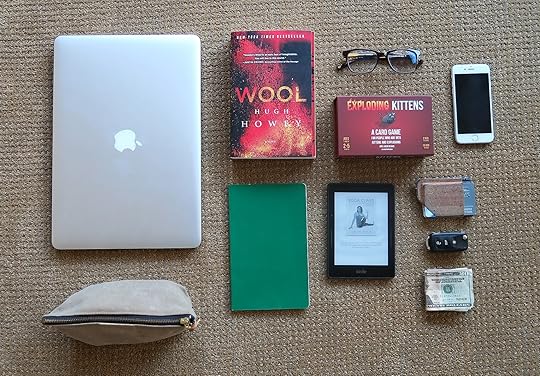

Fun and random, huh? Pretty much a visually organized representation of who I am as a person. Here’s the breakdown of what I keep in my travel bag:
Moleskine Journal
Kindle Voyage
Slide Wallet
Exploding Kittens Game
One physical book
warby parker chamberlains
SAMSONITE BOARDING BAG
You might be shocked to see what’s coming next, but Caroline doesn’t actually just slide all the items from her desk into a plastic bag to bring with her (I’m so happy she doesn’t!). The items she brings with her vary based on her current medium for creation or the current projects she’s working on.
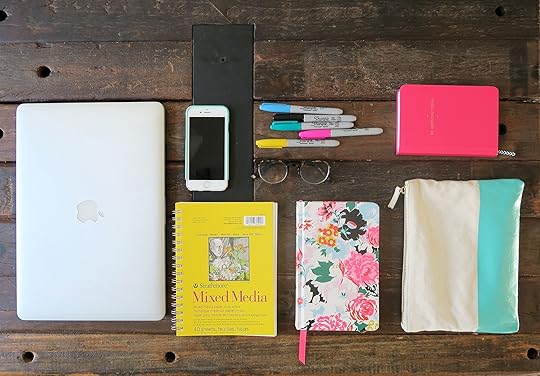

Crazy organized, right!?! I know. So proud. Here’s what she keeps close at-hand in her travel bag:
Mint iPhone Case
Mixed Media Pad
Be Awesome Today Journal
Marker & Pen Pouch
SAMSONITE LAPTOP TOTE
The things we pack
I won’t bore you with each item we put in our suitcases, but I will share a couple packing tips we’ve learned over the years.
Tip #1 – Wear your biggest pair of shoes, pack your smaller pairs.
This is more for me than Caroline, but it’s amazing how much room a slightly larger pair of shoes can take up in your suitcase.
Tip #2 – Roll your clothes.
If anyone reading this has a family member in the military, then you know the beauty of rolling your clothes. This is an absolute must and actually helps keep clothing wrinkle-free-ish.
Tip #3 – For the ladies: Pack basics that you can mix and match.
The key to making sure you have an outfit for any occasion when you travel without including your entire closet is to make sure you have neutral and versatile basics (like a gray cotton dress) that can be dressed up or dressed down with shoes/accessories.
Tip #4 – For the gents: Exosphere makes the best men’s underwear ever.
I know, I said I wouldn’t bore you with suitcase item details, but this is a type for my dude-readers. Buy a pair of these and tell me I’m wrong!
Bonus Tip – Never check bags. Ever.
This is a hard-and-fast rule for a couple reasons. One, it makes the travel process way more efficient (leave me and my idiosyncrasies alone!). Two, it forces you not to empty your entire closet into a suitcase that becomes heavy, that you have to pay to check, and that causes you to wait in baggage claim watching the conveyer belt of hope (hoping that your bag made it safely, that is).
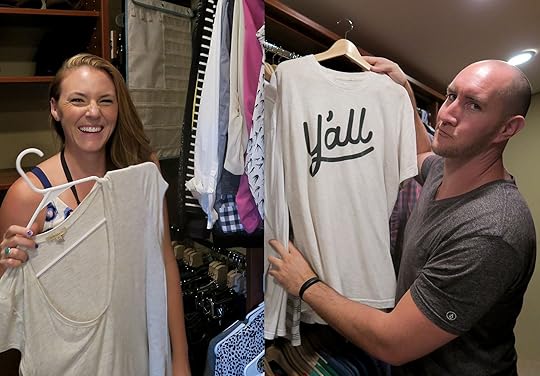
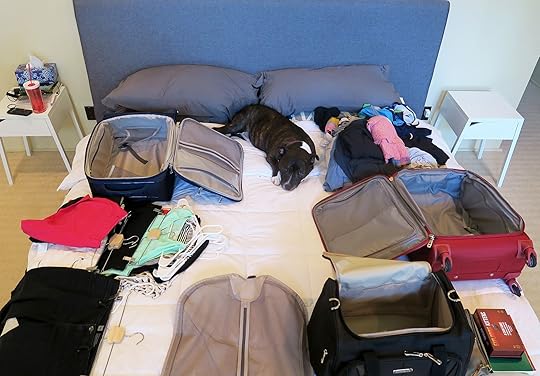

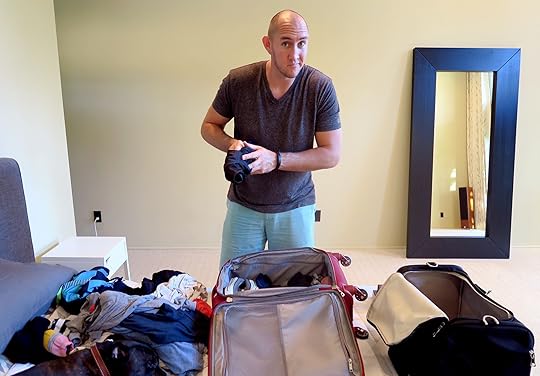
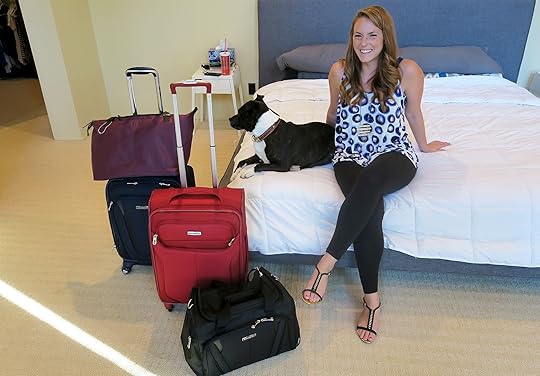
You’ll notice we only travel with Samsonite luggage. Full transparency, they reached out and offered to hook us up with luggage and we couldn’t say no to fancy new bags. Especially Caroline, whose previous rolling suitcase looked (and sounded) like it squared off in a gladiatorial arena with a disgruntled airline crew worker. Seriously, you could hear that thing and its bum wheel coming from an entire terminal away.
The bags we own are as follows:
Samsonite Lift2 (Jason’s Red Suitcase)
Samsonite Boarding Bag (Jason’s Black Duffel)
SAMSONITE SILHOUETTE SPHERE (Caroline’s Twilight Blue Suitcase)
Samsonite Laptop Tote (Caroline’s Amethyst Tote)
We recently went on a trip and as we were walking out the door, with the exact stuff you see above, we realized how much of a minimal lifestyle we’ve established. We could easily travel for weeks on end bringing only what you see above (and we have!).
Where we enjoy working
When we aren’t at home, our favorite places to work are unique coffee shops. There’s just something about the smell of fresh coffee, the vibe of the place, and the people coming and going that creates an atmosphere we love.

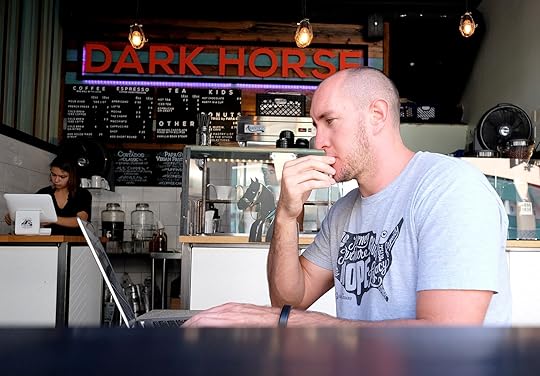
It’s taken us a few years of trial and error, but we’ve figured out how to run our businesses efficiently no matter where we are. Whether we have to hop on a plane at a moment’s notice (yes, it’s happened before) or we just need a change of scenery to get the creative juices flowing, our work process is a well-oiled machine. No matter where we are when our next big ideas hit, we’re ready to make them happen.
Note: Some of the links in this article are affiliate links. You pay the exact same price if you buy something and we get a tiny bit of money to spend on underwear and coffee.
The post See Behind The Scenes: How We Work and Travel appeared first on Jason Does Stuff.
August 29, 2015
Use My Exact Blueprint For Audience Growth
I paid for fans on a Facebook Page (when that was a thing) and bought followers on Twitter (I was a big deal in Malaysia for 24hrs).
I’ve even bribed people with giveaways of iPads, MacBooks, heck even cash!
But I’ve learned that all those efforts were a complete waste of time.
Actually, let me correct myself: All of those efforts were a complete waste of time, except for being able to learn that all of those efforts were a complete waste of time.
The effort it takes to grow a passionate audience isn’t as difficult as chiseling a beautiful statue out of marble. But like chiseling a statue, you need to be armed with the right tools, the right motivation, and a whole bunch of determination.
Let me help you chisel away your perfect audience.
Before you even begin building, tame your ego
When it comes to anything that can be quantified, our egos quickly become our worst enemies. And boy-oh-boy, do we live in a time with numbers being shoved in our face at every turn:
Twitter Followers
Facebook Likes/Followers/Friends
Email Subscribers
Website Visitors
Customers
YouTube Subscribers
The worst part? Almost every platform puts these numbers front and center any chance it gets. The more numbers you see the more numbers your ego craves.
I wish I could tell you there was a magical way to tame your ego. Some concoction of Diet Coke + Coffee + Chipotle (the usual daily meal plan for any entrepreneur). But alas, it only comes with effort and experience.
It’s damn cliche, but when it comes to building a following, you must focus on quality over quantity. Learning to tame your ego can help you sift through the numbers and find the people who give you the most value.
How deleting my entire audience helped me grow
Earlier this year I did something unthinkable to most people. I deleted an email list of 25,000+ subscribers that I had been growing since 2010. 25,000+!
Why in the world would I do such a crazy thing??
Because that audience wasn’t right for me or the business I was trying to run.
Remember all those ‘growth hacks’ I talked about earlier? Turns out lots of people sign up for a mailing list if they think they’re going to win an iPad. But here’s the problem with building an audience based solely on incentives: That’s all they ever want.
My list eventually got to the point that whenever I would send an email, something I had spent time on and poured my heart into, the only responses I’d receive were:
“I didn’t sign up to hear about this crap!”
“Where are the giveaways? That’s what I’m here for.”
Even more demoralizing was the dwindling open rate. What hovered at around 15-20% for the first year or two slowly dropped below 10%, then 8%, and then as low as 5%. Talk about a red flag slapping you in the face.
So I pulled the plug. I realized sending emails to that list was always doing more harm than good. Hitting delete on 25,000+ people was not easy, but I’ll never forget the immediate feeling of relief after I finally did it.
How to build the right audience from scratch
Luckily, I had seen the writing on the wall a few years before things got bad and started to build an entirely separate email list. With the chance to start over, I started looking at people I respected with sizable audiences and reverse engineering how they were growing their list.
The two most important things I discovered were:
They have been building their audience slowly for a long time. Quality takes time and not a single person I look up to has built their list in just a few months.
They are very straightforward with saying who exactly their list is for.
While the first insight made sense, the second one seemed very narrow-minded to me at first.
But then I saw the power of it. As I started to grow my new list I made it very clear who this new email list was for and exactly what you’d be getting if you signed up. While those statements have evolved over the years they’ve been the guiding force of growing my audience.
My current list is not super impressive. As of writing it’s at 8,210 people with an average of 10 new subscribers a day with a pretty consistent open rate of 30%.
But do you want to know the statistic for my email list that matters most to me?
I make 80% of my income directly from my email list. The other 20ish% is made up of people referring me to strangers and people finding me organically (Social media may account for 1% at most).
The actual (and ethical) audience growth tactics that work
I understand that you want these things to happen quickly. Most of us aren’t able to sit idly by while we see our competition (or friends, even) grow their audience and their business.
In my experience, growing a loyal and committed audience boils down to 3 main factors:
Defining who your audience is and focusing heavily on bringing them value.
Creating consistent content that solves problems for your audience or inspires them to become the best version of themselves they can.
Actually giving a crap about these people and spending time interacting with them.
These points can seem a bit nebulous, so let’s look at how to practically apply each one:
1. Defining your audience
The easiest way to attract the right people is to be crystal clear in the copy on your sign-up forms. For example:
“If you’re a freelance designer or developer, this is the email list for you. I want to help you grow your business with my weekly articles.”
Now, whenever you create content you can put it through your audience definition filter.
When you finish writing an article (or creating any piece of content) ask yourself, “Will this help or resonate with freelance designers/developers?”
And don’t be afraid to be polarizing. If you do an interview or go to an event, own your niche and say “I’m not the guy who helps advertising agencies and Fortune 500s. I want to help the freelance designers of the world, because that’s who I am!”
Your audience connects with you because you share strong values. And the only way they’ll know how you think is if you’re outspoken and clear.
2. Creating consistent content
If you’re sending out weekly newsletters use the 9/10 rule: 90% of your articles should be valuable content that helps your audience, while the other 10% can include pitches for products.
(Fun note: My girlfriend sent her first newsletter to just 4 subscribers, 2 of which were her and me. She stayed consistent and two years later has a list of more than 2,500!)
I keep a running list of topics I want to discuss based on things that interest me, but also regularly get inspiration from questions I get from my audience. Over half the articles I write are email responses I’ve sent to people that I elaborate further on.
If you find yourself answering similar questions from your audience that’s a pretty good sign that you should turn those answers into an article or podcast that will reach more people.
If you use other channels to promote your content, be sure you’re staying consistent on them as well. I repost every article I write to Medium two days after I write it for my website (and include a link to join my weekly newsletter). That link goes to a specific page on this website that welcomes people from Medium and gives them a rundown of who my email list is for and why they should (or should not) join.
I average about 100 new email subscribers a month using this tactic and many of them have purchased multiple products I’ve offered my list.
3. Actually giving a crap
I don’t know anyone that has a passionate audience that doesn’t interact with them in some form.
For me, that’s replying to emails. For you, that could be creating videos, running a Slack channel, or being active on Twitter or Facebook.
Whatever vehicle you use for communication, spend quality time there.
Find ways to remember things about people. I do this naturally, but apps like Contactually can help you manage this. And if you are building an email list, MailChimp allows you to add notes about each individual subscriber.
If you sell a lot of products, reward your customers with free bonus content. Notice I didn’t say offer free bonus content to get new customers. Audience retention is way more important than audience acquisition in my experience!
Don’t focus on just building an audience, focus on building a defined loyal audience
I’ve learned my lesson when it comes to audience building. I know what works for me and what’s bringing me (and my audience) the most value.
If you can put your ego in check, define the audience that’s right for you, and be consistent in providing value, you will build a loyal audience.
I’ll take an exponentially smaller audience that’s loyal, over a large unqualified audience any day.
// This article originally appeared on the Crew Blog
The post Use My Exact Blueprint For Audience Growth appeared first on Jason Does Stuff.
August 23, 2015
Stop Hustling
We’ve reached peak Hustle Porn. It seems if you aren’t working incredibly long hours, you simply aren’t working hard enough on your idea. If you aren’t constantly “grinding” and “putting in work” then you’re destined to fail. Your business isn’t making enough money? You aren’t hustling enough.
I will fully admit that I subscribed to the hustle mentality a few years ago. You know where it led me? Stressed. In Debt. Overweight. Completely unhappy with my business. I had to stop working like I thought I should (and saw others doing). I had to redefine what hustling meant to me.
Am I telling you to stop working long hours?
Absolutely not. Most businesses require a lot of extra hours to reach certain milestones and desired levels of success. But there must be balance. You simply can’t keep burning the candle at both ends and working until your fingers bleed (if you’re reading this and bleeding, please call a doctor immediately).
What I’m advocating is counteracting the time you overwork with time to underwork. I know exactly how it feels to see a never-ending to-do list. I know what the financial crunch feels like. I know how it can feel to think that just a few more hours of hustle will get you where you need to be.
You don’t have to work like other people work.
Listen, I love Gary Vaynerchuk as much as the next entrepreneur. I’d even call Gary a friend. But that guy plays on a different level than we do. He also has huge teams of people at his side. Gary can do what he does (constant hustle) because of a lot of behind-the-scenes factors. Oh, and let’s also not forget his DNA, which he openly admits is unique to him. Gary is the type of guy who has been wired for hustle since he was a little kid.
You and I are not Gary Vaynerchuk. We shouldn’t aspire to work like him. We should find our own version of hustle and work in a way that feels congruent with who we are as people.
There are so many inspirational quotes about working hard and hustling and making sacrifices and blah blah blah. Yes, some of this stuff can be helpful at certain times. But make sure you’re running your business (or your life) your way. Just because you work 90 hours a week doesn’t mean you’re going to be successful. Even if you model your work off of someone else who is successful, there are too many other factors at play that you can’t replicate.
Hustling doesn’t put money in your bank account.
You can’t pay your mortgage with hard work. You can’t buy groceries with a few extra hours of effort. You aren’t going to be happy with your business (or life) if you’re constantly working.
Hustling can provide you experience. It can help you learn lessons. It will open doors that might otherwise be closed. But again, you have to hustle in a way that makes you feel like you aren’t overextending yourself and going to an unhealthy place.
When you take a hustle break, good things happen.
Last year I took a break from social media for 30 days. During that time I found a new sense of clarity on my personal (and business) values. I slept better than I had in a long time. I started appreciating things in my life more that weren’t on a digital screen. Oh, and I came up with a business idea that brought in more than $40,000 in revenue. Not too shabby.
With my latest break, a break I took from writing for the past 8 weeks, I stumbled into what could be my biggest and craziest idea yet. You can read more about “Project Galaxy” on Medium.
When you take a break from constantly working and constantly thinking, you allow space for creation and new ideas.
Rarely does anyone come up with a great idea while pulling an all-nighter or after 14 straight hours of staring at a computer screen. All of my great ideas have come at times when I haven’t been working myself overtime. I’ve just shared two examples, and I could go on. I never have groundbreaking ideas when I’m stressed to the max and over stimulated.
I believe in the hustle, but I also believe in balancing out the hustle with rest. Listen to your mind and body. Take breaks. Enjoy life. Realize that you don’t have to work every hour of every day just because some people think that’s a cool thing to do.
Take a moment to define what hustle means to you, then hustle that way.
The post Stop Hustling appeared first on Jason Does Stuff.
June 29, 2015
Learn From My Experience Writing Over 800,000 Words In Two Years
For the past two years, I’ve written about 1,000 words almost every single day. I know it averages out to about 1,000 words because my typical first draft for any article gets written in about one hour and ends up being around 2,500 words. Take away weekends, holidays, and days when I simply felt I had nothing to write about, and I strongly believe I’m left with a daily average of 1,000 words since June of 2013. Add in my 60,000-word book Creativity For Sale and we’re over 800,000 words written.
Writing didn’t come naturally to me, therefore I had to set daily intentions
When I decided I wanted to write more consistently, I sat down at my laptop one day and popped open a Word doc. I stared at the blinking cursor on that blank white page for what felt like forever. That’s about the time that I disappeared into the catacombs of YouTube. I was begging to be distracting by anything that didn’t feel like that Mount Everest of Word docs.
Writing seemed daunting. I wasn’t a “writer.” What business did I have writing? Sure, I had experiences I wanted to share throughout my entrepreneurial journey, but to just sit down and write? Not for me.
Just one week after I’d officially decided I wasn’t a writer, I heard a talk from my friend Joshua Fields Millburn. In that talk he mentioned the idea of “just sitting in the chair” and writing, no matter what. I’m fairly certain he mentioned something about writing 500 – 1,000 words per day. 1,000 words per day? Was that the length of a novel? That seemed insane!
But, still I decided I’d give it the old college try. I cracked open Word shortly after hearing his talk and just started typing. About every four minutes I highlighted the words I’d written to check the word count. I found myself slightly disappointed when the number was only 27, or 58, or 149. I wish I had some hilariously awful .docx file to attach to this article for you to laugh at. But alas, I believe I deleted those first bits of writing faster than you can say the word delete. (Be honest, did you just try to say the word delete again?)
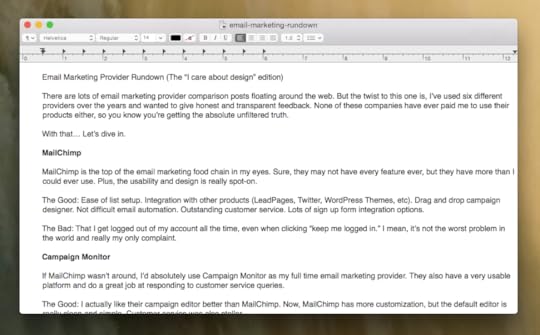
What I did do though, was develop a habit. Every day, first thing, I would write 500 – 1,000 words. And if you’re wondering, yes, I quickly realized how awful Word was and moved to Mac’s native app TextEdit. I actually have a file dated August of 2013 that never saw the light of day:
Whether my writing was good or bad, I stuck with it. Each day I would force myself to write at least 500 words. The funny thing that happened? Almost every single day I ended up writing 1,000 – 1,500 words.
That simple daily practice helped me find my writing voice (which will always be evolving) and helped give me confidence in my writing.
It becomes easier to write when you know you have to do it tomorrow
Because of my daily writing intention, the pressure to write something amazing quickly deteriorated. Early on I’d sit down and think, “Okay Jason, you have a Pulitzer Prize caliber article in you, just let it out!” Then I figured out that I didn’t give a crap if my writing ever won awards or read as professional writing; I just had to stick to my daily goal.
It couldn’t have been more than a couple weeks writing every day when almost all the self-doubt about how good my writing was disappeared. It wasn’t that I suddenly gained confidence in my writing. (Or that it was any good.) Not even close. It was that I knew I would be sitting in the chair every day, so why worry about today’s writing when I’m just going to have to write something again tomorrow?
Once I got over the hump of self-doubt, each day’s writing became an achievable task. I simply wrote about a topic until I couldn’t write about it anymore (or until I knew I was over 500 words written and could go do something else). Some days I couldn’t think of anything to write about, so I’d write something that started like this:
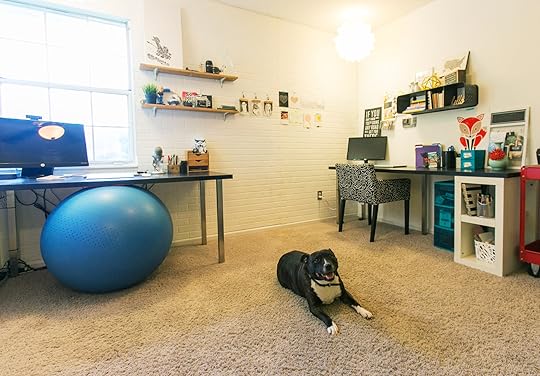
This is me sitting down in the chair to write. The chair I’m sitting on isn’t actually a chair. It’s a big blue yoga ball. Sometimes I wonder if the yoga ball is just going to pop one day (that would be painful and embarrassing).
Why sit on a yoga ball? I think I read in a Men’s Health article it was good for my core. Funny enough, I may not even have read that. I may have just heard it somewhere. And do I have any clue if my core has benefitted from sitting on a blue yoga ball? Nope. But alas, I continue to do it.
I can’t think of anything to write about today. I won’t mentioned what I wrote about yesterday as that would feel like cheating. If I’m being honest, right now I’m thinking about writing about my favorite types of breakfast. Waffles, french toast, etc. But who cares what I think about breakfast? Then again, who cares what I think about marketing and entrepreneurship? Oh boy, here comes the self doubt train. Choo! Choo!
(And now a photo of my dog Plaxico and said blue yoga ball…)
Truthfully, that’s probably nearly verbatim of something I wrote on many days. I didn’t have a list of topics and I didn’t really care. All I wanted to do was write. And while I’m being truthful, I often enjoyed those nonsensical writing days more than I enjoyed the “tips on how to overcome your fears” articles I wrote.
Finding the right writing app makes a difference
I already admitted that I started writing in Word. Oh, I forgot to mention I use a Mac, so Word for Mac, yeah, that’s like 10 times worse now. Anyway, once I moved from Word to TextEdit, I stayed there for awhile.
TextEdit removed all the distracting bells and whistles. I could still format my writing slightly (bold, italics, font sizes) and even get lost in the world of picking random fonts to write in. But it’s a fairly feature-free writing tool. However, there was one small thing that always bothered me: The damn margins. If you’ve ever used TextEdit, you might know what I’m talking about. Those little arrows that slide around the top of the document drove me insane, especially when I randomly grabbed one and half my article got malformed. Ugh, such a #firstworldwritingproblem, I know.
Nonetheless, I moved on from TextEdit to a very sophisticated software. One I actually was already spending a lot of time writing in: Mac Mail.
Sounds silly, right? To use Mac Mail as a daily writing program? Well, it was and it wasn’t. I liked Mac Mail because it was also fairly limited on the formatting and buttons. And while writing, it automatically saved a draft of the email. What I didn’t like was the fact that with every email I received, I left ‘Writing Land’ and took a trip to Emailsville. Those trips were almost always one way.
Believe it or not, I stuck with writing in Mac Mail for over a year and a half. Towards the end of that time I started writing in Google Docs. But because I had to be online to write in Google Docs, I always felt the itch of distraction. Facebook was only a tab away! Twitter was a mere command + T and then type the letters “Tw” to have my history pulled up: Twitter.com/notifications. There were just too many opportunities to get out of my chair (virtually) to stick with Google Docs.
Then I found Letterspace. Oh Letterspace, you sexy, sexy beast.
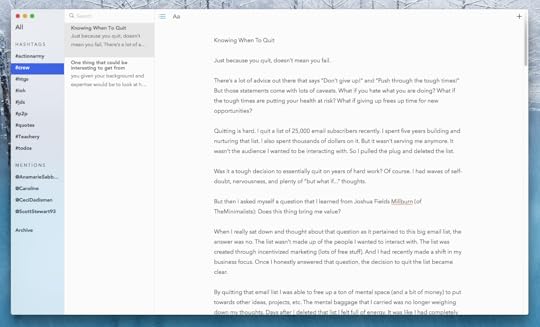
Letterspace is my, for now, perfect writing app. You can easily separate articles with hashtags and @ signs. You can archive articles. You can search words throughout all articles. It writes in markdown language, so there’s almost no formatting whatsoever. The only button in the app is a “+” button that allows you to create a new article (only newbs click that, I’m all up on the command + N game). And it magically auto-saves while you’re writing (online or off). I think it also syncs between the desktop and iPhone app, but I never write on my tiny iPhone screen.
Oh, and Letterspace is a mere $9.99. I love that it has created an environment that’s conducive to writing for me. And for under $10? That’s a no-brainer.
A copy editor is your friend!
At the end of 2014 I made a commitment to myself. I had used an amazing editor to help me write my book and there was one huge takeaway from that experience: A great editor gives me the ability to just dump all my thoughts into a somewhat coherent document. Then, they can just drop in and help turn it into something much better.
I like to think of working with a copy editor like a little kid trying to build a house with Lincoln Logs. Remember those?
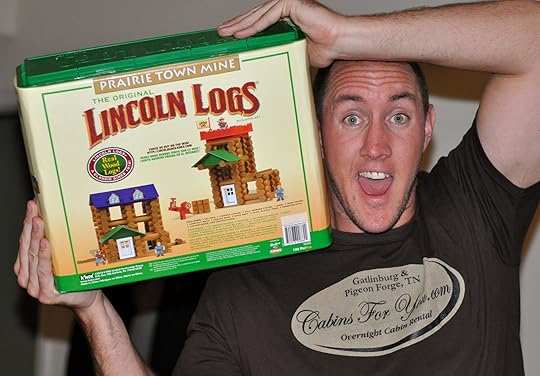
I, being the little kid, do my best to stack the little logs (words) into what should be a house (finished article). Some logs go the wrong direction. Some logs get jammed where they don’t fit. But to my credit, when I’m done I have something that resembles a house (mostly).
A great copy editor is like your Mom. She swoops in and straightens all the crooked logs. She flips the ones around you put in the wrong way. And she generally cleans up the surrounding area to make the little log cabin (my article) shine like a diamond. Because we all know great log cabins shine like diamonds.
I have to give a shout out to the two editors I’ve worked with. One, Lizzie Vance, is more than a copy editor. She’s a full on book authoring coach. Without her, who knows what type of randomness I would have tried to pawn off as a book. And two, Ashley Bright, my copy editor for 98% of all my articles for the past eight months.
Copy editors aren’t cheap, but they also aren’t expensive. I pay anywhere from $100 – $300 depending on the amount of writing I’m doing. It’s worth every penny to me, because I know that if I just get my thoughts down, Ashley will come in and fix my log cabin right up!
Consistency brings confidence, confidence brings results
I’m not one of those people who has a site that gets millions of pageviews every month. In fact, as of writing this article, I’m only on pace for 200,000 page views in 2015. Now, that’s definitely not bad, but my point is that I don’t define results just by pageviews.
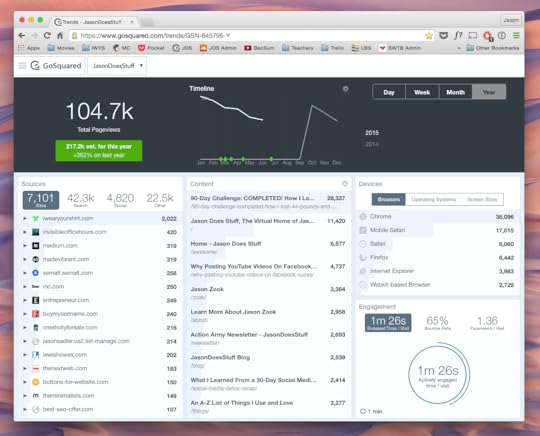
You see, two years ago I’d had my writing syndicated to publications like Forbes and Entrepreneur.com, but it wasn’t really my writing. I essentially wrote articles for an entrepreneurial group and then randomly one of my articles would get published under the group’s name. Yeah, my name was still in the byline, but that’s very different than writing an actual column for a publication (or having them reach out to republish an article from your site!)
Writing consistently over the years has made me realize my writing is good enough. It’s impactful for certain people, and I write the exact way I want to write.
That confidence in my writing has landed me a (paid) weekly column with Inc.com. A syndicated column with TheNextWeb.com. Paid writing on The Crew Blog. And various republishing opportunities to BusinessInsider.com, CNBC.com, and more.
While those opportunities haven’t changed my life, they’ve certainly put dollars in my bank account and put my writing in front of hundreds of thousands of entrepreneurs. Plus, I’d be lying if I said it wasn’t cool to see an article I’ve written on the front page of “important” websites. Remember, not too long ago, all I was writing about was my blue yoga ball.
Writing has legitimately changed my life
I’ve seen the benefits of my writing time and time again. I’m not talking about the money. I’m not talking about the digital pats on the back.
I’m talking about the people who email me and say that my writing had a profound impact on them. Or that my writing gave them the courage to make a big leap in their lives. Or the countless emails from people around the planet who have read my book and said it was the exact thing they needed in their lives at that time.
The feelings I get from those types of emails are unlike anything else in my life. They warm my heart and remind me that my words matter (especially during the times when I just can’t seem to finish a damn thought or find the most coherent way to express myself through letters and sentences.)
I believe I am a better person because of the 800,000+ words I’ve written in the past two years. I also know that I’ve honed a skill and one I hope to put to continued use for years to come. I quietly committed to releasing my next book in 2016. We’ll have to see how that goes.
Lastly, you need to take breaks
This brings us to present day where I’m taking a writing sabbatical for two months (July and August).
I haven’t hit the lottery. I don’t have some mysterious money-making scheme going on right now that’s filled my bank account. But if I waited for those things to happen to take a break, a break would probably never come.
I’m intentionally taking a break when it isn’t the perfect time, because sometimes that’s when you need it most.
I do have some paid writing I’ll be (gladly) finishing up, but I want to give my writing brain a rest. I want to focus my time on reading more books and shoring up a few projects. I also want to spend less time sitting at my computer and more time seeking out new adventures. One of which will be a 3-week road trip from San Diego to Vancouver Island. More on that when I resume writing in late August.
800,000+ words later, it’s finally time for me to take a break from my writing, but this could be the perfect time for you to start. Maybe you feel like you’re where I was in those early days, staring at the Mount Everest of blank pages. Maybe you don’t think you could ever consider yourself a writer. If that’s the case, I’d like to do for you what my friend Joshua did for me: encourage you to sit in the chair, form the habit, and just keep writing. You never know what may come of it.
The post Learn From My Experience Writing Over 800,000 Words In Two Years appeared first on Jason Does Stuff.
June 21, 2015
Avoid Website Shame
Websites, like bed sheets, should be changed and cleaned way more often than they usually are. “Oh, I’ll get around to changing that next week,” or “It’s on my to-do list, it’s just a low priority item.”
Does this sound familiar to you?
For years I’ve tried to invest in my online profile. No, not my Match or Plenty Of Fish dating profile. I mean the thing online that most accurately sums up everything I do—my website.
If you’re anything like me, you change directions and focus way more often than your website reflects that. James Altucher says we’re a completely new person every six months. I agree with that. Maybe it’s 10 months or 12 months for you? But I strongly believe we’re growing and changing as people more than we realize.
I’m really excited for the redesign of JasonDoesStuff.com. To some people, it may not look incredibly different, but to me, there’s an entirely refined focus.
I certainly didn’t have “website shame” as Marie Forleo calls it. But something was just a bit off with my little slice of the Internet that represents who I am.
I realized I had too much fluff.
On the previous iteration of JASONDOESSTUFF.COM I was trying to show a prospective user all of these things:
That I have a weekly newsletter
That I write weekly articles
That I do public speaking
That I have a few ongoing projects
That I wrote a book
That people have said nice things about me
That I do consulting calls/meetings
That’s a total of seven calls to action. And not only is it too many, I’m also not excited about all seven of them anymore. I can’t remember how I felt a year ago, heck, maybe I was really passionate about doing all of those things. But for this new six-month version of myself, I’m laser focused on three things:
1. My weekly articles
2. Getting people to join my weekly newsletter (The Action Army)
3. Showcasing my most recent project
Everything else is ancillary. Everything else is a lower priority. And that may totally change again in six months, but that’s absolutely okay!
Early on in my career as a graphic designer I learned about this “Rule of 3.” Study after study showed that three pieces of information were the optimal amount for someone to understand and make a decision with. There’s a rule of thirds in photography. The Air Force has three rules for surviving captivity. It’s a known fact that selling something with three options ends up producing higher sales volume and revenue as opposed to just one or two options. And the great Steve Jobs even used the rule of three with the different storage sizes of iPods, iPhones, and iPads (8GB, 16GB, 32GB).
In the case of my newly redesigned and reorganized website, my belief is that if I nail the three things I want to focus on, people will search out any remaining offerings on their own. I won’t need to push everything I can do on the homepage of my website. I can let all the extra stuff be discovered when people are getting enough value from the three core items.
Is what you are currently doing with your website meeting your expectations?
If it is, and you have zero website shame, then you can move on from this article (or reply and share your website with me). If your website isn’t converting sales, newsletter signups, etc., you are not alone…
Meet Roger Bentlingsworth
I have a friend whose name I won’t actually reveal, but we’ll call him Roger Bentlingsworth (cool name right??).
Roger has had the same website for the past three years. His website has had a couple subtle changes (a different image on the homepage or adding new blog posts), but for the most part the website has gone unchanged. Roger on the other hand, has completely changed his focus in business. Roger and his website are way out of alignment.
I had a call with Roger and asked him what he wanted his website to be doing do for him.
His answer was “to get more people to buy my online course.”
To which I replied, “Okay, how many courses has your website helped you sell in the past year?”
His answer: “Maybe 4.”
We all want higher conversions. We all want our website to generate more revenue. But many of us are not willing to make the necessary (and sometimes drastic) changes. Why? Sunk cost bias. We’ve spent time and money on our website already, why should we have to change it?
Sunk cost is a real a-hole. If you read my article on FEEDBACK you know how feedback can completely derail progress. Sunk cost is almost worst, because it stops everything you’re doing before you even get to a place of thinking about progress!
I finally convinced Roger that it was time to make a radical change to his website. Him saying out loud that his website only sold four courses was the thing that finally clicked in his mind that some had to change. After coming to an agreement about changing his website, the discussion then turned to how much could we change it and what the specific things are that he wants to focus on.
In my mind, there’s almost nothing we can do to Roger’s website that will decrease sales. So the decision to make changes has become much easier for him.
I bring up Roger’s story somewhat prematurely. It hasn’t relaunched yet, but it’s getting very close. I plan on writing a follow up post about him and his story, but I want to let his case study build a bit. I want to see our plan of action get put into place and measure the results. I’m willing to bet my shorts he’ll increase his online course sales tenfold in a very short period of time (way shorter than a year). We shall see.
Change is difficult
I know that I’m an anomaly when it comes to being okay with change, especially as it relates to my website and the things I’m working on. Change comes much easier for me, but I understand it can be difficult.
If your website is not meeting your expectations, it needs to be changed. That doesn’t mean you have to flip it completely upside down and do something crazy, but it does mean that you need to do more than just switch up a few photos or change a color here or there.
Take a moment to write down the three most important things you want your website to be doing for you.
Is it currently doing those things? If it’s not, then you know it’s time for change. And if you’re being really honest with yourself and you have website shame, then all the more reason to embrace some big changes.
Do you want to know the beautiful thing about changing something like your website? You can always revert back! Whoa… mind-blowing right? Gosh, what will they think of next??
My good friend Paul Jarvis said this recently:
“The fewer the complications, the more likely you’ll see a better outcome.”
That simple phrase inspired me to finish this article. An article that I’d had a draft of for a few months before reading Paul’s thoughts on PIZZA (specifically: cheese, sauce and dough). A little pizzandipity never hurt anyone! (That’s pizza + serendipity if you’re keeping score at home)
Stop being ashamed of your website and for the love of Pete (whoever Pete is) make some changes.
The post Avoid Website Shame appeared first on Jason Does Stuff.
June 14, 2015
Find Courage, Happiness, and Gratitude

I stood on the side of a stage, moments away from getting up in front of 200+ people. The woman who was speaking before me asked me: “what are you talking about?” To which I confidently responded “I don’t know, I haven’t decided yet.”
Let me rewind a bit and set the scene for you. Last week I traveled to Orlando to speak at a conference, which is very familiar territory for me (both the city of Orlando and speaking at conferences). But this particular talk came a day after my normal talk and was supposed to be a 10-minute “TED style talk” about something new and unique.
Earlier in the week I kept moving the “work on 10-minute talk” calendar reminder around my Google Cal. I didn’t just move it once, I actually moved it four times. Upon dragging it for the fourth time I finally said to myself, “screw this, I’m just going to wing it!”
So there I am. Stage left. About to walk up on stage in front of a sizable audience of people with absolutely no idea what I was going to talk about.
All I knew is that it wouldn’t have anything to do with my normal speaking stuff (IWearYourShirt, BuyMyLastName, marketing, yadda yadda). Instead I decided I want to talk about three things: Courage, happiness, and gratitude.
My name gets called, I hear (and see) people clapping, and I make my way to the stage. During the final steps to the stage I was still working out the details of what I was going to [try] to entertain this crowd with…
Courage
Anyone who gets up on stage in front of people, any in capacity, has a very similar fear: What if I forget my lines and it’s dead silent??
I pulled my iPhone out of my pocket, flipped open the stopwatch, and pressed the start button. All the while, over 200 faces looked on in bewilderment.
As the seconds ticked by I could feel my heart racing. I didn’t say a word. I just stood on stage, looking out into the audience, and occasionally put one finger up to let the audience know I wasn’t losing my mind and that this was on purpose.
15 seconds ticked by and felt like minutes. 20 seconds went by and I could feel my pulse racing. 25 seconds and then finally, finally, the stopwatch hit 30 seconds and I hit the stop button.
I let out a huge sigh of relief (and I think the audience did too). I proceeded to explain that I wanted to talk to them about three things: Courage, happiness, and gratitude. I also asked them to help me remember those three things because I had just decided to talk about them about one minute prior to that moment on stage.
I went on to explain that the reason I chose to stand in front of them for 30 seconds (of agonizing) silence, was to face a fear that every person that takes the stage fears. Instead of waiting for a moment like that to come to me, I decided to muster up some courage and embrace that moment on my own. After that 30 seconds, I felt more alive and invigorated than I had in a long time.
I asked the audience to think of small courageous acts they could do in their lives. Little things that would give them the same invigorating feeling I just felt. (Note: I wouldn’t recommend trying my 30 seconds of silence if you’re going up on stage for the first time!)
For you, the reader, where can you embrace moments of courage in your life? Especially ones that relate to fears you have? I’m willing to bet if I ever forget what I’m talking about while on stage, I’ll immediately remember those 30 seconds of silence I forced upon myself (and an unsuspecting audience) and be able to recover or snap out of it much quicker.
Happiness
From there I’d like to say I transitioned perfectly into the topic of happiness, but truthfully I had completely forgotten what I was going to talk about next. I asked the audience and they quickly reminded by shouting out, “Happiness!” (That in itself was kind of awesome.)
Some of you may have read my article on morning rituals so you know where this is going.
A year ago I noticed I had a lot things going well for me, but for some reason I still felt kind of unhappy throughout my day to day life. I don’t remember exactly who I heard of it from (or where I read it), but I remember stumbling across someone talking about starting mornings off being proactive instead of reactive. Specifically, not rolling over in bed and checking all your notifications, emails, and the news. Instead, do something for yourself. I think they were talking more about it from a process and productivity angle, but I chose to see it through the lens of trying to fix my happiness problem.
I decided to give it a shot. I made the commitment that when I woke up, I wouldn’t immediately reach for my phone. Well, honestly, I would reach for my phone and make sure I didn’t have a missed call or text message from anyone in my family saying their houses were on fire. Morbid thought. I know. But hey, I’m being honest here. After allowing myself to check for morbid messages, I would leave my phone next to my bed and try to find a moment of happiness.
Where would I find that moment? Calvin and Hobbes.
As a kid I was obsessed with Calvin and Hobbes. I owned every book Bill Watterson put out. I clipped the strips out of the actual paper. Heck, I filled notebooks with my own renditions of Calvin building killer snowmen. Calvin and Hobbes was deeply rooted in my soul as my happy place.
Knowing that, I pulled a few Calvin and Hobbes books out of the attic and would start flipping through them while making my coffee in the morning. There were no emails to read. No social media updates to scroll through. No chance of negativity creeping its way into the start of my day.
Back to me standing on stage telling an audience of strangers about my childhood. I shared with them how much of a profound impact this small change in my morning routine made. I could legitimately feel myself becoming happier each day. It cost me nothing and it only took 5 minutes every morning. I still do this morning ritual a year later.
“What’s your happiness moment?” I asked the audience. I’ll ask you the same question. What in your life can give you a happy jumpstart to your day? We all deserve to live happier and more fulfilled lives, it just takes work to get there.
Gratitude
I knew my third topic, but I quizzed the audience anyway. They were on top of it and yelled “gratitude!” back at me. Which, looking back on it, was also a fun thing to hear hundreds of people yell out loud.
I asked the audience to all pull out their phones, tablets, phablets, laptops, whatever device they had on them. I think I dropped a flip phone joke in there, but maybe not. I gave them a few seconds to fumble through their pockets/belongings and get their device in hand. Kind of counterintuitive to what you want people to do when you’re up on stage in front of them, no?
I could see a look of confusion on their faces but I told them to trust me. I told them to open up whatever mail application they had on their phones. All their heads dropped and then popped back up. Then I told them to compose a new email to a family member, spouse, best friend, someone they really cared about. Down went their heads and then back up. Then I told them to put a smiley face in the subject line and write “I am grateful for you” or “I love you” or whatever sentence seemed appropriate for them to write that showed gratitude in the body of the email.
Then I told them to hit send.
At that moment I told them that 200 people had just sent notes of gratitude that could have an incredibly profound impact on someone’s life. I shared with them that I was in a pretty bad place in 2013 and I remember getting an email from a friend of mine that said simply “Jason, you are awesome, don’t ever forget that.” That email had a real strong affect on me. I knew my friends and family loved me, but it’s an entirely different feeling when it’s from an unexpected source at an unexpected time.
I finished my 10-minute talk by telling them that the simple message of gratitude they just sent may have an incredible impact on someone. It may, and I know this seems silly, change someone’s life. But that’s what little moments of gratitude and thanks can do.
If you’re reading this article, I’d love for you to send a note of gratitude to someone right now. You don’t have to write much, just a sentence of thanks or love will do. It’ll take you five seconds, but those seconds may do more for someone than you could ever imagine.
I share the story of this talk in the hope that you will embrace small moments of courage, happiness, and gratitude. I’m fully aware that articles like this are a lot more touchy-feely than my normal stuff. But hey, I’m constantly trying to grow as a person. And I just moved to San Diego, so I might be becoming a hippie (a very large, meat-eating hippie, who likes fast cars).
Be courageous. Find your morning happy place. Share some gratitude.
The post Find Courage, Happiness, and Gratitude appeared first on Jason Does Stuff.