Jason SurfrApp's Blog, page 21
January 10, 2016
Frame Your Year
A year from now wouldn’t it be great to look back at your accomplishments and know that you set yourself up for growth and success? That you drew a line in the sand and used that line to make important decisions in your life and business? Wouldn’t it be great if there was a simple way to do that? Well, I believe there is, and I want to share it with you.
For as long as I can remember I’ve never worried about the cycle of a year. I’ve never been a big resolution-er. I didn’t know what framing a year could do for me. That was, until, 2015.
2007 to 2014 (my time as an entrepreneur) were years that had zero framing or planning whatsoever. I made a lot of business changes and personal progress, but I can’t look back and pinpoint the exact timeline in which that happened. I’m okay with this, and if you’re reading this, you should be okay with the fact that you haven’t framed out any of your previous years either.
2015, however, was my first framed year: The year of experimentation.
Looking back, I’m incredibly happy that I set the intention of framing an entire year. In doing so, it gave me the permission I needed to make some hard decisions in my life and in my businesses. Every opportunity that I created for myself or that fell in my lap went through the filter of “experimentation.”
What does framing a year mean?
Take my 2015 as an example, and picture the word experimentation drawn in the sand on a beach. That word becomes your line in the sand as you stand above it. Every opportunity, change, or decision that comes your way is a shell in the sand that washes up right in front of the word experimentation. It’s entirely up to you whether you bend over, pick up each shell and cast it away (back into the sea of opportunities) or carry it over the line and put it next to your feet (allowing it into your life as something you’ll focus on).
So what exactly did experimentation mean for me and for 2015? It was actually quite different from my early years as an entrepreneur when I followed the advice of focusing more and doing less. 2015 was a year when I allowed myself to be more open to change and opportunities in my life and in my business. My goal was simply to try things. To see what I liked, what brought me value and what didn’t.
Does this mean I said YES to every opportunity that came my way? Quite the contrary. It meant that I looked for more new opportunities and less comfortable ones (by comfortable, I mean things that come easily to me).
– I turned down most speaking gigs offered to me in 2015 because it wasn’t something that was new for me. It wasn’t something that would challenge me. It wasn’t something I wanted to do something new with.
– I accepted a bunch more paid freelance writing opportunities in 2015. I won’t say it’s easy to write for myself, but it’s certainly quite a bit scarier to deliver an article to someone else and let them edit it, make changes, and put it on a platform where many other people can openly critique it. This was new for me, and I actually really enjoyed it.
– I worked with many more people on collaborative projects in 2015. I always hated group projects in school, but I said yes to more people than ever before in 2015 because I thought it would stretch me as a person. It would force me to get out of my comfort zone of working mostly alone and give up control (something that I value greatly).
– I hadn’t had a big bold project in a few years, but I could feel myself itching to do something big again. When the idea for BuyMyFuture hit me, it was a beautiful shell I happily picked up and brought over my line in the sand. I knew it would be a difficult project, but I also knew it was the type of project that fit perfectly in my experimentation frame.
– In my personal life, my girlfriend Caroline and I sold almost all our worldly possessions (we kept our dog, our underwear, and our laptops) and moved clear across the country from Florida to California. This was by no means an easy decision to make, but it certainly felt right considering my guiding principle of experimentation.
This idea of framing a year does not have to be looked at under a microscope. It doesn’t need detailed metrics or over-analyzation. Instead, it’s a big wide lens with which you can zoom in and out. Having a frame for the year is a nice crutch to lean on when you might need to nudge yourself in one direction or another.
Framing your year doesn’t have to start January 1
Just because the calendar starts on January 1, your timeframe for your year can start whenever you like.
If a word or value doesn’t immediately come to mind to help you frame your year, here are a couple examples for you:
Flexibility – This is one of my most important values. Do you want more options in your life? Do you want more spontaneity? Do you currently feel trapped in your job, city you live in, etc? Flexibility could be the word you need to start making big changes in your life.
Focus – This is somewhat the opposite of flexibility. Is there one big project or goal that’s been nagging at you for some time? A book to write? A business to start? A life decision to make? Focus as a framing word could really help you deflect opportunities that don’t directly relate to your one big project or goal.
Saving – This is the year you really start to tackle your debt. This is the year you stop eating out as much and start cooking meals at home. This is the year you take a strong look at your financial situation and make some cutbacks so you can build a little nest egg. When saving becomes your frame, you’ll be amazed at how much extra cash you can accrue.
Health – Have you let your health go? Tried multiple diets and failed (don’t worry, you aren’t alone)? What if the next 365 days weren’t about a diet, but were just focused on the frame of health. Each day you could do 5-10 minutes of exercise you don’t hate. Each day you could ensure you drink an extra glass or two of water. Each time you go out for a meal you could order something fresh instead of fried.
Charity – Do you want to give back more (and I don’t just mean money)? Do you want to donate your time on a daily/weekly/monthly basis? Knowing that you’re making charity or giving back the most important value for your year could help you make profound impact in the lives of other people.
Adventure – If you’ve been putting off big life and business changes, then this is the frame you need. This can be a challenging frame for a year, but it can also be the most rewarding. Stop taking the easy way out and start looking for the decisions and moments that will stretch you with excitement and the unknown.
Completion – Are you a serial project starter but not finisher? Do you feel like you get things to 90% completion but can never quite finish the last 10%? Frame your year with completion and don’t allow yourself to take on new projects, new tasks, etc, until you finish the previous ones.
Those are just a few ways you can frame your year. Again, framing your year doesn’t have to mean making gigantic sacrifices and changes (although it can), it’s simply a helpful nudge when an opportunity is staring you in the face.
Use your frame as a mantra
I wouldn’t recommend standing in line at a coffee shop and mumbling your framing word over and over again. (Well, unless your word is crazy.) But think of your framing word as a mantra you can repeat over and over again in your mind when the need to make a decision shows up in front of you.
With my example of the word experimentation, an idea or opportunity would appear and I would simply think “is this an experimentation? will this help me grow? does this take me outside my comfort zone a bit?” Whether it was something big or a tiny detail that I couldn’t seem to make my mind up on, my framing word of experimentation became a great deciding factor.
Another useful tip to keep your framing word top of mind is to print it out and tape to the wall in front of you at work or at home. Keep it on your fridge. Write it in big bold letters on the cover of the journal/notebook you’re going to use this year.
As for me? My next year will be focused on MODERATION.
I’m looking forward to working a bit less and enjoying the life I’ve created for myself a bit more. I want to spend less time on technology and more time exploring new things with my girlfriend (and our awesome dog). I’m also looking to make healthier decisions and going to less extremes when it comes to exercise and eating (read: maybe just one appetizer at dinner instead of three). The seesaw of my life has been tipped up a bit more in recent years and I’d like to level it out a bit. Moderation will be my frame.
What will you frame your year with?
The post Frame Your Year appeared first on Jason Does Stuff.


December 7, 2015
Stay on my email list!
[image error]
That’s it. You’re all set. You will not get deleted from the Action Army. Phew! That was a close call.
Okay, now go binge on some Netflix, read a good book, build a sandcastle, or do all those things at the same time and send me the photo of you doing it (so I can print it out and frame it).
You rock. Thanks for being a solid human.
The post Stay on my email list! appeared first on Jason Does Stuff.
December 6, 2015
Finish The Last 10%
Remember the excitement you felt when you launched headfirst into your latest project? That bliss of knowing every door was open and the opportunities were endless.
But then, if you’re like most people, something happens as you near the finish line.
You trip. Fall. Get a cramp and take a break. And all that momentum and drive that got you to that spot seems to just disappear.
So many of us get stuck at 90%. We put so much pressure on the idea of actually finishing something and saying ‘this is done’ that we stress and look for excuses to delay that moment.
We get trapped in asking what will people think of us? What will happen if we get to 100% and fail? What if we finish a project and aren’t immediately swimming through money like Scrooge McDuck?
These are the types of thoughts that run rampant in our minds while trying to push through that last 10%.
But we can’t wrack it all up to pressure. Hitting the 90% wall has a lot to do with our dwindling attention spans. We live in a completely distracted society, so how can we possibly expect to finish our work?
Jim Rohn has a great quote:
“Success is nothing more than a few simple disciplines, practiced every day.”
As a serial project finisher, this has been instrumental thinking for me over the years.
Too often we want to focus on the big to-do item, the big project goal, the end result of work. This could be writing a book, launching a new website, building an app, etc… It’s been said many times over before, but you simply can’t write the big item down on your to-do list.
That item should be written down on a completely separate list called something like “Big Awesome Things I Want To Do!” Go ahead and write that list. Now, put that list somewhere where you won’t see it every day, it’s time to do a couple things that will actually help you finish your work/projects/etc.
Start with lots and lots of small to-do lists
What you and I work on isn’t rocket science, but you better believe we can learn a thing or two from rocket scientists.
A rocket scientist can’t just build a rocket, they have to start by building each component. There are tanks, injectors, pumps, housings, chambers, nozzles, and a myriad of other parts that need individual focus and completion. The sum of the completion of all those parts leads to a rocket. And yes, I had to Google how to build a rocket.
But the same thinking should be applied to whatever you’re working on. Don’t focus on any large items. Focus on much smaller items that you can complete one-by-one. It’s helpful to write down individual to-do lists for individual parts of a project. The smaller and more mundane the items are on your lists, the easier they are to scratch off.
I used to struggle with to-do lists. But once I tried a few different things, I found a method that worked for me.
Instead of using a fancy app, I use good ol’ pen and paper. Each day I write out that day’s to-do items and break them down into the smallest tasks possible. Throughout the day I look back at my list and mark things off as I get them done (it’s amazing how empowering crossing off a to-do list with a sharpie can be).
The next day,when I sit down to write out my to-dos, if I have any leftovers from the previous day I rewrite them. The task of rewriting to-dos became my least favorite part of the day.
Despising rewriting daily to-dos helped me focus on getting all my tasks done each day as to avoid the rewriting process. I finally broke my habit of letting tasks carry over each day and it only took about 30 days.
When all your small to-do lists are done, you should have a fully functioning rocket! Or blog. Or web app.
The pacing of a project is incredibly important
Let’s face it, at the core of it we’re animals. We have survival instincts. Whenever we start working on something, it’s hard for us to stop. It’s just our nature. I envision some part of our brain saying “get this thing done before a sabertooth tiger eats us!”
But we don’t live in survival mode anymore. You must resist your instinctual urges and pace yourself when you’re trying to work on (and finish) a project.
We’ve all been there: An approaching deadline. Too much work to be done. Sleepless nights and copious amounts of caffeine help us reach a mediocre finish line. We end up with work we aren’t proud of because we didn’t give ourselves ample time to get the job done right.
This isn’t the way work has to be done if you plan to pace yourself.
For those of us that work for ourselves, our deadlines are 100% arbitrary. So why do we let them control us?
In 2014 I had a hard deadline for my book launch (my birthday, May 15). But out of nowhere there were complications with the book printing and some really ridiculous hurdles in dealing with Amazon.com as a self-published author.
As May 15 crept closer and closer I realized it just wasn’t going to happen. I was angry for about a day when I realized something: That deadline to launch my book on my birthday was a deadline I had made up and one that, in the grand scheme of life, could easily be moved.
I remember sending an email to my list letting them know the release date had to change and I was met with overwhelming support. More often than not, if you’re honest with yourself and your audience, changing a deadline is not that big of a deal.
Not everything needs to get done on day one and you certainly shouldn’t try to get everything done on the last day of your project. Build a plan for your project and be disciplined in your (small) daily work.
Breaks are essential
Piggy-backing off of pacing, you must remember to take breaks. If you’ve ever felt like your brain is fried and you simply can’t get any more work done, it’s because you’ve overworked yourself.
I’ve personally found that forcing myself to take many breaks throughout the day is critical to working efficiently and without the feeling of my brain being turned to a pile of useless mush. These breaks are not breakfast, lunch, and dinner. These breaks are time throughout the day when you’d normally be working, but when you force yourself to take 10-30 minutes to step away.
I find that nature provides the absolute best brain-refueling. I leave all technology behind and I go on a walk or a hike. I take time to enjoy my surroundings and breath deeply. For some, this might be meditation. For me, I look at it as releasing my tension and stress out into the world.
I’ve personally found that forcing myself to take many breaks throughout the day is critical to working efficiently and without the feeling of my brain being turned to a pile of useless mush.
There’s one small caveat when I say I “leave all technology behind.” I bought a Garmin Vivosmart activity band for the sole purpose of its inactivity alarm feature. This little device I wear measures how active I am and alerts me if I’ve been sitting for more than 40 minutes.
Wearing this for almost a year now has trained me to get up and move around before the 40-minute inactivity alarm even has a chance to go off. And when I need to focus for a longer period of time? I just take it off and leave it on my desk.
Just like you want to create habits for your daily to-do list creation and completion, make time for breaks that re-energize you.
Remember that the last 10% usually takes help
Whether you’re a solo founder, one-woman shop, or prideful entrepreneur (like me), a little bit of help can usually give you the little push you need to get to the finish line.
This can be done in a few different ways:
Create a trust circle that can keep you accountable
Make your deadline public on social media and ask your friends, followers, family, for their support and encouragement
Use a tool like followup.cc or boomerang and write yourself future letters of encouragement
The first two should be fairly self explanatory. The last one is a nice little trick that works wonders.
Take time to write an email to yourself that encourages you to “keep going!” and schedule this email to arrive a week or two before your deadline. If you want to get serious, write multiple emails and schedule them to arrive in your inbox 1 month, 3 weeks, 2 weeks, 1 week, 3 days, 1 day before your project deadline.
Your own encouraging words can give you that extra nudge. Plus, you’ll likely forget about them if you write the emails far enough in advance, which becomes a fun surprise.
When the finish line is near
When that finish line is in sight all of those doubts you pushed aside tend to creep back up.
It takes a little bit of grit. It takes a little bit of courage. It takes digging deep and pushing through the moments of wanting to quit.
If you remind yourself of why you’re doing the work you’re doing, it can help push you to the finish line.
Most importantly, you’ll never accomplish the last 10% if you’re working on projects you don’t want to be working on.
This comes with experience. I have at least 30 projects under my entrepreneurial belt and the ones I struggled the most to complete were the ones I should have quit working on.
Ask yourself: Am I not getting this project completed because I need more discipline or because I don’t actually want to work on this anymore?
If your answer was discipline, read this article again. If your answer was because you don’t want to work on it, now’s a great time to take a break and think about what you want to do next.
This article originally appeared on the wonderful Crew blog.
The post Finish The Last 10% appeared first on Jason Does Stuff.
November 30, 2015
Find Your Passion, Build A Profitable Business, And Have Insanely Happy Customers For Only $64.08

Most of you reading this have spent, are in the process of spending, or are about to spend $20,000 – $100,000 on a college degree.
A college degree is supposed to help you make a return on your investment, yet the average student will incur $30,867* in student loan debt. The standard repayment plan for student loan debt is 10-years, but research has shown the average bachelor’s degree holder takes 21 years* to pay off his or her loans.
Despite the stats about student loan debt, I’d go out on a limb and wager that the majority of people reading this article are like me, and believe the education received in college was not worth the time, effort, and money. A college education did not set us up for immediate financial success and worse than that, the experience didn’t help us figure out what we actually wanted to be doing with our lives (passion, purpose, etc).
I don’t believe college is the right option for the majority of people anymore. In fact, I think it’s actually an irresponsible financial decision given the statistics staring us all in the face.
But I digress. Let’s dive into this clickbait title I used to get you to open this article.
By following the steps I’m about to share, I’m extremely confident you can arm yourself with all the knowledge you will need to build a successful business you can actually enjoy investing your time and effort into for the small sum of $64.08.
And yes, you read that correctly: For just $64.08 I want to show you how to gain all the knowledge you’ll need to start doing work that matters (to you and others).
A couple disclaimers before we move forward:
I, just like a college institution, cannot guarantee that by spending any amount of money that you will make money in return.
However, I can guarantee that your investment of $64.08 (which doesn’t go in my pocket by the way) is exponentially easier to pay off than $30,867.
If you don’t actually do the work laid out below, your chances of finding passion, building a profitable business, and having happy customers are about 1 in a 1,000,000.
I have not been paid by anyone to write this article and the recommendations in it are based solely on my 15 years of experience of going to college, working in corporate America, and then spending nearly a decade as a successful entrepreneur.
You are going to have to read four books and then take action on the practical things mentioned in them. This will take you exponentially less time than four years.
Now, let’s dive into how to acquire your very own Under-$70 MBA. Which, is a thing I completely made up (just like we made up going to college).
Step #1: Read Pamela Slim’s Body of Work ($12.73)
This is where you start. If you don’t know what your values are, what you want in life, no amount of money or success in business is going to make you happy. I’ve been there and so have countless others.
Pamela Slim is a wonderfully smart human and has written an actionable guide to discovering exactly what it is you are passionate about. Does that mean you’re going to build a business based on your passion? Probably not. But it will help you define a clear set of values with which you can build a business around so that every decision you make pushes you toward actually enjoying the work you do.
Your values will change. Your passions will change. Your purpose will change. This book will help you start to identify all of those things, and just as important, will help you identify things you aren’t passionate about and don’t want to be doing.
Step #2: Read Eric Ries’ The Lean Startup ($14.96)
Business is not being done the way it’s being taught in the majority of colleges right now. The word “iteration” barely exists in corporate America. If you want to build a business in the digital age we currently live in, this book is required reading.
Eric Ries gives you a framework for understanding how to start and operate a business. He walks you through the principles of using lean methodology to avoid spending a lot of time and money on your ideas. He introduces you to the term “minimum viable product” which is a critical business concept.
I read this book after building multiple businesses and wish I would have read it at the very beginning. It reframes your thinking and helps you truly understand what it means to own and run a startup.
Step #3: Read Kathy Sierra’s Badass: Making Users Awesome ($23.47)
If your business is going to have customers, which every business does, this book will change the way you think about serving the people who spend money on your product or service.
Kathy Sierra is a brilliant woman who has written a no-fluff book that breaks down exactly how you should be talking to your customers and presenting what you sell to them. She includes some eye-opening examples of how to shift the way you think about interacting with your customers.
The advice in this book is timeless. You should always want to make your customers badass and if your products don’t do that, the likelihood of you building a business that will last is very slim.
Step #4: Read Jason Fried and David Heinemeier Hansson’s Rework ($12.92)
Rework is the perfect book to wrap everything together in a nice bow. It’s full of real-talk about running a business, and free of “chase your dreams” propaganda.
Running a business takes work. Running a business takes messing up and learning from your mistakes. Running a business does not take an executive summary and a business plan anymore.
You don’t have to work 8 hours per day (9-5). You don’t have to have years of experience. This book is an excellent practical guide to stop thinking about building a business and to actually start building a business today.
Additional free resource to Rework: David Heinemeier Hansson, one of the authors of Rework, is more well-known and successful than me and recently wrote a fantastic article to back up my points about passion and money.
– – –
The beautiful thing about this Under $70-MBA is that anyone can do it right now. No one has to apply and be accepted to do it.
Whether you’re a 13 year-old aspiring entrepreneur, you’re currently in college, or you’ve been to college and incurred student loan debt, you can do this.
If you’re scoffing at the idea that reading four books can help you build a business you’ll truly love and make you successful, I challenge you to put it to the test. Read these books. Implement the practical lessons in them. Invest a little bit of time and effort.
No one article, book, or piece of advice is going to answer all your questions. Consume the right knowledge for what you’re seeking in life, and enjoy the journey along the way.
The post Find Your Passion, Build A Profitable Business, And Have Insanely Happy Customers For Only $64.08 appeared first on Jason Does Stuff.
November 23, 2015
Challenge Yourself To Do Something For 30 Days
This article could stop there, but I’d like to give you a few more parameters and share a few 30-day challenge ideas you can do if you don’t have any ideas of your own.
*If you don’t need to read any further, but you want to share your 30-day challenge publicly, jump to the bottom of this article for more information on that.
What I’ve learned about 30-day challenges
What I’ve learned from doing multiple 30-day challenges is that it’s rarely about the daily task and more about what comes from a month of doing something consistently.
Last year I did a 30-day social media detox challenge. My only intention with that challenge was to stop my obsessive use of Facebook and Twitter. But during those 30 days something unintended happened: I came up with an idea to monetize the podcast I co-hosted, which resulted in over $40,000 in revenue. Talk about an awesome by-product of a 30-day challenge (pun intended if you bought the Bundle of Awesome).
I’ve also learned that I can make profound changes in my life in just 30 days.
A few years ago I set out track my sleep better by committing to wearing and checking a Jawbone UP for 30 days. For 10 days I went to bed at 11pm. Then for 10 days I went to bed at midnight. And for the last 10 days I went to bed at 1am. Not an outrageous 30-day challenge right? What I found during that experience was that I got my best night’s sleep if I went to bed at 11pm or 1pm. However, if I went to bed at midnight, I had a terrible night of sleep and woke up feeling groggy. We all know how important sleep is, so to be able to learn more about my own sleep cycles in just 30 days was huge.
The key to a successful 30-day challenge is choosing something achievable
We all want to lose weight (well, 99% of us). We all want to get better at some skill (writing, reading, exotic carpentry, etc). We all have something we want to improve, but it likely never gets improved because we swing for the fences.
Focus on doing something small each day.
Ideally your 30-day challenge task should take less than an hour each day. In fact, I’d recommend picking something you can do in 10-15 minutes per day, especially if you’ve never done something consistently for 30 days before.
Example: If you want to exercise more and get in shape during a 30-day challenge, don’t try an entirely new crazy workout plan. It requires too much will power and you’ll never stick with it (sorry, that’s real talk). Instead, aim for doing 10-15 minutes of exercise at the same time each day for 30 days. Don’t do P90x, Insanity, or any of those things. Do some pushups, chair dips, air squats, climb some stairs, or go for a moderate jog. But keep it at 10-15 minutes per day and use your will power to do it consistently for 30 days straight.
It’s human nature to go to extremes. But extremes are rarely where progress is actually made. Getting better, honing a skill, or losing weight (in this case), comes with consistency and repetitive effort.
If you’re going to remove something, you must fill the void.
30-day challenges are great for creating new habits, but if you plan on trying to quit something, you must replace the thing you’re quitting with something else.
Example: Let’s say you want to improve your diet and lose weight over the next 30 days. Because you know we need to focus on small achievable tasks, you’re only going to cut soda out of your diet. You aren’t going to start eating paleo, bulletproof, the zone, or any other huge diet changes. Instead, you’re going to quit doing one thing that contributes to weight gain (drinking soda) and leave everything else in your diet exactly the way it is for 30 days. Now, you’re probably used to drinking soda during meals or with snacks throughout the day. Don’t just quit soda and go straight to water, replace soda with something like Lacroix, Perrier, or coffee/tea (not sweetened tea or sugary coffee drinks, sorry). By creating a replacement for soda, your chances of sticking with quitting it will become exponentially higher in 30 days. I’d be willing to bet the imaginary farm I don’t own that if you drink soda right now and quit it over the next 30 days, you will lose weight and you will feel better.
No matter what you are trying to quit in 30 days, there has to be something to replace the thing you’re removing or you’ll fall back into your old habits. You’ll be amazed at how quickly you can create new habits and get rid of (bad) old ones if you use the remove/replace method.
Some type of measurement is good, but not necessary.
I’ve found that my most successful 30-day challenges don’t involve strict measurement. The more things I add to my plate while trying to do something consistently for 30 days, the less likely it is that I’m actually going to stick with it.
Example: Let’s say you want to commit to doing a 30-day writing challenge. Well, you may want to write 1,000+ words per day, but in all likelihood measuring how much you write each day will sap all your will power and become a point of difficultly when you sit down and try to write each day. Instead, create a minimum for yourself, something like 200 words (which should only take you 10-15 minutes to write – ah ha, see what I did there?). Sit down at the same time each day for 30 days, and write a minimum of 200 words on a pre-determined topic of your choosing (or no topic at all, just vomit your thoughts via the keyboard). What will happen is that you’ll find yourself writing 750 words, 1,000 words, maybe even 2,000 words on some days. But because you don’t have the pressure of a bigger daily number staring you in the face that you need to keep measuring against, you can actually get your daily challenge accomplished.
We live in a measurement society. To actually accomplish things, it’s important to ignore these metrics at times. Plus, you can always start to analyze and measure things during your second 30-day challenge after your first one.
30-day challenge ideas you can steal
Maybe you have your own idea of what you want to challenge yourself to do? If so, great, go ahead and skip this section. If you don’t, or just want some inspiration, here are a few ideas:
Take a social media detox
Create a 200-word minimum daily writing challenge
Quit drinking soda
Run 1 mile per day
Read 20 pages of a book (in 30 days, that’s 2-3 full books)
Whiten your teeth
Email 3 customers per day, thank them, ask how you can help them
Take a 15 minute walk without technology
Replace coffee with tea
Buy a sleep tracker and try three different bed times
Go vegan
Get rid of one item in your closet per day
Spend 10-15 minutes learning CSS, HTML, Javascript, etc
These are just a few ideas. It’s likely you already have something in mind you’d like to do during a 30-day challenge. Just remember: Do something achievable!
My next 30-day challenge
I’ll be taking another break from social media. For 30 days I will not be using Facebook, Twitter, Instagram, Pinterest, etc. All of these apps will be removed from my phone (all but Instagram currently are) and I will consciously replace the time I’d spend on these social networks reading books, writing, working on my various projects, or doodling in my journals.
I highly believe in the process of taking breaks and I also believe that social media is the next big addiction.
Make your 30-day challenge public!
I’d love to share YOUR 30-day challenge right here in this article! Simply send me an email through the contact page with what 30-day challenge you’re going to embark on. Please note these three simple things if you want your challenge shared here:
Include your first and last name
Try to keep your challenge description to 140 characters (length of a tweet)
Acknowledge that I will use your first name and last initial if I share your challenge
By sharing your 30-day challenge publicly, you’ll be taking a huge step in being accountable to yourself and sticking with your challenge. That’s a great motivator and why I share my own 30-day challenges publicly!
The post Challenge Yourself To Do Something For 30 Days appeared first on Jason Does Stuff.
November 15, 2015
Understand Why You Need Limitations and Constraints
There are times when you feel like you just can’t get any work done. Your thinking isn’t clear. You have too many things racing around in your mind and instead of buckling down and getting to it, procrastination is at an all-time high.
You fall into Workload Paralysis: You stress about all the work that needs to be done to the point of needing an escape, only to come back and see even more work to be done. And on and on and on…
It’s a dark place to be in, but there is a solution. It might seem counterintuitive, but I strongly believe that setting limitations and constraints can help you get through these mental roadblocks and finish your work on time.
Shifting your mindset
We’ve all been there before. We feel the squeeze of a deadline and somehow manage to hunker down and get the work done just in time. Often times during the ‘squeeze’ we feel like we get in the ‘zone’.
You know the zone right? That place where you just seem to be firing on all cylinders and to-dos get knocked off like falling dominos.
There’s a trick to getting in this ‘zone’ often. That trick is to set limitations on time and constrain yourself to focusing on only one task at a time.
One of the best ways I’ve found to master my work output is to be very strict with my calendar. For example, while writing this article I blocked off 1.5 hours. During that time my email was closed, Google Chrome was minimized, my phone was out of sight. I put on some music that helps me focus while writing (Odesza and Pretty Lights). Then I just write. Free from distractions. Of course I have moments where I can’t think of what to write next or I can feel the pull of social media. But I remind myself of the limitation I’ve set and stay focused.
My weekly calendar is filled with similar events.
There aren’t a lot of free hours in my day. 90% of the events, however, have nothing to do with phone calls or meetings. Heck, I used to even set times on my calendar to check email and social media (thanks 4-Hour Workweek).
I block off time for writing, for strategy sessions, for customer support stuff, for life tasks (appointments, errands, etc), and I even block off time to NOT work.
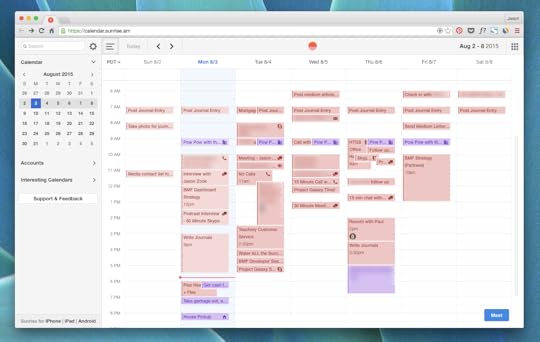
(A screenshot of my calendar during the BuyMyFuture planning and build.)
It may sound weird, but I only allow myself 30 minutes for a trip to the grocery store. No one needs to spend an hour browsing the aisles. Plus, this little trick keeps me from buying extra things I don’t need (because that would take too much time). I’m in and out, with only the items I needed, and I can get back to work or back to time off from work.
If you don’t feel you have the willpower to let your calendar dictate your life, try finding an accountability partner for awhile. If you don’t have friends you want to trust with this task, hire a virtual assistant. For the $20-50 you’d spend a week having someone nag you, it might make you want to stick to your schedule more because you’re spending money on it.
Plus, it’s human nature not to let someone down. Whether that’s a friend or stranger somewhere else in the world, accountability can be very powerful.
The paradox of tools (and why basic is better)
We have too many tools at our disposal. A simple Google search for “writing app” brings up 359,000,000 results. Holy crap. How does anyone decided where to start? And the answer is not to click through until Page 5 or 6 in the results, that’s just ludicrous.
The key is just to pick one tool and limit yourself to that one thing to start. Personally, I like to pick the tool with the least amount of features. As an example, I use the Letterspace app for writing. It doesn’t have a toolbar. It doesn’t have text decoration options. There isn’t even any text formatting. Not being able to waste time with features helps me get in the writing zone very quickly.
A tool should be just that—a tool. It should have just the amount of features necessary to get the job done. When you have the right tool, it fades into the background and allows you to focus on the task at hand.
But how did I find Letterspace? Through a friend on Twitter. A friend I trusted the opinion of and I knew was also an efficient writer. It’s one thing to take a recommendation from a friend who has successfully used that tool to their advantage. But if they’re just gushing about all the shiny and ‘interesting’ features it has, that might be a red flag that their recommendation isn’t the right thing for you.
Another way to test a tool is to set limitations with it. Let’s say it takes you one hour to do an existing task with an app you’ve been using for a while. If you want to try a new app, only allow yourself an hour to perform the same task. If you can’t get it done, then the new app isn’t worth the time investment. If you’re able to do the same task in half the time, then you definitely should switch apps.
Constraints can be beautiful
It’s my honest opinion, coming from someone who’s created five online courses, written a book, and built two web apps in two years, that having constraints is a beautiful thing.
When I say constraints, I’m talking about a few specific things. The first is only doing the essential things needed to complete a project. The second is not letting assumptions dictate the amount of work you do.
Let me break both of these down for you:
When you’re building anything, it can be tempting to follow through with every ‘great’ idea you have along the way. Yet by constraining yourself to only work on a few things, you have a better chance of actually finishing your project and creating something with value. Here’s an example:
I have an online learning product called Teachery. For a year my co-founder Gerlando and I were heads-down building the best online course building tool we could, with the least amount of features possible.
Every time we’d think of a new feature idea, instead of spending time on it, we’d put it in a massive to-do list in Basecamp. Early on we set goals to help people quickly and easily build and sell beautiful online courses. If each feature we came up with didn’t directly relate to our goals, then it got put in the to-do list queue.
Recently we archived a queue of 50+ feature ideas. They weren’t bad ideas either. But by constraining ourselves to stick to the core features and work on perfecting them, we’ve been able to hit all our goals and milestones (which can be extremely tough when building a software product).
Now, when it comes to assumptions, I want to share an example of an online course I recently created. When I was writing the outline for the course I had 12 topic ideas. But when I sat down to create the course I told myself to pick the top 8 ideas I thought were most important to open up the course for purchase.
I assumed that people would be interested in the other 4 topics, but knew they weren’t absolutely necessary. I wrote a note in my outline next to those 4 topics that said “If 5 people ask for any of these, I will create and add them as lessons in the course.” This small step would help test my assumption that people would want this information. So far no one has asked about any of them.
Now in both of these examples you could argue that my projects could have been better with all the additional features and topics. And while I agree with you in principle, I also believe in the quote “Done is better than perfect”.
I’ve seen it with my own projects and with entrepreneurs and creative professionals time and time again. You want to over deliver as much as possible to show the value of whatever you’re building. But it’s much easier to launch with less and add to a completed product, then it is to struggle to get a product to market that has a feature list a mile-long.
—
In almost all aspects of creation I see constraints as a beautiful and helpful thing.
They help guide you and give you a compass to reach the finish line of whatever you’re working on. Lots of people get projects to 80-90% completion. Those same people struggle to get sales and always seem stressed out and overwhelmed. Get the best, smallest version of your project done and revel in your successes.
There’s a lot of power in completion.
This article originally appeared on the Crew Blog.
The post Understand Why You Need Limitations and Constraints appeared first on Jason Does Stuff.
November 8, 2015
Ignite your pilot light of weirdness and develop a kickass personal brand

My pilot light comes in the form of my unwillingness to let the boundaries set by other people stop me from doing things differently. Your pilot light might be your creativity, the way you write, how you see the world, something unique that sets you apart.
It’s time you started to embrace your own inner pilot light and stop letting other people hold you back.
As I’ve grown older I’ve learned that people and society try to snuff out our pilot lights. People have experienced things in their lives that have caused them harm, stress, or anguish. Due to their own experiences, they project these feelings on anyone within reach.
Often times, people don’t even realize they’re projecting their fears on people. But at the same time, they don’t have the self-awareness to take a step back and realize people need to experience things for themselves.
Once I came to this realization about my inner pilot light and decided I no longer wanted the fears and hesitations of other people to hold me back, I started actually adding fuel to my pilot light, effectively creating a roaring blaze of weirdness. Little by little I started giving myself permission to chase my big ideas and in ways that felt 100% authentic to me. I didn’t know it a few years ago, but I was starting to build my personal brand.
This continually-added “fuel” has led to some of my most successful moves in business and to creating a more clearly defined brand that stands out. Projects like IWearYourShirt, BuyMyLastName, SponsorMyBook, and most recently, BuyMyFuture, are all examples of turning my pilot light way up and embracing who I am and what I stand for.
But let’s dive a little deeper. When I say “fuel,” what exactly do I mean?
Let’s look at the example of my book, Creativity For Sale
When I made the decision I was going to write a book about my entrepreneurial journey, I did what any well-intentioned future author would do: I looked at the landscape I was about to play in. The first step in that process was searching the word “entrepreneurship” in Amazon’s books section. I discovered there were over 50,000+ results.
Uh oh.
I was immediately hit with the pilot light dimming question: “What do I possibly have to say about entrepreneurship that 50,000+ other authors haven’t already said???”
But the key word there is “I.”
I have unique experiences
I have my own personal views and opinions
I have my own style of writing (and storytelling)
You may not be a writer, but I guarantee that have your own unique experiences and personal views/stories that are different from everyone else. These specific things are your fuel!
I didn’t learn to embrace these things on my own when writing my book. Luckily I had a super awesome book authoring coach named Lizzie who helped me realize this. Had I not had her in my corner, I probably would have let imposter syndrome take over and it’s likely that I wouldn’t have written the most authentic and personal book that I could have.
During that writing process Lizzie kept telling me to put more “me” into my writing. Don’t try to copy other people and don’t do things a certain way just because they’ve worked for other people. That was more fuel on my inner fire.
Creativity For Sale has been never been a “best selling book,” but those types of labels don’t matter to me. I care more that I get an email or two per week from people who’ve read my book and how much of an impact it’s made on their lives. How much they’ve appreciated my unique outlook and the way that I write. And if numbers matter to you, I’ve moved over 15,000 copies of my tiny self-published book.
Out of 50,000+ books I was able to stand out from all of them for people because of who I am and embracing my unique personal brand.
You’re probably not going to create something that’s never been created before
This is OKAY! In fact, creating a product or service that’s already been created shows there’s a market for it. It’s much easier to build a successful business when a market already exist for your product.
Almost everyone knows that Google wasn’t the first search engine created. But because the founders of Google had their own stories, technical skills, and personal views, they’ve been able to build one of the most profitable companies in the world (leaving every search engine in the dust, even Dogpile!).
Whether you’re writing a book, creating an online course, building a SaaS app, doing coaching/mentoring, are a realtor, marketing consultant, public speaker, or building the next great search engine, there is a clear path to success: Putting as much YOU in your product as possible.
Here are a few questions you can answer that will help your personal brand stand out from a crowded landscape:
What do you stand for? What are your core values?
What are you not willing to sacrifice for your customers?
What is quirky or weird about you?
What life stories can you share that people can latch onto and relate with?
What do people tell you is different about you?
Those items are your fuel for your pilot light. They are the things that will make up your unique personal brand. And trust me, they are also the same things that will help you make more money if you embrace and share them.
Everyone can compete with you on features.
Everyone can compete with you on knowledge.
But no one can compete with you on your personal experiences, stories, and unique outlooks.
Start putting more YOU into what you do and stop letting the fears and hesitations of other people dim your pilot light of weirdness.
The post Ignite your pilot light of weirdness and develop a kickass personal brand appeared first on Jason Does Stuff.
November 1, 2015
Fire Your Bad Clients

In 2009, I ran into my first bad client.
While running my IWearYourShirt (IWYS) business, I encountered clients of all shapes and sizes, but up to that point (and a count of 161 previous clients) I’d never had any trouble.
I had just finished a live steam where I consumed nearly 10lbs of beef jerky (sorry to all my vegan friends) when an email from the jerky company’s owner appeared in my inbox.
He was unhappy with how I talked about his product, saying I didn’t ‘sell’ it enough and was disappointed overall with how the live event went. My jaw dropped.
Now, I love meat. When it comes to jerky I eat it by the package, not the handful. Working with this client was a dream come true as I knew there’d be no need for forced enthusiasm.
Even during the stream, which included the owner live chatting with viewers, people were saying they were going to or had already bought his jerky. I felt the event was a success, so when the client came down on me I was befuddled.
In the email correspondence that followed I found myself questioning all of my choices. It seemed like all my effort was for not. But then I realized something: This was my first bad client.
I learned a bunch of valuable lessons from that experience and have gone on to work with over 2,000 different (happy) clients since then. Here are the lessons I’ve learned and how I’ve applied them to avoid dealing with potential bad clients:
Be clear with your deliverables and stand by your processes
Whether you wear t-shirts and film videos talking about beef jerky, or you’re a designer, developer, writer, etc… you have to create processes that allow you to do your best work. It’s easy to let your processes slip when a big client shows up on your doorstep (or email inbox), but the outcome of doing this is usually disastrous.
There’s a well-known story about Steve Jobs and the famous designer Paul Rand. Jobs approached Rand when he needed a logo for his company NeXT, and in typical fashion asked for multiple options to choose from. But Rand refused, saying: “No, I will solve your problem for you. And you will pay me. If you want options go talk to other people. But I will solve the problem the best way I know how. And you use it or not. That’s up to you.”
Jobs was later quoted saying of Rand, “He is one of the most professional people I have ever worked with: in the sense that he had thought through all of the formal relationship between a client and a professional such as himself.”
Now, you and I are not Paul Rand. And we are not being approached by the Steve Jobs(es?) of the world. But we are people. We do have talents. And we should absolutely create a set of values and processes that we stand by when it comes to our work. If a prospective client is not okay with those things, then that client is not the right fit for you.
If you don’t have processes in place to help you vet potential clients, you should think about creating some. This doesn’t have to be an exhaustive 10-page document. A simple one-pager will do.
Here’s an example of some of the first questions I ask a new client:
What are your goals with this project?
What is the timeline for the project?
What are the specific deliverables for the project?
Are you okay with knock knock jokes over email?
Right away, I have all of the information I need to get started working.
You’ll have to find the questions that best represent your work and your style. For me, a question like #4 (knock knock jokes) is one of the most important ones as I want to make sure the people I work with have personality, enjoy having fun, and don’t take everything too seriously.
Look for red flags from the beginning (or, how to spot a bad client from a mile away)
If a potential client shows resistance to filling out your one-page process document, that’s an immediate red flag.
If they do fill out your one-page process document and you still get a weird feeling in your gut about their answers, that’s a red flag. We don’t listen to our initial reactions enough and if something seems off it almost always is.
It may sound weird, but do some Internet stalking.
Google the client’s name. Does anything negative come up in the first few pages of results? Search their @name via Twitter and see if there are any conversations that might concern you.
You can also read some of their tweets and see if they’re the type of person who publicly complains and could cause your business harm. If they aren’t on Twitter, try to find them on other platforms (like Facebook or LinkedIn).
Another way to find out if a client is going to cause you a raging inferno of stress is to ask them for references. This sounds old school, but old school works.
Your client should be ready and willing to provide you with people who will sing their praises. Those who aren’t willing to do that fall into two categories:
They’ve pissed everyone off and no one will vouch for them
They aren’t willing to follow your processes, in which case that’s a huge red flag
You should also try to get a gauge of their expectations and goals of their project. If their goals don’t align with your values, it’s a red flag.
For example, let’s say you’re a designer and a farm-to-table restaurant reaches out to you to redo their website. They seem cool and they pass the test of filling out your one-page process document but on the first phone call with them they off-handedly mention they don’t really care about sustainable food and are just jumping on a trend. If sustainable food and running a business with ethical values matters to you (the designer), then this might be a red flag and a client you want to avoid.
I’m not saying you have to share all the same values as your clients, but it certainly doesn’t hurt.
Remember that your latest client didn’t exist a week ago
Too often a new client gives us shiny-object-syndrome, We get so enamored with the possibility of income, a new project, and the accolades that come along with the relationship that we neglect one simple thing:
Your next client is not your last client. They didn’t exist a few days ago and they won’t be the last person on Earth to contact you for work.
I’ve been guilty of this a few times.
A notable company, someone I look up to, or just a cool opportunity falls in my lap. Then, for whatever reason, the project falls through. After that happens I find myself in a short-term state of unhappiness where I consider editing my values and processes to make the relationship work.
Those decisions will only lead to trouble down the road. Instead, I’ve learned to take a deep breath and understand that potential client didn’t ever exist on my radar before. Yes, it’s a bit of a bummer that things didn’t work out with them, but there are plenty of other client-fish swimming in the sea.
How to fire your existing bad clients
I’m not going to sugarcoat it: Firing existing clients is not easy. But what I will tell you is that once you rip the bandaid off you’ll feel like you’ve lifted a 900-pound gorilla from your shoulders.
There are a few things to consider when going about firing a bad client:
Don’t leave them out to dry: You should do everything in your power to get the project you’re working on to a state of transition. That won’t mean finishing the website or app (for example), but rather reaching a specific milestone and creating transition documentation.
Refund any money that’s been paid for future work: You shouldn’t keep a bad client’s money if it’s for work that hasn’t been done yet (no matter how badly you want to charge them an ‘a-hole client tax’).
Have an honest, verbal conversation but don’t leave the door open: Too many times we’ll acquiesce when we start to feel bad for someone. Be firm and honest with your communication. Set a date of transition and make sure they have enough advance notice to start making changes.
Make absolutely sure you aren’t violating any agreed-upon terms: If you signed a contract of any kind, look it over thoroughly before you attempt to end a client relationship.
Clients shouldn’t be seen as transactional, they should be seen as partnerships
Take care of your clients and they will take care of you. If you create great working relationships with people, they should want to do all your marketing for you.
Seek to solve problems for your clients and over-deliver on their goals if you can. I don’t mean work 10x more hours, but rather go out of your way to make their life easier and give them the right tools for success (however that’s determined for your business offerings).
If you can change your mindset from clients to partnerships it will make the entire working relationship easier. Instead of thinking you owe someone a certain amount of hours of work, you can shift your thinking to investing hours to help someone reach their goals. That’s where real success happens.
Happy clients pay their bills and are more likely to pay you again
Successful partnerships have the same benefits as happy clients, but also lead to referrals, additional projects, and long-term relationships.
Some of the clients from the first year of my IWearYourShirt business (2009) continue to support my new projects to this day. We respect each other and have built a solid foundation together, one that continues to be mutually beneficial year after year.
The post Fire Your Bad Clients appeared first on Jason Does Stuff.
October 25, 2015
Improve Your Marketing With These 10 Free Ideas
These are free ideas, but all of them take work. If you are looking for an automated marketing plan that can activate your passive income funnel and deposit $100k directly into your bank account in the Caymans this is not that. This article is, however, a free resource that you should pick and choose from if you’re in need of a little marketing inspiration.
Let me be clear, no marketing strategy, idea, or plan is guaranteed to work. If you want guarantees, get out of any business that requires marketing or advertising of any kind. Nothing is guaranteed in business and nothing is owed to you.
Ready to put in some effort and see some results? Awesome. Oh by the way, results don’t necessarily equate to money. Results can also mean lessons learned. Which are vital for any business at any stage.
One more thing while I’m handing out caveats like old ladies hand out taffy on Halloween: Trying any of these ideas could lead to other ideas. That’s the beauty of creation and work. You may be seeking specific results by trying a certain marketing strategy, but you should be open to unintended outcomes which can lead to new ideas.
Okay. The caveat train has left the building. Here are your 10 free marketing ideas in no particular order of importance or effectiveness (except #1, because it’s the thing that works best for me):
Idea #1 – Build an email list and send consistent useful content to your subscribers.
I make 90% of my income from my email list. Let that sink in for a moment. I don’t use crazy growth tactics. I don’t have a single email pop-up. What I have is a strategy for delivering consistent and useful content.
Step #1 – Pick your favorite email marketing provider and add opt-in forms.
It doesn’t matter which one I think you should use, just pick one. Then, add an opt-in form on your website in multiple places. You can find my opt-in form on the homepage of my site, in the footer of my site, and in the navigation of my site.
Step #2 – Explain the value and who your emails are for.
I don’t stop at just having an opt-in form. I explain at each opt-in form exactly why someone should sign up for my email list, who I think my email list is for, and what useful content they can expect. Here’s the exact text I use:
Hello, I’m Jason Zook
I’m an action taker, doer of stuff, and enjoyer of not fitting in.
I’d like you to join The Action Army: a group of business owners, creative professionals, entrepreneurs, and anyone else who wants more out of life than was prescribed to them.
Members of THE ACTION ARMY get my weekly articles delivered to them before anyone else, and they get first access to all of my projects.
There are no pushups required for this army! Join today.
This is polarizing. You either consider yourself a part of one of the categories of people I listed or you don’t. You either want to take more action in your life and business, or you don’t. I intentionally want to deter people who aren’t aligned with the audience that my weekly articles can best serve.
Step #3 – Be consistently useful.
I’ve sent out a weekly email for almost two years and every single week people reply that my email helped them. I don’t just think I’m writing useful content, my subscribers are telling me I’m writing useful content.
People like structure so I send my emails at the exact same time each week (Monday at 10am EST). There have been a few times when my emails didn’t go out on time or I took a break. When this happens I always get emails/tweets from people asking me if they missed that Monday’s email. That’s a fist pump moment right there.
Being consistently useful has more marketing power than you can imagine. The trick is to believe in the process and continue to deliver on your promises.
Bonus Step #4 – Brand your email list.
My email list used to be called “Get Jason’s Updates.” Super sexy right? Just reading that gets you amped up to get those updates doesn’t it? Not. When I rebranded my personal site to JasonDoesStuff my girlfriend Caroline came up with the name The Action Army. I absolutely loved it.
Giving your email list a name helps people remember it, but it also helps people feel included in something bigger than just an email list. Here are some words you can steal to brand your own list: Community, collective, conglomerate, cool kids club, group, crew, members, society, legion, etc. If you can tie-in what your emails will be about (mine are about taking action, hence Action Army), even better.
Idea #2 – Host a free awesome local event.
We live in a digital world, but we forget how impactful in-person events can be. To host an in-person event, you need to do just a few things right.
Thing #1 – Find a cool venue.
If you thought “conference room at a hotel” when I said “local event” please immediately close this article and go read something else. Picking a boring venue for an event does one thing extremely well: It makes you and your business look boring.
In almost every town in America there is a cool coffee shop, an old historic building, a mainstay restaurant that everyone knows and loves, or some outdoor space that people really enjoy. If you don’t think you know of any cool venues, ask a friend, your kid, or people on social media in your area. If you hear the same place mentioned more than once, that’s the place where your event should be hosted.
Thing #2 – Have good food, good drinks, or good music.
Hosting a local event isn’t just about having your company name pushed in people’s faces. It’s about people associating your company with things they enjoy, which in turn, means they might enjoy your company. Again, go local here and find a hometown chef, mixologist, and/or musician. Don’t feel like you need to pay an arm-and-a-leg for these people. Ask if these folks want to partner with you and get some exposure for their business as well. You don’t get what you don’t ask for.
Thing #3 – Own the event.
Spend the majority of time meeting each and every person at the event and asking them questions about what they do. Keep asking questions and listening. Don’t pitch your business or hand your business cards out.
Whether you have a microphone or you just want to stand on a chair and holler, don’t be afraid to take credit for how awesome a time everyone is having. Don’t be a douchecanoe about it, but take a moment to share something about your company. Just keep it short and useful (don’t read your business plan or elevator pitch).
Bonus Thing #4 – Getting people to show up?
This is where you embrace the power of your existing network. Who do you know in your town? Tell them how awesome your event is going to be and build a list of word of mouth event sharers. Use a service like Meetup, Eventbrite, or Facebook Events to have a (free) RSVP to your event. This makes your event feel bigger and more important than it probably is.
Idea #3 – Host a virtual summit or webinar that doesn’t suck with other like-minded business owners who don’t suck.
Virtual summits and webinars get a bad rap. Why? Because crappy marketers do a horrible job and spoil things for the rest of us. By partnering up with people who might be in your industry or doing things similar to what you do, a virtual summit or webinar can bring your combined audiences together in one place for a grand-fiesta-of-value!
Step #1 – Plan to deliver value, not sell your stuff.
Too many people use virtual summits and webinars as a place just to sell. These platforms are ripe for teaching. What knowledge can you give to people? What problems can you help them solve? Who do you know that also has unique things to offer in your business space?
Marketing isn’t just about making sales. It’s about building trust and making people respect you. The sales will come if you continue to deliver value.
Step #2 – Find experienced people to partner with and make sure there’s something in it for them.
This is by far the hardest part of partnering with other people. I get asked too often to do a virtual summit, webinar, etc, and there’s nothing in it for me. I’m not trying to be a selfish jerk, I just have a limited amount of time to throw around.
A couple things you could offer someone, especially if you don’t know them and want to partner with them: Your product or service at a hugely discount rate (or better yet, free) for that person’s customer base (please make sure their customers would even care). A dedicated email to your customer list promoting something from your potential partner. A very generous revenue share IF you are selling something.
Step #3 – Plan to under promise and over deliver.
This is a marketing tip in itself, but with live events you definitely want to plan in some extra goodness for the audience. This could be a helpful e-book, an online course, a huge discount to something awesome, or some resource or tool that people can use for free.
Don’t talk about this thing at all until you actually deliver it during the live event. Surprising and delighting people can go a long way (and you should plan to do this often!).
Bonus Step #4 – Use the right platform for live online events.
I’m a big fan of Crowdcast.io right now. It’s super easy to use and their customer service is on point. I’ve used GoToWebinar and Google Hangouts before. Both are good, but my preference right now is Crowdcast.
Idea #4 – Create a podcast.
Podcasting is suuuuuuch a great tool for marketing right now. We’re on the bubble, folks. Now’s the time to start a podcast. But wait, don’t start one unless you have these things honed in:
Thing #1 – Be informative or entertaining.
I don’t care about the length of a podcast I listen to, I just want it to do one of two things: Inform me of something that improves my life or business or entertain me so I can enjoy some down time.
The podcasts that do the absolute best are the ones that are both entertaining and informative. This isn’t rocket science. It’s planning. Plan to record a bunch of test episodes of your potential podcast. Then share your test episodes with friends, your trust circle, and your existing customers/audience. What do they think? What feedback do they give you?
Also, if you don’t like listening to your own podcast, you should probably change things up.
Thing #2 – Be clear about who your podcast is for and what it’s about.
Don’t start a podcast on marketing. Don’t do it. Get laser-focused. What part of marketing are you really good at? What part of marketing do you know a ton of stuff about? And do you love talking about marketing? Because if you don’t, don’t host a podcast about something you don’t actually enjoy talking about.
Just like the email list idea above, you should be very clear with who your podcast is targeted to. Let’s say you want to host a podcast about the mating habits of exotic birds. Be very clear that your podcast is for people who like birds and their mating habits. Go even further and say something like “If you want to know more about The Rainbow Lorikeet, The Golden Pheasant, The Hoopoe, and the Quetzal, this is the podcast for you!” (I like birds, leave me alone.)
The bird example is silly, I know, but it illustrates my point. Be super focused on who your podcast is actually for. Don’t worry about creating the next Serial podcast. Create a podcast that you and you alone can create.
Thing #3 – Be consistent.
Again, just like the email list idea above, consistency is king. And the queen of the castle? Authenticity. Don’t pretend to speak like someone else. Don’t remove all the uniqueness from the way you talk naturally. Be 100% you. Then create a production schedule and stick to it.
If you aren’t sure if you’ll like podcasting, set a 3-month plan for yourself. Commit to doing it for 3 months and then reassess at a certain date. If you hate doing it and it isn’t bringing you value, stop doing it. If you enjoy it and can see an uptick with stuff related to your business, keep going!
Bonus Thing #4 – Ride the New & Noteworthy train.
A handy little trick with getting in New & Noteworthy on iTunes is launching with a few podcast episodes in the bag and getting ratings and reviews early on. So instead of releasing 1 episode when you start, have 3-5 already recorded and ready to launch. Instead of launching your podcast and then asking for ratings and reviews, get people ready to give you ratings and reviews before you launch. The more time people spend listening to your show early on, the better your chances are for hitting New & Noteworthy.
You can read more about this and podcasting in general in this podcasting article I wrote.
Idea #5 – Make swag people actually want.
This is a really great article about making t-shirts and giving them away. I’ll summarize it for you if you don’t want to read the whole thing (which you should though).
People will not wear crappy t-shirts. Trust me, I know from a boatload of experience. The plain white 100% cotton shirts with your mediocre company logo on them? Yeah, those will get tossed in a drawer and the next time that shirt sees the light of day is when it gets donated to Goodwill. Pick high-quality shirts (blends created by Next Level, American Apparel, and Canvas are great) and put something interesting on the shirt! Sorry, your logo isn’t super interesting unless you’re a band, a delicious coffee company, or a ghost with boobs.
What’s something your company stands for? What’s a phrase you use all the time that people like hearing you say? What’s a little motto or interesting design element that tells the story of your company (and that people would be proud to wear)? Put that on your t-shirts.
The same advice goes for stickers, etc. Make stuff that people would be proud to showcase, even if it doesn’t clearly say your brand name. If it’s interesting and people get asked about it, then they have the ability to tell your story to someone else. Creating an opportunity for word of mouth marketing is very powerful marketing.
Idea #6 – Create a scavenger hunt.
Who doesn’t love scavenger hunts?? This could be virtual or in-person. In-person would be really fun, but that favors businesses that have some type of local appeal. Scavenger hunts are really not that hard if you just take a moment to plan out each step and make it a fun thing for people to spend time doing.
Virtual or in-person, here are some steps to consider in the hunting process:
Step #1 – Good design goes a long way.
Remember how excited you got as a kid whenever you thought of (or created) a treasure map? Hire a designer to create a treasure map! Whether your scavenger hunt is online or not, a physical map that someone can hold in their hands creates a visceral response. Yes, it will take planning and money to come up with a map that leads people on their hunt, but with effort comes results.
If your scavenger hunt experience is in-person, don’t just shove an item on the hunt in a bush or under a mailbox. Create an experience for the person when they find it. You can do the same thing if you do a scavenger hunt online. Add good copy and design at every turn.
Step #2 – Offer up cool stuff!
Have you EVER in your life gotten excited about a lanyard or 5% discount? Don’t make those things the rewards for people’s effort. You don’t have to offer up gold bullion. I mean, that would be epic, but if you know what your customers like, then invest in some stuff they would actually enjoy.
Step #3 – Don’t make it too easy or too difficult.
People’s attention spans are crap these days. I’m shocked you’ve read this far in this article. It’s just the nature of the time we live in. Know this and make sure you aren’t creating a scavenger hunt that takes two lifetimes to accomplish.
A great way to test this is have different people of different ages go through your scavenger hunt. See how long it takes them and listen to any feedback they offer.
Idea #7 – Ask your existing customer what their favorite childhood memories are, then make those childhood memories show up on their doorstep.
This one is pretty easy. Whether by email, survey, social media, or carrier pigeon, ask your existing customers what their favorite memories are from childhood. If you want to get specific, ask what their favorite cereals, candies, snacks, movies, songs, etc, are.
Then, buy those things for your customers and mail them those memories. Do you know how excited I would be if someone mailed me a package with a small box of Honeycomb cereal, Skittles, and a Super Contra Nintendo cartridge? Holy crap, I’d Instagram/Facebook/Twitter the hell out of that photo. Maybe there’d also be a note from that person with their company’s cool sticker or t-shirt that doesn’t suck in the box too? That’d be great marketing.
Tip for sending memories: Don’t do something like this just because you think it’s a good marketing tactic. Do this if you actually care about your existing customers and if value customer retention over customer acquisition.
Idea #8 – Do a 24-hour challenge and invite people to watch you live.
There’s something really interesting about seeing the behind the scenes and live-action of a project. I used to do this daily with a live video show I hosted on Ustream. There were many times when I kept the live video going for hours after the show time because people wanted to watch. Those bonus-hour-watchers ended up being my biggest fans (and sometimes best customers).
Step #1 – Pick the right platform for you.
You don’t have to host a live video show. You could create a blog post and update it hour by hour (my friend Nathan Barry did this and it was fun to watch). You could do this via social media and keep people up-to-date via a hashtag. You could use an audio recording service (like Soundcloud) and make lots of little clips.
Find a platform that provides little barrier to entry for you, but is also easy for a potential viewer/listener/reader to enjoy.
Step #2 – Share your processes.
People love learning processes. Some of my biggest successes in business have come through sharing my entire process (SponsorMyBook and BuyMyFuture specifically). If you’re going to do something for 24-hours, whatever unique processes you use to accomplish that thing should be shared and explained to other people.
Step #3 – The outcome (kind of) doesn’t matter.
It’s 24 hours. You aren’t going to build a DeLorean from the ground up. Pick something reasonable like a e-book, course, website, fundraiser, gluten-free bake sale, whatever interesting thing you can create. It really doesn’t matter how good the thing turns out, you just want people to join you on the journey and feel like they were a part of something.
Step #4 – Include people!
Ask people to call you, tweet at you, comment on your blog, email you, leave audio recordings, etc. Then, showcase their words during your 24-hour event. People love seeing their name and words online. Embrace people’s vanity!
Including people also helps you build a stronger bond with your customers and fans. Having raving customers and fans is possible for any company in any industry. If you don’t believe that, I have no idea why you’re reading this article.
Idea #9 – Secret deliveries.
This idea came to me while writing this article. Here’s how it works:
Step #1 – Find something awesome in your local area or that you can order online in bulk that’s easy to deliver.
Let’s say, for example, there’s an amazing donut shoppe in your town (and you know it’s amazing because they spell shop “shoppe”). Go talk to the donut kingpin who owns the shoppe and order up a whole slew of circular deliciousnesses.
While the donuts are baking, buy a domain like ihopeyoulikedthedonuts.com. Have a designer whip up a very simple website with a fun message on it (use Squarespace if you want to save money and do it yourself). The message could say something like:
“We hope you enjoyed the donuts! Wait, who are ‘we?’ Well, we’re . We just wanted to deliver a little deliciousness to your doorstep today. If you’re ever in need of , feel free to shoot us an email or give us a call”
– Tom Selleck, CEO, Mustaches-R-Us, 1-800-MUSTACHE / tom@stachaholics.com
Step #2 – Get a little note printed for the packages.
You don’t need your corporate logo on any packaging. You don’t want your name plastered all over the delivery. Create a little mystery!
Leave a note in the box (example donuts) that says nothing more than “Enjoy the delicious pastries? Visit ihopeyoulikethedonuts.com” That’s it! Don’t muddy up the note with all your business objectives, logos, letterhead, CEO’s dog’s name, etc. You want people to be interested in taking the next step to find out more info.
Step #3 – Make a potential (and existing) customer list.
I’d recommend a healthy dose of existing customers and potential new customers. Gather up all their addresses and plan out your delivery route.
Don’t want to deliver the items yourself? That’s cool. Most cities have courier services or you can post on Craigslist and find people willing to do deliveries for cheap.
Step #4 – Word travels quickly, get your deliveries done quickly.
An idea like this doesn’t have a long shelf-life (much like a yummy donut). Organize a handful of delivery people to drop off the goodies at the same time to all the businesses on your list. If I was doing this marketing idea, I’d make sure as many deliveries got delivered first thing in the morning and within the smallest time window possible.
Step #5 – Forget about this idea.
Wait, what? I’m serious. Ideas like this aren’t meant to be measured and analyzed. It’s a fun marketing thing to do, not a long-term strategy. Don’t obsess over how many people call, email, or even visit the website. Understand that you made an impression on a potential customer and move on to your next idea.
Idea #10 – Reach out to your existing customers and ask what you can do for them. Then do those things.
Best form of marketing ever? Word of mouth. Who has mouths? Your existing (and hopefully) happy customers. Send an email to your customer list and ask one question: “What’s something we can help you do, within reason, right now?”
Then wait for the responses.
Does someone’s family member need prayers because they are in the hospital? Send them a bouquet of flowers.
Does someone need help getting customers for their own business? Offer to jump on the phone with them and share everything that’s worked in your business to get customers.
Does someone want tickets to a New York Knicks game? Go on Stubhub and buy them two tickets to a game in the future at whatever price you can afford.
Yes, these things will cost you money. No, you are not required to do any of them. But if you are going to take on this marketing idea, I suggest you set a budget and do your best to accommodate every single person who replies. This takes effort and money, but those two things can yield incredibly returns if invested in the right places.
Every marketing idea has unintended outcomes.
These ideas might not work. They make work incredibly well. Either way, doing anything will bring about learning moments to advance your business forward.
Even if you don’t use one of these ideas, my hope is that reading this article might spark some sort of idea for you. Remember that ideas are great, but execution is the true secret to any success. Now get out there and do something interesting.
The post Improve Your Marketing With These 10 Free Ideas appeared first on Jason Does Stuff.
October 18, 2015
Understand That Quitting Isn’t Failing
You might not want to hear this, but it’s time to quit.
There’s a lot of advice out there saying “Don’t give up!” and “Push through the tough times!” But those statements come with lots of caveats. What if you hate what you are doing? What if the tough times are putting your health at risk? What if giving up frees up time for new opportunities?
Just because you quit something doesn’t mean you’ve failed. And the added time and freedom you’ll feel from quitting are well worth the struggle of making the call to let go and move on.
Whether it’s a short-term quit or a long-term quit, it’s time to take control. It’s time for you to take the necessary steps to get yourself out of situations that aren’t bringing you value.
Making temporary space through short-term quitting
When it comes to freeing up your time you don’t necessarily have to quit something completely.
Short-term quitting (or taking a pause) is a great way to create mental space and give yourself a break—one that can help you figure out if you want to quit completely or continue on.
Last year around this time I got really frustrated with social media. I wasn’t seeing the interaction that I’d seen in years prior and felt myself getting angry when reading tweets and posts from people about topics I didn’t want to read.
I realized it was time for a break (short-term quit).
For 30 days I quit social media. I deleted the apps from my phone (Twitter, Facebook, YouTube, etc) and I removed all associated bookmarks and browsing history. I wasn’t going to read or post anything for a month and see how I felt at the end.
Would I want to get back on social media? Would I want to quit forever? Only 30 days would tell.
During the social media hiatus, I felt a wave of emotions. I was sad that I wasn’t able to interact with people I genuinely enjoyed talking with on a daily basis. I was frustrated that my iPhone started to feel like a worthless brick of technology. I realized I had built addictive tendencies (upon unlocking my phone, I felt my thumb reach for a space where the Facebook app no longer existed).
I also spent more time during the 30 day break than I’d like to admit staring at a completely blank page in my web browser, all the while thinking “where do I go on the Internet now?”
I wrote a detailed article about my social media detox here, but at the end of those 30 days I decided not to completely quit. I did, however, not re-install the Facebook app on my phone. I didn’t add Facebook and Twitter back to my browser bookmarks. And I created a new structure for my usage of social media, which included visiting sites once in the morning and once in the afternoon.
If I just went back to it, was it worth quitting social media at all?
During that 30 day break I came up with multiple new business ideas, one of which brought in over $40,000 in revenue. The months prior to that I felt like I would never come up with a new idea again. My thoughts were always cloudy and jumbled. After my break, I had a newfound sense of clarity and energy.
The power of long-term quitting
There’s times when a short term break just won’t cut it and you need to make the call whether or not to drop something for good.
In 2010 my IWearYourShirt business was doing very well. It was profitable, it had a very devoted fan-base, and everything seemed to be humming along perfectly. Because of all those things I decided I wanted to give back and create my own charity or non-profit organization with a focus on something I was passionate about: t-shirts.
After multiple daily live brainstorming sessions with friends and fans of IWearYourShirt, I decided to try to achieve something big and get 1,000,000 t-shirts donated to people in impoverished areas of the world.
As this idea started to come together the support for it grew like a weed.
A local design and development company wanted to do all the branding and web work and an existing non-profit organization wanted to help handle all of the logistics (receiving shirts and finding rural villages around the world to take them to). Everything was clicking into place.
But then the backlash started. The company, called 1MillionShirts, found its way onto the laps of non-profit and charity activists and bloggers. They ripped the idea to shreds.
If you’re thinking “why the heck would they do that, this sounds like a great idea!” you are not alone. I lashed out at some of these people, defending my idea with vigor.
I felt my intentions were in the right place and there were people all over the world who didn’t have clothing (specifically t-shirts). This was my chance to make a tiny impact with something I had an influence on.
But then a few non-profit folks explained the situation on the ground in these countries and areas where I’d never been but wanted to drop stockpiles of free t-shirts on.
They explained that by dumping loads of free clothing on people it would crush any micro-economies that existed where people were trying to make a living by selling their own t-shirts. It would also perpetuate the handout mentality that only reinforces the behavior of waiting for good things to come instead of making them happen on your own.
In short, I would be doing way more harm than good.
There’s a lot more context and layers of conversations to share, but it was apparent to me that I needed to quit 1MillionShirts. It wasn’t just that I, personally, needed to walk away. It’s that I needed to shut it down (especially since over 12,000 t-shirts were donated within the first few weeks).
Did I think about pivoting 1MillionShirts into a direction that would provide the right value to people in need? Absolutely. I even spent hours on various Skype calls with non-profit organizers around the world trying to find the right answer.
But the stress, the anguish, the misaligned good intentions were too much. I was still trying to run a growing (and profitable) business which was getting the negative effects of also trying to build, pivot, and learn about non-profit organizations.
So I shut down 1MillionShirts a month and a half after it was announced to the world. After thousands of people reached out to support it. After I (and many other people) poured countless hours into it. I was extremely passionate about doing some good for the world, but I was doing it the wrong way and without enough knowledge of the space I was trying to get into.
Quitting is essential to starting
Removing yourself from the quitting=failure mindset shows you just how much more can be accomplished when you free up time in your life.
Letting go of something puts you in control. If a project or relationship isn’t bringing you value and isn’t working the way you want, quit it.
Stop doing that thing right now. Take a deep breath, step back, and reflect on the time you spent doing what you were doing so you can apply it to your next big idea.
You don’t have to quit big things either. If you’re trying to get healthier, start doing yoga. If you hate it, quit it and try something else. If you’re trying to become a better writer, experiment with a completely different writing style for one week. If you hate that style, quit it and try another one.
Quitting shouldn’t be looked at as the end. It’s simply a step in the process. A step that should always be pushing you forward, not backwards.
***
Too often quitting gets lumped in with failure. But we all need to understand that these are two completely separate situations. Failure is typically something you can’t control, while quitting means you’re taking control of the situation.
Think of all the successful people you look up to right now. I doubt you can name anything they’ve quit. People don’t remember or dwell on the things you let go of. They care about all the amazing things that happened because you were strong enough to quit and move on.
// This article originally appeared on the Crew Blog
The post Understand That Quitting Isn’t Failing appeared first on Jason Does Stuff.