Jason SurfrApp's Blog, page 31
May 12, 2014
The Skill They Don’t Teach You In Any Business Class: Flexibility
 (Photo credit: Thissocalledlife)
Owning a business is not a smooth ride for most people, myself included. You set yourself on a certain path and a hurricane of changes completely derails you. You write down specific goals and they get shaken up by an earthquake of revisions. Being flexible is probably one of the most important skills you can hone as a business owner, and it’s a skill that nobody can teach you.
Growing up I learned a lot about flexibility. Moving to different cities and states. Changing schools often. I had multiple crappy jobs, all of which required incredibly different skill sets to keep me employed and sane. All of that life experience gave me a Bachelor’s Degree in Flexibility. However, nothing teaches you how to be flexible like owning your own business. And I’ll be the first to admit, sometimes I feel like a sumo wrestler in a yoga class (read: not very flexible at all).
During my time starting, running, building, and managing people for IWearYourShirt, I was put in some of the most uncomfortable business-yoga poses I had ever been in. But as awful as some of those experiences were at the time, they’ve made me incredibly more flexible today. The tough decisions I had to make a few years ago, don’t feel anywhere near as tough today. When something doesn’t go as planned, I’m much quicker to adapt and make changes. I feel like I have a Master’s Degree in Flexibility now.
My most recent issue that required flexibility was diving into the self-publishing process for my upcoming book Creativity For Sale. Last October I set a book release date of May 15 (my 32nd birthday). I set this specific date because I wanted to make sure I didn’t drag this project out for an extended period of time.
With the help of the awesome back cover sponsor of my book (RTC) I was able to write the first draft of my book, get a second draft done, then a third, then a final, then edits, then proofing, and formatting all in about two months. Never writing a book before, even I know that’s a crazy-fast timeline for getting a book done. The folks at RTC became very flexible for me and I can’t thank them enough for that.
But even with all that hard work, the actual printing of the book and getting it up on Amazon.com was something completely out of my control.
So here’s where my flexibility skills come in.
I won’t make the release date of May 15. Even with an amazingly hardworking book printer and calls to Amazon.com, it just won’t happen. A few years ago this may have ruined my day/week/month. But this is the situation I’m in and I can’t do anything about it. There are too many items outside of my control and I understand and embrace that. Instead of getting upset and angry, I’m making the best of it. I’m using the extra time to add a couple more items to my book launch marketing plan.
My book will officially be released on June 3 and I’m perfectly okay with that.
With every project I work on I find new obstacles to overcome. Previous obstacles seem mundane and trivial. It’s a learning and growing process to increase business flexibility.
If you own a business, I’m sure you’ve experienced similar feelings. At times you’ve felt like you’re being bent and twisted in directions you never thought imaginable. You had a plan and it was completely shattered. But you picked up the pieces and you moved forward. You’ve undoubtably become incredibly more flexible since you started your company.
There’s no guidebook for learning how to be more flexible in business, there’s only experience. No matter what life throws at you, keep pushing forward and make the best of every situation.


May 7, 2014
Why 200×5000.com is Brilliant
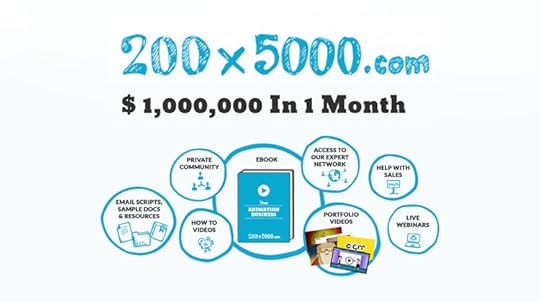
A few months ago an entrepreneur named Scott Barlow reached out to me via email. I didn’t respond. Not because I’m a jerk or because I’m lazy, but mostly because I’ve received emails like his before and they never go anywhere. The email he sent went something like this:
“Hey Jason, I have a great idea to make $1,000,000! I love what you’ve done with IWearYourShirt, would love to chat with you about my idea.”
What I’ve realized over the years is that tons of people have $1M ideas, about 0% of them actually put in the work to try to make them happen. So after I read this familiar email, I passed on responding to see if Scott was different from the countless others who’ve sent similar emails over the years and never followed up (or put their idea in motion).
Then a funny thing happened. About a week later Scott followed up. Then a week later he followed up again. He had my attention and I thought he might actually be serious about his $1M idea.
Scott and I hopped on a Skype call and began to chat about his $1M idea he calls 200×5000. The idea was good and Scott has lots of experience in the video animation space, but what I really enjoyed was Scott’s passion. Not only did he have an idea, but he had a plan in place to make it happen (and an aggressive one at that). Plus he shared this cool blog post with me, which made me smile.
For the entire month of May, Scott is dedicating his life to try to sell 5,000 units of his $200 “Start your own video animation business” package. I applaud Scott for building a platform to help other people learn how to make side income, but again, that’s now why I think Scott is brilliant.
What Scott may not even realize is that he’s literally created a business that people will pay him to learn how to build and run a business. Whether Scott hits $1M or not, the business is already a success because he’s made $6,200 in the first few days. I know he didn’t spend that much money building the website or the business package, so he’s already created a profitable side business.
Of course it would be amazing and life-changing if Scott hit his $1M goal, but just putting his idea into motion and generating his first few sales is amazing and life-changing. I hope Scott realizes the incredible amount of entrepreneurial experience this project will bring him. Oh, and that he’s getting paid for that awesome experience. That’s brilliant.
If you’re thinking about starting your own business, embrace your inner Scott Barlow. Have a huge goal and work your ass off to achieve it. You and Scott might not make $1M, but actually starting something is incredibly beneficial. My buddy Noah has a cool program that helps you learn how to make $1,000 per month. You might want to check that out.
Anyone can have an idea, but it’s people like Scott who are willing to put an idea out into the world and work their asses off to make it happen that are the ones that will succeed.
Kudos and good luck to you Scott!
May 4, 2014
Sales Advice From The World’s Crappiest Salesperson (a Guest Post from Paul Jarvis)
This is a first ever guest post on JasonSadler.com. I met Paul Jarvis a few months ago when I took a free course he created called “My Damn Book.” Since then we’ve exchanged tons of emails, chatted book marketing, complained about social media, and enjoyed talking about creative things. I invited Paul to write a guest post here to promote his new book The Good Creative. I’ve read Paul’s newest book and I highly recommend it. Learn more about Paul at his website, follow him @pjrvs, and definitely sign up for his email newsletter (it’s one of my favorites). Hope you enjoy the post!
# # # #
Most of us creatives suck at selling.
And this is probably part of the reason why we write or draw or create instead of selling cars or condos. There’s nothing wrong with selling cars or condos, but I doubt many of us would be able to sell even one.
If you put me in a room and told me, “OK, Paul. Listen here. You’ve gotta sell this nice, cool glass of lemonade to these thirsty and overheating people,” I doubt I could do it.
There’d be a lot of umm’s and hand-wringing. I would probably ask to borrow a computer so I could make a website for the drink instead.
A lot of us feel that selling is “icky”. And for the most part, it can be if we do it in a way that doesn’t suit us.
The Internet feels a lot like The National Inquirer, edited by a statistician, who’s also just dropped acid.
(FYI: this is something I’d LOVE to see happen.)
With their flashy sales pages (which are clearly fully optimized for hyper-improved conversions), the blinking pixels send out their covert (or sometimes, not-so-covert) messages:
You’d better be afraid, because your life will suck forever… unless you act now and BUY my product!
Look at all this social proof! All the cool kids are doing it!
Wanna know the 15 ways to achieve X that no one (but me) knows about?
Hack the system to unlock your hidden wealth with these 3 easy steps!
Stats, oh glorious stats!
I feel like I’m in the lemonade room, feeling the skin-tightening pressure to sell, all the time.
When I create a new book and want people to buy it.
When I want a blurb from another author whose name has serious clout.
When my band plays shows and we want to sell t-shirts and CDs.
Hell, even if someone asks me why they should hire me to create their website, my answer is often akin to, “Drink?… Now?… Lemons!?”
It seems silly to write about selling when I fully admit that I’m probably the world’s crappiest seller. But here’s what I do know: people need to feel like they know who you are before they’ll give you any money.
If they don’t feel like they know you, it’s going to be a much more uphill battle to get them to open their wallets.
So how do you get people to know who you are?
Be really good at what you do.
Like, the best—while always learning and improving. That’s a no brainer, right?
Oh, and did I mention that “good” takes years, not weeks or months, especially if it’s creative work?
Want to have a popular blog? Write on it every week for 5 years.
Want to sell out coaching sessions? Get your credentials and then work hard with any clients that come your way, for a very long time.
Focusing on a specific group people is another important point, because it’s next to impossible to get to know every person on the planet. It’s better to pick a tiny group that you can easily interact with.
Social media, message boards, even networking events—the more focused they are on a specific niche/industry, the better for you. That way, when you start offering your opinion, offering suggestions or sharing your expertise, you can build awareness and value specifically for that small group’s needs. You don’t even have to sell/pitch/be icky to these people. Just talk to them.
I have been very deliberately chosen the niche my web design work focuses on because I know how much easier it is to get clients when I work at a single, tiny niche.
Sure, I’ve switched niches a few times, but it’s only ever been one at a time. That’s because once I do a few websites in a niche, I don’t need to do any hard sells (which I’m awful at) to book clients. I become “that guy who designs websites for these type of people”. And being the go-to guy for a tiny niche pretty much guarantees steady work.
This kind of focus means less people need to get to know you, and because their community is so small, they’ll talk to each other about you, essentially becoming your own word-of-mouth marketing street team.
Next, once you’ve figured out your focus, get super duper, laserBEAM clear on what you’re offering these people and why.
Can you explain what you do in one sentence? If not, get to work on that.
On your website, is it immediately clear to the right people why what you’re selling is beneficial? I’m not talking about bullet points that list a metric ton of features. I’m talking about using plain, easy-to-understand language to tell the story of why what you’ve got will give someone value in return for their money. Clarity works.
I’ve seen far too many websites fail, because (even after a few minutes of prowling around) most people can’t tell what’s being sold or why they should buy it.
Often, this boils down to the way you told your product’s story.
If you’re using language that you, the expert, are comfortable with, will someone who’s not an expert yet (since they haven’t bought what you’re selling) understand it? If not, revise it.
The easiest way I’ve found to do this is to ask someone who’s bought what I sell (books, in my case) to describe the book back to me. I then steal part of their language for my sales copy (with permission, of course).
The other side of the clarity coin is checking that you’re not making your sales copy all about you and your product. It may seem counter-intuitive, but selling is about the other person.
What’s in it for them? How will they benefit? Why should they be interested? What need is this product filling in their lives? Why does it make their life better (since it’s making them slightly poorer)?
So, there you have it.
That’s my big reveal about sales: people need to know you to give you their money. So be good, be focused and be clear.
Good thing I didn’t package this as a $127 e-course, because the punch-line isn’t super sexy or “OMG NOW I CAN BE RICH”.
If selling isn’t your jam, that’s ok.
Play to your creative strengths instead – you’ve got those in spades.
You already know how much hard work is required to make a go at being creative for a living.
It’s easier to focus on a smaller group of people to work for. And creativity is about communicating, so be clear about what you’ve made and why it’s going to help people.
And most importantly of all…
Enquiring minds need to know: what would you do in that room, holding a glass of lemonade?
# # # #
If you enjoyed this post from Paul, read more at pjrvs.com.
May 1, 2014
Investing In The Right Tools Makes The Job Easier
2013 was a rough year for me. I went through some of my lowest lows and did some heavy soul-searching. One of the byproducts of having a tough year was that my nutrition plan derailed from 2012 when I had gotten myself back in great shape.
When I get stressed out, the last thing I want to do is eat healthy and spend time preparing meals.
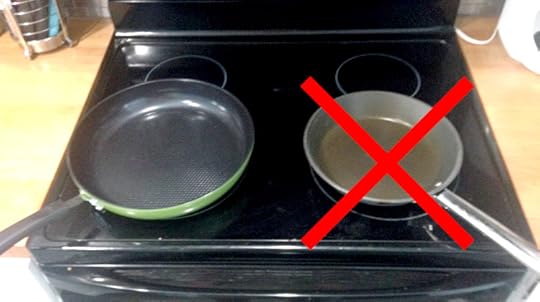
Earlier this year I decided to kick my ass back in gear and start focusing on eating healthier again. The nutrition plan I used in 2012 was incredibly effective, so I knew I wanted to go back to some version of it. There was one problem. Each day of the week starts with eggs for breakfast. I don’t mind eating eggs, but I loathe making them (this is where the photo above comes into play).
My problem with having eggs for breakfast had nothing to do with the eggs. The problem was in the tools I was using to make the eggs. I had this pan that was quite simply a pain in the ass. I tried using grape seed oil, coconut oil, baking spray, butter, and other coating substances, but no matter what I used the pan always ended up crusty and hard to clean. Through trial and error I found that cooking the eggs on medium-low heat worked much better, but then it took me about 10 minutes to scramble eggs (that’s ridiculous) and the pan was still a pain to clean.
To preface the remainder of this post I want to share a little nugget I’m not proud of: I’ve never purchased a pot or pan in 31 years of life. The pots and pans I own were hand-me-downs from my mom, who is an incredibly good cook. I knew she bought quality products and I knew they weren’t cheap.
One day last month I got fed up. My eggs were slightly burnt. The non-stick pan was not being very non-stick. It took way longer than it should have to cook my breakfast and clean up. I wanted to stop eating eggs and find a breakfast alternative.
Then it hit me. The pan I was using was easily 10 years old. I had no clue what it would cost to replace the pan, but I knew it was probably time. So after finishing another grueling battle of scrambling eggs I grabbed my iPhone and went to Amazon.com. I typed in “best non-stick pan” and hit the search button.
The results shocked me. The first result (which you see in the photo above) was a $38 pan with nearly 2,000 positive reviews! $38!?
I bought the $38 Green Earth Frying Pan (aff link) and even opted for $3.99 overnight shipping. Thanks Amazon Prime!
The next day the pan showed up. I read the instructions, even though I was pretty sure I knew how a pan worked, and gave it a quick wash. I put the pan on the stove, added a small chunk of butter (the new pan said it needed less than normal pans), and cracked my eggs in the pan. I grabbed the spatula I normally used to scramble my eggs and a miracle happened. My eggs didn’t stick to the pan. The non-stick pan was actually non-stick!
When I finished cooking my eggs, the pan was nearly 100% clean. No gross crusty eggs. No burnt eggs. A quick rinse and swipe with a soapy sponge and the pan was spotless. My cooking and cleaning time went from 10-12 frustrating minutes to 4-5 frustration-free minutes. An increase in efficiency, but even better, an 100% decrease in my irritation with cooking eggs.
I used to wake up and hate the idea of cooking breakfast. I knew it was going to be time consuming and bothersome. For a mere $38 I fixed this problem.
For some reason I was hesitant to invest in a new tool for the job. I had built up this idea in my mind that the pan I had was the right tool. I also thought good pots and pans had to be expensive. I was wrong on all accounts. The $38 I invested in a new pan has been worth every single penny. Even if that pan only last 6 months (which I’m sure it will last way longer), I’d happily spend another $38 to replace it. The value it brings me in saving time and frustration is through the roof!
I don’t hate cooking breakfast anymore. I don’t loath putting in the work each morning because I have the right tools to do the job.
So how does this apply to your life? Well first off, if you don’t have a good pan for cooking eggs, I can’t recommend the 12″ Green Earth Pan (aff link) enough. Secondly, look at areas of your life where you find yourself frustrated. Maybe it’s managing social media accounts? Your email inbox? Your to-do lists? Your daily schedule? No matter what it is, when you have the right tool, the work becomes way less frustrating. We’re all adverse to change by nature, but if you can force yourself to try new tools, I bet you’ll find yourself becoming more efficient and hating whatever the thing is that you currently hate less.
You don’t need to go out and spend thousands of dollars on every fancy tool out there for every project, but I highly recommend giving new tools a try. I’m willing to bet a $38 pan you’ll be surprised at how trying a new tool can completely change the way you feel about the work you need to do.
Invest in the right tools. The right tools should make your work easier and frustration-free.
Feel free to chat with me about this post on Twitter or Facebook.