Jason SurfrApp's Blog, page 20
March 18, 2016
Learn How To Be a Great Public Speaker, and Why I’m Taking a Break From It

Taking the stage in front of over 1,500 people was one of the most nerve-wracking moments of my life.
I heard my name being announced and my bio being read, but even that booming echo was a whisper next to the huge rush of butterflies in my stomach.
I felt like a complete fraud. I don’t belong here, I have nothing valuable to share, where’s the off-ramp?
My thoughts were a mess, but I climbed the metal stairs to the stage, anyway. I shook a man’s hand, took a deep breath, and…boom.
I was on.
Instantly, everything snapped into place. The butterflies disappeared. The feeling of fraud evaporated. I started sharing my story and clicking through my slides, and I worked that room for the next 60 minutes—moving from side to side, engaging the audience, and making people laugh. It went by in a blur, and before I knew it, the roar of applause was filling my earholes with joy.
That was my first paid speaking gig, and only my fifth gig ever. The rush I felt after that hour on stage fueled me for many years to come.
Since that talk in 2010, public speaking has been my jam. I’ve given over 75 talks. I’ve stood sometimes in front of thousands of people, and other times in front of just 5. I’ve made over $250,000 in speaking revenue, and with every talk, I’ve given 100% effort and energy.
One of my absolute favorite parts of public speaking is the feeling you get knowing you are making an impact on at least one person’s life. I can honestly say I know this happens because I’ve never done a talk where someone hasn’t come up to me afterwards and said something to the effect of, “This made such an impact on me!” I’ve also come to really enjoy the adrenaline rush I get after every talk. It’s a dopamine response like no other.
Want to give it a try? Oh, man, do you ever.
Here’s what I’ve learned about getting paid to speak and getting good at it:
Want more speaking gigs? Tell shareable stories.
Imagine being in the audience for two different speeches about healthy eating. The first speaker has a lot of facts to share. Statistics for days. There’s no room for emotion in this talk, but wow, he knows a lot about cauliflower. The final slide is a screenshot of his website and social media handles, and his sign-off from the stage is that he’s available to speak at your next event. Yay?
The next speaker shuffles his way to the stage, and he makes you laugh immediately with a silly joke about Nutella as a protein source. He opens up about his own emotional health journey—sharing moments of failure and success along the way—and he can’t believe it, either, but cauliflower fixed his high cholesterol issues and become a replacement for buffalo wings. A final joke about Nutella Protein Balls finishes off his talk, and he leaves the stage.
Now, which speaker do you think people are going to speak positively about? Which speaker do you think folks will pass stories along to their friends and coworkers about? And most importantly, which speaker do you think is going to get more speaking gigs?
As a speaker, telling stories is paramount. It’s what creates a connection with the audience and gives them a memorable experience.
We all have stories we can share. The trick is figuring out how to share those stories and weave them into a message that an audience can resonate with, relate to, and learn from.
Take a moment to think about some of your best personal stories.
What tough moments have you encountered in your life or your business?
What big changes have you made as a person?
What are the stories your friends share when introducing you to other people?
Write these down, and figure out how they can tie into an impactful message that your audience can use to change their lives.
Practice, practice, practice.
(Queue the Allen Iverson video clip about practice if you know it.)
I’ve had the displeasure of watching my early speaking gigs played back on video. Wowzers, it’s painful. At one event back in 2010, I was so intimidated by the size of the auditorium we were in that I literally hid behind the podium the entire time, white-knuckling the edges and never taking a step. Sounds like a nightmare come true…but! Watching that talk later on helped me realize how important it is to move around the stage, and to watch my own uncomfortable moments so I can learn and grow.
Whether you’re getting consistent speaking gigs now or you haven’t yet had your first public talk, here’s something simple you can do to get better: grab a video camera, iPhone, or webcam, and record a practice run of your talk. Give it your 100% effort. Do not half-ass it. Then, watch the recording. What did you like? What didn’t you like? Make notes, and then repeat over and over again, critiquing yourself (constructively! lovingly!) each time. You’ll get better, I promise.
Should you ever speak for free? Yes! Accepting non-paying speaking gigs early on is a rite of passage. We’ve all been there. The key with those events is to focus on honing your skills. Use the early and unpaid opportunities to try different things and share different stories. What seems to resonate with the audience? What do you enjoy talking about?
Find your comfortable speaking moments through experience. The only way to get more comfortable on stage is with practice.
Use the 10/20/30 rule for speaking presentations
If you’re not going to use slides, you can skip this step (but I’d suggest reading it anyway).
The 10/20/30 rule was created by Guy Kawasaki, and it’s very simple. 10 slides. 20 minutes. 30-point font. That’s it.
You don’t have to follow this formula exactly (I didn’t), but it’s a great way to keep your presentation extremely simple and easy to follow. It’s a framework rather than a crutch, and it’s a way to make sure your slides reinforce your story instead of the other way around.
The exception to the 10/20/30 rule is if you use a ton of imagery and click through your slides quickly. Now, I don’t mean you should rush through your presentation, just that you have a lot of visuals to back you up.
(By the way, if you don’t have great imagery of your own, I’d recommend Unsplash and Death to Stock. Please don’t use clip art!)
Be funny, but don’t try to be a comedian
You don’t have to tell jokes to be funny. Many aspiring speakers make the mistake of trying to land jokes (as if they were stand-up comedians). This doesn’t work. Unless you have experience doing stand-up comedy, stick to telling funny stories.
And here’s a huge secret to telling funny stories: they don’t have to be your own! That may sound weird, but other people’s funny stories are great way to introduce new perspectives, infuse humor, and reinforce your message.
Use pop culture for moments of humor as well. Remember many years ago, when Brett Favre got in trouble for texting scandalous photos of himself? When I gave talks around that time about using photography to promote your business, my running joke was to warn the audience, “Just don’t share photos like Brett Favre.” I’m no stand-up comedian, but this line always got a laugh. It was timely, people knew exactly what I was saying, and it worked like a charm because it fit into the message I was trying to share.
And hey, if you don’t want to even worry about trying to add humor to your presentation, that’s okay, too. As long as you’re telling good stories and delivering valuable information, you can still be a highly sought-after public speaker.
Use your existing network to get more paid speaking gigs
A few years ago, my speaking schedule seemed to be drying up. I realized I had done a terrible job of reaching out to previous gigs (more on that in a second), so I decided to email a handful of other contacts to see if anyone I knew could recommend me to a friend. Here’s exactly how I did that:
I scrolled through my email inbox and made a spreadsheet with 50 names and email addresses on it. These were not people who’d hired me to speak before; they were just people I knew through various other means.
From that list, I sent an email to each individual. I kept the email short and sweet, and simply asked if they knew anyone who ran events or was looking for a good public speaker.
I sent all 50 emails, and a week later followed up with anyone who didn’t email me back. People need following up with. (I’ve got more on how to follow up in episode 9 of the Action Army podcast.)
From those exact emails, I can attribute over $50,000 in speaking revenue. Again, not a single person I emailed ran events, hired public speakers, or was even someone I thought had a contact for me. I was just willing to ask, and I trusted that people I knew might know people (and would vouch for me).
Of course, it’s an even easier idea to reach back out to previous speaking gigs (people who’ve hired you to speak before). You can ask them how things are going with their current events and if they need anyone for future events. I should’ve done this! If they don’t want to bring you back that’s absolutely okay—you can also ask these folks for introductions to other potential speaking engagements. This works really well, and a warm introduction can go a long way.
Just be yourself
This is your last tip about booking paid speaking engagements. Event coordinators are looking for interesting and unique people. They want people who have their own stories and their own talks. If you copy other people, you’re not going to stand out. Figure out what sets you apart, and embrace the heck out of that!
As a final resource, my buddy Grant Baldwin has a ton of resources that help people learn how to be better public speakers and how to get paid doing it. I highly recommend taking his free course (and he has no idea I’m even sharing this with you).
After all that success, why would I stop?
The last talk I gave was in November 2015. It was a great event in Dallas that paid well. I shared my story with hundreds of conference attendees, and even did one of my on-stage cartwheels to finish things off. I walked off that stage feeling pumped up, and was met with an overwhelmingly positive response afterwards. So why was it my last?
Well, life has a way of changing. My life right now is moving away from the public speaking phase. I feel like I’m simply telling the same stories over and over again, so I’m going to take some time off to create some new stories. To experience new things in life. Will I be back on stage soon? I’m not sure.
But you know what? My taking a break just means there’s at least one more open spot out there for someone who’s got a story to tell.
Someone like you.
So go do it. Use this article to help.
The post Learn How To Be a Great Public Speaker, and Why I’m Taking a Break From It appeared first on Jason Does Stuff.


March 13, 2016
See The Results of a 3-Week Email List Growth Experiment
My 3-week email list growth experiment started with this tweet:
Today marks the start of a 3-week experiment. I will report back with findings in about a month. This vague tweet is content for the recap

March 6, 2016
Define Your Road Runner Rules
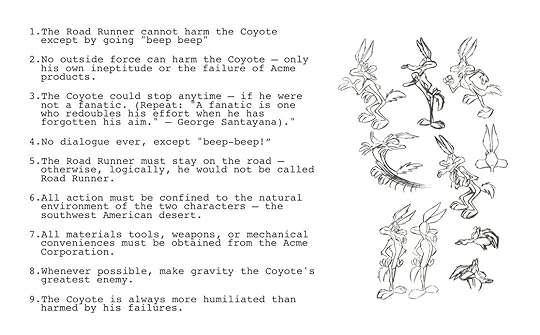
Today, we’re gonna steal his idea, and create some Road Runner Rules for a content-based business.
But before we go any further, do we all know what a content-based business is?
A content-based business is one in which a business owner shares consistent and free content (emails, blog posts, articles, videos, podcasts, etc) with an audience. That content helps audience members improve some aspect of their lives. The business owner makes money by creating products and/or services that build on the free content and provide even more value to the audience.
Example: I send out a weekly email (The Action Army newsletter) and occasionally create products or services (online courses, books, workshops, software, etc) that can help Action Army members learn something that will help them take action in some aspect of their lives or businesses.
I’m certainly not the first to stumble upon Jones’ rules, which were first made public in a 1999 autobiography. (In fact, I didn’t even find them on my own—my friend Matt Giovanisci told me about them.) But once I read the nine rules and understood how Jones used them, well…BEEP BEEP! I knew they could work for business, too. Here they are:
OK, that’s all for this week. Off you go to implement these for your business!
Kidding. Obviously, your rules may have fewer beeps and comedic anvils, but the list above can still be incredibly helpful. And just like your values, your Road Runner Rules can become a set of guiding principles (or filters, if you will). They can help strengthen the content you put out into the world.
Inspired by Jones, I’ve come up with nine questions we can ask ourselves to create our own set of rules for a content-based business. I’ll share my rules after the questions, specifically as they relate to content I share on JasonDoesStuff and with my community, the Action Army.
Questions for creating your own Road Runner Rules
1. What’s something unique about the way you create and share content?
2. What topic or genre will you never create content about?
3. What’s one word that can describe the outcome you want for the people who consume the content you create? Include the definition of that word (or a quote that really resonates with you).
4. How do you speak to your audience? Is it from a place of relation? From a place of authority? Both? Somewhere else entirely?
5. What is your content schedule? What can you commit to that doesn’t waver or change?
6. Do you share stories from other people, or only talk about yourself and your experiences?
7. List out the tools you’ll use to create your content. (Having a list of tools will help you create with more consistency and without getting down rabbit holes of trying new tools all the time.)
8. What’s one question you can ask yourself at every turn to make sure you’re staying on track with the content you create?
9. What’s something you won’t compromise on when it comes to creating content for your audience?
Your answers to these questions may change over time, but I’d challenge you to stick to your answers until you absolutely must make a change. These are foundational things. The answers should be based on what you believe in and what you stand for. Those things shouldn’t change too often.
(If you’re questioning this, think again of the original Road Runner Rules. How different a cartoon would it be if those nine things weren’t consistent?)
My Road Runner Rules for JasonDoesStuff (and The Action Army)
1. Something unique: I will always write and share content in my own authentic voice. I will not remove my nonsensical tangents and commentary. Those are what make my content stand out from the rest.
2. I will never: write from a place of criticism or belittlement.
3. In one word: Action. (Action is defined as inspiring people to do something specific.)
4. I speak to my audience: from a place of relation, and hopefully with some experience to share. I never want it to feel like I’m talking down to anyone. I always want you to feel like I’m in the entrepreneurial trenches with you, because I am!
5. Content schedule: I will send my weekly newsletter to the Action Army on Monday mornings at 10am Eastern.
6. When sharing stories: I can share other people’s stories, but I must always pick stories that I have some experience with or that have helped me make a big change in my life/business.
7. Tools: I write everything in the Letterspace app. My editor edits in Google Docs. I send the finished article through MailChimp to the Action Army. Then I update my Google Spreadsheet, which helps me track what I’m working on and when I post.
8. At every turn, I ask myself: Does this thing I’m creating help someone take a specific action in their life/business?
9. I will not compromise on: sponsorship integrity. I will never create paid content for companies I don’t use/love. I believe selling out is defined as taking money for something you don’t absolutely enjoy doing (or talking about).
As I was writing out my own Road Runner Rules, I realized how helpful it will be to revisit these rules when I’m stuck. If I ever feel like a piece of content, an online course, a podcast episode, or anything I create doesn’t meet the requirements of my nine rules, then I won’t share that thing. In fact, I should immediately blow that piece of content up (with Acme dynamite, obviously) and make sure it doesn’t see the light of day!
Related article: Constraints
What if you don’t have a content-based business?
I hate to be the bearer of bad news, but you probably do. Whether you’re actually creating content is a different story, but nearly all businesses can benefit from putting out targeted content these days.
If you’re starting your business from scratch, this doesn’t mean you need to sign up for social media accounts and start posting tweets, status updates, pins, snapchats, and whatever else. It means that you should create content that can help your customers improve their lives and their experience with whatever product or service you create.
My friend Jeff runs the popular apparel company Ugmonk. Over the years he’s focused just on creating quality products and hasn’t worried too much about the content. In recent years, however, he’s released a few – beautiful – videos and has shared some behind-the-scenes stories of his creation process. The result? Jeff has noticed an increase in attention and revenue from the content he puts out. He’s rewarding the loyalty of his existing customers and bringing in new people who love his content. He understands that creating content (in a way that he enjoys creating it) is helping his business grow.
There’s a reason why almost all of us immediately run to Google when we want to find something. What shows up when you Google something? Content! If you can create helpful content (read: stuff that makes your audience/customers more awesome), you can attract way more people who matter to your business.
It’s time to create your own Road Runner Rules
As I’ve done with a few recent articles, I’d love to link to your Road Runner Rules if you write them and share them publicly.
Write them on paper and take a photo, or write an article like this for your audience. Email your rules over, and I’ll share them below!
So what’re you waiting for? Run as fast as the Road Runner, avoid any falling anvils, and start writing your nine rules now.
Beep Beep!
The post Define Your Road Runner Rules appeared first on Jason Does Stuff.
February 28, 2016
Figure Out If Sprinkles Are Hurting Your Business
Now, I really like ice cream. I love going to Baskin Robbins and ordering my favorite flavor, Peanut Butter Chocolate. Fun fact: I’ve never, ever, ever ordered another flavor from B&R. As far as I’m concerned, 30 of them are just distractions. There’s only one true choice.
A lot of people think this is crazy. Some of you probably like to order something different every time, or get two different flavors in one cone, or —HORROR— dump a bunch of sprinkles on top of a perfectly good sundae.
I’m kidding (kind of). Add all the sprinkles you want to your sundae, but limit that approach to your dessert choices, will ya? When it comes to business, there comes a time when we have to ask ourselves…
“Is this necessary, or is this a distraction?”
If you’re trying to build a business right now, there are 3 things that you should be exclusively focused on. Let’s call it your triple-layer hot fudge business sundae:
Layer 1: The ice cream (your product or service)
Layer 2: The hot fudge sauce (the promo you do to make everyone start drooling)
Layer 3: The cherry on top (your customer service)
Notice what’s missing from this sundae? Yep, SPRINKLES. This sundae is laser focused. It has none of the random cool features that we could add to our core product, but that distract us from the point.
Read every business book on the planet, and they’ll all come back to the importance of focusing on the 3 things above, and of not getting distracted by the ancillary stuff. Sure, adding a bunch of rainbow sprinkles might help a little bit here and there, and they’ll make your offer look extra pretty, but remember this: if the ice cream itself is a pile of dog poop, no amount of sprinkles is going to make it edible. Weird metaphor, I know.
Now, let’s take a look at each of the 3 layers.
1. The ice cream (your product or service)
When you’re starting a business, working on a side project, or even working for someone else on their product, the most important thing you can focus on is making sure it solves a problem (is useful) or will enrich someone’s life (is entertaining).
And just how do you ensure you’re making something people actually want? Well, you could talk to them for a start.
Considering no one from Apple is reading my articles and trying to learn how to make the next iPhone even better, I can assume that your product or service doesn’t need to be shrouded in secrecy from the masses. And while I firmly believing in building buzz, you still need feedback from your target customers. My last big project (BuyMyFuture) was a secret to the public for three months, but behind the scenes, I talked with over 100 people before launching it to the masses.
Getting feedback from your target customers
Whether you’re making sundaes, building an online course, creating a calendar scheduling application, or inventing a dryer that can fold your laundry and put it away after it’s dry (if you’re doing this, please email me immediately), you need to see how your customers actually respond to what you’re creating.
Ask your customers to play around with your product or service without giving them much information. Your conversations with them beforehand, followed by a semi-formal interview after, will reveal the following:
How do they describe it back to you?
How do they use the product? As you intended?
What type of outcomes happen after they use it?
When they talk about their experience, do they use the same words as you’d thought about using on your website, sales page, marketing, etc?
You might need to do multiple rounds of testing with your customers. And that’s okay! Revisions are only going to make your offer better and easier for you to sell to future customers.
Invest in the product itself
So many business owners want to allocate budgets for marketing and advertising, but they skimp on making the product itself really great. Again, no amount of rainbow sprinkles makes dog poop taste good. The underlying product (beneath the marketing and advertising hot-fudge layer) needs to be as good as you can possibly make it!
Note that I didn’t say “perfect.” Don’t strive for perfection as you’ll never get there. Strive to put out the best product or service you can with lots of testing, revisions, and feedback from your actual customers.
As an example, it may cost little to nothing to make an online course—it’s really just organizing your knowledge in a digestible way—but investing in good production equipment is extremely worthwhile. You don’t want someone to purchase the course, start listening to a lesson, and think your audio sounds like it was recorded in a tunnel. And, unless you’re a Pulitzer Prize-winning writer, you should invest in an editor to go through all your course copy (heck, I bet Pulitzer Prize-winning writers have great editors).
SnapChat doesn’t make your product better
I’m calling out SnapChat, but it could be Facebook, Twitter, Periscope, etc. They’re all sprinkles. There’s absolutely no need to worry about building a social media following, creating a social media content calendar, or coming up with any strategies about which filters you’ll use for your hot-fudge sundae photos on Instagram.
Every one of these platforms is a distraction from making your core offer great.
2. The hot fudge sauce (the promo you do to make everyone start drooling)
I don’t have a fancy statistic backed by Harvard Business School about the amount of time people spend building a product versus the time they spend promoting it. What I do have is a decade of experience watching friends (of all walks of life) build businesses and put products out into the world. Most of them represent an extreme opposite from the one above, in that “promotion” tends to be looked at as a dirty word. These friends poured their knowledge into creating amazing things—they didn’t skimp even a little bit on the ice cream—but when it came time to add the hot fudge sauce, they stalled out. Maybe you’ve been there, too.
If you believe in the product you are selling, you should never be ashamed to promote it.
This doesn’t mean you should spam people on Twitter (we’ll get to social media promotion in a moment). It also doesn’t mean you should hand out your business card to every single person you meet.
What it does mean, is that you should invest the time to promote your product or service, and that you should iterate on that promotion (just like you should do while building the product itself). You may find that your customers don’t like hot fudge sauce, but that doesn’t mean they don’t like ice cream—it just means you should try caramel sauce instead.
If you’re stuck, I wrote an article with 10 free marketing ideas. They aren’t foolproof, and none of them are guaranteed to work. But they are ideas you can borrow, steal, and get your inspiration from.
Spend an equal amount of time promoting your product as you did creating it
If it took 40 hours to get the first version of whatever your product is to a completed and ready-to-promote state, you shouldn’t spend 4 hours promoting it and then give up. In fact, I believe you should spend the same amount of time promoting your product as you did building it. Promote in different and unique ways, and only then determine whether the product is a failure or a success. Too many people will slave away for hours upon hours building something, and then after trying to promote it once or twice with little success, they’ll throw in the entrepreneurial towel.
Listen, I’m a big believer in quitting when it’s appropriate, but not without the adequate and deserved time spent trying.
Promotion doesn’t mean jumping at every opportunity
There are a plethora of attractive platforms that can help you promote your shiny new product or service. What you need to ask yourself is, “Does my target customer hang out here?”
It may seem like a good idea to start a social media account on every service you can and see which one sticks, but it’ll never work. Your time will be spread too thin, which will give you a lackluster response on every network. But, if you remove the distractions of all the social networks and pick 1 or 2 (where your customers hang out), you will see some solid success.
And while I’m mentioning social media, don’t use your business’ Twitter account to share every thought you have. Focus on solving problems for your target customer with every tweet you put out. Sure, add some personality in there, but if you’re trying to build a business you don’t need to share your thoughts about Kim and Kanye’s next baby’s name. What you should be doing is searching keywords based on the problem your product solves and directly talking with people and helping them if you can (read: actually helping, not shoving your product in their face).
Especially on social media sites, being helpful can be more effective than any sales pitch.
Or just forget about social media and build an email list
This is where every business owner should start and should focus their time: not on growing a social following, but on building a highly targeted list of potential customers whose problems you can solve with information transmitted via the amazing technology of email.
The equal time spent idea is really important here. Spend 40 hours trying different things to grow your list. People like Bryan Harris are great people to learn from. (I learn from him all the time.)
You can read more on my thoughts about email marketing here and here.
3. The cherry on top (your customer service)
Go above and beyond for the customers who give you money.
This was the goal all along, right? To get someone to pay you money for the thing you created? If you accomplish that goal, you should do everything you can to make sure that customer is as happy as a clam (which is a very bizarre thing to imagine).
Make a plan to reward your customers
Create an amazing first touch point: Once they buy, what’s your first touch point with your brand new customers? Is it a receipt of purchase that gets emailed to them? Borrow an idea from Derek Sivers and add some fun copy to the receipt email:
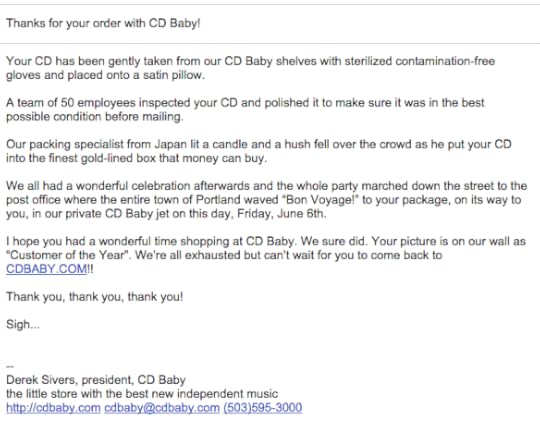
Follow up: After they’ve owned your product or service for a few days, plan to send them an email and ask your customer how they’re doing. Is the product actually helping them? Could you make it any better?
Make it easy to ask for help: I don’t know about you, but I get Hulk-smash angry when I can’t find a simple help or support contact form on a company’s website. Even if my question can be answered in a FAQ or Help Resources page, I don’t have time to scroll through topic after topic to try to find my issue. If I paid for a product, I expect part of that payment to include the company talking to me if I have a problem.
Say thank you: What’s a fun way to thank your customer that would surprise and delight them? Is it a handwritten note? Maybe a photo of your staff celebrating how happy they are that there’s a new customer? You could make a fun thank-you video that features a dog barking and it being translated as a message telling the customer how wag-tastic they are! (Please feel free to use the word “wag-tastic” in any of your marketing or thank-you materials).
There are lots of ways you can plan to offer great customer service. And the key is to PLAN for it. Don’t just end up with a database full of customers, and then wonder why no one is spreading your company through word of mouth. Yes, the wag-tastic-ness of your product should do that on its own, but you can give people a helpful nudge with your customer service.
So there you have it: a triple-layer hot fudge business sundae that promises a fun entrepreneurial venture for you, a high-quality end product, and a winning experience for your customer. Betcha you won’t even miss the sprinkles.
The post Figure Out If Sprinkles Are Hurting Your Business appeared first on Jason Does Stuff.
February 21, 2016
Find Your Flavor of Minimalism
Before we take a single step further, let’s talk about what minimalism is and isn’t:
Minimalism is the idea that you can live with LESS, but get MORE out of life.
Minimalism is the idea that you only allow things in your life that you believe will bring you value.
Minimalism is not living in a home with just one chair.
Minimalism is not a cult that keeps you from buying things ever again.
Minimalism is different for everyone.
A few years ago, I was not a minimalist. I was an electronic gadget-buying machine. Amazon Prime and I were in a monogamous relationship. I thought that buying new things would make me happy, and oh, did I buy them.
I expertly justified buying new things, especially moderately expensive things. I convinced myself that because I had the financial ability, I should compensate for all the times when I was younger and wanted things but couldn’t have them. Along with buying things, I also remember having goals that I thought would make me feel good about myself (read more on this: the pressures of society).
All of those thoughts, buying habits, and societal goals came to a screeching halt in late May of 2013. My girlfriend, Caroline, and I sat in the audience of a small hand-crafted conference in Fargo, North Dakota, and listened to Joshua Fields Millburn tell his story. It’s a story that I’ve shared a bit about before.
It’s a story that completely changed my life.
The too-long-didn’t-read (TL;DR) version: Joshua had a job that paid him well, but he was constantly buying things to try to fill a void in his life. It wasn’t until he realized he was truly unhappy and that all the stuff in his life was weighing him down that he decided to become a minimalist. His transformation away from buying lots of things didn’t happen overnight. But like anything else in life, there is no overnight success when it comes to becoming a minimalist. Slowly, he started parting ways with his stuff while also changing his habits. The by-product of doing those things? He (and his friends) started to notice an incredible change in his happiness.
Joshua’s story inspired Caroline and me to take a strong look at our lives. To take inventory of all of the stuff in the different parts of our home, and to start asking ourselves an important question we learned from Joshua: does this thing bring me value?
Getting started with minimalism in 3 steps
There are lots of ways to get started, and lots of resources available to guide you, but here’s what we did in 3 progressively more intense steps, followed by 3 challenges for you.
1. Our closets
This was the place in our home where we had accumulated a bunch of items and had rarely let anything go. Shorts I hadn’t worn since college? Piled in a drawer. T-shirts Caroline used to wear for her sorority? Stuffed on the back of a shelf. Jeans we both bought on sale because, hey, we thought our butts would look great in them? Never worn and covered in closet dust.
Instead of trying to make a bunch of 1-by-1 decisions as we combed through hangers and drawers, we instead decided something drastic: “If we haven’t worn it in a year, it’s got to go.”
The result? Multiple garbage bags filled to the brim with clothing we hadn’t worn in years and were only holding onto just in case we might want to wear them again someday. Someday hadn’t come in years prior, though, so it certainly wasn’t going to magically show up just because we became more aware of these items in our closet.
Shortly after that first closet clean-out, Caroline discovered something called a capsule wardrobe. This is the practice of pairing your wardrobe down to just 37 items (not including underwear). She loved it! She sold a bunch of her unworn clothes on a website called Threadflip, and then got rid of the rest ($500 worth) via an Instagram post.
Cleaning out our wardrobes (on multiple occasions) has helped us enjoy the clothing we have left a lot more. We no longer stand in our filled-to-the-brim closets, paralyzed by choices. Now, we have just the right amount of clothes, and we actually like all of them. Weird, I know.
Your first minimalism challenge: Spend tonight or this weekend going through your closet. What haven’t you worn in a year that you can get rid of, donate, or sell?
2. My old business
IWearYourShirt brought a lot great things into my life and my home. Now, you might be thinking I’m going to talk to you about all the t-shirts I had to comb through and give away. Interestingly enough (to me, at least), I never held on to those T-shirts for too long. Truthfully, I simply didn’t have the room (365+ XL T-shirts per year take up a ton of space!).
What IWearYourShirt did leave behind were boxes filled with silly props, filming equipment, papers, and paint-covered walls–all the things that helped me create daily photo and video content for that business while it was active.
After IWearYourShirt came to a close, all of these items lingered around my home. They stared me in the face (especially this wall), constantly reminding me of a business that no longer existed. The longer this stuff stayed in my home, the longer I ended up being stuck with all the memories (good and bad) that went along with it.
When I finally made the decision to rid my home of all the leftover stuff from IWearYourShirt, an incredible weight lifted off my shoulders. Once I removed all of these things, it was as if I could finally let go of the stress that hung around with them.
Your second minimalism challenge: Do you have an old business or idea from which you have kept related items? It’s time to let them go. The process of getting rid of them will help relieve any residual stress.
3. Everything we owned
Yes, this is a big leap from the previous two steps. Stick with me here. I think you’re ready.
In 2014, we decided we were going to move clear across the country from Florida to California (read more about our adventure). Along with that decision, we planned to sell all of the possessions we had in our home. The only things we could keep were what we could fit in our Volkswagen SUV.
This was absolutely one of the most freeing and liberating feelings we’d ever had. We took a 1,600-square-foot home that was pretty well packed with stuff, and we put price tags on everything. We posted a one-day-everything-must-go-sale on Facebook and Craigslist. For eight hours on a Saturday, people showed up to our home and took our things away in exchange for money.
Pro tip: I used a Square reader on my iPhone to accept credit cards as people bought things. It was a fantastic way to sell bigger items like our couch, bed, TV, dining room set, etc.
After it was all said and done, we made over $5,000 selling everything in our home! There were a couple moments when we didn’t want to see things go (like the 6-month old couch I had driven 10 hours roundtrip to buy and transport myself), but we kept reminding ourselves that those things were just things. They were just objects we had purchased that, at some point, didn’t exist in our lives before. None of that stuff would actually make a difference in our lives if it went back to a state of ceasing to exist.
Your third minimalism challenge: Move! Just kidding. However, maybe it’s time you had a garage/yard sale? Pretend you’re moving, and be willing to let go of all the things that sit around your home and literally collect dust.
How we’ve continued to implement minimalism in our lives
The 1-in-1-out rule
Again, minimalism isn’t about not buying things/stuff. It’s about being more discerning with what you purchase.
My girlfriend and I love clothes. We love wearing things that make us feel good about how we look and that express who we are as people. But that doesn’t mean we need a closet full of items to accomplish those things. (Remember, we started with minimalism by cleaning out our closets!)
When we do purchase new items of clothing, we use the 1-in-1-out rule. Buy a new pair of jeans? An existing pair has to go. Buy a new awesome scarf? Sorry, old crappy scarf, you have to leave. Buy three pairs of zany socks from Happy Socks? Three pairs of old boring socks are out the door.
The 1-in-1-out rule forces us to be very picky about what we keep while still allowing us to buy new items. Technically, you could apply this rule to all purchases (food, electronics, etc).
Meal Prep
As entrepreneurs (read: people who work from home every day), we all kind of loathe the time required to go grocery shopping and cook our meals.
It seems weird to some people, but because we tend to eat 3-5 meals per day, that’s easily 1.5 – 2.5 hours of time we waste trying to make healthy choices. We’d rather have that additional time and brainpower to write articles like this, dive into a great book, go on a hike, or enjoy our time having a D&M (deep and meaningful convo).
Minimalist solution: food delivery service!
Each week, Caroline and I have a meal prep company deliver a week’s worth of food directly to our doorstep. I get 4 meals per day, and Caroline gets 3—not including breakfast because that’s quick, easy, and cheap to make. We keep breakfast simple with eggs and oatmeal (not combined—that would be gross), but the rest of the day’s food is done and delivered for us. We also intentionally leave one full day of the week open with no meal delivery so we can get our butts out of the house and enjoy something different.
This weekly service not only saves us hours of valuable time, but it also frees up mental space for decision-making!
Let’s talk about the numbers real quick:
We used to spent $2,000 a month on groceries + eating out
We spent roughly 15 hours a week grocery shopping and cooking
We now pay roughly $1,400 total per month for our meals ($350 per week)
We save, on average, 60 hours per month because we use a meal prep company!
Not to mention one other glaringly great thing about meal prep—it’s healthy! We get meals prepared based on what foods we like, and they are portioned perfectly to fuel us for our busy days while keeping us in a good weight-loss zone.
Gifts and Holidays
We don’t give each other gifts for birthdays and occasions. Instead, we create experiences. This past Christmas, we created a new tradition of each picking a movie, a snack, and an activity. We filled an entire evening with laughter, fun, and a new tradition we’ll carry forward and remember for years. That’s more than we can say for anything we’ve given each other over the years that was wrapped in a box and shoved under the tree.
Money
For years, we didn’t have a plan when it came to our money. Why? Mostly because there are so many damn options. It’s daunting. Well, we finally bit the bullet and did a few things:
Started working with financial planners
Started working with bookkeepers
Created a recurring weekly budget meeting
How does this relate to minimalism? Well, before we were spending countless hours trying to figure all this stuff out for ourselves (or having Mom help; thanks, Mom!). We’d spent so much time thinking about, planning for, and just agonizing about money. As soon as we started working with financial planners (who cost us $0 per month, by the way) and a bookkeeper, we immediately had a bunch of extra time and mental energy freed up.
That is a huge tenet of minimalism: Remove the things that take up excess time and energy, and simplify things to suit a happier lifestyle.
Finding your own flavor of minimalism
There are a couple really awesome articles out there that can help you find your own flavor of minimalism. Here are a few of my favorites:
30-day minimalism game
Have a packing party
Minimalism with kids (and I don’t even have kids!)
7 strategies for dealing with toxic people
How to engage in social media without losing your mind
Your version of minimalism is going to look completely different from mine. That’s the point! The decisions you make, the things you value, and how you live your life with less clutter—physical and mental—are what will make your flavor of minimalism unique.
The best way to explore becoming a minimalist is just to try different things. See what sticks for you. See what makes you happier. Give the idea of having less a chance, and try to measure how it makes you feel.
Like many things in life, there is no one-size-fits-all version of minimalism. But I do believe aspects of minimalism can benefit every single person.
The post Find Your Flavor of Minimalism appeared first on Jason Does Stuff.
February 14, 2016
Learn The 3×333 Method, or How To Get 1,000 Tasks Done
That’s what I used to think too.
Enter the 3×333 Method.
You want to get more done in your life in business, right? I mean, if you’re reading an article written by me, I have to assume that is something you want to do.
Can you imagine the impact of getting 1,000 targeted tasks done? Does it seems like an impossible feat? Do you think you have a better chance of climbing Mount Everest a couple times first? Well, let me help you implement a simple new method into your life.
What is the 3×333 Method? Completing three tasks every day for 333 days.
Just three tasks. Nothing too scary there, right? Three tasks is all you need to do. Want to take breaks on weekends? Go for it. It’s your life. But the more you commit, the more you’ll get out of this method.
How many tasks did you get done last year? Without a tracking system in place, it’s impossible to tell if you got any closer to your goals, or if each day was productive or a total wash. A year from now, wouldn’t it be amazing to actually see that you accomplished 1,000 tasks and be able to witness the direct impact of those things? Your answer is yes, so let’s keep going.
There are just five steps. (I know, I know. I should’ve made it three.)
The structure of the 3×333 Method:
Step #1: Create a recurring calendar reminder for the same time every morning.
This is VERY important. Hence why it’s Step #1.
Whether you use the calendar app on your phone, Google Cal, Sunrise, Outlook, a physical daily planner, or you have an assistant who manages your every need (who probably deserves a raise, by the way), a recurring daily reminder is critical. It’ll help this method become an expected part of your day instead of a frustrating interruption.
I recommend having the 3×333 Method be your first calendar item of the day. Yeah, go ahead and make coffee and surf your Instagram feed, but after that, your 3×333 alarm should be going off. Have this calendar item recur every single day into eternity. Don’t worry about ending it on day 333. That’s not important. Stop wasting time on things that don’t matter right now. Recurring calendar reminder at a set time. Boom. Done.
Step #2: Write out your three tasks as soon as the alarm goes off.
This, my friends, helps you build a habit. And what do habits do? They help you get stuff done when you struggle to get stuff done!
I’d recommend a piece of paper or a journal/notebook. I found I get way more things done when I do the physical act of writing something down (instead of creating yet another new page/list in a to-do list app). Plus, the beauty of a piece of paper is you can crumple it up each day and get a little destructive satisfaction in your life! And if you use a journal or notebook? It’s fun to leaf back through the pages when you’re needing a little boost about exactly how much you’re accomplishing every day. (Just try to get a notebook that can fit 333 3-item lists on it so you don’t need to move to a second journal/book).
What should you write down for your three tasks? Things you can get done that day! “Write my best-selling novel” is not a one-day task. Write something simpler and more accomplishable—something that helps you achieve the much bigger goal to write a best-selling novel (or whatever your bigger goal is). Things like:
Write 500 words of Chapter 3: the section about my awkward playground experience on the jungle gym.
Spend 10 minutes answering emails.
Do slides 25-30 for XYZ Business powerpoint.
Skype call with Paul about new podcast.
The smaller and more concise the tasks you write down, the better the chances that you’ll actually get them done! (If you don’t get them done, the next step will help you.)
Step #3: Every day, focus on getting those three things done. If you miss one or two, carry them over.
Let’s say you’re on Day 7, and you’ve just sat down to review your list of three items from Day 6. You realize you didn’t get the last item done. Uh oh. Don’t worry! This will happen. Be okay with it. Don’t freak out and go on a weird donut-binging bender or anything. What you’ll need to do is rewrite the task you didn’t get done from Day 6 as the first task to do on Day 7. Then add your two new tasks.
Not getting a task done may feel like you’ve derailed your 3×333 to 1,000 progress, but that’s just not true. How do I know? Just trust me. I’m your getting-things-done sherpa. Keep going. Keep pushing forward. I’ll explain in Step 5.
Step #4: 3×333 does not equal 1,000.
Thank you, Einstein! But here’s the beautiful thing about the 3×333 Method. Eventually, you’re going to have days where you get more than three tasks done. GASP! I know. Your mind has entered a state of fireworks and Michael Bay 360-degree-explosions.
If you’re a strict rule follower, here’s the missing 1,000th task: Do four tasks on Day 333.
You may finish your 1,000 tasks way ahead of 333 days. Great! I’m extremely proud of you, and I’d like to give you a blue ribbon for your accomplishment. The goal is to help you get going, so get going.
Step #5: Don’t quit. You will build momentum.
This is where you go out on a limb and you trust me. You trust the guy who puts “Does Stuff” in his website URL. You trust a guy who, for nearly 900 straight days, worked without a day off. You trust someone who embraces his overly efficient (some may call it OCD) tendencies.
If you keep your tasks small and achievable, you will have no problem getting to 1,000. Maybe on Day 10, you’ll hit a snag. Or on Day 20, your dog will have to have emergency plastic surgery so he can get the part he’s always dreamed of in that Petco commercial. (I really hope cosmetic surgery isn’t actually a thing for dogs.) But if you stick with this process, you will build momentum.
If you want the 3×333 Method to help you achieve a larger goal, you can target your tasks in that direction. If you want simply to get more things done every day, the same method will help you go to bed each night feeling accomplished.
Completion and consistency are like compounding interest. You don’t see the benefits right away, but we all know it works.
Bonus Step #6: Get an accountability partner.
The first time I did the 3×333 Method as a formal thing was in April 2015, and we called it Pow Pow with the Bow Wow. This was a cute name my roommates came up with when we used to have morning meetings to list the three tasks we were going to get done each day. Calling it the 3×333 Method is a bit simpler (even though Pow Pow with the Bow Wow is more fun to say).
As a household, we met every morning at the exact same time. It was our Step #1: the recurring item on all our calendars. We sat together and wrote a physical list of the three tasks we each wanted to get done. Then we’d refer to this list throughout the day and reflect on it the next morning, repeating the process over and over again.
If you have a friend, co-worker, or significant other, bring them into your 3×333. The three daily tasks don’t have to be business-related. I’ve kept them that way for this audience, but everyone has things they need to get done on a daily basis. Your list might include tasks for your forthcoming Bassett Hound Cosmetic Surgery Clinic, but your friend might just list personal errands. Just write things down, and focus on getting them done!
If you’re looking for some scientific backing to the 3×333 Method, you won’t find any.
I made it up. Just like other human beings make up all the magical things around us in our world. But doesn’t this seem like a really actionable, practical way to get 1,000 tasks done? Yes, you still have to do the actual work involved with those 1,000 tasks, but now you have a process and a guide to help keep you on track. And you’ll have proof, after 333 days, that you’re a productivity machine!
The unintended consequences of inconsistency are easy to ignore. Give yourself a chance to become an action-taking kung-fu master and to prove to yourself (and anyone else you want to prove things to) that you can accomplish 1,000 tasks in the next 333 days.
The post Learn The 3×333 Method, or How To Get 1,000 Tasks Done appeared first on Jason Does Stuff.
February 7, 2016
Remove Stress In Your Business
I was incredibly inspired by an article written by David Heinemeier Hansson called Reconsider. One of my favorite parts of the article reads:
I wanted to work for myself. Walk to my own beat. Chart my own path. Call it like I saw it, and not worry about what dudes in suits thought of that. All the cliches of independence that sound so quaint until you have a board meeting questioning why you aren’t raising more, burning faster, and growing at supersonic speeds yesterday?!
Independence isn’t missed until it’s gone. And when it’s gone, in the sense of having money masters dictate YOUR INCREDIBLE JOURNEY, it’s gone in the vast majority of cases. Once the train is going choo-choo there’s no stopping, no getting off, until you either crash into the mountain side or reach the IPO station at lake liquidity.
Was he writing this directly to me?
Does it feel like he’s writing it directly to you, too?
There are these ideals in business, especially in the startup and entrepreneurial world. These things that we’re told we need to do to become successful.
1. More employees = You look super cool and important
2. More customers = You must have an ahhhmazing product
3. More money = Everything must be going so well and you have a great life
4. Funding!? = You must be filthy rich and ready to retire!
Yet, I’ve had experience with most of these things, and almost all of them lead only to more stress, more problems, and way less independence.
There was a time when seven people relied on me for monthly salaries (roughly $30,000 per month). But I didn’t start out with seven people relying on me. I started out with just me. Just lil ole me and no pressure or keep-you-up-at-night-heart-beating-out-of-your-chest-cold-sweat-stress. The more I read news in the entrepreneurial and tech space, though, the more I was force-fed this idea of scaling my business and how important that was.
So I scaled up.
I’ll admit it was really exciting for a few weeks to be able to boast that I had multiple employees. Look how big we’ve grown! We’re not wearing startup potty trainers anymore, we have startup big-boy pull-ups on now! But that excitement wore off when someone didn’t get their work done on time. That excitement wore off when a client didn’t pay their bills and I had to make payroll happen. ($30,000/month is a lot of money for any size business, let alone a tiny startup.) That excitement really wore off when an employee became disgruntled, and the quality of work they put out reflected poorly on the brand and business I’d built from absolutely nothing. No one told me an employee might be able to put a dent in MY reputation.
Wait? What happened to looking cool?
More customers and more money tend to go hand in hand. I saw this happen in spades in 2011. I went from having one client per day two years prior, to having five clients per day. While that did result in 5x the revenue, it also resulted in nearly 20x the expenses. Unfortunately, I didn’t have enough experience (or time) to see the writing on the wall before it was too late. What looked like a half-million-dollar business with lots of customers quickly turned into $100,000 in debt and hundreds of headaches every month.
I share all of this because when I read David Heinemeier Hansson’s article, it really struck a chord with me. A chord that I wish had been struck when I was knee-deep in trying to do everything in my power to scale up my business.
Do you actually need more (or any) employees?
I get that there are companies who have a full roster of amazing employees. Your company might even have its fair share. But if you’re thinking about adding more employees, ask yourself if you’re ready for the expenses, the additional human needs, and the potential fallout that come with hiring.
Take a look at your business at this very moment. Are you stressed to the max because you aren’t sure if you can make payroll next month for your employees? Do you have someone working for you who you think might be hurting your hard-earned reputation?
Since 2013, I’ve run a completely employee-less business. It’s been amazing. I’ve realized how much better I work and bring value to the world when I’m not burdened with managing people. I no longer stress out and lose sleep over the thought of not being able to pay someone. That doesn’t mean I do everything on my own, though. I outsource a ton of things. But those are transactional relationships that are quick and easy.
I’m certainly not advocating that you fire all your employees. But I would take a real hard look at what your employees contribute to your company, and what you contribute to their lives.
Do you actually need more customers and money?
I’ve heard so many entrepreneurs and small business owners who want to make $1,000,000 in their next year. But why? Do you have $1,000,000 in bills/expenses you need to pay? I freakin’ hope not. Those same people have no idea what kind of extra stress comes with the steps needed to increase their revenue to reach that goal.
What are the things you actually value in life? What really makes you happy? Don’t just pick things that society puts up on a pedestal (cars, vacations, other frivolous things).
What are your expenses? If you don’t immediately know the bare minimum amount of money you need to pay your bills and make your business run, I’m worried for you (because that used to be me and it got me $100,000 in debt). Take a real hard look at what you actually have to make to live a life that makes you completely happy. That may require getting rid of employees and customers, and making big changes in your life. That’s a good thing!
Of course, there are good ways to scale your business
Obviously, David Heinemeier Hansson would agree that getting to 40 employees at Basecamp (in 12 years) is right where they need to be as a company. He also knows that increasing the amount of customers who pay for his company’s services helps his company grow. But I’ve watched Basecamp from the sidelines for years. I’ve seen them shut down other business ventures. I’ve seen them restructure their operations to be more lean.
Build the business you want for your life, not the business other people want for their lives.
If you actually think you need more employees, hire some people part-time at first. Have them take on the new tasks, and see if those part-time people add more stress to your life. If you want more customers, make a big push to add more, but then track how much extra time you have to work that takes away from doing the things that make you happy.
Don’t scale your business just because you think you should. Do it because it actually brings value to your life and the lives of people your company affects.
The post Remove Stress In Your Business appeared first on Jason Does Stuff.
January 31, 2016
Put Down The Toothpick And Pick Up The Hammer
Imagine a giant block of Italian Carrara white marble.
It’s over 20 feet tall, it weighs over 6 tons, and it’s your job to turn it into a beautiful statue. Imagine the pressure you feel: your reputation rests on this job. Your family is counting on you. Everyone is watching. The marble itself is priceless and irreplaceable, but there’s one catch: it’s been examined and abandoned by two skilled sculptors before you. Unfit for carving, they said, shortly after one of them gouged an ugly hole in it and left it out in the elements for 25 years. Too many imperfections.
You have one shot.
I’m curious what you’d do first, where you would start to tackle this mess of a task and turn it into something everyone could be proud of. Would you start timidly with a toothpick, poking away at the smallest of the “taroli” (imperfections)? Would you chip away at tiny flakes so as not to compromise stability at the base? Maybe you’d worry yourself into complete inaction, convince yourself the other sculptors were right, and abandon the job like they did.
In 1501, a young Italian sculptor faced exactly this challenge. He’d convinced the commissioning party that he could finish work that the skilled hands before him could not, and when he examined the neglected and gouged marble block, towering above him and riddled with taroli, he knew something they didn’t: this job wasn’t going to get very far with just a toothpick.
The sculptor took a hammer to the imperfect marble. He hacked about six feet right off the top, and he found a reason to make that ugly mistake of a hole even bigger than it already was. He was ruthless in eliminating the unnecessary. What did he see that no one else could? Years later, he shared these words about his masterpiece:
“David was always there in the marble. I just took away everything that was not David.” —Michelangelo
Recently, a friend was asking me for help with his new business and the website that accompanied it. He wanted input, he said, because the site was riddled with taroli—or maybe he just said the logo didn’t look right on the page. The color wasn’t quite right. The sizing was off. And he couldn’t decide if it should be left or center aligned. There were so many details to worry about, he confessed. Too many imperfections.
I stopped him in his tracks and asked “Are any of these concerns going to help your customer buy your stuff? Better yet, does your logo size and positioning help your customer be better at what they do?”
Feel free to stop reading this article if you’ve ever made a purchasing decision based on the alignment of a logo. Oh, you haven’t?? Yeah, me neither.
Of course, his answer to both questions was “no.” My friend realized immediately that he was too focused on the details, and was attempting to carve his marble statue with a toothpick.
As business owners, we worry too much about the “taroli”
We spend loads of mental energy worrying about tiny imperfections in our businesses. We toil over the fear of making incorrect decisions that will reduce our businesses to rubble. We convince ourselves that everyone else was right, and that we should abandon this slab before it gets worse. We lose sight of David in the marble.
When you get stuck worrying about the placement and size of your logo (as an example), you’re approaching a giant piece of marble with a toothpick. You’re also probably poking away at a section that doesn’t even matter (yet).
Should your logo look great? Yes, it should. Should it be clearly visible to people who visit your website? Yes, it should. But should you spend more than a couple seconds worrying about your logo placement on your website? No, because that doesn’t help your potential customers make an informed decision about you or what you’re selling.
Whether your goal is to carve a marble sculpture or sell your products consistently and profitably, you need to be prepared to make big changes and take risks. You need to put down the toothpick and pick up the hammer.
Even Michelangelo made mistakes while working on the Statue of David, you know. Some say the right hand is too big, and others debate about a missing muscle in David’s back. And who knows what happened during the carving process that Michelangelo managed to fix before anyone saw. Maybe he chiseled off a little too much or removed a piece in a spot that he didn’t mean to. Maybe he thought a day of work was going to go one way, but he was soon working on a completely different part of the statue. Whatever the issues were, Michelangelo certainly didn’t finish the Statue of David in three years by whittling away at the tiniest pieces or concerning himself with the taroli.
Use the hammer
To figure out how to best serve your customers (which also typically leads to making money), you need a hammer. You need to be willing to try new things and make mistakes. This has nothing to do with failure, but it has everything to do with trial and error.
Instead of worrying about the sizing and placement of your logo, maybe you should try reducing your product offering to one focused thing for awhile.
Instead of adding social share icons to your website, maybe you should try writing useful and valuable content that gives away 90% of your business knowledge.
Instead of being on every social media platform, maybe you focus on just one for six months (or better yet, abandon them all and focus only on email marketing [LINK]).
Instead of tracking your employees’ progress by the hours they work, maybe you give them complete hourly working autonomy for a month. Then compare the progress between the two months and see what brought in better results (sales/deliverables/happiness/etc).
Instead of changing some copy and images on the homepage of your website, maybe you change the entire layout and switch it up month by month.
Instead of having a bricks-and-mortar business with the same hours as everyone else, maybe you do limited hours for a month, but in those hours you offer something really unique: free local coffee and pastries, a fun atmosphere to relax in, complimentary accounting advice, etc.
These are just a few examples. They’re hammer changes instead of toothpick changes, or at least that’s the intent. The results will tell how much marble you carved, and how big of a deal it was.
Do less assuming and do more swinging.
You aren’t going to need the hammer forever
The hammer gets you started. Use it to eliminate all the unnecessary stuff, sometimes up to six feet right off the top!. Eventually, you won’t need to make big changes anymore. And like a sculptor, you’ll then grab a smaller set of tools that help you refine, tweak, and adjust the minor things that show up later on down the road. Even Michelangelo didn’t carve the features of David’s face first.
There’s a reason why there isn’t a set way of starting or running a business. There aren’t a specific set of rules and steps you must follow. Your hammer is going to be completely different from mine. The trick is to use the tools you have at your disposal and not be afraid of the mistakes that will inevitably happen along the way.
Unlike a marble statue, though, you don’t have just one shot. Your business is not priceless and irreplaceable, and it’s not going to stay the same forever.
A few years from now, you may need a sledgehammer and an entirely new block of marble. That’s called adapting to the times.
Enjoy the process of carving away and getting your business to a successful state. You’ll definitely have to make big changes again in the future, so get comfortable with the bigger tools, and keep in mind that what you’re trying to build is already there in the marble.
What will you use to get it out?
The post Put Down The Toothpick And Pick Up The Hammer appeared first on Jason Does Stuff.
January 24, 2016
Get Off The Ferris Wheel of Perfection
We live in a society obsessed with perfection.
We take fourteen versions of a selfie to make sure we look the best. We write and rewrite status updates and messages to each other trying to sound witty or smart. We buy clothes that accentuate our best features. We want to optimize everything.
This obsession with perfection has leaked its way into almost every facet of our lives.
When someone subscribes to my weekly email newsletter (The Action Army) I ask one simple question: What’s the thing you’re struggling with the most right now?
The replies I see the most are as follows:
– I want to start my own business, but I don’t have the perfect idea yet
– I have a business, but I haven’t perfected the product/service yet
– I feel paralyzed by the amount of choices and wish I had the perfect step-by-step process
There’s one word I keep seeing over and over again: perfect.
(And no, I promise I’m not adding it in to craftily round out this article)
How to find the ‘perfect’ idea
I hate to be the bearer of bad news, but there is no such thing as a perfect idea. There are good ideas. There are bad ideas. There are fun ideas. There are stupid ideas. But no idea is ever perfect.
Once you get that idea of perfection out of your head you can start looking at your ideas from a different angle. For me, I look for ideas I can’t get out of my head. Here’s how that works:
Step 1 – When I have an idea, I write a couple of bullet points about it in a journal. I do this as soon as the idea comes to me.
Step 2 – I put the journal (and idea) away for a week. I don’t write anything else about it and I don’t spend any time building a prototype version of it. I just let the idea sit.
Step 3 – If I can’t stop thinking about the idea after a week I take the next steps to pursue it. If I’ve forgotten about the idea or it’s no longer nagging at me, I move on.
Instead of looking for a perfect idea, look for something you simply can’t stop thinking about. Trust your gut and listen for things that feel right. We often dismiss our intuition in our unrealistic pursuit of perfection.
Building ‘the perfect business’
Apple is arguably the most perfect* business in the history of the world. They will most likely be the first ever trillion dollar company if they can execute a few of their next big ideas well (carplay, a physical TV, a self-driving car, even bigger iPads, iPhone 7/8/9, etc).
But… Everyone has probably had a less-than-stellar experience with an Apple product. I went through four iMac computers during one year. My iPhone seems to have a power-devouring gremlin living inside the battery. I’ve owned at least twenty Apple products over the years and continue to buy them even though they aren’t perfect. If you’ve owned an Apple device you’ve probably had a problem with it at some time or another.
Apple, as big and well-run as it is, is far from perfect and it’s working out pretty damn well for them. Steve Jobs was a notorious perfectionist, often taking it to utter extremes and becoming abusive and angry towards people who didn’t share his drive. Yet even his dogmatic perfectionism didn’t hold Apple back from launching groundbreaking product after product. Perfectionism can help you on your journey towards making the best product you possibly can, but you can’t lose sight of the end goal: building something people want and can use. Had Jobs waited until every single aspect of every single product was ‘perfect’ we never would have had the iPod or iPhone. Instead, the ideas came, the products were built, and the issues were dealt with in future versions.
You will never have a perfect business. You will never be able to have everything work perfectly. There will always be some issue, problem, or battery-consuming-gremlin. It happens to us all. Accept it and focus on the things you can control: creating a quality product, having amazing customer service, and focusing on making your customers more awesome.
*Taking a leap of faith that we agree that the majority of people would define perfect as insanely profitable, desirable, and seemingly high quality and well made. I understand that many people do not use Apple products.
Creating ‘the perfect process’
One of the most destructive, yet widely spread versions of perfectionism is the illusion and simplicity of success in business that’s being spread around. The ‘16 tactics to insane profitability’ or ‘what one simple thing brought in six figures in additional revenue’ propaganda we read every single day on ‘reputable’ news sources.
What’s never (or extremely rarely) talked about in those over-simplified articles are the things that it actually takes to be successful. And while what it actually takes can be boiled town into a few bullet points, those bullet points are layered with context for each individual person and business, and can’t be read as a repeatable ‘how to’ guide. Those bullet points take months or years of trial and error to end up working for us and helping us reach success.
There are too many success stories without enough focus on the times of non-success. In psychology, they call this survivorship bias–a logical error where we focus on those who have ‘survived’ some process and inadvertently overlook those who didn’t (probably because they’re not being paraded around front and center).
This bias can distort our reality, causing us to be overly optimistic and to falsely believe that the successes of a group are due to some special property they have that we don’t, rather than just being coincidence.
Those who win the war, write the history, right?
This cycle continues because we as consumers of content (aka readers of websites) keep clicking the stupid click-bait headlines hoping to find some magic spell or potion.
(Please contact me if you’ve clicked one of these articles, learned a tip or tactic, applied to your business, and enjoyed all the riches and success you were promised. I won’t hold my breath for any of those emails to show up in my inbox.)
The perfect process does not exist. What does exist, however, is the process you create for yourself and that works specifically for you. This comes with time and is never truly perfect.
Get off the Ferris wheel of perfection
By chasing the perfect anything, you’re essentially riding a Ferris wheel. As soon as you think you’ve reached the end, a new set of ‘problems’ arise and you continue going around in a never-ending circle.
Instead of going around and around, focus on creating and trusting the path you create for yourself. The one you won’t be able to see laid out perfectly in front of you.
“Writing a novel is like driving a car at night. You can see only as far as your headlights but you can make the whole trip that way.” – E. L. Doctorow
There’s no such thing as a fully lit path. You simply need to give your ideas a chance. Believe in whatever process you choose. Build a business and life for yourself that you actually enjoy. The path will illuminate itself bit by bit just as headlights do on a winding road you’ve never driven before.
Stop searching for perfection and start focusing on completion
If you can reframe your thinking from perfection to completion, you’re sure to accomplish much more. Don’t worry about finishing a task in the perfect way, worry about finishing the task. The pursuit of perfection most often only leads to procrastination and avoidance.
By focusing on completion things will actually get done. Right or wrong doesn’t matter. What matters is that you are constantly moving yourself and your business forward.
In my own life, I’ve fallen into the trap of perfection many times. Back in 2008 when I was looking to launch my IWearYourShirt business, I had placed a daunting task ahead of myself: filming and editing a video every single day with zero filming experience. At the time I had committed to this path I didn’t even own a video camera or editing software. Scary, right? But what was even more scary were the thoughts that I let run rampant through my head: This first video has to be perfect or else people will know I don’t have any experience.
Can you guess what happened? At every stage in the process I put an immense amount of pressure on myself to have the perfect lighting, audio, angle, composition. The editing, I assumed, would have had to be perfect too. But I didn’t even get to that point because I gave up shortly after I started. The pressure of perfection was too much.
Then a thought occurred: Holy crap, I’m committing to making 365 daily videos… How the hell am I going to get a perfect video done everyday!?
That’s when I made the decision I would focus on completion and not perfection. Just get each day’s video done, I told myself. From that moment forward I tried to not worry about the perfect anything. If I felt something was wrong I’d just film a second take or two. If I didn’t love how I edited a text overlay on the video, I said I’d do a better job on the next one. Slowly but surely I got better at making videos. I am 100% aware that my early videos are terrible. But they got completed. And as time went on people started to really enjoy them (which meant more opportunities to get better).
A constant reminder for all of us: Done is better than perfect
Perfection is a virus, don’t let it infect you.
I’ve seen it work for myself and countless other friends and entrepreneurs over the years. You will not come up with the perfect idea, process, or business. And the pursuit of those things will keep you trapped, scared, and unable to get anything done.
Instead, rethink your priorities. Reframe your thinking. Focus on the path in front of you and make decisions based on what you can complete and then take the next step forward.
The post Get Off The Ferris Wheel of Perfection appeared first on Jason Does Stuff.
January 17, 2016
Write Your Own State of the Union and Read My Annual Review
Originally, I hesitated to write this article and realized why I was hesitating: I was afraid I might have to admit I’d failed, or that I’d find something I was ashamed of. I don’t have any clue (as of starting to write this) if I failed, but the fear that I might uncover a failure was strong enough to force me to immediately start writing. I’m certainly not going to let my ego get in the way of progress, so here we go…
What went well in 2015
Selling all our stuff and moving to San Diego: My girlfriend and I made the decision to pack up our perfectly acceptable life in Florida and move clear across the country. We emptied a 1,600-square-foot home of stuff and let strangers come and haul it away (for a couple dollars here and there, obviously). We packed only what we could fit in our VW Tiguan and drove 3,000+ miles to our new home. Decluttering our lives, starting (nearly) completely over, and living in a brand new environment was incredible for us both. This was a huge win.
Traveling like crazy: I was surprised to find out I traveled to 23 different cities in 2015! They weren’t all super glamorous cities, and they certainly weren’t lavish trips. But I found myself doing some of my best writing and thinking while on the road and in unfamiliar environments. I wrote an article about working and traveling if you’d like to read more about that.
Making money in weird ways (again): 2015 was my best year financially since 2011. Yet, when I think about the amount of stress I had and time I worked in 2011, the two don’t even compare (2015 wins by a mile!). Because 2015 was a year of experimentation for me, it was no surprise that I made money from 22 different sources. Yep, 22! As a fun tidbit, I made over $200,000 in total revenue, but made only $655 in the month of May. That’s not a typo. That actually happened. 10% of my income came from completely hands-off sources (Deal sites, YouTube, and Amazon) and another 10% came from public speaking. The remaining 80% came from digital products (almost all of which can be directly attributed to my email list). I use this handy spreadsheet for keeping projects and projections organized.
Uncovering and sticking to life values: Sitting down and really understanding what I value in life was probably one of the biggest wins of 2015. A few years ago, if you would have asked me what I’d do if I won the Powerball, I’d immediately have listed all these luxurious purchases, trips, etc. All things I was supposed to want. But after writing my book and having lots of D&Ms (deep and meaningfuls) with my girlfriend, Caroline, I’ve realized how much I don’t care about owning a big house, lots of fancy cars, blah blah blah. Knowing what I do value has made such an extremely positive impact on my life.
Consistently writing, no matter how painful: I never thought I’d be a “writer”, yet it’s the job description I best identify with right now. I don’t consider myself a good writer (whatever that even means), but I don’t aspire to win awards with my writing or be recognized for my word-smithing. In 2015, I wrote over half a million (500,000) words and tossed most of them in the garbage. But the ones that didn’t end up in the garbage helped convince people to buy the stuff I make and learn from the experiences I’ve had in life. If that’s all my writing ever does, I’m totally okay with that.
What didn’t go well in 2015
Health and Fitness: Truthfully, I think this is the thing I’m most ashamed of. I regained almost all the weight I lost in 2012. Freakin’ bummer. But I realized that I can’t do everything. I needed to focus on realigning my businesses and ensuring I kept some balance and happiness in my life. Unfortunately, working out and eating right fell by the wayside a bit. I’m hopeful that by having “moderation” be my word for 2016, I can create better habits and get back in my fighting shape! (I was never actually in fighting shape. It just felt cool to write that…)
Social Media: For the first few months of the year, I really struggled with social media. Should I get on Periscope? Should I put more time into creating content specifically for Facebook? How many tweets is the right amount per day? YUCK. I’ve done two 30-day social media sabbaticals, and they’ve taught me a lot about how social media affects my life. I get stuck scrolling through carefully curated feeds of people’s lives and end up comparing my own life to theirs. It’s not healthy, and I strongly believe social media is an addiction. I’ll be stepping back heavily from social media in 2016 and trying to focus more on in-person time and creation time.
Teachery: If I’m being honest, which I’m really trying to be here, I failed Teachery and my co-founder, Gerlando. I should have invested more time and more energy, but I simply put too many other things on my plate (and in front of Teachery on that plate). I still strongly believe in what we’ve built with Teachery, and I am trying to set a more focused plan for the time I’ll be able to spend growing and nurturing Teachery and its users.
What surprised me about 2015
Stats: I don’t really care about how big my email list is or how much web traffic I get to JasonDoesStuff.com, but I was surprised when I checked the numbers. My email list (The Action Army) grew from 6,767 subscribers on January 1, 2015, to 8,738 subscribers on January 1, 2016. That’s an average of 5 new subscribers per day, or around 160 per month. My website had 205,000 pageviews in 2015, and because it launched in late 2014, I don’t have year-over-year numbers to compare it with. I do know that:
15% of the total traffic came from referrals (other sites). IWearYourShirt.com was the biggest referrer of traffic (and it’s completely inactive). TheNextWeb.com was the second-highest referrer.
40% of the total traffic came from search. My 90-Day Challenge article from 2013 is still the article that drives the most search traffic. My Social Media Detox Recap article is the second-highest driver of search traffic.
41% of the total traffic was direct traffic. People coming from links in other people’s email newsletters (or my own). Or people just typing my domain in directly (that’s cool!).
4% (just 4!) of the total traffic came from social media sites. This was shocking to me as I posted my articles on Twitter and Facebook often.
Being able to write and talk about IWearYourShirt: This may sound weird, but 2015 was the first year I truly felt comfortable talking about IWearYourShirt (IWYS) and didn’t have a sinking feeling in the pit of my stomach. When I walked away from that business in 2013, I was in a bit of a dark place. I just felt like a complete failure and like I let a lot of people down (myself included). I’ve since picked up those shattered pieces and started to realize how important every mistake, mishap, and decision made during that time was for becoming the person I am today. I credit a big part of my newfound comfort with IWYS to reading the book The Obstacle Is The Way (a must read!).
I read a bunch of books! If you know me at all, this is a shocker to you. Before 2015, I’d probably read 5 total books in the past 10 years (no exaggeration—I can name them). But in 2015, I read over 20 books. 20! I’ve discovered that I get a lot of ideas for my own writing from reading books. I think it’s partly due to the experience of reading a book and focusing only on that one task. It’s impossible to see popups, notifications, and other distractions on the physical pages of a book, or even on my Kindle. I have a reading list of my favorite books here.
I became an uncle! Let’s not beat around the bush on this one: I had no idea I’d become an uncle in 2015. It was definitely a surprise. But my sister and her husband welcomed their first child (Jake) into the world, and he couldn’t have been more adorable. I’m perfectly capable of holding a baby, but man oh man, do they make me sweaty (probably both out of body heat and fear that I’ll break them).
What’s ahead for 2016
BuyMyFuture Round 2: BuyMyFuture was such a great project for me last year. Not only financially (that part was good, too), but also as a way to prove to myself that I still have big creative ideas and can execute them well. I really love the initial community of BuyMyFuture buyers and can’t wait to welcome more people into my future in September of 2016.
My Second Book: Heyyy-oh! Yep, I’ll be working on my second book this year. No spoilers yet, but it will be another non-fiction book, focused on entrepreneurship. I already have a fun idea for the pre-order phase, which should happen in May. Pumped for this one!
The Action Army Podcast: I’m excited to kick off a solo weekly podcast on January 28. The goal of this podcast is to help entrepreneurs and small business owners make changes and take action in their lives and businesses. I’ll be doing this by highlighting weekly article topics I’ve written about and sharing success stories from people in the Action Army Community.
Things with Paul Jarvis: If you’ve followed me at all in 2015, then you know I’ve found my Internet Boyfriend (as my girlfriend, Caroline, calls him). Paul and I work really well together and share a lot of the same values. We have a handful of projects we’re working on together in 2016, and I’m really excited for the fourth season of our co-hosted podcast (Invisible Office Hours), which launches in February. We’re going to build a software product during the podcast season and pull back all the curtains on what goes into that process. I can’t wait for the challenges this will bring.
More Travel: As of this moment, I’m not sure where Caroline and I will be living after April. We’re going to take a few trips to scope out other areas of California and the West Coast. It’s a bit scary, but also exciting at the same time. We love San Diego, but also want to keep exploring and seeing new places. Oh, and we’re planning a few trips outside the US in 2016, too (like Iceland!).
No Public Speaking: I’ve decided to take a break from public speaking in 2016. While I’ve thoroughly enjoyed speaking these past few years, I feel like I need a break. I want to create more, experience more, and learn more. Taking a year off should give me lots of ammunition to come back with in 2017. Or I’ll just become a hermit. Who knows?
What can you learn from your own review and preview?
You certainly don’t have to share your 2015 review and 2016 preview, but I’d challenge you to at least write one for yourself.
If you hesitate at the thought of writing your own State of the Union, I’d guess that it’s because you’re afraid of what you might uncover. I was afraid, too! But after going through everything and writing it all out, I can honestly tell you I feel great about facing those fears and assumptions. You may uncover a bunch of things that need your attention, and you may realize that you need to make some changes in your life or business(es).
“Without reflection, we go blindly on our way, creating more unintended consequences, and failing to achieve anything useful.” —Margaret J. Wheatley
Take an hour or two to reflect on 2015 (or whatever previous year it is when you read this). Find the areas where you need to improve, and admit to them. The mental anguish we put ourselves through is often worse than realizing and admitting what we did wrong and then moving on!
I hope this was helpful for you. It was definitely helpful for me. Now go write your own State of the Union!
The post Write Your Own State of the Union and Read My Annual Review appeared first on Jason Does Stuff.