David Williams's Blog, page 65
September 15, 2015
The Shamans of Mammon
 I've always been partial to the idea of the shaman, that peculiar, wild entity who moves through the shadows of the tribe. The shaman is the storyteller, the speaker of arcane mysteries, the one who bears the identity of a people out into the wildness and returns to give savor to the tribe with the taste of wildness.
Seminary, honestly, doesn't quite cut it on that front, which may be one of the challenges facing institutional Christianity. The soul-searing fires of truly untamed places bear little resemblance to the infant-seat trigger-warning-label ethos of academe these days.
But engaging the powers doesn't mean that a shaman is the bearer of a good truth, or the carrier of a healing grace. Sometimes, they're just nuts, their mind blasted into fragments by the merciless desert sun. Other times, they've encountered a reality that has consumed their soul, rendering them a servant of some outer darkness.
The shaman is no more inherently good than any other cleric. Just 'cause you're in touch with the primal chaos doesn't mean you're good, as any book-and-dice Dungeons and Dragons player could tell you.
I was reminded of this recently after doing some sermon research, during which I encountered a bizarre little article on the Guardian, which tends towards the peculiar and the left. It was a reflection on the part of Camille Henrot, a French artist, who articulated in a very arty way her awe at the wonder that was Nicki Minaj.
Nicki Minaj, in the event you're as marginally clued in to popular culture as I am, is a rapper/starlet/hiphop person. Her music, which seems to demand quote marks around it, is like the "music" of Kei$ha or Iggy Azalea. It's hypersexual, radically consumerist, aggressively profane, and airbrush/surgeried/polished to a high gloss by the folks at Corporate.
For Henrot, Nicki Minaj is a "feminist icon," who is "radical" and "majestic." She's "challenging archetypes" and demanding that we abandon our repression of female sexuality. Her music and performances...which you can watch here, if you so choose...are nothing more than the expressions of a "wild woman" and a "shaman."
On the one hand, this kind of abstraction is why feminism is failing as a movement. As it has moved from the practicality of empowerment to the existential distance of academic discourse, it has become less and less capable of critiquing power, of assessing the impact of capitalist semiotics on both action and worldview.
It's not that she's in touch with the primal power of a wild woman's sexuality. There are rappers who do that, dangerously, in a way that's real. There are artists who exist on the margins, drawing their power from their connection to the Wild. That is not Nicki Minaj. She lies at the heart of economic power.
Nicki Minaj is a brand. Nicki Minaj is a product. She's a creature of consumerist objectification. Her sexuality has been marketized and commodified by corporate power. But to observe this radiantly obvious reality? It's "slut-shaming." It's denigrating the integrity of "sex work."
Capitalism, quite frankly, has no beef with academic feminism, because popularized lumpenfeminism has created an ethos in which capitalism can thrive. Corporate capitalism quite happily adapts to the ethos of moral and cultural relativism, to a worldview that breaks humanity up into endlessly smaller categories. Who's to say anyone has the right to judge anyone else's actions? If I define my empowerment by my Bentley and my G4, and use my sexuality to sell myself, what right to you have to go hatin'?
And the alphabet soup of gender studies? Gay? Lesbian? Trans? Genderqueer? Cis? When you get right down to it, they're all just target demographics, baby. It's Marketing 101. Just keep 'em arguing on twitter, and fangrrling about entertainment product, and we're looking at another profitable quarter.
And on the other hand, something about Henrot's observation resonated, if I was honest with myself.
Perhaps, I think, perhaps she is right. Particularly about the shaman thing.
All those musicians who sing the joys of loveless commodified sexuality, of the endless grasping hunger that makes others into objects to be used? Those artists who have been subsumed into the power of the Market, where art serves the fierce power of Wealth? They stand in encounter with that fire, and they have been changed by it.
Perhaps they are the shamanic power of Mammon, being ridden like a malevolent orisha riding a babalao, bearers of the primal churning hunger of concupiscent samsara . Or, to be more accurate, ConcupiSamsara, Inc.
Because there are powers out there in the wildness, and they need someone to sing their songs and tell their stories.


September 11, 2015
When Power Coopts Our Faith
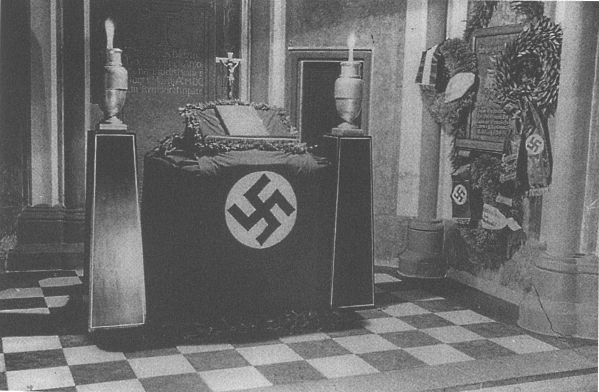 My recent reading of Adolph Hitler's Mein Kampf was difficult, for a range of reasons.
The first of those was, unsurprisingly, his complete and utter hatred of the Jews. Knowing what came of that, for any not-evil human being, that's hard enough to read.
But as a Presbyterian pastor with a Jewish wife and children, it made wading through this monstrous book particularly difficult. Here, a man who would given half a chance have murdered my children, and killed my family. Five hundred and twelve times in that godforsaken book, he spits out his hate, hate on almost every page, a hatred for everything Jewish that is deeply, pervasively demonic.
And here I was, spending time in his mind, and engaging with his thoughts, hundreds and hundreds of pages of them. I felt like Socrates, half-empty cup in hand. My soul recognized the bitter evil of it, tasted that it is toxic. But still, on I drank, forcing myself to take it down, to know it more intimately.
As a person of faith, I tasted in his writing something of the faith that motivated Adolph Hitler. And he did talk a great deal about faith.
Judaism, as far as Hitler was concerned, was not a faith. His hatred of the Jews was not because it was a different religion. As far as he is concerned, it was not a faith at all. He dismisses that as a lie told by liberals, a secret back door to allowing Jews to be just one belief system among many in a pluralistic culture, rather than the source of all evil that Hitler endlessly, relentlessly claimed. Jews, Hitler argues in Mein Kampf, are only a nation and a race, bound together not by a legitimate covenant with God, but by blood and ethnic identity. Given how oddly this sounds against ongoing conversations within Judaism itself about what constitutes Jewish identity, it was peculiar to hear what Judaism's greatest enemy had to say.
Just as hard for me, as a follower of Jesus of Nazareth, was the way that Adolph Hitler coopted the language of Christianity into his service. He uses Christian language and symbol as a way to cement his political power.
On multiple occasions, Mein Kampf coopts the New Testament, using images and snippets from the parables and storytelling of Jesus to make a point.
"Like a camel through the eye of a needle," Hitler says. "No man can serve two masters," Hitler says. I wince at the references, familiar from the voice of my own Master. And of course, he uses the "cleansing of the Temple" image, the go-to Jesus-story for people who want justification for their hatred and desire for violence.
But the references are warped. For example, Hitler was using the camel/needle story in Mein Kampf not to challenge wealth and power as Jesus did, but to attack the idea that representative democracy can ever produce strong leadership. The cleansing of the temple? For Hitler, it's about how Jesus--the Jew, who taught other Jews like a rabbi and used the Torah and the prophets as his foundation--wanted to purge the world of all things Jewish. Hitler's misusage was insane. It had nothing at all to do with the Gospel or Jesus of Nazareth.
Because Adolph Hitler's faith was in martial power, national pride, and cultural purity. That was his god, the object of his worship, the teleological yearning of his mad, misbegotten Reich. The shallow cultural Christianity of the German people was just a means to that ultimate end.
But tapping that source of power worked, clearly, in a potent way. What it did was take the in-group language of Christian faith, and said: look, I know how to speak this way. Look at how I am just like you, about how I share what you share.
He stripped the words away from the reality towards which they were intended to point. No longer do they declare a Kingdom of grace, where the outcasts are welcomed, and the broken are made whole. Hitler uses them and warps them to point to another reality, a darker one, seething with nationalist resentment, racial pride, and violence, the antithesis of the Gospel.
Some Christians realized this demonic influence, and fought it. They were few in number, and died for their resistance. My own Presbyterian denomination remembers their witness, recorded in the Barmen Declaration, as part of our Constitution. It stands as reminder of the terrible danger of allowing our faith to be coopted by political power. Never again, we say, and we keep that memory close and precious.
My reading of the most potently evil book of the twentieth century reminded me of how careful we need to be, as power seeks to take, corrupt, and use the language of our faith to control us.
And right now, we need to be very, very careful.
September 10, 2015
Seven Ways You Can Be Like Hitler
 The political season has begun, and that means for the next year, Godwin's Law will come out to play.
Godwin's Law, in the event you've not heard of it, is the debating principle that states that in every argument, eventually someone will accuse their enemies of being a Nazi. "You're just like Hitler," they'll say. "Gay rights advocates are Nazis! Conservative Christians are Nazis! Cops are all Nazis! Hitler banned guns! Being concerned about gun violence makes you a Nazi! Hitler Hitler Hitler! Nazi Nazi Nazi!"
But as much as his name is the go-to insult for any opponent, and being a Nazi is just shorthand for "an opponent I despise," Hitler's National Socialism was a very, very specific thing. It involved discrete patterns of thought. It was a cohesive ideology and way of understanding the world. To understand it, you must know it. You must engage with it.
Ad fons, or so the saying of my Reformed faith goes. "To the foundations," that means. To understand a thing, go to its source.
And so, with that as my purpose, I girded up my loins, invoked a sequence of protective prayers around my soul, and waded into a book I'd never read. It was the bible of National Socialism, the heart of that darkness: Adolph Hitler's Mein Kampf.
For some reason, I'd visualized a pithy little pamphlet filled with terrible aphorisms. Perhaps it was memories of reading Chairman Mao's Little Red Book echoing in my head.
Oh Lord, was I wrong.
Sweet Mary and Joseph, but that book was long. It was huge, and remarkably, amazingly drab. Much of it is dull, interminable political inside baseball, as Hitler rambles on about the Hapsburg dynasty and minutiae of contemporary German/Austrian Parliamentary processes and personalities. In between some remarkably tedious droning, there was the clear seedbed of horror, a fevered, passionate hatred, and the clear conceptual foundations for both war and the systematic extermination of millions of human beings. Mein Kampf is a monstrous book, an evil thing.
Now that I've read it, and taken the spiritual equivalent of a long hot shower, I have a better sense of both the methodology and approach of National Socialism. Here, seven takeaways, a listicle of evil, what it really means to be like Hitler:
1) It's All About the Outrage. At the beating heart of Mein Kampf is umbrage, the absolute certainty that Other People are Responsible for Our Suffering. "Mein Kampf" means "my struggle," and that's what Hitler means for his reader to feel. He...and you, the reader...are in a desperate struggle against a nefarious Other, who is seeking to destroy all that you hold dear.
That Other, in the five hundred and twelve times he names it, are the Jews. But as Hitler himself admits, it does not have to be. It just has to be an enemy, against which a movement or a nation can be organized. As Hitler puts it:
"The art of leadership, as displayed by really great popular leaders in all ages, consists in consolidating the attention of the people against a single adversary and taking care that nothing will split up that attention into sections. The more the militant energies of the people are directed towards one objective the more will new recruits join the movement, attracted by the magnetism of its unified action, and thus the striking power will be all the more enhanced."I've read this before, seen this principle used as a baseline for organizing a mass movement. It's articulated repeatedly in Saul Alinsky's The Rules for Radicals, for pointed example.
To get a people moving, there is nothing more effective than an enemy to demonize and hate.
2) Politicians are All Corrupt. Hitler spends a great deal of time attacking politicians. They are all pocket-lining, incompetent fools, he asserts. All they know how to do is speechify, and none of them do their jobs. They need to be replaced, all of them.
His attacks on politics as usual, through a simple redirection of force, becomes an attack on the idea of representative democracy itself. Our representatives are just suck-ups and weaklings, and that's the only reason they are in power.
"Surely nobody believes that these chosen representatives of the nation are the choice spirits or first-class intellects," he snarks.
Throw the bums out. Having accepted that premise, it's an easy move to Hitler's answer: they need to be replaced by men of Will and Honor, people who can really get done what needs to get done.
By which he means himself, and the Nazi Party.
Hitler was clearly tapping a deep wellspring of popular cynicism about governmental incompetence, and particularly the incompetence of representative government. Sure is a good thing that there's none of that in America these days.
3) The Press is The Enemy. Hitler hated the press. As far as he was concerned, the media were primarily responsible for the collapse of German pride, sappers of the will of the people. Again, he taps a deep and abiding cynicism, this time about the media. For example:
"It took the Press only a few days to transform some ridiculously trivial matter into an issue of national importance, while vital problems were completely ignored or filched and hidden away from public attention."Why does the press do this? Well, it's the "Jewish Press," as far as Hitler is concerned. Because Jews engage in objective thinking, which saps the vital essence of a people. That's the idea, at least.
From that foundation of racial hate and cynicism, Hitler makes the move to asserting...at great length...what the press should be doing.
Hitler argues that the goal and purpose of all media needs to be instilling patriotism and national pride. It must intentionally create propaganda--he's unafraid of that term--that stirs the emotions of the lowest common denominator. It does not matter if this propaganda is "true." It only matters that the people believe it, and that it serves the purpose of patriotic endeavor.
As Hitler puts it, good propaganda is exactly like advertising or marketing. The goal is not to tell the objective truth. It's to sell your product. Or to proclaim your ideology.
The best propaganda, in other words, speaks to the folks in your society who primarily use their lizard brains, whose higher functions are ruled by their passions and emotions.
4) The Military Is the Heart of Culture. Hitler's National Socialism was fascist, and central to fascism is complete reverence for all things military. That's what the fasces--the bundle of sticks with an axe-blade that is the symbol of fascism--represents. Hitler talks, at great length, about the refining fire of martial endeavor, about the nobility of the military and the abuses suffered by veterans. The military is, as far as he is concerned, the very best part of national identity.
Why? Because in the crucible of conflict, where your life is on the line, men become stronger. Or they die. And because this is done in the service of the nation, soldiers are the truest, most tested patriots.
As he presents it, the German army only lost because it was betrayed by the press and subverted by the Jews. It made no errors. It was about to win, until victory was snatched from it by the Other.
He has nothing but contempt for talk of peace. Peace makes a people weak. Those who call for compromise and finding nonviolent solutions with the Enemy are just parasites or subversives.
5) Passion is Primary, Critical Thinking is to be Avoided. The goal of National Socialism is passion, which is peculiar, given the tone and language of Mein Kampf. It's a cold book, bright-eyed and distant, written in a tone that most closely resembles the distant, unforgiving prose of Ayn Rand. It is, itself, a little distant.
For those few in control of the system, being dispassionate is key. The scientists and the elites must be cool, rational thinkers.
Yet for the rest of the people, what Hitler prescribes is passion and emotion. Outrage, yes, but also all other emotions. Fierce love. Tears. Laughter. Joy. The reason for this: motivating the masses. To stir the heart of a folk is to call them to the Great and Noble End which you are pursuing. Make them feel the feels. Stir their heart, because it is from emotion--anger and pride in particular--that the strength of a people is found.
What's remarkable is how up front he is about his methods. Right there in his book, the idea that leaders must manipulate the emotions of their followers, that they should mask objective truth.
6) Liberal Intellectuals are the Enemy. Why? As Hitler describes it, this is because they undermine the spirit of patriotism that shapes a nation's pride and purpose. Liberal intellectuals tend to be internationalists, who see value in other cultures and other races, and this distracts from building up national identity. They also insist on critiquing the behaviors of a nation, which drains morale and the vigor of the folk.
Worse yet, liberals insist on looking for common ground with the Enemy, or finding reasons that the Enemy isn't really as bad as all that.
For example, Hitler has pages of venom directed at those German Christian liberals who argued that Jews were just another faith, and that they could be truly German.
He also notes with rage that liberals had taken charge of the educational system, and that they were using education to corrupt the spirit of German youth. The purpose of education, Hitler suggests, is not to create objective, critical thinkers. It is to teach the greatness of a people, to inculcate pride and patriotism, and to cement their commitment to the national purpose.
7) The Goal Is Purity. What mattered to National Socialism was racial and ideological perfection. That was its goal and purpose. All compromise, accommodation, and weakness were to be cut away.
For Hitler's National Socialism, that meant racial purity. The Aryan and Germanic ideal was only diluted by efforts to blend in or mix with other cultures and races. Efforts to create states that included multiple cultures were inherently doomed, because they were inherently corrupted.
From that also rises a focus on ideological purity. That means that any variance from the party line, any whiff of compromise, any move away from the One Purpose? It is to be viewed as suspect.
National Socialism, as Hitler lays it out in Mein Kampf, represents a radically binary, absolutist worldview. There is Us, and We are Good. And then there is Not-Us, which is inferior or the enemy.
And there, from the darkest heart of twentieth century evil, are seven key features of Hitler's thinking, of what it really means to be a Nazi.
It's important to have a grasp on these principles. Why? Because while Godwin was right about our compulsive overuse of the Nazi/Hitler card, that doesn't mean that there aren't movements and leaders that actually resemble National Socialism.
And just because we falsely cry wolf, over and over again, that doesn't mean that wolves don't still roam hungry in the darkness of our culture, looking for an opportunity to rule.
September 8, 2015
Narrative, Ambiguity, and Apocalypse
 As I prepare myself to work on the final edits to my novel, I find myself wrestling with something of a paradox.
What I'm writing is apocalyptic literature, in the most classical sense of the term. As a biblical narrative genre--and yes, it's a biblical narrative genre--apocalyptic literature is intended to open up the eyes of the reader. ἀποκάλυψις, in the Greek, means an "unveiling," a revealing of truths otherwise hidden.
That "revealing" happens when something comes along to shatter conventional reality, as the patterns and norms of our societal power dynamics are obliterated. That can involve zombies, asteroids, and pandemic plagues. It can involve the tearing apart of the heavens, and the arrival of the four horsemen. The core idea is the same.
As a biblical genre, apocalypse reveals the way ahead, the Path That Is God's Will.
I'll freely admit that some Biblical apocalypses don't do that revealing part well. John da Revelatah was notorious for not getting that memo, masking his truths in secret-code language and fever-dream abstractions.
But what he was trying for, what all those who speak in apocalyptic language are trying for, is to open our eyes to the Way Things Are.
In working to refine my manuscript, though, I'm realizing that ambiguity is a necessary part of apocalyptic. As I work with my excellent, capable editor, I find myself trying to keep the narrative as open-ended as possible, struggling create a conclusion that is both satisfying but also allows the reader freedom of interpretation.
Why? Because narratives that only have a single possible outcome reveal nothing. By saying: this is the plan, there is no variance from the plan, and everything will go according to plan, we are masking ourselves with a false certainty.
What does that mean? Hmm. If you give a person only one choice, it tells you nothing about them. "You may only do this," you say. "OK," they say, and they do it. Their choosing that path means nothing, because that is the only path you have left open to them. It does not reveal anything about their nature.
As it stands in relationship to a reader, such a narrative is not apocalyptic.
It is Calyptic literature, literature that masks and veils and hides the truth behind its rigidity. This is what fundamentalist literalism does to the sacred texts of Scripture. It does not test. It does not challenge. It does not do what Jesus did when he taught in parables, which were designed to give the hearer the opportunity to misinterpret them.
But if you say, here you are free to choose, free to interpret, free to act as you wish? Then that choosing reveals a truth about the soul that decides. Do they choose for good or ill or some admixture of the both? Do they choose based on grasping self-interest, or compassion?
Ambiguity may not reveal the One Truth of Reality. But it reveals the truth about anyone who encounters it.
In that, ambiguity is the nature of our apocalypse, the apocalypse that God is working right now.
Ambiguity is the fire in which we--as persons, as cultures--are tested and known.
September 6, 2015
What Fighting for Your Religious Freedom Looks Like
 Anger, fear, and resentment are wonderful ways to motivate and radicalize a constituency. And so there's an episode in our history, long forgotten to most of America, that's on my mind as the political umbrage machine finds reasons to stir our fears this season.
 One of the major rallying cries for this upcoming election is this: Religious freedom is threatened. How? Well, there's an anecdote here, and a snopes-fail story there, but really? All that matters is that people are riled up enough to feel motivated.
And sure, there are real threats to the freedom of religious practice elsewhere. In China, for example, where churches are forced to close for just being churches. Or in the Middle East, where being Christian means you may be tortured and beheaded. Our self-aggrandizing sense of "oppression" is an embarrassment to the faith, a mockery of the very real crosses borne by Christ followers around the world.
"Tyranny?" Lord help us, we have no idea what that means, although the folks who are manipulating our fears would be happy to show us, I'm sure.
That's not to say that religious freedom hasn't been challenged before in the United States. It has. When that's happened, though, and when it was resisted, what did that look like?
What does defending your religious freedom look like in a constitutional republic, when it's genuinely at risk?
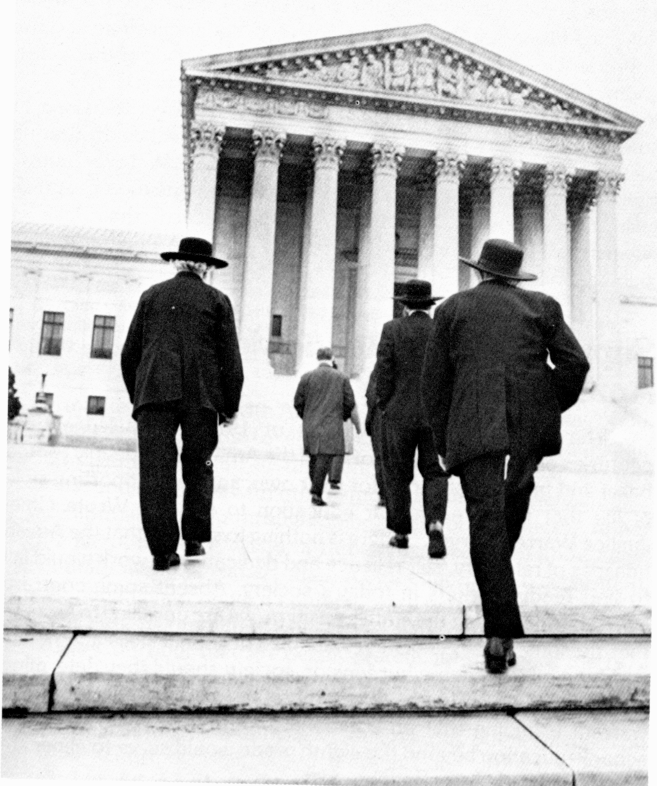
For that, my research into the dynamics and lives of the Old Order Amish for my forthcoming novel surfaced an interesting case. There was a time, in the mid-20th century, when the Amish were jailed for their beliefs. It was the era when public education was increasingly a national priority. The United States was in the midst of the Cold War, and them Russkies were edumacating their young 'uns up real good.
If we didn't develop a new generation of scientists and mathematicians and engineers, the Red Menace would overtake us with their Sputniks and their Soyuzes and their ICBMs. Next thing you know, we'd be singing the Internationale, watching terrible propaganda musicals, and being herded into interminable performances of abstract dance at the Bolshoi.
So STEM education was the rule of the day, and everyone needed to be on board. School was mandatory.
But a group of Wisconsin Amish refused to send their kids to school past eighth grade, on religious grounds. They were conservative Christian agrarian/craftsman pacifists, and they wanted to educate their children to be part of their community. They had nothing against literacy, because the Amish were and are avid readers and writers. They had nothing against math, in so far as you need some math to run a farm or a small business or a household.
But the rest of modern-era public higher education was preparing their children for an economy in which they did not want to participate, an economy that was antithetical to their faith. So they refused.
Their children simply didn't show up to class. Or, if forced to go to class, they'd flee into the cornfields. Amish parents were accused of encouraging truancy, of subverting the American way with their backwards ignorance. Charges were filed. The Amish held their ground.
Amish elders were jailed, repeatedly, for breaking the law of the land. They maintained their position, relentlessly and peacefully, with the stubborn gentleness of that movement.
Ultimately, they won. In 1972, the Supreme Court unanimously ruled in favor of the Old Order Amish, in a landmark decision establishing the rights of parents to see to the education of their young ones.
But there's a detail in there, one that the current self-absorbed hullabaloo about religious freedom willfully ignores. The Amish were only interested in defending their way of life.
They were not, in any way, imposing their way of life on others.
Let me repeat that, because that's the part we seem confused about:
They were not, in any way, imposing their way of life on others.
I'd bold it and put it in all-caps, but hopefully, that point has been gotten across.
What we "English" do did not matter to them. They had their way, their path, their Ordnung. Others were not expected to live by it, not coerced by the power of the state into living according to their rules.
Now, I'm a fan of public education. Is it perfect? No, of course not. But it's a good thing, a public good, something that makes our nation better. Smarter. Stronger. Faster. Nonetheless, I can respect both the Amish position and the way in which they went about defending their inalienable rights.
In a democratic republic, where your neighbor's freedom matters as much as your own, they showed us how defending religious liberty is done.
September 5, 2015
The Gatekeeper
 The truth of the recent Kim Davis mess in Kentucky surfaced in a detail, a detail familiar to anyone who has spent any time around churches.
We've been there, all us Jesus folk, when someone decides they're in charge of something at a church. It could be anything. It could be the coffee hour. Or the treasury. Or the annual Life Day celebration.
This is their thing. Sometimes, it's because they are doing it for the joy of it. It's a way of exuberantly sharing their gifts and graces. Other times, they're doing it with an open hand and a servant heart.
And other times? Well, sometimes there are...cough...other motivations.
They own it. It belongs to them.
That part of the life of the community becomes the place of their power, the place that gives them a sense of control over the world around them. Sure, their life may be a wreck otherwise, a weeping disaster of abandonment and brokenness, failure heaped on failure, but when it comes to determining how the doilies are arranged on the fellowship hall tables, they are the Absolute Ruler of All That May Be Done.
They are the Gatekeeper.
Woe betide anyone who messes with that sense of power. No-one else is allowed to touch it, to do it differently. If you are a new member or a fresh-out-of-seminary pastor, it's a thermonuclear landmine. Mess with their fiefdom, and that Gatekeeper will do everything in their power to destroy you.
Because that role is them, themselves. And sure, it seems so impossibly small a thing to fight over, such a waste of energy over a tiny nothing, But that tiny nothing is the source of their identity, and they're as understanding about your touching it as Sauron was with that little ring of his.
This, I am convinced, is why when the libertarian out was offered, Davis did not take it. Rand Paul, the quasi-libertarian, named it the other day in an interview.
Just have someone who doesn't object to the law sign the documents, like, say, a notary public. Then the law is upheld, the freedom of gays and lesbians is not violated, and her freedom of conscience is not violated. It would also be entirely legal.
That was precisely the compromise offered by the court. OK, fine, the judge said. You don't have to do that. Just authorize someone else to do it. But that compromise was flatly rejected.
And in rejecting it, the truth of her position seems clear. It is not just that she can't perform her duties because it would violate her liberty. It is that she does not want the thing over which she has power done any way other than she wishes it done. It would violate not her own freedom, but her control over the liberty of others.
She has become the Gatekeeper.
Now, it'd be easy at this point to get all self-righteous about how terrible a person she is, what a terrible Christian, to do such a thing.
But this hunger for power rests in all of us, no matter where we are in the political spectrum. We all yearn for it, desire it, that place where our will rules over all. Privilege feeds it. So does the brokenness of want or powerlessness. Whenever we are in community, it whispers to us, or rises up in indignant fury when someone suggests that maybe we might try doing it differently.
That desire, for power over the Other, that concupiscence, is the dark heart of human sin.
Our sin.
September 4, 2015
The Wall Around Power
Teslas are awesome, they really are. As a lifelong enthusiast of all things automotive who is simultaneously concerned about the impact we're having on our little planet, the Tesla seems like the killer app of vehicles.
The S is gorgeous, of course. Swift, luxurious, and elegant, yet simultaneously low-impact on the environment and cheap as dirt to operate, it seems you just can't go wrong. Only, well, they're a wee bit pricey, with the entry point standing at 150% of the average America annual household income.
The P85D, the big boss daddy of the lightning-car world? It's berzerk, or "insane," as those videos show us it making your Jewish grandma swear (potty-mouth-language at the link, just so's ya know) and blowing the doors off of old school combustion muscle cars.
And the new SUV/Van, the X? Amazing, with doors that scissor open, Falcon Wings, perfect for Leia once she's finally settled down into the 'burbs with Han. Oh so practical, and yours for $135,000, six times the price of the recently purchased used minivan that graces the front of our home.
Elon Musk's latest endeavor, the Tesla PowerWall, also seems like a brilliant idea. It's a hyper-effective and stylish battery-pack, one that can be integrated with a rooftop solar array to render your home functionally energy self-sufficient. It's an eco-libertarian fantasy, perfect for surviving blackouts and zombie apocalypses and the second Trump administration.
I'd love to have one in our home, frankly. Would totally, totally buy it.
Only, well, there's a subtle catch, a tickle in my consciousness.
My family, at least at the present time, could afford a Tesla PowerWall. A little saving, a little scrimping, and we'd be there with the twenty-five grand you'd need to cut the cord.
But we are not most Americans. If the average household income is $51,000, and most of us are carrying substantial debt loads, twenty five thousand large is a huge, huge hurdle. That, and you have to own your own property. And be likely to stay there a while, meaning you have locational stability.
And there, there something catches in my soul about Tesla's super-premium "aspirational" business model, and about one dark possible future of a distributed energy economy.
If our energy infrastructure starts to come apart, those with wealth will do fine in a Tesla PowerWall world. The owned square footage for the sun and the batteries are theirs. Their sleek cars will hum and their screens will glow and their homes will be cool.
But for the rest, as things crumble? For the renters, the young and indebted, the struggling rural rednecks and the disenfranchised urban poor?
That transition may be rougher. As the global carbon economy finally sputters on vapors and dies, our lives might look like the lives of those in West Africa or the Middle East, where lights are on for just hours a day...for all but those few who have the economic power.
Because power draws power to itself, and casts a high wall around itself. The poor are allowed to see those distant lights flickering, in their darkness.
The S is gorgeous, of course. Swift, luxurious, and elegant, yet simultaneously low-impact on the environment and cheap as dirt to operate, it seems you just can't go wrong. Only, well, they're a wee bit pricey, with the entry point standing at 150% of the average America annual household income.
The P85D, the big boss daddy of the lightning-car world? It's berzerk, or "insane," as those videos show us it making your Jewish grandma swear (potty-mouth-language at the link, just so's ya know) and blowing the doors off of old school combustion muscle cars.
And the new SUV/Van, the X? Amazing, with doors that scissor open, Falcon Wings, perfect for Leia once she's finally settled down into the 'burbs with Han. Oh so practical, and yours for $135,000, six times the price of the recently purchased used minivan that graces the front of our home.
Elon Musk's latest endeavor, the Tesla PowerWall, also seems like a brilliant idea. It's a hyper-effective and stylish battery-pack, one that can be integrated with a rooftop solar array to render your home functionally energy self-sufficient. It's an eco-libertarian fantasy, perfect for surviving blackouts and zombie apocalypses and the second Trump administration.
I'd love to have one in our home, frankly. Would totally, totally buy it.
Only, well, there's a subtle catch, a tickle in my consciousness.
My family, at least at the present time, could afford a Tesla PowerWall. A little saving, a little scrimping, and we'd be there with the twenty-five grand you'd need to cut the cord.
But we are not most Americans. If the average household income is $51,000, and most of us are carrying substantial debt loads, twenty five thousand large is a huge, huge hurdle. That, and you have to own your own property. And be likely to stay there a while, meaning you have locational stability.
And there, there something catches in my soul about Tesla's super-premium "aspirational" business model, and about one dark possible future of a distributed energy economy.
If our energy infrastructure starts to come apart, those with wealth will do fine in a Tesla PowerWall world. The owned square footage for the sun and the batteries are theirs. Their sleek cars will hum and their screens will glow and their homes will be cool.
But for the rest, as things crumble? For the renters, the young and indebted, the struggling rural rednecks and the disenfranchised urban poor?
That transition may be rougher. As the global carbon economy finally sputters on vapors and dies, our lives might look like the lives of those in West Africa or the Middle East, where lights are on for just hours a day...for all but those few who have the economic power.
Because power draws power to itself, and casts a high wall around itself. The poor are allowed to see those distant lights flickering, in their darkness.
September 3, 2015
My Rights and Your Rights
 My recent reading of a brilliant biography of radical abolitionist John Brown was a fascinating exploration of his life, but it was something more. In examining that fierce, peculiar life, the author opened up the history of that difficult time in our national story.
What is most striking, wallop-you-in-your-face striking, was the lie that the Confederacy was all about states rights. It was most certainly not that, as any close reading of the constitution of the Confederate States of America reveals. I'd always assumed, blindly and from high school, that the CSA went back to some variant of the original Articles of Confederation. That document, which predates the Constitution, gave much more rights to individual states, with a weaker central authority.
This is not my excellent high school history teacher's fault. I assumed that because, um, well, a Confederacy seems likely to have Articles of Confederation. Because...um...it has "Confeder" in it.
But the truth of the CSA Constitution was simple: it was the United States Constitution, clumsily edited to mandate slavery as a cultural absolute, and to forbid any state or citizen to ever challenge slavery as an inalienable right of slaveholders.
Meaning, in the name of liberty, it attempted to codify the right of one person to infringe on the life, liberty, and pursuit of happiness of another.
In John Brown's time, what was called "state's rights" was no different. Slaveholding states wanted their rights to have precedence over the rights of both blacks and the citizens of free states. Through legislation like the Fugitive Slave Act, Southern slaveholders sought to prevent the citizens of free states from acting according to the laws of their states and their own consciences. Meaning, because they treated a person as an ownable object, as subhuman, everyone else was legally coerced to honor their right to do so. Their rights and freedom have precedence over others.
That's not valuing rights or freedom. That is violence.
In that long ago era, the truth of that violence was written out in the Kansas territory, where slave-state-funded and armed militias terrorized abolitionists, burning their presses to silence them, and gunning them down on the street.
We are, thank the Maker, not in that place right now. But that willful, self-interested misunderstanding of the nature of our inalienable rights and human liberty remains, because human sin remains.
It is, now, echoed out in the "religious liberties" so loudly proclaimed by those on the far right.
This false flag "freedom" serves a purpose. It's great for stirring that sense of aggrieved umbrage that is so useful for motivating a political constituency, but let it be clear: this is the same misbegotten appeal to "liberty" that defined the Confederacy.
Because to truly value religious and personal liberty, you must value more than just your own. You must equally value the freedom of your neighbors, be they gay or transgender, conservative or atheist or pagan or Muslim or Raelian.
If their lives and their choices do not meaningfully impact your own, you have no standing to claim offense at the mere fact of their existence.
Not if America matters to you.
September 2, 2015
My Inclusive Language Heresy
It's a standard part of our service, just a part of the pattern of a tradition service in a little church. The sermon is finished and done, and I've ended with an amen, and then we're all on our feet to read text from our bulletin.
"Let's rise and affirm what we believe," I say, pretty much every week, and then we together intone something from the Presbyterian Book of Confessions. It's the Presbyterian part of the service, beyond the classical movement of the worship, as we dig into a selection from one of the historical creeds and confessions of the Reformed tradition.
I value that, I do, because it reminds us that we're not the first folks to come up with this whole faith thing. It connects us with our story, the long narrative of those who journeyed the same path we're on centuries and millennia ago.
Only, well, I have a tendency to do a couple of things. I stay with the more contemporary Confessions, for the most part, the ones we can say without having to
And I also tweak the readings a little bit, particularly when we're reading from one mid-twentieth century confession. The Confession of 1967, it's called, and it still has important things to say. It speaks directly to issues of power and war, of racial bias and environmental degradation, things that should still be front and center in our consciousness.
But it's a creature of it's time, and the language used for human beings is both masculine and abstracted. Meaning, that when it talks about people generally, it says: "man," or "men." When it talks about our life together as a people called to follow Jesus and walk the way, it says: "the church."
So what we read, when we read from that Confession? I've edited it, just a wee little bit, to be more inclusive.
What that does not mean is that I've changed it to "women and men" or "Mother/Father/Parent God" in the well meaning clumsiness that blighted the liturgies of my youth in a progressive church. "Dear Mother slash Father slash Parent," the earnest worship leader would say, making the prayer as awkward as if our children addressed us as "Mom slash Dad slash Parent," and as impersonal as if our Dad insisted on calling us Daughter slash Son slash Offspring.
Now, of course, that would need to be "women, gays, lesbians, transgendered persons, the genderqueer, the intersex, the asexual, and cisgendered males," as the categorical divisiveness of academic discourse sends our self-understanding into an endless fractal fragmentation. That may be more precise, in its way, but what it isn't is more inclusive.
So where that confession says "man" or "men," I simply change it to read "we" or "us."
I do the same where the Confession refers to the church as an abstracted other, as if The Church is something other than the human beings who are together saying the words that hum in the air together. Not "the church does this," or "the church hopes that." Instead, "we do this." Or "our hope is that."
In no way do I mess with the meaning of the text, or with the purpose. As heresies go, it's remarkably orthodox.
"Let's rise and affirm what we believe," I say, pretty much every week, and then we together intone something from the Presbyterian Book of Confessions. It's the Presbyterian part of the service, beyond the classical movement of the worship, as we dig into a selection from one of the historical creeds and confessions of the Reformed tradition.
I value that, I do, because it reminds us that we're not the first folks to come up with this whole faith thing. It connects us with our story, the long narrative of those who journeyed the same path we're on centuries and millennia ago.
Only, well, I have a tendency to do a couple of things. I stay with the more contemporary Confessions, for the most part, the ones we can say without having to
And I also tweak the readings a little bit, particularly when we're reading from one mid-twentieth century confession. The Confession of 1967, it's called, and it still has important things to say. It speaks directly to issues of power and war, of racial bias and environmental degradation, things that should still be front and center in our consciousness.
But it's a creature of it's time, and the language used for human beings is both masculine and abstracted. Meaning, that when it talks about people generally, it says: "man," or "men." When it talks about our life together as a people called to follow Jesus and walk the way, it says: "the church."
So what we read, when we read from that Confession? I've edited it, just a wee little bit, to be more inclusive.
What that does not mean is that I've changed it to "women and men" or "Mother/Father/Parent God" in the well meaning clumsiness that blighted the liturgies of my youth in a progressive church. "Dear Mother slash Father slash Parent," the earnest worship leader would say, making the prayer as awkward as if our children addressed us as "Mom slash Dad slash Parent," and as impersonal as if our Dad insisted on calling us Daughter slash Son slash Offspring.
Now, of course, that would need to be "women, gays, lesbians, transgendered persons, the genderqueer, the intersex, the asexual, and cisgendered males," as the categorical divisiveness of academic discourse sends our self-understanding into an endless fractal fragmentation. That may be more precise, in its way, but what it isn't is more inclusive.
So where that confession says "man" or "men," I simply change it to read "we" or "us."
I do the same where the Confession refers to the church as an abstracted other, as if The Church is something other than the human beings who are together saying the words that hum in the air together. Not "the church does this," or "the church hopes that." Instead, "we do this." Or "our hope is that."
In no way do I mess with the meaning of the text, or with the purpose. As heresies go, it's remarkably orthodox.
August 27, 2015
#Hashtag Binaries
 I preached this last Sunday on the strange, intense life of radical abolitionist John Brown, whose visage graces my blog. As preached, it was a reflection on faith, violence, and the violence of martial imagery in scripture.
But there was an undercurrent in the sermon, a quiet hum that I just couldn't ignore, but that couldn't be cleanly integrated into my reflections.
We've found ourselves in a spasm of national anxiety over race for the last year. As the final term of America's first black president comes to a close, our nation grows more and more anxious about race. Because for all of the idealistic look-we're-not-racist-anymore hopeyness that blossomed when Obama was elected, the reality for most African-American communities hasn't changed all that much over the last seven years. We've not "solved" the problem of communities color that are systemically and culturally trapped.
So we are tense about it, and that tension splashes out in odd, culturally-idiosyncratic ways. For pointed example, I'm reasonably sure John Brown wouldn't have known what to make of our recent squabbling over hashtagged slogans. #Blacklivesmatter or #Alllivesmatter, locked in a mortal struggle? It would have been incoherent to him, as, in fact, it is incoherent to me.
Here, all this sound and fury vented over two propositions that are different, but neither antithetical nor mutually exclusive.
#Blacklivesmatter is important to say, and say clearly, because it reflects an organizing principle for a systematically disenfranchised community. Black communities and persons need to be able to say this clearly and firmly, because the rest of the culture needs to hear it and they need to hear themselves being heard.
Having travelled through the Deep South, and through areas of urban blight, I know this isn't what our dominant culture tells black culture. Ta-Nehisi Coates suggested in his recent book that what white culture does is continually plunder black culture, but I think his pessimism misses the mark. It's worse. Plunder implies some sense of value, even if just as an object. Generations ago, the dominant culture plundered. Now, those disenfranchised communities are simply discarded, having been used up in the way our industrial consumerist society uses up objects. They serve no purpose in the great global machine. They do not matter.
Which is why #blacklivesmatter is so very important to be able to speak without shame or qualification. Because a community without hope or purpose will forever tear itself apart, and never find the will to rise and grow.
And #alllivesmatter? That's categorically different. It is not the discrete organizing principle of a particular sub community. It is, instead, the intersectional foundation for building a larger coalition.
Because, to be blunt, the clawing, empty meaninglessness that has torn the heart out of black communities is doing the same everywhere else. For Latinos, Asians, and Europeans, the same cultural issues are at play. The growing divide between the socioeconomic elite and the rest of society is crippling all of us. The besieged working class scrambles to cobble together a life in a culture where labor has all been offshored. The anxious center watches as their economic foundation crumbles, and as it becomes harder and harder to maintain life, where a single job loss or hospitalization can crush a person or a family. Our culture teaches that #nolivesmatter, that all of us are disposable and replaceable. That dark consumer-materialist ethos needs to be resisted or it'll tear us apart.
The two ideas both speak prophetically against the same reality, and both can be integrated seamlessly into a single worldview.
And yet these two have been set into opposition, as if they are fundamentally antithetical propositions. To say one is to be accused of silencing the other. Why?
I wonder, with McLuhan, if it has anything to do with the medium. Meaning, the problem lies not with the incompatibility of the concepts, but with organizing around #hashtags.
A #hashtag, after all, is not a relationship. It is a data tag, a marker of a discrete concept within a virtual socio-neural network, one that--as a principle--stands in relation only to itself. It is #this but not #that, a closed thought, not part of the complex latticework of narrative symbol, but a single strand of viral information. Even a bumpersticker is more complex.
And sure, we can play around with #hashtags. #We #can #play #with #their #inherent #divisiveness. We can use them in intentional conjunction to indicate #polyvalent / #non-boolean concepts. But their purpose remains.
A #hashtag as a search tool is all well and good. But used as a primary organizing principle it is inherently rigid, divisive, resistant to modification, and inherently exclusivist.
Thanks, #Twitter.