David Williams's Blog, page 61
February 22, 2016
Disruption and Integration
 This is the year of "disruptive leadership." Both of parties that comprise the dysfunctional false binary of American politics are wrestling with insurgencies from folks who aren't technically members of said parties. Sanders, after all, isn't a Democrat. And Trump? Lord, I don't even know what he is, other than possibly one of them thar signs o' the 'poacalypse John of Patmos was always ranting about.
 When a system is stuck, what current conventional wisdom shares is that we need "disruptive" leaders. You've got to tear it all down, to shatter dysfunction, to blow it all up.
That, we are told, is what good leadership does. I hear that, particularly, in church circles, as yet another of the impossible list of expectations that are heaped onto pastors.
Here, though, I find myself doing an empirical-reality gut check. Because the call to disruptive leadership seems loudest and most clear in the portions of Christianity that are withering away.
Of course, one might say. That's necessary. You need to shatter a failed paradigm in order to make room to build a new one.
But leadership that conceptualizes itself as primarily disruptive has trouble with the "building" part. If your fundamental orientation is deconstruction, and the conceptual tools you apply to life are those that critique and tear down, you ain't gonna build nothin'. Just ain't gonna happen. When the only tool you've got in your toolkit is a wrecking ball, the best you can do with continued application of said wrecking ball is pound the rubble into finer and finer powder.
The goal, instead, is for a leader to articulate a vision that embraces and gives courage to the best graces and possible futures in a community. And sure, that disrupts what is. But it also works with the reality that leader is encountering. It reflects purpose, a purpose that is shared and spread.
Sure, things need to fall away for the new life to come into place. But the purpose of that act is not the disruption itself. It's just part of the integrative process of building up.
And for communities that serve the Way, at least, building up is far more important than tearing down. It is, in point of fact, the whole of our purpose.


February 19, 2016
Liking Nino
 Antonin Scalia's passing was, well, it was kind of a strange moment.
Because, on the one hand, I disagreed with him about just about everything. I viewed him as a reactionary, someone whose views...about the methodology for interpreting the Constitution and just about everything else...were remarkably, significantly wrong.
On the other, damned if I couldn't help but like the man. And not in the abstract. If asked, last year, which American political figure I'd like to sit down and sip a scotch with, he'd have been probably my first pick.
Specifically and because I didn't agree with him, and because even in the face of that, I found him...likeable. He had a sharp wit. He was genuinely funny, in an unguarded, apolitical way. If you opposed him, what mattered wasn't that you fought. It was that you fought well.
Because as firmly as he held on to his beliefs, he legendarily did not let them get in the way of his personal relationships with others who disagreed with him.
He'd have been thoroughly entertaining to be around. I just can't help but think that.
I wonder, in this age of media-polarized demonization, if that's even permitted.
February 16, 2016
The Face of American Socialism
 The word "socialism" gets thrown around a whole bunch in our life politic lately. It's a catch-all slur on the right, so overused and dumbed down that it might as well mean nothing. If you've reached a point in your thinking where you can't tell the difference between Canada and Stalin's Soviet Union? Honey, it's time to reconnect with reality.
But socialism also gets dreamily misrepresented by the left. Even setting aside the gulag and the reeducation camp, the dismal slog of procedure and protocol-driven bureaucracies is a very real thing. It's a lifeless, artless, joyless horror. Doing our life together right...in a way that preserves our humanity...is a challenge.
There's been a meme circulating recently among my leftist friends that highlights that conundrum. It's the "socialist snowplow" meme, in which a line of giant department of transportation trucks with plows affixed rumble down the highway. "Look! You benefit from Socialism! You conservative morons!"
Or something lovely, polite, and bridge-building like that.
Here's the thing. The face of socialism in America will never be a giant state owned truck. If socialism ever has a snow-face in America, it'll be the face of a Ford F-150.
Why? Because I've watched the way my purple state has managed snow the last few years, and I've been honestly impressed. I grew up in Virginia. It's my home. It's where I met my wife. It's where I went to high school and college and where I've raised my family.
Back when I was a young man, the state exclusively took the big plow route. Giant trucks, with huge plows, part of the Virginia Department of Transportation fleet. They did a good job of the highways, but there weren't enough of them to get back to the roads where people lived. Plows would come through days after a storm. You'd wait, and wait.
That's changed.
Now, my state still has those big trucks. But it also works with what must be thousands of small contractors. During the recent blizzard...a huge, huge storm, 32 inches of snow hitting a southern state...the first wave of trucks hit at the height of the storm. What we saw in the neighborhoods were not Big State Trucks. These were working men, contractors and landscapers, driving the trucks that they use in their day to day labors. F-150s, 250s, and 350s, mostly. None of them gussied up with leather and nav and the coddling farkles. Just 4x4, and room to move a crew. Honest working trucks.
Those humble Fords hit and hit and hit again, multiple passes every day, buzzing around like worker bees. Within 24 hours after the last flake fell, for single largest snow I have seen in my lifetime, the roads were passable.
It worked.
And that, I think, is the challenge of blind ideological responses to anything. What should matter, if we are American, can't be ideological purity. It's reality, the simple, honest reality of getting things done to make life better, doing them well, and doing them together with a sense of common purpose.
February 14, 2016
Hamilton and Progress

Hamilton is such a peculiar thing.
Here, a Broadway musical, a raging success, sold out shows stretching out to the horizon. The concept, so wildly and remarkably unlikely as a triumph.
Hey, says the playwright at the party, I'm writing a hip-hop musical about the life of founding father Alexander Hamilton.
Uh huh. You can almost see the eyes rolling.
And yet it's soaring. As it should be. It's engaging, it's funny, it's historically grounded, remarkably subtle and intelligent. It was written by a Latino, intentionally cast in the rich warm hues of American diversity, using the forms and styles of both classical Broadway belting and rap. Mostly rap, which I don't usually listen to now that it's descended into subsentient misogyny, consumerist grasping, and the celebration of violence.
But it does this odd thing. It embraces the fundamental humanity of the American creation story, staking a claim on that narrative. This is part of my story, the musical sings. It is the story of the immigrant. The call to shake off the chains of oppression? That's a common story. The human mess of love and conflict that lead to Hamilton's death at the hands of Aaron Burr? That's human. Being human, it's a story we all understand.
How to process it?
For all of its retelling of the Founding Story, it sure isn't right wing, not by the standards of borderline fascism that have come to define the shout-radio fueled madness of American conservatism. Here, a willful recasting of the American narrative, shattering expectations of color and race. Here, a musical that defiantly celebrates immigration as central to the American experience, at the same moment that off-the-rails conservatism seems to have forgotten that completely as it throws its love to fascist demagogues and race-baiting charlatans. Hamilton, in form and intent, resists the shallow, false idol that the right worships in place of the American dream.
But neither is it a creature of the left. The radical left has only contempt for the founding narrative of the United States. It was just the monstrous self-interest of racist oligarchs, wealthy white men who understood "freedom" no further than their own power over their land and the souls they claimed the right to own. Or so I've heard, sitting in the back of classrooms and listening. From this perspective, America was always a lie. That's all it ever was.
There is a hint of truth in that spin, truth that lies in the painful dissonance between revolutionary ideals and the bitter realities of racism in the creation of this nation. But it is not a binary truth, as much as the radical left snarks at Hamilton. "You're forbidden to recast this tale," leftism fumes, in full commissar-thought-police dudgeon.
And yet, honestly, recasting and building on founding stories is the nature of progress. If you cast them in stone, they cease to live. When you endlessly tear them apart, they do not live. But when those stories are allowed to live and change and grow?
They're how things change for the better.
February 10, 2016
The Illusion of Choice
 Over the last few weeks, I've been blazing my way through the postapocalyptic wastelands around Boston, as I've played through Fallout 4. As with most of the games I've played coming out of Bethesda Softworks, it's great fun to play, brilliant and well written, with a sequence of interrelated stories and a single core narrative.
It's been a hoot, only, well, now I'm reaching the end of the central story, and I've encountered one of the tantalizing limitations of this kind of game. The main storyline branches out in a number of different ways, with different endings. How you act and the choices you make determines how the story ends...up to a point.
And as I reach that point, the illusion of choice becomes harder and harder to miss. Not choice, but the illusion thereof.
As the story progresses, the pre-established decisionmaking trees grow further and further away from what I'd actually select. I'll look at the options presented to me, and think: I wouldn't do any of these things.
No, I don't want to kill that character. No, I don't want to destroy that thing. I want to use suasion and patience to change the story for the better. I can see how that would work. But I'm not given that option.
I've had this challenge with other "open" games, like in a painfully unnecessary conflict at the end of the Fallout: New Vegas expansion. Dang it, that didn't have to happen! I could have made it not happen!
But this being a game, and not reality, it's not actually open.
Funny, how that reminds me of American politics.
February 9, 2016
Reputation
 It was the strangest feeling.
We were scampering around on a recent Friday night, racing from place to place and juggling multiple simultaneous events. A meal had to be secured, and so we stopped in at Chipotle. It had been a while.
I knew, in the back of my head, that Chipotle had been struggling after a series of food-related illnesses had hit their restaurants in other areas of the country. But there'd been none anywhere near our metropolitan area, and I'd honestly not given it a second thought. Our regional supply chain and practices, I figured, were most likely unrelated to the problem.
As a vegetarian, it's a great option, and I am simpatico with their corporate ethos. The only issue I'd had with Chipotle: the lines were too long. Particularly on a Friday night, when the place would be packed.
That wasn't even close to the case.
Though it was peak dinner rush on a Friday, there was almost no-one in the place. We walked right up, and ordered.
Convenience aside, it was a little unsettling. And a reminder.
When organizations lose their reputation for something, when the perception of their place or role shifts in the cultural narrative, the impacts can be substantial.
If your product is tainted, or your service is flawed? Crowds vanish. Lines disappear. If you lose sight of your core narrative as a faith community? Formerly crowded pews sit empty.
And repairing something as precious and ephemeral as reputation is a difficult thing indeed.
February 5, 2016
Darwinian Economics and American Christianity
 As I've studied and meditated in preparation for leading a retreat exploring the interplay between faith and science, those cogitative ruminations...or is is ruminative cogitations...have played interestingly against the background roar of American presidential politics.
I've been reading up on Darwin, and on the for-some-reason-still-active debate about evolutionary theory. And as I'm doing so, I'm reminded that there's a familiar but remarkable irony at play in American politics. That irony is this:
The American political party that is home to most conservative Christians is socioeconomically Darwinist.
The ethos of the radically free market, and of allowing market forces their "natural" course in determining our lives together? As an economic system, it works under the same operating assumptions as Darwinian evolution. Meaning, it's an essentially blind, reactive process, in which the weak fail and the strong survive.
This is the "system" most vigorously defended by the American right wing, which wraps it up in the language of liberty and freedom.
From this standpoint, any effort to shape the direction of our oikonomia...which means the "rules of the house," or our life together...from a sense of moral or national purpose? It must be rejected. "Let market forces do their work," we are told, by those who most benefit from this arrangement.
Yet God is self-evidently not present in the dynamics of globalized free-market capitalism. The moral assumptions that arise from the teachings of Jesus--compassion, humility, mercy--do not have any impact on this quarter's profit margin.
Instead, we are offered a process as unforgiving as the Serengeti at the height of the dry season, as brutal as a Jack London story, a peculiar mix of entropy and the raw and purposeless dynamics of self-serving power.
It's the market, red in tooth and claw. It's Darwinian natural selection, writ in the harshest way into our lives together, and for some reason, the majority of American Christianity has decided that's all fine and dandy.
That most of those same souls also reject evolution? It's a dissonant, peculiar thing.
February 2, 2016
Between My Face and Your Face

I'd stopped into the big box electronics emporium for a gift, and as I browsed, something caught my eye.
It was a demo headset, a virtual reality jobbie, one designed to take one of the giant Android slab-phones and turn it into an immersive 3D experience. Virtual reality, right there on a table to sampled. I'd never experienced VR, and so on it went.
It wasn't much at first. Just floating menus, and a couple of simulation programs that failed to run each time I fired them up. One after another, they crashed. It felt very beta, a rush-to-market job.
But then one of the demos actually worked.
It was a Cirque De Soleil tie-in, because heck, is there anything they won't do for money? The idea was a simple vignette: you're standing on a stage, surrounded by dancers and gymnasts and acrobats and Vegas-clowns. They are behind you and above you, reaching towards you, pointing, almost touching.
It wasn't perfect. It was a little pixelated, the best image possible with the kludged-together phone-based system. You couldn't move around in the space, other than rotating on the spot.
That didn't matter. The illusion was surprisingly effective. Not real, not yet, but close. There was a disorienting sense of place and presence, the visual and audio cues coming close to creating an Uncanny Valley experience spatially. As you moved and shifted, so did the "space" around you, in ways that felt almost...almost...right.
I felt faintly dizzy afterwards, both physically and existentially.
Because this is the future, not the distant future, but the very near future. With the Oculus Rift headset releasing this year for Windows, and the PlayStation VR headset coming from Sony, the human experience of media is about to take a very significant leap. It's a leap I intend on taking. There's some astoundingly creative stuff in the works for this new medium. Not to mention some mindbogglingly fun games, the kinds of games I would dream of as an Atari 2600 playing kid.
But as I do so, I do so with caution. Sure I'm leaping. But into what? Here, a medium that is a sea change, as much a shift as those first films by the Lumiere brothers, as marvelous and fearsome as that train rushing towards the station. It's a medium that can connect, but that also can place us at a remove from the real. It can inform and delight, but it can also be used to obscure and distract. I've mused on this before, a couple of years back.
Now, having experienced a first taste of it, I find myself reminded of one of my Hebrew classes in seminary. We were translating the Ten Commandments, and the professor offered up an interesting spin on the First Commandment.
"You shall have no other gods before me," is how we usually pitch it, as the I Am That I Am lays down the law.
But, she suggested, the Hebrew could be legitimately interpreted to mean "Place no gods between My Face and your face."
Let our relationship be unmediated, unfiltered, without the falseness of idols and fabrications.
And as we pull our headsets over our eyes, and plug our ears with the sounds of our own songs, I wonder at how that will shape our souls.
January 28, 2016
I Didn't Go To Seminary So That I Could...
 I drove up to the church, just days after the blizzard, and there they were.
Two stalwart members, digging out the sidewalk, trying to get as much done in the warm of the day before the freeze hit that evening. I waved, they waved back, and I pulled into the lot. When I got out of my van and headed for the church, I was carrying a bunch of things with me.
I had a Religious Studies degree from the University of Virginia. I had a Masters of Divinity from my seminary, Magna Cum Laude, no less. I had a freshly minted Doctor of Ministry degree in Pastoral Leadership Excellence.
And I had a shovel.
For the next hour and a half, I grunted excellently, hummed pastorally and showed leadership in heaving snow, because that was what needed to be done. My shoulders and arms and glutes may have been worn from the days before, but they forgot their ache in the rhythm of the digging.
About half an hour in, a woman and her young son arrived with a shovel. They weren't members, but had a plot in the community garden our congregation hosts on our property. They joined in, and in the breaks to let my well worn late-forties back recover, I chatted with them about life and the church.
By the time we were done, the facility was entirely accessible, not just for our use, but also for those in the community we welcome in.
Four years of undergraduate education, and what became eleven years of postgraduate education, and I'm shoveling snow.
Which is, having paid attention to my good teachers during that time, exactly what I should have been doing.
It's one of the joys of pastoring small congregations. Sure, you preach and teach and pray. But your role is different. You are not the manager, the one in charge of everything. You are not the Face-of-the-Brand Chief Executive Christian. You are not the Visionary Font of All Wisdom.
Oh, sure, you're "casting a vision." The vision of you, doing what Jesus asked, no matter how much it may leave your ego hungry and your back aching.
You get dirty, and you break a sweat. You get to use shovels and mops. You give food to the hungry, and you clean up the dishes and scrub the pans afterwards.
It's easy, in the institutional cultures of the Oldline or the corporate culture of AmeriChrist, Inc., to lose sight of that way of being. You allow yourself to fall into a role, wearing a mask that has more to do with your place in the organizational hierarchy than with your journeying with others who have chosen to walk the Way.
"You didn't go to seminary just so you could [fill in the menial task here,]" an umbrage-filled voice may whisper in your ear. "How dare they expect you to do that!"
This is probably not Jesus.
Just so's you know.
January 26, 2016
More Power than We Need
 For my birthday this year, my dear wife gave me a present.
She knows that my Scots Irish blood means I am a creature of peculiar contradictions. I am, being a Scots Presbyterian, a lover of thrift, frugality, and the practical. My inner Irishman, however, enjoys a good raging hooley, a bit of the wildness that makes life's story a story worth telling.
I've learned, over time, that it's best to let John Knox make most of the significant purchasing decisions. And so though an efficient hybrid and a practical used minivan do their stalwart duty in our driveway, my heart longs for more exuberant things.
"Your present: go rent a fun car again," she told me on my birthday. She's done it before, and it's a favorite gift.
As it so happened, inbound was a great beast of a snowstorm, the forecast "historic," the tolling bell of weather panic ringing from every virtual steeple. As other Washingtonians scurried about like Tokyo denizens before a giant rubber suited man, I contemplated the optimal possible non-military surplus vehicle for dealing with the snow.
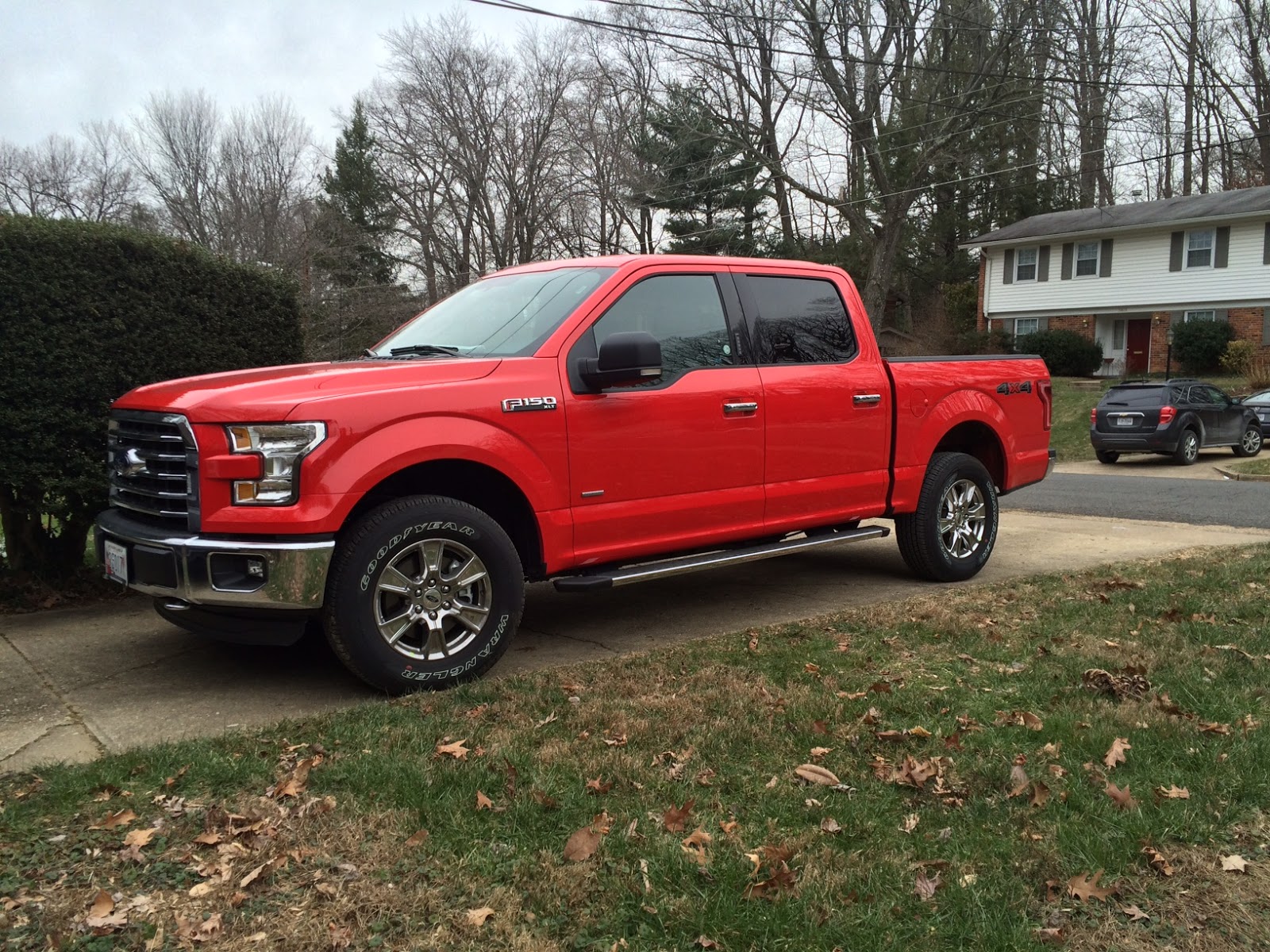
So on the day of the storm's arrival, I pulled into our driveway with a Big Red American Truck. A Ford F-150 XLT SuperCrew 4X4, to be precise.
That first morning, as the blizzard howled, I cleaned the great red beast off and prepared to test it out on the 18 to 20 inches of unsullied powder that covered our suburban road. The snow, up to my knee, seemed impossible, impenetrable, so deep it was a challenge to walk.
I've always been a confident snow driver. Heck, I even enjoy it.
But looking at the depth of Snowzilla's first evening's leavings, I was convinced that I'd made a mistake. This was a colossal boondoggle. I'd pull out, and get stuck, and that'd be that. It would be lovely driveway candy, for as many days as it took them to plow us out.
I was wrong. In four high, with traction control engaged, and with 1,500 pounds of snow packed down in the bed right over the rear axle, the truck was unstoppable. The big Ford just...pushed. And the snow got out of the way. I made two runs through the neighborhood, carving nice deep walking tracks into the snow, perfect for walking the pup.
As the blizzard roared on, I got out every hour or two, and kept tracks running through the neighborhood. It was, occasionally, a bit technical. And more than a little fun. I got through, pounding through four foot snow berms. The truck and I could not be stopped. Six thousand five hundred pounds of 4X4 with 420 foot-pounds of torque just gets where it needs to get.
So I ran errands, checked in on my parents and my in-laws as the storm roared, shuttled my teens to help with shoveling afterwards, and surveyed the scope of Snowzilla's impact.
A day passed. Then another. The roads got plowed. Not all of them, but most. I ran errands. We visited my parents, and my in-laws. I stopped to help the stranded, including a plow that got stuck on a hill I'd traversed just three minutes before.
It was utterly enjoyable.
But on the last day I'd rented it, as streets reached the point where I could easily traverse them with one of our more frugal vehicles, I began feeling, well, odd.
Here I was, in a glorious beast of a truck, and...I didn't need to be. I'm not a farmer or a contractor. I don't live in the Upper Peninsula or Fargo. It felt like excess capacity, like the kind of meal that sets well after a day of hard labor, but that just leaves you feeling off if you've been sitting around all day.
And as fun as it had been, I found myself eager to be out of it, and back into something that more reflected my actual needs.
Power, after all, can be a dangerous thing if we become to used to it.