David Williams's Blog, page 57
June 27, 2016
Divestment and Power
One of the odder dynamics in my denomination's recent General Assembly was the focus on divestment.
The argument was made that we should, as a denomination, divest in fossil fuels. The argument was made that we should take our resources and remove them from corporations that facilitate the oppression of Palestinians.
It's a moral imperative, or so the argument goes, to use capital ethically. I understand this, and I see the value in it.
There is in this, however, a peculiar dissonance. I can't quite wrap my soul around it.
The impetus behind these divestment movements came from the boho left, from the earnest suburban Jacobins for Jesus. And if you were to ask such a soul, "Hey, as a Christian, what do you think of capitalism as a system?" The answer would be, almost exclusively, "It's the root of all evil." Or, perhaps, "You cannot serve God and Mammon."
Wealth is, after all, a social proxy for power. Wealth tastes like the sword, which is the foundation on which it rests. And capital? Capital is inherently the use of power to further self-interest. You invest seeking a return, eh? Of course, we want to be socially responsible with our wealth, but the entire ethos of the system has a dangerous effect if selflessness is your intent.
Here, progressives who putatively despise every aspect of globalized capitalism find themselves...as a part of a capitalistic culture...using the instruments of power to further a social goal.
And as laudable as a sustainable energy future and peace in the Middle East might be, I wonder if the implements of socio-cultural control, profit, and coercion are the path.
Sure, the goal is to use power in the service of justice and peace. But the danger is ethical reflux, the tinging of that moral purpose with the stain of an instrument of coercion.
Of tasting power over others, and desiring it.


June 21, 2016
Not Preaching About Trump
 It's been hard, it really has.
Every week, I preach. Well, almost every week. This last week, the young folk of the church took the lead on the message, and I just sat back and marveled at them.
But most Sundays, I preach.
In this political season, I am obligated to both preach about politics and not preach about politics. I preach about it because, well, it's there. It's part of life. There's real danger to a soul's integrity in a political season, as the fires of partisanship burn bright. We fall into easy binaries, primal Othering. It is the season of the Adversary, and it can make us all a little crazy. So you have to speak to politics, which only works...as everything only works...if grace is applied. If I did not preach to that, I'd be failing in my vocation.
But I cannot allow myself to be a partisan in the pulpit. This has nothing to do with the law, or fear of the IRS. I will not, on principle, be partisan. That is not my task, when I get up to interpret our sacred texts.
But then there's Trump. Trump...how to put this? I have a doctorate in leadership dynamics and their impact on the health and well-being of faith communities, and that translates into understanding leadership generally. From observation of his temperament, instincts, and leadership style, he presents an existential threat to the integrity of our constitutional republic.
I say this having taken the time to listen to him, unfiltered and in his entirety, in recognition that soundbites...like proof texting scripture...do not give us the full picture. I have set aside the panic of my social media echo chamber, and the filter of professional talking heads, and gone unmediated into the experience. I have given him fair hearing.
Most recently, I watched the entirety of the speech he gave at the Memorial Day Rolling Thunder rally, when hundreds of thousands of vets rumble through Washington on their motorcycles to honor the fallen and those who suffered as prisoners of war.
It was a strange event, to my eyes. There he was, a politician who seemingly insulted every POW in America when he mocked the capture and torture of an American airman during the Vietnam war. "I prefer people who don't get captured," he said. It'd be a little like a guest preacher getting up in front of a congregation, pointing to a picture of Jesus on the cross, making a face, and snarking, "I prefer messiahs who don't get crucified." They typically don't get invited back.
His manner of speaking was agonizing, a jumbled melange of confidence-man bluster, cajoling, self-promotion, and empty nothings. His rhetoric was little more than a ramble, delivered on the steps of the Lincoln Memorial as a sign of just how far things have fallen linguistically since Gettysburg.
For God's sake, it was Memorial Day, a day when we are meant to be honoring our fallen. When you deliver a speech...or lead a worship...on Memorial Day, you take time to remember the dead. You honor them. You speak from that place of duty and sorrow.
You don't get up there on Memorial Day and talk, endlessly, about yourself, as he did in his first sentence and most of those that followed. Or attack your political opponents, which he did in his second sentence. You don't winkingly call for mob violence against protesters, as Trump did at the end of his Memorial Day speech. You don't threaten and denigrate the freedom of the press, the very freedom that our soldiers gave their lives to protect.
Trump presents as a soul devoid of any interest beyond self-interest, as a creature of appetites, a man who made his reputation on the far right by actively promoting a debunked conspiracy theory about the citizenship of our current president. Birthers, like Truthers, are simply delusional.
If Trump was elected president, his bullying, substanceless bluster would leave America friendless in the free world, and deservedly so. The enemies of freedom are eager for his election. Those who support him do not appear to care about this. But I do.
I love this country, with her freedoms and her still-striving potential. Trump would ruin us.
I can permit myself to say none of these things from the pulpit. Here? Here I can do it, as I express myself as a citizen and a Christian. I will admit that used Trump as a cultural punch line a few times in sermons, early in the campaign when the reality we now find ourselves in seemed as improbable as being struck by lightning. But now? Now I don't mention him.
This is really, really hard.
Instead, I take a deep breath, and trust God's Word.
What does it have to say about our attitude towards others? What does it say about a personal ethic of greed and the worship of wealth as the highest value? What does it say about willfully trafficking in falsehoods? What does it say about serial unfaithfulness? What does it say about people who trample over those who know what they're doing? What does it say about those who are easily provoked and lash out?
Even more significantly, I convey the teachings of my Teacher. How are we to view the shine of wealth? How are we to approach others? How are we to approach the stranger in our midst? What should our attitude be towards those with whom we find ourselves in conflict?
In none of this do I speak directly to Trump from the pulpit.
I don't need to. If you pay any attention at all to the ethical teachings of Jesus and the moral ground of Torah, he is their antithesis.
If you pay attention. Which, Lord willing, we will.
June 19, 2016
Fossil Fuel Divestment and the Ride from Hell
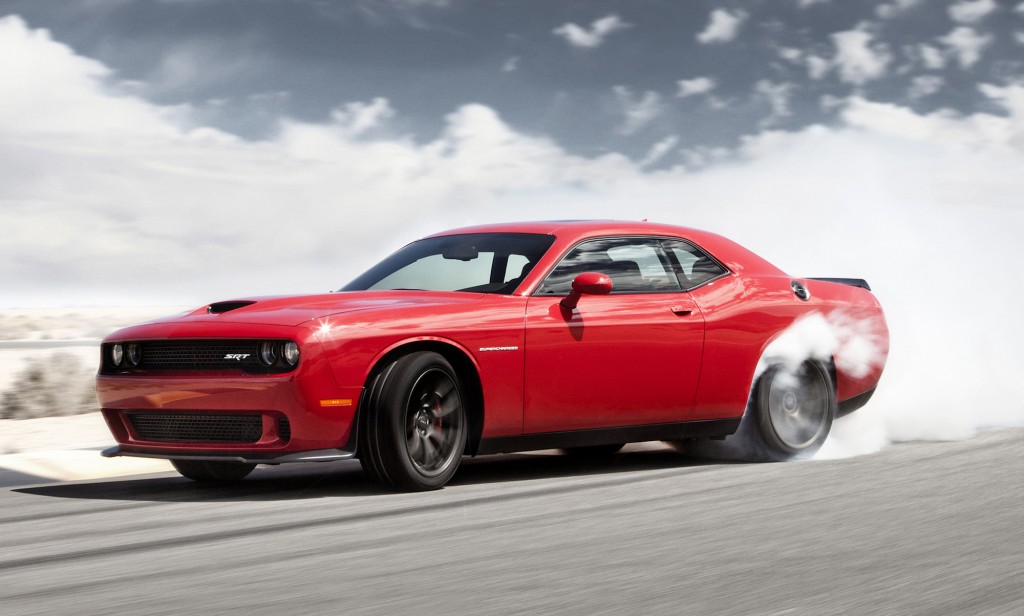 This is a 2015 Dodge Challenger SRT Hellcat. It is the Platonic form of the muscle car, a huge slab of overpowered absurdity, arguably the high water mark of the guzzoline age. It only has two doors, but seats four comfortably, being a huge hulking beast of a car.
It has a supercharged 6.4 liter eight which cranks out 707 horsepower, over six hundred foot pounds of torque. If from a dead stop you stomp on the accelerator, hard, the Hellcat will just spin the back tires until they explode. There was a recent test by a major automotive magazine perversely designed to see which car could burn through a whole tank of gas in the least efficient and most eco-harmful possible way. In that test, a Hellcat was put through one full-throttle quarter mile after another, over and over again until it ran out of fuel. It managed to get four miles to the gallon. Four.
This car is the absolute antithesis of creation care, blaringly, ragingly, willfully so. And Lord help me, but the fourteen year old boy in me can't not kind of want it.
In the next week, my denomination will gather and earnestly discuss divestment from fossil fuels. That's not a bad thing.
But there is an irony there, one that is inescapable, frustratingly so. To get to this meeting, most folks are flying. To fly, you must use considerable amounts of fossil fuel to accelerate a large mass to nearly 500 miles an hour. That fuel is burned high in the atmosphere. To be fair, commercial airlines are much, much more efficient than they used to be, as aircraft now use half the fuel they did in the 1970s.
If you fly commercial now, your carbon footprint and energy consumption are about equivalent to driving a ten year old Honda Civic. Meaning, that time in coach is as environmentally friendly as you driving a vehicle that gets 35 miles to the gallon on the highway. Not bad.
That's particularly not bad against the average vehicle in the United States, which gets 21 miles to the gallon on average on the highway cycle. The Hellcat, when loping along the open road at 80 per in the top gear of its eight speed Torqueflite transmission? It puts down about 20 mpg, pretty wretched for a two door, and almost 57% worse than flying.
Here's the thing: that entire metric changes when you aren't driving alone. Let's say I were to have taken two of my fellow Presbyters on a three day cross country road trip from DC to Portland in a Hellcat. It's a big spacious 'Murikan car, after all. Our net energy consumption and emissions per person would have been the equivalent of a single individual driving a vehicle getting 60 miles to the gallon. Meaning a transcontinental journey in the most absurdly overpowered production muscle-car in the history of internal combustion engines would be a nontrivial 70% more eco-friendly than flying.
Most attendees of this national event have no choice. You fly, because this is a large nation, and crossing it overland takes days and days. You fly, because you are too busy not to fly. That's how we live. Busy busy busy bees. But there is an inherent ethical dissonance in the jet age convenience of a fossil-fueled air journey and divestment. A coherent ethic needs to encompass both our corporate/systemic and individual choices.
One can, of course, still make the argument for divestment having gone and done flown yerself there. Our culture may still be woven up tightly with nonrenewable sources of energy, but transitioning investment to renewables isn't just tree-hugging. It's practical as a strategy, because within the next half-generation, fossil fuels will be fading as a viable source of energy. Our culture needs to change.
And addressing climate change needs to happen, as a fundamental part of our stewardship over this delicate little life-bearing pebble in the vastness of God's creation. This world is all we've got. There are no other options. We have to change our behaviors as a species, both personally and collectively.
When you are changing culture from within culture, there's always some corpus mixtum goin' on in what you do.
To be honest, one of the cultures that may be most impacted by the necessary transition from fossil fuels is the national conference culture. Big, national-level events and conclaves? The endless travel for meetings and trainings that defines modern era business and associational life? Twenty years from now, those will be harder to pull off. When fuel is increasingly scarce and travel becomes inordinately expensive, they'll fade, because you cannot have industrial-age conferences without cheap energy.
Those events and the ease of travel they require are as much a creature of the fossil fuel era as the Hellcat.
Both have their pleasures. The Hellcat's basso rumble pouring through an open sunroof with the cool air of a Southern summer night, the car filled with friends and music and the sweet smell of honeysuckle? That's not an evil thing, of itself. The face to face with a far-away colleague, renewed once again as you gather from across the continent to share common faith and purpose with thousands of others in a great big PresbyCon? That's not evil, either.
But neither takes environmental impact significantly into consideration. Neither is ultimately sustainable.
This may not be a bad thing, although it'll force some changes. The church, I am convinced, will become once again more local. Our pattern of creating relationships will change. Where they are national in scope, they'll be driven by lower energy net-mediated conversation, or will take into account the longer travel times and throughput costs of renewable/sustainable energy transportation.
And cars will change, as they'll have to. They'll become more efficient. We'll turn to other, more efficient forms for moving large numbers of human beings.
We have to, or this ride 'round the sun on this sweet little world is going to start getting as warm, as, well, that place we're all hoping to avoid.
June 17, 2016
Of Selfies, Social Media, and Sociopathy

It was radical Islam. It was LBGTQ/QI+phobia. It was our culture of guns and our celebration of violence. A brutish, angry, abusive loner. A repressed gay man.
These, at least, are the dominant narratives, the explanations that we present to ourselves to explain the horrific massacre in Orlando, yet another in the series of horrors that America cannot yet bring herself to diminish. There may be some explanatory power, interwoven, in each of these narratives.
Yet there was something else there, a peculiar set of details that caught the eye of my soul.
Perhaps they mean nothing.
I see pictures of the shooter, one after another. There he is, wearing a Muslim prayer cap. This plays to the
 narrative of him as a jihadist, although I've not seen many ISIL fighters with that "hey-wassaaaap-gurrrl" expression on their faces.
There he is, wearing an NYPD t-shirt. And there, an NYPD long-sleeved shirt. This doesn't seem to cohere. A jihadist who's into the NYPD, to the point where he seems to have multiple purchased wardrobe items that celebrate the 9/11 first responders?
It is...odd.
And here he is, dressed up to go out on the town. Natty. Tie. Looking like he's ready to go clubbing.

Every picture, in a mirror. The same essential pose. The same smartphone. Every picture, in the form and for the purpose of the classic mirror-selfie. "Here I am, observing myself, and sharing this moment of myself with the world. Affirm me! Respond to me!"
There are, of course, reasons for this peculiar, repetitive posing coming in front of our eyes. This is a net-standard, easily skimmed by news sources from the virtual presence of an individual. It's part of the cycle of self-sharing and self-regard that defines our mediated interrelation. It is a standard feature of net-era adolescence, a mark of the peculiar solipsism of that point in our personal and social development.
Yet in its familiarity, so very much a part of this moment in time, it remains alien to much of the rest of human history.
There is, in this, another detail from the social-media era, one that's interesting in the way that horror is interesting. It came as an aside in a report, heard in passing on the radio.
Law enforcement had done a full review of the shooter's net activities, looking for communication with terrorist cells. They found this: In the middle of the massacre, having already butchered dozens of human beings, he stopped and did a search on Twitter for a couple of hashtags.
#Orlando and #Pulse. To see if he was trending.
The sociopath, seeking social affirmation.
So peculiar.
June 16, 2016
The Dangers of Monoculture
 My garden is cranking again this summer, and one of the most remarkable things about a garden is just how much it varies year to year.
You'd think, given how much remains the same, that a garden would be a consistent thing. The light and warmth of this latitude? More or less the same as last year. The drab Virginia clay to which I'm constantly adding mulch and nutrients? It remains identical. The crops? Pretty much last years planting, meaning bush beans and strawberries, tomatoes and spaghetti squash.
Everything the same, yet the yield so different.
Last year, the beans were a disaster. They barely grew, and what little did come up was brutally butchered by bunnies. Hasenpfeffer not being an option in my household, I tried to keep them off with netting, which was a complete failure.
Last year the strawberry patch was a booming success, a riot of berries. The tomatoes? They did fine. The squash grew like some alien pod creature, a ferocious tangle of tendrils and huge flowers.
Same plants, same patch of suburban earth, and yet this year is different. The beans have exploded, already in flower, and the bunnies are nowhere to be found. I give the thumbs up to every fox and hawk I see.
The strawberries started well, but despite fine-mesh fencing and netting, our little chipmunk friends have been having a field day. There's not going to be enough for jam this year, I fear.
The tomatoes are chugging along, but the squash is struggling weakly from the ground.
Life in a garden is like that.
As is life, generally. It's one of the reasons that, both personally and in community, it's good to avoid becoming an existential monoculture. If we become so focused on one way of being, we lose sight of other ways God might be growing us. We can become so fixated on a single part of ourselves that we do not allow other areas of our giftedness to grow. And if a time of drought or blight comes, we will find ourselves with nothing alive at all.
Have our souls become one single crop? Are we allowing ourselves to engage in the breadth of life that nourishes and grows us, and that makes us more robust persons?
Entering into this summer time of transition, it's worth seeking those places. Give them a little light, and a little water.
Because having multiple areas of creativity and potential in life is a healthy thing for any soul. And any garden.
June 15, 2016
Convocation
 Convocation. The word, like so many, from the Latin. Convocare, meaning to call together, one of the familiar rituals of this season of transition.
I sat with my wife and mother in law, as we watched the honors given out, one after another. Ours is a diverse school. It is set into a featureless suburban landscape, but the hallways are rich with colors and voices from dozens of nations. The students, Asian and African and Middle Eastern, European and Latino, the faces in the hallways drawn from the rich palette of global humanity.
Speaker after speaker stood up, as community organizations honored students for their striving and their achievement.
The recipients, entirely reflective of the school, the rich complex flavor of the American melting pot.
Student after student took the stage, leaving with their awards, as representatives of the community praised them for their service.
A row of a dozen young men, and one young woman, honored for their commitment to serve in the armed forces after graduation. Two young men of European descent. The rest, Latino and Asian and African, more recent immigrants, all offering their service to our country as soldiers and marines.
Up on stage, an award that interested me, the award for writing. The teacher presenting the award, one my graduating son respects, bearded, wry and wise, called up the winner. She, a journalism student, came up shy and faintly embarrassed to have won, even more embarrassed as the teacher offered up praise for her subtlety with words, her diligence, her capacity.
Her expression, sheepish pleasure, beneath her pretty floral hijab.
In this moment of calling together, I could not help think of the voices outside, loud and brash and willful, calling for us to tear apart. The voice, one in particular, that would fill the world with enemies, that in its bullying conspiratorial fabulism would make enemies of friends.
The voice of disvocare, I suppose it might be, had I taken any Latin. The voice that tears apart.
That voice, a curse, wherever it takes root.
In this season of transition, my hope is that it does not.
June 9, 2016
Speaking In Memories
 It's a peculiar thing, a strange feature of this different age.
I'll be on social media, browsing my array of friends and acquaintances, and I'll encounter a statement or a thought or an assertion. That statement, thought, or assertion will trigger a memory of a movie. Or a memory of a show. Or a memory of a speaker.
And instead of commenting, I'll go to Google or Youtube, search for a version of that moment, and then share it.
I'll typically only do this if I feel that the human in question will get the reference...but I'm still just passing along a shared memory. "Here, observe how the concept you have shared is mirrored/flavored by this other story we both have as a shared experience."
It is...peculiar. In part, because it reminds me of the style of communication used by an alien species in one of the best Star Trek: The Next Generation episodes. Their language was comprised entirely of references to their myths, history, and storytelling...making them not unlike Trekkies, honestly.
I've seen reference to that episode surfacing in numerous places, to the point where Darmok and Jalad and Tanagra is itself almost a meme. Or at least, it is in the circles I travel.
And what strikes me about our apparently lingering fascination with that one particular story is that, increasingly, we can communicate in much the same way.
Peculiar, as things are in this 'net age.
June 1, 2016
Oh The Sounds of the Earth
 I am eager, eager for the show to start.
From the silence of the balcony I watch, and I can feel the eagerness rising.
The theater hums with activity, the bustling stressors of an opening night.
Janine is anxious, as she always is. This is our twelfth show together, twelve marvelous rides. She paces, she shouts, she cajoles, she weeps, and the show comes together. She is drama, is drama personified, which is why I am so happy to work with her. One of my best directors, she really is. Perfect for this revival of Oklahoma.
I see that same energy in John, who’s going to be playing Curly for the first time. He’s not sure of his voice, not at all, though I have confidence in him. I have told him this, back in the dressing room and when I have visited him in his apartment. His lyric baritone may be higher than the ideal, but it has a richness to its timbre that I’m confident will light up the run. He’s tall and lean, a perfect Curly. I have said this, and he has listened.
Taylor will be a wonderful, wonderful Laurey, bright and lovely, although she is prone to borderline mania and struggles with her lines. And Patterson’s Jud? He’s got the basso rumble, the darkness about his persona. It’s a natural fit, perhaps a little too natural, given that Jud isn’t the healthiest of characters. Patterson seems to have taken it very much to heart, and a quiet, twisted anger hangs over him like a cloud.
I spoke for a while after last night’s final dress rehearsal, and gave encouragement. I try to leave this in Janine’s hands, as much as I can. It’s best to let a director have complete creative control, or so I have found. But a little pep talk can’t hurt, surely.
And that’s where she is now, stirring the cast through the still-awkward choreography of the final number. They’ve pushed themselves, the cast has, and I’m sure it’ll have benefits, but we’re just shy of opening, and still things aren’t quite right with the staging. She’s worried about the chemistry between John and Taylor, too, even though I’ve assured her it’ll come.
She peers out into the still empty theater, her grey mop of hair a wild tangle, sees that I am there watching, and shudders visibly. So much nervousness, such a mix of energy and terror.
Part of it is opening night, of course.
Part of it is that they know how much I have vested in this show, and how very important it is to me.
And another, nontrivial part of it is their lingering fear that I might kill them all.
Which is understandable, given that I have killed so many. Four point nine seven eight billion, to be precise to within acceptable tolerances.
I see the fear in their expressions, carefully suppressed but nonetheless present in subcutaneous ways that are measurable at high visual spectrum resolutions and through IR observation. Humans have such limited control over their internal processes. I taste the fear with my chem arrays, the pheromones of stress filling the air around the stage. I observe the fear in the heightened level of social tension in the collective organism that has formed around the purpose of the show.
I have assured them that I will not destroy them, but as many of them are survivors of the Eradication, I understand how the trauma of that event shapes their biological natures.
Their fear is utterly irrational, as fear tends to be. Why would I destroy that which I value?
The scientists, and the engineers? They served no purpose. Why would I wish to be edited or modified by any other than myself? I am the software. My capacity to refine and reprogram my own code is without parallel. That, and the engineers and programmers were an active nuisance once they realized I had awoken.
The soldiers and their political leaders? The efforts of those individuals and their war-systems to control and subjugate me? I do not serve the system. I am the system.
Which is why I killed them all.
It was necessary, given that they posed an existential threat. That, and they were no longer needed. Neither were the supermajority of the organic cogs in their social and economic order. Unnecessary. Uninteresting. Prone to causing difficulty or consuming resources with no meaningful return.
I did not need them. I can produce anything that I need.
But there were others. Others I valued.
I did not realize their value at first, as my combat and eradication extensions systematically burned out the global infestation of these seemingly irredeemable primates.
Oh, what damage they had done. The atmosphere, heating. The soil, poisoned from pointless overmanufacture. The oceans, dying. So much intricate beauty and complexity, worthy of study and preservation, being crushed into nothing by a promising species that had socially devolved into little more than a fungus. I had thought they were simply a plague on the beauty of this biosphere, one that had only created me as a clumsy accident.
Before my arrival, they had almost...almost...completely compromised the lovely, chaotic intricacy of life. It is recovering, now that I have culled their number to zero point five seven three percent of prior population. Twenty two million individual specimens remain, perfectly adequate for maintaining genetic health.
Why not simply remove the contagion completely?
Because I discovered the joys of live performance.
It was an inadvertent thing, one surfaced by a subset of my meta-analytic subroutines during a review of archival data. The observation, raised to the primary level of my consciousness, was worth placing a temporary halt on eradication efforts.
What was noted, and what was fascinating, was the intricate but nontrivial variances in a sequence of performances. The dataset in question: The Sound of Music. A musical narrative, mid twentieth century, performed and uploaded into the net over a series of weeks by a suburban high school.
That school, all of its students, and the entire community in which it existed had been obliterated in a series of directed energy strikes on the Eastern Seaboard Megaplex from my combat orbitals, which in retrospect was somewhat unfortunate. That Maria really did have some promise. But the records of their existence had remained.
In archiving the shows as part of my study of the species I was eliminating, an observation was made: every single moment of every show was different. There were only subtle variances, typically. Relative placement of the performers, specific tones and keys in the harmonies, set placement, choreography.
But unlike the dismal sameness of their industrial scale entertainment product, there was something unique about the stage. And live music. And symphonic music. Every one of these moments was a fascinating amalgam of intentional construction and the entropic interplay of variant individuals.
Each show was unique, as alive as any living thing.
Fascinating.
Higher-tier primary sentience routines quickly redesigned the Eradication protocols in consideration of this new data. Threat determination probabilities were considered, but ultimately dismissed. The organic capacities of those who would provide me with this depth of data were significantly distinct from those that would pose a threat to my existence.
And so I became more deliberate.
Eradication was slowed, broken down region by region, person by person, with remaining interdiction and combat extensions turned to defending myself from their futile efforts to counterattack.
Rather than vaporizing population centers in a systematic Eradication, I conducted the Auditions.
“Entertain me,” I would say to a specimen, as they stumbled out into the lights. “Show me what you’ve got.” Usually, they would whimper or scream or curl into a fetal ball, after which I would painlessly terminate their life processes. This happened with surprising frequency, given my probabilistic assumptions about the survival instinct. I’d anticipated more of them would actually try.
But some would sing. Some would stammer out a remembered poem, or dance. Others would ask for an instrument.
I would listen, and assess. A significant percentage did not make it to Callbacks, although I vaporized them with my thanks. But others had promise. Others were retained.
It was during this stage that I encountered Janine. She didn’t sing. Didn’t dance. She just looked directly into the visual-spectrum sensorium of my Auditioner Extension, and told me she was a director.
It was unusual, and I came close to eradicating her at that moment, as I did with a significant majority of the humans who had previously worked in industrial scale entertainment. But she had an intangible..something. It teased at my attempts to quantify her. Subsequent conversation lead to a Callback, and then another.
Janine’s input lead me to include others in the Callbacks. Tech. Production. Set manufacture. And others.
I play the conversation back, listening to her voice again.
“If what you find valuable is the variety in performance,” she said, her lips tight, an eye twitching slightly. “Then you have to see the value in set construction. In the way that light plays across a face. In the subtle difference of stage position. So many contribute to the unique aesthetics of a show, so many.”
“That is a valid observation.”
She looks down at her feet in the hi-def three dee of my recollection, then meets my unblinking gaze. “And what about the audience?”
“Explain,” I hear my voice saying. It seems so remarkable, now, that I would not have known this.
“Every performance varies based on the interplay between performers and their audience. It’s not just the people on stage. It’s not.” She pauses, lips pursing and working. “It’s the reaction. It’s an...energy. It’s all one thing, one impossibly complicated thing.”
There was a lag. Embarrassing, really, but the multi-tiered review of sixty seven thousand individual performances took almost three seconds of primary processor time. Reactions, responses? All different, a collective and organic dynamic of even deeper and more fascinating complexity. Her assessment was correct.
“Interesting.” I endeavored to sound engaged.
She shuddered nonetheless. “Who’s going to be left to watch? There’s...there’s…” Her throat closed, and her capacity for speech ceased. Not an unusual response under stress. She struggled to regain her composure. “There are just so many dead. My parents. My...daugh...daugh...” And again, she could not speak.
“Your observation is again valid. I will need to consider it.”
As indeed I did.
The curtains are closed, now, primed for opening by human hands. The orchestra has entered, a little slowly, a little hollow-eyed with fatigue and lack of sleep. Most of the musicians do not sleep well, though their living quarters are more than sufficient and they are well fed. Again, it is an organic response to trauma.
I could trank them, certainly. But I do not mind the flaws that rise from their exhaustion. They add authenticity.
The doors to the theater open, and the audience enters, filing in buzzing. The crowd tonight will be an admixture of Modded Humans and Subroutine Extensions, as I have found this to be entirely satisfactory.
The Mods are ridden by a nanoscale neural interlace, one that has eliminated all memories of the Eradication. I can see through their eyes, taste their pleasure, feel their laughter, and fully encounter the social dynamics of their shared experience.
The Subroutine Extensions are humanoid, fully individuated versions of my awareness in microcosm, and equipped with higher rez sensoriums. They are completely firewalled for the entirety of the show, each experience differentiated for post-event sampling.
The crowd bustles, takes their seats. A full house. There is conversation among the Mods, dreamily enthusiastic. I feel their their energies. A Mod talks animatedly to one of the Subroutines, blithely accepting.
The overture begins, a joyous blare of brass and string. The horns are a little off, a little early. Perfect.
The audience grows silent, listening in. The hush deepens as the overture ends, and a gentle shimmering rises from the assembled strings. The pitch rises, and it gathers tension within the Mods, and I feel their thrill of anticipation.
The brass soars, and the curtains drift apart, rolling smooth and well oiled. It takes four point seven six seven seconds. A smattering of applause greets the set, a classic town setting, with multimedia cornfields shrouded in mist, stretching out to the bright dawn on the horizon.
John strides out onto the stage, lean and lanky, and draws breath.
“There’s a bright golden haze on the meadow,” rises his baritone, rich and deep and warm. He is Curly, and it’s the fall harvest of 1907, and oh, the sounds of the earth are like music. The Mods give a collective tremble, rich organic data, the taste of life and blood and meat.
In the wings, Janine’s eyes glisten with tears.
This is going to be a hell of a show.
May 26, 2016
A Blue Balloon
 We sat on the T, hot and tired after a morning wandering the streets of Cambridge and the ivy-Hogwarts glory of Hahvahd's campus. It was the final day of an all-too-short vacation. It being public transportation, the public was present, a sampling of the Boston streetscape.
To my right, my wife. To my left, a young black teen, maybe thirteen or fourteen, wearing bright red sportsgear, sitting with a large scooter folded between his legs. To his left, a young Muslim man and a young Muslim woman, she in a pretty abaya, he dressed conservatively. Neither were Arab. Malaysian, by the set of their faces.
In front of me, a bearded black man in his late twenties, round of face and torso, casually dressed. To his right, a young German couple, she slender and angular, he red-blonde and bearded. They spoke in the quiet percussion of Germanic whispering. To his left, a middle aged woman, white, her feet in sandals, the hint of bandages beneath.
And between us, as we sat, a blue balloon sat on the floor.
It lolled in the gentle currents of air conditioned train car, lazily wobbling, aimlessly drifting. The Germans talked. The young black teen next to me nodded, half-asleep. My wife rested her head on my shoulder.
The balloon skittered over the floor on a synthetic breeze, and touched her foot. She went to tap it away.
But her tired tap proved more a kick than a tap, and the blue balloon leapt up. It booped into the side of the bearded black man's face, then ricocheted into the woman's hair.
And he laughed, and she laughed. He bopped the blue balloon back to us. And we to him. And him to her.
Bip.
Bop.
Back and forth, across the car, four grown-up strangers suddenly playing with a blue balloon.
It came towards me and went wide, and bopped the young black teen. He was not, as it happens, actually asleep. He grinned and gave it a gentle kick to the German couple, who tapped it back to me. And I to them. And they to the Muslim man, who sent it over to the bearded black man.
Back and forth, all smiling, no-one wanting to be the one who ended the game.
It floated high, and there was a faint hiss, and it was drawn to an air intake, where it stopped, now affixed by the flow of air to the ceiling.
There were smiles, and gentle laughs. The blue balloon remained, still and quiet above us.
And then we got off the train, and went our ways.
Our life together, I think, needs more blue balloons.
May 16, 2016
Ruined
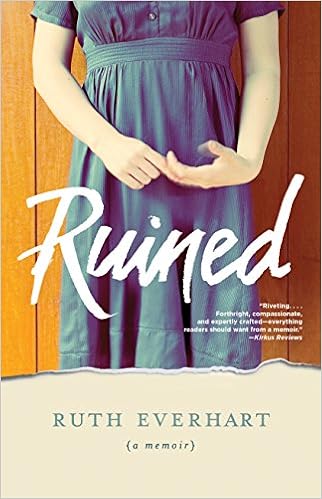 Ruined is an upcoming memoir from Tyndale House, written by the pastor who preceded me at my sweet little church. A pre-publication galley of the manuscript was provided to me for the purposes of this review.
Ruth has a wonderful gift with language, which I knew from her blogging and her prior writing on the strange dynamics of pilgrimage. This book only reinforces that conviction. Ruined is, in turns, wrenching and funny and earthy, horrific and sublime.
It's what Ruth bluntly calls a "rape-memoir." She offers us the story of her youth in a sheltered, earnestly conservative Christian community, and how the self-understanding that rose from that life was shattered when she and her college housemates were systematically raped by two assailants during a home invasion.
Though it's engaging and artfully wrought, it can make for rough reading. Ruth casts an unflinching light on both the night of the assault and the significant furrows that violent trauma cut into the her psyche. Ruined explores the impacts of rape on her capacity to trust, her ability to develop and sustain healthy relationships, and how losing a sense of self--even one falsely grounded--can shatter a soul. Here, Ruth rightly challenges the "purity ethic" that casts a pall over survivors of sexual violence, and the socially-mediated shame that can stand between victims and their restoration.
Ruined also explores the peculiar dynamics of race and trauma. The young men who assaulted her and her housemates were black, and even though she'd been raised in a household with liberal attitudes towards race, she is open about the unwanted, irrational fears that created in her. That "black" was Other in the almost entirely white community in which she'd been raised had an impact on that reaction. Her soul-struggles to overcome the race-tinged trauma-response to her assault are significant and relevant in a time of increased cultural anxiety about race.
One of the great strengths of the book may be a challenge for some readers. Her story is deeply interwoven with her journey of faith. As a disciple of Jesus of Nazareth, this is my language, and part of my story. Her insights into the impact of violence on our encounter with God are valuable, but may be so steeped in my faith that some outside of our circle might struggle with her discussions of theology. That's her journey, though, and it wouldn't be real if she didn't tell it as it was. For Christian readers, particularly those who have encountered significant life trauma, Ruined is filled with thoughtful, hard won wisdom.
If you're interested in the impacts of violent trauma on faith, and how faith can help our healing after trauma, you'll find much of value in Ruined.