David Williams's Blog, page 56
August 27, 2016
Dying and Rising
 The morning was hot, the thick wet suffusing heat of a late Southern summer, and I was walking.
Three point five miles, it is, from the place we get our car serviced to our home, and even though the day's temperature was heading into the triple digits, I'm still happy to walk it. Because when you walk, you see things. You're aware of creation.
The sun beats down, the sidewalk fiercely radiant under my sandaled feet. I see the shade cast by the tall trees at the waning of the morning. I cross the street, and walk under the generous cooling shadow of their canopy.
I see a man at the crosswalk, unshaven and smoking and wearing a surplus jacket five sizes too large. It's 97 degrees. He's doesn't appear to be sweating. He does not notice me.
I pass an elderly man, slow but quietly determined. He looks up, he smiles. "Oh, we shuffle along," he says. "Yes we do," I reply, returning the smile.
And at a bend in a road, deep in the heart of a suburban neighborhood, I pass a church. It's the same church I always pass when I walk that way, only now, it isn't.
Meaning, it is the same building. It is still a church. But it is no longer the church it was.
For years, for decades, it had been a Korean congregation, small and independent. Presbyterian. But the bold, blocky, assertive fierceness of hangul text has vanished like smoke.
This is unsurprising. The Korean community has moved on, out into the sprawling exurbs, just like the immigrant Scots who once filled my grandfather's church moved out of Queens.
That church is dead. But the church still lives.
In the parking lot, a fleet of lightly-used 12 and 15 passenger vans, each white, neatly numbered. I count them. There are at least a dozen.
"Christo vive!" announces the bright new sign, along with worship times, all in Spanish.
It is, I reflect, one of the great strengths of a faith that inherently transcends culture and language. It can adapt, can adjust, shaping and forming itself to the reality it encounters.
Resurrection is, after all, the heart of what we Jesus folk are. And resurrection never quite looks like the thing it was before.


August 22, 2016
One Minute Mindfulness
The most recent acquisition in my household sits, a darkly unobtrusive cylinder in our living room. It's an Amazon Echo, a remarkable little gadget that automates your home life. Like the computer in Star Trek, it'll do almost anything in your home. It'll adjust the thermostat, lock your doors, turn your lights on and off, answer your questions, order your pizzas. And, of course, let you buy things from Amazon from the convenience of your sofa without even needing to lift a finger.
Which is, of course, The Plan.
I talked about it a bit during my sermon yesterday, but in playing around with its expanding functionalities, I was struck by a "skill" it can learn: being your mindfulness guide.
You ask the machine in your living room to guide you through a quick meditation. "Alexa," you say, because Alexa is the name that triggers it to listen. "One Minute Mindfulness."
A synthetic voice, generically female, counsels you to sit, attend to your breathing, and not worry about your thoughts. Gentle white-noise music plays, usually of a burbling brook underlaid with New Age synthesizers. You breathe in and out, and the minute passes. "Enjoy your day," chirrups the mindfulness machine.
Mindfulness has loose roots in Eastern practice, and can be an excellent way of centering yourself. But it is increasingly turned into nothing more than corporatized meditation, meditation for the explicit purpose of increasing productivity. Not enlightenment. Not awakening or the loss of self or transcendence. But productivity.
Which is why One Minute Mindfulness is categorized as a "productivity" tool.
"Feeling stressed and frayed by endless scattering inputs and demands? HR strongly encourages mindfulness! It kinda works, and it impacts the costs of our prescription plan considerably less than the Xanax/Ritalin cocktail you'd otherwise need to endure contemporary suburban existence."
It's so peculiar, living in what was once the dystopian future.
August 8, 2016
Vee Bee Ess
 I sat in my office as they arrived, pulling into the gravel lot of our little church, and wondered about going out to say hello.
I was going to, of course, but having spent much of the day in the unairconditioned church office, I was...well...a little stickier than I tend to like to be around folks. But before I could get moving, one or two arrived at my office to say hello or to ask questions.
They were bearing crafts and guitars and planning materials, because this was Vacation Bible School, being run as our little community runs it.
And we do it different, being the little church we are.
VBS has never quite felt like a thing for me, perhaps because it was never part of my life growing up. Worship and singing and Sunday School, sure. But Vacation Bible School just wasn't something that Presbyterian churches in Nairobi, Kenya did back in the early 1970s. It didn't play into the life of an English Free Church in the late seventies and early eighties in a London suburb. And it wasn't part of the dynamic of a downtown commuter social justice church in the late 1980s.
And yet, here it is, a ubiquitous part of the expectation for American church life. It's just a part of the summer, like swim team or soccer camp or any one of the ways we manage the time of our children now that they're generally not called upon to help with the harvest.
So much VBS is neatly packaged, carefully constructed to appeal to the bustling suburbanite. Every year, the ads arrive for the VBS packages. There are the ubiquitous cartoon characters, each professionally created. There are often tie-ins with whatever blockbuster movie is anticipated for release, to the point where it wouldn't surprise me if there was a Suicide Squad-knockoff VBS theme. "Cain, Jezebel, Goliath, Ramses and Judas: Five Lessons from The Villainous Five."
Huh. That....actually...might be kind of cool. Seriously. Cain, the undying, bitter and lost. Jezebel, fierce and terrible and selfishly cunning. Goliath, massive and Hulkish, all about power and brutality. Dude. It'd work. And then Ramses could be...but I'm getting off topic.
What I love about our little VBS in our little church is that it is none of those things. We go hard core amateur, meaning it's a labor of love. There are straight up crafts. Guitars. Simple themes that relate to God's love. It's designed, planned, and implemented by church members, feeling more like the games played at a traditional family gathering than a pre-packaged commodity.
And what amazes me, every year when I pop in to observe the singing and smell the paint, is just how natural it all feels. How organic.
In this era when everything is packaged and marketed and you can teach kids about Jesus for the low low price of $199.99* there's something refreshing about that.
*starter kit only, please check your catalog for pricing
July 27, 2016
Burning it All Down
 Let's just blow it all up. Let's just burn it all down.
That's the temptation, the mood, the zeitgeist that's propelling our nation through this strange time. On some levels, I can understand it.
But as a nation, we really don't know what that means. Once you tear it all apart, things get...unpleasant.
I know, things seem bad. And in some ways, they are. But that yearning for apocalypse--for the end of brokenness and the beginning of restoration--is not facilitated by destruction. It never has been. Never, in the thousands of years of human history, has burning it all down worked out.
That's because the yearning to destroy and the yearning for apocalypse aren't the same thing.
If all you want to do is burn that mother down, burn baby burn, to bust it all apart, then you're not thinking apocalyptically. There's a much more precise word for total obliteration by fire, for burning devastation.
Holocaust. That word is "holocaust."
Holocaust thinking is, to put it mildly, not a good thing. It is the yearning that destroys the good. That destroys everything. It is ashes and horror. That holocaust fire burns in the bright eyes of the zealot, of the fascist and the brownshirt, of the Jacobin and the Bolshevik.
Apocalyptic is different. It's a word from my faith tradition, and understood correctly, it is an unveiling of purpose and meaning, a casting aside of the things that stand between us and our gracious potential as creatures. Apocalyptic communities are communities of hope, communities that orient themselves towards the active participation in that reality they wish to encounter.
They are not communities that call for holocaust.
I see a whole bunch of folks not really grasping the difference lately. Just let it all burn, let it all burn, and then lets see what's left.
But that impulse comes from making an idol of ideology, of choosing to close ourselves off from the reality of what we're doing.
Ours is a small and fragile world, one that--with its Creator--has always yearned for us to choose hope and reconciliation over our hunger for the flames.
My Biggest Problem With Hillary Clinton
 The biggest hurdle in the Democratic Convention is coming up, the one that concerns me. It's my biggest problem with Hillary Clinton. Bigger than her expediency, than her tendency to overthink and show hypercaution before acting. Bigger than her hawkishness, and her defensiveness.
Hillary is going to give her speech. And, well. She's...um...not a good public speaker.
There's a reflexive assumption on the part of liberals and leftists that to make that statement means you're anti-woman. That's balderdash. It isn't sexist. It's the reality of Hillary Clinton.
Women can be amazing, remarkable, compelling speakers. I've heard many in my career as a preacher, women whose voices soar and inspire and uplift.
 In the secular world, you want to hear what a capable female rhetorician sounds like? Listen to Michelle Obama. Even before the home run she hit at the convention, I knew she was brilliant. Warm, smart, genuine, and passionate. She conveys strength and compassion, and can move a room with authority. Ms. Obama is just incredible in front of a crowd. She wows me.
But just like men can drone and men can harangue, women can be terrible at public speaking too. Listen to any Hillary ad, and you hear it. The most personal and genuine part of those ads comes when she says: "I'm Hillary Clinton, and I approve this message." Then, she's alone in a room with friends. She sounds capable and at ease. When she's unguarded and comfortable, she's really rather compelling.
But when she's in front of a crowd, she sounds like...like...like what?
 She sounds like you're in Statistics 101, and the professor is talking, and everything they say is going to be on the test. You try to focus, you do, but they're talking directly from the Powerpoint, and you're on slide number twenty four of a hundred and seven.
Her inflections are forced, her rhythm, stilted and academic. She struggles for warmth of tonality. Then, when she goes for emphasis, her eyes go all Emperor Palpatine and her tone sounds more angry than passionate. "Raaaah RAAAAAH Raaah RAAAAAH!"
You're flashing back fourth grade again, and the class has been rowdy, and your teacher is giving the whole class a talking to. The teacher is trying to keep it together, trying not to go off, and you can feel the strain in their soul as. They grit their. Teeth and. Try not to. Scream at. THE CHILDREN.
It just doesn't work. I'm sure she's been coached, but though she's smart and thoughtful and diligent and in a sane world would be the next president, (Lord, I hope this world is saner than I think) it just isn't an area of her giftedness. Even Hermione Granger wasn't good at everything, eh?
And that's a problem, because that impacts the energy of a community. I've known wonderful spiritual pastors who were great at the bedside or in the boardroom, but couldn't preach their way out of a wet paper bag, and that makes things hard. You have to be able to stir a room. To stir a people.
What to do?
At this late hour, there's not much that can be done. But the need is great.
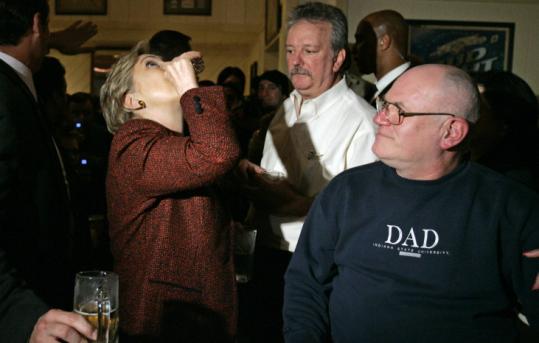
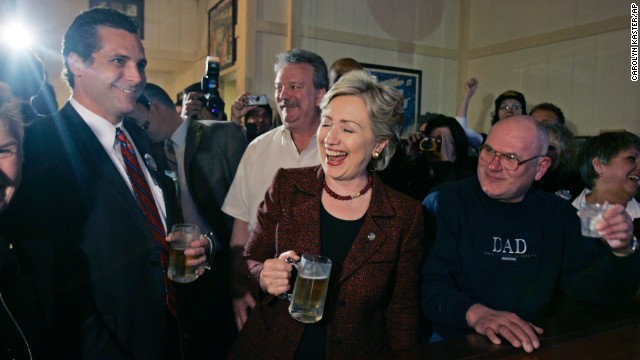
Given that desperate times call for desperate measures, I wonder, perhaps, if the judicious application of whisky might help. Two or three shots of a nice Kentucky Bourbon, administered ten minutes before her speech.
Maybe a beer chaser midway through.
That could backfire, I'll admit. There could be weeping and truculence, as the carefully constructed restraint of her Methodism fell away and she rambled for twenty minutes about Bill and just how much that all hurt.
Or she could get loose, let herself trust herself, and nail it.
At a bare minimum, it'd make for an interesting speech.
July 21, 2016
Six Reasons Why I'm Voting for Donald Trump

I am, without reservation and hesitation, casting my vote for Donald Trump in 2016.
Why?
There are many reasons, but let me sum them up with six, because, well, six is my favorite number:
1) Donald Trump's Unerring Judgment. He never errs. Not ever. Nothing he does, so far as he is concerned, is ever an error. If something goes wrong, this is someone else's fault, and he'll berate or fire them. If something he says is materially incorrect, he simply refutes reality itself. He does so with complete certainty, with such total confidence that even I sometimes get taken in. His correctness bends and shapes the dynamics of reality around him, folding the universe into a shimmering mirage of perfection.
I honestly can't believe how well he does it. It's amazing. The best. I can barely do it that well myself.
2) Donald Trump is a gifted storyteller. Donald, oh, he does this so well too. You create a story around yourself, a brand. Of course, it isn't the real you. It isn't real at all. But it draws people in, makes them imagine that you're something you're not, allows them to project their frustrated dreams onto the blank canvas of the brand-image you're presenting.
You don't even begin to realize how useful that is until you've done it yourself.
Even better are the stories you create about others, and at that, Trump is the best. Even his name means to make up stories about someone.
"Trumping up," it's called, and Donald does it so well it might as well have been named after him. In fact, it probably was. There's no way you can prove otherwise.
To Trump up against someone, you hint, darkly, that "people say" things about them. You nod sadly, and mention that "they say" your enemy committed a crime, or your opponent isn't who he says he is. You call a person a liar, or belittle them, or create a false persona for them that you pitch out as if it were real. That story comes to define that person, at least to those who embrace it.
There's no truth in that at all, of course, but what is truth? What possible relevance can truth have, when what we want isn't reality? Who wants reality? Reality is boring. What we want is that story that affirms us in who we are, that makes us proud and bold, that gives us the feels.
And gives someone to hate.
3) Donald Trump is strong. You can tell he's strong. I mean, look how easily he takes down his opponents. Look at how he belittles them, mocks them, tears them apart. Seeing him destroy weak and stupid people makes us feel good. His threats to sue or attack anyone who crosses him show that he knows how to keep a situation under his control. Seeing him fluster those who are too weak and short sighted to step outside of the bounds of propriety and human decency is just amazing.
He speaks in strong simple words, words that are nice and clear and uncomplicated. Strong men do that. Strong men don't want to complicate things, because that makes them seem weak and ineffectual. Best to keep things simple.
And he has that plane. And all that money and those giant houses. And those women, all the women he wants, younger and hotter every time.
What matters is strength and confidence. What matters is power. He's got that. So strong. The strongest.
4) Donald Trump is a disruptive leader. He really is. "Apocalyptic," even. Everything doesn't work any more, he declares, and you need me to bust it apart. He's a bearer and bringer of chaos, a tearer-down of things, a shatterer of the status quo. You never know what he's going to do. Why? Because he never knows what he's going to do. From one moment to the next, he does just what feels good at that moment. It's all gut, all the time.
That's a huge part of his appeal, particularly to people who are angry and feel left out of the system. "Blow it all up," they say.
This is exactly right. I used to work in a place where my former boss--my Opponent--was big into bringing order out of chaos. I hate that. It's more fun to tear things apart, to shatter them, to rip everything apart.
It feels good. So good. Liberating. Powerful.
5) Donald Trump understands what is most important to me about Christianity. What matters in American name it and claim it faith is that you're great. That you're perfect. That you never need apologize for anything, and that you're always right. It's big and shiny and proud and bold, and keeps you hungry for the material blessings you just know you deserve. Just demand it, and the universe will serve it up. It's simple, just a few simple sayings, all about you and being blessed.
What matters is that you not actually listen to that delusional carpenter's son and the terrible advice he had about how to live your life. That's all garbage.
Blessed are the poor? Oh, come on. Poverty sucks. Donald knows this. Power and wealth are where you want to be. Blessed are the meek? Please. The meek are just weak and worthless. Give me a go-getter, a fierce fighter who knows what he wants and goes for it.
And love your enemy? C'mon. Enemies are for hating. That's why they're called enemies. You have to have an enemy, so you can rouse the passions of your people. You have to have an enemy that you can use to personify your hate, that you can project all of your brokenness onto so that your followers stay angry and motivated. Loving them? No. You never love them. My friend Saul Alinsky knew the truth of that. That was why he dedicated his little book to me.
Without the rage that comes from that hate, life just gets...boring.
Peace is so boring.
6) President Donald Trump means that America will go to Hell. This is, obviously, my big one. My goal. America, as a nation, annoys me. It's not because you're selfish and ignorant and hateful. I'm fine with that. That serves my purposes. Keep doing that.
It's because you Americans also have this irritating tendency to care for one another, to find the things that are wrong with your culture and fix them, to strive for the stars, and to welcome the stranger. It's because you blend cultures, that you insist on at least attempting to be a noble people. It's because you're practical, grounded, and hopeful. It's because you value the freedom of your neighbor to do as they please, because of that blasted Constitution and those daydreaming "Founding Fathers."
Ugh. Now I've got Hamilton in my head, and I seriously can't stand that musical.
But a screaming, divided, selfish America, one that has no idea what it is doing but confidently blunders on deeper into the swamp? A short-tempered angry America that boos and howls like a mob for the blood of opponents? An America that turns her back on "free" societies and finds common cause with the strong men of the world? Oh, that will be simply delicious.
Because before you know it, things will fall apart. And without a grasp on reality, and an absence of my Opponent's pesky influence, things will stay a broken, snarling, hateful mess. When your method is tearing people down, finding enemies, creating lies and delusions and living as if they were real, things stay broken. Forever.
Which is my goal, my reign, right here. I can just open up the gates of my Kingdom, and stroll right on in to yours. At that point, there won't be much difference.
So. Trump 2016! He has my vote. And he should have yours.
Sincerely, Your Friend and Master,
Satan
July 20, 2016
Of Stealing Language and of Lying
 I have a confession to make. I often...well...I borrow language for my sermons.
 I have to speak, every week, for 15 to 20 minutes. That's been true for over a decade, meaning I have well over 500 texts written out. I also speak on a three year cycle, as the texts of the Bible recur in the list of recommended readings used by my denomination.
Meaning, I've preached on them before. So one of the things I do every week, frankly, is go back to see what I've said before. If it's no longer relevant, I don't use it. But if it's got thoughts in it I can use again, I'll cut and paste those thoughts into my sermon, layering those thoughts over with a couple of changed words here and there.
Meaning, I do "borrow" language. And sure, those are actually *my* words that I'm borrowing. But they're not original to that moment.
So on some levels, I can appreciate the peculiar spectacle from the Republican Convention, where the candidate's wife--a model, not familiar with public speaking--borrowed words that were not technically hers to express herself.
The challenge I have, honestly, lies not in her borrowing of words. That a political neophyte would make a callow mistake is not an issue for me.
What troubles me lies in the lies told by the campaign afterwards.
Here, a straight up gobsmackingly obvious self-evident instance of lifting a paragraph from another work. You just can't miss it. And yet, after faintly hinting at first that yes, well, maybe they did borrow some language from Michelle Obama, the Trump system did what it always does: double down.
So we get the official response from the Trump campaign: "No, that wasn't copied. You'd be crazy to think so. And this whole thing is Hillary Clinton's fault."
They didn't even try to parse their way around it, to do the Clintonian semantic shuffle. "Well, that depends what you mean by 'plagiarism.'" They bluntly denied that it had even happened.
But this was an instance of "borrowing" so flagrant that no sentient being could miss it. This isn't just a random similarity. It isn't just a shared generic sentiment. It is not those things.
It's a lightly re-written paragraph, a straight up cut and paste. I do that, with my own words, on a regular basis. I know what that looks like. That is what it was, as sure as the sun is in the sky, as sure as the earth is under our feet.
Those who argue otherwise are lying. What the Trump people and the RNC have done is straight up, cover your butt, we never do anything wrong lying.
It's just so brazen, so flagrant. It's your four year old walking across the kitchen to the cookie jar, reaching in, and stuffing one into their face. Then, with the crumbs tumbling out of their mouth, denying the thing that so clearly just happened. "Cookie? Are you crazy? I'm not eating a cookie. That you even think that is my sister's fault."
In that, it's emblematic of the entirety of the Trump campaign. Here, a public figure whose political rise was founded on a lie about a standing president, who trucks in conspiracy theories and rabble-rousing falsehood.
His followers, either out of self-interest or delusion, have no issue with this. Truth is no longer a meaningful category in Trump's party.
As for myself? I lay this out, as a fundamental principle, from the ground of the American Presbyterian tradition that Trump so flagrantly never valued:
Godliness is founded on truth. A test of truth is its power to promote holiness according to our Saviour’s rule, “By their fruits ye shall know them” (Matthew 7:20). No opinion can be more pernicious or more absurd than that which brings truth and falsehood upon the same level.On the contrary, there is an inseparable connection between faith and practice, truth and duty. Otherwise it would be of no consequence either to discover truth or to embrace it.It speaks not well of us, that this no longer seems to matter.
July 12, 2016
What Augmenting Reality Reveals
 It's been the hum and buzz of the last few days, a welcome change of focus from the toxicity of our culture.
Pokemon GO, it's called, a bit of augmented reality silliness that builds upon the warm simplicity of the Pokemon universe. Pokemon games...both electronic and card based...have always involved wandering around a virtual world in search of Pocket Monsters to find, catch, and collect.
It's a game that has succeeded by scratching that primal itch to both hunt and gather.
Only now, rather than sitting on the basement sofa with their DS, Pokemon hunter/gatherers are out there in the world. Pokemon are cast out everywhere, found not in some mythical far-off land but "inhabiting" our neighborhoods.
It's the Thing of the Summer, it really is, and it's simple fun. But it's also something else.
It's a measure of the health of a culture.
If a human culture is healthy, Pokemon GO works.
In a healthy culture, you can wander the streets being harmless and silly and social, and do so without folks getting anxious. In a healthy culture, a cluster of teens or young adults can walk the streets late on a summer night, and not fear either assault or an aggressive law enforcement response. In a healthy culture, adults don't anguish over every possible terrible thing that might happen should you leave the safety of their carefully constructed control.
So against that standard, how are we doing?
It's been a mixed bag.
There've been heartening stories of folks just out being social, and connecting across racial and class lines. Love of Pokemon crosses all of the divisions of our identity-obsessed culture. It goes deeper. There've been stories about this getting people with depression out into the world, and getting us up and moving.
And then there've been the stories of fear, as we fret about crashes and muggings and assaults. There've been the stories of anxiety over viruses and people crashing into things.
There's been legitimate worry, particularly among African American gamers, that they'll be viewed as a threat if they wander into anxiety-suburbia, or viewed as easy prey in crime-riddled neighborhoods.
This may possibly be an unanticipated collateral impact of augmented reality.
Just by taking that slight step outside of the reality we inhabit, and seeing it through a different lens, we reveal its nature perhaps even more clearly than if we remained mired within it.
July 10, 2016
I Hate My Pastor
 It began simply enough, with a general chat about what we did, as we milled about at an event. She shared her work, chatting away about how busy she was and how much she had to do, in that badge-of-pride-in-our-overwork way we Washingtonians have.
Then she asked me what I did, and I said, oh, I'm a pastor. I'm never quite sure if this will prove the death knell to a conversation, but it's honest. May as well be honest.
Oh, she said. What church? I took that as a good sign, and so I told her.
Wow, she said. I'm Presbyterian too! I asked her where she attended, and she told me.
Ah, I said. I know that congregation. That's X's church. Do you know X?
And she rolled her eyes. Lord help me.
She went on for a bit about the pastor How they'd destroyed the church. How she'd hated the pastor from the very first day they arrived at the church. "We made it clear what we wanted from a pastor, and that first Sunday, I thought, how could they have selected X? It's been a disaster since day one."
Day one was a while ago. Years and years and years. Decades, in point of fact.
The litany of woe continued. How X didn't come and visit her mother when she was in rehab locally, even though it had been a month. It felt like a story worn smooth with the retelling.
"Did you ask X to come visit?" I queried, attempting to manage a genial tone.
She looked confused for a moment, and then continued, leaving the question unanswered.
And I listened, and I nodded, as the complaints piled up.
Eventually, I found that I had something else to do, and I took my leave.
I found myself wondering, as I often do, about the why of hating one's pastor. It seems so...odd. Faith is woven up with volition, defining it and giving it shape. The leadership of a community makes a difference in how that is perceived and shaped, or so I would hope.
But if you really genuinely can't stand the flawed, imperfect soul who finds themselves in leadership in your community, why would you stick around? Not just for a year, but for years?
Part of that might be territorial, that desire to hold on to a space or a place. We humans like that. Part of it might be our love of tension, our love of a fight, even one that goes for years.
Part of it might be that they're a terrible, terrible pastor. They could be controlling or angry or manipulative or predatory or self-serving, although those folks tend to self-destruct after four or five years.
Or they could just not be very good at some of the agonizingly obscene list of expectations we have for our Holy Folk, and we...not listening to Jesus...choose to focus on their failings rather than giving them grace.
Sigh. Humans are strange.
June 28, 2016
The Voices of the Young
 Last week, I spent time tracking the activity at the Presbyterian Church (USA)'s Two Hundred and Twenty Second General Assembly. The medium: #twitter, which gave a peculiar realtime stream-of-psychotic-consciousness feel to the event. Grim fundamentalist trolls and umbraged Social Justice Warriors mingled their tweets with moments of joy and fellowship, procedural in-house-language and the laments of exhausted committee members, all speaking with one single voice under one single hashtag.
 Taken together, it was a strange voice.
It was like listening to the Gerasene demoniac give color commentary at the Macy's Day parade.
I followed the last GA on #twitter, too, but this year feels...different. Perhaps it's that I'm two years older. Or perhaps it's that over the last two years, I've stopped considering myself part of the progressive wing of the church. Or...most likely...it's that #twitter as a medium lends itself to incoherence.
Seen through the lens of that medium, the assembly felt like a dissonant mix of churning entropy and procedural rigidity, storm-froth beating against the superstructure of a rusted oil rig.
In the midst of the chatter, though, a theme surfaced and resurfaced over the course of the event: YAADs.
Meaning, in the acronym-obsessive parlance of my oldline community: Young Adult Advisory Delegates. The goal of the YAAD program is simple. We want the voices of young people. We want to hear them. But 18-22 year olds just don't tend to be part of the organic leadership of the church. They certainly can't be Teaching El...sorry..."Ministers of Word and Sacrament." The process of becoming a pastor in the PC(USA) requires not just an undergraduate degree, but a completed M.Div., not to mention an array of other hoops.
But 18-22 year olds are also unlikely to be Ruling Elders, charged with formal leadership within a local church. Institutional churches look for developed skill sets and experience in leadership, because that's what organizations do. And if you're not an elder, you're not going to be a commissioner to Presbytery. And if you're not a commissioner to Presbytery, you won't have developed the relationships that get you elected to serve as a commissioner to General Assembly.
So from this, we get Young Adult Advisory Delegates. Hey, presto, young people at the General Assembly! I don't get the appeal myself. Well, maybe I get a little bit of it. It's travel, it's an opportunity to share in fellowship with other young folks, and a chance to engage with some big-thinky-things on a national level. It's an opportunity for some excellent worship, and to hear some of the best and most engaging voices in our denomination. So I get that. But there are negatives. There's conflict, and politicking, and all the fun that entails. Plus, there are big cumbersome parliamentary meetings. Lord, but are there.
Back when I was a whippersnapper, the idea of going to a huge formal Robert's Rules meeting would have filled my soul with mortal horror. Given the choice between listening to a discussion of an amendment to an amendment to a motion at 11:35 pm and a stint at Gitmo, I might have to think a little bit.
When I was young, my spirit longed for unmediated person-to-person conversation, desert contemplation, and the sweat of direct service to neighbor. Heck, it still does.
But what about the influence that comes from engaging with others in a system, and casting your vote as a commissioner?
Only YAADs aren't exactly commissioners. They can be polled prior to a vote, but it's a poll. They "advise." They're there to be there, not rising from the dynamics of the organic church, but from a structurally-mediated anxiety response. "We need the young people," the system frets. "But our standard business practice does not bring them."
It seems, to my admittedly cynical eyes, a synthetic thing, the transparent tokenism of a system that requires institutional fertilizer to remediate the soil. It is unrepresentative of the dynamics of the particular church, a parallel system established to assuage a institutional failing. And if you have an unrepresentative system layered on top of a polity whose identity is representational, you've got a dissonance. It feels awkward, in the way that human systems so often feel awkward.
Within my own wee kirk, hearing the voices of the young is easier.
We've had on Session, since I've been pastor, young adults. I've had a session member in their twenties. A session member in her late teens. Not in an "advisory" capacity, either, but full on Elders, charged with being part of the servant cadre that keeps our little fellowship truckin' along. Heck, if you're confirmed and you're called, you're welcome to serve.
When the young want to lead, we're small enough that it's not a source of stress. Little churches are relational beings, organic of structure and elemental of spirit. We're mutually supportive enough...and institutionally non-anxious enough...to pull that off.
Like this last Sunday, in worship. There were to be three worship leaders, myself included. Me, preaching and praying and reading the third scripture. An elder, leading the people in prayers. And a little guy, V., who'd had the gumption a few weeks back to go up to a Session member and asked if he could please sometime be a liturgist. V.'d not always been comfortable reading, but he's been getting better and more confident, and he knows everyone in the church loves him. So of course we said yes. V. was lined up to read the Psalm and the first reading. Not as an "advisory" liturgist. But right there, being the church, just the same as anyone else.
Only there'd been a miscommunication, and another one of the young folk of the church had thought it was her chance to read. A.'s a thoughtful girl, smart and reflective and just on the cusp of entering tweenerdom. She was, I could tell, really looking forward to reading, and a little crestfallen that she might not get to serve.
"You can take the third scripture, the one I usually read," I told her, which seemed to brighten her up. So I sat, and listened to V. read from the Word, his fingers tracing across the lines. And then I sat again, making space for A. to offer up the scripture that would be the foundation of my sermon. They both did a great job.
There we were, a little church, with a worship in which our young want to take on those roles, and we're more than happy to let their voices fill our ears.
It seems so simple.